Republic of the Philippines
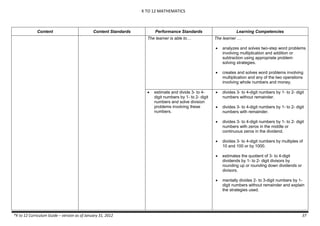
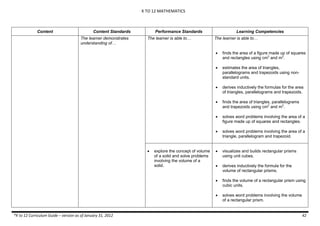
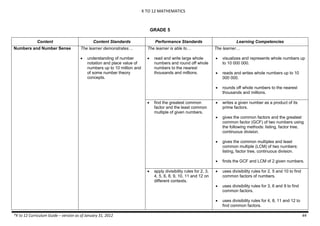
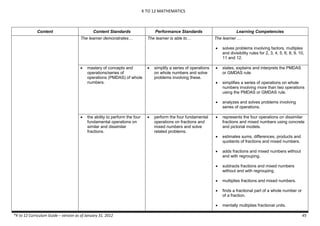
Department of Education
DepEd Complex, Meralco Avenue
Pasig City

K to 12 Curriculum Guide

MATHEMATICS
(Grade 1 to Grade 10)

January 31, 2012
K TO 12 MATHEMATICS

CONCEPTUAL FRAMEWORK

Mathematics is one subject that pervades life at any age, in any circumstance. Thus, its value goes beyond the classroom and the school.
Mathematics as a school subject, therefore, must be learned comprehensively and with much depth.
The twin goals of mathematics in the basic education levels, K-10 are Critical Thinking and Problem Solving. We adopt the definition of critical thinking
by Scriven and Paul (1987):
Critical thinking is the intellectually disciplined process of actively and skillfully conceptualizing, applying, analyzing, synthesizing, and/or evaluating
information gathered from, or generated by, observation, experience, reflection, reasoning, or communication, as a guide to belief and action.
On the other hand, we define Problem Solving in mathematics using Polya’s (1945 & 1962) definition:
Mathematical problem solving is finding a way around a difficulty, around an obstacle, and finding a solution to a problem that is unknown.
These two goals are to be achieved with an organized and rigorous curriculum content, a well-defined set of high-level skills and processes, desirable
values and attitudes, and appropriate tools, recognizing as well the different contexts of Filipino learners.
There are five content areas in the curriculum, as adopted from the framework prepared by MATHTED & SEI (2010): Numbers and Number Sense,
Measurement, Geometry, Patterns and Algebra, and Probability and Statistics.
The specific skills and processes to be developed are: Knowing and Understanding; Estimating, Computing and Solving; Visualizing and Modelling;
Representing and Communicating; Conjecturing, Reasoning, Proving and Decision-making, and: Applying and Connecting.
The following values and attitudes are to be honed as well: Accuracy, Creativity, Objectivity, Perseverance, and Productivity.
We recognize that the use of appropriate tools is needed in teaching mathematics. These include: manipulative objects, measuring devices,
calculators and computers, Smartphones and tablet PCs, and the Internet.
We define context as a locale, situation or set of conditions of Filipino learners that may influence their study and use of mathematics to develop critical
thinking and problem solving skills. Contexts refer to beliefs, environment, language and culture that include traditions and practices, and learner’s prior
knowledge and experiences.

*K to 12 Curriculum Guide – version as of January 31, 2012

2
K TO 12 MATHEMATICS

The framework is supported by the following underlying learning principles and theories: Experiential and Situated Learning, Reflective Learning,
Constructivism, Cooperative Learning and Discovery and Inquiry-based Learning. The mathematics curriculum is grounded in these theories.
Experiential learning as advocated by David Kolb is learning that occurs by making sense of direct everyday experiences. Experiential learning theory
defines learning as "the process whereby knowledge is created through the transformation of experience. Knowledge results from the combination of grasping
and transforming experience" (Kolb, 1984, p. 41). Situated learning, theorized by Lave and Wenger, is learning in the same context on which concepts and
theories are applied.
Reflective learning refers to learning that is facilitated by reflective thinking. It is not enough that learners encounter real-life situations. Deeper learning
occurs when learners are able to think about their experiences and process these allowing them the opportunity to make sense and meaning of their
experiences.
Constructivism is the theory that argues that knowledge is constructed when the learner is able to draw ideas from his own experiences and connects
them to new ideas that are encountered.
Cooperative Learning puts premium on active learning achieved by working with fellow learners as they all engage in a shared task.
The mathematics curriculum allows for students to learn by asking relevant questions and discovering new ideas. Discovery and Inquiry-based
learning (Bruner, 1961) support the idea that students learn when they make use of personal experiences to discover facts, relationships and concepts.

*K to 12 Curriculum Guide – version as of January 31, 2012

3
K TO 12 MATHEMATICS

Figure 1. The Conceptual Framework of Mathematics Education
*K to 12 Curriculum Guide – version as of January 31, 2012

4
K TO 12 MATHEMATICS

BRIEF COURSE DESCRIPTION

Mathematics from K-10 is a skills subject. By itself, it is all about quantities, shapes and figures, functions, logic and reasoning. Mathematics is also a
tool of science and a language complete with its own notations and symbols and “grammar” rules, with which concepts and ideas are effectively expressed.
The contents of mathematics include Numbers and Number Sense, Measurement, Geometry, Patterns & Algebra and Statistics and Probability.
Numbers and Number Sense as a strand includes concepts of numbers, properties, operations, estimation and their applications.
Measurement as a strand includes the use of numbers and measures to describe, understand and compare mathematical and concrete objects. It
focuses on attributes such as length, mass and weight, capacity, time, money and temperature among others, as well as applications involving perimeter,
area, surface area, volume and angle measure.
Geometry as a strand includes properties of two- and three-dimensional figures and their relationships, spatial visualization, reasoning and geometric
modeling and proofs.
Patterns and Algebra as a strand studies patterns, relationships and changes among shapes and quantities and includes the use of algebraic
notations and symbols, equations and most importantly, functions, to represent and analyze relationships.
Statistics and Probability as a strand is all about developing skills in collecting and organizing data using charts, tables and graphs, understanding,
analyzing and interpreting data, dealing with uncertainty and making predictions and outcomes.
The K to 10 Mathematics Curriculum provides a solid foundation for Mathematics at Grades 11 to 12. More importantly, it provides necessary
concepts and life skills needed by Filipino learners as they proceed to the next stage in their life as learners and as citizens of our beloved country, the
Philippines.

*K to 12 Curriculum Guide – version as of January 31, 2012

5
K TO 12 MATHEMATICS

LEARNING AREA STANDARD:

The learner demonstrates understanding and appreciation of key concepts and principles of mathematics
as applied, using appropriate technology, in problem solving, communicating, reasoning, making
connections, representations, and decisions in real life.

KEY STAGE STANDARDS:
K–3

4–6

At the end of Grade 3, the learner demonstrates
understanding and appreciation of key concepts
and skills involving whole numbers up to ten
thousand, fractions, measurement, simple
geometric figures, pre-algebra concepts and
data representation and analysis as applied,
using appropriate technology, in critical thinking,
problem solving, reasoning, communicating,
making connections, representations and
decisions in real life.

At the end of Grade 6, the learner demonstrates
understanding and appreciation of key concepts
and skills involving rational numbers,
measurement, geometric figures, pre-algebra
concepts, simple probability and data analysis as
applied, using appropriate technology, in critical
thinking, problem solving, reasoning,
communicating, making connections,
representations and decisions in real life.

*K to 12 Curriculum Guide – version as of January 31, 2012

7 – 10

At the end of grade 10, the learner
demonstrates understanding and appreciation
of key concepts and skills involving number
sense, measurement, algebra, geometry,
probability and statistics, and trigonometry as
applied, using appropriate technology, in
critical thinking, problem solving,
communicating, reasoning, making
connections, representations, and decisions in
real life.

6
K TO 12 MATHEMATICS

GRADE LEVEL STANDARDS:
Grade Level

Grade Level Standards

Grade 1

The learner demonstrates understanding and appreciation of key concepts and skills involving whole numbers up to 100, fractions,
measurement, simple geometric figures, pre-algebra concepts, data collection and representation as applied, using appropriate
technology, in critical thinking, problem solving, reasoning, communicating, making connections, representations and decision in real
life.

Grade 2

The learner demonstrates understanding and appreciation of key concepts and skills involving whole numbers up to 1 000, fractions,
measurement and geometric figures, pre-algebra concepts, data collection, representation and analysis as applied, using appropriate
technology, in critical thinking, problem solving, reasoning, communicating, making connections, representations and decision in real
life.

Grade 3

The learner demonstrates understanding and appreciation of key concepts and skills involving whole numbers up to 10 000, fractions,
measurement, geometric figures, pre-algebra concepts, data collection, representation and analysis as applied, using appropriate
technology, in critical thinking, problem solving, reasoning, communicating, making connections, representations and decision in real
life.

Grade 4

The learner demonstrates understanding and appreciation of key concepts and skills involving whole numbers up to 100 000,
fractions, decimals including money, ratio, angles, plane figures like square, rectangle, and triangle, measurement (perimeter, area of
triangle, parallelogram and trapezoids, volume of cubes and rectangular prisms, pre-algebra concepts, data collection, representation
and analysis as applied, using appropriate technology, in critical thinking, problem solving, reasoning, communicating, making
connections, representations and decisions in real life.

Grade 5

The learner demonstrates understanding and appreciation of key concepts and skills involving whole numbers up to 10 000 000,
fractions, decimals including money, ratio, percent, geometry (circles and five or more-sided polygons), measurement (circumference,
area of circle, volume of cubes and rectangular prisms, temperature) ,pre-algebra concepts, data collection, representation and
analysis as applied, using appropriate technology, in critical thinking, problem solving, reasoning, communicating, making
connections, representations and decisions in real life.

Grade 6

The learner is expected to have mastered the concepts and operations on whole numbers; demonstrates understanding and
appreciation of the key concepts and skills involving fractions, decimals including money, ratio and proportion, percent, rate, integers,
geometry (spatial figures), measurement (surface area, volume, meter reading), pre-algebra concepts, data collection, representation
and analysis, probability, expressions and equations as applied, using appropriate technology, in critical thinking, problem solving,
reasoning, communicating, making connections, representations and decisions in real life.

*K to 12 Curriculum Guide – version as of January 31, 2012

7
K TO 12 MATHEMATICS

Grade Level

Grade Level Standards

Grade 7

The learner demonstrates understanding of key concepts and principles of number sense, measurement, algebra, geometry,
probability and statistics as applied, using appropriate technology, in critical thinking, problem solving, reasoning, communicating,
making connections, representations and decisions in real life.

Grade 8

The learner demonstrates understanding of key concepts and principles of algebra, geometry, probability and statistics as applied,
using appropriate technology, in critical thinking, problem solving, reasoning, communicating, making connections, representations
and decisions in real life.

Grade 9

The learner demonstrates understanding of key concepts and principles of algebra, geometry, and trigonometry as applied, using
appropriate technology, in critical thinking, problem solving, reasoning, communicating, making connections, representations and
decisions in real life.

Grade10

The learner demonstrates understanding of key concepts and principles of number sense, algebra, geometry, probability and
statistics as applied, using appropriate technology, in critical thinking, problem solving, reasoning, communicating, making
connections, representations and decisions in real life.

*K to 12 Curriculum Guide – version as of January 31, 2012

8
K TO 12 MATHEMATICS

GRADE 1
Content

Content Standards

Performance Standards

Learning Competencies

The learner demonstrates
understanding of…

The learner is able to…

The learner…







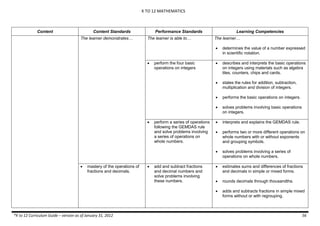
recognizes cardinal numbers from 0 to 100.



counts and tells the number of objects in a
given set by ones and tens.



identifies the number that is one more or one
less from a given number.



composes and decomposes a given number.



regroups sets of ones into sets of tens and
sets of tens into hundred using objects.



compares two sets using the expressions
“fewer than,” “more than,” and “as many as.”



orders sets from least to greatest and
viceversa.



counts by 2’s, 5’s and 10’s through 100.



reads and writes numbers up to 100 in
symbols and in words.



identifies the place value and finds the value
of a digit in a one- and two-digit numbers.




Numbers and Number Sense

renames numbers into tens and ones.
compares numbers up to 100 using relation
symbols.

number notation and place
value, cardinal and ordinal
numbers, and comparing and
ordering numbers up to 100.

*K to 12 Curriculum Guide – version as of January 31, 2012

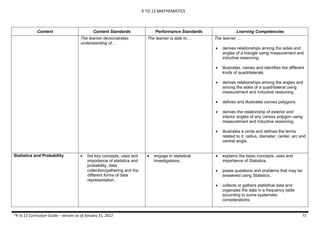
explore the concept of
cardinal numbers up to 100
and compare these numbers
in various contexts.

9
K TO 12 MATHEMATICS

Content

Content Standards
The learner demonstrates
understanding of…

Performance Standards
The learner is able to…

Learning Competencies
The learner …



*K to 12 Curriculum Guide – version as of January 31, 2012



illustrates addition as putting together and
subtraction as taking away, comparing and
adding up.
illustrates the relationship of joining sets to
addition of whole numbers.
illustrates that addition and subtraction are
inverse operations.
identifies and constructs equivalent number
expressions using addition and subtractions.



illustrate addition and
subtraction of whole numbers.

determines the position of an object using
1st to 10th from a given point of reference.





identifies the 1st, 2nd, 3rd up to the 10th
object in a given set from a given point of
reference.



addition and subtraction up to
100.

reads and writes ordinal numbers 1st, 2nd,
3rd up to 10th.









explore the concept of ordinal
numbers.

recognizes coins and bills up to P100 (pesos
and centavos).





arranges numbers up to 100 in increasing
order and vice versa.

identifies and creates patterns to compose
and decomposes numbers using addition.

10
K TO 12 MATHEMATICS

Content

Content Standards

Performance Standards

Learning Competencies

The learner is able to…

The learner …





adds two one-digit numbers with sums up to
18 using the order and zero properties of
addition.



adds two to three one-digit numbers
horizontally and vertically with sums up to
18.



adds three one-digit numbers having sums
up to 18 using the order and grouping
properties of addition.



uses expanded form to explain the meaning
of addition with regrouping.



adds numbers with sums through 99 without
or with regrouping.



mentally adds two to three 1-digit numbers
with sums up to 18.



mentally adds a 2-digit number and 1-digit
number with regrouping.



The learner demonstrates
understanding of…

solves one-step word problems involving
addition of whole numbers including money
with sums up to 99 using appropriate
problem solving strategy.



subtracts one-digit numbers with minuends
through 18 (basic facts).



*K to 12 Curriculum Guide – version as of January 31, 2012

compute for sums and solve
addition problems.

compute for differences and
solve subtraction problems.

11
K TO 12 MATHEMATICS

Content

Content Standards
The learner demonstrates
understanding of…

Performance Standards
The learner is able to…

Learning Competencies
The learner …
 subtracts one to two-digit numbers with
minuends up to 99 without regrouping.





visualizes and identifies ½ and ¼ of a whole
object.



divides a whole into halves and fourths.
divides the elements of a set of objects into
two groups of equal quantities to show
halves of sets.



*K to 12 Curriculum Guide – version as of January 31, 2012

solves word problems involving subtraction
of whole numbers including money with
minuends up to 99 with and without
regrouping using appropriate problem
solving strategy.



visualize, model and
represent the concept of
halves and fourths using
whole objects and sets.

mentally subtracts a 1-digit number from 2digit minuends without regrouping.





mentally subtracts 1-digit numbers from
minuends up to 18 without regrouping.



the concepts of halves and
fourths and applies them in
dividing a whole or set
equally.

subtracts one to two-digit numbers with
minuends up to 99 with regrouping.





uses the expanded form to explain
subtraction with regrouping.

divides the elements of a set of objects into
four groups of equal quantities to show
fourths of sets.

12
K TO 12 MATHEMATICS

Content

Content Standards
The learner demonstrates
understanding of…

Performance Standards
The learner is able to…

Learning Competencies
The learner…


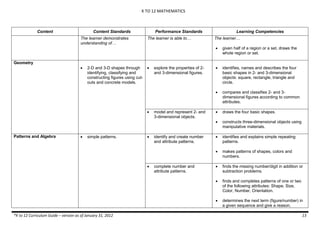
given half of a region or a set, draws the
whole region or set.



identifies, names and describes the four
basic shapes in 2- and 3-dimensional
objects: square, rectangle, triangle and
circle.



compares and classifies 2- and 3dimensional figures according to common
attributes.



draws the four basic shapes.



constructs three-dimensional objects using
manipulative materials.



identifies and explains simple repeating
patterns.



makes patterns of shapes, colors and
numbers.



finds the missing number/digit in addition or
subtraction problems.



finds and completes patterns of one or two
of the following attributes: Shape, Size,
Color, Number, Orientation.



determines the next term (figure/number) in
a given sequence and give a reason.

Geometry


2-D and 3-D shapes through
identifying, classifying and
constructing figures using cutouts and concrete models.





Patterns and Algebra



simple patterns.





*K to 12 Curriculum Guide – version as of January 31, 2012

explore the properties of 2and 3-dimensional figures.

model and represent 2- and
3-dimensional objects.

identify and create number
and attribute patterns.

complete number and
attribute patterns.

13
K TO 12 MATHEMATICS

Content

Content Standards

Performance Standards

The learner demonstrates
understanding of…

The learner is able to…



Measurement



Learning Competencies
The learner …



*K to 12 Curriculum Guide – version as of January 31, 2012





compares objects using the comparative
words: Short, shorter, shortest; Long, longer,
longest; Tall, taller, tallest; High, higher,
highest; Heavy, heavier, heaviest; Light,
lighter, lightest.
estimates and measures length using nonstandard units of linear measures.
estimates and measures mass using nonstandard units of mass/weight measures.
shows and finds capacity using nonstandard unit.



collects and organizes data using tallies and
tables.



represents data using pictographs without
using a scale.



organizing, representing and
comparing data using
pictographs without scale
representations and
probability, and explores
games and activities.

tells the time by an hour, half-hour and
quarter-hour.




uses a calendar to determine a day or
month.



Statistics and Probability

names and tells the number of days in a
week; months in a year in the right order.









the concepts of time and
measures and compares
objects using direct
comparison and non-standard
units of length, mass and
capacity.

reads and interprets a pictograph.

give different measures of
time.

estimate and compute for
measurements of length,
mass and capacity.

organize and interpret data.

14
K TO 12 MATHEMATICS

Content

Content Standards

Performance Standards

Learning Competencies

The learner is able to…


*K to 12 Curriculum Guide – version as of January 31, 2012

The learner …


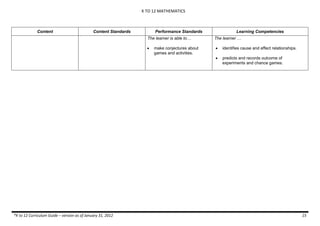
identifies cause and effect relationships.



predicts and records outcome of
experiments and chance games.

make conjectures about
games and activities.

15
K TO 12 MATHEMATICS

GRADE 2
Content

Content Standards

Performance Standards

Learning Competencies



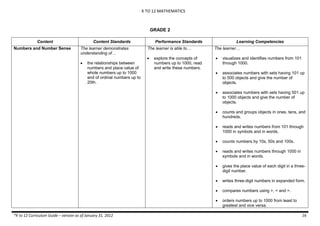
associates numbers with sets having 101 up
to 500 objects and give the number of
objects.
associates numbers with sets having 501 up
to 1000 objects and give the number of
objects.
counts and groups objects in ones, tens, and
hundreds.
reads and writes numbers from 101 through
1000 in symbols and in words.



counts numbers by 10s, 50s and 100s.



reads and writes numbers through 1000 in
symbols and in words.



gives the place value of each digit in a threedigit number.



writes three-digit numbers in expanded form.



compares numbers using >, < and =.



*K to 12 Curriculum Guide – version as of January 31, 2012

visualizes and identifies numbers from 101
through 1000.



the relationships between
numbers and place value of
whole numbers up to 1000
and of ordinal numbers up to
20th.







The learner…



The learner demonstrates
understanding of…

The learner is able to…



Numbers and Number Sense

orders numbers up to 1000 from least to
greatest and vice versa.

explore the concepts of
numbers up to 1000, read
and write these numbers.

16
K TO 12 MATHEMATICS

Content

Content Standards

Performance Standards

Learning Competencies



visualizes and identifies the 1st through the
20th object of a given set from a given point
of reference.
reads and writes ordinal numbers from 1st
through the 20th.
identifies and uses the pattern of naming
ordinal numbers from 1st to the 20th.



adds numbers with sums up to 1000 without
and with regrouping: 2 digit and 3-digit.



adds numbers with sums up to 1000 without
and with regrouping: 3 digit and 3-digit.
uses the following properties of addition in
computing for sums of up to 1000:
zero/identity property of addition,
commutative property of addition,
associative property of addition.



mentally adds 1- to 2-digit numbers with
sums up to 50.



mentally adds 3-digit numbers by ones (up
to 9).



mentally adds 3-digit numbers by tens
(multiples of 10 up to 90).



*K to 12 Curriculum Guide – version as of January 31, 2012





the concept of the four
operations of whole numbers
and the identity and zero
properties of multiplication.

The learner …




The learner is able to…



The learner demonstrates
understanding of…

mentally adds 3-digit numbers by hundreds
(multiples of 100 up to 900).



identify ordinal numbers
through 20th.

compute sums and solve
addition problems involving
numbers of up to 1000.

17
K TO 12 MATHEMATICS

Content

Content Standards
The learner demonstrates
understanding of…

Performance Standards
The learner is able to…

Learning Competencies
The learner …


*K to 12 Curriculum Guide – version as of January 31, 2012

mentally subtracts 1-digit numbers from 1 to
2-digit numbers with minuends up to 50.
mentally subtracts 3-digit by ones without
regrouping.
mentally subtracts 3-digit by tens without
regrouping.
mentally subtracts 3-digit by hundreds
without regrouping.



compute for sums and
differences and solve
problems involving both
addition and subtraction of
numbers.







subtracts 2- to 3-digit numbers with
minuends up to 999 without and with
regrouping.



compute differences and
solve subtraction problems
involving numbers of up to
1000.







analyzes and solves word problems
involving addition of whole numbers
including money with sums up to 1000
without and with regrouping.

analyzes and solves one-step word
problems involving subtraction of whole
numbers including money with minuends up
to1000 without and with regrouping.



performs order of operations involving
addition and subtraction of small numbers.



solves two-step word problems involving
addition and subtraction of 2- to 3-digit
numbers including money using appropriate
procedures.
18
K TO 12 MATHEMATICS

Content

Content Standards

Performance Standards

Learning Competencies

The learner is able to…

The learner …





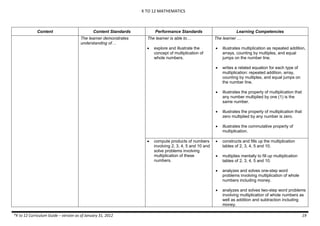
illustrates multiplication as repeated addition,
arrays, counting by multiples, and equal
jumps on the number line.



writes a related equation for each type of
multiplication: repeated addition, array,
counting by multiples, and equal jumps on
the number line.



illustrates the property of multiplication that
any number multiplied by one (1) is the
same number.



illustrates the property of multiplication that
zero multiplied by any number is zero.



illustrates the commutative property of
multiplication.



constructs and fills up the multiplication
tables of 2, 3, 4, 5 and 10.



multiplies mentally to fill up multiplication
tables of 2, 3, 4, 5 and 10.



analyzes and solves one-step word
problems involving multiplication of whole
numbers including money.



The learner demonstrates
understanding of…

analyzes and solves two-step word problems
involving multiplication of whole numbers as
well as addition and subtraction including
money.



*K to 12 Curriculum Guide – version as of January 31, 2012

explore and illustrate the
concept of multiplication of
whole numbers.

compute products of numbers
involving 2, 3, 4, 5 and 10 and
solve problems involving
multiplication of these
numbers.

19
K TO 12 MATHEMATICS

Content

Content Standards

Performance Standards

Learning Competencies

The learner is able to…

The learner …





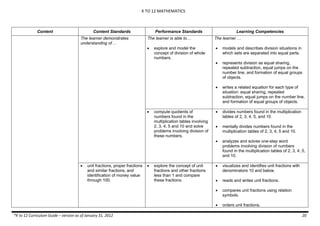
models and describes division situations in
which sets are separated into equal parts.



represents division as equal sharing,
repeated subtraction, equal jumps on the
number line, and formation of equal groups
of objects.



writes a related equation for each type of
situation: equal sharing, repeated
subtraction, equal jumps on the number line,
and formation of equal groups of objects.



divides numbers found in the multiplication
tables of 2, 3, 4, 5, and 10.



mentally divides numbers found in the
multiplication tables of 2, 3, 4, 5 and 10.



analyzes and solves one-step word
problems involving division of numbers
found in the multiplication tables of 2, 3, 4, 5,
and 10.



visualizes and identifies unit fractions with
denominators 10 and below.



reads and writes unit fractions.



compares unit fractions using relation
symbols.



The learner demonstrates
understanding of…

orders unit fractions.





unit fractions, proper fractions
and similar fractions, and
identification of money value
through 100.

*K to 12 Curriculum Guide – version as of January 31, 2012



explore and model the
concept of division of whole
numbers.

compute quotients of
numbers found in the
multiplication tables involving
2, 3, 4, 5 and 10 and solve
problems involving division of
these numbers.

explore the concept of unit
fractions and other fractions
less than 1 and compare
these fractions.

20
K TO 12 MATHEMATICS

Content

Content Standards
The learner demonstrates
understanding of…

Performance Standards
The learner is able to…

Learning Competencies
The learner …



reads and writes similar fractions.



apply number concepts on
problem situations involving
money.

visualizes and identifies similar fractions
(using group of objects and number line).





visualizes and identifies other fractions less
than one with denominators 10 and below.

compares similar fractions using relation
symbols.
orders similar fractions.
reads and writes money with value through
100.




counts and tells the value of a set of bills or
a set of coins through 100 in peso ( coins
only, bills only and coins and bills).



counts and tells the value of a set of bills or
a set of coins through 100 in centavo (coins).



counts and tells the value of a set of bills or
a set of coins through 100 in combinations of
pesos and centavos (Peso and centavo
coins only, bills and centavo coins, coins and
bills).



reads and writes money in symbols and in
words through 100.



*K to 12 Curriculum Guide – version as of January 31, 2012



compares values of different denominations
of coins and paper bills through 100 using
relation symbols >, < and =.
21
K TO 12 MATHEMATICS

Content

Content Standards

Performance Standards

Learning Competencies

The learner demonstrates
understanding of…

The learner is able to…

The learner …





visualize and model halfcircles and quarter circles as
well as other common
shapes.



visualizes, identifies, classifies and
describes half-circles and quarter circles.



constructs squares, rectangles, triangle,
circles, half-circles and quarter circles using
cut-outs and square grids.

explore the concept of
symmetry.



identifies shapes/figures that show symmetry
in a line.



creates figures that show symmetry in a line.



recognizes shapes that can tessellate.



tessellates a surface using triangles and
squares.



identifies straight lines and curves, flat and
curved surfaces in a 3-dimenional object.



explains the differences between straight
lines and curved lines, flat surfaces and
curved surfaces.



identifies and explains simple repeating
patterns.



Geometry

determines the next term (figure/number) in
a given sequence and give a reason.

the basic properties of
geometric shapes, simple
tessellations and symmetry.







Patterns and Algebra



patterns on numbers and
geometric objects.

*K to 12 Curriculum Guide – version as of January 31, 2012



visualize, model and
represent tessellations.

explore the concept of lines,
curves and surface on 3dimensional objects.

argue and justify patterns.

22
K TO 12 MATHEMATICS

Content

Content Standards

Performance Standards

Learning Competencies

apply their understanding and
strategies in completing
patterns.



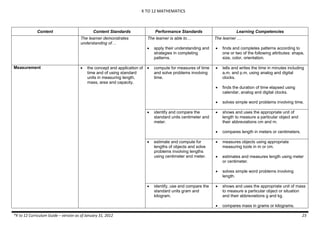
finds and completes patterns according to
one or two of the following attributes: shape,
size, color, orientation.



compute for measures of time
and solve problems involving
time.



tells and writes the time in minutes including
a.m. and p.m. using analog and digital
clocks.



finds the duration of time elapsed using
calendar, analog and digital clocks.
solves simple word problems involving time.



shows and uses the appropriate unit of
length to measure a particular object and
their abbreviations cm and m.
compares length in meters or centimeters.



measures objects using appropriate
measuring tools in m or cm.



estimates and measures length using meter
or centimeter.
solves simple word problems involving
length.



shows and uses the appropriate unit of mass
to measure a particular object or situation
and their abbreviations g and kg.



the concept and application of
time and of using standard
units in measuring length,
mass, area and capacity.







The learner …



Measurement

The learner is able to…



The learner demonstrates
understanding of…

compares mass in grams or kilograms.







*K to 12 Curriculum Guide – version as of January 31, 2012

identify and compare the
standard units centimeter and
meter.

estimate and compute for
lengths of objects and solve
problems involving lengths
using centimeter and meter.

identify, use and compare the
standard units gram and
kilogram.

23
K TO 12 MATHEMATICS

Content

Content Standards

Performance Standards

Learning Competencies

The learner is able to…

The learner …





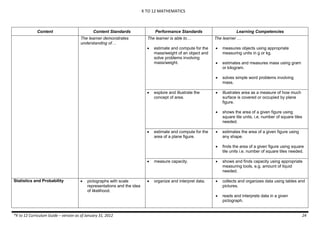
measures objects using appropriate
measuring units in g or kg.



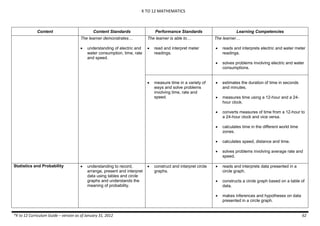
estimates and measures mass using gram
or kilogram.



solves simple word problems involving
mass.



illustrates area as a measure of how much
surface is covered or occupied by plane
figure.



shows the area of a given figure using
square tile units, i.e. number of square tiles
needed.



estimates the area of a given figure using
any shape.



The learner demonstrates
understanding of…

finds the area of a given figure using square
tile units i.e. number of square tiles needed.





estimate and compute for the
mass/weight of an object and
solve problems involving
mass/weight.

explore and illustrate the
concept of area.

estimate and compute for the
area of a plane figure.





pictographs with scale
representations and the idea
of likelihood.

*K to 12 Curriculum Guide – version as of January 31, 2012



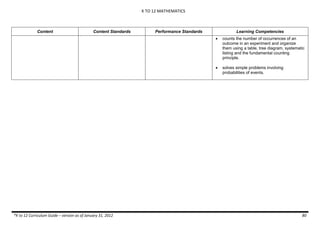
shows and finds capacity using appropriate
measuring tools, e.g. amount of liquid
needed.



organize and interpret data.



collects and organizes data using tables and
pictures.



Statistics and Probability

measure capacity.

reads and interprets data in a given
pictograph.

24
K TO 12 MATHEMATICS

Content

Content Standards

Performance Standards

Learning Competencies

The learner is able to…

The learner …





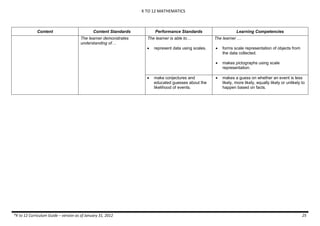
forms scale representation of objects from
the data collected.



The learner demonstrates
understanding of…

makes pictographs using scale
representation.



makes a guess on whether an event is less
likely, more likely, equally likely or unlikely to
happen based on facts.



*K to 12 Curriculum Guide – version as of January 31, 2012

represent data using scales.

make conjectures and
educated guesses about the
likelihood of events.

25
K TO 12 MATHEMATICS

GRADE 3
Content

Content Standards

Performance Standards

Learning Competencies

The learner demonstrates
understanding of…

The learner is able to…

The learner …







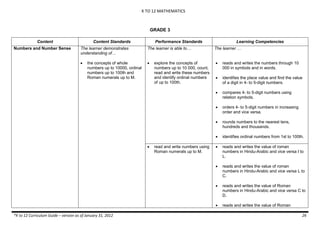
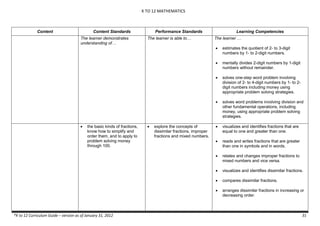
reads and writes the numbers through 10
000 in symbols and in words.



identifies the place value and find the value
of a digit in 4- to 5-digit numbers.



compares 4- to 5-digit numbers using
relation symbols.



orders 4- to 5-digit numbers in increasing
order and vice versa.



rounds numbers to the nearest tens,
hundreds and thousands.



identifies ordinal numbers from 1st to 100th.



reads and writes the value of roman
numbers in Hindu-Arabic and vice versa I to
L.



reads and writes the value of roman
numbers in Hindu-Arabic and vice versa L to
C.



reads and writes the value of Roman
numbers in Hindu-Arabic and vice versa C to
D.



Numbers and Number Sense

reads and writes the value of Roman

the concepts of whole
numbers up to 10000, ordinal
numbers up to 100th and
Roman numerals up to M.



*K to 12 Curriculum Guide – version as of January 31, 2012

explore the concepts of
numbers up to 10 000, count,
read and write these numbers
and identify ordinal numbers
of up to 100th.

read and write numbers using
Roman numerals up to M.

26
K TO 12 MATHEMATICS

Content

Content Standards

Performance Standards

Learning Competencies
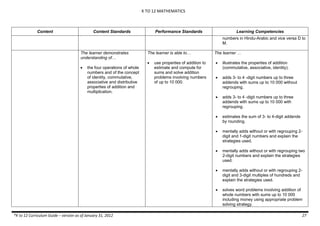
numbers in Hindu-Arabic and vice versa D to
M.

illustrates the properties of addition
(commutative, associative, identity).



adds 3- to 4 -digit numbers up to three
addends with sums up to 10 000 without
regrouping.
adds 3- to 4 -digit numbers up to three
addends with sums up to 10 000 with
regrouping.
estimates the sum of 3- to 4-digit addends
by rounding.



mentally adds without or with regrouping 2digit and 1-digit numbers and explain the
strategies used.



mentally adds without or with regrouping two
2-digit numbers and explain the strategies
used.



mentally adds without or with regrouping 2digit and 3-digit multiples of hundreds and
explain the strategies used.



*K to 12 Curriculum Guide – version as of January 31, 2012





the four operations of whole
numbers and of the concept
of identity, commutative,
associative and distributive
properties of addition and
multiplication.

The learner …





The learner is able to…


The learner demonstrates
understanding of…

solves word problems involving addition of
whole numbers with sums up to 10 000
including money using appropriate problem
solving strategy.

use properties of addition to
estimate and compute for
sums and solve addition
problems involving numbers
of up to 10 000.

27
K TO 12 MATHEMATICS

Content

Content Standards

Performance Standards

Learning Competencies
The learner…





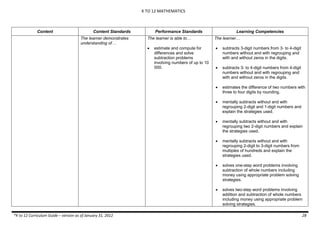
subtracts 3-digit numbers from 3- to 4-digit
numbers without and with regrouping and
with and without zeros in the digits.



subtracts 3- to 4-digit numbers from 4-digit
numbers without and with regrouping and
with and without zeros in the digits.
estimates the difference of two numbers with
three to four digits by rounding.



mentally subtracts without and with
regrouping 2-digit and 1-digit numbers and
explain the strategies used.



mentally subtracts without and with
regrouping two 2-digit numbers and explain
the strategies used.



mentally subtracts without and with
regrouping 2-digit to 3-digit numbers from
multiples of hundreds and explain the
strategies used.



solves one-step word problems involving
subtraction of whole numbers including
money using appropriate problem solving
strategies.



*K to 12 Curriculum Guide – version as of January 31, 2012

The learner is able to…



The learner demonstrates
understanding of…

solves two-step word problems involving
addition and subtraction of whole numbers
including money using appropriate problem
solving strategies.

estimate and compute for
differences and solve
subtraction problems
involving numbers of up to 10
000.

28
K TO 12 MATHEMATICS

Content

Content Standards

Performance Standards

Learning Competencies
The learner …





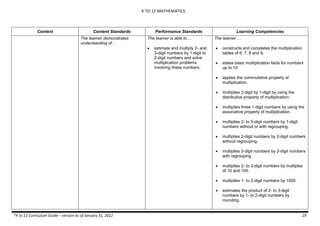
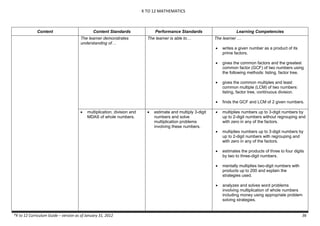
constructs and completes the multiplication
tables of 6, 7, 8 and 9.



states basic multiplication facts for numbers
up to 10.
applies the commutative property of
multiplication.



multiplies 2-digit by 1-digit by using the
distributive property of multiplication.



multiplies three 1-digit numbers by using the
associative property of multiplication.



multiplies 2- to 3-digit numbers by 1-digit
numbers without or with regrouping.



multiplies 2-digit numbers by 2-digit numbers
without regrouping.



multiplies 2-digit numbers by 2-digit numbers
with regrouping.



multiplies 2- to 3-digit numbers by multiples
of 10 and 100.



multiplies 1- to 2-digit numbers by 1000.



*K to 12 Curriculum Guide – version as of January 31, 2012

The learner is able to…



The learner demonstrates
understanding of…

estimates the product of 2- to 3-digit
numbers by 1- to 2-digit numbers by
rounding.

estimate and multiply 2- and
3-digit numbers by 1-digit to
2-digit numbers and solve
multiplication problems
involving these numbers.

29
K TO 12 MATHEMATICS

Content

Content Standards
The learner demonstrates
understanding of…

Performance Standards
The learner is able to…

Learning Competencies
The learner …




differentiates prime and composite numbers.



divides numbers found in the multiplication
tables of 6, 7, 8, 9.



states basic division facts of numbers up to
10.
divides 2- to 3-digit numbers by 1-digit
numbers without remainder.
divides 2- to 3-digit numbers by 1-digit
numbers with remainder.



divides 2-digit numbers by 2-digit numbers.


*K to 12 Curriculum Guide – version as of January 31, 2012

states multiples of 1- to 2-digit numbers.



estimate and divide 3-digit
numbers by up to 2-digit
numbers and solve division
problems involving these
numbers.







solves two-step word problems involving
multiplication as well as addition and
subtraction including money using
appropriate problem solving strategies.



explore the concepts of
factors and multiples.

solves one-step word problems involving
multiplication of whole numbers including
money using appropriate problem solving
strategies.





mentally multiplies 2-digit by 1-digit numbers
without regrouping involving products of up
to 100.

divides numbers by 10 and 100.
30
K TO 12 MATHEMATICS

Content

Content Standards
The learner demonstrates
understanding of…

Performance Standards
The learner is able to…

Learning Competencies
The learner …



visualizes and identifies fractions that are
equal to one and greater than one.



reads and writes fractions that are greater
than one in symbols and in words.
relates and changes improper fractions to
mixed numbers and vice versa.



visualizes and identifies dissimilar fractions.



compares dissimilar fractions.



*K to 12 Curriculum Guide – version as of January 31, 2012

solves word problems involving division and
other fundamental operations, including
money, using appropriate problem solving
strategies.



explore the concepts of
dissimilar fractions, improper
fractions and mixed numbers.

solves one-step word problem involving
division of 2- to 4-digit numbers by 1- to 2digit numbers including money using
appropriate problem solving strategies.





mentally divides 2-digit numbers by 1-digit
numbers without remainder.



the basic kinds of fractions,
know how to simplify and
order them, and to apply to
problem solving money
through 100.

estimates the quotient of 2- to 3-digit
numbers by 1- to 2-digit numbers.







arranges dissimilar fractions in increasing or
decreasing order.

31
K TO 12 MATHEMATICS

Content

Content Standards
The learner demonstrates
understanding of…

Performance Standards
The learner is able to…

Learning Competencies
The learner…





*K to 12 Curriculum Guide – version as of January 31, 2012

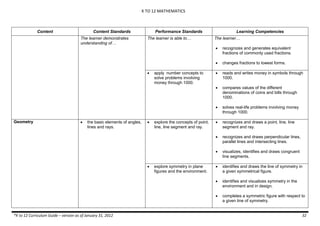
explore the concepts of point,
line, line segment and ray.

explore symmetry in plane
figures and the environment.

compares values of the different
denominations of coins and bills through
1000.
solves real-life problems involving money
through 1000.



recognizes and draws a point, line, line
segment and ray.
recognizes and draws perpendicular lines,
parallel lines and intersecting lines.
visualizes, identifies and draws congruent
line segments.



identifies and draws the line of symmetry in
a given symmetrical figure.
identifies and visualizes symmetry in the
environment and in design.









the basic elements of angles,
lines and rays.

reads and writes money in symbols through
1000.









Geometry

apply number concepts to
solve problems involving
money through 1000.

changes fractions to lowest forms.





recognizes and generates equivalent
fractions of commonly used fractions.

completes a symmetric figure with respect to
a given line of symmetry.

32
K TO 12 MATHEMATICS

Content

Content Standards
The learner demonstrates
understanding of…

Patterns and Algebra



patterns of numbers,
operations, geometric objects
and relationships.

Performance Standards
The learner is able to…

Learning Competencies
The learner …




explore the concept of odd
and even numbers.



tessellates the plane using triangles,
squares and other shapes that can
tessellate.
tells when a number is odd or even.







convert time measures from
one unit to another.

recognize, perform and use
conversions of common units.



converts time measure from seconds to
minutes, minutes to hours, hours to day.
converts time measure from days to weeks
and months, and convert weeks, months and
years to days.
finds the exact time between dates.



the concept and application of
time (in minutes), length,
mass, area and capacity.

finds the missing number or digit in a
pattern.





determines the pattern of a given sequence
and state the rule.



Measurement

identify the rule for a pattern
and complete the number
pattern.






finds the pattern using odd and even
numbers with objects, pictures and words.

solves word problems involving time
measure.
converts common units of measure from
larger unit to smaller unit and vice versa:
meter and centimeter, kilogram and gram,
liter and milliliter.





*K to 12 Curriculum Guide – version as of January 31, 2012

solves word problems involving conversions
of common units of measure.

33
K TO 12 MATHEMATICS

Content

Content Standards

Performance Standards

Learning Competencies

The learner is able to…

The learner …





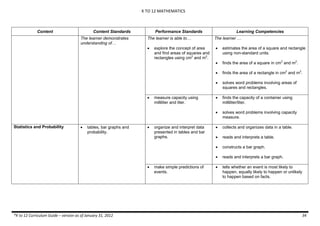
estimates the area of a square and rectangle
using non-standard units.



finds the area of a square in cm2 and m2.



finds the area of a rectangle in cm2 and m2.



solves word problems involving areas of
squares and rectangles.



finds the capacity of a container using
milliliter/liter.



solves word problems involving capacity
measure.



collects and organizes data in a table.



reads and interprets a table.



constructs a bar graph.



The learner demonstrates
understanding of…

reads and interprets a bar graph.



tells whether an event is most likely to
happen, equally likely to happen or unlikely
to happen based on facts.



Statistics and Probability



tables, bar graphs and
probability.





*K to 12 Curriculum Guide – version as of January 31, 2012

explore the concept of area
and find areas of squares and
rectangles using cm2 and m2.

measure capacity using
milliliter and liter.

organize and interpret data
presented in tables and bar
graphs.

make simple predictions of
events.

34
K TO 12 MATHEMATICS

GRADE 4
Content

Content Standards

Performance Standards

Learning Competencies

The learner demonstrates
understanding of…

The learner is able to…

The learner…







reads and writes numbers through hundred
thousands in symbols and in words.



identifies numbers up to 100 000.



gives the place value of each digit in a sixdigit number.



reads and writes numbers up to hundred
thousands in symbols and in words.



compares numbers up to hundred
thousands.



arranges numbers up to hundred thousands.



identifies factors of a given number up to
100.



identifies the multiples of a given number up
to 100.



Numbers and Number Sense

makes conjectures about common factors of
numbers.



differentiates prime numbers from composite
numbers.



finds the prime factors of a number.

number notation and place
value of numbers up to
100000, and of factors and
multiples of numbers up to
100, and of the greatest
common factor and least
common multiple.





*K to 12 Curriculum Guide – version as of January 31, 2012

read, write, compare and
arrange numbers through 100
000 and round off numbers to
the nearest thousands and
ten thousands.

investigate the concepts of
factors and multiples.

find the greatest common
factor and the least common
multiple of given numbers.

35
K TO 12 MATHEMATICS

Content

Content Standards
The learner demonstrates
understanding of…

Performance Standards
The learner is able to…

Learning Competencies
The learner …



multiplies numbers up to 3-digit numbers by
up to 2-digit numbers without regrouping and
with zero in any of the factors.



multiplies numbers up to 3-digit numbers by
up to 2-digit numbers with regrouping and
with zero in any of the factors.
estimates the products of three to four digits
by two to three-digit numbers.



mentally multiplies two-digit numbers with
products up to 200 and explain the
strategies used.



*K to 12 Curriculum Guide – version as of January 31, 2012

finds the GCF and LCM of 2 given numbers.



estimate and multiply 3-digit
numbers and solve
multiplication problems
involving these numbers.

gives the common multiples and least
common multiple (LCM) of two numbers:
listing, factor tree, continuous division.




gives the common factors and the greatest
common factor (GCF) of two numbers using
the following methods: listing, factor tree.



multiplication, division and
MDAS of whole numbers.

writes a given number as a product of its
prime factors.







analyzes and solves word problems
involving multiplication of whole numbers
including money using appropriate problem
solving strategies.

36
K TO 12 MATHEMATICS

Content

Content Standards

Performance Standards
The learner is able to…

Learning Competencies
The learner …




divides 3- to 4-digit numbers by 1- to 2- digit
numbers without remainder.



divides 3- to 4-digit numbers by 1- to 2- digit
numbers with remainder.
divides 3- to 4-digit numbers by 1- to 2- digit
numbers with zeros in the middle or
continuous zeros in the dividend.
divides 3- to 4-digit numbers by multiples of
10 and 100 or by 1000.



estimates the quotient of 3- to 4-digit
dividends by 1- to 2- digit divisors by
rounding up or rounding down dividends or
divisors.



*K to 12 Curriculum Guide – version as of January 31, 2012





estimate and divide 3- to 4digit numbers by 1- to 2- digit
numbers and solve division
problems involving these
numbers.

creates and solves word problems involving
multiplication and any of the two operations
involving whole numbers and money.





analyzes and solves two-step word problems
involving multiplication and addition or
subtraction using appropriate problem
solving strategies.

mentally divides 2- to 3-digit numbers by 1digit numbers without remainder and explain
the strategies used.

37
K TO 12 MATHEMATICS

Content

Content Standards
The learner demonstrates
understanding of…

Performance Standards
The learner is able to…

Learning Competencies
The learner …




a fraction as part of a set of
objects, as a number, as
division, and of the different
kinds of fractions and applies
them in real-life situations.





*K to 12 Curriculum Guide – version as of January 31, 2012

identify fractions on a number
line and investigate fractions
as part of a set of objects.

compare and arrange similar
and dissimilar fractions.



interprets and explains MDAS correctly.
performs a series of two or more operations.



illustrates fractions using regions, sets and
the number line.



divides sets of objects into smaller sets of
equal amounts to recognize and identify
fractional parts of a set.



identifies similar and dissimilar fractions from
a given set of fractions.





creates and solves 1- to 2- step word
problems involving multiplication and any
other operations involving whole numbers
and money.



perform series of operations
following the MDAS rule.

analyzes and solves 2- to 3-step word
problems involving division and any one or
two of the other fundamental operations
including money using appropriate problem
solving strategies.





analyzes and solves one-step word
problems involving division of 3- to 4-digit
numbers by 1- to 2- digit numbers including
money using appropriate problem solving
strategies.

compares and arranges similar fractions
from least to greatest and vice versa.
38
K TO 12 MATHEMATICS

Content

Content Standards
The learner demonstrates
understanding of…

Performance Standards
The learner is able to…

Learning Competencies
The learner …


Geometry



parallel and perpendicular
lines, measures of angles,
symmetry, plane figures up to
4 sides, and 2-D
representation of a 3-D solid.

*K to 12 Curriculum Guide – version as of January 31, 2012



add and subtract fractions
and solve problems involving
addition and subtraction of
fractions.

investigate the concepts of
parallel and perpendicular
lines and angles.



visualizes and adds similar fractions.



visualizes and subtracts similar fractions.
visualizes and subtracts a fraction from a
whole number.
adds and subtracts dissimilar fractions.





converts one (1) to a fraction and vice versa.



operation of fractions.

changes improper fraction to mixed numbers
and vice versa.





identifies proper fraction/ improper
fraction/mixed numbers from a given set of
fractions including those with denominators
of 10 and 100.



convert improper fractions to
mixed numbers and vice
versa.







compares and arranges dissimilar fractions
from least to greatest and vice versa.

solves word problems involving addition and
subtraction of fractions using appropriate
problem solving strategies.



describes and illustrates different angles
(right, acute and obtuse) using models.



draws perpendicular and parallel lines using
a ruler and set squares.

39
K TO 12 MATHEMATICS

Content

Content Standards
The learner demonstrates
understanding of…

Performance Standards
The learner is able to…

Learning Competencies
The learner is able to…




uses concrete objects/ models to
explore/describe plane figures according to
their attributes/properties of triangles and
quadrilaterals.
identifies and describes the different kinds of
triangles: acute, right, obtuse, scalene,
isosceles, equilateral, equiangular.
identifies and describes the different kinds of
quadrilaterals: square, rectangle,
parallelogram, trapezoid, rhombus.



identifies and visualizes symmetry in the
environment and in design.



*K to 12 Curriculum Guide – version as of January 31, 2012





explore symmetry in plane
figures and the environment.

identifies parallel and perpendicular lines
and use these terms to describe geometric
figures.





describes and illustrates parallel and
perpendicular lines.



describe various plane figures
up to four sides and discuss
their properties.

draws a given angle using a protractor.





identifies parts of an angle and name angles
using notation such as ABC , x , and 2
in plane figures.

completes a symmetric figure with respect to
a given line of symmetry.

40
K TO 12 MATHEMATICS

Content

Content Standards
The learner demonstrates
understanding of…

Patterns and Algebra



patterns and number
sentences.

Performance Standards

Learning Competencies

The learner is able to…

The learner is able to…





visualizes and describes geometric solids.



makes models of different geometric solids:
cube, prism, cylinder.



searches for a pattern given a set of objects
or figures.



determines the next object or term or figure
from a given pattern.



explore different geometric
solids.

describe the rule in a pattern
in order to complete the
pattern.



measures of perimeter and
area of squares, rectangles,
triangles, parallelograms and
trapezoids, and their related
figures, and volume of
rectangular prism.

finds the missing value in a number
sentence involving one of the four
operations of whole numbers.



find the perimeter of a plane
figure and solve problems
involving perimeter.



describes and illustrates the perimeter of a
given figure.



finds the perimeter of triangles, squares,
rectangles, parallelograms and trapezoids.
solves word problems involving perimeter of
squares and rectangles, triangles,
parallelograms and trapezoids.



estimates the area of an irregular plane
figure made up of squares and rectangles
using non-standard units.









Measurement

complete number sentences.

derives inductively the formulas for the area
of squares and rectangles.



*K to 12 Curriculum Guide – version as of January 31, 2012

find the area of a plane figure
and solve problems involving
area.

41
K TO 12 MATHEMATICS

Content

Content Standards
The learner demonstrates
understanding of…

Performance Standards
The learner is able to…

Learning Competencies
The learner is able to…



finds the area of triangles, parallelograms
and trapezoids using cm2 and m2.



solves word problems involving the area of a
figure made up of squares and rectangles.



solves word problems involving the area of a
triangle, parallelogram and trapezoid.



visualizes and builds rectangular prisms
using unit cubes.



derives inductively the formula for the
volume of rectangular prisms.



finds the volume of a rectangular prism using
cubic units.



*K to 12 Curriculum Guide – version as of January 31, 2012

derives inductively the formulas for the area
of triangles, parallelograms and trapezoids.



explore the concept of volume
of a solid and solve problems
involving the volume of a
solid.

estimates the area of triangles,
parallelograms and trapezoids using nonstandard units.





finds the area of a figure made up of squares
and rectangles using cm2 and m2.

solves word problems involving the volume
of a rectangular prism.

42
K TO 12 MATHEMATICS

Content

Content Standards

Performance Standards

Learning Competencies

The learner demonstrates
understanding of…

The learner is able to…

The learner is able to…







organizes data in tables.



constructs bar graphs and organize data
using bar graphs.



reads and interprets data presented in tables
and bar graphs.



solves problems using data presented in bar
graphs and tables.



gathers and records favorable outcomes
from an activity with different results (e.g.,
rolling a die, drawing a card, tossing coins,
etc.).



Statistics and Probability

analyzes the chance of a result using
spinners.

tables, bar graphs and
probability.



*K to 12 Curriculum Guide – version as of January 31, 2012

solve problems involving data
presented in bar graphs and
tables.

make simple predictions of
events based on data
records.

43
K TO 12 MATHEMATICS

GRADE 5
Content

Content Standards

Performance Standards

Learning Competencies

The learner demonstrates…

The learner is able to…

The learner…







visualizes and represents whole numbers up
to 10 000 000.



reads and writes whole numbers up to 10
000 000.



rounds off whole numbers to the nearest
thousands and millions.



writes a given number as a product of its
prime factors.



gives the common factors and the greatest
common factor (GCF) of two numbers using
the following methods: listing, factor tree,
continuous division.



gives the common multiples and least
common multiple (LCM) of two numbers:
listing, factor tree, continuous division.



finds the GCF and LCM of 2 given numbers.



uses divisibility rules for 2, 5 and 10 to find
common factors of numbers.



uses divisibility rules for 3, 6 and 9 to find
common factors.



Numbers and Number Sense

uses divisibility rules for 4, 8, 11 and 12 to
find common factors.

understanding of number
notation and place value of
numbers up to 10 million and
of some number theory
concepts.





*K to 12 Curriculum Guide – version as of January 31, 2012

read and write large whole
numbers and round off whole
numbers to the nearest
thousands and millions.

find the greatest common
factor and the least common
multiple of given numbers.

apply divisibility rules for 2, 3,
4, 5, 6, 8, 9, 10, 11 and 12 on
different contexts.

44
K TO 12 MATHEMATICS

Content

Content Standards
The learner demonstrates…

Performance Standards
The learner is able to…

Learning Competencies
The learner …


represents the four operations on dissimilar
fractions and mixed numbers using concrete
and pictorial models.
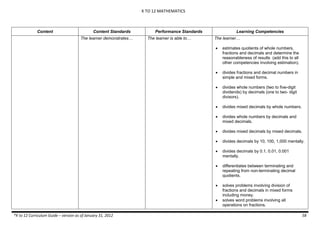
estimates sums, differences, products and
quotients of fractions and mixed numbers.
adds fractions and mixed numbers without
and with regrouping.
subtracts fractions and mixed numbers
without and with regrouping.
multiplies fractions and mixed numbers.



finds a fractional part of a whole number or
of a fraction.


*K to 12 Curriculum Guide – version as of January 31, 2012





perform the four fundamental
operations on fractions and
mixed numbers and solve
related problems.

analyzes and solves problems involving
series of operations.





simplify a series of operations
on whole numbers and solve
problems involving these.

simplifies a series of operations on whole
numbers involving more than two operations
using the PMDAS or GMDAS rule.



the ability to perform the four
fundamental operations on
similar and dissimilar
fractions.





states, explains and interprets the PMDAS
or GMDAS rule.





mastery of concepts and
operations/series of
operations (PMDAS) of whole
numbers.







solves problems involving factors, multiples
and divisibility rules for 2, 3, 4, 5, 6, 8, 9, 10,
11 and 12.

mentally multiplies fractional units.
45
K TO 12 MATHEMATICS

Content

Content Standards
The learner demonstrates…

Performance Standards
The learner is able to…

Learning Competencies
The learner …



*K to 12 Curriculum Guide – version as of January 31, 2012

explore, know and
understand the concept and
value of a decimal number.



visualizes decimal numbers using models
like blocks, grid, number line and money.
visualizes decimal numbers using
models/pictures to show the relationship to
fractions.
reads and writes common fractions in
decimal form through thousandths.
renames decimal numbers to fractions with
denominators of 10, 100, 1000,10000.



gives the place value of each digit of a given
decimal through thousandths.





uses models to illustrate fractions as division
of two numbers.



investigate the relationship
between fractions and
decimal numbers.







solves problems involving addition,
subtraction, multiplication and division of
fractions and mixed numbers using the
appropriate strategies.



understanding of the concept
of decimals, and addition and
subtraction of decimals up to
hundredths.

simplifies fractions and mixed numbers to
their lowest terms.





divides fractions and mixed numbers.

reads and writes decimal numbers through
thousandths.

46
K TO 12 MATHEMATICS

Content

Content Standards
The learner demonstrates…

Performance Standards
The learner is able to…

Learning Competencies
The learner …



adds and subtracts decimals through
thousandths without and with regrouping.
adds and subtracts mixed decimals without
and with regrouping.
analyzes and solves word problems,
including money problems, involving addition
and subtraction of decimal numbers.



represents multiplication of decimal numbers
using pictorial models.



estimates the products of decimal numbers.
multiplies decimal numbers by multiples of
10 and 100.
multiplies decimal numbers of values up to
hundredths.



*K to 12 Curriculum Guide – version as of January 31, 2012





multiply decimal numbers of
values up to the hundredths
and solve problems involving
these numbers.

estimates the sum or difference of decimal
numbers.









add and subtract decimal
numbers with values through
thousandths and solve
problems involving these.

compares and arranges decimal numbers
from least to greatest and vice versa.





rounds decimals to the nearest tenths and
hundredths.

multiplies mixed decimals with tenths and
hundredths by whole numbers.

47
K TO 12 MATHEMATICS

Content

Content Standards
The learner demonstrates…

Performance Standards
The learner is able to…

Learning Competencies
The learner …



*K to 12 Curriculum Guide – version as of January 31, 2012

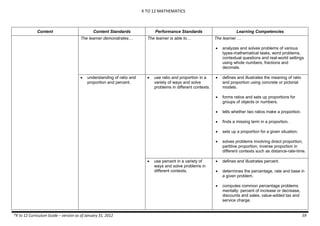
manipulate ratios and solve
problems involving ratios and
proportions



estimates the quotients of decimal numbers.
divides decimal numbers of values up to the
hundredths.
divides decimal numbers by whole numbers.
analyzes and solves problems of various
types using whole numbers, fractions and
decimals.



visualizes the ratio of two given sets of
objects.



expresses the ratio of two numbers using
either the colon (:) or a fraction.





represents division of decimal numbers
using pictorial models.



understanding on the use of
ratio, proportion and percent.







analyzes and solves word problems
involving multiplication of decimals including
money.



divide decimal numbers of
values up to the hundredths
and solve problems involving
these numbers.

multiplies decimals mentally by 0.1, 0.01, 10
and 100.





multiplies mixed decimals by mixed decimals
with tenths and hundredths.

expresses one value as a fraction of another
given their ratio and vice versa.

48
K TO 12 MATHEMATICS

Content

Content Standards
The learner demonstrates…

Performance Standards
The learner is able to…

Learning Competencies
The learner …



finds the missing term in a pair of equivalent
ratios.



defines and describes a proportion.



recognizes when two quantities are in direct
proportion.



solves problems involving ratio and direct
proportion.



uses models to illustrate the concept of
percent and its relationship to fractions,
ratios and decimal numbers.



gives the relationship among fractions, ratios
and percents, between percent and a
decimal number, among fractions, ratios,
decimal numbers and percents.



defines the following: percentage, rate or
percent, base.



*K to 12 Curriculum Guide – version as of January 31, 2012

expresses ratios in their simplest forms.



know and understand the
concept of percent and to
solve problems involving
percents.

identifies and writes equivalent ratios.





finds how many times one value is as large
as another given their ratio and vice versa.

identifies the base percentage and rate in a
problem.

49
K TO 12 MATHEMATICS

Content

Content Standards

Performance Standards

Learning Competencies



finds the percentage in a given problem.
analyzes and solves problems involving
percents.

The learner demonstrates…

The learner is able to…

The learner…







describes, models and draws polygons.



names polygons with 5 or more sides.



describes and compares properties of
polygons.



represents congruent polygons using
models.



identifies and describes congruent polygons.

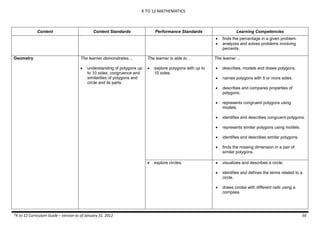


represents similar polygons using models.



identifies and describes similar polygons.



finds the missing dimension in a pair of
similar polygons.



visualizes and describes a circle.



identifies and defines the terms related to a
circle.



Geometry

draws circles with different radii using a
compass.

understanding of polygons up
to 10 sides, congruence and
similarities of polygons and
circle and its parts.



*K to 12 Curriculum Guide – version as of January 31, 2012

explore polygons with up to
10 sides.

explore circles.

50
K TO 12 MATHEMATICS

Content

Content Standards

Performance Standards

Learning Competencies

The learner is able to…

The learner …





uses models to illustrate mathematical
sentences.



determines the patterns in completing
mathematical sentences.



uses patterns to solve for the unknown in
simple equations involving one or more
operation on whole numbers and fractions.



represents and describes the circumference
of a circle.



uses a model to estimate the circumference
of a circle.



derives a formula for finding the
circumference of a circle.



finds the circumference of the given circle
using the formula/s derived.



solves problems involving circumference.



estimates and uses appropriate units of
measure for area.



converts sq cm to sq m and vice versa.



Measurement

The learner demonstrates…


Patterns and Algebra

names the appropriate unit of measure used
for measuring area for accuracy.
estimates and uses appropriate units of
measure for volume.



understanding of simple
equations.

understanding on
measurement in metric units
to approximate measure and
to compute for the
circumference, area, volume
and temperature.





solve for the unknown values
in simple equations involving
one or more operations on
whole numbers and fractions.

describe the circumference of
a circle, measure and use it to
solve problems. the measure
of circumference, area of a
circle, volume of a cube and a
rectangular prism and
temperature.

convert units of measure for
area and volume and select
appropriate units and tools for
consistency and accuracy.


*K to 12 Curriculum Guide – version as of January 31, 2012

51
K TO 12 MATHEMATICS

Content

Content Standards
The learner demonstrates…

Performance Standards
The learner is able to…

Learning Competencies
The learner …



*K to 12 Curriculum Guide – version as of January 31, 2012



uses a model to find the area of a circle.
derives a formula for finding the area of a
circle.
finds the area of a circle using the formula/s
derived.
solves problems involving area of circle
using appropriate formulas and procedures.



describes the volume of cube and a
rectangular prism.



derives a formula for finding the volume of
cube and a rectangular prism.



describe the volume of a cube
and a rectangular prism,
measure and use it to solve
problems.

represents and describes the area of a
circle.








describe the area of a circle,
measure and use it to solve
problems.

names the appropriate unit of measure used
for measuring the volume of a cube and a
rectangular prism for accuracy.





converts one cubic unit of measure to a
larger or smaller unit.

solves problems involving volume of a cube
and rectangular prism using appropriate
formulas and procedures.

52
K TO 12 MATHEMATICS

Content

Content Standards
The learner demonstrates…

Performance Standards

Learning Competencies

describes and estimates the temperature
inside and outside of the classroom.
identifies the parts of a thermometer.



reads a thermometer.



measures temperature using the degree
Celsius.



solves problems involving temperature.



reads and interprets data presented in a line
graph and in its corresponding table of data.



constructs a line graph using the
corresponding table of data.



describes and estimates the average value
of a set of data.



finds the average value of a set of data that
includes whole numbers, fractions and
decimal numbers.



understanding to record,
arrange, present, and
interpret data using tables,
line graphs and probability.






The learner …



Probability and Data Analysis

The learner is able to…

solves problems involving line graphs and
the average of a set of data.



describes a probability experiment.



performs a probability experiment and record
results by listing.





*K to 12 Curriculum Guide – version as of January 31, 2012

describe temperature,
measure and use it to solve
problems.

construct, read and interpret a
line graph and its
corresponding table of data
and solve problems involving
data from a table and a line
graph.

make simple predictions of
events based on a probability
experiment.

53
K TO 12 MATHEMATICS

Content

Content Standards

Performance Standards

Learning Competencies


*K to 12 Curriculum Guide – version as of January 31, 2012

analyzes data obtained from chance using
experiments involving letter cards (A to Z)
and number cards (0 to 20).

54
K TO 12 MATHEMATICS

GRADE 6
Content

Content Standards

Performance Standards

Learning Competencies

The learner demonstrates…

The learner is able to…

The learner…







describes the set of integers.



identifies real-life situations that make use of
integers.



represents integers on the number line.



compares integers with other numbers such
as whole numbers, fractions and decimals.



compares and arranges integers from least
to greatest and vice versa.



defines and describes the exponent and the
base in a number expressed in exponential
notation.



gives the value of numbers expressed in
exponential notation.



expresses positive whole numbers in
expanded notation using exponential
notation and vice versa.



finds and compares the value of the
numbers expressed in either the expanded
or exponential notation.



Numbers and Number Sense

reads and writes numbers up to trillions in
scientific notation.

understanding of the concept
of integers, exponents, base
and scientific notation.



*K to 12 Curriculum Guide – version as of January 31, 2012

explore the concept of
integers and compare
integers with whole numbers,
fractions and decimal
numbers.

use the notation and
computation of positive whole
number powers to find values
of numbers.

55
K TO 12 MATHEMATICS

Content

Content Standards
The learner demonstrates…

Performance Standards
The learner is able to…

Learning Competencies
The learner…


mastery of the operations of
fractions and decimals.

*K to 12 Curriculum Guide – version as of January 31, 2012



add and subtract fractions
and decimal numbers and
solve problems involving
these numbers.

solves problems involving basic operations
on integers.



interprets and explains the GEMDAS rule.



performs two or more different operations on
whole numbers with or without exponents
and grouping symbols.
solves problems involving a series of
operations on whole numbers.



estimates sums and differences of fractions
and decimals in simple or mixed forms.



rounds decimals through thousandths.





performs the basic operations on integers.



perform a series of operations
following the GEMDAS rule
and solve problems involving
a series of operations on
whole numbers.

states the rules for addition, subtraction,
multiplication and division of integers.




describes and interprets the basic operations
on integers using materials such as algebra
tiles, counters, chips and cards.



perform the four basic
operations on integers







determines the value of a number expressed
in scientific notation.

adds and subtracts fractions in simple mixed
forms without or with regrouping.

56
K TO 12 MATHEMATICS

Content

Content Standards

Performance Standards
The learner is able to…

Learning Competencies
The learner …




*K to 12 Curriculum Guide – version as of January 31, 2012



estimates products of whole numbers,
fractions and decimals.
multiplies fractions in simple and mixed
forms.
shows that multiplying a fraction by its
reciprocal is equal to 1.
multiplies decimals and mixed decimals
through thousandths without and with
regrouping and with “0” difficulty.



divide fractions and decimal
numbers and solve problems
involving division of fractions
and decimal numbers.

illustrates multiplication of fractions and
decimals using models.









multiply fractions and decimal
numbers and solve problems
involving multiplication of
fractions and decimal
numbers.

solves problems involving addition and
subtraction of fractions and decimals in
simple or mixed forms without and with
regrouping.





adds and subtracts decimals and mixed
decimals through ten thousandths without or
with regrouping.

solves problems involving addition,
subtraction, and multiplication of numbers in
mixed forms.



illustrates division of fractions and decimals
using models.

57
K TO 12 MATHEMATICS

Content

Content Standards
The learner demonstrates…

Performance Standards
The learner is able to…

Learning Competencies
The learner…


estimates quotients of whole numbers,
fractions and decimals and determine the
reasonableness of results (add this to all
other competencies involving estimation).



divides fractions and decimal numbers in
simple and mixed forms.



divides whole numbers (two to five-digit
dividends) by decimals (one to two- digit
divisors).



divides mixed decimals by whole numbers.



divides whole numbers by decimals and
mixed decimals.



divides mixed decimals by mixed decimals.



divides decimals by 10, 100, 1,000 mentally.



divides decimals by 0.1, 0.01, 0.001
mentally.



differentiates between terminating and
repeating from non-terminating decimal
quotients.



solves problems involving division of
fractions and decimals in mixed forms
including money.
solves word problems involving all
operations on fractions.



*K to 12 Curriculum Guide – version as of January 31, 2012

58
K TO 12 MATHEMATICS

Content

Content Standards
The learner demonstrates…

Performance Standards
The learner is able to…

Learning Competencies
The learner …


*K to 12 Curriculum Guide – version as of January 31, 2012

sets up a proportion for a given situation.
solves problems involving direct proportion,
partitive proportion, inverse proportion in
different contexts such as distance-rate-time.



defines and illustrates percent.



determines the percentage, rate and base in
a given problem.



use percent in a variety of
ways and solve problems in
different contexts.

finds a missing term in a proportion.





tells whether two ratios make a proportion.



use ratio and proportion in a
variety of ways and solve
problems in different contexts.

forms ratios and sets up proportions for
groups of objects or numbers.





defines and illustrates the meaning of ratio
and proportion using concrete or pictorial
models.



understanding of ratio and
proportion and percent.







analyzes and solves problems of various
types-mathematical tasks, word problems,
contextual questions and real-world settings
using whole numbers, fractions and
decimals.

computes common percentage problems
mentally: percent of increase or decrease,
discounts and sales, value-added tax and
service charge.

59
K TO 12 MATHEMATICS

Content

Content Standards
The learner demonstrates…

Performance Standards
The learner is able to…

Learning Competencies
The learner …






Measurement



understanding of
circumference and area of a
circle, perimeter and area of
figures related to square,

*K to 12 Curriculum Guide – version as of January 31, 2012



find unknown angle measures
in geometrical figures.

explore spatial figures.

solve problems involving
finding areas of composite
figures.

finds unknown angles using angle properties
in geometrical figures such as a square,
rectangle, parallelogram, rhombus, trapezoid
and triangle.



identifies the different spatial figures.
illustrates the different spatial figures using
various concrete and pictorial models.
visualizes and describes the different spatial
figures: cube, prism, cylinder, sphere,
pyramid, cone, etc.





determines the sum of the angles in a
triangle and a quadrilateral.



understanding of angles in
geometric figures using
various properties, attributes
of spatial figures, 2-D
representation of a 3-D solid
and identification of nets of
cube, prism and pyramid.

describes the properties of angles on a
straight line, angles at a point and vertically
opposite angles.









Geometry

solves problems involving finding the
percentage, rate and base: commission,
sales, taxes and simple interest.

identifies the nets of the following spatial
figures: cube, prism, cylinder, pyramid and
cone.



finds the area of composite figures formed
by any two or more of the following: triangle,
square, rectangle, circle and semi-circle.

60
K TO 12 MATHEMATICS

Content

Content Standards
rectangle, triangle and circle,
surface area and volume of
rectangular prisms and
capacity.

Performance Standards
The learner is able to…

Learning Competencies
The learner …


find the volume of solids and
solve problems related to this.



visualizes and describes surface area and
name the unit of measure used for
measuring the surface area of solids.
derives a formula for finding the surface area
of cubes, prisms and cylinders.
finds the surface area of cubes, prisms and
cylinders.




identifies the faces of a geometric solid.



explore the concept of
surface area and find the
surface area of geometric
solids.







solves word problem involving area of
composite figures formed by any two or
more of the following: triangle, square,
rectangle, circle and semi-circle.

solves word problems involving
measurement of surface area.
describes the meaning of the volume of a
solid.






obtains formulas for finding the volumes of
cylinders, pyramids and cones.



finds the volume of a cylinder, pyramid or a
cone.


*K to 12 Curriculum Guide – version as of January 31, 2012

determines the relationship between the
volume of a rectangular prism and of a
pyramid and between a cylinder and a cone.

solves problems involving volumes of solids.
61
K TO 12 MATHEMATICS

Content

Content Standards

Performance Standards

Learning Competencies

The learner demonstrates…

The learner is able to…

The learner…







reads and interprets electric and water meter
readings.



solves problems involving electric and water
consumptions.



estimates the duration of time in seconds
and minutes.



measures time using a 12-hour and a 24hour clock.



converts measures of time from a 12-hour to
a 24-hour clock and vice versa.



calculates time in the different world time
zones.



calculates speed, distance and time.



solves problems involving average rate and
speed.



reads and interprets data presented in a
circle graph.



constructs a circle graph based on a table of
data.



makes inferences and hypotheses on data
presented in a circle graph.

understanding of electric and
water consumption, time, rate
and speed.



Statistics and Probability



understanding to record,
arrange, present and interpret
data using tables and circle
graphs and understands the
meaning of probability.

*K to 12 Curriculum Guide – version as of January 31, 2012



read and interpret meter
readings.

measure time in a variety of
ways and solve problems
involving time, rate and
speed.

construct and interpret circle
graphs.

62
K TO 12 MATHEMATICS

Content

Content Standards

Performance Standards

Learning Competencies

describes the meaning of probability such as
“50% chance of rain” and “one in a million
chance of winning.”
quantifies the phrases “most likely to
happen” and “unlikely to happen.”
performs experiments and record outcomes.



makes listings and diagrams of outcomes
and tell the number of favorable outcomes
and chances using these listings and
diagrams.



makes simple predictions of events based
on the results of experiments.



differentiates between an expression and an
equation and differentiate the two.



gives a verbal translation of an equation and
an expression using real-life contexts and
vice versa.



understanding of constants,
variables and algebraic
expressions in one variable.







The learner …



Patterns and Algebra

The learner is able to…


The learner demonstrates

solves problems involving different types of
numerical expressions and equations such
as 7 + 9 = _____ + 6.



replaces a quantity in a numerical equation
or expression with a letter or symbol and
write the equation or expression in different
forms.





*K to 12 Curriculum Guide – version as of January 31, 2012

make simple predictions of
events based on experiments.

explore the meaning of
numerical expressions and
equations.

use a letter or symbol to
represent a quantity in a
simple algebraic expression
and simplify an algebraic
expression.

63
K TO 12 MATHEMATICS

Content

Content Standards

Performance Standards
The learner is able to…

Learning Competencies
The learner …



simplifies algebraic expressions in one
variable.



evaluates algebraic expressions involving
one variable.



represents quantities in real-life situation
using algebraic expressions.



identifies the pattern in a given series of
objects and numbers.



determines the quantity to be represented by
a letter or a symbol in a pattern.



writes the algebraic expression that
represents the pattern in a given series of
objects or numbers.



*K to 12 Curriculum Guide – version as of January 31, 2012

defines a variable in an algebraic
expression.



use a variable to generate a
pattern in a series.

describes the uses of a letter or symbol in an
algebraic expression: placeholder, pattern
generalizer, unknown, value (e.g.  ) and
label.





writes an algebraic expression involving only
one letter or symbol.

determines the next object or number in a
given series using the algebraic expression
for the pattern.
64
K TO 12 MATHEMATICS

GRADE 7
Content

Content Standards

Performance Standards

Learning Competencies



describes and illustrates well-defined sets,
subsets, universal set and the null set.



defines and describes the union and
intersection of sets and the complement of a
set.



uses Venn Diagrams to represent sets,
subsets and set operations.
solves problems involving sets.



describes and illustrates the absolute value
of a number on a number line as the
distance of the number from 0.



performs fundamental operations on
integers: addition, subtraction, multiplication,
division.



states and illustrates the different properties
of the operations on integers (commutative,
associative, distributive, identity, inverse).





The learner…



The learner demonstrates
understanding of…

The learner is able to…



Numbers and Number Sense

defines and illustrates rational numbers and
arrange them on a number line.

the key concepts of sets, the
real number system,
estimation / approximation of
a square of a number and the
measures of quantities, and
the applications of real
numbers to measurements.



*K to 12 Curriculum Guide – version as of January 31, 2012

explore set concepts and set
operations.

apply various procedures and
manipulations on the different
subsets of the set of real
numbers.

65
K TO 12 MATHEMATICS

Content

Content Standards
The learner demonstrates
understanding of…

Performance Standards
The learner is able to…

Learning Competencies
The learner …
expresses rational numbers (both repeating
and terminating/non-repeating and nonterminating) from fraction form to decimal
form and vice versa.



performs operations on rational numbers
and illustrate their properties.



describes principal roots and tells whether
they are rational or irrational.



determines between what two integers the
square root of a number is.



estimates the square root of a number to the
nearest tenth.



illustrates and graphs irrational numbers
(square roots) on a number line with and
without appropriate technology.



describes, represents and compares the
different subsets of real numbers.



finds the union, intersection and complement
of the set of real numbers and its subsets.



arranges real numbers in increasing or
decreasing order.



*K to 12 Curriculum Guide – version as of January 31, 2012



determines the significant digits in a given
situation.

66
K TO 12 MATHEMATICS

Content

Content Standards
The learner demonstrates
understanding of…

Performance Standards
The learner is able to…

Learning Competencies
The learner …



describes the development of measurement
from the primitive to the present international
system of units.
estimates or approximates the measures of
quantities particularly length, weight/mass,
volume, time, angle and temperature.
uses appropriate instruments to measure
quantities such as length, weight/mass,
volume, time, angle and temperature.
converts measurements from one unit to
another for each type of measurement
including the English system.



*K to 12 Curriculum Guide – version as of January 31, 2012

describes what it means to measure.



extend concepts of
measurements to include
different types of measures
and all the subsets of the set
of real numbers to solve
measurement problems.







solves problems involving real numbers.



the different types of
measures.

describes and represents real-life situations
which involve integers, rational numbers,
square roots of a rational numbers and
irrational numbers.




writes very large or very small numbers in
scientific notation.



Measurement



solves problems involving measurements
such as perimeter, area, weight, time,
speed, temperature, volume/capacity and
utilities usage (meter reading).
67
K TO 12 MATHEMATICS

Content

Content Standards

Performance Standards

Learning Competencies





translates verbal phrases to mathematical
phrases and vice versa.



differentiates between constants and
variables in a given algebraic expression.
evaluates algebraic expressions for given
values of the variables.



gives examples of polynomials, monomial,
binomial, trinomial.
identifies the base, coefficient, terms and
exponents in a given polynomial.



defines and interprets the meaning of an
where n is a positive integer.



derives inductively the laws of exponents
(Exponents restricted to positive integers).



illustrates the laws of exponents.



adds and subtracts polynomials.



multiplies and divides polynomials.





The learner …



The learner demonstrates
understanding of…

The learner is able to…



Algebra

finds inductively using models the (a)
product of two binomials; (b) product of a
sum and difference of two terms; (c) square
of a binomial; (d) cube of a binomial; (e)
product of a binomial and a trinomial.

the key concepts of algebraic
expressions as applied in
solving problems.



*K to 12 Curriculum Guide – version as of January 31, 2012

simplify and evaluate
algebraic expressions in one
or more variables.

explore the concept of and
manipulate polynomials.

68
K TO 12 MATHEMATICS

Content

Content Standards
The learner demonstrates
understanding of…

Performance Standards
The learner is able to…

Learning Competencies
The learner …


translates English sentences to
mathematical sentences and vice versa.
differentiates between equations and
inequalities.



defines and illustrates the meaning of
absolute value.



finds the solution of an equation or inequality
involving one variable, including one that
involves absolute value (a) from a given
replacement; (b) intuitively by guess and
check; (c) by algebraic procedures (applying
the properties of equalities and inequalities);
(d) graphing.



*K to 12 Curriculum Guide – version as of January 31, 2012

differentiates between mathematical
expressions and mathematical equations.



solve equations and
inequalities.






finds algebraically the (a) product of two
binomials; (b) product of a sum and
difference of two terms; (c) square of a
binomial; (d) cube of a binomial; (e) product
of a binomial and a trinomial.

solves problems that use equations and
inequalities.

69
K TO 12 MATHEMATICS

Content

Content Standards

Performance Standards

Learning Competencies





represents a point, line and plane using
concrete and pictorial models.



defines, identifies and names the subsets of
a line.



illustrates, names, identifies and defines the
different kinds of angles.
derives relationships of geometric figures
using measurements and by inductive
reasoning: supplementary angles,
complementary angles, equal angles,
adjacent angles, linear pairs, perpendicular
lines and parallel lines.
derives relationships between vertical angles
and among angles formed by parallel lines
cut by a transversal using measurement and
by inductive reasoning.



uses a compass and straightedge to bisect
line segments and angles and construct
perpendiculars and parallels.



classifies triangles according to their angles
and according to their sides.





The learner …



The learner demonstrates
understanding of…

The learner is able to…



Geometry

illustrates, names and identifies different
kinds of triangles and define the terms
associated with a triangle.

the key concepts of geometry
of shapes and sizes,
geometric construction and
the application of
measurements in geometric
figures.



*K to 12 Curriculum Guide – version as of January 31, 2012

analyze and investigate in a
more formal environment the
basic concepts in geometry.

analyze and investigate the
different kinds of triangles,
quadrilaterals, convex
polygons and circles.

70
K TO 12 MATHEMATICS

Content

Content Standards
The learner demonstrates
understanding of…

Performance Standards
The learner is able to…

Learning Competencies
The learner …

illustrates a circle and defines the terms
related to it: radius, diameter, center, arc and
central angle.



explains the basic concepts, uses and
importance of Statistics.



poses questions and problems that may be
answered using Statistics.



*K to 12 Curriculum Guide – version as of January 31, 2012

derives the relationship of exterior and
interior angles of any convex polygon using
measurement and inductive reasoning.



engage in statistical
investigations.

defines and illustrates convex polygons.





derives relationships among the angles and
among the sides of a quadrilateral using
measurement and inductive reasoning.



the key concepts, uses and
importance of statistics and
probability, data
collection/gathering and the
different forms of data
representation.

illustrates, names and identifies the different
kinds of quadrilaterals.





derives relationships among the sides and
angles of a triangle using measurement and
inductive reasoning.



Statistics and Probability



collects or gathers statistical data and
organizes the data in a frequency table
according to some systematic
considerations.

71
K TO 12 MATHEMATICS

Content

Content Standards

Performance Standards
The learner is able to…

Learning Competencies
The learner …




finds the mean, median and mode of
statistical data.



describes the data using information from
the mean, median and mode.



*K to 12 Curriculum Guide – version as of January 31, 2012

uses appropriate graphs to represent
organized data: pie chart, bar graph, line
graph and a histogram.

analyzes, interprets accurately and draws
conclusions from graphic and tabular
presentations of statistical data.

72
K TO 12 MATHEMATICS

GRADE 8
Content

Content Standards

Performance Standards

Learning Competencies

The learner demonstrates
understanding of…

The learner is able to…

The learner…







identifies polynomials which are special
products: polynomials with common
monomial factors, trinomials that are
products of two binomials, trinomials that are
squares of a binomial, and products of the
sum and difference of two terms (e.g.
x 2  y 2 , x 3  y 3 ).



finds special products and factors of certain
polynomials: product of two binomials,
product of sum and difference of two terms,

square of a binomial, cube of a binomial, and
product of the special case of multiplying a
binomial and a trinomial.



factors completely different types of
polynomials (polynomials with common
monomial factors, a difference of two
squares, sum and difference of two cubes,
perfect square trinomial, general trinomials)
using special formulas, grouping and other
techniques.



solves problems involving polynomials and
their products and factors.



defines and illustrates rational expressions.



Algebra

simplifies rational expressions.

special products and factors
of polynomials and operations
rational expressions.

recognize special products
and factor polynomials.





*K to 12 Curriculum Guide – version as of January 31, 2012

perform operations on rational
expressions.

73
K TO 12 MATHEMATICS

Content

Content Standards
The learner demonstrates
understanding of…

Performance Standards
The learner is able to…

Learning Competencies
The learner…





explore the rectangular
coordinate system.

explore the concept of a
relations and a function.

defines and interprets zero and negative
exponents.



evaluates algebraic expressions involving
integral exponents.
simplifies algebraic expressions involving
integral exponents.



describes the rectangular coordinate system
and its uses.
defines and illustrates the coordinate axes,
the origin and a point on the coordinate
plane.









linear functions and their
graphs.

solves problems involving rational
expressions.




simplifies complex fractions.



manipulate algebraic
expressions with integral
exponents.

adds and subtracts rational expressions.





multiplies and divides rational expressions.

describes and plots positions on the
coordinate plane using coordinate axes.



defines and illustrates a relation and a
function.
determines if a given relation is a function
using a table of ordered pairs, graphs and
equations.



*K to 12 Curriculum Guide – version as of January 31, 2012

74
K TO 12 MATHEMATICS

Content

Content Standards
The learner demonstrates
understanding of…

Performance Standards
The learner is able to…

Learning Competencies
The learner …




defines and describes a linear function using
its points, equation and graph.
finds the domain and range of a linear
function.



defines and illustrates the meaning of slope
of a line.



finds the slope of a line given two points, a
table of values or list of ordered pairs, its
equation and graph.



explore the linear function, its
equation and graph.

defines and describes the domain and range
of a function.





differentiates between dependent and
independent variables.

writes the linear equation Ax  By  C in the
form y  mx  b and vice versa.



graphs a linear equation given (a) any two
points; (b) the x- y-intercepts; (c) the
and
 slope and a point on the line.



*K to 12 Curriculum Guide – version as of January 31, 2012

characterizes the graph of a linear equation
in terms of its intercept and slope.
finds the equation of a line given (a) two
points; (b) the slope and a point; (c) the
slope and its intercept.
75
K TO 12 MATHEMATICS

Content

Content Standards
The learner demonstrates
understanding of…

Performance Standards
The learner is able to…

Learning Competencies
The learner…

graphs linear inequalities in two variables on
the coordinate plane.



defines and describes systems of linear
equations and inequalities using practical
situations and mathematical expressions.
identifies which given systems of linear
equations have graphs that are parallel, that
intersect and coincide.
graphs systems of linear equations.



solves systems of linear equations by (a)
graphing; (b) elimination; (c) substitution.



graphs systems of linear inequalities in two
variables.



*K to 12 Curriculum Guide – version as of January 31, 2012

defines and illustrates linear inequalities in
two variables.



explore and solve systems of
linear equations and
inequalities in two variables.

differentiates between equations and
inequalities.





graph linear inequalities in
two variables.

differentiates between mathematical
expressions and mathematical equations.









linear equations and
inequalities.

solves problems involving linear functions
and linear patterns.







solves a system of linear inequalities in two
variables by graphing.
76
K TO 12 MATHEMATICS

Content

Content Standards
The learner demonstrates
understanding of…

Geometry



axiomatic development of
geometry, triangle
congruence, inequalities in
triangles and parallel and
perpendicular lines.

Performance Standards
The learner is able to…

Learning Competencies
The learner …




engage in formal arguments,
reason and proof.



solves problems involving systems of linear
equations and inequalities.
identifies the hypothesis and conclusions of
if-then and other types of statements.




writes formal arguments as a series of
statements that make up a proof (both direct
and indirect).



gives and illustratesthe undefined terms in
geometry.



explains the need for defined terms and
formally define all terms previously
introduced.



differentiates between postulate and
theorem and give the importance of each.



defines and illustrates triangle congruence.



*K to 12 Curriculum Guide – version as of January 31, 2012

provides formal arguments that explain
results of a phenomenon or a situation.



prove triangle congruence.

distinguishes between inductive and
deductive reasoning.





formulates the inverse, converse and
contrapositive of an implication.

states and illustrates the SAS congruence
postulate and the ASA and SSS congruence
theorems.
77
K TO 12 MATHEMATICS

Content

Content Standards
The learner demonstrates
understanding of…

Performance Standards
The learner is able to…

Learning Competencies
The learner…




*K to 12 Curriculum Guide – version as of January 31, 2012

applies the theorems on triangle inequalities
to: (a) determine possible measures for the
angles and sides of triangles, and (b) justify
claims about the unequal relationships
between side and angle measures.
applies the theorems on triangle inequalities
to prove results involving triangle
inequalities.



defines parallel and perpendicular lines.



illustrates and proves properties of parallel
lines cut by a transversal.
recalls the different kinds of quadrilaterals
and identify those that are parallelograms.



prove results involving
parallel and perpendicular
lines.

states and illustrates the theorems on
triangle inequalities, e.g., exterior angle
inequality theorem, triangle inequality
theorem, hinge theorem.









explore situations involving
inequalities in triangles.

applies triangle congruence to geometric
constructions of perpendicular bisector and
angle bisector.





applies the postulate and theorems on
triangle congruence to prove statements on
congruence, including right triangles.

determines the conditions that make a
quadrilateral a parallelogram.
78
K TO 12 MATHEMATICS

Content

Content Standards
The learner demonstrates
understanding of…

Performance Standards
The learner is able to…

Learning Competencies
The learner …

*K to 12 Curriculum Guide – version as of January 31, 2012

calculates the different measures of
variability of a given set of data: (a) range;
(b) average deviation; (c) standard deviation.
describes a set of data using measures of
central tendency and measures of variability.



defines an experiment, outcome, sample
space and event.



defines and discusses the probability of an
event.
interprets the meaning of the probability of
an event.



discuss the basic concepts of
probability and solve simple
problems involving
probabilities of events.

discusses the meaning of variability.





explore the concept of
measure of variability.

recalls the meaning and interpretation of the
mean, median and mode of ungrouped data
and extend them to grouped data.









measures of variability of data
and basic concepts of
probability.

uses properties to find measures of angles,
sides and other quantities involving
parallelograms.





determines and proves the conditions under
which lines and segments are parallel or
perpendicular.



Statistics and Probability



differentiates between an experimental
probability and a theoretical probability.

79
K TO 12 MATHEMATICS

Content

Content Standards

Performance Standards

Learning Competencies




*K to 12 Curriculum Guide – version as of January 31, 2012

counts the number of occurrences of an
outcome in an experiment and organize
them using a table, tree diagram, systematic
listing and the fundamental counting
principle.
solves simple problems involving
probabilities of events.

80
K TO 12 MATHEMATICS

GRADE 9
Content

Content Standards

Performance Standards

Learning Competencies

makes mathematical models to represent
real-life situations using quadratic functions.



recognizes quadratic functions and quadratic
equations.
differentiates between a quadratic function
and a quadratic equation.
represents and describes a quadratic
function using its: (a) tables of values; (b)
graph; (c) equation.



finds the domain and range of a quadratic
function.



graphs quadratic functions and determines
or describes its: (a) intercepts; (b) zeroes; (c)
axis of symmetry; (d) maximum or minimum
point; (e) shape.



writes the equation of a quadratic function
given: (a) a table of values; (b) graph; (c)
zeroes.



quadratic functions and
equations, and variation.







The learner…



The learner demonstrates
understanding of…

The learner is able to…



Algebra

transforms the quadratic function
y  ax 2  bx  c into the form

explore the concepts
involving a quadratic function
and its graph and solve
problems involving quadratic
functions and equations.

y  ax  h  k .
2


*K to 12 Curriculum Guide – version as of January 31, 2012



81
K TO 12 MATHEMATICS

Content

Content Standards
The learner demonstrates
understanding of…

Performance Standards

Learning Competencies

The learner is able to…

The learner is able to…


describes the relationship between the
coefficients and the roots of a quadratic
equation.
solves equations transformable to quadratic
equations.



solves problems involving quadratic
functions and quadratic equations.



recognizes equations that involve rational
expressions.



solves equations involving rational
expressions.



*K to 12 Curriculum Guide – version as of January 31, 2012

characterizes the roots of a quadratic
equation using the discriminant.



solve equations involving
rational expressions.

solves quadratic equations by: (a) extracting
square roots; (b) factoring; (c) completing
the square; (d) the quadratic formula.











analyzes the effects of changing the values
of a, h and k in the equation
2
y  ax  h  k of a quadratic function on
its graph.

identifies and solves equations involving
rational expressions that are transformable
to quadratic equations.
82
K TO 12 MATHEMATICS

Content

Content Standards
The learner demonstrates
understanding of…

Performance Standards
The learner is able to…

Learning Competencies
The learner…


*K to 12 Curriculum Guide – version as of January 31, 2012



simplify expressions with
rational exponents and solve
problems involving them.

translates statements that involve variations
to: (a) a table of values; (b) a mathematical
equation; (c) a graph and vice versa.
identifies situations that involve quantities
that vary (a) directly; (b) inversely; (c) jointly;
(d) according to a combination of any of
these.
solves problems involving variation.



applies the concepts and laws involving
positive integer exponents to zero, negative
and rational exponents.
simplifies expressions with rational
exponents.



expressions with rational
exponents and involving
radicals.







recognizes relationships between two
quantities that involve the following
variations: (a) direct; (b) inverse; (c) joint; (d)
combination of any of these.



explore relationships of
quantities that involve
variation and solve problems
involving direct, indirect and
joint variation.







solves problems that use equations involving
rational expressions, including those in reallife situations.

solves problems involving expressions with
different exponents (integers and rational).

83
K TO 12 MATHEMATICS

Content

Content Standards
The learner demonstrates
understanding of…

Performance Standards
The learner is able to…

The learner …

*K to 12 Curriculum Guide – version as of January 31, 2012

writes expressions with rational exponent as
radicals and viceversa.
states and proves the laws of radicals.
simplifies expressions with radicals using the
laws of radicals.
performs operations on expressions
involving radicals.
solves equations involving expressions with
radicals.
solves problems that involve equations with
radicals.



defines a proportion.



states and applies the different properties of
proportion.



use the fundamental
theorems of proportionality.







relates expressions with fractional exponents
to expressions with radicals.



triangle similarity and of
quadrilaterals.







recognizes expressions with radicals.



perform fundamental
operations on expressions
involving radicals and solve
problems involving
expressions and equations
with radicals.





Geometry



Learning Competencies

applies the fundamental theorems of
proportionality to solve problems involving
proportions.

84
K TO 12 MATHEMATICS

Content

Content Standards
The learner demonstrates
understanding of…

Performance Standards
The learner is able to…


Learning Competencies
The learner …

proves the theorems on triangle similarity:
(a) SAS similarity theorem; (b) SSS similarity
theorem; (c) AA similarity theorem; (d) right
triangle similarity theorem; (e) special right
triangle theorems; (f) others involving area
and perimeter ratios.
states and proves the Pythagorean theorem.
differentiates between triangle similarity and
triangle congruence and relate one to the
other.
applies the theorems to show that given
triangles are similar.



solves problems that involve: (a) triangle
similarity; (b) Pythagorean theorem; (c)
special right triangles.



defines the different quadrilaterals.



proves theorems on the properties of a
parallelogram.



determines the conditions that make a
quadrilateral a parallelogram.



*K to 12 Curriculum Guide – version as of January 31, 2012





prove and use theorems
involving quadrilaterals.

states, illustrates and explains the conditions
for similarity of triangles.









prove and use concepts on
triangle similarity, particularly
on similarity of right triangles
to solve problems.

proves theorems on the different kinds of
parallelogram (rectangle, rhombus, square).
85
K TO 12 MATHEMATICS

Content

Content Standards
The learner demonstrates
understanding of…

Performance Standards
The learner is able to…

Learning Competencies
The learner …



finds the trigonometric ratios of special
angles.
describes and illustrates angles of elevation
and angles of depression.
recognizes situations that involve angles of
elevation and depression.
solves problems that involve angles of
elevation or depression.



*K to 12 Curriculum Guide – version as of January 31, 2012

defines the six trigonometric ratios sine,
cosine, tangent, secant, cosecant and
cotangent.



explore the concept of
trigonometric ratios and use
these to solve problems on
angles of elevation and
depression and navigation.







uses properties to find measures of angles,
sides and other quantities involving
quadrilaterals.



the basic concepts of
trigonometry.

proves the midline and intercept theorems.





proves theorems on trapezoids and kites.



Patterns and Algebra
(Trigonometry)



uses trigonometric ratios to solve problems
involving right triangles (e.g., navigation,
surveying).

86
K TO 12 MATHEMATICS

GRADE 10
Content

Content Standards

Performance Standards

Learning Competencies

The learner demonstrates
understanding of…

The learner is able to…

The learner…







observes and generalizes a pattern.



define and illustrate a sequence and some
types of sequences (e.g., harmonic,
Fibonacci).



defines, illustrates and graphs an arithmetic
sequence.



gives examples of an arithmetic sequence.



finds the terms of an arithmetic sequence
including the general nth term of the
sequence.



finds the sum of terms of a given arithmetic
sequence.



defines, illustrates and graphs a geometric
sequence.



gives examples of a geometric sequence.



differentiates between a finite and an infinite
geometric sequence.



Patterns and Algebra

differentiates between an arithmetic and a
geometric sequence.

sequences and polynomial
functions.

*K to 12 Curriculum Guide – version as of January 31, 2012

generate an arithmetic and a
geometric sequence, find the
sums of the terms in the
sequence and solve problems
involving these sequences.

87
K TO 12 MATHEMATICS

Content

Content Standards
The learner demonstrates
understanding of…

Performance Standards
The learner is able to…

Learning Competencies
The learner…






defines and describes polynomial functions.
recognizes and gives examples of
polynomial functions.



recognizes that linear and quadratic
functions are also polynomial functions.



differentiates between polynomial functions
and polynomial expressions.



recalls how to perform operations on
polynomial expressions.



describes, illustrates and performs the
synthetic division process for dividing
polynomial expressions by a binomial.



states the remainder theorem and provides a
proof of the theorem.



*K to 12 Curriculum Guide – version as of January 31, 2012

solves problems involving sequences and
their sums.



explore polynomial functions.

finds the sum of terms of a given geometric
sequence, both finite and infinite.




finds the terms of a geometric sequence
including the general nth term of the
sequence.

states the factor theorem and provides a
proof of the theorem.
88
K TO 12 MATHEMATICS

Content

Content Standards
The learner demonstrates
understanding of…

Performance Standards
The learner is able to…

Learning Competencies
The learner …

defines, identifies and illustrates the parts of
a circle: the center, radius, diameter, interior
and exterior, chord, arc, central angle,
inscribed angle.
derives the relation among chords, arcs,
central angles and inscribed angles.
states and proves the theorems relating
chords, arcs, central angles and inscribed
angles.



defines secant and tangent lines and
segments, segment and sector of a circle.



states and proves the theorems on secant
and tangent lines and segments.



*K to 12 Curriculum Guide – version as of January 31, 2012





find parts of a circle and solve
problems involving the circle
and its parts.

solves problems involving factors and zeroes
of polynomial functions.





sketches graphs of polynomial functions.



concepts of circles.

finds the zeroes of polynomial functions.





factors polynomial expressions using
synthetic division, the remainder theorem
and the factor theorem.



Geometry



solves problems that involve parts of circles.

89
K TO 12 MATHEMATICS

Content

Content Standards
The learner demonstrates
understanding of…

Performance Standards
The learner is able to…

The learner …

solves problems involving geometric figures
in the coordinate plane.



defines and describes the following
measures of position: quartiles, deciles and
percentiles.
explains and interprets quartiles, deciles and
percentiles.



calculates specified percentiles (e.g. 90th
percentile) of a set of data.



*K to 12 Curriculum Guide – version as of January 31, 2012

sketches the graph of a circle on the
coordinate plane.



describe a set of data using
measures of position.

finds the center and radius of a circle given
its equation and vice versa.




derives and states the center-radius form of
the equation of a circle.



measures of Position.

applies the distance formula to derive and
prove some geometric properties.





derives the distance formula between two
points on the plane.



explore geometric figures on
the rectangular coordinate
plane.




Statistics and Probability



Learning Competencies

uses measures of position to describe a set
of data and infer some information about the
data.

90
K TO 12 MATHEMATICS

Content

Content Standards
The learner demonstrates
understanding of…

Performance Standards
The learner is able to…

Learning Competencies
The learner …



states and explains the fundamental
counting principle.
uses the fundamental counting principle to
count the number of arrangements or ways
that a task can be carried out.
recognizes groupings that require order and
groupings that do not require order.
defines a permutation of n objects taken r at
a time.



derives and uses the formula for finding the
permutation of n objects taken r at a time.



defines a combination of n objects taken r at
a time as a subset.



derives and uses the formula for finding the
number of combinations of n objects taken r
at a time.


*K to 12 Curriculum Guide – version as of January 31, 2012

counts the number of occurrences of an
event using: (a) a grid table; (b) a tree
diagram; (c) systematic listing.



count occurrences of an
event and arrangements
using the Fundamental
Counting Principle,
Permutations and
Combinations.







constructs box plot from a set of data.



basic combinational concepts
and probability.

solves problems involving quartiles, deciles
and percentiles.






explains the relationship of a permutation to
91
K TO 12 MATHEMATICS

Content

Content Standards

Performance Standards

Learning Competencies
a combination of n objects taken r at a time.


The learner is able to…


solves problems involving permutations and
combinations.

The learner …


recognizes events, union of events and
intersection of events.



finds the cardinality of a union of two sets a
and b.



defines the probability of a union of two
events using the definition of the probability
of an event e.



finds the probability PA  B.



defines events that are independent.



finds the probability PA  B.



find the probability of
compound events.

solves problems involving probabilities of a
union and intersection of events.





*K to 12 Curriculum Guide – version as of January 31, 2012

92
K TO 12 MATHEMATICS

GLOSSARY
Accuracy – the quality of being correct and precise.
Applying – the skill of using concepts, procedures, algorithms and other mathematical constructs on practical situations and phenomena.
Communicating – the use of notations, symbols, figures, equations and functions to convey mathematical ideas.
Computing – the skill of calculating using correct algorithms, procedures and tools to arrive at a final exact result.
Conjecturing – the skill of formulating mathematical theories that still need to be proven.
Connecting – the skill of integrating mathematics to other school subjects and other areas in life.
Constructivism – the theory that knowledge is constructed when the learner is able to draw ideas from his/her own experiences and connects them to new
ideas that are encountered.
Context - a locale, situation or set of conditions of students that may influence their study and use of mathematics to develop critical thinking and problem
solving skills.
Cooperative Learning - learning that is achieved by working with fellow learners as they all engage in a shared task.
Creativity – the skill of using available procedures in Mathematics and non-conventional methods to solve a problem and produce answers.
Critical Thinking - the intellectually disciplined process of actively and skillfully conceptualizing, applying, analyzing, synthesizing, and/or evaluating
information gathered from, or generated by, observation, experience, reflection, reasoning, or communication, as a guide to belief and action (Scriven &
Paul, 1987).
Decision-making – the skill of arriving at a choice or decision based on sound, logical procedures and mathematical analyses.
Discovery Learning – learning that is achieved by allowing students to discover new ideas using their experiences (Bruner, 1961).
Estimating – the skill of roughly calculating or judging a numerical value or quantity.
*K to 12 Curriculum Guide – version as of January 31, 2012

93
K TO 12 MATHEMATICS

Experiential Learning – learning that occurs by making sense of direct everyday experiences (Kolb, 1984)
Inquiry-based Learning – learning that focuses on students asking questions and finding answers to their questions using their personal experiences.
Knowing and Understanding – meaningful acquisition of concepts that include memorizing and recalling of facts and procedures
Mathematical Problem Solving - finding a solution to a problem that is unknown (Polya, 1945 & 1962).
Modeling – the use of functions and graphs to represent relationships between and among quantities in a phenomenon.
Objectivity – the quality of judging, evaluating and making decisions based on mathematical facts and results without being influenced by subjective
conditions.
Perseverance – firmness in finishing a task despite difficulties and obstacles.
Productivity – the quality of pursuing an activity to arrive at a meaningful and useful result or product.
Proving – the skill of demonstrating the truth or falsity of a theory using reasoning and arguments.
Reasoning – the process of explaining using sound analyses, following the rules of logic.
Reflective Learning – learning that is facilitated by deep thinking.
Representing – the use of figures and shapes, variables, equations and functions to concretize and illustrate quantities and their relationships.
Situated Learning – learning in the same context on which concepts and theories are applied.
Solving – to find the answer to an algebraic or mathematical problem using any procedures and tools available.
Visualizing - using one’s creativity and imagination to produce images, pictures and other means to represent and understand mathematical concepts
(MATHTED & SEI, 2010).
*K to 12 Curriculum Guide – version as of January 31, 2012

94
K TO 12 MATHEMATICS

References
Bruner, J. S. (1961). "The act of discovery". Harvard Educational Review 31 (1): 21–32.
Chamberlin, S. A. (n.d.) What is problem solving in the mathematics classroom. Retrieved July 19, 2011, from
http://74.125.153.132/search?q=cache:TKX2hdSKJ- gJ:people.exeter.ac.uk/PErnest/pome23/Chamberlin%2520What%2520is%
2520Math%2520Prob%2520Solving.doc+mathematical+Problem+Solving+ definition&cd=10&hl=tl&ct=clnk&gl=ph.
Kolb, D. A. (1984). Experiential learning: Experience as the source of learning and development. New Jersey: Prentice-Hall.
MATHTED & SEI. (2010). Mathematics framework for Philippine basic education. Manila: SEI & MATHTED.
Polya, G. (1945). How to Solve It. Princeton, NJ: Princeton University Press.
Polya, G. (1962). Mathematical discovery: On understanding, learning and teaching problem solving: Volume I. New York: John Wiley and Sons, Inc.
http://www.criticalthinking.org/aboutct/define_critical_thinking.cfm

*K to 12 Curriculum Guide – version as of January 31, 2012

95
K TO 12 MATHEMATICS

CURRICULUM DEVELOPERS/WRITERS/REACTORS/REVIEWERS in the DEVELOPMENT of K to 12 CURRICULUM
MATHEMATICS
---------------------------------------------------------------------------------------A. Workshop on the Finalization of Learning Competencies
Venue: Development Academy of the Philippines,Tagaytay City
Date:
August 8-12, 2011
NAME
1. Remylinda Soriano
2. Teresita Tagulao
3. Robesa Hilario
4. Elizabeth Catao
5. Sonia Javier
6. Melvin Callanta
7. Nicanor San Gabriel Jr.
8. Dr. Maxima Acelajado
9. Dr. Catherine Vistro – Yu
10. Lydia Landrito
11. Dr. Florante C. Marmeto

DESIGNATION
Education Program Specialist I
Education Program Specialist
Head Teacher III
Head Teacher VI
Teacher I
Professor
Professor I
Science Education Specialist
Principal IV

B. Workshop on the Development of Learning Competencies and Teaching Guides
Venue: Development Academy of the Philippines,Tagaytay City
Date:
July 18-22, 2011
NAME
DESIGNATION
1. Teresita P. Tagulao
Education Program Specialist I
2. Remylinda T. Soriano
Education Program Specialist I
3. Melvin Calanta
Head Teacher VI
4. Nicanor M. San Gabriel Jr.
Teacher I
5. Maxima J. Acelajado
Professor
*K to 12 Curriculum Guide – version as of January 31, 2012

OFFICE/SCHOOL
DCS - Manila
DCS - Pasig
DepEd – BEE – CDD
DepEd – BSE – CDD
JSHS
Mangaldan High School
Araullo High School
De La Salle University
Ateneo De Manila University
University of the Philippines - NISMED
Sucat Elementary School

OFFICE/SCHOOL
DCS - Pasig
D.O. Manila
Mangaldan High School
Araullo High School
De La Salle University
96
K TO 12 MATHEMATICS

6. Elizabeth Catao
7. Sonia E. Javier
8. Catherine P. Vistro - Yu
9. Robesa Hilario
10. Thomas Manuel L. Quiton

Education Program Specialist
Head Teacher III
Professor I
Education Program Specialist

C. Workshop on the Development of Learning Competencies Grades K to 3
Venue: Development Academy of the Philippines,Tagaytay City
Date:
July 11-15, 2011
NAME
DESIGNATION
1. Teresita P. Tagulao
2. Remylinda T. Soriano
3. Robesa Hilario
4. Abelardo B. Medes
5. Thomas Manuel L. Quiton
D. Experts’ Review of the Curriculum Standards
Venue: Bulwagan ng Karunungan, DepEd Complex, Pasig City
Date:
July 15, 2011
NAME
DESIGNATION
1. Dr. Evangeline P. Bautista
Associate Professor
2. Mr. Melvin M. Callanta
3. Ms. Elizabeth G. Catao
4. Sr. Iluminada C. Coronel
President
5. Dr. Rosemarievic V. Diaz
6. Ms. Janet D. Dionio
7. Dr. Ruth G. de Lara
Retired Education Supervisor
8. Mr. Emmanuel V. Dionisio
Head Teacher III
9. Dr. Juanita A. Ferido
Education Supervisor II
10. Dr. Flordeliza F. Francisco
Assistant Professor
11. Dr. Ian June L. Garces
Associate Professor
*K to 12 Curriculum Guide – version as of January 31, 2012

DepEd – BSE – CDD
JSHS
Ateneo De Manila University
DepEd – BEE – CDD
BEE

OFFICE/SCHOOL
D.O. Pasig City
D.O. Manila
BEE - CDD
BEE – CDD
BEE

OFFICE/SCHOOL
Ateneo de Manila University
DepEd BSE
DepEd BSE
Mathematics Teachers Assoc. of the Phils.
Philippine Normal University
Manuel Roxas High School
DCS Manila
A.F.G. Bernardino Memorial Trade School
DepEd NCR
Ateneo de Manila University
97
K TO 12 MATHEMATICS

12. Dr. Milagros D. Ibe
13. Dr. Sonia E. Javier
14. Dr. Ma. Nympha B. Joaquin
15. Ms. Lydia M. Landrito
16. Dr. Queena N. Lee-Chua
17. Dr. Auxencia A. Limjap
18. Dr. Gladys C. Nivera
19. Mr. Nicanor M. San Gabriel Jr.
20. Ms. Revie G. Santos
21. Dr. Cornelia C. Soto
22. Dr. Merle C. Tan
23. Dr. Soledad A. Ulep
24. Dr. Catherine P. Vistro-Yu
25. Dr. Aida A. Yap

Science Education Specialist
Professor
Professor I
Master Teacher II
Director
Professor

UP Diliman and Miriam College
Juan Sumulong High School
UP Diliman
UP NISMED
Ateneo de Manila University
De La Salle University
Philippine Normal University
DepEd BSE-CDD
Rizal High School
Ateneo de Manila University
UP NISMED
UP NISMED
Ateneo de Manila University
UP NISMED

E. Writeshop on the Finalization of the Curriculum Standards
Venue: Regional Education Learning Center, Region IV-A (CALABARZON), Malvar, Batangas
Date:
May 19-21,2011
NAME
DESIGNATION
OFFICE/SCHOOL
1. Dr. Ian June L. Garces
Associate Professor
Ateneo de Manila University
2. Dr. Gladys C. Nivera
Professor I
Philippine Normal University
3. Dr. Ruth G. de Lara
Retired Education Supervisor
DCS Manila
4. Lydia M. Landrito
Science Education Specialist
University of the Philippines
5. Remylinda T. Soriano
Education Program Supervisor I
DCS Manila
6. Revie G. Santos
Master Teacher II
Rizal High School
7. Emmanuel V. Dionisio
Head Teacher III/ Documentor
A.F.G. Bernardino Memorial Trade School

*K to 12 Curriculum Guide – version as of January 31, 2012

98
K TO 12 MATHEMATICS

F. Workshop on the Review and Refinement of the K to 12 Curriculum Framework and Standards
Venue: Development Academy of the Philippines,Tagaytay City
Date:
May 10-13,2011
NAME
DESIGNATION
OFFICE/SCHOOL
6. Dr. Ian June L. Garces
Associate Professor
Ateneo de Manila University
7. Dr. Gladys C. Nivera
Professor I
Philippine Normal University
8. Dr. Ruth G. de Lara
Retired Education Supervisor
DCS Manila
9. Nicanor M. San Gabriel
BSE – CDD
10. Elizabeth Catao
BSE – CDD
11. Abelardo B. Medes
BEE – CDD
12. Robesa R. Hilario
BEE – CDD
13. Revie G. Santos
Master Teacher II
Rizal High School
14. Emmanuel V. Dionisio
Head Teacher III/ Documentor
A.F.G. Bernardino Memorial Trade School

G. Consultative Workshops for the Validation of the K to 12 Curriculum Framework and Standards
1. Regions IV-A, IV-B,V and NCR
Venue: BulwaganngKarunungan, DepEd Complex, Meralco Avenue, Pasig City
Date:
April 27, 2011
NAME
DESIGNATION
OFFICE/SCHOOL
1. Maria Gregoria P. Malihan
St. Jude Catholic School
2. Loreto S. Sauz
UST – EHS
3. Arnold G. Gerance
AurolioArago, Oriental Mindoro
4. Cheryl G. Pauericio
Division of Legazpi City
5. Abella A. Amican
Niogan Elementary School
6. Arnulfo G. Mariano
Division of Valenzuela City
7. Sr. Iluminada C. Coronel
MTAP
8. Revie G. Santos
Rizal High School
9. Juanita A. Ferido
Dep. Ed. NCR
10. Larry Samala
Dep. Ed. R-IVB
11. Ian June L. Garces
Ateneo de Manila University
*K to 12 Curriculum Guide – version as of January 31, 2012

99
K TO 12 MATHEMATICS

2. Regions I,II,III and CAR
Venue: Teachers’Camp, Baguio City
Date:
April 29, 2011
NAME
1. Carmelita S. Domantay
2. Rubielyn L. Babaran
3. Romel L. Ricardo
4. Janette T. Fermin
5. Nestor A. Paat
6. Nestor G. Villaflor
7. Nestor P. Nuesca
8. Janice Q. Nonog
9. Ofelia A. Dolo
10. Jenny Jesusa J. Catubay

DESIGNATION

ESP II
ESP I
ESP II
Teacher II
Master Teacher II
Master Teacher II

11. Arnel R. Lumbo
12. Susana E. Vanhoutte
13. Norma Maria P. Rutab
14. Daniel D. Peredo
15. Lauro C. Cruz
3. Regions VI, VII and VIII
Venue: Ecotech Center, Lahug, Cebu City
Date:
May 4, 2011
NAME
1. Rosemary S. Achacoso
2. Feliciaro C. Buenate Jr.
3. Rufa T. Temblor
4. Ma. Emilie S. Gepison
5. Jose Leover S. Illut
*K to 12 Curriculum Guide – version as of January 31, 2012

Dept. Head
Dept. Head

DESIGNATION
Education Program Supervisor

OFFICE/SCHOOL
Dagupan City NHS – Dagupan City
Enrile North Central School – Enrile, Cagayan
Regional Science High School, Tumauini, Isabela
St. Paul University Philippines, Tugeugarao City
DepEdTugeugarao City
DepEd – Div. Office, Ilocos Sur
DepEd RO III
Tabuk c/s, Dagupan West, Tabuk City, Kalinga
La Trinidad, Benquet, CAR
Sta. Maria Elem. School
University of the Cordilleras – Grade School
Baguio City
SLU – Lab. High School
University of the Cordilleras, Baguio City
Benguet NHS, La Trinidad, Benquet
Sacred Heart Academy, Pob, Sta. Maria, Bulacan

OFFICE/SCHOOL
Maasin City Division – Region VIII
RO VI – Western Visayas
St. Francis of Assisi School
Lahug, Cebu City. Region VII
Leon Elem. School, Division of Iloilo, RO- VI
San Roque Child Dev’t School
YatiIliloan, Cebu – Region VII
100
K TO 12 MATHEMATICS

6. Ann Marie C. Bandola

EPS – I Math

7. Jeremy M. Movilla
8. Romao D. Castante
9. Suzette C. Martinez
10. Andreo G. Aba
11. Cesar L. Sanchez
12. Adonis A. Torres
13. Lita B. Morales
4. Regions IX,X and ARMM
Venue: Regional Education Learning Center, Cagayan de Oro City
Date:
May 5, 2011
NAME
DESIGNATION
1. Susan P. Kuyong
2. Arnel L. Agaug
3. Rudilene D. Cael
4. Evelyn T. Villa
5. Ma. Theresa B. Miranda
6. Noelli B. Yap
7. Reymundo B. Gimena
8. Gilda L. Taboclaon
9. Rogelio J. Bahian
10. Maria Conchita P. Bas
11. Editha J. Amper
12. Rhodora S. Amantorno
*K to 12 Curriculum Guide – version as of January 31, 2012

City of Naga Division, Region VII
Ormoc City Central School
Ormoc City Division, Region VIII
Calbayog City NHS
Calbayog City Division – RO VIII
Inocencio V FerrerMem. School of Fisheries
Talisay City, Neg. Occ., Div. of Neg. Occ.
Guihulangan National Agricultural School
Plagatasanon, Guihulangan City, Neg. Or.
Div. of Guih. City
University of San Jose Recoletos
BasakPardo, Cebu City
Tanjay City Science High School
Tanjay City Schools Division – Region VII
Don Carlos Ledesma NHS
San Carlos City, Neg. Occ. – Region VI

OFFICE/SCHOOL
DepEd Sulu II
DepEd
DepEd
DepEd
DepEd
The Abba’s Orchard School
DepEd – Dinagat Division
Dep. Ed
Dep. Ed. R – X
CUBED
Corpus Christi School
OLLES
101
K TO 12 MATHEMATICS

13. Reymundo B. Gimena
14. Rosalina V. Eviota
15. Arnold C. Solen
16. Noelli B. Yap

5. Regions XI,XII, ARMM (ShariffKabunsuan,Maguindanao)
Venue: Regional Education Learning Center, Davao City and CARAGA
Date:
May 6,2011
NAME
DESIGNATION
1. Reynante A. Solitario
2. Araceu J. Dinopol
3. Junelo C. Fornolles
4. Agnes B. Ortega, RN
5. Aida M. Pescado
6. Nempha F. Gonzales
7. Abdul – Aziz H. Iya
8. Levi B. Butihen
9. Eduard C. Amoguis
10. Genelyn H. Morante
11. Glenn A. Bisnan

H. Workshop on the K to 12 Curriculum Mapping
Venue: Development Academy of the Philippines, Tagaytay City
Date:
March 16-18, 2011
NAME
DESIGNATION
1. Abelardo Medes
2. RobesaHilario
*K to 12 Curriculum Guide – version as of January 31, 2012

Dep. Ed. Dinagat Island
Dep. Ed. Agusan del Norte
The Abba’s Orchard

OFFICE/SCHOOL
DepEd ROXI, EPS
DepEdSarangani Division Region XII
Samal NHS – Ibalos Region XI
Cotabato City Region XII
MAG. I
Davao Christian Learning Center, Davao
City
Bureau of Elementary Education DepEd –
ARMM RO
Polomolok West District Division of South
Cotobato
EPS – Math Division of Davao del Norte
Region XI
Sultan Kudarat Division
DepEd ROXII – EPS

OFFICE/SCHOOL
SDD – BEE
CDD – BEE
102
K TO 12 MATHEMATICS

CDD – BEE
Division of Muntinlupa
CDD – BSE
Mangaldan NHS – Pangasinan
Division of Quezon City
Dela Salle University – Taft
World Bank Consultant – TUP Retired Professor
UP – NISMED
Ateneo de Manila Univ
UP College of Edu (UPIS)
CDD – BEE

3. ForcefinaFrias
4. RanteMamerto
5. Elizabeth Catao
6. Melvin Callanta
7. Sonia Javier
8. Dr. Maxima Acelajado
9. Dr. Ruth Lara
10. Ms. Lydia Ladrito
11. Dr. Carmela Oracion
12. Dr. Ronald San Jose
13. Jannet Labu
SECRETARIAT
NAME
1. Rachelle C. Fermin
2. Prescy Ong
3. Frederick G. Del Rosario
4. Emmanuel V. Dionisio
5. Magdalena Mendoza
6. Tristan Suratos
7. Kimberly Pobre
8. Cristina Villasenor
9. Lani Garnace
10. Kidjie Saguin
11. Maria Boncan
12. Daylinda Guevarra
13. Fenerosa Maur
14. Divina Tomelden
15. Nilva Jimenez

*K to 12 Curriculum Guide – version as of January 31, 2012

DESIGNATION
DepEd
DepEd
BAHS – DepEd Support Staff
AFGBMTS – DepEd Support Staff
DAP
DAP
DAP
DAP
DAP
DAP
Accountant, DepEd
Accountant, DepEd
Accountant, DepEd
Accountant, DepEd
Disbursing Officer, DepEd

103
K TO 12 MATHEMATICS

FACILITATORS/SUPPORT TEAM
NAME
1.
2.
3.
4.
5.
6.

DESIGNATION
CDD – BEE
CDD – BSE
CDD – BSE
SPED – BEE
CDD – BEE
SDD – BEE

Irene C. De Robles
Jose Tuguinayo, Jr.
Marivic Abcede
Mirla Olores
Simeona Ebol
Fe Villalino

ADVISORY TEAM
NAME
1. Usec. Yolanda S. Quijano
2. Dr. Lolita Andrada
3. Dr. Angelita Esdicul
4. Dr. Ricardo de Lumen
5. Dr. Paraluman R. Giron
6. Dr. Avelina T. Llagas
7. Dr. Dina Ocampo
8. Dr. Ester B. Ogena
9. Dr. Brenda B. Corpuz
10. Dr. Dennis Faustino
11. Dr. Merle Tan
12. Dr. Cristina Padolina
13. Mr. Napoleon Imperial
14. Diane Decker
15. Dr. Nelia Benito
16. Dr. Socorro Pilor
17. Dr. Beatriz Torno
18. Dr. Carolina Guerrero
19. Dr. Irene Isaac
20. Dr. Imelda Taganas

*K to 12 Curriculum Guide – version as of January 31, 2012

DESIGNATION
Undersecretary, DepEd OSEC
Director, BSE – DepEd, Pasig
Director, BEE – DepEd, Pasig
OIC, Director III – Tech Voc, DepEd
Chair, K – 10 TWG
Consultant, TEC, DepEd
Dean, COE, UP Diliman
President, PNU
Technical Adviser to the Office of USEC, Pograms and Standards
Headmaster, SMS Sagada, Mt. Prov.
Director, UP – NISMED
President, CEU
CHED
Consultant, MTB – MLE
Director, NETRC
Director, IMCS
Executive Director, TEC
Director, BALS
Director, TESDA
Director, TESDA

104

Lesson guides

  • 1.
    Republic of thePhilippines Department of Education DepEd Complex, Meralco Avenue Pasig City K to 12 Curriculum Guide MATHEMATICS (Grade 1 to Grade 10) January 31, 2012
  • 2.
    K TO 12MATHEMATICS CONCEPTUAL FRAMEWORK Mathematics is one subject that pervades life at any age, in any circumstance. Thus, its value goes beyond the classroom and the school. Mathematics as a school subject, therefore, must be learned comprehensively and with much depth. The twin goals of mathematics in the basic education levels, K-10 are Critical Thinking and Problem Solving. We adopt the definition of critical thinking by Scriven and Paul (1987): Critical thinking is the intellectually disciplined process of actively and skillfully conceptualizing, applying, analyzing, synthesizing, and/or evaluating information gathered from, or generated by, observation, experience, reflection, reasoning, or communication, as a guide to belief and action. On the other hand, we define Problem Solving in mathematics using Polya’s (1945 & 1962) definition: Mathematical problem solving is finding a way around a difficulty, around an obstacle, and finding a solution to a problem that is unknown. These two goals are to be achieved with an organized and rigorous curriculum content, a well-defined set of high-level skills and processes, desirable values and attitudes, and appropriate tools, recognizing as well the different contexts of Filipino learners. There are five content areas in the curriculum, as adopted from the framework prepared by MATHTED & SEI (2010): Numbers and Number Sense, Measurement, Geometry, Patterns and Algebra, and Probability and Statistics. The specific skills and processes to be developed are: Knowing and Understanding; Estimating, Computing and Solving; Visualizing and Modelling; Representing and Communicating; Conjecturing, Reasoning, Proving and Decision-making, and: Applying and Connecting. The following values and attitudes are to be honed as well: Accuracy, Creativity, Objectivity, Perseverance, and Productivity. We recognize that the use of appropriate tools is needed in teaching mathematics. These include: manipulative objects, measuring devices, calculators and computers, Smartphones and tablet PCs, and the Internet. We define context as a locale, situation or set of conditions of Filipino learners that may influence their study and use of mathematics to develop critical thinking and problem solving skills. Contexts refer to beliefs, environment, language and culture that include traditions and practices, and learner’s prior knowledge and experiences. *K to 12 Curriculum Guide – version as of January 31, 2012 2
  • 3.
    K TO 12MATHEMATICS The framework is supported by the following underlying learning principles and theories: Experiential and Situated Learning, Reflective Learning, Constructivism, Cooperative Learning and Discovery and Inquiry-based Learning. The mathematics curriculum is grounded in these theories. Experiential learning as advocated by David Kolb is learning that occurs by making sense of direct everyday experiences. Experiential learning theory defines learning as "the process whereby knowledge is created through the transformation of experience. Knowledge results from the combination of grasping and transforming experience" (Kolb, 1984, p. 41). Situated learning, theorized by Lave and Wenger, is learning in the same context on which concepts and theories are applied. Reflective learning refers to learning that is facilitated by reflective thinking. It is not enough that learners encounter real-life situations. Deeper learning occurs when learners are able to think about their experiences and process these allowing them the opportunity to make sense and meaning of their experiences. Constructivism is the theory that argues that knowledge is constructed when the learner is able to draw ideas from his own experiences and connects them to new ideas that are encountered. Cooperative Learning puts premium on active learning achieved by working with fellow learners as they all engage in a shared task. The mathematics curriculum allows for students to learn by asking relevant questions and discovering new ideas. Discovery and Inquiry-based learning (Bruner, 1961) support the idea that students learn when they make use of personal experiences to discover facts, relationships and concepts. *K to 12 Curriculum Guide – version as of January 31, 2012 3
  • 4.
    K TO 12MATHEMATICS Figure 1. The Conceptual Framework of Mathematics Education *K to 12 Curriculum Guide – version as of January 31, 2012 4
  • 5.
    K TO 12MATHEMATICS BRIEF COURSE DESCRIPTION Mathematics from K-10 is a skills subject. By itself, it is all about quantities, shapes and figures, functions, logic and reasoning. Mathematics is also a tool of science and a language complete with its own notations and symbols and “grammar” rules, with which concepts and ideas are effectively expressed. The contents of mathematics include Numbers and Number Sense, Measurement, Geometry, Patterns & Algebra and Statistics and Probability. Numbers and Number Sense as a strand includes concepts of numbers, properties, operations, estimation and their applications. Measurement as a strand includes the use of numbers and measures to describe, understand and compare mathematical and concrete objects. It focuses on attributes such as length, mass and weight, capacity, time, money and temperature among others, as well as applications involving perimeter, area, surface area, volume and angle measure. Geometry as a strand includes properties of two- and three-dimensional figures and their relationships, spatial visualization, reasoning and geometric modeling and proofs. Patterns and Algebra as a strand studies patterns, relationships and changes among shapes and quantities and includes the use of algebraic notations and symbols, equations and most importantly, functions, to represent and analyze relationships. Statistics and Probability as a strand is all about developing skills in collecting and organizing data using charts, tables and graphs, understanding, analyzing and interpreting data, dealing with uncertainty and making predictions and outcomes. The K to 10 Mathematics Curriculum provides a solid foundation for Mathematics at Grades 11 to 12. More importantly, it provides necessary concepts and life skills needed by Filipino learners as they proceed to the next stage in their life as learners and as citizens of our beloved country, the Philippines. *K to 12 Curriculum Guide – version as of January 31, 2012 5
  • 6.
    K TO 12MATHEMATICS LEARNING AREA STANDARD: The learner demonstrates understanding and appreciation of key concepts and principles of mathematics as applied, using appropriate technology, in problem solving, communicating, reasoning, making connections, representations, and decisions in real life. KEY STAGE STANDARDS: K–3 4–6 At the end of Grade 3, the learner demonstrates understanding and appreciation of key concepts and skills involving whole numbers up to ten thousand, fractions, measurement, simple geometric figures, pre-algebra concepts and data representation and analysis as applied, using appropriate technology, in critical thinking, problem solving, reasoning, communicating, making connections, representations and decisions in real life. At the end of Grade 6, the learner demonstrates understanding and appreciation of key concepts and skills involving rational numbers, measurement, geometric figures, pre-algebra concepts, simple probability and data analysis as applied, using appropriate technology, in critical thinking, problem solving, reasoning, communicating, making connections, representations and decisions in real life. *K to 12 Curriculum Guide – version as of January 31, 2012 7 – 10 At the end of grade 10, the learner demonstrates understanding and appreciation of key concepts and skills involving number sense, measurement, algebra, geometry, probability and statistics, and trigonometry as applied, using appropriate technology, in critical thinking, problem solving, communicating, reasoning, making connections, representations, and decisions in real life. 6
  • 7.
    K TO 12MATHEMATICS GRADE LEVEL STANDARDS: Grade Level Grade Level Standards Grade 1 The learner demonstrates understanding and appreciation of key concepts and skills involving whole numbers up to 100, fractions, measurement, simple geometric figures, pre-algebra concepts, data collection and representation as applied, using appropriate technology, in critical thinking, problem solving, reasoning, communicating, making connections, representations and decision in real life. Grade 2 The learner demonstrates understanding and appreciation of key concepts and skills involving whole numbers up to 1 000, fractions, measurement and geometric figures, pre-algebra concepts, data collection, representation and analysis as applied, using appropriate technology, in critical thinking, problem solving, reasoning, communicating, making connections, representations and decision in real life. Grade 3 The learner demonstrates understanding and appreciation of key concepts and skills involving whole numbers up to 10 000, fractions, measurement, geometric figures, pre-algebra concepts, data collection, representation and analysis as applied, using appropriate technology, in critical thinking, problem solving, reasoning, communicating, making connections, representations and decision in real life. Grade 4 The learner demonstrates understanding and appreciation of key concepts and skills involving whole numbers up to 100 000, fractions, decimals including money, ratio, angles, plane figures like square, rectangle, and triangle, measurement (perimeter, area of triangle, parallelogram and trapezoids, volume of cubes and rectangular prisms, pre-algebra concepts, data collection, representation and analysis as applied, using appropriate technology, in critical thinking, problem solving, reasoning, communicating, making connections, representations and decisions in real life. Grade 5 The learner demonstrates understanding and appreciation of key concepts and skills involving whole numbers up to 10 000 000, fractions, decimals including money, ratio, percent, geometry (circles and five or more-sided polygons), measurement (circumference, area of circle, volume of cubes and rectangular prisms, temperature) ,pre-algebra concepts, data collection, representation and analysis as applied, using appropriate technology, in critical thinking, problem solving, reasoning, communicating, making connections, representations and decisions in real life. Grade 6 The learner is expected to have mastered the concepts and operations on whole numbers; demonstrates understanding and appreciation of the key concepts and skills involving fractions, decimals including money, ratio and proportion, percent, rate, integers, geometry (spatial figures), measurement (surface area, volume, meter reading), pre-algebra concepts, data collection, representation and analysis, probability, expressions and equations as applied, using appropriate technology, in critical thinking, problem solving, reasoning, communicating, making connections, representations and decisions in real life. *K to 12 Curriculum Guide – version as of January 31, 2012 7
  • 8.
    K TO 12MATHEMATICS Grade Level Grade Level Standards Grade 7 The learner demonstrates understanding of key concepts and principles of number sense, measurement, algebra, geometry, probability and statistics as applied, using appropriate technology, in critical thinking, problem solving, reasoning, communicating, making connections, representations and decisions in real life. Grade 8 The learner demonstrates understanding of key concepts and principles of algebra, geometry, probability and statistics as applied, using appropriate technology, in critical thinking, problem solving, reasoning, communicating, making connections, representations and decisions in real life. Grade 9 The learner demonstrates understanding of key concepts and principles of algebra, geometry, and trigonometry as applied, using appropriate technology, in critical thinking, problem solving, reasoning, communicating, making connections, representations and decisions in real life. Grade10 The learner demonstrates understanding of key concepts and principles of number sense, algebra, geometry, probability and statistics as applied, using appropriate technology, in critical thinking, problem solving, reasoning, communicating, making connections, representations and decisions in real life. *K to 12 Curriculum Guide – version as of January 31, 2012 8
  • 9.
    K TO 12MATHEMATICS GRADE 1 Content Content Standards Performance Standards Learning Competencies The learner demonstrates understanding of… The learner is able to… The learner…    recognizes cardinal numbers from 0 to 100.  counts and tells the number of objects in a given set by ones and tens.  identifies the number that is one more or one less from a given number.  composes and decomposes a given number.  regroups sets of ones into sets of tens and sets of tens into hundred using objects.  compares two sets using the expressions “fewer than,” “more than,” and “as many as.”  orders sets from least to greatest and viceversa.  counts by 2’s, 5’s and 10’s through 100.  reads and writes numbers up to 100 in symbols and in words.  identifies the place value and finds the value of a digit in a one- and two-digit numbers.   Numbers and Number Sense renames numbers into tens and ones. compares numbers up to 100 using relation symbols. number notation and place value, cardinal and ordinal numbers, and comparing and ordering numbers up to 100. *K to 12 Curriculum Guide – version as of January 31, 2012 explore the concept of cardinal numbers up to 100 and compare these numbers in various contexts. 9
  • 10.
    K TO 12MATHEMATICS Content Content Standards The learner demonstrates understanding of… Performance Standards The learner is able to… Learning Competencies The learner …   *K to 12 Curriculum Guide – version as of January 31, 2012  illustrates addition as putting together and subtraction as taking away, comparing and adding up. illustrates the relationship of joining sets to addition of whole numbers. illustrates that addition and subtraction are inverse operations. identifies and constructs equivalent number expressions using addition and subtractions.  illustrate addition and subtraction of whole numbers. determines the position of an object using 1st to 10th from a given point of reference.   identifies the 1st, 2nd, 3rd up to the 10th object in a given set from a given point of reference.  addition and subtraction up to 100. reads and writes ordinal numbers 1st, 2nd, 3rd up to 10th.     explore the concept of ordinal numbers. recognizes coins and bills up to P100 (pesos and centavos).   arranges numbers up to 100 in increasing order and vice versa. identifies and creates patterns to compose and decomposes numbers using addition. 10
  • 11.
    K TO 12MATHEMATICS Content Content Standards Performance Standards Learning Competencies The learner is able to… The learner …   adds two one-digit numbers with sums up to 18 using the order and zero properties of addition.  adds two to three one-digit numbers horizontally and vertically with sums up to 18.  adds three one-digit numbers having sums up to 18 using the order and grouping properties of addition.  uses expanded form to explain the meaning of addition with regrouping.  adds numbers with sums through 99 without or with regrouping.  mentally adds two to three 1-digit numbers with sums up to 18.  mentally adds a 2-digit number and 1-digit number with regrouping.  The learner demonstrates understanding of… solves one-step word problems involving addition of whole numbers including money with sums up to 99 using appropriate problem solving strategy.  subtracts one-digit numbers with minuends through 18 (basic facts).  *K to 12 Curriculum Guide – version as of January 31, 2012 compute for sums and solve addition problems. compute for differences and solve subtraction problems. 11
  • 12.
    K TO 12MATHEMATICS Content Content Standards The learner demonstrates understanding of… Performance Standards The learner is able to… Learning Competencies The learner …  subtracts one to two-digit numbers with minuends up to 99 without regrouping.    visualizes and identifies ½ and ¼ of a whole object.  divides a whole into halves and fourths. divides the elements of a set of objects into two groups of equal quantities to show halves of sets.  *K to 12 Curriculum Guide – version as of January 31, 2012 solves word problems involving subtraction of whole numbers including money with minuends up to 99 with and without regrouping using appropriate problem solving strategy.  visualize, model and represent the concept of halves and fourths using whole objects and sets. mentally subtracts a 1-digit number from 2digit minuends without regrouping.   mentally subtracts 1-digit numbers from minuends up to 18 without regrouping.  the concepts of halves and fourths and applies them in dividing a whole or set equally. subtracts one to two-digit numbers with minuends up to 99 with regrouping.   uses the expanded form to explain subtraction with regrouping. divides the elements of a set of objects into four groups of equal quantities to show fourths of sets. 12
  • 13.
    K TO 12MATHEMATICS Content Content Standards The learner demonstrates understanding of… Performance Standards The learner is able to… Learning Competencies The learner…  given half of a region or a set, draws the whole region or set.  identifies, names and describes the four basic shapes in 2- and 3-dimensional objects: square, rectangle, triangle and circle.  compares and classifies 2- and 3dimensional figures according to common attributes.  draws the four basic shapes.  constructs three-dimensional objects using manipulative materials.  identifies and explains simple repeating patterns.  makes patterns of shapes, colors and numbers.  finds the missing number/digit in addition or subtraction problems.  finds and completes patterns of one or two of the following attributes: Shape, Size, Color, Number, Orientation.  determines the next term (figure/number) in a given sequence and give a reason. Geometry  2-D and 3-D shapes through identifying, classifying and constructing figures using cutouts and concrete models.   Patterns and Algebra  simple patterns.   *K to 12 Curriculum Guide – version as of January 31, 2012 explore the properties of 2and 3-dimensional figures. model and represent 2- and 3-dimensional objects. identify and create number and attribute patterns. complete number and attribute patterns. 13
  • 14.
    K TO 12MATHEMATICS Content Content Standards Performance Standards The learner demonstrates understanding of… The learner is able to…  Measurement  Learning Competencies The learner …  *K to 12 Curriculum Guide – version as of January 31, 2012   compares objects using the comparative words: Short, shorter, shortest; Long, longer, longest; Tall, taller, tallest; High, higher, highest; Heavy, heavier, heaviest; Light, lighter, lightest. estimates and measures length using nonstandard units of linear measures. estimates and measures mass using nonstandard units of mass/weight measures. shows and finds capacity using nonstandard unit.  collects and organizes data using tallies and tables.  represents data using pictographs without using a scale.  organizing, representing and comparing data using pictographs without scale representations and probability, and explores games and activities. tells the time by an hour, half-hour and quarter-hour.   uses a calendar to determine a day or month.  Statistics and Probability names and tells the number of days in a week; months in a year in the right order.     the concepts of time and measures and compares objects using direct comparison and non-standard units of length, mass and capacity. reads and interprets a pictograph. give different measures of time. estimate and compute for measurements of length, mass and capacity. organize and interpret data. 14
  • 15.
    K TO 12MATHEMATICS Content Content Standards Performance Standards Learning Competencies The learner is able to…  *K to 12 Curriculum Guide – version as of January 31, 2012 The learner …  identifies cause and effect relationships.  predicts and records outcome of experiments and chance games. make conjectures about games and activities. 15
  • 16.
    K TO 12MATHEMATICS GRADE 2 Content Content Standards Performance Standards Learning Competencies  associates numbers with sets having 101 up to 500 objects and give the number of objects. associates numbers with sets having 501 up to 1000 objects and give the number of objects. counts and groups objects in ones, tens, and hundreds. reads and writes numbers from 101 through 1000 in symbols and in words.  counts numbers by 10s, 50s and 100s.  reads and writes numbers through 1000 in symbols and in words.  gives the place value of each digit in a threedigit number.  writes three-digit numbers in expanded form.  compares numbers using >, < and =.  *K to 12 Curriculum Guide – version as of January 31, 2012 visualizes and identifies numbers from 101 through 1000.  the relationships between numbers and place value of whole numbers up to 1000 and of ordinal numbers up to 20th.    The learner…  The learner demonstrates understanding of… The learner is able to…  Numbers and Number Sense orders numbers up to 1000 from least to greatest and vice versa. explore the concepts of numbers up to 1000, read and write these numbers. 16
  • 17.
    K TO 12MATHEMATICS Content Content Standards Performance Standards Learning Competencies  visualizes and identifies the 1st through the 20th object of a given set from a given point of reference. reads and writes ordinal numbers from 1st through the 20th. identifies and uses the pattern of naming ordinal numbers from 1st to the 20th.  adds numbers with sums up to 1000 without and with regrouping: 2 digit and 3-digit.  adds numbers with sums up to 1000 without and with regrouping: 3 digit and 3-digit. uses the following properties of addition in computing for sums of up to 1000: zero/identity property of addition, commutative property of addition, associative property of addition.  mentally adds 1- to 2-digit numbers with sums up to 50.  mentally adds 3-digit numbers by ones (up to 9).  mentally adds 3-digit numbers by tens (multiples of 10 up to 90).  *K to 12 Curriculum Guide – version as of January 31, 2012   the concept of the four operations of whole numbers and the identity and zero properties of multiplication. The learner …   The learner is able to…  The learner demonstrates understanding of… mentally adds 3-digit numbers by hundreds (multiples of 100 up to 900).  identify ordinal numbers through 20th. compute sums and solve addition problems involving numbers of up to 1000. 17
  • 18.
    K TO 12MATHEMATICS Content Content Standards The learner demonstrates understanding of… Performance Standards The learner is able to… Learning Competencies The learner …  *K to 12 Curriculum Guide – version as of January 31, 2012 mentally subtracts 1-digit numbers from 1 to 2-digit numbers with minuends up to 50. mentally subtracts 3-digit by ones without regrouping. mentally subtracts 3-digit by tens without regrouping. mentally subtracts 3-digit by hundreds without regrouping.  compute for sums and differences and solve problems involving both addition and subtraction of numbers.    subtracts 2- to 3-digit numbers with minuends up to 999 without and with regrouping.  compute differences and solve subtraction problems involving numbers of up to 1000.    analyzes and solves word problems involving addition of whole numbers including money with sums up to 1000 without and with regrouping. analyzes and solves one-step word problems involving subtraction of whole numbers including money with minuends up to1000 without and with regrouping.  performs order of operations involving addition and subtraction of small numbers.  solves two-step word problems involving addition and subtraction of 2- to 3-digit numbers including money using appropriate procedures. 18
  • 19.
    K TO 12MATHEMATICS Content Content Standards Performance Standards Learning Competencies The learner is able to… The learner …   illustrates multiplication as repeated addition, arrays, counting by multiples, and equal jumps on the number line.  writes a related equation for each type of multiplication: repeated addition, array, counting by multiples, and equal jumps on the number line.  illustrates the property of multiplication that any number multiplied by one (1) is the same number.  illustrates the property of multiplication that zero multiplied by any number is zero.  illustrates the commutative property of multiplication.  constructs and fills up the multiplication tables of 2, 3, 4, 5 and 10.  multiplies mentally to fill up multiplication tables of 2, 3, 4, 5 and 10.  analyzes and solves one-step word problems involving multiplication of whole numbers including money.  The learner demonstrates understanding of… analyzes and solves two-step word problems involving multiplication of whole numbers as well as addition and subtraction including money.  *K to 12 Curriculum Guide – version as of January 31, 2012 explore and illustrate the concept of multiplication of whole numbers. compute products of numbers involving 2, 3, 4, 5 and 10 and solve problems involving multiplication of these numbers. 19
  • 20.
    K TO 12MATHEMATICS Content Content Standards Performance Standards Learning Competencies The learner is able to… The learner …   models and describes division situations in which sets are separated into equal parts.  represents division as equal sharing, repeated subtraction, equal jumps on the number line, and formation of equal groups of objects.  writes a related equation for each type of situation: equal sharing, repeated subtraction, equal jumps on the number line, and formation of equal groups of objects.  divides numbers found in the multiplication tables of 2, 3, 4, 5, and 10.  mentally divides numbers found in the multiplication tables of 2, 3, 4, 5 and 10.  analyzes and solves one-step word problems involving division of numbers found in the multiplication tables of 2, 3, 4, 5, and 10.  visualizes and identifies unit fractions with denominators 10 and below.  reads and writes unit fractions.  compares unit fractions using relation symbols.  The learner demonstrates understanding of… orders unit fractions.   unit fractions, proper fractions and similar fractions, and identification of money value through 100. *K to 12 Curriculum Guide – version as of January 31, 2012  explore and model the concept of division of whole numbers. compute quotients of numbers found in the multiplication tables involving 2, 3, 4, 5 and 10 and solve problems involving division of these numbers. explore the concept of unit fractions and other fractions less than 1 and compare these fractions. 20
  • 21.
    K TO 12MATHEMATICS Content Content Standards The learner demonstrates understanding of… Performance Standards The learner is able to… Learning Competencies The learner …   reads and writes similar fractions.  apply number concepts on problem situations involving money. visualizes and identifies similar fractions (using group of objects and number line).   visualizes and identifies other fractions less than one with denominators 10 and below. compares similar fractions using relation symbols. orders similar fractions. reads and writes money with value through 100.   counts and tells the value of a set of bills or a set of coins through 100 in peso ( coins only, bills only and coins and bills).  counts and tells the value of a set of bills or a set of coins through 100 in centavo (coins).  counts and tells the value of a set of bills or a set of coins through 100 in combinations of pesos and centavos (Peso and centavo coins only, bills and centavo coins, coins and bills).  reads and writes money in symbols and in words through 100.  *K to 12 Curriculum Guide – version as of January 31, 2012  compares values of different denominations of coins and paper bills through 100 using relation symbols >, < and =. 21
  • 22.
    K TO 12MATHEMATICS Content Content Standards Performance Standards Learning Competencies The learner demonstrates understanding of… The learner is able to… The learner …   visualize and model halfcircles and quarter circles as well as other common shapes.  visualizes, identifies, classifies and describes half-circles and quarter circles.  constructs squares, rectangles, triangle, circles, half-circles and quarter circles using cut-outs and square grids. explore the concept of symmetry.  identifies shapes/figures that show symmetry in a line.  creates figures that show symmetry in a line.  recognizes shapes that can tessellate.  tessellates a surface using triangles and squares.  identifies straight lines and curves, flat and curved surfaces in a 3-dimenional object.  explains the differences between straight lines and curved lines, flat surfaces and curved surfaces.  identifies and explains simple repeating patterns.  Geometry determines the next term (figure/number) in a given sequence and give a reason. the basic properties of geometric shapes, simple tessellations and symmetry.    Patterns and Algebra  patterns on numbers and geometric objects. *K to 12 Curriculum Guide – version as of January 31, 2012  visualize, model and represent tessellations. explore the concept of lines, curves and surface on 3dimensional objects. argue and justify patterns. 22
  • 23.
    K TO 12MATHEMATICS Content Content Standards Performance Standards Learning Competencies apply their understanding and strategies in completing patterns.  finds and completes patterns according to one or two of the following attributes: shape, size, color, orientation.  compute for measures of time and solve problems involving time.  tells and writes the time in minutes including a.m. and p.m. using analog and digital clocks.  finds the duration of time elapsed using calendar, analog and digital clocks. solves simple word problems involving time.  shows and uses the appropriate unit of length to measure a particular object and their abbreviations cm and m. compares length in meters or centimeters.  measures objects using appropriate measuring tools in m or cm.  estimates and measures length using meter or centimeter. solves simple word problems involving length.  shows and uses the appropriate unit of mass to measure a particular object or situation and their abbreviations g and kg.  the concept and application of time and of using standard units in measuring length, mass, area and capacity.    The learner …  Measurement The learner is able to…  The learner demonstrates understanding of… compares mass in grams or kilograms.    *K to 12 Curriculum Guide – version as of January 31, 2012 identify and compare the standard units centimeter and meter. estimate and compute for lengths of objects and solve problems involving lengths using centimeter and meter. identify, use and compare the standard units gram and kilogram. 23
  • 24.
    K TO 12MATHEMATICS Content Content Standards Performance Standards Learning Competencies The learner is able to… The learner …   measures objects using appropriate measuring units in g or kg.  estimates and measures mass using gram or kilogram.  solves simple word problems involving mass.  illustrates area as a measure of how much surface is covered or occupied by plane figure.  shows the area of a given figure using square tile units, i.e. number of square tiles needed.  estimates the area of a given figure using any shape.  The learner demonstrates understanding of… finds the area of a given figure using square tile units i.e. number of square tiles needed.   estimate and compute for the mass/weight of an object and solve problems involving mass/weight. explore and illustrate the concept of area. estimate and compute for the area of a plane figure.   pictographs with scale representations and the idea of likelihood. *K to 12 Curriculum Guide – version as of January 31, 2012  shows and finds capacity using appropriate measuring tools, e.g. amount of liquid needed.  organize and interpret data.  collects and organizes data using tables and pictures.  Statistics and Probability measure capacity. reads and interprets data in a given pictograph. 24
  • 25.
    K TO 12MATHEMATICS Content Content Standards Performance Standards Learning Competencies The learner is able to… The learner …   forms scale representation of objects from the data collected.  The learner demonstrates understanding of… makes pictographs using scale representation.  makes a guess on whether an event is less likely, more likely, equally likely or unlikely to happen based on facts.  *K to 12 Curriculum Guide – version as of January 31, 2012 represent data using scales. make conjectures and educated guesses about the likelihood of events. 25
  • 26.
    K TO 12MATHEMATICS GRADE 3 Content Content Standards Performance Standards Learning Competencies The learner demonstrates understanding of… The learner is able to… The learner …    reads and writes the numbers through 10 000 in symbols and in words.  identifies the place value and find the value of a digit in 4- to 5-digit numbers.  compares 4- to 5-digit numbers using relation symbols.  orders 4- to 5-digit numbers in increasing order and vice versa.  rounds numbers to the nearest tens, hundreds and thousands.  identifies ordinal numbers from 1st to 100th.  reads and writes the value of roman numbers in Hindu-Arabic and vice versa I to L.  reads and writes the value of roman numbers in Hindu-Arabic and vice versa L to C.  reads and writes the value of Roman numbers in Hindu-Arabic and vice versa C to D.  Numbers and Number Sense reads and writes the value of Roman the concepts of whole numbers up to 10000, ordinal numbers up to 100th and Roman numerals up to M.  *K to 12 Curriculum Guide – version as of January 31, 2012 explore the concepts of numbers up to 10 000, count, read and write these numbers and identify ordinal numbers of up to 100th. read and write numbers using Roman numerals up to M. 26
  • 27.
    K TO 12MATHEMATICS Content Content Standards Performance Standards Learning Competencies numbers in Hindu-Arabic and vice versa D to M. illustrates the properties of addition (commutative, associative, identity).  adds 3- to 4 -digit numbers up to three addends with sums up to 10 000 without regrouping. adds 3- to 4 -digit numbers up to three addends with sums up to 10 000 with regrouping. estimates the sum of 3- to 4-digit addends by rounding.  mentally adds without or with regrouping 2digit and 1-digit numbers and explain the strategies used.  mentally adds without or with regrouping two 2-digit numbers and explain the strategies used.  mentally adds without or with regrouping 2digit and 3-digit multiples of hundreds and explain the strategies used.  *K to 12 Curriculum Guide – version as of January 31, 2012   the four operations of whole numbers and of the concept of identity, commutative, associative and distributive properties of addition and multiplication. The learner …   The learner is able to…  The learner demonstrates understanding of… solves word problems involving addition of whole numbers with sums up to 10 000 including money using appropriate problem solving strategy. use properties of addition to estimate and compute for sums and solve addition problems involving numbers of up to 10 000. 27
  • 28.
    K TO 12MATHEMATICS Content Content Standards Performance Standards Learning Competencies The learner…   subtracts 3-digit numbers from 3- to 4-digit numbers without and with regrouping and with and without zeros in the digits.  subtracts 3- to 4-digit numbers from 4-digit numbers without and with regrouping and with and without zeros in the digits. estimates the difference of two numbers with three to four digits by rounding.  mentally subtracts without and with regrouping 2-digit and 1-digit numbers and explain the strategies used.  mentally subtracts without and with regrouping two 2-digit numbers and explain the strategies used.  mentally subtracts without and with regrouping 2-digit to 3-digit numbers from multiples of hundreds and explain the strategies used.  solves one-step word problems involving subtraction of whole numbers including money using appropriate problem solving strategies.  *K to 12 Curriculum Guide – version as of January 31, 2012 The learner is able to…  The learner demonstrates understanding of… solves two-step word problems involving addition and subtraction of whole numbers including money using appropriate problem solving strategies. estimate and compute for differences and solve subtraction problems involving numbers of up to 10 000. 28
  • 29.
    K TO 12MATHEMATICS Content Content Standards Performance Standards Learning Competencies The learner …   constructs and completes the multiplication tables of 6, 7, 8 and 9.  states basic multiplication facts for numbers up to 10. applies the commutative property of multiplication.  multiplies 2-digit by 1-digit by using the distributive property of multiplication.  multiplies three 1-digit numbers by using the associative property of multiplication.  multiplies 2- to 3-digit numbers by 1-digit numbers without or with regrouping.  multiplies 2-digit numbers by 2-digit numbers without regrouping.  multiplies 2-digit numbers by 2-digit numbers with regrouping.  multiplies 2- to 3-digit numbers by multiples of 10 and 100.  multiplies 1- to 2-digit numbers by 1000.  *K to 12 Curriculum Guide – version as of January 31, 2012 The learner is able to…  The learner demonstrates understanding of… estimates the product of 2- to 3-digit numbers by 1- to 2-digit numbers by rounding. estimate and multiply 2- and 3-digit numbers by 1-digit to 2-digit numbers and solve multiplication problems involving these numbers. 29
  • 30.
    K TO 12MATHEMATICS Content Content Standards The learner demonstrates understanding of… Performance Standards The learner is able to… Learning Competencies The learner …   differentiates prime and composite numbers.  divides numbers found in the multiplication tables of 6, 7, 8, 9.  states basic division facts of numbers up to 10. divides 2- to 3-digit numbers by 1-digit numbers without remainder. divides 2- to 3-digit numbers by 1-digit numbers with remainder.  divides 2-digit numbers by 2-digit numbers.  *K to 12 Curriculum Guide – version as of January 31, 2012 states multiples of 1- to 2-digit numbers.  estimate and divide 3-digit numbers by up to 2-digit numbers and solve division problems involving these numbers.    solves two-step word problems involving multiplication as well as addition and subtraction including money using appropriate problem solving strategies.  explore the concepts of factors and multiples. solves one-step word problems involving multiplication of whole numbers including money using appropriate problem solving strategies.   mentally multiplies 2-digit by 1-digit numbers without regrouping involving products of up to 100. divides numbers by 10 and 100. 30
  • 31.
    K TO 12MATHEMATICS Content Content Standards The learner demonstrates understanding of… Performance Standards The learner is able to… Learning Competencies The learner …  visualizes and identifies fractions that are equal to one and greater than one.  reads and writes fractions that are greater than one in symbols and in words. relates and changes improper fractions to mixed numbers and vice versa.  visualizes and identifies dissimilar fractions.  compares dissimilar fractions.  *K to 12 Curriculum Guide – version as of January 31, 2012 solves word problems involving division and other fundamental operations, including money, using appropriate problem solving strategies.  explore the concepts of dissimilar fractions, improper fractions and mixed numbers. solves one-step word problem involving division of 2- to 4-digit numbers by 1- to 2digit numbers including money using appropriate problem solving strategies.   mentally divides 2-digit numbers by 1-digit numbers without remainder.  the basic kinds of fractions, know how to simplify and order them, and to apply to problem solving money through 100. estimates the quotient of 2- to 3-digit numbers by 1- to 2-digit numbers.    arranges dissimilar fractions in increasing or decreasing order. 31
  • 32.
    K TO 12MATHEMATICS Content Content Standards The learner demonstrates understanding of… Performance Standards The learner is able to… Learning Competencies The learner…    *K to 12 Curriculum Guide – version as of January 31, 2012 explore the concepts of point, line, line segment and ray. explore symmetry in plane figures and the environment. compares values of the different denominations of coins and bills through 1000. solves real-life problems involving money through 1000.  recognizes and draws a point, line, line segment and ray. recognizes and draws perpendicular lines, parallel lines and intersecting lines. visualizes, identifies and draws congruent line segments.  identifies and draws the line of symmetry in a given symmetrical figure. identifies and visualizes symmetry in the environment and in design.     the basic elements of angles, lines and rays. reads and writes money in symbols through 1000.     Geometry apply number concepts to solve problems involving money through 1000. changes fractions to lowest forms.   recognizes and generates equivalent fractions of commonly used fractions. completes a symmetric figure with respect to a given line of symmetry. 32
  • 33.
    K TO 12MATHEMATICS Content Content Standards The learner demonstrates understanding of… Patterns and Algebra  patterns of numbers, operations, geometric objects and relationships. Performance Standards The learner is able to… Learning Competencies The learner …   explore the concept of odd and even numbers.  tessellates the plane using triangles, squares and other shapes that can tessellate. tells when a number is odd or even.    convert time measures from one unit to another. recognize, perform and use conversions of common units.  converts time measure from seconds to minutes, minutes to hours, hours to day. converts time measure from days to weeks and months, and convert weeks, months and years to days. finds the exact time between dates.  the concept and application of time (in minutes), length, mass, area and capacity. finds the missing number or digit in a pattern.   determines the pattern of a given sequence and state the rule.  Measurement identify the rule for a pattern and complete the number pattern.    finds the pattern using odd and even numbers with objects, pictures and words. solves word problems involving time measure. converts common units of measure from larger unit to smaller unit and vice versa: meter and centimeter, kilogram and gram, liter and milliliter.   *K to 12 Curriculum Guide – version as of January 31, 2012 solves word problems involving conversions of common units of measure. 33
  • 34.
    K TO 12MATHEMATICS Content Content Standards Performance Standards Learning Competencies The learner is able to… The learner …   estimates the area of a square and rectangle using non-standard units.  finds the area of a square in cm2 and m2.  finds the area of a rectangle in cm2 and m2.  solves word problems involving areas of squares and rectangles.  finds the capacity of a container using milliliter/liter.  solves word problems involving capacity measure.  collects and organizes data in a table.  reads and interprets a table.  constructs a bar graph.  The learner demonstrates understanding of… reads and interprets a bar graph.  tells whether an event is most likely to happen, equally likely to happen or unlikely to happen based on facts.  Statistics and Probability  tables, bar graphs and probability.   *K to 12 Curriculum Guide – version as of January 31, 2012 explore the concept of area and find areas of squares and rectangles using cm2 and m2. measure capacity using milliliter and liter. organize and interpret data presented in tables and bar graphs. make simple predictions of events. 34
  • 35.
    K TO 12MATHEMATICS GRADE 4 Content Content Standards Performance Standards Learning Competencies The learner demonstrates understanding of… The learner is able to… The learner…    reads and writes numbers through hundred thousands in symbols and in words.  identifies numbers up to 100 000.  gives the place value of each digit in a sixdigit number.  reads and writes numbers up to hundred thousands in symbols and in words.  compares numbers up to hundred thousands.  arranges numbers up to hundred thousands.  identifies factors of a given number up to 100.  identifies the multiples of a given number up to 100.  Numbers and Number Sense makes conjectures about common factors of numbers.  differentiates prime numbers from composite numbers.  finds the prime factors of a number. number notation and place value of numbers up to 100000, and of factors and multiples of numbers up to 100, and of the greatest common factor and least common multiple.   *K to 12 Curriculum Guide – version as of January 31, 2012 read, write, compare and arrange numbers through 100 000 and round off numbers to the nearest thousands and ten thousands. investigate the concepts of factors and multiples. find the greatest common factor and the least common multiple of given numbers. 35
  • 36.
    K TO 12MATHEMATICS Content Content Standards The learner demonstrates understanding of… Performance Standards The learner is able to… Learning Competencies The learner …  multiplies numbers up to 3-digit numbers by up to 2-digit numbers without regrouping and with zero in any of the factors.  multiplies numbers up to 3-digit numbers by up to 2-digit numbers with regrouping and with zero in any of the factors. estimates the products of three to four digits by two to three-digit numbers.  mentally multiplies two-digit numbers with products up to 200 and explain the strategies used.  *K to 12 Curriculum Guide – version as of January 31, 2012 finds the GCF and LCM of 2 given numbers.  estimate and multiply 3-digit numbers and solve multiplication problems involving these numbers. gives the common multiples and least common multiple (LCM) of two numbers: listing, factor tree, continuous division.   gives the common factors and the greatest common factor (GCF) of two numbers using the following methods: listing, factor tree.  multiplication, division and MDAS of whole numbers. writes a given number as a product of its prime factors.    analyzes and solves word problems involving multiplication of whole numbers including money using appropriate problem solving strategies. 36
  • 37.
    K TO 12MATHEMATICS Content Content Standards Performance Standards The learner is able to… Learning Competencies The learner …   divides 3- to 4-digit numbers by 1- to 2- digit numbers without remainder.  divides 3- to 4-digit numbers by 1- to 2- digit numbers with remainder. divides 3- to 4-digit numbers by 1- to 2- digit numbers with zeros in the middle or continuous zeros in the dividend. divides 3- to 4-digit numbers by multiples of 10 and 100 or by 1000.  estimates the quotient of 3- to 4-digit dividends by 1- to 2- digit divisors by rounding up or rounding down dividends or divisors.  *K to 12 Curriculum Guide – version as of January 31, 2012   estimate and divide 3- to 4digit numbers by 1- to 2- digit numbers and solve division problems involving these numbers. creates and solves word problems involving multiplication and any of the two operations involving whole numbers and money.   analyzes and solves two-step word problems involving multiplication and addition or subtraction using appropriate problem solving strategies. mentally divides 2- to 3-digit numbers by 1digit numbers without remainder and explain the strategies used. 37
  • 38.
    K TO 12MATHEMATICS Content Content Standards The learner demonstrates understanding of… Performance Standards The learner is able to… Learning Competencies The learner …   a fraction as part of a set of objects, as a number, as division, and of the different kinds of fractions and applies them in real-life situations.   *K to 12 Curriculum Guide – version as of January 31, 2012 identify fractions on a number line and investigate fractions as part of a set of objects. compare and arrange similar and dissimilar fractions.  interprets and explains MDAS correctly. performs a series of two or more operations.  illustrates fractions using regions, sets and the number line.  divides sets of objects into smaller sets of equal amounts to recognize and identify fractional parts of a set.  identifies similar and dissimilar fractions from a given set of fractions.   creates and solves 1- to 2- step word problems involving multiplication and any other operations involving whole numbers and money.  perform series of operations following the MDAS rule. analyzes and solves 2- to 3-step word problems involving division and any one or two of the other fundamental operations including money using appropriate problem solving strategies.   analyzes and solves one-step word problems involving division of 3- to 4-digit numbers by 1- to 2- digit numbers including money using appropriate problem solving strategies. compares and arranges similar fractions from least to greatest and vice versa. 38
  • 39.
    K TO 12MATHEMATICS Content Content Standards The learner demonstrates understanding of… Performance Standards The learner is able to… Learning Competencies The learner …  Geometry  parallel and perpendicular lines, measures of angles, symmetry, plane figures up to 4 sides, and 2-D representation of a 3-D solid. *K to 12 Curriculum Guide – version as of January 31, 2012  add and subtract fractions and solve problems involving addition and subtraction of fractions. investigate the concepts of parallel and perpendicular lines and angles.  visualizes and adds similar fractions.  visualizes and subtracts similar fractions. visualizes and subtracts a fraction from a whole number. adds and subtracts dissimilar fractions.   converts one (1) to a fraction and vice versa.  operation of fractions. changes improper fraction to mixed numbers and vice versa.   identifies proper fraction/ improper fraction/mixed numbers from a given set of fractions including those with denominators of 10 and 100.  convert improper fractions to mixed numbers and vice versa.    compares and arranges dissimilar fractions from least to greatest and vice versa. solves word problems involving addition and subtraction of fractions using appropriate problem solving strategies.  describes and illustrates different angles (right, acute and obtuse) using models.  draws perpendicular and parallel lines using a ruler and set squares. 39
  • 40.
    K TO 12MATHEMATICS Content Content Standards The learner demonstrates understanding of… Performance Standards The learner is able to… Learning Competencies The learner is able to…   uses concrete objects/ models to explore/describe plane figures according to their attributes/properties of triangles and quadrilaterals. identifies and describes the different kinds of triangles: acute, right, obtuse, scalene, isosceles, equilateral, equiangular. identifies and describes the different kinds of quadrilaterals: square, rectangle, parallelogram, trapezoid, rhombus.  identifies and visualizes symmetry in the environment and in design.  *K to 12 Curriculum Guide – version as of January 31, 2012   explore symmetry in plane figures and the environment. identifies parallel and perpendicular lines and use these terms to describe geometric figures.   describes and illustrates parallel and perpendicular lines.  describe various plane figures up to four sides and discuss their properties. draws a given angle using a protractor.   identifies parts of an angle and name angles using notation such as ABC , x , and 2 in plane figures. completes a symmetric figure with respect to a given line of symmetry. 40
  • 41.
    K TO 12MATHEMATICS Content Content Standards The learner demonstrates understanding of… Patterns and Algebra  patterns and number sentences. Performance Standards Learning Competencies The learner is able to… The learner is able to…   visualizes and describes geometric solids.  makes models of different geometric solids: cube, prism, cylinder.  searches for a pattern given a set of objects or figures.  determines the next object or term or figure from a given pattern.  explore different geometric solids. describe the rule in a pattern in order to complete the pattern.  measures of perimeter and area of squares, rectangles, triangles, parallelograms and trapezoids, and their related figures, and volume of rectangular prism. finds the missing value in a number sentence involving one of the four operations of whole numbers.  find the perimeter of a plane figure and solve problems involving perimeter.  describes and illustrates the perimeter of a given figure.  finds the perimeter of triangles, squares, rectangles, parallelograms and trapezoids. solves word problems involving perimeter of squares and rectangles, triangles, parallelograms and trapezoids.  estimates the area of an irregular plane figure made up of squares and rectangles using non-standard units.     Measurement complete number sentences. derives inductively the formulas for the area of squares and rectangles.  *K to 12 Curriculum Guide – version as of January 31, 2012 find the area of a plane figure and solve problems involving area. 41
  • 42.
    K TO 12MATHEMATICS Content Content Standards The learner demonstrates understanding of… Performance Standards The learner is able to… Learning Competencies The learner is able to…   finds the area of triangles, parallelograms and trapezoids using cm2 and m2.  solves word problems involving the area of a figure made up of squares and rectangles.  solves word problems involving the area of a triangle, parallelogram and trapezoid.  visualizes and builds rectangular prisms using unit cubes.  derives inductively the formula for the volume of rectangular prisms.  finds the volume of a rectangular prism using cubic units.  *K to 12 Curriculum Guide – version as of January 31, 2012 derives inductively the formulas for the area of triangles, parallelograms and trapezoids.  explore the concept of volume of a solid and solve problems involving the volume of a solid. estimates the area of triangles, parallelograms and trapezoids using nonstandard units.   finds the area of a figure made up of squares and rectangles using cm2 and m2. solves word problems involving the volume of a rectangular prism. 42
  • 43.
    K TO 12MATHEMATICS Content Content Standards Performance Standards Learning Competencies The learner demonstrates understanding of… The learner is able to… The learner is able to…    organizes data in tables.  constructs bar graphs and organize data using bar graphs.  reads and interprets data presented in tables and bar graphs.  solves problems using data presented in bar graphs and tables.  gathers and records favorable outcomes from an activity with different results (e.g., rolling a die, drawing a card, tossing coins, etc.).  Statistics and Probability analyzes the chance of a result using spinners. tables, bar graphs and probability.  *K to 12 Curriculum Guide – version as of January 31, 2012 solve problems involving data presented in bar graphs and tables. make simple predictions of events based on data records. 43
  • 44.
    K TO 12MATHEMATICS GRADE 5 Content Content Standards Performance Standards Learning Competencies The learner demonstrates… The learner is able to… The learner…    visualizes and represents whole numbers up to 10 000 000.  reads and writes whole numbers up to 10 000 000.  rounds off whole numbers to the nearest thousands and millions.  writes a given number as a product of its prime factors.  gives the common factors and the greatest common factor (GCF) of two numbers using the following methods: listing, factor tree, continuous division.  gives the common multiples and least common multiple (LCM) of two numbers: listing, factor tree, continuous division.  finds the GCF and LCM of 2 given numbers.  uses divisibility rules for 2, 5 and 10 to find common factors of numbers.  uses divisibility rules for 3, 6 and 9 to find common factors.  Numbers and Number Sense uses divisibility rules for 4, 8, 11 and 12 to find common factors. understanding of number notation and place value of numbers up to 10 million and of some number theory concepts.   *K to 12 Curriculum Guide – version as of January 31, 2012 read and write large whole numbers and round off whole numbers to the nearest thousands and millions. find the greatest common factor and the least common multiple of given numbers. apply divisibility rules for 2, 3, 4, 5, 6, 8, 9, 10, 11 and 12 on different contexts. 44
  • 45.
    K TO 12MATHEMATICS Content Content Standards The learner demonstrates… Performance Standards The learner is able to… Learning Competencies The learner …  represents the four operations on dissimilar fractions and mixed numbers using concrete and pictorial models. estimates sums, differences, products and quotients of fractions and mixed numbers. adds fractions and mixed numbers without and with regrouping. subtracts fractions and mixed numbers without and with regrouping. multiplies fractions and mixed numbers.  finds a fractional part of a whole number or of a fraction.  *K to 12 Curriculum Guide – version as of January 31, 2012   perform the four fundamental operations on fractions and mixed numbers and solve related problems. analyzes and solves problems involving series of operations.   simplify a series of operations on whole numbers and solve problems involving these. simplifies a series of operations on whole numbers involving more than two operations using the PMDAS or GMDAS rule.  the ability to perform the four fundamental operations on similar and dissimilar fractions.   states, explains and interprets the PMDAS or GMDAS rule.   mastery of concepts and operations/series of operations (PMDAS) of whole numbers.    solves problems involving factors, multiples and divisibility rules for 2, 3, 4, 5, 6, 8, 9, 10, 11 and 12. mentally multiplies fractional units. 45
  • 46.
    K TO 12MATHEMATICS Content Content Standards The learner demonstrates… Performance Standards The learner is able to… Learning Competencies The learner …   *K to 12 Curriculum Guide – version as of January 31, 2012 explore, know and understand the concept and value of a decimal number.  visualizes decimal numbers using models like blocks, grid, number line and money. visualizes decimal numbers using models/pictures to show the relationship to fractions. reads and writes common fractions in decimal form through thousandths. renames decimal numbers to fractions with denominators of 10, 100, 1000,10000.  gives the place value of each digit of a given decimal through thousandths.   uses models to illustrate fractions as division of two numbers.  investigate the relationship between fractions and decimal numbers.    solves problems involving addition, subtraction, multiplication and division of fractions and mixed numbers using the appropriate strategies.  understanding of the concept of decimals, and addition and subtraction of decimals up to hundredths. simplifies fractions and mixed numbers to their lowest terms.   divides fractions and mixed numbers. reads and writes decimal numbers through thousandths. 46
  • 47.
    K TO 12MATHEMATICS Content Content Standards The learner demonstrates… Performance Standards The learner is able to… Learning Competencies The learner …   adds and subtracts decimals through thousandths without and with regrouping. adds and subtracts mixed decimals without and with regrouping. analyzes and solves word problems, including money problems, involving addition and subtraction of decimal numbers.  represents multiplication of decimal numbers using pictorial models.  estimates the products of decimal numbers. multiplies decimal numbers by multiples of 10 and 100. multiplies decimal numbers of values up to hundredths.  *K to 12 Curriculum Guide – version as of January 31, 2012   multiply decimal numbers of values up to the hundredths and solve problems involving these numbers. estimates the sum or difference of decimal numbers.     add and subtract decimal numbers with values through thousandths and solve problems involving these. compares and arranges decimal numbers from least to greatest and vice versa.   rounds decimals to the nearest tenths and hundredths. multiplies mixed decimals with tenths and hundredths by whole numbers. 47
  • 48.
    K TO 12MATHEMATICS Content Content Standards The learner demonstrates… Performance Standards The learner is able to… Learning Competencies The learner …   *K to 12 Curriculum Guide – version as of January 31, 2012 manipulate ratios and solve problems involving ratios and proportions  estimates the quotients of decimal numbers. divides decimal numbers of values up to the hundredths. divides decimal numbers by whole numbers. analyzes and solves problems of various types using whole numbers, fractions and decimals.  visualizes the ratio of two given sets of objects.  expresses the ratio of two numbers using either the colon (:) or a fraction.   represents division of decimal numbers using pictorial models.  understanding on the use of ratio, proportion and percent.    analyzes and solves word problems involving multiplication of decimals including money.  divide decimal numbers of values up to the hundredths and solve problems involving these numbers. multiplies decimals mentally by 0.1, 0.01, 10 and 100.   multiplies mixed decimals by mixed decimals with tenths and hundredths. expresses one value as a fraction of another given their ratio and vice versa. 48
  • 49.
    K TO 12MATHEMATICS Content Content Standards The learner demonstrates… Performance Standards The learner is able to… Learning Competencies The learner …   finds the missing term in a pair of equivalent ratios.  defines and describes a proportion.  recognizes when two quantities are in direct proportion.  solves problems involving ratio and direct proportion.  uses models to illustrate the concept of percent and its relationship to fractions, ratios and decimal numbers.  gives the relationship among fractions, ratios and percents, between percent and a decimal number, among fractions, ratios, decimal numbers and percents.  defines the following: percentage, rate or percent, base.  *K to 12 Curriculum Guide – version as of January 31, 2012 expresses ratios in their simplest forms.  know and understand the concept of percent and to solve problems involving percents. identifies and writes equivalent ratios.   finds how many times one value is as large as another given their ratio and vice versa. identifies the base percentage and rate in a problem. 49
  • 50.
    K TO 12MATHEMATICS Content Content Standards Performance Standards Learning Competencies   finds the percentage in a given problem. analyzes and solves problems involving percents. The learner demonstrates… The learner is able to… The learner…    describes, models and draws polygons.  names polygons with 5 or more sides.  describes and compares properties of polygons.  represents congruent polygons using models.  identifies and describes congruent polygons.  represents similar polygons using models.  identifies and describes similar polygons.  finds the missing dimension in a pair of similar polygons.  visualizes and describes a circle.  identifies and defines the terms related to a circle.  Geometry draws circles with different radii using a compass. understanding of polygons up to 10 sides, congruence and similarities of polygons and circle and its parts.  *K to 12 Curriculum Guide – version as of January 31, 2012 explore polygons with up to 10 sides. explore circles. 50
  • 51.
    K TO 12MATHEMATICS Content Content Standards Performance Standards Learning Competencies The learner is able to… The learner …   uses models to illustrate mathematical sentences.  determines the patterns in completing mathematical sentences.  uses patterns to solve for the unknown in simple equations involving one or more operation on whole numbers and fractions.  represents and describes the circumference of a circle.  uses a model to estimate the circumference of a circle.  derives a formula for finding the circumference of a circle.  finds the circumference of the given circle using the formula/s derived.  solves problems involving circumference.  estimates and uses appropriate units of measure for area.  converts sq cm to sq m and vice versa.  Measurement The learner demonstrates…  Patterns and Algebra names the appropriate unit of measure used for measuring area for accuracy. estimates and uses appropriate units of measure for volume.  understanding of simple equations. understanding on measurement in metric units to approximate measure and to compute for the circumference, area, volume and temperature.   solve for the unknown values in simple equations involving one or more operations on whole numbers and fractions. describe the circumference of a circle, measure and use it to solve problems. the measure of circumference, area of a circle, volume of a cube and a rectangular prism and temperature. convert units of measure for area and volume and select appropriate units and tools for consistency and accuracy.  *K to 12 Curriculum Guide – version as of January 31, 2012 51
  • 52.
    K TO 12MATHEMATICS Content Content Standards The learner demonstrates… Performance Standards The learner is able to… Learning Competencies The learner …   *K to 12 Curriculum Guide – version as of January 31, 2012  uses a model to find the area of a circle. derives a formula for finding the area of a circle. finds the area of a circle using the formula/s derived. solves problems involving area of circle using appropriate formulas and procedures.  describes the volume of cube and a rectangular prism.  derives a formula for finding the volume of cube and a rectangular prism.  describe the volume of a cube and a rectangular prism, measure and use it to solve problems. represents and describes the area of a circle.     describe the area of a circle, measure and use it to solve problems. names the appropriate unit of measure used for measuring the volume of a cube and a rectangular prism for accuracy.   converts one cubic unit of measure to a larger or smaller unit. solves problems involving volume of a cube and rectangular prism using appropriate formulas and procedures. 52
  • 53.
    K TO 12MATHEMATICS Content Content Standards The learner demonstrates… Performance Standards Learning Competencies describes and estimates the temperature inside and outside of the classroom. identifies the parts of a thermometer.  reads a thermometer.  measures temperature using the degree Celsius.  solves problems involving temperature.  reads and interprets data presented in a line graph and in its corresponding table of data.  constructs a line graph using the corresponding table of data.  describes and estimates the average value of a set of data.  finds the average value of a set of data that includes whole numbers, fractions and decimal numbers.  understanding to record, arrange, present, and interpret data using tables, line graphs and probability.    The learner …  Probability and Data Analysis The learner is able to… solves problems involving line graphs and the average of a set of data.  describes a probability experiment.  performs a probability experiment and record results by listing.   *K to 12 Curriculum Guide – version as of January 31, 2012 describe temperature, measure and use it to solve problems. construct, read and interpret a line graph and its corresponding table of data and solve problems involving data from a table and a line graph. make simple predictions of events based on a probability experiment. 53
  • 54.
    K TO 12MATHEMATICS Content Content Standards Performance Standards Learning Competencies  *K to 12 Curriculum Guide – version as of January 31, 2012 analyzes data obtained from chance using experiments involving letter cards (A to Z) and number cards (0 to 20). 54
  • 55.
    K TO 12MATHEMATICS GRADE 6 Content Content Standards Performance Standards Learning Competencies The learner demonstrates… The learner is able to… The learner…    describes the set of integers.  identifies real-life situations that make use of integers.  represents integers on the number line.  compares integers with other numbers such as whole numbers, fractions and decimals.  compares and arranges integers from least to greatest and vice versa.  defines and describes the exponent and the base in a number expressed in exponential notation.  gives the value of numbers expressed in exponential notation.  expresses positive whole numbers in expanded notation using exponential notation and vice versa.  finds and compares the value of the numbers expressed in either the expanded or exponential notation.  Numbers and Number Sense reads and writes numbers up to trillions in scientific notation. understanding of the concept of integers, exponents, base and scientific notation.  *K to 12 Curriculum Guide – version as of January 31, 2012 explore the concept of integers and compare integers with whole numbers, fractions and decimal numbers. use the notation and computation of positive whole number powers to find values of numbers. 55
  • 56.
    K TO 12MATHEMATICS Content Content Standards The learner demonstrates… Performance Standards The learner is able to… Learning Competencies The learner…  mastery of the operations of fractions and decimals. *K to 12 Curriculum Guide – version as of January 31, 2012  add and subtract fractions and decimal numbers and solve problems involving these numbers. solves problems involving basic operations on integers.  interprets and explains the GEMDAS rule.  performs two or more different operations on whole numbers with or without exponents and grouping symbols. solves problems involving a series of operations on whole numbers.  estimates sums and differences of fractions and decimals in simple or mixed forms.  rounds decimals through thousandths.   performs the basic operations on integers.  perform a series of operations following the GEMDAS rule and solve problems involving a series of operations on whole numbers. states the rules for addition, subtraction, multiplication and division of integers.   describes and interprets the basic operations on integers using materials such as algebra tiles, counters, chips and cards.  perform the four basic operations on integers    determines the value of a number expressed in scientific notation. adds and subtracts fractions in simple mixed forms without or with regrouping. 56
  • 57.
    K TO 12MATHEMATICS Content Content Standards Performance Standards The learner is able to… Learning Competencies The learner …   *K to 12 Curriculum Guide – version as of January 31, 2012  estimates products of whole numbers, fractions and decimals. multiplies fractions in simple and mixed forms. shows that multiplying a fraction by its reciprocal is equal to 1. multiplies decimals and mixed decimals through thousandths without and with regrouping and with “0” difficulty.  divide fractions and decimal numbers and solve problems involving division of fractions and decimal numbers. illustrates multiplication of fractions and decimals using models.     multiply fractions and decimal numbers and solve problems involving multiplication of fractions and decimal numbers. solves problems involving addition and subtraction of fractions and decimals in simple or mixed forms without and with regrouping.   adds and subtracts decimals and mixed decimals through ten thousandths without or with regrouping. solves problems involving addition, subtraction, and multiplication of numbers in mixed forms.  illustrates division of fractions and decimals using models. 57
  • 58.
    K TO 12MATHEMATICS Content Content Standards The learner demonstrates… Performance Standards The learner is able to… Learning Competencies The learner…  estimates quotients of whole numbers, fractions and decimals and determine the reasonableness of results (add this to all other competencies involving estimation).  divides fractions and decimal numbers in simple and mixed forms.  divides whole numbers (two to five-digit dividends) by decimals (one to two- digit divisors).  divides mixed decimals by whole numbers.  divides whole numbers by decimals and mixed decimals.  divides mixed decimals by mixed decimals.  divides decimals by 10, 100, 1,000 mentally.  divides decimals by 0.1, 0.01, 0.001 mentally.  differentiates between terminating and repeating from non-terminating decimal quotients.  solves problems involving division of fractions and decimals in mixed forms including money. solves word problems involving all operations on fractions.  *K to 12 Curriculum Guide – version as of January 31, 2012 58
  • 59.
    K TO 12MATHEMATICS Content Content Standards The learner demonstrates… Performance Standards The learner is able to… Learning Competencies The learner …  *K to 12 Curriculum Guide – version as of January 31, 2012 sets up a proportion for a given situation. solves problems involving direct proportion, partitive proportion, inverse proportion in different contexts such as distance-rate-time.  defines and illustrates percent.  determines the percentage, rate and base in a given problem.  use percent in a variety of ways and solve problems in different contexts. finds a missing term in a proportion.   tells whether two ratios make a proportion.  use ratio and proportion in a variety of ways and solve problems in different contexts. forms ratios and sets up proportions for groups of objects or numbers.   defines and illustrates the meaning of ratio and proportion using concrete or pictorial models.  understanding of ratio and proportion and percent.    analyzes and solves problems of various types-mathematical tasks, word problems, contextual questions and real-world settings using whole numbers, fractions and decimals. computes common percentage problems mentally: percent of increase or decrease, discounts and sales, value-added tax and service charge. 59
  • 60.
    K TO 12MATHEMATICS Content Content Standards The learner demonstrates… Performance Standards The learner is able to… Learning Competencies The learner …    Measurement  understanding of circumference and area of a circle, perimeter and area of figures related to square, *K to 12 Curriculum Guide – version as of January 31, 2012  find unknown angle measures in geometrical figures. explore spatial figures. solve problems involving finding areas of composite figures. finds unknown angles using angle properties in geometrical figures such as a square, rectangle, parallelogram, rhombus, trapezoid and triangle.  identifies the different spatial figures. illustrates the different spatial figures using various concrete and pictorial models. visualizes and describes the different spatial figures: cube, prism, cylinder, sphere, pyramid, cone, etc.   determines the sum of the angles in a triangle and a quadrilateral.  understanding of angles in geometric figures using various properties, attributes of spatial figures, 2-D representation of a 3-D solid and identification of nets of cube, prism and pyramid. describes the properties of angles on a straight line, angles at a point and vertically opposite angles.     Geometry solves problems involving finding the percentage, rate and base: commission, sales, taxes and simple interest. identifies the nets of the following spatial figures: cube, prism, cylinder, pyramid and cone.  finds the area of composite figures formed by any two or more of the following: triangle, square, rectangle, circle and semi-circle. 60
  • 61.
    K TO 12MATHEMATICS Content Content Standards rectangle, triangle and circle, surface area and volume of rectangular prisms and capacity. Performance Standards The learner is able to… Learning Competencies The learner …  find the volume of solids and solve problems related to this.  visualizes and describes surface area and name the unit of measure used for measuring the surface area of solids. derives a formula for finding the surface area of cubes, prisms and cylinders. finds the surface area of cubes, prisms and cylinders.   identifies the faces of a geometric solid.  explore the concept of surface area and find the surface area of geometric solids.    solves word problem involving area of composite figures formed by any two or more of the following: triangle, square, rectangle, circle and semi-circle. solves word problems involving measurement of surface area. describes the meaning of the volume of a solid.    obtains formulas for finding the volumes of cylinders, pyramids and cones.  finds the volume of a cylinder, pyramid or a cone.  *K to 12 Curriculum Guide – version as of January 31, 2012 determines the relationship between the volume of a rectangular prism and of a pyramid and between a cylinder and a cone. solves problems involving volumes of solids. 61
  • 62.
    K TO 12MATHEMATICS Content Content Standards Performance Standards Learning Competencies The learner demonstrates… The learner is able to… The learner…    reads and interprets electric and water meter readings.  solves problems involving electric and water consumptions.  estimates the duration of time in seconds and minutes.  measures time using a 12-hour and a 24hour clock.  converts measures of time from a 12-hour to a 24-hour clock and vice versa.  calculates time in the different world time zones.  calculates speed, distance and time.  solves problems involving average rate and speed.  reads and interprets data presented in a circle graph.  constructs a circle graph based on a table of data.  makes inferences and hypotheses on data presented in a circle graph. understanding of electric and water consumption, time, rate and speed.  Statistics and Probability  understanding to record, arrange, present and interpret data using tables and circle graphs and understands the meaning of probability. *K to 12 Curriculum Guide – version as of January 31, 2012  read and interpret meter readings. measure time in a variety of ways and solve problems involving time, rate and speed. construct and interpret circle graphs. 62
  • 63.
    K TO 12MATHEMATICS Content Content Standards Performance Standards Learning Competencies describes the meaning of probability such as “50% chance of rain” and “one in a million chance of winning.” quantifies the phrases “most likely to happen” and “unlikely to happen.” performs experiments and record outcomes.  makes listings and diagrams of outcomes and tell the number of favorable outcomes and chances using these listings and diagrams.  makes simple predictions of events based on the results of experiments.  differentiates between an expression and an equation and differentiate the two.  gives a verbal translation of an equation and an expression using real-life contexts and vice versa.  understanding of constants, variables and algebraic expressions in one variable.    The learner …  Patterns and Algebra The learner is able to…  The learner demonstrates solves problems involving different types of numerical expressions and equations such as 7 + 9 = _____ + 6.  replaces a quantity in a numerical equation or expression with a letter or symbol and write the equation or expression in different forms.   *K to 12 Curriculum Guide – version as of January 31, 2012 make simple predictions of events based on experiments. explore the meaning of numerical expressions and equations. use a letter or symbol to represent a quantity in a simple algebraic expression and simplify an algebraic expression. 63
  • 64.
    K TO 12MATHEMATICS Content Content Standards Performance Standards The learner is able to… Learning Competencies The learner …   simplifies algebraic expressions in one variable.  evaluates algebraic expressions involving one variable.  represents quantities in real-life situation using algebraic expressions.  identifies the pattern in a given series of objects and numbers.  determines the quantity to be represented by a letter or a symbol in a pattern.  writes the algebraic expression that represents the pattern in a given series of objects or numbers.  *K to 12 Curriculum Guide – version as of January 31, 2012 defines a variable in an algebraic expression.  use a variable to generate a pattern in a series. describes the uses of a letter or symbol in an algebraic expression: placeholder, pattern generalizer, unknown, value (e.g.  ) and label.   writes an algebraic expression involving only one letter or symbol. determines the next object or number in a given series using the algebraic expression for the pattern. 64
  • 65.
    K TO 12MATHEMATICS GRADE 7 Content Content Standards Performance Standards Learning Competencies  describes and illustrates well-defined sets, subsets, universal set and the null set.  defines and describes the union and intersection of sets and the complement of a set.  uses Venn Diagrams to represent sets, subsets and set operations. solves problems involving sets.  describes and illustrates the absolute value of a number on a number line as the distance of the number from 0.  performs fundamental operations on integers: addition, subtraction, multiplication, division.  states and illustrates the different properties of the operations on integers (commutative, associative, distributive, identity, inverse).   The learner…  The learner demonstrates understanding of… The learner is able to…  Numbers and Number Sense defines and illustrates rational numbers and arrange them on a number line. the key concepts of sets, the real number system, estimation / approximation of a square of a number and the measures of quantities, and the applications of real numbers to measurements.  *K to 12 Curriculum Guide – version as of January 31, 2012 explore set concepts and set operations. apply various procedures and manipulations on the different subsets of the set of real numbers. 65
  • 66.
    K TO 12MATHEMATICS Content Content Standards The learner demonstrates understanding of… Performance Standards The learner is able to… Learning Competencies The learner … expresses rational numbers (both repeating and terminating/non-repeating and nonterminating) from fraction form to decimal form and vice versa.  performs operations on rational numbers and illustrate their properties.  describes principal roots and tells whether they are rational or irrational.  determines between what two integers the square root of a number is.  estimates the square root of a number to the nearest tenth.  illustrates and graphs irrational numbers (square roots) on a number line with and without appropriate technology.  describes, represents and compares the different subsets of real numbers.  finds the union, intersection and complement of the set of real numbers and its subsets.  arranges real numbers in increasing or decreasing order.  *K to 12 Curriculum Guide – version as of January 31, 2012  determines the significant digits in a given situation. 66
  • 67.
    K TO 12MATHEMATICS Content Content Standards The learner demonstrates understanding of… Performance Standards The learner is able to… Learning Competencies The learner …  describes the development of measurement from the primitive to the present international system of units. estimates or approximates the measures of quantities particularly length, weight/mass, volume, time, angle and temperature. uses appropriate instruments to measure quantities such as length, weight/mass, volume, time, angle and temperature. converts measurements from one unit to another for each type of measurement including the English system.  *K to 12 Curriculum Guide – version as of January 31, 2012 describes what it means to measure.  extend concepts of measurements to include different types of measures and all the subsets of the set of real numbers to solve measurement problems.    solves problems involving real numbers.  the different types of measures. describes and represents real-life situations which involve integers, rational numbers, square roots of a rational numbers and irrational numbers.   writes very large or very small numbers in scientific notation.  Measurement  solves problems involving measurements such as perimeter, area, weight, time, speed, temperature, volume/capacity and utilities usage (meter reading). 67
  • 68.
    K TO 12MATHEMATICS Content Content Standards Performance Standards Learning Competencies   translates verbal phrases to mathematical phrases and vice versa.  differentiates between constants and variables in a given algebraic expression. evaluates algebraic expressions for given values of the variables.  gives examples of polynomials, monomial, binomial, trinomial. identifies the base, coefficient, terms and exponents in a given polynomial.  defines and interprets the meaning of an where n is a positive integer.  derives inductively the laws of exponents (Exponents restricted to positive integers).  illustrates the laws of exponents.  adds and subtracts polynomials.  multiplies and divides polynomials.   The learner …  The learner demonstrates understanding of… The learner is able to…  Algebra finds inductively using models the (a) product of two binomials; (b) product of a sum and difference of two terms; (c) square of a binomial; (d) cube of a binomial; (e) product of a binomial and a trinomial. the key concepts of algebraic expressions as applied in solving problems.  *K to 12 Curriculum Guide – version as of January 31, 2012 simplify and evaluate algebraic expressions in one or more variables. explore the concept of and manipulate polynomials. 68
  • 69.
    K TO 12MATHEMATICS Content Content Standards The learner demonstrates understanding of… Performance Standards The learner is able to… Learning Competencies The learner …  translates English sentences to mathematical sentences and vice versa. differentiates between equations and inequalities.  defines and illustrates the meaning of absolute value.  finds the solution of an equation or inequality involving one variable, including one that involves absolute value (a) from a given replacement; (b) intuitively by guess and check; (c) by algebraic procedures (applying the properties of equalities and inequalities); (d) graphing.  *K to 12 Curriculum Guide – version as of January 31, 2012 differentiates between mathematical expressions and mathematical equations.  solve equations and inequalities.    finds algebraically the (a) product of two binomials; (b) product of a sum and difference of two terms; (c) square of a binomial; (d) cube of a binomial; (e) product of a binomial and a trinomial. solves problems that use equations and inequalities. 69
  • 70.
    K TO 12MATHEMATICS Content Content Standards Performance Standards Learning Competencies   represents a point, line and plane using concrete and pictorial models.  defines, identifies and names the subsets of a line.  illustrates, names, identifies and defines the different kinds of angles. derives relationships of geometric figures using measurements and by inductive reasoning: supplementary angles, complementary angles, equal angles, adjacent angles, linear pairs, perpendicular lines and parallel lines. derives relationships between vertical angles and among angles formed by parallel lines cut by a transversal using measurement and by inductive reasoning.  uses a compass and straightedge to bisect line segments and angles and construct perpendiculars and parallels.  classifies triangles according to their angles and according to their sides.   The learner …  The learner demonstrates understanding of… The learner is able to…  Geometry illustrates, names and identifies different kinds of triangles and define the terms associated with a triangle. the key concepts of geometry of shapes and sizes, geometric construction and the application of measurements in geometric figures.  *K to 12 Curriculum Guide – version as of January 31, 2012 analyze and investigate in a more formal environment the basic concepts in geometry. analyze and investigate the different kinds of triangles, quadrilaterals, convex polygons and circles. 70
  • 71.
    K TO 12MATHEMATICS Content Content Standards The learner demonstrates understanding of… Performance Standards The learner is able to… Learning Competencies The learner … illustrates a circle and defines the terms related to it: radius, diameter, center, arc and central angle.  explains the basic concepts, uses and importance of Statistics.  poses questions and problems that may be answered using Statistics.  *K to 12 Curriculum Guide – version as of January 31, 2012 derives the relationship of exterior and interior angles of any convex polygon using measurement and inductive reasoning.  engage in statistical investigations. defines and illustrates convex polygons.   derives relationships among the angles and among the sides of a quadrilateral using measurement and inductive reasoning.  the key concepts, uses and importance of statistics and probability, data collection/gathering and the different forms of data representation. illustrates, names and identifies the different kinds of quadrilaterals.   derives relationships among the sides and angles of a triangle using measurement and inductive reasoning.  Statistics and Probability  collects or gathers statistical data and organizes the data in a frequency table according to some systematic considerations. 71
  • 72.
    K TO 12MATHEMATICS Content Content Standards Performance Standards The learner is able to… Learning Competencies The learner …   finds the mean, median and mode of statistical data.  describes the data using information from the mean, median and mode.  *K to 12 Curriculum Guide – version as of January 31, 2012 uses appropriate graphs to represent organized data: pie chart, bar graph, line graph and a histogram. analyzes, interprets accurately and draws conclusions from graphic and tabular presentations of statistical data. 72
  • 73.
    K TO 12MATHEMATICS GRADE 8 Content Content Standards Performance Standards Learning Competencies The learner demonstrates understanding of… The learner is able to… The learner…    identifies polynomials which are special products: polynomials with common monomial factors, trinomials that are products of two binomials, trinomials that are squares of a binomial, and products of the sum and difference of two terms (e.g. x 2  y 2 , x 3  y 3 ).  finds special products and factors of certain polynomials: product of two binomials, product of sum and difference of two terms,  square of a binomial, cube of a binomial, and product of the special case of multiplying a binomial and a trinomial.  factors completely different types of polynomials (polynomials with common monomial factors, a difference of two squares, sum and difference of two cubes, perfect square trinomial, general trinomials) using special formulas, grouping and other techniques.  solves problems involving polynomials and their products and factors.  defines and illustrates rational expressions.  Algebra simplifies rational expressions. special products and factors of polynomials and operations rational expressions. recognize special products and factor polynomials.   *K to 12 Curriculum Guide – version as of January 31, 2012 perform operations on rational expressions. 73
  • 74.
    K TO 12MATHEMATICS Content Content Standards The learner demonstrates understanding of… Performance Standards The learner is able to… Learning Competencies The learner…    explore the rectangular coordinate system. explore the concept of a relations and a function. defines and interprets zero and negative exponents.  evaluates algebraic expressions involving integral exponents. simplifies algebraic expressions involving integral exponents.  describes the rectangular coordinate system and its uses. defines and illustrates the coordinate axes, the origin and a point on the coordinate plane.     linear functions and their graphs. solves problems involving rational expressions.   simplifies complex fractions.  manipulate algebraic expressions with integral exponents. adds and subtracts rational expressions.   multiplies and divides rational expressions. describes and plots positions on the coordinate plane using coordinate axes.  defines and illustrates a relation and a function. determines if a given relation is a function using a table of ordered pairs, graphs and equations.  *K to 12 Curriculum Guide – version as of January 31, 2012 74
  • 75.
    K TO 12MATHEMATICS Content Content Standards The learner demonstrates understanding of… Performance Standards The learner is able to… Learning Competencies The learner …    defines and describes a linear function using its points, equation and graph. finds the domain and range of a linear function.  defines and illustrates the meaning of slope of a line.  finds the slope of a line given two points, a table of values or list of ordered pairs, its equation and graph.  explore the linear function, its equation and graph. defines and describes the domain and range of a function.   differentiates between dependent and independent variables. writes the linear equation Ax  By  C in the form y  mx  b and vice versa.  graphs a linear equation given (a) any two points; (b) the x- y-intercepts; (c) the and  slope and a point on the line.   *K to 12 Curriculum Guide – version as of January 31, 2012 characterizes the graph of a linear equation in terms of its intercept and slope. finds the equation of a line given (a) two points; (b) the slope and a point; (c) the slope and its intercept. 75
  • 76.
    K TO 12MATHEMATICS Content Content Standards The learner demonstrates understanding of… Performance Standards The learner is able to… Learning Competencies The learner… graphs linear inequalities in two variables on the coordinate plane.  defines and describes systems of linear equations and inequalities using practical situations and mathematical expressions. identifies which given systems of linear equations have graphs that are parallel, that intersect and coincide. graphs systems of linear equations.  solves systems of linear equations by (a) graphing; (b) elimination; (c) substitution.  graphs systems of linear inequalities in two variables.  *K to 12 Curriculum Guide – version as of January 31, 2012 defines and illustrates linear inequalities in two variables.  explore and solve systems of linear equations and inequalities in two variables. differentiates between equations and inequalities.   graph linear inequalities in two variables. differentiates between mathematical expressions and mathematical equations.     linear equations and inequalities. solves problems involving linear functions and linear patterns.    solves a system of linear inequalities in two variables by graphing. 76
  • 77.
    K TO 12MATHEMATICS Content Content Standards The learner demonstrates understanding of… Geometry  axiomatic development of geometry, triangle congruence, inequalities in triangles and parallel and perpendicular lines. Performance Standards The learner is able to… Learning Competencies The learner …   engage in formal arguments, reason and proof.  solves problems involving systems of linear equations and inequalities. identifies the hypothesis and conclusions of if-then and other types of statements.   writes formal arguments as a series of statements that make up a proof (both direct and indirect).  gives and illustratesthe undefined terms in geometry.  explains the need for defined terms and formally define all terms previously introduced.  differentiates between postulate and theorem and give the importance of each.  defines and illustrates triangle congruence.  *K to 12 Curriculum Guide – version as of January 31, 2012 provides formal arguments that explain results of a phenomenon or a situation.  prove triangle congruence. distinguishes between inductive and deductive reasoning.   formulates the inverse, converse and contrapositive of an implication. states and illustrates the SAS congruence postulate and the ASA and SSS congruence theorems. 77
  • 78.
    K TO 12MATHEMATICS Content Content Standards The learner demonstrates understanding of… Performance Standards The learner is able to… Learning Competencies The learner…   *K to 12 Curriculum Guide – version as of January 31, 2012 applies the theorems on triangle inequalities to: (a) determine possible measures for the angles and sides of triangles, and (b) justify claims about the unequal relationships between side and angle measures. applies the theorems on triangle inequalities to prove results involving triangle inequalities.  defines parallel and perpendicular lines.  illustrates and proves properties of parallel lines cut by a transversal. recalls the different kinds of quadrilaterals and identify those that are parallelograms.  prove results involving parallel and perpendicular lines. states and illustrates the theorems on triangle inequalities, e.g., exterior angle inequality theorem, triangle inequality theorem, hinge theorem.     explore situations involving inequalities in triangles. applies triangle congruence to geometric constructions of perpendicular bisector and angle bisector.   applies the postulate and theorems on triangle congruence to prove statements on congruence, including right triangles. determines the conditions that make a quadrilateral a parallelogram. 78
  • 79.
    K TO 12MATHEMATICS Content Content Standards The learner demonstrates understanding of… Performance Standards The learner is able to… Learning Competencies The learner … *K to 12 Curriculum Guide – version as of January 31, 2012 calculates the different measures of variability of a given set of data: (a) range; (b) average deviation; (c) standard deviation. describes a set of data using measures of central tendency and measures of variability.  defines an experiment, outcome, sample space and event.  defines and discusses the probability of an event. interprets the meaning of the probability of an event.  discuss the basic concepts of probability and solve simple problems involving probabilities of events. discusses the meaning of variability.   explore the concept of measure of variability. recalls the meaning and interpretation of the mean, median and mode of ungrouped data and extend them to grouped data.     measures of variability of data and basic concepts of probability. uses properties to find measures of angles, sides and other quantities involving parallelograms.   determines and proves the conditions under which lines and segments are parallel or perpendicular.  Statistics and Probability  differentiates between an experimental probability and a theoretical probability. 79
  • 80.
    K TO 12MATHEMATICS Content Content Standards Performance Standards Learning Competencies   *K to 12 Curriculum Guide – version as of January 31, 2012 counts the number of occurrences of an outcome in an experiment and organize them using a table, tree diagram, systematic listing and the fundamental counting principle. solves simple problems involving probabilities of events. 80
  • 81.
    K TO 12MATHEMATICS GRADE 9 Content Content Standards Performance Standards Learning Competencies makes mathematical models to represent real-life situations using quadratic functions.  recognizes quadratic functions and quadratic equations. differentiates between a quadratic function and a quadratic equation. represents and describes a quadratic function using its: (a) tables of values; (b) graph; (c) equation.  finds the domain and range of a quadratic function.  graphs quadratic functions and determines or describes its: (a) intercepts; (b) zeroes; (c) axis of symmetry; (d) maximum or minimum point; (e) shape.  writes the equation of a quadratic function given: (a) a table of values; (b) graph; (c) zeroes.  quadratic functions and equations, and variation.    The learner…  The learner demonstrates understanding of… The learner is able to…  Algebra transforms the quadratic function y  ax 2  bx  c into the form explore the concepts involving a quadratic function and its graph and solve problems involving quadratic functions and equations. y  ax  h  k . 2  *K to 12 Curriculum Guide – version as of January 31, 2012  81
  • 82.
    K TO 12MATHEMATICS Content Content Standards The learner demonstrates understanding of… Performance Standards Learning Competencies The learner is able to… The learner is able to…  describes the relationship between the coefficients and the roots of a quadratic equation. solves equations transformable to quadratic equations.  solves problems involving quadratic functions and quadratic equations.  recognizes equations that involve rational expressions.  solves equations involving rational expressions.  *K to 12 Curriculum Guide – version as of January 31, 2012 characterizes the roots of a quadratic equation using the discriminant.  solve equations involving rational expressions. solves quadratic equations by: (a) extracting square roots; (b) factoring; (c) completing the square; (d) the quadratic formula.      analyzes the effects of changing the values of a, h and k in the equation 2 y  ax  h  k of a quadratic function on its graph. identifies and solves equations involving rational expressions that are transformable to quadratic equations. 82
  • 83.
    K TO 12MATHEMATICS Content Content Standards The learner demonstrates understanding of… Performance Standards The learner is able to… Learning Competencies The learner…  *K to 12 Curriculum Guide – version as of January 31, 2012  simplify expressions with rational exponents and solve problems involving them. translates statements that involve variations to: (a) a table of values; (b) a mathematical equation; (c) a graph and vice versa. identifies situations that involve quantities that vary (a) directly; (b) inversely; (c) jointly; (d) according to a combination of any of these. solves problems involving variation.  applies the concepts and laws involving positive integer exponents to zero, negative and rational exponents. simplifies expressions with rational exponents.  expressions with rational exponents and involving radicals.    recognizes relationships between two quantities that involve the following variations: (a) direct; (b) inverse; (c) joint; (d) combination of any of these.  explore relationships of quantities that involve variation and solve problems involving direct, indirect and joint variation.    solves problems that use equations involving rational expressions, including those in reallife situations. solves problems involving expressions with different exponents (integers and rational). 83
  • 84.
    K TO 12MATHEMATICS Content Content Standards The learner demonstrates understanding of… Performance Standards The learner is able to… The learner … *K to 12 Curriculum Guide – version as of January 31, 2012 writes expressions with rational exponent as radicals and viceversa. states and proves the laws of radicals. simplifies expressions with radicals using the laws of radicals. performs operations on expressions involving radicals. solves equations involving expressions with radicals. solves problems that involve equations with radicals.  defines a proportion.  states and applies the different properties of proportion.  use the fundamental theorems of proportionality.    relates expressions with fractional exponents to expressions with radicals.  triangle similarity and of quadrilaterals.    recognizes expressions with radicals.  perform fundamental operations on expressions involving radicals and solve problems involving expressions and equations with radicals.   Geometry  Learning Competencies applies the fundamental theorems of proportionality to solve problems involving proportions. 84
  • 85.
    K TO 12MATHEMATICS Content Content Standards The learner demonstrates understanding of… Performance Standards The learner is able to…  Learning Competencies The learner … proves the theorems on triangle similarity: (a) SAS similarity theorem; (b) SSS similarity theorem; (c) AA similarity theorem; (d) right triangle similarity theorem; (e) special right triangle theorems; (f) others involving area and perimeter ratios. states and proves the Pythagorean theorem. differentiates between triangle similarity and triangle congruence and relate one to the other. applies the theorems to show that given triangles are similar.  solves problems that involve: (a) triangle similarity; (b) Pythagorean theorem; (c) special right triangles.  defines the different quadrilaterals.  proves theorems on the properties of a parallelogram.  determines the conditions that make a quadrilateral a parallelogram.  *K to 12 Curriculum Guide – version as of January 31, 2012   prove and use theorems involving quadrilaterals. states, illustrates and explains the conditions for similarity of triangles.     prove and use concepts on triangle similarity, particularly on similarity of right triangles to solve problems. proves theorems on the different kinds of parallelogram (rectangle, rhombus, square). 85
  • 86.
    K TO 12MATHEMATICS Content Content Standards The learner demonstrates understanding of… Performance Standards The learner is able to… Learning Competencies The learner …  finds the trigonometric ratios of special angles. describes and illustrates angles of elevation and angles of depression. recognizes situations that involve angles of elevation and depression. solves problems that involve angles of elevation or depression.  *K to 12 Curriculum Guide – version as of January 31, 2012 defines the six trigonometric ratios sine, cosine, tangent, secant, cosecant and cotangent.  explore the concept of trigonometric ratios and use these to solve problems on angles of elevation and depression and navigation.    uses properties to find measures of angles, sides and other quantities involving quadrilaterals.  the basic concepts of trigonometry. proves the midline and intercept theorems.   proves theorems on trapezoids and kites.  Patterns and Algebra (Trigonometry)  uses trigonometric ratios to solve problems involving right triangles (e.g., navigation, surveying). 86
  • 87.
    K TO 12MATHEMATICS GRADE 10 Content Content Standards Performance Standards Learning Competencies The learner demonstrates understanding of… The learner is able to… The learner…    observes and generalizes a pattern.  define and illustrate a sequence and some types of sequences (e.g., harmonic, Fibonacci).  defines, illustrates and graphs an arithmetic sequence.  gives examples of an arithmetic sequence.  finds the terms of an arithmetic sequence including the general nth term of the sequence.  finds the sum of terms of a given arithmetic sequence.  defines, illustrates and graphs a geometric sequence.  gives examples of a geometric sequence.  differentiates between a finite and an infinite geometric sequence.  Patterns and Algebra differentiates between an arithmetic and a geometric sequence. sequences and polynomial functions. *K to 12 Curriculum Guide – version as of January 31, 2012 generate an arithmetic and a geometric sequence, find the sums of the terms in the sequence and solve problems involving these sequences. 87
  • 88.
    K TO 12MATHEMATICS Content Content Standards The learner demonstrates understanding of… Performance Standards The learner is able to… Learning Competencies The learner…    defines and describes polynomial functions. recognizes and gives examples of polynomial functions.  recognizes that linear and quadratic functions are also polynomial functions.  differentiates between polynomial functions and polynomial expressions.  recalls how to perform operations on polynomial expressions.  describes, illustrates and performs the synthetic division process for dividing polynomial expressions by a binomial.  states the remainder theorem and provides a proof of the theorem.  *K to 12 Curriculum Guide – version as of January 31, 2012 solves problems involving sequences and their sums.  explore polynomial functions. finds the sum of terms of a given geometric sequence, both finite and infinite.   finds the terms of a geometric sequence including the general nth term of the sequence. states the factor theorem and provides a proof of the theorem. 88
  • 89.
    K TO 12MATHEMATICS Content Content Standards The learner demonstrates understanding of… Performance Standards The learner is able to… Learning Competencies The learner … defines, identifies and illustrates the parts of a circle: the center, radius, diameter, interior and exterior, chord, arc, central angle, inscribed angle. derives the relation among chords, arcs, central angles and inscribed angles. states and proves the theorems relating chords, arcs, central angles and inscribed angles.  defines secant and tangent lines and segments, segment and sector of a circle.  states and proves the theorems on secant and tangent lines and segments.  *K to 12 Curriculum Guide – version as of January 31, 2012   find parts of a circle and solve problems involving the circle and its parts. solves problems involving factors and zeroes of polynomial functions.   sketches graphs of polynomial functions.  concepts of circles. finds the zeroes of polynomial functions.   factors polynomial expressions using synthetic division, the remainder theorem and the factor theorem.  Geometry  solves problems that involve parts of circles. 89
  • 90.
    K TO 12MATHEMATICS Content Content Standards The learner demonstrates understanding of… Performance Standards The learner is able to… The learner … solves problems involving geometric figures in the coordinate plane.  defines and describes the following measures of position: quartiles, deciles and percentiles. explains and interprets quartiles, deciles and percentiles.  calculates specified percentiles (e.g. 90th percentile) of a set of data.  *K to 12 Curriculum Guide – version as of January 31, 2012 sketches the graph of a circle on the coordinate plane.  describe a set of data using measures of position. finds the center and radius of a circle given its equation and vice versa.   derives and states the center-radius form of the equation of a circle.  measures of Position. applies the distance formula to derive and prove some geometric properties.   derives the distance formula between two points on the plane.  explore geometric figures on the rectangular coordinate plane.   Statistics and Probability  Learning Competencies uses measures of position to describe a set of data and infer some information about the data. 90
  • 91.
    K TO 12MATHEMATICS Content Content Standards The learner demonstrates understanding of… Performance Standards The learner is able to… Learning Competencies The learner …  states and explains the fundamental counting principle. uses the fundamental counting principle to count the number of arrangements or ways that a task can be carried out. recognizes groupings that require order and groupings that do not require order. defines a permutation of n objects taken r at a time.  derives and uses the formula for finding the permutation of n objects taken r at a time.  defines a combination of n objects taken r at a time as a subset.  derives and uses the formula for finding the number of combinations of n objects taken r at a time.  *K to 12 Curriculum Guide – version as of January 31, 2012 counts the number of occurrences of an event using: (a) a grid table; (b) a tree diagram; (c) systematic listing.  count occurrences of an event and arrangements using the Fundamental Counting Principle, Permutations and Combinations.    constructs box plot from a set of data.  basic combinational concepts and probability. solves problems involving quartiles, deciles and percentiles.    explains the relationship of a permutation to 91
  • 92.
    K TO 12MATHEMATICS Content Content Standards Performance Standards Learning Competencies a combination of n objects taken r at a time.  The learner is able to…  solves problems involving permutations and combinations. The learner …  recognizes events, union of events and intersection of events.  finds the cardinality of a union of two sets a and b.  defines the probability of a union of two events using the definition of the probability of an event e.  finds the probability PA  B.  defines events that are independent.  finds the probability PA  B.  find the probability of compound events. solves problems involving probabilities of a union and intersection of events.   *K to 12 Curriculum Guide – version as of January 31, 2012 92
  • 93.
    K TO 12MATHEMATICS GLOSSARY Accuracy – the quality of being correct and precise. Applying – the skill of using concepts, procedures, algorithms and other mathematical constructs on practical situations and phenomena. Communicating – the use of notations, symbols, figures, equations and functions to convey mathematical ideas. Computing – the skill of calculating using correct algorithms, procedures and tools to arrive at a final exact result. Conjecturing – the skill of formulating mathematical theories that still need to be proven. Connecting – the skill of integrating mathematics to other school subjects and other areas in life. Constructivism – the theory that knowledge is constructed when the learner is able to draw ideas from his/her own experiences and connects them to new ideas that are encountered. Context - a locale, situation or set of conditions of students that may influence their study and use of mathematics to develop critical thinking and problem solving skills. Cooperative Learning - learning that is achieved by working with fellow learners as they all engage in a shared task. Creativity – the skill of using available procedures in Mathematics and non-conventional methods to solve a problem and produce answers. Critical Thinking - the intellectually disciplined process of actively and skillfully conceptualizing, applying, analyzing, synthesizing, and/or evaluating information gathered from, or generated by, observation, experience, reflection, reasoning, or communication, as a guide to belief and action (Scriven & Paul, 1987). Decision-making – the skill of arriving at a choice or decision based on sound, logical procedures and mathematical analyses. Discovery Learning – learning that is achieved by allowing students to discover new ideas using their experiences (Bruner, 1961). Estimating – the skill of roughly calculating or judging a numerical value or quantity. *K to 12 Curriculum Guide – version as of January 31, 2012 93
  • 94.
    K TO 12MATHEMATICS Experiential Learning – learning that occurs by making sense of direct everyday experiences (Kolb, 1984) Inquiry-based Learning – learning that focuses on students asking questions and finding answers to their questions using their personal experiences. Knowing and Understanding – meaningful acquisition of concepts that include memorizing and recalling of facts and procedures Mathematical Problem Solving - finding a solution to a problem that is unknown (Polya, 1945 & 1962). Modeling – the use of functions and graphs to represent relationships between and among quantities in a phenomenon. Objectivity – the quality of judging, evaluating and making decisions based on mathematical facts and results without being influenced by subjective conditions. Perseverance – firmness in finishing a task despite difficulties and obstacles. Productivity – the quality of pursuing an activity to arrive at a meaningful and useful result or product. Proving – the skill of demonstrating the truth or falsity of a theory using reasoning and arguments. Reasoning – the process of explaining using sound analyses, following the rules of logic. Reflective Learning – learning that is facilitated by deep thinking. Representing – the use of figures and shapes, variables, equations and functions to concretize and illustrate quantities and their relationships. Situated Learning – learning in the same context on which concepts and theories are applied. Solving – to find the answer to an algebraic or mathematical problem using any procedures and tools available. Visualizing - using one’s creativity and imagination to produce images, pictures and other means to represent and understand mathematical concepts (MATHTED & SEI, 2010). *K to 12 Curriculum Guide – version as of January 31, 2012 94
  • 95.
    K TO 12MATHEMATICS References Bruner, J. S. (1961). "The act of discovery". Harvard Educational Review 31 (1): 21–32. Chamberlin, S. A. (n.d.) What is problem solving in the mathematics classroom. Retrieved July 19, 2011, from http://74.125.153.132/search?q=cache:TKX2hdSKJ- gJ:people.exeter.ac.uk/PErnest/pome23/Chamberlin%2520What%2520is% 2520Math%2520Prob%2520Solving.doc+mathematical+Problem+Solving+ definition&cd=10&hl=tl&ct=clnk&gl=ph. Kolb, D. A. (1984). Experiential learning: Experience as the source of learning and development. New Jersey: Prentice-Hall. MATHTED & SEI. (2010). Mathematics framework for Philippine basic education. Manila: SEI & MATHTED. Polya, G. (1945). How to Solve It. Princeton, NJ: Princeton University Press. Polya, G. (1962). Mathematical discovery: On understanding, learning and teaching problem solving: Volume I. New York: John Wiley and Sons, Inc. http://www.criticalthinking.org/aboutct/define_critical_thinking.cfm *K to 12 Curriculum Guide – version as of January 31, 2012 95
  • 96.
    K TO 12MATHEMATICS CURRICULUM DEVELOPERS/WRITERS/REACTORS/REVIEWERS in the DEVELOPMENT of K to 12 CURRICULUM MATHEMATICS ---------------------------------------------------------------------------------------A. Workshop on the Finalization of Learning Competencies Venue: Development Academy of the Philippines,Tagaytay City Date: August 8-12, 2011 NAME 1. Remylinda Soriano 2. Teresita Tagulao 3. Robesa Hilario 4. Elizabeth Catao 5. Sonia Javier 6. Melvin Callanta 7. Nicanor San Gabriel Jr. 8. Dr. Maxima Acelajado 9. Dr. Catherine Vistro – Yu 10. Lydia Landrito 11. Dr. Florante C. Marmeto DESIGNATION Education Program Specialist I Education Program Specialist I Education Program Specialist Education Program Specialist Head Teacher III Head Teacher VI Teacher I Professor Professor I Science Education Specialist Principal IV B. Workshop on the Development of Learning Competencies and Teaching Guides Venue: Development Academy of the Philippines,Tagaytay City Date: July 18-22, 2011 NAME DESIGNATION 1. Teresita P. Tagulao Education Program Specialist I 2. Remylinda T. Soriano Education Program Specialist I 3. Melvin Calanta Head Teacher VI 4. Nicanor M. San Gabriel Jr. Teacher I 5. Maxima J. Acelajado Professor *K to 12 Curriculum Guide – version as of January 31, 2012 OFFICE/SCHOOL DCS - Manila DCS - Pasig DepEd – BEE – CDD DepEd – BSE – CDD JSHS Mangaldan High School Araullo High School De La Salle University Ateneo De Manila University University of the Philippines - NISMED Sucat Elementary School OFFICE/SCHOOL DCS - Pasig D.O. Manila Mangaldan High School Araullo High School De La Salle University 96
  • 97.
    K TO 12MATHEMATICS 6. Elizabeth Catao 7. Sonia E. Javier 8. Catherine P. Vistro - Yu 9. Robesa Hilario 10. Thomas Manuel L. Quiton Education Program Specialist Head Teacher III Professor I Education Program Specialist C. Workshop on the Development of Learning Competencies Grades K to 3 Venue: Development Academy of the Philippines,Tagaytay City Date: July 11-15, 2011 NAME DESIGNATION 1. Teresita P. Tagulao 2. Remylinda T. Soriano 3. Robesa Hilario 4. Abelardo B. Medes 5. Thomas Manuel L. Quiton D. Experts’ Review of the Curriculum Standards Venue: Bulwagan ng Karunungan, DepEd Complex, Pasig City Date: July 15, 2011 NAME DESIGNATION 1. Dr. Evangeline P. Bautista Associate Professor 2. Mr. Melvin M. Callanta 3. Ms. Elizabeth G. Catao 4. Sr. Iluminada C. Coronel President 5. Dr. Rosemarievic V. Diaz 6. Ms. Janet D. Dionio 7. Dr. Ruth G. de Lara Retired Education Supervisor 8. Mr. Emmanuel V. Dionisio Head Teacher III 9. Dr. Juanita A. Ferido Education Supervisor II 10. Dr. Flordeliza F. Francisco Assistant Professor 11. Dr. Ian June L. Garces Associate Professor *K to 12 Curriculum Guide – version as of January 31, 2012 DepEd – BSE – CDD JSHS Ateneo De Manila University DepEd – BEE – CDD BEE OFFICE/SCHOOL D.O. Pasig City D.O. Manila BEE - CDD BEE – CDD BEE OFFICE/SCHOOL Ateneo de Manila University DepEd BSE DepEd BSE Mathematics Teachers Assoc. of the Phils. Philippine Normal University Manuel Roxas High School DCS Manila A.F.G. Bernardino Memorial Trade School DepEd NCR Ateneo de Manila University Ateneo de Manila University 97
  • 98.
    K TO 12MATHEMATICS 12. Dr. Milagros D. Ibe 13. Dr. Sonia E. Javier 14. Dr. Ma. Nympha B. Joaquin 15. Ms. Lydia M. Landrito 16. Dr. Queena N. Lee-Chua 17. Dr. Auxencia A. Limjap 18. Dr. Gladys C. Nivera 19. Mr. Nicanor M. San Gabriel Jr. 20. Ms. Revie G. Santos 21. Dr. Cornelia C. Soto 22. Dr. Merle C. Tan 23. Dr. Soledad A. Ulep 24. Dr. Catherine P. Vistro-Yu 25. Dr. Aida A. Yap Science Education Specialist Professor Professor I Master Teacher II Director Professor UP Diliman and Miriam College Juan Sumulong High School UP Diliman UP NISMED Ateneo de Manila University De La Salle University Philippine Normal University DepEd BSE-CDD Rizal High School Ateneo de Manila University UP NISMED UP NISMED Ateneo de Manila University UP NISMED E. Writeshop on the Finalization of the Curriculum Standards Venue: Regional Education Learning Center, Region IV-A (CALABARZON), Malvar, Batangas Date: May 19-21,2011 NAME DESIGNATION OFFICE/SCHOOL 1. Dr. Ian June L. Garces Associate Professor Ateneo de Manila University 2. Dr. Gladys C. Nivera Professor I Philippine Normal University 3. Dr. Ruth G. de Lara Retired Education Supervisor DCS Manila 4. Lydia M. Landrito Science Education Specialist University of the Philippines 5. Remylinda T. Soriano Education Program Supervisor I DCS Manila 6. Revie G. Santos Master Teacher II Rizal High School 7. Emmanuel V. Dionisio Head Teacher III/ Documentor A.F.G. Bernardino Memorial Trade School *K to 12 Curriculum Guide – version as of January 31, 2012 98
  • 99.
    K TO 12MATHEMATICS F. Workshop on the Review and Refinement of the K to 12 Curriculum Framework and Standards Venue: Development Academy of the Philippines,Tagaytay City Date: May 10-13,2011 NAME DESIGNATION OFFICE/SCHOOL 6. Dr. Ian June L. Garces Associate Professor Ateneo de Manila University 7. Dr. Gladys C. Nivera Professor I Philippine Normal University 8. Dr. Ruth G. de Lara Retired Education Supervisor DCS Manila 9. Nicanor M. San Gabriel BSE – CDD 10. Elizabeth Catao BSE – CDD 11. Abelardo B. Medes BEE – CDD 12. Robesa R. Hilario BEE – CDD 13. Revie G. Santos Master Teacher II Rizal High School 14. Emmanuel V. Dionisio Head Teacher III/ Documentor A.F.G. Bernardino Memorial Trade School G. Consultative Workshops for the Validation of the K to 12 Curriculum Framework and Standards 1. Regions IV-A, IV-B,V and NCR Venue: BulwaganngKarunungan, DepEd Complex, Meralco Avenue, Pasig City Date: April 27, 2011 NAME DESIGNATION OFFICE/SCHOOL 1. Maria Gregoria P. Malihan St. Jude Catholic School 2. Loreto S. Sauz UST – EHS 3. Arnold G. Gerance AurolioArago, Oriental Mindoro 4. Cheryl G. Pauericio Division of Legazpi City 5. Abella A. Amican Niogan Elementary School 6. Arnulfo G. Mariano Division of Valenzuela City 7. Sr. Iluminada C. Coronel MTAP 8. Revie G. Santos Rizal High School 9. Juanita A. Ferido Dep. Ed. NCR 10. Larry Samala Dep. Ed. R-IVB 11. Ian June L. Garces Ateneo de Manila University *K to 12 Curriculum Guide – version as of January 31, 2012 99
  • 100.
    K TO 12MATHEMATICS 2. Regions I,II,III and CAR Venue: Teachers’Camp, Baguio City Date: April 29, 2011 NAME 1. Carmelita S. Domantay 2. Rubielyn L. Babaran 3. Romel L. Ricardo 4. Janette T. Fermin 5. Nestor A. Paat 6. Nestor G. Villaflor 7. Nestor P. Nuesca 8. Janice Q. Nonog 9. Ofelia A. Dolo 10. Jenny Jesusa J. Catubay DESIGNATION ESP II ESP I ESP II Teacher II Master Teacher II Master Teacher II 11. Arnel R. Lumbo 12. Susana E. Vanhoutte 13. Norma Maria P. Rutab 14. Daniel D. Peredo 15. Lauro C. Cruz 3. Regions VI, VII and VIII Venue: Ecotech Center, Lahug, Cebu City Date: May 4, 2011 NAME 1. Rosemary S. Achacoso 2. Feliciaro C. Buenate Jr. 3. Rufa T. Temblor 4. Ma. Emilie S. Gepison 5. Jose Leover S. Illut *K to 12 Curriculum Guide – version as of January 31, 2012 Dept. Head Dept. Head DESIGNATION Education Program Supervisor Education Program Supervisor OFFICE/SCHOOL Dagupan City NHS – Dagupan City Enrile North Central School – Enrile, Cagayan Regional Science High School, Tumauini, Isabela St. Paul University Philippines, Tugeugarao City DepEdTugeugarao City DepEd – Div. Office, Ilocos Sur DepEd RO III Tabuk c/s, Dagupan West, Tabuk City, Kalinga La Trinidad, Benquet, CAR Sta. Maria Elem. School University of the Cordilleras – Grade School Baguio City SLU – Lab. High School University of the Cordilleras, Baguio City Benguet NHS, La Trinidad, Benquet Sacred Heart Academy, Pob, Sta. Maria, Bulacan OFFICE/SCHOOL Maasin City Division – Region VIII RO VI – Western Visayas St. Francis of Assisi School Lahug, Cebu City. Region VII Leon Elem. School, Division of Iloilo, RO- VI San Roque Child Dev’t School YatiIliloan, Cebu – Region VII 100
  • 101.
    K TO 12MATHEMATICS 6. Ann Marie C. Bandola EPS – I Math 7. Jeremy M. Movilla 8. Romao D. Castante 9. Suzette C. Martinez 10. Andreo G. Aba 11. Cesar L. Sanchez 12. Adonis A. Torres 13. Lita B. Morales 4. Regions IX,X and ARMM Venue: Regional Education Learning Center, Cagayan de Oro City Date: May 5, 2011 NAME DESIGNATION 1. Susan P. Kuyong 2. Arnel L. Agaug 3. Rudilene D. Cael 4. Evelyn T. Villa 5. Ma. Theresa B. Miranda 6. Noelli B. Yap 7. Reymundo B. Gimena 8. Gilda L. Taboclaon 9. Rogelio J. Bahian 10. Maria Conchita P. Bas 11. Editha J. Amper 12. Rhodora S. Amantorno *K to 12 Curriculum Guide – version as of January 31, 2012 City of Naga Division, Region VII Ormoc City Central School Ormoc City Division, Region VIII Calbayog City NHS Calbayog City Division – RO VIII Inocencio V FerrerMem. School of Fisheries Talisay City, Neg. Occ., Div. of Neg. Occ. Guihulangan National Agricultural School Plagatasanon, Guihulangan City, Neg. Or. Div. of Guih. City University of San Jose Recoletos BasakPardo, Cebu City Tanjay City Science High School Tanjay City Schools Division – Region VII Don Carlos Ledesma NHS San Carlos City, Neg. Occ. – Region VI OFFICE/SCHOOL DepEd Sulu II DepEd DepEd DepEd DepEd The Abba’s Orchard School DepEd – Dinagat Division Dep. Ed Dep. Ed. R – X CUBED Corpus Christi School OLLES 101
  • 102.
    K TO 12MATHEMATICS 13. Reymundo B. Gimena 14. Rosalina V. Eviota 15. Arnold C. Solen 16. Noelli B. Yap 5. Regions XI,XII, ARMM (ShariffKabunsuan,Maguindanao) Venue: Regional Education Learning Center, Davao City and CARAGA Date: May 6,2011 NAME DESIGNATION 1. Reynante A. Solitario 2. Araceu J. Dinopol 3. Junelo C. Fornolles 4. Agnes B. Ortega, RN 5. Aida M. Pescado 6. Nempha F. Gonzales 7. Abdul – Aziz H. Iya 8. Levi B. Butihen 9. Eduard C. Amoguis 10. Genelyn H. Morante 11. Glenn A. Bisnan H. Workshop on the K to 12 Curriculum Mapping Venue: Development Academy of the Philippines, Tagaytay City Date: March 16-18, 2011 NAME DESIGNATION 1. Abelardo Medes 2. RobesaHilario *K to 12 Curriculum Guide – version as of January 31, 2012 Dep. Ed. Dinagat Island Dep. Ed. Dinagat Island Dep. Ed. Agusan del Norte The Abba’s Orchard OFFICE/SCHOOL DepEd ROXI, EPS DepEdSarangani Division Region XII Samal NHS – Ibalos Region XI Cotabato City Region XII MAG. I Davao Christian Learning Center, Davao City Bureau of Elementary Education DepEd – ARMM RO Polomolok West District Division of South Cotobato EPS – Math Division of Davao del Norte Region XI Sultan Kudarat Division DepEd ROXII – EPS OFFICE/SCHOOL SDD – BEE CDD – BEE 102
  • 103.
    K TO 12MATHEMATICS CDD – BEE Division of Muntinlupa CDD – BSE Mangaldan NHS – Pangasinan Division of Quezon City Dela Salle University – Taft World Bank Consultant – TUP Retired Professor UP – NISMED Ateneo de Manila Univ UP College of Edu (UPIS) CDD – BEE 3. ForcefinaFrias 4. RanteMamerto 5. Elizabeth Catao 6. Melvin Callanta 7. Sonia Javier 8. Dr. Maxima Acelajado 9. Dr. Ruth Lara 10. Ms. Lydia Ladrito 11. Dr. Carmela Oracion 12. Dr. Ronald San Jose 13. Jannet Labu SECRETARIAT NAME 1. Rachelle C. Fermin 2. Prescy Ong 3. Frederick G. Del Rosario 4. Emmanuel V. Dionisio 5. Magdalena Mendoza 6. Tristan Suratos 7. Kimberly Pobre 8. Cristina Villasenor 9. Lani Garnace 10. Kidjie Saguin 11. Maria Boncan 12. Daylinda Guevarra 13. Fenerosa Maur 14. Divina Tomelden 15. Nilva Jimenez *K to 12 Curriculum Guide – version as of January 31, 2012 DESIGNATION DepEd DepEd BAHS – DepEd Support Staff AFGBMTS – DepEd Support Staff DAP DAP DAP DAP DAP DAP Accountant, DepEd Accountant, DepEd Accountant, DepEd Accountant, DepEd Disbursing Officer, DepEd 103
  • 104.
    K TO 12MATHEMATICS FACILITATORS/SUPPORT TEAM NAME 1. 2. 3. 4. 5. 6. DESIGNATION CDD – BEE CDD – BSE CDD – BSE SPED – BEE CDD – BEE SDD – BEE Irene C. De Robles Jose Tuguinayo, Jr. Marivic Abcede Mirla Olores Simeona Ebol Fe Villalino ADVISORY TEAM NAME 1. Usec. Yolanda S. Quijano 2. Dr. Lolita Andrada 3. Dr. Angelita Esdicul 4. Dr. Ricardo de Lumen 5. Dr. Paraluman R. Giron 6. Dr. Avelina T. Llagas 7. Dr. Dina Ocampo 8. Dr. Ester B. Ogena 9. Dr. Brenda B. Corpuz 10. Dr. Dennis Faustino 11. Dr. Merle Tan 12. Dr. Cristina Padolina 13. Mr. Napoleon Imperial 14. Diane Decker 15. Dr. Nelia Benito 16. Dr. Socorro Pilor 17. Dr. Beatriz Torno 18. Dr. Carolina Guerrero 19. Dr. Irene Isaac 20. Dr. Imelda Taganas *K to 12 Curriculum Guide – version as of January 31, 2012 DESIGNATION Undersecretary, DepEd OSEC Director, BSE – DepEd, Pasig Director, BEE – DepEd, Pasig OIC, Director III – Tech Voc, DepEd Chair, K – 10 TWG Consultant, TEC, DepEd Dean, COE, UP Diliman President, PNU Technical Adviser to the Office of USEC, Pograms and Standards Headmaster, SMS Sagada, Mt. Prov. Director, UP – NISMED President, CEU CHED Consultant, MTB – MLE Director, NETRC Director, IMCS Executive Director, TEC Director, BALS Director, TESDA Director, TESDA 104