Submitted by:– Pratheek Gowda313(6)
Social
Emotional
Physical
Intellectual
Human beings
develop in 4
different aspects
of growth. The
areas are all
inter-connected,
so when one is
affected it may
influence the
others.
Physical development involves both the growth
and motor (movement) skills of the child.
Growth refers to a measurable change in size, such as height and weight.
Development refers to an increase in physical, emotional, social, or intellectual
skills. Boys may lag behind girls in growth and development as much as 2 years.
The satisfactory growth of a child is measured in
“percentiles” on a chart. A percentile is a statistical
value on a scale of one hundred that indicates whether
a distribution is above or below it. If a child’s weight
falls on the 50th percentile for his age, that means 50%
of all other children his age weigh more, and 50% of all
other children his age weigh less. If a child’s height
falls on the 90% percentile for his age, it means that
10% of all children his age will be taller than he is, and
90% of all children his age will be shorter than he is.
Factors influencing how
children grow: genetic
potential, medical problems,
and nutritional status
An additional factor influencing
development: practice
Development follows an orderly,
step-by-step sequence in three
different patterns:
Cephalo-caudal development is a
“head-to-foot” pattern. Prenatally
and at birth the newborn’s head is
proportionately larger; development
continues downward.
Proximal-distal (proximodistal)
development is an “inward-to-
outward” pattern. Development
starts at the trunk of the body and
moves further outward.
Simple-to-complex development is
a pattern relating to the difficulty
of tasks. Babies start with simply
eating and sleeping and progress
from there. Tasks involving a
combination of motions is more
complex.
As the muscles of the eye
strengthen in the newborn,
eyesight improves rapidly.
Along with that comes an
improvement in two abilities
that influence physical
development.
Depth Perception is the ability to
recognize that an object is three-
dimensional, not flat. This ability
is not present at birth, but
appears sometime during the
second month and improves over
a number of years.
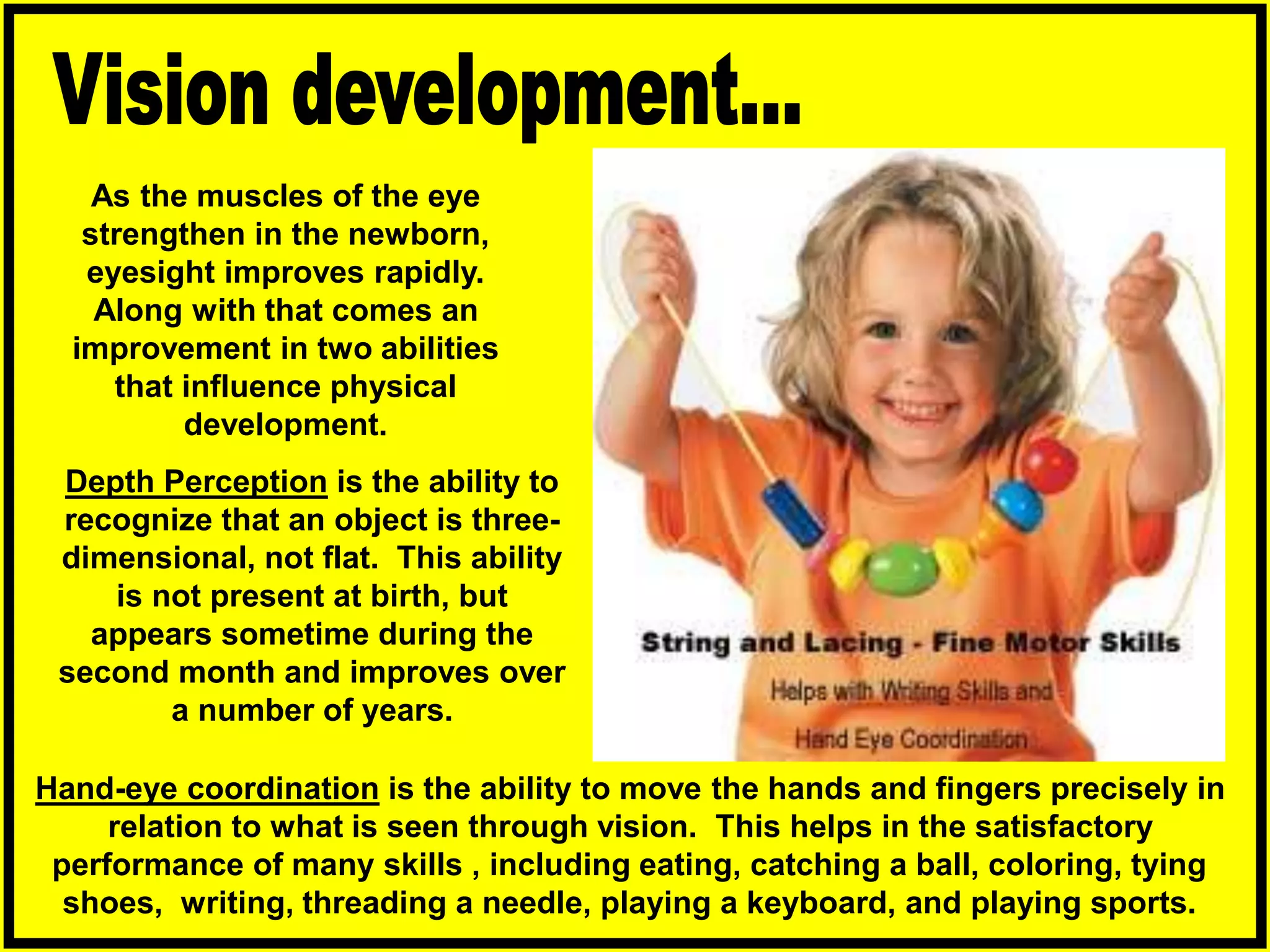
Hand-eye coordination is the ability to move the hands and fingers precisely in
relation to what is seen through vision. This helps in the satisfactory
performance of many skills , including eating, catching a ball, coloring, tying
shoes, writing, threading a needle, playing a keyboard, and playing sports.
Motor skills, often referred to
as locomotion, are abilities
that depend on the use and
control of muscles. Mastering
these skills, although
seemingly just a physical
development skill, relies
heavily on intellectual, social,
and emotional development.
The first motor skills to be developed
are the “gross” motor skills. These
involve the use of larger muscles in
the body such as the trunk, neck,
arms, and legs. Skills might include
running, jumping, hopping, skipping,
throwing, and catching.
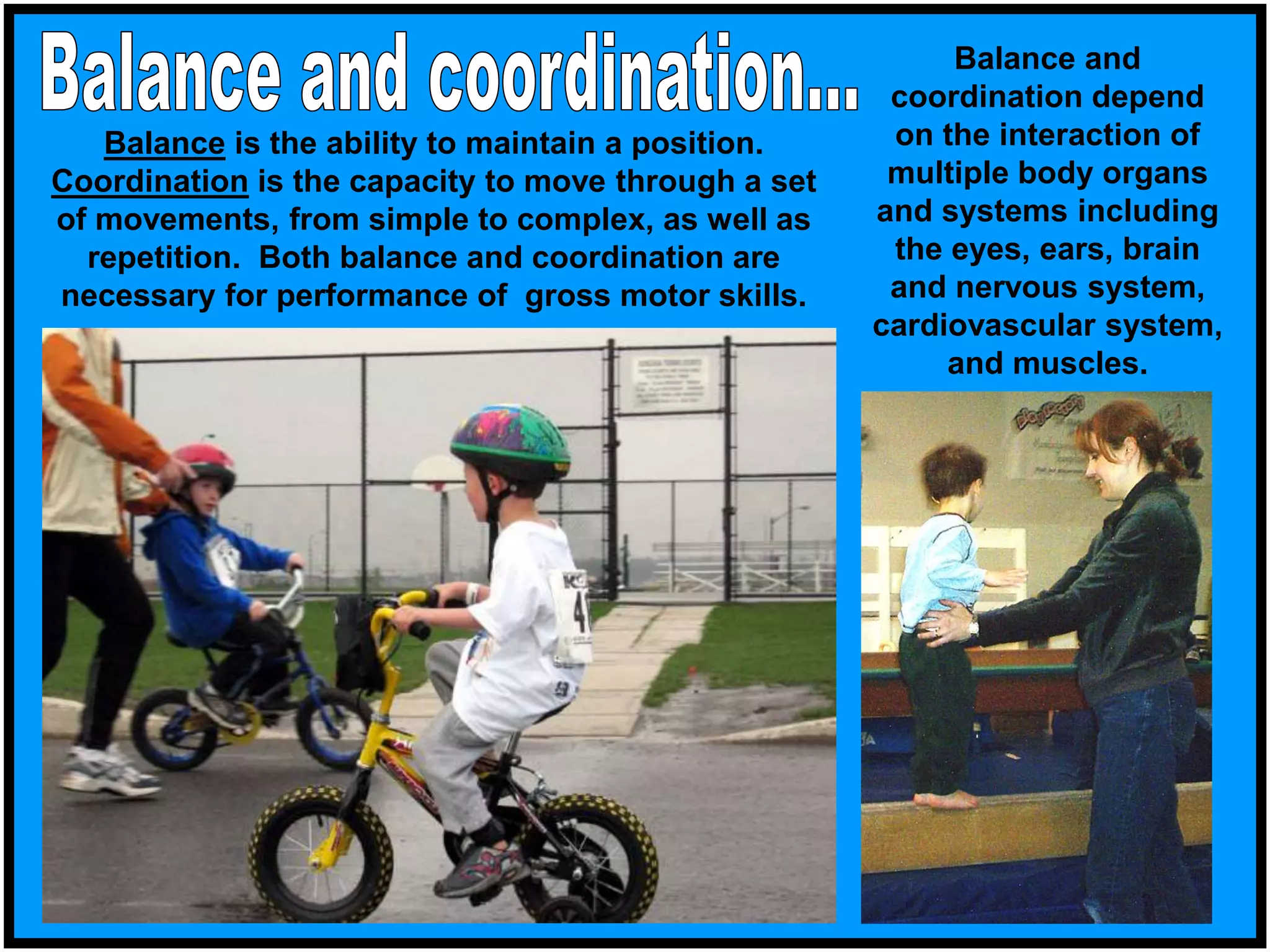
Balance is the ability to maintain a position.
Coordination is the capacity to move through a set
of movements, from simple to complex, as well as
repetition. Both balance and coordination are
necessary for performance of gross motor skills.
Balance and
coordination depend
on the interaction of
multiple body organs
and systems including
the eyes, ears, brain
and nervous system,
cardiovascular system,
and muscles.
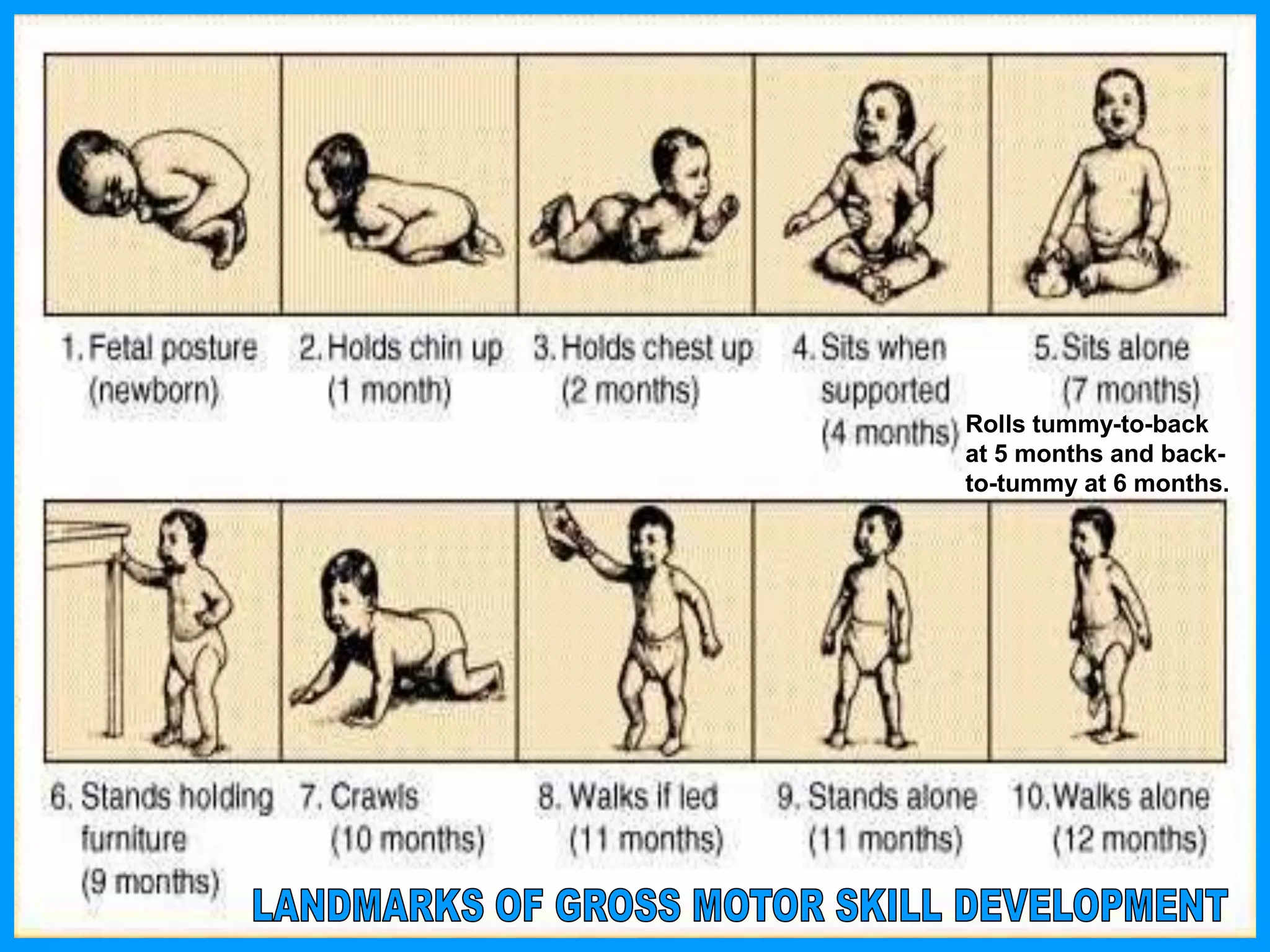
Rolls tummy-to-back
at 5 months and back-
to-tummy at 6 months.
Continuous steps alternating feet.
Arms are in opposition to legs:
If the right foot is forward, swing the left arm forward.
This pattern of right leg
forward – left arm forward
was first seen in crawling.
As the right hand moved
forward – the left leg moved
forward. As speed, balance,
and coordination improve,
the child will run.
Walking involves a smooth
transfer of weight from the
heel to the toe. When a child
walks toe first, they appear to
have a light, bouncing
motion. (Runway models do
this deliberately to add sway
to their walk.)
Until the child can
climb up and
downstairs without
assistance, a gate
may be used at the
top and bottom of
the stairway to
prevent falls.
The crawling infant simply crawls
upstairs on hands and knees, and
comes back down backwards.
There are two patterns of stair-climbing:
1. Marking time – the child will step up
with one foot, then bring the other foot
up to the same step; repeat (this
occurs first)
2. Alternating feet – the child will step up
on one step with one foot, then bring the
next foot up to the step above the first;
repeat (this follows marking time)
physical development of children.pptx

physical development of children.pptx

  • 1.
  • 2.
    Social Emotional Physical Intellectual Human beings develop in4 different aspects of growth. The areas are all inter-connected, so when one is affected it may influence the others. Physical development involves both the growth and motor (movement) skills of the child.
  • 3.
    Growth refers toa measurable change in size, such as height and weight. Development refers to an increase in physical, emotional, social, or intellectual skills. Boys may lag behind girls in growth and development as much as 2 years. The satisfactory growth of a child is measured in “percentiles” on a chart. A percentile is a statistical value on a scale of one hundred that indicates whether a distribution is above or below it. If a child’s weight falls on the 50th percentile for his age, that means 50% of all other children his age weigh more, and 50% of all other children his age weigh less. If a child’s height falls on the 90% percentile for his age, it means that 10% of all children his age will be taller than he is, and 90% of all children his age will be shorter than he is. Factors influencing how children grow: genetic potential, medical problems, and nutritional status An additional factor influencing development: practice
  • 4.
    Development follows anorderly, step-by-step sequence in three different patterns: Cephalo-caudal development is a “head-to-foot” pattern. Prenatally and at birth the newborn’s head is proportionately larger; development continues downward. Proximal-distal (proximodistal) development is an “inward-to- outward” pattern. Development starts at the trunk of the body and moves further outward. Simple-to-complex development is a pattern relating to the difficulty of tasks. Babies start with simply eating and sleeping and progress from there. Tasks involving a combination of motions is more complex.
  • 5.
    As the musclesof the eye strengthen in the newborn, eyesight improves rapidly. Along with that comes an improvement in two abilities that influence physical development. Depth Perception is the ability to recognize that an object is three- dimensional, not flat. This ability is not present at birth, but appears sometime during the second month and improves over a number of years. Hand-eye coordination is the ability to move the hands and fingers precisely in relation to what is seen through vision. This helps in the satisfactory performance of many skills , including eating, catching a ball, coloring, tying shoes, writing, threading a needle, playing a keyboard, and playing sports.
  • 6.
    Motor skills, oftenreferred to as locomotion, are abilities that depend on the use and control of muscles. Mastering these skills, although seemingly just a physical development skill, relies heavily on intellectual, social, and emotional development. The first motor skills to be developed are the “gross” motor skills. These involve the use of larger muscles in the body such as the trunk, neck, arms, and legs. Skills might include running, jumping, hopping, skipping, throwing, and catching.
  • 7.
    Balance is theability to maintain a position. Coordination is the capacity to move through a set of movements, from simple to complex, as well as repetition. Both balance and coordination are necessary for performance of gross motor skills. Balance and coordination depend on the interaction of multiple body organs and systems including the eyes, ears, brain and nervous system, cardiovascular system, and muscles.
  • 8.
    Rolls tummy-to-back at 5months and back- to-tummy at 6 months.
  • 9.
    Continuous steps alternatingfeet. Arms are in opposition to legs: If the right foot is forward, swing the left arm forward. This pattern of right leg forward – left arm forward was first seen in crawling. As the right hand moved forward – the left leg moved forward. As speed, balance, and coordination improve, the child will run. Walking involves a smooth transfer of weight from the heel to the toe. When a child walks toe first, they appear to have a light, bouncing motion. (Runway models do this deliberately to add sway to their walk.)
  • 10.
    Until the childcan climb up and downstairs without assistance, a gate may be used at the top and bottom of the stairway to prevent falls. The crawling infant simply crawls upstairs on hands and knees, and comes back down backwards. There are two patterns of stair-climbing: 1. Marking time – the child will step up with one foot, then bring the other foot up to the same step; repeat (this occurs first) 2. Alternating feet – the child will step up on one step with one foot, then bring the next foot up to the step above the first; repeat (this follows marking time)