Lesson 2 - Physical
Development
Vanojan Manickanadarajah,
MD, MBA
Learning Outcomes
• Outline physical developmental milestone for young children 0-5 years:
• Gross motor skills
• Fine motor skills.
Introduction
•Physical Development: Focuses on children’s ability to
move, coordinate, and control their bodies.
•Divided into:
•Gross Motor Skills: Movements involving large
muscles (e.g., walking, running).
•Fine Motor Skills: Smaller movements, usually
involving hands and fingers (e.g., drawing,
manipulating objects).
•Why it matters: These skills enable children to interact
with their surroundings, and lay the foundation for daily
activities such as dressing, feeding, and playing.
Overview of Physical
Development (0-5
Years)
•Children develop at different rates, but all
pass through key milestones.
•The role of play in promoting motor
development is crucial.
•Key developmental periods:
•0-12 months: Foundation of movement.
•1-2 years: Refining early skills,
increasing independence.
•3-5 years: Mastery of more complex
movements.
Videos on Gross motor
skills vs Fine motor skills
• Fine motor skills
• https://www.youtube.com/wat
ch?v=LiTuGv_GeaE
• https://www.youtube.com/wat
ch?v=uR2tmJ60vNg
• Gross Motor skills
• https://www.youtube.com/wat
ch?v=VEw6w4aQdEY
Birth to 12 Months
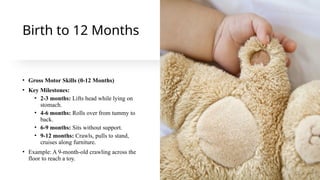
• Gross Motor Skills (0-12 Months)
• Key Milestones:
• 2-3 months: Lifts head while lying on
stomach.
• 4-6 months: Rolls over from tummy to
back.
• 6-9 months: Sits without support.
• 9-12 months: Crawls, pulls to stand,
cruises along furniture.
• Example: A 9-month-old crawling across the
floor to reach a toy.
Birth to 12 Months
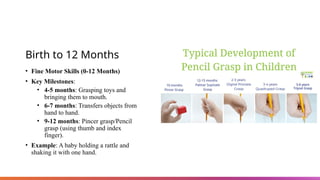
• Fine Motor Skills (0-12 Months)
• Key Milestones:
• 4-5 months: Grasping toys and
bringing them to mouth.
• 6-7 months: Transfers objects from
hand to hand.
• 9-12 months: Pincer grasp/Pencil
grasp (using thumb and index
finger).
• Example: A baby holding a rattle and
shaking it with one hand.
Year 2: 12 to 24
Months
• Gross Motor Skills (12-24 Months)
• Key Milestones:
• 12-15 months: Walks independently.
• 15-18 months: Climbs stairs with assistance,
pulls toys while walking.
• 18-24 months: Begins to run, throws a ball
with some accuracy, climbs onto furniture
unaided.
• Example: A 2-year-old running across the
playground.
Year 2: 12 to 24
Months
• Fine Motor Skills (12-24 Months)
• Key Milestones:
• 12-15 months: Scribbles with crayons,
stacks 2-4 blocks.
• 18-24 months: Begins to use a spoon
effectively, turns pages in a book.
• Example: A child building a tower of 3
blocks.
Year 3: 24 to 36
Months
• Gross Motor Skills (24-36 Months)
• Key Milestones:
• 24-30 months: Jumps with two
feet, kicks a ball, begins to pedal a
tricycle.
• 30-36 months: Walks up and down
stairs with alternate feet, starts to
catch a ball.
• Example: A child pedaling a tricycle in
the park.
Year 3: 24 to 36
Months
• Fine Motor Skills (24-36 Months)
• Key Milestones:
• 24-30 months: Builds a tower of 6 or
more blocks, manipulates simple puzzles.
• 30-36 months: Holds a pencil between
thumb and fingers, starts to copy circles
and lines.
• Example: A child drawing basic shapes on
paper.
Year 4: 36 to 48
Months
• Gross Motor Skills (36-48
Months)
• Key Milestones:
• 36-40 months: Balances on one foot
for a few seconds, begins to hop.
• 40-48 months: Rides a tricycle with
better coordination, throws and
catches a ball with some accuracy.
• Example: A child hopping from
one foot to the other.
Year 4: 36 to 48
Months
• Fine Motor Skills (36-48 Months)
• Key Milestones:
• 36-40 months: Cuts with scissors
along straight lines, builds more
complex structures with blocks.
• 40-48 months: Begins to write
letters, draws more defined shapes
(e.g., squares, triangles).
• Example: A child cutting paper with
safety scissors.
Year 5: 48 to 60
Months
• Gross Motor Skills (48-60 Months)
• Key Milestones:
• 48-54 months: Skips, somersaults,
climbs well on playground
equipment.
• 54-60 months: Rides a bicycle with
training wheels, catches a ball more
reliably.
• Example: A child riding a bike in the
park.
Year 5: 48 to 60
Months
• Fine Motor Skills (48-60 Months)
• Key Milestones:
• 48-54 months: Ties shoelaces,
starts to use a knife and fork with
ease.
• 54-60 months: Writes their name
and other letters, draws more
complex figures (e.g., people with
heads, arms, and legs).
• Example: A child tying their shoelaces
or writing their name.
Understanding
Variations in
Development
• Development varies from child to child due to
factors such as:
• Genetics: Inherited traits can influence
motor skills development.
• Environmental Factors: Access to play,
nutrition, and parental involvement impact
development.
• Prematurity: Babies born prematurely
may reach milestones later but often catch
up by age 3-5.
• Cultural differences: Milestones can vary
across cultures based on parenting practices and
environmental stimulation.
Supporting Gross Motor
Skills Development
Key Ways to Promote Gross Motor Skills:
•Encourage active play: Running, jumping,
climbing, and dancing.
•Provide space for exploration, both indoors and
outdoors.
•Offer toys that promote movement (e.g., ride-on
toys, balls).
•Playgrounds: Swings, slides, and climbing frames
help develop core strength and coordination.
•At Home: Encourage children to help with daily
tasks like carrying light objects or walking up stairs.
Supporting Fine Motor
Skills Development
Key Ways to Promote Fine Motor Skills:
•Offer art and craft activities: Colouring,
painting, cutting, and sticking.
•Provide materials that require
manipulation: Playdough, threading beads,
puzzles.
•Encourage self-care tasks: Zipping up
coats, buttoning shirts, using cutlery.
Examples: Completing puzzles, threading
beads, and copying shapes are excellent
ways to develop dexterity.
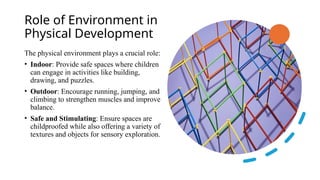
Role of Environment in
Physical Development
The physical environment plays a crucial role:
• Indoor: Provide safe spaces where children
can engage in activities like building,
drawing, and puzzles.
• Outdoor: Encourage running, jumping, and
climbing to strengthen muscles and improve
balance.
• Safe and Stimulating: Ensure spaces are
childproofed while also offering a variety of
textures and objects for sensory exploration.
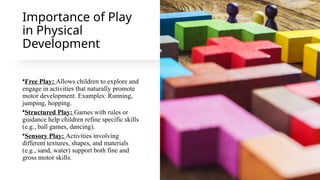
Importance of Play
in Physical
Development
•Free Play: Allows children to explore and
engage in activities that naturally promote
motor development. Examples: Running,
jumping, hopping.
•Structured Play: Games with rules or
guidance help children refine specific skills
(e.g., ball games, dancing).
•Sensory Play: Activities involving
different textures, shapes, and materials
(e.g., sand, water) support both fine and
gross motor skills.
Working with Children
with Special Needs
Children with developmental delays or physical
disabilities may need adapted activities.
•Gross Motor Adaptations: Larger or softer
balls, adapted bicycles, or assistive devices.
•Fine Motor Adaptations: Use of thicker
crayons, adaptive scissors, or Velcro in place of
buttons.
•Inclusion: Creating inclusive environments
where children with special needs can
participate in group activities is important for
both physical and social development.
Group Activities for
Enhancing Physical
Skills
•Gross Motor Group Activities:
Games like "Simon Says" or relay
races help develop coordination and
balance.
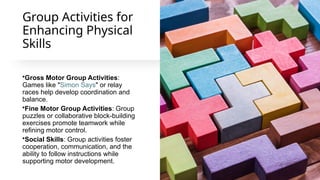
•Fine Motor Group Activities: Group
puzzles or collaborative block-building
exercises promote teamwork while
refining motor control.
•Social Skills: Group activities foster
cooperation, communication, and the
ability to follow instructions while
supporting motor development.
Next
Lesson
Lesson 3 -
Intellectual
development of
children 0-5 years

Lesson 2 Physical Development - Childcare

  • 1.
    Lesson 2 -Physical Development Vanojan Manickanadarajah, MD, MBA
  • 2.
    Learning Outcomes • Outlinephysical developmental milestone for young children 0-5 years: • Gross motor skills • Fine motor skills.
  • 3.
    Introduction •Physical Development: Focuseson children’s ability to move, coordinate, and control their bodies. •Divided into: •Gross Motor Skills: Movements involving large muscles (e.g., walking, running). •Fine Motor Skills: Smaller movements, usually involving hands and fingers (e.g., drawing, manipulating objects). •Why it matters: These skills enable children to interact with their surroundings, and lay the foundation for daily activities such as dressing, feeding, and playing.
  • 4.
    Overview of Physical Development(0-5 Years) •Children develop at different rates, but all pass through key milestones. •The role of play in promoting motor development is crucial. •Key developmental periods: •0-12 months: Foundation of movement. •1-2 years: Refining early skills, increasing independence. •3-5 years: Mastery of more complex movements.
  • 5.
    Videos on Grossmotor skills vs Fine motor skills • Fine motor skills • https://www.youtube.com/wat ch?v=LiTuGv_GeaE • https://www.youtube.com/wat ch?v=uR2tmJ60vNg • Gross Motor skills • https://www.youtube.com/wat ch?v=VEw6w4aQdEY
  • 6.
    Birth to 12Months • Gross Motor Skills (0-12 Months) • Key Milestones: • 2-3 months: Lifts head while lying on stomach. • 4-6 months: Rolls over from tummy to back. • 6-9 months: Sits without support. • 9-12 months: Crawls, pulls to stand, cruises along furniture. • Example: A 9-month-old crawling across the floor to reach a toy.
  • 7.
    Birth to 12Months • Fine Motor Skills (0-12 Months) • Key Milestones: • 4-5 months: Grasping toys and bringing them to mouth. • 6-7 months: Transfers objects from hand to hand. • 9-12 months: Pincer grasp/Pencil grasp (using thumb and index finger). • Example: A baby holding a rattle and shaking it with one hand.
  • 8.
    Year 2: 12to 24 Months • Gross Motor Skills (12-24 Months) • Key Milestones: • 12-15 months: Walks independently. • 15-18 months: Climbs stairs with assistance, pulls toys while walking. • 18-24 months: Begins to run, throws a ball with some accuracy, climbs onto furniture unaided. • Example: A 2-year-old running across the playground.
  • 9.
    Year 2: 12to 24 Months • Fine Motor Skills (12-24 Months) • Key Milestones: • 12-15 months: Scribbles with crayons, stacks 2-4 blocks. • 18-24 months: Begins to use a spoon effectively, turns pages in a book. • Example: A child building a tower of 3 blocks.
  • 10.
    Year 3: 24to 36 Months • Gross Motor Skills (24-36 Months) • Key Milestones: • 24-30 months: Jumps with two feet, kicks a ball, begins to pedal a tricycle. • 30-36 months: Walks up and down stairs with alternate feet, starts to catch a ball. • Example: A child pedaling a tricycle in the park.
  • 11.
    Year 3: 24to 36 Months • Fine Motor Skills (24-36 Months) • Key Milestones: • 24-30 months: Builds a tower of 6 or more blocks, manipulates simple puzzles. • 30-36 months: Holds a pencil between thumb and fingers, starts to copy circles and lines. • Example: A child drawing basic shapes on paper.
  • 12.
    Year 4: 36to 48 Months • Gross Motor Skills (36-48 Months) • Key Milestones: • 36-40 months: Balances on one foot for a few seconds, begins to hop. • 40-48 months: Rides a tricycle with better coordination, throws and catches a ball with some accuracy. • Example: A child hopping from one foot to the other.
  • 13.
    Year 4: 36to 48 Months • Fine Motor Skills (36-48 Months) • Key Milestones: • 36-40 months: Cuts with scissors along straight lines, builds more complex structures with blocks. • 40-48 months: Begins to write letters, draws more defined shapes (e.g., squares, triangles). • Example: A child cutting paper with safety scissors.
  • 14.
    Year 5: 48to 60 Months • Gross Motor Skills (48-60 Months) • Key Milestones: • 48-54 months: Skips, somersaults, climbs well on playground equipment. • 54-60 months: Rides a bicycle with training wheels, catches a ball more reliably. • Example: A child riding a bike in the park.
  • 15.
    Year 5: 48to 60 Months • Fine Motor Skills (48-60 Months) • Key Milestones: • 48-54 months: Ties shoelaces, starts to use a knife and fork with ease. • 54-60 months: Writes their name and other letters, draws more complex figures (e.g., people with heads, arms, and legs). • Example: A child tying their shoelaces or writing their name.
  • 16.
    Understanding Variations in Development • Developmentvaries from child to child due to factors such as: • Genetics: Inherited traits can influence motor skills development. • Environmental Factors: Access to play, nutrition, and parental involvement impact development. • Prematurity: Babies born prematurely may reach milestones later but often catch up by age 3-5. • Cultural differences: Milestones can vary across cultures based on parenting practices and environmental stimulation.
  • 17.
    Supporting Gross Motor SkillsDevelopment Key Ways to Promote Gross Motor Skills: •Encourage active play: Running, jumping, climbing, and dancing. •Provide space for exploration, both indoors and outdoors. •Offer toys that promote movement (e.g., ride-on toys, balls). •Playgrounds: Swings, slides, and climbing frames help develop core strength and coordination. •At Home: Encourage children to help with daily tasks like carrying light objects or walking up stairs.
  • 18.
    Supporting Fine Motor SkillsDevelopment Key Ways to Promote Fine Motor Skills: •Offer art and craft activities: Colouring, painting, cutting, and sticking. •Provide materials that require manipulation: Playdough, threading beads, puzzles. •Encourage self-care tasks: Zipping up coats, buttoning shirts, using cutlery. Examples: Completing puzzles, threading beads, and copying shapes are excellent ways to develop dexterity.
  • 19.
    Role of Environmentin Physical Development The physical environment plays a crucial role: • Indoor: Provide safe spaces where children can engage in activities like building, drawing, and puzzles. • Outdoor: Encourage running, jumping, and climbing to strengthen muscles and improve balance. • Safe and Stimulating: Ensure spaces are childproofed while also offering a variety of textures and objects for sensory exploration.
  • 20.
    Importance of Play inPhysical Development •Free Play: Allows children to explore and engage in activities that naturally promote motor development. Examples: Running, jumping, hopping. •Structured Play: Games with rules or guidance help children refine specific skills (e.g., ball games, dancing). •Sensory Play: Activities involving different textures, shapes, and materials (e.g., sand, water) support both fine and gross motor skills.
  • 21.
    Working with Children withSpecial Needs Children with developmental delays or physical disabilities may need adapted activities. •Gross Motor Adaptations: Larger or softer balls, adapted bicycles, or assistive devices. •Fine Motor Adaptations: Use of thicker crayons, adaptive scissors, or Velcro in place of buttons. •Inclusion: Creating inclusive environments where children with special needs can participate in group activities is important for both physical and social development.
  • 22.
    Group Activities for EnhancingPhysical Skills •Gross Motor Group Activities: Games like "Simon Says" or relay races help develop coordination and balance. •Fine Motor Group Activities: Group puzzles or collaborative block-building exercises promote teamwork while refining motor control. •Social Skills: Group activities foster cooperation, communication, and the ability to follow instructions while supporting motor development.
  • 23.