By Adrienne Bitoy Jackson, MS. Ed., PMP
1
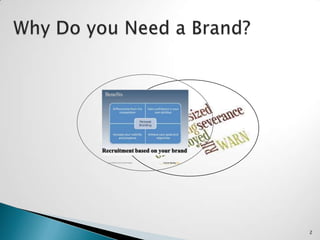
2
3
The brand ambassador is meant to embody the corporate identity in
appearance, demeanor, values and ethics.
4
Brand Ambassadors
5
6
What is Your
Brand?
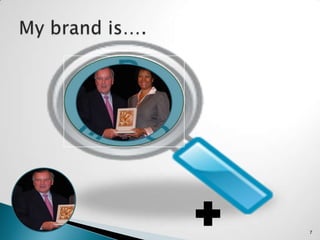
7
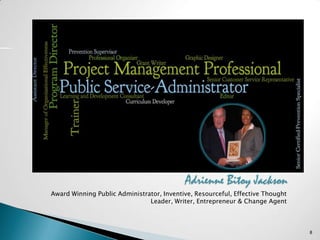
Award Winning Public Administrator, Inventive, Resourceful, Effective Thought
Leader, Writer, Entrepreneur & Change Agent
8
Adrienne Bitoy Jackson
9
What is Your
Brand?
Your PUBLIC IMAGE should reflect
who you are and for what you
stand, i.e.
self impression + professional reputation+
personal values = PUBLIC IMAGE
PUBLIC IMAGE = Professional Brand.
10
11
You are a brand. A brand can start
with nothing more than a name.
Exercise 1
Google “your name”…
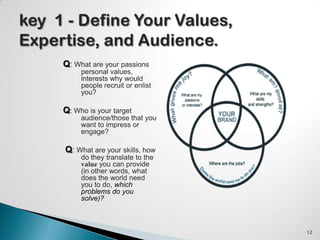
Q: What are your passions
personal values,
interests why would
people recruit or enlist
you?
Q: Who is your target
audience/those that you
want to impress or
engage?
Q: What are your skills, how
do they translate to the
value you can provide
(in other words, what
does the world need
you to do, which
problems do you
solve)?
12
13
A. Your brand statement is essential to
your business identity & reputation.
B. Your brand should define:
1. what you excel at,
2. which audience you serve, and
3. what makes you stand out among your
competition, your unique value promise.
C. The statement should be uniquely
yours; credible and consistent with
what you actually are known to do.
14
68% of people spend time reading
about brands that interest them!
15
Remember a brand is nothing more than a
name. Your brand statement is….
Exercise 2
Write Your Professional Brand Statement.
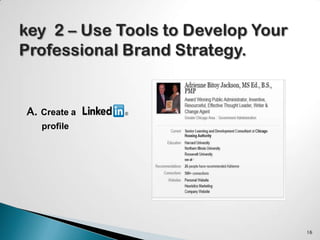
A. Create a
profile
16
B. Create a business card
 an electronic business
card exchangeable through
www, IM or email.
 a paper business card
17
C. Create a Graphic Resume
18
D. Create a portfolio
19
20
E. Write a blog
F. Build a Web Site.
21
56% of all hiring managers are more impressed
by a candidate’s personal website than any
other personal branding tool.
G. Create a
presence
22
23
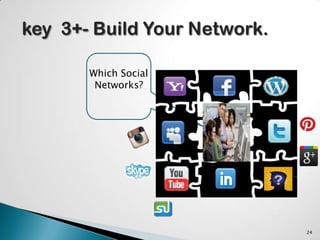
Which Social
Networks?
24
25
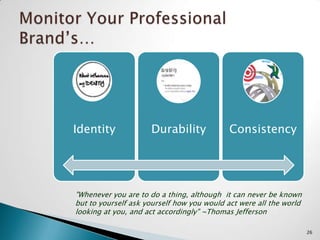
Identity Durability Consistency
26
"Whenever you are to do a thing, although it can never be known
but to yourself ask yourself how you would act were all the world
looking at you, and act accordingly" ~Thomas Jefferson
 Keep your social media profiles
congruent with each other.
 Link your profiles together.
27
Whether a printed resume,
online profile, or blog, use the
same basic elements, photos, &
content; and people will identify
you with your brand.
All lot of work goes into building a
brand, so don’t lose
mo me n t u m after
launching yours.
 Intranets, portals, wikis, and password
protected sites on the NET work great.
 Don’t forget to get the word out by
promoting your brand, keep networking
and consulting with your resources.
28
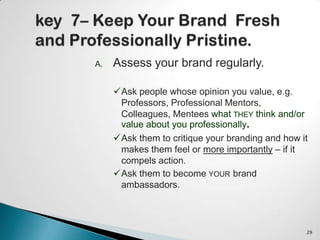
A. Assess your brand regularly.
Ask people whose opinion you value, e.g.
Professors, Professional Mentors,
Colleagues, Mentees what THEY think and/or
value about you professionally.
Ask them to critique your branding and how it
makes them feel or more importantly – if it
compels action.
Ask them to become YOUR brand
ambassadors.
29
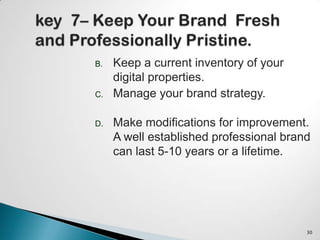
B. Keep a current inventory of your
digital properties.
C. Manage your brand strategy.
D. Make modifications for improvement.
A well established professional brand
can last 5-10 years or a lifetime.
30
31
32
PUBLIC IMAGE = Professional brand.
Brand statement is uniquely YOU.
Brand is credible, consistent & congruent in all
forms.
Network for brand exposure.
Use brand ambassadors and sponsors
Keep brand fresh and
33
34
For more information contact Adrienne Bitoy Jackson, Heuristics Marketing Consultant, at
heuristics1@comcast.net
This work is licensed under a Creative Commons Attribution 3.0 Unported License.

Developing your professional brand

  • 1.
    By Adrienne BitoyJackson, MS. Ed., PMP 1
  • 2.
  • 3.
  • 4.
    The brand ambassadoris meant to embody the corporate identity in appearance, demeanor, values and ethics. 4 Brand Ambassadors
  • 5.
  • 6.
  • 7.
  • 8.
    Award Winning PublicAdministrator, Inventive, Resourceful, Effective Thought Leader, Writer, Entrepreneur & Change Agent 8 Adrienne Bitoy Jackson
  • 9.
  • 10.
    Your PUBLIC IMAGEshould reflect who you are and for what you stand, i.e. self impression + professional reputation+ personal values = PUBLIC IMAGE PUBLIC IMAGE = Professional Brand. 10
  • 11.
    11 You are abrand. A brand can start with nothing more than a name. Exercise 1 Google “your name”…
  • 12.
    Q: What areyour passions personal values, interests why would people recruit or enlist you? Q: Who is your target audience/those that you want to impress or engage? Q: What are your skills, how do they translate to the value you can provide (in other words, what does the world need you to do, which problems do you solve)? 12
  • 13.
    13 A. Your brandstatement is essential to your business identity & reputation. B. Your brand should define: 1. what you excel at, 2. which audience you serve, and 3. what makes you stand out among your competition, your unique value promise. C. The statement should be uniquely yours; credible and consistent with what you actually are known to do.
  • 14.
    14 68% of peoplespend time reading about brands that interest them!
  • 15.
    15 Remember a brandis nothing more than a name. Your brand statement is…. Exercise 2 Write Your Professional Brand Statement.
  • 16.
  • 17.
    B. Create abusiness card  an electronic business card exchangeable through www, IM or email.  a paper business card 17
  • 18.
    C. Create aGraphic Resume 18
  • 19.
    D. Create aportfolio 19
  • 20.
  • 21.
    F. Build aWeb Site. 21 56% of all hiring managers are more impressed by a candidate’s personal website than any other personal branding tool.
  • 22.
  • 23.
  • 24.
  • 25.
  • 26.
    Identity Durability Consistency 26 "Wheneveryou are to do a thing, although it can never be known but to yourself ask yourself how you would act were all the world looking at you, and act accordingly" ~Thomas Jefferson
  • 27.
     Keep yoursocial media profiles congruent with each other.  Link your profiles together. 27 Whether a printed resume, online profile, or blog, use the same basic elements, photos, & content; and people will identify you with your brand.
  • 28.
    All lot ofwork goes into building a brand, so don’t lose mo me n t u m after launching yours.  Intranets, portals, wikis, and password protected sites on the NET work great.  Don’t forget to get the word out by promoting your brand, keep networking and consulting with your resources. 28
  • 29.
    A. Assess yourbrand regularly. Ask people whose opinion you value, e.g. Professors, Professional Mentors, Colleagues, Mentees what THEY think and/or value about you professionally. Ask them to critique your branding and how it makes them feel or more importantly – if it compels action. Ask them to become YOUR brand ambassadors. 29
  • 30.
    B. Keep acurrent inventory of your digital properties. C. Manage your brand strategy. D. Make modifications for improvement. A well established professional brand can last 5-10 years or a lifetime. 30
  • 31.
  • 32.
    32 PUBLIC IMAGE =Professional brand. Brand statement is uniquely YOU. Brand is credible, consistent & congruent in all forms. Network for brand exposure. Use brand ambassadors and sponsors Keep brand fresh and
  • 33.
  • 34.
    34 For more informationcontact Adrienne Bitoy Jackson, Heuristics Marketing Consultant, at heuristics1@comcast.net This work is licensed under a Creative Commons Attribution 3.0 Unported License.

Editor's Notes

  • #2 My name is Adrienne Bitoy Jackson, one of the Sr. Learning and Development Consultants at the Chicago Housing Authority and I am an Award Winning Public Service Administrator, Inventive, Resourceful, Effective Thought Leader, Writer, Entrepreneur and Change Agent.From a branding perspective, I and the organization for whom I work/ am employed are two separate entities, but we are also somewhat linked and my behavior on social media has to take this into account.I believe in the concept that professional development is exponentially enhanced via a community of learners, I have been asked to share what I’ve learned with you and provide some quick and easy “how to’ keys on creating a professional brand, using your online presence and social networking w/online media . By a show of hands how many people are : new to the field, mi level, senior level?I also would like to hear from you why this subject is of interest to you and what you expect to gain from this session.
  • #3 While you might think that branding is reserved for celebrities and corporations, the truth is that anyone can benefit from creating their own brand. Why you need it: greater competition, fewer job opportunities, downsizing, outsourcing, fewer promotions, automation/robotics, diminishing or disappearing increases, younger replacements, and early retirements Whether you're searching for a new job or looking to advance inyour current career, personal branding can help you communicate more effectively and stand out in a crowded marketplace. As you work to determine who you are and what you want, you'll learn how to present yourself with greater confidence and clarity.
  • #4 If you currently work for a municipality, government agency or non profit organization they have a public image, an online presence… a brand. Some may have a slogan or brand statement. All have a code of conduct to which you must adhere, as long as you work for them, you are connected. As a public administrator, you are identified as their employee, an important element of what their brand represents. There may even be times when you are asked to speak on their behalf. At those times you serve as a brand ambassador.
  • #5 We often talk about engaged citizens but rarely about engaged public employees. Clearly, as public administrators we aspire to be excellent public servants and to advance the mission of the agencies for whom we work, or intend to work. If we have been officially “on boarded” we have been purposely indoctrinated with the organization’s cultural norms, expectations, guiding principles and are “engaged” to share the organizational vision and mission.We gain familiarity with the agency, who it serves and what it represents. We are stakeholders and often the human face of the organizationWe become it’s ambassadors, and because it involves public trust we behave accordingly adhering to its rules, regulations, guidelines and administrative policies.
  • #6 Here I actively engaged in supporting the organizational mission, which is “to leverage the power of affordable decent safe , and stable housing to help communities thrive and low-income families increase their potential for long term economic success and a sustained high quality of life” In this picture, I am a brand ambassador, not only for the Chicago Housing Authority but because of the tag line “You Are Here” for Harvard University’s Kennedy School of Government, as well.
  • #7 Yet brand ambassadors in their individuality are separate from the organization.So the question you must ask yourself is… How do you differentiate your brand from that of the organization for whom you work?Developing a personal brand allows you to control how you are perceived by others. Whether you're interacting with someone online or in person, a strong personal brand helps you make a memorable and positive impression.
  • #8 Let me illustrate… My brand is my public persona plus
  • #9 my professional experience, skills, and the way I am routinely describedby others
  • #11 Social media can be used as a tool for building a professional presence. Your public image includes your online presence.Fact: The World Wide Web (www) has at least 200 people search data bases which collect all kinds of public information. The most popular of which is googleWith a quick Google search, you can find out quite a lot about someone, both good and bad. For instance, with a simple online search, you can often find :letters to the editor someone has written or mentions in any other news media, both controversial or not; blog posts; discussion threads from newsgroups; legal notices about lawsuits a person has been in; specifics on their campaign contributions to political candidates; information about someone as an online seller through EBay or Amazon.com, and sometimes a person’s “wishlist” on Amazon.com; negative reviews on things like “Ripoff reportsinformation revealing someone’s home mailing address and phone number, including details on exactly how much the person paid for their house; and of course, the requisite Facebook account.If you tweet or use Facebook your comments, activities and associations may be open to public scrutiny. So may those of your friends .If Iwe did a search using Google, one of the strongest search engines in the world what would I find out about you? Let’s fin out, shall we? Go to your browser open google and search your name in quotation marks
  • #12 When you “googled” yourself how many items were searched? (did you look at images,et.al) What did you find? Were you happy with what the search revealed? Over 80, 000 names are searched on Google each day..This can be your best friend or worst enemyUsually, if the person is a “professional”, their profile will come up in Linkedin.com. Make sure to describe yourself on your public profiles in the way that you want to be known. Think in terms of what will be relevant over the next six months to one year, and don't get stuck on the label you acquired in college, graduate school, or even in your early/current jobs. What if what came up isn’t YOU, what do should you do? Know who your “digital doppelgängers” are and differentiate, if necessary with a nickname or middle initial. - See more at: http://sarahsfav.es/2013/06/24/6-tips-for-protecting-your-online-reputation-from-randi-zuckerberg/#sthash.4zho1pmQ.dpuf
  • #13 Because your public image is valuable and equates with you brand, learn to position it. For a prominent place in stakeholders minds select your key attributes or qualities the ones that are most admired or desired, and ones that sharply differentiate you from others. Use your values, vision, core strengths and areas of expertise to formulate your brand statement. It might include the qualities that people use to describe you, why you motivate their selection, and what issue you resolve for them. Target Audience: hiring managers, recruiters, and career contacts
  • #14 Simply put, your brand is the definition of you as defined by others, and is made up of five components:Your NameYour ImageYour Online IDYour ReputationYour NetworkWith a brand statementPeople trust you moreYou have a much higher perceived valueYou are differentiated from the competitionYou are always 100% authenticYou are the “go-to” person in your area of expertise for your specific audienceYou are known as an expert in your fieldYou attract ideal opportunities
  • #15 A good place to start is with a “Twitter” bio. Describing yourself in 140 characters forces you to develop a concise, captivating and intriguing brand statement, leading to a response of “Tell me more.” Graduating students In China students are using a “micro-resume” a resume in 140 , characters (like Twitter), e.g. academic degree, interests and experience
  • #16 Consider Your Outlook On The WorldThink About Your Individual future goalsLook At Your Attributes And Professional HistoryUse the worksheet that has been provided for you.What career or business attributes would you say people recognize you for? Take 10 minutes to make a list - name up to 5 if you can. Pick your top three If you get 30 seconds to pitch your brand for your dream situation, what three points will you try to make?  In essence, that’s your summary:  memorable, catchy, descriptive.  Realize that in actuality sometime you may only get 6 seconds (Headline/brand statement)Now introduce yourself saying your name and your brand statement.
  • #17 A LinkedIn profile gives increased visibility provides a digital version of your resume, portfolio recommendations and references. Don't be without one. Withno LinkedIn profile, career counselors /recruitersmaymake one of two assumptions:The person is over 50 years of age and hasn’t bothered to keep up on current technology.The person is under 22 years of age and spends all his or her time on Facebook, probably posting inappropriate pictures of him/herselfThings to have in your profile Employment (current and past), education, and industry. Review your resume and copy/paste the relevant information into your profile. If you’re currently unemployed list your current position as "Open to opportunities."Photo (a headshot is recommended or upload a larger photo and edit it) to your LinkedIn profile. Note that it must be a small photo - no larger than 80x80 pixels.Professional Summary. The Professional Summary section of your profile is a good way to highlight your experience. Select an Industry, because recruiters often use that field to search. Headline, this is a perfect place for your brand statement because that's right at the top of the page when someone views your profile. (only thing vivible)Keywords and Skills. Include all the keywords and skills from your resume in yourprofile. That will make it easier for your profile to be found in search results. These can be search tagsLinks. The links section of your profile is a good way to provide even more information topotential employers and to your contacts. I have links to my company web site, my portfolio and my personal business . (no in contact info)Public Profile URL. Don't forget to make your profile public - that's how the world can find it. Also, customizing your URL will give you a link that's easy to share.Follow Companies (2.6M+) +PulsseWith LinkedIn's degrees of relevance, you might be surprised to know who in your network knows someone at that company or can put you in touch with the client or hiring manager for a position. Used wisely LinkedIn can be much, much more. Join groups (150K you get 50) that are of interest to you to further expand your network and promote your brand. Read articles .
  • #18 Business cards are essential in the professional world. They are exchanged at social gathering, meetings, conferences, etc.One of the goals of networking is to identify qualified leads, potential employers or referral sources. That doesn’t mean that you don’t meet and talk to people outside of those targets. But it does mean you are selective about who you choose to exchange information with.Read more at http://www.careerealism.com/3-rules-to-smart-business-card-etiquette/#J87Ac6LLqjryUIBF.99As a FT CHA employee I have an electronic business card that can be attached to emails. It is created using Microsoft Outlook and a contact form. If you have access to Outlook at home you can do this too. If not, you also can design your business card for free using www.MOO.com, www.vistaprint.com or www.Dropcards.com and pay to have them shipped
  • #19 The graphic resume is a great idea to have available on oversized cards to hand out at a professional networking venue. The graphic can be used on a website. http://www.vizualize.me/sparkle605#http://www.yatedo.com/p/normal/normal/6c19a15a2104f2b36f6d2d037d848a9d?preview=true
  • #20 Your portfolio is a great way to showcase your past work. Online tools, e.g. visualcv, or re.vu can be viewed or shared w/ colleagues or potential employers Consider a format that allows multi media presentations and work examples .http://www.visualcv.com/users/212597-abitoyj/cvs/256140Right click images for hyperlink
  • #21 Blog: Whether anybody reads it or not, you must write. If nothing else, it will help you learn your subject matter and polish your communication skills as well. Consider carefully what your blog will entail, whether a/o how it adds to your branding strategy.comment on others’ blogs, showcase your areas of expertise and to add your professional branding package. •Maintain a Blog - Starting your own blog demonstrates your willingness to contribute back to your niche with your own expertise. Most importantly it shows that you care about a certain topic and are willing to spend time writing about it.•Contribute to other blogs- Many bloggers out there are regularly looking for guest blog posts. Start to know who operates in the blogosphere related to your expertise and reach out to these bloggers.•Publish Articles - Publishing articles builds your credibility by spotlighting you as a reliable individual in your area of expertise.Saying what you are known for is one thing but having it recognized and promoted by others adds to your credibility.
  • #22 Create and showcase your brand. It's quick & easy to build a site that promotes your professional presenceA website gives you creative freedom to express your personality in ways that are not be possible through your resume. Everything from the bio paragraph you write to the design options you choose for your website says something about you, and gives recruiters more chances to decide if they want to bring you in for an interview.But before you think of even linking to any of your social networks in your webpage or blog, consider how the profiles would appear to your target audience .http://www.yatedo.com/p/normal/normal/6c19a15a2104f2b36f6d2d037d848a9d?preview=true
  • #23 Create and curate online content, join group discussions, go to industry meetings, events & conferences. Before the event reach out to people via online community groups and engage in discussions. Seek out opportunities to meet them once you are there.During the event, what are the top three things you want to get out of this conference? Whether it’s meeting a particular attendee or speaker or gaining a better understanding of how to create a social media strategy, the more specific you are, the likelier you are to walk out of that experience feeling satisfied and accomplished .In the flurry of meet and greets, it is likely you will get home and not remember half of who those cards are from. To remedy this think of one actionable item for each person you meet. Then write the date and the item on their business card before you walk out of the room Build a network that focuses endeavors relevant to your skills and career goals.When creating a presence remember you are allowed freedom of speech, however remember to add disclaimers, or my slide share presentations i.e. “The postings on this site are my own and don't represent CHA's positions, strategies or opinions”.Also protect your intellectual property rights by applying for Creative commons licensing
  • #24 But effective networking requires more than just a online profiles.80% of job offers are received through networking.Your friends and family network, college alumni network (alumni), or business network, are specific sub-groups they should be people with whom you have a relationship or share a common bond. To determine if someone is in your network, consider if they would immediately return your phone call. One essential professional network to include is your Collegiate Alumni Association, it is your initial credentialing body. Professors and/or advisors are potential references, as well as, sources of recommendations. Recommendations are actually brand endorsements. Caution to avoid the appearance of impropriety do not request recommendations from any one where there coul be a perceived conflict of interest. Find websites w/discussions that reflect your interest and participate in the community. You don't have to be an expert to join the conversation .For conferences try this strategy : email the person you want to include or network with ahead of time with the header 'Look Forward to Meeting You at the Conference' and try to set up a time to talk.Later send a personal message to tell them how great it was to meet them, set up a time to meet again if they're in town, or join groups that they are a part of to engage in conversationRight click logos for hyperlink to websites.
  • #25 But what sites work to your advantage?Do you have an account on a social networking site, like MySpace, Twitter, or Facebook? Believe it or not, employers do check these sites. Take a look at your profile, your pictures, and who is linked from your site and vice versa. Is there anything you wouldn't want a potential employer to see? If you're concerned, make your profile private and be careful what you put on the front page. Anyone may be able to see the information on that page, even if your profile is private. If you choose Twitter, create a Twitter account complete with photo. Stay consistent with your existing profiles , e.g. names or descriptions of what you do or can do. Follow people who are interested in topics similar to your brand concept and positioning strategy. Make your Twitter presence “employer-friendly”Put your job pitch in your Twitter bio (which is 140 characters)Use a professional looking avatar and Tweet about your job searchInclude a link to an online CV or resume in your bio Use RT as a tactic to effectively engage and Interact and establish your expertise . Recognizing others for their knowledge and contributions says that you are well-informed. Hashtags (#) = followers build your audienceYour Twitter stream can be a huge asset to you as a social media resume tool because it’s easy to update and recruiters can get a better feeling about who you are from reading it. There are Twitter badges you can include on your site as well.
  • #26 social media content
  • #27 Now a word of caution:For a public administrator, upholding the public trust means faithfully executing one’s duties, as determined through the political process, in support of the public interest or the collective good. The first provision in the federal Principles of Ethical Conduct for Government Officers and Employees (Office of Government Ethics, 1992) (first issued by executive order in 1989) is “Public service is a public trust, requiring employees to place loyalty to the Constitution, the laws and ethical principles above private gain” Avoid the “Appearance of impropriety”. The appearance of impropriety is a phrase referring to a situation which to a layperson without knowledge of the specific circumstances might seem to raise ethics questions.Public environment public record
  • #28 In the long run a brand is nothing more than a name.Consistency across all social media tools, same professional voice, same imaging, same market niche..Ask is this post consistent with my professional brand statement in any way?
  • #29 Keep in mind the process of improving your online presence never stops. Neither does keeping up with how you are perceived online.
  • #30 When your brand is off-kilter or out of touch, it’s time to rebrand, or, in other words, rekindle your values, reclaim your position, and reassert your promise. Establish a Personal Board of Advisors (PBA): 5-6 individuals you are particularly close with and who can be your go-to network for advice that not only touches on your career, but on you, e.g. how are you doing as a person?
  • #33 The biggest advantage of professional branding is that it allows you to be unique so that your prospects (recruiters, et al.) can differentiate you from your competitors. Your personal brand helps your target customers to identify youfrom a pool of peers. It gives you that extra competitive edge which is required for success.
  • #34 Sources: Alison Doyle@About.com, Dan Schawbel, Jeff Haden, Laura Lake, Masheable