Draw one.


www.create‐learning.com
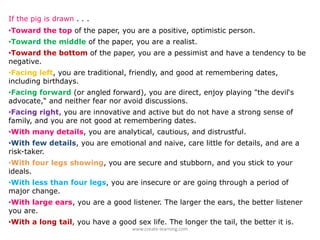
If the pig is drawn . . .
•Toward the top of the paper, you are a positive, optimistic person.
•Toward the middle of the paper, you are a realist.
•Toward the bottom of the paper, you are a pessimist and have a tendency to be
negative.
•Facing left, you are traditional, friendly, and good at remembering dates,
including birthdays.
•Facing forward (or angled forward), you are direct, enjoy playing "the devil‘s
advocate,“ and neither fear nor avoid discussions.
•Facing right, you are innovative and active but do not have a strong sense of
family, and you are not good at remembering dates.
•With many details, you are analytical, cautious, and distrustful.
•With few details, you are emotional and naive, care little for details, and are a
risk-taker.
•With four legs showing, you are secure and stubborn, and you stick to your
ideals.
•With less than four legs, you are insecure or are going through a period of
major change.
•With large ears, you are a good listener. The larger the ears, the better listener
you are.
•With a long tail, you have a good sex life. The longer the tail, the better it is.
                                   www.create‐learning.com
www.create‐learning.com
Detailed Data Discovery

Within the next 15 minutes your objective
  is to;
o Introduce self to team
o Accumulate team data you may choose any area or multiple
  areas to tabulate and illustrate team data

o Compile and translate data into information
  your team will present to others
o Develop a consensus of 1 team goal for our
  time together
o Add 1 more ground rule, if necessary

                                www.create‐learning.com
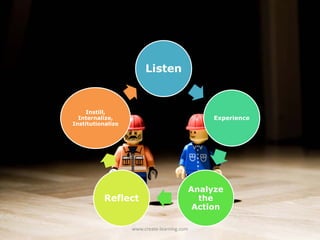
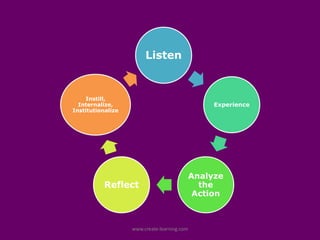
Listen


    Instill,
  Internalize,                                    Experience
Institutionalize


                                             Analyze
           Reflect                             the
                                              Action

                   www.create‐learning.com
When the going gets tough.

The tough get going!

Default to their
highest level of training.


        www.create‐learning.com
Hard Skill Soft Skill
 Write down 5 soft skills you possess, and 5
hard skills you possess, do it fast and don’t let
    anyone else see what you are writing.


                  www.create‐learning.com
?


www.create‐learning.com
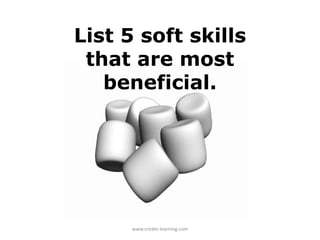
List 5 soft skills
 that are most
   beneficial.


      www.create‐learning.com
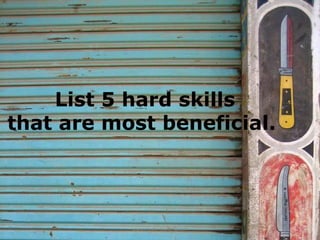
List 5 hard skills 
         that are most 
    List5 hard skills
           beneficial.  
that are most beneficial.


            www.create‐learning.com
www.create‐learning.com
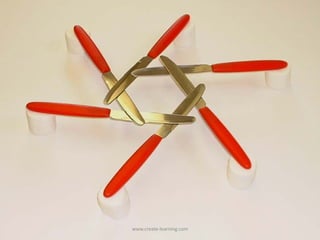
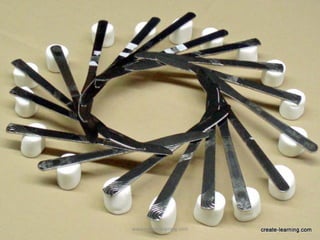
Groups and Teams
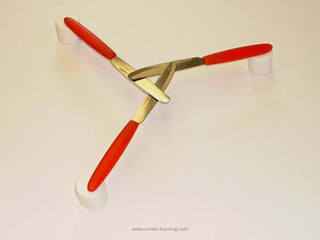
How are the knives (hard skills)
& marshmallows (soft skills)
before construction like a group,

and the same knives (hard skills)
& marshmallows (soft skills)
after construction like a team?


            www.create‐learning.com
www.create‐learning.com
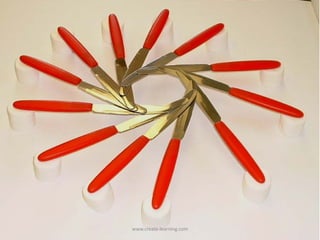
Individually and Cooperatively
What were the differences between
working alone on the first round
and
working together on this second
round?


            www.create‐learning.com
www.create‐learning.com
Small team and Large team

In what ways does team size
affect performance and
interactions?


           www.create‐learning.com
www.create‐learning.com
Static team and Dynamic team

What were some of the key factors that
allowed you to complete each task?

How did your role(s) change as more people
were added to the task?

Which proved to be the most challenging –
Hard Skills (building and technical
knowledge, etc…) or Soft Skills (inter and
intra personal communications, etc…)?

What from this can be applied to your team
& you? How? When?
                 www.create‐learning.com
Listen


    Instill,
  Internalize,                                    Experience
Institutionalize


                                             Analyze
           Reflect                             the
                                              Action


                   www.create‐learning.com
Great
team dynamics
   include ?


        www.create‐learning.com
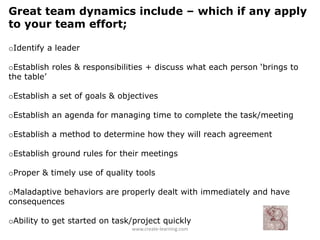
Great team dynamics include – which if any apply
to your team effort;

oIdentify a leader

oEstablish roles & responsibilities + discuss what each person ‘brings to
the table’

oEstablish a set of goals & objectives

oEstablish an agenda for managing time to complete the task/meeting

oEstablish a method to determine how they will reach agreement

oEstablish ground rules for their meetings

oProper & timely use of quality tools

oMaladaptive behaviors are properly dealt with immediately and have
consequences

oAbility to get started on task/project quickly
                               www.create‐learning.com
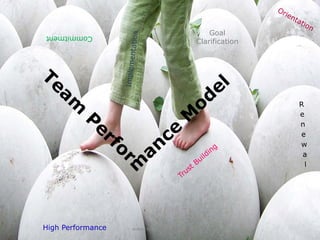
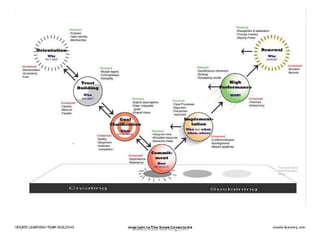
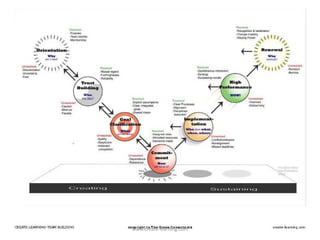
Commitment                                       Goal
                                             Clarification


High Performance   www.create‐learning.com
www.create‐learning.com
Team
Development
     &
 Leadership


  www.create‐learning.com
www.create‐learning.com
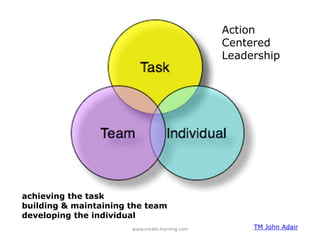
Action
                                                 Centered
                                                 Leadership


achieving the task
building & maintaining the team
developing the individual
                       www.create‐learning.com        TM John Adair
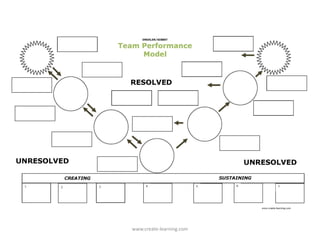
How does the Adair Action
Centered Leadership model
apply to the Team
Performance Model?
Examples. Stories.
www.create‐learning.com
Conversations & Team Norms


     www.create‐learning.com
Strength Envelopes

Purpose:
To create a verbal self-portrait
that incorporates your
strengths (as perceived by
your colleagues).


                          www.create‐learning.com
morale
Shows itself
As a state of mind
Radiating confidence
In people

where each member
Feels sure of his own niche,
Stands on his own abilities
And works out his own solutions
- Knowing he is
Part of a team

where there exists
A sharing of ideas
A freedom to plan
A sureness of worth,
And a knowledge
That help is available
For the asking

to the end that
People grow and mature
Warmed by a friendly climate

-anon

michael cardus is create-learning
         www.create‐learning.com
Credits:
Pig personality ‐ http://www.davidnewsum.co.uk/Newsletters/Pig_personality.pdf
Photo slide 5 ‐ ansik
Photo slide 6‐ i dont make art anymore
Photo slide 7‐ jronaldlee
Photo slide 24 – CarbonNYC
Photo slide 25 ‐ Bascom Hogue
Photos slide 26 ‐ Pink Sherbet Photography
Photo slide 29 – Clark Dever
Photo slide 34 ‐ takomabibelot
Photo slide 35 – normanack
Photo slide 37 ‐ Lee Nachtigal


                                        www.create‐learning.com

Developing & Leading High Performance Teams

  • 1.
  • 2.
    If the pigis drawn . . . •Toward the top of the paper, you are a positive, optimistic person. •Toward the middle of the paper, you are a realist. •Toward the bottom of the paper, you are a pessimist and have a tendency to be negative. •Facing left, you are traditional, friendly, and good at remembering dates, including birthdays. •Facing forward (or angled forward), you are direct, enjoy playing "the devil‘s advocate,“ and neither fear nor avoid discussions. •Facing right, you are innovative and active but do not have a strong sense of family, and you are not good at remembering dates. •With many details, you are analytical, cautious, and distrustful. •With few details, you are emotional and naive, care little for details, and are a risk-taker. •With four legs showing, you are secure and stubborn, and you stick to your ideals. •With less than four legs, you are insecure or are going through a period of major change. •With large ears, you are a good listener. The larger the ears, the better listener you are. •With a long tail, you have a good sex life. The longer the tail, the better it is. www.create‐learning.com
  • 3.
  • 4.
    Detailed Data Discovery Withinthe next 15 minutes your objective is to; o Introduce self to team o Accumulate team data you may choose any area or multiple areas to tabulate and illustrate team data o Compile and translate data into information your team will present to others o Develop a consensus of 1 team goal for our time together o Add 1 more ground rule, if necessary www.create‐learning.com
  • 5.
    Listen Instill, Internalize, Experience Institutionalize Analyze Reflect the Action www.create‐learning.com
  • 6.
    When the goinggets tough. The tough get going! Default to their highest level of training. www.create‐learning.com
  • 7.
    Hard Skill SoftSkill Write down 5 soft skills you possess, and 5 hard skills you possess, do it fast and don’t let anyone else see what you are writing. www.create‐learning.com
  • 8.
  • 9.
    List 5 softskills that are most beneficial. www.create‐learning.com
  • 10.
    List 5 hard skills  that are most  List5 hard skills beneficial.   that are most beneficial. www.create‐learning.com
  • 11.
  • 12.
  • 13.
    Groups and Teams Howare the knives (hard skills) & marshmallows (soft skills) before construction like a group, and the same knives (hard skills) & marshmallows (soft skills) after construction like a team? www.create‐learning.com
  • 14.
  • 15.
  • 16.
    Individually and Cooperatively Whatwere the differences between working alone on the first round and working together on this second round? www.create‐learning.com
  • 17.
  • 18.
  • 19.
    Small team andLarge team In what ways does team size affect performance and interactions? www.create‐learning.com
  • 20.
  • 21.
  • 22.
    Static team andDynamic team What were some of the key factors that allowed you to complete each task? How did your role(s) change as more people were added to the task? Which proved to be the most challenging – Hard Skills (building and technical knowledge, etc…) or Soft Skills (inter and intra personal communications, etc…)? What from this can be applied to your team & you? How? When? www.create‐learning.com
  • 23.
    Listen Instill, Internalize, Experience Institutionalize Analyze Reflect the Action www.create‐learning.com
  • 24.
    Great team dynamics include ? www.create‐learning.com
  • 25.
    Great team dynamicsinclude – which if any apply to your team effort; oIdentify a leader oEstablish roles & responsibilities + discuss what each person ‘brings to the table’ oEstablish a set of goals & objectives oEstablish an agenda for managing time to complete the task/meeting oEstablish a method to determine how they will reach agreement oEstablish ground rules for their meetings oProper & timely use of quality tools oMaladaptive behaviors are properly dealt with immediately and have consequences oAbility to get started on task/project quickly www.create‐learning.com
  • 26.
    Commitment Goal Clarification High Performance www.create‐learning.com
  • 27.
  • 28.
  • 29.
  • 30.
  • 31.
    Team Development & Leadership www.create‐learning.com
  • 32.
  • 33.
    Action Centered Leadership achieving the task building & maintaining the team developing the individual www.create‐learning.com TM John Adair
  • 34.
    How does theAdair Action Centered Leadership model apply to the Team Performance Model? Examples. Stories. www.create‐learning.com
  • 35.
  • 36.
    Conversations & Team Norms www.create‐learning.com
  • 37.
    Strength Envelopes Purpose: To createa verbal self-portrait that incorporates your strengths (as perceived by your colleagues). www.create‐learning.com
  • 38.
    morale Shows itself As astate of mind Radiating confidence In people where each member Feels sure of his own niche, Stands on his own abilities And works out his own solutions - Knowing he is Part of a team where there exists A sharing of ideas A freedom to plan A sureness of worth, And a knowledge That help is available For the asking to the end that People grow and mature Warmed by a friendly climate -anon michael cardus is create-learning www.create‐learning.com
  • 39.
    Credits: Pig personality ‐ http://www.davidnewsum.co.uk/Newsletters/Pig_personality.pdf Photo slide 5 ‐ ansik Photo slide 6‐i dont make art anymore Photo slide 7‐ jronaldlee Photo slide 24 – CarbonNYC Photo slide 25 ‐ Bascom Hogue Photos slide 26 ‐ Pink Sherbet Photography Photo slide 29 – Clark Dever Photo slide 34 ‐ takomabibelot Photo slide 35 – normanack Photo slide 37 ‐ Lee Nachtigal www.create‐learning.com