
Helping Teams Work 5 of 12
Handling Team
Conflict Through
Compromising vs.
Consensus-Seeking
www.create-learning.com
Hello – I’m Mike Cardus of
Create-Learning Team
Building & Leadership. An
expert in creating &
sustaining high
performance teams.
www.create-learning.com
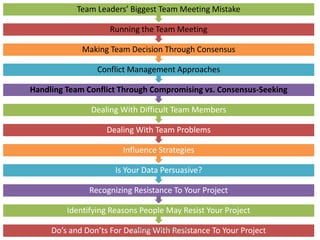
Do’s and Don’ts For Dealing With Resistance To Your Project
Identifying Reasons People May Resist Your Project
Recognizing Resistance To Your Project
Is Your Data Persuasive?
Influence Strategies
Dealing With Team Problems
Dealing With Difficult Team Members
Handling Team Conflict Through Compromising vs. Consensus-Seeking
Conflict Management Approaches
Making Team Decision Through Consensus
Running the Team Meeting
Team Leaders’ Biggest Team Meeting Mistake
www.create-learning.com
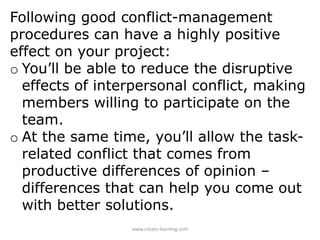
Following good conflict-management
procedures can have a highly positive
effect on your project:
o You’ll be able to reduce the disruptive
effects of interpersonal conflict, making
members willing to participate on the
team.
o At the same time, you’ll allow the task-
related conflict that comes from
productive differences of opinion –
differences that can help you come out
with better solutions.
www.create-learning.com
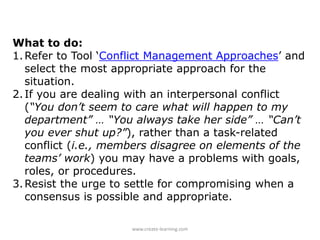
What to do:
1.Refer to Tool ‘Conflict Management Approaches’ and
select the most appropriate approach for the
situation.
2.If you are dealing with an interpersonal conflict
(“You don’t seem to care what will happen to my
department” … “You always take her side” … “Can’t
you ever shut up?”), rather than a task-related
conflict (i.e., members disagree on elements of the
teams’ work) you may have a problems with goals,
roles, or procedures.
3.Resist the urge to settle for compromising when a
consensus is possible and appropriate.
www.create-learning.com
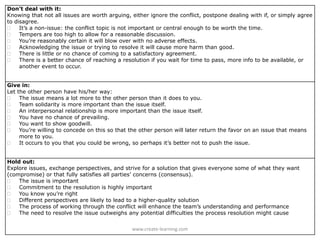
Don’t deal with it:
Knowing that not all issues are worth arguing, either ignore the conflict, postpone dealing with if, or simply agree
to disagree.
 It’s a non-issue: the conflict topic is not important or central enough to be worth the time.
 Tempers are too high to allow for a reasonable discussion.
 You’re reasonably certain it will blow over with no adverse effects.
 Acknowledging the issue or trying to resolve it will cause more harm than good.
 There is little or no chance of coming to a satisfactory agreement.
 There is a better chance of reaching a resolution if you wait for time to pass, more info to be available, or
another event to occur.
Give in:
Let the other person have his/her way:
 The issue means a lot more to the other person than it does to you.
 Team solidarity is more important than the issue itself.
 An interpersonal relationship is more important than the issue itself.
 You have no chance of prevailing.
 You want to show goodwill.
 You’re willing to concede on this so that the other person will later return the favor on an issue that means
more to you.
 It occurs to you that you could be wrong, so perhaps it’s better not to push the issue.
Hold out:
Explore issues, exchange perspectives, and strive for a solution that gives everyone some of what they want
(compromise) or that fully satisfies all parties’ concerns (consensus).
 The issue is important
 Commitment to the resolution is highly important
 You know you’re right
 Different perspectives are likely to lead to a higher-quality solution
 The process of working through the conflict will enhance the team’s understanding and performance
 The need to resolve the issue outweighs any potential difficulties the process resolution might cause
www.create-learning.com
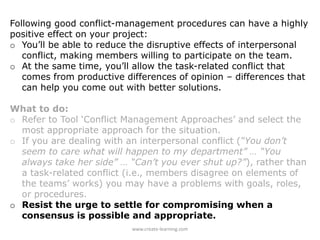
Following good conflict-management procedures can have a highly
positive effect on your project:
o You’ll be able to reduce the disruptive effects of interpersonal
conflict, making members willing to participate on the team.
o At the same time, you’ll allow the task-related conflict that
comes from productive differences of opinion – differences that
can help you come out with better solutions.
What to do:
o Refer to Tool ‘Conflict Management Approaches’ and select the
most appropriate approach for the situation.
o If you are dealing with an interpersonal conflict (“You don’t
seem to care what will happen to my department” … “You
always take her side” … “Can’t you ever shut up?”), rather than
a task-related conflict (i.e., members disagree on elements of
the teams’ works) you may have a problems with goals, roles,
or procedures.
o Resist the urge to settle for compromising when a
consensus is possible and appropriate.
www.create-learning.com
Consensus and Compromise
Many misconceptions haunt both consensus and compromise; it is
not a tool in total agreement among the team, nor is it a type of
voting.
Both are a decision making method where all parties involved have
input on the decision to be made and whatever agreement is reached
will not be sabotaged by the team.
Advantages;
o Full participation by the entire team; involves total involvement of
the team
o Total participation increases buy-in to the decision made
o With input from the total team the ultimate decision is not made
until there is agreement therefore showing buy-in from all team
members.
Disadvantages;
o Necessitating buy-in from the total team may take a longer time
frame
o Final decision made are often “watered down”
www.create-learning.com
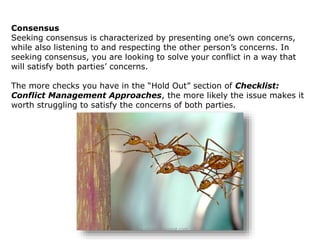
Consensus
Seeking consensus is characterized by presenting one’s own concerns,
while also listening to and respecting the other person’s concerns. In
seeking consensus, you are looking to solve your conflict in a way that
will satisfy both parties’ concerns.
The more checks you have in the “Hold Out” section of Checklist:
Conflict Management Approaches, the more likely the issue makes it
worth struggling to satisfy the concerns of both parties.
www.create-learning.com
Compromising
You give up something to get
something. While the result of
compromising may feel fair to the
parties in conflict, usually one or
both parties had to give up
something that they thought was
important.
Compromise may be the most
expedient way to settle the conflict if
one or more parties can check off
items in the “Don’t deal with it” or
“Give in” section of the Checklist:
Conflict Management
Approaches.
www.create-learning.com
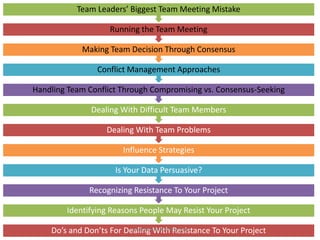
Do’s and Don’ts For Dealing With Resistance To Your Project
Identifying Reasons People May Resist Your Project
Recognizing Resistance To Your Project
Is Your Data Persuasive?
Influence Strategies
Dealing With Team Problems
Dealing With Difficult Team Members
Handling Team Conflict Through Compromising vs. Consensus-Seeking
Conflict Management Approaches
Making Team Decision Through Consensus
Running the Team Meeting
Team Leaders’ Biggest Team Meeting Mistake
www.create-learning.com
Helping Teams Work 5 of 12
Handling Team
Conflict Through
Compromising vs.
Consensus-Seeking
www.create-learning.com

How Teams Work Teamwork Through Consensus or Compromising

  • 1.
    Helping Teams Work5 of 12 Handling Team Conflict Through Compromising vs. Consensus-Seeking www.create-learning.com
  • 2.
    Hello – I’mMike Cardus of Create-Learning Team Building & Leadership. An expert in creating & sustaining high performance teams. www.create-learning.com
  • 3.
    Do’s and Don’tsFor Dealing With Resistance To Your Project Identifying Reasons People May Resist Your Project Recognizing Resistance To Your Project Is Your Data Persuasive? Influence Strategies Dealing With Team Problems Dealing With Difficult Team Members Handling Team Conflict Through Compromising vs. Consensus-Seeking Conflict Management Approaches Making Team Decision Through Consensus Running the Team Meeting Team Leaders’ Biggest Team Meeting Mistake www.create-learning.com
  • 4.
    Following good conflict-management procedurescan have a highly positive effect on your project: o You’ll be able to reduce the disruptive effects of interpersonal conflict, making members willing to participate on the team. o At the same time, you’ll allow the task- related conflict that comes from productive differences of opinion – differences that can help you come out with better solutions. www.create-learning.com
  • 5.
    What to do: 1.Referto Tool ‘Conflict Management Approaches’ and select the most appropriate approach for the situation. 2.If you are dealing with an interpersonal conflict (“You don’t seem to care what will happen to my department” … “You always take her side” … “Can’t you ever shut up?”), rather than a task-related conflict (i.e., members disagree on elements of the teams’ work) you may have a problems with goals, roles, or procedures. 3.Resist the urge to settle for compromising when a consensus is possible and appropriate. www.create-learning.com
  • 6.
    Don’t deal withit: Knowing that not all issues are worth arguing, either ignore the conflict, postpone dealing with if, or simply agree to disagree.  It’s a non-issue: the conflict topic is not important or central enough to be worth the time.  Tempers are too high to allow for a reasonable discussion.  You’re reasonably certain it will blow over with no adverse effects.  Acknowledging the issue or trying to resolve it will cause more harm than good.  There is little or no chance of coming to a satisfactory agreement.  There is a better chance of reaching a resolution if you wait for time to pass, more info to be available, or another event to occur. Give in: Let the other person have his/her way:  The issue means a lot more to the other person than it does to you.  Team solidarity is more important than the issue itself.  An interpersonal relationship is more important than the issue itself.  You have no chance of prevailing.  You want to show goodwill.  You’re willing to concede on this so that the other person will later return the favor on an issue that means more to you.  It occurs to you that you could be wrong, so perhaps it’s better not to push the issue. Hold out: Explore issues, exchange perspectives, and strive for a solution that gives everyone some of what they want (compromise) or that fully satisfies all parties’ concerns (consensus).  The issue is important  Commitment to the resolution is highly important  You know you’re right  Different perspectives are likely to lead to a higher-quality solution  The process of working through the conflict will enhance the team’s understanding and performance  The need to resolve the issue outweighs any potential difficulties the process resolution might cause www.create-learning.com
  • 7.
    Following good conflict-managementprocedures can have a highly positive effect on your project: o You’ll be able to reduce the disruptive effects of interpersonal conflict, making members willing to participate on the team. o At the same time, you’ll allow the task-related conflict that comes from productive differences of opinion – differences that can help you come out with better solutions. What to do: o Refer to Tool ‘Conflict Management Approaches’ and select the most appropriate approach for the situation. o If you are dealing with an interpersonal conflict (“You don’t seem to care what will happen to my department” … “You always take her side” … “Can’t you ever shut up?”), rather than a task-related conflict (i.e., members disagree on elements of the teams’ works) you may have a problems with goals, roles, or procedures. o Resist the urge to settle for compromising when a consensus is possible and appropriate. www.create-learning.com
  • 8.
  • 9.
    Consensus and Compromise Manymisconceptions haunt both consensus and compromise; it is not a tool in total agreement among the team, nor is it a type of voting. Both are a decision making method where all parties involved have input on the decision to be made and whatever agreement is reached will not be sabotaged by the team. Advantages; o Full participation by the entire team; involves total involvement of the team o Total participation increases buy-in to the decision made o With input from the total team the ultimate decision is not made until there is agreement therefore showing buy-in from all team members. Disadvantages; o Necessitating buy-in from the total team may take a longer time frame o Final decision made are often “watered down” www.create-learning.com
  • 10.
    Consensus Seeking consensus ischaracterized by presenting one’s own concerns, while also listening to and respecting the other person’s concerns. In seeking consensus, you are looking to solve your conflict in a way that will satisfy both parties’ concerns. The more checks you have in the “Hold Out” section of Checklist: Conflict Management Approaches, the more likely the issue makes it worth struggling to satisfy the concerns of both parties. www.create-learning.com
  • 11.
    Compromising You give upsomething to get something. While the result of compromising may feel fair to the parties in conflict, usually one or both parties had to give up something that they thought was important. Compromise may be the most expedient way to settle the conflict if one or more parties can check off items in the “Don’t deal with it” or “Give in” section of the Checklist: Conflict Management Approaches. www.create-learning.com
  • 12.
    Do’s and Don’tsFor Dealing With Resistance To Your Project Identifying Reasons People May Resist Your Project Recognizing Resistance To Your Project Is Your Data Persuasive? Influence Strategies Dealing With Team Problems Dealing With Difficult Team Members Handling Team Conflict Through Compromising vs. Consensus-Seeking Conflict Management Approaches Making Team Decision Through Consensus Running the Team Meeting Team Leaders’ Biggest Team Meeting Mistake www.create-learning.com
  • 13.
    Helping Teams Work5 of 12 Handling Team Conflict Through Compromising vs. Consensus-Seeking www.create-learning.com