IT Transformation
Challenges & Choices …


 Indranil Guha
 10th Sep 2012
Key Challenges
   FINANCIAL
    •   Reduced Funding (Budgets)
    •   Balance Spending on “Run” vs “Change”
    •   “Lights-ON”, Secure, Comply, Change
    •   IT is perceived “Expensive” & “Slow”


   TECHNOLOGY
    •   Legacy Infrastructure & Application Systems
    •   Availability, Reliability, Maintainability & Performance
    •   Silo Systems lacking integration
    •   Poor Architecture
    •   Lacks Agility – Says “No” & justifies vs. “Yes” can be done


   PROCESS
    • None or Sub-optimal Processes
    • Lacks Quality & Consistency
    • IT is losing the control and governance


   PEOPLE
    • Technical Skills Brush-up
    • Belief in Process, Initiative Taking & need to Do Things Differently
                                                                             1
New Paradigms Brings New Opportunities
“IT Simplified” & “Blurring Lines”:


   Business - IT JVs- Collaborative; Not Reactive
   CIO & CxO Roles – Enhanced Common Grounds
   Proliferation & Consumerization of IT – BYOD
   New Computing Models – Smarter Applications


 Business (almost) Selects IT Solutions – Impacts
  Architectural Harmony; Security; Performance &
  Sustainability
 Constant Race Against Time – Delays Imply Loss of
  Competitive Edge
 Eroding Budgets; Pressure of Cost Effectiveness – Be
  Efficient & Be Agile !                                 2
Way Forward – Quick Wins

 DISTRACTORS & INHIBITORS
  •   Lights-ON issues?
  •   Too many changes are being implemented?
  •   Doubts on what is being implemented follows an
      architectural blue-print?
  •   Simple routine activities do not follow a well defined
      process?
  •   Is any sort of Enterprise Monitoring available?

 QUICK WINs
     Probably Change Control is a bit slack; Tighten it
     Implement a “good enough” release management
     Come up with an Architectural Blue-Print
     Implement proper processes for key & routine activities
     Ensure monitoring of key CIs & Systems – Manual Check-
      List, if required


                                                                3
Lights-ON Improved Scenario


                              4
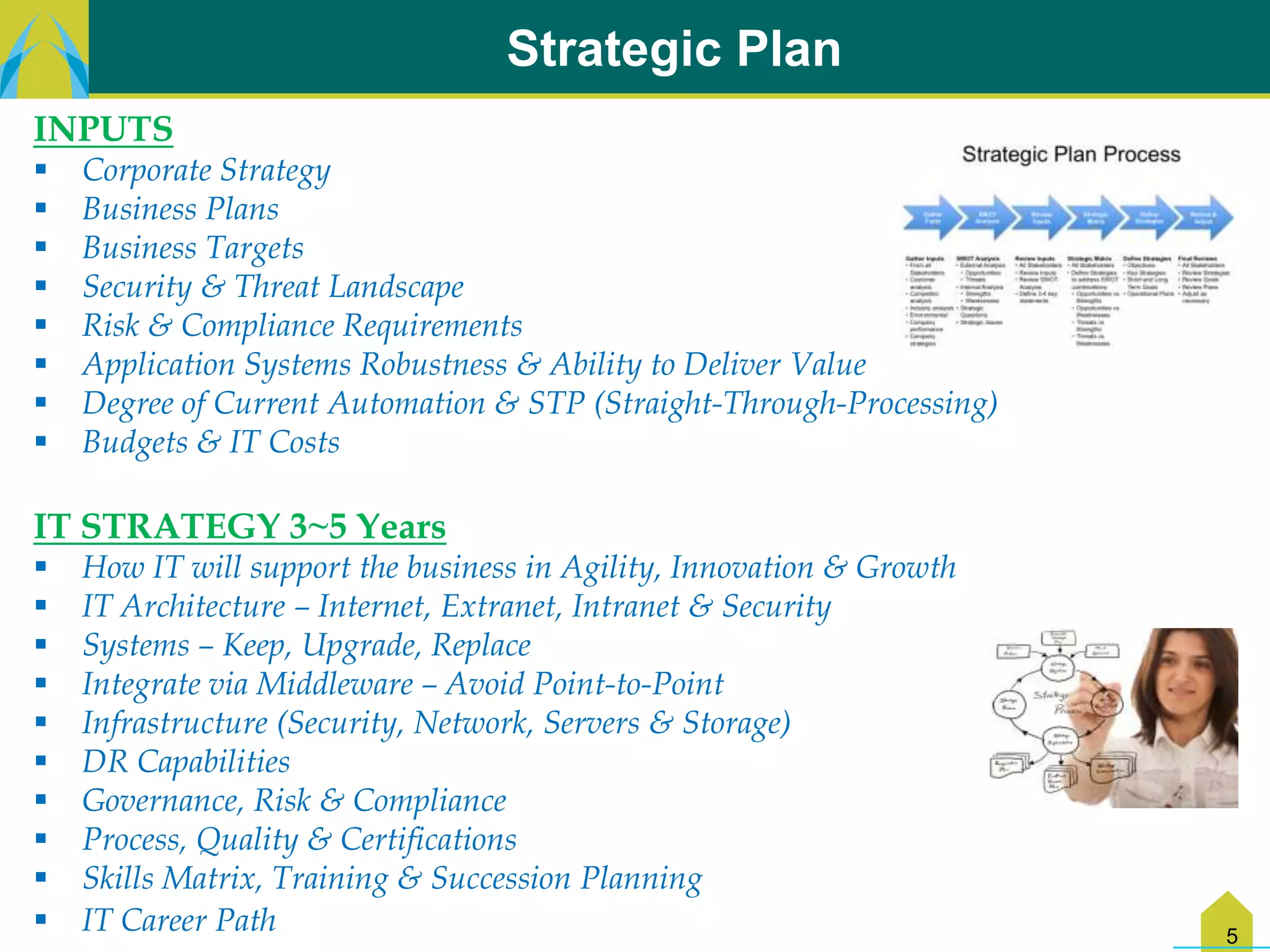
Strategic Plan
INPUTS
   Corporate Strategy
   Business Plans
   Business Targets
   Security & Threat Landscape
   Risk & Compliance Requirements
   Application Systems Robustness & Ability to Deliver Value
   Degree of Current Automation & STP (Straight-Through-Processing)
   Budgets & IT Costs

IT STRATEGY 3~5 Years
   How IT will support the business in Agility, Innovation & Growth
   IT Architecture – Internet, Extranet, Intranet & Security
   Systems – Keep, Upgrade, Replace
   Integrate via Middleware – Avoid Point-to-Point
   Infrastructure (Security, Network, Servers & Storage)
   DR Capabilities
   Governance, Risk & Compliance
   Process, Quality & Certifications
   Skills Matrix, Training & Succession Planning
   IT Career Path                                                     5
Tactical Plan

TACTICAL PLAN 2~3 Years
   Cover Holistic View of People, Process & Technology

   Key Initiatives/Projects Showing Current Pains & Expected Benefits

   Investment Dashboard

 Quarterly Breakdown of Investment Plan


                                                                         6
Risk & Compliance
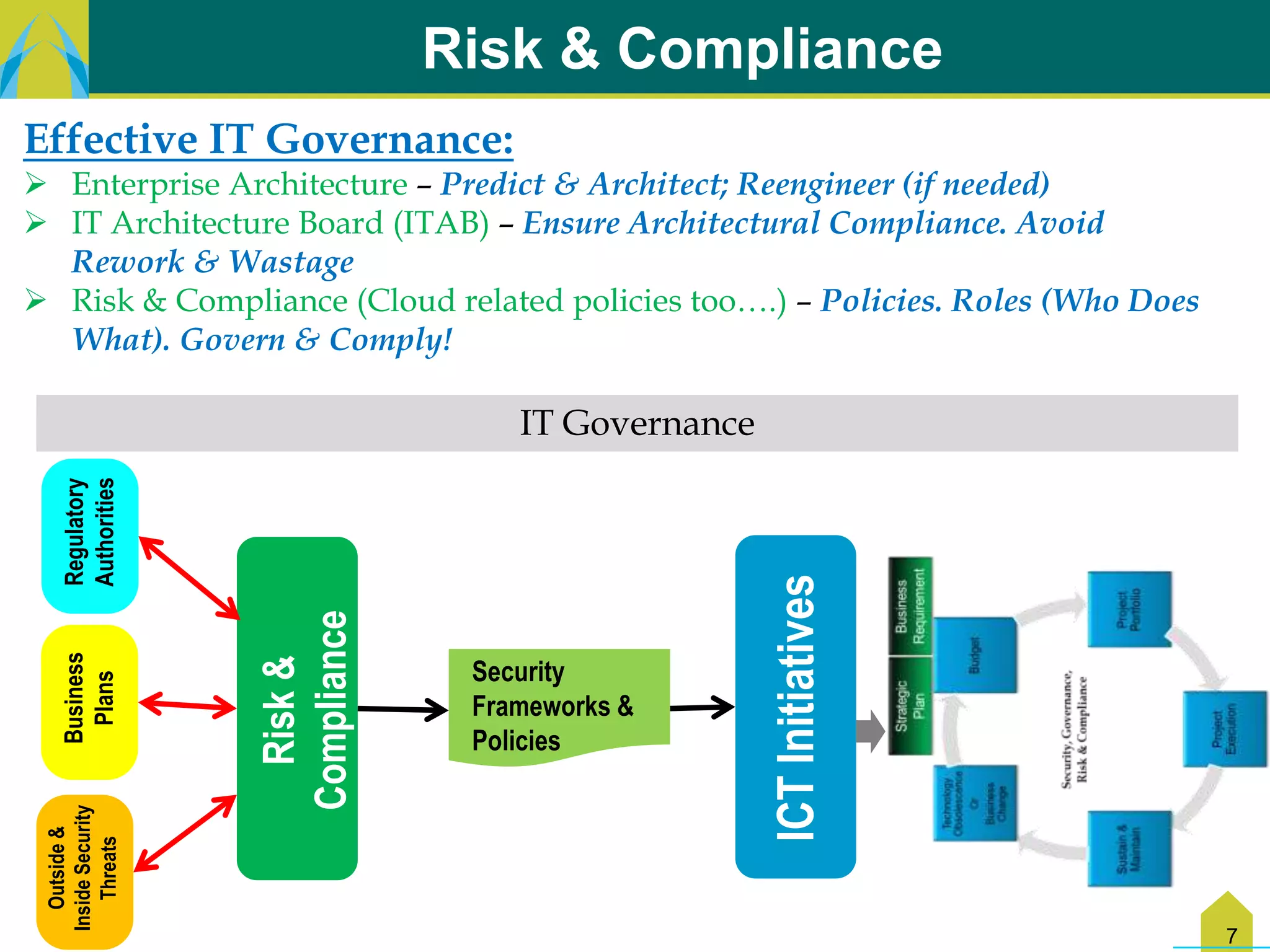
Effective IT Governance:
 Enterprise Architecture – Predict & Architect; Reengineer (if needed)
 IT Architecture Board (ITAB) – Ensure Architectural Compliance. Avoid
  Rework & Wastage
 Risk & Compliance (Cloud related policies too….) – Policies. Roles (Who Does
  What). Govern & Comply!

                                    IT Governance
    Authorities
    Regulatory


                                                    ICT Initiatives
                   Compliance
   Business


                                 Security
                     Risk &
    Plans


                                 Frameworks &
                                 Policies
 Inside Security
    Outside &

     Threats


                                                                                 7
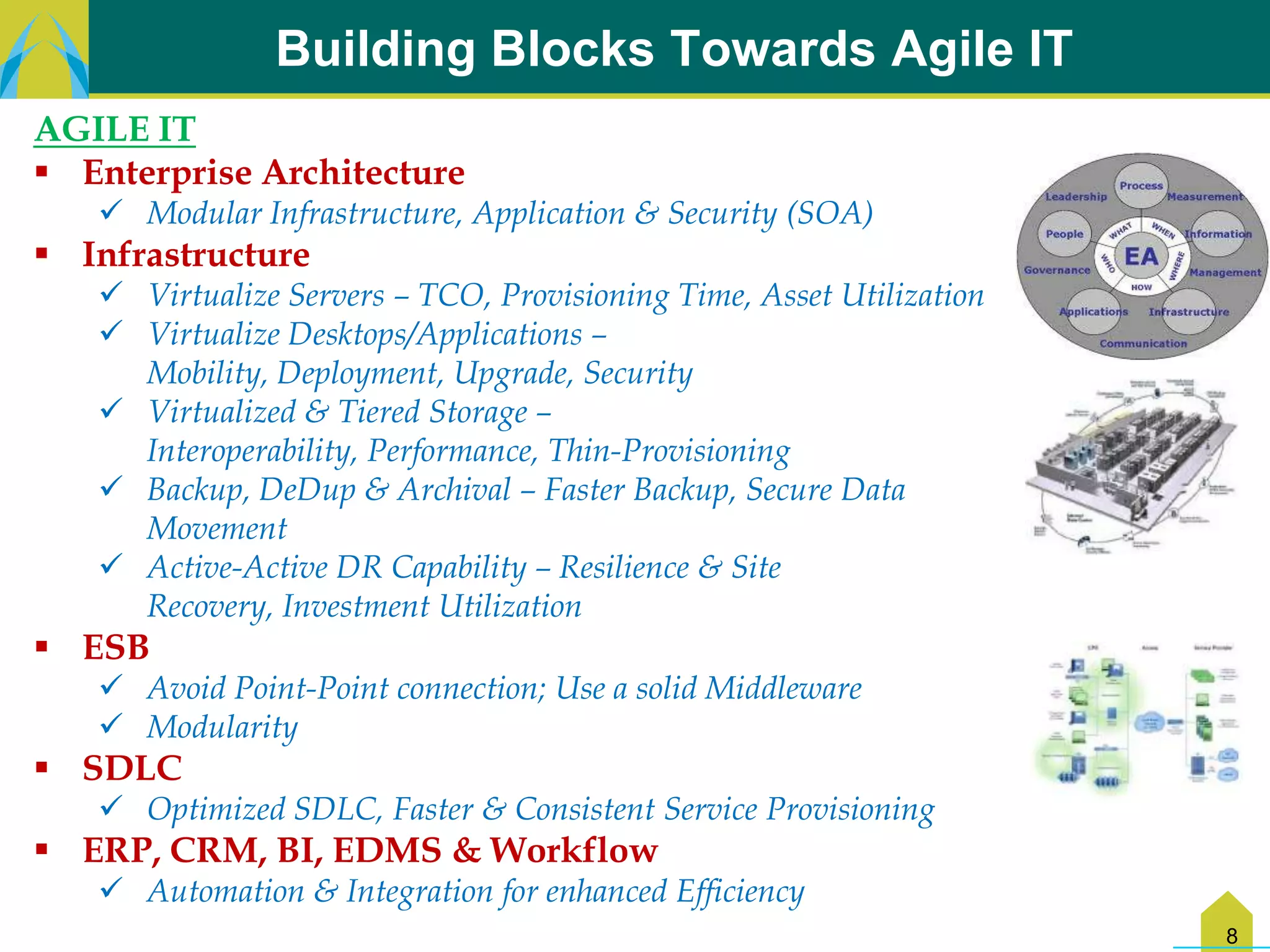
Building Blocks Towards Agile IT
AGILE IT
 Enterprise Architecture
    Modular Infrastructure, Application & Security (SOA)
 Infrastructure
    Virtualize Servers – TCO, Provisioning Time, Asset Utilization
    Virtualize Desktops/Applications –
     Mobility, Deployment, Upgrade, Security
    Virtualized & Tiered Storage –
     Interoperability, Performance, Thin-Provisioning
    Backup, DeDup & Archival – Faster Backup, Secure Data
     Movement
    Active-Active DR Capability – Resilience & Site
     Recovery, Investment Utilization
 ESB
    Avoid Point-Point connection; Use a solid Middleware
    Modularity
 SDLC
    Optimized SDLC, Faster & Consistent Service Provisioning
 ERP, CRM, BI, EDMS & Workflow
    Automation & Integration for enhanced Efficiency
                                                                      8
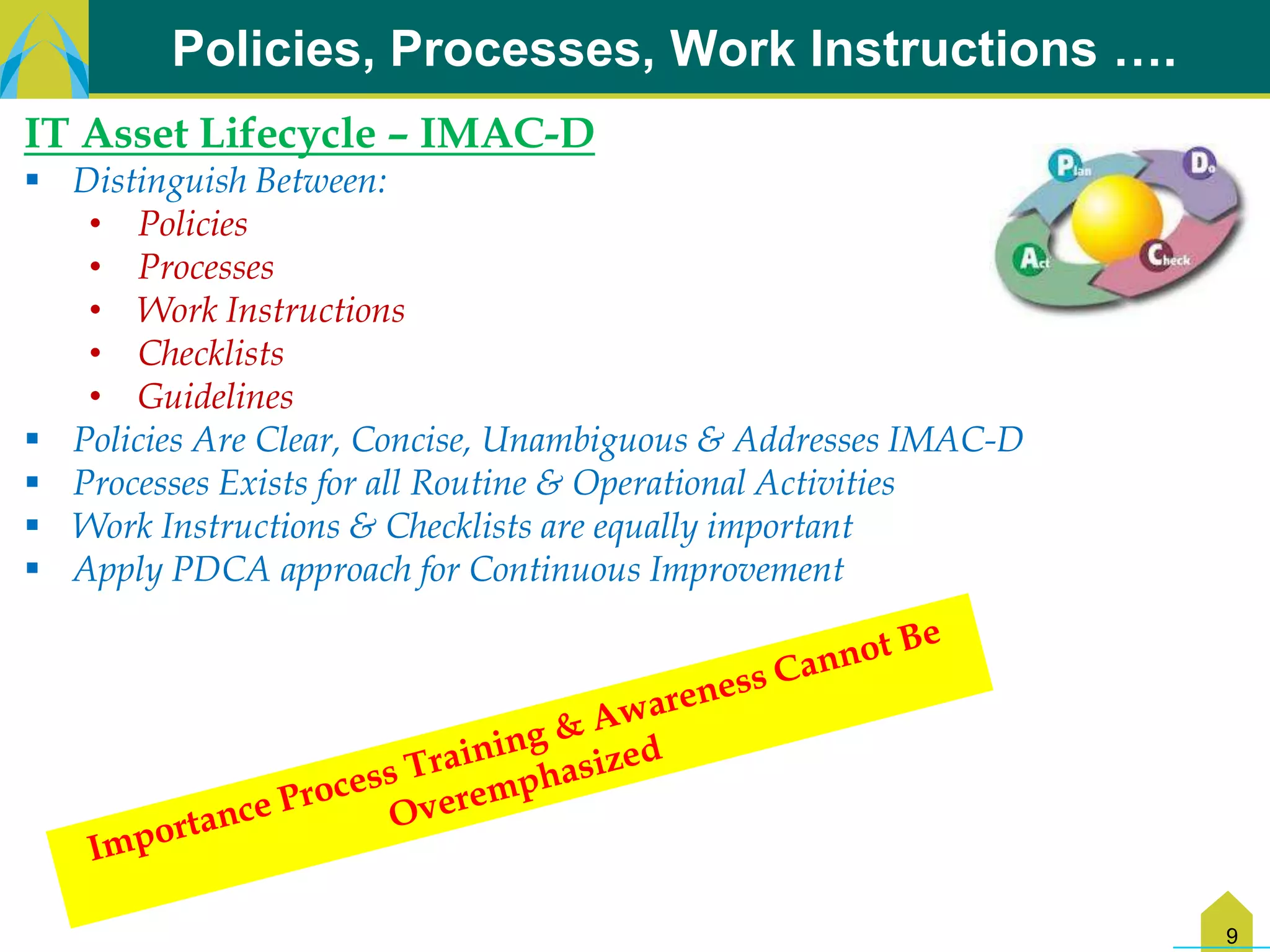
Policies, Processes, Work Instructions ….
IT Asset Lifecycle – IMAC-D
 Distinguish Between:
   • Policies
   • Processes
   • Work Instructions
   • Checklists
   • Guidelines
 Policies Are Clear, Concise, Unambiguous & Addresses IMAC-D
 Processes Exists for all Routine & Operational Activities
 Work Instructions & Checklists are equally important
 Apply PDCA approach for Continuous Improvement


                                                                9
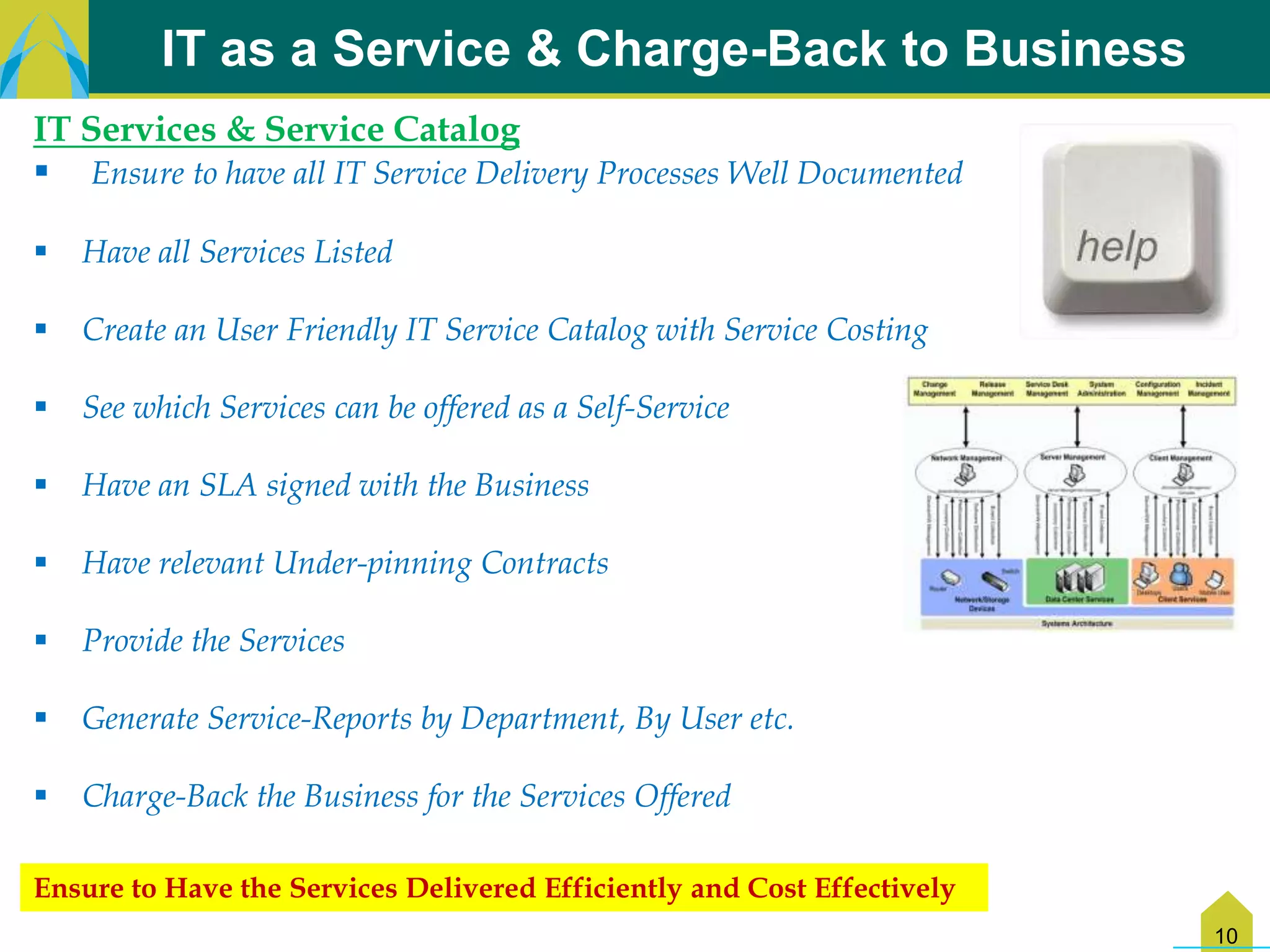
IT as a Service & Charge-Back to Business
IT Services & Service Catalog
 Ensure to have all IT Service Delivery Processes Well Documented

   Have all Services Listed

   Create an User Friendly IT Service Catalog with Service Costing

   See which Services can be offered as a Self-Service

   Have an SLA signed with the Business

   Have relevant Under-pinning Contracts

   Provide the Services

   Generate Service-Reports by Department, By User etc.

   Charge-Back the Business for the Services Offered

Ensure to Have the Services Delivered Efficiently and Cost Effectively
                                                                         10
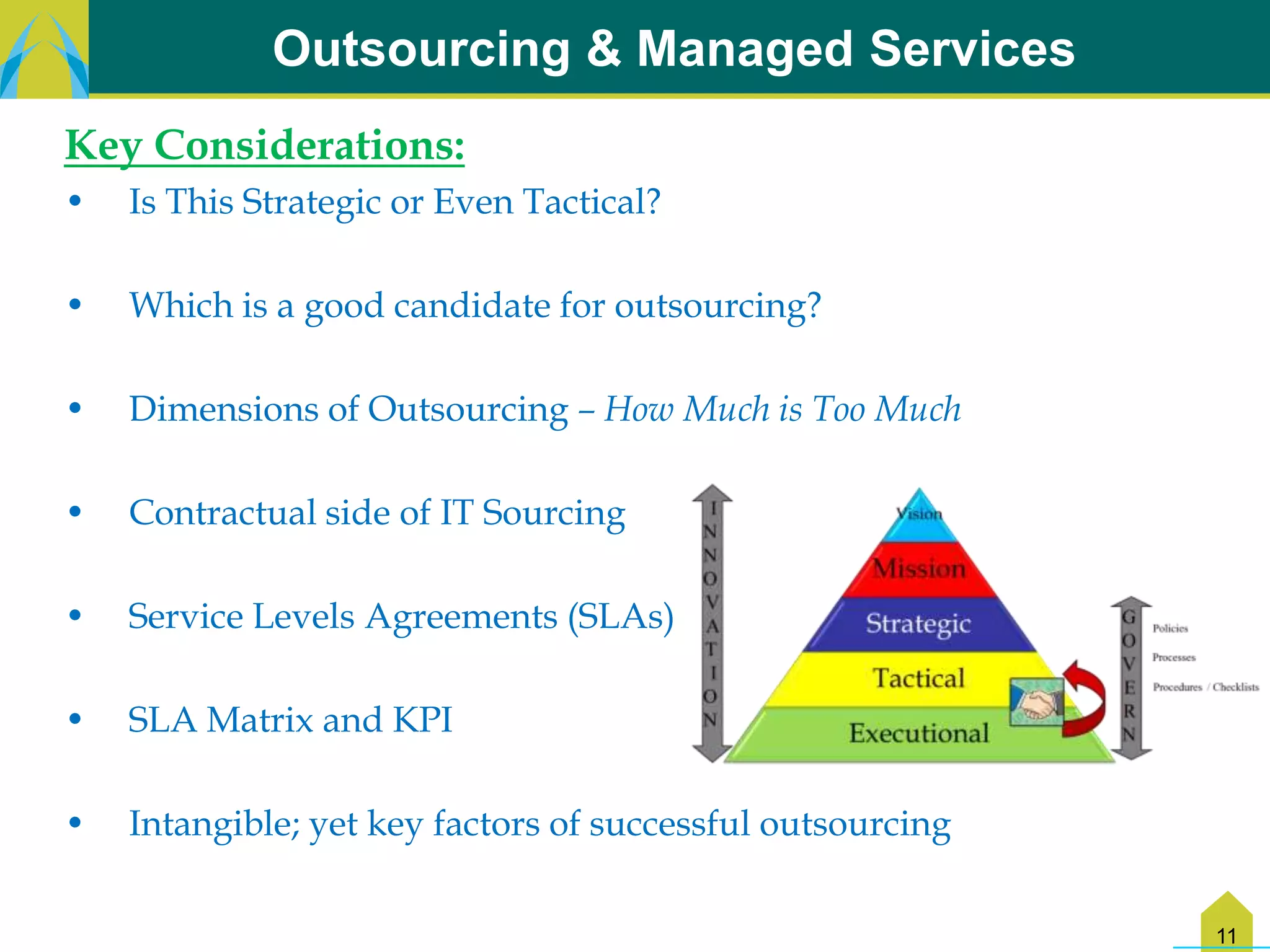
Outsourcing & Managed Services
Key Considerations:
•   Is This Strategic or Even Tactical?

•   Which is a good candidate for outsourcing?

•   Dimensions of Outsourcing – How Much is Too Much

•   Contractual side of IT Sourcing

•   Service Levels Agreements (SLAs)

•   SLA Matrix and KPI

•   Intangible; yet key factors of successful outsourcing


                                                            11
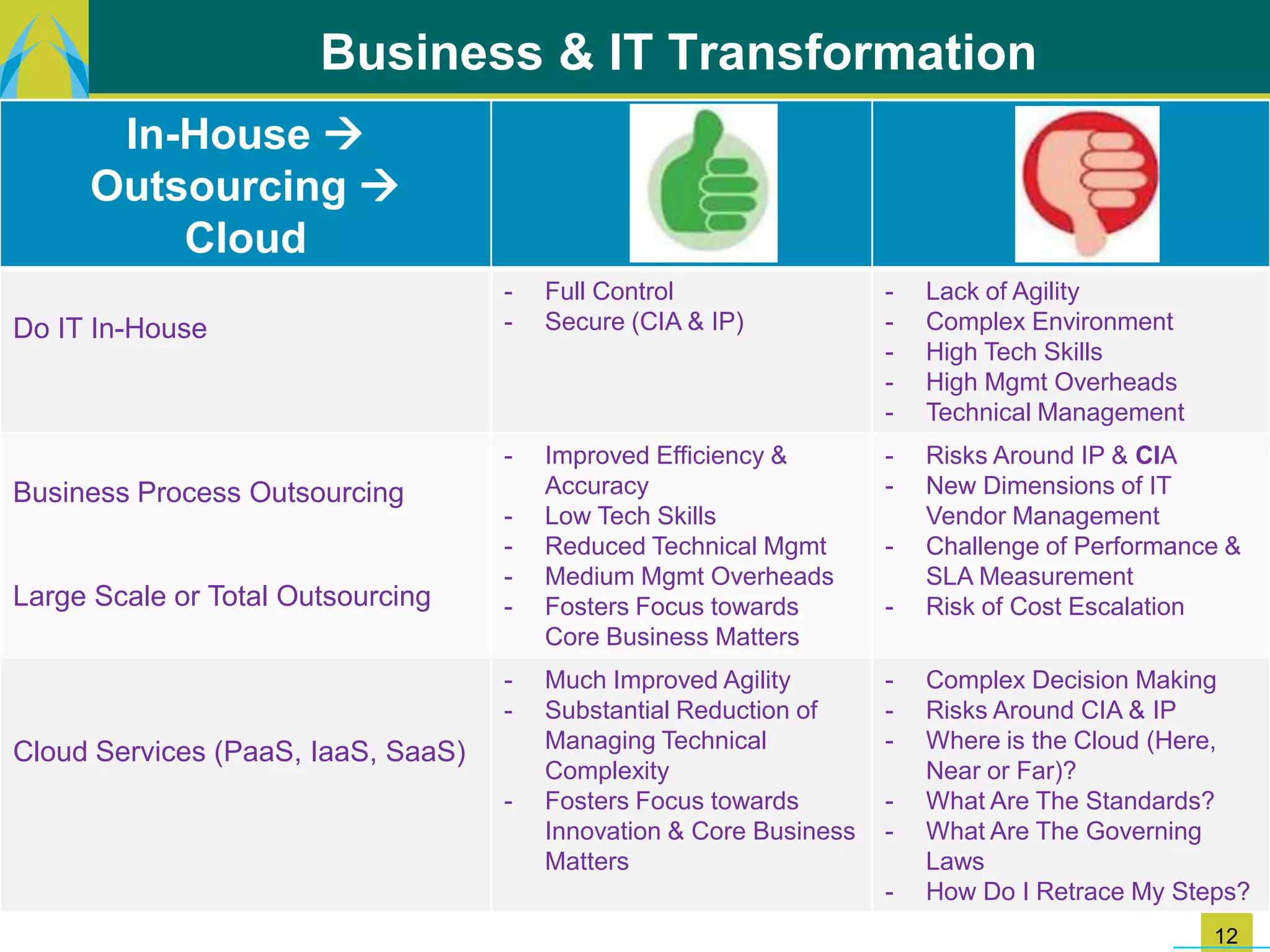
Business & IT Transformation
      In-House 
     Outsourcing 
         Cloud
                                    -   Full Control                 -   Lack of Agility
Do IT In-House                      -   Secure (CIA & IP)            -   Complex Environment
                                                                     -   High Tech Skills
                                                                     -   High Mgmt Overheads
                                                                     -   Technical Management
                                    -   Improved Efficiency &        -   Risks Around IP & CIA
Business Process Outsourcing            Accuracy                     -   New Dimensions of IT
                                    -   Low Tech Skills                  Vendor Management
                                    -   Reduced Technical Mgmt       -   Challenge of Performance &
                                    -   Medium Mgmt Overheads            SLA Measurement
Large Scale or Total Outsourcing    -   Fosters Focus towards        -   Risk of Cost Escalation
                                        Core Business Matters
                                    -   Much Improved Agility        -   Complex Decision Making
                                    -   Substantial Reduction of     -   Risks Around CIA & IP
Cloud Services (PaaS, IaaS, SaaS)       Managing Technical           -   Where is the Cloud (Here,
                                        Complexity                       Near or Far)?
                                    -   Fosters Focus towards        -   What Are The Standards?
                                        Innovation & Core Business   -   What Are The Governing
                                        Matters                          Laws
                                                                     -   How Do I Retrace My Steps?
                                                                                                12
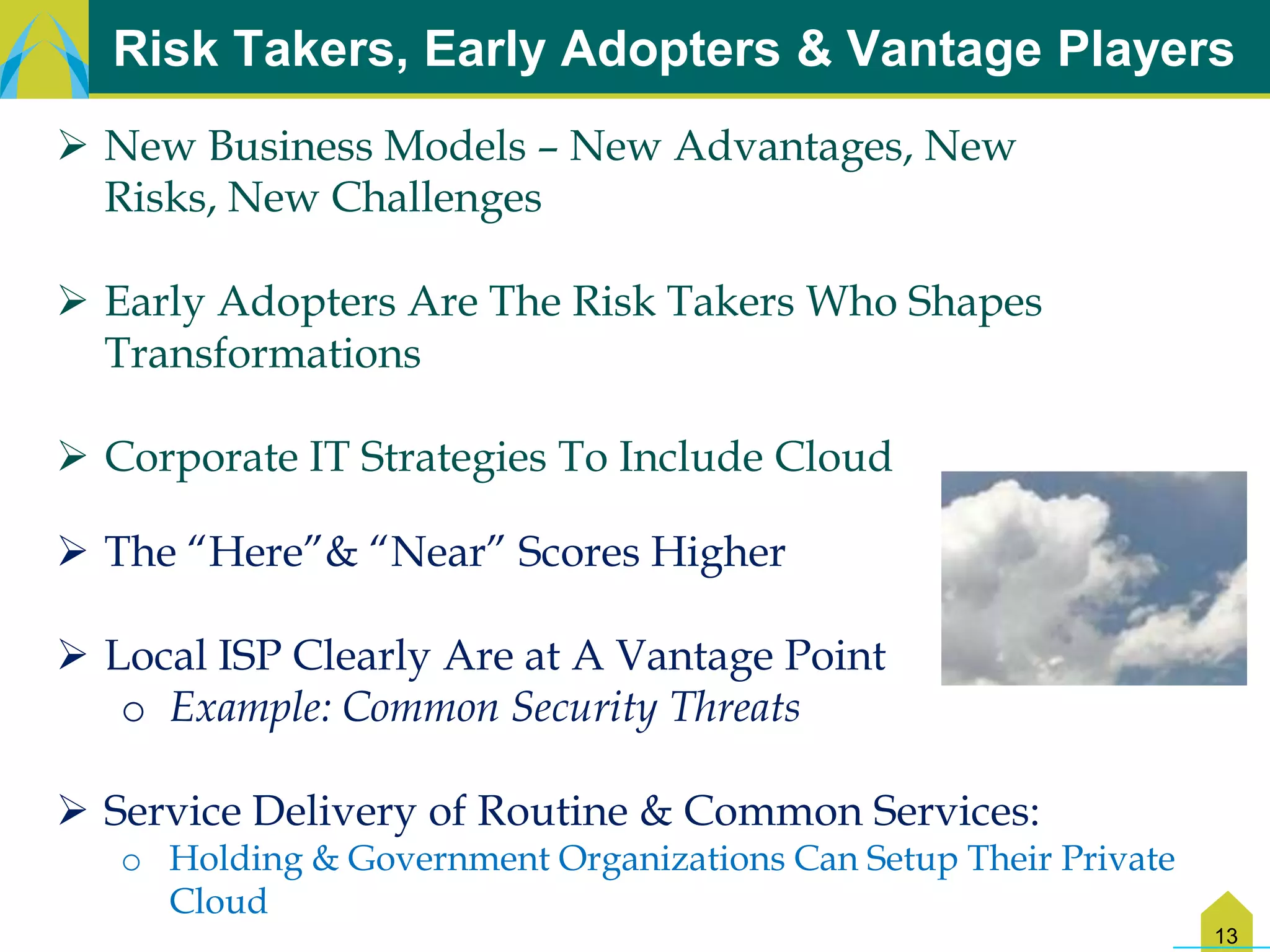
Risk Takers, Early Adopters & Vantage Players
 New Business Models – New Advantages, New
  Risks, New Challenges

 Early Adopters Are The Risk Takers Who Shapes
  Transformations

 Corporate IT Strategies To Include Cloud

 The “Here”& “Near” Scores Higher

 Local ISP Clearly Are at A Vantage Point
   o Example: Common Security Threats

 Service Delivery of Routine & Common Services:
   o Holding & Government Organizations Can Setup Their Private
     Cloud
                                                                  13
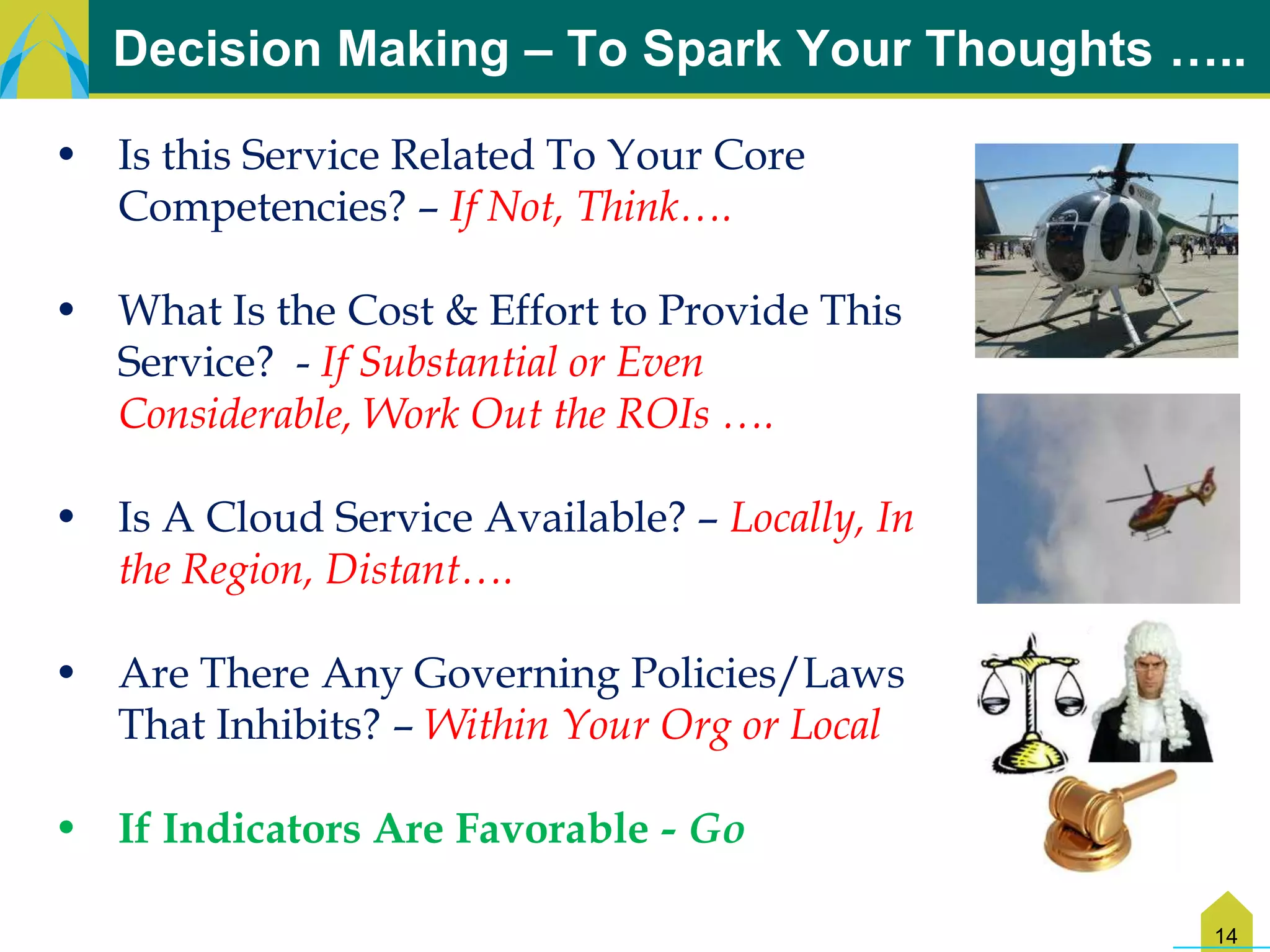
Decision Making – To Spark Your Thoughts …..

• Is this Service Related To Your Core
  Competencies? – If Not, Think….

• What Is the Cost & Effort to Provide This
  Service? - If Substantial or Even
  Considerable, Work Out the ROIs ….

• Is A Cloud Service Available? – Locally, In
  the Region, Distant….

• Are There Any Governing Policies/Laws
  That Inhibits? – Within Your Org or Local

• If Indicators Are Favorable - Go

                                                14
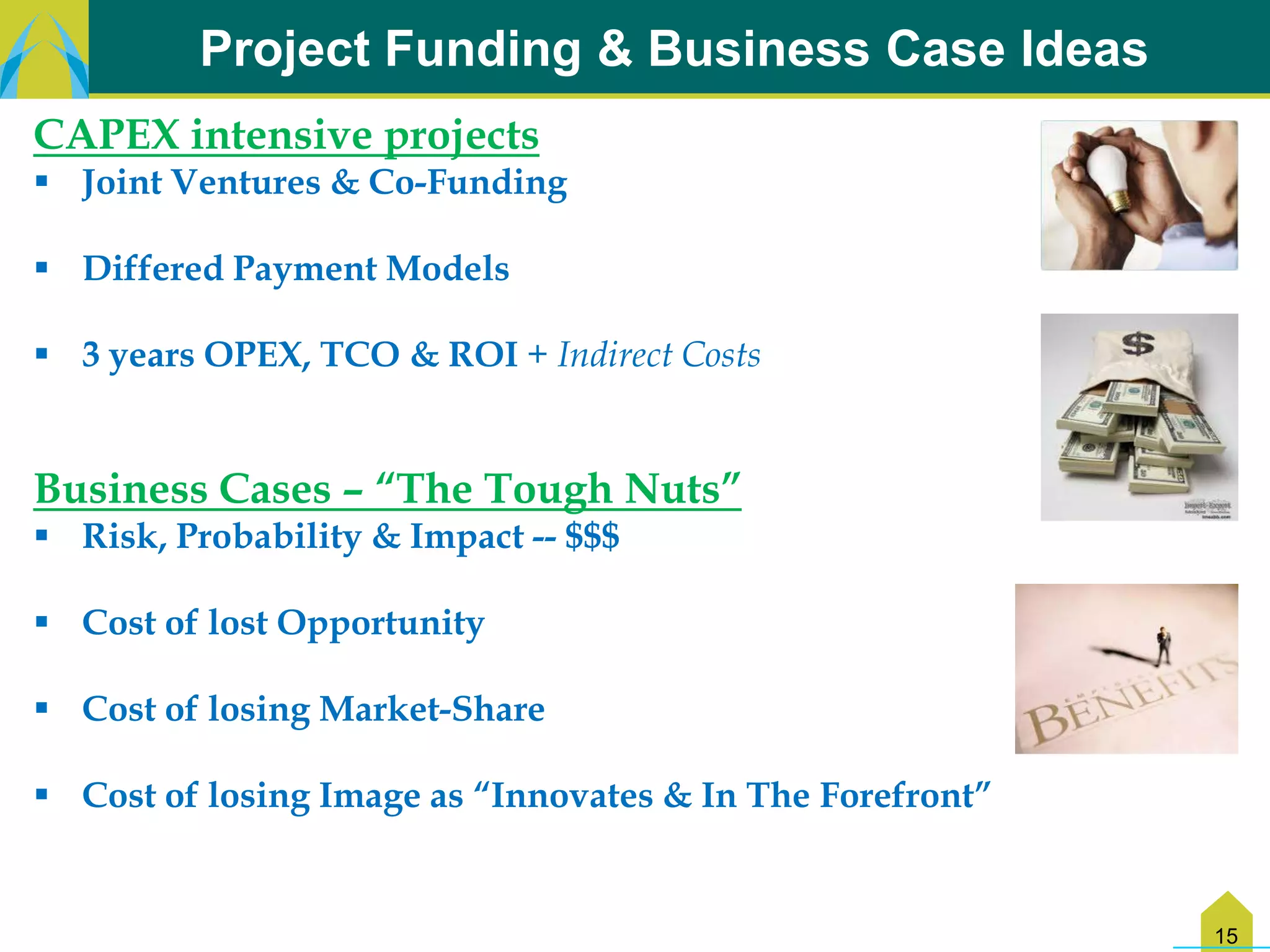
Project Funding & Business Case Ideas
CAPEX intensive projects
 Joint Ventures & Co-Funding

 Differed Payment Models

 3 years OPEX, TCO & ROI + Indirect Costs


Business Cases – “The Tough Nuts”
 Risk, Probability & Impact -- $$$

 Cost of lost Opportunity

 Cost of losing Market-Share

 Cost of losing Image as “Innovates & In The Forefront”


                                                           15
Maturity Models & Certifications
IT Maturity – Evolve your IT
 Reactive – Business decides; IT requirement is conveyed

 Collaborative & Proactive – IT is involved with Business

 Predictive & Influential – IT predicts & influences Business

 Service Oriented & Well Orchestrated – Agile IT

 IT Costs are Charged-Back – IT has to be Competitive

Frameworks, Capability & Quality Certifications
   COBIT
   CMMI
   ITIL
   ISO – Service Management; IT Security, IT Governance


    Business Is Happy; Credibility is Endorsed !!
                                                                 16
Summary of IT Transformation Road Map
 Quick Wins

 Strategic Plans

 Tactical Plans

 IT Risk, Compliance & Governance

 IT Architecture – Simple, Modular, Secure & Future-Proofed

 Agile IT – Infrastructure, Applications, SDLC & Process

 Cloud, Outsource, Co-source, JVs & Insource – Balance IT
  Right

 Service Delivery – Efficient, Optimized & Consistent

 HR Assets – Honed Skills, Motivated & Believes

        Keep All Stakeholders Well Informed
                                                               17
Thank You
indranil.guha@cbd.ae

   Questions?


                       18

Indranil Guha - It transformation challenges & choices...

  • 1.
    IT Transformation Challenges &Choices … Indranil Guha 10th Sep 2012
  • 2.
    Key Challenges  FINANCIAL • Reduced Funding (Budgets) • Balance Spending on “Run” vs “Change” • “Lights-ON”, Secure, Comply, Change • IT is perceived “Expensive” & “Slow”  TECHNOLOGY • Legacy Infrastructure & Application Systems • Availability, Reliability, Maintainability & Performance • Silo Systems lacking integration • Poor Architecture • Lacks Agility – Says “No” & justifies vs. “Yes” can be done  PROCESS • None or Sub-optimal Processes • Lacks Quality & Consistency • IT is losing the control and governance  PEOPLE • Technical Skills Brush-up • Belief in Process, Initiative Taking & need to Do Things Differently 1
  • 3.
    New Paradigms BringsNew Opportunities “IT Simplified” & “Blurring Lines”:  Business - IT JVs- Collaborative; Not Reactive  CIO & CxO Roles – Enhanced Common Grounds  Proliferation & Consumerization of IT – BYOD  New Computing Models – Smarter Applications  Business (almost) Selects IT Solutions – Impacts Architectural Harmony; Security; Performance & Sustainability  Constant Race Against Time – Delays Imply Loss of Competitive Edge  Eroding Budgets; Pressure of Cost Effectiveness – Be Efficient & Be Agile ! 2
  • 4.
    Way Forward –Quick Wins  DISTRACTORS & INHIBITORS • Lights-ON issues? • Too many changes are being implemented? • Doubts on what is being implemented follows an architectural blue-print? • Simple routine activities do not follow a well defined process? • Is any sort of Enterprise Monitoring available?  QUICK WINs  Probably Change Control is a bit slack; Tighten it  Implement a “good enough” release management  Come up with an Architectural Blue-Print  Implement proper processes for key & routine activities  Ensure monitoring of key CIs & Systems – Manual Check- List, if required 3
  • 5.
  • 6.
    Strategic Plan INPUTS  Corporate Strategy  Business Plans  Business Targets  Security & Threat Landscape  Risk & Compliance Requirements  Application Systems Robustness & Ability to Deliver Value  Degree of Current Automation & STP (Straight-Through-Processing)  Budgets & IT Costs IT STRATEGY 3~5 Years  How IT will support the business in Agility, Innovation & Growth  IT Architecture – Internet, Extranet, Intranet & Security  Systems – Keep, Upgrade, Replace  Integrate via Middleware – Avoid Point-to-Point  Infrastructure (Security, Network, Servers & Storage)  DR Capabilities  Governance, Risk & Compliance  Process, Quality & Certifications  Skills Matrix, Training & Succession Planning  IT Career Path 5
  • 7.
    Tactical Plan TACTICAL PLAN2~3 Years  Cover Holistic View of People, Process & Technology  Key Initiatives/Projects Showing Current Pains & Expected Benefits  Investment Dashboard  Quarterly Breakdown of Investment Plan 6
  • 8.
    Risk & Compliance EffectiveIT Governance:  Enterprise Architecture – Predict & Architect; Reengineer (if needed)  IT Architecture Board (ITAB) – Ensure Architectural Compliance. Avoid Rework & Wastage  Risk & Compliance (Cloud related policies too….) – Policies. Roles (Who Does What). Govern & Comply! IT Governance Authorities Regulatory ICT Initiatives Compliance Business Security Risk & Plans Frameworks & Policies Inside Security Outside & Threats 7
  • 9.
    Building Blocks TowardsAgile IT AGILE IT  Enterprise Architecture  Modular Infrastructure, Application & Security (SOA)  Infrastructure  Virtualize Servers – TCO, Provisioning Time, Asset Utilization  Virtualize Desktops/Applications – Mobility, Deployment, Upgrade, Security  Virtualized & Tiered Storage – Interoperability, Performance, Thin-Provisioning  Backup, DeDup & Archival – Faster Backup, Secure Data Movement  Active-Active DR Capability – Resilience & Site Recovery, Investment Utilization  ESB  Avoid Point-Point connection; Use a solid Middleware  Modularity  SDLC  Optimized SDLC, Faster & Consistent Service Provisioning  ERP, CRM, BI, EDMS & Workflow  Automation & Integration for enhanced Efficiency 8
  • 10.
    Policies, Processes, WorkInstructions …. IT Asset Lifecycle – IMAC-D  Distinguish Between: • Policies • Processes • Work Instructions • Checklists • Guidelines  Policies Are Clear, Concise, Unambiguous & Addresses IMAC-D  Processes Exists for all Routine & Operational Activities  Work Instructions & Checklists are equally important  Apply PDCA approach for Continuous Improvement 9
  • 11.
    IT as aService & Charge-Back to Business IT Services & Service Catalog  Ensure to have all IT Service Delivery Processes Well Documented  Have all Services Listed  Create an User Friendly IT Service Catalog with Service Costing  See which Services can be offered as a Self-Service  Have an SLA signed with the Business  Have relevant Under-pinning Contracts  Provide the Services  Generate Service-Reports by Department, By User etc.  Charge-Back the Business for the Services Offered Ensure to Have the Services Delivered Efficiently and Cost Effectively 10
  • 12.
    Outsourcing & ManagedServices Key Considerations: • Is This Strategic or Even Tactical? • Which is a good candidate for outsourcing? • Dimensions of Outsourcing – How Much is Too Much • Contractual side of IT Sourcing • Service Levels Agreements (SLAs) • SLA Matrix and KPI • Intangible; yet key factors of successful outsourcing 11
  • 13.
    Business & ITTransformation In-House  Outsourcing  Cloud - Full Control - Lack of Agility Do IT In-House - Secure (CIA & IP) - Complex Environment - High Tech Skills - High Mgmt Overheads - Technical Management - Improved Efficiency & - Risks Around IP & CIA Business Process Outsourcing Accuracy - New Dimensions of IT - Low Tech Skills Vendor Management - Reduced Technical Mgmt - Challenge of Performance & - Medium Mgmt Overheads SLA Measurement Large Scale or Total Outsourcing - Fosters Focus towards - Risk of Cost Escalation Core Business Matters - Much Improved Agility - Complex Decision Making - Substantial Reduction of - Risks Around CIA & IP Cloud Services (PaaS, IaaS, SaaS) Managing Technical - Where is the Cloud (Here, Complexity Near or Far)? - Fosters Focus towards - What Are The Standards? Innovation & Core Business - What Are The Governing Matters Laws - How Do I Retrace My Steps? 12
  • 14.
    Risk Takers, EarlyAdopters & Vantage Players  New Business Models – New Advantages, New Risks, New Challenges  Early Adopters Are The Risk Takers Who Shapes Transformations  Corporate IT Strategies To Include Cloud  The “Here”& “Near” Scores Higher  Local ISP Clearly Are at A Vantage Point o Example: Common Security Threats  Service Delivery of Routine & Common Services: o Holding & Government Organizations Can Setup Their Private Cloud 13
  • 15.
    Decision Making –To Spark Your Thoughts ….. • Is this Service Related To Your Core Competencies? – If Not, Think…. • What Is the Cost & Effort to Provide This Service? - If Substantial or Even Considerable, Work Out the ROIs …. • Is A Cloud Service Available? – Locally, In the Region, Distant…. • Are There Any Governing Policies/Laws That Inhibits? – Within Your Org or Local • If Indicators Are Favorable - Go 14
  • 16.
    Project Funding &Business Case Ideas CAPEX intensive projects  Joint Ventures & Co-Funding  Differed Payment Models  3 years OPEX, TCO & ROI + Indirect Costs Business Cases – “The Tough Nuts”  Risk, Probability & Impact -- $$$  Cost of lost Opportunity  Cost of losing Market-Share  Cost of losing Image as “Innovates & In The Forefront” 15
  • 17.
    Maturity Models &Certifications IT Maturity – Evolve your IT  Reactive – Business decides; IT requirement is conveyed  Collaborative & Proactive – IT is involved with Business  Predictive & Influential – IT predicts & influences Business  Service Oriented & Well Orchestrated – Agile IT  IT Costs are Charged-Back – IT has to be Competitive Frameworks, Capability & Quality Certifications  COBIT  CMMI  ITIL  ISO – Service Management; IT Security, IT Governance Business Is Happy; Credibility is Endorsed !! 16
  • 18.
    Summary of ITTransformation Road Map  Quick Wins  Strategic Plans  Tactical Plans  IT Risk, Compliance & Governance  IT Architecture – Simple, Modular, Secure & Future-Proofed  Agile IT – Infrastructure, Applications, SDLC & Process  Cloud, Outsource, Co-source, JVs & Insource – Balance IT Right  Service Delivery – Efficient, Optimized & Consistent  HR Assets – Honed Skills, Motivated & Believes Keep All Stakeholders Well Informed 17
  • 19.