(eBook PDF) IT Strategy Issues and PracticesIssues and Practices 3rd
(eBook PDF) IT Strategy Issues and PracticesIssues and Practices 3rd
(eBook PDF) IT Strategy Issues and PracticesIssues and Practices 3rd
(eBook PDF) IT Strategy Issues and PracticesIssues and Practices 3rd
(eBook PDF) IT Strategy Issues and PracticesIssues and Practices 3rd
1.
(eBook PDF) ITStrategy Issues and
PracticesIssues and Practices 3rd download
https://ebooksecure.com/product/ebook-pdf-it-strategy-issues-and-
practicesissues-and-practices-3rd/
Download full version ebook from https://ebooksecure.com
2.
We believe theseproducts will be a great fit for you. Click
the link to download now, or visit ebooksecure.com
to discover even more!
IT Strategy: Issues and Practices 3rd Edition (eBook
PDF)
http://ebooksecure.com/product/it-strategy-issues-and-
practices-3rd-edition-ebook-pdf/
(eBook PDF) Foundation Design Principles and Practices
3rd Edition
http://ebooksecure.com/product/ebook-pdf-foundation-design-
principles-and-practices-3rd-edition/
(eBook PDF) IT Strategy & Innovation 4th Edition By
James D. McKeen
http://ebooksecure.com/product/ebook-pdf-it-strategy-
innovation-4th-edition-by-james-d-mckeen/
Bioethics: Principles, Issues, and Cases 3rd Edition
(eBook PDF)
http://ebooksecure.com/product/bioethics-principles-issues-and-
cases-3rd-edition-ebook-pdf/
3.
(eBook PDF) Readingand Writing About Contemporary
Issues 3rd Edition
http://ebooksecure.com/product/ebook-pdf-reading-and-writing-
about-contemporary-issues-3rd-edition/
Global Health Care: Issues and Policies 3rd Edition
(eBook PDF)
http://ebooksecure.com/product/global-health-care-issues-and-
policies-3rd-edition-ebook-pdf/
(eBook PDF) Corporate Governance: Principles, Policies,
and Practices 3rd Canadian Edition
http://ebooksecure.com/product/ebook-pdf-corporate-governance-
principles-policies-and-practices-3rd-canadian-edition/
(eBook PDF) Managing Information Systems: Strategy and
Organisation 3rd Edition
http://ebooksecure.com/product/ebook-pdf-managing-information-
systems-strategy-and-organisation-3rd-edition/
(eBook PDF) Behavior Modification: What It Is and How
To Do It 11th Edition
http://ebooksecure.com/product/ebook-pdf-behavior-modification-
what-it-is-and-how-to-do-it-11th-edition/
5.
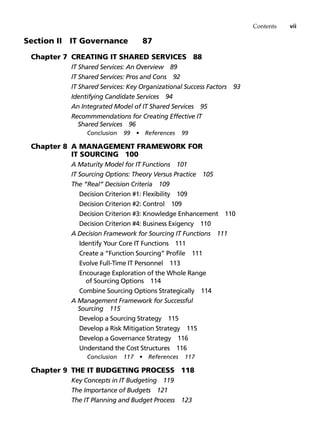
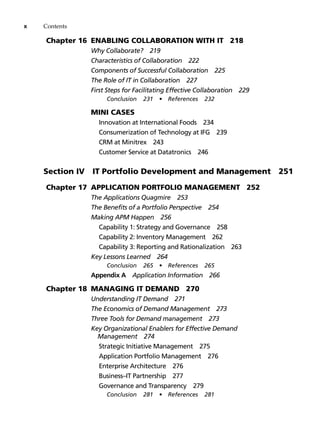
Contents vii
Section II IT Governance 87
Chapter 7 Creating IT Shared Services 88
IT Shared Services: An Overview 89
IT Shared Services: Pros and Cons 92
IT Shared Services: Key Organizational Success Factors 93
Identifying Candidate Services 94
An Integrated Model of IT Shared Services 95
Recommmendations for Creating Effective IT
Shared Services 96
Conclusion 99 • References 99
Chapter 8 A Management Framework for
IT Sourcing 100
A Maturity Model for IT Functions 101
IT Sourcing Options: Theory Versus Practice 105
The “Real” Decision Criteria 109
Decision Criterion #1: Flexibility 109
Decision Criterion #2: Control 109
Decision Criterion #3: Knowledge Enhancement 110
Decision Criterion #4: Business Exigency 110
A Decision Framework for Sourcing IT Functions 111
Identify Your Core IT Functions 111
Create a “Function Sourcing” Profile 111
Evolve Full-Time IT Personnel 113
Encourage Exploration of the Whole Range
of Sourcing Options 114
Combine Sourcing Options Strategically 114
A Management Framework for Successful
Sourcing 115
Develop a Sourcing Strategy 115
Develop a Risk Mitigation Strategy 115
Develop a Governance Strategy 116
Understand the Cost Structures 116
Conclusion 117 • References 117
Chapter 9 The IT Budgeting Process 118
Key Concepts in IT Budgeting 119
The Importance of Budgets 121
The IT Planning and Budget Process 123
6.
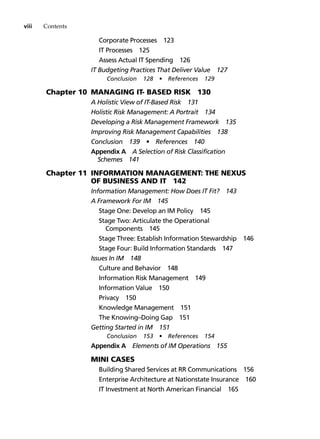
viii Contents
Corporate Processes123
IT Processes 125
Assess Actual IT Spending 126
IT Budgeting Practices That Deliver Value 127
Conclusion 128 • References 129
Chapter 10 Managing IT- Based Risk 130
A Holistic View of IT-Based Risk 131
Holistic Risk Management: A Portrait 134
Developing a Risk Management Framework 135
Improving Risk Management Capabilities 138
Conclusion 139 • References 140
Appendix A A Selection of Risk Classification
Schemes 141
Chapter 11 Information Management: The Nexus
of Business and IT 142
Information Management: How Does It Fit? 143
A Framework For IM 145
Stage One: Develop an IM Policy 145
Stage Two: Articulate the Operational
Components 145
Stage Three: Establish Information Stewardship 146
Stage Four: Build Information Standards 147
Issues In IM 148
Culture and Behavior 148
Information Risk Management 149
Information Value 150
Privacy 150
Knowledge Management 151
The Knowing–Doing Gap 151
Getting Started in IM 151
Conclusion 153 • References 154
Appendix A Elements of IM Operations 155
Mini Cases
Building Shared Services at RR Communications 156
Enterprise Architecture at Nationstate Insurance 160
IT Investment at North American Financial 165
7.
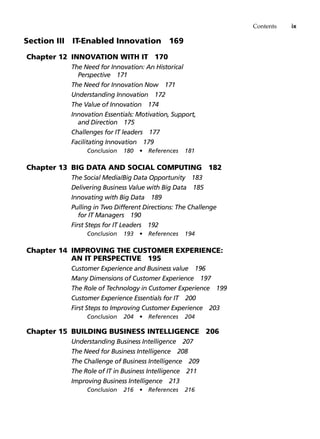
Contents ix
Section III IT-Enabled Innovation 169
Chapter 12 Innovation with IT 170
The Need for Innovation: An Historical
Perspective 171
The Need for Innovation Now 171
Understanding Innovation 172
The Value of Innovation 174
Innovation Essentials: Motivation, Support,
and Direction 175
Challenges for IT leaders 177
Facilitating Innovation 179
Conclusion 180 • References 181
Chapter 13 Big Data and Social Computing 182
The Social Media/Big Data Opportunity 183
Delivering Business Value with Big Data 185
Innovating with Big Data 189
Pulling in Two Different Directions: The Challenge
for IT Managers 190
First Steps for IT Leaders 192
Conclusion 193 • References 194
Chapter 14 Improving the Customer Experience:
An IT Perspective 195
Customer Experience and Business value 196
Many Dimensions of Customer Experience 197
The Role of Technology in Customer Experience 199
Customer Experience Essentials for IT 200
First Steps to Improving Customer Experience 203
Conclusion 204 • References 204
Chapter 15 Building Business Intelligence 206
Understanding Business Intelligence 207
The Need for Business Intelligence 208
The Challenge of Business Intelligence 209
The Role of IT in Business Intelligence 211
Improving Business Intelligence 213
Conclusion 216 • References 216
8.
x Contents
Chapter 16Enabling Collaboration with IT 218
Why Collaborate? 219
Characteristics of Collaboration 222
Components of Successful Collaboration 225
The Role of IT in Collaboration 227
First Steps for Facilitating Effective Collaboration 229
Conclusion 231 • References 232
Mini Cases
Innovation at International Foods 234
Consumerization of Technology at IFG 239
CRM at Minitrex 243
Customer Service at Datatronics 246
Section IV
IT Portfolio Development and Management 251
Chapter 17 Application Portfolio Management 252
The Applications Quagmire 253
The Benefits of a Portfolio Perspective 254
Making APM Happen 256
Capability 1: Strategy and Governance 258
Capability 2: Inventory Management 262
Capability 3: Reporting and Rationalization 263
Key Lessons Learned 264
Conclusion 265 • References 265
Appendix A Application Information 266
Chapter 18 Managing IT Demand 270
Understanding IT Demand 271
The Economics of Demand Management 273
Three Tools for Demand management 273
Key Organizational Enablers for Effective Demand
Management 274
Strategic Initiative Management 275
Application Portfolio Management 276
Enterprise Architecture 276
Business–IT Partnership 277
Governance and Transparency 279
Conclusion 281 • References 281
9.
Contents xi
Chapter 19Creating and Evolving a Technology
Roadmap 283
What is a Technology Roadmap? 284
The Benefits of a Technology Roadmap 285
External Benefits (Effectiveness) 285
Internal Benefits (Efficiency) 286
Elements of the Technology Roadmap 286
Activity #1: Guiding Principles 287
Activity #2: Assess Current Technology 288
Activity #3: Analyze Gaps 289
Activity #4: Evaluate Technology
Landscape 290
Activity #5: Describe Future Technology 291
Activity #6: Outline Migration Strategy 292
Activity #7: Establish Governance 292
Practical Steps for Developing a Technology
Roadmap 294
Conclusion 295 • References 295
Appendix A Principles to Guide a Migration
Strategy 296
Chapter 20 Enhancing Development
Productivity 297
The Problem with System Development 298
Trends in System Development 299
Obstacles to Improving System Development
Productivity 302
Improving System Development Productivity: What we
know that Works 304
Next Steps to Improving System Development
Productivity 306
Conclusion 308 • References 308
Chapter 21 Information Delivery: IT’s Evolving Role 310
Information and IT: Why Now? 311
Delivering Value Through Information 312
Effective Information Delivery 316
New Information Skills 316
New Information Roles 317
New Information Practices 317
10.
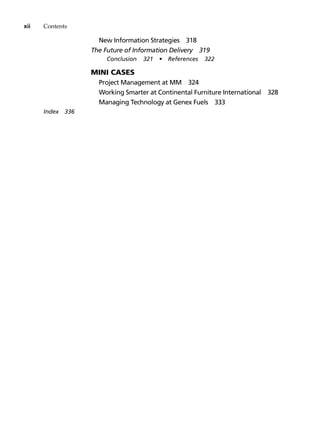
xii Contents
New InformationStrategies 318
The Future of Information Delivery 319
Conclusion 321 • References 322
Mini Cases
Project Management at MM 324
Working Smarter at Continental Furniture International 328
Managing Technology at Genex Fuels 333
Index 336
11.
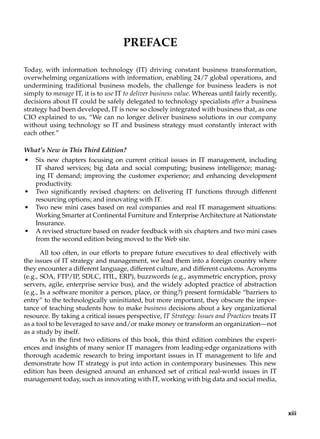
Preface
Today, with informationtechnology (IT) driving constant business transformation,
overwhelming organizations with information, enabling 24/7 global operations, and
undermining traditional business models, the challenge for business leaders is not
simply to manage IT, it is to use IT to deliver business value. Whereas until fairly recently,
decisions about IT could be safely delegated to technology specialists after a business
strategy had been developed, IT is now so closely integrated with business that, as one
CIO explained to us, “We can no longer deliver business solutions in our company
without using technology so IT and business strategy must constantly interact with
each other.”
What’s New in This Third Edition?
• Six new chapters focusing on current critical issues in IT management, including
IT shared services; big data and social computing; business intelligence; manag-
ing IT demand; improving the customer experience; and enhancing development
productivity.
• Two significantly revised chapters: on delivering IT functions through different
resourcing options; and innovating with IT.
• Two new mini cases based on real companies and real IT management situations:
Working Smarter at Continental Furniture and Enterprise Architecture at Nationstate
Insurance.
• A revised structure based on reader feedback with six chapters and two mini cases
from the second edition being moved to the Web site.
All too often, in our efforts to prepare future executives to deal effectively with
the issues of IT strategy and management, we lead them into a foreign country where
they encounter a different language, different culture, and different customs. Acronyms
(e.g., SOA, FTP/IP, SDLC, ITIL, ERP), buzzwords (e.g., asymmetric encryption, proxy
servers, agile, enterprise service bus), and the widely adopted practice of abstraction
(e.g., Is a software monitor a person, place, or thing?) present formidable “barriers to
entry” to the technologically uninitiated, but more important, they obscure the impor-
tance of teaching students how to make business decisions about a key organizational
resource. By taking a critical issues perspective, IT Strategy: Issues and Practices treats IT
as a tool to be leveraged to save and/or make money or transform an organization—not
as a study by itself.
As in the first two editions of this book, this third edition combines the experi-
ences and insights of many senior IT managers from leading-edge organizations with
thorough academic research to bring important issues in IT management to life and
demonstrate how IT strategy is put into action in contemporary businesses. This new
edition has been designed around an enhanced set of critical real-world issues in IT
management today, such as innovating with IT, working with big data and social media,
xiii
12.
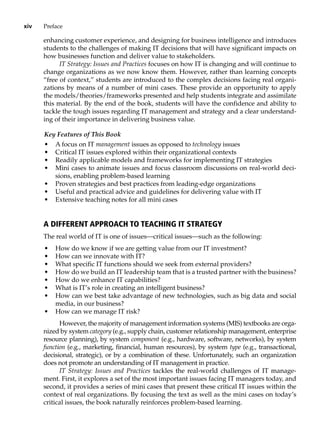
xiv Preface
enhancing customerexperience, and designing for business intelligence and introduces
students to the challenges of making IT decisions that will have significant impacts on
how businesses function and deliver value to stakeholders.
IT Strategy: Issues and Practices focuses on how IT is changing and will continue to
change organizations as we now know them. However, rather than learning concepts
“free of context,” students are introduced to the complex decisions facing real organi-
zations by means of a number of mini cases. These provide an opportunity to apply
the models/theories/frameworks presented and help students integrate and assimilate
this material. By the end of the book, students will have the confidence and ability to
tackle the tough issues regarding IT management and strategy and a clear understand-
ing of their importance in delivering business value.
Key Features of This Book
• A focus on IT management issues as opposed to technology issues
• Critical IT issues explored within their organizational contexts
• Readily applicable models and frameworks for implementing IT strategies
• Mini cases to animate issues and focus classroom discussions on real-world deci-
sions, enabling problem-based learning
• Proven strategies and best practices from leading-edge organizations
• Useful and practical advice and guidelines for delivering value with IT
• Extensive teaching notes for all mini cases
A Different Approach to Teaching IT Strategy
The real world of IT is one of issues—critical issues—such as the following:
• How do we know if we are getting value from our IT investment?
• How can we innovate with IT?
• What specific IT functions should we seek from external providers?
• How do we build an IT leadership team that is a trusted partner with the business?
• How do we enhance IT capabilities?
• What is IT’s role in creating an intelligent business?
• How can we best take advantage of new technologies, such as big data and social
media, in our business?
• How can we manage IT risk?
However, the majority of management information systems (MIS) textbooks are orga-
nized by system category (e.g., supply chain, customer relationship
management, enterprise
resource planning), by system component (e.g., hardware, software,
networks), by system
function (e.g., marketing, financial, human resources), by
system type (e.g., transactional,
decisional, strategic), or by a combination of these. Unfortunately, such an organization
does not promote an understanding of IT management in practice.
IT Strategy: Issues and Practices tackles the real-world challenges of IT manage-
ment. First, it explores a set of the most important issues facing IT managers today, and
second, it provides a series of mini cases that present these critical IT issues within the
context of real organizations. By focusing the text as well as the mini cases on today’s
critical issues, the book naturally reinforces problem-based learning.
13.
Preface xv
IT Strategy:Issues and Practices includes thirteen mini cases—each based on a real
company presented anonymously.1
Mini cases are not simply abbreviated versions of
standard, full-length business cases. They differ in two significant ways:
1. A horizontal perspective. Unlike standard cases that develop a single issue within
an organizational setting (i.e., a “vertical” slice of organizational life), mini cases
take a “horizontal” slice through a number of coexistent issues. Rather than looking
for a solution to a specific problem, as in a standard case, students analyzing a mini
case must first identify and prioritize the issues embedded within the case. This mim-
ics real life in organizations where the challenge lies in “knowing where to start” as
opposed to “solving a predefined problem.”
2. Highly relevant information. Mini cases are densely written. Unlike standard
cases, which intermix irrelevant information, in a mini case, each sentence exists for
a reason and reflects relevant information. As a result, students must analyze each
case very carefully so as not to miss critical aspects of the situation.
Teaching with mini cases is, thus, very different than teaching with standard cases.
With mini cases, students must determine what is really going on within the organiza-
tion. What first appears as a straightforward “technology” problem may in fact be a
political problem or one of five other “technology” problems. Detective work is, there-
fore, required. The problem identification and prioritization skills needed are essential
skills for future managers to learn for the simple reason that it is not possible for organi-
zations to tackle all of their problems concurrently. Mini cases help teach these skills to
students and can balance the problem-solving skills learned in other classes. Best of all,
detective work is fun and promotes lively classroom discussion.
Toassistinstructors,extensiveteachingnotesareavailableforallminicases.Developed
by the authors and based on “tried and true” in-class experience, these notes include case
summaries, identify the key issues within each case, present ancillary
information about the
company/industry represented in the case, and offer guidelines for organizing the class-
room discussion. Because of the structure of these mini cases and their embedded issues, it
is common for teaching notes to exceed the length of the actual mini case!
This book is most appropriate for MIS courses where the goal is to understand how
IT delivers organizational value. These courses are frequently labeled “IT Strategy” or
“IT Management” and are offered within undergraduate as well as MBA programs. For
undergraduate juniors and seniors in business and commerce programs, this is usually
the “capstone” MIS course. For MBA students, this course may be the compulsory core
course in MIS, or it may be an elective course.
Each chapter and mini case in this book has been thoroughly tested in a variety
of undergraduate, graduate, and executive programs at Queen’s School of Business.2
1
We are unable to identify these leading-edge companies by agreements established as part of our overall
research program (described later).
2
Queen’s School of Business is one of the world’s premier business schools, with a faculty team renowned
for its business experience and academic credentials. The School has earned international recognition for
its innovative approaches to team-based and experiential learning. In addition to its highly acclaimed MBA
programs, Queen’s School of Business is also home to Canada’s most prestigious undergraduate business
program and several outstanding graduate programs. As well, the School is one of the world’s largest and
most respected providers of executive education.
14.
xvi Preface
These materialshave proven highly successful within all programs because we adapt
how the material is presented according to the level of the students. Whereas under-
graduate students “learn” about critical business issues from the book and mini cases
for the first time, graduate students are able to “relate” to these same critical issues
based on their previous business experience. As a result, graduate students are able to
introduce personal experiences into the discussion of these critical IT issues.
Organization of This Book
One of the advantages of an issues-focused structure is that chapters can be approached
in any order because they do not build on one another. Chapter order is immaterial; that
is, one does not need to read the first three chapters to understand the fourth. This pro-
vides an instructor with maximum flexibility to organize a course as he or she sees fit.
Thus, within different courses/programs, the order of topics can be changed to focus on
different IT concepts.
Furthermore, because each mini case includes multiple issues, they, too, can be
used to serve different purposes. For example, the mini case “Building Shared Services
at RR Communications” can be used to focus on issues of governance, organizational
structure, and/or change management just as easily as shared services. The result is a
rich set of instructional materials that lends itself well to a variety of pedagogical appli-
cations, particularly problem-based learning, and that clearly illustrates the reality of IT
strategy in action.
The book is organized into four sections, each emphasizing a key component of
developing and delivering effective IT strategy:
• Section I: Delivering Value with IT is designed to examine the complex ways that
IT and business value are related. Over the past twenty years, researchers and prac-
titioners have come to understand that “business value” can mean many
different
things when applied to IT. Chapter 1 (Developing and Delivering on the IT Value
Proposition) explores these concepts in depth. Unlike the simplistic value propo-
sitions often used when implementing IT in organizations, this
chapter
presents
“value” as a multilayered business construct that must be effectively
managed at
several levels if technology is to achieve the benefits expected. Chapter 2 (Developing
IT Strategy for Business Value) examines the dynamic
interrelationship between
business and IT strategy and looks at the processes and critical
success
factors
used by organizations to ensure that both are well aligned. Chapter 3 (Linking IT
to Business Metrics) discusses new ways of measuring IT’s
effectiveness that pro-
mote closer business–IT alignment and help drive greater business value. Chapter
4 (Building a Strong Relationship with the Business) examines the nature of the
business–IT relationship and the characteristics of an effective relationship that
delivers real value to the enterprise. Chapter 5 (Communicating with Business
Managers) explores the business and interpersonal competencies that IT staff will
need in order to do their jobs effectively over the next five to seven years and what
companies should be doing to develop them. Finally, Chapter 6 (Building Better IT
Leaders from the Bottom Up) tackles the increasing need for improved leadership
skills in all IT staff and examines the expectations of the business for strategic and
innovative guidance from IT.
15.
Preface xvii
In themini cases associated with this section, the concepts of delivering
value with IT are explored in a number of different ways. We see business and
IT
executives at Hefty Hardware grappling with conflicting priorities and per-
spectives and how best to work together to achieve the company’s strategy. In
“Investing in TUFS,” CIO Martin Drysdale watches as all of the work his IT depart-
ment has put into a major new system fails to deliver value. And the “IT Planning
at ModMeters” mini case follows CIO Brian Smith’s efforts to create a strategic
IT plan that will align with business strategy, keep IT running, and not increase
IT’s budget.
• Section II: IT Governance explores key concepts in how the IT organization is
structured and managed to effectively deliver IT products and services to the orga-
nization. Chapter 7 (IT Shared Services) discusses how IT shared services should be
selected, organized, managed, and governed to achieve improved organizational
performance. Chapter 8 (A Management Framework for IT Sourcing) examines
how organizations are choosing to source and deliver different types of IT functions
and presents a framework to guide sourcing decisions. Chapter 9 (The IT Budgeting
Process) describes the “evil twin” of IT strategy, discussing how budgeting mecha-
nisms can significantly undermine effective business strategies and suggesting
practices for addressing this problem while maintaining traditional fiscal account-
ability. Chapter 10 (Managing IT-based Risk) describes how many IT organizations
have been given the responsibility of not only managing risk in their own activities
(i.e., project development, operations, and delivering business strategy) but also
of managing IT-based risk in all company activities (e.g., mobile computing, file
sharing, and online access to information and software) and the need for a holistic
framework to understand and deal with risk effectively. Chapter 11 (Information
Management: The Nexus of Business and IT) describes how new organizational
needs for more useful and integrated information are driving the development of
business-oriented functions within IT that focus specifically on information and
knowledge, as opposed to applications and data.
The mini cases in this section examine the difficulties of managing com-
plex IT issues when they intersect substantially with important business issues.
In “Building Shared Services at RR Communications,” we see an IT organiza-
tion in transition from a traditional divisional structure and governance model
to a more centralized enterprise model, and the long-term challenges experi-
enced by CIO Vince Patton in changing both business and IT practices, includ-
ing information management and delivery, to support this new approach. In
“Enterprise Architecture at Nationstate Insurance,” CIO Jane Denton endeavors
to make IT more flexible and agile, while incorporating new and emerging tech-
nologies into its strategy. In “IT Investment at North American Financial,” we
show the opportunities and challenges involved in prioritizing and resourcing
enterprisewide IT projects and monitoring that anticipated benefits are being
achieved.
• Section III: IT-Enabled Innovation discusses some of the ways technology is
being used to transform organizations. Chapter 12 (Innovation with IT) examines
the nature and importance of innovation with IT and describes a typical inno-
vation life cycle. Chapter 13 (Big Data and Social Computing) discusses how IT
leaders are incorporating big data and social media concepts and technologies
16.
xviii Preface
to successfullydeliver business value in new ways. Chapter 14 (Improving the
Customer Experience: An IT Perspective) explores the IT function’s role in creating
and improving an organization’s customer experiences and the role of technology
in helping companies to understand and learn from their customers’ experiences.
Chapter 15 (Building Business Intelligence) looks at the nature of business intelli-
gence and its relationship to data, information, and knowledge and how IT can be
used to build a more intelligent organization. Chapter 16 (Enabling Collaboration
with IT) identifies the principal forms of collaboration used in organizations, the
primary business drivers involved in them, how their business value is measured,
and the roles of IT and the business in enabling collaboration.
The mini cases in this section focus on the key challenges companies face in
innovating with IT. “Innovation at International Foods” contrasts the need for pro-
cess and control in corporate IT with the strong push to innovate with technology
and the difficulties that ensue from the clash of style and culture. “Consumerization
of Technology at IFG” looks at issues such as “bring your own device” (BYOD) to
the workplace. In “CRM at Minitrex,” we see some of the internal technological and
political conflicts that result from a strategic decision to become more customercen-
tric. Finally, “Customer Service at Datatronics” explores the importance of present-
ing unified, customer-facing IT to customers.
• Section IV: IT Portfolio Development and Management looks at how the IT
function must transform itself to be able to deliver business value effectively in
the future. Chapter 17 (Application Portfolio Management) describes the ongoing
management process of categorizing, assessing, and rationalizing the IT application
portfolio. Chapter 18 (Managing IT Demand) looks at the often neglected issue of
demand management (as opposed to supply management), explores the root causes
of the demand for IT services, and identifies a number of tools and enablers to
facilitate more effective demand management. Chapter 19 (Creating and Evolving
a Technology Roadmap) examines the challenges IT managers face in implement-
ing new infrastructure, technology standards, and types of technology in their real-
world business and technical environments, which is composed of a huge variety of
hardware, software, applications, and other technologies, some of which date back
more than thirty years. Chapter 20 (Enhancing Development Productivity) explores
how system development practices are changing and how managers can create
an environment to promote improved development productivity. And Chapter 21
(Information Delivery: IT’s Evolving Role) examines the fresh challenges IT faces in
managing the exponential growth of data and digital assets; privacy and account-
ability concerns; and new demands for access to information on an anywhere, any-
time basis.
The mini cases associated with this section describe many of these themes
embedded within real organizational contexts. “Project Management at MM” mini
case shows how a top-priority, strategic project can take a wrong turn when proj-
ect management skills are ineffective. “Working Smarter at Continental Furniture”
mini case follows an initiative to improve the company’s analytics so it can reduce
its environmental impact. And in the mini case “Managing Technology at Genex
Fuels,” we see CIO Nick Devlin trying to implement enterprisewide technology for
competitive advantage in an organization that has been limping along with obscure
and outdated systems.
17.
Preface xix
Supplementary Materials
OnlineInstructor Resource Center
The following supplements are available online to adopting instructors:
• PowerPoint Lecture Notes
• Image Library (text art)
• Extensive Teaching Notes for all Mini cases
• Additional chapters including Developing IT Professionalism; IT Sourcing; Master
DataManagement;DevelopingITCapabilities;TheIdentityManagementChallenge;
Social Computing; Managing Perceptions of IT; IT in the New World of Corporate
Governance Reforms; Enhancing Customer Experiences with Technology; Creating
Digital Dashboards; and Managing Electronic Communications.
• Additional mini cases, including IT Leadership at MaxTrade; Creating a Process-Driven
Organization at Ag-Credit; Information Management at Homestyle Hotels; Knowledge
Management at Acme Consulting; Desktop Provisioning at CanCredit; and Leveraging
IT Vendors at SleepSmart.
For detailed descriptions of all of the supplements just listed, please visit http://
www.pearsonhighered.com/mckeen.
CourseSmart eTextbooks Online
CourseSmart is an exciting new choice for students looking to save money. As an alter-
native to purchasing the print textbook, students can purchase an electronic version of
the same content and save up to 50 percent off the suggested list price of the print text.
With a CourseSmart etextbook, students can search the text, make notes online, print
out reading assignments that incorporate lecture notes, and bookmark important pas-
sages for later review. www.coursesmart.com.
The Genesis of This Book
Since 1990 we have been meeting quarterly with a group of senior IT managers from
a number of leading-edge organizations (e.g., Eli Lilly, BMO, Honda, HP, CIBC, IBM,
Sears, Bell Canada, MacDonalds, and Sun Life) to identify and discuss critical IT manage-
ment issues. This focus group represents a wide variety of industry sectors (e.g., retail,
manufacturing, pharmaceutical, banking, telecommunications, insurance, media, food
processing, government, and automotive). Originally, it was established to meet the com-
panies’ needs for well-balanced, thoughtful, yet practical information on emerging IT
management topics, about which little or no research was available. However, we soon
recognized the value of this premise for our own research in the rapidly evolving field
of IT management. As a result, it quickly became a full-scale research program in which
we were able to use the focus group as an “early warning system” to document new IT
management issues, develop case studies around them, and explore more collaborative
approaches to identifying trends, challenges, and effective practices in each topic area.3
3
This now includes best practice case studies, field research in organizations, multidisciplinary qualitative
and quantitative research projects, and participation in numerous CIO research consortia.
18.
xx Preface
As weshared our materials with our business students, we realized that this issues-
based approach resonated strongly with them, and we began to incorporate more of our
research into the classroom. This book is the result of our many years’ work with senior
IT managers, in organizations, and with students in the classroom.
Each issue in this book has been selected collaboratively by the focus group after
debate and discussion. As facilitators, our job has been to keep the group’s focus on IT
management issues, not technology per se. In preparation for each meeting, focus group
members researched the topic within their own organization, often involving a number
of members of their senior IT management team as well as subject matter experts in
the process. To guide them, we provided a series of questions about the issue, although
members are always free to explore it as they see fit. This approach provided both struc-
ture for the ensuing discussion and flexibility for those members whose
organizations
are approaching the issue in a different fashion.
The focus group then met in a full-day session, where the members discussed all
aspects of the issue. Many also shared corporate documents with the group. We facilitated
the discussion, in particular pushing the group to achieve a common understanding of
the dimensions of the issue and seeking examples, best practices, and guidelines for deal-
ing with the challenges involved. Following each session, we wrote a report based on the
discussion, incorporating relevant academic and practitioner materials where these were
available. (Because some topics are “bleeding edge,” there is often little traditional IT
research available on them.)
Each report has three parts:
1. A description of the issue and the challenges it presents for both business and IT
managers
2. Models and concepts derived from the literature to position the issue within a con-
textual framework
3. Near-term strategies (i.e., those that can be implemented immediately) that have
proven successful within organizations for dealing with the specific issue
Each chapter in this book focuses on one of these critical IT issues. We have learned
over the years that the issues themselves vary little across industries and organizations,
even in enterprises with unique IT strategies. However, each organization tackles the
same issue somewhat differently. It is this diversity that provides the richness of insight
in these chapters. Our collaborative research approach is based on our belief that when
dealing with complex and leading-edge issues, “everyone has part of the solution.”
Every focus group, therefore, provides us an opportunity to explore a topic from a
variety of perspectives and to integrate different experiences (both successful and oth-
erwise) so that collectively, a thorough understanding of each issue can be developed
and strategies for how it can be managed most successfully can be identified.
19.
About the Authors
JamesD. McKeen is Professor Emeritus at the Queen’s School of Business. He has been
working in the IT field for many years as a practitioner, researcher, and consultant. In
2011, he was named the “IT Educator of the Year” by ComputerWorld Canada. Jim has
taught at universities in the United Kingdom, France, Germany, and the United States.
His research is widely published in a number of leading journals and he is the coau-
thor (with Heather Smith) of five books on IT management. Their most recent book—IT
Strategy: Issues and Practices (2nd ed.)—was the best-selling business book in Canada
(Globe and Mail, April 2012).
Heather A. Smith has been named the most-published researcher on IT management
issues in two successive studies (2006, 2009). A senior research associate with Queen’s
University School of Business, she is the author of five books, the most recent being IT
Strategy: Issues and Practices (Pearson Prentice Hall, 2012). She is also a senior research
associate with the American Society for Information Management’s Advanced Practices
Council. Aformer senior IT manager, she is codirector of the IT Management Forum and
the CIO Brief, which facilitate interorganizational learning among senior IT executives.
In addition, she consults and collaborates with organizations worldwide.
xxi
20.
Acknowledgments
The work containedin this book is based on numerous meetings with many senior IT
managers. We would like to acknowledge our indebtedness to the following individuals
who willingly shared their insights based on their experiences “earned the hard way”:
Michael Balenzano, Sergei Beliaev, Matthias Benfey, Nastaran Bisheban, Peter
Borden, Eduardo Cadena, Dale Castle, Marc Collins, Diane Cope, Dan Di Salvo,
Ken Dschankilic, Michael East, Nada Farah, Mark Gillard, Gary Goldsmith, Ian
Graham, Keiko Gutierrez, Maureen Hall, Bruce Harding, Theresa Harrington,
Tom Hopson, Heather Hutchison, Jim Irich, Zeeshan Khan, Joanne Lafreniere,
Konstantine Liris, Lisa MacKay, Mark O’Gorman, Amin Panjwani, Troy Pariag,
Brian Patton, Marius Podaru, Helen Restivo, Pat Sadler, A. F. Salam, Ashish
Saxena, Joanne Scher, Stewart Scott, Andy Secord, Marie Shafi, Helen Shih, Trudy
Sykes, Bruce Thompson, Raju Uppalapati, Len Van Greuning, Laurie Schatzberg,
Ted Vincent, and Bond Wetherbe.
We would also like to recognize the contribution of Queen’s School of Business
to this work. The school has facilitated and supported our vision of better integrat-
ing academic research and practice and has helped make our collaborative approach
to the study of IT management and strategy an effective model for interorganizational
learning.
James D. McKeen
Kingston, Ontario
Heather A. Smith
School of Business
June 2014
xxii
21.
S ect ionI
Delivering Value with IT
Chapter 1 Developing and Delivering on the IT Value Proposition
Chapter 2 Developing IT Strategy for Business Value
Chapter 3 Linking IT to Business Metrics
Chapter 4 Building a Strong Relationship with the Business
Chapter 5 Communicating with Business Managers
Chapter 6 Building Better IT Leaders from the Bottom Up
Mini Cases
■ Delivering Business Value with IT at Hefty Hardware
■ Investing in TUFS
■ IT Planning at ModMeters
22.
2
C h ap t e r
1 Developing and Delivering
on the IT Value Proposition1
1
This chapter is based on the authors’ previously published article, Smith, H. A., and J. D. McKeen.
“Developing and Delivering on the IT Value Proposition.” Communications of the Association for Information
Systems 11 (April 2003): 438–50. Reproduced by permission of the Association for Information Systems.
I
t’s déjà vu all over again. For at least twenty years, business leaders have been
trying to figure out exactly how and where IT can be of value in their organizations.
And IT managers have been trying to learn how to deliver this value. When IT was
used mainly as a productivity improvement tool in small areas of a business, this was
a
relatively straightforward process. Value was measured by reduced head counts—
usually in clerical areas—and/or the ability to process more transactions per person.
However, as systems grew in scope and complexity, unfortunately so did the risks. Very
few companies escaped this period without making at least a few disastrous invest-
ments in systems that didn’t work or didn’t deliver the bottom-line benefits executives
thought they would. Naturally, fingers were pointed at IT.
With the advent of the strategic use of IT in business, it became even more difficult
to isolate and deliver on the IT value proposition. It was often hard to tell if an invest-
ment had paid off. Who could say how many competitors had been deterred or how
many customers had been attracted by a particular IT initiative? Many companies can
tell horror stories of how they have been left with a substantial investment in new forms
of technology with little to show for it. Although over the years there have been many
improvements in where and how IT investments are made and good controls have been
established to limit time and cost overruns, we are still not able to accurately articulate
and deliver on a value proposition for IT when it comes to anything other than simple
productivity improvements or cost savings.
Problems in delivering IT value can lie with how a value proposition is conceived
or in what is done to actually implement an idea—that is, selecting the right project and
doing the project right (Cooper et al. 2000; McKeen and Smith 2003; Peslak 2012). In
addition, although most firms attempt to calculate the expected payback of an IT invest-
ment before making it, few actually follow up to ensure that value has been achieved or
to question what needs to be done to make sure that value will be delivered.
But whether hewere or were not on a level with his Pachita (and perhaps
the only superiority he possessed over her was his masculine acuteness of
intellect and his learning), it was certain that Don Nicanor seemed at times
a little ashamed of his better half. A concealed observer, stationed at Doña
Aurora’s door and noting first Señor de Rojas and then Señor de Candás,
each accompanied by his wife, as they entered the house on the day in
question, might, from this observation alone, have been able to form a
correct idea of the psychic natures of each of the couples and of the moral
atmosphere of their houses. Rojas offered his arm to his wife as they were
going upstairs, hurried forward to ring the bell, and then stood aside
courteously at the door to allow her to enter first, afterward drawing aside
the portière of the dining-room (where the receptions were once more held).
His manner of seating himself beside her, of associating her with him in his
inquiries for the health of Rogelio’s mother, was full of the same
consideration, the same delicate feeling of reverential familiarity, if I may
say so, and the magistrate, in respecting his partner, showed that he
respected himself. Señor de Candás, on the contrary, entered with the same
want of ceremony as on the other days, and almost left his wife in the
corner where he left his umbrella. One might have thought that Pachita and
her husband were strangers to each other who had met by chance on the
staircase. But further: while Señor de Rojas, conversing with his wife in the
same deferential tone as with Doña Aurora, made no motion to go until
Señora de Rojas gave the customary signal, saying: “When you wish,
Prudencio, we will go home,” Señor de Candás, brusquely cutting short a
harangue of Pacha on the dearness and the rancidness of bacon in Madrid,
said, with the greatest rudeness:
“Eh, Pacha, hold your tongue and come on; it is time for us to go.”
Señor de Candás left the room first, doubtless to show the way to his
wife, who was floundering through the ceremonies of leave-taking, and was
just in time to surprise two persons who were whispering earnestly together
at the further end of the hall. No one could excel the sly Asturian in the art
of appearing not to see what was not meant for him to see, but as for seeing,
carapuche, he saw so much that long after he had quitted the house a smile
still played among the wrinkles of his Voltairian countenance.
25.
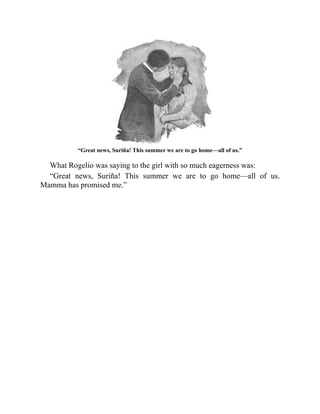
“Great news, Suriña!This summer we are to go home—all of us.”
What Rogelio was saying to the girl with so much eagerness was:
“Great news, Suriña! This summer we are to go home—all of us.
Mamma has promised me.”
26.
XVIII.
Señora de Pardiñaswas now pronounced entirely well, and the
advisability of her going out for a walk was being considered, when one
morning, at the hour when Rogelio had his lecture on Political Economy, an
hour which was unusually early for visitors, Don Nicanor arrived, smiling,
and seemingly in a very good humor. He pretended to be surprised at
finding none of the accustomed visitors there, whereupon Doña Aurora,
who was knitting a woolen stocking, answered with much show of reason
that as it wanted at least two hours to the usual time of their arrival, it was
not strange that none of them had yet come. But apparently Lain Calvo did
not hear this answer, for he had kept his ear trumpet in his pocket, using his
hand as a substitute.
“Tell me, Doña Aurora, have you not noticed something?” he asked,
settling himself comfortably in his easy-chair, whose broad back already
bore the impress of his form.
Doña Aurora raised her eyes with an expression that seemed to say: No
—that is to say, I don’t know. Do me the favor to explain yourself.
“Did you not notice the other day, the day that Pacha and I were here
——”
“Yes, yes; I know—Friday.”
“How dejected the wife of Rojas seemed?”
“Poor woman! She is never very cheerful; but she never seems
discontented, either. She is an excellent woman! As good as gold!”
“Well, she tried hard to conceal her grief, but it was very evident,
especially to those of us who were already aware of the circumstances.”
“Why, what has happened? Have they had any trouble?” asked Señora de
Pardiñas in alarm, for she sincerely esteemed and liked Señora de Rojas.
“Joaquin—the son, the judge—they have transferred him again from one
end of Spain to the others, two months after the first transfer, and just when
his wife is about to be confined. That will convince him that one cannot
play the Quixote here, carapuche. Fancy a young man, who is beginning his
career, making his début by opposing so powerful a chief as Colmenar, who
27.
has at hisback the Minister of the Department. He will soon see, he will
soon see that they are not the people to be trifled with. And he will see, too,
of how much consequence the law is. A judge can be transferred only at his
own instance? Well, put in the royal order, ‘at his own instance,’ and that
settles it. Why, there have been people who were placed on the retired list
‘at their own instance.’ And when they protested, they were told they were
wanting in respect for the Minister.”
“But, Señor Don Nicanor, that is very creditable to the Rojases. It is
evident the young man is of his father’s school. People as upright as that are
seldom seen nowadays. I understand nothing about those things, but I
remember the affair was discussed here, and it was said that they wanted
Joaquin Rojas to be a party to a dreadful piece of dishonesty—a robbery of
——”
“The idea of a jackanapes like that,” continued Lain Calvo, persisting in
his deafness, “wishing to set himself up in opposition to the Minister. The
Rojases are as stubborn as mules. Talis pater—a fanatic the father, a fanatic
the son. That is to say, a still greater fanatic, although that might seem to be
impossible. For the father at least does not get himself into a fix; he adheres
to the letter of the law and that is the end of it. The code says white? White
let it be, then. Does it say black? Then let it be black. Rojas is a machine for
carrying out the law. If the law to flog criminals or to cut off their ears were
still in force, Rojas would himself go about seeing it carried into execution.
But the boy! Because he has read a few trashy German and Italian books,
translated into worse gibberish, he plays the learned man and the phi-los-o-
pher. A judge a phi-los-o-pher! Fancy! What pretentiousness!”
“Well, for my part,” protested Doña Aurora, without raising her voice,
for she knew how much faith to put in the Crown Solicitor’s deafness, “I
think that in every situation in life a man should behave himself with
dignity and propriety. For that reason I have a great deal of sympathy for
the Rojases.”
“And as a natural consequence,” continued Lain Calvo, “they are very
straitened in their circumstances. They never light a fire in that house, they
eat only the plainest food, they drink no coffee. The salary is not enough to
meet the expenses of moving from one place to another; he has married a
girl without a penny, and as soon as things come to a crisis the young
gentleman will lower his tone. Necessity teaches more than all the
28.
universities put together.They will tame him yet. He will be as soft as a
glove before the year is over.”
Convinced that she would gain nothing by argument, Doña Aurora went
on narrowing the heel of her stocking, contenting herself with shaking her
head in dissent from time to time, for her quick temper would not allow her
to listen quietly to the spiteful remarks of the malicious Asturian.
“We all begin life with the idea that we are going to reform the world,”
he went on, “but very soon we take in our sails. Oh, yes, we soon take in
our sails. Or if we do not, we lead a miserable existence. You will see that
the storm that has caught Joaquin will reach his father also. It is brewing for
him. Before the year is out they will give him a lesson he won’t forget.
They cannot transfer him? They will superannuate him, then. I am no lover
of the past like Don Gaspar and the others, but I must acknowledge that in
my day politics had less to do with the magistracy than it has now. That is
the way things come and that is how we must take them. Those gentlemen
are always in the clouds, carapuche. Complete fools! The new generation
understand things better. I am the only one of our circle who lives in the
world. If it were not for this cursed deafness——”
“Don’t come to me with stories about your deafness,” protested Señora
de Pardiñas. “God deliver me from deaf people like you. You hear more
than you ought to hear. Give over your nonsense with me, eh? I wasn’t born
in the year of the fools.”
“And the craziest of them all,” continued Lain, pretending not to have
heard, “is the worthy Don Gaspar. He is a perfect simpleton. He has gone
back to his childhood. We shall have to give him a nurse, or at the least a
maid to take care of him. That is what he wants, and that is what he sighs
for, and he is trying to steal away from you the one you have chosen for
your boy. I am speaking in earnest; as sure as my name is Nicanor he is
crazy for your maid, for Esclava, or whatever her name is. No boy of
twenty could be more desperately in love than he is with her. I am certain
that Rogelio is not half so deeply smitten.”
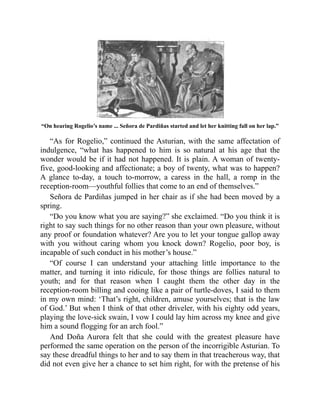
On hearing Rogelio’s name, and observing the tone in which it was
uttered by Candás, Señora de Pardiñas started, and let her knitting fall on
her lap.
29.
“On hearing Rogelio’sname ... Señora de Pardiñas started and let her knitting fall on her lap.”
“As for Rogelio,” continued the Asturian, with the same affectation of
indulgence, “what has happened to him is so natural at his age that the
wonder would be if it had not happened. It is plain. A woman of twenty-
five, good-looking and affectionate; a boy of twenty, what was to happen?
A glance to-day, a touch to-morrow, a caress in the hall, a romp in the
reception-room—youthful follies that come to an end of themselves.”
Señora de Pardiñas jumped in her chair as if she had been moved by a
spring.
“Do you know what you are saying?” she exclaimed. “Do you think it is
right to say such things for no other reason than your own pleasure, without
any proof or foundation whatever? Are you to let your tongue gallop away
with you without caring whom you knock down? Rogelio, poor boy, is
incapable of such conduct in his mother’s house.”
“Of course I can understand your attaching little importance to the
matter, and turning it into ridicule, for those things are follies natural to
youth; and for that reason when I caught them the other day in the
reception-room billing and cooing like a pair of turtle-doves, I said to them
in my own mind: ‘That’s right, children, amuse yourselves; that is the law
of God.’ But when I think of that other driveler, with his eighty odd years,
playing the love-sick swain, I vow I could lay him across my knee and give
him a sound flogging for an arch fool.”
And Doña Aurora felt that she could with the greatest pleasure have
performed the same operation on the person of the incorrigible Asturian. To
say these dreadful things to her and to say them in that treacherous way, that
did not even give her a chance to set him right, for with the pretense of his
30.
deafness, he mightassert what he chose regardless of all that might be said
either in denial or disproof of his words. It was enough to make one’s blood
boil with rage. It was a stupid, shameless, insufferable jest. And was she
going to let it pass? No, indeed. Señora de Pardiñas’s anger was aroused;
the blood boiled in her veins. “Hypocrite! liar! fire-brand! tale-bearer! fox!”
she said to the Asturian in her own mind. “Now I am going to settle
accounts with you.” She rose from her chair, went up quickly to him, put
her hand in the pocket of his coat with the dexterity of a professional
pickpocket, and took from it the case which contained his ear-trumpet. And
before the astonished Lain Calvo could make a movement to defend
himself, Doña Aurora had taken the silver tube out of its case, introduced it
into his ear, and screamed with all her might:
“Whenever you talk to me in future, either use your trumpet or else
make up your mind to hear what I say in answer to you. All that about
Rogelio and Esclava is the suggestion of your own vile thoughts, do you
hear? My boy is not in the habit of flirting with his mother’s servants, do
you hear? People are not so loose and so shameless in their conduct as you
try to make them out to be, do you hear? do you hear? And decent people
are not the same as villains, do you hear? And I am not so great a simpleton,
listen well to what I say, that such things could take place under my very
nose without my seeing them. And malicious people are not to my taste, do
you hear? For I always think of the saying, ‘Ill-doers, ill-deemers,’ do you
hear?”
Her philippic ended, she let herself fall on the sofa, agitated and
unstrung, while the Asturian, putting both his hands up to his bald crown,
exclaimed in distressed accents:
“Carapuche, Aurorina, you have broken the drum of my ear. Another
such outbreak as that and you would leave me deaf.”
31.
XIX.
But no soonerhad the hypocritical Lain Calvo taken his departure than
Doña Aurora, whose agitation had now subsided, and in whose mind anger
had given place to reflection, scratched her head with her knitting needle, as
was her habit, and put to herself the question invariably suggested by
mistrust.—“And why should it not be true?” Without the need of any great
perspicacity, without possessing the Crown Solicitor’s evil-mindedness, her
own good sense suggested to her that such proverbs as, ‘Fire and tow,’ etc.,
were not without foundation. And by a natural process of reasoning, based
on common sense, Señora de Pardiñas arrived at a conclusion exactly the
reverse of her first conviction, and accused herself of being simple-minded
and credulous, because not only the possibility but the probability also of so
obvious a result had not occurred to her until it had been maliciously
brought to her notice by a stranger, when it was her duty to have foreseen
the danger. “We mothers make the mistake of thinking that boys will always
remain boys,” she said to herself, “and time passes, and they become men
without their mustaches waiting for our permission to grow. When we don’t
imagine they are still children we go to the opposite extreme and think that
they are old men, and ought to have as much sense as we have ourselves—
another absurdity, another mistake. Youth will have what belongs to it, and
it is a folly to shut our eyes to it. The worst of it here is that we have the
enemy within our very gates. And it was I myself who admitted her. I
opened the door and invited her in. Besides putting myself in a humiliating
and unbecoming position, I have placed the temptation in his way and
increased the seriousness of the consequences that may follow—and how
serious they may be! Of course I never supposed that Rogelio was going to
live all his life like a saint, but this—here, in the very house——”
Another scratching of the head suggested to her the logical counterpoise
to these reflections. “It is very likely that that vile old man may have
slandered my boy and poor Esclava merely for the pleasure of slandering. I
am not so easily deceived where birds of that feather are in question, and it
was precisely on account of her modest and serious appearance that I took a
liking to Esclava. It is true her family antecedents are not in her favor, and
that she has bad blood on both sides, but in that—in that one is sometimes
32.
apt to begreatly mistaken; people are not like peppers, that grow good or
bad according to the seed they spring from. No, there is only one course to
be pursued here—to observe, to be on the alert, and to provide some outside
distraction for the boy. I will be guided by circumstances. I am not going to
commit the cruelty of turning the girl away without a word of warning. If
all this should turn out to be only stories of Don Nicanor, I should have it
on my conscience. And if it is the truth, the lad might rebel and we should
have a fine time. These first fancies are apt to be very violent with boys. I
must proceed with caution. Aurora, imagine that you are a policeman, and
that they have set you to track a crime. Keep your eyes open, be prudent,
and suspect everything.”
Never was programme more literally carried out. Señora de Pardiñas
occupied herself from that very instant in making up for lost time. In
proportion as she had been trusting and credulous before, did she become
incredulous and mistrusting from the moment when suspicion first suddenly
laid its cold touch upon her. She watched them adroitly, without betraying
her suspicions or allowing her uneasiness to be perceived. In every woman,
in the most innocent and frankest even, there is the germ of the detective.
The habits of dissimulation, practiced from childhood, make it easy for her
to play the part. In order not to awaken suspicion, Doña Aurora resolved to
exercise her surveillance over one only of the supposed criminals. And,
indeed, in the circumstances it cannot be denied that watching Esclavita it
was unnecessary to watch Rogelio. And this was what Señora de Pardiñas
did. Making use of her indisputable right she studied, without a moment’s
cessation, every action, every step, every movement of her servant. She
knew at what hour she awoke in the morning, what she did when she arose,
how often and with what object she entered Rogelio’s room; how she spent
the afternoon; in what way she was occupied when there were visitors;
when she retired for the night, and when she put the light out. And it must
be confessed that at first this espionage was absolutely without result.
Esclavita, when she left the room, attended at once to the making of the
chocolate, and afterward to her toilet, which was simple; she did not even
arrange her hair in the coil at the back of the head which is the only
adornment indulged in by the domestics of Madrid. She put Rogelio’s study
and bed-room in order while he was at college or out walking; she never
entered either room when he was there. Esclavita never went out on
Sundays except to go to church, consequently Rogelio did not go out either.
33.
During the receptionsRogelio did not stir from his corner on the sofa, nor
the girl from her basket of mending, except to open the door. And the
evenings, which, unless some college friend came to see him, Rogelio spent
reading the magazines or at the theater, Esclavita spent in her room sewing
or doing some other work for herself. There was nothing in all this to arouse
suspicion, and Señora de Pardiñas would have slept with a tranquil mind if
her powers of observation had been of a more vulgar order.
But she was not a woman to let pass unnoticed certain things,
insignificant in appearance, but in reality very significant and even alarming
for a suspicious mother—loose threads which her maternal perspicacity
divined to belong to a tangled skein. These indications, signs or guides for
the investigations of the watchful mother, were something of the following
nature: At breakfast, when Esclava brought Rogelio his pills or his syrup of
iron, or when she handed him some favorite dish, there passed between
them (and it would have been useless to try to persuade Doña Aurora to the
contrary, for she had seen it only too well) an exchange of glances, at times
languishing and sentimental, at times flashing and ardent. When Esclavita
went to open the door at Rogelio’s ring she showed an eagerness which she
was very far from showing when it was one of the tiresome old men who
rang the bell; it was evident that she recognized the Señorito’s ring, and
even the sound of his step upon the stairs. When Esclavita was ironing
Rogelio’s linen, she took the greatest possible pains with it, and this sign
was also observable in the manner in which she arranged his room and
waited on him at the table. Sometimes, when Rogelio was going out of an
evening, the girl would be in the hall and they would exchange a few
words, but always in so low a tone that it was impossible to catch what they
said; the same thing happened when Rogelio came in from college in the
morning, if Doña Aurora did not chance to be in the reception-room at the
time. Finally, and this last was the most significant sign of all, Rogelio had,
on two or three occasions, objected to accompanying his mother when she
went out, and although he always finally yielded, it was with much
grumbling and evident dissatisfaction.
This was all Señora de Pardiñas perceived, but this was enough and
more than enough to keep her in a state of constant anxiety, and to inspire
her with an ardent desire to put an end, in the quietest way possible, to this
ambiguous situation, and to unwind the skein which threatened otherwise to
become, with time, an inextricable tangle. She did not dare to stir from the
34.
house lest sheshould thus afford them dangerous opportunities. Such a
course may be followed for a time, but it cannot be continued through a
whole winter without arousing suspicion. Rogelio had already, on several
occasions, manifested much surprise at the discontinuance of the morning
drives. “Mater,” he said to her jestingly, “we are soon destined to witness
grave disturbances if you persist in your seclusion, disdaining the gilded
chariots that wait impatiently to receive you at the foot of our palace walls,
that, reclining luxuriously on their embroidered cushions, you may resume
your accustomed matutinal drives. An imposing demonstration is being
organized in which ten thousand of the most distinguished Phætons are to
take part; discourses in the sweet tongue of the troubadour Macías and the
eloquent jargon of Duke Pelayo are to be pronounced. Martin the Buloniu
and José the Cabaleiro are to speak. The government has adopted
precautionary measures and the affair will come off in the tavern.”
When the habitués of the house learned of Doña Aurora’s seclusion,
they, too, felt themselves obliged to enter their protest against it on hygienic
grounds. “Friend Aurora, you must not give way to indolence. Take care
how you create humors that may afterward give you trouble. Look at me, I
owe my good health and my cheerful spirits to my habit of never letting a
day pass without walking a certain distance. Less than a league will not thin
the blood. Since the accident to my foot I walk more than that.” This advice
came from the worthy Nuño Rasura. “Exercise is very necessary,” added
Señor de Rojas, with his accustomed sententiousness, “for the body, and, if
it goes to that, for the mind as well. Walking, the mind is diverted. There is
nothing like a little walk, and if one finds it tiresome, why one can count the
stones, or the trees, or the numbers on the houses.” These counsels at last
put Doña Aurora out of patience. “People have a sort of mania for giving
advice without knowing what is the matter or where the shoe pinches,” she
said to herself. “These gentlemen seem determined on having happen here
what shouldn’t happen. That intermeddler, Don Nicanor, is right in saying
that they all live in the clouds.”
Doña Aurora, however, was not long in convincing herself that her plan
of remaining always at home was impracticable, and it irritated her to think
that perhaps she was taking unnecessary trouble, for the inclination of the
young people for each other did not seem so strong as to justify all these
35.
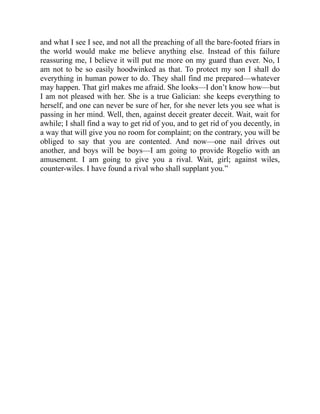
“And dismissing itshortly afterward, returned home on foot.”
precautions; and even if it were, to try to prevent them from seeing each
other alone was like putting doors to an open field. A device then occurred
to her by means of which to clear up her doubts and measure the magnitude
of the danger. She had a key secretly made for the door of the apartment;
and, provided with this, she drove out one morning in one of her
“equipages”—that of Martin, it chanced to be—and dismissing it shortly
afterward, returned home on foot, opened the door noiselessly with her key,
and made her way softly to the lion’s den, where she supposed she should
find Esclavita, nor was she mistaken. She found her quietly seated at her
sewing, as usual, with that pensive and absorbed air which characterized
her.
“Where is the Señorito?” Doña Aurora asked her suddenly, with the
intention of taking her off her guard.
The girl, raising her serene or rather melancholy countenance, answered:
“I believe he is studying in his room. How did you get in, Señora? I did
not hear the bell.”
“Fausta was going out,” hurriedly explained Doña Aurora, feeling as if
she herself had been caught in the snare she had laid. She even felt her
cheeks grow red. This was what might be called a take-in! So much secrecy
about having the key made only to find that nothing particular was going on
at the house, and that when she expected to surprise them in a stolen
meeting she found everything going on in its usual routine. And yet she was
not convinced. No, indeed. Let Satan convince himself. “Can this girl be
slyer than I had imagined?” she thought. “Can she be deceiving me without
my knowing it? Are they both laughing at me? For the glances and the
whispered words when they meet and the unwillingness the boy shows to
leave the house—no one can make me lose sight of all that; I have seen it,
36.
and what Isee I see, and not all the preaching of all the bare-footed friars in
the world would make me believe anything else. Instead of this failure
reassuring me, I believe it will put me more on my guard than ever. No, I
am not to be so easily hoodwinked as that. To protect my son I shall do
everything in human power to do. They shall find me prepared—whatever
may happen. That girl makes me afraid. She looks—I don’t know how—but
I am not pleased with her. She is a true Galician: she keeps everything to
herself, and one can never be sure of her, for she never lets you see what is
passing in her mind. Well, then, against deceit greater deceit. Wait, wait for
awhile; I shall find a way to get rid of you, and to get rid of you decently, in
a way that will give you no room for complaint; on the contrary, you will be
obliged to say that you are contented. And now—one nail drives out
another, and boys will be boys—I am going to provide Rogelio with an
amusement. I am going to give you a rival. Wait, girl; against wiles,
counter-wiles. I have found a rival who shall supplant you.”
37.
XX.
And in effect,before twenty-four hours had passed, Señora de Pardiñas
had arranged an interview between her son and Esclavita’s rival. The place
of rendezvous was the abode of the aforesaid rival, an obscure abode and
not a very odorous one, as is apt to be the case with the dwellings of
individuals of her class; for which reason, in order that Rogelio should
make himself acquainted with the bearing and the figure of his new
sweetheart, she was brought out into the yard unadorned, her graceful form
was covered only by an old blanket, which Augustin Cuero, the proprietor
of the livery stable, hastened to take off, so that not a single one of her
charms should remain hidden from view.
She was a beautiful Andalusian pony, sorrel, with black feet, with a
small, thin head, sinewy legs, curved and shining hoofs, a coat dazzlingly
bright, dilated and sensitive nostrils, and an eye full of fire and sweetness;
she was young, gentle, graceful, spirited, one of those animals which do
honor to the race of Spanish horses by the beauty of their appearance, by
their intelligence, and by their noble and generous natures. Augustin Cuero
was lavish in his praises of the animal, affecting to be grieved at parting
from so precious a treasure.
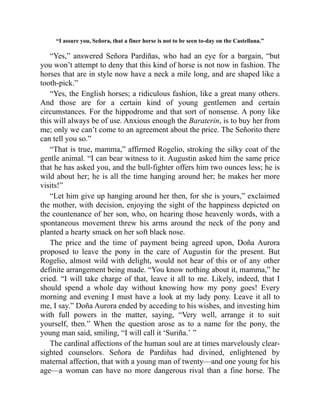
“I assure you, Señora, that a finer horse is not to be seen to-day on the
Castellana. She has not a single blemish. And she is a saint—a skein of silk;
an infant could manage her. Spirited as she is, she is incapable of playing a
trick. So that a man becomes attached to her, and when one sells her, it is
like parting, one might almost say, with one of the family.”
38.
“I assure you,Señora, that a finer horse is not to be seen to-day on the Castellana.”
“Yes,” answered Señora Pardiñas, who had an eye for a bargain, “but
you won’t attempt to deny that this kind of horse is not now in fashion. The
horses that are in style now have a neck a mile long, and are shaped like a
tooth-pick.”
“Yes, the English horses; a ridiculous fashion, like a great many others.
And those are for a certain kind of young gentlemen and certain
circumstances. For the hippodrome and that sort of nonsense. A pony like
this will always be of use. Anxious enough the Baraterin, is to buy her from
me; only we can’t come to an agreement about the price. The Señorito there
can tell you so.”
“That is true, mamma,” affirmed Rogelio, stroking the silky coat of the
gentle animal. “I can bear witness to it. Augustin asked him the same price
that he has asked you, and the bull-fighter offers him two ounces less; he is
wild about her; he is all the time hanging around her; he makes her more
visits!”
“Let him give up hanging around her then, for she is yours,” exclaimed
the mother, with decision, enjoying the sight of the happiness depicted on
the countenance of her son, who, on hearing those heavenly words, with a
spontaneous movement threw his arms around the neck of the pony and
planted a hearty smack on her soft black nose.
The price and the time of payment being agreed upon, Doña Aurora
proposed to leave the pony in the care of Augustin for the present. But
Rogelio, almost wild with delight, would not hear of this or of any other
definite arrangement being made. “You know nothing about it, mamma,” he
cried. “I will take charge of that, leave it all to me. Likely, indeed, that I
should spend a whole day without knowing how my pony goes! Every
morning and evening I must have a look at my lady pony. Leave it all to
me, I say.” Doña Aurora ended by acceding to his wishes, and investing him
with full powers in the matter, saying, “Very well, arrange it to suit
yourself, then.” When the question arose as to a name for the pony, the
young man said, smiling, “I will call it ‘Suriña.’ ”
The cardinal affections of the human soul are at times marvelously clear-
sighted counselors. Señora de Pardiñas had divined, enlightened by
maternal affection, that with a young man of twenty—and one young for his
age—a woman can have no more dangerous rival than a fine horse. The
39.
horse is notmerely a distraction for a couple of hours daily, but an
occupation and a preoccupation from sunrise to sunset. To make
investigations with regard to what it has eaten, and whether it has been
robbed of its feed; to see if it has been rubbed down, and if all the
operations of its toilet have been performed—and the toilet of a fine horse
occupies almost as much time as the toilet of a beautiful woman; then the
affectionate understanding that establishes itself between the horseman who
for the first time enjoys the possession of a horse, and the animal; the
tenderness that springs from ownership, the exchange of caresses, the sugar
robbed from the breakfast table to take to it; the fresh bread put away in the
waistcoat pocket, the pleasure produced by the joyful whinny of the animal
when its keen sense of smell and its delicate perception tell it that its master
is approaching with the dainty. Then the anxieties regarding its health—a
horse gives as much anxiety in this respect as a child. “Señorito, I don’t
know what is the matter with the pony, it hasn’t eaten its feed to-day. I
notice that its eyes look dull—” “Señorito, to-day the pony has not—” But
who can enumerate the ailments from which a pony may suffer. With all
these cares, there are others of a different order, having relation to what may
be called the wedding-finery of horsemanship—the saddle of the best pig-
skin, small, fanciful, that crackles at the touch; the saddle-cloth of
handsome felt, adorned with English ciphers; the steel stirrup, the fine head
stall that gives free play to the graceful movements of the slender head; and
for the rider, the whip with its chased silver handle, the Tyrolese gloves, the
cravat with white horseshoes on a gray ground. All is excitement, all is
delight in the enchanting honeymoon of the young man and his pony. And
what emotion when it is brought out of the stable! What pride in displaying
it before his friends! What ineffable joy to ride up and down the shady
walks of Moncloa, seated on its back; to see a carriage approach in which
some black-robed beauty reclines, and under the fascinating gaze of the
beautiful unknown to make it rear and prance and show off its grace and
spirit until it is covered with foam and sweat! What delight to put it through
all its paces,—passing from the measured pace to the quick trot, then to the
fiery gallop, and, as he strokes with his palm the neck of the obedient brute,
to hear it snort with pleasure, thrilling through all its sensitive nerves and its
vigorous and sinewy muscles like a young girl when the arm of her agile
partner encircles her waist as he leads her to the dance!
40.
There was nota doubt but that the idea of the pony had been a happy
one, suggested as it was by experience, and infinitely superior to that
commonplace artifice of taking a sweetheart, which had suggested itself to
the innocent mind of Rogelio as a sovereign remedy against his incipient
love-sickness. His mother did not need now to ask him to accompany her
on her expeditions or to invent excuses to get him out of the house. Of his
own accord the young man spent his time between his house and the stall of
his favorite. The weather was now growing milder. The closing days of
March, notwithstanding the bad reputation of that variable month, were
clear, calm, and pleasant, and every afternoon, at three o’clock, Rogelio
rode out to enjoy the first warm airs of spring, now alone, again with some
friend, and again with the riding-master, to return home at dusk healthily
tired, intoxicated with the pure air, strengthened and exhilarated, and his
mind free from enervating thoughts. Between this vein of activity which his
mother had discovered, and study no longer to be avoided, as the
examinations were approaching with alarming swiftness, how or when
could he find time to devote to Esclavita?
His mother did not on this account relax her vigilance, however, or
abandon her well-considered plan of defense. One day Don Gaspar Febrero,
having gone somewhat earlier than usual to Doña Aurora’s, found himself
alone with her, and, according to his custom, turned the conversation on
Esclavita, praising her so extravagantly that his companion at last began to
grow impatient.
“Now that you speak of the girl,” she said, when the old man allowed
her to get in a word, “I wish to say something to you about her. But promise
me first that you will answer me with the frankness due to our long-
standing friendship.”
“Can you doubt it? Why of course I shall, my dear Aurora. In what way
can I serve you?”
“You shall hear. It is something that I have been thinking of sitting here
alone in the mornings when the boy is at college. As you will be very
lonely, no doubt, when Felisa starts on her long voyage to the Philippines, I
have thought—so that you might not miss so greatly the attentions to which
you have been accustomed—what do you think?”
“Let us hear—let us hear. Since the idea is yours—you always reason
very judiciously, my dear friend——”
41.
“As you haveoften told me that you thought Esclavita so excellent a
servant——”
The sprightly old man made a quick movement of delighted surprise,
settled his spectacles on his nose, and eagerly and tremulously, in disjointed
phrases, exclaimed:
“My dear friend! my dear friend! what is it you are saying? what is it
you are saying? Have you considered well before speaking? To part with
that treasure! that treasure! You overwhelm me with this proof of your
goodness. Yes, indeed, but in conscience no, I cannot accept. Now I see of
what friendship is capable, Aurora! No, it would be too selfish on my part.
You have not thought well over the matter. Are you speaking in earnest? in
earnest?”
Señora de Pardiñas felt the pricking of remorse at this spontaneous
effusion of gratitude, and hastened to add:
“Listen and you will see that it would be for my own advantage as well
as for yours. There is something of selfishness in the offer, too, Don Gaspar,
it is not all a kindness. As I am thinking of taking Rogelio on a visit to our
native place this year——”
“A reason the more, my friend; a reason the more. You cannot dispense
with the services of such a girl, traveling. The times are bad. With the
Higinias that are going, who would part with an Esclavita? And an Esclavita
of that stamp! Have you thought seriously over the matter, I mean
seriously?”
As he spoke thus, Nuño Rasura jumped up and down in his chair,
twirling his crutch between his palms. His eyes sparkled, his form
straightened itself like a boy’s, and his breast rose and fell with his agitated
breathing.
“Heaven help us!” thought Doña Aurora, “I shall have to lift the man up
from the floor with a spoon.” And as she remained silent, affecting to be
considering the good man’s arguments, the latter added quickly and
energetically, like a child who pretends to be yielding to persuasion in
accepting a toy:
“That is to say—of course I know from the very fact of your proposing it
to me that you have thought well over it. I see that you are right in what you
say; very right, very right, Aurora. Traveling, one is better alone; the boy
42.
and his mother,of course, of course. As for me, it is enough that you should
propose it; I accept, I accept; do you hear, my friend? I accept.”
“It is true,” reflected Doña Aurora, “that that slippery Don Nicanor, who
is stuffed full of malice and who is capable of thinking evil of his own
mother, irritates one at times; but these simpletons, too, who can never
understand a hint—well, there are days when they keep one’s nerves on the
stretch like the strings of a guitar.”
Don Gaspar’s scruples being thus vanquished, he himself arranged a
plan of action, which he laid before Doña Aurora—as soon as his daughter
should go away, he would take Esclavita as his housekeeper. The
octogenarian added, rubbing his hands:
“Don’t let Candás know anything about the matter. I don’t want to be
made the subject of annoying jests.”
43.
XXI.
This domestic conspiracywas kept a profound secret. Doña Aurora was
silent, for women know how to keep a secret when they resolve to do so,
especially if their affections are concerned, and Don Gaspar did not open
his lips because he dreaded more than the cholera the jokes and insinuations
of the Crown Solicitor, and no less—if we must betray the secrets of his
household—the anger of his daughter Felisa. The latter, suspicious as a
wife, distrusting the sociable and gallant disposition of the old man, had
made it her business to provide him with the ugliest, most ignorant, and
worst-tempered Maritornes to be found, for she always saw in the distance
the menacing shadow of a stepmother. Until Felisa should have started on
her voyage to the fifth division of the globe, the old man did not dare even
to hint at his desire of taking into his service the gentle and pretty Esclavita.
It was with the greatest difficulty that he was able to control his impatience
and wait for this event, for his old age was a second childhood. Capricious
and impatient as a child, if he yielded to his impulses, he would stamp upon
the floor whenever anything interfered with the gratification of his desires.
The outlet he sought for his impatience was a tête-à-tête with Doña Aurora
before the arrival of the other visitors, when he would talk to her
ramblingly, as old people are wont to talk, of his plans for the future, of the
comfort he should enjoy with Esclavita to wait upon him, of the favors he
would heap upon her, of how easy it would be to wait on an old man like
him, without any family, and many other things of the same kind. And when
the good man, owing to the presence of others, was unable to dilate on his
favorite theme, he gave his excellent friend glances and winks of
intelligence. He smiled at her without any cause, and, in short, sought to
give vent to his exuberant and boyish gayety. “Heaven grant he may keep
his reason,” said Señora de Pardiñas to herself. “I don’t know why we
should wonder at the craziness of youth, when old men can act in this way.
No boy could be more deeply smitten. I declare, if he is not wild for his
daughter to take herself off, so that he may get Esclavita at once. If I did not
know that he is a really excellent man and that the girl, on her part, is
incapable of laying a trap for him, I should be a little uneasy, for no one can
tell where these things will end, and if he should take it into his head to
44.
marry!—” The ideaof Don Gaspar marrying a girl of twenty-five was so
absurd that Señora de Pardiñas laughed to herself, and the monologue
ended by the good lady scratching her head with her knitting-needle, and
saying, as a corollary of her reflections: “It won’t be my fault if anything
extraordinary should happen. To find a good situation for a good servant is
not a crime. All I am sorry for is that that tiresome Felisa Febrero keeps
forever putting off her departure for the Philippines.”
It was true, indeed, that Don Gaspar’s daughter delayed her journey in a
way to make the blood boil in the veins of a more patient person than Doña
Aurora. What made the latter wild was that the time for the examinations to
take place was now drawing near, after which she had resolved to take a trip
to Galicia, and to leave Esclavita behind or to take her with her seemed
equally impracticable. Don Gaspar kept her informed of the news regarding
his daughter’s departure, looking more and more joyful as the time drew
nearer. “They are packing the trunks.” “They have made inquiries
concerning the dates of sailing of the steamers.” “On Thursday, or at
furthest on Saturday, they will be on their way to Cadiz.” At last he came
one day with a face looking more radiant, more Olympic than usual, under
the aureole of his beautiful white curls. “Friend Aurora,” he said, “they are
to leave us this afternoon.” It was agreed that for appearance’s sake a few
days should be allowed to pass before giving warning to the ignorant and
slatternly Estremaduran who waited on Don Gaspar, and informing
Esclavita of her change of situation. “Friend Aurora, do you take charge of
that,” said the octogenarian. But although he thus laid all the responsibility
on the shoulders of Doña Aurora, he could not resist the temptation, as he
was passing the
45.
“As he waspassing the confectionary of La Pajarita.”
confectionary of La Pajarita when he was taking his constitutional on the
following day in the Puerta del Sol, to enter the shop and buy half a pound
of caramels and bonbons. He hid his purchase in an inside pocket of his
coat and when, stopping at the house of Señora de Pardiñas, Esclavita
opened the door for him, he glanced around furtively, put his hand into his
pocket, and drawing out the cartridge slipped it into her palm as if it were a
billet doux. “Fresh,” was the only word his pleasing agitation allowed him
to utter, as he put the gift into her hand.
Very reluctantly, and with much hemming and hawing, Doña Aurora set
about performing her disagreeable task of getting rid of Esclavita. She
would have felt less embarrassed if she had been called upon to break to her
the news of some great misfortune, such as the death of some one dear to
her, or some pecuniary loss, for, after all, in such a case she would have
none of the responsibility nor would she be in any way to blame, while in
merely announcing to her the impending change of abode and of employers,
she felt, with her natural sense of right, to which nothing but her maternal
affection could blind her, that there was something of harshness and cruelty
in her conduct, although this was dictated by motives such as no prudent
mother could disregard. “It is even a matter of conscience with me,” she
said to herself, to fortify her courage. “I was thoughtless in bringing
temptation within Rogelio’s reach. Felisa Febrero has shown more
knowledge of the world than I, for, old as her father is, she would not put
him in danger’s way. The boy has more sense than could have been
expected, not to have lost his head completely. No, no, it is better to blush
once than to turn pale a hundred times. To-day I will get rid of her. As soon
as Rogelio goes to college——”
There are in the tones of the human voice mysterious notes of warning
which in certain situations reveal our inmost thoughts before we have put
them into words. The simple words, “Come here, Esclavita,” words such as
a servant hears innumerable times in the course of a day, echoed on this
occasion with an ominous sound in the soul of the young Galician. All the
blood in her body rushed to her heart, and when she entered the room where
her mistress was awaiting her she already knew by intuition the purport of
what she was about to hear.
46.
Doña Aurora wasseated, not in the dining-room, but in her son’s study,
where she was in the habit of going, in his absence, to write a note, to make
up her accounts, or the like, and perhaps also to satisfy that instinctive and
restless curiosity characteristic of an absorbing affection when it reaches the
height of a passion. She made Esclavita sit down in a chair beside her and
began to speak, without looking at her, occupying herself in taking the pens,
one by one, from a little pen-box and placing them symmetrically, side by
side, upon the table—On account of the trip to Galicia, there was nothing
else to be done—To travel with three people was not the same as to travel
with only two, that required no explanation—A situation in the house of
Señor de Febrero was the best thing a girl like her could possibly desire; it
was a great piece of good fortune. She would be, not a servant, but the
housekeeper. She would be treated with every kind of consideration. The
labor of waiting on one person only would not kill her; by taking a little
trouble to please that excellent gentleman she would be in heaven—almost
as if she were in her own house. Finally, Don Gaspar, too, was from Galicia.
There would be no cause for her to feel lonesome there, as she had felt in
the house of the Señoritas Romera.
When she had brought forward all these arguments she felt her mind
relieved and, still apparently intent on the symmetrical arrangement of the
rows of pens, gave a side glance at the girl. Esclavita remained motionless
in her seat, her hands folded in her lap, her feet side by side, her eyes cast
down; she, too, was little prone to throw open those windows of the soul to
prying eyes.
“Well, what do you say?” asked Señora de Pardiñas at last, beginning to
grow impatient, as she always did when she was met by a passive
resistance.
“What should I say?” asked Esclavita in husky tones, but with apparent
calmness.
“Say yes or no; say whether you like the situation I propose to you, or
whether you would prefer to look for another, which should be more to your
taste.”
There was an interval of silence, and then the girl answered in a voice
deprived of all expression by her effort to render it calm:
“If there is no great hurry, I will give you my answer to-morrow or the
day after.”
47.
“I understand you,”said Señora de Pardiñas, in her own mind. “You
want to have a talk with the boy first. Very good. I am prepared for
whatever may happen. Here I am on guard and here I mean to remain. The
first thing I shall do is to see that you don’t take him by surprise. I shall be
on the alert, never fear!”
That afternoon, however, she was obliged to leave the house, contrary to
her habit, to go to the railway station to see Felisa Febrero off, in
compliance with one of those irksome social duties which cannot be evaded
and which always seem to come at the most inopportune moment. Rogelio,
too, had gone out riding, but owing to the necessity of attending to his
studies now that the examinations were close at hand, he shortened his ride,
and it was just as he was entering the house, flushed with exercise, fanning
himself with his gray hat and cracking his whip, that Esclavita caught him
by the sleeve and drew him, almost by force, into the study, bringing him to
a stand-still beside the very table on which Doña Aurora had that morning
drawn up her army of pens.
“Has anything happened, Suriña?” he asked. “What is the matter with
you?”
“Didn’t I tell you—that I wasn’t going to Galicia,” she cried, “either this
year or any other year? Your mamma has dismissed me. She is going to
leave me at Señor Febrero’s.”
“What are you saying? What do you mean? Tell me, tell me all about it.”
The girl told him all she herself knew. Her eyes were dry, but her mouth
and chin quivered. Her bosom heaved, and in her manner of telling what
had occurred, in that despairing cry for help, like the cry of a drowning man
when he is about to sink beneath the waves, there was a vehemence and
disorder which formed a contrast to her habitual composure, and which
might well have moved one with more years and experience than Rogelio.
While he stammered, “No, it cannot be possible, you won’t leave us, what
nonsense,” he clasped his arms involuntarily around the girl’s slender form,
and the thrill of passion he had felt four or five months before awoke within
him again, more ardent than ever, inspiring him with courage to rebel, to
protest, and to defend Esclavita as we defend what belongs to us and is a
part of our life. “Some one must have been telling her stories,” he said; “but
who and why? What motive have we given for talk, Suriña? Why, since
mamma’s illness we have scarcely spoken a word together. You never put
48.
Welcome to OurBookstore - The Ultimate Destination for Book Lovers
Are you passionate about testbank and eager to explore new worlds of
knowledge? At our website, we offer a vast collection of books that
cater to every interest and age group. From classic literature to
specialized publications, self-help books, and children’s stories, we
have it all! Each book is a gateway to new adventures, helping you
expand your knowledge and nourish your soul
Experience Convenient and Enjoyable Book Shopping Our website is more
than just an online bookstore—it’s a bridge connecting readers to the
timeless values of culture and wisdom. With a sleek and user-friendly
interface and a smart search system, you can find your favorite books
quickly and easily. Enjoy special promotions, fast home delivery, and
a seamless shopping experience that saves you time and enhances your
love for reading.
Let us accompany you on the journey of exploring knowledge and
personal growth!
ebooksecure.com