MaRS Best Practice Series
              Developing Collaborative Leadership
                                              In Partnership with


                                         Mary Stacey M.A.
                                  Context Management Consulting Inc.


                                      Thursday October 8th, 2009


                                                                          Generously Supported by


                                                                                       "
Additional Generous Support by The William and Nona Heaslip Foundation
Welcome – Two Interactive Sessions

           –  Today’s Agenda – Developing Collaborative Leadership
           –  December 2 – Building A Collaborative Culture


                   Whether you’re an entrepreneur in the start up phase or the
                   CEO of a mature business, it’s the right time to pay attention
                   to the culture of your enterprise.


Mary Stacey 2009
Developing Collaborative Leadership

           What we will cover
           –  the relational dimensions of collaboration
           –  leadership practices that build collaboration

           What we won’t cover
           –  collaborative technologies
           –  social media


             Organizations function best when committed people work in
             collaborative relationships based on respect.
             Henry Mintzberg, HBR Rebuilding Companies as Communities, 2009


Mary Stacey 2009
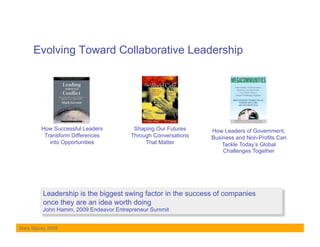
Evolving Toward Collaborative Leadership


         How Successful Leaders         Shaping Our Futures    How Leaders of Government,
          Transform Differences        Through Conversations   Business and Non-Profits Can
            into Opportunities              That Matter            Tackle Today’s Global
                                                                   Challenges Together


         Leadership is the biggest swing factor in the success of companies
         once they are an idea worth doing
         John Hamm, 2009 Endeavor Entrepreneur Summit


Mary Stacey 2009
Scale Yourself – Scale Your Enterprise?


     “Leaders who scale do so because
       they take deliberate steps to confront
       their shortcomings and become the
       leaders their organizations need them
       to be.”


      John Hamm, Why Entrepreneurs Don’t Scale (Harvard Business Review, 2002)

Mary Stacey 2009
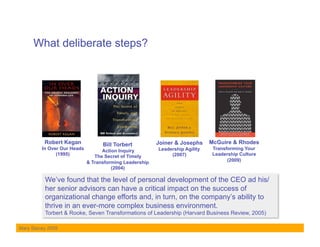
What deliberate steps?


          Robert Kegan             Bill Torbert          Joiner & Josephs     McGuire & Rhodes
         In Over Our Heads         Action Inquiry        Leadership Agility    Transforming Your
               (1995)           The Secret of Timely          (2007)           Leadership Culture
                             & Transforming Leadership                               (2009)
                                       (2004)

          We’ve found that the level of personal development of the CEO ad his/
          her senior advisors can have a critical impact on the success of
          organizational change efforts and, in turn, on the company’s ability to
          thrive in an ever-more complex business environment.
          Torbert & Rooke, Seven Transformations of Leadership (Harvard Business Review, 2005)

Mary Stacey 2009
Developmental View of Leadership

    Concerned with meaning making that
    influences perspective & behavior

    Differentiated from trait theories,
    preferences, life stage, cultural
    identification

    Center of gravity - Action-Logics that
    develop in a predictable pattern through the
    lifespan

    Expansion of capacities through
    experience, personal practices, formal
    education that challenges assumptions,
    life crises.


 Kegan, 1982, Torbert, 1991; Torbert & Associates, 2004; Torbert and Rooke, 2005Joiner & Josephs, 2007,
 McGuire & Rhodes, 2009
Mary Stacey 2009
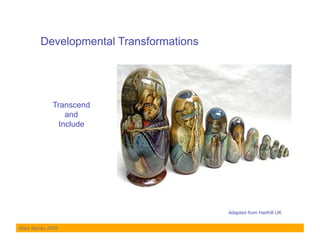
Developmental Transformations


             Transcend
                 and
               Include


                                        Adapted from Harthill UK


Mary Stacey 2009
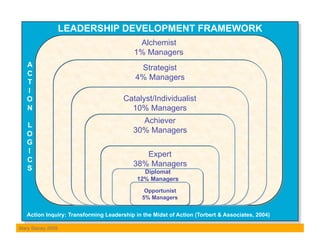
LEADERSHIP DEVELOPMENT FRAMEWORK
                                            Alchemist
                                           1% Managers
   A                                        Strategist
   C
                                           4% Managers
   T
   I
   O                                   Catalyst/Individualist
   N                                     10% Managers
                                            Achiever
   L
   O                                      30% Managers
   G
   I                                         Expert
   C
                                          38% Managers
   S                                          Diplomat
                                            12% Managers
                                               Opportunist
                                              5% Managers


   Action Inquiry: Transforming Leadership in the Midst of Action (Torbert & Associates, 2004)

Mary Stacey 2009
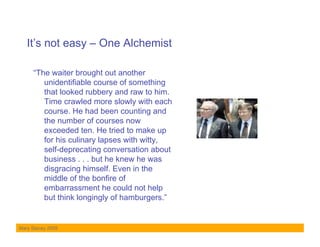
It’s not easy – One Alchemist

     “The waiter brought out another
        unidentifiable course of something
        that looked rubbery and raw to him.
        Time crawled more slowly with each
        course. He had been counting and
        the number of courses now
        exceeded ten. He tried to make up
        for his culinary lapses with witty,
        self-deprecating conversation about
        business . . . but he knew he was
        disgracing himself. Even in the
        middle of the bonfire of
        embarrassment he could not help
        but think longingly of hamburgers.”


Mary Stacey 2009
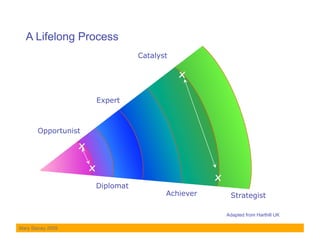
A Lifelong Process
                                      Catalyst

                                                 x

                           Expert


       Opportunist

                   x
                       x
                                                        x
                           Diplomat
                                             Achiever        Strategist

                                                            Adapted from Harthill UK

Mary Stacey 2009
Two Main Drivers of Transformation

     •  Negative association with current Action-Logic
           –  frustration or boredom
           –  disillusionment
           –  recognition of limitations


     •  Positive attraction to later Action-Logic
           –  experiencing a taste of the next stage
           –  desire to close the capacity-behavior gap


Mary Stacey 2009
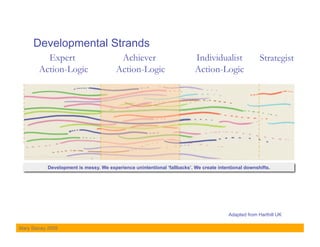
Developmental Strands
          Expert                         Achiever                         Individualist                Strategist
        Action-Logic                    Action-Logic                      Action-Logic


           Development is messy. We experience unintentional ‘fallbacks’. We create intentional downshifts.


                                                                                         Adapted from Harthill UK

Mary Stacey 2009
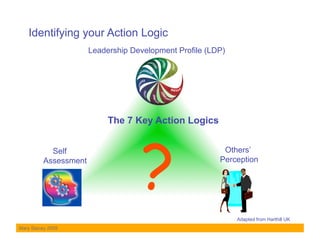
Identifying your Action Logic
                       Leadership Development Profile (LDP)


                                     ?
            Self                                          Others’
          Assessment                                     Perception


                                                              Adapted from Harthill UK
Mary Stacey 2009
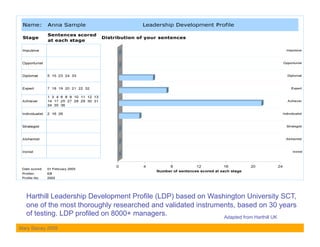
Harthill Leadership Development Profile (LDP) based on Washington University SCT,
   one of the most thoroughly researched and validated instruments, based on 30 years
   of testing. LDP profiled on 8000+ managers.                 Adapted from Harthill UK

Mary Stacey 2009
Development Example: Expert
     •  Consolidating
         –  Get feedback from respected sources
         –  Seek opportunities to mentor others

     •  Transforming
         –  Consider the big picture, responsibility for broader corporate
            goals
         –  Emphasize taking on ‘informal leadership’ roles


Mary Stacey 2009
Development Examples: Achiever
     •  Consolidating
         –  Self development opportunities in relation to getting results
         –  Facilitative, strategic and results oriented leadership approach

     •  Transitioning
         –  Mentoring or coaching – opportunities to reflect
         –  Complex opportunities where positional power is reduced and
            influence more important


Mary Stacey 2009
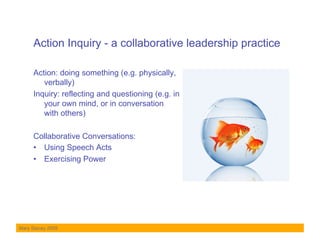
Action Inquiry - a collaborative leadership practice

     Action: doing something (e.g. physically,
        verbally)
     Inquiry: reflecting and questioning (e.g. in
        your own mind, or in conversation
        with others)

     Collaborative Conversations:
     •  Using Speech Acts
     •  Exercising Power


Mary Stacey 2009
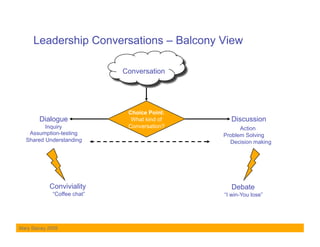
Leadership Conversations – Balcony View

                             Conversation


                              Choice Point:
        Dialogue               What kind of     Discussion
         Inquiry              Conversation?         Action
   Assumption-testing                         Problem Solving
  Shared Understanding                          Decision making


            Conviviality                         Debate
             “Coffee chat”                    “I win-You lose”


Mary Stacey 2009
Leadership Conversations – Balcony View

                                  Conversation


                                    Choice Point:
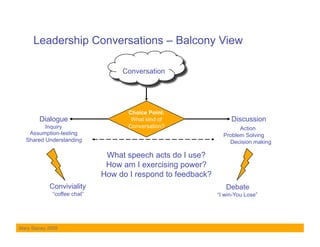
        Dialogue                     What kind of                 Discussion
         Inquiry                    Conversation?                    Action
   Assumption-testing                                          Problem Solving
  Shared Understanding                                           Decision making

                              What speech acts do I use?
                              How am I exercising power?
                             How do I respond to feedback?
            Conviviality                                        Debate
             “coffee chat”                                   “I win-You Lose”


Mary Stacey 2009
Collaborative Conversation: Speech Acts
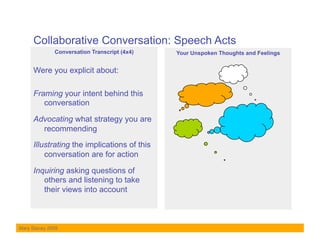
              Conversation Transcript (4x4)   Your Unspoken Thoughts and Feelings


     Were you explicit about:

     Framing your intent behind this
        conversation

     Advocating what strategy you are
       recommending
     Illustrating the implications of this
         conversation are for action

     Inquiring asking questions of
        others and listening to take
        their views into account


Mary Stacey 2009
Exercising Power: Building Trust & Collaboration


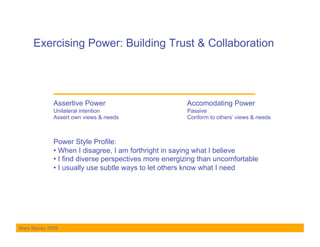
              Assertive Power                           Accomodating Power
              Unilateral intention                      Passive
              Assert own views & needs                  Conform to others’ views & needs


              Power Style Profile:
              •  When I disagree, I am forthright in saying what I believe
              •  I find diverse perspectives more energizing than uncomfortable
              •  I usually use subtle ways to let others know what I need


Mary Stacey 2009
Exercising Power: Trust & Collaboration


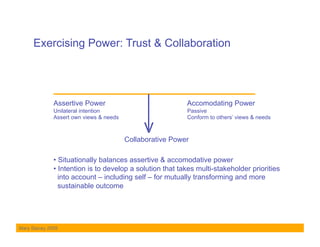
              Assertive Power                              Accomodating Power
              Unilateral intention                         Passive
              Assert own views & needs                     Conform to others’ views & needs

                                              V
                                         Collaborative Power

              •  Situationally balances assertive & accomodative power
              •  Intention is to develop a solution that takes multi-stakeholder priorities
                into account – including self – for mutually transforming and more
                sustainable outcome


Mary Stacey 2009
A note about vulnerability


       Staff members awareness that the CEO and senior managers are facing the
       same vulnerabilities, uncertainties, and experiments as they are can become
       a potent force for widespread buy in and collaboration
       Torbert and Rooke, 2004


Mary Stacey 2009
Summary

     •  Research: leaders who can facilitate collaboration create more
        sustainable enterprises
     •  Learn about and develop your centre of gravity to ‘scale yourself
        while scaling your enterprise’
     •  Leadership development in the context of human development
        meets evolving complexity & interdependence
     •  Action Inquiry develops your capacity to be a more collaborative
        leader
         –  Simple collaborative practices to exercise power, build trust,
            create conversations, respond to feedback
         –  Facilitate deeper collaboration in every relationship


Mary Stacey 2009
Resources

     Seven Transformations of Leadership by David Rooke and Bill Torbert, Harvard
        Business Review (April 2005)

     Action Inquiry: The Secret of Timely and Transforming Leadership by Bill
        Torbert and Associates (Berrett Koehler, 2004)

     Leadership Agility by Bill Joiner and Stephen Josephs (Jossey Bass 2007)

     Transforming Your Leadership Culture by John B. McGuire and Gary Rhodes
        (Jossey Bass 2009)

     Power Inventory
     http://www.leadershipagility.com/assess_style.phpS


                                                                                26
Mary Stacey 2009

Developing Collaborative Leadership

  • 1.
    MaRS Best PracticeSeries Developing Collaborative Leadership In Partnership with Mary Stacey M.A. Context Management Consulting Inc. Thursday October 8th, 2009 Generously Supported by " Additional Generous Support by The William and Nona Heaslip Foundation
  • 2.
    Welcome – TwoInteractive Sessions –  Today’s Agenda – Developing Collaborative Leadership –  December 2 – Building A Collaborative Culture Whether you’re an entrepreneur in the start up phase or the CEO of a mature business, it’s the right time to pay attention to the culture of your enterprise. Mary Stacey 2009
  • 3.
    Developing Collaborative Leadership What we will cover –  the relational dimensions of collaboration –  leadership practices that build collaboration What we won’t cover –  collaborative technologies –  social media Organizations function best when committed people work in collaborative relationships based on respect. Henry Mintzberg, HBR Rebuilding Companies as Communities, 2009 Mary Stacey 2009
  • 4.
    Evolving Toward CollaborativeLeadership How Successful Leaders Shaping Our Futures How Leaders of Government, Transform Differences Through Conversations Business and Non-Profits Can into Opportunities That Matter Tackle Today’s Global Challenges Together Leadership is the biggest swing factor in the success of companies once they are an idea worth doing John Hamm, 2009 Endeavor Entrepreneur Summit Mary Stacey 2009
  • 5.
    Scale Yourself –Scale Your Enterprise? “Leaders who scale do so because they take deliberate steps to confront their shortcomings and become the leaders their organizations need them to be.” John Hamm, Why Entrepreneurs Don’t Scale (Harvard Business Review, 2002) Mary Stacey 2009
  • 6.
    What deliberate steps? Robert Kegan Bill Torbert Joiner & Josephs McGuire & Rhodes In Over Our Heads Action Inquiry Leadership Agility Transforming Your (1995) The Secret of Timely (2007) Leadership Culture & Transforming Leadership (2009) (2004) We’ve found that the level of personal development of the CEO ad his/ her senior advisors can have a critical impact on the success of organizational change efforts and, in turn, on the company’s ability to thrive in an ever-more complex business environment. Torbert & Rooke, Seven Transformations of Leadership (Harvard Business Review, 2005) Mary Stacey 2009
  • 7.
    Developmental View ofLeadership Concerned with meaning making that influences perspective & behavior Differentiated from trait theories, preferences, life stage, cultural identification Center of gravity - Action-Logics that develop in a predictable pattern through the lifespan Expansion of capacities through experience, personal practices, formal education that challenges assumptions, life crises. Kegan, 1982, Torbert, 1991; Torbert & Associates, 2004; Torbert and Rooke, 2005Joiner & Josephs, 2007, McGuire & Rhodes, 2009 Mary Stacey 2009
  • 8.
    Developmental Transformations Transcend and Include Adapted from Harthill UK Mary Stacey 2009
  • 9.
    LEADERSHIP DEVELOPMENT FRAMEWORK Alchemist 1% Managers A Strategist C 4% Managers T I O Catalyst/Individualist N 10% Managers Achiever L O 30% Managers G I Expert C 38% Managers S Diplomat 12% Managers Opportunist 5% Managers Action Inquiry: Transforming Leadership in the Midst of Action (Torbert & Associates, 2004) Mary Stacey 2009
  • 10.
    It’s not easy– One Alchemist “The waiter brought out another unidentifiable course of something that looked rubbery and raw to him. Time crawled more slowly with each course. He had been counting and the number of courses now exceeded ten. He tried to make up for his culinary lapses with witty, self-deprecating conversation about business . . . but he knew he was disgracing himself. Even in the middle of the bonfire of embarrassment he could not help but think longingly of hamburgers.” Mary Stacey 2009
  • 11.
    A Lifelong Process Catalyst x Expert Opportunist x x x Diplomat Achiever Strategist Adapted from Harthill UK Mary Stacey 2009
  • 12.
    Two Main Driversof Transformation •  Negative association with current Action-Logic –  frustration or boredom –  disillusionment –  recognition of limitations •  Positive attraction to later Action-Logic –  experiencing a taste of the next stage –  desire to close the capacity-behavior gap Mary Stacey 2009
  • 13.
    Developmental Strands Expert Achiever Individualist Strategist Action-Logic Action-Logic Action-Logic Development is messy. We experience unintentional ‘fallbacks’. We create intentional downshifts. Adapted from Harthill UK Mary Stacey 2009
  • 14.
    Identifying your ActionLogic Leadership Development Profile (LDP) ? Self Others’ Assessment Perception Adapted from Harthill UK Mary Stacey 2009
  • 15.
    Harthill Leadership DevelopmentProfile (LDP) based on Washington University SCT, one of the most thoroughly researched and validated instruments, based on 30 years of testing. LDP profiled on 8000+ managers. Adapted from Harthill UK Mary Stacey 2009
  • 16.
    Development Example: Expert •  Consolidating –  Get feedback from respected sources –  Seek opportunities to mentor others •  Transforming –  Consider the big picture, responsibility for broader corporate goals –  Emphasize taking on ‘informal leadership’ roles Mary Stacey 2009
  • 17.
    Development Examples: Achiever •  Consolidating –  Self development opportunities in relation to getting results –  Facilitative, strategic and results oriented leadership approach •  Transitioning –  Mentoring or coaching – opportunities to reflect –  Complex opportunities where positional power is reduced and influence more important Mary Stacey 2009
  • 18.
    Action Inquiry -a collaborative leadership practice Action: doing something (e.g. physically, verbally) Inquiry: reflecting and questioning (e.g. in your own mind, or in conversation with others) Collaborative Conversations: •  Using Speech Acts •  Exercising Power Mary Stacey 2009
  • 19.
    Leadership Conversations –Balcony View Conversation Choice Point: Dialogue What kind of Discussion Inquiry Conversation? Action Assumption-testing Problem Solving Shared Understanding Decision making Conviviality Debate “Coffee chat” “I win-You lose” Mary Stacey 2009
  • 20.
    Leadership Conversations –Balcony View Conversation Choice Point: Dialogue What kind of Discussion Inquiry Conversation? Action Assumption-testing Problem Solving Shared Understanding Decision making What speech acts do I use? How am I exercising power? How do I respond to feedback? Conviviality Debate “coffee chat” “I win-You Lose” Mary Stacey 2009
  • 21.
    Collaborative Conversation: SpeechActs Conversation Transcript (4x4) Your Unspoken Thoughts and Feelings Were you explicit about: Framing your intent behind this conversation Advocating what strategy you are recommending Illustrating the implications of this conversation are for action Inquiring asking questions of others and listening to take their views into account Mary Stacey 2009
  • 22.
    Exercising Power: BuildingTrust & Collaboration Assertive Power Accomodating Power Unilateral intention Passive Assert own views & needs Conform to others’ views & needs Power Style Profile: •  When I disagree, I am forthright in saying what I believe •  I find diverse perspectives more energizing than uncomfortable •  I usually use subtle ways to let others know what I need Mary Stacey 2009
  • 23.
    Exercising Power: Trust& Collaboration Assertive Power Accomodating Power Unilateral intention Passive Assert own views & needs Conform to others’ views & needs V Collaborative Power •  Situationally balances assertive & accomodative power •  Intention is to develop a solution that takes multi-stakeholder priorities into account – including self – for mutually transforming and more sustainable outcome Mary Stacey 2009
  • 24.
    A note aboutvulnerability Staff members awareness that the CEO and senior managers are facing the same vulnerabilities, uncertainties, and experiments as they are can become a potent force for widespread buy in and collaboration Torbert and Rooke, 2004 Mary Stacey 2009
  • 25.
    Summary •  Research: leaders who can facilitate collaboration create more sustainable enterprises •  Learn about and develop your centre of gravity to ‘scale yourself while scaling your enterprise’ •  Leadership development in the context of human development meets evolving complexity & interdependence •  Action Inquiry develops your capacity to be a more collaborative leader –  Simple collaborative practices to exercise power, build trust, create conversations, respond to feedback –  Facilitate deeper collaboration in every relationship Mary Stacey 2009
  • 26.
    Resources Seven Transformations of Leadership by David Rooke and Bill Torbert, Harvard Business Review (April 2005) Action Inquiry: The Secret of Timely and Transforming Leadership by Bill Torbert and Associates (Berrett Koehler, 2004) Leadership Agility by Bill Joiner and Stephen Josephs (Jossey Bass 2007) Transforming Your Leadership Culture by John B. McGuire and Gary Rhodes (Jossey Bass 2009) Power Inventory http://www.leadershipagility.com/assess_style.phpS 26 Mary Stacey 2009