WELCOME TO

EFFECTIVE COMMUNICATION
   WITH VIRTUAL TEAMS
Created by Aly Anliker and Rachelle Jacover
Agenda

•   Welcome and Introductions
•   Virtual Teams Overview
•   Challenges
•   Solutions
•   Wrap-Up
Objectives
At the end of this session you will:
• Identify your virtual team
  challenges
• Implement a strategy for
  conducting virtual meetings
• Use resources to explore next steps
  for virtual communications
Virtual Team Definition
Individuals pulled together from various locations to serve
on a group to achieve some important, urgent and specific
objective such as:

• planning and/or launching event
• designing and/or running new program or initiative
• developing and/or testing new product
• running major campaign
• designing and/or implementing improved business
  processes
• planning and/or executing change management
• regular team meetings
Virtual Team Characteristics
What are some of the
characteristics of virtual teams?

•
•
•
•
Virtual Team Characteristics
• A collection of geographically distributed, functionally
  and/or culturally diverse entities
• Linked by electronic forms of communication
• Assembled and disassembled according to need
• Different work shifts or time zones
• Collaborative network of people working together,
  regardless of location or who "owns" them
Virtual Teams – Observations
• 41 million corporate employees worldwide work virtually one day
  per week and are likely to be part of a virtual team – Gartner Group
• 36% of virtual team members have never met their team members
  face to face
• 65% of virtual team members report they have never had an
  effective team-building session
• Productivity drops over time - virtual teams operating 1- 3 years are
  much less likely to be high performing teams compared to teams
  that had been together 6 to 12 months.
• In general, management still has an “out-of-sight, out-of-mind”
  mentality when it comes to paying attention to virtual teams and
  giving them the support and resources they need to be successful.
Virtual Communication Challenges
• Leadership
• Team Development
• Technology
Leadership Challenges


• Underestimating impact leaders have on success of virtual
  team
• Manage expectations by clearly establishing and
  maintaining ground rules and assumptions
• Establishing and aligning team and corporate
  goals/objectives
• Importance of using tools to communicate effectively in a
  virtual meeting environment
Leadership Challenges
• Recruiting, introducing and including new members
• Assigning personnel with skills necessary to lead or
  participate on virtual teams
• Recognizing the importance of preparing and training
  people to be part of virtual teams
• Measuring, motivating and tracking progress of team
• Performance Evaluation - Developing performance
  objectives and expectations for team members
Team Challenges - Stages of Teams
Tuckman (1965) discovered that
teams normally go through five
stages of growth:
•Forming
•Storming
•Norming
•Performing
•Adjourning
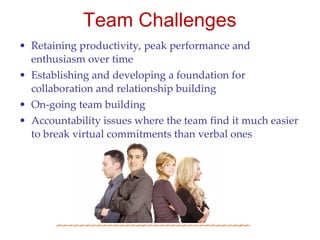
Team Challenges
• Retaining productivity, peak performance and
  enthusiasm over time
• Establishing and developing a foundation for
  collaboration and relationship building
• On-going team building
• Accountability issues where the team find it much easier
  to break virtual commitments than verbal ones
Team Challenges
• Dealing with communication issues like culture,
  language, learning styles
• Not being face to face creates unique challenges
  and difficulties in managing the involvement,
  commitment and trust building of a team
Technology Challenges
Rapidly accelerating business environment with the “do it
now” business culture
                  +
Complexities in Virtually Networked Teams (Virtual,
Network and Technology Factors)
                  =
Getting things done is all that more difficult
Technology Challenges


Learning how to use
technology to foster
collaboration and effective
meeting processes
Technology Challenges

• Introducing and using new technology –
  making it work for the team – can be difficult
  to adopt
• Accurately confirming and recording
  meeting agreements, next steps and
  ownership
• Technology problems can derail or distract
  meetings
Leadership Solutions
• Conduct initial meetings to establish team process
• Learn about new team members, share their information
  or ask them to share their background with team
• Virtual meeting to focus on how team work aligns with
  corporate goals and objectives
• Onboarding employee to virtual environment – find
  buddy or mentor
• Ask team members to lead a meeting or take a topic of
  the meeting
• Share copies of presentation, agenda
• Decide on roles, note taker, time keeper, etc.
Team Solutions
• Set guidelinesmeeting protocols with teams participation
• Create team notes – disband with action items and persons
 responsible, share with team
• Rules when team member can’t meet commitment, ask
 “how can team help”
• Round Robin – Make sure you have heard from everyone
 at least once during meeting
• May need to coach a member offline
Technology Solutions

• Provide different ways participants can use
  tools, raise hand, type on slide, chat
• Initial meeting to teach tools and application.
  Provide tutorial, training or mentor
• Ask team member with technical challenges
  to just listen in. Troubleshoot later. Provide
  a copy of the presentation beforehand
• ManagerFacilitator use tools, games, polls,
  visuals
• Keep virtual meetings to an hour or less
Meeting Tools


• Webex
• Microsoft Live Meeting
• Elluminate
• Adobe Connect
• GoTo Meeting
Interactive Meetings

 • Raise Hand Feature
 • Chat Feature
 • Use Annotation Tools
 • Allow team to see
   who is attending,
   gives sense of team
 • Participation is key!
Sample Team Meeting Guidelines

•   Quick check in
•   Contribute 1 idea per meeting
•   Assume positive intent
•   Identify problems and focus on
    solutions
•   Make sure objectives are realistic in
    scope
•   Keep to timelines
•   Leave with next steps and task
    assignments
•   Expect work outside meeting via sub
    groups and task forces
Summary
• Most teams are virtual in some way in our world today
• There are some similarities in team dynamics and
  challenges between virtual and face to face teams
• Skills needed for virtual teaming are different than face to
  face teams
• Focus on People first: Continue to “learn” about others and
  how they learn
• Focus on Technology second: Continue to embrace
  technology as a resource
• Focus on accountability and team engagement
Resources
• The Gartner Group
http://www.gartner.com/technology/home.jsp
• Quality Digest – Leading Virtual Teams
http://www.qualitydigest.com/sept00/html/tea
ms.html
• Information & Management Best Practices
    Study on Virtual Teams – PDF
• Tuckman, Bruce (1965). Developmental
    sequence in small groups
• Handbook of High Performance Virtual
    Teams, Nemiro, et al
Thank You!


                 503-891-1108
Strategies for Success and Working Creatively

Effective Communication With Virtual Teams

  • 1.
    WELCOME TO EFFECTIVE COMMUNICATION WITH VIRTUAL TEAMS Created by Aly Anliker and Rachelle Jacover
  • 2.
    Agenda • Welcome and Introductions • Virtual Teams Overview • Challenges • Solutions • Wrap-Up
  • 3.
    Objectives At the endof this session you will: • Identify your virtual team challenges • Implement a strategy for conducting virtual meetings • Use resources to explore next steps for virtual communications
  • 4.
    Virtual Team Definition Individualspulled together from various locations to serve on a group to achieve some important, urgent and specific objective such as: • planning and/or launching event • designing and/or running new program or initiative • developing and/or testing new product • running major campaign • designing and/or implementing improved business processes • planning and/or executing change management • regular team meetings
  • 5.
    Virtual Team Characteristics Whatare some of the characteristics of virtual teams? • • • •
  • 6.
    Virtual Team Characteristics •A collection of geographically distributed, functionally and/or culturally diverse entities • Linked by electronic forms of communication • Assembled and disassembled according to need • Different work shifts or time zones • Collaborative network of people working together, regardless of location or who "owns" them
  • 7.
    Virtual Teams –Observations • 41 million corporate employees worldwide work virtually one day per week and are likely to be part of a virtual team – Gartner Group • 36% of virtual team members have never met their team members face to face • 65% of virtual team members report they have never had an effective team-building session • Productivity drops over time - virtual teams operating 1- 3 years are much less likely to be high performing teams compared to teams that had been together 6 to 12 months. • In general, management still has an “out-of-sight, out-of-mind” mentality when it comes to paying attention to virtual teams and giving them the support and resources they need to be successful.
  • 8.
    Virtual Communication Challenges •Leadership • Team Development • Technology
  • 9.
    Leadership Challenges • Underestimatingimpact leaders have on success of virtual team • Manage expectations by clearly establishing and maintaining ground rules and assumptions • Establishing and aligning team and corporate goals/objectives • Importance of using tools to communicate effectively in a virtual meeting environment
  • 10.
    Leadership Challenges • Recruiting,introducing and including new members • Assigning personnel with skills necessary to lead or participate on virtual teams • Recognizing the importance of preparing and training people to be part of virtual teams • Measuring, motivating and tracking progress of team • Performance Evaluation - Developing performance objectives and expectations for team members
  • 11.
    Team Challenges -Stages of Teams Tuckman (1965) discovered that teams normally go through five stages of growth: •Forming •Storming •Norming •Performing •Adjourning
  • 12.
    Team Challenges • Retainingproductivity, peak performance and enthusiasm over time • Establishing and developing a foundation for collaboration and relationship building • On-going team building • Accountability issues where the team find it much easier to break virtual commitments than verbal ones
  • 13.
    Team Challenges • Dealingwith communication issues like culture, language, learning styles • Not being face to face creates unique challenges and difficulties in managing the involvement, commitment and trust building of a team
  • 14.
    Technology Challenges Rapidly acceleratingbusiness environment with the “do it now” business culture + Complexities in Virtually Networked Teams (Virtual, Network and Technology Factors) = Getting things done is all that more difficult
  • 15.
    Technology Challenges Learning howto use technology to foster collaboration and effective meeting processes
  • 16.
    Technology Challenges • Introducingand using new technology – making it work for the team – can be difficult to adopt • Accurately confirming and recording meeting agreements, next steps and ownership • Technology problems can derail or distract meetings
  • 17.
    Leadership Solutions • Conductinitial meetings to establish team process • Learn about new team members, share their information or ask them to share their background with team • Virtual meeting to focus on how team work aligns with corporate goals and objectives • Onboarding employee to virtual environment – find buddy or mentor • Ask team members to lead a meeting or take a topic of the meeting • Share copies of presentation, agenda • Decide on roles, note taker, time keeper, etc.
  • 18.
    Team Solutions • Setguidelinesmeeting protocols with teams participation • Create team notes – disband with action items and persons responsible, share with team • Rules when team member can’t meet commitment, ask “how can team help” • Round Robin – Make sure you have heard from everyone at least once during meeting • May need to coach a member offline
  • 19.
    Technology Solutions • Providedifferent ways participants can use tools, raise hand, type on slide, chat • Initial meeting to teach tools and application. Provide tutorial, training or mentor • Ask team member with technical challenges to just listen in. Troubleshoot later. Provide a copy of the presentation beforehand • ManagerFacilitator use tools, games, polls, visuals • Keep virtual meetings to an hour or less
  • 20.
    Meeting Tools • Webex •Microsoft Live Meeting • Elluminate • Adobe Connect • GoTo Meeting
  • 21.
    Interactive Meetings •Raise Hand Feature • Chat Feature • Use Annotation Tools • Allow team to see who is attending, gives sense of team • Participation is key!
  • 22.
    Sample Team MeetingGuidelines • Quick check in • Contribute 1 idea per meeting • Assume positive intent • Identify problems and focus on solutions • Make sure objectives are realistic in scope • Keep to timelines • Leave with next steps and task assignments • Expect work outside meeting via sub groups and task forces
  • 23.
    Summary • Most teamsare virtual in some way in our world today • There are some similarities in team dynamics and challenges between virtual and face to face teams • Skills needed for virtual teaming are different than face to face teams • Focus on People first: Continue to “learn” about others and how they learn • Focus on Technology second: Continue to embrace technology as a resource • Focus on accountability and team engagement
  • 24.
    Resources • The GartnerGroup http://www.gartner.com/technology/home.jsp • Quality Digest – Leading Virtual Teams http://www.qualitydigest.com/sept00/html/tea ms.html • Information & Management Best Practices Study on Virtual Teams – PDF • Tuckman, Bruce (1965). Developmental sequence in small groups • Handbook of High Performance Virtual Teams, Nemiro, et al
  • 25.
    Thank You! 503-891-1108 Strategies for Success and Working Creatively