STRATEGY IN ACTION
STRATEGY IN ACTION Dates: March 26 th  & 27 th   A highly interactive session for middle managers and supervisors, dedicated to improve their professional and personal development skills. Share personal experiences and individual learning style.  Learn from each other. Facilitators:  Mauro Calcano, 3 Hour Session Lectures Group Dynamics Video Wrap-Up & Feedback
Group Dynamics Business Scorecard Executive Toys Management Style Survey Videos A Peacock In The Land Of Penguins Pigeonholed In The Land Of Penguins We’re Also Going to Have Some Fun Today:
Introduction:  Farm Animals
What does strategy mean to you? STRATEGY IN ACTION
STRATEGY IN ACTION Strategy   is long-range planning in order to development a tactical plan Tactics   deals with the use of competencies in actual implementation Strategy in Action  – combines both to adapt behavior and provide structure in order to achieve continuous improvements
“ BELIEVING THAT LASTING ORGANIZATIONAL CHANGE AND ACTION, TAKES PLACE ONLY  THROUGH  AND  WITH  PEOPLE” STRATEGY IN ACTION
HOW IS THIS REALIZED? Through  Action  Leadership 1.  Managing Vision and Purpose Communicating an exciting vision of the future for the business Helping people understand how their jobs contribute to the overall success of the business  Ensuring clarity through consistent actions
2.  Strategic Capability Developing strategies and plans that are responsive to the long term needs of the business Understanding the strategic implications to the business 3.  Dealing with Ambiguity Managing change in a thoughtful & well planned manner, rather than a reactive one
4.  Business Acumen Understanding the critical leverage points of the  business and the changing environment. 5.  Functional Excellence Keeping up to date with your own developments in  your field or function People Development & Building Effective  Teams  Leadership should be team-focused and shared,  rather than driven by a single person
Problem Solving & Decision Making The pace of change today, because of  globalization ,  world flattening technology ,  innovation ,  information access ,  economic  and  financial fluctuations , are both incredible and unbelievable. SPEED TO MARKET THE KEY TO GOOD STRATEGY DEVELOPMENT IS IN:
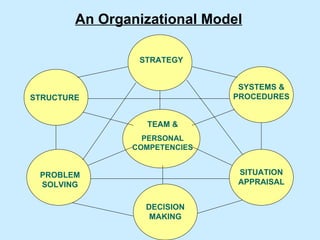
An Organizational Model STRATEGY STRUCTURE SYSTEMS & PROCEDURES TEAM & PERSONAL COMPETENCIES PROBLEM SOLVING DECISION MAKING SITUATION APPRAISAL
Tips For Strategy In Action Participate actively  Don’t just listen to the words; listen to the content and meaning Ask questions to clarify or confirm your understanding State your own thoughts Act like a unified team
Intended Results Of Strategy In Action More clarity about desired performance and what is expected of you More effective cooperation between team members Better interaction and feedback about performance needed and results desired
Intended Results Of Strategy In Action Improved communication and understanding Develop your style of management and leadership Much attention to communication is required between you and team members, in terms of building and maintaining commitment
WHAT ARE THE  TOP 3  THINGS YOU WANT TMX PHILLIPINES TO BE KNOWN FOR? WHAT DO WE DO THAT IS WORLD CLASS? STRATEGY IN ACTION
Strategy Challenge Enable management to align actions with strategy by: Supporting and defining critical success factors and key  performance indicators  Providing effective  tools  to realize agreed performance standards
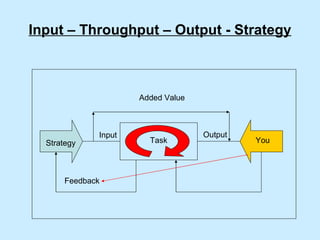
Input – Throughput – Output - Strategy Added Value Strategy Task Feedback Input Output You
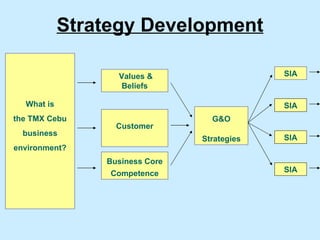
Strategy Development What is the TMX Cebu business environment?  Values & Beliefs Customer Business Core Competence G&O Strategies SIA SIA SIA SIA
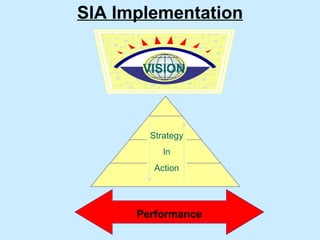
SIA Implementation VISION Strategy In Action Performance
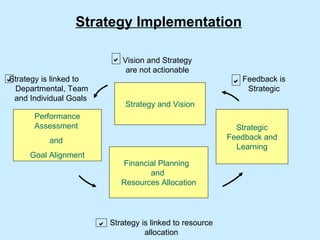
Strategy Implementation Strategic Feedback and Learning Performance Assessment  and  Goal Alignment Financial Planning  and  Resources Allocation Strategy and Vision Vision and Strategy are not actionable Strategy is linked to  Departmental, Team and Individual Goals Feedback is Strategic Strategy is linked to resource allocation    
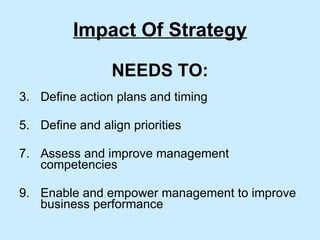
Impact Of Strategy NEEDS TO: Define action plans and timing Define and align priorities Assess and improve management competencies  Enable and empower management to improve business performance
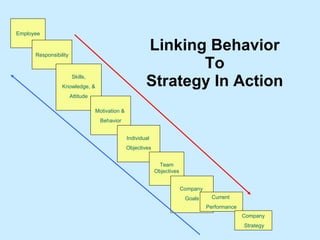
Linking Behavior To Strategy In Action Employee Responsibility Skills, Knowledge, & Attitude Motivation &  Behavior Individual  Objectives Team Objectives Company  Goals Current  Performance Company Strategy
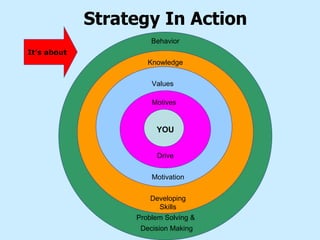
Behavior Knowledge Values Motives Drive Motivation Developing Skills Problem Solving &  Decision Making It’s about Strategy In Action YOU
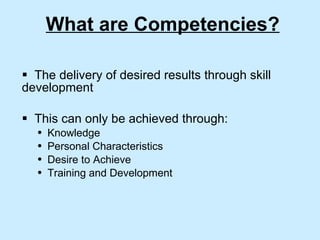
What are Competencies? The delivery of desired results through skill development This can only be achieved through: Knowledge  Personal Characteristics  Desire to Achieve Training and Development
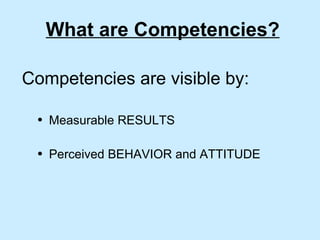
What are Competencies? Competencies are visible by: Measurable RESULTS Perceived BEHAVIOR and ATTITUDE
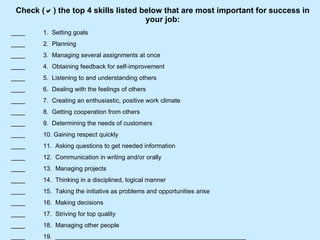
Check (  ) the top 4 skills listed below that are most important for success in your job: ____ 1.  Setting goals ____ 2.  Planning ____ 3.  Managing several assignments at once ____ 4.  Obtaining feedback for self-improvement ____ 5.  Listening to and understanding others ____ 6.  Dealing with the feelings of others ____ 7.  Creating an enthusiastic, positive work climate ____ 8.  Getting cooperation from others ____ 9.  Determining the needs of customers ____ 10. Gaining respect quickly ____ 11.  Asking questions to get needed information ____ 12.  Communication in writing and/or orally ____ 13.  Managing projects ____ 14.  Thinking in a disciplined, logical manner ____ 15.  Taking the initiative as problems and opportunities arise ____ 16.  Making decisions ____ 17.  Striving for top quality ____ 18.  Managing other people ____ 19.  _______________________________________________________
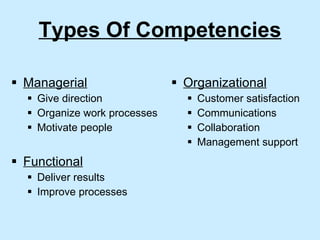
Types Of Competencies Managerial Give direction Organize work processes Motivate people Functional Deliver results Improve processes Organizational Customer satisfaction Communications Collaboration Management support
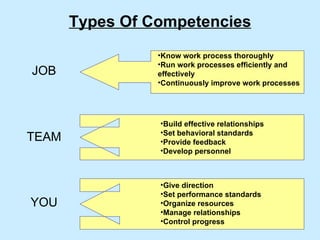
Types Of Competencies JOB TEAM YOU Know work process thoroughly Run work processes efficiently and effectively Continuously improve work processes Give direction Set performance standards Organize resources Manage relationships Control progress Build effective relationships Set behavioral standards Provide feedback Develop personnel
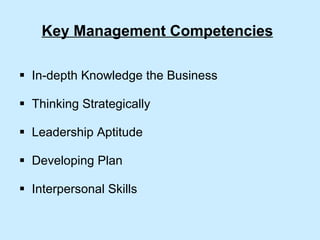
Key Management Competencies In-depth Knowledge the Business Thinking Strategically Leadership Aptitude Developing Plan Interpersonal Skills
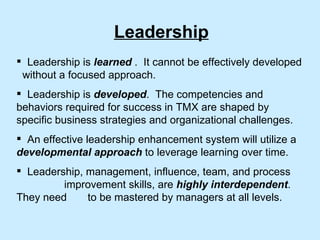
Leadership is  learned  .  It cannot be effectively developed  without a focused approach. Leadership is  developed .  The competencies and behaviors required for success in TMX are shaped by specific business strategies and organizational challenges. An effective leadership enhancement system will utilize a  developmental approach  to leverage learning over time. Leadership, management, influence, team, and process  improvement skills, are  highly interdependent .  They need  to be mastered by managers at all levels. Leadership
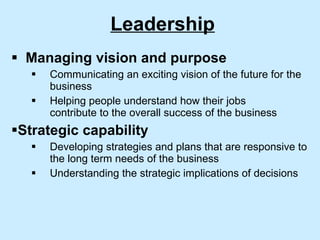
Managing vision and purpose Communicating an exciting vision of the future for the business  Helping people understand how their jobs  contribute to the overall success of the business Strategic capability   Developing strategies and plans that are responsive to the long term needs of the business Understanding the strategic implications of decisions Leadership
Leadership Dealing with ambiguity Managing change in a thoughtful and well planned manner, rather than reactive one Business acumen Understanding the critical leverage points of the business, the changing industry, and market conditions
Leadership Functional excellence Keeping up to date with leading edge developments in your field or function Design high performing teams  To support and drive business performance
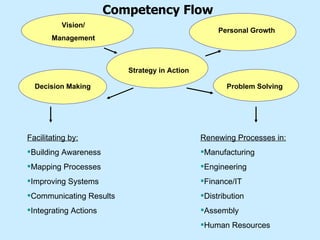
Vision/ Management Personal Growth Strategy in Action Problem Solving Decision Making Facilitating by: Building Awareness Mapping Processes Improving Systems Communicating Results Integrating Actions Renewing Processes in: Manufacturing Engineering Finance/IT Distribution Assembly Human Resources Competency Flow
YOU NEED TO…. Define and clarify the concept of  Decision Making Why is  Problem Solving  essential to success? Define a process for assessing current state of your business and the desired outcome Measure and manage the gap between problem solving and decision analysis Explore alternate approaches to create positive change
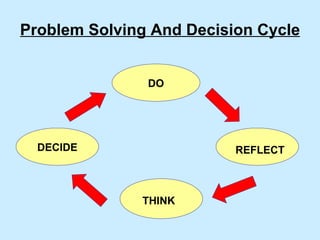
Problem Solving And Decision Cycle DO REFLECT THINK DECIDE
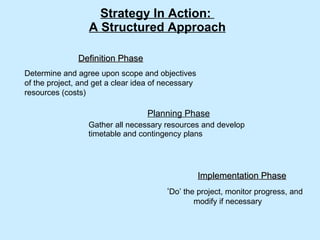
Strategy In Action:  A Structured Approach Planning Phase Gather all necessary resources and develop timetable and contingency plans Definition Phase Determine and agree upon scope and objectives of the project, and get a clear idea of necessary resources (costs) Implementation Phase ‘ Do’ the project, monitor progress, and  modify if necessary
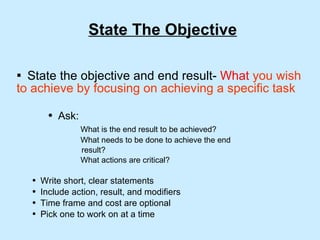
State The Objective State the objective and end result-  What   you wish to achieve by focusing on achieving a specific task Ask: What is the end result to be achieved? What needs to be done to achieve the end  result? What actions are critical? Write short, clear statements Include action, result, and modifiers Time frame and cost are optional Pick one to work on at a time
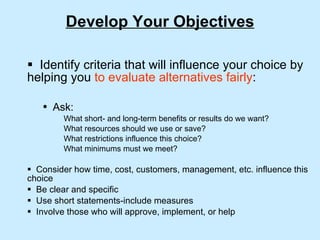
Develop Your Objectives Identify criteria that will influence your choice by helping you  to evaluate alternatives fairly : Ask: What short- and long-term benefits or results do we want? What resources should we use or save? What restrictions influence this choice? What minimums must we meet? Consider how time, cost, customers, management, etc. influence this choice Be clear and specific Use short statements-include measures  Involve those who will approve, implement, or help
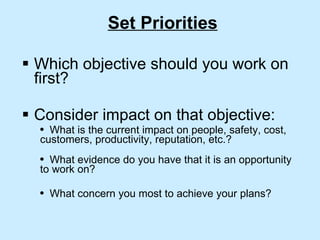
Set Priorities Which objective should you work on first? Consider impact on that objective: What is the current impact on people, safety, cost, customers, productivity, reputation, etc.?  What evidence do you have that it is an opportunity to work on? What concern you most to achieve your plans?
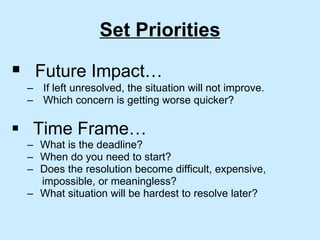
Set Priorities Future Impact… If left unresolved, the situation will not improve. Which concern is getting worse quicker? Time Frame… What is the deadline?  When do you need to start? Does the resolution become difficult, expensive,  impossible, or meaningless? What situation will be hardest to resolve later?
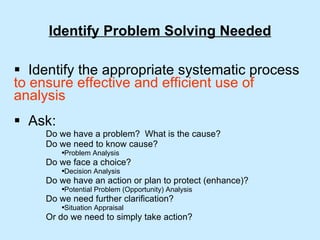
Identify Problem Solving Needed Identify the appropriate systematic process  to ensure effective and efficient use of analysis Ask: Do we have a problem?  What is the cause? Do we need to know cause?  Problem Analysis Do we face a choice? Decision Analysis Do we have an action or plan to protect (enhance)? Potential Problem (Opportunity) Analysis Do we need further clarification? Situation Appraisal Or do we need to simply take action?
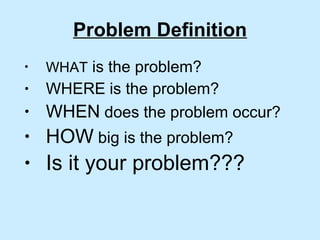
Problem Definition WHAT  is the problem? WHERE   is the problem? WHEN  does the problem occur? HOW  big is the problem? Is it your problem???
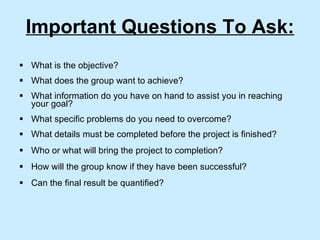
Important Questions To Ask: What is the objective? What does the group want to achieve? What information do you have on hand to assist you in reaching your goal? What specific problems do you need to overcome? What details must be completed before the project is finished? Who or what will bring the project to completion? How will the group know if they have been successful? Can the final result be quantified?
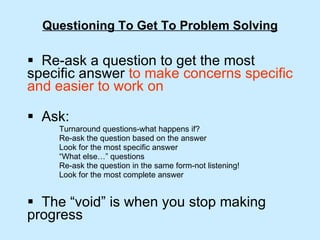
Questioning To Get To Problem Solving Re-ask a question to get the most specific answer  to make concerns specific and easier to work on Ask: Turnaround questions-what happens if? Re-ask the question based on the answer Look for the most specific answer “ What else…” questions Re-ask the question in the same form-not listening! Look for the most complete answer The “void” is when you stop making progress
Questioning Is A Key Skill Success depends on using a systematic  approach and asking questions effectively Effective questioners understand: The intent behind their question The assumptions they have made The importance of choosing words carefully Where they are likely to get the answers
Open Questions Ask questions that invite unrestricted answers  in phrases or sentences,  to gather or clarify  new information Start with “What, Where, When, How, Who,  Why…” Listen for a number of possible answers
Closed Questions Ask questions that determine the possible answers, by the manner in which they are inquired,  to check answers and show that you understand them Start with “Do, Have, Will, Can, Are, Is…” Be ready for a long answer even though you expect a short one
Active Listening  Paying attention Provide non-verbal cues such as eye contact, head nods, smiles, etc. Listening for the whole message Look for meaning, ideas, feelings, verbal and non-verbal Hearing before evaluating Avoid premature conclusions  Ask questions Paraphrasing Paraphrase what you heard
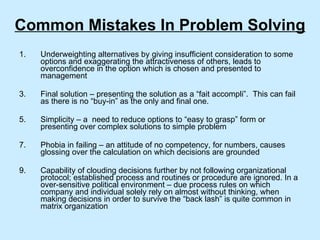
Common Mistakes In Problem Solving Underweighting alternatives by giving insufficient consideration to some options and exaggerating the attractiveness of others, leads to overconfidence in the option which is chosen and presented to management Final solution – presenting the solution as a “fait accompli”.  This can fail as there is no “buy-in” as the only and final one. Simplicity – a  need to reduce options to “easy to grasp” form or presenting over complex solutions to simple problem Phobia in failing – an attitude of no competency, for numbers, causes glossing over the calculation on which decisions are grounded Capability of clouding decisions further by not following organizational protocol; established process and routines or procedure are ignored. In a over-sensitive political environment – due process rules on which company and individual solely rely on almost without thinking, when making decisions in order to survive the “back lash” is quite common in matrix organization
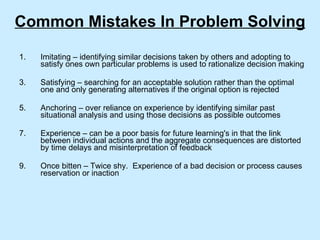
Common Mistakes In Problem Solving Imitating – identifying similar decisions taken by others and adopting to satisfy ones own particular problems is used to rationalize decision making Satisfying – searching for an acceptable solution rather than the optimal one and only generating alternatives if the original option is rejected Anchoring – over reliance on experience by identifying similar past situational analysis and using those decisions as possible outcomes Experience – can be a poor basis for future learning's in that the link between individual actions and the aggregate consequences are distorted by time delays and misinterpretation of feedback Once bitten – Twice shy.  Experience of a bad decision or process causes reservation or inaction
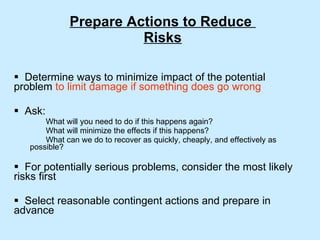
Prepare Actions to Reduce  Risks Determine ways to minimize impact of the potential problem  to limit damage if something does go wrong Ask: What will you need to do if this happens again? What will minimize the effects if this happens? What can we do to recover as quickly, cheaply, and effectively as  possible? For potentially serious problems, consider the most likely risks first Select reasonable contingent actions and prepare in advance
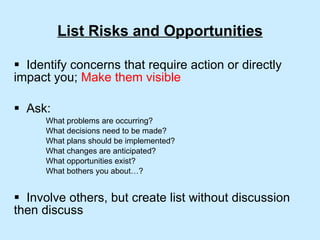
List Risks and Opportunities Identify concerns that require action or directly impact you;  Make them visible Ask: What problems are occurring? What decisions need to be made? What plans should be implemented? What changes are anticipated? What opportunities exist? What bothers you about…? Involve others, but create list without discussion  then discuss
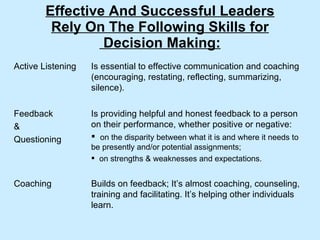
Effective And Successful Leaders Rely On The Following Skills for  Decision Making: Active Listening Is essential to effective communication and coaching (encouraging, restating, reflecting, summarizing, silence). Feedback & Questioning Is providing helpful and honest feedback to a person on their performance, whether positive or negative:  on the disparity between what it is and where it needs to be presently and/or potential assignments;  on strengths & weaknesses and expectations. Coaching Builds on feedback; It’s almost coaching, counseling, training and facilitating. It’s helping other individuals learn.
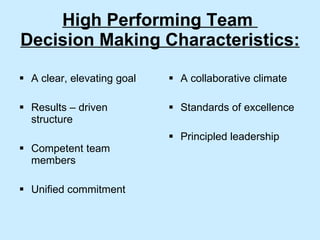
High Performing Team  Decision Making Characteristics: A clear, elevating goal Results – driven structure Competent team members Unified commitment A collaborative climate Standards of excellence Principled leadership
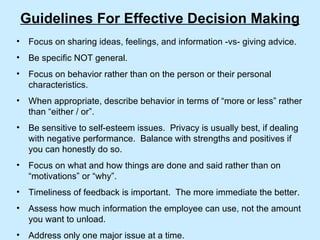
Guidelines For Effective Decision Making Focus on sharing ideas, feelings, and information -vs- giving advice. Be specific NOT general. Focus on behavior rather than on the person or their personal characteristics. When appropriate, describe behavior in terms of “more or less” rather than “either / or”. Be sensitive to self-esteem issues.  Privacy is usually best, if dealing with negative performance.  Balance with strengths and positives if you can honestly do so. Focus on what and how things are done and said rather than on “motivations” or “why”. Timeliness of feedback is important.  The more immediate the better. Assess how much information the employee can use, not the amount you want to unload. Address only one major issue at a time.
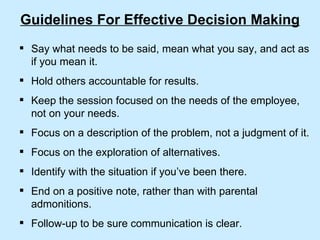
Guidelines For Effective Decision Making Say what needs to be said, mean what you say, and act as if you mean it. Hold others accountable for results. Keep the session focused on the needs of the employee, not on your needs. Focus on a description of the problem, not a judgment of it. Focus on the exploration of alternatives. Identify with the situation if you’ve been there. End on a positive note, rather than with parental admonitions. Follow-up to be sure communication is clear.
Guidelines For Coaching in  Decision Making Know your own strengths and coach from those. Find others to coach in areas outside your strengths. Regularly communicate with those being coached. Be available to your staff. Provide time, without agendas, in addition to formal coaching sessions Be sensitive to the fact that your own behavior affects others. Encourage your staff to coach  one another.
Handling Questions About Your Decision Making Receive and assess information given to you by others  to   make sure you can use the information you get After you ask a question : Listen Acknowledge Confirm Record If the answer does not match the question, acknowledge it and try again If the answer is confusing, doubtful, incomplete, or too general, use turnaround or clarifying questions Acknowledge and provide feedback
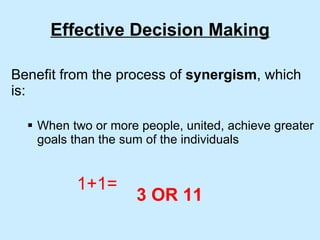
Effective Decision Making Benefit from the process of  synergism , which is: When two or more people, united, achieve greater goals than the sum of the individuals 1+1= 3 OR 11
Effective Decision Making Some members are particularly qualified to take on distinctive roles, such as thinkers, presenters, implementers and organizers. The group should identify these advantages and play to these strengths.
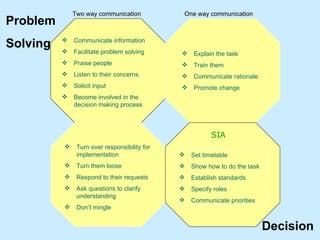
Two way communication One way communication Problem Solving Decision Communicate information Facilitate problem solving Praise people Listen to their concerns Solicit input Become involved in the decision making process Explain the task Train them Communicate rationale Promote change Turn over responsibility for implementation Turn them loose Respond to their requests Ask questions to clarify understanding Don’t mingle Set timetable Show how to do the task Establish standards Specify roles Communicate priorities SIA
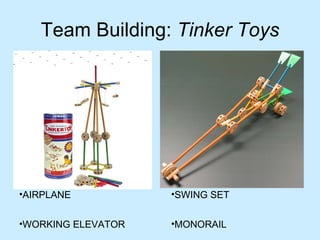
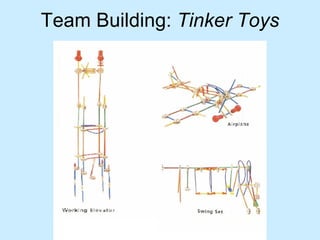
Team Building:  Tinker Toys AIRPLANE WORKING ELEVATOR SWING SET MONORAIL
Team Building:  Tinker Toys
TMX CEBU CREATIVE THINKING in Decision Making
Objectives Identify policies and practices that block or hamper creativity in your organization Build a work environment that supports creativity Use practical and fun techniques that increase creativity Use brainstorming to generate new ideas Be aware of factors that help or hinder creativity in a group to which you belong
What is  CREATIVITY? Decision Making
Creativity is the ability to generate new and useful ideas and solutions to  everyday  problems and challenges.
“ Creativity is inventing, experimenting, growing, taking risks, breaking “some” rules, making mistakes, and having fun.”
Types of Creativity A new thing comes into being ( creation ) Two previously unrelated things are joined ( synthesis ) A thing is improved or gains a new application ( modification )
Creativity helps our organization Find ways of working together more effectively Find new or better solutions to problems Be able to do more with less Discover/create ideas for new products or services Discover ideas to market and sell products Find ways to help employees feel energized and committed Find ways to be more competitive, especially in the global marketplace
In a creative environment: The climate is safe, non-threatening and non-judgmental There is time to brainstorm about problems and new ideas Risk taking is rewarded Mistakes are viewed as learning opportunities There is an atmosphere of collaboration
Three Ways to Improving Creativity Strengthen existing supportive forces--we can encourage creativity in our teams/culture Reduce inhibiting forces--we can remove mistake punishment and idea ridicule Add new supportive forces--we can include creativity as a requirement when hiring
Creativity Factors  Our self-talk or self-criticism -- we tell ourselves that we aren’t creative and then we aren’t Stress drains energy that we could use to be creative Too many routines, or never getting out of our routines A strong belief that one way is the  only  right way Fear of self-expression and of the judgment of others can severely limit our creativity
Steps of Creative Problem-Solving: Define the Problem Generate Ideas Evaluate and Identify the Best Solution Implement
Creative Problem Solving Techniques Reframing Brainstorming Thinking Hats Creative Problem Solving
Guidelines for Brainstorming 1. Define the problem 2. Keep the session focused on the problem 3. Ensure that no one criticizes or evaluates ideas  4. Encourage an enthusiastic, participatory attitude  5. Encourage everyone to have fun, to come up with as many ideas as possible 6. Ensure that no train of thought is followed for too long 7. Encourage people to build on other people's ideas 8. Appoint a note-taker
To encourage and support  creativity our company: What steps do leaders/managers need to take? What steps do employees need to take?
Leaders Need To: Embrace diversity  Facilitate a climate of supportive communication Reward inventive and innovative creativity Foster collaboration  Practice active listening
Management Needs To: Choose to work at being more creative  Choose to accept that we can improve and expand our creative abilities  Work more at doing small things more creatively  Ask for help and support in being creative  Ask for opportunities to work on more creative work  Collaborate with others  Ask more questions
The problems we face fall into one of three areas: Direct control   (problems involving our own behavior)   Indirect control   (problems involving other people's behavior), or   No control   (problems we can do nothing about, such as our past, or situational realities) Circle of Influence
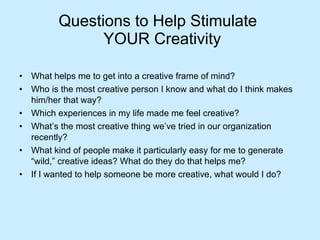
Questions to Help Stimulate   YOUR Creativity What helps me to get into a creative frame of mind? Who is the most creative person I know and what do I think makes him/her that way? Which experiences in my life made me feel creative? What’s the most creative thing we’ve tried in our organization recently? What kind of people make it particularly easy for me to generate “wild,” creative ideas? What do they do that helps me? If I wanted to help someone be more creative, what would I do?
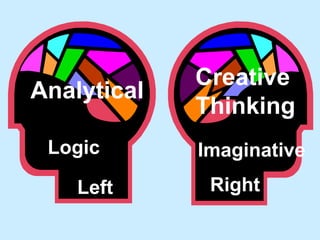
Analytical Logic Left Right Creative Thinking Imaginative
Creativity is what people find  the most  rewarding because it is something that comes naturally!
? ?   ? ? ? ? ? ? ? ? ? ? ? ? ? ? ?
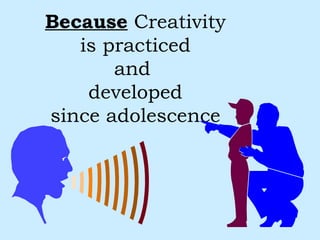
Because  Creativity is practiced and  developed since adolescence
Creativity is the ability to connect and to link situations, benefits, and ideas  that had no prior relationship
Creativity  requires imagination: It is like dreaming going from one situation to another
Creativity should be extensively developed as part of decision making  There are  many rewards  for Creative Thinking!!!
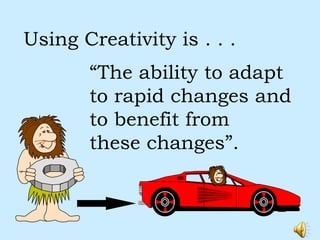
Using Creativity is . . .  “ The ability to adapt to rapid changes and  to benefit from these changes”.
People find the solutions to  problems by applying  Creativity This is  always  the best solution
Creativity produces a larger number  of ideas that have  to be analyzed  and selected, before  coming to further and enhanced decisions
So, remember: EVALUATE  ALL IDEAS Before making a decision
Reposition  the problem
Withhold judgement
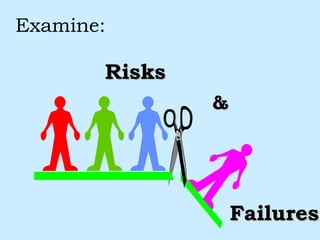
Examine: Risks & Failures
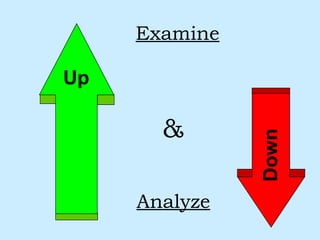
Examine & Down Up Analyze
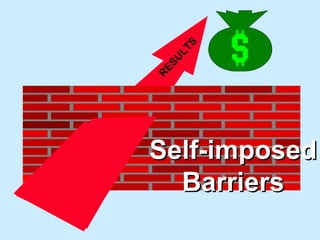
Self-imposed Barriers RESULTS
UN BUSINESS as USUAL
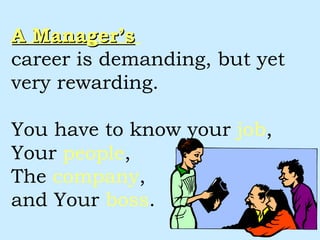
A Manager’s   career is demanding, but yet very rewarding. You have to know your  job ,  Your  people ,  The  company , and Your   boss .
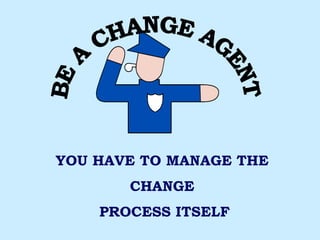
BE A CHANGE AGENT YOU HAVE TO MANAGE THE  CHANGE  PROCESS ITSELF
Success in this environment  requires flexibility and  adaptability if the rate  of change in the organization  exceeds your own rate of  change as a manager! ADAPT! Flexibility  is one of the keys to being a good change agent!
Don't give away your power Managers become more tentative during times of significant organizational change.  They grow more cautious, more careful, and more uncertain, regarding the extent of their authority and decision making latitude
Assume an Active Stance If you wait for  crystal clear signals  from  above regarding  what you can  and can’t do, your part of the  organization is going to lose  momentum. Empower  yourself Attack  your job  with confidence  and authority. “ THE BEST DEFENCE IS A GOOD OFFENCE”
Keep a  Positive  Attitude Your attitude is one of the few things that is completely under your control Be upbeat, positive, and enthusiastic The attitude and morale of your subordinates will be favourably influenced
Change can be aggravating, confusing and stressful Look at organizational change as a personal challenge.  Seek out the opportunities that change presents Keep a  Positive  Attitude
Give your troops clear-cut  marching orders Organizational change usually creates a higher level of uncertainty You need to manage in a way that minimizes the ambiguity, and clears up the “unknown” as much as possible Employees usually respond well to hands-on management Give them generous management direction
Frame out their duties and assignments in specific terms, rather than leaving things general and vague Assign definite deadlines and timetables regarding when the work is to be completed Organizational slippage is something  you have to fight against during times of transition and change Organizational change creates many distractions, so employees need “focusing” by  management Guidance helps keep people on track & reduces drop-off in productivity
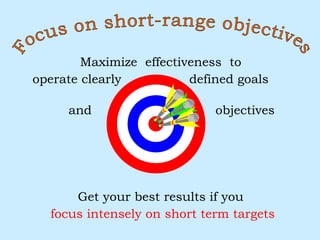
Maximize  effectiveness  to  operate clearly  defined goals  and  objectives Get your best results if you  focus intensely on short term targets Focus on short-range objectives
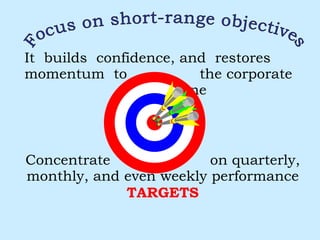
It  builds  confidence, and  restores momentum  to  the corporate  machine Concentrate  on quarterly, monthly, and even weekly performance  TARGETS Focus on short-range objectives
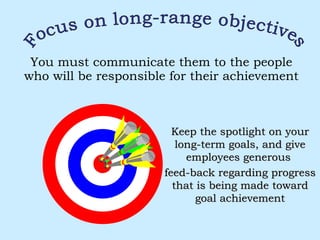
You must communicate them to the people who will be responsible for their achievement Focus on long-range objectives Keep the spotlight on your long-term goals, and give employees generous  feed-back regarding progress that is being made toward goal achievement
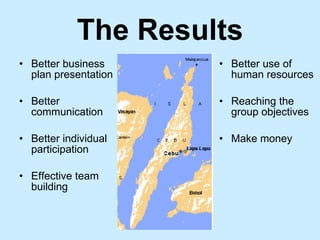
The Results Better business plan presentation Better communication Better individual participation Effective team building Better use of human resources Reaching the group objectives Make money
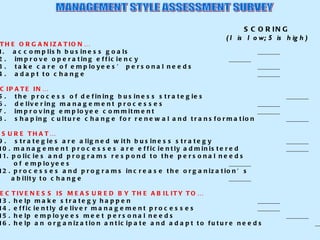
MANAGEMENT STYLE ASSESSMENT SURVEY SCORING (1 is low; 5 is high) I HELP THE ORGANIZATION… 1.  accomplish business goals _______ 2.  improve operating efficiency _______ 3.  take care of employees’ personal needs _______ 4.  adapt to change _______ I PARTICIPATE IN… 5.  the process of defining business strategies _______ 6.  delivering management processes _______ 7.  improving employee commitment _______ 8.  shaping culture change for renewal and transformation _______ I MAKE SURE THAT… 9.  strategies are aligned with business strategy _______ 10. management processes are efficiently administered _______ 11. policies and programs respond to the personal needs   of employees _______ 12. processes and programs increase the organization’s   ability to change _______  MY EFFECTIVENESS IS MEASURED BY THE ABILITY TO… 13. help make strategy happen _______ 14. efficiently deliver management processes _______ 15. help employees meet personal needs _______ 16. help an organization anticipate and adapt to future needs _______
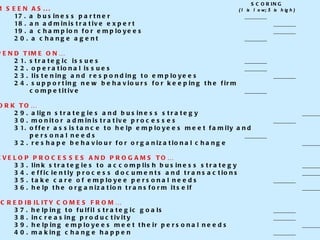
I AM SEEN AS... 17. a business partner _______ 18. an administrative expert _______ 19. a champion for employees _______ 20. a change agent _______ I SPEND TIME ON… 21. strategic issues _______ 22. operational issues _______ 23. listening and responding to employees _______ 24. supporting new behaviours for keeping the firm    competitive _______ I WORK TO… 29. align strategies and business strategy _______ 30. monitor administrative processes _______ 31. offer assistance to help employees meet family and   personal needs _______ 32. reshape behaviour for organizational change _______ I DEVELOP PROCESSES AND PROGAMS TO… 33. link strategies to accomplish business strategy _______ 34. efficiently process documents and transactions _______ 35. take care of employee personal needs _______ 36. help the organization transform itself _______ MY CREDIBILITY COMES FROM… 37. helping to fulfil strategic goals _______ 38. increasing productivity _______ 39. helping employees meet their personal needs _______ 40. making change happen _______ SCORING (1 is low; 5 is high)
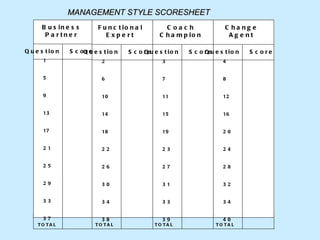
MANAGEMENT STYLE SCORESHEET Business Partner Question  Score 1 5 9 13 17 21 25 29 33 37 Functional Expert Question  Score 2 6 10 14 18 22 26 30 34 38 Coach Champion Question  Score 3 7 11 15 19 23 27 31 33 39 Change Agent Question  Score 4 8 12 16 20 24 28 32 34 40 TOTAL TOTAL  TOTAL   TOTAL
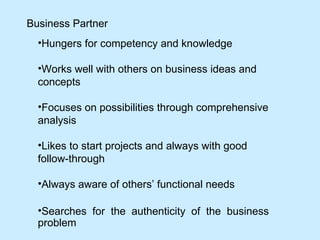
Business Partner   Hungers for competency and knowledge Works well with others on business ideas and concepts Focuses on possibilities through comprehensive analysis Likes to start projects and always with good  follow-through Always aware of others’ functional needs Searches for the authenticity of the business problem
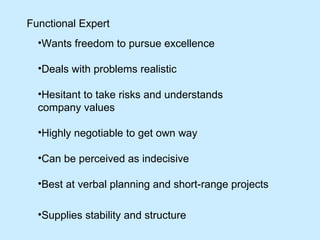
Functional Expert  Wants freedom to pursue excellence Deals with problems realistic Hesitant to take risks and understands company values Highly negotiable to get own way Can be perceived as indecisive Best at verbal planning and short-range projects Supplies stability and structure
Coach Champion Strives to belong and contribute Prizes harmony and teams  Orderly, dependable and empathetic Expects others to be realistic  More likely to reward team achievement than personal  Can reward more easily than   be critical of mistakes
Change Agent Searches for different approaches and meaning of the opportunity - Responsive to new ideas See all possibilities to the problem – not only one solution Communicates appreciation, enthusiasm for trying different things Highly responsive to continuous improvement  Keeps in close contact with what needs to be changed Effective at conflict resolution
Use  ALL YOUR POTENTIAL !!!
With a little FIRE  . . .
. . . and  Love  !!!
To develop for your future
So, who are we . . . ?
WE ARE A HIGH PERFORMANCE TEAM TMX CEBU
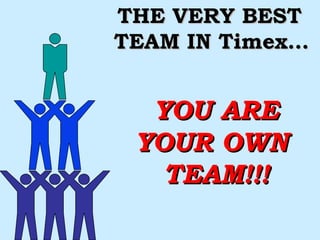
YOU ARE YOUR OWN  TEAM!!! THE VERY BEST  TEAM IN Timex…
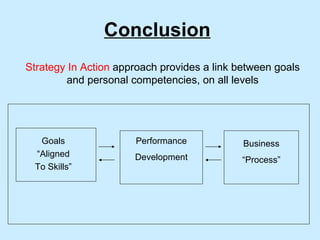
Conclusion   Strategy In Action  approach provides a link between goals and personal competencies, on all levels Goals “ Aligned To Skills” Performance Development Business “ Process”
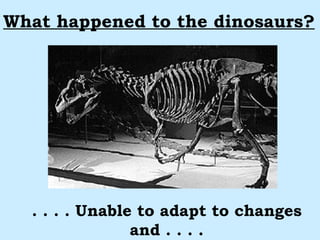
What happened to the dinosaurs? . . . . Unable to adapt to changes and . . . .
Whack There is usually more than one good solution to being creative. Groups of people are usually more successful at solving a problem and being creative than individuals working alone. Our assumptions can limit our creativity. Watching others and learning from their experience can help us be more creative in the future.

Strategy in Action

  • 1.
  • 2.
    STRATEGY IN ACTIONDates: March 26 th & 27 th A highly interactive session for middle managers and supervisors, dedicated to improve their professional and personal development skills. Share personal experiences and individual learning style. Learn from each other. Facilitators: Mauro Calcano, 3 Hour Session Lectures Group Dynamics Video Wrap-Up & Feedback
  • 3.
    Group Dynamics BusinessScorecard Executive Toys Management Style Survey Videos A Peacock In The Land Of Penguins Pigeonholed In The Land Of Penguins We’re Also Going to Have Some Fun Today:
  • 4.
  • 5.
    What does strategymean to you? STRATEGY IN ACTION
  • 6.
    STRATEGY IN ACTIONStrategy is long-range planning in order to development a tactical plan Tactics deals with the use of competencies in actual implementation Strategy in Action – combines both to adapt behavior and provide structure in order to achieve continuous improvements
  • 7.
    “ BELIEVING THATLASTING ORGANIZATIONAL CHANGE AND ACTION, TAKES PLACE ONLY THROUGH AND WITH PEOPLE” STRATEGY IN ACTION
  • 8.
    HOW IS THISREALIZED? Through Action Leadership 1. Managing Vision and Purpose Communicating an exciting vision of the future for the business Helping people understand how their jobs contribute to the overall success of the business Ensuring clarity through consistent actions
  • 9.
    2. StrategicCapability Developing strategies and plans that are responsive to the long term needs of the business Understanding the strategic implications to the business 3. Dealing with Ambiguity Managing change in a thoughtful & well planned manner, rather than a reactive one
  • 10.
    4. BusinessAcumen Understanding the critical leverage points of the business and the changing environment. 5. Functional Excellence Keeping up to date with your own developments in your field or function People Development & Building Effective Teams Leadership should be team-focused and shared, rather than driven by a single person
  • 11.
    Problem Solving &Decision Making The pace of change today, because of globalization , world flattening technology , innovation , information access , economic and financial fluctuations , are both incredible and unbelievable. SPEED TO MARKET THE KEY TO GOOD STRATEGY DEVELOPMENT IS IN:
  • 12.
    An Organizational ModelSTRATEGY STRUCTURE SYSTEMS & PROCEDURES TEAM & PERSONAL COMPETENCIES PROBLEM SOLVING DECISION MAKING SITUATION APPRAISAL
  • 13.
    Tips For StrategyIn Action Participate actively Don’t just listen to the words; listen to the content and meaning Ask questions to clarify or confirm your understanding State your own thoughts Act like a unified team
  • 14.
    Intended Results OfStrategy In Action More clarity about desired performance and what is expected of you More effective cooperation between team members Better interaction and feedback about performance needed and results desired
  • 15.
    Intended Results OfStrategy In Action Improved communication and understanding Develop your style of management and leadership Much attention to communication is required between you and team members, in terms of building and maintaining commitment
  • 16.
    WHAT ARE THE TOP 3 THINGS YOU WANT TMX PHILLIPINES TO BE KNOWN FOR? WHAT DO WE DO THAT IS WORLD CLASS? STRATEGY IN ACTION
  • 17.
    Strategy Challenge Enablemanagement to align actions with strategy by: Supporting and defining critical success factors and key performance indicators Providing effective tools to realize agreed performance standards
  • 18.
    Input – Throughput– Output - Strategy Added Value Strategy Task Feedback Input Output You
  • 19.
    Strategy Development Whatis the TMX Cebu business environment? Values & Beliefs Customer Business Core Competence G&O Strategies SIA SIA SIA SIA
  • 20.
    SIA Implementation VISIONStrategy In Action Performance
  • 21.
    Strategy Implementation StrategicFeedback and Learning Performance Assessment and Goal Alignment Financial Planning and Resources Allocation Strategy and Vision Vision and Strategy are not actionable Strategy is linked to Departmental, Team and Individual Goals Feedback is Strategic Strategy is linked to resource allocation    
  • 22.
    Impact Of StrategyNEEDS TO: Define action plans and timing Define and align priorities Assess and improve management competencies Enable and empower management to improve business performance
  • 23.
    Linking Behavior ToStrategy In Action Employee Responsibility Skills, Knowledge, & Attitude Motivation & Behavior Individual Objectives Team Objectives Company Goals Current Performance Company Strategy
  • 24.
    Behavior Knowledge ValuesMotives Drive Motivation Developing Skills Problem Solving & Decision Making It’s about Strategy In Action YOU
  • 25.
    What are Competencies?The delivery of desired results through skill development This can only be achieved through: Knowledge Personal Characteristics Desire to Achieve Training and Development
  • 26.
    What are Competencies?Competencies are visible by: Measurable RESULTS Perceived BEHAVIOR and ATTITUDE
  • 27.
    Check ( ) the top 4 skills listed below that are most important for success in your job: ____ 1. Setting goals ____ 2. Planning ____ 3. Managing several assignments at once ____ 4. Obtaining feedback for self-improvement ____ 5. Listening to and understanding others ____ 6. Dealing with the feelings of others ____ 7. Creating an enthusiastic, positive work climate ____ 8. Getting cooperation from others ____ 9. Determining the needs of customers ____ 10. Gaining respect quickly ____ 11. Asking questions to get needed information ____ 12. Communication in writing and/or orally ____ 13. Managing projects ____ 14. Thinking in a disciplined, logical manner ____ 15. Taking the initiative as problems and opportunities arise ____ 16. Making decisions ____ 17. Striving for top quality ____ 18. Managing other people ____ 19. _______________________________________________________
  • 28.
    Types Of CompetenciesManagerial Give direction Organize work processes Motivate people Functional Deliver results Improve processes Organizational Customer satisfaction Communications Collaboration Management support
  • 29.
    Types Of CompetenciesJOB TEAM YOU Know work process thoroughly Run work processes efficiently and effectively Continuously improve work processes Give direction Set performance standards Organize resources Manage relationships Control progress Build effective relationships Set behavioral standards Provide feedback Develop personnel
  • 30.
    Key Management CompetenciesIn-depth Knowledge the Business Thinking Strategically Leadership Aptitude Developing Plan Interpersonal Skills
  • 31.
    Leadership is learned . It cannot be effectively developed without a focused approach. Leadership is developed . The competencies and behaviors required for success in TMX are shaped by specific business strategies and organizational challenges. An effective leadership enhancement system will utilize a developmental approach to leverage learning over time. Leadership, management, influence, team, and process improvement skills, are highly interdependent . They need to be mastered by managers at all levels. Leadership
  • 32.
    Managing vision andpurpose Communicating an exciting vision of the future for the business Helping people understand how their jobs contribute to the overall success of the business Strategic capability Developing strategies and plans that are responsive to the long term needs of the business Understanding the strategic implications of decisions Leadership
  • 33.
    Leadership Dealing withambiguity Managing change in a thoughtful and well planned manner, rather than reactive one Business acumen Understanding the critical leverage points of the business, the changing industry, and market conditions
  • 34.
    Leadership Functional excellenceKeeping up to date with leading edge developments in your field or function Design high performing teams To support and drive business performance
  • 35.
    Vision/ Management PersonalGrowth Strategy in Action Problem Solving Decision Making Facilitating by: Building Awareness Mapping Processes Improving Systems Communicating Results Integrating Actions Renewing Processes in: Manufacturing Engineering Finance/IT Distribution Assembly Human Resources Competency Flow
  • 36.
    YOU NEED TO….Define and clarify the concept of Decision Making Why is Problem Solving essential to success? Define a process for assessing current state of your business and the desired outcome Measure and manage the gap between problem solving and decision analysis Explore alternate approaches to create positive change
  • 37.
    Problem Solving AndDecision Cycle DO REFLECT THINK DECIDE
  • 38.
    Strategy In Action: A Structured Approach Planning Phase Gather all necessary resources and develop timetable and contingency plans Definition Phase Determine and agree upon scope and objectives of the project, and get a clear idea of necessary resources (costs) Implementation Phase ‘ Do’ the project, monitor progress, and modify if necessary
  • 39.
    State The ObjectiveState the objective and end result- What you wish to achieve by focusing on achieving a specific task Ask: What is the end result to be achieved? What needs to be done to achieve the end result? What actions are critical? Write short, clear statements Include action, result, and modifiers Time frame and cost are optional Pick one to work on at a time
  • 40.
    Develop Your ObjectivesIdentify criteria that will influence your choice by helping you to evaluate alternatives fairly : Ask: What short- and long-term benefits or results do we want? What resources should we use or save? What restrictions influence this choice? What minimums must we meet? Consider how time, cost, customers, management, etc. influence this choice Be clear and specific Use short statements-include measures Involve those who will approve, implement, or help
  • 41.
    Set Priorities Whichobjective should you work on first? Consider impact on that objective: What is the current impact on people, safety, cost, customers, productivity, reputation, etc.? What evidence do you have that it is an opportunity to work on? What concern you most to achieve your plans?
  • 42.
    Set Priorities FutureImpact… If left unresolved, the situation will not improve. Which concern is getting worse quicker? Time Frame… What is the deadline? When do you need to start? Does the resolution become difficult, expensive, impossible, or meaningless? What situation will be hardest to resolve later?
  • 43.
    Identify Problem SolvingNeeded Identify the appropriate systematic process to ensure effective and efficient use of analysis Ask: Do we have a problem? What is the cause? Do we need to know cause? Problem Analysis Do we face a choice? Decision Analysis Do we have an action or plan to protect (enhance)? Potential Problem (Opportunity) Analysis Do we need further clarification? Situation Appraisal Or do we need to simply take action?
  • 44.
    Problem Definition WHAT is the problem? WHERE is the problem? WHEN does the problem occur? HOW big is the problem? Is it your problem???
  • 45.
    Important Questions ToAsk: What is the objective? What does the group want to achieve? What information do you have on hand to assist you in reaching your goal? What specific problems do you need to overcome? What details must be completed before the project is finished? Who or what will bring the project to completion? How will the group know if they have been successful? Can the final result be quantified?
  • 46.
    Questioning To GetTo Problem Solving Re-ask a question to get the most specific answer to make concerns specific and easier to work on Ask: Turnaround questions-what happens if? Re-ask the question based on the answer Look for the most specific answer “ What else…” questions Re-ask the question in the same form-not listening! Look for the most complete answer The “void” is when you stop making progress
  • 47.
    Questioning Is AKey Skill Success depends on using a systematic approach and asking questions effectively Effective questioners understand: The intent behind their question The assumptions they have made The importance of choosing words carefully Where they are likely to get the answers
  • 48.
    Open Questions Askquestions that invite unrestricted answers in phrases or sentences, to gather or clarify new information Start with “What, Where, When, How, Who, Why…” Listen for a number of possible answers
  • 49.
    Closed Questions Askquestions that determine the possible answers, by the manner in which they are inquired, to check answers and show that you understand them Start with “Do, Have, Will, Can, Are, Is…” Be ready for a long answer even though you expect a short one
  • 50.
    Active Listening Paying attention Provide non-verbal cues such as eye contact, head nods, smiles, etc. Listening for the whole message Look for meaning, ideas, feelings, verbal and non-verbal Hearing before evaluating Avoid premature conclusions Ask questions Paraphrasing Paraphrase what you heard
  • 51.
    Common Mistakes InProblem Solving Underweighting alternatives by giving insufficient consideration to some options and exaggerating the attractiveness of others, leads to overconfidence in the option which is chosen and presented to management Final solution – presenting the solution as a “fait accompli”. This can fail as there is no “buy-in” as the only and final one. Simplicity – a need to reduce options to “easy to grasp” form or presenting over complex solutions to simple problem Phobia in failing – an attitude of no competency, for numbers, causes glossing over the calculation on which decisions are grounded Capability of clouding decisions further by not following organizational protocol; established process and routines or procedure are ignored. In a over-sensitive political environment – due process rules on which company and individual solely rely on almost without thinking, when making decisions in order to survive the “back lash” is quite common in matrix organization
  • 52.
    Common Mistakes InProblem Solving Imitating – identifying similar decisions taken by others and adopting to satisfy ones own particular problems is used to rationalize decision making Satisfying – searching for an acceptable solution rather than the optimal one and only generating alternatives if the original option is rejected Anchoring – over reliance on experience by identifying similar past situational analysis and using those decisions as possible outcomes Experience – can be a poor basis for future learning's in that the link between individual actions and the aggregate consequences are distorted by time delays and misinterpretation of feedback Once bitten – Twice shy. Experience of a bad decision or process causes reservation or inaction
  • 53.
    Prepare Actions toReduce Risks Determine ways to minimize impact of the potential problem to limit damage if something does go wrong Ask: What will you need to do if this happens again? What will minimize the effects if this happens? What can we do to recover as quickly, cheaply, and effectively as possible? For potentially serious problems, consider the most likely risks first Select reasonable contingent actions and prepare in advance
  • 54.
    List Risks andOpportunities Identify concerns that require action or directly impact you; Make them visible Ask: What problems are occurring? What decisions need to be made? What plans should be implemented? What changes are anticipated? What opportunities exist? What bothers you about…? Involve others, but create list without discussion then discuss
  • 55.
    Effective And SuccessfulLeaders Rely On The Following Skills for Decision Making: Active Listening Is essential to effective communication and coaching (encouraging, restating, reflecting, summarizing, silence). Feedback & Questioning Is providing helpful and honest feedback to a person on their performance, whether positive or negative: on the disparity between what it is and where it needs to be presently and/or potential assignments; on strengths & weaknesses and expectations. Coaching Builds on feedback; It’s almost coaching, counseling, training and facilitating. It’s helping other individuals learn.
  • 56.
    High Performing Team Decision Making Characteristics: A clear, elevating goal Results – driven structure Competent team members Unified commitment A collaborative climate Standards of excellence Principled leadership
  • 57.
    Guidelines For EffectiveDecision Making Focus on sharing ideas, feelings, and information -vs- giving advice. Be specific NOT general. Focus on behavior rather than on the person or their personal characteristics. When appropriate, describe behavior in terms of “more or less” rather than “either / or”. Be sensitive to self-esteem issues. Privacy is usually best, if dealing with negative performance. Balance with strengths and positives if you can honestly do so. Focus on what and how things are done and said rather than on “motivations” or “why”. Timeliness of feedback is important. The more immediate the better. Assess how much information the employee can use, not the amount you want to unload. Address only one major issue at a time.
  • 58.
    Guidelines For EffectiveDecision Making Say what needs to be said, mean what you say, and act as if you mean it. Hold others accountable for results. Keep the session focused on the needs of the employee, not on your needs. Focus on a description of the problem, not a judgment of it. Focus on the exploration of alternatives. Identify with the situation if you’ve been there. End on a positive note, rather than with parental admonitions. Follow-up to be sure communication is clear.
  • 59.
    Guidelines For Coachingin Decision Making Know your own strengths and coach from those. Find others to coach in areas outside your strengths. Regularly communicate with those being coached. Be available to your staff. Provide time, without agendas, in addition to formal coaching sessions Be sensitive to the fact that your own behavior affects others. Encourage your staff to coach one another.
  • 60.
    Handling Questions AboutYour Decision Making Receive and assess information given to you by others to make sure you can use the information you get After you ask a question : Listen Acknowledge Confirm Record If the answer does not match the question, acknowledge it and try again If the answer is confusing, doubtful, incomplete, or too general, use turnaround or clarifying questions Acknowledge and provide feedback
  • 61.
    Effective Decision MakingBenefit from the process of synergism , which is: When two or more people, united, achieve greater goals than the sum of the individuals 1+1= 3 OR 11
  • 62.
    Effective Decision MakingSome members are particularly qualified to take on distinctive roles, such as thinkers, presenters, implementers and organizers. The group should identify these advantages and play to these strengths.
  • 63.
    Two way communicationOne way communication Problem Solving Decision Communicate information Facilitate problem solving Praise people Listen to their concerns Solicit input Become involved in the decision making process Explain the task Train them Communicate rationale Promote change Turn over responsibility for implementation Turn them loose Respond to their requests Ask questions to clarify understanding Don’t mingle Set timetable Show how to do the task Establish standards Specify roles Communicate priorities SIA
  • 64.
    Team Building: Tinker Toys AIRPLANE WORKING ELEVATOR SWING SET MONORAIL
  • 65.
    Team Building: Tinker Toys
  • 66.
    TMX CEBU CREATIVETHINKING in Decision Making
  • 67.
    Objectives Identify policiesand practices that block or hamper creativity in your organization Build a work environment that supports creativity Use practical and fun techniques that increase creativity Use brainstorming to generate new ideas Be aware of factors that help or hinder creativity in a group to which you belong
  • 68.
    What is CREATIVITY? Decision Making
  • 69.
    Creativity is theability to generate new and useful ideas and solutions to everyday problems and challenges.
  • 70.
    “ Creativity isinventing, experimenting, growing, taking risks, breaking “some” rules, making mistakes, and having fun.”
  • 71.
    Types of CreativityA new thing comes into being ( creation ) Two previously unrelated things are joined ( synthesis ) A thing is improved or gains a new application ( modification )
  • 72.
    Creativity helps ourorganization Find ways of working together more effectively Find new or better solutions to problems Be able to do more with less Discover/create ideas for new products or services Discover ideas to market and sell products Find ways to help employees feel energized and committed Find ways to be more competitive, especially in the global marketplace
  • 73.
    In a creativeenvironment: The climate is safe, non-threatening and non-judgmental There is time to brainstorm about problems and new ideas Risk taking is rewarded Mistakes are viewed as learning opportunities There is an atmosphere of collaboration
  • 74.
    Three Ways toImproving Creativity Strengthen existing supportive forces--we can encourage creativity in our teams/culture Reduce inhibiting forces--we can remove mistake punishment and idea ridicule Add new supportive forces--we can include creativity as a requirement when hiring
  • 75.
    Creativity Factors Our self-talk or self-criticism -- we tell ourselves that we aren’t creative and then we aren’t Stress drains energy that we could use to be creative Too many routines, or never getting out of our routines A strong belief that one way is the only right way Fear of self-expression and of the judgment of others can severely limit our creativity
  • 76.
    Steps of CreativeProblem-Solving: Define the Problem Generate Ideas Evaluate and Identify the Best Solution Implement
  • 77.
    Creative Problem SolvingTechniques Reframing Brainstorming Thinking Hats Creative Problem Solving
  • 78.
    Guidelines for Brainstorming1. Define the problem 2. Keep the session focused on the problem 3. Ensure that no one criticizes or evaluates ideas 4. Encourage an enthusiastic, participatory attitude 5. Encourage everyone to have fun, to come up with as many ideas as possible 6. Ensure that no train of thought is followed for too long 7. Encourage people to build on other people's ideas 8. Appoint a note-taker
  • 79.
    To encourage andsupport creativity our company: What steps do leaders/managers need to take? What steps do employees need to take?
  • 80.
    Leaders Need To:Embrace diversity Facilitate a climate of supportive communication Reward inventive and innovative creativity Foster collaboration Practice active listening
  • 81.
    Management Needs To:Choose to work at being more creative Choose to accept that we can improve and expand our creative abilities Work more at doing small things more creatively Ask for help and support in being creative Ask for opportunities to work on more creative work Collaborate with others Ask more questions
  • 82.
    The problems weface fall into one of three areas: Direct control (problems involving our own behavior) Indirect control (problems involving other people's behavior), or No control (problems we can do nothing about, such as our past, or situational realities) Circle of Influence
  • 83.
    Questions to HelpStimulate YOUR Creativity What helps me to get into a creative frame of mind? Who is the most creative person I know and what do I think makes him/her that way? Which experiences in my life made me feel creative? What’s the most creative thing we’ve tried in our organization recently? What kind of people make it particularly easy for me to generate “wild,” creative ideas? What do they do that helps me? If I wanted to help someone be more creative, what would I do?
  • 84.
    Analytical Logic LeftRight Creative Thinking Imaginative
  • 85.
    Creativity is whatpeople find the most rewarding because it is something that comes naturally!
  • 86.
    ? ? ? ? ? ? ? ? ? ? ? ? ? ? ? ? ?
  • 87.
    Because Creativityis practiced and developed since adolescence
  • 88.
    Creativity is theability to connect and to link situations, benefits, and ideas that had no prior relationship
  • 89.
    Creativity requiresimagination: It is like dreaming going from one situation to another
  • 90.
    Creativity should beextensively developed as part of decision making There are many rewards for Creative Thinking!!!
  • 91.
    Using Creativity is. . . “ The ability to adapt to rapid changes and to benefit from these changes”.
  • 92.
    People find thesolutions to problems by applying Creativity This is always the best solution
  • 93.
    Creativity produces alarger number of ideas that have to be analyzed and selected, before coming to further and enhanced decisions
  • 94.
    So, remember: EVALUATE ALL IDEAS Before making a decision
  • 95.
  • 96.
  • 97.
  • 98.
    Examine & DownUp Analyze
  • 99.
  • 100.
  • 101.
    A Manager’s career is demanding, but yet very rewarding. You have to know your job , Your people , The company , and Your boss .
  • 102.
    BE A CHANGEAGENT YOU HAVE TO MANAGE THE CHANGE PROCESS ITSELF
  • 103.
    Success in thisenvironment requires flexibility and adaptability if the rate of change in the organization exceeds your own rate of change as a manager! ADAPT! Flexibility is one of the keys to being a good change agent!
  • 104.
    Don't give awayyour power Managers become more tentative during times of significant organizational change. They grow more cautious, more careful, and more uncertain, regarding the extent of their authority and decision making latitude
  • 105.
    Assume an ActiveStance If you wait for crystal clear signals from above regarding what you can and can’t do, your part of the organization is going to lose momentum. Empower yourself Attack your job with confidence and authority. “ THE BEST DEFENCE IS A GOOD OFFENCE”
  • 106.
    Keep a Positive Attitude Your attitude is one of the few things that is completely under your control Be upbeat, positive, and enthusiastic The attitude and morale of your subordinates will be favourably influenced
  • 107.
    Change can beaggravating, confusing and stressful Look at organizational change as a personal challenge. Seek out the opportunities that change presents Keep a Positive Attitude
  • 108.
    Give your troopsclear-cut marching orders Organizational change usually creates a higher level of uncertainty You need to manage in a way that minimizes the ambiguity, and clears up the “unknown” as much as possible Employees usually respond well to hands-on management Give them generous management direction
  • 109.
    Frame out theirduties and assignments in specific terms, rather than leaving things general and vague Assign definite deadlines and timetables regarding when the work is to be completed Organizational slippage is something you have to fight against during times of transition and change Organizational change creates many distractions, so employees need “focusing” by management Guidance helps keep people on track & reduces drop-off in productivity
  • 110.
    Maximize effectiveness to operate clearly defined goals and objectives Get your best results if you focus intensely on short term targets Focus on short-range objectives
  • 111.
    It builds confidence, and restores momentum to the corporate machine Concentrate on quarterly, monthly, and even weekly performance TARGETS Focus on short-range objectives
  • 112.
    You must communicatethem to the people who will be responsible for their achievement Focus on long-range objectives Keep the spotlight on your long-term goals, and give employees generous feed-back regarding progress that is being made toward goal achievement
  • 113.
    The Results Betterbusiness plan presentation Better communication Better individual participation Effective team building Better use of human resources Reaching the group objectives Make money
  • 114.
    MANAGEMENT STYLE ASSESSMENTSURVEY SCORING (1 is low; 5 is high) I HELP THE ORGANIZATION… 1. accomplish business goals _______ 2. improve operating efficiency _______ 3. take care of employees’ personal needs _______ 4. adapt to change _______ I PARTICIPATE IN… 5. the process of defining business strategies _______ 6. delivering management processes _______ 7. improving employee commitment _______ 8. shaping culture change for renewal and transformation _______ I MAKE SURE THAT… 9. strategies are aligned with business strategy _______ 10. management processes are efficiently administered _______ 11. policies and programs respond to the personal needs of employees _______ 12. processes and programs increase the organization’s ability to change _______ MY EFFECTIVENESS IS MEASURED BY THE ABILITY TO… 13. help make strategy happen _______ 14. efficiently deliver management processes _______ 15. help employees meet personal needs _______ 16. help an organization anticipate and adapt to future needs _______
  • 115.
    I AM SEENAS... 17. a business partner _______ 18. an administrative expert _______ 19. a champion for employees _______ 20. a change agent _______ I SPEND TIME ON… 21. strategic issues _______ 22. operational issues _______ 23. listening and responding to employees _______ 24. supporting new behaviours for keeping the firm competitive _______ I WORK TO… 29. align strategies and business strategy _______ 30. monitor administrative processes _______ 31. offer assistance to help employees meet family and personal needs _______ 32. reshape behaviour for organizational change _______ I DEVELOP PROCESSES AND PROGAMS TO… 33. link strategies to accomplish business strategy _______ 34. efficiently process documents and transactions _______ 35. take care of employee personal needs _______ 36. help the organization transform itself _______ MY CREDIBILITY COMES FROM… 37. helping to fulfil strategic goals _______ 38. increasing productivity _______ 39. helping employees meet their personal needs _______ 40. making change happen _______ SCORING (1 is low; 5 is high)
  • 116.
    MANAGEMENT STYLE SCORESHEETBusiness Partner Question Score 1 5 9 13 17 21 25 29 33 37 Functional Expert Question Score 2 6 10 14 18 22 26 30 34 38 Coach Champion Question Score 3 7 11 15 19 23 27 31 33 39 Change Agent Question Score 4 8 12 16 20 24 28 32 34 40 TOTAL TOTAL TOTAL TOTAL
  • 117.
    Business Partner Hungers for competency and knowledge Works well with others on business ideas and concepts Focuses on possibilities through comprehensive analysis Likes to start projects and always with good follow-through Always aware of others’ functional needs Searches for the authenticity of the business problem
  • 118.
    Functional Expert Wants freedom to pursue excellence Deals with problems realistic Hesitant to take risks and understands company values Highly negotiable to get own way Can be perceived as indecisive Best at verbal planning and short-range projects Supplies stability and structure
  • 119.
    Coach Champion Strivesto belong and contribute Prizes harmony and teams Orderly, dependable and empathetic Expects others to be realistic More likely to reward team achievement than personal Can reward more easily than be critical of mistakes
  • 120.
    Change Agent Searchesfor different approaches and meaning of the opportunity - Responsive to new ideas See all possibilities to the problem – not only one solution Communicates appreciation, enthusiasm for trying different things Highly responsive to continuous improvement Keeps in close contact with what needs to be changed Effective at conflict resolution
  • 121.
    Use ALLYOUR POTENTIAL !!!
  • 122.
    With a littleFIRE . . .
  • 123.
    . . .and Love !!!
  • 124.
    To develop foryour future
  • 125.
    So, who arewe . . . ?
  • 126.
    WE ARE AHIGH PERFORMANCE TEAM TMX CEBU
  • 127.
    YOU ARE YOUROWN TEAM!!! THE VERY BEST TEAM IN Timex…
  • 128.
    Conclusion Strategy In Action approach provides a link between goals and personal competencies, on all levels Goals “ Aligned To Skills” Performance Development Business “ Process”
  • 129.
    What happened tothe dinosaurs? . . . . Unable to adapt to changes and . . . .
  • 130.
    Whack There isusually more than one good solution to being creative. Groups of people are usually more successful at solving a problem and being creative than individuals working alone. Our assumptions can limit our creativity. Watching others and learning from their experience can help us be more creative in the future.