Developing a Thesis
Statement
What is a thesis?

    A thesis is a specific sentence in an
     essay (but sometimes a cluster of
     sentences) that lets the reader know
     what the writer is asserting about the
     topic. In college-level papers we
     establish interest in the topic and some
     focus for the topic before offering the
     thesis statement.
Tips for writing your thesis:
 1.       Determine what kind of paper you are
          being asked to write:
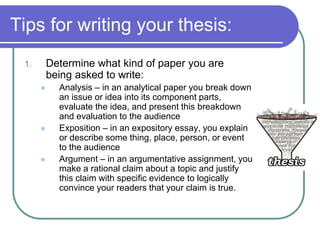
           Analysis – in an analytical paper you break down
            an issue or idea into its component parts,
            evaluate the idea, and present this breakdown
            and evaluation to the audience
           Exposition – in an expository essay, you explain
            or describe some thing, place, person, or event
            to the audience
           Argument – in an argumentative assignment, you
            make a rational claim about a topic and justify
            this claim with specific evidence to logically
            convince your readers that your claim is true.
Tips (continued):

 2.   A thesis is an assertion, NOT a
      statement of fact or observation.
         Fact or observation: People use many
          lawn chemicals.
         Thesis: People are poisoning the
          environment with chemicals merely to
          keep their lawns clean.
Tips (continued):

 3.       A thesis takes a stand rather than
          announcing a subject or topic. Never
          begin your essay with a phrase like:
           The thesis of this paper is…
           I am writing about…
           My paper will examine…
           In this paper, I will discuss…
Tips (continued):

 4.   A thesis is NOT a question. Your thesis
      should be an answer to a question.
 5.   A thesis statement is narrow, rather than
      broad. If the thesis statement is sufficiently
      narrow, it can be fully supported.
           Broad: The American steel industry has many
            problems.
           Thesis: The primary problem of the American
            steel industry is the lack of funds to renovate
            outdated plants and equipment.
Tips (continued):

 6.       A thesis statement is specific, rather
          than vague or general. Avoid fuzzy or
          hard to define words like:
           Good
           Bad
           Interesting
           Disgusting
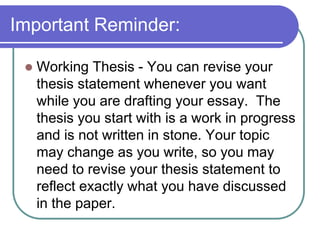
Important Reminder:

    Working Thesis - You can revise your
     thesis statement whenever you want
     while you are drafting your essay. The
     thesis you start with is a work in progress
     and is not written in stone. Your topic
     may change as you write, so you may
     need to revise your thesis statement to
     reflect exactly what you have discussed
     in the paper.
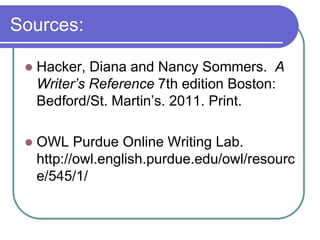
Sources:

    Hacker, Diana and Nancy Sommers. A
     Writer’s Reference 7th edition Boston:
     Bedford/St. Martin’s. 2011. Print.

    OWL Purdue Online Writing Lab.
     http://owl.english.purdue.edu/owl/resourc
     e/545/1/

Developing a thesis statement

  • 1.
  • 2.
    What is athesis?  A thesis is a specific sentence in an essay (but sometimes a cluster of sentences) that lets the reader know what the writer is asserting about the topic. In college-level papers we establish interest in the topic and some focus for the topic before offering the thesis statement.
  • 3.
    Tips for writingyour thesis: 1. Determine what kind of paper you are being asked to write:  Analysis – in an analytical paper you break down an issue or idea into its component parts, evaluate the idea, and present this breakdown and evaluation to the audience  Exposition – in an expository essay, you explain or describe some thing, place, person, or event to the audience  Argument – in an argumentative assignment, you make a rational claim about a topic and justify this claim with specific evidence to logically convince your readers that your claim is true.
  • 4.
    Tips (continued): 2. A thesis is an assertion, NOT a statement of fact or observation.  Fact or observation: People use many lawn chemicals.  Thesis: People are poisoning the environment with chemicals merely to keep their lawns clean.
  • 5.
    Tips (continued): 3. A thesis takes a stand rather than announcing a subject or topic. Never begin your essay with a phrase like:  The thesis of this paper is…  I am writing about…  My paper will examine…  In this paper, I will discuss…
  • 6.
    Tips (continued): 4. A thesis is NOT a question. Your thesis should be an answer to a question. 5. A thesis statement is narrow, rather than broad. If the thesis statement is sufficiently narrow, it can be fully supported.  Broad: The American steel industry has many problems.  Thesis: The primary problem of the American steel industry is the lack of funds to renovate outdated plants and equipment.
  • 7.
    Tips (continued): 6. A thesis statement is specific, rather than vague or general. Avoid fuzzy or hard to define words like:  Good  Bad  Interesting  Disgusting
  • 8.
    Important Reminder:  Working Thesis - You can revise your thesis statement whenever you want while you are drafting your essay. The thesis you start with is a work in progress and is not written in stone. Your topic may change as you write, so you may need to revise your thesis statement to reflect exactly what you have discussed in the paper.
  • 9.
    Sources:  Hacker, Diana and Nancy Sommers. A Writer’s Reference 7th edition Boston: Bedford/St. Martin’s. 2011. Print.  OWL Purdue Online Writing Lab. http://owl.english.purdue.edu/owl/resourc e/545/1/