Writing a
    Thesis
   Statement
It is easier than you might think….
What is a Thesis Statement?

   The thesis statement states the thesis or
    argument of the author in an essay


   A thesis statement declares what you
    believe and what you intend to prove. A
    good thesis statement makes the difference
    between a thoughtful research project/idea
    and a simple retelling of facts.
But watch out

   Often, unskilled writers will try to make a
    thesis statement a summary of what they will
    talk about. They will do this by writing their
    thesis statement by piecing together the
    central points from each idea that they will
    cover in their paper.
What makes a good thesis
statement?

   It should be contestable, proposing an arguable point with which people could reasonably
    disagree. A strong thesis is provocative/interesting; it takes a stand and justifies the
    discussion you will present.

   It tackles a subject that could be adequately covered in the format of the project assigned.

   It is specific and focused. A strong thesis proves a point without discussing “everything
    about …” Instead of music, think "American jazz in the 1930s" and your argument about
    it.

   It clearly asserts your own conclusion based on evidence. Note: Be flexible. The evidence
    may lead you to a conclusion you didn't think you'd reach. It is perfectly okay to change
    your thesis!

   It provides the reader with a map to guide him/her through your work.

   It anticipates and refutes the counter-arguments

   It avoids vague language (like "it seems").

   It avoids the first person. ("I believe," "In my opinion")

   It should pass the So what? or Who cares? test (Would your most honest friend ask why
    he should care or respond with "but everyone knows that"?) For instance, "people should
    avoid driving under the influence of alcohol," would be unlikely to evoke any opposition.
Isn’t there an easy way to
remember how to write a
thesis statement?

   Simple equations for a thesis might look
    something like this:
       Specific topic +
        Attitude/Angle/Argument = Thesis
       What you plan to argue + How you plan
        to argue it = Thesis
How do you know you have a
good thesis statement?

   Try these five tests:
     Does the thesis inspire a reasonable reader to
      ask, "How?" or Why?"
     Would a reasonable reader NOT respond with
      "Duh!" or "So what?" or "Gee, no kidding!" or "Who
      cares?"
     Does the thesis avoid general phrasing and/or
      sweeping words such as "all" or "none" or "every"?
     Does the thesis lead the reader toward the topic
      sentences of each paragraph (the subtopics
      needed to prove the thesis)?
     Can the thesis be adequately developed in the
      required length of the paper or project?

   If you cannot answer "YES" to these questions, what
    changes must you make in order for your thesis to
    pass these tests?
What else should I
remember?

As you read look for:

   Interesting contrasts or comparisons or
    patterns emerging in the information

   Is there something about the topic that
    surprises you?

   Do you encounter ideas that make you
    wonder why?

   Does something an "expert" says make you
    respond, "no way! That can be right!" or
    "Yes, absolutely. I agree!"
Examples of Brainstorming a
Thesis…

   Select a topic: television violence and
    children
     Ask an interesting question: What are the
      effects of television violence on children?
     Revise the question into a thesis: Violence
      on television increases aggressive
      behavior in preschool children.
     Remember this argument is your
      “preliminary” or “working” thesis. As you
      read you may discover evidence that may
      affect your stance. It is okay to revise your
      thesis!
Are there different kinds of
Thesis Statements?

Yes!

   Determine what kind of paper you are
    writing:
     An expository (explanatory) paper
      explains something to the audience.
     An argumentative paper makes a claim
      about a topic and justifies this claim with
      specific evidence. The claim could be an
      opinion, a policy proposal, an
      evaluation, a cause-and-effect
      statement, or an interpretation. The goal
      of the argumentative paper is to convince
      the audience that the claim is true based
      on the evidence provided.
Example – Expository/
Explanatory Thesis…

   The life of the typical college student is
    characterized by time spent
    studying, attending class, and socializing
    with peers.
       The paper that follows should:
           explain how students spend their time
            studying, attending class, and
            socializing with peers
Example – Argumentative
Thesis…

   High school graduates should be required to
    take a year off to pursue community service
    projects before entering college in order to
    increase their maturity and global
    awareness.
       The paper that follows should:
           present an argument and give evidence
            to support the claim that students
            should pursue community projects
            before entering college
Remember….

   good thesis statement often answers these
    questions. You may encounter a thesis
    statement that reads:


   The lifestyle of a teenager in the Middle
    Ages was very different from the lifestyle of
    most modern American teenagers.
       So what? Why should a reader continue?
        In what ways are the lifestyles of the
        youngsters different?
Better versions of that Thesis
Statement might be…

   Because of the relative freedom enjoyed by young
    people today, the lifestyle of modern American
    teenagers is very different from the lifestyle of teens
    in the Middle Ages.
     (this at least says why the difference exists)
   A young person in the Middle Ages had very different
    expectations about marriage, family, and personal
    freedom than do young adults today.
     (this version of the statement emphasizes the
       Medieval, not modern, teenager, but it still does
       not present an argument to be defended)

   A young person in the Middle Ages had fewer options
    for marriage, family, and personal privacy and
    freedom than do young adults today.
     (the essay could go on to support what the
       "options" were and why they were limited)
Questions to consider as you
write a Thesis Statement…

   What is the main idea of your paper in 25 or
    fewer words?

   What is the assignment asking? How can
    you answer that question AND focus on a
    small area of investigation?

   What "code words" (such as "relative
    freedom" or "lifestyles") does the draft of my
    thesis statement contain? Are these words
    adequately explained?

   As you read over your paper, have you
    supported the thesis or drifted off topic?
    Where? How?
Now Let’s
 Play….
    Is It
     A
  Thesis?
Which is a Thesis?

   I enjoy white water rafting.

   White water rafting is expensive.

   A first water rafting experience can
    challenge the body and spirit and transform
    an adolescent into an adult
Which is a Thesis?

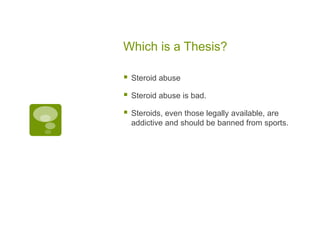
   Steroid abuse

   Steroid abuse is bad.

   Steroids, even those legally available, are
    addictive and should be banned from sports.
Which is a Thesis?

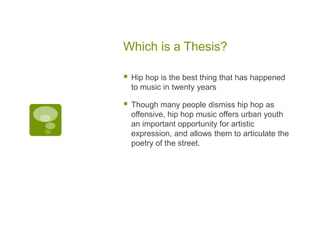
   Hip hop is the best thing that has happened
    to music in twenty years

   Though many people dismiss hip hop as
    offensive, hip hop music offers urban youth
    an important opportunity for artistic
    expression, and allows them to articulate the
    poetry of the street.
Which is a Thesis?

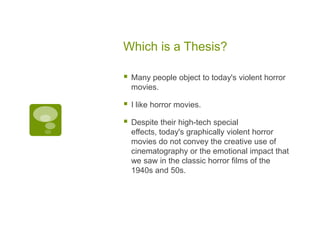
   Many people object to today's violent horror
    movies.

   I like horror movies.

   Despite their high-tech special
    effects, today's graphically violent horror
    movies do not convey the creative use of
    cinematography or the emotional impact that
    we saw in the classic horror films of the
    1940s and 50s.
Your Turn…

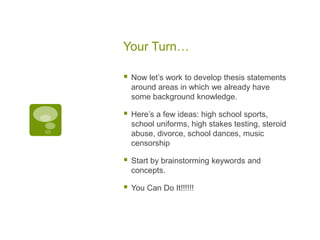
   Now let’s work to develop thesis statements
    around areas in which we already have
    some background knowledge.

   Here’s a few ideas: high school sports,
    school uniforms, high stakes testing, steroid
    abuse, divorce, school dances, music
    censorship

   Start by brainstorming keywords and
    concepts.

   You Can Do It!!!!!!

How to write a thesis statment

  • 1.
    Writing a Thesis Statement It is easier than you might think….
  • 2.
    What is aThesis Statement?  The thesis statement states the thesis or argument of the author in an essay  A thesis statement declares what you believe and what you intend to prove. A good thesis statement makes the difference between a thoughtful research project/idea and a simple retelling of facts.
  • 3.
    But watch out  Often, unskilled writers will try to make a thesis statement a summary of what they will talk about. They will do this by writing their thesis statement by piecing together the central points from each idea that they will cover in their paper.
  • 4.
    What makes agood thesis statement?  It should be contestable, proposing an arguable point with which people could reasonably disagree. A strong thesis is provocative/interesting; it takes a stand and justifies the discussion you will present.  It tackles a subject that could be adequately covered in the format of the project assigned.  It is specific and focused. A strong thesis proves a point without discussing “everything about …” Instead of music, think "American jazz in the 1930s" and your argument about it.  It clearly asserts your own conclusion based on evidence. Note: Be flexible. The evidence may lead you to a conclusion you didn't think you'd reach. It is perfectly okay to change your thesis!  It provides the reader with a map to guide him/her through your work.  It anticipates and refutes the counter-arguments  It avoids vague language (like "it seems").  It avoids the first person. ("I believe," "In my opinion")  It should pass the So what? or Who cares? test (Would your most honest friend ask why he should care or respond with "but everyone knows that"?) For instance, "people should avoid driving under the influence of alcohol," would be unlikely to evoke any opposition.
  • 5.
    Isn’t there aneasy way to remember how to write a thesis statement?  Simple equations for a thesis might look something like this:  Specific topic + Attitude/Angle/Argument = Thesis  What you plan to argue + How you plan to argue it = Thesis
  • 6.
    How do youknow you have a good thesis statement?  Try these five tests:  Does the thesis inspire a reasonable reader to ask, "How?" or Why?"  Would a reasonable reader NOT respond with "Duh!" or "So what?" or "Gee, no kidding!" or "Who cares?"  Does the thesis avoid general phrasing and/or sweeping words such as "all" or "none" or "every"?  Does the thesis lead the reader toward the topic sentences of each paragraph (the subtopics needed to prove the thesis)?  Can the thesis be adequately developed in the required length of the paper or project?  If you cannot answer "YES" to these questions, what changes must you make in order for your thesis to pass these tests?
  • 7.
    What else shouldI remember? As you read look for:  Interesting contrasts or comparisons or patterns emerging in the information  Is there something about the topic that surprises you?  Do you encounter ideas that make you wonder why?  Does something an "expert" says make you respond, "no way! That can be right!" or "Yes, absolutely. I agree!"
  • 8.
    Examples of Brainstorminga Thesis…  Select a topic: television violence and children  Ask an interesting question: What are the effects of television violence on children?  Revise the question into a thesis: Violence on television increases aggressive behavior in preschool children.  Remember this argument is your “preliminary” or “working” thesis. As you read you may discover evidence that may affect your stance. It is okay to revise your thesis!
  • 9.
    Are there differentkinds of Thesis Statements? Yes!  Determine what kind of paper you are writing:  An expository (explanatory) paper explains something to the audience.  An argumentative paper makes a claim about a topic and justifies this claim with specific evidence. The claim could be an opinion, a policy proposal, an evaluation, a cause-and-effect statement, or an interpretation. The goal of the argumentative paper is to convince the audience that the claim is true based on the evidence provided.
  • 10.
    Example – Expository/ ExplanatoryThesis…  The life of the typical college student is characterized by time spent studying, attending class, and socializing with peers.  The paper that follows should:  explain how students spend their time studying, attending class, and socializing with peers
  • 11.
    Example – Argumentative Thesis…  High school graduates should be required to take a year off to pursue community service projects before entering college in order to increase their maturity and global awareness.  The paper that follows should:  present an argument and give evidence to support the claim that students should pursue community projects before entering college
  • 12.
    Remember….  good thesis statement often answers these questions. You may encounter a thesis statement that reads:  The lifestyle of a teenager in the Middle Ages was very different from the lifestyle of most modern American teenagers.  So what? Why should a reader continue? In what ways are the lifestyles of the youngsters different?
  • 13.
    Better versions ofthat Thesis Statement might be…  Because of the relative freedom enjoyed by young people today, the lifestyle of modern American teenagers is very different from the lifestyle of teens in the Middle Ages.  (this at least says why the difference exists)  A young person in the Middle Ages had very different expectations about marriage, family, and personal freedom than do young adults today.  (this version of the statement emphasizes the Medieval, not modern, teenager, but it still does not present an argument to be defended)  A young person in the Middle Ages had fewer options for marriage, family, and personal privacy and freedom than do young adults today.  (the essay could go on to support what the "options" were and why they were limited)
  • 14.
    Questions to consideras you write a Thesis Statement…  What is the main idea of your paper in 25 or fewer words?  What is the assignment asking? How can you answer that question AND focus on a small area of investigation?  What "code words" (such as "relative freedom" or "lifestyles") does the draft of my thesis statement contain? Are these words adequately explained?  As you read over your paper, have you supported the thesis or drifted off topic? Where? How?
  • 15.
    Now Let’s Play…. Is It A Thesis?
  • 16.
    Which is aThesis?  I enjoy white water rafting.  White water rafting is expensive.  A first water rafting experience can challenge the body and spirit and transform an adolescent into an adult
  • 17.
    Which is aThesis?  Steroid abuse  Steroid abuse is bad.  Steroids, even those legally available, are addictive and should be banned from sports.
  • 18.
    Which is aThesis?  Hip hop is the best thing that has happened to music in twenty years  Though many people dismiss hip hop as offensive, hip hop music offers urban youth an important opportunity for artistic expression, and allows them to articulate the poetry of the street.
  • 19.
    Which is aThesis?  Many people object to today's violent horror movies.  I like horror movies.  Despite their high-tech special effects, today's graphically violent horror movies do not convey the creative use of cinematography or the emotional impact that we saw in the classic horror films of the 1940s and 50s.
  • 20.
    Your Turn…  Now let’s work to develop thesis statements around areas in which we already have some background knowledge.  Here’s a few ideas: high school sports, school uniforms, high stakes testing, steroid abuse, divorce, school dances, music censorship  Start by brainstorming keywords and concepts.  You Can Do It!!!!!!