SULPHATE
ATTACK
Introduction
• Sulphates occur in both soil and ground water.
• Soild sulphate does not attack the concrete severely.
• But water sulphates enter into the porous concrete and
react with the HCP products forming a whitish
appearance.
• This indicates Sulphate Attack.
Sulphate Attack
• Increase in the volume of cement paste in concrete or
mortar due to the chemical reaction between the
products of HCP and solution containing sulphates.
• In hardened concrete, C-A-H can react with sulphate
salt from outside, forming calcium sulphoaluminate in the
framework of HCP.
• Due to the increase in volume of the solid phase( which
can go up to 227%),a gradual disintegration of concrete
take place.
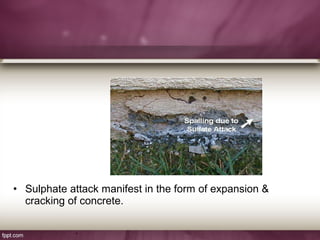
• Sulphate attack manifest in the form of expansion &
cracking of concrete.
Reactions
Reactions on hardened cement paste
• Sodium sulphate attacking Ca(OH)₂
Ca(OH) +Na SO .10 H O CaSO .2 H O +2NaOH +8H O₂ ₂ ₄ ₂ ₄ ₂ ₂
• Reaction with Calcium aluminate hydrate
2(3CaO . Al O . 12 H O) + 3(Na₂ ₃ ₂ ₂SO₄. 10H₂O)
3CaO. Al₂O₃. 3CaSO₄. 31H₂O + 2Al(OH)₃ +
( ettringite) 6NaOH +
17H₂O
• Calcium sulphate reacts with CAH to form calcium
sulphoaluminate( ettringite).
• Magnesium sulphate reacts with Ca(OH) , CAH and₂
completely decomposes CSH making it a friable mass
(easy to crumble).
Types
» External
» Internal
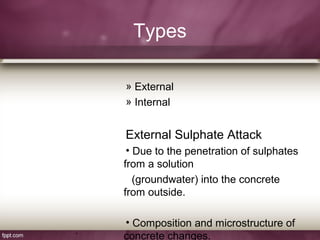
External Sulphate Attack
• Due to the penetration of sulphates
from a solution
(groundwater) into the concrete
from outside.
• Composition and microstructure of
concrete changes.
• These changes may vary in type or severity but
commonly include:
• Extensive cracking
• Expansion
• Loss of bond between the cement paste and aggregate
• This results in overall decrease in strength.
Other sources of sulphate which can cause sulphate attack
include:
• Seawater
• Oxidation of sulphate minerals in clay adjacent to the concrete -
this can produce sulphuric acid which reacts with the concrete
• Bacterial action in sewers - anaerobic bacterial produce sulphur
dioxide which dissolves in water and then oxidizes to form
sulfuric acid
• In masonry, sulphates present in bricks and can be gradually
released over a long period of time, causing sulphate attack of
mortar, especially where sulphates are concentrated due to
moisture movement
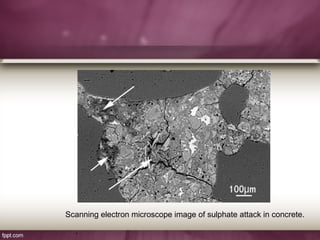
Scanning electron microscope image of sulphate attack in concrete.
• Ettringite (arrowed) has replaced some of the calcium
silicate hydrate in the cement paste.
• The darker areas of paste have been partly decalcified.
• As a consequence of these alterations, the paste will be
weakened.
Internal Sulphate Attack
• Due to source of sulphate being incorporated into the
concrete at the time of mixing, while adding gypsum in
the cement etc
• Proper screening and testing procedures should
generally avoid internal sulfate attack.
Delayed ettringite formation
• Delayed ettringite formation (DEF) is a special case of
internal sulfate attack.
• DEF occurs if the ettringite which normally forms during
hydration is decomposed, then subsequently re-forms in the
hardened concrete.
• Sulphate ions released by decomposition of ettringnite are
absorbed by CSH. Then sulphate ions are desorbed,
reformation of ettringnite take place.
• Damage to the concrete occurs when the ettringite crystals
exert an expansive force within the concrete as they grow.
• DEF causes a characteristic form of damage to the concrete.
While the paste expands, the aggregate does not.
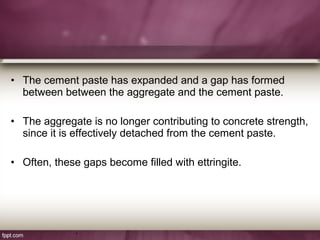
Delayed ettringite formation: scanning electron microscope image of
limestone aggregate particle
• The cement paste has expanded and a gap has formed
between between the aggregate and the cement paste.
• The aggregate is no longer contributing to concrete strength,
since it is effectively detached from the cement paste.
• Often, these gaps become filled with ettringite.
Conditions necessary for DEF to occur are:
• High temperature (above 65-70 degrees C approx.), usually
during curing but not necessarily
• Water: intermittent or permanent saturation after curing
• Commonly associated with alkali-silica reaction (ASR)
• Limestone coarse aggregate has been found to reduce
expansion.
Reference
• Concrete Technology by M S Shetty.
• Concrete, Microstructure, Properties and Materials by
Metha, P K and Monteiro.
• Understanding Cement by Nicholas B Winter.
Sulphate attack

Sulphate attack

  • 1.
  • 2.
    Introduction • Sulphates occurin both soil and ground water. • Soild sulphate does not attack the concrete severely. • But water sulphates enter into the porous concrete and react with the HCP products forming a whitish appearance. • This indicates Sulphate Attack.
  • 3.
    Sulphate Attack • Increasein the volume of cement paste in concrete or mortar due to the chemical reaction between the products of HCP and solution containing sulphates. • In hardened concrete, C-A-H can react with sulphate salt from outside, forming calcium sulphoaluminate in the framework of HCP. • Due to the increase in volume of the solid phase( which can go up to 227%),a gradual disintegration of concrete take place.
  • 4.
    • Sulphate attackmanifest in the form of expansion & cracking of concrete.
  • 5.
    Reactions Reactions on hardenedcement paste • Sodium sulphate attacking Ca(OH)₂ Ca(OH) +Na SO .10 H O CaSO .2 H O +2NaOH +8H O₂ ₂ ₄ ₂ ₄ ₂ ₂ • Reaction with Calcium aluminate hydrate 2(3CaO . Al O . 12 H O) + 3(Na₂ ₃ ₂ ₂SO₄. 10H₂O) 3CaO. Al₂O₃. 3CaSO₄. 31H₂O + 2Al(OH)₃ + ( ettringite) 6NaOH + 17H₂O
  • 6.
    • Calcium sulphatereacts with CAH to form calcium sulphoaluminate( ettringite). • Magnesium sulphate reacts with Ca(OH) , CAH and₂ completely decomposes CSH making it a friable mass (easy to crumble).
  • 7.
    Types » External » Internal ExternalSulphate Attack • Due to the penetration of sulphates from a solution (groundwater) into the concrete from outside. • Composition and microstructure of concrete changes.
  • 8.
    • These changesmay vary in type or severity but commonly include: • Extensive cracking • Expansion • Loss of bond between the cement paste and aggregate • This results in overall decrease in strength.
  • 9.
    Other sources ofsulphate which can cause sulphate attack include: • Seawater • Oxidation of sulphate minerals in clay adjacent to the concrete - this can produce sulphuric acid which reacts with the concrete • Bacterial action in sewers - anaerobic bacterial produce sulphur dioxide which dissolves in water and then oxidizes to form sulfuric acid • In masonry, sulphates present in bricks and can be gradually released over a long period of time, causing sulphate attack of mortar, especially where sulphates are concentrated due to moisture movement
  • 10.
    Scanning electron microscopeimage of sulphate attack in concrete.
  • 11.
    • Ettringite (arrowed)has replaced some of the calcium silicate hydrate in the cement paste. • The darker areas of paste have been partly decalcified. • As a consequence of these alterations, the paste will be weakened.
  • 12.
    Internal Sulphate Attack •Due to source of sulphate being incorporated into the concrete at the time of mixing, while adding gypsum in the cement etc • Proper screening and testing procedures should generally avoid internal sulfate attack.
  • 13.
    Delayed ettringite formation •Delayed ettringite formation (DEF) is a special case of internal sulfate attack. • DEF occurs if the ettringite which normally forms during hydration is decomposed, then subsequently re-forms in the hardened concrete. • Sulphate ions released by decomposition of ettringnite are absorbed by CSH. Then sulphate ions are desorbed, reformation of ettringnite take place. • Damage to the concrete occurs when the ettringite crystals exert an expansive force within the concrete as they grow.
  • 14.
    • DEF causesa characteristic form of damage to the concrete. While the paste expands, the aggregate does not. Delayed ettringite formation: scanning electron microscope image of limestone aggregate particle
  • 15.
    • The cementpaste has expanded and a gap has formed between between the aggregate and the cement paste. • The aggregate is no longer contributing to concrete strength, since it is effectively detached from the cement paste. • Often, these gaps become filled with ettringite.
  • 16.
    Conditions necessary forDEF to occur are: • High temperature (above 65-70 degrees C approx.), usually during curing but not necessarily • Water: intermittent or permanent saturation after curing • Commonly associated with alkali-silica reaction (ASR) • Limestone coarse aggregate has been found to reduce expansion.
  • 17.
    Reference • Concrete Technologyby M S Shetty. • Concrete, Microstructure, Properties and Materials by Metha, P K and Monteiro. • Understanding Cement by Nicholas B Winter.