EXPERIMENTAL INVESTIGATION OF TOP MIX
PERMEABLE CONCRETE ON PEDESTRAIN PATHWAY
INTRODUCTION
Top mix permeable is a fast draining concrete
pavement solution that rapidly directs
stormwater off streets, Parking surfaces,
driveways & walkways
This minimises the cost & long term
maintance, it soaks upto 4000 litres in 60
seconds.
PERMEABLE CONCRETE
 Permeable concrete are the members those which allows the
water to penetrate through the concrete.
 These type of concrete generally will not absorb the water
instead provides an path to penetrate.
ABSTRACT
 Our cities are being covered with building and the air-proof concrete
road more and more. In addition, the environment of city is far from
natural. Because of the lack of water permeability and air permeability
of the common concrete pavement, the rainwater is not filtered
underground. Without constant supply of water to the soil, plants are
difficult to grow normally. In addition, it is difficult for soil to exchange
heat and moisture with air; therefore, the temperature and humidity of
the Earth's surface in large cities cannot be adjusted. At the same time,
the plash on the road during a rainy day reduces the safety of traffic of
vehicle and foot passenger. The research on permeable pavement
materials has begun in developed countries such as the US and Japan
since 1980s.
SCOPE
 To reduce the staging of water during the
heavy storms.
 To improve the ground water table along
pedestrians.
 Improving of drainage in busy roads.
FLEXIBLE PAVEMENT VS PERMEABLE PAVEMENT
FLEXIBLE PAVEMENT PERMEABLE PAVEMENT
 Have low flexural strength.  Have low repair cost but completion cost is high.
& Force of friction is high.
 Damaged by oils and certain chemicals.  Surfacing can be directly laid on the subgrade.
 Have low life span (high maintenance cost).  Life span is more when compared to the flexible
pavements (low maintenance cost).
 Have low completion cost but repair cost is
high.
 Strength of the road is less dependent on the
strength of the subgrade
APPLICATIONS OF PERMEABLE
CONCRETE
 Low-volume pavements
 Residential roads and
driveway
 Sidewalks pathways
 Tennis courts
 Slope stabilization
 Well linings
 pavement edge drains
 Parking areas
METHODOLOGY
LITERATURE REVIEW
1. R. Vignesh Kumar, G. Vivek Kumar, V.Vineet, MS. F. S. Freidan (2016) “AN EXPERIMENTAL STUDY ON
PROPERTIES OF PERVIOUS CONCRETE”
Concrete is a homogeneous mixture of cement, Aggregate (fine aggregate and
coarse aggregate) and water. Now a days, special concrete is more preferred in the
construction industry. Some of the special concretes are pervious concrete,
transparent concrete, high volume fly ash concrete, self-compacted and curing
concrete because of their special properties which is better compared to
conventional concrete. Pervious Concrete is a special type of concrete in which no
fine aggregates are used and gravel has been used in place of the coarse aggregate.
Pervious Concrete is also called as “no-fines” concrete. Compressive strength and
tensile strength of pervious concrete does depend primarily on the porosity, it is also
affected by aggregate / gravel size, shape and gradation.
Mr.V. R. Patil, Prof. A. K. Gupta, Prof. D. B. Desai (2015) “USE OF
PERVIOUS CONCRETE IN CONSTRUCTION OF
PAVEMENT FOR IMPROVING THEIR PERFORMANCE”
Pervious concrete is a mixture of gravel or stone, cement, water and little or
no sand which creates an open cell structure that allows water and air to pass
through it. According to EPA (Environmental Protection Agency’s) storm
water runoff can send as much as 90% of pollutant such as oil and other
hydrocarbon. The ability of pervious concrete to allow water to flow through
itself recharges ground water and minimizes the extent of pollution and storm
water runoff. Pervious concrete is used to allow storm water to infiltrate
through the pavement and reduce or eliminate the need for additional control
structures, such as retention ponds.
CHARACTERISTICS OF PERMEABLE
CONCRETE
 Water Purifying Performance
 Permeable Concrete As Noise Absorption
 Permeable Concrete Reduces Problems
MIX DESIGN
MIX PROPORTIONFOR 1𝒎𝟑
 Cement = 334.125 kg/m3
 Silica fume = 37.125 kg/m3
 Water = 202.5 kg/m3
 coarse aggregate = 996.41 kg
 Water cement ratio = 0.60
MIX RATIO FOR 1𝒎𝟑
CEMENT COARSE AGGREGATE WATER
371.250 996.41 202.5
1 2.78 0.30
Compressive Strength Test
Specimen Days of curing Load in (KN) Load in (N/mm2)
Specimen-1 3 160 7.12
Specimen-2 7 290 12.89
Specimen-3 14 410 18.22
Specimen Days of curing Load in (KN) Load in (N/mm2)
Specimen-1 3 180 8
Specimen-2 7 320 14.23
Specimen-3 14 440 19.51
COMPRESSIVE STRENGTH OF PERMEABLE CONCRETE
WITH SILICA FUME (10%)
COMPRESSIVE STRENGTH OF PERMEABLE CONCRETE
WITHOUT SILICA FUME
Specimen Days of curing Load in (KN) Load in (N/mm2)
Specimen-1 3 195 8.6
Specimen-2 7 335 14.88
Specimen-3 14 450 20
Specimen Days of curing Load in (KN) Load in (N/mm2)
Specimen-1 3 185 8.2
Specimen-2 7 330 14.66
Specimen-3 14 420 18.67
COMPRESSIVE STRENGTH OF PERMEABLE CONCRETE
WITH SILICA FUME (20%)
COMPRESSIVE STRENGTH OF PERMEABLE CONCRETE
WITH SILICA FUME (15%)
0
2
4
6
8
10
12
14
16
18
20
3 days 7 days 14 days
without silica fume with silica fume 10% with silica fume 15% with silica fume 20%
Compressive
Strength
(N/mm
2
)
Curing (Days)
Infiltration test
 The infiltration test is carried out for recommendation to
perform and infiltration test at least annually to determine
the need for maintenance.
Infiltration calculation
I =
𝐾𝑀
𝐷2(𝑇)
M=water mass
D= dia of ring
T= Time of infiltration
 I=
𝐾𝑀
𝐷2(𝑇)
K=126,870 in constant
Table for infiltration test
Description Trial – 1 Trial – 2
Water mass in (lit) 1.5 3.0
Diameter of ring in (cm) 30 30
Time of infiltration in (sec) 19.65 42.55
CALCULATION
Trail -1
I =
126870∗1.5
302∗ 19.65
= 10.761 mm/sec
Trail -2
I =
126870∗3
302∗ 42.55
= 9.940 mm/sec
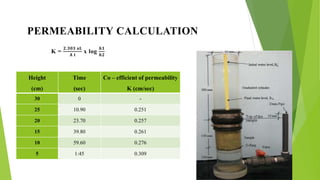
PERMEABILITY TEST
 The permeable concrete was determined using a
falling head permeability set up. Water was
allowed to flow through the sample, through a
connected stand pipe which provides the water
head.
PERMEABILITY CALCULATION
K =
𝟐.𝟑𝟎𝟑 𝐚𝐋
𝐀 𝐭
x log
𝒉𝟏
𝒉𝟐
Height
(cm)
Time
(sec)
Co – efficient of permeability
K (cm/sec)
30 0 -
25 10.90 0.251
20 23.70 0.257
15 39.80 0.261
10 59.60 0.276
5 1:45 0.309
RESULTS
 1. Permeable concrete made from coarse aggregate size
12.5mm has compressive strength of without silica fume of
18.22 N/mm2 & with silica fume 15% of 20 N/ mm2
 2. The aggregate/cement ratio of 2.78:1 produced permeable
concrete of higher co-efficient of permeability of 0.271 cm/sec
for aggregate size 12.5mm respectively.
PERMEABLE CONCRETE IN INDIA
 Permeable concrete can be used and it is being implemented in some metropolitan cities in
parking lots, drive ways, gullies, sidewalks, road platforms etc. The roads around the
apartments and the surfacing inside the compound can be made with permeable concrete.
Another significant advantage in India is low cost of labour compared to western countries,
much of the permeable concrete is laid manually without using heavy machinery, so this can
be placed in lower costs even in rural areas.
 In future with increased urbanization, diminishing ground water levels and focus on
sustainability technologies such as permeable concrete are likely to become even more
popular in India compared to other countries.
CONCLUSION
 1. The smaller the size of coarse aggregate should be able to produce
a higher compressive strength and at the same time produce a higher
permeability rate.
 2. The mixtures with aggregate/cement ratio 2.78:1 as M20 grade of
nominal mix are considered to be useful for pavement that requires
high permeability rate.
 3. Finally, further study should be conducted on the permeable
concrete pavement produced with these material proportions to meet
the condition of increased abrasion and compressive stresses due to
high vehicular loading and traffic volumes.
Thank you

permeable concrete(sp).pptx

  • 1.
    EXPERIMENTAL INVESTIGATION OFTOP MIX PERMEABLE CONCRETE ON PEDESTRAIN PATHWAY
  • 2.
    INTRODUCTION Top mix permeableis a fast draining concrete pavement solution that rapidly directs stormwater off streets, Parking surfaces, driveways & walkways This minimises the cost & long term maintance, it soaks upto 4000 litres in 60 seconds.
  • 3.
    PERMEABLE CONCRETE  Permeableconcrete are the members those which allows the water to penetrate through the concrete.  These type of concrete generally will not absorb the water instead provides an path to penetrate.
  • 4.
    ABSTRACT  Our citiesare being covered with building and the air-proof concrete road more and more. In addition, the environment of city is far from natural. Because of the lack of water permeability and air permeability of the common concrete pavement, the rainwater is not filtered underground. Without constant supply of water to the soil, plants are difficult to grow normally. In addition, it is difficult for soil to exchange heat and moisture with air; therefore, the temperature and humidity of the Earth's surface in large cities cannot be adjusted. At the same time, the plash on the road during a rainy day reduces the safety of traffic of vehicle and foot passenger. The research on permeable pavement materials has begun in developed countries such as the US and Japan since 1980s.
  • 5.
    SCOPE  To reducethe staging of water during the heavy storms.  To improve the ground water table along pedestrians.  Improving of drainage in busy roads.
  • 6.
    FLEXIBLE PAVEMENT VSPERMEABLE PAVEMENT FLEXIBLE PAVEMENT PERMEABLE PAVEMENT  Have low flexural strength.  Have low repair cost but completion cost is high. & Force of friction is high.  Damaged by oils and certain chemicals.  Surfacing can be directly laid on the subgrade.  Have low life span (high maintenance cost).  Life span is more when compared to the flexible pavements (low maintenance cost).  Have low completion cost but repair cost is high.  Strength of the road is less dependent on the strength of the subgrade
  • 7.
    APPLICATIONS OF PERMEABLE CONCRETE Low-volume pavements  Residential roads and driveway  Sidewalks pathways  Tennis courts  Slope stabilization  Well linings  pavement edge drains  Parking areas
  • 8.
  • 9.
    LITERATURE REVIEW 1. R.Vignesh Kumar, G. Vivek Kumar, V.Vineet, MS. F. S. Freidan (2016) “AN EXPERIMENTAL STUDY ON PROPERTIES OF PERVIOUS CONCRETE” Concrete is a homogeneous mixture of cement, Aggregate (fine aggregate and coarse aggregate) and water. Now a days, special concrete is more preferred in the construction industry. Some of the special concretes are pervious concrete, transparent concrete, high volume fly ash concrete, self-compacted and curing concrete because of their special properties which is better compared to conventional concrete. Pervious Concrete is a special type of concrete in which no fine aggregates are used and gravel has been used in place of the coarse aggregate. Pervious Concrete is also called as “no-fines” concrete. Compressive strength and tensile strength of pervious concrete does depend primarily on the porosity, it is also affected by aggregate / gravel size, shape and gradation.
  • 10.
    Mr.V. R. Patil,Prof. A. K. Gupta, Prof. D. B. Desai (2015) “USE OF PERVIOUS CONCRETE IN CONSTRUCTION OF PAVEMENT FOR IMPROVING THEIR PERFORMANCE” Pervious concrete is a mixture of gravel or stone, cement, water and little or no sand which creates an open cell structure that allows water and air to pass through it. According to EPA (Environmental Protection Agency’s) storm water runoff can send as much as 90% of pollutant such as oil and other hydrocarbon. The ability of pervious concrete to allow water to flow through itself recharges ground water and minimizes the extent of pollution and storm water runoff. Pervious concrete is used to allow storm water to infiltrate through the pavement and reduce or eliminate the need for additional control structures, such as retention ponds.
  • 11.
    CHARACTERISTICS OF PERMEABLE CONCRETE Water Purifying Performance  Permeable Concrete As Noise Absorption  Permeable Concrete Reduces Problems
  • 12.
    MIX DESIGN MIX PROPORTIONFOR1𝒎𝟑  Cement = 334.125 kg/m3  Silica fume = 37.125 kg/m3  Water = 202.5 kg/m3  coarse aggregate = 996.41 kg  Water cement ratio = 0.60 MIX RATIO FOR 1𝒎𝟑 CEMENT COARSE AGGREGATE WATER 371.250 996.41 202.5 1 2.78 0.30
  • 13.
    Compressive Strength Test SpecimenDays of curing Load in (KN) Load in (N/mm2) Specimen-1 3 160 7.12 Specimen-2 7 290 12.89 Specimen-3 14 410 18.22 Specimen Days of curing Load in (KN) Load in (N/mm2) Specimen-1 3 180 8 Specimen-2 7 320 14.23 Specimen-3 14 440 19.51 COMPRESSIVE STRENGTH OF PERMEABLE CONCRETE WITH SILICA FUME (10%) COMPRESSIVE STRENGTH OF PERMEABLE CONCRETE WITHOUT SILICA FUME
  • 14.
    Specimen Days ofcuring Load in (KN) Load in (N/mm2) Specimen-1 3 195 8.6 Specimen-2 7 335 14.88 Specimen-3 14 450 20 Specimen Days of curing Load in (KN) Load in (N/mm2) Specimen-1 3 185 8.2 Specimen-2 7 330 14.66 Specimen-3 14 420 18.67 COMPRESSIVE STRENGTH OF PERMEABLE CONCRETE WITH SILICA FUME (20%) COMPRESSIVE STRENGTH OF PERMEABLE CONCRETE WITH SILICA FUME (15%)
  • 15.
    0 2 4 6 8 10 12 14 16 18 20 3 days 7days 14 days without silica fume with silica fume 10% with silica fume 15% with silica fume 20% Compressive Strength (N/mm 2 ) Curing (Days)
  • 16.
    Infiltration test  Theinfiltration test is carried out for recommendation to perform and infiltration test at least annually to determine the need for maintenance. Infiltration calculation I = 𝐾𝑀 𝐷2(𝑇) M=water mass D= dia of ring T= Time of infiltration  I= 𝐾𝑀 𝐷2(𝑇) K=126,870 in constant
  • 17.
    Table for infiltrationtest Description Trial – 1 Trial – 2 Water mass in (lit) 1.5 3.0 Diameter of ring in (cm) 30 30 Time of infiltration in (sec) 19.65 42.55 CALCULATION Trail -1 I = 126870∗1.5 302∗ 19.65 = 10.761 mm/sec Trail -2 I = 126870∗3 302∗ 42.55 = 9.940 mm/sec
  • 18.
    PERMEABILITY TEST  Thepermeable concrete was determined using a falling head permeability set up. Water was allowed to flow through the sample, through a connected stand pipe which provides the water head.
  • 19.
    PERMEABILITY CALCULATION K = 𝟐.𝟑𝟎𝟑𝐚𝐋 𝐀 𝐭 x log 𝒉𝟏 𝒉𝟐 Height (cm) Time (sec) Co – efficient of permeability K (cm/sec) 30 0 - 25 10.90 0.251 20 23.70 0.257 15 39.80 0.261 10 59.60 0.276 5 1:45 0.309
  • 20.
    RESULTS  1. Permeableconcrete made from coarse aggregate size 12.5mm has compressive strength of without silica fume of 18.22 N/mm2 & with silica fume 15% of 20 N/ mm2  2. The aggregate/cement ratio of 2.78:1 produced permeable concrete of higher co-efficient of permeability of 0.271 cm/sec for aggregate size 12.5mm respectively.
  • 21.
    PERMEABLE CONCRETE ININDIA  Permeable concrete can be used and it is being implemented in some metropolitan cities in parking lots, drive ways, gullies, sidewalks, road platforms etc. The roads around the apartments and the surfacing inside the compound can be made with permeable concrete. Another significant advantage in India is low cost of labour compared to western countries, much of the permeable concrete is laid manually without using heavy machinery, so this can be placed in lower costs even in rural areas.  In future with increased urbanization, diminishing ground water levels and focus on sustainability technologies such as permeable concrete are likely to become even more popular in India compared to other countries.
  • 22.
    CONCLUSION  1. Thesmaller the size of coarse aggregate should be able to produce a higher compressive strength and at the same time produce a higher permeability rate.  2. The mixtures with aggregate/cement ratio 2.78:1 as M20 grade of nominal mix are considered to be useful for pavement that requires high permeability rate.  3. Finally, further study should be conducted on the permeable concrete pavement produced with these material proportions to meet the condition of increased abrasion and compressive stresses due to high vehicular loading and traffic volumes.
  • 23.