Alternative Approaches: Threshold Models and Choice Theory CHAPTER 4, Detection Theory: A User’s Guide
Much psychophysics was concerned with measuring “thresholds” 1950s-1960s, developing SDT Luce(1959) proposed Choice Theory
Single High-Threshold Theory q=(H-F)/(1-F) Sometime said to “correct” the hit rate for “guessing” H=.75, F=.1 q=.72 H=.75, F=.5 q=.5
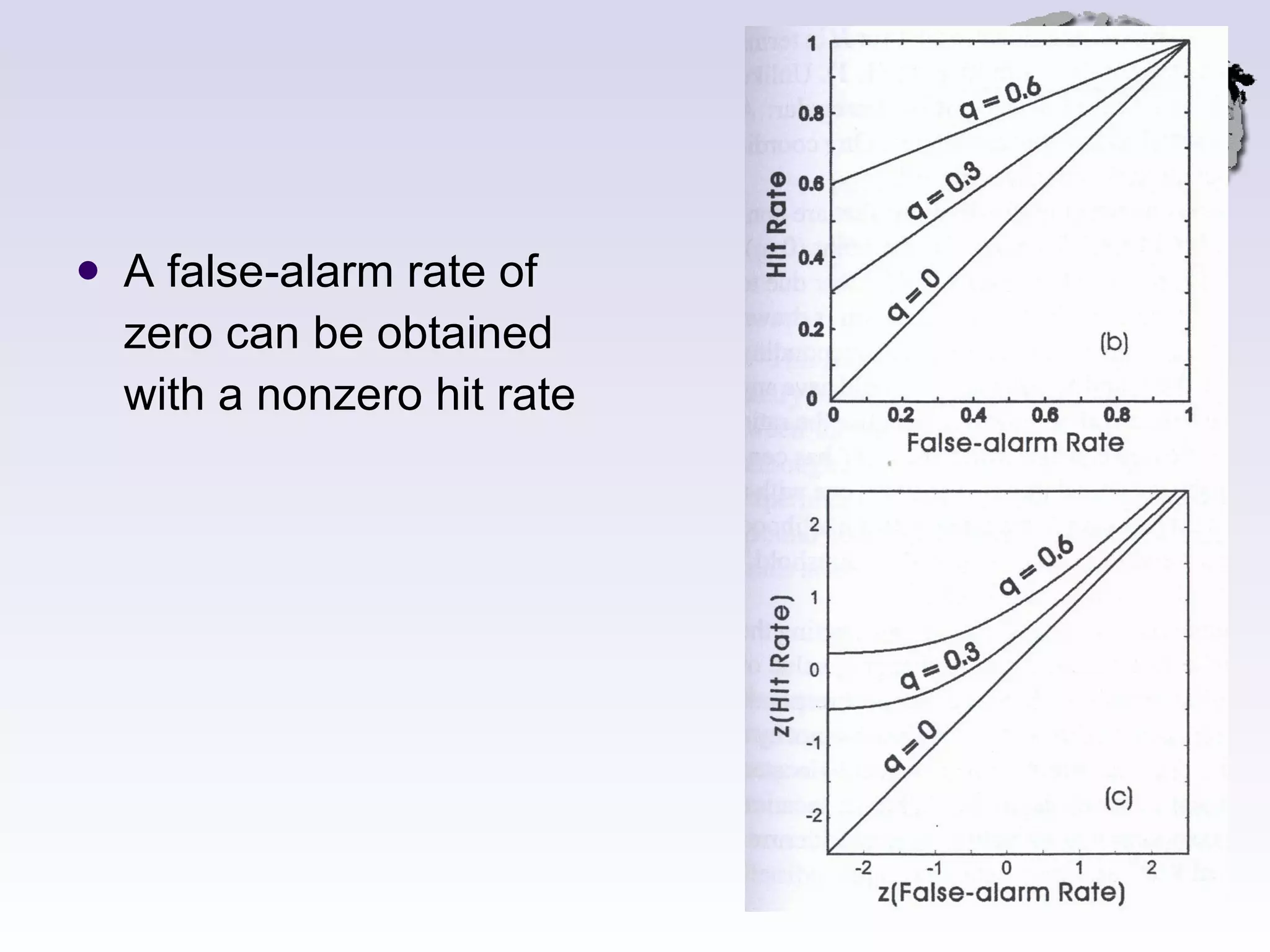
A false-alarm rate of  zero can be obtained with a nonzero hit rate
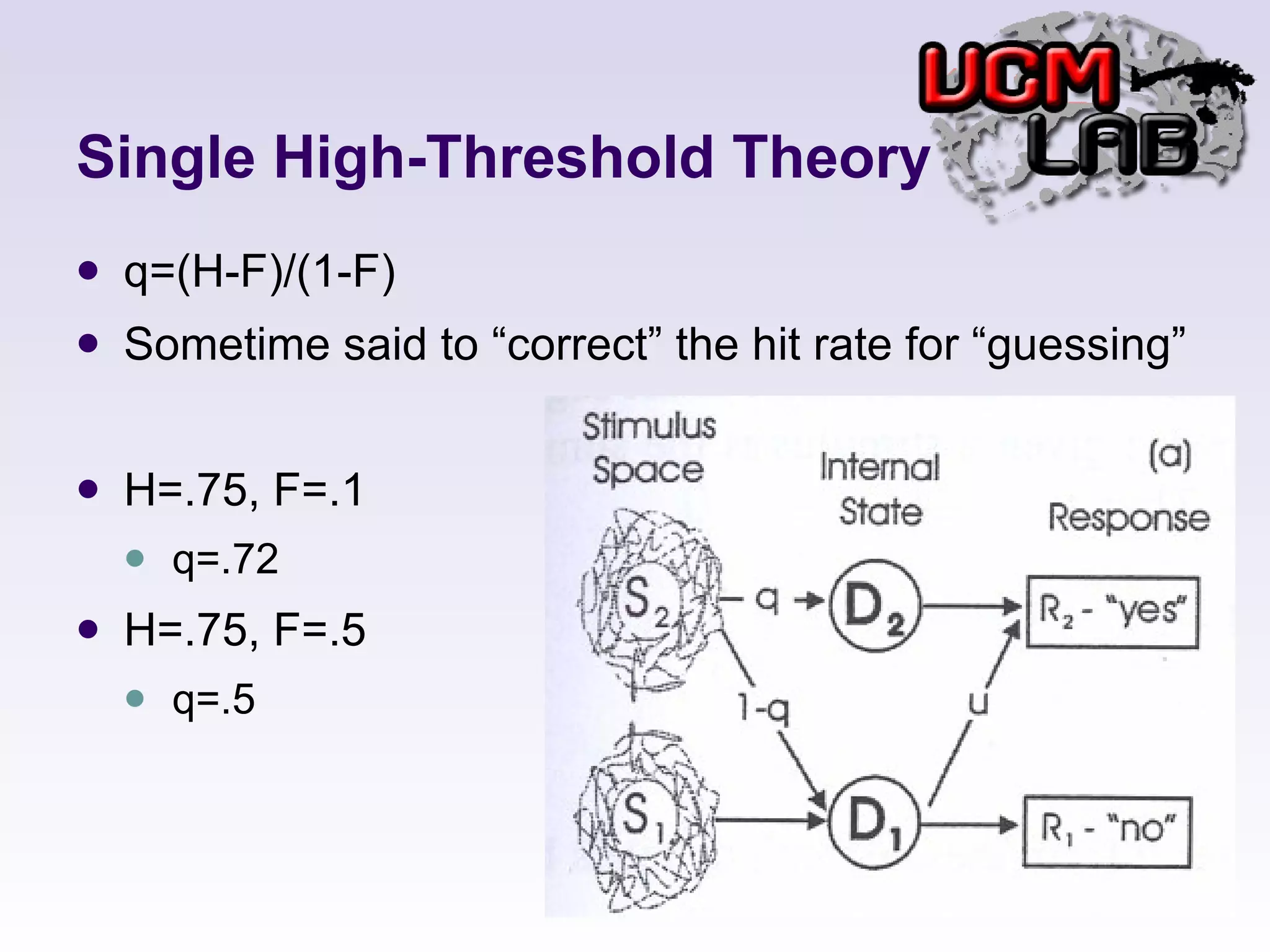
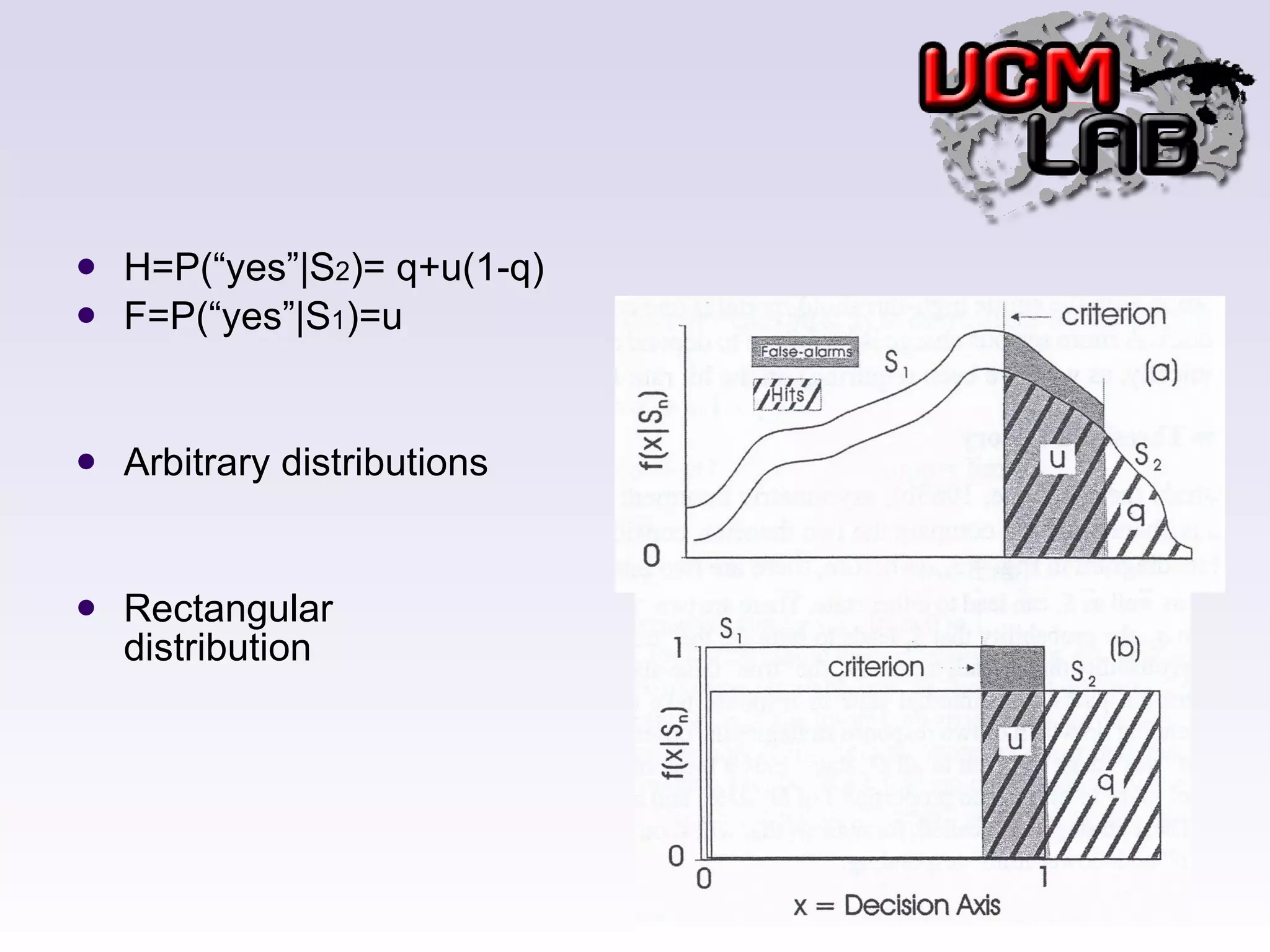
H=P(“yes”|S 2 )= q+u(1-q) F=P(“yes”|S 1 )=u Arbitrary distributions Rectangular  distribution
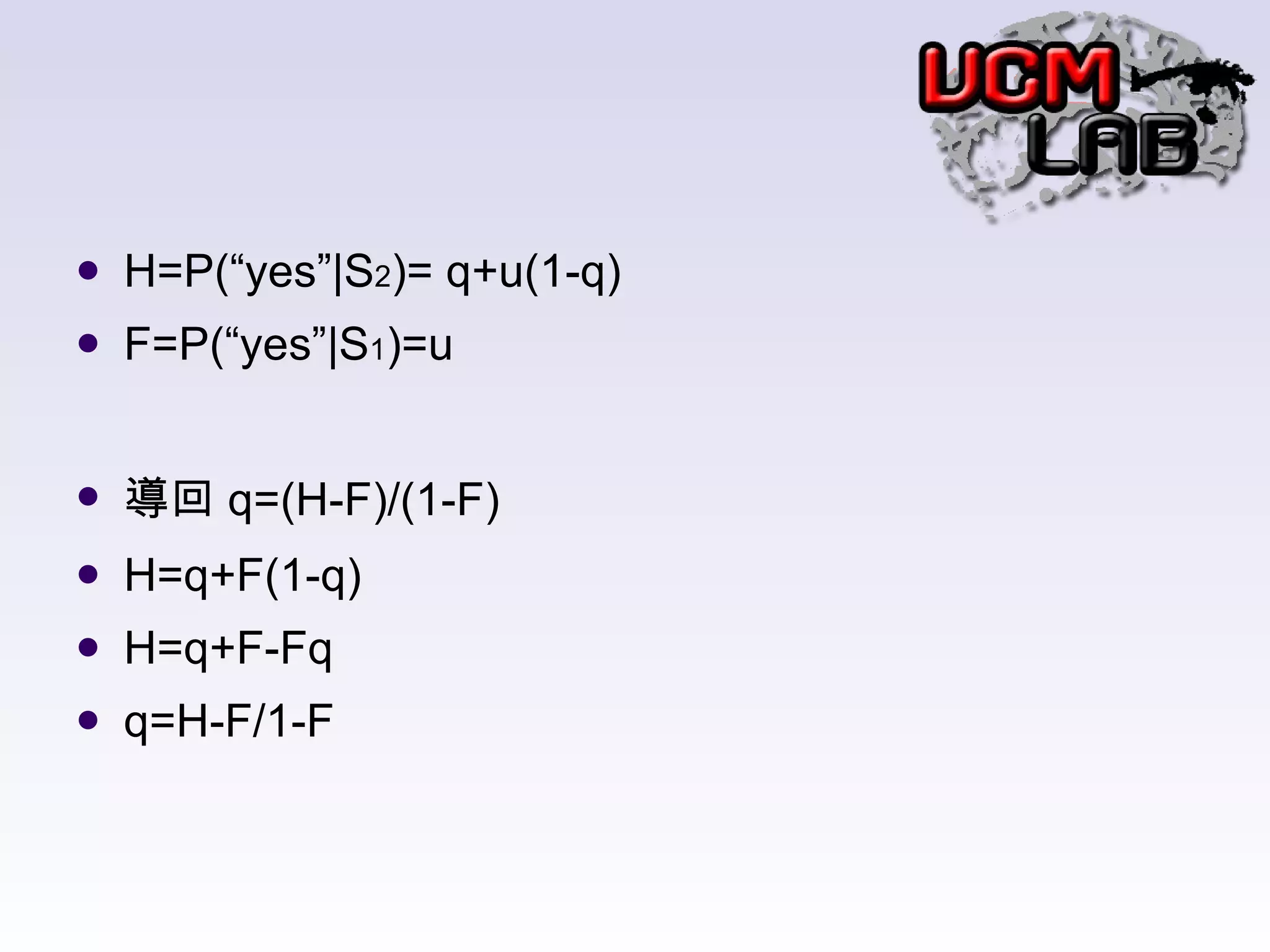
H=P(“yes”|S 2 )= q+u(1-q) F=P(“yes”|S 1 )=u 導回 q=(H-F)/(1-F) H=q+F(1-q) H=q+F-Fq q=H-F/1-F
The threshold –the dividing line between the internal states– is “high” because S1 cannot hurdle it, although S2 can.
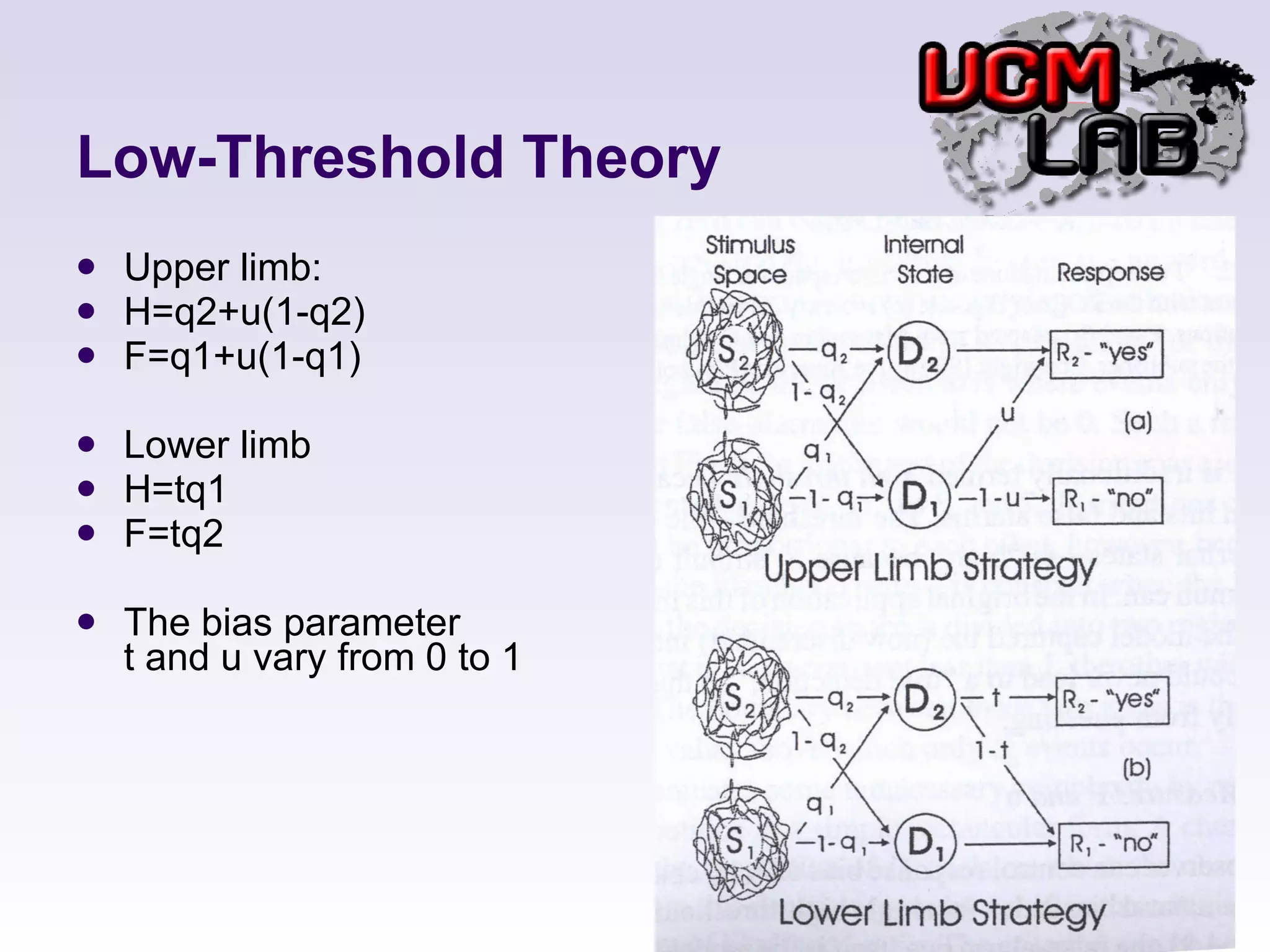
Low-Threshold Theory Upper limb: H=q2+u(1-q2) F=q1+u(1-q1) Lower limb H=tq1 F=tq2 The bias parameter t and u vary from 0 to 1
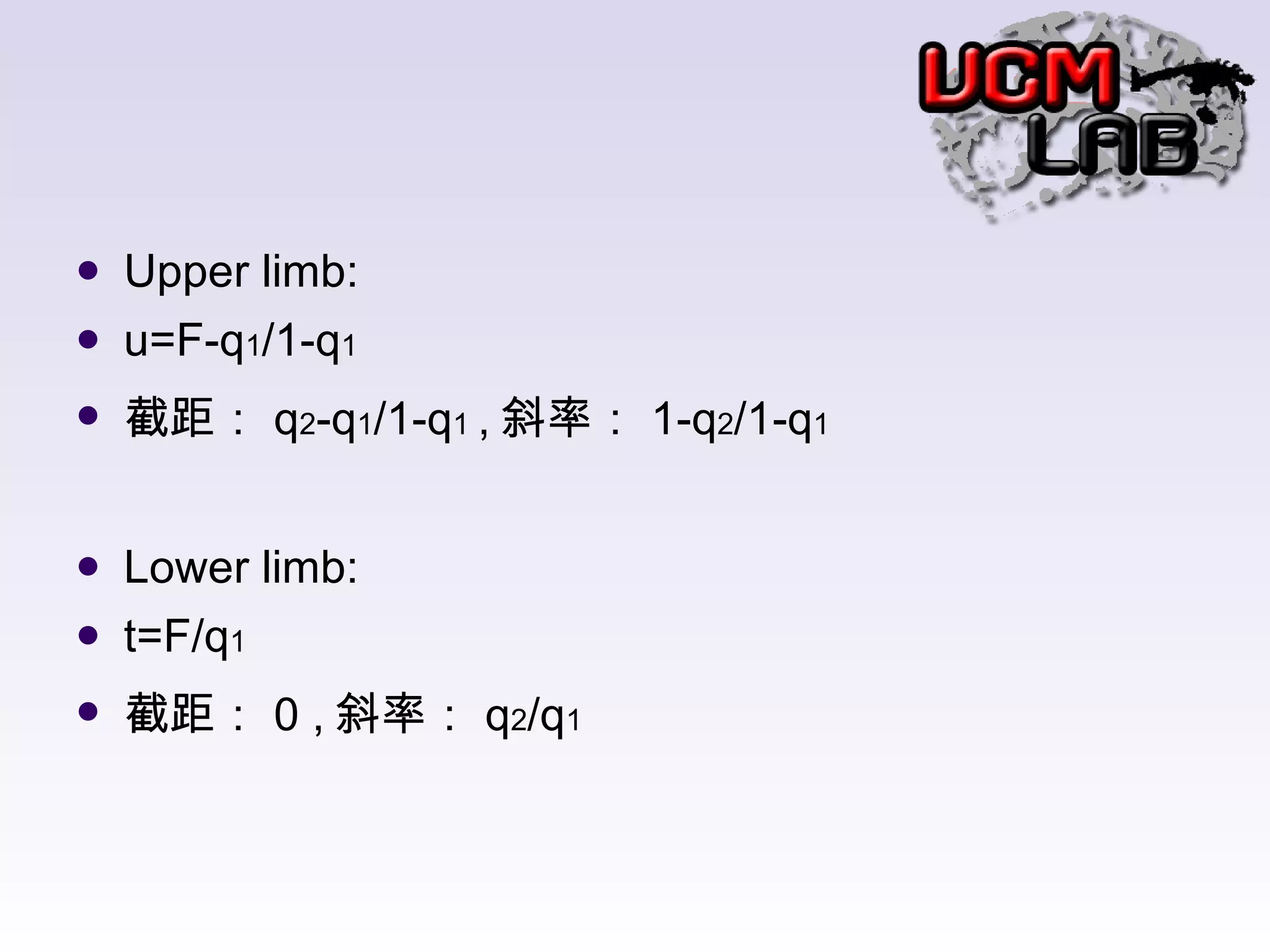
Upper limb: u=F-q 1 /1-q 1 截距: q 2 -q 1 /1-q 1  , 斜率: 1-q 2 /1-q 1 Lower limb: t=F/q 1 截距: 0 , 斜率: q 2 /q 1
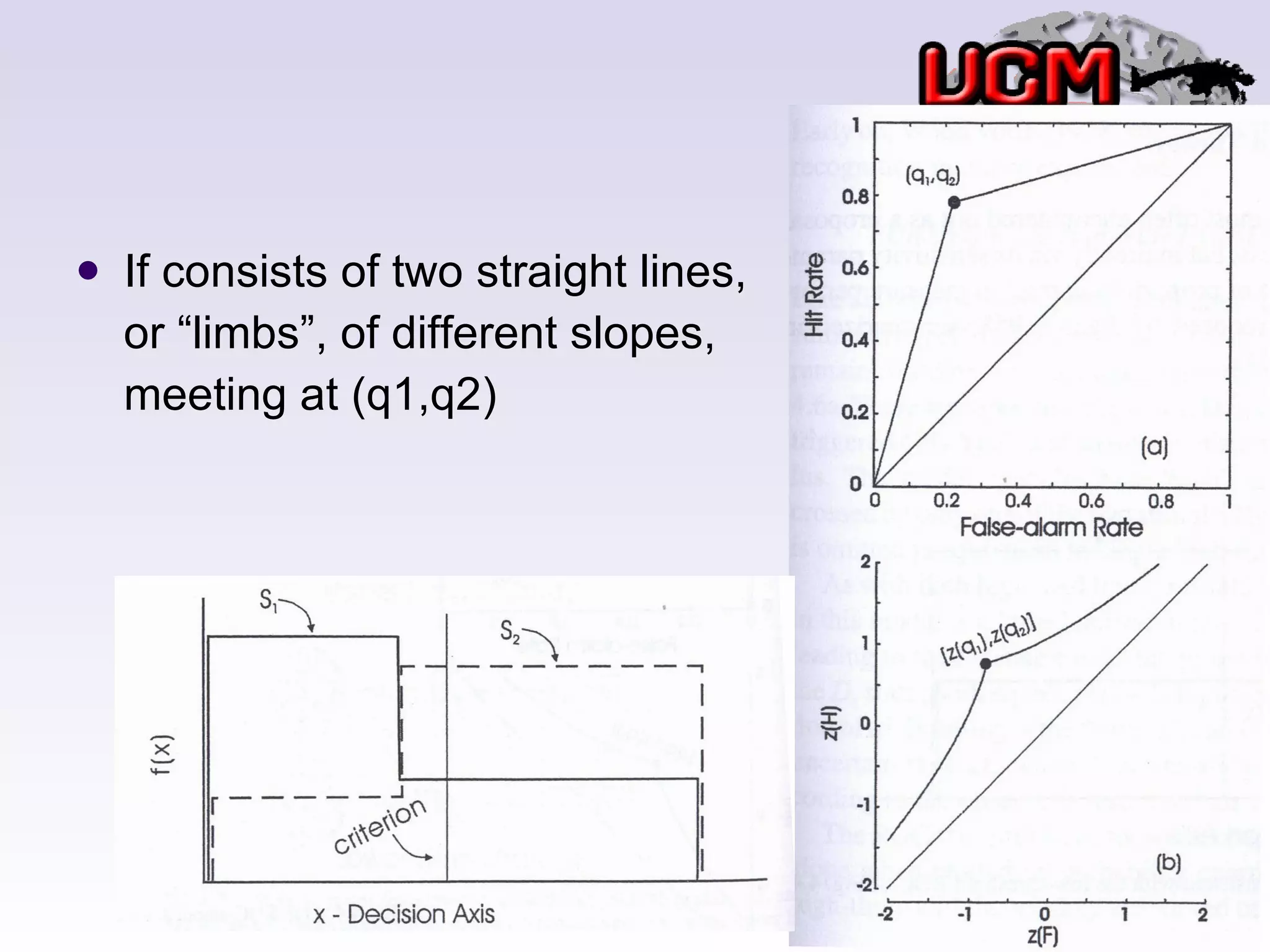
If consists of two straight lines, or “limbs”, of different slopes, meeting at (q1,q2)
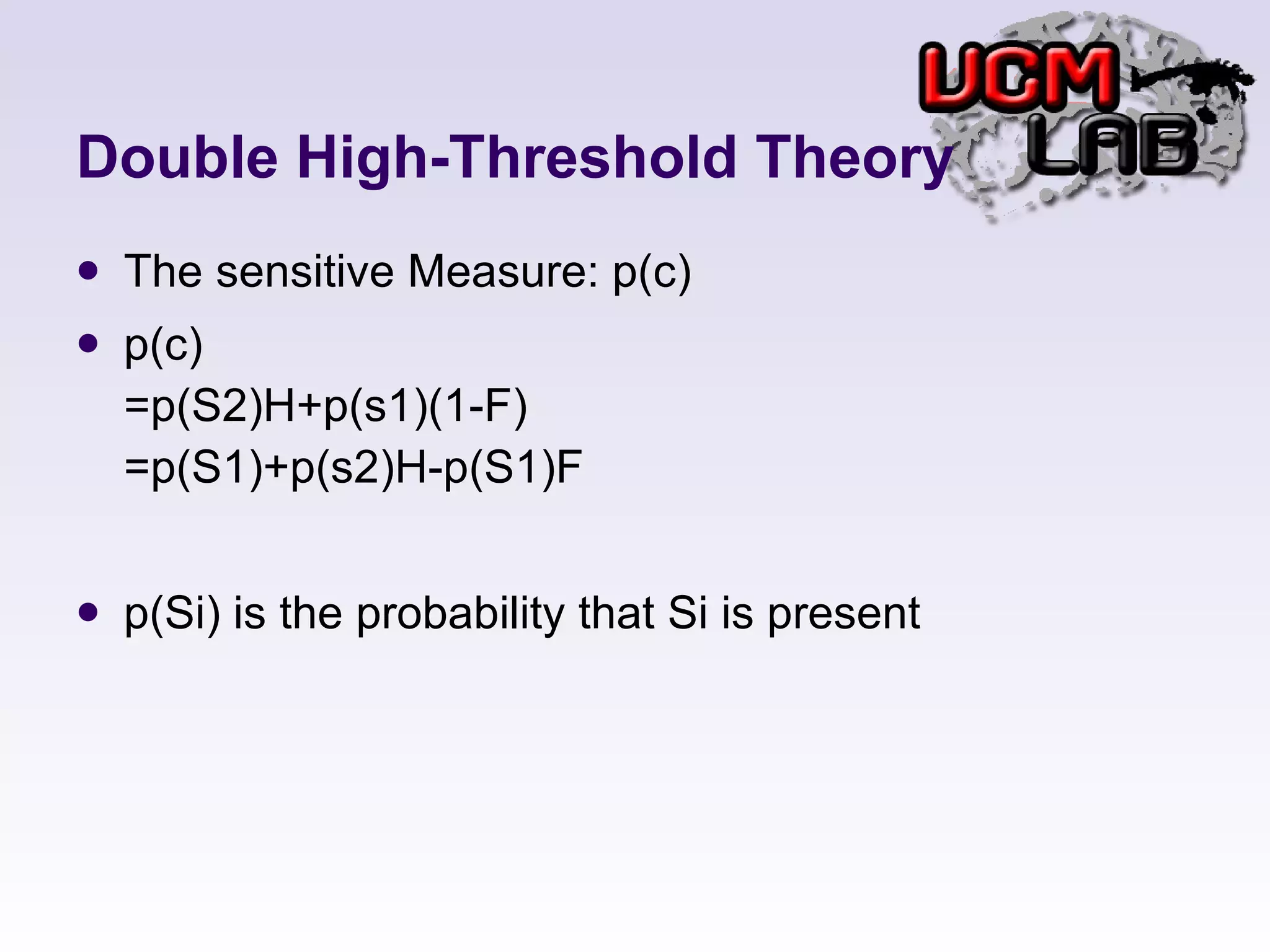
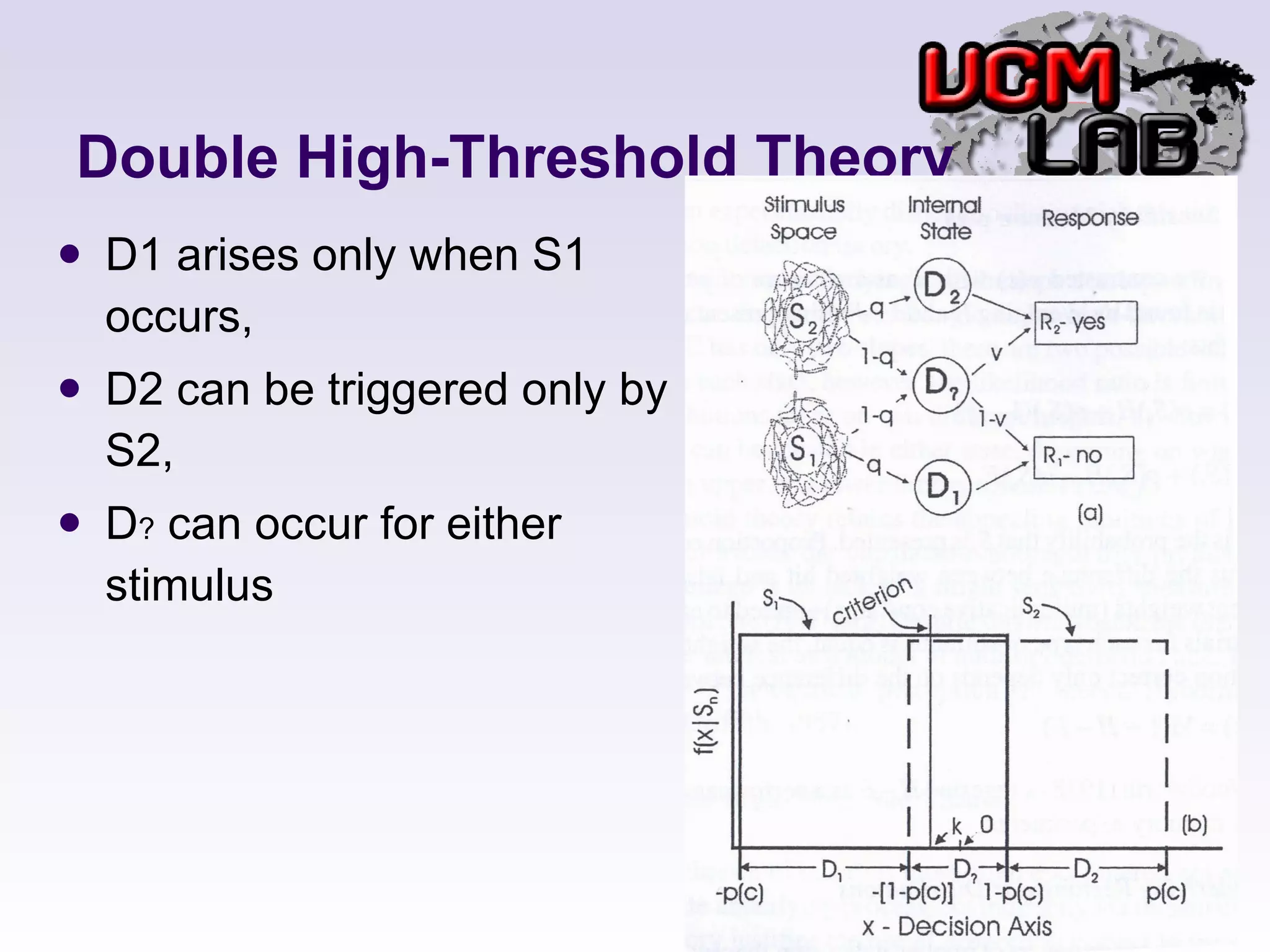
Double High-Threshold Theory The sensitive Measure: p(c) p(c) =p(S2)H+p(s1)(1-F) =p(S1)+p(s2)H-p(S1)F p(Si) is the probability that Si is present
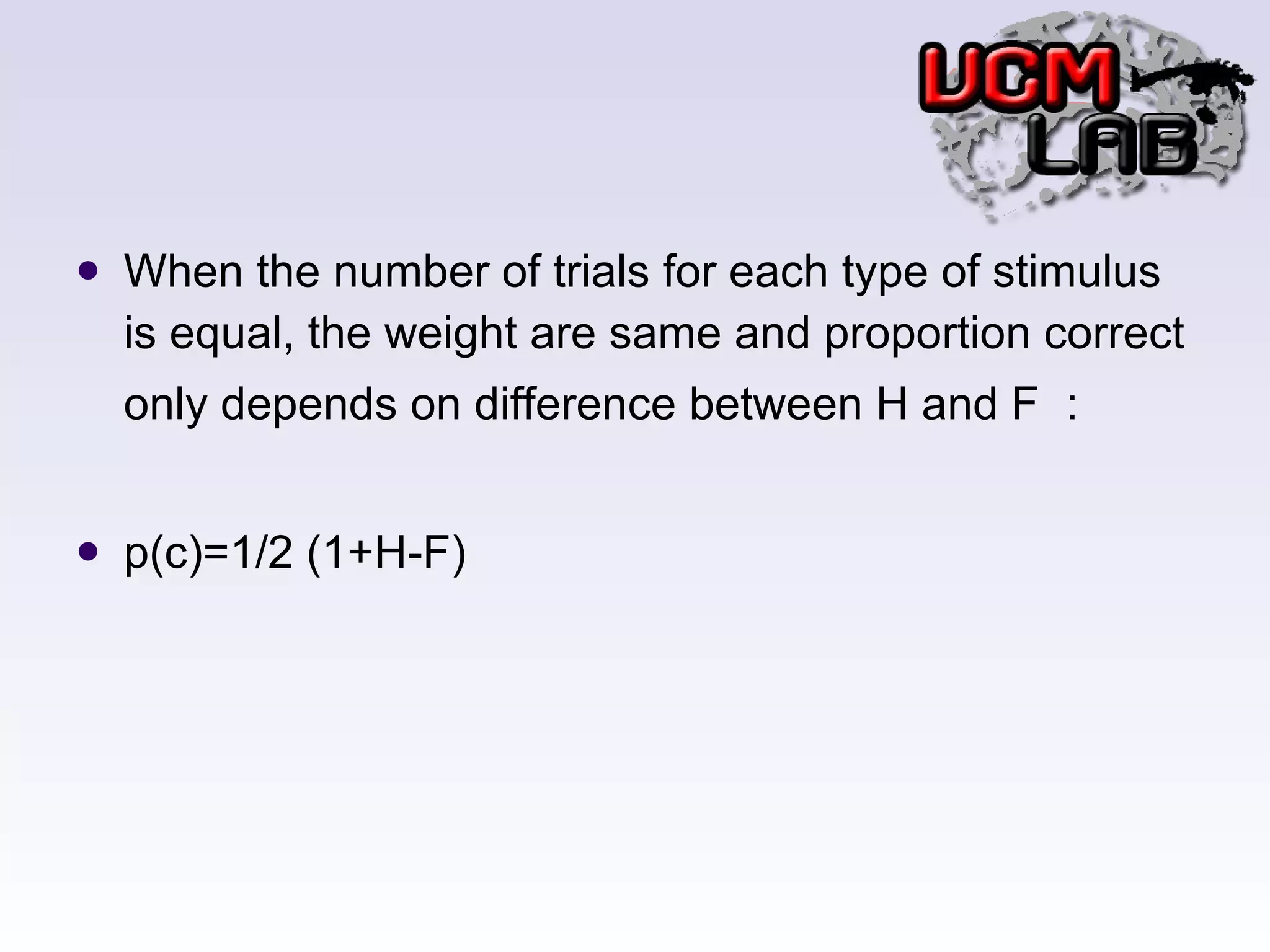
When the number of trials for each type of stimulus is equal, the weight are same and proportion correct only depends on difference between H and F : p(c)=1/2 (1+H-F)
Double High-Threshold Theory D1 arises only when S1 occurs, D2 can be triggered only by S2, D ?  can occur for either stimulus
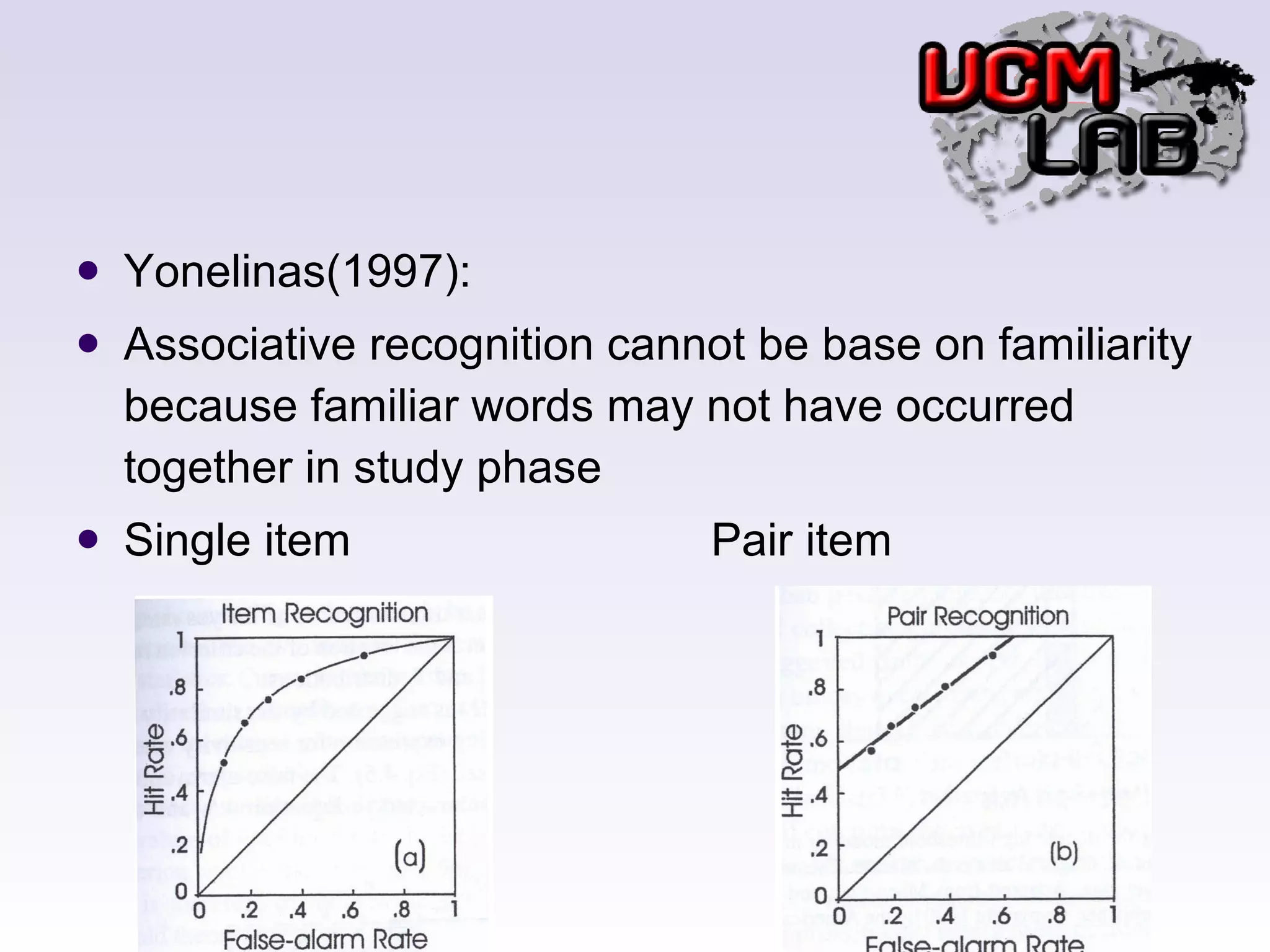
Yonelinas(1997): Associative recognition cannot be base on familiarity because familiar words may not have occurred together in study phase Single item Pair item
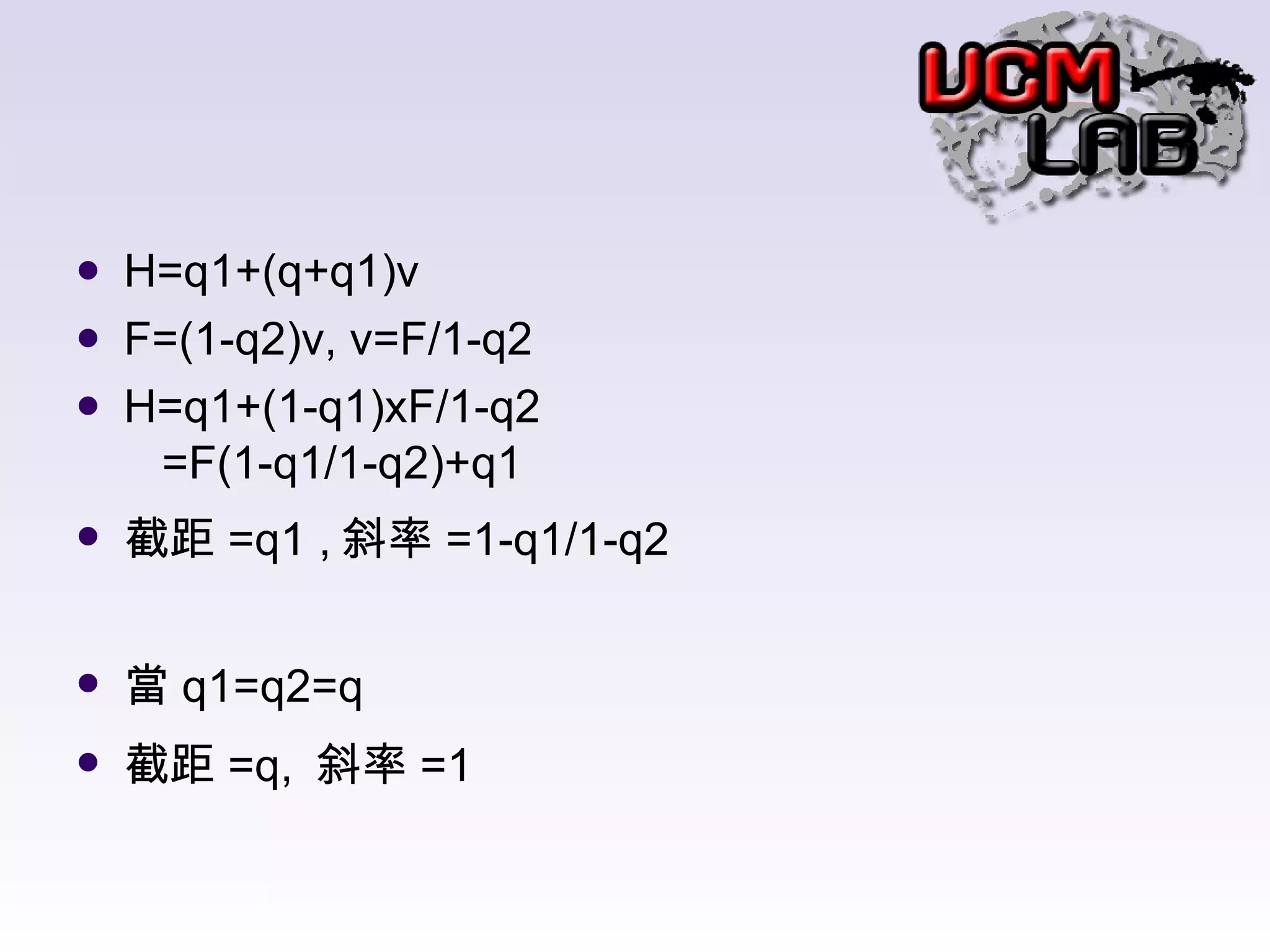
H=q1+(q+q1)v F=(1-q2)v, v=F/1-q2 H=q1+(1-q1)xF/1-q2   =F(1-q1/1-q2)+q1 截距 =q1 , 斜率 =1-q1/1-q2 當 q1=q2=q 截距 =q,  斜率 =1
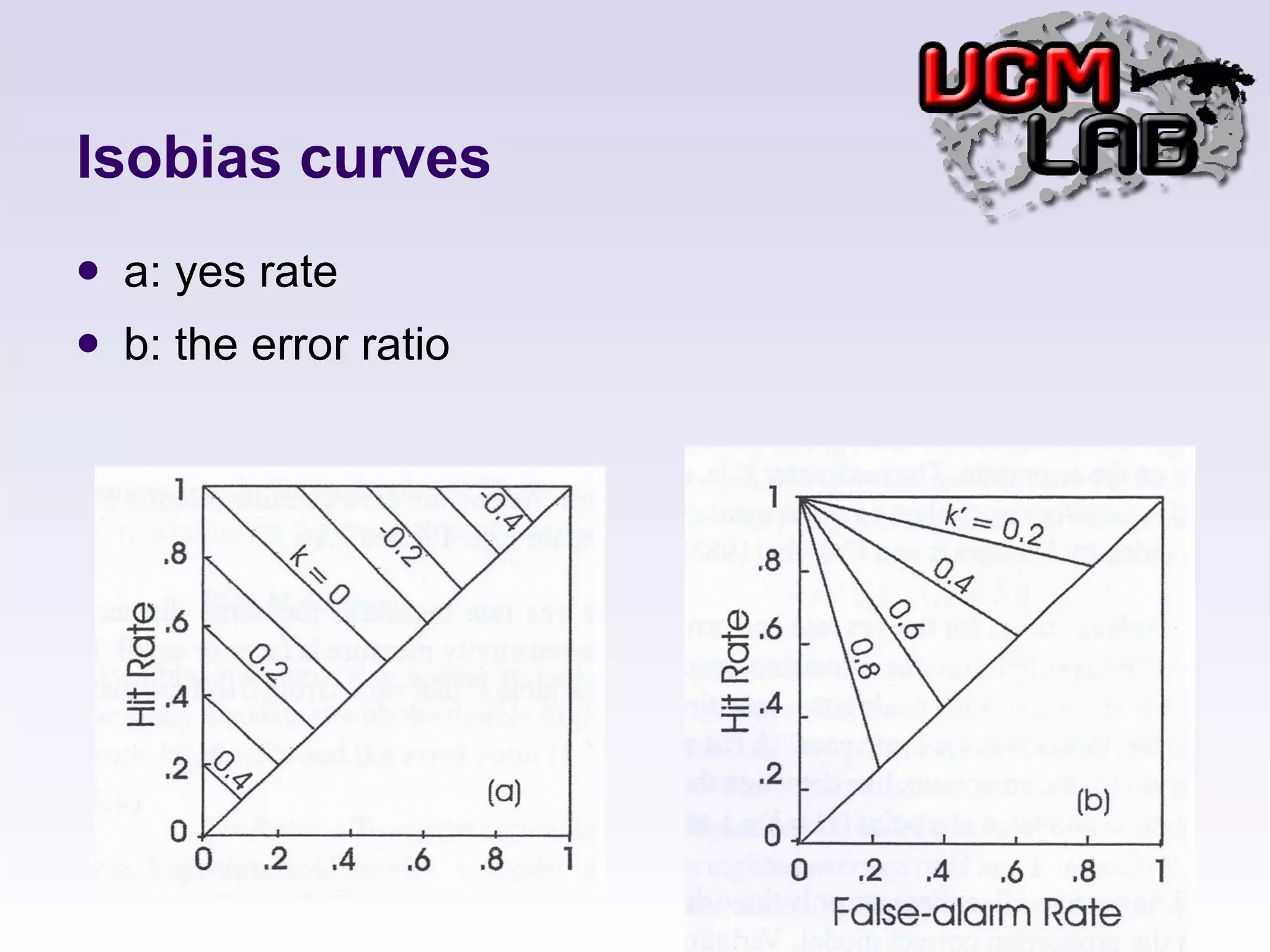
Yes Rate: ½ (H+F) Error Rate: (1-H)/F k is criterion H=p(c)-k F=1-p(c)-k k=1/2[1-(H+F)]
Error ratio: Linearly transform k into a new variable k’ that varies from 0 to 1, no matter what p(c) k’=[1+F/(1-H)] -1 k’=1-v
Isobias curves a: yes rate  b: the error ratio
Choice Theory Base on  choice axiom Sensitivity Measure: α α=[H(1-F)/(1-H)F] 1/2 ln(α)=1/2ln(H/1-H)-1/2ln(F/1-F)
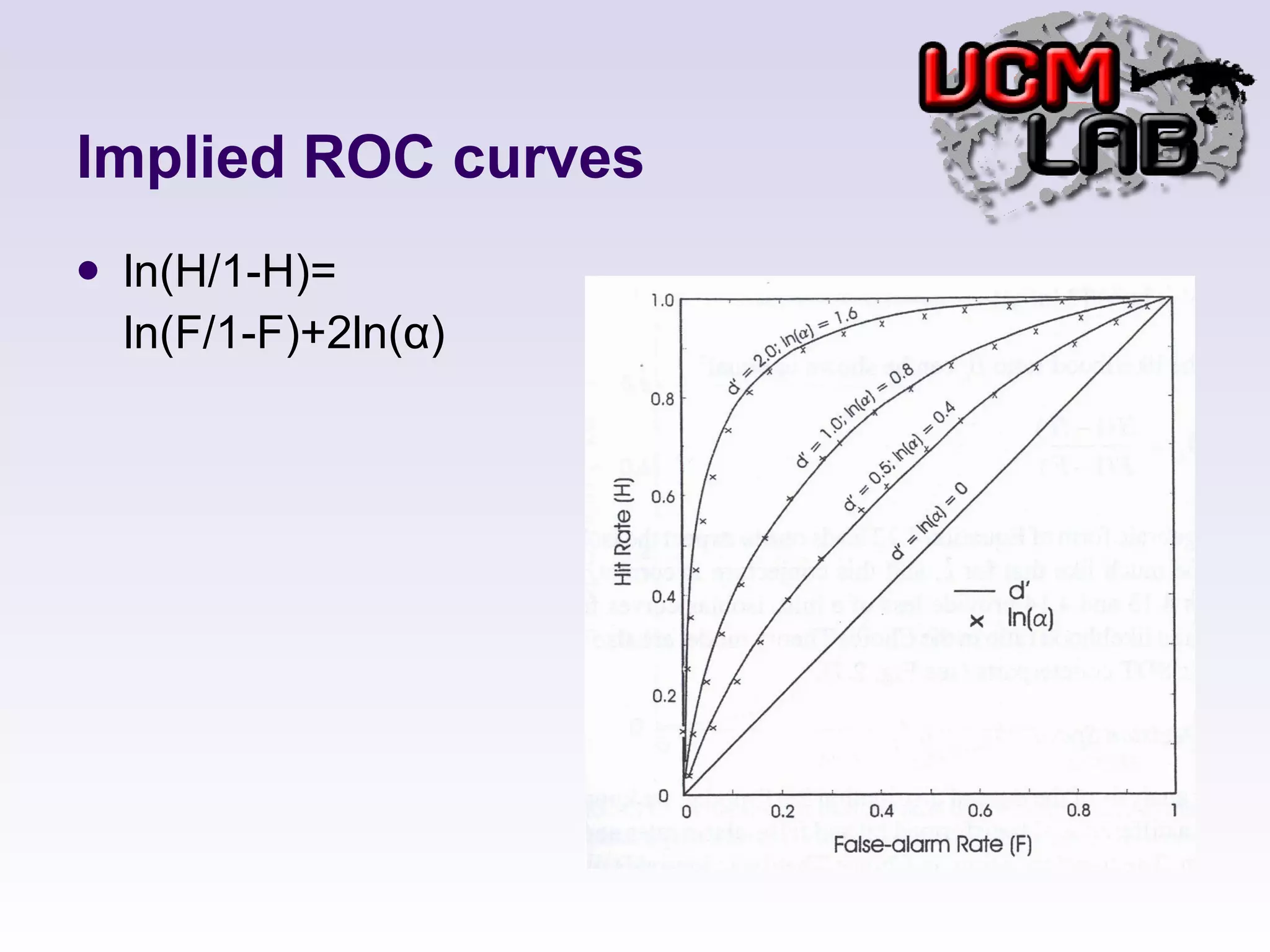
Implied ROC curves ln(H/1-H)= ln(F/1-F)+2ln(α)
Bias Measures b (for “bias”)=[(1-H)(1-F)/HF] 1/2 ln(b)=-1/2[ln(H/1-H)+ln(F/1-F)] b’=ln(b)/[2 ln(α)] β L =H(1-H)/F1-F
Choice Theory is log-odds, which converts a proportion p to ln[p/(1-p)]
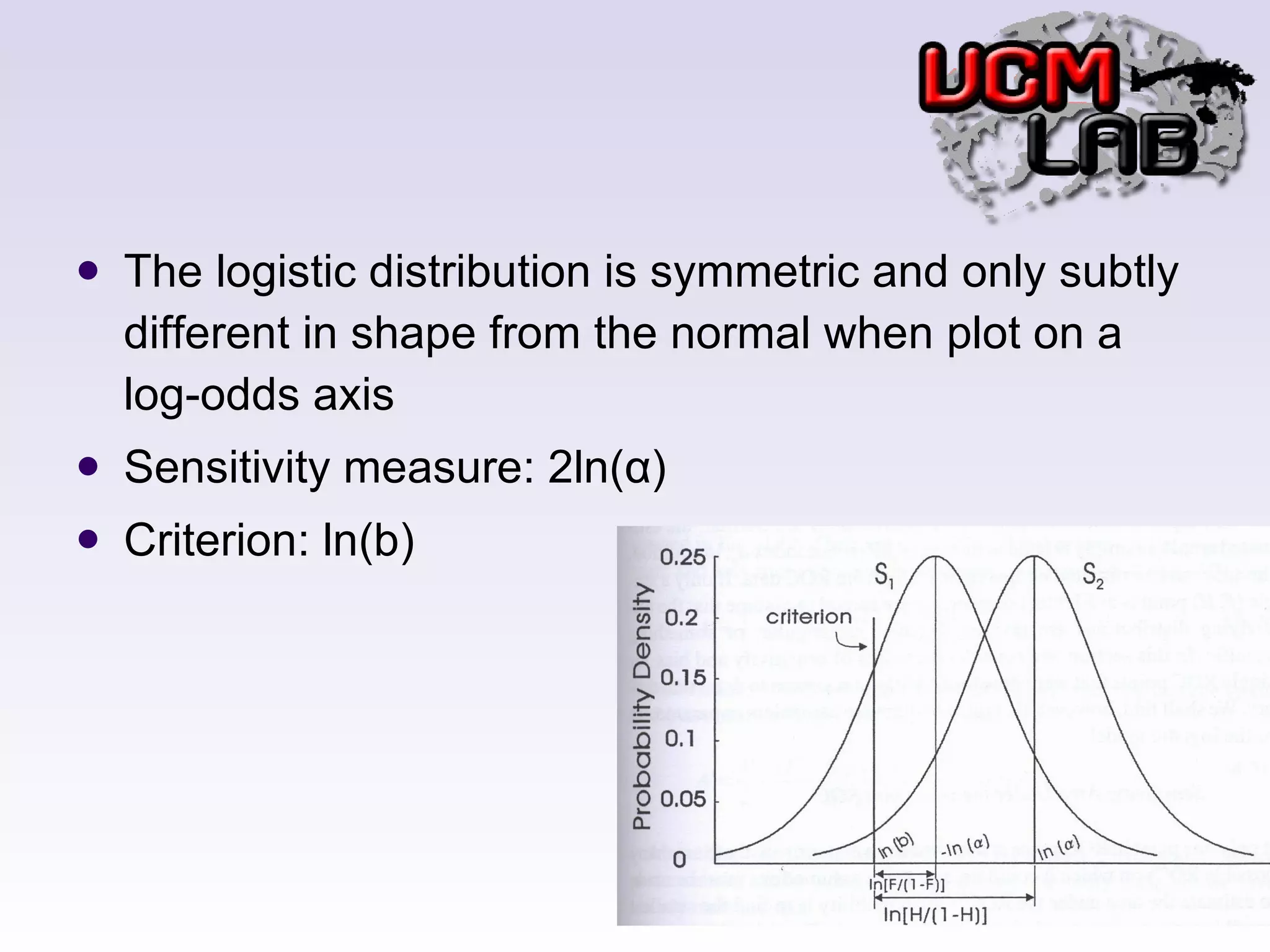
The logistic distribution is symmetric and only subtly different in shape from the normal when plot on a log-odds axis Sensitivity measure: 2ln(α) Criterion: ln(b)
x= ln[p/(1-p)] p=1/(1+e x ) x must be expressed as a distance from the mean S2 distribution: x=ln(b)-ln(α) S1 distribution: x=ln(b)+ln(α) H=α/(α+b) F=1/(1+αb)
Unbiased observer, b=1 H=α/(α+1) F=1/(1+α) =>H=1-F p(c)=α/(α+1)
Area Under the one-point ROC A’=1/2+(H-F)(1+H-F)/4H(1-F), if H>=F A’= 1/2+(F-H)(1+F-H)/4F(1-H), if H<=F A’=1/2+1/2p(c){1-1/[2ln(α)] 2 }
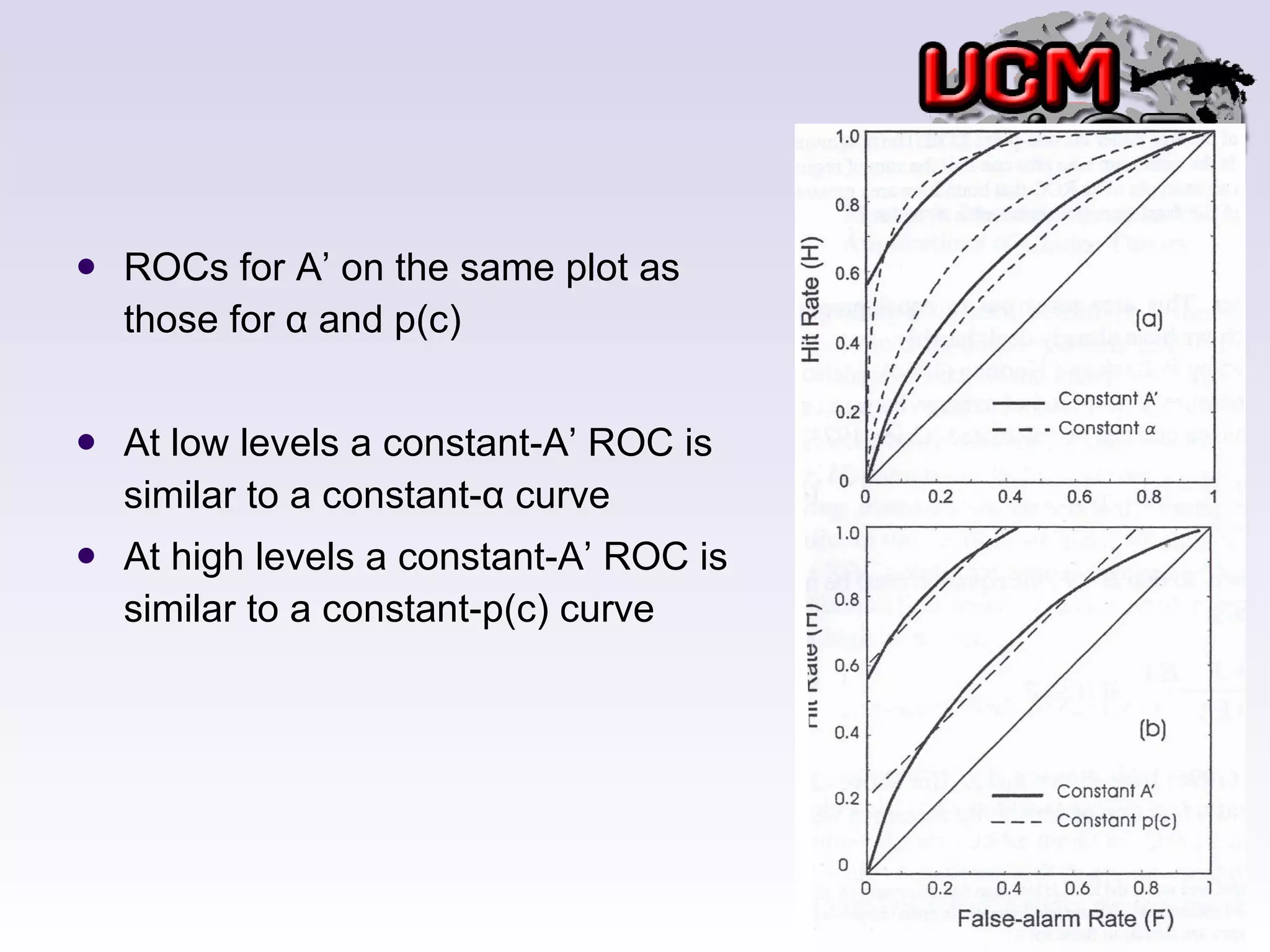
ROCs for A’ on the same plot as those for α and p(c) At low levels a constant-A’ ROC is similar to a constant-α curve At high levels a constant-A’ ROC is similar to a constant-p(c) curve
Bias Measures Based on ROC Geometry B’’ must be modified if performance is below chance B’’=H(1-H)-F(1-F)/H(1-H)+F(1-F), if H>=F B’’=F(1-F)-H(1-H)/H(1-H)+F(1-F), if H<=F
Nonparametric Analysis of Rating Data Dual-response version of ratings paradigm 分別對 signal/noise 做信心評量, 並測量 FA 和 H 的差異可得 S’ S’ did a better job than d’ of rank ordering conditions that differed slightly in sensitivity
Essay: The Appeal of discrete Model Subliminal perception Classification of speech Sounds Statistical Hypothesis Testing

DETECTION THEORY CHAPTER 4

  • 1.
    Alternative Approaches: ThresholdModels and Choice Theory CHAPTER 4, Detection Theory: A User’s Guide
  • 2.
    Much psychophysics wasconcerned with measuring “thresholds” 1950s-1960s, developing SDT Luce(1959) proposed Choice Theory
  • 3.
    Single High-Threshold Theoryq=(H-F)/(1-F) Sometime said to “correct” the hit rate for “guessing” H=.75, F=.1 q=.72 H=.75, F=.5 q=.5
  • 4.
    A false-alarm rateof zero can be obtained with a nonzero hit rate
  • 5.
    H=P(“yes”|S 2 )=q+u(1-q) F=P(“yes”|S 1 )=u Arbitrary distributions Rectangular distribution
  • 6.
    H=P(“yes”|S 2 )=q+u(1-q) F=P(“yes”|S 1 )=u 導回 q=(H-F)/(1-F) H=q+F(1-q) H=q+F-Fq q=H-F/1-F
  • 7.
    The threshold –thedividing line between the internal states– is “high” because S1 cannot hurdle it, although S2 can.
  • 8.
    Low-Threshold Theory Upperlimb: H=q2+u(1-q2) F=q1+u(1-q1) Lower limb H=tq1 F=tq2 The bias parameter t and u vary from 0 to 1
  • 9.
    Upper limb: u=F-q1 /1-q 1 截距: q 2 -q 1 /1-q 1 , 斜率: 1-q 2 /1-q 1 Lower limb: t=F/q 1 截距: 0 , 斜率: q 2 /q 1
  • 10.
    If consists oftwo straight lines, or “limbs”, of different slopes, meeting at (q1,q2)
  • 11.
    Double High-Threshold TheoryThe sensitive Measure: p(c) p(c) =p(S2)H+p(s1)(1-F) =p(S1)+p(s2)H-p(S1)F p(Si) is the probability that Si is present
  • 12.
    When the numberof trials for each type of stimulus is equal, the weight are same and proportion correct only depends on difference between H and F : p(c)=1/2 (1+H-F)
  • 13.
    Double High-Threshold TheoryD1 arises only when S1 occurs, D2 can be triggered only by S2, D ? can occur for either stimulus
  • 14.
    Yonelinas(1997): Associative recognitioncannot be base on familiarity because familiar words may not have occurred together in study phase Single item Pair item
  • 15.
    H=q1+(q+q1)v F=(1-q2)v, v=F/1-q2H=q1+(1-q1)xF/1-q2 =F(1-q1/1-q2)+q1 截距 =q1 , 斜率 =1-q1/1-q2 當 q1=q2=q 截距 =q, 斜率 =1
  • 16.
    Yes Rate: ½(H+F) Error Rate: (1-H)/F k is criterion H=p(c)-k F=1-p(c)-k k=1/2[1-(H+F)]
  • 17.
    Error ratio: Linearlytransform k into a new variable k’ that varies from 0 to 1, no matter what p(c) k’=[1+F/(1-H)] -1 k’=1-v
  • 18.
    Isobias curves a:yes rate b: the error ratio
  • 19.
    Choice Theory Baseon choice axiom Sensitivity Measure: α α=[H(1-F)/(1-H)F] 1/2 ln(α)=1/2ln(H/1-H)-1/2ln(F/1-F)
  • 20.
    Implied ROC curvesln(H/1-H)= ln(F/1-F)+2ln(α)
  • 21.
    Bias Measures b(for “bias”)=[(1-H)(1-F)/HF] 1/2 ln(b)=-1/2[ln(H/1-H)+ln(F/1-F)] b’=ln(b)/[2 ln(α)] β L =H(1-H)/F1-F
  • 22.
    Choice Theory islog-odds, which converts a proportion p to ln[p/(1-p)]
  • 23.
    The logistic distributionis symmetric and only subtly different in shape from the normal when plot on a log-odds axis Sensitivity measure: 2ln(α) Criterion: ln(b)
  • 24.
    x= ln[p/(1-p)] p=1/(1+ex ) x must be expressed as a distance from the mean S2 distribution: x=ln(b)-ln(α) S1 distribution: x=ln(b)+ln(α) H=α/(α+b) F=1/(1+αb)
  • 25.
    Unbiased observer, b=1H=α/(α+1) F=1/(1+α) =>H=1-F p(c)=α/(α+1)
  • 26.
    Area Under theone-point ROC A’=1/2+(H-F)(1+H-F)/4H(1-F), if H>=F A’= 1/2+(F-H)(1+F-H)/4F(1-H), if H<=F A’=1/2+1/2p(c){1-1/[2ln(α)] 2 }
  • 27.
    ROCs for A’on the same plot as those for α and p(c) At low levels a constant-A’ ROC is similar to a constant-α curve At high levels a constant-A’ ROC is similar to a constant-p(c) curve
  • 28.
    Bias Measures Basedon ROC Geometry B’’ must be modified if performance is below chance B’’=H(1-H)-F(1-F)/H(1-H)+F(1-F), if H>=F B’’=F(1-F)-H(1-H)/H(1-H)+F(1-F), if H<=F
  • 29.
    Nonparametric Analysis ofRating Data Dual-response version of ratings paradigm 分別對 signal/noise 做信心評量, 並測量 FA 和 H 的差異可得 S’ S’ did a better job than d’ of rank ordering conditions that differed slightly in sensitivity
  • 30.
    Essay: The Appealof discrete Model Subliminal perception Classification of speech Sounds Statistical Hypothesis Testing