The Classical Psychophysical Methods CHAPTER 3, Detection Theory: A User’s Guide
Outline Method of constant stimuli   Absolute Thresholds Difference  Thresholds Method of limits Absolute Thresholds Difference  Thresholds Variation of the Method of Limits Method of adjustment Absolute Thresholds Difference  Thresholds Application of classical psychophysical methods to problems of stimulus matching
Introduction The threshold has been defined as the stimulus value which is perceptible in 50% of the trails. Three methods of threshold measurement:   1.Method of constant stimuli   2.Method of limits   3.Method of adjustment
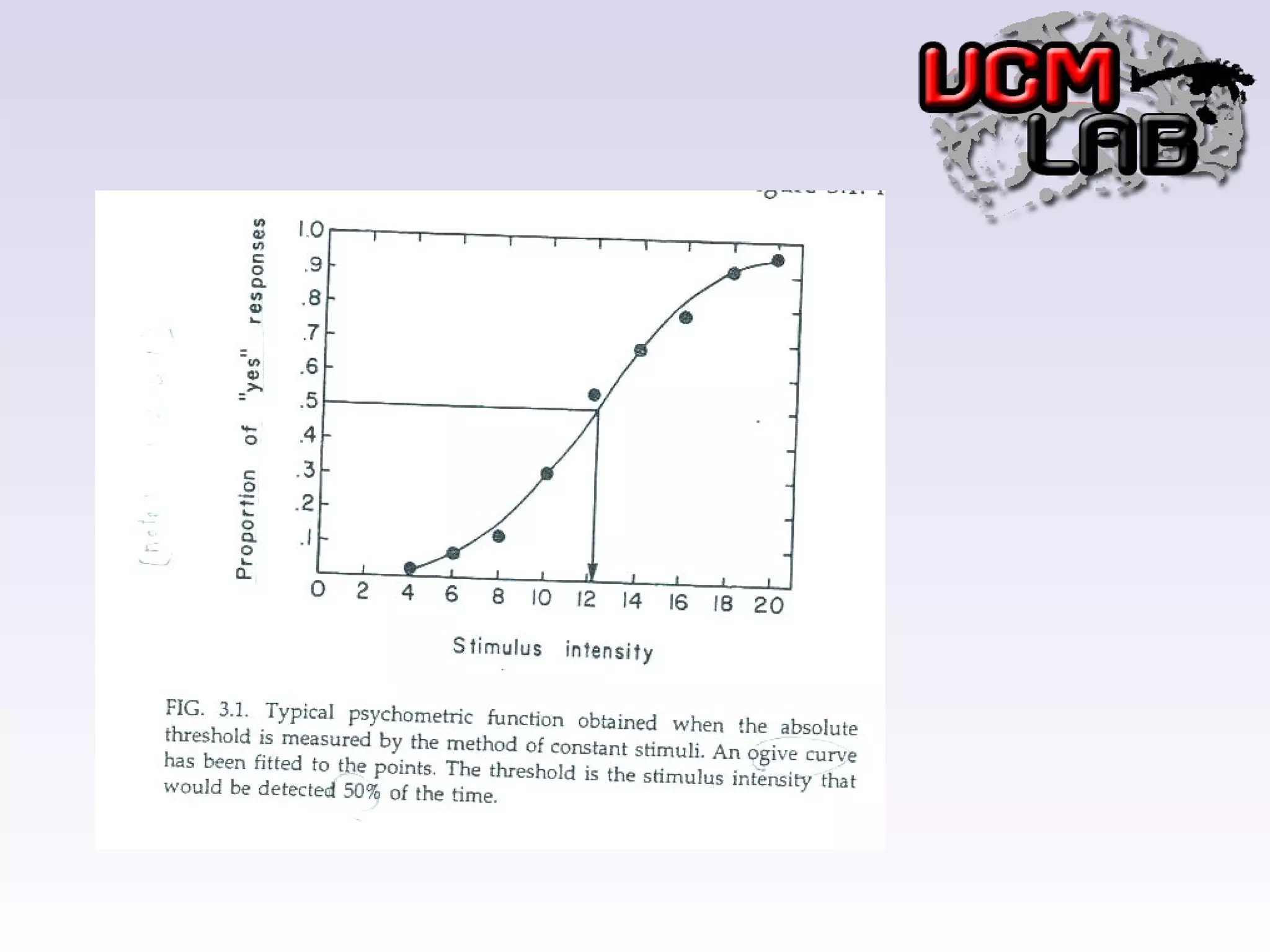
Method of constant stimuli   - Absolute Thresholds Procedure: using the same set of stimuli(5~9 different values in the set) , each stimulus is present repeatedly, usually 100 times or more, but in a random order.  The percentage of detections as a function of stimulus intensity,  φ  is determined. Yes or No response: the proportion( p ) of yes response is computed, and a graph called a  psychometric function  is constructed.
 
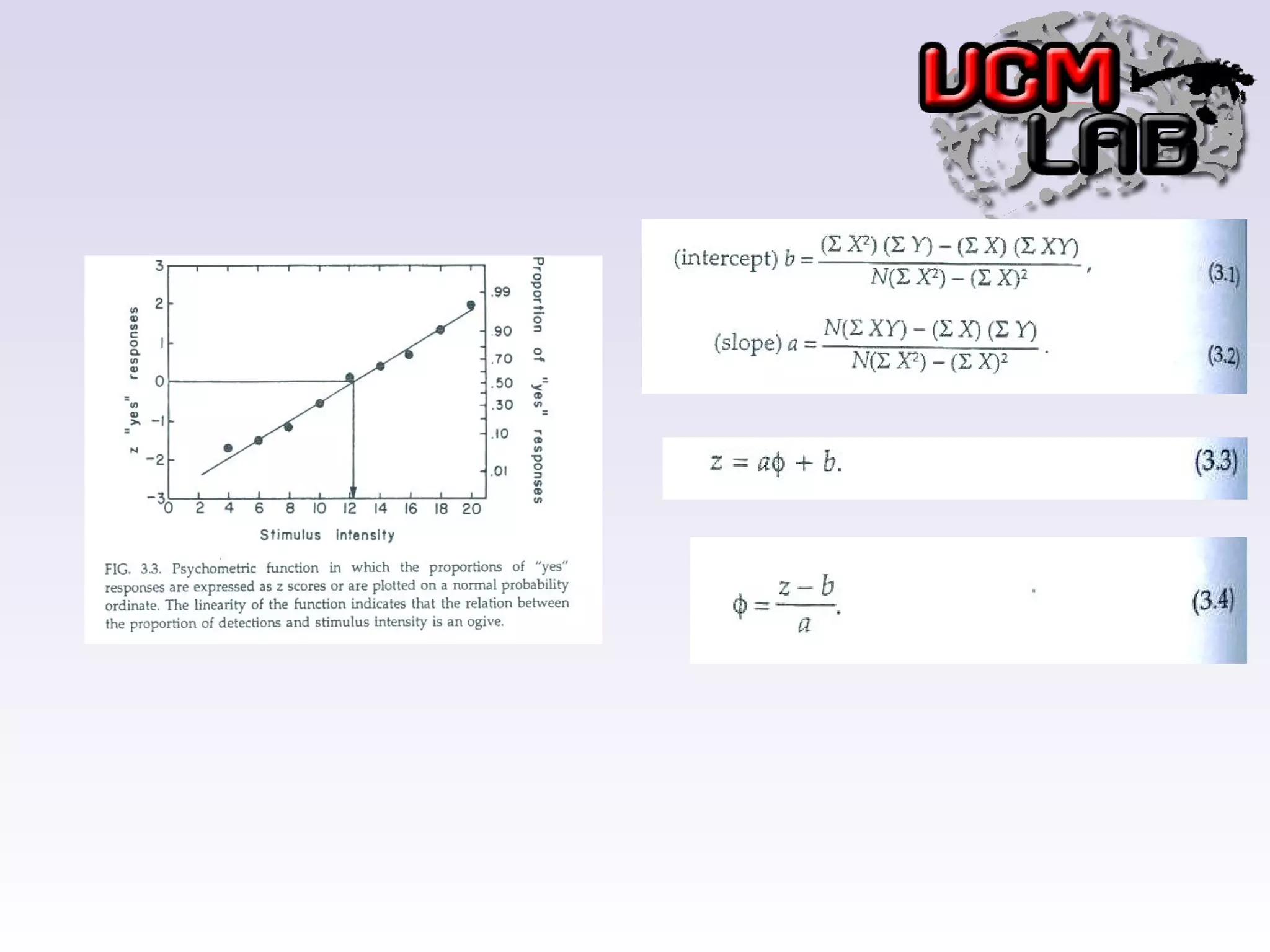
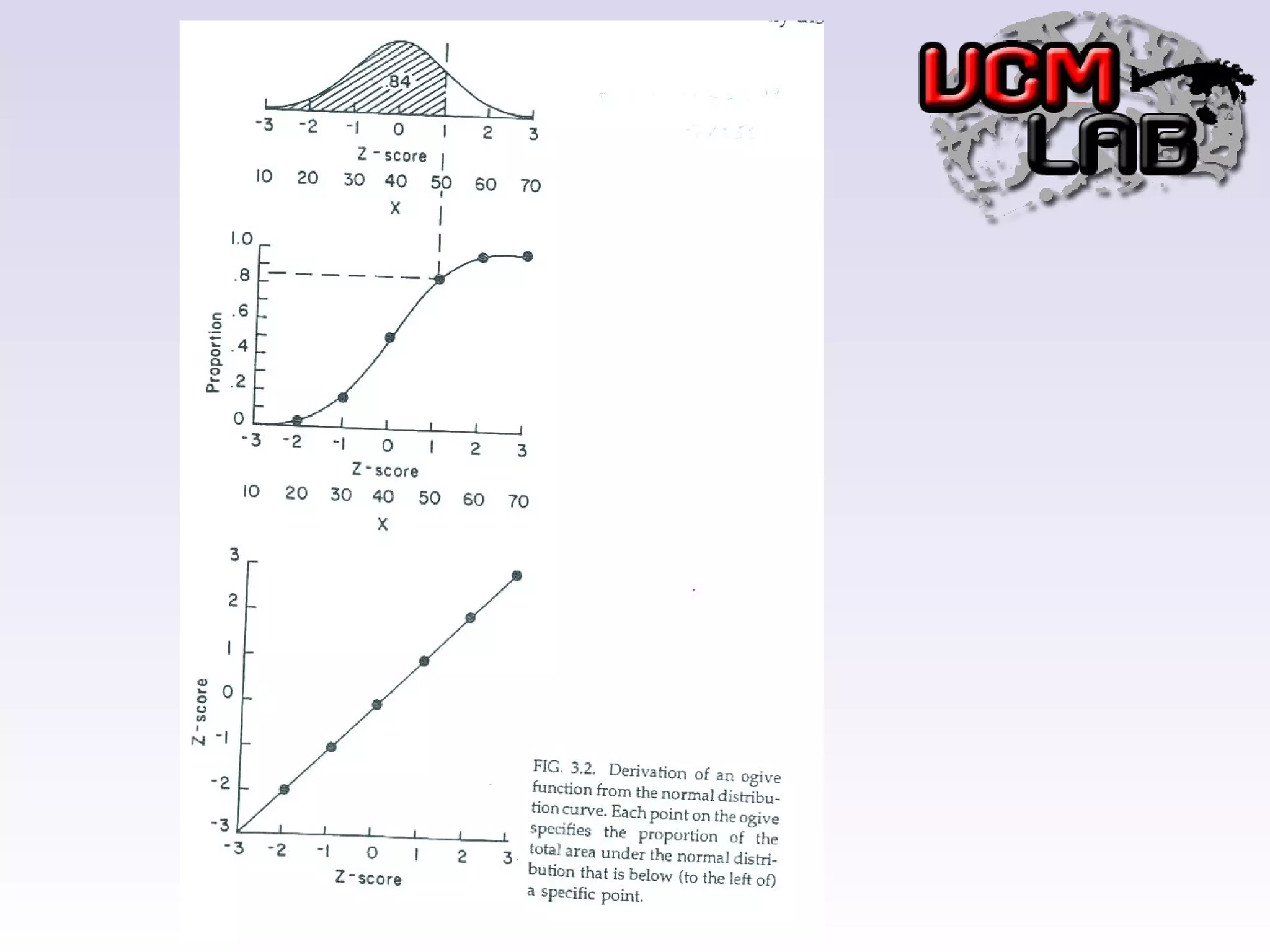
Method of constant stimuli   - Absolute Thresholds Absolute threshold: the stimulus intensity for which the proportion of trials resulting in yes response is 0.5 Ogive function : S-shaped, is a cumulative form of normal distribution.  Fitting ogive function to threshold data range: z-score method of least squares
 
 
Method of constant stimuli   - Difference  Thresholds Standard stimulus(St):  fixed value Comparison stimulus(Co):  the value is changed from trial to trial Space error Time error
 
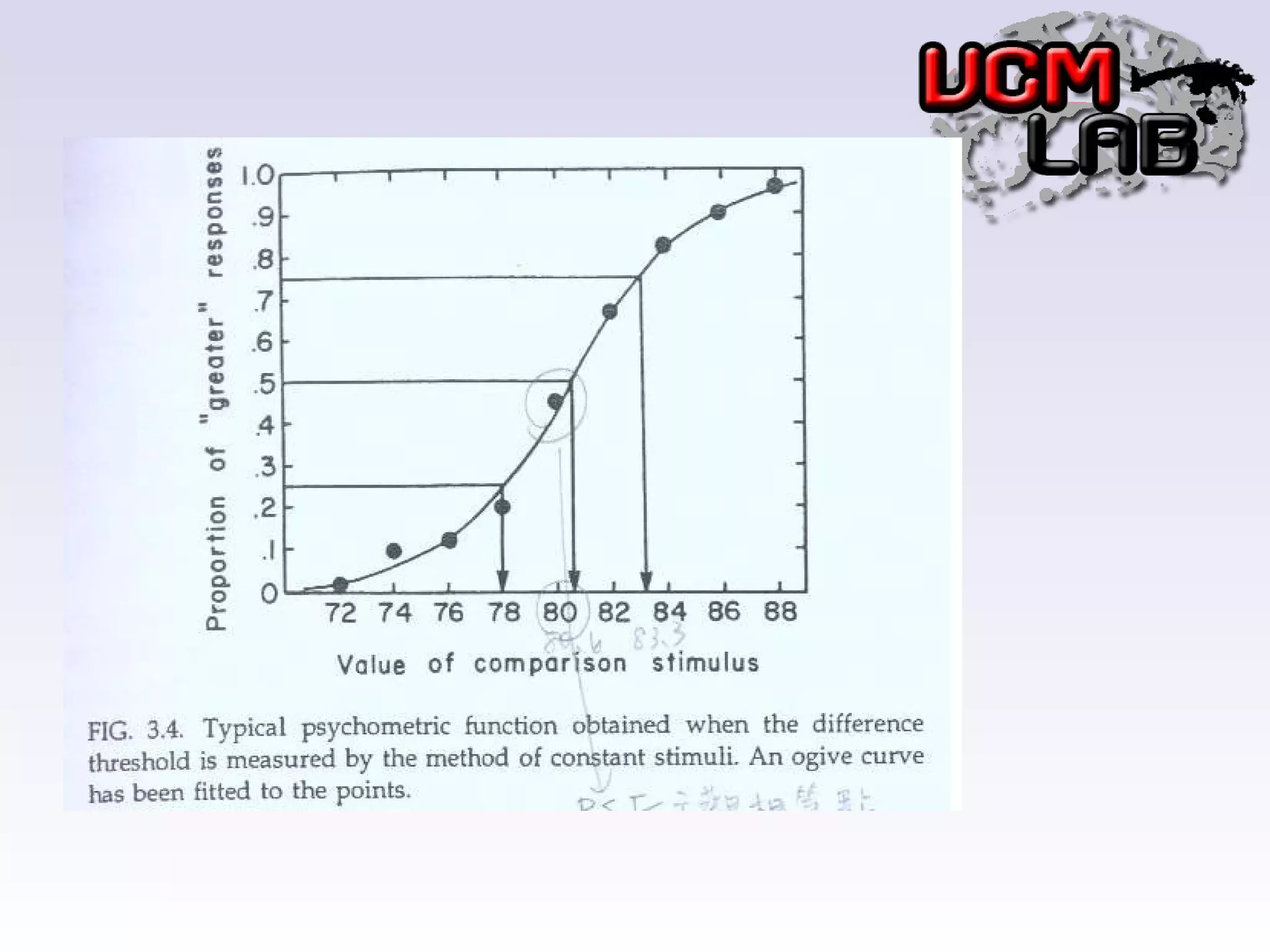
Method of constant stimuli   - Difference  Thresholds Point of subjective equality(PSE):  The 0.5 point on the psychometric function , is perceived subjectively as equal to standard stimulus Constant error(CE) CE = PSE - St
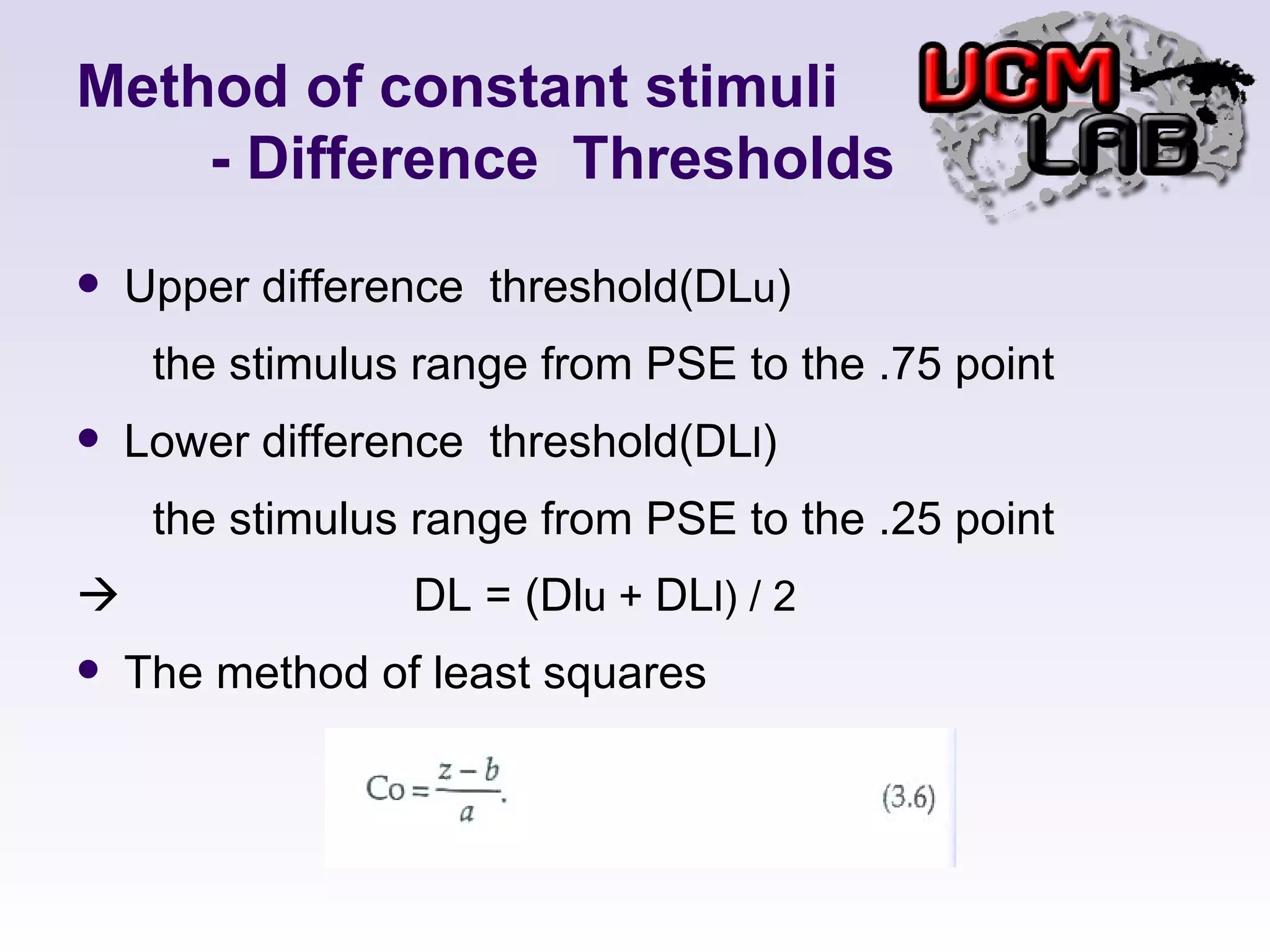
Method of constant stimuli   - Difference  Thresholds Upper difference  threshold(DL u ) the stimulus range from PSE to the .75 point Lower difference  threshold(DL l ) the stimulus range from PSE to the .25 point    DL = (Dl u +  DL l) / 2 The method of least squares
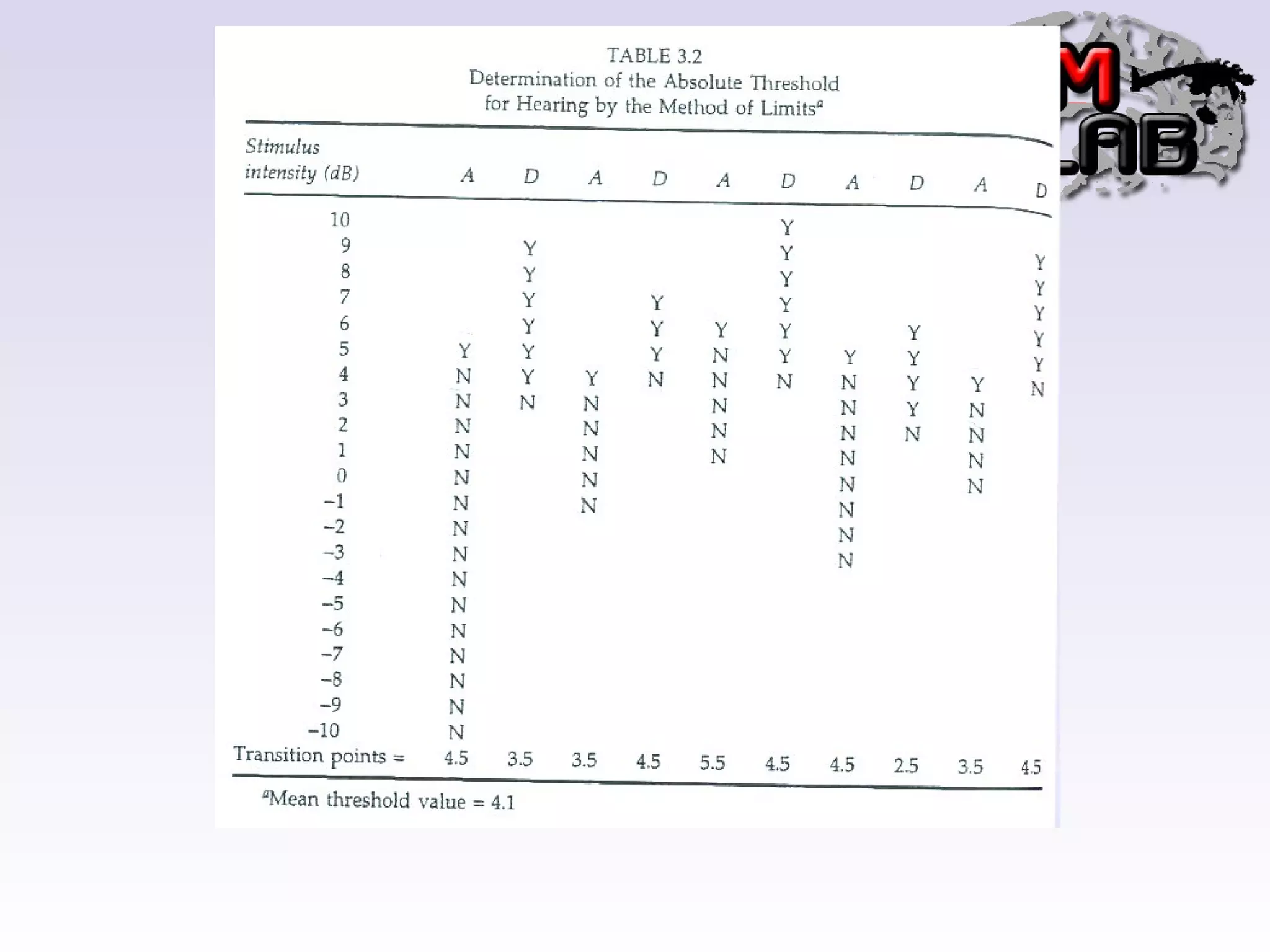
Method of limits   - Absolute Thresholds Ascending series : begin with very weak subthreshold stimulus, then increased by a small amount until the observer report the presence of the sensation Descending series : the value of stimulus is decreased until the observer report the absence of the sensation Threshold : the average of the transition points
 
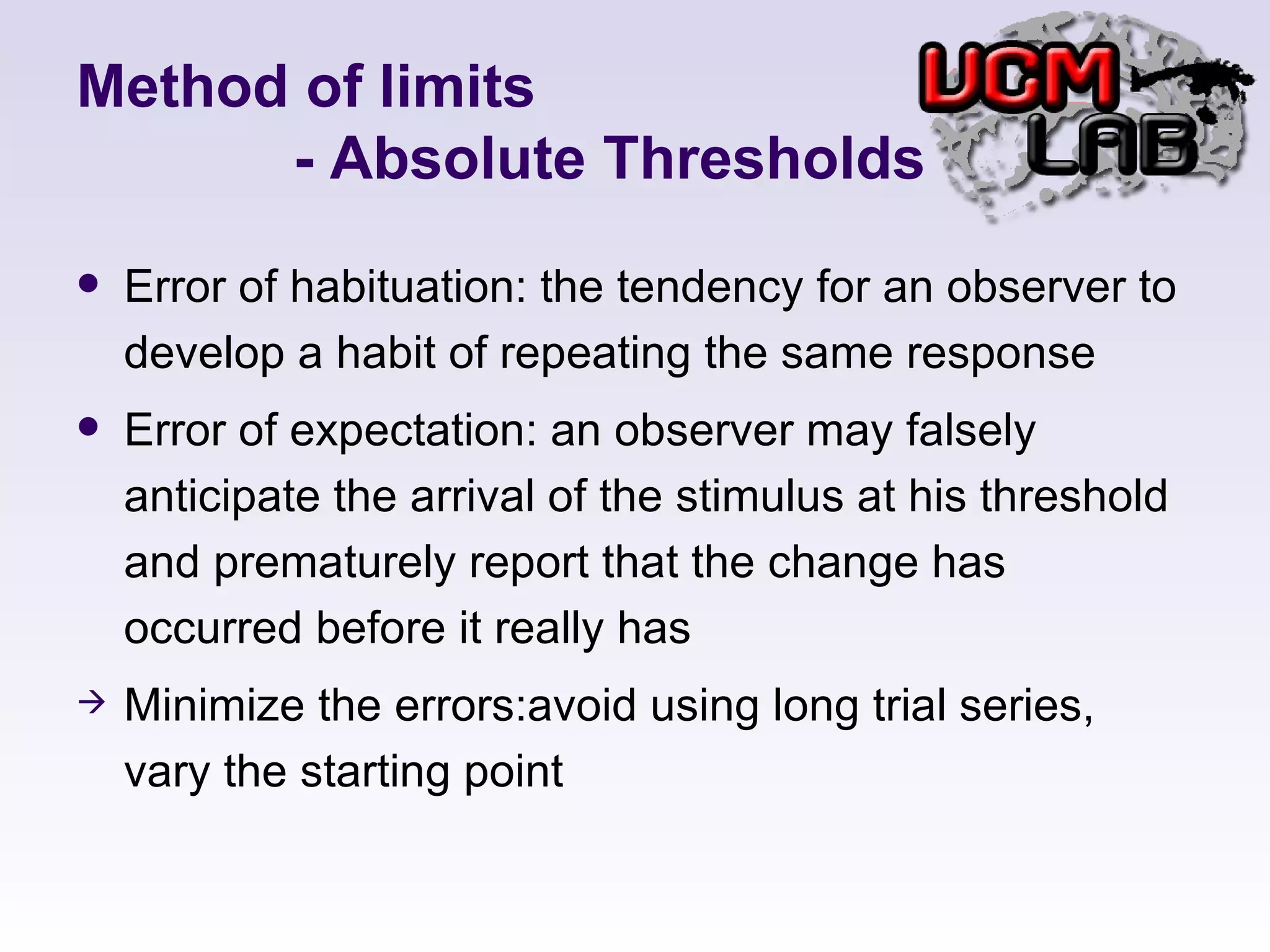
Method of limits   - Absolute Thresholds Error of habituation: the tendency for an observer to develop a habit of repeating the same response Error of expectation: an observer may falsely anticipate the arrival of the stimulus at his threshold and prematurely report that the change has occurred before it really has  Minimize the errors:avoid using long trial series, vary the starting point
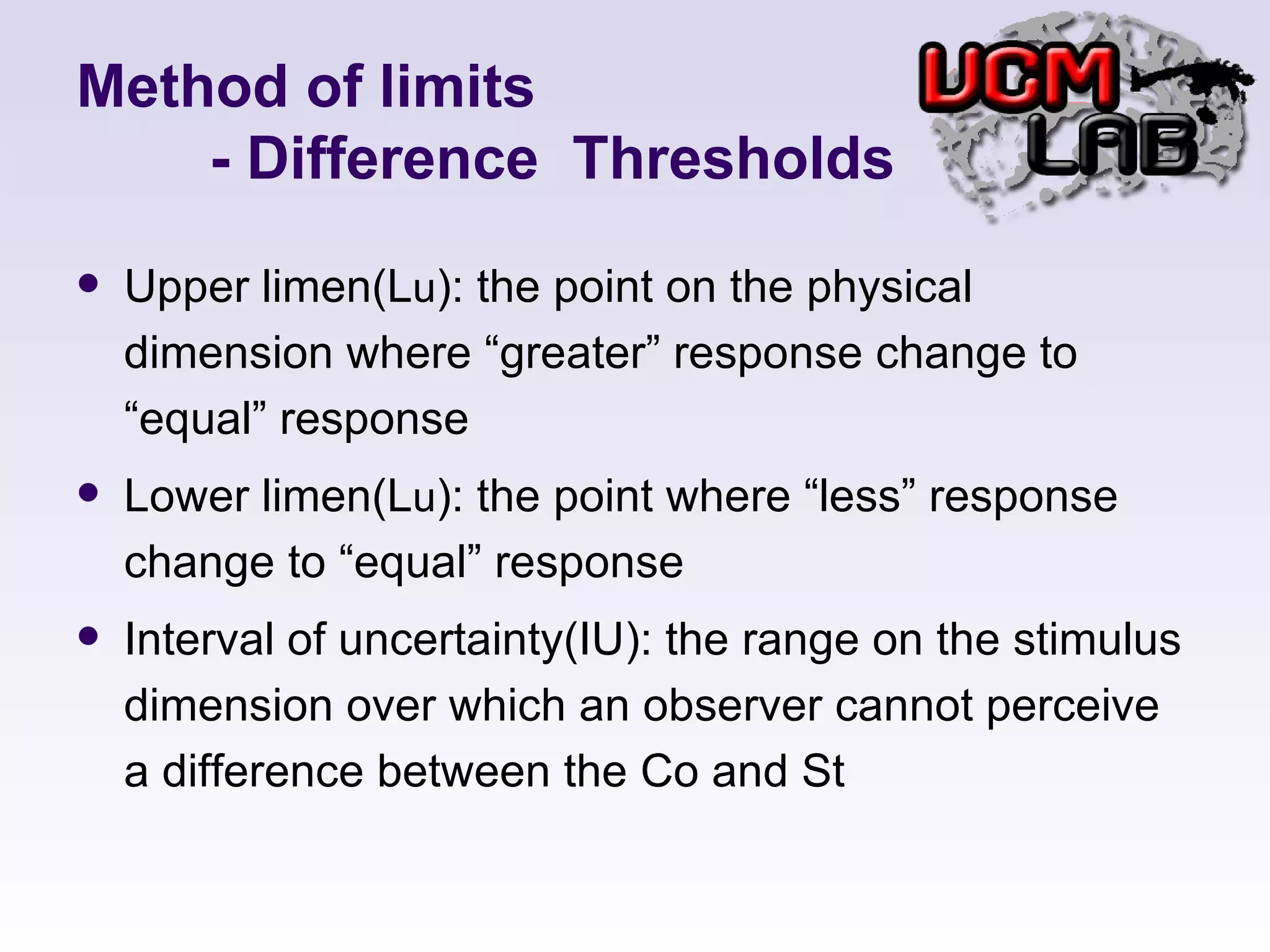
Method of limits   - Difference  Thresholds Upper limen(L u ): the point on the physical dimension where “greater” response change to “equal” response Lower limen(L u ): the point where “less” response change to “equal” response Interval of uncertainty(IU): the range on the stimulus dimension over which an observer cannot perceive a difference between the Co and St
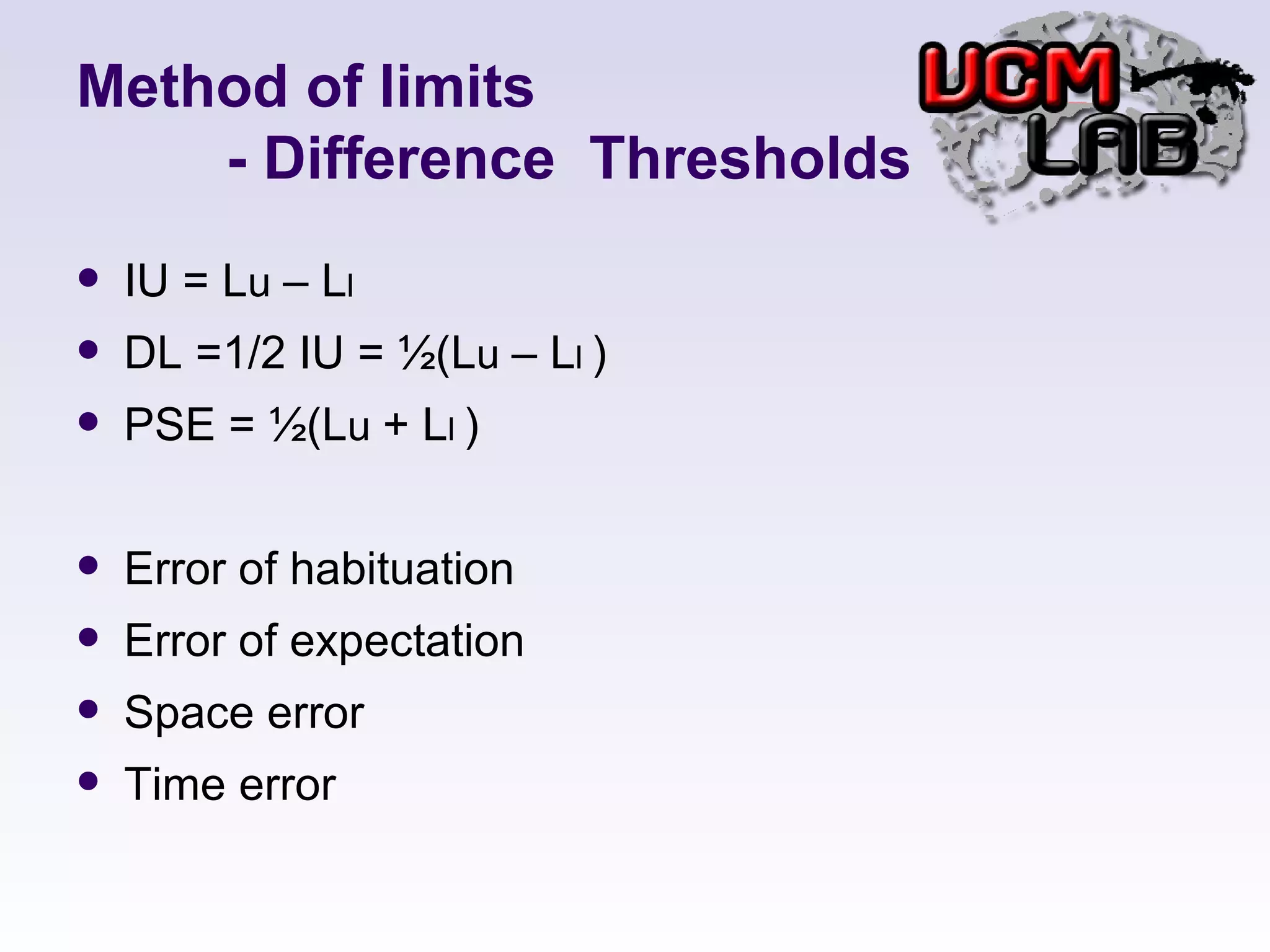
Method of limits   - Difference  Thresholds IU = L u  – L l  DL =1/2 IU = ½(L u  – L l  ) PSE = ½(L u  + L l  ) Error of habituation Error of expectation Space error Time error
Variation of the Method of Limits Up-and-down/ staircase method  (Cornsweet, 1962) - efficient  - step size : must chosen with care Threshold tracking method (Bekesy, 1947) Forced choice method(Blackwell, 1953) - temporal-forced choice - spatial-forced choice - threshold: two correct responses in succession - response bias: the tendency to report the  presence of subthreshold or absent stimuli
Method of adjustment   - Absolute Thresholds Procedure: set the stimulus intensity level either far below or far above threshold and ask the observer either to increase the intensity level until it is just perceptible or vice versa. Can prevent boredom  Error of habituation Error of expectation
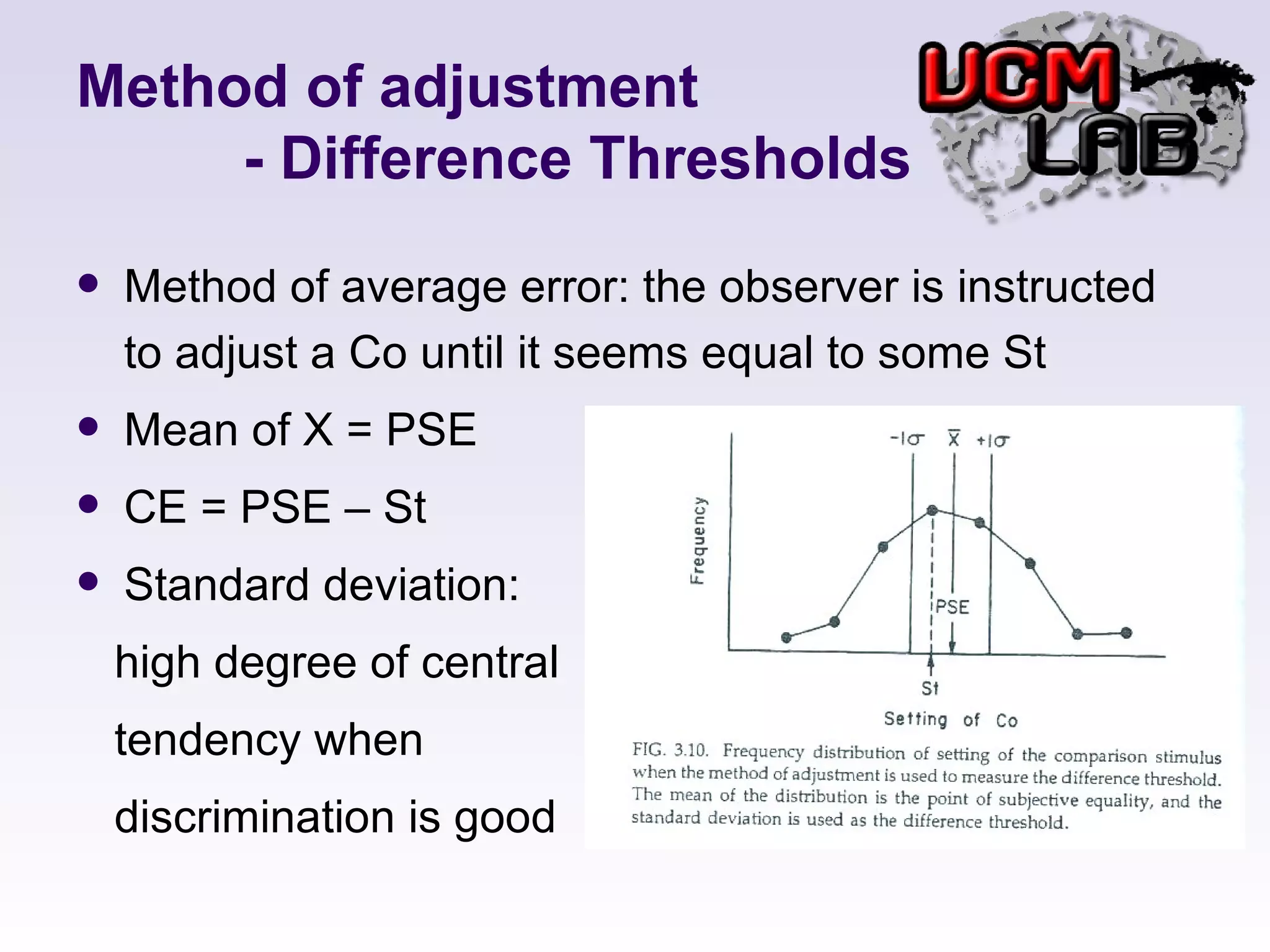
Method of adjustment   - Difference Thresholds Method of average error: the observer is instructed to adjust a Co until it seems equal to some St  Mean of X = PSE CE = PSE – St Standard deviation: high degree of central  tendency when  discrimination is good
Method of adjustment   - Absolute Thresholds Shortcomings: - difficult to apply when stimulus are not  continuously variable - difficult to apply when pairs of stimulus  cannot be presented simultaneously - difficult to maintain constant conditions
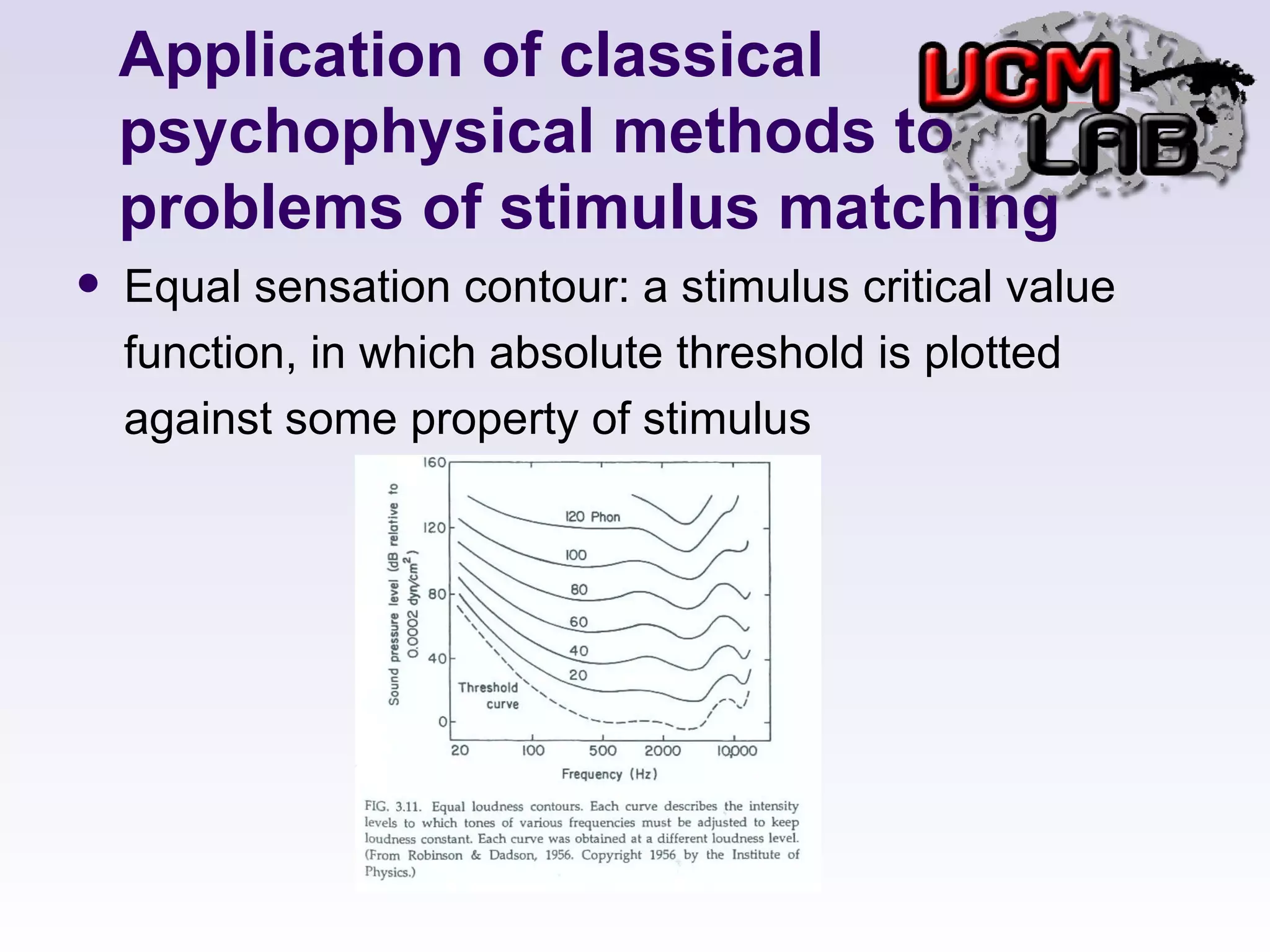
Application of classical psychophysical methods to problems of stimulus matching Equal sensation contour: a stimulus critical value function, in which absolute threshold is plotted against some property of stimulus
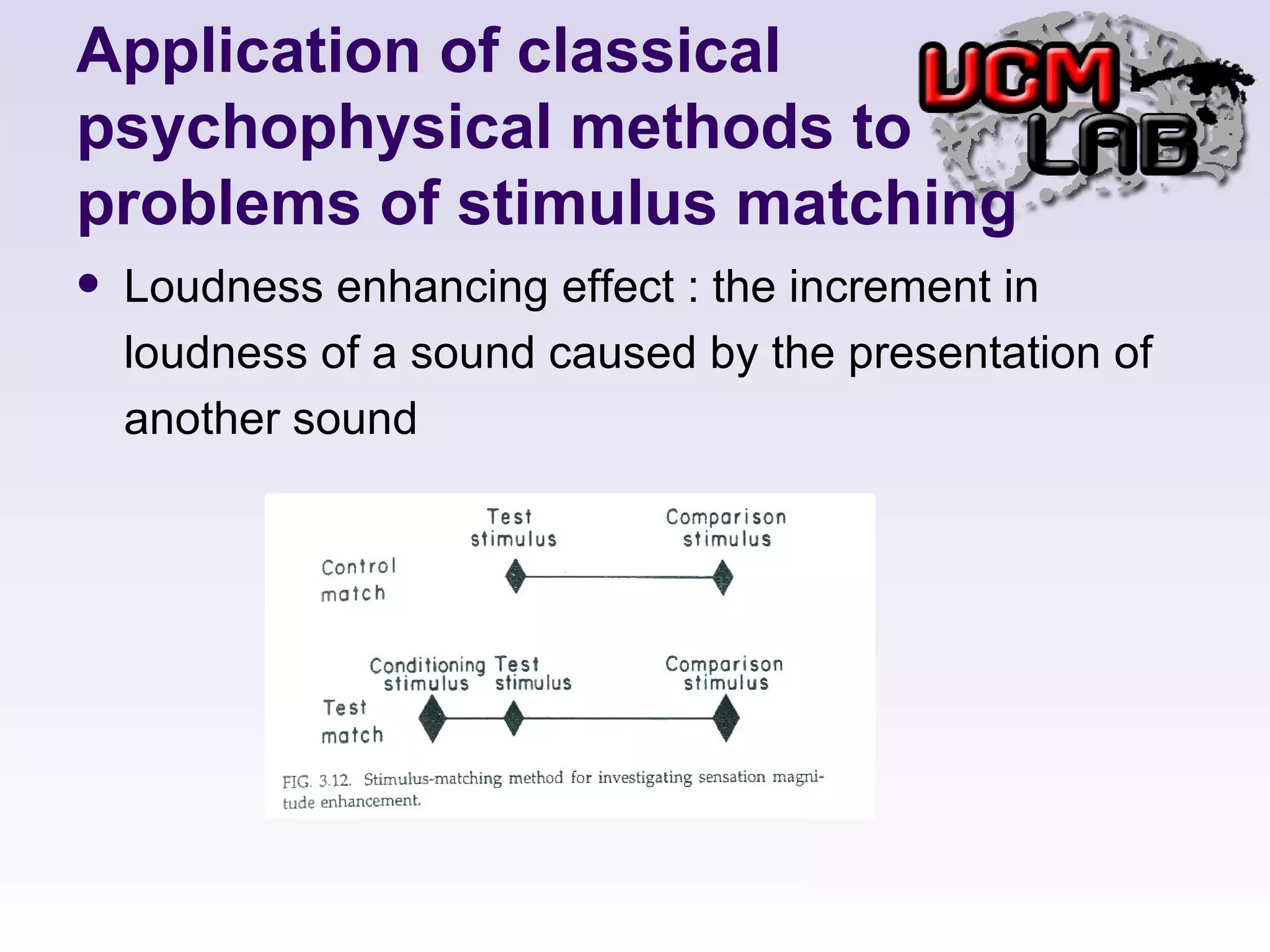
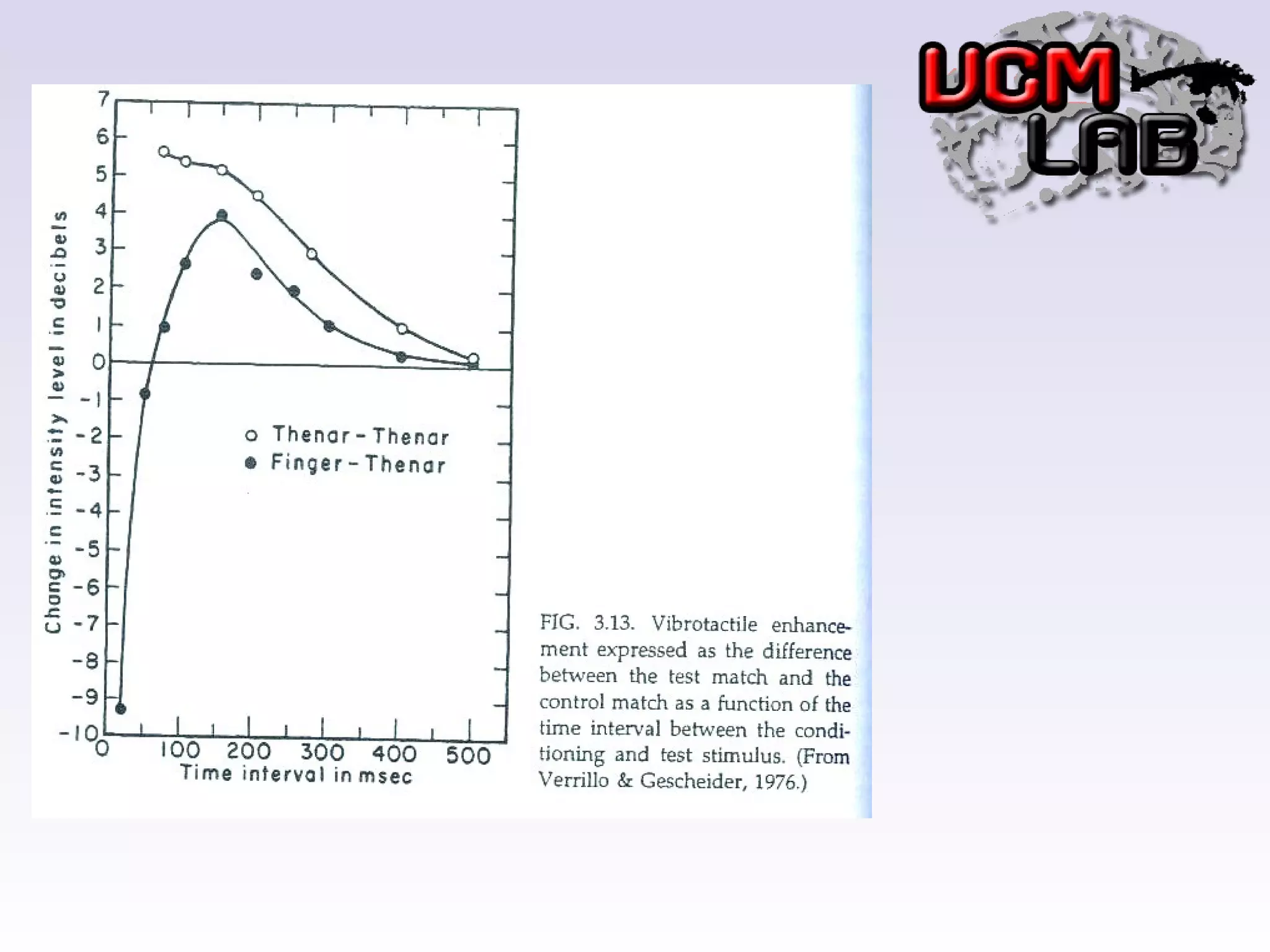
Application of classical psychophysical methods to problems of stimulus matching Loudness enhancing effect : the increment in loudness of a sound caused by the presentation of another sound
 
Conclusion Sensation is treated as a concept which must be defined in terms of stimulus-response relationships.
DETECTION THEORY CHAPTER 3

  • 1.
    The Classical PsychophysicalMethods CHAPTER 3, Detection Theory: A User’s Guide
  • 2.
    Outline Method ofconstant stimuli Absolute Thresholds Difference Thresholds Method of limits Absolute Thresholds Difference Thresholds Variation of the Method of Limits Method of adjustment Absolute Thresholds Difference Thresholds Application of classical psychophysical methods to problems of stimulus matching
  • 3.
    Introduction The thresholdhas been defined as the stimulus value which is perceptible in 50% of the trails. Three methods of threshold measurement:   1.Method of constant stimuli   2.Method of limits   3.Method of adjustment
  • 4.
    Method of constantstimuli - Absolute Thresholds Procedure: using the same set of stimuli(5~9 different values in the set) , each stimulus is present repeatedly, usually 100 times or more, but in a random order. The percentage of detections as a function of stimulus intensity, φ is determined. Yes or No response: the proportion( p ) of yes response is computed, and a graph called a psychometric function is constructed.
  • 5.
  • 6.
    Method of constantstimuli - Absolute Thresholds Absolute threshold: the stimulus intensity for which the proportion of trials resulting in yes response is 0.5 Ogive function : S-shaped, is a cumulative form of normal distribution. Fitting ogive function to threshold data range: z-score method of least squares
  • 7.
  • 8.
  • 9.
    Method of constantstimuli - Difference Thresholds Standard stimulus(St): fixed value Comparison stimulus(Co): the value is changed from trial to trial Space error Time error
  • 10.
  • 11.
    Method of constantstimuli - Difference Thresholds Point of subjective equality(PSE): The 0.5 point on the psychometric function , is perceived subjectively as equal to standard stimulus Constant error(CE) CE = PSE - St
  • 12.
    Method of constantstimuli - Difference Thresholds Upper difference threshold(DL u ) the stimulus range from PSE to the .75 point Lower difference threshold(DL l ) the stimulus range from PSE to the .25 point  DL = (Dl u + DL l) / 2 The method of least squares
  • 13.
    Method of limits - Absolute Thresholds Ascending series : begin with very weak subthreshold stimulus, then increased by a small amount until the observer report the presence of the sensation Descending series : the value of stimulus is decreased until the observer report the absence of the sensation Threshold : the average of the transition points
  • 14.
  • 15.
    Method of limits - Absolute Thresholds Error of habituation: the tendency for an observer to develop a habit of repeating the same response Error of expectation: an observer may falsely anticipate the arrival of the stimulus at his threshold and prematurely report that the change has occurred before it really has Minimize the errors:avoid using long trial series, vary the starting point
  • 16.
    Method of limits - Difference Thresholds Upper limen(L u ): the point on the physical dimension where “greater” response change to “equal” response Lower limen(L u ): the point where “less” response change to “equal” response Interval of uncertainty(IU): the range on the stimulus dimension over which an observer cannot perceive a difference between the Co and St
  • 17.
    Method of limits - Difference Thresholds IU = L u – L l DL =1/2 IU = ½(L u – L l ) PSE = ½(L u + L l ) Error of habituation Error of expectation Space error Time error
  • 18.
    Variation of theMethod of Limits Up-and-down/ staircase method (Cornsweet, 1962) - efficient - step size : must chosen with care Threshold tracking method (Bekesy, 1947) Forced choice method(Blackwell, 1953) - temporal-forced choice - spatial-forced choice - threshold: two correct responses in succession - response bias: the tendency to report the presence of subthreshold or absent stimuli
  • 19.
    Method of adjustment - Absolute Thresholds Procedure: set the stimulus intensity level either far below or far above threshold and ask the observer either to increase the intensity level until it is just perceptible or vice versa. Can prevent boredom Error of habituation Error of expectation
  • 20.
    Method of adjustment - Difference Thresholds Method of average error: the observer is instructed to adjust a Co until it seems equal to some St Mean of X = PSE CE = PSE – St Standard deviation: high degree of central tendency when discrimination is good
  • 21.
    Method of adjustment - Absolute Thresholds Shortcomings: - difficult to apply when stimulus are not continuously variable - difficult to apply when pairs of stimulus cannot be presented simultaneously - difficult to maintain constant conditions
  • 22.
    Application of classicalpsychophysical methods to problems of stimulus matching Equal sensation contour: a stimulus critical value function, in which absolute threshold is plotted against some property of stimulus
  • 23.
    Application of classicalpsychophysical methods to problems of stimulus matching Loudness enhancing effect : the increment in loudness of a sound caused by the presentation of another sound
  • 24.
  • 25.
    Conclusion Sensation istreated as a concept which must be defined in terms of stimulus-response relationships.