International Research Journal of Engineering and Technology (IRJET) e-ISSN: 2395-0056
Volume: 09 Issue: 01 | Jan 2022 www.irjet.net p-ISSN: 2395-0072
© 2022, IRJET | Impact Factor value: 7.529 | ISO 9001:2008 Certified Journal | Page 1442
DETECTING FAKE NEWS
Harshini1, Shalma Aishal Rodrigues2, Shivani Purushotham3, Sweekritha Jeevandas Hegde4,
Mrs.Geethalaxmi5
1-4Student, Dept. of Information Science and Engineering, CEC, Karnataka, India
5Asst. Professor, Dept. of Information Science and Engineering, CEC, Karnataka, India
---------------------------------------------------------------------***----------------------------------------------------------------------
Abstract - As a result of occurrence of different technologiesand media platforms, information has become more widely available.
The news gets spread to a great amount of people, resulting in increased use of internet media categories including LinkedIn,
Instagram, Meta, and others. Spreading bogus news has a numberofnegativeimplications.Phishersfrequentlyusenewsfeaturesto
their gain, suchas raising cash through click baits.False news is propagating at a rapid and increasingrate,owingtothegrowthof
social media and communications. Incorrect information discovery is a relatively new subject of study that has drawn a lot of
interest. We present a model that uses a passive aggressive method, term frequency – inverse document frequency (TF-IDF), and a
convolutional neural networkto detect bogus news in this paper (CNN). Detection of fake news is decided by the project'soutcome.
1. INTRODUCTION
Mobile technologies and social media are growing increasingly popular as a result of the voluntarily available information.
Mobile applications as well as user generated content like Meta and other social networking sites have supplanted in the
traditional media realm of information and news. Because of the speed and ease afforded by use of technological networks,
humans use social media to show their choices. As more facts or news become accessible, the question if the data collected is
accurate or not emerges. Machine learning approaches such as the passiveaggressivealgorithm,convolutional neural network
(CNN), and TF-IDF vectorized approach are used in fake news recognition system. We also supply a set of false and real news
information to help train the proposed algorithm. As fresh datasets are introduced,a MLmodel istaught,utilizedina cultureof
sustained improvement, as the methodology used is classified as an onlinelearningalgorithm.Asan outcome,algorithmwhich
we used is best to systems that get different information in a stream.
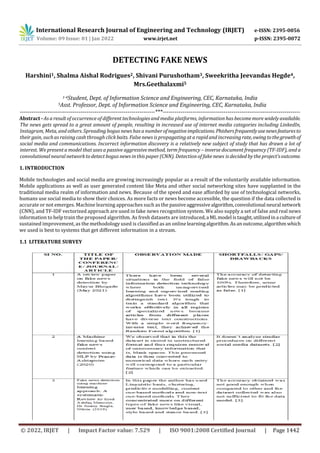
1.1 LITERATURE SURVEY
International Research Journal of Engineering and Technology (IRJET) e-ISSN: 2395-0056
Volume: 09 Issue: 01 | Jan 2022 www.irjet.net p-ISSN: 2395-0072
© 2022, IRJET | Impact Factor value: 7.529 | ISO 9001:2008 Certified Journal | Page 1443
2. PROPOSED SYSTEM
The main goal of this research is to see if the
information in a particular news item is correct. Our initial
goal will be to use the fake news dataset to trainthemachine
to spot incorrect news. The data will next be divided equally.
Once we've determined that the collection has an equal
quantity of real and bogus news, the data will be separated
into training and test sets. Then we employ Term Frequency
– Inverse Document Frequency (TF-IDF) to remove the stop
words.
TheTermFrequency– InverseDocumentFrequency
(TF-IDF) approach determines which words are used the
most & less frequently in a document. It also use the term
Count Vectorizer, which breaks the string into tokens that
can be leveraged for a number of calculations later. After
stripping away the stop words, we'll train and test the fake
news detection model byusingPassiveAggressiveapproach.
Figure 1.Block diagram of detecting fake news
The Passive Aggressive Classifier is an online learning
algorithm technique that reacts passively to correct
classifications while aggressively reacting to erroneous
classifications.
The user can give information in either image / text
format during the testing phase. If the input is an image, the
image is processed using a CNN (Convolutional Neural
Network) that specializes at processing data with a grid-like
structure, like images. After the inputs have indeed been
processed, a passive aggressivealgorithmisappliedtoassess
yet if the information is bogus or true.
3. CONCLUSIONS
News stories must be explicitly categorized and we
require a great understanding and mastered in identifying
oddities. Since it takes a while to verify news so we have
opted this project using ML models and a set of methods.
It is important for having accessibility to inaccurate
news, or weshouldknow that whatever society tells usisnot
always accurate. As a result, we need to be carefully. This is
how we can guide people to have more knowledge so that
they will not get convinced to believe in false data.
REFERENCES
[1] Mayur Bhogade, Bhushan Deore, Abhishek Sharma,
Omkar Sonawane and Prof. Manisha Singh proposed a
Review Paper on Fake News Detection.
[2] Pranav Ashtaputre, Ashutosh Nawale and Rohit Pandit
proposed A Machine LearningBasedFakeNewsContent
Detection Using NLP.
[3] Syed Ashfaq Manzoor, Dr Jimmy Singla, Nikitaproposed
Fake news detection using machine learning approach:
A systematic Review.
International Research Journal of Engineering and Technology (IRJET) e-ISSN: 2395-0056
Volume: 09 Issue: 01 | Jan 2022 www.irjet.net p-ISSN: 2395-0072
© 2022, IRJET | Impact Factor value: 7.529 | ISO 9001:2008 Certified Journal | Page 1444
[4] Muhammad Syahmi Mokhtar, YusmadiYahJusoh,Novia
Admodisastro, Noraini Che Pa and Amru Yusrin
Amruddin proposed Fakebuster: Fake News Detection
System Using Logistic Regression TechniqueinMachine
Learning.
[5] Akshay Jain and Amey Kasbe proposed by Fake News
Detection.

DETECTING FAKE NEWS

  • 1.
    International Research Journalof Engineering and Technology (IRJET) e-ISSN: 2395-0056 Volume: 09 Issue: 01 | Jan 2022 www.irjet.net p-ISSN: 2395-0072 © 2022, IRJET | Impact Factor value: 7.529 | ISO 9001:2008 Certified Journal | Page 1442 DETECTING FAKE NEWS Harshini1, Shalma Aishal Rodrigues2, Shivani Purushotham3, Sweekritha Jeevandas Hegde4, Mrs.Geethalaxmi5 1-4Student, Dept. of Information Science and Engineering, CEC, Karnataka, India 5Asst. Professor, Dept. of Information Science and Engineering, CEC, Karnataka, India ---------------------------------------------------------------------***---------------------------------------------------------------------- Abstract - As a result of occurrence of different technologiesand media platforms, information has become more widely available. The news gets spread to a great amount of people, resulting in increased use of internet media categories including LinkedIn, Instagram, Meta, and others. Spreading bogus news has a numberofnegativeimplications.Phishersfrequentlyusenewsfeaturesto their gain, suchas raising cash through click baits.False news is propagating at a rapid and increasingrate,owingtothegrowthof social media and communications. Incorrect information discovery is a relatively new subject of study that has drawn a lot of interest. We present a model that uses a passive aggressive method, term frequency – inverse document frequency (TF-IDF), and a convolutional neural networkto detect bogus news in this paper (CNN). Detection of fake news is decided by the project'soutcome. 1. INTRODUCTION Mobile technologies and social media are growing increasingly popular as a result of the voluntarily available information. Mobile applications as well as user generated content like Meta and other social networking sites have supplanted in the traditional media realm of information and news. Because of the speed and ease afforded by use of technological networks, humans use social media to show their choices. As more facts or news become accessible, the question if the data collected is accurate or not emerges. Machine learning approaches such as the passiveaggressivealgorithm,convolutional neural network (CNN), and TF-IDF vectorized approach are used in fake news recognition system. We also supply a set of false and real news information to help train the proposed algorithm. As fresh datasets are introduced,a MLmodel istaught,utilizedina cultureof sustained improvement, as the methodology used is classified as an onlinelearningalgorithm.Asan outcome,algorithmwhich we used is best to systems that get different information in a stream. 1.1 LITERATURE SURVEY
  • 2.
    International Research Journalof Engineering and Technology (IRJET) e-ISSN: 2395-0056 Volume: 09 Issue: 01 | Jan 2022 www.irjet.net p-ISSN: 2395-0072 © 2022, IRJET | Impact Factor value: 7.529 | ISO 9001:2008 Certified Journal | Page 1443 2. PROPOSED SYSTEM The main goal of this research is to see if the information in a particular news item is correct. Our initial goal will be to use the fake news dataset to trainthemachine to spot incorrect news. The data will next be divided equally. Once we've determined that the collection has an equal quantity of real and bogus news, the data will be separated into training and test sets. Then we employ Term Frequency – Inverse Document Frequency (TF-IDF) to remove the stop words. TheTermFrequency– InverseDocumentFrequency (TF-IDF) approach determines which words are used the most & less frequently in a document. It also use the term Count Vectorizer, which breaks the string into tokens that can be leveraged for a number of calculations later. After stripping away the stop words, we'll train and test the fake news detection model byusingPassiveAggressiveapproach. Figure 1.Block diagram of detecting fake news The Passive Aggressive Classifier is an online learning algorithm technique that reacts passively to correct classifications while aggressively reacting to erroneous classifications. The user can give information in either image / text format during the testing phase. If the input is an image, the image is processed using a CNN (Convolutional Neural Network) that specializes at processing data with a grid-like structure, like images. After the inputs have indeed been processed, a passive aggressivealgorithmisappliedtoassess yet if the information is bogus or true. 3. CONCLUSIONS News stories must be explicitly categorized and we require a great understanding and mastered in identifying oddities. Since it takes a while to verify news so we have opted this project using ML models and a set of methods. It is important for having accessibility to inaccurate news, or weshouldknow that whatever society tells usisnot always accurate. As a result, we need to be carefully. This is how we can guide people to have more knowledge so that they will not get convinced to believe in false data. REFERENCES [1] Mayur Bhogade, Bhushan Deore, Abhishek Sharma, Omkar Sonawane and Prof. Manisha Singh proposed a Review Paper on Fake News Detection. [2] Pranav Ashtaputre, Ashutosh Nawale and Rohit Pandit proposed A Machine LearningBasedFakeNewsContent Detection Using NLP. [3] Syed Ashfaq Manzoor, Dr Jimmy Singla, Nikitaproposed Fake news detection using machine learning approach: A systematic Review.
  • 3.
    International Research Journalof Engineering and Technology (IRJET) e-ISSN: 2395-0056 Volume: 09 Issue: 01 | Jan 2022 www.irjet.net p-ISSN: 2395-0072 © 2022, IRJET | Impact Factor value: 7.529 | ISO 9001:2008 Certified Journal | Page 1444 [4] Muhammad Syahmi Mokhtar, YusmadiYahJusoh,Novia Admodisastro, Noraini Che Pa and Amru Yusrin Amruddin proposed Fakebuster: Fake News Detection System Using Logistic Regression TechniqueinMachine Learning. [5] Akshay Jain and Amey Kasbe proposed by Fake News Detection.