International Research Journal of Engineering and Technology (IRJET) e-ISSN: 2395-0056
Volume: 06 Issue: 11 | Nov 2019 www.irjet.net p-ISSN: 2395-0072
© 2019, IRJET | Impact Factor value: 7.34 | ISO 9001:2008 Certified Journal | Page 1949
SKIN DISEASE DETECTION USING NEURAL NETWORK
Janak Sawale1, Saloni Jadhav2, Poonam Gaikwad3, Prof. Ashok Kalal4
1,2,3B.E Student, Dept. of Information Technology, Anantrao Pawar College of Engineering and Research,
Pune, Maharashtra, India
4Professor (Internal Guide), Dept. of Information Technology, Anantrao Pawar College of Engineering and
Research, Pune, Maharashtra, India
---------------------------------------------------------------------***----------------------------------------------------------------------
Abstract - This paper proposed an intelligent system to
detect skin diseases using neural network. The system have
two main parts. In the first part the features are extracted
from the image using feature extraction method and in the
second part the image is feed to the pre-trained neural
network for the detection of skin disease. The TensorFlow
library is used for the neural network.
Key Words: Skin disease, Neural network, Feature
extraction, TensorFlow, Intelligent.
1. INTRODUCTION
Skin is the largest organ in the human body. According to
National Geographic a human adult has an average of 22
square feet of skin. That’s a bit larger than the entirety of a
standard door frame. In addition (maybe even
consequently) skin-based diseases are some of the most
common in the human population. Because of this,
dermatologists recommend that people see a certified
dermatologist annually for a full-body check-up and if they
notice any unusual growths or moles on their skin. But
booking an appointment with a dermatologist can be a
really frustrating process. Many dermatologists are
booked for weeks, some maybe even months. And on top
of that, some hospitals require a referral from a primary
care physician. That’s even more waiting! Currently, there
are apps that try to let people skip that wait time by
implementing telemedicine solutions in which they ask
users for a couple of images of their condition, and then
send those images to a dermatologist who reviews them
and provides professional advice. But as more people use
the apps, we run into the same problem we had in
traditional healthcare. There just aren’t enough
dermatologists to meet demand. Even with telemedicine
apps, responses will soon either take more time to get or
become more expensive to buy.
To address this, system propose using the latest computer
vision and artificial intelligence techniques to build an app
that not only detects different types of skin diseases, but
also provides related disease information within minutes
and at a low cost. All you need to do is take a picture with
your phone!
1.1 DATA COLLECTION AND LABELLING:
Skin diseases vary a lot between individuals, so diagnosis is
challenging and requires a variety of visual clues such as
lesion morphology, scaling, body site distribution, etc. It’s
hard to train a dermatologist. It’s even harder to train a
machine to recognize different types of skin diseases with
high accuracy. Dermatologists use a variety of magnifying
instruments to identify possible bad blemishes, so does
deep learning models. We need large amount of high
resolution data labelled with accurate ground truth
bounding boxes for a model to learn pixel by pixel. In
addition, skin disease images usually come with a lot of
noise such as different skin colors, skin areas, and even
skin hair (you don’t want hair to be detected as rashes
because of similar distribution). Therefore, being able to
exclude noise and find true disease features is also what a
model needs to accomplish.
1.2 DEEP LEARNING MODELS:
Models are the most crucial and exciting part when
developing an AI application. Now let’s take a look at the
model we will be implementing using TensorFlow
framework: ResNet.
Deep convolutional neural networks detect objects by
learning features. Theoretically, adding more layers to a
CNN enables it to learn more features and achieve higher
accuracies; however, it is not such an ideal case in reality.
It has come to be acknowledged that training accuracies
tend to reach saturation and are then followed by a rapid
degradation when adding more layers. ResNet (short for
deep residual networks) makes it possible to train very
deep neural networks without losing accuracy as a
tradeoff. The Deep convolutional neural networks detect
objects by learning features. Theoretically, adding more
layers to a CNN enables it to learn more features and
achieve higher accuracies; however, it is not such an ideal
case in reality. It has come to be acknowledged that
training accuracies tend to reach saturation and are then
followed by a rapid degradation when adding more layers.
ResNet (short for deep residual networks) makes it
possible to train very deep neural networks without losing
accuracy as a tradeoff. The residual network is
characterized by a shortcut connection[8], instead of going
from layer to layer in normal cases, two layers (two layers
shown in graph, but can be one or more than one layer)
International Research Journal of Engineering and Technology (IRJET) e-ISSN: 2395-0056
Volume: 06 Issue: 11 | Nov 2019 www.irjet.net p-ISSN: 2395-0072
© 2019, IRJET | Impact Factor value: 7.34 | ISO 9001:2008 Certified Journal | Page 1950
are skipped to perform identity mapping, which means
outputs from n-2 layer are directly added to the outputs of
current layer n. Such skip connection makes learning
accuracy degradation evitable since even if the skipped
connections don’t achieve anything in learning, the output
accuracy from current layer is maintained by the identity
mapping from previous n-2 layer. ResNet has been
reported to achieve improved accuracy on datasets such
as ImageNet and COCO^3, therefore it’s a proper network
to implement on our skin disease dataset for which very
deep neural network is needed.
2. SYSTEM ARCHITECTURE
Fig -1: System architecture
The above image shows system flow. The image will be
capture using smartphone and uploaded on the
TensorFlow. The features of the image will be extracted.
The features will be the input for the neural network. Here
system is using the ResNet which is makes possible to
trained deep neural network without losing the accuracy.
The testing and validation is done. The knowledge graph is
build. This graph will not only contain metadata about each
disease, but it will also contain information about the
relationships between them.
3. IMPELMENTATION
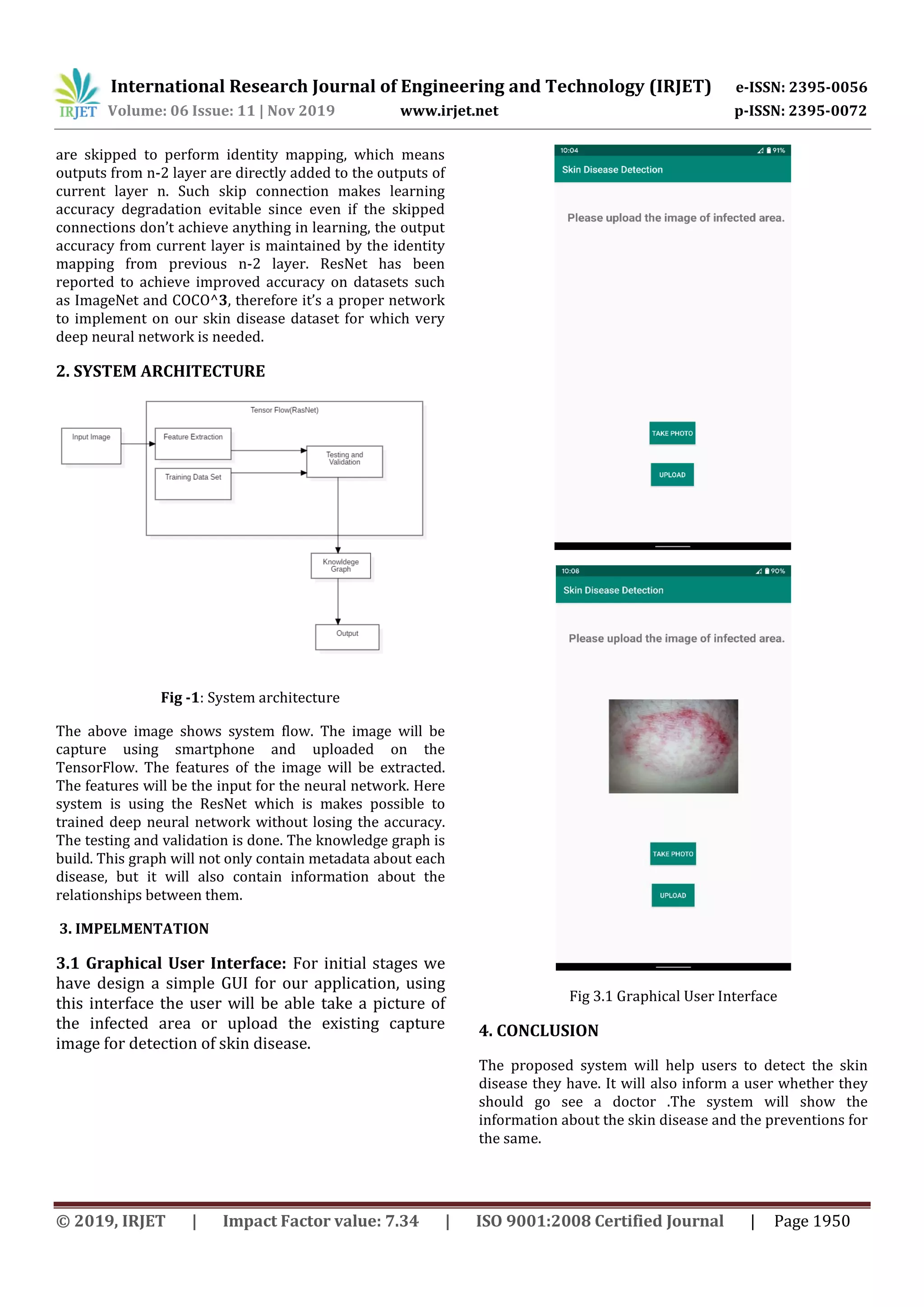
3.1 Graphical User Interface: For initial stages we
have design a simple GUI for our application, using
this interface the user will be able take a picture of
the infected area or upload the existing capture
image for detection of skin disease.
Fig 3.1 Graphical User Interface
4. CONCLUSION
The proposed system will help users to detect the skin
disease they have. It will also inform a user whether they
should go see a doctor .The system will show the
information about the skin disease and the preventions for
the same.
International Research Journal of Engineering and Technology (IRJET) e-ISSN: 2395-0056
Volume: 06 Issue: 11 | Nov 2019 www.irjet.net p-ISSN: 2395-0072
© 2019, IRJET | Impact Factor value: 7.34 | ISO 9001:2008 Certified Journal | Page 1951
REFERENCES
[1] AmirrezaMahbod, Gerald Schaefer, Chunliang
Wang, Rupert Ecker, Isabella Ellinger “Skin Lesion
Classification Using Hybrid Deep Neural
Networks” IEEE, ISSN: 978-1-5386-4658-8, 2019.
[2] ZHE WU, SHUANG ZHAO, YONGHONG PENG,
XIAOYU HE, XINYU ZHAO,KAI HUANG “Studies on
Different CNN Algorithms for Face Skin Disease
Classification Based on Clinical Images”
,IEEE,ISSN-2169-3536,2019.
[3] Nils Gessert, ThiloSentker, Frederic Madesta,
Rudiger Schmitz, Helge Kniep, Ivo Baltruschat,
Rene Werner, Alexander Schlaefer “Skin Lesion
Classification Using CNNs with Patch-Based
Attention and Diagnosis-Guided Loss
Weighting”,2019.
[4] Muhammad Attique Khan, Muhammad
YounusJaved, Muhammad Sharif, Tanzila Saba
“Multi-Model Deep Neural Network based
Features Extraction and Optimal Selection
Approach for Skin Lesion Classification”, IEEE,
ISSN-978-1-5386-8125-1,2019.
[5] Timothy James McBride, NabeelVandayar,
Kenneth John Nixon “Comparison of Skin
Detection Algorithms for Hand Gesture
Recognition”, IEEE, ISSN-978-1-7281-0369-3,
2019.
[6] SerbanRadu Stefan Jianu, Loretta Ichim, Dan
Popescu, Stefan S. Nicolau “Automatic Diagnosis
of Skin Cancer Using Neural Networks”, IEEE,
ISSN-978-1-7281-0101-9, 2019.
[7] Tammineni Sreelatha, M. V. Subramanyam, M. N.
Giri Prasad “Early Detection of Skin Cancer Using
Melanoma Segmentation technique”, Springer,
2019.

IRJET- Skin Disease Detection using Neural Network

  • 1.
    International Research Journalof Engineering and Technology (IRJET) e-ISSN: 2395-0056 Volume: 06 Issue: 11 | Nov 2019 www.irjet.net p-ISSN: 2395-0072 © 2019, IRJET | Impact Factor value: 7.34 | ISO 9001:2008 Certified Journal | Page 1949 SKIN DISEASE DETECTION USING NEURAL NETWORK Janak Sawale1, Saloni Jadhav2, Poonam Gaikwad3, Prof. Ashok Kalal4 1,2,3B.E Student, Dept. of Information Technology, Anantrao Pawar College of Engineering and Research, Pune, Maharashtra, India 4Professor (Internal Guide), Dept. of Information Technology, Anantrao Pawar College of Engineering and Research, Pune, Maharashtra, India ---------------------------------------------------------------------***---------------------------------------------------------------------- Abstract - This paper proposed an intelligent system to detect skin diseases using neural network. The system have two main parts. In the first part the features are extracted from the image using feature extraction method and in the second part the image is feed to the pre-trained neural network for the detection of skin disease. The TensorFlow library is used for the neural network. Key Words: Skin disease, Neural network, Feature extraction, TensorFlow, Intelligent. 1. INTRODUCTION Skin is the largest organ in the human body. According to National Geographic a human adult has an average of 22 square feet of skin. That’s a bit larger than the entirety of a standard door frame. In addition (maybe even consequently) skin-based diseases are some of the most common in the human population. Because of this, dermatologists recommend that people see a certified dermatologist annually for a full-body check-up and if they notice any unusual growths or moles on their skin. But booking an appointment with a dermatologist can be a really frustrating process. Many dermatologists are booked for weeks, some maybe even months. And on top of that, some hospitals require a referral from a primary care physician. That’s even more waiting! Currently, there are apps that try to let people skip that wait time by implementing telemedicine solutions in which they ask users for a couple of images of their condition, and then send those images to a dermatologist who reviews them and provides professional advice. But as more people use the apps, we run into the same problem we had in traditional healthcare. There just aren’t enough dermatologists to meet demand. Even with telemedicine apps, responses will soon either take more time to get or become more expensive to buy. To address this, system propose using the latest computer vision and artificial intelligence techniques to build an app that not only detects different types of skin diseases, but also provides related disease information within minutes and at a low cost. All you need to do is take a picture with your phone! 1.1 DATA COLLECTION AND LABELLING: Skin diseases vary a lot between individuals, so diagnosis is challenging and requires a variety of visual clues such as lesion morphology, scaling, body site distribution, etc. It’s hard to train a dermatologist. It’s even harder to train a machine to recognize different types of skin diseases with high accuracy. Dermatologists use a variety of magnifying instruments to identify possible bad blemishes, so does deep learning models. We need large amount of high resolution data labelled with accurate ground truth bounding boxes for a model to learn pixel by pixel. In addition, skin disease images usually come with a lot of noise such as different skin colors, skin areas, and even skin hair (you don’t want hair to be detected as rashes because of similar distribution). Therefore, being able to exclude noise and find true disease features is also what a model needs to accomplish. 1.2 DEEP LEARNING MODELS: Models are the most crucial and exciting part when developing an AI application. Now let’s take a look at the model we will be implementing using TensorFlow framework: ResNet. Deep convolutional neural networks detect objects by learning features. Theoretically, adding more layers to a CNN enables it to learn more features and achieve higher accuracies; however, it is not such an ideal case in reality. It has come to be acknowledged that training accuracies tend to reach saturation and are then followed by a rapid degradation when adding more layers. ResNet (short for deep residual networks) makes it possible to train very deep neural networks without losing accuracy as a tradeoff. The Deep convolutional neural networks detect objects by learning features. Theoretically, adding more layers to a CNN enables it to learn more features and achieve higher accuracies; however, it is not such an ideal case in reality. It has come to be acknowledged that training accuracies tend to reach saturation and are then followed by a rapid degradation when adding more layers. ResNet (short for deep residual networks) makes it possible to train very deep neural networks without losing accuracy as a tradeoff. The residual network is characterized by a shortcut connection[8], instead of going from layer to layer in normal cases, two layers (two layers shown in graph, but can be one or more than one layer)
  • 2.
    International Research Journalof Engineering and Technology (IRJET) e-ISSN: 2395-0056 Volume: 06 Issue: 11 | Nov 2019 www.irjet.net p-ISSN: 2395-0072 © 2019, IRJET | Impact Factor value: 7.34 | ISO 9001:2008 Certified Journal | Page 1950 are skipped to perform identity mapping, which means outputs from n-2 layer are directly added to the outputs of current layer n. Such skip connection makes learning accuracy degradation evitable since even if the skipped connections don’t achieve anything in learning, the output accuracy from current layer is maintained by the identity mapping from previous n-2 layer. ResNet has been reported to achieve improved accuracy on datasets such as ImageNet and COCO^3, therefore it’s a proper network to implement on our skin disease dataset for which very deep neural network is needed. 2. SYSTEM ARCHITECTURE Fig -1: System architecture The above image shows system flow. The image will be capture using smartphone and uploaded on the TensorFlow. The features of the image will be extracted. The features will be the input for the neural network. Here system is using the ResNet which is makes possible to trained deep neural network without losing the accuracy. The testing and validation is done. The knowledge graph is build. This graph will not only contain metadata about each disease, but it will also contain information about the relationships between them. 3. IMPELMENTATION 3.1 Graphical User Interface: For initial stages we have design a simple GUI for our application, using this interface the user will be able take a picture of the infected area or upload the existing capture image for detection of skin disease. Fig 3.1 Graphical User Interface 4. CONCLUSION The proposed system will help users to detect the skin disease they have. It will also inform a user whether they should go see a doctor .The system will show the information about the skin disease and the preventions for the same.
  • 3.
    International Research Journalof Engineering and Technology (IRJET) e-ISSN: 2395-0056 Volume: 06 Issue: 11 | Nov 2019 www.irjet.net p-ISSN: 2395-0072 © 2019, IRJET | Impact Factor value: 7.34 | ISO 9001:2008 Certified Journal | Page 1951 REFERENCES [1] AmirrezaMahbod, Gerald Schaefer, Chunliang Wang, Rupert Ecker, Isabella Ellinger “Skin Lesion Classification Using Hybrid Deep Neural Networks” IEEE, ISSN: 978-1-5386-4658-8, 2019. [2] ZHE WU, SHUANG ZHAO, YONGHONG PENG, XIAOYU HE, XINYU ZHAO,KAI HUANG “Studies on Different CNN Algorithms for Face Skin Disease Classification Based on Clinical Images” ,IEEE,ISSN-2169-3536,2019. [3] Nils Gessert, ThiloSentker, Frederic Madesta, Rudiger Schmitz, Helge Kniep, Ivo Baltruschat, Rene Werner, Alexander Schlaefer “Skin Lesion Classification Using CNNs with Patch-Based Attention and Diagnosis-Guided Loss Weighting”,2019. [4] Muhammad Attique Khan, Muhammad YounusJaved, Muhammad Sharif, Tanzila Saba “Multi-Model Deep Neural Network based Features Extraction and Optimal Selection Approach for Skin Lesion Classification”, IEEE, ISSN-978-1-5386-8125-1,2019. [5] Timothy James McBride, NabeelVandayar, Kenneth John Nixon “Comparison of Skin Detection Algorithms for Hand Gesture Recognition”, IEEE, ISSN-978-1-7281-0369-3, 2019. [6] SerbanRadu Stefan Jianu, Loretta Ichim, Dan Popescu, Stefan S. Nicolau “Automatic Diagnosis of Skin Cancer Using Neural Networks”, IEEE, ISSN-978-1-7281-0101-9, 2019. [7] Tammineni Sreelatha, M. V. Subramanyam, M. N. Giri Prasad “Early Detection of Skin Cancer Using Melanoma Segmentation technique”, Springer, 2019.