International Research Journal of Engineering and Technology (IRJET) e-ISSN: 2395-0056
Volume: 09 Issue: 06 | Jun 2022 www.irjet.net p-ISSN: 2395-0072
© 2022, IRJET | Impact Factor value: 7.529 | ISO 9001:2008 Certified Journal | Page 2033
Human Activity Recognition System
Disha Amit Nakhare 1, Palak Shah 1, Harsh Chetan Faganiya 1, Prof Uttara Bhatt2
1 Undergraduate Students, Department of EXTC,Thadomal Shahani Engineering College, Mumbai, India
2. Assistant Professor, Department of EXTC,Thadomal Shahani Engineering College, Mumbai, India
---------------------------------------------------------------------***---------------------------------------------------------------------
Abstract - Human activity recognition is a capability to
interpret natural body gesture or movement via detectors
and arbitrate natural exercise or action. Utmost of the
human day-to-day chores can be streamlined or automated
if they can be recognized via HAR system. Generally, HAR
system can be additionally supervised or unsupervised. A
supervised HAR system needed some previous training with
constant datasets while unsupervised HAR network is being
configured ground rules during development. HAR is
accounted as an important element in varied scientific
exploration surrounds i.e., supervision, healthcare and
human computer interaction (HCI). This paper will present
you an elaborate depiction and comparison of the styles,
namely CNN and RNN, that can be applied to develop a
Human Activity Recognition System.
Key Words: Human activity recognition,
Convolutional Neural Network, Long Short-Term
Memory, Datasets, Neural Network.
1. INTRODUCTION
Human Activity Recognition (HAR) is one of the active
exploration fields in computer vision as well as human
computer relation. Still, it remains a really complicated
assignment, due to unresolvable difficulties similar as
detector movement, detector placement, cluttered
background, and essential variability in the method
activities are carried on by distinguishable human. The
most generally engaged sensing technologies in HAR
system regardless of the computational models or
category algorithms are anatomized. The pros and cons of
each sensing technology have been bandied. This paper is
wrapped up with some complaints for the most
sophisticated sensing technologies.
Research suggests that the physical activities led by
people can affect them physically, mentally, socially and
cognitively. A sedentary lifestyle can lead to a number of
diseases, including but not limited to several forms of
cancer, diabetes, hypertension, coronary and
cerebrovascular diseases, and obesity etc. Similarly,
research establishes a correlation between the amount of
physical activity undertaken and mental wellbeing. With
13 percent of the total globe disease burden accounting to
mental health, depression is predicted to be the leading
cause for it by 2030. That can be countered with exercise
as research suggests that exercise does improve the
mental health of people affected by the disease. The
diagnosis is pretty clear at this point but Ell now the
means with which psychiatrists and medical practitioners
could treat and monitor patients was not ideal. Their
diagnosis would mostly depend on the patient’s detailed
insights into themselves. With a short and limited contact
Time with each patient, there is a huge deficit in the data
that must be needed by the medical practitioner for a solid
diagnosis. That vacuum can be filled with data collected
from smart watches or phones of people if it can be
accurately translated to useful bits. The ease of
accessibility makes digital phenotyping a very plausible
global diagnosis system. With almost everyone already
owning a smart phone, no additional device needs to be
bought for diagnosis, thus producing nearly no additional
costs to anyone.
2. LITERATURE REVIEW
Many scientists have always been interested in human
activity recognition research. The development of a
machine learning algorithm capable of identifying
complicated human physical activity in real-world
situations is still ongoing. There are several types of
sensors that can be used utilized to identify the activity of
humans Accelerometers are widely utilized since they
come with a variety of functions which aid in the
classification of activity
Researchers in [1] employed a smartphone's
accelerometer to identify data instead of wearable sensors
physical activity utilizing a machine learning method
known as support vector machine and tracking it in real
time. Time is a real person who uses an Android phone
(OS). The accelerometer, gyroscope, and GPS data. The
linearity of accelerometer sensors was accelerometer
sensors was collected and pre-processed.
Researchers in [2] attempted to create a multi-layer
parallel LSTM RNN model that could classify objects u sing
smartphone sensor data to calculate human activity. Their
studies yielded better outcomes than expected traditional
machine learning approaches, as well as the outcomes
provided by CNNs in general. Their LSTM model had a 94
percent accuracy rate. However, they discovered that
LSTM RNNs were far less effective computationally more
difficult than CNNs the network's computational
complexity reduce with the number of LSTM units running
concurrently. It was deduced from this that increasing the
number of neurons in a parallel LSTM unit improved the
International Research Journal of Engineering and Technology (IRJET) e-ISSN: 2395-0056
Volume: 09 Issue: 06 | Jun 2022 www.irjet.net p-ISSN: 2395-0072
© 2022, IRJET | Impact Factor value: 7.529 | ISO 9001:2008 Certified Journal | Page 2034
network's performance marginally. The performance of
the LSTM was improved by adding neurons to a parallel
LSTM unit.
3. NEURAL NETWORKS
A neural network is a set of algorithms that aims to
recognize underlying relationships in a batch of data using
a method that replicates how the human brain works. In
this context, neural networks refer to natural or artificial
systems of neurons. They can discover hidden patterns
and correlations in raw data using algorithms, cluster and
categorize it, and learn and improve it over time.
3.1 Convolutional Neural Network
Convolutional Neural Networks are a type of neural
network that is commonly used to recognize images. Its
features such as the use of local receptive fields to identify
specific aspects or features within the image input into it,
which may subsequently be used to distinguish it from a
set of similar images [6]. The pooling layer, non-linearity
layer, convolutional layer, and fully - connected layers are
all layers of a CNN. Convolution is a mathematical equation
in which two components are merged to create a third
function. The sensors used in our smart phones for
measuring movement of the body is called Accelerometer
and the one used to detect orientation is called Gyrometer.
Their output, which is a time-series data set will be fed to
the 1D CNN model. This model can map to different types
of inputs and no manual input featuring is required.
3.2 Long Short-Term Memory
Out of the two RNN models, namely GRU which stands for
Gated Recurrent Unit and LSTM we chose LSTM because it
provides a higher accuracy and faster learning rate [4].
This too needs no manual input feeding system and is
therefore, a good model to implement. LSTM networks are
effortlessly served long data sequences to categorizing,
reprocessing and fabricating prognostications predicated
on time series data, since there can be lags of unknown
time between vital episodes in a time series. LSTMs were
evolved to deal with the vanishing gradient problem that
can be faced when training conventional RNNs.
4. COMPARISON BETWEEN CCN AND LSTM
NEURAL NETWORK
Convolutional Neural
Network
Long Short-Term Memory
Consists of various
layers that help in the
processing of data and
spatial correlation
Consists of various gates that
help in making predictions
about the data
Shows average
performance with large
datasets
Useful for processing large
datasets
Does not retain data
memory
Retains previous data unit
5. SOFTWARE USED IN HUMAN ACTIVITY
RECOGNITION SYSTEM
Different supervised, semi-supervised and unsupervised
algorithms can be used to solve the problem of real-time
recognition. Different algorithms had proved themselves
useful in different applications, which is why there is no
clear distinction on which algorithm is more appropriate
than others.
5.1 Machine Learning Algorithms
Based on the Supervised Learning technique, this is one of
the simplest Machine Learning algorithms. The K-NN
algorithm assumes that the new case/data and preexisting
cases are comparable and places the new case in the
category that is most similar to the existing categories.
The K-NN technique stores all available data and
classifies a new data point based on its similarity to the
existing data. This means that as fresh data is generated,
the K-NN algorithm can quickly classify it into a suitable
category [3]. The K-NN algorithm can be used for both
regression and classification, but it is primarily employed
for classification problems. The K-NN algorithm is a quasi-
algorithm, which means it makes no assumptions
regarding data. It's also known as a slow learner.
5.2 Support Vector or SVM
This is one of the most widely used Supervised Machine
learning for Classification and Regression issues. However,
it is mostly employed in Machine Learning for
Categorization difficulties. The purpose of the SVM method
is to find the optimum line or decision boundary for
dividing n-dimensional space into classes so that
additional data points can be readily placed in the correct
category in the future.
5.3 Random Forest
This is a machine learning strategy used to address
regression and classification problems. It employs
ensemble learning, a technique that combines numerous
classifiers to find solutions to complex problems. A
random forest algorithm is made up of a lot of decision
trees. The random forest algorithm's 'forest' is trained via
bagging. Bagging is a meta-algorithm for improving the
accuracy of machine learning systems.
International Research Journal of Engineering and Technology (IRJET) e-ISSN: 2395-0056
Volume: 09 Issue: 06 | Jun 2022 www.irjet.net p-ISSN: 2395-0072
© 2022, IRJET | Impact Factor value: 7.529 | ISO 9001:2008 Certified Journal | Page 2035
Based on the predictions of the decision trees, the
(random forest) algorithm determines the outcome. It
forecasts by averaging or averaging the output from
various trees. Increasing the number of trees improves the
outcome's precision. It lowers the likelihood of
overfitting.
6. OUTPUT FOR CCN AND LSTM
The programming code for this project was written in
Python using the Spyder IDE. A sequential model was
used for the implementation, which allows for the building
of a model and then the addition of layers later. It
simplifies the process of creating deep learning models.
The model was created with a 3.0 GHz Hexa-Core AMD
Ryzen CPU and 16 GB 3200 MHz LPDDR3 RAM on the
online Kaggle platform IDE. The model was trained for 42
epochs with a batch size of 32. The data is first tested on
the Sphere Dataset and then validated by the Validation
Dataset called the WISDM Dataset.
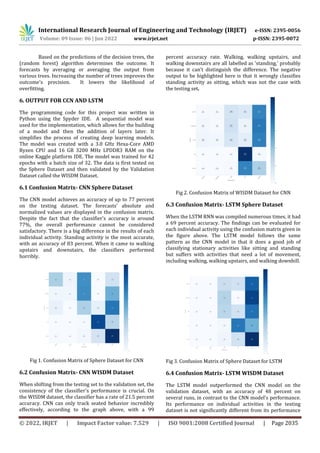
6.1 Confusion Matrix- CNN Sphere Dataset
The CNN model achieves an accuracy of up to 77 percent
on the testing dataset. The forecasts' absolute and
normalized values are displayed in the confusion matrix.
Despite the fact that the classifier's accuracy is around
77%, the overall performance cannot be considered
satisfactory. There is a big difference in the results of each
individual activity. Standing activity is the most accurate,
with an accuracy of 83 percent. When it came to walking
upstairs and downstairs, the classifiers performed
horribly.
Fig 1. Confusion Matrix of Sphere Dataset for CNN
6.2 Confusion Matrix- CNN WISDM Dataset
When shifting from the testing set to the validation set, the
consistency of the classifier's performance is crucial. On
the WISDM dataset, the classifier has a rate of 21.5 percent
accuracy. CNN can only track seated behavior incredibly
effectively, according to the graph above, with a 99
percent accuracy rate. Walking, walking upstairs, and
walking downstairs are all labelled as 'standing,' probably
because it can't distinguish the difference. The negative
output to be highlighted here is that it wrongly classifies
standing activity as sitting, which was not the case with
the testing set.
Fig 2. Confusion Matrix of WISDM Dataset for CNN
6.3 Confusion Matrix- LSTM Sphere Dataset
When the LSTM RNN was compiled numerous times, it had
a 69 percent accuracy. The findings can be evaluated for
each individual activity using the confusion matrix given in
the figure above. The LSTM model follows the same
pattern as the CNN model in that it does a good job of
classifying stationary activities like sitting and standing
but suffers with activities that need a lot of movement,
including walking, walking upstairs, and walking downhill.
Fig 3. Confusion Matrix of Sphere Dataset for LSTM
6.4 Confusion Matrix- LSTM WISDM Dataset
The LSTM model outperformed the CNN model on the
validation dataset, with an accuracy of 48 percent on
several runs, in contrast to the CNN model's performance.
Its performance on individual activities in the testing
dataset is not significantly different from its performance
International Research Journal of Engineering and Technology (IRJET) e-ISSN: 2395-0056
Volume: 09 Issue: 06 | Jun 2022 www.irjet.net p-ISSN: 2395-0072
© 2022, IRJET | Impact Factor value: 7.529 | ISO 9001:2008 Certified Journal | Page 2036
on them. Walking accuracy increased from 23 percent on
the testing set to 70 percent on the validation set, while
sitting accuracy increased from 59 percent to 79 percent.
However, standing accuracy declined from 81 percent to
21 percent.
Fig 4. Confusion Matrix of WISDM Dataset for LSTM
7. COMPARISON BETWEEN OUTPUTS OF CCN AND
LSTM NEURAL NETWORK
Parameters CNN LSTM
Learning Time 5:04:21
minutes
13:22:90
minutes
Retention of
Memory
(at 21 epochs)
CPU: 135%
GPU: 20%
RAM: 2.2GB
GPU: 15.6GB
CPU: 108%
GPU: 67%
ZAM: 2GB
GPU: 15.6GB
Retention of
Memory
(at 42 epochs)
CPU: 134%
GPU: 25%
RAM: 2.2GB
GPU: 15.6GB
CPU: 102%
GPU: 69%
RAM: 2GB
GPU: 15.6GB
Table 2. Execution Comparison of CNN and LSTM
Parameters CNN LSTM
Standing 83% 81%
Sitting 74% 59%
Walking 27% 23%
Walking
Downstairs
3% 0%
Walking
Upstairs
28% 0%
Overall
Accuracy
77% 69%
Table 3. Confusion Matrix Comparison for Sphere Dataset
of CNN and LSTM
Parameters CNN LSTM
Standing 32% 48%
Sitting 99% 79%
Walking 16% 70%
Walking
Downstairs
1% 0%
Walking
Upstairs
1% 0%
Overall
Accuracy
21% 48%
Table 4. Confusion Matrix Comparison for WISDM Dataset
of CNN and LSTM
8. LIMITATIONS
When it came to walking upstairs and downstairs, the
classifiers performed horribly. There might be a number of
reasons for these erroneous categorizations. One
interesting feature is that activities like standing and
sitting, which were identified more accurately than the
rest in both our original and testing datasets, were more
densely present than activities like walking, going
upstairs, and walking downstairs. In the testing set, there
were around 2000 instances of standing, but only 42
samples of walking upstairs. Moreover, due to the
retention of memory in LSTM, the model can experience
overfitting [7]. In this, the model gets very well acquainted
to the program, resulting in absorbing noise and errors.
9. APLLICATIONS
The Human Activity Recognition System has vivid
applications in many fields all over the world. This wide
range of usage is due to high flexibility and correlation
with the systems it is applied to alongside. This application
can be further converted into a software application used
for nursing, supervision and fitness.
9.1 Active living applications for smart homes
Modern technological advancements have created novel
approaches to improve the quality of independent living
International Research Journal of Engineering and Technology (IRJET) e-ISSN: 2395-0056
Volume: 09 Issue: 06 | Jun 2022 www.irjet.net p-ISSN: 2395-0072
© 2022, IRJET | Impact Factor value: 7.529 | ISO 9001:2008 Certified Journal | Page 2037
for the elderly and disabled. A smart house, is an
environment with sensors that improve occupants' safety
and monitor their health problems. As a result, smart
homes increase the freedom and quality of life of those
who require assistance with physical and cognitive tasks.
In general, the behavior of occupants and their
interactions with the environment are monitored inside a
smart home by evaluating data acquired through sensors.
9.2 Healthcare monitoring applications
The advancement of medical research and technology has
significantly improved the quality of life for patients.
According to Goldstone, life expectancy rates will rise
considerably by 2050, with over 30% of Americans,
Canadians, Chinese, and Europeans reaching the age of 60
[5]. As a result, researchers are attempting to improve
existing healthcare monitoring systems in order to tackle
urgent medical emergencies and reduce a patient's
hospital stay and frequent medical visits.
9.3 Security and surveillance applications
Human operators supervise traditional surveillance
systems. They should always be mindful of the human
actions that are visible through the camera images. As the
number of camera installations and views grows, the
operators' task becomes more stressful, and their
productivity suffers as a result. As a result, security
companies are turning to vision-based technology for
assistance in automating human operator operations and
detecting anomalies in camera images.
10. FUTURE WORK
This paper can be used as a reference before building a
human activity recognition system by applying either of
the neural networks. An application can be built for online
gymnasiums, surveillance and monitoring systems. A
software for health tracking can be made for people with a
smart phone, which can help doctors to get real-time data
for treatment rather than the data manually filled in by the
patient, which can be faulty. The Human Activity
Recognition System has a wide range of uses in the
security and surveillance sector as well. The Human
Activity Recognition System could be a vital application
needed in the future with all activities turning digital.
10. CONCLUSION
All models were unable to distinguish going upstairs and
downstairs in both datasets – testing and validation – after
comparing all parameters of CNN and LSTM. The findings
observed might be due to a variety of factors. The LSTM
RNN model has a greater accuracy on the validation
dataset than the CNN model. This supports the theoretical
assumption that LSTM RNNs are better at categorizing
time series data than CNNs, which was established before
these models were developed. This might also explain why
the LSTM model fails to categorize actions such as walking
upstairs and downstairs.
ACKNOWLEDGEMENT
We would like to express our gratitude to our professor, Ms.
Uttara Bhatt and our parents for their guidance and immense
support.
REFERENCES
[1] D. N. T. a. D. D. Phan, “Human Activities Recognition in
Android Smartphone Using Support Vector Machine,” in
7th International Conference on Intelligent Systems,
Modelling and Simulation (ISMS), Bangkok, 2016.
[2] J. C. N. Y. a. X. L. T. Yu, “A Multi-Layer Parallel LSTM
Network for Human Activity Recognition with Smartphone
Sensors,” in 10th International Conference on Wireless
Communications and Signal Processing, Hangzhou, 2018.
[3]Jhinal Modi, Prof. Hetal Bhaidasna, Jubin Bhaidasna,
"Human Activity Recognition using Deep Learning
Methods”
[4] Tahmina Zebin, Matthew Sperrin, Niels Peek and
Alexander J. Casson, Senior Member, IEEE "Human activity
recognition from inertial sensor time-series using batch
normalized deep LSTM recurrent networks “
[5] J. A. Knight, “Physical Inactivity: Associated Diseases
and Disorders,” 2012. [Online].
http://www.annclinlabsci.org/content/42/3/320.full
[Accessed 2nd October 2019]
[6] T. A. M. a. S. A.-Z. S. Albawi, “Understanding of a
convolutional neural network,” 2017. [Online]. Available:
https://ieeexplore.ieee.org/document/8308186
[Accessed 4 April 2020].
[7] N. e. a. Srivastava, “Dropout: a simple way to prevent
neural networks from overfitting,” 2014. [Online].
Available:
https://jmlr.org/papers/v15/srivastava14a.html
[Accessed 11 April 2020].

Human Activity Recognition System

  • 1.
    International Research Journalof Engineering and Technology (IRJET) e-ISSN: 2395-0056 Volume: 09 Issue: 06 | Jun 2022 www.irjet.net p-ISSN: 2395-0072 © 2022, IRJET | Impact Factor value: 7.529 | ISO 9001:2008 Certified Journal | Page 2033 Human Activity Recognition System Disha Amit Nakhare 1, Palak Shah 1, Harsh Chetan Faganiya 1, Prof Uttara Bhatt2 1 Undergraduate Students, Department of EXTC,Thadomal Shahani Engineering College, Mumbai, India 2. Assistant Professor, Department of EXTC,Thadomal Shahani Engineering College, Mumbai, India ---------------------------------------------------------------------***--------------------------------------------------------------------- Abstract - Human activity recognition is a capability to interpret natural body gesture or movement via detectors and arbitrate natural exercise or action. Utmost of the human day-to-day chores can be streamlined or automated if they can be recognized via HAR system. Generally, HAR system can be additionally supervised or unsupervised. A supervised HAR system needed some previous training with constant datasets while unsupervised HAR network is being configured ground rules during development. HAR is accounted as an important element in varied scientific exploration surrounds i.e., supervision, healthcare and human computer interaction (HCI). This paper will present you an elaborate depiction and comparison of the styles, namely CNN and RNN, that can be applied to develop a Human Activity Recognition System. Key Words: Human activity recognition, Convolutional Neural Network, Long Short-Term Memory, Datasets, Neural Network. 1. INTRODUCTION Human Activity Recognition (HAR) is one of the active exploration fields in computer vision as well as human computer relation. Still, it remains a really complicated assignment, due to unresolvable difficulties similar as detector movement, detector placement, cluttered background, and essential variability in the method activities are carried on by distinguishable human. The most generally engaged sensing technologies in HAR system regardless of the computational models or category algorithms are anatomized. The pros and cons of each sensing technology have been bandied. This paper is wrapped up with some complaints for the most sophisticated sensing technologies. Research suggests that the physical activities led by people can affect them physically, mentally, socially and cognitively. A sedentary lifestyle can lead to a number of diseases, including but not limited to several forms of cancer, diabetes, hypertension, coronary and cerebrovascular diseases, and obesity etc. Similarly, research establishes a correlation between the amount of physical activity undertaken and mental wellbeing. With 13 percent of the total globe disease burden accounting to mental health, depression is predicted to be the leading cause for it by 2030. That can be countered with exercise as research suggests that exercise does improve the mental health of people affected by the disease. The diagnosis is pretty clear at this point but Ell now the means with which psychiatrists and medical practitioners could treat and monitor patients was not ideal. Their diagnosis would mostly depend on the patient’s detailed insights into themselves. With a short and limited contact Time with each patient, there is a huge deficit in the data that must be needed by the medical practitioner for a solid diagnosis. That vacuum can be filled with data collected from smart watches or phones of people if it can be accurately translated to useful bits. The ease of accessibility makes digital phenotyping a very plausible global diagnosis system. With almost everyone already owning a smart phone, no additional device needs to be bought for diagnosis, thus producing nearly no additional costs to anyone. 2. LITERATURE REVIEW Many scientists have always been interested in human activity recognition research. The development of a machine learning algorithm capable of identifying complicated human physical activity in real-world situations is still ongoing. There are several types of sensors that can be used utilized to identify the activity of humans Accelerometers are widely utilized since they come with a variety of functions which aid in the classification of activity Researchers in [1] employed a smartphone's accelerometer to identify data instead of wearable sensors physical activity utilizing a machine learning method known as support vector machine and tracking it in real time. Time is a real person who uses an Android phone (OS). The accelerometer, gyroscope, and GPS data. The linearity of accelerometer sensors was accelerometer sensors was collected and pre-processed. Researchers in [2] attempted to create a multi-layer parallel LSTM RNN model that could classify objects u sing smartphone sensor data to calculate human activity. Their studies yielded better outcomes than expected traditional machine learning approaches, as well as the outcomes provided by CNNs in general. Their LSTM model had a 94 percent accuracy rate. However, they discovered that LSTM RNNs were far less effective computationally more difficult than CNNs the network's computational complexity reduce with the number of LSTM units running concurrently. It was deduced from this that increasing the number of neurons in a parallel LSTM unit improved the
  • 2.
    International Research Journalof Engineering and Technology (IRJET) e-ISSN: 2395-0056 Volume: 09 Issue: 06 | Jun 2022 www.irjet.net p-ISSN: 2395-0072 © 2022, IRJET | Impact Factor value: 7.529 | ISO 9001:2008 Certified Journal | Page 2034 network's performance marginally. The performance of the LSTM was improved by adding neurons to a parallel LSTM unit. 3. NEURAL NETWORKS A neural network is a set of algorithms that aims to recognize underlying relationships in a batch of data using a method that replicates how the human brain works. In this context, neural networks refer to natural or artificial systems of neurons. They can discover hidden patterns and correlations in raw data using algorithms, cluster and categorize it, and learn and improve it over time. 3.1 Convolutional Neural Network Convolutional Neural Networks are a type of neural network that is commonly used to recognize images. Its features such as the use of local receptive fields to identify specific aspects or features within the image input into it, which may subsequently be used to distinguish it from a set of similar images [6]. The pooling layer, non-linearity layer, convolutional layer, and fully - connected layers are all layers of a CNN. Convolution is a mathematical equation in which two components are merged to create a third function. The sensors used in our smart phones for measuring movement of the body is called Accelerometer and the one used to detect orientation is called Gyrometer. Their output, which is a time-series data set will be fed to the 1D CNN model. This model can map to different types of inputs and no manual input featuring is required. 3.2 Long Short-Term Memory Out of the two RNN models, namely GRU which stands for Gated Recurrent Unit and LSTM we chose LSTM because it provides a higher accuracy and faster learning rate [4]. This too needs no manual input feeding system and is therefore, a good model to implement. LSTM networks are effortlessly served long data sequences to categorizing, reprocessing and fabricating prognostications predicated on time series data, since there can be lags of unknown time between vital episodes in a time series. LSTMs were evolved to deal with the vanishing gradient problem that can be faced when training conventional RNNs. 4. COMPARISON BETWEEN CCN AND LSTM NEURAL NETWORK Convolutional Neural Network Long Short-Term Memory Consists of various layers that help in the processing of data and spatial correlation Consists of various gates that help in making predictions about the data Shows average performance with large datasets Useful for processing large datasets Does not retain data memory Retains previous data unit 5. SOFTWARE USED IN HUMAN ACTIVITY RECOGNITION SYSTEM Different supervised, semi-supervised and unsupervised algorithms can be used to solve the problem of real-time recognition. Different algorithms had proved themselves useful in different applications, which is why there is no clear distinction on which algorithm is more appropriate than others. 5.1 Machine Learning Algorithms Based on the Supervised Learning technique, this is one of the simplest Machine Learning algorithms. The K-NN algorithm assumes that the new case/data and preexisting cases are comparable and places the new case in the category that is most similar to the existing categories. The K-NN technique stores all available data and classifies a new data point based on its similarity to the existing data. This means that as fresh data is generated, the K-NN algorithm can quickly classify it into a suitable category [3]. The K-NN algorithm can be used for both regression and classification, but it is primarily employed for classification problems. The K-NN algorithm is a quasi- algorithm, which means it makes no assumptions regarding data. It's also known as a slow learner. 5.2 Support Vector or SVM This is one of the most widely used Supervised Machine learning for Classification and Regression issues. However, it is mostly employed in Machine Learning for Categorization difficulties. The purpose of the SVM method is to find the optimum line or decision boundary for dividing n-dimensional space into classes so that additional data points can be readily placed in the correct category in the future. 5.3 Random Forest This is a machine learning strategy used to address regression and classification problems. It employs ensemble learning, a technique that combines numerous classifiers to find solutions to complex problems. A random forest algorithm is made up of a lot of decision trees. The random forest algorithm's 'forest' is trained via bagging. Bagging is a meta-algorithm for improving the accuracy of machine learning systems.
  • 3.
    International Research Journalof Engineering and Technology (IRJET) e-ISSN: 2395-0056 Volume: 09 Issue: 06 | Jun 2022 www.irjet.net p-ISSN: 2395-0072 © 2022, IRJET | Impact Factor value: 7.529 | ISO 9001:2008 Certified Journal | Page 2035 Based on the predictions of the decision trees, the (random forest) algorithm determines the outcome. It forecasts by averaging or averaging the output from various trees. Increasing the number of trees improves the outcome's precision. It lowers the likelihood of overfitting. 6. OUTPUT FOR CCN AND LSTM The programming code for this project was written in Python using the Spyder IDE. A sequential model was used for the implementation, which allows for the building of a model and then the addition of layers later. It simplifies the process of creating deep learning models. The model was created with a 3.0 GHz Hexa-Core AMD Ryzen CPU and 16 GB 3200 MHz LPDDR3 RAM on the online Kaggle platform IDE. The model was trained for 42 epochs with a batch size of 32. The data is first tested on the Sphere Dataset and then validated by the Validation Dataset called the WISDM Dataset. 6.1 Confusion Matrix- CNN Sphere Dataset The CNN model achieves an accuracy of up to 77 percent on the testing dataset. The forecasts' absolute and normalized values are displayed in the confusion matrix. Despite the fact that the classifier's accuracy is around 77%, the overall performance cannot be considered satisfactory. There is a big difference in the results of each individual activity. Standing activity is the most accurate, with an accuracy of 83 percent. When it came to walking upstairs and downstairs, the classifiers performed horribly. Fig 1. Confusion Matrix of Sphere Dataset for CNN 6.2 Confusion Matrix- CNN WISDM Dataset When shifting from the testing set to the validation set, the consistency of the classifier's performance is crucial. On the WISDM dataset, the classifier has a rate of 21.5 percent accuracy. CNN can only track seated behavior incredibly effectively, according to the graph above, with a 99 percent accuracy rate. Walking, walking upstairs, and walking downstairs are all labelled as 'standing,' probably because it can't distinguish the difference. The negative output to be highlighted here is that it wrongly classifies standing activity as sitting, which was not the case with the testing set. Fig 2. Confusion Matrix of WISDM Dataset for CNN 6.3 Confusion Matrix- LSTM Sphere Dataset When the LSTM RNN was compiled numerous times, it had a 69 percent accuracy. The findings can be evaluated for each individual activity using the confusion matrix given in the figure above. The LSTM model follows the same pattern as the CNN model in that it does a good job of classifying stationary activities like sitting and standing but suffers with activities that need a lot of movement, including walking, walking upstairs, and walking downhill. Fig 3. Confusion Matrix of Sphere Dataset for LSTM 6.4 Confusion Matrix- LSTM WISDM Dataset The LSTM model outperformed the CNN model on the validation dataset, with an accuracy of 48 percent on several runs, in contrast to the CNN model's performance. Its performance on individual activities in the testing dataset is not significantly different from its performance
  • 4.
    International Research Journalof Engineering and Technology (IRJET) e-ISSN: 2395-0056 Volume: 09 Issue: 06 | Jun 2022 www.irjet.net p-ISSN: 2395-0072 © 2022, IRJET | Impact Factor value: 7.529 | ISO 9001:2008 Certified Journal | Page 2036 on them. Walking accuracy increased from 23 percent on the testing set to 70 percent on the validation set, while sitting accuracy increased from 59 percent to 79 percent. However, standing accuracy declined from 81 percent to 21 percent. Fig 4. Confusion Matrix of WISDM Dataset for LSTM 7. COMPARISON BETWEEN OUTPUTS OF CCN AND LSTM NEURAL NETWORK Parameters CNN LSTM Learning Time 5:04:21 minutes 13:22:90 minutes Retention of Memory (at 21 epochs) CPU: 135% GPU: 20% RAM: 2.2GB GPU: 15.6GB CPU: 108% GPU: 67% ZAM: 2GB GPU: 15.6GB Retention of Memory (at 42 epochs) CPU: 134% GPU: 25% RAM: 2.2GB GPU: 15.6GB CPU: 102% GPU: 69% RAM: 2GB GPU: 15.6GB Table 2. Execution Comparison of CNN and LSTM Parameters CNN LSTM Standing 83% 81% Sitting 74% 59% Walking 27% 23% Walking Downstairs 3% 0% Walking Upstairs 28% 0% Overall Accuracy 77% 69% Table 3. Confusion Matrix Comparison for Sphere Dataset of CNN and LSTM Parameters CNN LSTM Standing 32% 48% Sitting 99% 79% Walking 16% 70% Walking Downstairs 1% 0% Walking Upstairs 1% 0% Overall Accuracy 21% 48% Table 4. Confusion Matrix Comparison for WISDM Dataset of CNN and LSTM 8. LIMITATIONS When it came to walking upstairs and downstairs, the classifiers performed horribly. There might be a number of reasons for these erroneous categorizations. One interesting feature is that activities like standing and sitting, which were identified more accurately than the rest in both our original and testing datasets, were more densely present than activities like walking, going upstairs, and walking downstairs. In the testing set, there were around 2000 instances of standing, but only 42 samples of walking upstairs. Moreover, due to the retention of memory in LSTM, the model can experience overfitting [7]. In this, the model gets very well acquainted to the program, resulting in absorbing noise and errors. 9. APLLICATIONS The Human Activity Recognition System has vivid applications in many fields all over the world. This wide range of usage is due to high flexibility and correlation with the systems it is applied to alongside. This application can be further converted into a software application used for nursing, supervision and fitness. 9.1 Active living applications for smart homes Modern technological advancements have created novel approaches to improve the quality of independent living
  • 5.
    International Research Journalof Engineering and Technology (IRJET) e-ISSN: 2395-0056 Volume: 09 Issue: 06 | Jun 2022 www.irjet.net p-ISSN: 2395-0072 © 2022, IRJET | Impact Factor value: 7.529 | ISO 9001:2008 Certified Journal | Page 2037 for the elderly and disabled. A smart house, is an environment with sensors that improve occupants' safety and monitor their health problems. As a result, smart homes increase the freedom and quality of life of those who require assistance with physical and cognitive tasks. In general, the behavior of occupants and their interactions with the environment are monitored inside a smart home by evaluating data acquired through sensors. 9.2 Healthcare monitoring applications The advancement of medical research and technology has significantly improved the quality of life for patients. According to Goldstone, life expectancy rates will rise considerably by 2050, with over 30% of Americans, Canadians, Chinese, and Europeans reaching the age of 60 [5]. As a result, researchers are attempting to improve existing healthcare monitoring systems in order to tackle urgent medical emergencies and reduce a patient's hospital stay and frequent medical visits. 9.3 Security and surveillance applications Human operators supervise traditional surveillance systems. They should always be mindful of the human actions that are visible through the camera images. As the number of camera installations and views grows, the operators' task becomes more stressful, and their productivity suffers as a result. As a result, security companies are turning to vision-based technology for assistance in automating human operator operations and detecting anomalies in camera images. 10. FUTURE WORK This paper can be used as a reference before building a human activity recognition system by applying either of the neural networks. An application can be built for online gymnasiums, surveillance and monitoring systems. A software for health tracking can be made for people with a smart phone, which can help doctors to get real-time data for treatment rather than the data manually filled in by the patient, which can be faulty. The Human Activity Recognition System has a wide range of uses in the security and surveillance sector as well. The Human Activity Recognition System could be a vital application needed in the future with all activities turning digital. 10. CONCLUSION All models were unable to distinguish going upstairs and downstairs in both datasets – testing and validation – after comparing all parameters of CNN and LSTM. The findings observed might be due to a variety of factors. The LSTM RNN model has a greater accuracy on the validation dataset than the CNN model. This supports the theoretical assumption that LSTM RNNs are better at categorizing time series data than CNNs, which was established before these models were developed. This might also explain why the LSTM model fails to categorize actions such as walking upstairs and downstairs. ACKNOWLEDGEMENT We would like to express our gratitude to our professor, Ms. Uttara Bhatt and our parents for their guidance and immense support. REFERENCES [1] D. N. T. a. D. D. Phan, “Human Activities Recognition in Android Smartphone Using Support Vector Machine,” in 7th International Conference on Intelligent Systems, Modelling and Simulation (ISMS), Bangkok, 2016. [2] J. C. N. Y. a. X. L. T. Yu, “A Multi-Layer Parallel LSTM Network for Human Activity Recognition with Smartphone Sensors,” in 10th International Conference on Wireless Communications and Signal Processing, Hangzhou, 2018. [3]Jhinal Modi, Prof. Hetal Bhaidasna, Jubin Bhaidasna, "Human Activity Recognition using Deep Learning Methods” [4] Tahmina Zebin, Matthew Sperrin, Niels Peek and Alexander J. Casson, Senior Member, IEEE "Human activity recognition from inertial sensor time-series using batch normalized deep LSTM recurrent networks “ [5] J. A. Knight, “Physical Inactivity: Associated Diseases and Disorders,” 2012. [Online]. http://www.annclinlabsci.org/content/42/3/320.full [Accessed 2nd October 2019] [6] T. A. M. a. S. A.-Z. S. Albawi, “Understanding of a convolutional neural network,” 2017. [Online]. Available: https://ieeexplore.ieee.org/document/8308186 [Accessed 4 April 2020]. [7] N. e. a. Srivastava, “Dropout: a simple way to prevent neural networks from overfitting,” 2014. [Online]. Available: https://jmlr.org/papers/v15/srivastava14a.html [Accessed 11 April 2020].