designing an
A variable is something that
changes.
6 components of an experiment
independent variable
dependent variable
constants
control group
experimental group
repeated trials
independent variable
the variable that is changed
on purpose by the experimenter
aka cause, stimulus, reason,
manipulated variable, etc.
dependent variable
the variable that changes in
response to the independent
variable
aka effect(s), result(s), responding
variable, etc.
constants
all the factors which are NOT
allowed to change during the
experiment
control group
the group (standard) to which
everything is compared
experimental group
the group(s) being tested using
the independent variable
Each test group has only one factor
different from the other test groups:
the independent variable.
repeated trials
the number of times the experiment
is repeated
An experiment should be carried out
many times to produce accurate/
repeatable results
Before carrying out an experiment,
you MUST identify your independent
variable, constants and dependent
variable.
What is this called? What are these called?
What are these called?
0 2 4 6
What is this called?
The plant growth that you
observe here can be called . . .
 the results (of adding fertilizer)
 the response (to adding fertilizer)
 the effects (of adding fertilizer)
forming a
A good hypothesis:
- Is a statement (NOT a question)
- Is written in clear and simple language
- Relates the independent and dependent
variables
- Is testable
- Can be written in several ways
(including if, then statement)
Write a hypothesis for the plant
experiment in the box in your notes.
Good or Bad Hypothesis?
- Warm water will dissolve more
salt than cold water.
What is another way this hypothesis
can be written?
Good or Bad Hypothesis?
- Will fertilizer make my lawn grow
more?
How can you make this a good
hypothesis?
recording and displaying
iv dv
constants
plant growth
fertilizer
0 drops
2 drops
4 drops
6 drops
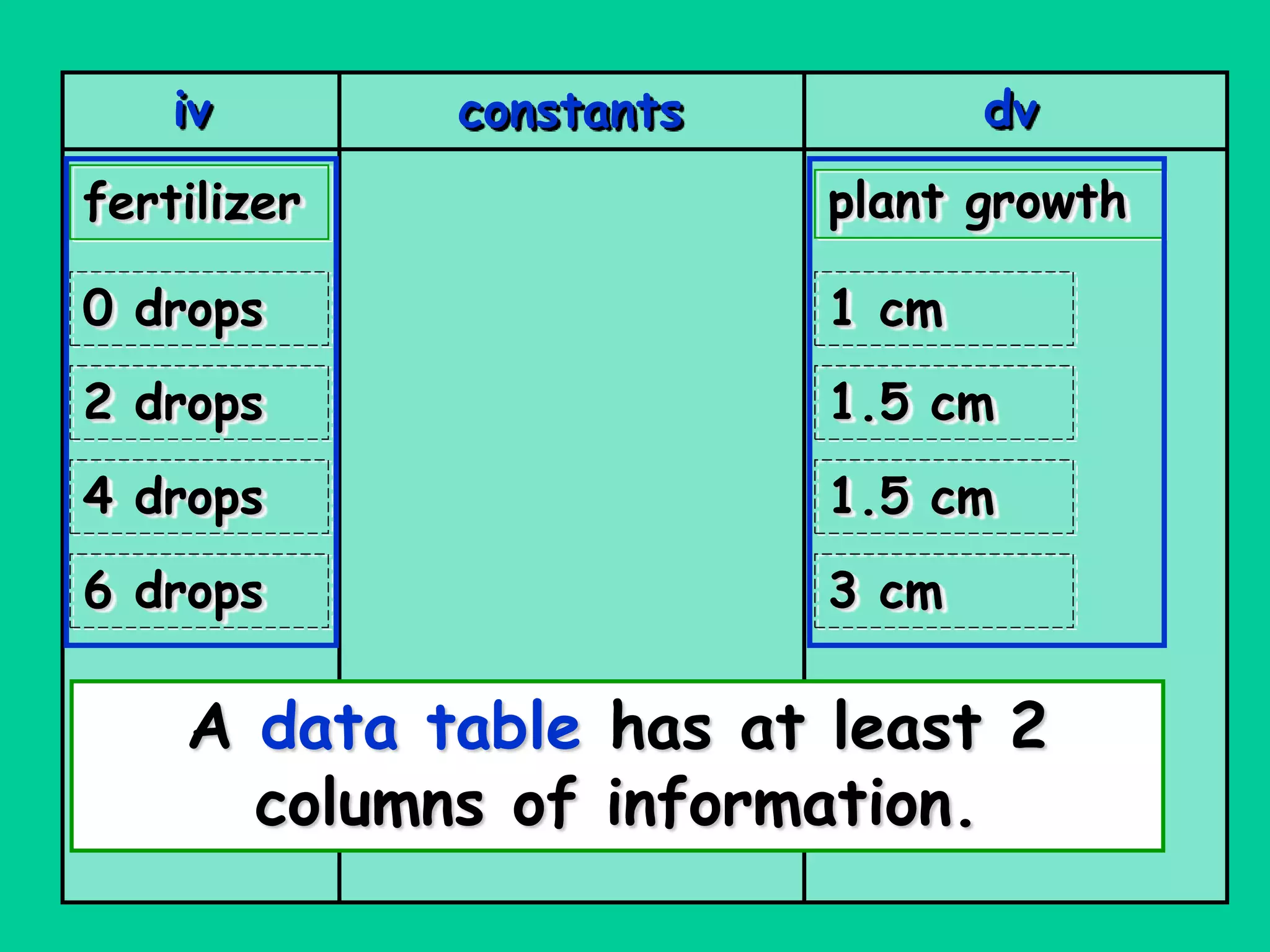
Results from your
experimentation should be
recorded in a carefully
constructed data table.
iv dv
constants
plant growth
fertilizer
0 drops
2 drops
4 drops
6 drops
1 cm
1.5 cm
1.5 cm
3 cm
A data table has at least 2
columns of information.
fertilizer
0 drops
2 drops
4 drops
6 drops
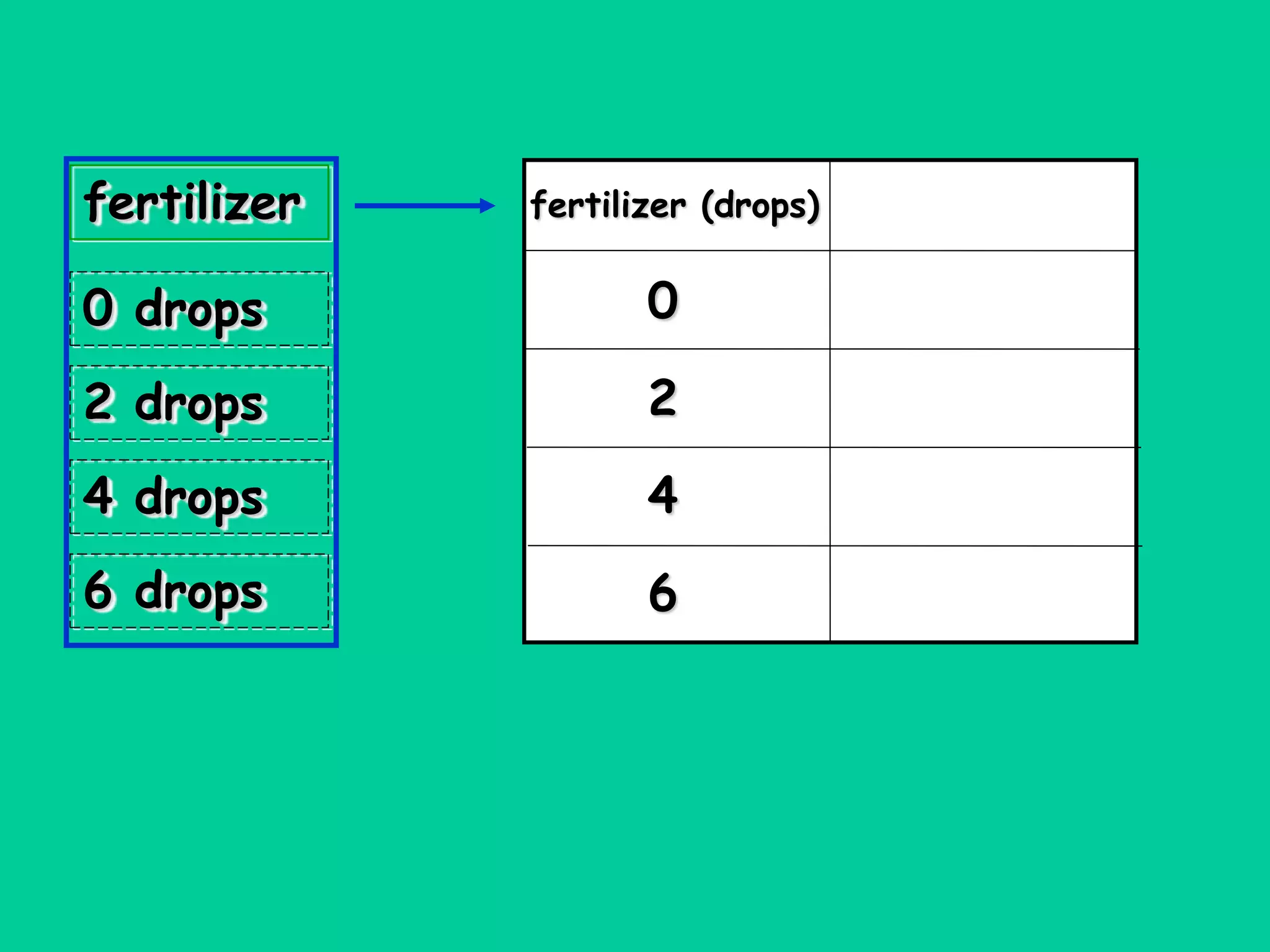
Independent variable data is always
(a) recorded in the left column
(b) recorded BEFORE experimentation
IV
fertilizer
0 drops
2 drops
4 drops
6 drops
fertilizer (drops)
0
2
4
6
plant growth
1 cm
1.5 cm
1.5 cm
3 cm
Dependent variable data is always
(a) recorded in the right column
(b) recorded DURING experimentation
fertilizer (drops)
0
2
4
6
DV
plant growth
1 cm
1.5 cm
1.5 cm
3 cm
fertilizer (drops)
0
2
4
6
plant growth (cm)
1
1.5
1.5
3
Choose an appropriate title for the
data table.
fertilizer (drops)
0
2
4
6
plant growth (cm)
1
1.5
1.5
3
Effect of Fertilizer on Plants Growth
Data from a correctly constructed
data table can be displayed in a
graph.
fertilizer (drops)
0
2
4
6
plant growth (cm)
1
1.5
1.5
3
Effect of Fertilizer on Plants
IV data is plotted on the X axis.
DV data is plotted on the Y axis.
fertilizer (drops)
0
2
4
6
plant growth (cm)
1
1.5
1.5
3
Effect of Fertilizer on Plants
fertilizer (drops)
plant
growth
(cm)
0 2 4 6
1.0
2.0
1.5
.5
2.5
3.0
The title of the data table is also the
title of the graph.
fertilizer (drops)
0
2
4
6
plant growth (cm)
1
1.5
1.5
3
Effect of Fertilizer on Plants
fertilizer (drops)
plant
growth
(cm)
0 2 4 6
1.0
2.0
1.5
.5
2.5
3.0
Effect of Fertilizer on Plants

Designing Experiment

  • 1.
  • 2.
    A variable issomething that changes.
  • 3.
    6 components ofan experiment independent variable dependent variable constants control group experimental group repeated trials
  • 4.
    independent variable the variablethat is changed on purpose by the experimenter aka cause, stimulus, reason, manipulated variable, etc.
  • 5.
    dependent variable the variablethat changes in response to the independent variable aka effect(s), result(s), responding variable, etc.
  • 6.
    constants all the factorswhich are NOT allowed to change during the experiment
  • 7.
    control group the group(standard) to which everything is compared
  • 8.
    experimental group the group(s)being tested using the independent variable Each test group has only one factor different from the other test groups: the independent variable.
  • 9.
    repeated trials the numberof times the experiment is repeated An experiment should be carried out many times to produce accurate/ repeatable results
  • 10.
    Before carrying outan experiment, you MUST identify your independent variable, constants and dependent variable.
  • 12.
    What is thiscalled? What are these called?
  • 13.
  • 14.
    0 2 46 What is this called? The plant growth that you observe here can be called . . .  the results (of adding fertilizer)  the response (to adding fertilizer)  the effects (of adding fertilizer)
  • 15.
  • 16.
    A good hypothesis: -Is a statement (NOT a question) - Is written in clear and simple language - Relates the independent and dependent variables - Is testable - Can be written in several ways (including if, then statement)
  • 17.
    Write a hypothesisfor the plant experiment in the box in your notes.
  • 18.
    Good or BadHypothesis? - Warm water will dissolve more salt than cold water. What is another way this hypothesis can be written?
  • 19.
    Good or BadHypothesis? - Will fertilizer make my lawn grow more? How can you make this a good hypothesis?
  • 20.
  • 21.
    iv dv constants plant growth fertilizer 0drops 2 drops 4 drops 6 drops Results from your experimentation should be recorded in a carefully constructed data table.
  • 22.
    iv dv constants plant growth fertilizer 0drops 2 drops 4 drops 6 drops 1 cm 1.5 cm 1.5 cm 3 cm A data table has at least 2 columns of information.
  • 23.
    fertilizer 0 drops 2 drops 4drops 6 drops Independent variable data is always (a) recorded in the left column (b) recorded BEFORE experimentation IV
  • 24.
    fertilizer 0 drops 2 drops 4drops 6 drops fertilizer (drops) 0 2 4 6
  • 25.
    plant growth 1 cm 1.5cm 1.5 cm 3 cm Dependent variable data is always (a) recorded in the right column (b) recorded DURING experimentation fertilizer (drops) 0 2 4 6 DV
  • 26.
    plant growth 1 cm 1.5cm 1.5 cm 3 cm fertilizer (drops) 0 2 4 6 plant growth (cm) 1 1.5 1.5 3
  • 27.
    Choose an appropriatetitle for the data table. fertilizer (drops) 0 2 4 6 plant growth (cm) 1 1.5 1.5 3 Effect of Fertilizer on Plants Growth
  • 28.
    Data from acorrectly constructed data table can be displayed in a graph. fertilizer (drops) 0 2 4 6 plant growth (cm) 1 1.5 1.5 3 Effect of Fertilizer on Plants
  • 29.
    IV data isplotted on the X axis. DV data is plotted on the Y axis. fertilizer (drops) 0 2 4 6 plant growth (cm) 1 1.5 1.5 3 Effect of Fertilizer on Plants fertilizer (drops) plant growth (cm) 0 2 4 6 1.0 2.0 1.5 .5 2.5 3.0
  • 30.
    The title ofthe data table is also the title of the graph. fertilizer (drops) 0 2 4 6 plant growth (cm) 1 1.5 1.5 3 Effect of Fertilizer on Plants fertilizer (drops) plant growth (cm) 0 2 4 6 1.0 2.0 1.5 .5 2.5 3.0 Effect of Fertilizer on Plants