Design Thinking for Adoption
Michelle Caldwell
mary.m.caldwell@Avanade.com
12 years in
SharePoint, 18+ in
IT
MVP PMP CSM
1 son (Brenden)
2 cats (Clark &
Snickers)
1 puppy (Zyla)
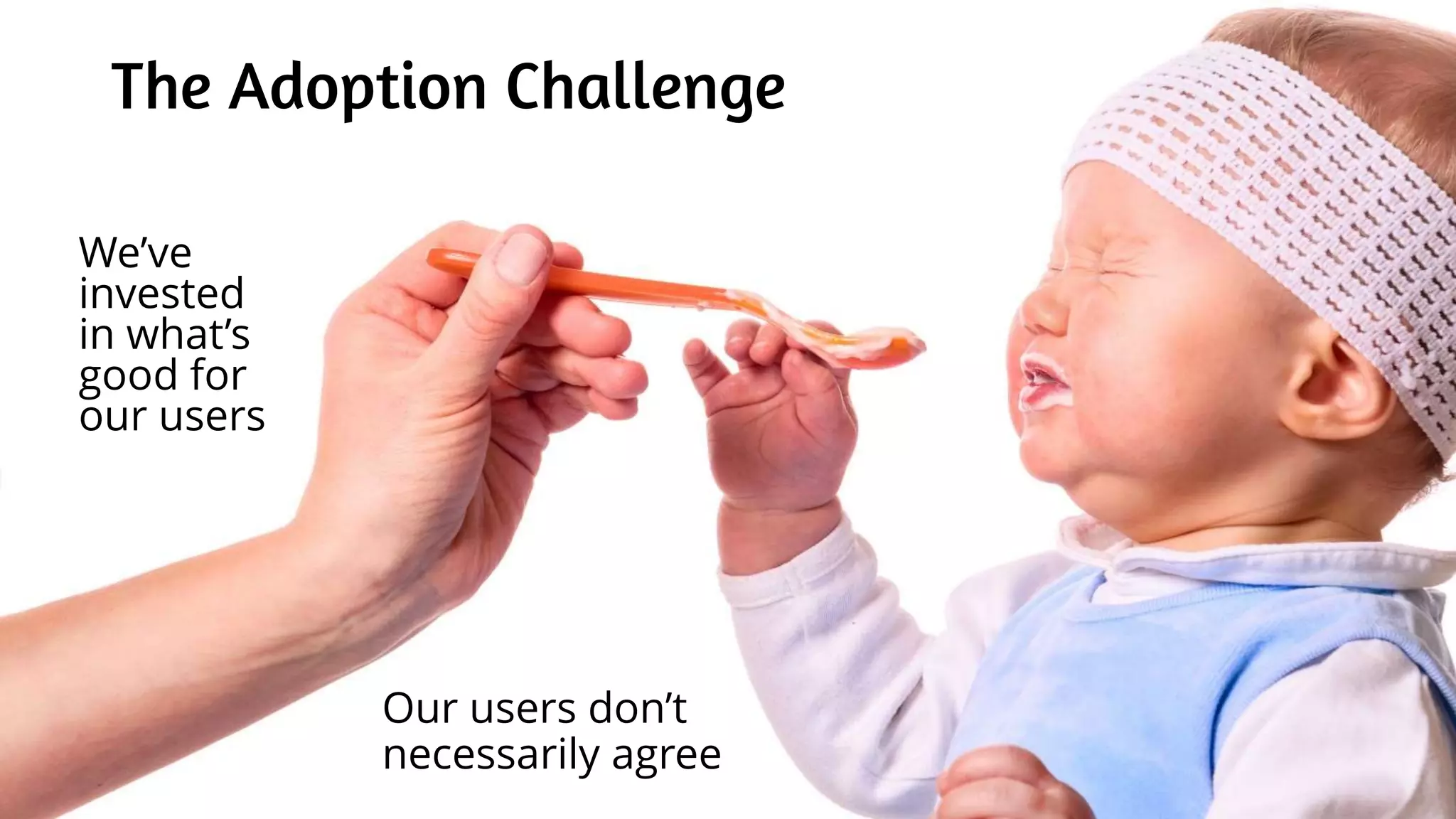
The Adoption Challenge
Our users don’t
necessarily agree
We’ve
invested
in what’s
good for
our users
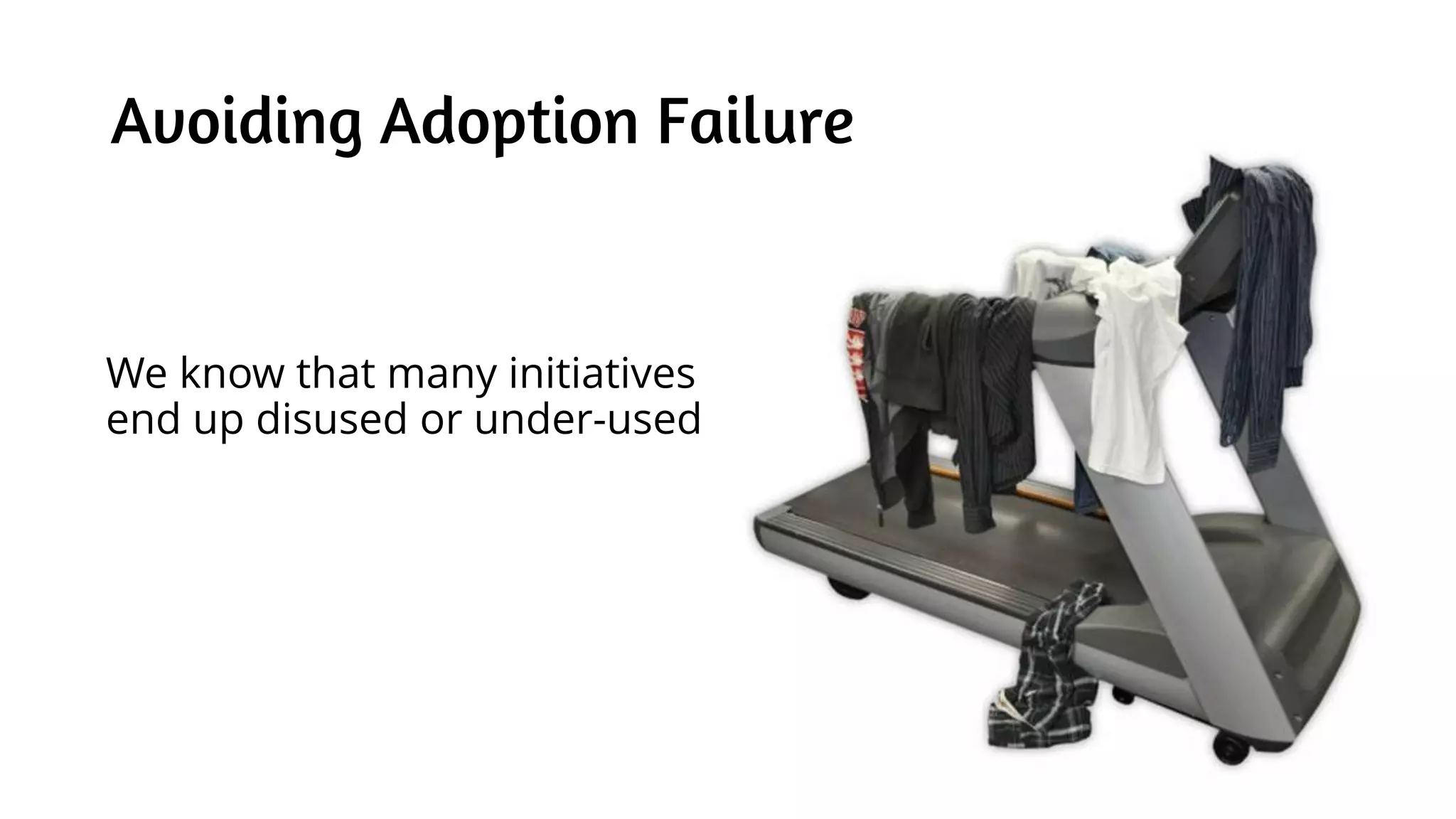
Avoiding Adoption Failure
We know that many initiatives
end up disused or under-used
We want to make a difference, but…
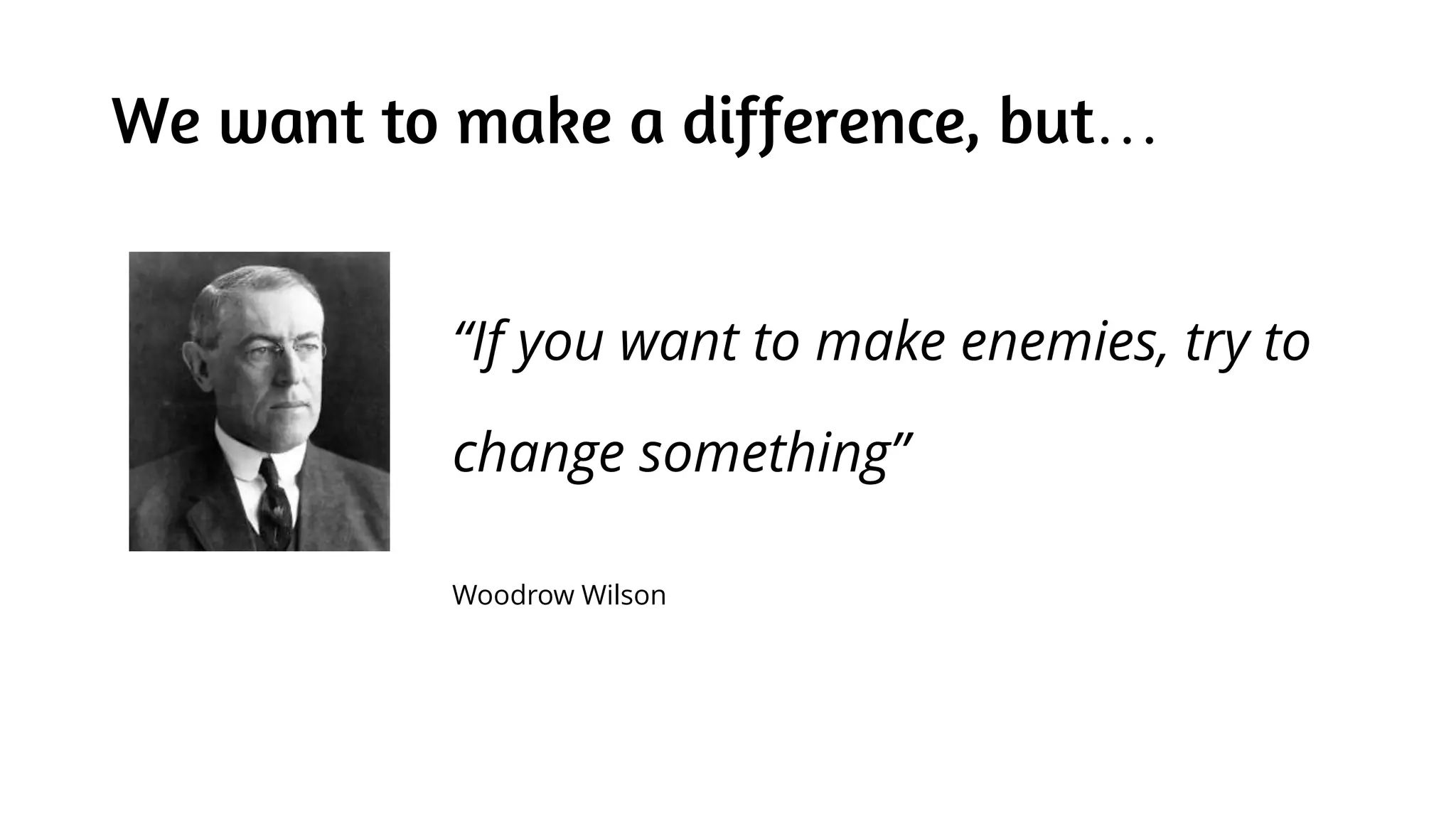
“If you want to make enemies, try to
change something”
Woodrow Wilson
It’s not always clear what direction to take
What can we do?
Search the internet?
• Download a PDF guide on adoption?
• Attend a session on adoption
at DevIntersections?
Those are all good, but…
• Let’s look at a potential
alternative
• One that involves your users
in a cooperative,
collaborative approach to
solving the problem
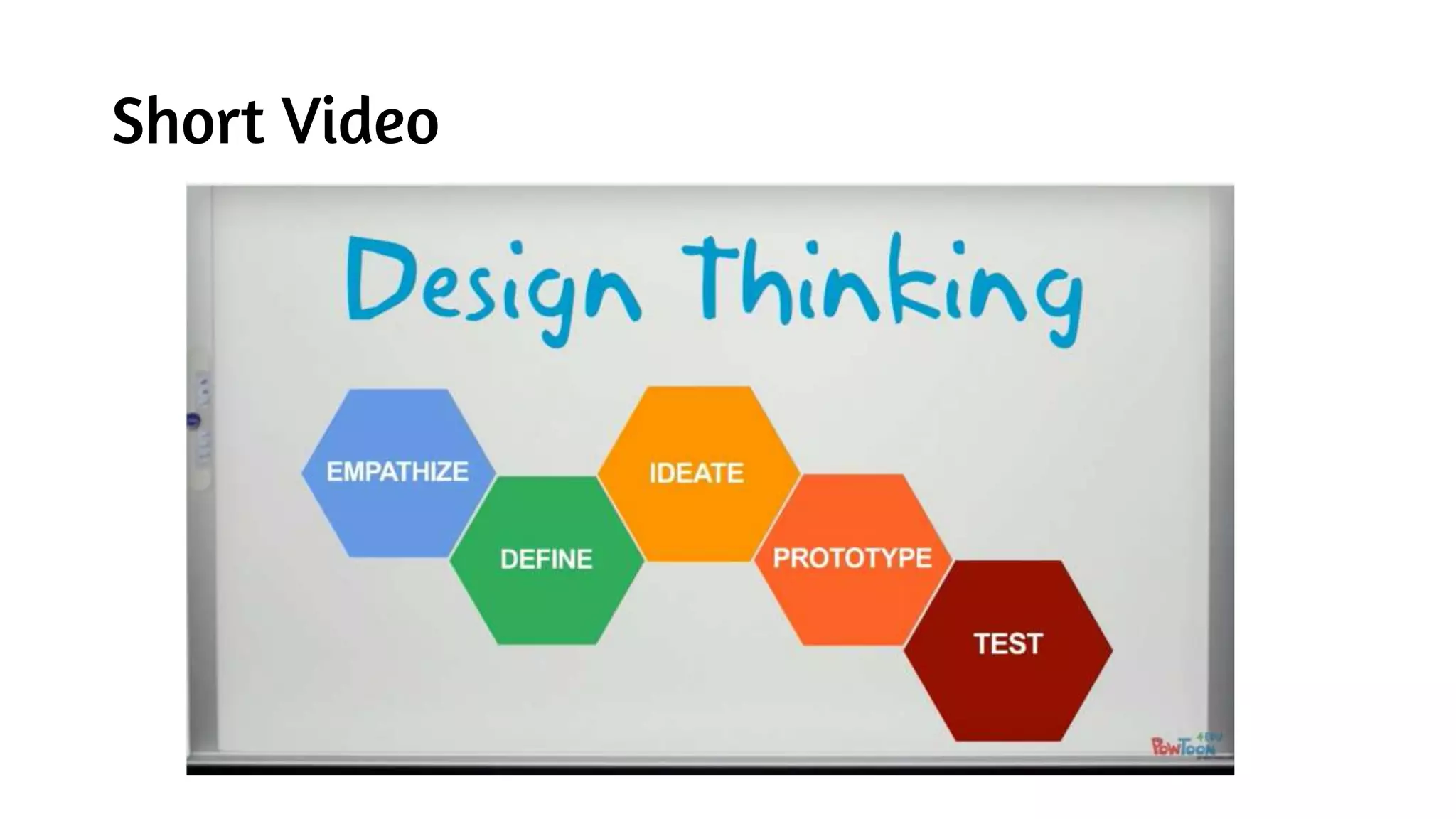
Short Video
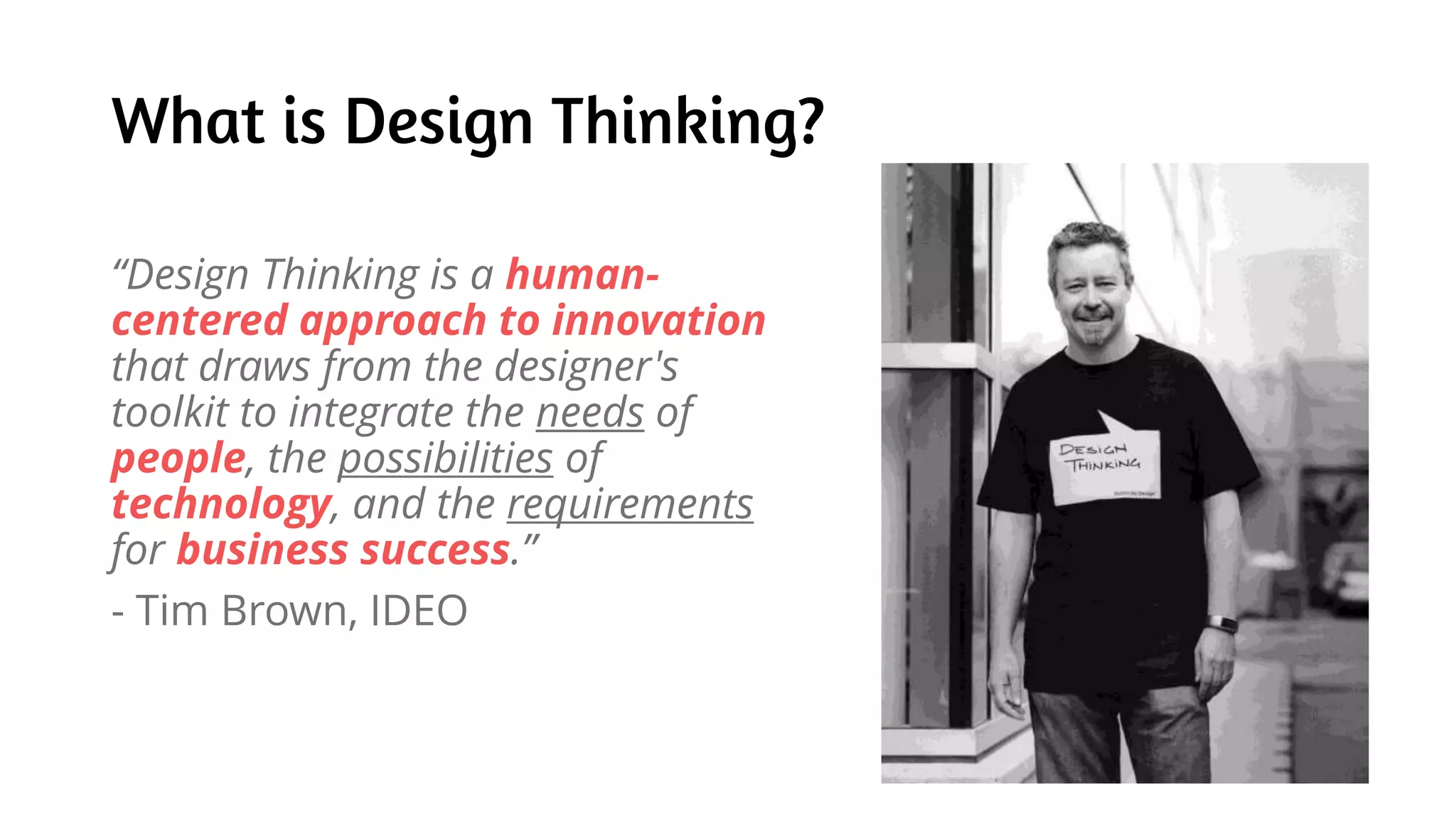
What is Design Thinking?
“Design Thinking is a human-
centered approach to innovation
that draws from the designer's
toolkit to integrate the needs of
people, the possibilities of
technology, and the requirements
for business success.”
- Tim Brown, IDEO
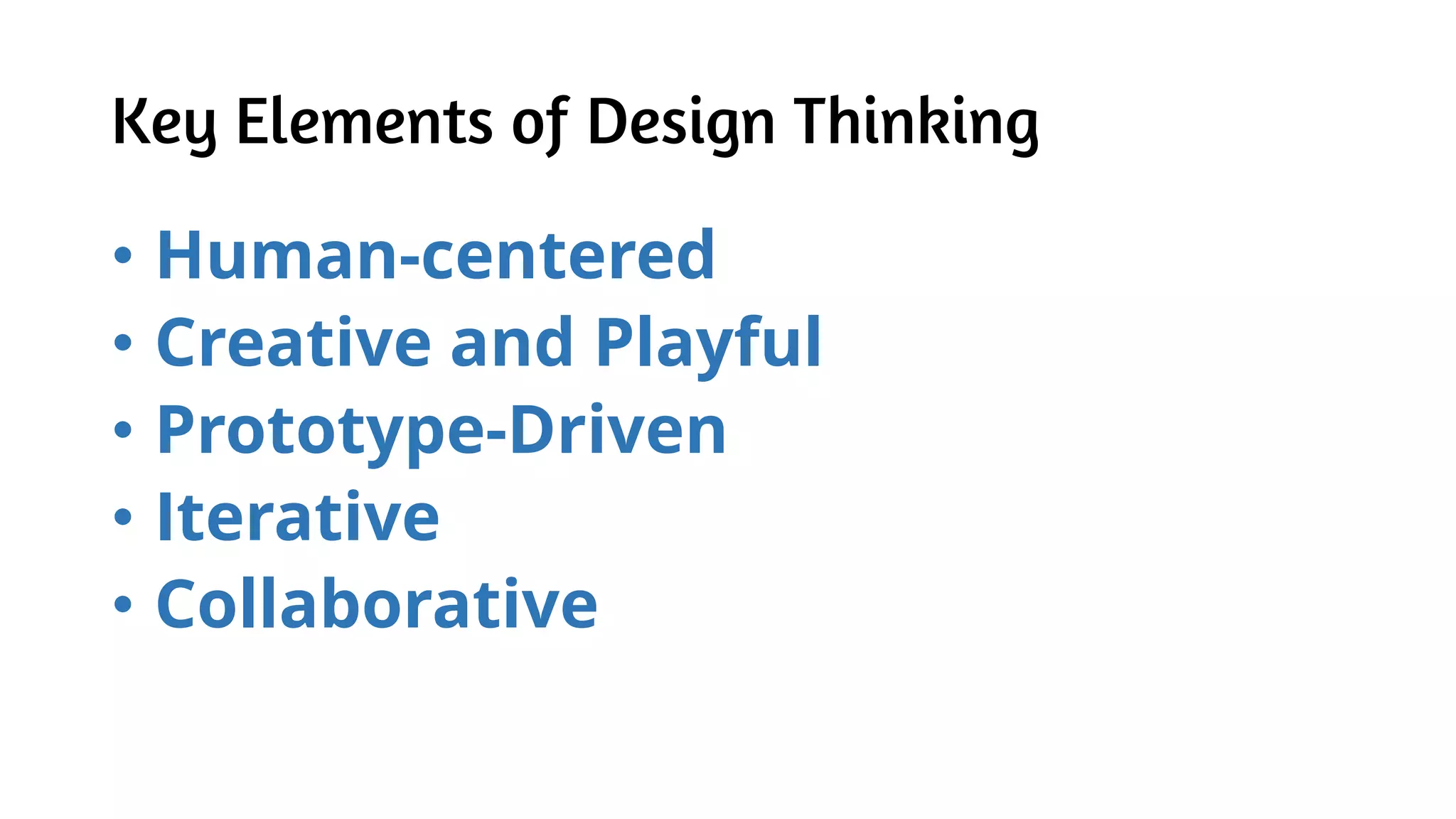
Key Elements of Design Thinking
• Human-centered
• Creative and Playful
• Prototype-Driven
• Iterative
• Collaborative
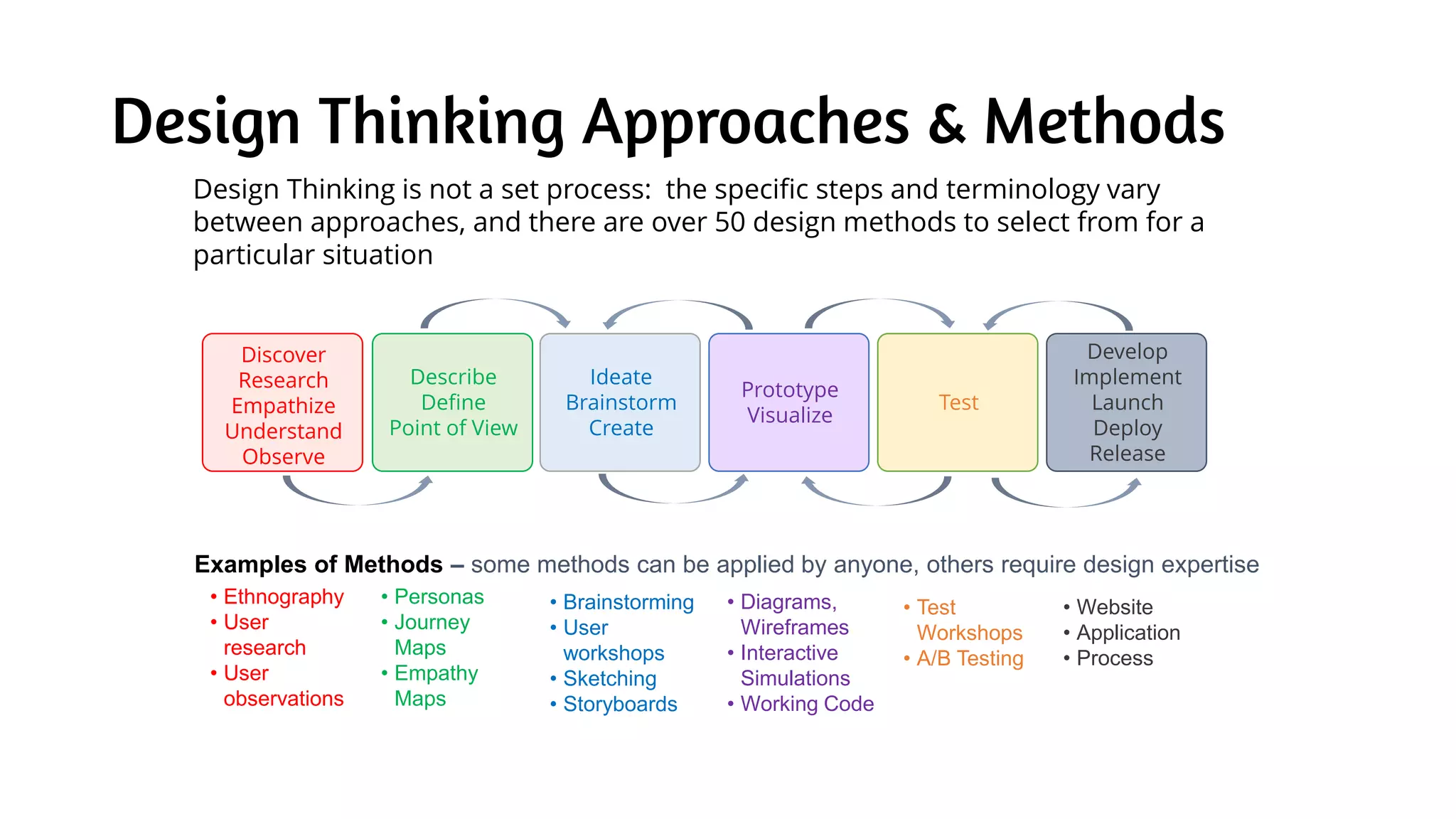
Design Thinking Approaches & Methods
Examples of Methods – some methods can be applied by anyone, others require design expertise
Discover
Research
Empathize
Understand
Observe
Describe
Define
Point of View
Ideate
Brainstorm
Create
Prototype
Visualize
Test
Develop
Implement
Launch
Deploy
Release
• Ethnography
• User
research
• User
observations
• Personas
• Journey
Maps
• Empathy
Maps
• Brainstorming
• User
workshops
• Sketching
• Storyboards
• Diagrams,
Wireframes
• Interactive
Simulations
• Working Code
• Test
Workshops
• A/B Testing
• Website
• Application
• Process
Design Thinking is not a set process: the specific steps and terminology vary
between approaches, and there are over 50 design methods to select from for a
particular situation
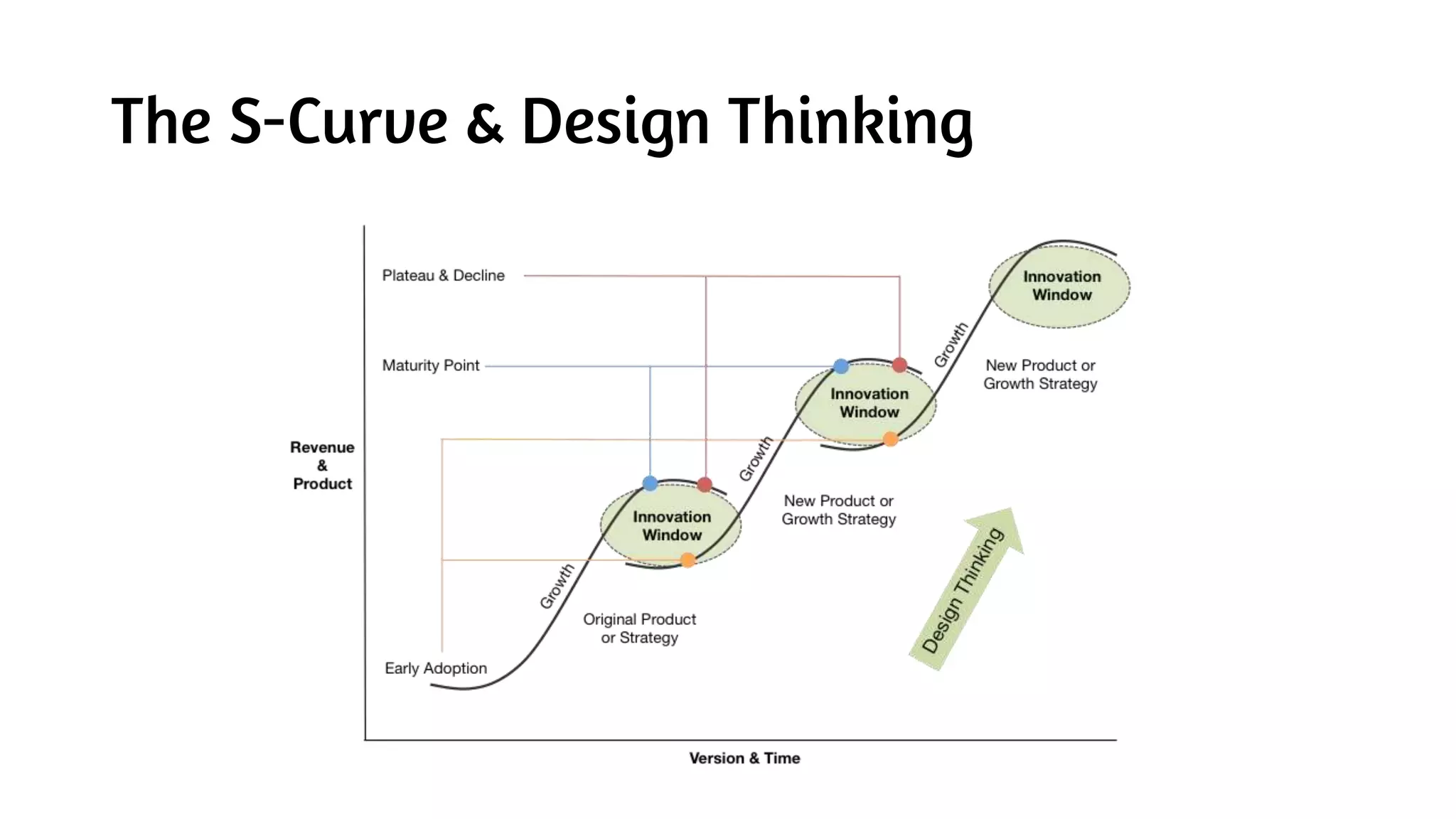
The S-Curve & Design Thinking
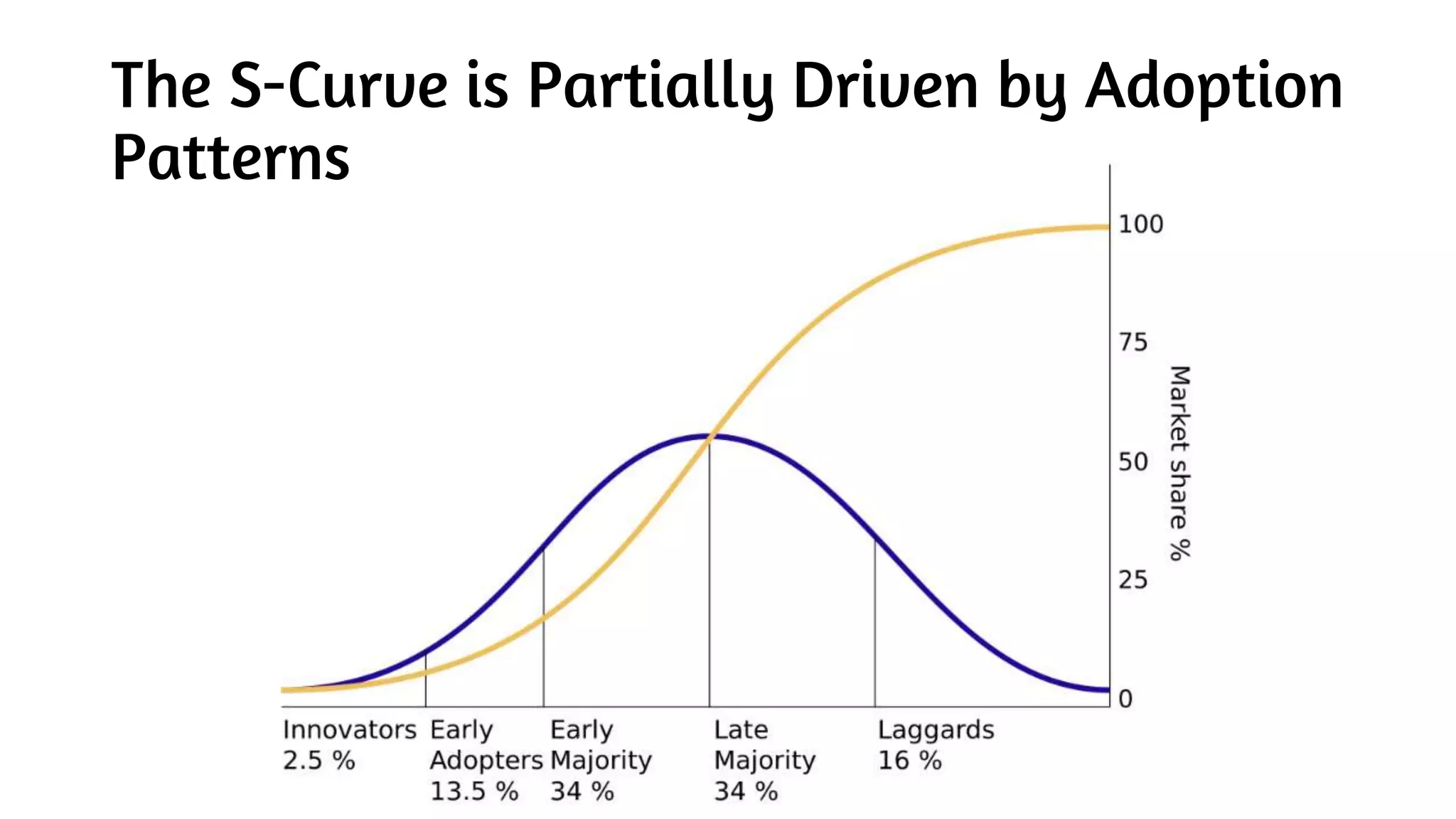
The S-Curve is Partially Driven by Adoption
Patterns
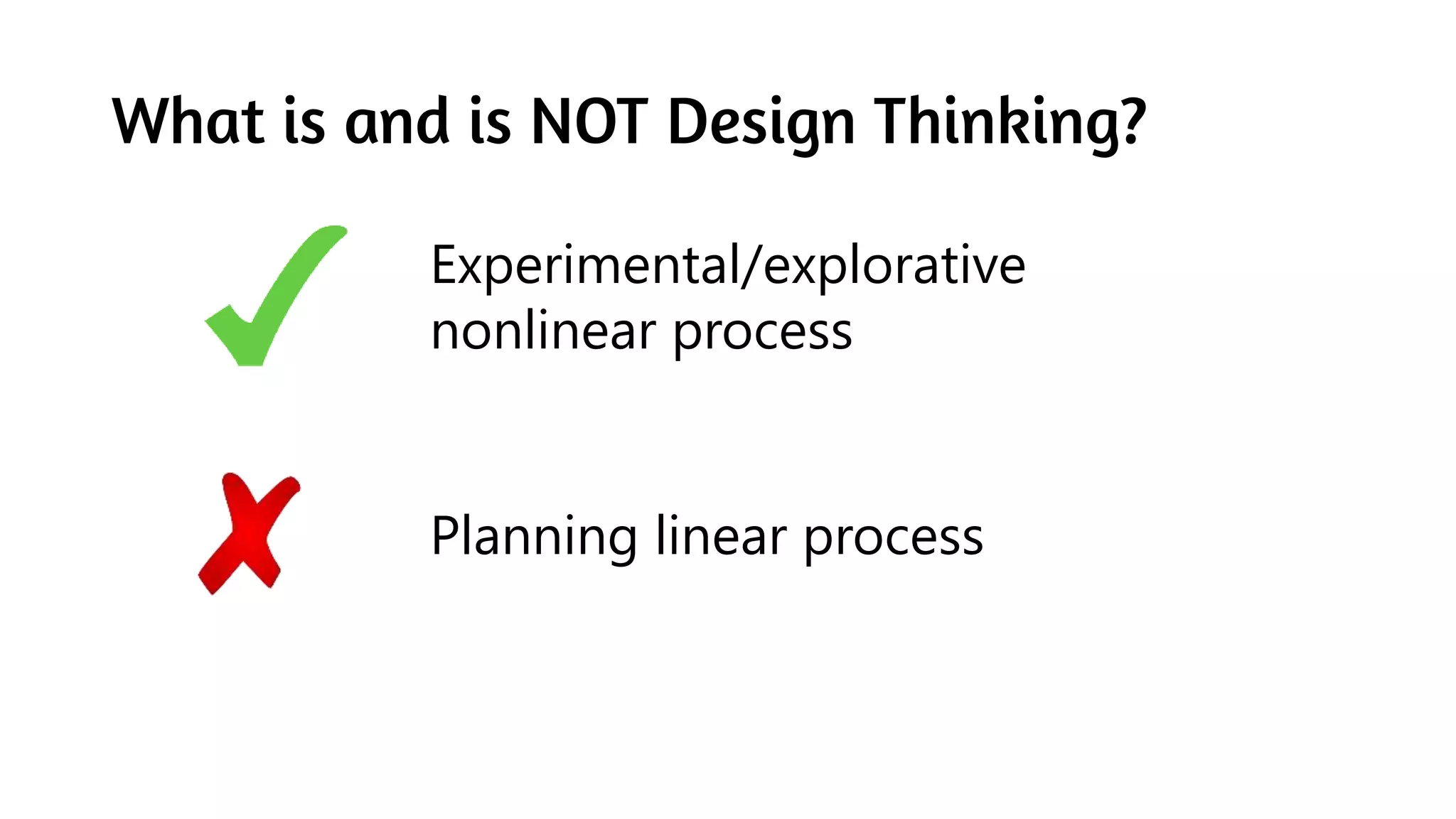
What is and is NOT Design Thinking?
Experimental/explorative
nonlinear process
Planning linear process
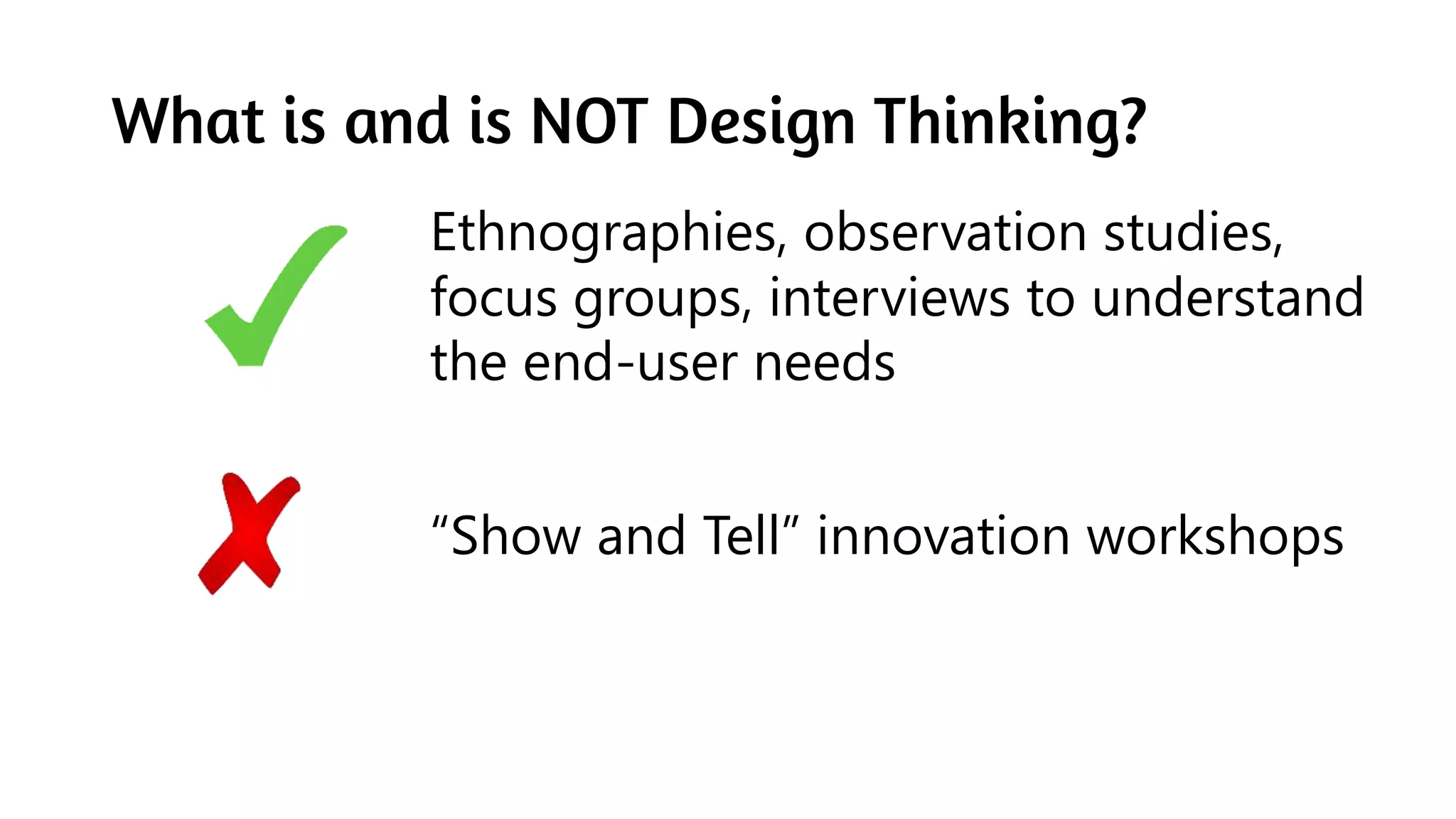
What is and is NOT Design Thinking?
Ethnographies, observation studies,
focus groups, interviews to understand
the end-user needs
“Show and Tell” innovation workshops
What is and is NOT Design Thinking?
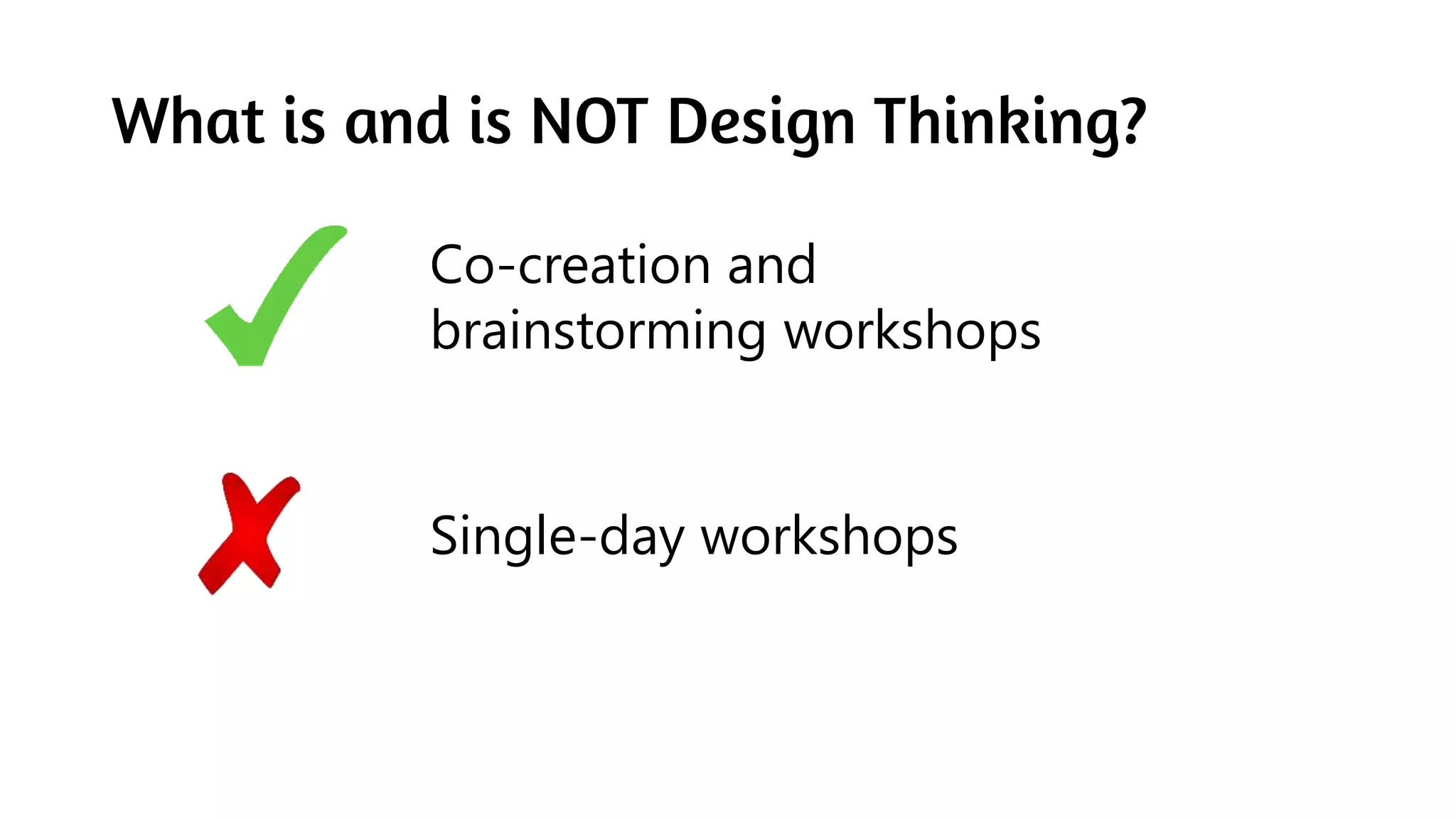
Co-creation and
brainstorming workshops
Single-day workshops
What is and is NOT Design Thinking?
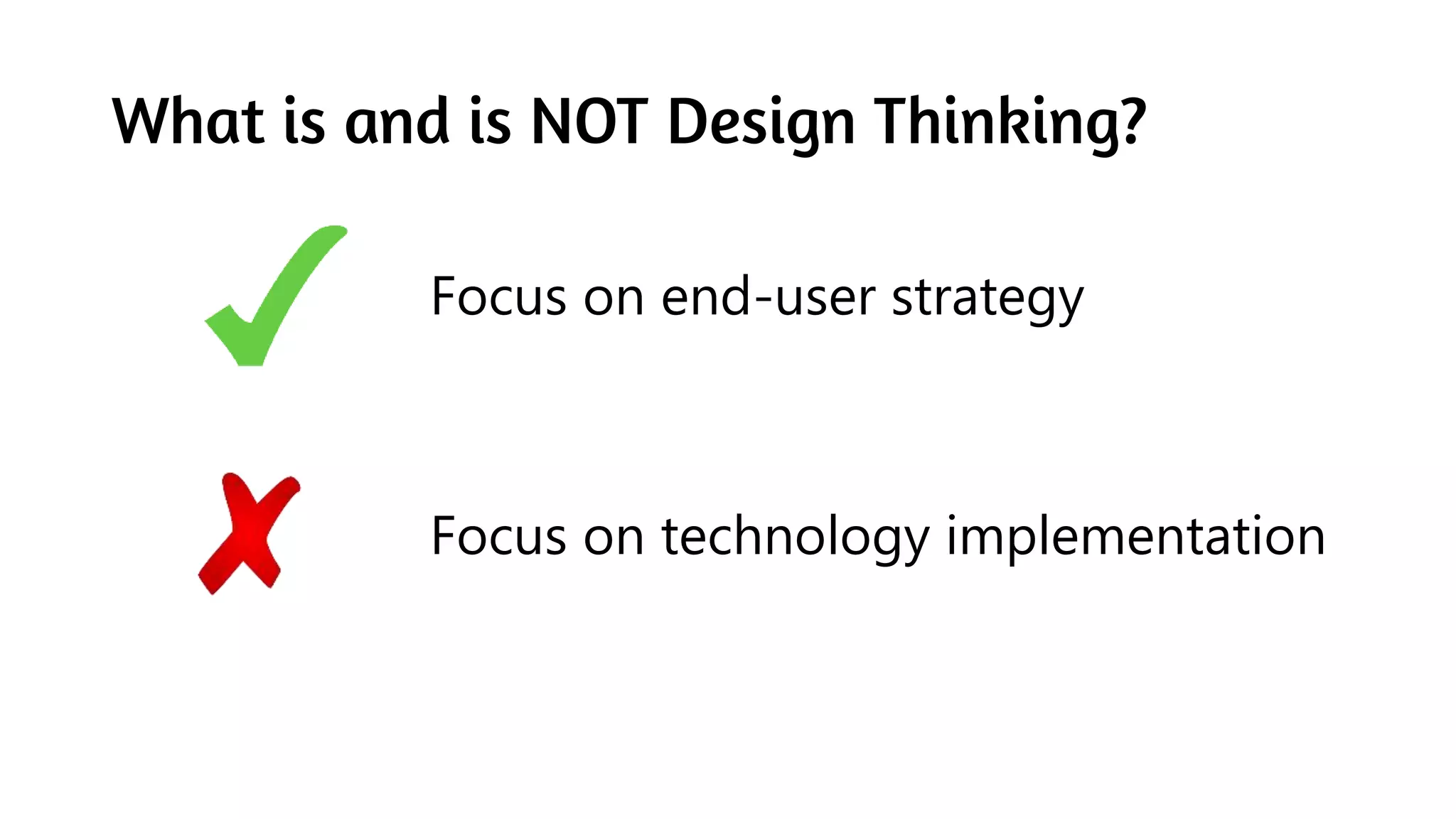
Focus on end-user strategy
Focus on technology implementation
What is and is NOT Design Thinking?
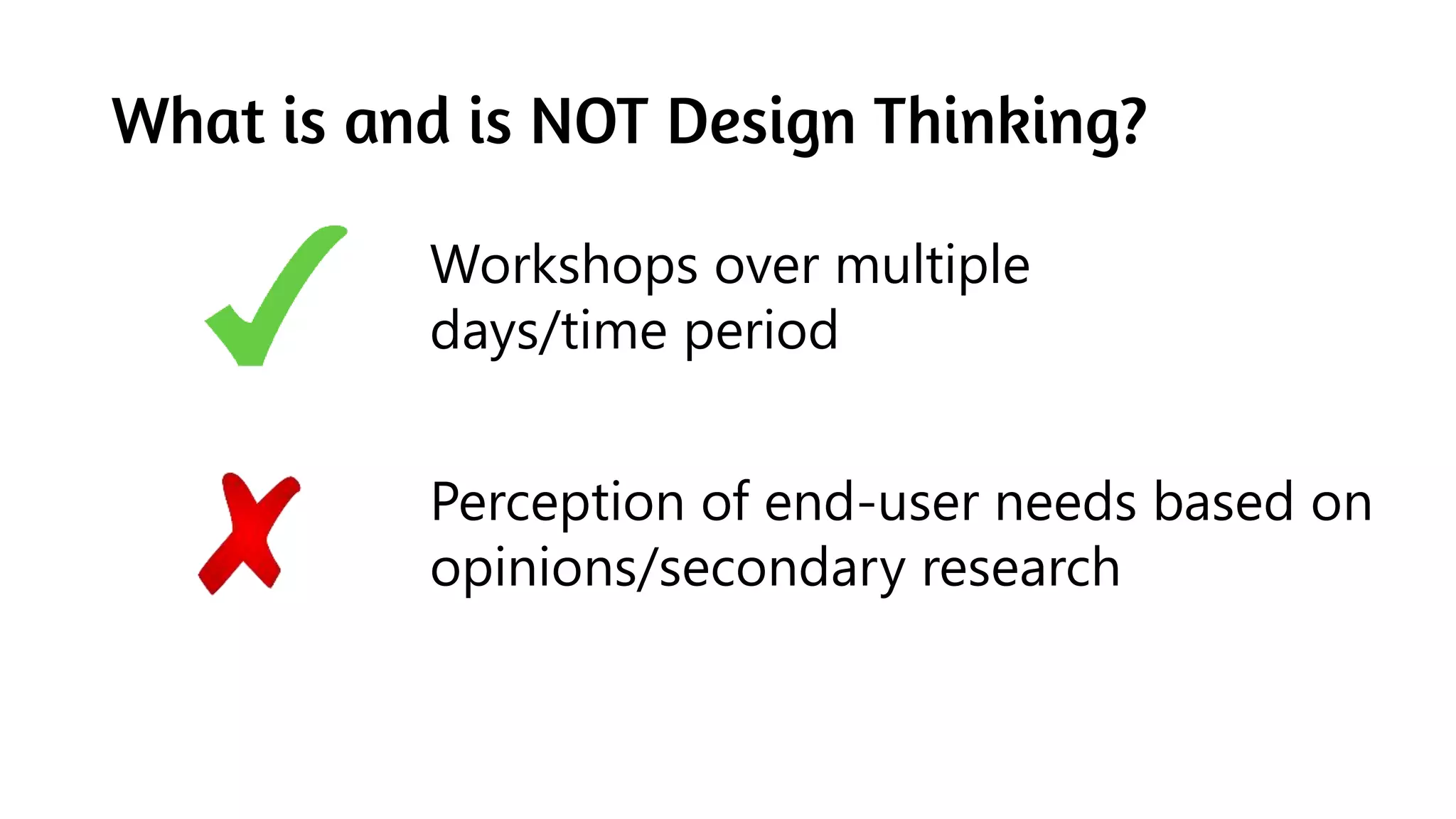
Workshops over multiple
days/time period
Perception of end-user needs based on
opinions/secondary research
What is and is NOT Design Thinking?
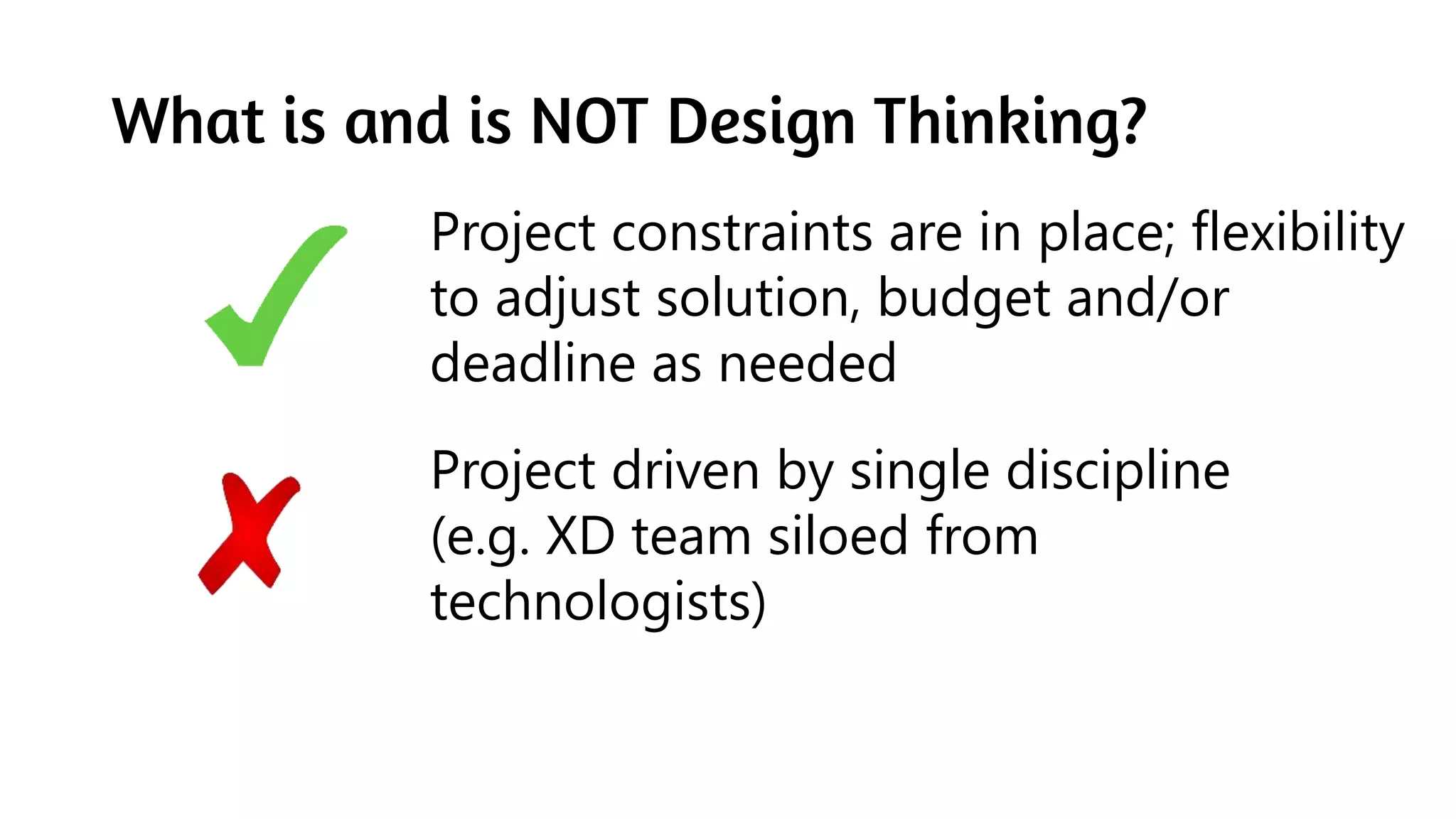
Project constraints are in place; flexibility
to adjust solution, budget and/or
deadline as needed
Project driven by single discipline

(e.g. XD team siloed from
technologists)
What is and is NOT Design Thinking?
Multidisciplinary team
Narrow audience
What is and is NOT Design Thinking?
Broad audience
Fixed solution, budget, and/or
deadlines with little to no room for
adjustments
What is and is NOT Design Thinking?
Rapid prototyping and testing;
evaluation and fine-tuning
Presentation of complete solution
(without phases of engagement/
prototypes)
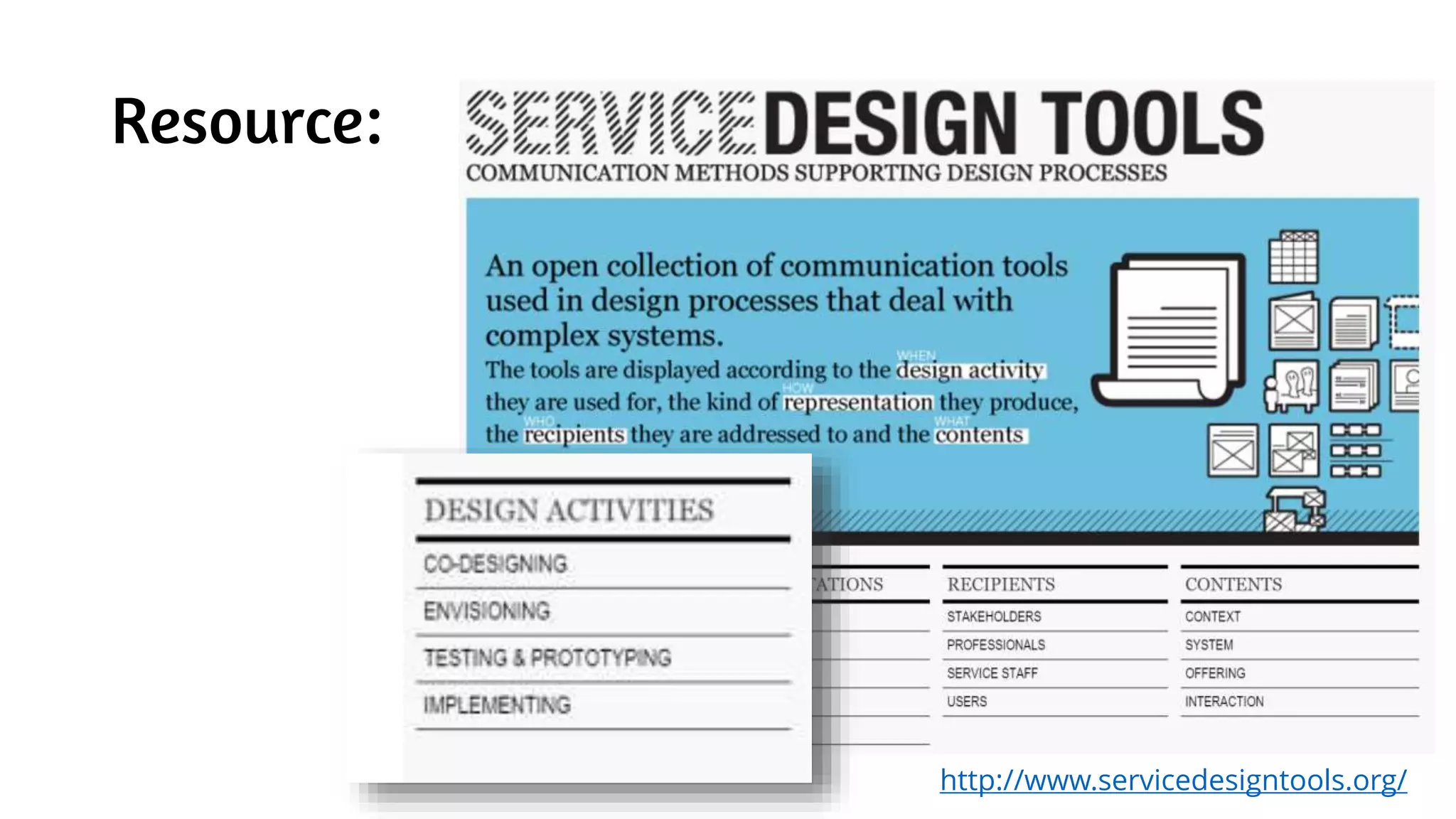
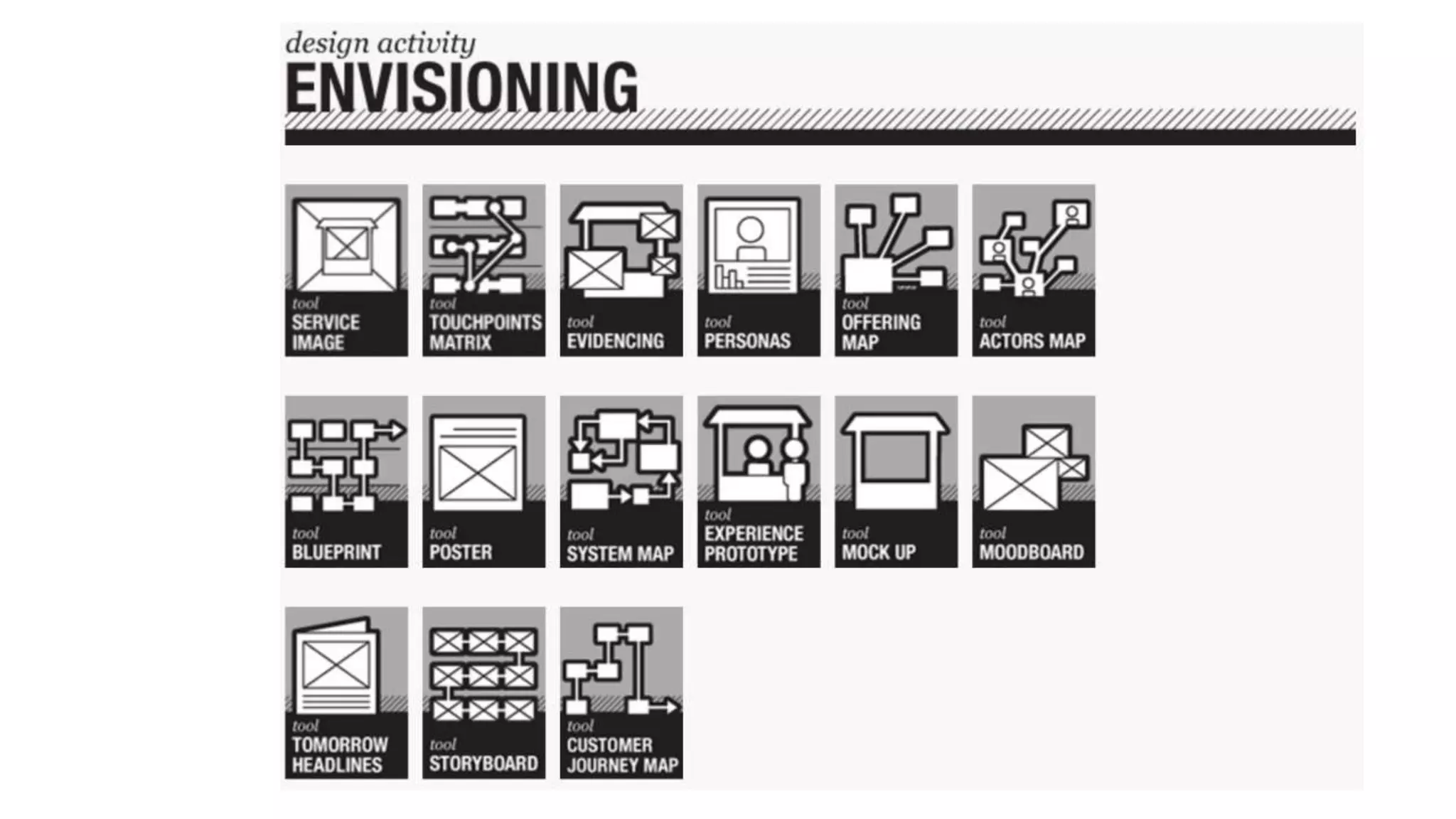
Design Thinking Tools
Resource:
http://www.servicedesigntools.org/
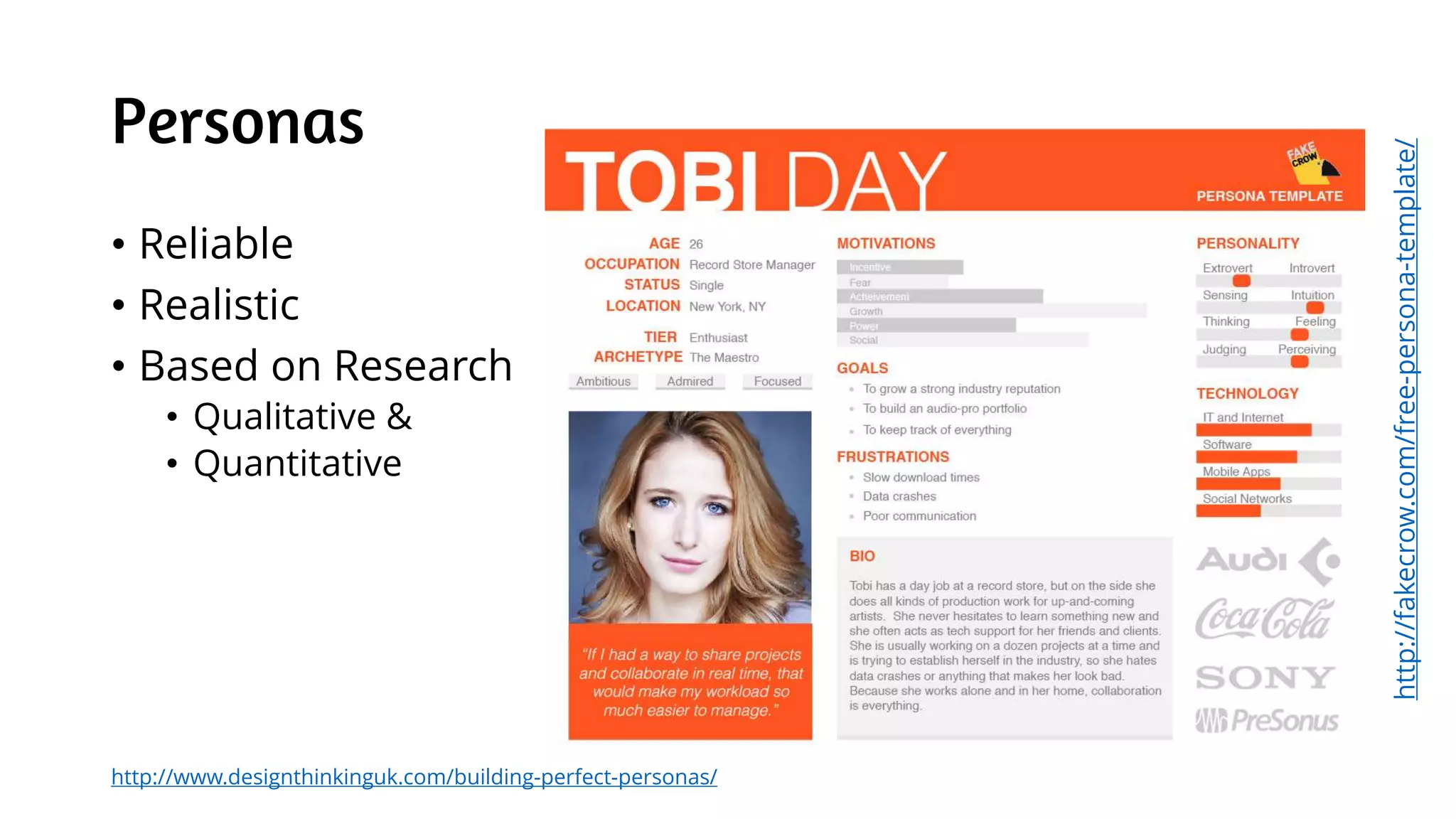
Personas
• Reliable
• Realistic
• Based on Research
• Qualitative &
• Quantitative
http://fakecrow.com/free-persona-template/
http://www.designthinkinguk.com/building-perfect-personas/
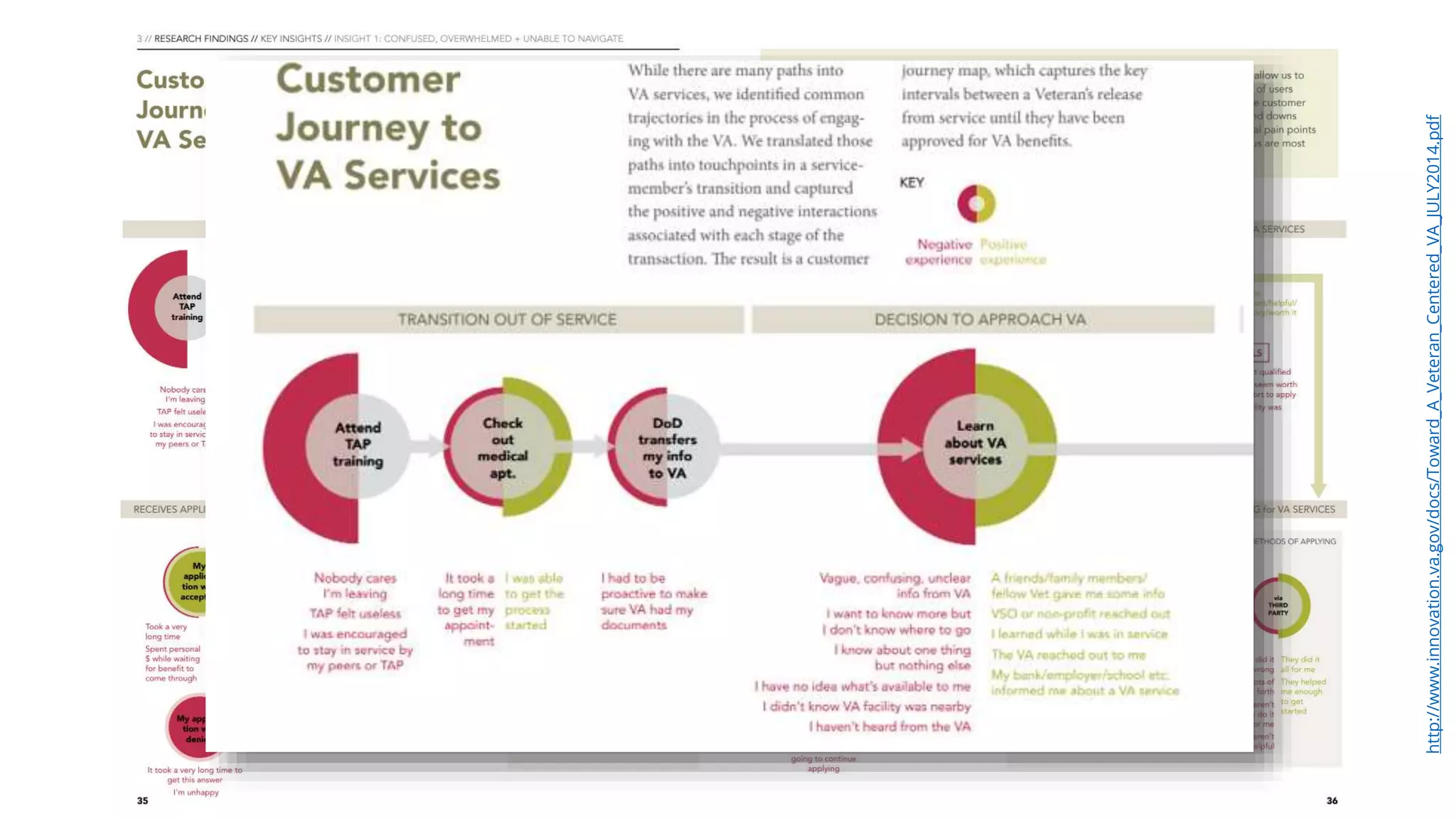
http://www.innovation.va.gov/docs/Toward_A_Veteran_Centered_VA_JULY2014.pdf
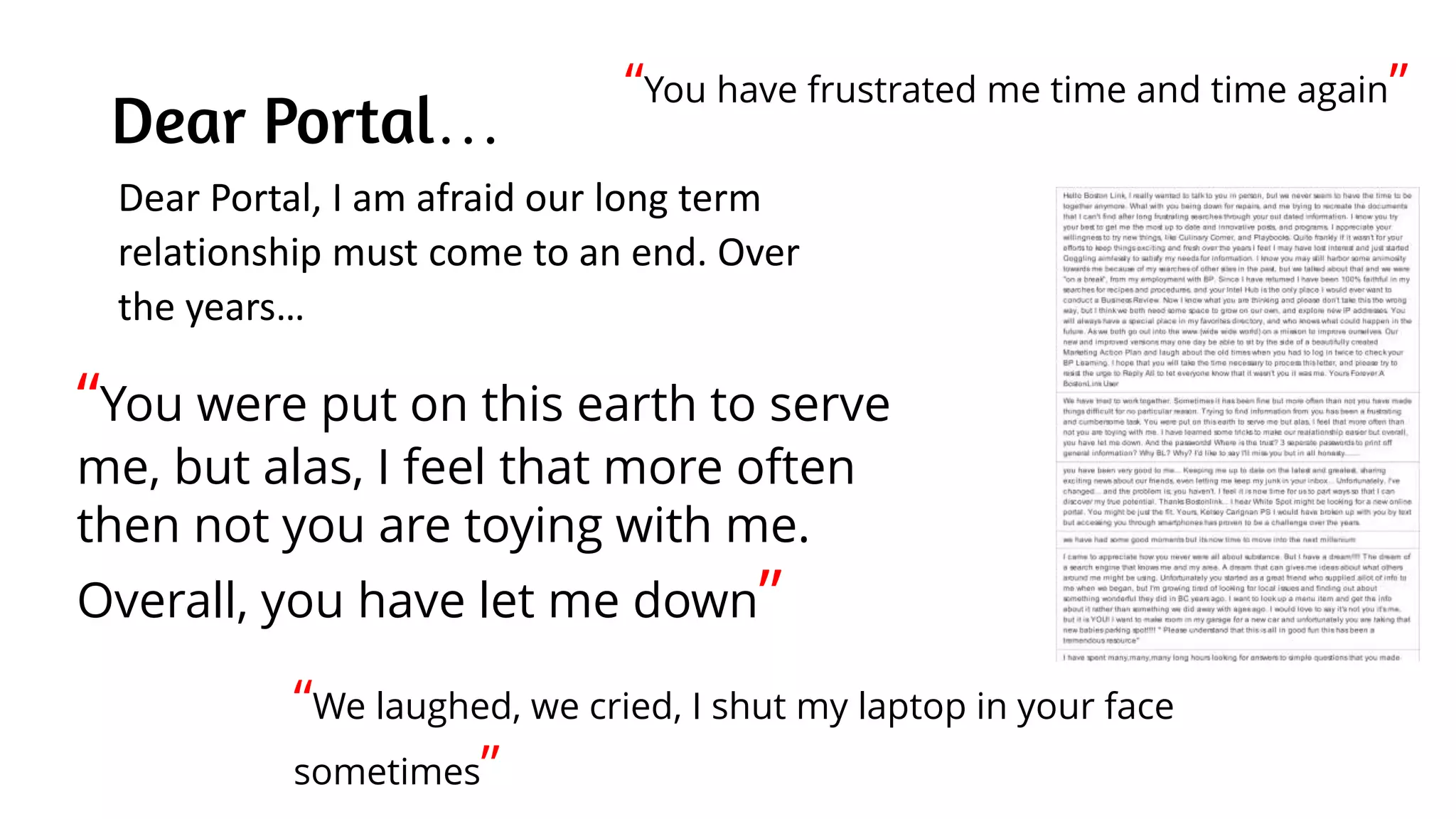
Dear Portal…
“You have frustrated me time and time again”
“You were put on this earth to serve
me, but alas, I feel that more often
then not you are toying with me.
Overall, you have let me down”
“We laughed, we cried, I shut my laptop in your face
sometimes”
Dear Portal, I am afraid our long term
relationship must come to an end. Over
the years…
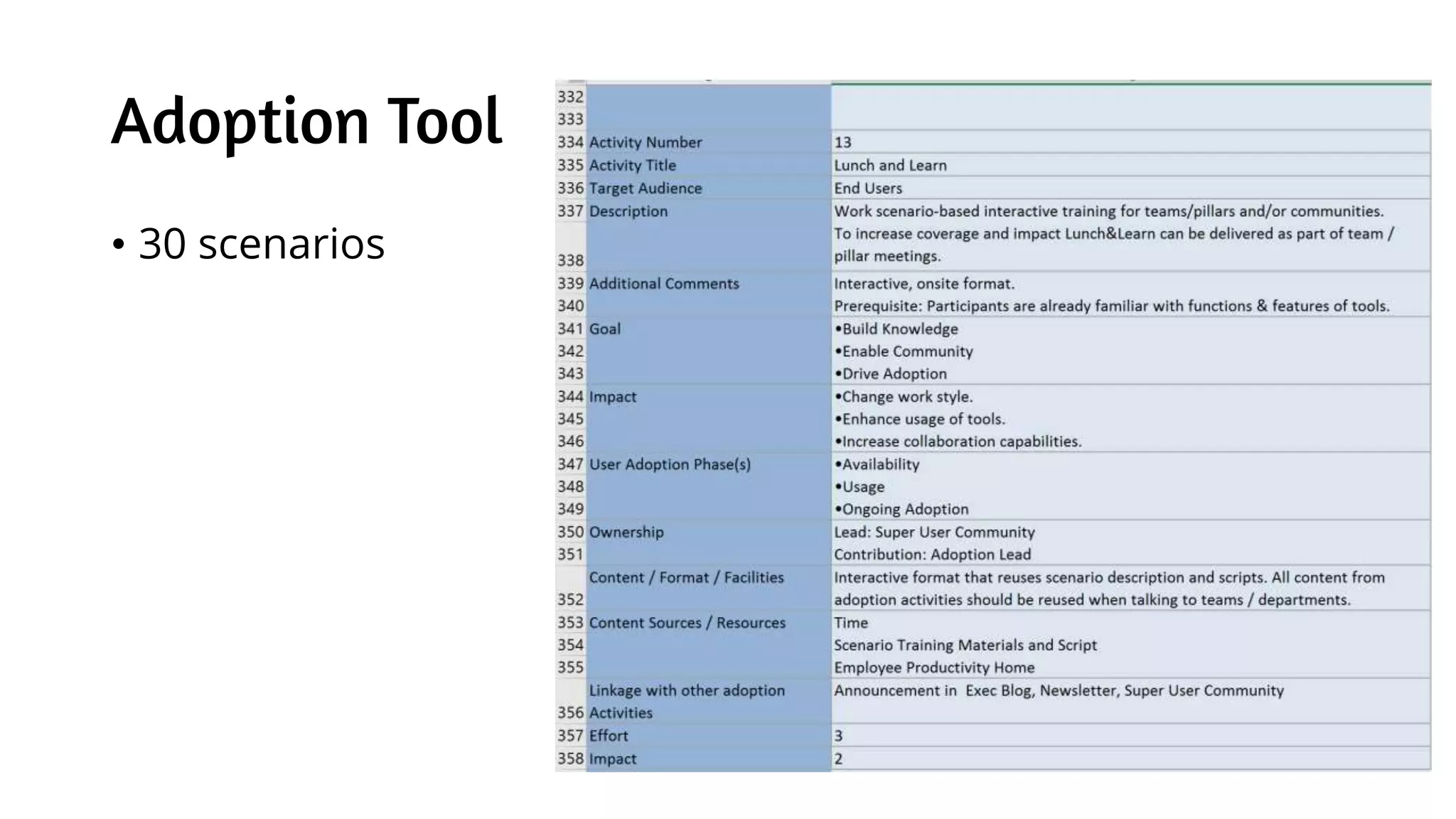
Adoption Tool
• 30 scenarios
Design Thinking Exercise
Exercise: Q-Storming
We need to ask the
right questions
But… we are often
impatient…
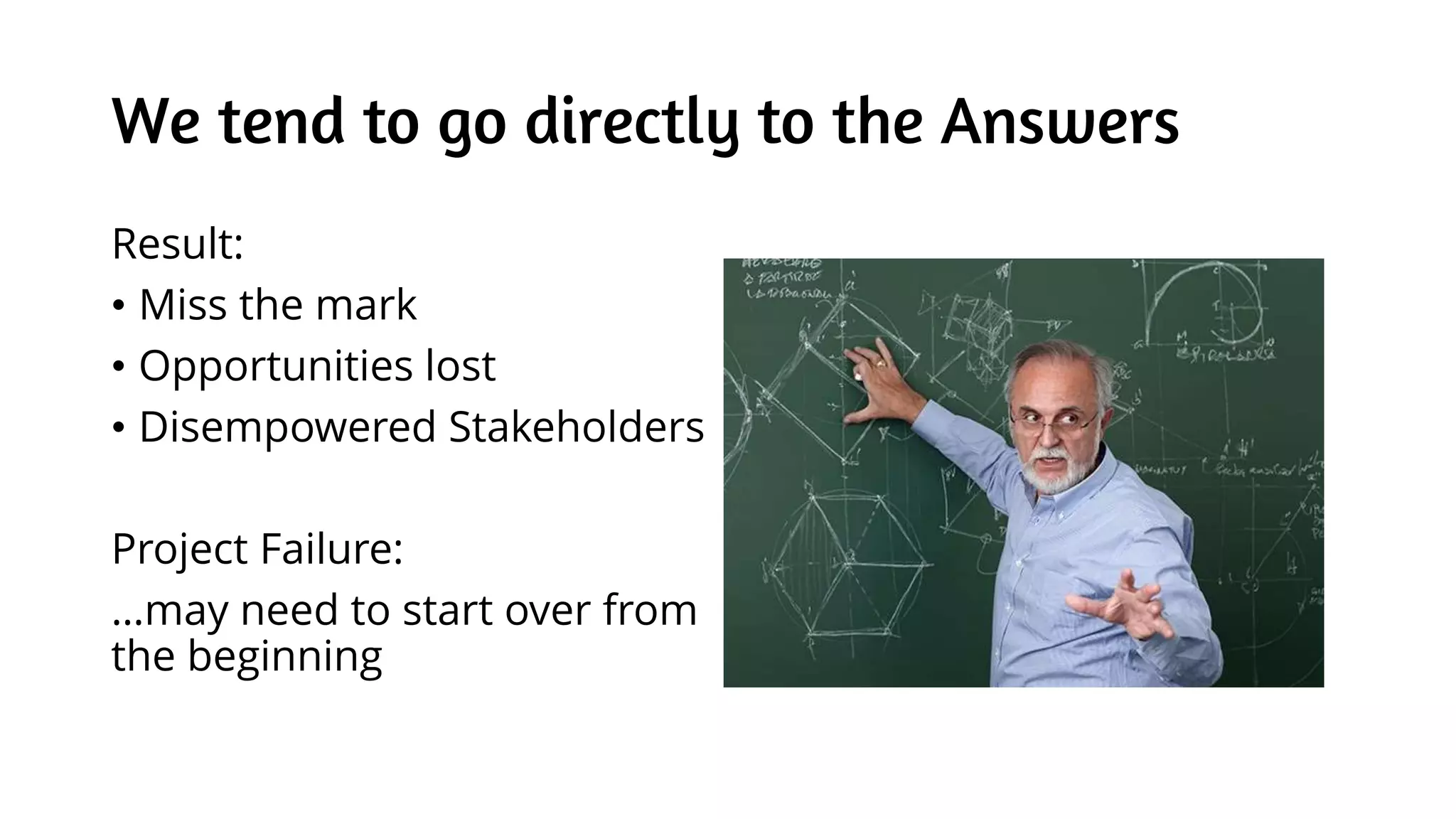
We tend to go directly to the Answers
Result:
• Miss the mark
• Opportunities lost
• Disempowered Stakeholders
Project Failure:
…may need to start over from
the beginning
What is Q-Storming?
A method of generating breakthrough questions
• Time bound
• Energy-producing
• Diverse participants
• Brainstorm the questions related to the subject
Process of Creating a Q-Storm
• Gather a diverse group of people
• A Scribe pre group – record all questions
• Establish a brief goal statement with any underlying assumptions
• Ask as many questions as they can think of that would need to be
attained
• Normally 20-30 min (10 min for this exercise)
• All questions welcome (none too silly)
• Move quickly, but ask one at a time and are recorded
• (facilitator can insert questions to get the group going)
Let’s Do It!
Once the questions have been generated:
• Post them on the wall
• Have the group identify natural categories
• Divide the group into sub-teams to to focus on specific
categories
• Refine the list to the most important questions to consider
• Have each team share their findings with the large group to
develop consensus
• Set problem solving priorities
Results of the Q-Storm
• Participant buy-in, empowerment and accountability
• A comprehensive set of questions generated from multiple
points of view
• Unique approaches to considering alternatives
• Breakthrough ideas and lines of enquiry
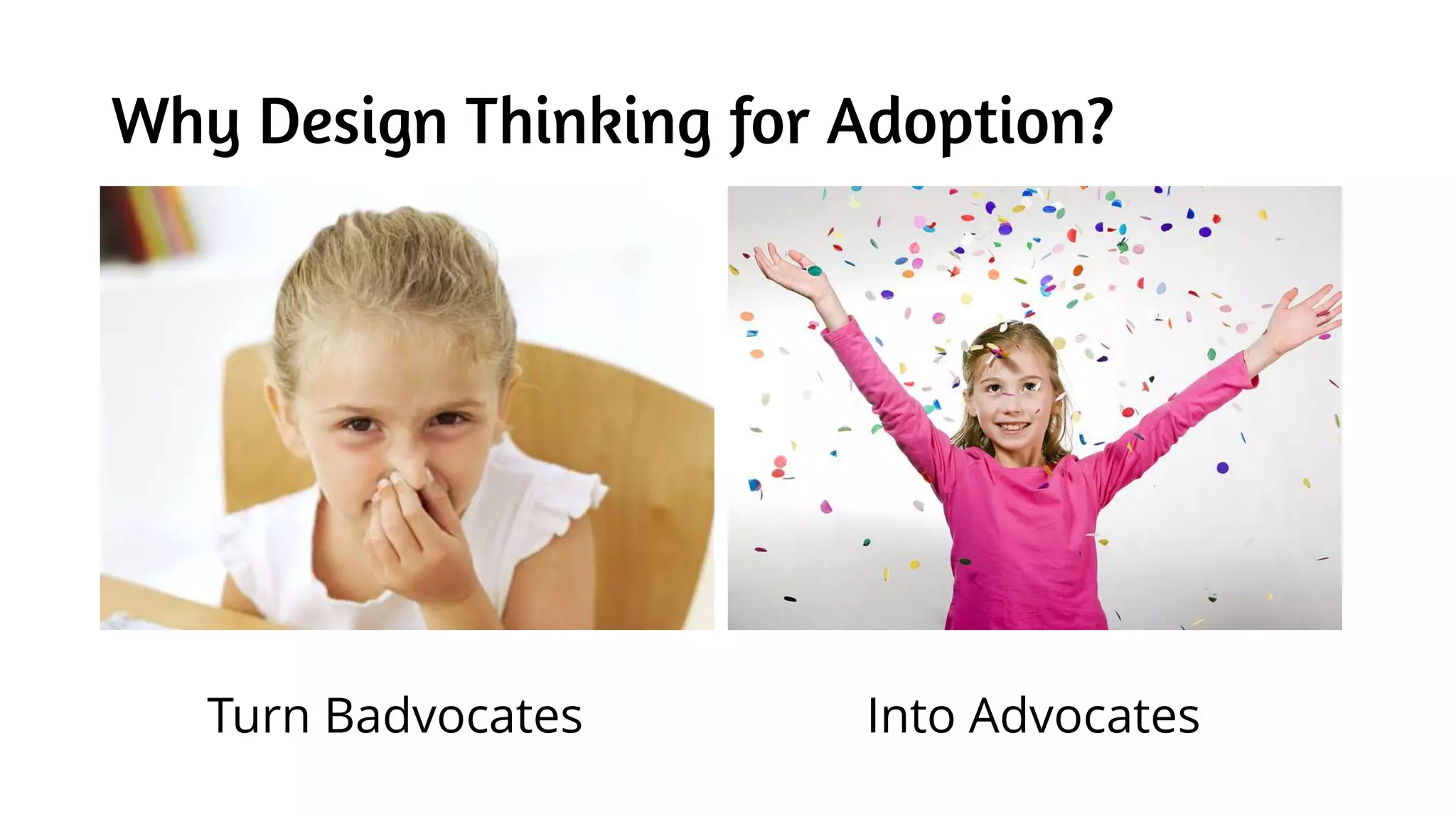
Why Design Thinking for Adoption?
Turn Badvocates Into Advocates
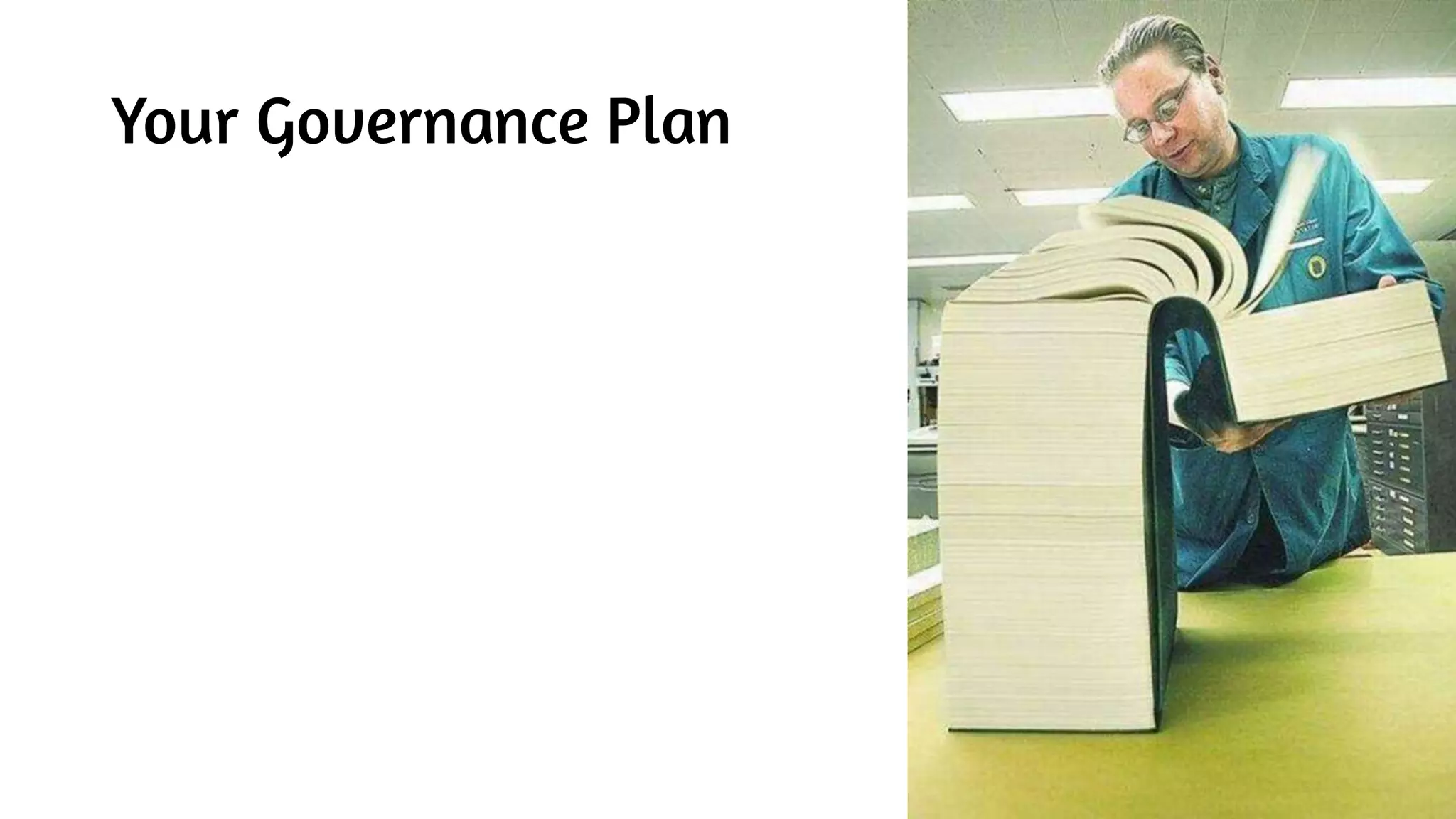
Your Governance Plan
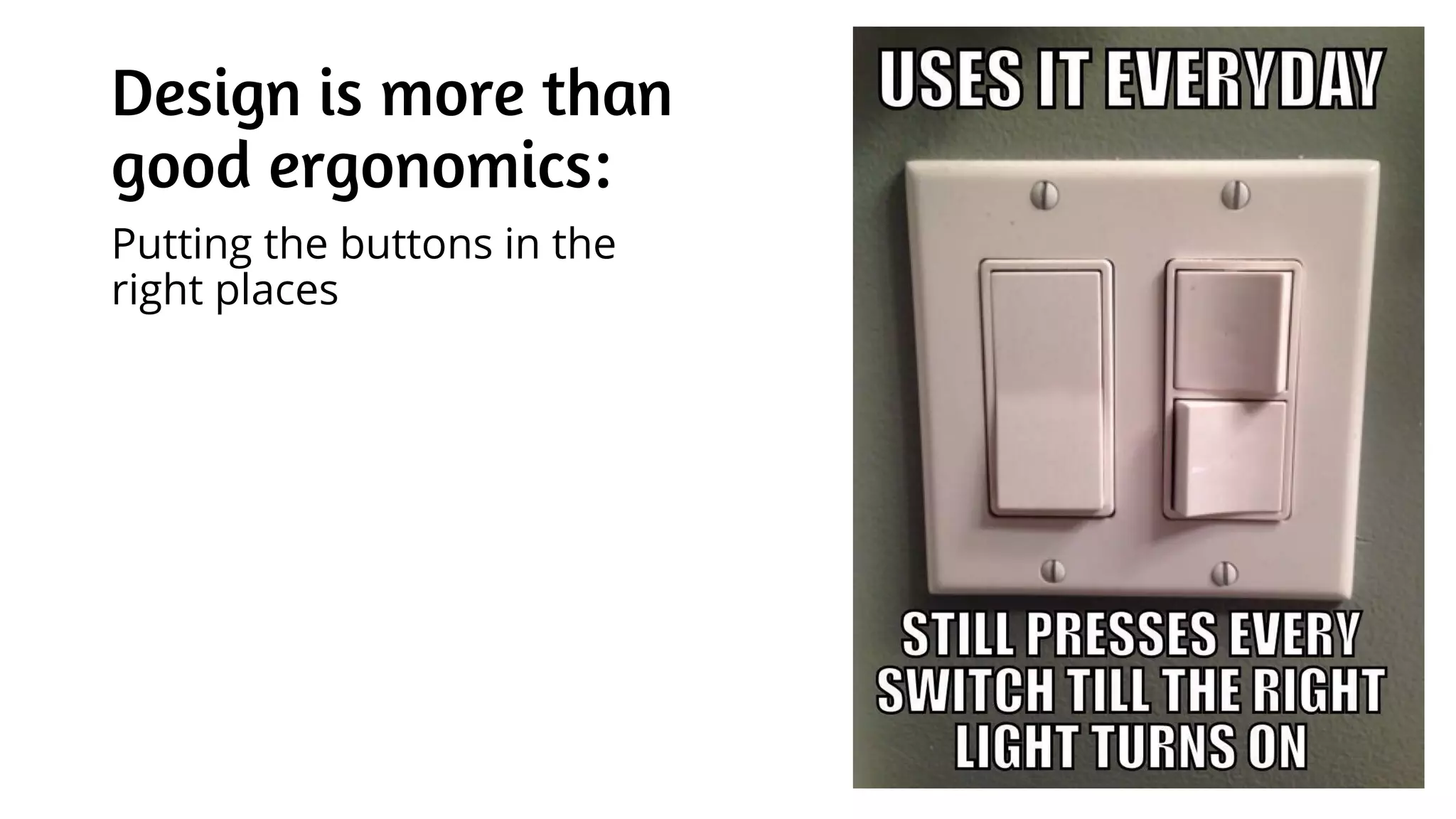
Design is more than
good ergonomics:
Putting the buttons in the
right places
Design Thinking: Goals & Results
• Understand aspirations and motivations
• Don’t start with technology, start with people and culture
• Prototypes speed up the process of innovation
• The faster we do that, the faster our ideas evolve
• From consumption to participation
• Shift from passive relationship from producer to consumer – to
participatory systems
Making Adoption Better
• Application of Design
Thinking forces you to take
the user into account
• MUCH better chance at
success
IT
© SPintersection. All rights reserved.
http://www.SPintersection.com
Please use Events XD (EventBoard)
to fill out a session evaluation.
Questions?
Thank you!

Design Thinking for Adoption - Devintersections-Fall2016.pptx

  • 1.
    Design Thinking forAdoption Michelle Caldwell mary.m.caldwell@Avanade.com
  • 2.
    12 years in SharePoint,18+ in IT MVP PMP CSM 1 son (Brenden) 2 cats (Clark & Snickers) 1 puppy (Zyla)
  • 3.
    The Adoption Challenge Ourusers don’t necessarily agree We’ve invested in what’s good for our users
  • 4.
    Avoiding Adoption Failure Weknow that many initiatives end up disused or under-used
  • 5.
    We want tomake a difference, but… “If you want to make enemies, try to change something” Woodrow Wilson
  • 6.
    It’s not alwaysclear what direction to take
  • 7.
  • 8.
    Search the internet? •Download a PDF guide on adoption? • Attend a session on adoption at DevIntersections?
  • 9.
    Those are allgood, but… • Let’s look at a potential alternative • One that involves your users in a cooperative, collaborative approach to solving the problem
  • 10.
  • 11.
    What is DesignThinking? “Design Thinking is a human- centered approach to innovation that draws from the designer's toolkit to integrate the needs of people, the possibilities of technology, and the requirements for business success.” - Tim Brown, IDEO
  • 12.
    Key Elements ofDesign Thinking • Human-centered • Creative and Playful • Prototype-Driven • Iterative • Collaborative
  • 13.
    Design Thinking Approaches& Methods Examples of Methods – some methods can be applied by anyone, others require design expertise Discover Research Empathize Understand Observe Describe Define Point of View Ideate Brainstorm Create Prototype Visualize Test Develop Implement Launch Deploy Release • Ethnography • User research • User observations • Personas • Journey Maps • Empathy Maps • Brainstorming • User workshops • Sketching • Storyboards • Diagrams, Wireframes • Interactive Simulations • Working Code • Test Workshops • A/B Testing • Website • Application • Process Design Thinking is not a set process: the specific steps and terminology vary between approaches, and there are over 50 design methods to select from for a particular situation
  • 14.
    The S-Curve &Design Thinking
  • 15.
    The S-Curve isPartially Driven by Adoption Patterns
  • 16.
    What is andis NOT Design Thinking? Experimental/explorative nonlinear process Planning linear process
  • 17.
    What is andis NOT Design Thinking? Ethnographies, observation studies, focus groups, interviews to understand the end-user needs “Show and Tell” innovation workshops
  • 18.
    What is andis NOT Design Thinking? Co-creation and brainstorming workshops Single-day workshops
  • 19.
    What is andis NOT Design Thinking? Focus on end-user strategy Focus on technology implementation
  • 20.
    What is andis NOT Design Thinking? Workshops over multiple days/time period Perception of end-user needs based on opinions/secondary research
  • 21.
    What is andis NOT Design Thinking? Project constraints are in place; flexibility to adjust solution, budget and/or deadline as needed Project driven by single discipline (e.g. XD team siloed from technologists)
  • 22.
    What is andis NOT Design Thinking? Multidisciplinary team Narrow audience
  • 23.
    What is andis NOT Design Thinking? Broad audience Fixed solution, budget, and/or deadlines with little to no room for adjustments
  • 24.
    What is andis NOT Design Thinking? Rapid prototyping and testing; evaluation and fine-tuning Presentation of complete solution (without phases of engagement/ prototypes)
  • 25.
  • 26.
  • 28.
    Personas • Reliable • Realistic •Based on Research • Qualitative & • Quantitative http://fakecrow.com/free-persona-template/ http://www.designthinkinguk.com/building-perfect-personas/
  • 29.
  • 30.
    Dear Portal… “You havefrustrated me time and time again” “You were put on this earth to serve me, but alas, I feel that more often then not you are toying with me. Overall, you have let me down” “We laughed, we cried, I shut my laptop in your face sometimes” Dear Portal, I am afraid our long term relationship must come to an end. Over the years…
  • 31.
  • 32.
  • 33.
    Exercise: Q-Storming We needto ask the right questions But… we are often impatient…
  • 34.
    We tend togo directly to the Answers Result: • Miss the mark • Opportunities lost • Disempowered Stakeholders Project Failure: …may need to start over from the beginning
  • 35.
    What is Q-Storming? Amethod of generating breakthrough questions • Time bound • Energy-producing • Diverse participants • Brainstorm the questions related to the subject
  • 36.
    Process of Creatinga Q-Storm • Gather a diverse group of people • A Scribe pre group – record all questions • Establish a brief goal statement with any underlying assumptions • Ask as many questions as they can think of that would need to be attained • Normally 20-30 min (10 min for this exercise) • All questions welcome (none too silly) • Move quickly, but ask one at a time and are recorded • (facilitator can insert questions to get the group going)
  • 37.
  • 38.
    Once the questionshave been generated: • Post them on the wall • Have the group identify natural categories • Divide the group into sub-teams to to focus on specific categories • Refine the list to the most important questions to consider • Have each team share their findings with the large group to develop consensus • Set problem solving priorities
  • 39.
    Results of theQ-Storm • Participant buy-in, empowerment and accountability • A comprehensive set of questions generated from multiple points of view • Unique approaches to considering alternatives • Breakthrough ideas and lines of enquiry
  • 40.
    Why Design Thinkingfor Adoption? Turn Badvocates Into Advocates
  • 41.
  • 42.
    Design is morethan good ergonomics: Putting the buttons in the right places
  • 43.
    Design Thinking: Goals& Results • Understand aspirations and motivations • Don’t start with technology, start with people and culture • Prototypes speed up the process of innovation • The faster we do that, the faster our ideas evolve • From consumption to participation • Shift from passive relationship from producer to consumer – to participatory systems
  • 44.
    Making Adoption Better •Application of Design Thinking forces you to take the user into account • MUCH better chance at success IT
  • 45.
    © SPintersection. Allrights reserved. http://www.SPintersection.com Please use Events XD (EventBoard) to fill out a session evaluation. Questions? Thank you!

Editor's Notes

  • #7 What tool do I use – should I create a blog or a wiki in SharePoint, or use Yammer Yammer can store files, what do I do about that?
  • #14 Human-centered – Starts with empathy and understanding people (the users) through direct observation and research. Creative and Playful –Reframes the problem and looks at it from different perspectives; considers many solutions.Prototype-Driven - Relies on tangible representations of potential solutions to get early user feedback. Iterative – Refines the problem definition and potential solutions based on feedback and testing; learns from early failures. Collaborative – Involves all disciplines throughout the process.
  • #31 The purpose of personas is to create reliable and realistic representations of your key audience segments for reference. These representations should be based on qualitative and some quantitative user research and web analytics. Remember, your personas are only as good as the research behind them. Effective personas: Represent a major user group for your business Express and focus on the major needs and expectations of the most important users Give a clear picture of the user’s expectations and how they’re likely to interact with your business Aid in uncovering universal features and functionality Describe real people with backgrounds, goals, and values