



Design Science in
Information Systems
Sergej Lugović, Mile Čolić, Ivan Dunđer
Artifact, Design science and
Information systems foundations
"The function of what I call design science is to solve
problems by introducing into the environment new artifacts,
the availability of which will induce their spontaneous
employment by humans and thus, coincidentally, cause
humans to abandon their previous problem-producing
behaviors and devices. For example, when humans have a
vital need to cross the roaring rapids of a river, as a design
scientist I would design them a bridge, causing them, I am
sure, to abandon spontaneously and forever the risking of
their lives by trying to swim to the other shore."
- R. Buckminster Fuller, Cosmography
Symbol systems* are almost the quintessential artifacts, for adaptivity to
an environment is their whole raison d'être (reason for existance). They
are goal- seeking, information-processing systems, usually enlisted in
the service of the larger systems in which they are incorporated…
...It must have means for acquiring information from the external
environment that can be encoded into internal symbols, as well as
means for producing symbols that initiate action upon the environment.
Thus it must use symbols to designate objects and relations and actions
in the world external to the system.
...Symbol systems are called "physical" to remind the reader that they
exist as real- world devices, fabricated of glass and metal (computers) or
flesh and blood (brains).
The Sciences of the Artificial - Herbert A. Simon
*In the literature the phrase information-processing system is used more frequently than symbol system.
I will use the two terms as synonyms.
An artifact can be thought of as a meeting point an "interface" in today's terms
between an "inner" environment, the substance and organization of the artifact itself,
and an ''outer" environment, the surroundings in which it operates. If the inner
environment is appropriate to the outer environment, or vice versa, the artifact will
serve its intended purpose.
1. Artificial things are synthesized by human beings.
2. Artificial things may imitate appearances in natural things while lacking, the reality
of the latter.
3. Artificial things can be characterized in terms of functions, goals, adaptation.
4. Artificial things are often discussed, particularly when they are being designed, in
terms of imperatives as well as descriptives.
With artificial science approach we could look for optimal
solutions instead of satisfactory.
The Sciences of the Artificial - Herbert A. Simon
Science, design and information
systems
Two scientific paradigms in IS design
Behavioral science paradigm - roots in natural science. Develop theories
that explain or predict organizational and human phenomena.
BUT
such a paradigms are impacted by design decisions of IS
Design-science paradigm - roots in engineering and the science of
artificial. It is a problem solving paradigm.
BUT they are not free from natural laws or behavioral theories
IS is done in two complementary phases
Behavioral science address research through the development
and justification of the theories that explain or predict
phenomena.
Goal is truth.
Design science address research through the building and
evaluation of artifacts.
Goal is utility
● Design is process (set of activities) and product (artifacts).
● It describes the world as acted upon (process) and as sensed (product).
● Evaluation of the artifact provides feedback, which is used to improve
design process and quality of the product.
● By doing so, it improve theories on which design is based on
A Design Science is an inventive or creative, problem solving activity, one in
which new technologies are the primary products...theory should be a primary
output and that theory and theorising need to play a central role in the
advancement of Design Science Research in IS (as well as in other fields)...and
more importantly how it should be – practiced in IS….
Venable, 2006
What is Design Science in Information systems?
Guidelines for Design Science in IS Research (Hevner et al (2004)
:
(1) Design as an Artifact - (based on March and Smith)
(2) Problem Relevance – address a relevant and important problem
(3) Design Evaluation – design artifact must be rigorously evaluated.
(4) Research Contributions – contribution must be clear and verifiable.
(5) Research Rigour – research methods must be rigorously applied.
(6) Design as a Search Process – research based on other competing
approaches, in which solutions are tested against each other
(7) Communication of the Research – to academic’s and professional’s audience
Models from 1990 - 2007
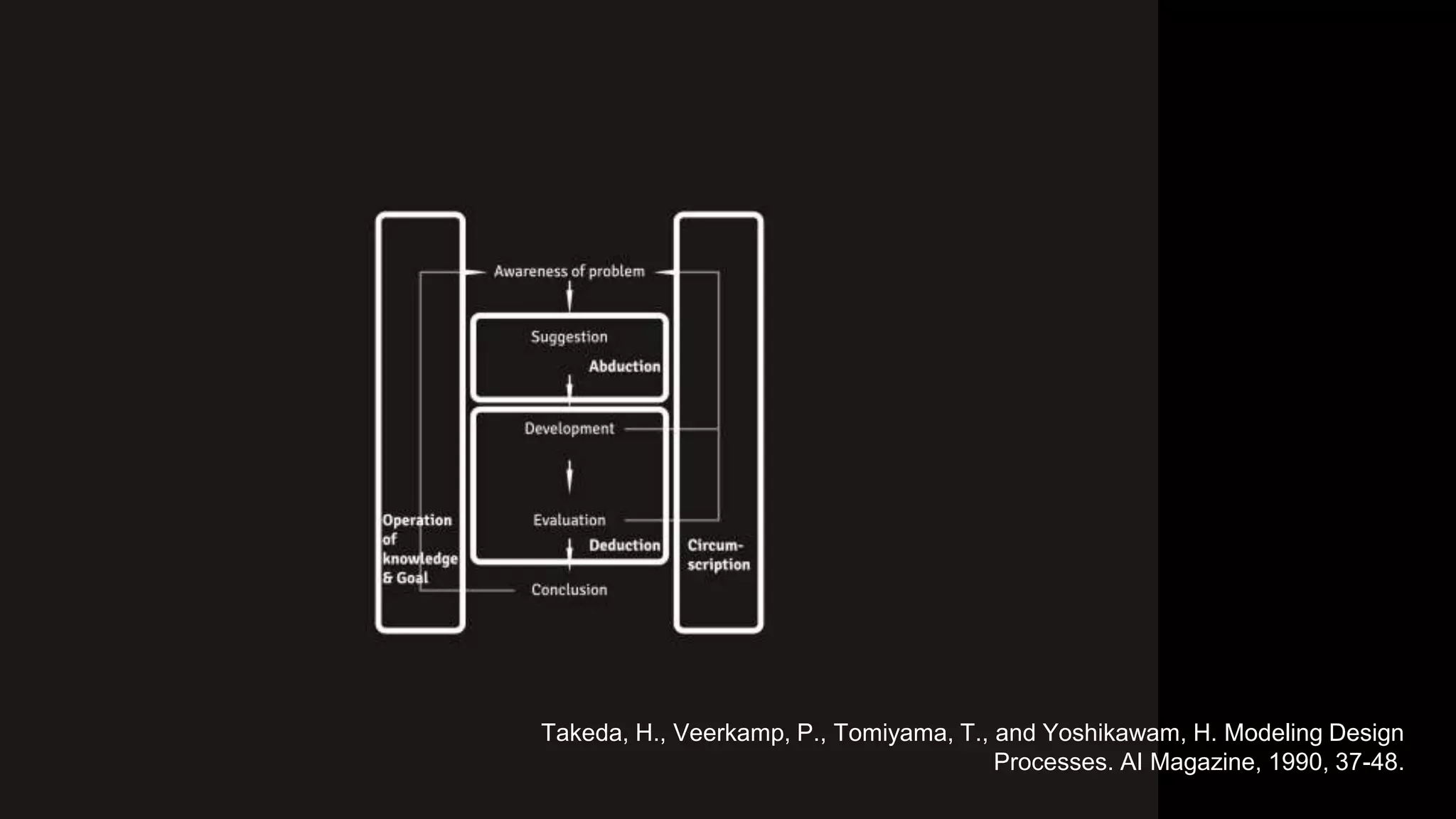
Takeda, H., Veerkamp, P., Tomiyama, T., and Yoshikawam, H. Modeling Design
Processes. AI Magazine, 1990, 37-48.
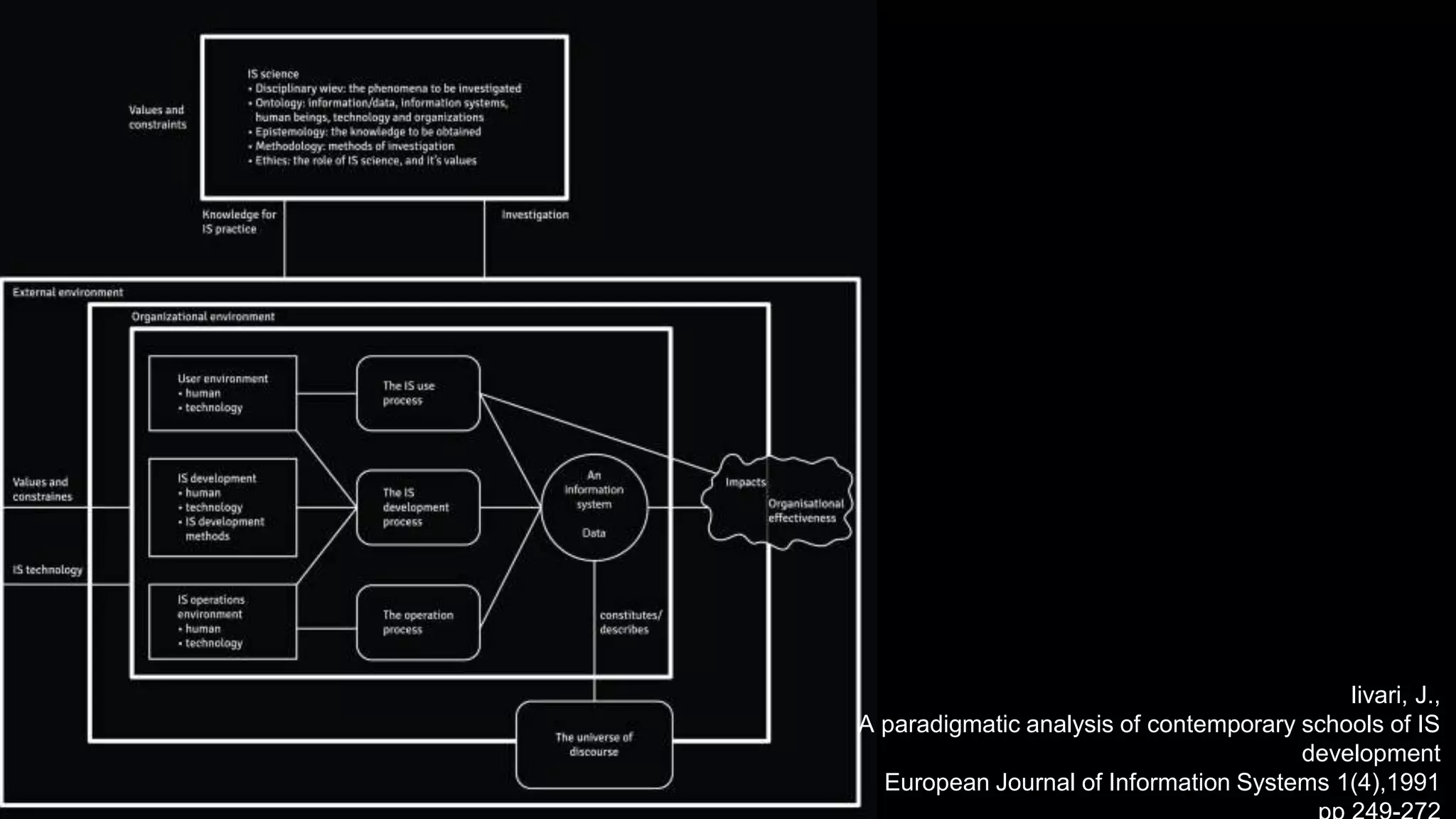
Iivari, J.,
A paradigmatic analysis of contemporary schools of IS
development
European Journal of Information Systems 1(4),1991
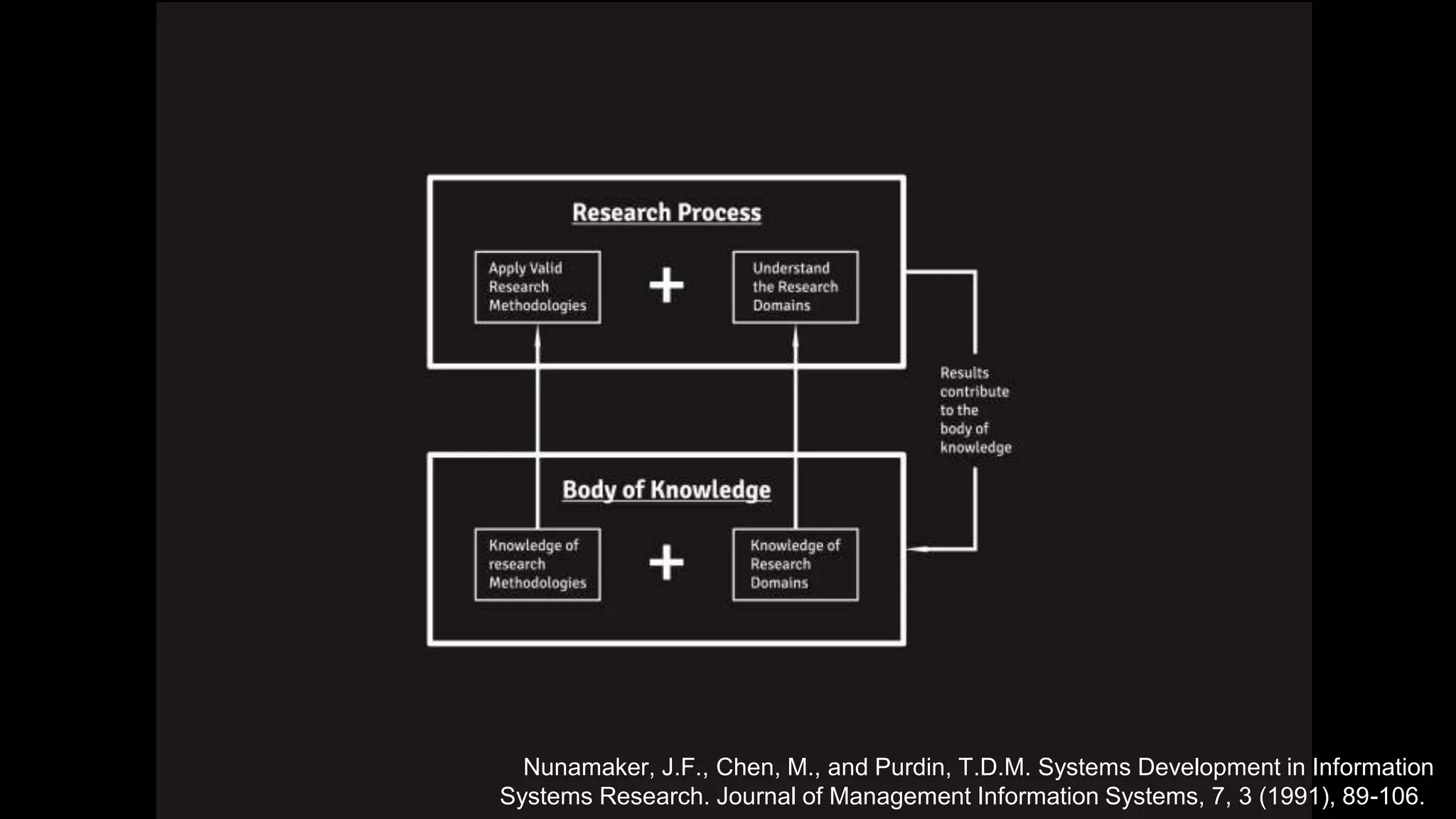
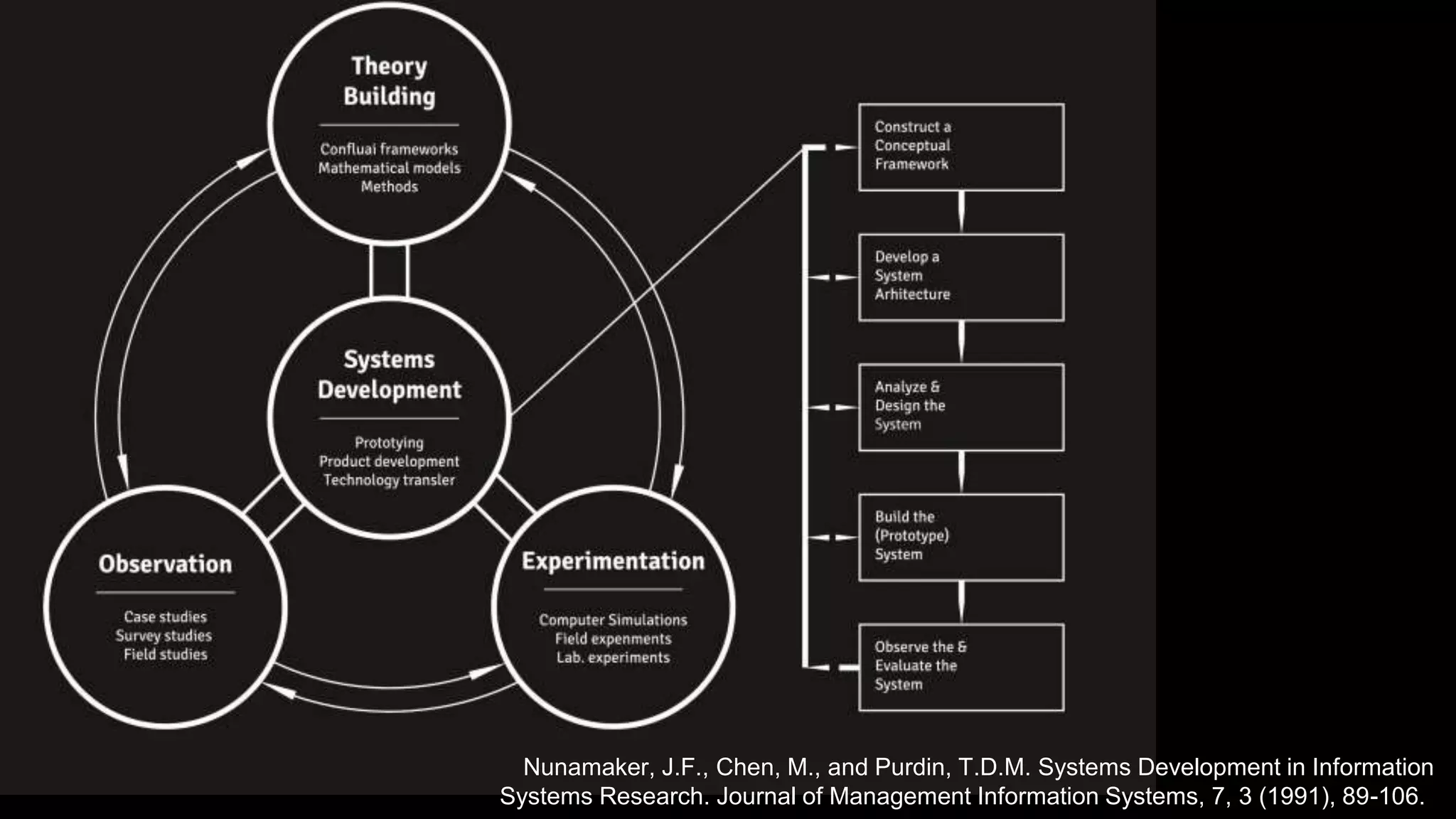
Nunamaker, J.F., Chen, M., and Purdin, T.D.M. Systems Development in Information
Systems Research. Journal of Management Information Systems, 7, 3 (1991), 89-106.
Nunamaker, J.F., Chen, M., and Purdin, T.D.M. Systems Development in Information
Systems Research. Journal of Management Information Systems, 7, 3 (1991), 89-106.
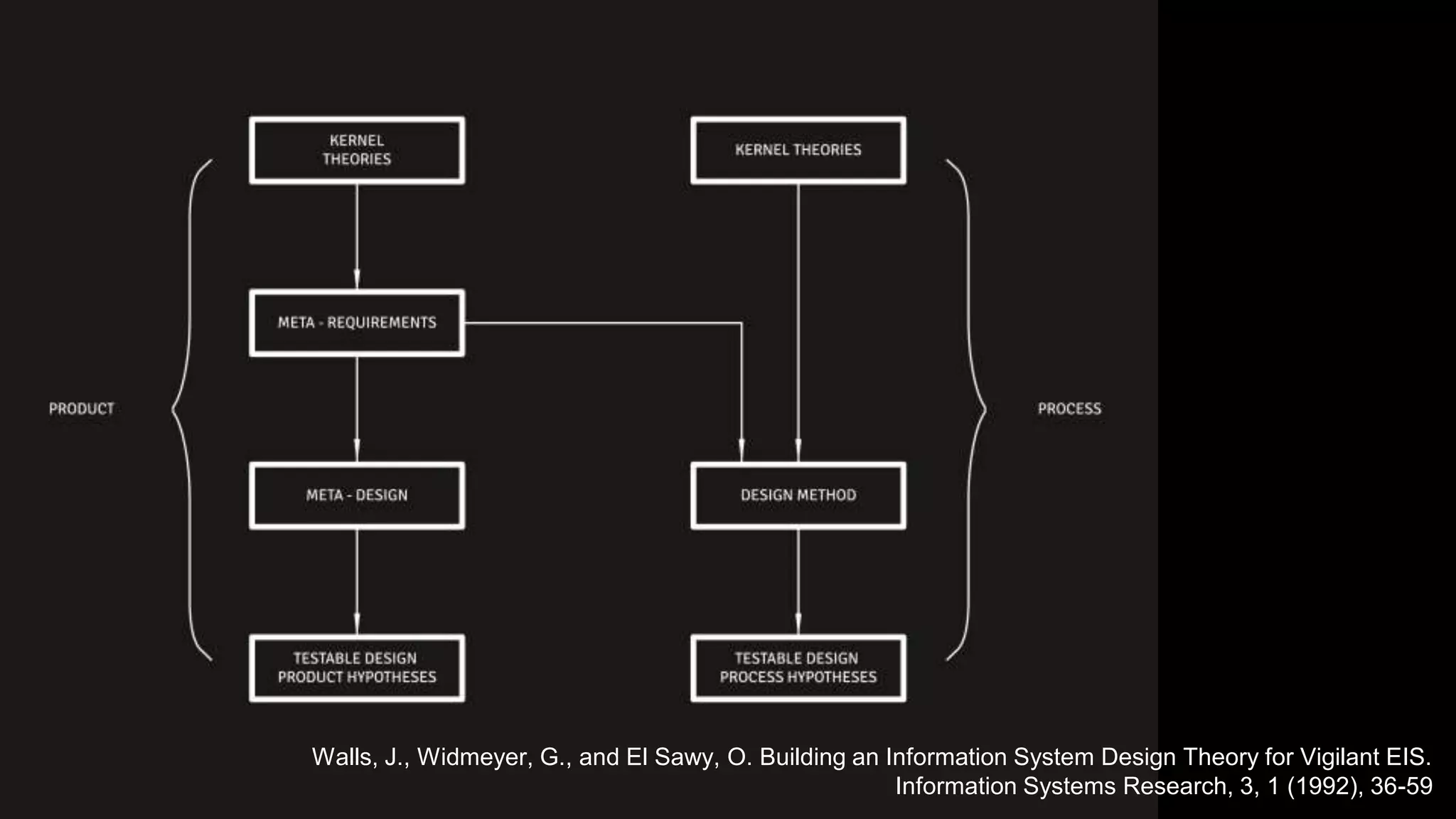
Walls, J., Widmeyer, G., and El Sawy, O. Building an Information System Design Theory for Vigilant EIS.
Information Systems Research, 3, 1 (1992), 36-59
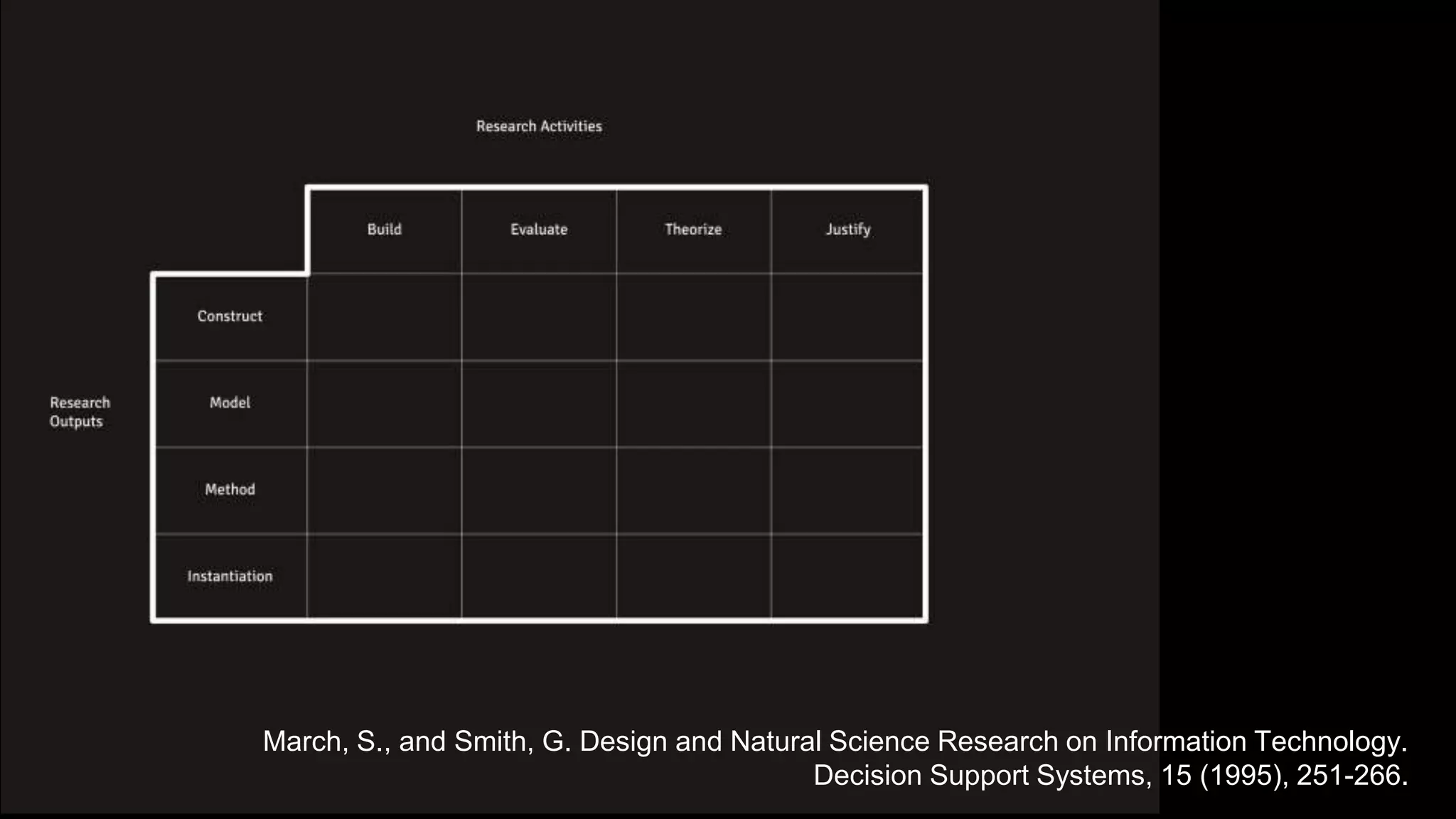
March, S., and Smith, G. Design and Natural Science Research on Information Technology.
Decision Support Systems, 15 (1995), 251-266.
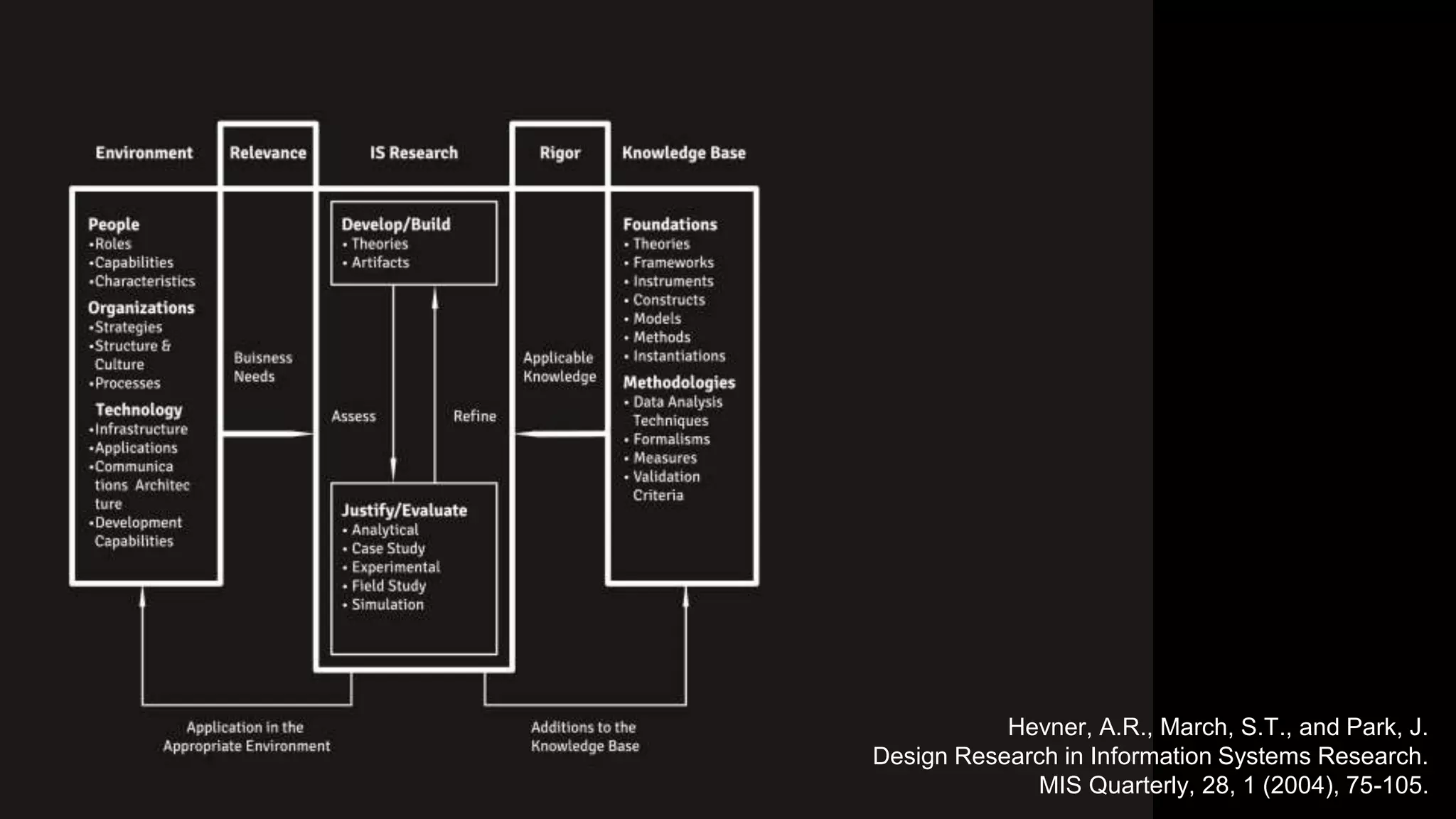
Hevner, A.R., March, S.T., and Park, J.
Design Research in Information Systems Research.
MIS Quarterly, 28, 1 (2004), 75-105.
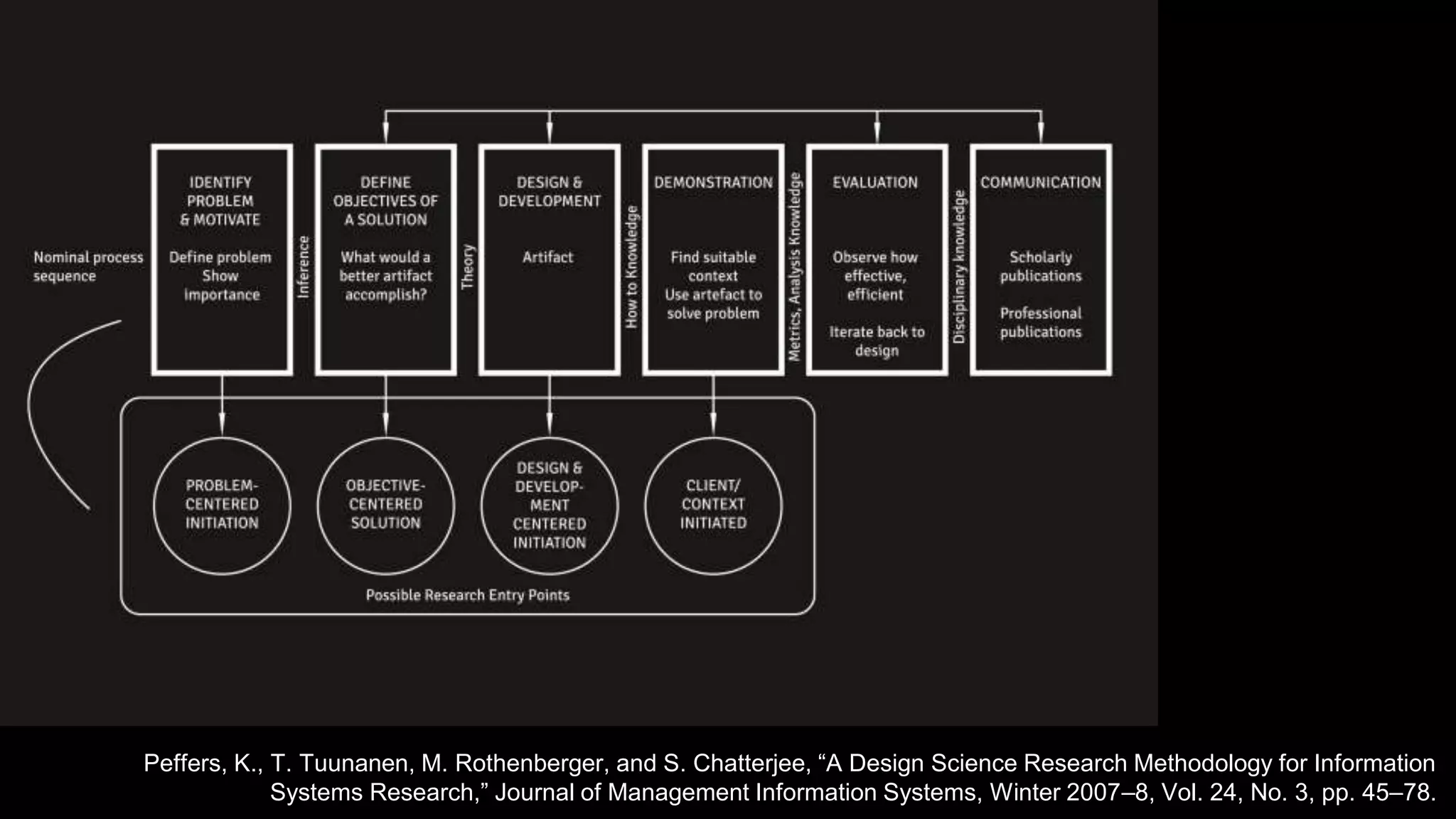
Peffers, K., T. Tuunanen, M. Rothenberger, and S. Chatterjee, “A Design Science Research Methodology for Information
Systems Research,” Journal of Management Information Systems, Winter 2007–8, Vol. 24, No. 3, pp. 45–78.
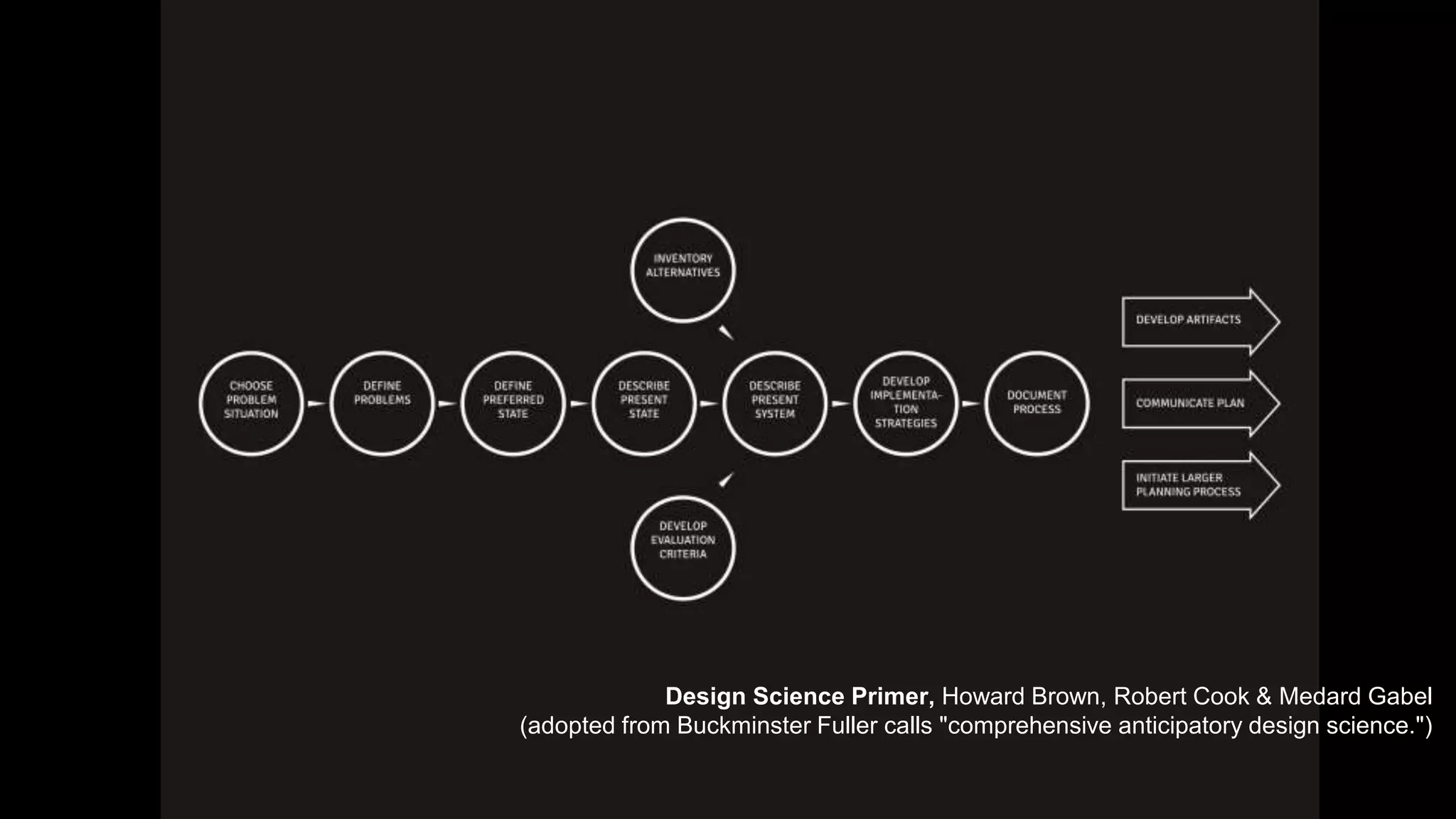
Design Science Primer, Howard Brown, Robert Cook & Medard Gabel
(adopted from Buckminster Fuller calls "comprehensive anticipatory design science.")
Is it applied science ?
1. Information Systems is ultimately an applied discipline.
2. Prescriptive research is an essential part of Information Systems as an applied discipline.
3. The design science activity of building IT artifacts is an important part of prescriptive research in Information
Systems.
4. The primary interest of Information Systems lies in IT applications and therefore Information Systems as a
design science should be based on a sound ontology of IT artifacts and especially of IT applications.
5. Information Systems as a design science builds IT meta-artifacts that support the development of concrete IT
applications.
6. The resulting IT meta-artifacts essentially entail design product and design process knowledge.
7. Design product and design process knowledge, as prescriptive knowledge, forms a knowledge area of its own
and cannot be reduced to the descriptive knowledge of theories and empirical regularities.
8. Constructive research methods should make the process of building IT meta-artifacts disciplined, rigorous
and transparent.
9. Explication of the practical problems to be solved, the existing artifacts to be improved, the analogies and
metaphors to be used, and/or the kernel theories to be applied is significant in making the building
process disciplined, rigorous and transparent.
10. The term ‘design theory’ should be used only when it is based on a sound kernel theory.
11. Information Systems as a design science cannot be value-free, but it may reflect means-end, interpretive or
critical orientation.
12. The values of design science research should be made as explicit as possible.
Iivari - 12 thesis about design science
Pragmatism is a school of thought that considers practical consequences or real effects
to be vital components of both meaning and truth. Along these lines I contend that
design science research is essentially pragmatic in nature due to its emphasis on
relevance; making a clear contribution into the application environment. However,
practical utility alone does not define good design science research. It is the synergy
between relevance and rigor and the contri- butions along both the relevance cycle and
the rigor cycle that define good design science research.
Since its beginnings in 1953, the NSF has strug- gled with distinctions between basic
science and applied science in its award- ing of research funds1 to academic
researchers. Does the practical utility of a result necessarily make the research project
applied science? Can a research project effectively balance goals of fundamental
scientific understanding with considerations of the usefulness of the resulting artifacts?
Hevner currently assigned in U.S. National Science Foundation (NSF)
Hevner response
Information science and
Information System science
Information Science’s Big Questions
1) The physical question: What are the features and laws of the recorded-
information universe?
2) The social question: How do people relate to, seek, and use information?
3) The design question: How can access to recorded information be made most
rapid and effective?
Bates, 1999
Information systems and Information Science
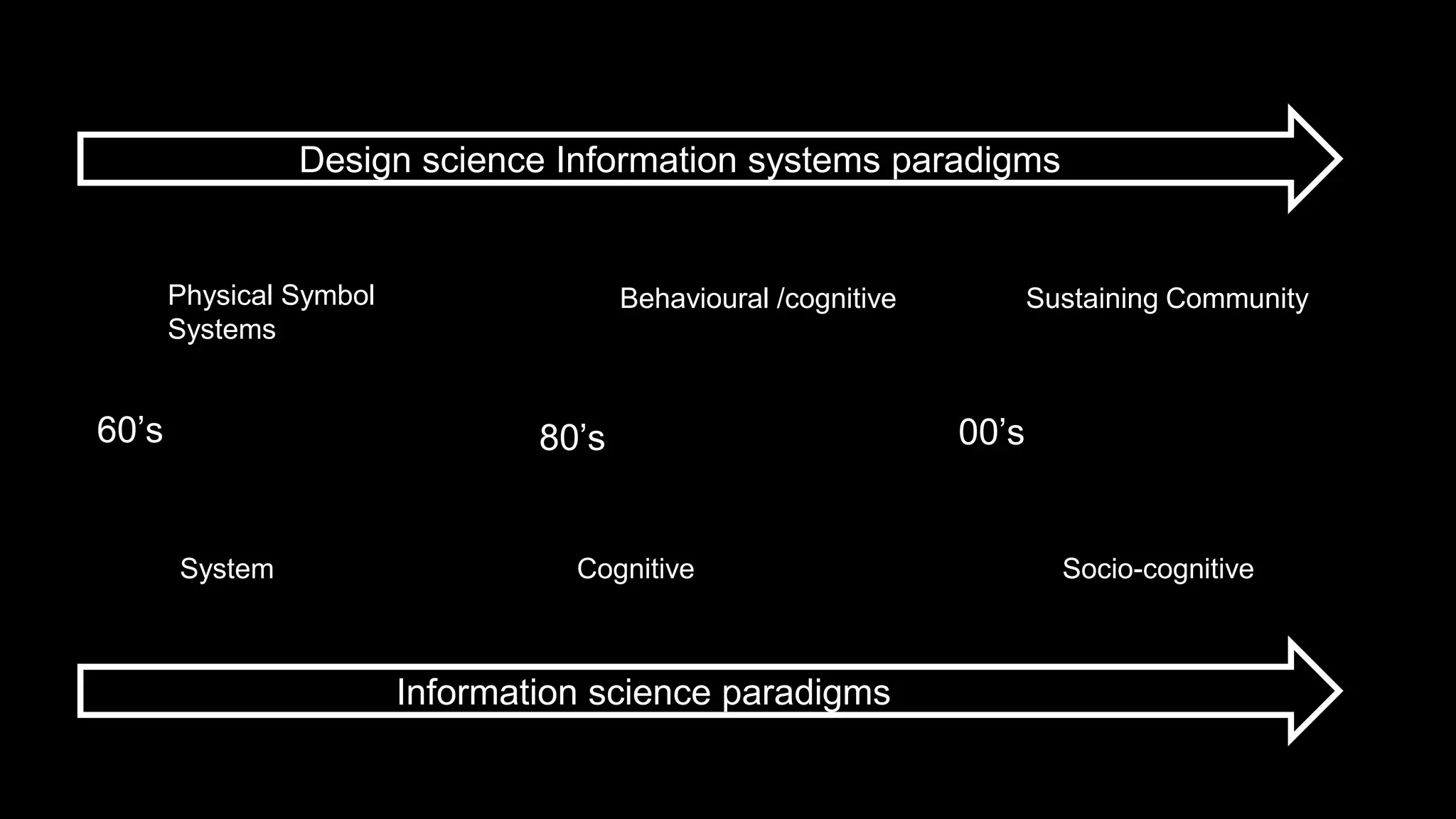
Design science Information systems paradigms
Information science paradigms
60’s 80’s
Physical Symbol
Systems
System Cognitive Socio-cognitive
00’s
Behavioural /cognitive Sustaining Community
Recent development
Distinguishing and contrasting two strategies for design
science research, Iivari
European Journal of Information Systems , (7 January 2014)
This paper distinguishes and contrasts two design science research strategies in information
systems.
In the first strategy, a researcher constructs or builds an IT meta-artefact as a general solution
concept to address a class of problem.
In the second strategy, a researcher attempts to solve a client’s specific problem by building a
concrete IT artefact in that specific context and distils from that experience prescriptive knowledge
to be packaged into a general solution concept to address a class of problem.
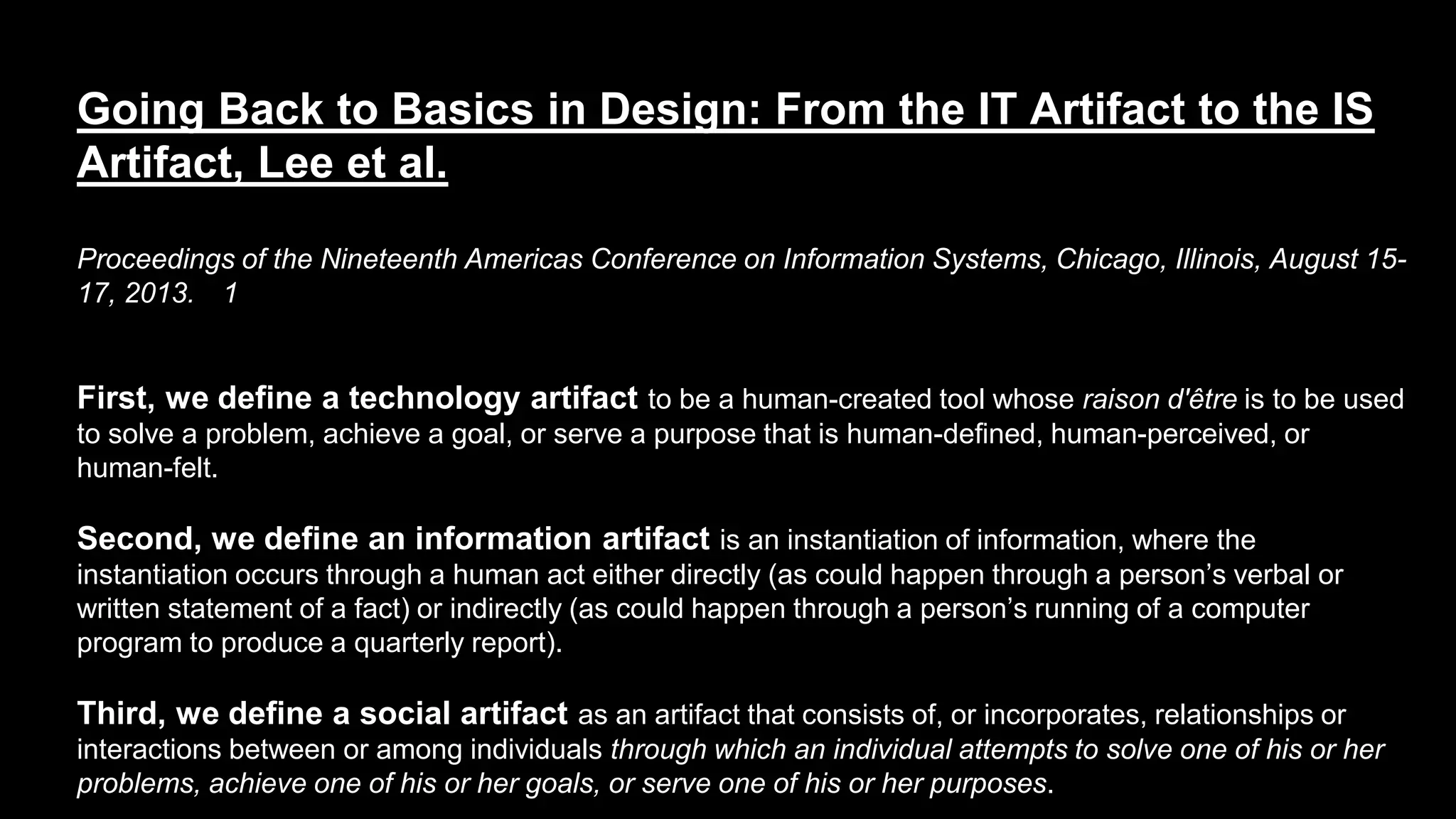
Going Back to Basics in Design: From the IT Artifact to the IS
Artifact, Lee et al.
Proceedings of the Nineteenth Americas Conference on Information Systems, Chicago, Illinois, August 15-
17, 2013. 1
First, we define a technology artifact to be a human-created tool whose raison d'être is to be used
to solve a problem, achieve a goal, or serve a purpose that is human-defined, human-perceived, or
human-felt.
Second, we define an information artifact is an instantiation of information, where the
instantiation occurs through a human act either directly (as could happen through a person’s verbal or
written statement of a fact) or indirectly (as could happen through a person’s running of a computer
program to produce a quarterly report).
Third, we define a social artifact as an artifact that consists of, or incorporates, relationships or
interactions between or among individuals through which an individual attempts to solve one of his or her
problems, achieve one of his or her goals, or serve one of his or her purposes.

Design Science in Information Systems

  • 1.
    Design Science in InformationSystems Sergej Lugović, Mile Čolić, Ivan Dunđer
  • 2.
    Artifact, Design scienceand Information systems foundations
  • 3.
    "The function ofwhat I call design science is to solve problems by introducing into the environment new artifacts, the availability of which will induce their spontaneous employment by humans and thus, coincidentally, cause humans to abandon their previous problem-producing behaviors and devices. For example, when humans have a vital need to cross the roaring rapids of a river, as a design scientist I would design them a bridge, causing them, I am sure, to abandon spontaneously and forever the risking of their lives by trying to swim to the other shore." - R. Buckminster Fuller, Cosmography
  • 4.
    Symbol systems* arealmost the quintessential artifacts, for adaptivity to an environment is their whole raison d'être (reason for existance). They are goal- seeking, information-processing systems, usually enlisted in the service of the larger systems in which they are incorporated… ...It must have means for acquiring information from the external environment that can be encoded into internal symbols, as well as means for producing symbols that initiate action upon the environment. Thus it must use symbols to designate objects and relations and actions in the world external to the system. ...Symbol systems are called "physical" to remind the reader that they exist as real- world devices, fabricated of glass and metal (computers) or flesh and blood (brains). The Sciences of the Artificial - Herbert A. Simon *In the literature the phrase information-processing system is used more frequently than symbol system. I will use the two terms as synonyms.
  • 5.
    An artifact canbe thought of as a meeting point an "interface" in today's terms between an "inner" environment, the substance and organization of the artifact itself, and an ''outer" environment, the surroundings in which it operates. If the inner environment is appropriate to the outer environment, or vice versa, the artifact will serve its intended purpose. 1. Artificial things are synthesized by human beings. 2. Artificial things may imitate appearances in natural things while lacking, the reality of the latter. 3. Artificial things can be characterized in terms of functions, goals, adaptation. 4. Artificial things are often discussed, particularly when they are being designed, in terms of imperatives as well as descriptives. With artificial science approach we could look for optimal solutions instead of satisfactory. The Sciences of the Artificial - Herbert A. Simon
  • 6.
    Science, design andinformation systems
  • 7.
    Two scientific paradigmsin IS design Behavioral science paradigm - roots in natural science. Develop theories that explain or predict organizational and human phenomena. BUT such a paradigms are impacted by design decisions of IS Design-science paradigm - roots in engineering and the science of artificial. It is a problem solving paradigm. BUT they are not free from natural laws or behavioral theories
  • 8.
    IS is donein two complementary phases Behavioral science address research through the development and justification of the theories that explain or predict phenomena. Goal is truth. Design science address research through the building and evaluation of artifacts. Goal is utility
  • 9.
    ● Design isprocess (set of activities) and product (artifacts). ● It describes the world as acted upon (process) and as sensed (product). ● Evaluation of the artifact provides feedback, which is used to improve design process and quality of the product. ● By doing so, it improve theories on which design is based on A Design Science is an inventive or creative, problem solving activity, one in which new technologies are the primary products...theory should be a primary output and that theory and theorising need to play a central role in the advancement of Design Science Research in IS (as well as in other fields)...and more importantly how it should be – practiced in IS…. Venable, 2006 What is Design Science in Information systems?
  • 10.
    Guidelines for DesignScience in IS Research (Hevner et al (2004) : (1) Design as an Artifact - (based on March and Smith) (2) Problem Relevance – address a relevant and important problem (3) Design Evaluation – design artifact must be rigorously evaluated. (4) Research Contributions – contribution must be clear and verifiable. (5) Research Rigour – research methods must be rigorously applied. (6) Design as a Search Process – research based on other competing approaches, in which solutions are tested against each other (7) Communication of the Research – to academic’s and professional’s audience
  • 11.
  • 12.
    Takeda, H., Veerkamp,P., Tomiyama, T., and Yoshikawam, H. Modeling Design Processes. AI Magazine, 1990, 37-48.
  • 13.
    Iivari, J., A paradigmaticanalysis of contemporary schools of IS development European Journal of Information Systems 1(4),1991
  • 14.
    Nunamaker, J.F., Chen,M., and Purdin, T.D.M. Systems Development in Information Systems Research. Journal of Management Information Systems, 7, 3 (1991), 89-106.
  • 15.
    Nunamaker, J.F., Chen,M., and Purdin, T.D.M. Systems Development in Information Systems Research. Journal of Management Information Systems, 7, 3 (1991), 89-106.
  • 16.
    Walls, J., Widmeyer,G., and El Sawy, O. Building an Information System Design Theory for Vigilant EIS. Information Systems Research, 3, 1 (1992), 36-59
  • 17.
    March, S., andSmith, G. Design and Natural Science Research on Information Technology. Decision Support Systems, 15 (1995), 251-266.
  • 18.
    Hevner, A.R., March,S.T., and Park, J. Design Research in Information Systems Research. MIS Quarterly, 28, 1 (2004), 75-105.
  • 19.
    Peffers, K., T.Tuunanen, M. Rothenberger, and S. Chatterjee, “A Design Science Research Methodology for Information Systems Research,” Journal of Management Information Systems, Winter 2007–8, Vol. 24, No. 3, pp. 45–78.
  • 20.
    Design Science Primer,Howard Brown, Robert Cook & Medard Gabel (adopted from Buckminster Fuller calls "comprehensive anticipatory design science.")
  • 21.
    Is it appliedscience ?
  • 22.
    1. Information Systemsis ultimately an applied discipline. 2. Prescriptive research is an essential part of Information Systems as an applied discipline. 3. The design science activity of building IT artifacts is an important part of prescriptive research in Information Systems. 4. The primary interest of Information Systems lies in IT applications and therefore Information Systems as a design science should be based on a sound ontology of IT artifacts and especially of IT applications. 5. Information Systems as a design science builds IT meta-artifacts that support the development of concrete IT applications. 6. The resulting IT meta-artifacts essentially entail design product and design process knowledge. 7. Design product and design process knowledge, as prescriptive knowledge, forms a knowledge area of its own and cannot be reduced to the descriptive knowledge of theories and empirical regularities. 8. Constructive research methods should make the process of building IT meta-artifacts disciplined, rigorous and transparent. 9. Explication of the practical problems to be solved, the existing artifacts to be improved, the analogies and metaphors to be used, and/or the kernel theories to be applied is significant in making the building process disciplined, rigorous and transparent. 10. The term ‘design theory’ should be used only when it is based on a sound kernel theory. 11. Information Systems as a design science cannot be value-free, but it may reflect means-end, interpretive or critical orientation. 12. The values of design science research should be made as explicit as possible. Iivari - 12 thesis about design science
  • 23.
    Pragmatism is aschool of thought that considers practical consequences or real effects to be vital components of both meaning and truth. Along these lines I contend that design science research is essentially pragmatic in nature due to its emphasis on relevance; making a clear contribution into the application environment. However, practical utility alone does not define good design science research. It is the synergy between relevance and rigor and the contri- butions along both the relevance cycle and the rigor cycle that define good design science research. Since its beginnings in 1953, the NSF has strug- gled with distinctions between basic science and applied science in its award- ing of research funds1 to academic researchers. Does the practical utility of a result necessarily make the research project applied science? Can a research project effectively balance goals of fundamental scientific understanding with considerations of the usefulness of the resulting artifacts? Hevner currently assigned in U.S. National Science Foundation (NSF) Hevner response
  • 24.
  • 25.
    Information Science’s BigQuestions 1) The physical question: What are the features and laws of the recorded- information universe? 2) The social question: How do people relate to, seek, and use information? 3) The design question: How can access to recorded information be made most rapid and effective? Bates, 1999 Information systems and Information Science
  • 26.
    Design science Informationsystems paradigms Information science paradigms 60’s 80’s Physical Symbol Systems System Cognitive Socio-cognitive 00’s Behavioural /cognitive Sustaining Community
  • 27.
  • 28.
    Distinguishing and contrastingtwo strategies for design science research, Iivari European Journal of Information Systems , (7 January 2014) This paper distinguishes and contrasts two design science research strategies in information systems. In the first strategy, a researcher constructs or builds an IT meta-artefact as a general solution concept to address a class of problem. In the second strategy, a researcher attempts to solve a client’s specific problem by building a concrete IT artefact in that specific context and distils from that experience prescriptive knowledge to be packaged into a general solution concept to address a class of problem.
  • 29.
    Going Back toBasics in Design: From the IT Artifact to the IS Artifact, Lee et al. Proceedings of the Nineteenth Americas Conference on Information Systems, Chicago, Illinois, August 15- 17, 2013. 1 First, we define a technology artifact to be a human-created tool whose raison d'être is to be used to solve a problem, achieve a goal, or serve a purpose that is human-defined, human-perceived, or human-felt. Second, we define an information artifact is an instantiation of information, where the instantiation occurs through a human act either directly (as could happen through a person’s verbal or written statement of a fact) or indirectly (as could happen through a person’s running of a computer program to produce a quarterly report). Third, we define a social artifact as an artifact that consists of, or incorporates, relationships or interactions between or among individuals through which an individual attempts to solve one of his or her problems, achieve one of his or her goals, or serve one of his or her purposes.