An Introduction to the
Systematic Inventive
Thinking (SIT)
Method
Tathagat Varma
Country Manager, NerdWallet
What separates them?
Innovation!!!
Systematic Inventive
Thinking (SIT)
Surprisingly, the majority of new,
inventive, and successful products
result from just five patterns.
SIT harnesses these five thinking
patterns that mankind has used for
thousands of years.
http://drewboyd.com/systematic-inventive-thinking/
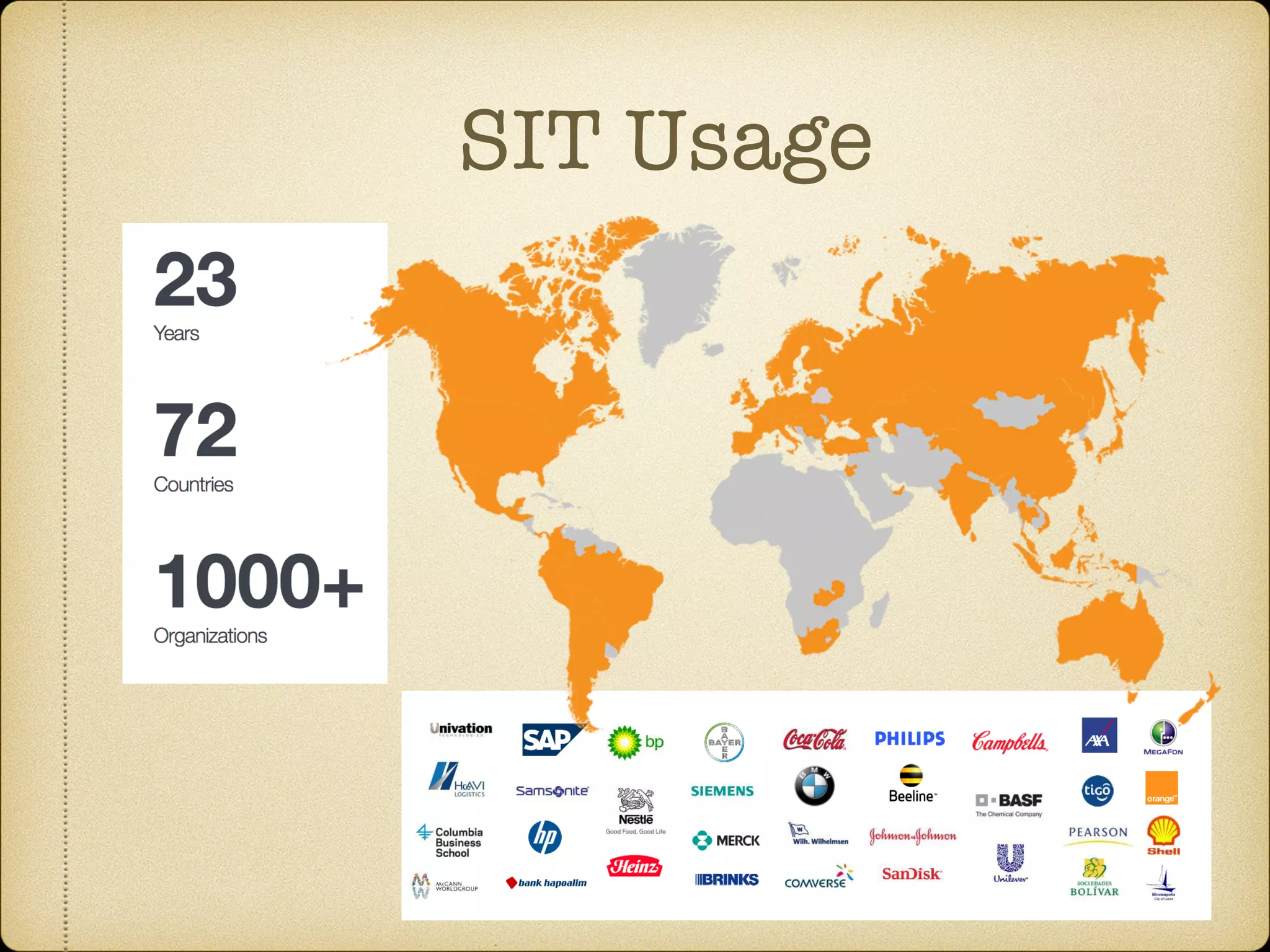
SIT Usage
SIT Principles
Cognitive Fixedness
Path of Most Resistance
Closed World
Function Follows Form
Existing Situation
Virtual Product
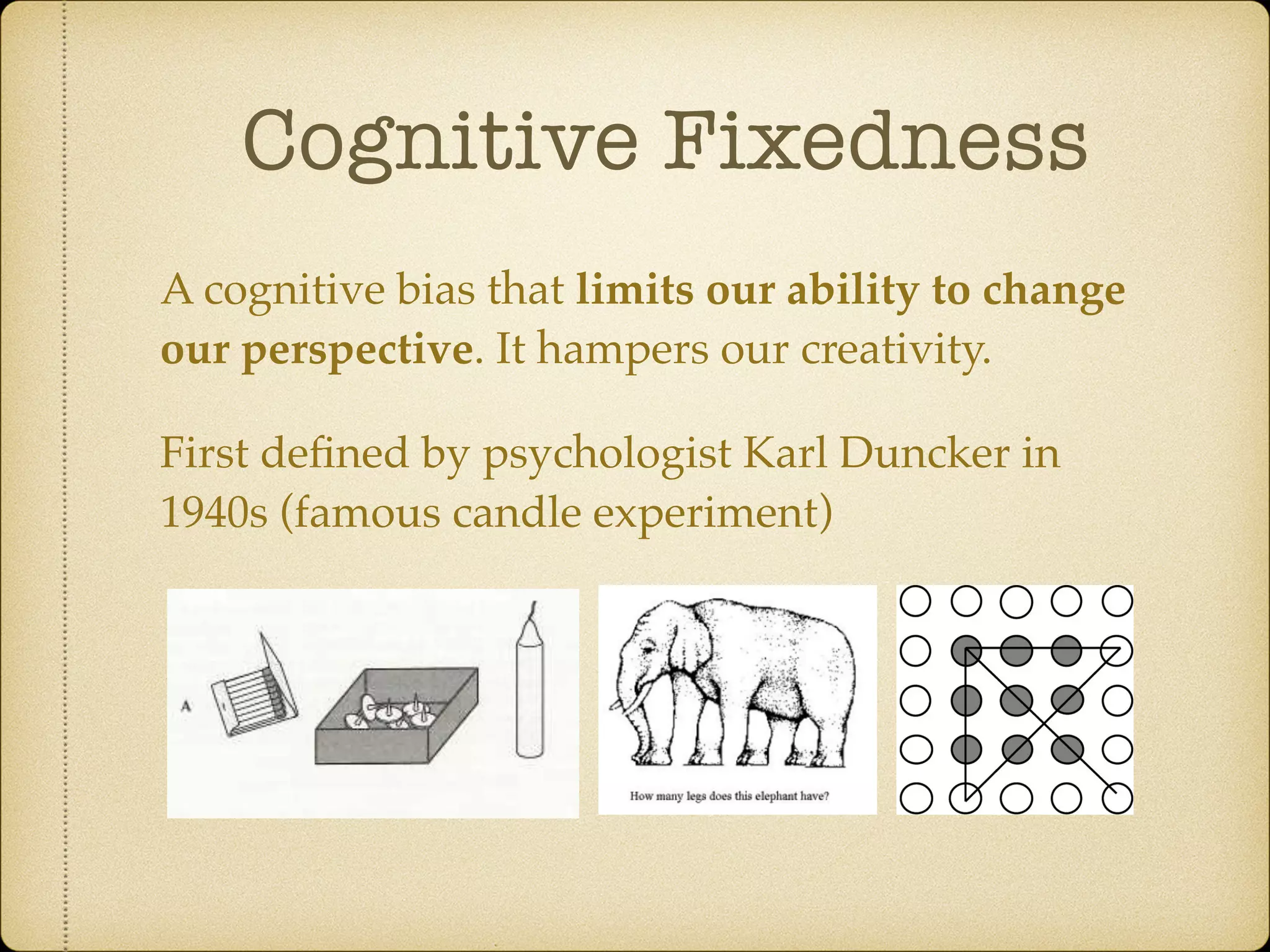
Cognitive Fixedness
A cognitive bias that limits our ability to change
our perspective. It hampers our creativity.
First defined by psychologist Karl Duncker in
1940s (famous candle experiment)
Types of Fixedness
Functional Fixedness: Use something
only for what it was designed for
Structural Fixedness: Unwillingness to
accept objects in a different shape
Relational Fixedness: The
interrelationship between two objects
Path of Most
Resistance (PoMR)
In nature, water cascading down a mountain will always
follow the path of least resistance- the easiest route. In
thinking, too, our minds tend to take the path of least
resistance- those avenues that are familiar to us. In doing
so, it is difficult to arrive at new ideas. Therefore, when
we want to come up with really new and innovative
ideas, it makes sense to take the counter-intuitive path
– the path of most resistance. This is the path our minds
are much less accustomed to using. All SIT tools are
designed to lead thinkers through their PoMR.
Closed World Principle
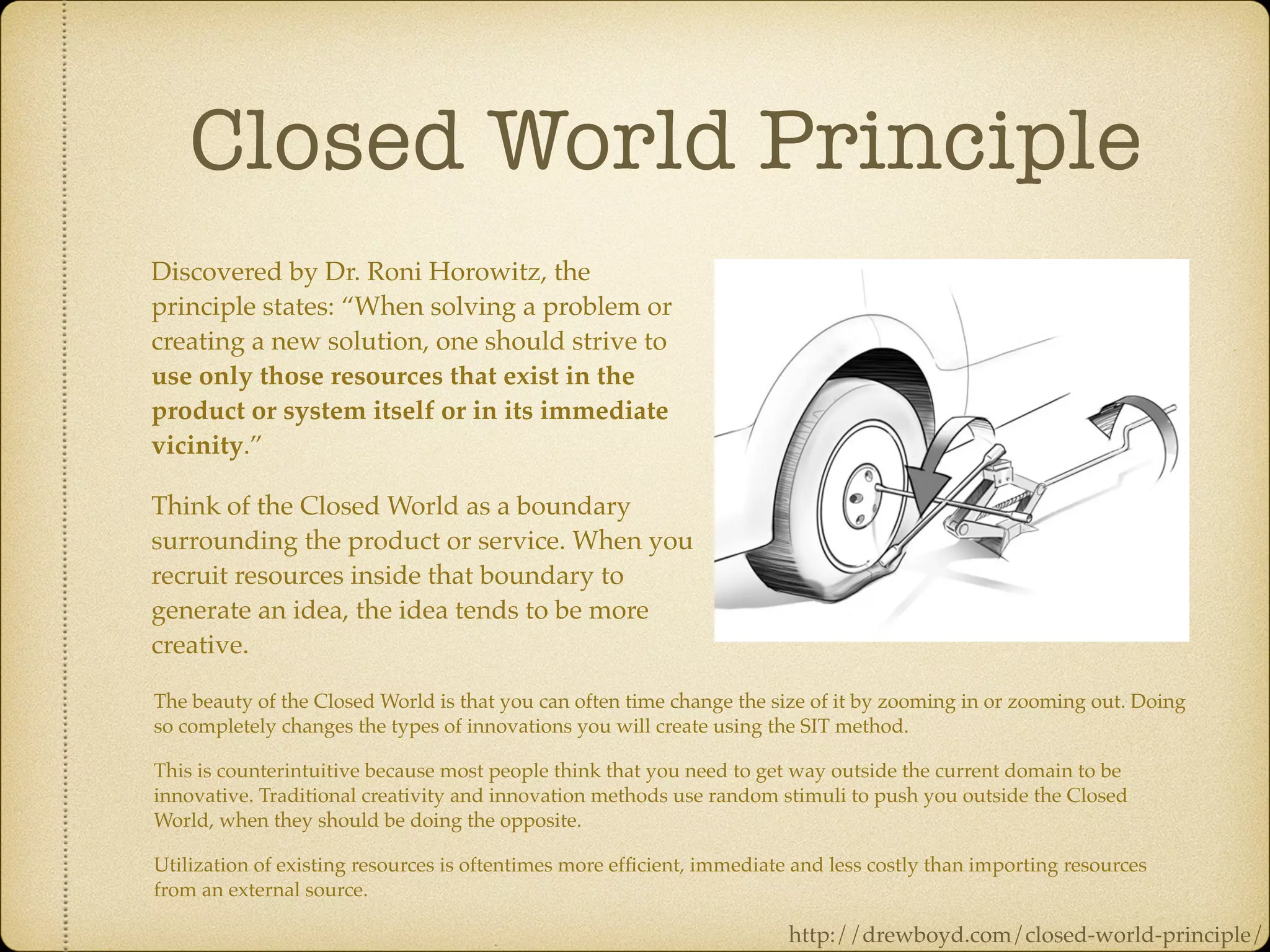
Discovered by Dr. Roni Horowitz, the
principle states: “When solving a problem or
creating a new solution, one should strive to
use only those resources that exist in the
product or system itself or in its immediate
vicinity.”
Think of the Closed World as a boundary
surrounding the product or service. When you
recruit resources inside that boundary to
generate an idea, the idea tends to be more
creative.
http://drewboyd.com/closed-world-principle/
The beauty of the Closed World is that you can often time change the size of it by zooming in or zooming out. Doing
so completely changes the types of innovations you will create using the SIT method.
This is counterintuitive because most people think that you need to get way outside the current domain to be
innovative. Traditional creativity and innovation methods use random stimuli to push you outside the Closed
World, when they should be doing the opposite.
Utilization of existing resources is oftentimes more efficient, immediate and less costly than importing resources
from an external source.
Function Follows Form
Back in the early ’90’s, a group of psychologists, led
by Ronald Finke, made an interesting discovery.
When it comes to creating, people are innately
better at uncovering the potential benefits of a
given form than creating a new form to satisfy a
given need. This discovery spurred a new thinking
approach called Function Follows Form that
encourages us to first create a Virtual Situation
(form), and then to explore its potential benefits
(function).
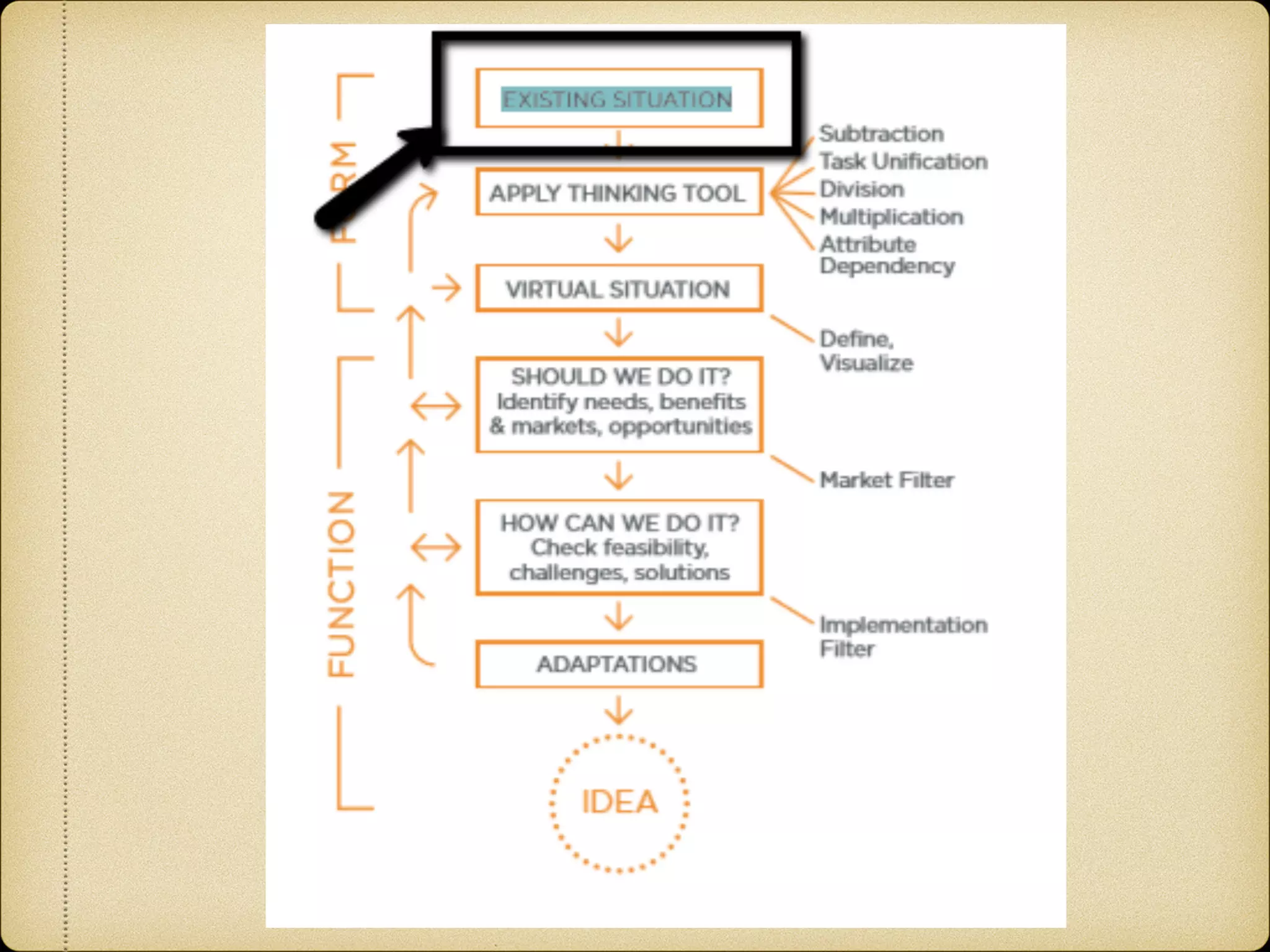
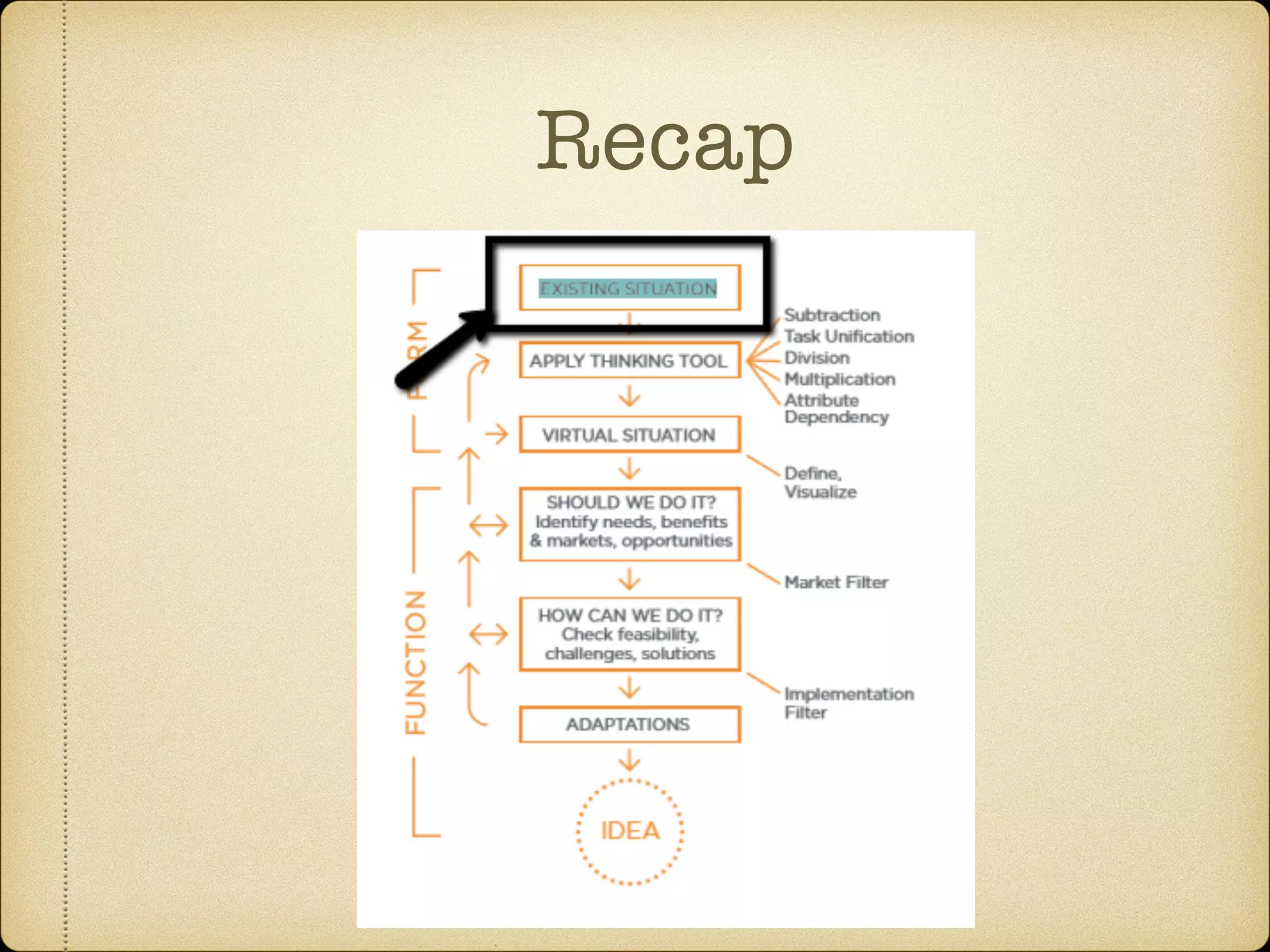
Existing Situation
The first stage of the FFF (Function Follows Form)
process is precisely defining the existing situation.
In order to best apply the SIT tools, one must
define a clear existing situation, which includes all
process stages, product components, and strategic
resources. Only when you have your existing
situation clearly defined can you move to the
second stage of FFF, applying an SIT tool.
SIT Thinking Tools
Subtraction
Task Unification
Division
Multiplication
Attribute Dependency
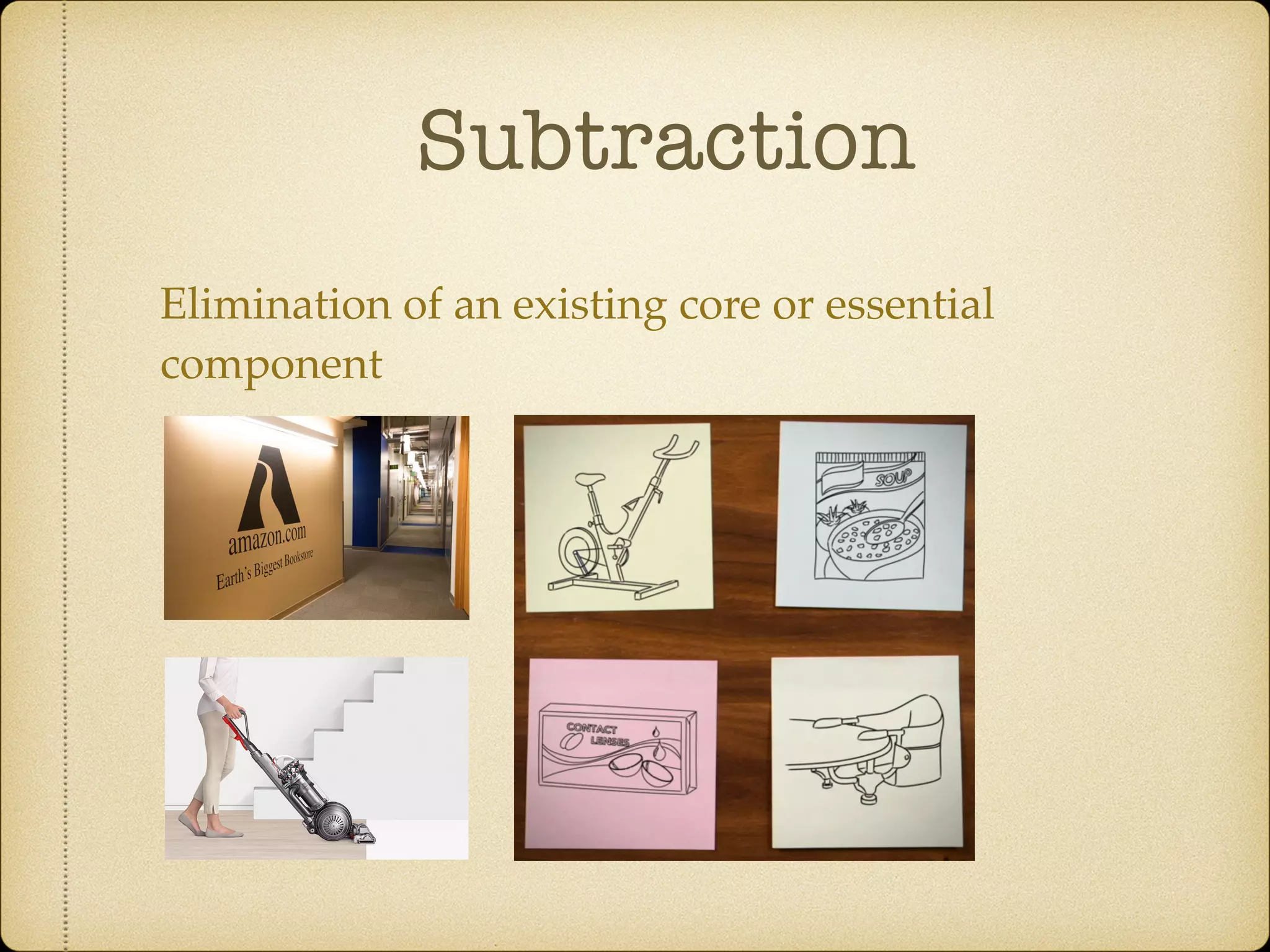
Subtraction
Elimination of an existing core or essential
component
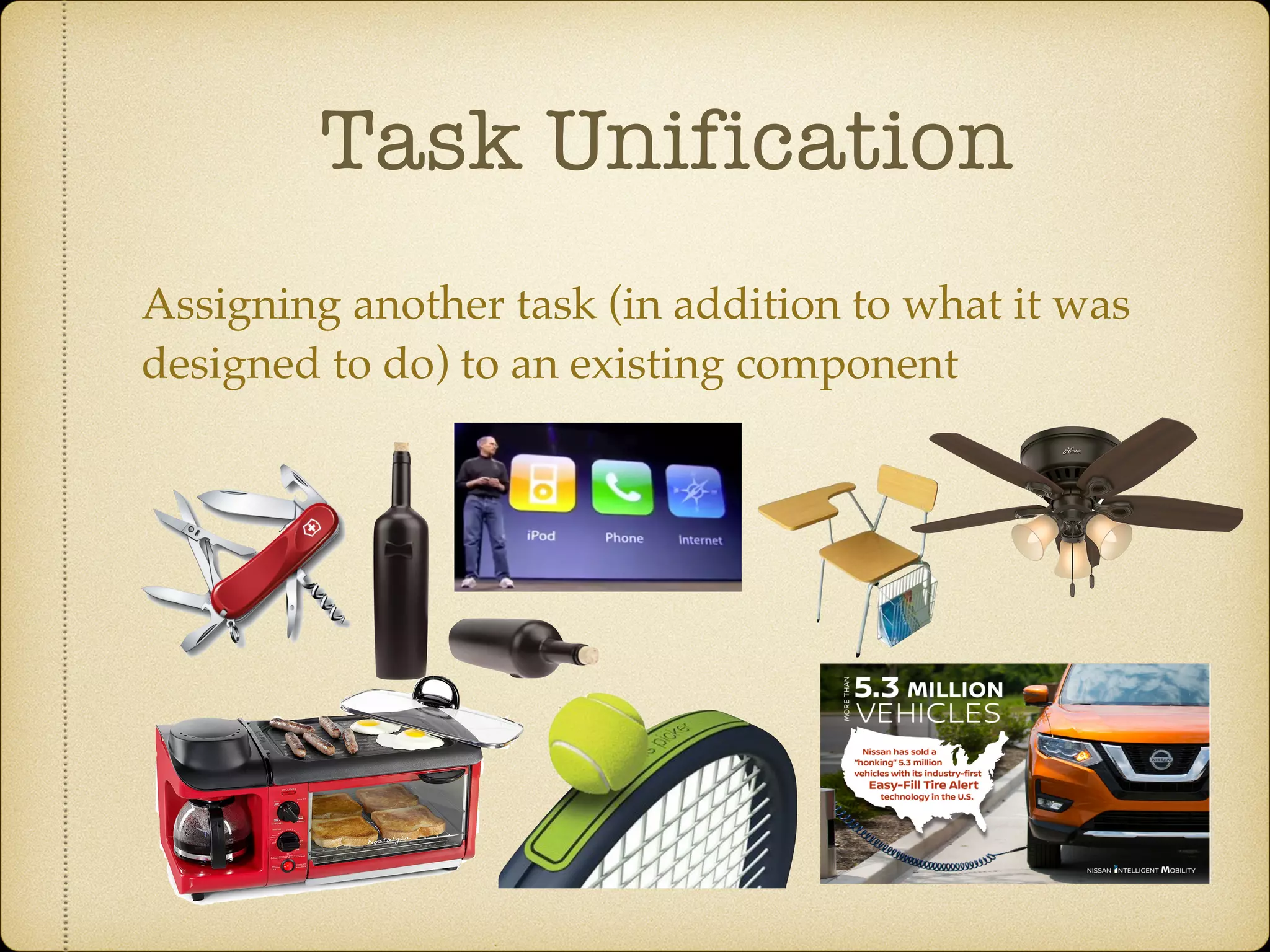
Task Unification
Assigning another task (in addition to what it was
designed to do) to an existing component
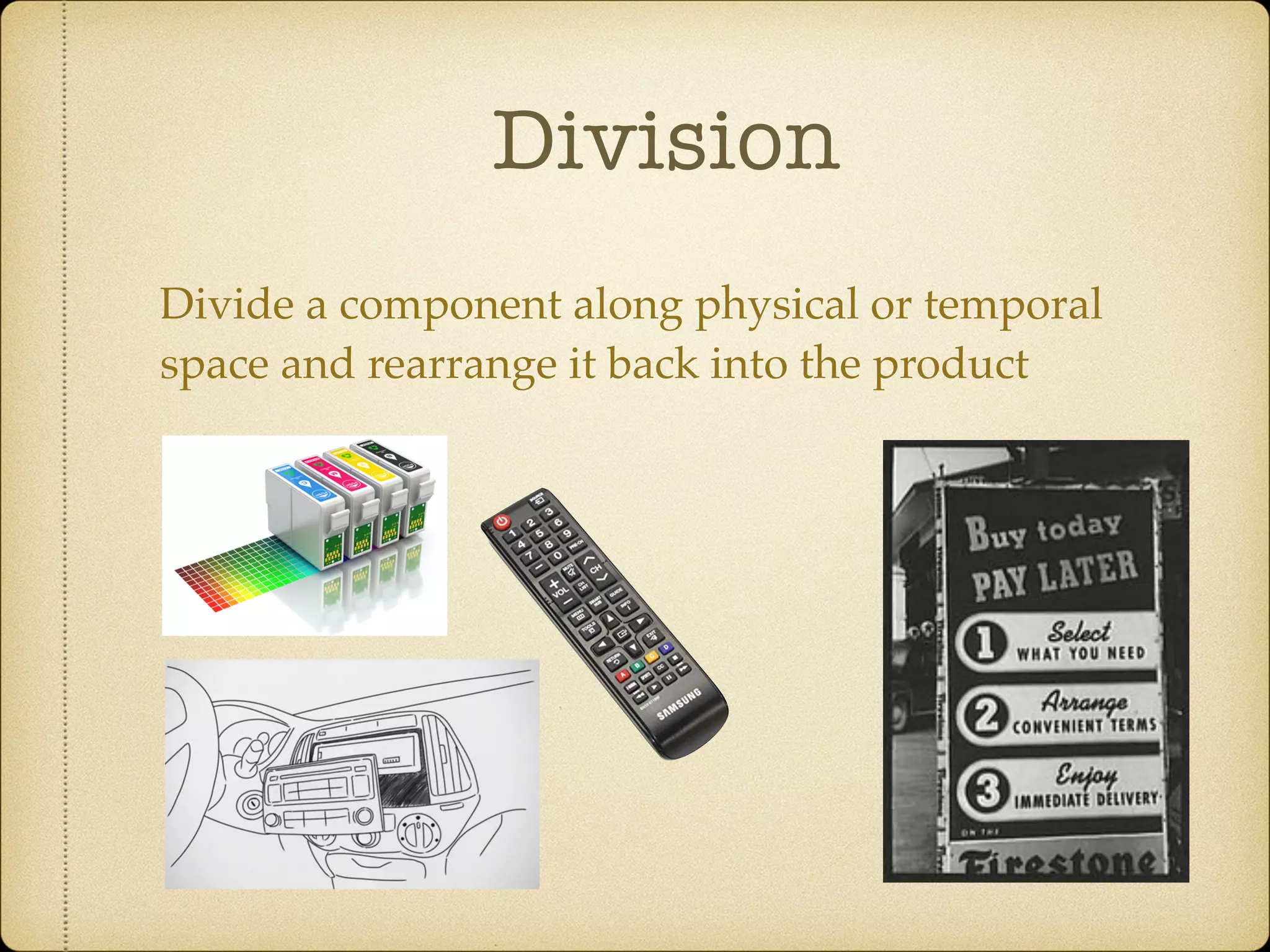
Division
Divide a component along physical or temporal
space and rearrange it back into the product
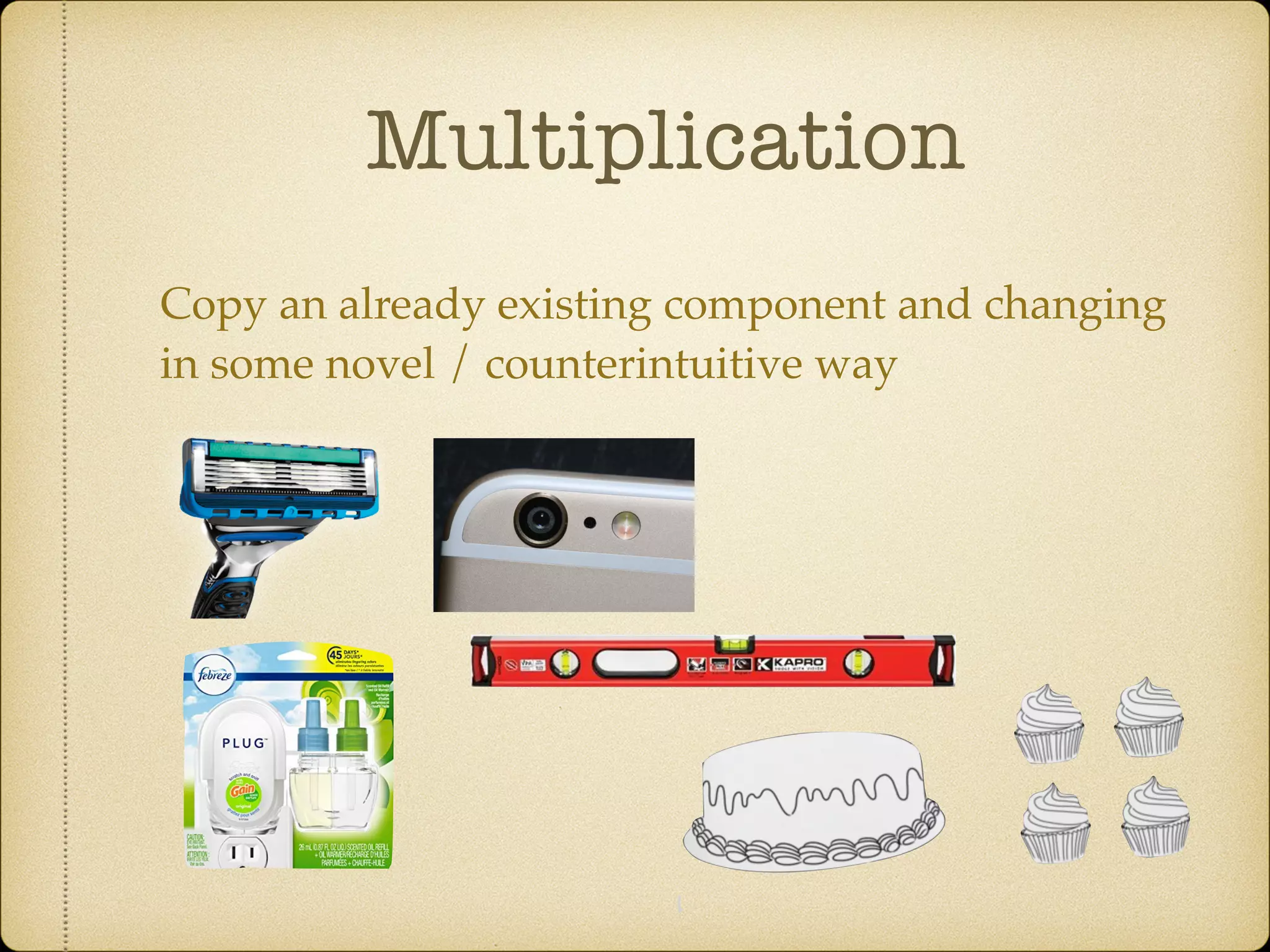
Multiplication
Copy an already existing component and changing
in some novel / counterintuitive way
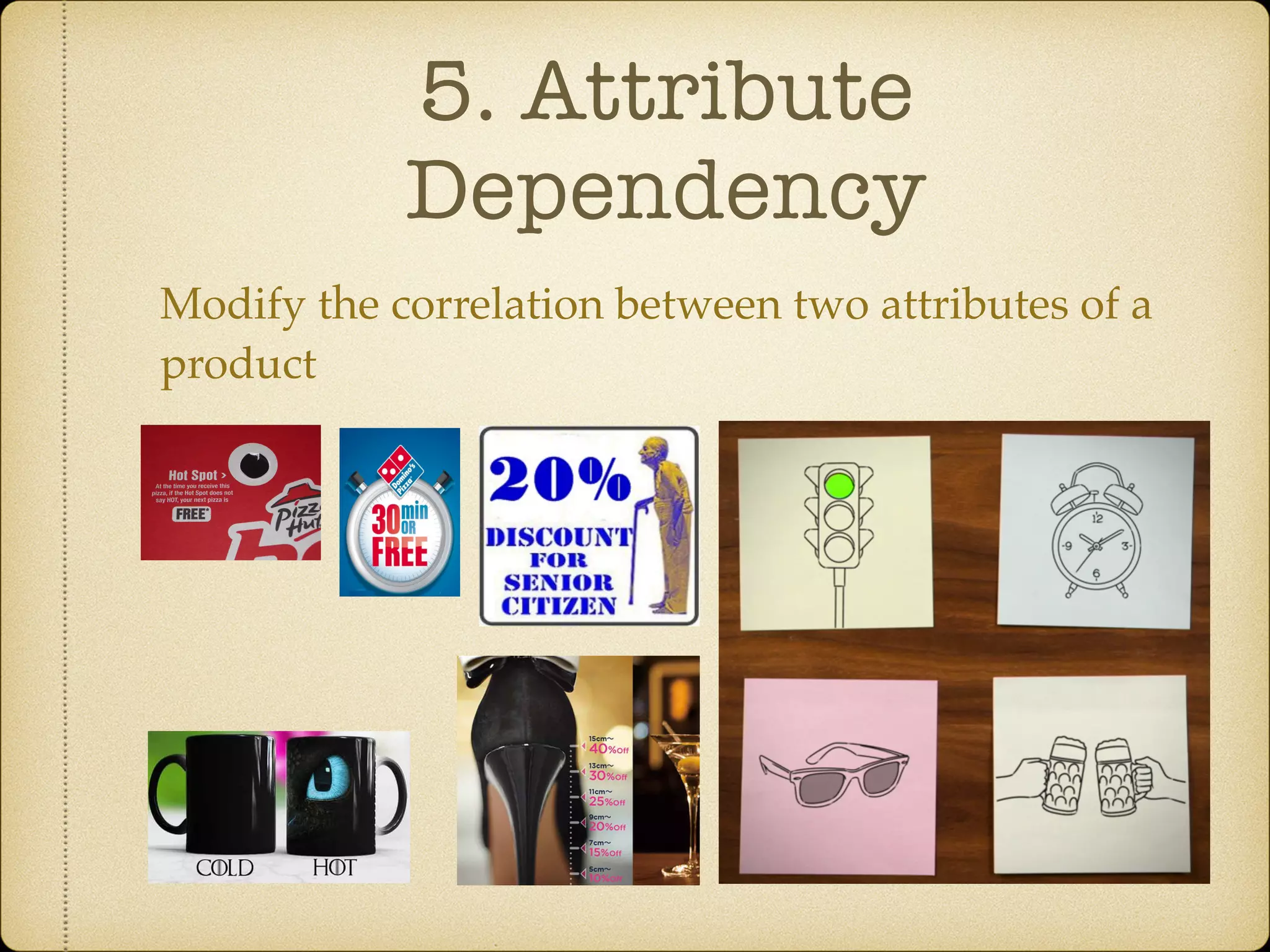
5. Attribute
Dependency
Modify the correlation between two attributes of a
product
Virtual Product
The result of mentally manipulating the existing
product is called a Virtual Product. Visualizing the
virtual product is not a simple task, since it is initially
not at all clear what its possible uses could be. This
can very often create a sense of discomfort due to the
feeling of uncertainty generated. This, however, is the
very reason why FFF is so effective. Users are forced
to genuinely try to figure out possible benefits –
which often leads them to identify previously
unidentified needs or audiences for new products.
Recap
Questions?
References
Inside the Box - Drew Boyd and Jacob Goldenberg, 2013
http://drewboyd.com/systematic-inventive-thinking/
https://triz-journal.com/using-asit-develop-new-products/
https://www.linkedin.com/learning/creative-thinking/
why-be-creative
https://hbr.org/2003/03/finding-your-innovation-sweet-
spot
https://triz-journal.com/using-asit-develop-new-products/

An Introduction to the Systematic Inventive Thinking (SIT) Method

  • 1.
    An Introduction tothe Systematic Inventive Thinking (SIT) Method Tathagat Varma Country Manager, NerdWallet
  • 2.
  • 3.
    Systematic Inventive Thinking (SIT) Surprisingly,the majority of new, inventive, and successful products result from just five patterns. SIT harnesses these five thinking patterns that mankind has used for thousands of years. http://drewboyd.com/systematic-inventive-thinking/
  • 4.
  • 5.
    SIT Principles Cognitive Fixedness Pathof Most Resistance Closed World Function Follows Form Existing Situation Virtual Product
  • 6.
    Cognitive Fixedness A cognitivebias that limits our ability to change our perspective. It hampers our creativity. First defined by psychologist Karl Duncker in 1940s (famous candle experiment)
  • 7.
    Types of Fixedness FunctionalFixedness: Use something only for what it was designed for Structural Fixedness: Unwillingness to accept objects in a different shape Relational Fixedness: The interrelationship between two objects
  • 8.
    Path of Most Resistance(PoMR) In nature, water cascading down a mountain will always follow the path of least resistance- the easiest route. In thinking, too, our minds tend to take the path of least resistance- those avenues that are familiar to us. In doing so, it is difficult to arrive at new ideas. Therefore, when we want to come up with really new and innovative ideas, it makes sense to take the counter-intuitive path – the path of most resistance. This is the path our minds are much less accustomed to using. All SIT tools are designed to lead thinkers through their PoMR.
  • 9.
    Closed World Principle Discoveredby Dr. Roni Horowitz, the principle states: “When solving a problem or creating a new solution, one should strive to use only those resources that exist in the product or system itself or in its immediate vicinity.” Think of the Closed World as a boundary surrounding the product or service. When you recruit resources inside that boundary to generate an idea, the idea tends to be more creative. http://drewboyd.com/closed-world-principle/ The beauty of the Closed World is that you can often time change the size of it by zooming in or zooming out. Doing so completely changes the types of innovations you will create using the SIT method. This is counterintuitive because most people think that you need to get way outside the current domain to be innovative. Traditional creativity and innovation methods use random stimuli to push you outside the Closed World, when they should be doing the opposite. Utilization of existing resources is oftentimes more efficient, immediate and less costly than importing resources from an external source.
  • 10.
    Function Follows Form Backin the early ’90’s, a group of psychologists, led by Ronald Finke, made an interesting discovery. When it comes to creating, people are innately better at uncovering the potential benefits of a given form than creating a new form to satisfy a given need. This discovery spurred a new thinking approach called Function Follows Form that encourages us to first create a Virtual Situation (form), and then to explore its potential benefits (function).
  • 12.
    Existing Situation The firststage of the FFF (Function Follows Form) process is precisely defining the existing situation. In order to best apply the SIT tools, one must define a clear existing situation, which includes all process stages, product components, and strategic resources. Only when you have your existing situation clearly defined can you move to the second stage of FFF, applying an SIT tool.
  • 13.
    SIT Thinking Tools Subtraction TaskUnification Division Multiplication Attribute Dependency
  • 14.
    Subtraction Elimination of anexisting core or essential component
  • 15.
    Task Unification Assigning anothertask (in addition to what it was designed to do) to an existing component
  • 16.
    Division Divide a componentalong physical or temporal space and rearrange it back into the product
  • 17.
    Multiplication Copy an alreadyexisting component and changing in some novel / counterintuitive way
  • 18.
    5. Attribute Dependency Modify thecorrelation between two attributes of a product
  • 19.
    Virtual Product The resultof mentally manipulating the existing product is called a Virtual Product. Visualizing the virtual product is not a simple task, since it is initially not at all clear what its possible uses could be. This can very often create a sense of discomfort due to the feeling of uncertainty generated. This, however, is the very reason why FFF is so effective. Users are forced to genuinely try to figure out possible benefits – which often leads them to identify previously unidentified needs or audiences for new products.
  • 20.
  • 21.
  • 22.
    References Inside the Box- Drew Boyd and Jacob Goldenberg, 2013 http://drewboyd.com/systematic-inventive-thinking/ https://triz-journal.com/using-asit-develop-new-products/ https://www.linkedin.com/learning/creative-thinking/ why-be-creative https://hbr.org/2003/03/finding-your-innovation-sweet- spot https://triz-journal.com/using-asit-develop-new-products/