Hevner et al./Design Science in IS Research


                                                                                              RESEARCH ESSAY


DESIGN SCIENCE IN INFORMATION
SYSTEMS RESEARCH1

By: Alan R. Hevner                                                Sudha Ram
    Information Systems and Decision                              Management Information Systems
      Sciences                                                    Eller College of Business and Public
    College of Business Administration                              Administration
                                                                  University of Arizona
    University of South Florida
                                                                  Tucson, AZ 85721
    Tampa, FL 33620                                               U.S.A.
    U.S.A.                                                        ram@bpa.arizona.edu
    ahevner@coba.usf.edu

    Salvatore T. March
    Own Graduate School of Management                        Abstract
    Vanderbilt University
    Nashville, TN 37203                                      Two paradigms characterize much of the research
    U.S.A.                                                   in the Information Systems discipline: behavioral
    Sal.March@owen.vanderbilt.edu                            science and design science. The behavioral-
                                                             science paradigm seeks to develop and verify
    Jinsoo Park                                              theories that explain or predict human or organi-
    College of Business Administration                       zational behavior. The design-science paradigm
    Korea University                                         seeks to extend the boundaries of human and
    Seoul, 136-701                                           organizational capabilities by creating new and
    KOREA                                                    innovative artifacts. Both paradigms are founda-
    jinsoo.park@acm.org                                      tional to the IS discipline, positioned as it is at the
                                                             confluence of people, organizations, and techno-
                                                             logy. Our objective is to describe the performance
                                                             of design-science research in Information Sys-
                                                             tems via a concise conceptual framework and
                                                             clear guidelines for understanding, executing, and
                                                             evaluating the research. In the design-science
                                                             paradigm, knowledge and understanding of a
                                                             problem domain and its solution are achieved in
                                                             the building and application of the designed arti-
1                                                            fact. Three recent exemplars in the research
 Allen S. Lee was the accepting senior editor for this
paper.                                                       literature are used to demonstrate the application


                                                         MIS Quarterly Vol. 28 No. 1, pp. 75-105/March 2004      75
Hevner et al./Design Science in IS Research


of these guidelines. We conclude with an analysis     ness and efficiency of an organization. These
of the challenges of performing high-quality          theories impact and are impacted by design
design-science research in the context of the         decisions made with respect to the system
broader IS community.                                 development methodology used and the functional
                                                      capabilities, information contents, and human
Keywords: Information Systems research meth-          interfaces implemented within the information
odologies, design science, design artifact, busi-     system.
ness environment, technology infrastructure,
search strategies, experimental methods,              The design-science paradigm has its roots in
creativity                                            engineering and the sciences of the artificial
                                                      (Simon 1996). It is fundamentally a problem-
                                                      solving paradigm. It seeks to create innovations
                                                      that define the ideas, practices, technical capa-
Introduction                                          bilities, and products through which the analysis,
                                                      design, implementation, management, and use of
Information systems are implemented within an         information systems can be effectively and
organization for the purpose of improving the         efficiently accomplished (Denning 1997;
effectiveness and efficiency of that organization.    Tsichritzis 1998). Such artifacts are not exempt
Capabilities of the information system and char-      from natural laws or behavioral theories. To the
acteristics of the organization, its work systems,    contrary, their creation relies on existing kernel
its people, and its development and implemen-         theories that are applied, tested, modified, and
tation methodologies together determine the           extended through the experience, creativity,
extent to which that purpose is achieved (Silver et   intuition, and problem solving capabilities of the
al. 1995). It is incumbent upon researchers in the    researcher (Markus et al. 2002; Walls et al. 1992).
Information Systems (IS) discipline to “further
knowledge that aids in the productive application     The importance of design is well recognized in the
of information technology to human organizations      IS literature (Glass 1999; Winograd 1996, 1998).
and their management” (ISR 2002, inside front         Benbasat and Zmud (1999, p. 5) argue that the
cover) and to develop and communicate “knowl-         relevance of IS research is directly related to its
edge concerning both the management of                applicability in design, stating that the implications
information technology and the use of information     of empirical IS research should be “implemen-
technology for managerial and organizational pur-     table,…synthesize an existing body of research,
poses” (Zmud 1997).                                   …[or] stimulate critical thinking” among IS practi-
                                                      tioners. However, designing useful artifacts is
We argue that acquiring such knowledge involves       complex due to the need for creative advances in
two complementary but distinct paradigms,             domain areas in which existing theory is often
behavioral science and design science (March          insufficient. “As technical knowledge grows, IT is
and Smith 1995). The behavioral-science para-         applied to new application areas that were not
digm has its roots in natural science research        previously believed to be amenable to IT support”
methods. It seeks to develop and justify theories     (Markus et al. 2002, p. 180). The resultant IT
(i.e., principles and laws) that explain or predict   artifacts extend the boundaries of human problem
organizational and human phenomena sur-               solving and organizational capabilities by pro-
rounding the analysis, design, implementation,        viding intellectual as well as computational tools.
management, and use of information systems.           Theories regarding their application and impact
Such theories ultimately inform researchers and       will follow their development and use.
practitioners of the interactions among people,
technology, and organizations that must be            Here, we argue, is an opportunity for IS research
managed if an information system is to achieve its    to make significant contributions by engaging the
stated purpose, namely improving the effective-       complementary research cycle between design-


76     MIS Quarterly Vol. 28 No. 1/March 2004
Hevner et al./Design Science in IS Research


science and behavioral-science to address funda-        artifact, the instantiation (system), although other
mental problems faced in the productive applica-        research efforts have also focused on the
tion of information technology. Technology and          evaluation of constructs (e.g., Batra et al. 1990;
behavior are not dichotomous in an information          Bodart et al. 2001; Geerts and McCarthy 2002;
system. They are inseparable (Lee 2000). They           Kim and March 1995) and methods (e.g., Marakas
are similarly inseparable in IS research. Philo-        and Elam 1998; Sinha and Vessey 1999).
sophically these arguments draw from the prag-          Relatively little behavioral research has focused
matists (Aboulafia 1991) who argue that truth           on evaluating models, a major focus of research
(justified theory) and utility (artifacts that are      in the management science literature.
effective) are two sides of the same coin and that
scientific research should be evaluated in light of     Design science, as the other side of the IS
its practical implications.                             research cycle, creates and evaluates IT artifacts
                                                        intended to solve identified organizational prob-
The realm of IS research is at the confluence of        lems. Such artifacts are represented in a struc-
people, organizations, and technology (Davis and        tured form that may vary from software, formal
Olson 1985; Lee 1999). IT artifacts are broadly         logic, and rigorous mathematics to informal
defined as constructs (vocabulary and symbols),         natural language descriptions. A mathematical
models (abstractions and representations),              basis for design allows many types of quantitative
methods (algorithms and practices), and instan-         evaluations of an IT artifact, including optimization
tiations (implemented and prototype systems).           proofs, analytical simulation, and quantitative
These are concrete prescriptions that enable IT         comparisons with alternative designs. The further
researchers and practitioners to understand and         evaluation of a new artifact in a given organi-
address the problems inherent in developing and         zational context affords the opportunity to apply
successfully implementing information systems           empirical and qualitative methods. The rich
within organizations (March and Smith 1995;             phenomena that emerge from the interaction of
Nunamaker et al. 1991a). As illustrations, Markus       people, organizations, and technology may need
et al. (2002) and Walls et al. (1992) present           to be qualitatively assessed to yield an under-
design-science research aimed at developing             standing of the phenomena adequate for theory
executive information systems (EISs) and systems        development or problem solving (Klein and
to support emerging knowledge processes                 Meyers 1999). As field studies enable behavioral-
(EKPs), respectively, within the context of “IS         science researchers to understand organizational
design theories.” Such theories prescribe “effec-       phenomena in context, the process of constructing
tive development practices” (methods) and “a type       and exercising innovative IT artifacts enable
of system solution” (instantiation) for “a particular   design-science researchers to understand the
class of user requirements” (models) (Markus et         problem addressed by the artifact and the
al. 2002, p. 180). Such prescriptive theories must      feasibility of their approach to its solution
be evaluated with respect to the utility provided for   (Nunamaker et al. 1991a).
the class of problems addressed.
                                                        The primary goal of this paper is to inform the
An IT artifact, implemented in an organizational        community of IS researchers and practitioners of
context, is often the object of study in IS behav-      how to conduct, evaluate, and present design-
ioral-science research. Theories seek to predict        science research. We do so by describing the
or explain phenomena that occur with respect to         boundaries of design science within the IS
the artifact’s use (intention to use), perceived        discipline via a conceptual framework for under-
usefulness, and impact on individuals and organi-       standing information systems research and by
zations (net benefits) depending on system,             developing a set of guidelines for conducting and
service, and information quality (DeLone and            evaluating good design-science research. We
McLean 1992, 2003; Seddon 1997). Much of this           focus primarily on technology-based design
behavioral research has focused on one class of         although we note with interest the current explora-


                                                              MIS Quarterly Vol. 28 No. 1/March 2004      77
Hevner et al./Design Science in IS Research


tion of organizations, policies, and work practices     organizations to engage new forms and new
as designed artifacts (Boland 2002). Following          structures—to change the ways they “do busi-
Klein and Myers (1999) treatise on the conduct          ness” (Drucker 1988, 1991; Orlikowski 2000). Our
and evaluation of interpretive research in IS, we       subsequent discussion of design science will be
use the proposed guidelines to assess recent            limited to the activities of building the IS infrastruc-
exemplar papers published in the IS literature in       ture within the business organization. Issues of
order to illustrate how authors, reviewers, and         strategy, alignment, and organizational infrastruc-
editors can apply them consistently. We conclude        ture design are outside the scope of this paper.
with an analysis of the challenges of performing
high-quality design-science research and a call for     To achieve a true understanding of and appre-
synergistic efforts between behavioral-science          ciation for design science as an IS research
and design-science researchers.                         paradigm, an important dichotomy must be faced.
                                                        Design is both a process (set of activities) and a
                                                        product (artifact)—a verb and a noun (Walls et al.
                                                        1992). It describes the world as acted upon (pro-
A Framework for IS Research                             cesses) and the world as sensed (artifacts). This
                                                        Platonic view of design supports a problem-
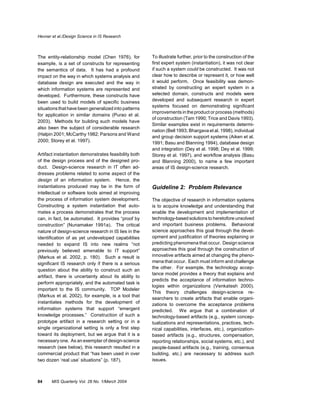
Information systems and the organizations they          solving paradigm that continuously shifts perspec-
support are complex, artificial, and purposefully       tive between design processes and designed
designed. They are composed of people, struc-           artifacts for the same complex problem. The
tures, technologies, and work systems (Alter            design process is a sequence of expert activities
2003; Bunge 1985; Simon 1996). Much of the              that produces an innovative product (i.e., the
work performed by IS practitioners, and managers        design artifact). The evaluation of the artifact then
in general (Boland 2002), deals with design—the         provides feedback information and a better
purposeful organization of resources to accom-          understanding of the problem in order to improve
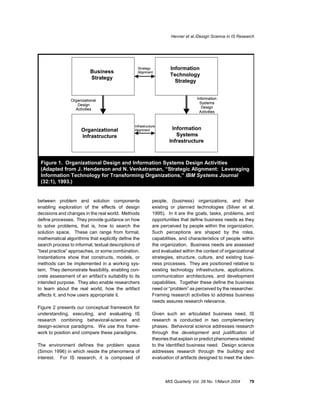
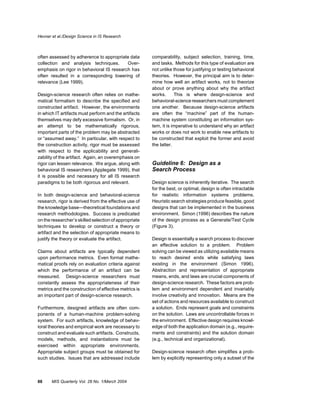
plish a goal. Figure 1 illustrates the essential        both the quality of the product and the design
alignments between business and information             process. This build-and-evaluate loop is typically
technology strategies and between organizational        iterated a number of times before the final design
and information systems infrastructures (Hender-        artifact is generated (Markus et al. 2002). During
son and Venkatraman 1993). The effective transi-        this creative process, the design-science re-
tion of strategy into infrastructure requires exten-    searcher must be cognizant of evolving both the
sive design activity on both sides of the figure—       design process and the design artifact as part of
organizational design to create an effective            the research.
organizational infrastructure and information
systems design to create an effective information       March and Smith (1995) identify two design
system infrastructure.                                  processes and four design artifacts produced by
                                                        design-science research in IS. The two processes
These are interdependent design activities that         are build and evaluate. The artifacts are con-
are central to the IS discipline. Hence, IS research    structs, models, methods, and instantiations.
must address the interplay among business               Purposeful artifacts are built to address heretofore
strategy, IT strategy, organizational infrastructure,   unsolved problems. They are evaluated with
and IS infrastructure. This interplay is becoming       respect to the utility provided in solving those
more crucial as information technologies are seen       problems. Constructs provide the language in
as enablers of business strategy and organiza-          which problems and solutions are defined and
tional infrastructure (Kalakota and Robinson 2001;      communicated (Schön 1983). Models use con-
Orlikowski and Barley 2001). Available and              structs to represent a real world situation—the
emerging IT capabilities are a significant factor in    design problem and its solution space (Simon
determining the strategies that guide an organiza-      1996). Models aid problem and solution under-
tion. Cutting-edge information systems allow            standing and frequently represent the connection


78     MIS Quarterly Vol. 28 No. 1/March 2004
Hevner et al./Design Science in IS Research


                                                   Strategy          Information
                          Business                 Alignment
                                                                     Technology
                          Strategy
                                                                       Strategy


                Organizational                                                     Information
                                                                                     Systems
                   Design
                  Activities                                                          Design
                                                                                    Activities


                                                 Infrastructure
                      Organizational             Alignment            Information
                      Infrastructure                                    Systems
                                                                     Infrastructure


 Figure 1. Organizational Design and Information Systems Design Activities
 (Adapted from J. Henderson and N. Venkatraman, “Strategic Alignment: Leveraging
 Information Technology for Transforming Organizations,” IBM Systems Journal
 (32:1), 1993.)


between problem and solution components                      people, (business) organizations, and their
enabling exploration of the effects of design                existing or planned technologies (Silver et al.
decisions and changes in the real world. Methods             1995). In it are the goals, tasks, problems, and
define processes. They provide guidance on how               opportunities that define business needs as they
to solve problems, that is, how to search the                are perceived by people within the organization.
solution space. These can range from formal,                 Such perceptions are shaped by the roles,
mathematical algorithms that explicitly define the           capabilities, and characteristics of people within
search process to informal, textual descriptions of          the organization. Business needs are assessed
“best practice” approaches, or some combination.             and evaluated within the context of organizational
Instantiations show that constructs, models, or              strategies, structure, culture, and existing busi-
methods can be implemented in a working sys-                 ness processes. They are positioned relative to
tem. They demonstrate feasibility, enabling con-             existing technology infrastructure, applications,
crete assessment of an artifact’s suitability to its         communication architectures, and development
intended purpose. They also enable researchers               capabilities. Together these define the business
to learn about the real world, how the artifact              need or “problem” as perceived by the researcher.
affects it, and how users appropriate it.                    Framing research activities to address business
                                                             needs assures research relevance.
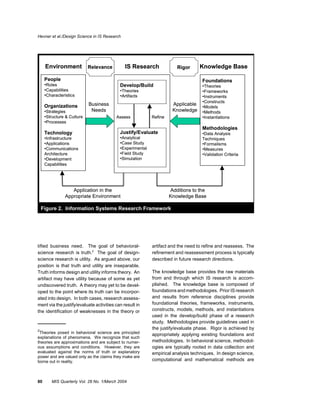
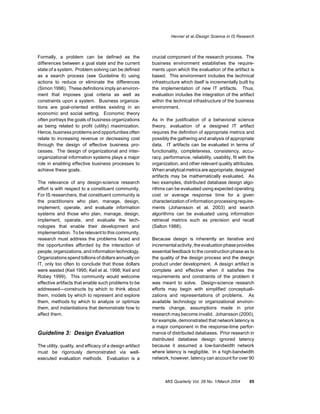
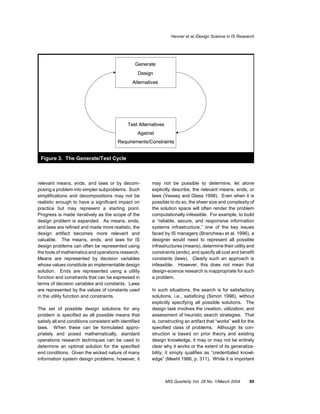
Figure 2 presents our conceptual framework for
understanding, executing, and evaluating IS                  Given such an articulated business need, IS
research combining behavioral-science and                    research is conducted in two complementary
design-science paradigms. We use this frame-                 phases. Behavioral science addresses research
work to position and compare these paradigms.                through the development and justification of
                                                             theories that explain or predict phenomena related
The environment defines the problem space                    to the identified business need. Design science
(Simon 1996) in which reside the phenomena of                addresses research through the building and
interest. For IS research, it is composed of                 evaluation of artifacts designed to meet the iden-


                                                                   MIS Quarterly Vol. 28 No. 1/March 2004     79
Hevner et al./Design Science in IS Research


     Environment Relevance                    IS Research              Rigor      Knowledge Base

     People                                                                        Foundations
     •Roles                                Develop/Build                           •Theories
     •Capabilities                         •Theories                               •Frameworks
     •Characteristics                      •Artifacts                              •Instruments
                                                                                   •Constructs
     Organizations          Business                                 Applicable
                                                                                   •Models
     •Strategies             Needs                                   Knowledge     •Methods
     •Structure & Culture                Assess            Refine                  •Instantiations
     •Processes
                                                                                   Methodologies
     Technology                            Justify/Evaluate                        •Data Analysis
     •Infrastructure                       •Analytical                             Techniques
     •Applications                         •Case Study                             •Formalisms
     •Communications                       •Experimental                           •Measures
     Architecture                          •Field Study                            •Validation Criteria
     •Development                          •Simulation
     Capabilities


                  Application in the                                Additions to the
               Appropriate Environment                              Knowledge Base

    Figure 2. Information Systems Research Framework


tified business need. The goal of behavioral-              artifact and the need to refine and reassess. The
science research is truth.2 The goal of design-            refinement and reassessment process is typically
science research is utility. As argued above, our          described in future research directions.
position is that truth and utility are inseparable.
Truth informs design and utility informs theory. An        The knowledge base provides the raw materials
artifact may have utility because of some as yet           from and through which IS research is accom-
undiscovered truth. A theory may yet to be devel-          plished. The knowledge base is composed of
oped to the point where its truth can be incorpor-         foundations and methodologies. Prior IS research
ated into design. In both cases, research assess-          and results from reference disciplines provide
ment via the justify/evaluate activities can result in     foundational theories, frameworks, instruments,
the identification of weaknesses in the theory or          constructs, models, methods, and instantiations
                                                           used in the develop/build phase of a research
                                                           study. Methodologies provide guidelines used in
2
                                                           the justify/evaluate phase. Rigor is achieved by
 Theories posed in behavioral science are principled       appropriately applying existing foundations and
explanations of phenomena. We recognize that such
theories are approximations and are subject to numer-      methodologies. In behavioral science, methodol-
ous assumptions and conditions. However, they are          ogies are typically rooted in data collection and
evaluated against the norms of truth or explanatory        empirical analysis techniques. In design science,
power and are valued only as the claims they make are
borne out in reality.                                      computational and mathematical methods are


80      MIS Quarterly Vol. 28 No. 1/March 2004
Hevner et al./Design Science in IS Research


primarily used to evaluate the quality and effec-      has produced a considerable literature on design
tiveness of artifacts; however, empirical techni-      (Dym 1994; Pahl and Beitz 1996; Petroski 1996).
ques may also be employed.                             Within the IS discipline, many design activities
                                                       have been extensively studied, formalized, and
The contributions of behavioral science and            become normal or routine.        Design-science
design science in IS research are assessed as          research in IS addresses what are considered to
they are applied to the business need in an            be wicked problems (Brooks 1987, 1996; Rittel
appropriate environment and as they add to the         and Webber 1984). That is, those problems
content of the knowledge base for further research     characterized by
and practice. A justified theory that is not useful
for the environment contributes as little to the IS    •   unstable requirements and constraints based
literature as an artifact that solves a nonexistent        upon ill-defined environmental contexts
problem.
                                                       •   complex interactions among subcomponents
One issue that must be addressed in design-
                                                           of the problem and its solution
science research is differentiating routine design
or system building from design research. The
                                                       •   inherent flexibility to change design pro-
difference is in the nature of the problems and
solutions. Routine design is the application of            cesses as well as design artifacts (i.e.,
existing knowledge to organizational problems,             malleable processes and artifacts)
such as constructing a financial or marketing
information system using best practice artifacts       •   a critical dependence upon human cognitive
(constructs, models, methods, and instantiations)          abilities (e.g., creativity) to produce effective
existing in the knowledge base. On the other               solutions
hand, design-science research addresses impor-
tant unsolved problems in unique or innovative         •   a critical dependence upon human social
ways or solved problems in more effective or               abilities (e.g., teamwork) to produce effective
efficient ways. The key differentiator between rou-
                                                           solutions
tine design and design research is the clear iden-
tification of a contribution to the archival knowl-
edge base of foundations and methodologies.            As a result, we agree with Simon (1996) that a
                                                       theory of design in information systems, of
In the early stages of a discipline or with signifi-   necessity, is in a constant state of scientific
cant changes in the environment, each new              revolution (Kuhn 1996). Technological advances
artifact created for that discipline or environment    are the result of innovative, creative design
is “an experiment” that “poses a question to           science processes. If not capricious, they are at
nature” (Newell and Simon 1976, p 114). Existing       least arbitrary (Brooks 1987) with respect to
knowledge is used where appropriate; however,          business needs and existing knowledge.
often the requisite knowledge is nonexistent
                                                       Innovations, such as database management sys-
(Markus et al. 2002). Reliance on creativity and
                                                       tems, high-level languages, personal computers,
trial-and-error search are characteristic of such
                                                       software components, intelligent agents, object
research efforts. As design-science research
results are codified in the knowledge base, they       technology, the Internet, and the World Wide
become best practice. System building is then the      Web, have had dramatic and at times unintended
routine application of the knowledge base to           impacts on the way in which information systems
known problems.                                        are conceived, designed, implemented, and
                                                       managed.      Consequently the guidelines we
Design activities are endemic in many profes-          present below are, of necessity, adaptive and
sions. In particular, the engineering profession       process-oriented.


                                                             MIS Quarterly Vol. 28 No. 1/March 2004      81
Hevner et al./Design Science in IS Research


Guidelines for Design Science                           contend that each of these guidelines should be
                                                        addressed in some manner for design-science
in Information Systems                                  research to be complete. How well the research
Research                                                satisfies the intent of each of the guidelines is
                                                        then a matter for the reviewers, editors, and
As discussed above, design science is inherently        readers to determine.
a problem solving process. The fundamental
principle of design-science research from which         Table 1 summarizes the seven guidelines. Each
our seven guidelines are derived is that knowl-         is discussed in detail below. In the following
edge and understanding of a design problem and          section, they are applied to specific exemplar
its solution are acquired in the building and           research efforts.
application of an artifact. That is, design-science
research requires the creation of an innovative,
purposeful artifact (Guideline 1) for a specified
problem domain (Guideline 2). Because the
                                                        Guideline 1: Design as an Artifact
artifact is purposeful, it must yield utility for the
specified problem. Hence, thorough evaluation of        The result of design-science research in IS is, by
the artifact is crucial (Guideline 3). Novelty is       definition, a purposeful IT artifact created to ad-
similarly crucial since the artifact must be            dress an important organizational problem. It
innovative, solving a heretofore unsolved problem       must be described effectively, enabling its imple-
or solving a known problem in a more effective or       mentation and application in an appropriate
efficient manner (Guideline 4). In this way,            domain.
design-science research is differentiated from the
practice of design. The artifact itself must be         Orlikowski and Iacono (2001) call the IT artifact
rigorously defined, formally represented, coherent,     the “core subject matter” of the IS field. Although
and internally consistent (Guideline 5). The pro-       they articulate multiple definitions of the term IT
cess by which it is created, and often the artifact     artifact, many of which include components of the
itself, incorporates or enables a search process        organization and people involved in the use of a
whereby a problem space is constructed and a            computer-based artifact, they emphasize the
mechanism posed or enacted to find an effective         importance of “those bundles of cultural properties
solution (Guideline 6). Finally, the results of the     packaged in some socially recognizable form such
design-science research must be communicated            as hardware and software” (p. 121), i.e., the IT
effectively (Guideline 7) both to a technical           artifact as an instantiation. Weber (1987) argues
audience (researchers who will extend them and          that theories of long-lived artifacts (instantiations)
practitioners who will implement them) and to a         and their representations (Weber 2003) are
managerial audience (researchers who will study         fundamental to the IS discipline. Such theories
them in context and practitioners who will decide       must explain how artifacts are created and
if they should be implemented within their              adapted to their changing environments and
organizations).                                         underlying technologies.

Our purpose for establishing these seven                Our definition of IT artifacts is both broader and
guidelines is to assist researchers, reviewers,         narrower then those articulated above. It is
editors, and readers to understand the require-         broader in the sense that we include not only
ments for effective design-science research.            instantiations in our definition of the IT artifact but
Following Klein and Myers (1999), we advise             also the constructs, models, and methods applied
against mandatory or rote use of the guidelines.        in the development and use of information
Researchers, reviewers, and editors must use            systems. However, it is narrower in the sense that
their creative skills and judgment to determine         we do not include people or elements of organi-
when, where, and how to apply each of the guide-        zations in our definition nor do we explicitly
lines in a specific research project. However, we       include the process by which such artifacts evolve


82     MIS Quarterly Vol. 28 No. 1/March 2004
Hevner et al./Design Science in IS Research


 Table 1. Design-Science Research Guidelines
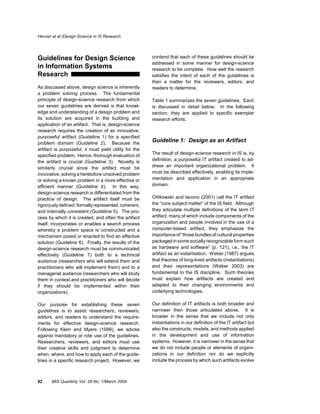
               Guideline                                              Description
 Guideline 1: Design as an Artifact         Design-science research must produce a viable artifact in the
                                            form of a construct, a model, a method, or an instantiation.
 Guideline 2: Problem Relevance             The objective of design-science research is to develop
                                            technology-based solutions to important and relevant
                                            business problems.
 Guideline 3: Design Evaluation             The utility, quality, and efficacy of a design artifact must be
                                            rigorously demonstrated via well-executed evaluation
                                            methods.
 Guideline 4: Research Contributions        Effective design-science research must provide clear and
                                            verifiable contributions in the areas of the design artifact,
                                            design foundations, and/or design methodologies.
 Guideline 5: Research Rigor                Design-science research relies upon the application of
                                            rigorous methods in both the construction and evaluation of
                                            the design artifact.
 Guideline 6: Design as a Search            The search for an effective artifact requires utilizing available
 Process                                    means to reach desired ends while satisfying laws in the
                                            problem environment.
 Guideline 7: Communication of              Design-science research must be presented effectively both
 Research                                   to technology-oriented as well as management-oriented
                                            audiences.


over time. We conceive of IT artifacts not as              1997; Tsichritzis 1998). This definition of the
independent of people or the organizational and            artifact is consistent with the concept of IS design
social contexts in which they are used but as              theory as used by Walls et al. (1992) and Markus
interdependent and coequal with them in meeting            et al. (2002) where the theory addresses both the
business needs. We acknowledge that percep-                process of design and the designed product.
tions and fit with an organization are crucial to the
successful development and implementation of an            More precisely, constructs provide the vocabulary
information system. We argue, however, that the            and symbols used to define problems and
capabilities of the constructs, models, methods,           solutions. They have a significant impact on the
and instantiations are equally crucial and that            way in which tasks and problems are conceived
design-science research efforts are necessary for          (Boland 2002; Schön 1983). They enable the
their creation.                                            construction of models or representations of the
                                                           problem domain. Representation has a profound
                                                           impact on design work. The field of mathematics
Furthermore, artifacts constructed in design-
                                                           was revolutionized, for example, with the con-
science research are rarely full-grown information
                                                           structs defined by Arabic numbers, zero, and
systems that are used in practice. Instead, artif-         place notation. The search for an effective prob-
acts are innovations that define the ideas,                lem representation is crucial to finding an effective
practices, technical capabilities, and products            design solution (Weber 2003). Simon (1996, p.
through which the analysis, design, implemen-              132) states, “solving a problem simply means
tation, and use of information systems can be              representing it so as to make the solution
effectively and efficiently accomplished (Denning          transparent.”


                                                                 MIS Quarterly Vol. 28 No. 1/March 2004       83
Hevner et al./Design Science in IS Research


The entity-relationship model (Chen 1976), for         To illustrate further, prior to the construction of the
example, is a set of constructs for representing       first expert system (instantiation), it was not clear
the semantics of data. It has had a profound           if such a system could be constructed. It was not
impact on the way in which systems analysis and        clear how to describe or represent it, or how well
database design are executed and the way in            it would perform. Once feasibility was demon-
which information systems are represented and          strated by constructing an expert system in a
developed. Furthermore, these constructs have          selected domain, constructs and models were
been used to build models of specific business         developed and subsequent research in expert
                                                       systems focused on demonstrating significant
situations that have been generalized into patterns
                                                       improvements in the product or process (methods)
for application in similar domains (Purao et al.
                                                       of construction (Tam 1990; Trice and Davis 1993).
2003). Methods for building such models have
                                                       Similar examples exist in requirements determi-
also been the subject of considerable research
                                                       nation (Bell 1993; Bhargava et al. 1998), individual
(Halpin 2001; McCarthy 1982; Parsons and Wand
                                                       and group decision support systems (Aiken et al.
2000; Storey et al. 1997).                             1991; Basu and Blanning 1994), database design
                                                       and integration (Dey et al. 1998; Dey et al. 1999;
Artifact instantiation demonstrates feasibility both   Storey et al. 1997), and workflow analysis (Basu
of the design process and of the designed pro-         and Blanning 2000), to name a few important
duct. Design-science research in IT often ad-          areas of IS design-science research.
dresses problems related to some aspect of the
design of an information system. Hence, the
instantiations produced may be in the form of          Guideline 2: Problem Relevance
intellectual or software tools aimed at improving
the process of information system development.         The objective of research in information systems
Constructing a system instantiation that auto-         is to acquire knowledge and understanding that
mates a process demonstrates that the process          enable the development and implementation of
can, in fact, be automated. It provides “proof by      technology-based solutions to heretofore unsolved
construction” (Nunamaker 1991a). The critical          and important business problems. Behavioral
nature of design-science research in IS lies in the    science approaches this goal through the devel-
identification of as yet undeveloped capabilities      opment and justification of theories explaining or
needed to expand IS into new realms “not               predicting phenomena that occur. Design science
previously believed amenable to IT support”            approaches this goal through the construction of
(Markus et al. 2002, p. 180). Such a result is         innovative artifacts aimed at changing the pheno-
significant IS research only if there is a serious     mena that occur. Each must inform and challenge
                                                       the other. For example, the technology accep-
question about the ability to construct such an
                                                       tance model provides a theory that explains and
artifact, there is uncertainty about its ability to
                                                       predicts the acceptance of information techno-
perform appropriately, and the automated task is
                                                       logies within organizations (Venkatesh 2000).
important to the IS community. TOP Modeler
                                                       This theory challenges design-science re-
(Markus et al. 2002), for example, is a tool that
                                                       searchers to create artifacts that enable organi-
instantiates methods for the development of            zations to overcome the acceptance problems
information systems that support “emergent             predicted. We argue that a combination of
knowledge processes.” Construction of such a           technology-based artifacts (e.g., system concep-
prototype artifact in a research setting or in a       tualizations and representations, practices, tech-
single organizational setting is only a first step     nical capabilities, interfaces, etc.), organization-
toward its deployment, but we argue that it is a       based artifacts (e.g., structures, compensation,
necessary one. As an exemplar of design-science        reporting relationships, social systems, etc.), and
research (see below), this research resulted in a      people-based artifacts (e.g., training, consensus
commercial product that “has been used in over         building, etc.) are necessary to address such
two dozen ‘real use’ situations” (p. 187).             issues.


84     MIS Quarterly Vol. 28 No. 1/March 2004
Hevner et al./Design Science in IS Research


Formally, a problem can be defined as the                 crucial component of the research process. The
differences between a goal state and the current          business environment establishes the require-
state of a system. Problem solving can be defined         ments upon which the evaluation of the artifact is
as a search process (see Guideline 6) using               based. This environment includes the technical
actions to reduce or eliminate the differences            infrastructure which itself is incrementally built by
(Simon 1996). These definitions imply an environ-         the implementation of new IT artifacts. Thus,
ment that imposes goal criteria as well as                evaluation includes the integration of the artifact
constraints upon a system. Business organiza-             within the technical infrastructure of the business
tions are goal-oriented entities existing in an           environment.
economic and social setting. Economic theory
often portrays the goals of business organizations        As in the justification of a behavioral science
as being related to profit (utility) maximization.        theory, evaluation of a designed IT artifact
Hence, business problems and opportunities often          requires the definition of appropriate metrics and
relate to increasing revenue or decreasing cost           possibly the gathering and analysis of appropriate
through the design of effective business pro-             data. IT artifacts can be evaluated in terms of
cesses. The design of organizational and inter-           functionality, completeness, consistency, accu-
organizational information systems plays a major          racy, performance, reliability, usability, fit with the
role in enabling effective business processes to          organization, and other relevant quality attributes.
achieve these goals.                                      When analytical metrics are appropriate, designed
                                                          artifacts may be mathematically evaluated. As
The relevance of any design-science research              two examples, distributed database design algo-
effort is with respect to a constituent community.        rithms can be evaluated using expected operating
For IS researchers, that constituent community is         cost or average response time for a given
the practitioners who plan, manage, design,               characterization of information processing require-
implement, operate, and evaluate information              ments (Johansson et al. 2003) and search
systems and those who plan, manage, design,               algorithms can be evaluated using information
implement, operate, and evaluate the tech-                retrieval metrics such as precision and recall
nologies that enable their development and                (Salton 1988).
implementation. To be relevant to this community,
research must address the problems faced and              Because design is inherently an iterative and
the opportunities afforded by the interaction of          incremental activity, the evaluation phase provides
people, organizations, and information technology.        essential feedback to the construction phase as to
Organizations spend billions of dollars annually on       the quality of the design process and the design
IT, only too often to conclude that those dollars         product under development. A design artifact is
were wasted (Keil 1995; Keil et al. 1998; Keil and        complete and effective when it satisfies the
Robey 1999). This community would welcome                 requirements and constraints of the problem it
effective artifacts that enable such problems to be       was meant to solve. Design-science research
addressed—constructs by which to think about              efforts may begin with simplified conceptuali-
them, models by which to represent and explore            zations and representations of problems. As
them, methods by which to analyze or optimize             available technology or organizational environ-
them, and instantiations that demonstrate how to          ments change, assumptions made in prior
affect them.                                              research may become invalid. Johansson (2000),
                                                          for example, demonstrated that network latency is
                                                          a major component in the response-time perfor-
Guideline 3: Design Evaluation                            mance of distributed databases. Prior research in
                                                          distributed database design ignored latency
The utility, quality, and efficacy of a design artifact   because it assumed a low-bandwidth network
must be rigorously demonstrated via well-                 where latency is negligible. In a high-bandwidth
executed evaluation methods. Evaluation is a              network, however, latency can account for over 90


                                                                 MIS Quarterly Vol. 28 No. 1/March 2004       85
Hevner et al./Design Science in IS Research


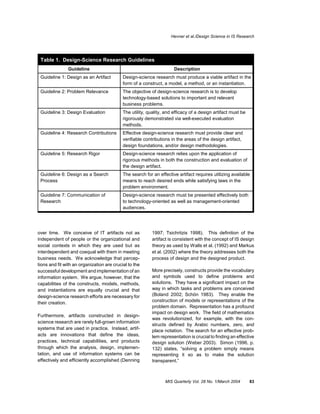
 Table 2. Design Evaluation Methods
 1. Observational          Case Study: Study artifact in depth in business environment
                           Field Study: Monitor use of artifact in multiple projects
 2. Analytical             Static Analysis: Examine structure of artifact for static qualities (e.g.,
                           complexity)
                           Architecture Analysis: Study fit of artifact into technical IS architecture
                           Optimization: Demonstrate inherent optimal properties of artifact or provide
                           optimality bounds on artifact behavior
                           Dynamic Analysis: Study artifact in use for dynamic qualities (e.g.,
                           performance)
 3. Experimental           Controlled Experiment: Study artifact in controlled environment for qualities
                           (e.g., usability)
                           Simulation – Execute artifact with artificial data
 4. Testing                Functional (Black Box) Testing: Execute artifact interfaces to discover
                           failures and identify defects
                           Structural (White Box) Testing: Perform coverage testing of some metric
                           (e.g., execution paths) in the artifact implementation
 5. Descriptive            Informed Argument: Use information from the knowledge base (e.g.,
                           relevant research) to build a convincing argument for the artifact’s utility
                           Scenarios: Construct detailed scenarios around the artifact to demonstrate
                           its utility


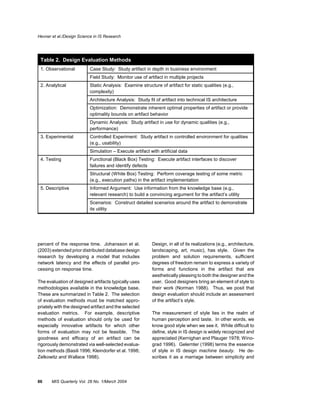
percent of the response time. Johansson et al.             Design, in all of its realizations (e.g., architecture,
(2003) extended prior distributed database design          landscaping, art, music), has style. Given the
research by developing a model that includes               problem and solution requirements, sufficient
network latency and the effects of parallel pro-           degrees of freedom remain to express a variety of
cessing on response time.                                  forms and functions in the artifact that are
                                                           aesthetically pleasing to both the designer and the
The evaluation of designed artifacts typically uses        user. Good designers bring an element of style to
methodologies available in the knowledge base.             their work (Norman 1988). Thus, we posit that
These are summarized in Table 2. The selection             design evaluation should include an assessment
of evaluation methods must be matched appro-               of the artifact’s style.
priately with the designed artifact and the selected
evaluation metrics. For example, descriptive               The measurement of style lies in the realm of
methods of evaluation should only be used for              human perception and taste. In other words, we
especially innovative artifacts for which other            know good style when we see it. While difficult to
forms of evaluation may not be feasible. The               define, style in IS design is widely recognized and
goodness and efficacy of an artifact can be                appreciated (Kernighan and Plauger 1978; Wino-
rigorously demonstrated via well-selected evalua-          grad 1996). Gelernter (1998) terms the essence
tion methods (Basili 1996; Kleindorfer et al. 1998;        of style in IS design machine beauty. He de-
Zelkowitz and Wallace 1998).                               scribes it as a marriage between simplicity and


86     MIS Quarterly Vol. 28 No. 1/March 2004
Hevner et al./Design Science in IS Research


power that drives innovation in science and                  formalisms, ontologies (Wand and Weber
technology. Simon (1996) also notes the impor-               1993, 1995; Weber 1997), problem and
tance of style in the design process. The ability to         solution representations, design algorithms
creatively vary the design process, within the               (Storey et al. 1997), and innovative
limits of satisfactory constraints, challenges and           information systems (Aiken 1991; Markus et
adds value to designers who participate in the               al. 2002; Walls et al. 1992) are examples of
process.                                                     such artifacts.

                                                        3.   Methodologies. Finally, the creative develop-
Guideline 4: Research Contributions                          ment and use of evaluation methods (e.g.,
                                                             experimental, analytical, observational,
Effective design-science research must provide               testing, and descriptive) and new evaluation
clear contributions in the areas of the design               metrics provide design-science research
artifact, design construction knowledge (i.e., foun-         contributions. Measures and evaluation
dations), and/or design evaluation knowledge (i.e.,          metrics in particular are crucial components
methodologies). The ultimate assessment for any              of design-science research. The right-facing
research is, “What are the new and interesting               arrow at the bottom of the figure from IS
contributions?” Design-science research holds                Research to the Knowledge Base in Figure 2
the potential for three types of research contri-            also indicates these contributions. TAM, for
butions based on the novelty, generality, and                example, presents a framework for predicting
significance of the designed artifact. One or more           and explaining why a particular information
of these contributions must be found in a given              system will or will not be accepted in a given
research project.                                            organizational setting (Venkatesh 2000).
                                                             Although TAM is posed as a behavioral
1.   The Design Artifact. Most often, the contribu-          theory, it also provides metrics by which a
     tion of design-science research is the artifact         designed information system or implemen-
     itself. The artifact must enable the solution of        tation process can be evaluated. Its implica-
     heretofore unsolved problems. It may extend             tions for design itself are as yet unexplored.
     the knowledge base (see below) or apply
     existing knowledge in new and innovative           Criteria for assessing contribution focus on
     ways. As shown in Figure 2 by the left-facing      representational fidelity and implementability.
     arrow at the bottom of the figure from IS          Artifacts must accurately represent the business
     Research to the Environment, exercising the        and technology environments used in the
     artifact in the environment produces               research, information systems themselves being
     significant value to the constituent IS            models of the business. These artifacts must be
     community. System development method-              “implementable,” hence the importance of instan-
     ologies, design tools, and prototype systems       tiating design science artifacts. Beyond these,
     (e.g., GDSS, expert systems) are examples          however, the research must demonstrate a clear
     of such artifacts.                                 contribution to the business environment, solving
                                                        an important, previously unsolved problem.
2.   Foundations. The creative development of
     novel, appropriately evaluated constructs,
     models, methods, or instantiations that            Guideline 5: Research Rigor
     extend and improve the existing foundations
     in the design-science knowledge base are           Rigor addresses the way in which research is
     also important contributions. The right-facing     conducted. Design-science research requires the
     arrow at the bottom of the figure from IS          application of rigorous methods in both the
     Research to the Knowledge Base in Figure 2         construction and evaluation of the designed
     indicates these contributions.       Modeling      artifact. In behavioral-science research, rigor is


                                                              MIS Quarterly Vol. 28 No. 1/March 2004     87
Hevner et al./Design Science in IS Research


often assessed by adherence to appropriate data        comparability, subject selection, training, time,
collection and analysis techniques.       Over-        and tasks. Methods for this type of evaluation are
emphasis on rigor in behavioral IS research has        not unlike those for justifying or testing behavioral
often resulted in a corresponding lowering of          theories. However, the principal aim is to deter-
relevance (Lee 1999).                                  mine how well an artifact works, not to theorize
                                                       about or prove anything about why the artifact
Design-science research often relies on mathe-         works.      This is where design-science and
matical formalism to describe the specified and        behavioral-science researchers must complement
constructed artifact. However, the environments        one another. Because design-science artifacts
in which IT artifacts must perform and the artifacts   are often the “machine” part of the human-
themselves may defy excessive formalism. Or, in        machine system constituting an information sys-
an attempt to be mathematically rigorous,              tem, it is imperative to understand why an artifact
important parts of the problem may be abstracted       works or does not work to enable new artifacts to
or “assumed away.” In particular, with respect to      be constructed that exploit the former and avoid
the construction activity, rigor must be assessed      the latter.
with respect to the applicability and generali-
zability of the artifact. Again, an overemphasis on
rigor can lessen relevance. We argue, along with       Guideline 6: Design as a
behavioral IS researchers (Applegate 1999), that       Search Process
it is possible and necessary for all IS research
paradigms to be both rigorous and relevant.            Design science is inherently iterative. The search
                                                       for the best, or optimal, design is often intractable
In both design-science and behavioral-science          for realistic information systems problems.
research, rigor is derived from the effective use of   Heuristic search strategies produce feasible, good
the knowledge base—theoretical foundations and         designs that can be implemented in the business
research methodologies. Success is predicated          environment. Simon (1996) describes the nature
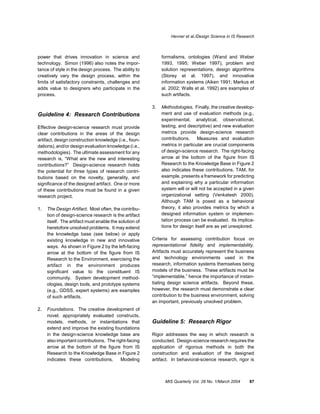
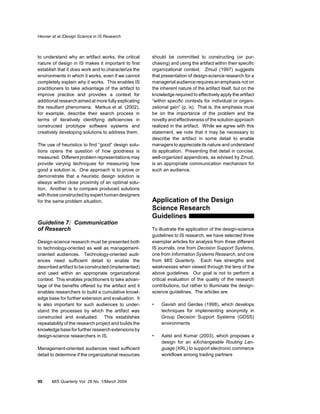
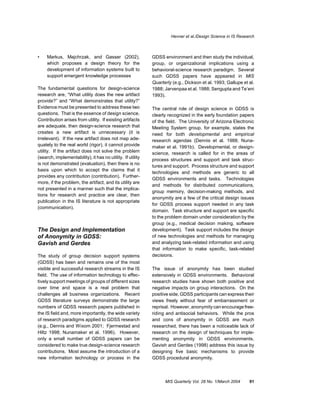
on the researcher’s skilled selection of appropriate   of the design process as a Generate/Test Cycle
techniques to develop or construct a theory or         (Figure 3).
artifact and the selection of appropriate means to
justify the theory or evaluate the artifact.           Design is essentially a search process to discover
                                                       an effective solution to a problem. Problem
Claims about artifacts are typically dependent         solving can be viewed as utilizing available means
upon performance metrics. Even formal mathe-           to reach desired ends while satisfying laws
matical proofs rely on evaluation criteria against     existing in the environment (Simon 1996).
which the performance of an artifact can be            Abstraction and representation of appropriate
measured. Design-science researchers must              means, ends, and laws are crucial components of
constantly assess the appropriateness of their         design-science research. These factors are prob-
metrics and the construction of effective metrics is   lem and environment dependent and invariably
an important part of design-science research.          involve creativity and innovation. Means are the
                                                       set of actions and resources available to construct
Furthermore, designed artifacts are often com-         a solution. Ends represent goals and constraints
ponents of a human-machine problem-solving             on the solution. Laws are uncontrollable forces in
system. For such artifacts, knowledge of behav-        the environment. Effective design requires knowl-
ioral theories and empirical work are necessary to     edge of both the application domain (e.g., require-
construct and evaluate such artifacts. Constructs,     ments and constraints) and the solution domain
models, methods, and instantiations must be            (e.g., technical and organizational).
exercised within appropriate environments.
Appropriate subject groups must be obtained for        Design-science research often simplifies a prob-
such studies. Issues that are addressed include        lem by explicitly representing only a subset of the


88     MIS Quarterly Vol. 28 No. 1/March 2004
Hevner et al./Design Science in IS Research


                                                  Generate
                                                    Design
                                                 Alternatives


                                              Test Alternatives
                                                   Against
                                         Requirements/Constraints


 Figure 3. The Generate/Test Cycle


relevant means, ends, and laws or by decom-               may not be possible to determine, let alone
posing a problem into simpler subproblems. Such           explicitly describe, the relevant means, ends, or
simplifications and decompositions may not be             laws (Vessey and Glass 1998). Even when it is
realistic enough to have a significant impact on          possible to do so, the sheer size and complexity of
practice but may represent a starting point.              the solution space will often render the problem
Progress is made iteratively as the scope of the          computationally infeasible. For example, to build
design problem is expanded. As means, ends,               a “reliable, secure, and responsive information
and laws are refined and made more realistic, the         systems infrastructure,” one of the key issues
design artifact becomes more relevant and                 faced by IS managers (Brancheau et al. 1996), a
valuable. The means, ends, and laws for IS                designer would need to represent all possible
design problems can often be represented using            infrastructures (means), determine their utility and
the tools of mathematics and operations research.         constraints (ends), and specify all cost and benefit
Means are represented by decision variables               constants (laws). Clearly such an approach is
whose values constitute an implementable design           infeasible. However, this does not mean that
solution. Ends are represented using a utility            design-science research is inappropriate for such
function and constraints that can be expressed in         a problem.
terms of decision variables and constants. Laws
are represented by the values of constants used           In such situations, the search is for satisfactory
in the utility function and constraints.                  solutions, i.e., satisficing (Simon 1996), without
                                                          explicitly specifying all possible solutions. The
The set of possible design solutions for any              design task involves the creation, utilization, and
problem is specified as all possible means that           assessment of heuristic search strategies. That
satisfy all end conditions consistent with identified     is, constructing an artifact that “works” well for the
laws. When these can be formulated appro-                 specified class of problems. Although its con-
priately and posed mathematically, standard               struction is based on prior theory and existing
operations research techniques can be used to             design knowledge, it may or may not be entirely
determine an optimal solution for the specified           clear why it works or the extent of its generaliza-
end conditions. Given the wicked nature of many           bility; it simply qualifies as “credentialed knowl-
information system design problems, however, it           edge” (Meehl 1986, p. 311). While it is important


                                                                  MIS Quarterly Vol. 28 No. 1/March 2004     89
Hevner et al./Design Science in IS Research


to understand why an artifact works, the critical      should be committed to constructing (or pur-
nature of design in IS makes it important to first     chasing) and using the artifact within their specific
establish that it does work and to characterize the    organizational context. Zmud (1997) suggests
environments in which it works, even if we cannot      that presentation of design-science research for a
completely explain why it works. This enables IS       managerial audience requires an emphasis not on
practitioners to take advantage of the artifact to     the inherent nature of the artifact itself, but on the
improve practice and provides a context for            knowledge required to effectively apply the artifact
additional research aimed at more fully explicating    “within specific contexts for individual or organi-
the resultant phenomena. Markus et al. (2002),         zational gain” (p. ix). That is, the emphasis must
for example, describe their search process in          be on the importance of the problem and the
terms of iteratively identifying deficiencies in       novelty and effectiveness of the solution approach
constructed prototype software systems and             realized in the artifact. While we agree with this
creatively developing solutions to address them.       statement, we note that it may be necessary to
                                                       describe the artifact in some detail to enable
The use of heuristics to find “good” design solu-      managers to appreciate its nature and understand
tions opens the question of how goodness is            its application. Presenting that detail in concise,
measured. Different problem representations may        well-organized appendices, as advised by Zmud,
provide varying techniques for measuring how           is an appropriate communication mechanism for
good a solution is. One approach is to prove or        such an audience.
demonstrate that a heuristic design solution is
always within close proximity of an optimal solu-
tion. Another is to compare produced solutions
with those constructed by expert human designers
for the same problem situation.                        Application of the Design
                                                       Science Research
                                                       Guidelines
Guideline 7: Communication
of Research                                            To illustrate the application of the design-science
                                                       guidelines to IS research, we have selected three
Design-science research must be presented both         exemplar articles for analysis from three different
to technology-oriented as well as management-          IS journals, one from Decision Support Systems,
oriented audiences. Technology-oriented audi-          one from Information Systems Research, and one
ences need sufficient detail to enable the             from MIS Quarterly. Each has strengths and
described artifact to be constructed (implemented)     weaknesses when viewed through the lens of the
and used within an appropriate organizational          above guidelines. Our goal is not to perform a
context. This enables practitioners to take advan-     critical evaluation of the quality of the research
tage of the benefits offered by the artifact and it    contributions, but rather to illuminate the design-
enables researchers to build a cumulative knowl-       science guidelines. The articles are
edge base for further extension and evaluation. It
is also important for such audiences to under-         •   Gavish and Gerdes (1998), which develops
stand the processes by which the artifact was              techniques for implementing anonymity in
constructed and evaluated. This establishes                Group Decision Support Systems (GDSS)
repeatability of the research project and builds the       environments
knowledge base for further research extensions by
design-science researchers in IS.                      •   Aalst and Kumar (2003), which proposes a
                                                           design for an eXchangeable Routing Lan-
Management-oriented audiences need sufficient              guage (XRL) to support electronic commerce
detail to determine if the organizational resources        workflows among trading partners


90     MIS Quarterly Vol. 28 No. 1/March 2004
Hevner et al./Design Science in IS Research


•    Markus, Majchrzak, and Gasser (2002),                  GDSS environment and then study the individual,
     which proposes a design theory for the                 group, or organizational implications using a
     development of information systems built to            behavioral-science research paradigm. Several
     support emergent knowledge processes                   such GDSS papers have appeared in MIS
                                                            Quarterly (e.g., Dickson et al. 1993; Gallupe et al.
The fundamental questions for design-science                1988; Jarvenpaa et al. 1988; Sengupta and Te’eni
research are, “What utility does the new artifact           1993).
provide?” and “What demonstrates that utility?”
Evidence must be presented to address these two             The central role of design science in GDSS is
questions. That is the essence of design science.           clearly recognized in the early foundation papers
Contribution arises from utility. If existing artifacts     of the field. The University of Arizona Electronic
are adequate, then design-science research that             Meeting System group, for example, states the
creates a new artifact is unnecessary (it is                need for both developmental and empirical
irrelevant). If the new artifact does not map ade-          research agendas (Dennis et al. 1988; Nuna-
quately to the real world (rigor), it cannot provide        maker et al. 1991b). Developmental, or design-
utility. If the artifact does not solve the problem         science, research is called for in the areas of
(search, implementability), it has no utility. If utility
                                                            process structures and support and task struc-
is not demonstrated (evaluation), then there is no
                                                            tures and support. Process structure and support
basis upon which to accept the claims that it
                                                            technologies and methods are generic to all
provides any contribution (contribution). Further-
                                                            GDSS environments and tasks. Technologies
more, if the problem, the artifact, and its utility are
                                                            and methods for distributed communications,
not presented in a manner such that the implica-
                                                            group memory, decision-making methods, and
tions for research and practice are clear, then
                                                            anonymity are a few of the critical design issues
publication in the IS literature is not appropriate
                                                            for GDSS process support needed in any task
(communication).
                                                            domain. Task structure and support are specific
                                                            to the problem domain under consideration by the
                                                            group (e.g., medical decision making, software
The Design and Implementation                               development). Task support includes the design
of Anonymity in GDSS:                                       of new technologies and methods for managing
Gavish and Gerdes                                           and analyzing task-related information and using
                                                            that information to make specific, task-related
The study of group decision support systems                 decisions.
(GDSS) has been and remains one of the most
visible and successful research streams in the IS           The issue of anonymity has been studied
field. The use of information technology to effec-          extensively in GDSS environments. Behavioral
tively support meetings of groups of different sizes        research studies have shown both positive and
over time and space is a real problem that                  negative impacts on group interactions. On the
challenges all business organizations. Recent               positive side, GDSS participants can express their
GDSS literature surveys demonstrate the large               views freely without fear of embarrassment or
numbers of GDSS research papers published in                reprisal. However, anonymity can encourage free-
the IS field and, more importantly, the wide variety        riding and antisocial behaviors. While the pros
of research paradigms applied to GDSS research              and cons of anonymity in GDSS are much
(e.g., Dennis and Wixom 2001; Fjermestad and                researched, there has been a noticeable lack of
Hiltz 1998; Nunamaker et al. 1996). However,                research on the design of techniques for imple-
only a small number of GDSS papers can be                   menting anonymity in GDSS environments.
considered to make true design-science research             Gavish and Gerdes (1998) address this issue by
contributions. Most assume the introduction of a            designing five basic mechanisms to provide
new information technology or process in the                GDSS procedural anonymity.


                                                                  MIS Quarterly Vol. 28 No. 1/March 2004     91
Hevner et al./Design Science in IS Research


Problem Relevance                                     design mechanisms to satisfy the system
                                                      requirements for anonymity. Proposed designs
The amount of interest and research on anonymity      are presented and anonymity claims are proved to
issues in GDSS testifies to its relevance. Field      be correct. A thorough discussion of the costs
studies and surveys clearly indicate that partici-    and benefits of the proposed anonymity
pants rank anonymity as a highly desired attribute    mechanisms is provided in Section 4 of the paper.
in the GDSS system. Many individuals state that
they would refuse to participate in or trust the
results of a GDSS meeting without a satisfactory      Design as an Artifact
level of assured anonymity (Fjermestad and Hiltz
1998).                                                The authors design a GDSS system architecture
                                                      that provides a rigorous level of procedural
                                                      anonymity. Five mechanisms are employed to
Research Rigor                                        ensure participant anonymity:

Gavish and Gerdes base their GDSS anonymity           •   All messages are encrypted with a unique
designs on past research in the fields of crypto-         session key
graphy and secure network communication proto-
cols (e.g., Chaum 1981; Schneier 1996). These         •   The sender’s header information is removed
research areas have a long history of formal,             from all messages
rigorous results that have been applied to the
design of many practical security and privacy         •   All messages are re-encrypted upon retrans-
mechanisms. Appendix A of the exemplar paper              mission from any GDSS server
provides a set of formal proofs that the claims
made by the authors for the anonymity designs         •   Transmission order of messages is ran-
are correct and draw their validity from the              domized
knowledge base of this past research.
                                                      •   Artificial messages are introduced to thwart
                                                          traffic analysis
Design as a Search Process
                                                      The procedures and communication protocols that
The authors motivate their design science             implement these mechanisms in a GDSS system
research by identifying three basic types of anony-   are the artifacts of this research.
mity in a GDSS system: environmental, content,
and procedural. After a definition and brief dis-
cussion of each type, they focus on the design of     Design Evaluation
mechanisms for procedural anonymity; the ability
of the GDSS system to hide the source of any          The evaluation consists of two reported activities.
message. This is a very difficult requirement         First, in Appendix A, each mechanism is proved to
because standard network protocols typically          correctly provide the claimed anonymity benefits.
attach source information in headers to support       Formal proof methods are used to validate the
reliable transmission protocols. Thus, GDSS sys-      effectiveness of the designed mechanisms.
tems must modify standard communication proto-        Second, Section 4 presents a thorough cost-
cols and include additional transmission proce-       benefit analysis. It is shown that the operational
dures to ensure required levels of anonymity.         costs of supporting the proposed anonymity
                                                      mechanisms can be quite significant. In addition,
The design-science process employed by the            the communication protocols to implement the
authors is to state the desired procedural anony-     mechanisms add considerable complexity to the
mity attributes of the GDSS system and then to        system. Thus, the authors recommend that a


92     MIS Quarterly Vol. 28 No. 1/March 2004
Hevner et al./Design Science in IS Research


cost-benefit justification be performed before       business processes. Workflow management
determining the level of anonymity to implement      systems are becoming integral components of
for a GDSS meeting.                                  many commercial enterprise-wide information
                                                     systems (Leymann and Roller 2000). Standards
The authors do not claim to have implemented the     for workflow semantics and syntax (i.e., workflow
proposed anonymity mechanisms in a prototype         languages) and workflow architectures are
or actual GDSS system. Thus, an instantiation of     promulgated by the Workflow Management
the designed artifact remains to be evaluated in     Coalition (WfMC 2000). While workflow models
an operational GDSS environment.                     have been used for many years to manage intra-
                                                     organizational business processes, there is now a
                                                     great demand for effective tools to model inter-
Research Contributions                               organization processes across heterogeneous
                                                     and distributed environments, such as those found
The design-science contributions of this research
                                                     in electronic commerce and complex supply
are the proposed anonymity mechanisms as the
                                                     chains (Kumar and Zhao 2002).
design artifacts and the evaluation results in the
form of formal proofs and cost-benefit analyses.
                                                     Aalst and Kumar (2003) investigate the problem of
These contributions advance our understanding of
                                                     exchanging business process information across
how best to provide participant anonymity in
GDSS meetings.                                       multiple organizations in an automated manner.
                                                     They design an eXchangable Routing Language
                                                     (XRL) to capture workflow models that are then
Research Communication                               embedded in eXtensible Markup Language (XML)
                                                     for electronic transmission to all participants in an
Although the presentation of this research is        interorganizational business process. The design
aimed at an audience familiar with network system    of XRL is based upon Petri nets, which provide a
concepts such as encryption and communication        formal basis for analyzing the correctness and
protocols, the paper also contains important,        performance of the workflows, as well as
useful information for a managerial audience.        supporting the extensibility of the language. The
Managers should have a good understanding of         authors develop a workflow management archi-
the implications of anonymity in GDSS meetings.      tecture and a prototype implementation to
This understanding must include an appreciation      evaluate XRL in a proof of concept.
of the costs of providing desired levels of
participant anonymity. While the authors provide
a thorough discussion of cost-benefit tradeoffs      Problem Relevance
toward the end of the paper, the paper would be
more accessible to a managerial audience if it       Interorganizational electronic commerce is
included a stronger motivation up front on the       growing rapidly and is projected to soon exceed
important implications of anonymity in GDSS          one trillion dollars annually (eMarketer 2002). A
system development and operations.
                                                     multitude of electronic commerce solutions are
                                                     being proposed (e.g., ebXML, UDDI, RosettaNet)
                                                     to enable businesses to execute transactions in
A Workflow Language for Inter-                       standardized, open environments. While XML has
organizational Processes:                            been widely accepted as a protocol for ex-
Aalst and Kumar                                      changing business data, there is still no clear
                                                     standard for exchanging business process infor-
Workflow models are an effective means for de-       mation (e.g., workflow models). This is the very
scribing, analyzing, implementing, and managing      relevant problem addressed by this research.


                                                           MIS Quarterly Vol. 28 No. 1/March 2004      93
Hevner et al./Design Science in IS Research


Research Rigor                                       Design as an Artifact

Research on workflow modeling has long been          There are two clearly identifiable artifacts pro-
based on rigorous mathematical techniques such       duced in this research. First, the workflow lan-
as Markov chains, queueing networks, and Petri       guage XRL is designed. XRL is based on Petri-
nets (Aalst and Hee 2002). In this paper, Petri      net formalisms and described in XML syntax.
nets provide the underlying semantics for XRL.       Interorganizational business processes are
These formal semantics allow for powerful analy-     specified via XRL for execution in a distributed,
sis techniques (e.g., correctness, performance) to   heterogeneous environment.
be applied to the designed workflow models.
Such formalisms also enable the development of       The second research artifact is the XRL/flower
automated tools to manipulate and analyze com-       workflow management architecture in which XRL-
plex workflow designs. Each language construct       described processes are executed. The XRL
in XRL has an equivalent Petri-net representation    routing scheme is parsed by an XML parser and
presented in the paper. The language is exten-       stored as an XML data structure. This structure is
sible in that adding a new construct simply          read into a Petri-net engine which determines the
requires defining its Petri-net representation and   next step of the business process and informs the
adding its syntax to the XRL. Thus, this research    next task provider via an e-mail message. Results
draws from a clearly defined and tested base of      of each task are sent back to the engine which
modeling literature and knowledge.                   then executes the next step in the process until
                                                     completion. The paper presents a prototype
                                                     implementation of the XRL/flower architecture as
Design as a Search Process                           a proof of concept (Aalst and Kumar 2003).

XRL is designed in the paper by performing a         Another artifact of this research is a workflow
thorough analysis of business process require-       verification tool named Wolfan that verifies the
ments and identifying features provided by leading   soundness of business process workflows.
commercial workflow management systems.              Soundness of a workflow requires that the
Using the terminology from the paper, workflows      workflow terminates, no Petri-net tokens are left
traverse routes through available tasks (i.e.,       behind upon termination, and there are no dead
business services) in the electronic business        tasks in the workflow. This verification tool is
environment. The basic routing constructs of XRL     described more completely in a different paper
define the specific control flow of the business     (Aalst 1999).
process. The authors build 13 basic constructs
into XRL: Task, Sequence, Any_sequence,
Choice, Condition, Parallel_sync, Parallel_no_       Design Evaluation
sync, Parallel_part_sync, Wait_all, Wait_any,
While_do, Stop, and Terminate. They show the         The authors evaluate the XRL and XRL/flower
Petri-net representation of each construct. Thus,    designs in several important ways:
the fundamental control flow structures of
sequence, decision, iteration, and concurrency are   •   XRL is compared and contrasted with lan-
supported in XRL.                                        guages in existing commercial workflow
                                                         systems and research prototypes. The
The authors demonstrate the capabilities of XRL          majority of these languages are proprietary
in several examples. However, they are careful           and difficult to adapt to ad hoc business
not to claim that XRL is complete in the formal          process design.
sense that all possible business processes can be
modeled in XRL. The search for a complete set of     •   The fit of XRL with proposed standards is
XRL constructs is left for future research.              studied. In particular, the Interoperability Wf-


94     MIS Quarterly Vol. 28 No. 1/March 2004
Hevner et al./Design Science in IS Research


    XML Binding standard (WfMC 2000) does not            Information Systems Design for
    at this time include the specification of control    Emergent Knowledge Processes:
    flow and, thus, is not suitable for inter-           Markus, Majchrzak, and Gasser
    organizational workflows. Electronic com-
    merce standards (e.g., RosettaNet) provide           Despite decades of research and development
    some level of control flow specification for         efforts, effective methods for developing infor-
    predefined business activities, but do not           mation systems that meet the information require-
    readily allow the ad hoc specification of            ments of upper management remain elusive.
    business processes.                                  Early approaches used a “waterfall” approach
                                                         where requirements were defined and validated
•   A research prototype of XRL/flower has been          prior to initiating design efforts which, in turn, were
    implemented and several of the user interface        completed prior to implementation (Royce 1998).
    screens are presented. The screens demon-            Prototyping approaches emerged next, followed
    strate a mail-order routing schema case              by numerous proposals including CASE tool-
    study.                                               based approaches, rapid application development,
                                                         and extreme programming (Kruchten 2000).
•   The Petri-net foundation of XRL allows the           Walls et al. (1992) propose a framework for a
    authors to claim the XRL workflows can be            prescriptive information system design theory
    verified for correctness and performance.            aimed at enabling designers to construct “more
    XRL is extensible since new constructs can           effective information systems” (p. 36). They apply
    be added to the language based on their              this framework to the design of vigilant executive
    translation to underlying Petri-net repre-           information systems. The framework establishes
    sentations. However, as discussed above,             a class of user requirements (model of design
    the authors do not make a formal claim for           problems) that are most effectively addressed
    the representational completeness of XRL.            using a particular type of system solution
                                                         (instantiation) designed using a prescribed set of
                                                         development practices (methods). Markus et al.
Research Contributions                                   (2002) extend this framework to the development
                                                         of information systems to support emergent
The clear contributions of this research are the         knowledge processes (EKPs)—processes in
design artifacts—XRL (a workflow language),              which structure is “neither possible nor desirable”
XRL/flower (a workflow architecture and its              (p. 182) and where processes are characterized
implemented prototype system), and Wolfan (a             by “highly unpredictable user types and work
Petri-net verification engine). Another interesting      contexts” (p. 183).
contribution is the extension of XML in its ability to
describe and transmit routing schemas (e.g.,
control flow information) to support interorgani-        Problem Relevance
zational electronic commerce.
                                                         The relevance and importance of the problem are
                                                         well demonstrated. Markus et al. describe a class
Research Communication                                   of management activities that they term emergent
                                                         knowledge processes (EKPs). These include
This paper provides clear information to both            “basic research, new product development,
technical and managerial audiences. The presen-          strategic business planning, and organization
tation, while primarily technical with XML coding        design” (p. 179). They are characterized by “pro-
and Petri-net diagrams throughout, motivates a           cess emergence, unpredictable user types and
managerial audience with a strong introduction on        use contexts, and distributed expert knowledge”
risks and benefits of applying interorganizational       (p. 186). They are crucial to many manufacturing
workflows to electronic commerce applications.           organizations, particularly those in high-tech


                                                                MIS Quarterly Vol. 28 No. 1/March 2004       95
Hevner et al./Design Science in IS Research


industries. Such organizations recognize the            in over two dozen ‘real use’ situations.” (p. 187).
need to integrate organizational design and infor-      In summary, this work effectively used theoretical
mation system design with manufacturing opera-          foundations from IS and organizational theory,
tions. They recognize the potential for significant     applied appropriate research methods in
performance improvements offered by such                developing the artifact, defined and applied
integration. Yet few have realized that potential.      appropriate performance measures, and tested
Markus et al. argue that this is due to a lack of an    the artifact within an appropriate context.
adequate design theory and lack of scientifically
based tools, noting that existing information
system development methodologies focus on               Design as a Search Process
structured or semi-structured decision processes
and are inadequate for the development of sys-          As discussed above, implementation and iteration
tems to support EKPs. TOP Modeler, the artifact         are central to this research. The authors study
created in this research effort, squarely addresses     prototypes that instantiate posed or newly learned
this problem. Not surprisingly, its development         design prescriptions. Their use and impacts were
attracted the attention and active participation of     observed, problems identified, solutions posed
several large, high-tech manufacturing organi-          and implemented, and the cycle was then
zations including “Hewlett-Packard, General             repeated. These interventions occurred over a
Motors, Digital Equipment Corporation, and Texas        period of 18 months within the aforementioned
Instruments” (p. 186).                                  companies as they dealt with organizational
                                                        design tasks. As a result, not only was the TOP
                                                        Modeler developed and deployed but prescrip-
Research Rigor                                          tions (methods) in the form of six principles for
                                                        developing systems to support EKPs were also
The presented work has theoretical foundations in       devised. The extensive experience, creativity,
both IS design theory and organizational design         intuition, and problem solving capabilities of the
theory. It uses the basic notions of IS design
                                                        researchers were involved in assessing problems
theory presented in Walls et al. (1992) and poses
                                                        and interpreting the results of deploying various
a prescription for designing information systems to
                                                        TOP modeler iterations and in constructing
support EKPs. Prior research in developing
                                                        improvements to address shortcomings identified.
decision support systems, executive information
systems, and expert systems serves as a foun-
dation for this work and deficiencies of these
                                                        Design as an Artifact
approaches for the examined problem type serve
as motivation. The knowledge-base constructed
within TOP Modeler was formed from a synthesis          The TOP Modeler is an implemented software
of socio-technical systems theory and the               system (instantiation). It is composed of an
empirical literature on organizational design           object-oriented user interface, an object-oriented
knowledge. It was evaluated theoretically using         query generator, and an analysis module built on
standard metrics from the expert systems                top of a relational meta-knowledge base that
literature and empirically using data gathered from     enables access to “pluggable” knowledge bases
numerous electronics manufacturing companies            representing different domains. It also includes
in the United States. Development of TOP                tools to support the design and construction of
Modeler used an “action research paradigm”              these knowledge bases. The TOP Modeler sup-
starting with a “kernel theory” based on prior          ports a development process incorporating the six
development methods and theoretical results and         principles for developing systems to support
iteratively posing and testing artifacts (prototypes)   EKPs. As mentioned above, TOP Modeler was
to assess progress toward the desired result.           commercialized and used in a number of different
Finally, the artifact was commercialized and “used      organizational redesign situations.


96     MIS Quarterly Vol. 28 No. 1/March 2004
Hevner et al./Design Science in IS Research


Design Evaluation                                        empirical evidence will establish the validity” of
                                                         such claims.
Evaluation is in the context of organizational
design in manufacturing organizations, and is
based on observation during the development and          Research Contributions
deployment of a single artifact, TOP Modeler. No
formal evaluation was attempted in the sense of          The design-science contributions of this research
comparison with other artifacts. This is not             are the TOP Modeler software and the design
surprising, nor is it a criticism of this work. There    principles. TOP Modeler demonstrates the feasi-
                                                         bility of using the design principles to develop an
simply are no existing artifacts that address the
                                                         artifact to support EKPs. Because TOP Modeler
same problem. However, given that method-
                                                         is the first artifact to address this task, its
ologies for developing information systems to
                                                         construction is itself a contribution to design
support semi-structured management activities
                                                         science. Furthermore, because the authors are
are the closest available artifacts, it is appropriate
                                                         able to articulate the design principles upon which
to use them as a comparative measure. In effect,
                                                         its construction was based, these serve as
this was accomplished by using principles from
                                                         hypotheses to be tested by future empirical work.
these methodologies to inform the initial design of
                                                         Their applicability to the development of other
TOP Modeler. The identification of deficiencies in       types of information systems can also be tested.
the resultant artifact provides evidence that these      An agenda for addressing such issues is pre-
artifacts are ill-suited to the task at hand.            sented. This focuses on validation, evaluation,
                                                         and the challenges of improvement inherent in the
Iterative development and deployment within the          evaluation process.
context of organizational design in manufacturing
organizations provide opportunities to observe
improvement but do not enable formal evalua-             Research Communication
tion—at each iteration, changes are induced in the
organization that cannot be controlled. As men-          This work presents two types of artifacts, TOP
tioned above, the authors have taken a creative          Modeler (an instantiation) and a set of design
and innovative approach that, of necessity, trades       principles (method) that address a heretofore
off rigor for relevancy. In the initial stages of a      unsolved problem dealing with the design of an
discipline, this approach is extremely effective.        information system to support EKPs. Recognizing
TOP Modeler demonstrates the feasibility of              that existing system development methods and
developing an artifact to support organizational         instantiations are aimed at structured or semi-
                                                         structured activities, Markus et al. identify an
design and EKPs within high-tech manufacturing
                                                         opportunity to apply information technology in a
organizations. “In short, the evidence suggests
                                                         new and innovative way. Their presentation
that TOP Modeler was successful in supporting
                                                         addresses each of the design guidelines posed
organizational design” (p. 187) but additional
                                                         above. TOP Modeler exemplifies “proof by con-
study is required to assess the comparative
                                                         struction”—it is feasible to construct an infor-
effectiveness of other possible approaches in this
                                                         mation system to support EKPs. Since it is the
or other contexts. Again, this is not a criticism of
                                                         first such artifact, its evaluation using formal
this work; rather it is a call for further research in   methods is deferred until future research.
the general class of problems dealing with emer-         Technical details of TOP Modeler are not pre-
gent knowledge processes. As additional re-              sented, making it difficult for a technical
search builds on this foundation, formal, rigorous       researcher or practitioner to replicate their work.
evaluation and comparison with alternative               The uniqueness of the artifacts and the innovation
approaches in a variety of contexts become               inherent in them are presented so that managerial
crucial to enable claims of generalizability. As the     researchers and IT managers are aware of the
authors point out, “Only the accumulated weight of       new capabilities.


                                                               MIS Quarterly Vol. 28 No. 1/March 2004     97
Hevner et al./Design Science in IS Research


Discussion and Conclusions                               tation, management, and use of such techno-
                                                         logies. The dangers of a design-science research
Philosophical debates on how to conduct IS               paradigm are an overemphasis on the technologi-
research (e.g., positivism vs. interpretivism) have      cal artifacts and a failure to maintain an adequate
been the focus of much recent attention (Klein and       theory base, potentially resulting in well-designed
Myers 1999; Robey 1996; Weber 2003). The                 artifacts that are useless in real organizational
major emphasis of such debates lies in the               settings. The dangers of a behavioral-science
epistemologies of research, the underlying               research paradigm are overemphasis on contex-
assumption being that of the natural sciences.           tual theories and failure to adequately identify and
That is, somewhere some truth exists and                 anticipate technological capabilities, potentially
somehow that truth can be extracted, explicated,         resulting in theories and principles addressing
and codified. The behavioral-science paradigm            outdated or ineffective technologies. We argue
seeks to find “what is true.” In contrast, the           strongly that IS research must be both proactive
design-science paradigm seeks to create “what is         and reactive with respect to technology. It needs
effective.” While it can be argued that utility relies   a complete research cycle where design science
on truth, the discovery of truth may lag the appli-      creates artifacts for specific information problems
cation of its utility. We argue that both design-        based on relevant behavioral science theory and
science and behavioral-science paradigms are             behavioral science anticipates and engages the
needed to ensure the relevance and effectiveness         created technology artifacts.
of IS research. Given the artificial nature of
organizations and the information systems that           Hence, we reiterate the call made earlier by March
support them, the design-science paradigm can            et al. (2000) to align IS design-science research
play a significant role in resolving the fundamental     with real-world production experience. Results
dilemmas that have plagued IS research: rigor,           from such industrial experience can be framed in
relevance, discipline boundaries, behavior, and          the context of our seven guidelines. These must
technology (Lee 2000).                                   be assessed not only by IS design-science
                                                         researchers but also by IS behavioral-science
Information systems research lies at the inter-          researchers who can validate the organizational
section of people, organizations, and technology         problems as well as study and anticipate the
(Silver et al. 1995). It relies on and contributes to    impacts of created artifacts. Thus, we encourage
cognitive science, organizational theory, manage-        collaborative industrial/academic research pro-
ment sciences, and computer science. It is both          jects and publications based on such experience.
an organizational and a technical discipline that is     Markus et al. (2002) is an excellent example of
concerned with the analysis, construction, deploy-       such collaboration. Publication of these results
ment, use, evaluation, evolution, and manage-            will help accelerate the development of domain
ment of information system artifacts in organi-          independent and scalable solutions to large-scale
zational settings (Madnick 1992; Orlikowski and          information systems problems within organiza-
Barley 2001).                                            tions. We recognize that a lag exists between
                                                         academic research and its adoption in industry.
Within this setting, the design-science research         We also recognize the possible ad hoc nature of
paradigm is proactive with respect to technology.        technology-oriented solutions developed in indus-
It focuses on creating and evaluating innovative IT      try. The latter gap can be reduced considerably
artifacts that enable organizations to address im-       by developing and framing the industrial solutions
portant information-related tasks. The behavioral-       based on our proposed guidelines.
science research paradigm is reactive with
respect to technology in the sense that it takes         It is also important to distinguish between “system
technology as “given.” It focuses on developing          building” efforts and design-science research.
and justifying theories that explain and predict         Guidelines addressing evaluation, contributions,
phenomena related to the acquisition, implemen-          and rigor are especially important in providing this


98     MIS Quarterly Vol. 28 No. 1/March 2004
Hevner et al./Design Science in IS Research


distinction. The underlying formalism required by     •   Design-science research is perishable.
these guidelines helps researchers to develop             Rapid advances in technology can invalidate
representations of IS problems, solutions, and            design-science research results before they
solution processes that clarify the knowledge             are implemented effectively in the business
produced by the research effort.                          environment or, just as importantly to mana-
                                                          gers, before adequate payback can be
As we move forward, there exist a number of               achieved by committing organizational
exciting challenges facing the design-science             resources to implementing those results.
research community in IS. A few are summarized            Two examples are the promises made by the
here.                                                     artificial intelligence community in the 1980s
                                                          (Feigenbaum and McCorduck 1983) and the
•   There is an inadequate theoretical base upon          more recent research on object-oriented
    which to build an engineering discipline of           databases (Chaudhri and Loomis 1998). Just
    information systems design (Basili 1996).             as important to IS researchers, design results
    The field is still very young lacking the             can be overtaken by technology before they
    cumulative theory development found in other          even appear in the research literature. How
    engineering and social-science disciplines. It        much research was published on the Year
    is important to demonstrate the feasibility and       2000 problem before it became a non-event?
    utility of such a theoretical base to a mana-
    gerial audience that must make technology-        •   Rigorous evaluation methods are extremely
    adoption decisions that can have far-reaching         difficult to apply in design-science research
    impacts on the organization.                          (Tichy 1998; Zelkowitz and Wallace 1998).
                                                          For example, the use of a design artifact on a
•   Insufficient sets of constructs, models,
                                                          single project may not generalize to different
    methods, and tools exist for accurately repre-
                                                          environments (Markus et al. 2002).
    senting the business/technology environment.
    Highly abstract representations (e.g., analyti-
                                                      We believe that design science will play an
    cal mathematical models) are criticized as
                                                      increasingly important role in the IS profession. IS
    having no relationship to “real-world” environ-
                                                      managers in particular are actively engaged in
    ments. On the other hand, many informal,
                                                      design activities—the creation, deployment, eval-
    descriptive IS models lack an underlying
                                                      uation, and improvement of purposeful IT artifacts
    theory base. The trade-offs between rele-
                                                      that enable organizations to achieve their goals.
    vance and rigor are clearly problematic;
                                                      The challenge for design-science researchers in
    finding representational techniques with an
                                                      IS is to inform managers of the capabilities and
    acceptable balance between the two is very
                                                      impacts of new IT artifacts.
    difficult.

•   The existing knowledge base is often insuffi-     Much of the research published in MIS Quarterly
    cient for design purposes and designers must      employs the behavioral-science paradigm. It is
    rely on intuition, experience, and trial-and-     passive with respect to technology, often ignoring
    error methods. A constructed artifact em-         or “under-theorizing” the artifact itself (Orlikowski
    bodies the designer’s knowledge of the            and Iacono 2001). Its focus is on describing the
    problem and solution. In new and emerging         implications of technology—its impact on indivi-
    applications of technology, the artifact itself   duals, groups, and organizations. It regularly
    represents an experiment. In its execution,       includes studies that examine how people employ
    we learn about the nature of the problem, the     a technology, report on the benefits and difficulties
    environment, and the possible solutions—          encountered when a technology is implemented
    hence, the importance of developing and           within an organization, or discuss how managers
    implementing prototype artifacts (Newell and      might facilitate the use of a technology. Orman
    Simon 1976).                                      (2002) argues that many of the equivocal results


                                                            MIS Quarterly Vol. 28 No. 1/March 2004      99
Hevner et al./Design Science in IS Research


in IS behavioral-science studies can be explained       References
by a failure to differentiate the capabilities and
purposes of the studied technology.                     Aalst, W. “Wolfan: A Petri-Net-Based Workflow
                                                             Analyzer,” Systems Analysis-Modeling-Simu-
Design science is active with respect to tech-               lation (34:3), 1999, pp. 345-357.
nology, engaging in the creation of technological       Aalst, W., and Hee, K. Workflow Management:
artifacts that impact people and organizations. Its          Models, Methods, and Systems, The MIT
focus is on problem solving but often takes a                Press, Cambridge, MA, 2002.
simplistic view of the people and the organiza-         Aalst, W., and Kumar, A. “XML-Based Schema
tional contexts in which designed artifacts must             Definition for Support of Interorganizational
function. As stated earlier, the design of an arti-          Workflow,” Information Systems Research
fact, its formal specification, and an assessment            (14:1), March 2003, pp. 23-46.
of its utility, often by comparison with competing      Aboulafia, M. (ed.). Philosophy, Social Theory,
artifacts, are integral to design-science research.          and the Thought of George Herbert Mead
These must be combined with behavioral and                   (SUNY Series in Philosophy of the Social
organizational theories to develop an under-                 Sciences), State University of New York
standing of business problems, contexts, solu-               Press, Albany, NY, 1991.
tions, and evaluation approaches adequate to            Aiken, M. W., Sheng, O. R. L., and Vogel, D. R.
servicing the IS research and practitioner com-              “Integrating Expert Systems with Group
munities. The effective presentation of design-              Decision Support Systems,” ACM Trans-
                                                             actions on Information Systems (9:1),
science research in major IS journals, such as
                                                             January 1991, pp. 75-95.
MIS Quarterly, will be an important step toward
                                                        Alter, S. “18 Reasons Why IT-Reliant Work
integrating the design-science and behavioral-
                                                             Systems Should Replace ‘The IT Artifact’ as
science communities in IS.
                                                             the Core Subject Matter of the IS Field,” Com-
                                                             munications of the AIS (12), October 2003,
                                                             pp. 365-394.
                                                        Applegate, L. M. “Rigor and Relevance in MIS
Acknowledgements                                             Research—Introduction,” MIS Quarterly
                                                             (23:1), March 1999, pp. 1-2.
We would like to thank Allen Lee, Ron Weber,
                                                        Basili, V. “The Role of Experimentation in Soft-
and Gordon Davis who in different ways each
                                                             ware Engineering: Past, Current, and Fu-
contributed to our thinking about design science in          ture,” in Proceedings of the 18thInternational
the Information Systems profession and en-                   Conference on Software Engineering, T.
couraged us to pursue this line of research. We              Maibaum and M. Zelkowitz (eds.), Berlin,
would also like to acknowledge the efforts of                Germany, March 25-29,1996, pp. 442-449.
Rosann Collins who provided insightful comments         Basu, A., and Blanning, R. W. “A Formal Ap-
and perspectives on the nature of the relationship           proach to Workflow Analysis,” Information
between behavioral-science and design-science                Systems Research (11:1), March 2000, pp.
research. This work has also benefited from                  17-36.
seminars and discussions at Arizona State Univer-       Basu, A., and Blanning, R. W. “Metagraphs: A
sity, Florida International University, Georgia State        Tool for Modeling Decision Support Systems,”
University, Michigan State University, Notre Dame            Management Science (40:12), December
University, and The University of Utah. We would             1994, pp. 1579-1600.
particularly like to thank Brian Pentland and Steve     Batra, D., Hoffer, J. A., and Bostrom, R. P. “A
Alter for feedback and suggestions they provided             Comparison of User Performance between
on an earlier version of this paper. The comments            the Relational and the Extended Entity Rela-
provided by several anonymous editors and                    tionship Models in the Discovery Phase of
reviewers greatly enhanced the content and                   Database Design,” Communications of the
presentation of the paper.                                   ACM (33:2), February 1990, pp. 126-139.


100     MIS Quarterly Vol. 28 No. 1/March 2004
Hevner et al./Design Science in IS Research


Bell, D. A. “From Data Properties to Evidence,”     Chen, P. P. S. “The Entity-Relationship Model:
     IEEE Transactions on Knowledge and Data            Toward a Unified View,” ACM Transactions
     Engineering (5:6), December 1993, pp. 965-         on Database Systems (1:1), 1976, pp. 9-36.
     969.                                           Davis, G. B., and Olson, M. H. Management
Benbasat, I., and Zmud, R. W. “Empirical                Information Systems: Conceptual Foun-
     Research in Information Systems: The Prac-         dations, Structure and Development (2nd ed.),
     tice of Relevance,” MIS Quarterly (23:1),          McGraw-Hill, New York, 1985.
     March 1999, pp. 3-16.                          DeLone, W. H., and McLean, E. R. “The DeLone
Bhargava, H. K., Krishnan, R., and Piela, P. “On        and McLean Model of Information Systems
     Formal Semantics and Analysis of Typed             Success: A Ten-Year Update,” Journal of
     Modeling Languages:         An Analysis of         Management Information Systems (19:4),
     Ascend,” INFORMS Journal on Computing              Spring 2003, pp. 9-30.
     (10:2), Spring 1998, pp. 189-208.              DeLone, W. H., and McLean, E. R. “Information
Bodart, F., Patel, A., Sim, M., and Weber, R.           Systems Success: The Quest for the
     “Should the Optional Property Construct be         Dependent Variable,” Information Systems
     Used in Conceptual Modeling? A Theory and          Research (3:1), March 1992, pp. 60-95.
     Three Empirical Tests,” Information Systems    Denning, P. J. “A New Social Contract for
     Research (12:4), December 2001, pp 384-            Research,” Communications of the ACM
     405.                                               (40:2), February 1997, pp. 132-134.
Boland, R. J. “Design in the Punctuation of Man-
                                                    Dennis, A., George, J., Jessup, L., Nunamaker, J.,
     agement Action” in Managing as Designing:
                                                        and Vogel, D. “Information Technology to
     Creating a Vocabulary for Management Edu-
                                                        Support Electronic Meetings,” MIS Quarterly
     cation and Research, R. Boland (ed.), Fron-
                                                        (12:4), December 1988, pp. 591-624.
     tiers of Management Workshop, Weather-
                                                    Dennis, A., and Wixom, B. “Investigating the
     head School of Management, June 14-15,
                                                        Moderators of the Group Support Systems
     2002 (available online at http://design.
                                                        Use with Meta-Analysis,” Journal of Manage-
     cwru.edu).
                                                        ment Information Systems (18:3), Winter
Brancheau, J., Janz, B., and Wetherbe, J. “Key
                                                        2001-02, pp. 235-257.
     Issues in Information Systems Management:
                                                    Dey, D., Sarkar, S., and De, P. “A Probabilistic
     1994-95 SIM Delphi Results,” MIS Quarterly
                                                        Decision Model for Entity Matching in Hetero-
     (20:2), June 1996, pp. 225-242.
Brooks, F. P., Jr. “The Computer Scientist as           geneous Databases,” Management Science
     Toolsmith II,” Communications of the ACM           (44:10), October 1998, pp. 1379-1395.
     (39:3), March 1996, pp. 61-68.                 Dey, D., Storey, V. C., and Barron, T. M.
Brooks, F. P., Jr. “No Silver Bullet: Essence and       “Improving Database Design through the
     Accidents of Software Engineering,” IEEE           Analysis of Relationships,” ACM Transactions
     Computer (20:4), April 1987, pp 10-19.             on Database Systems (24:4), December
Bunge, M. A. Treatise on Basic Philosophy:              1999, pp. 453-486.
     Volume 7—Epistemology & Methodology III:       Dickson, G., Partridge, J., and Robinson, L.
     Philosophy of Science and Technology—Part          “Exploring Modes of Facilitative Support for
     II: Life Science, Social Science and Tech-         GDSS Technology,” MIS Quarterly (17:2),
     nology, D. Reidel Publishing Company,              June 1993, pp. 173-194.
     Boston, MA, 1985.                              Drucker, P. F. “The Coming of the New Organi-
Chaudhri, A., and Loomis, M. Object Databases           zation,” Harvard Business Review (66:1),
     in Practice, Prentice-Hall, Upper Saddle           January-February 1988, pp. 45-53.
     River, NJ, 1998.                               Drucker, P. F. “The New Productivity Challenge,”
Chaum, D. “Untraceable Electronic Mail, Return          Harvard Business Review (69:6), November-
     Addresses, and Digital Pseudonyms,” Com-           December 1991, pp. 45-53.
     munications of the ACM (24:2), February        Dym, C. L. Engineering Design, Cambridge Uni-
     1981, pp. 84-87.                                   versity Press, New York, 1994.


                                                         MIS Quarterly Vol. 28 No. 1/March 2004     101
Hevner et al./Design Science in IS Research


eMarketer. E-Commerce Trade and B2B Ex-               Johansson, J. M., March, S. T., and Naumann, J.
    changes, March 2002 (available online at               D. “Modeling Network Latency and Parallel
    http://www.emarketer.com/products/report.p             Processing in Distributed Database Design,”
    hp?ecommerce_trade).                                   Decision Sciences Journal (34:4), Fall 2003.
Feigenbaum, E., and McCorduck, P. The Fifth           Kalakota, R., and Robinson, M. E-Business 2.0:
    Generation: Artificial Intelligence and Japan’s        Roadmap for Success, Addison-Wesley
    Computer Challenge to the World, Addison-              Pearson Education, Boston, MA, 2001.
    Wesley, Inc., Reading, MA, 1983.                  Keil, M. “Pulling the Plug: Software Project
Fjermestad, J., and Hiltz, S. R. “An Assessment            Management and the Problem of Project
    of Group Support Systems Experimental Re-              Escalation,” MIS Quarterly (19:4) December
    search: Methodology and Results,” Journal              1995, pp. 421-447.
    of Management Information Systems (15:3),         Keil, M., Cule, P. E., Lyytinen, K., and Schmidt, R.
    Winter 1998-99, pp. 7-149.                             C. “A Framework for Identifying Software
Gallupe, R., DeSanctis, G., and Dickson, G.                Project Risks,” Communications of the ACM
    “Computer-Based Support for Group Prob-                (41:11), November 1998, pp. 76-83.
    lem-Finding: An Experimental Investigation,”      Keil, M., and Robey, D. “Turning Around Troubled
    MIS Quarterly, (12:2), June 1988, pp. 277-             Software Projects: An Exploratory Study of
    298.                                                   the Deescalation of Commitment to Failing
Gavish, B., and Gerdes, J. “Anonymous Mecha-               Courses of Action,” Journal of Management
    nisms in Group Decision Support Systems                Information Systems, (15:4) December 1999,
    Communication,” Decision Support Systems               pp. 63-87.
    (23:4), October 1998, pp. 297-328.                Kernighan, B., and Plauger, P. J. The Elements
Geerts, G., and McCarthy, W. E. “An Ontological            of Programming Style (2nd ed.), McGraw-Hill,
    Analysis of the Primitives of the Extended-            New York, 1978.
    REA Enterprise Information Architecture,”         Kim, Y. G., and March, S. T. “Comparing Data
    The International Journal of Accounting                Modeling Formalisms,” Communications of
    Information Systems (3:1), 2002, pp. 1-16.             the ACM (38:6), June 1995, pp. 103-115.
Gelernter, D. Machine Beauty: Elegance and the        Klein, H. K., and Myers, M. D. “A Set of Principles
    Heart of Technology, Basic Books, New York,            for Conducting and Evaluating Interpretive
    1998.                                                  Field Studies in Information Systems,” MIS
Glass, R. “On Design,” IEEE Software (16:2),               Quarterly (23:1), March 1999, pp. 67-94.
    March/April 1999, pp. 103-104.                    Kleindorfer, G., O’Neill, L., and Ganeshan, R.
Halpin, T. A. Information Modeling and Relational          “Validation in Simulation: Various Positions
    Databases, Morgan Kaufmann Publishers,                 in the Philosophy of Science,” Management
    New York, 2001.                                        Science (44:8), August 1998, pp. 1087-1099.
Henderson, J., and Venkatraman, N. “Strategic         Kruchten, P. The Rational Unified Process: An
    Alignment: Leveraging Information Techno-              Introduction (2nd ed.), Addison-Wesley, Inc.,
    logy for Transforming Organizations,” IBM              Reading, MA, 2000.
    Systems Journal (32:1), 1993.                     Kuhn, T. S. The Structure of Scientific Revolu-
ISR. Editorial Statement and Policy, Information           tions (3rd ed.), University of Chicago Press,
    Systems Research (13:4), December 2002.                Chicago, IL, 1996.
Jarvenpaa, S., Rao, V., and Huber, G. “Computer       Kumar, A., and Zhao, J. “Workflow Support for
    Support for Meetings of Groups Working on              Electronic Commerce Applications,” Decision
    Unstructured Problems: A Field Experiment,”            Support Systems (32:3), January 2002, pp.
    MIS Quarterly (12:4), December 1988, pp.               265-278.
    645-666.                                          Lee, A. “Inaugural Editor’s Comments,” MIS
Johansson, J. M. “On the Impact of Network                 Quarterly (23:1), March 1999, pp. v-xi.
    Latency on Distributed Systems Design,”           Lee, A. “Systems Thinking, Design Science, and
    Information Technology Management (1),                 Paradigms: Heeding Three Lessons from the
    2000, pp. 183-194.                                     Past to Resolve Three Dilemmas in the


102     MIS Quarterly Vol. 28 No. 1/March 2004
Hevner et al./Design Science in IS Research


    Present to Direct a Trajectory for Future       Norman, D. The Design of Everyday Things,
    Research in the Information Systems Field,”          Currency Doubleday, New York, 1988.
    Keynote Address, Eleventh International Con-    Nunamaker, J., Briggs, R., Mittleman, D., Vogel,
    ference on Information Management, Taiwan,           D., and Balthazard, P. “Lessons from a
    May 2000 (available online at http://www.            Dozen Years of Group Support Systems
    people.vcu.edu/~aslee/ICIM-keynote-2000).            Research: A Discussion of Lab and Field
Leymann, F., and Roller, D. Production Workflow:         Findings,” Journal of Management Informa-
    Concepts and Techniques, Prentice-Hall,              tion Systems, (13:3), Winter 1996-97, pp.
    Upper Saddle River, NJ, 2000.                        163-207.
Madnick, S. E. “The Challenge: To Be Part of the    Nunamaker, J., Chen, M., and Purdin, T. D. M.
    Solution Instead of Being Part of the Prob-          “Systems Development in Information Sys-
    lem,” in Proceedings of the Second Annual            tems Research,” Journal of Management
    Workshop on Information Technology and               Information Systems (7:3), Winter 1991a, pp.
    Systems, V. Storey and A. Whinston (eds.),           89-106.
    Dallas, TX, December 12-13, 1992, pp. 1-9.      Nunamaker, J., Dennis, A., Valacich, J., Vogel, D.,
Marakas, G. M., and Elam, J. J. “Semantic                and George, J. “Electronic Meeting Systems
    Structuring in Analyst Acquisition and Repre-        to Support Group Work,” Communications of
    sentation of Facts in Requirements Analysis,”        the ACM, (34:7), July 1991b, pp. 40-61.
    Information Systems Research (9:1), March       Orlikowski, W. J. “Using Technology and Con-
    1998, pp. 37-63.                                     stituting Structures: A Practice Lens for
March, S. T., Hevner, A., and Ram, S. “Research          Studying Technology in Organizations.”
    Commentary: An Agenda for Information                Organization Science (11:4), December 2000,
    Technology Research in Heterogeneous and             pp. 404-428.
    Distributed Environment,” Information Sys-      Orlikowski, W. J., and Barley, S. R. “Technology
    tems Research (11:4), December 2000, pp.             and Institutions: What Can Research on
    327-341.                                             Information Technology and Research on
March, S. T., and Smith, G. “Design and Natural          Organizations Learn From Each Other?,” MIS
    Science Research on Information Techno-              Quarterly (25:2), June 2001, pp 145-165.
    logy,” Decision Support Systems (15:4),         Orlikowski, W. J., and Iacono, C. S. “Research
    December 1995, pp. 251-266.                          Commentary: Desperately Seeking the ‘IT’ in
Markus, M. L., Majchrzak, A., and Gasser, L. “A          IT Research—A Call to Theorizing the IT
    Design Theory for Systems that Support               Artifact,” Information Systems Research
    Emergent Knowledge Processes,” MIS Quar-             (12:2), June 2001, pp. 121-134.
    terly (26:3), September, 2002, pp. 179-212.     Orman, L. V. “Electronic Markets, Hierarchies,
McCarthy, W. E. “The REA Accounting Model: A             Hubs, and Intermediaries,” Journal of Infor-
    Generalized Framework for Accounting Sys-            mation Systems Frontiers (4:2), 2002, pp.
    tems in a Shared Data Environment,” The              207-222.
    Accounting Review (58:3), 1982, pp. 554-        Pahl, G., and Beitz, W. Engineering Design: A
    578.                                                 Systematic Approach, Springer-Verlag, Lon-
Meehl, P. E. “What Social Scientists Don’t               don, 1996.
    Understand,” in Metatheory in Social Science,   Parsons, J., and Wand, Y.          “Emancipating
    D. W. Fiske and R. A. Shweder (eds.),                Instances from the Tyranny of Classes in
    University of Chicago Press, Chicago, IL,            Information Modeling,” ACM Transactions on
    1986, pp. 315-338.                                   Database Systems (25:2), June 2000, pp.
Newell, A., and Simon, H. “Computer Science as           228-268.
    Empirical Inquiry: Symbols and Search,”         Petroski, H. Invention by Design: How Engineers
    Communications of the ACM (19:3), March              Get from Thought to Thing, Harvard Univer-
    1976, pp. 113-126.                                   sity Press, Cambridge, MA, 1996.


                                                         MIS Quarterly Vol. 28 No. 1/March 2004     103
Hevner et al./Design Science in IS Research


Purao, S., Storey, V. C., and Han, T. D. “Im-        Storey, V. C., Chiang, R. H. L., Dey, D., Goldstein,
     proving Reuse-Based System Design with               R. C., and Sundaresan, S. “Database Design
     Learning,” Information Systems Research              with Common Sense Business Reasoning
     (14:3), September 2003, pp. 269-290.                 and Learning,” ACM Transactions on
Rittel, H. J., and Webber, M. M. “Planning Prob-          Database Systems (22:4), December 1997,
     lems Are Wicked Problems,” in Develop-               pp. 471-512.
     ments in Design Methodology, N. Cross (ed.),    Tam, K. Y. “Automated Construction of Knowl-
     John Wiley & Sons, New York, 1984.                   edge-Bases from Examples,” Information
Robey, D. “Research Commentary: Diversity in              Systems Research (1:2), June 1990, pp. 144-
     Information Systems Research: Threat,                167.
     Opportunity, and Responsibility,” Information   Tichy, W. “Should Computer Scientists Experi-
     Systems Research (7:4), 1996, pp. 400-408.           ment More?” IEEE Computer (31:5), May
Royce, W. Software Project Management: A                  1998, pp. 32-40.
     Unified Framework, Addison-Wesley, Inc.,        Trice, A., and Davis, R. “Heuristics for Recon-
     Reading, MA, 1998.                                   ciling Independent Knowledge Bases,” Infor-
Salton, G. Automatic Text Processing: The                 mation Systems Research (4:3), September
     Transformation, Analysis, and Retrieval of           1993, pp. 262-288.
     Information by Computer, Addison-Wesley,        Tsichritzis, D. “The Dynamics of Innovation,” in
     Inc., Reading, MA, 1988.                             Beyond Calculation: The Next Fifty Years of
Schneier, B. Applied Cryptography: Protocols,             Computing, P. J. Denning and R. M. Metcalfe
     Algorithms, and Source Code in C (2nd ed.),          (eds.), Copernicus Books, New York, 1998,
     John Wiley and Sons, New York, January               pp. 259-265.
     1996.                                           Venkatesh, V. “Determinants pf Perceived Ease
Schön, D. A. The Reflective Practitioner: How             of Use: Integrating Control, Intrinsic Motiva-
     Professionals Think in Action, Basic Books,          tion, and Emotion into the Technology Accep-
     New York, 1983.                                      tance Model,” Information Systems Research
Seddon, P. B. “A Respecification and Extension            (11:4), December 2000, pp. 342-365.
     of the DeLone and McLean Model of IS            Vessey, I., and Glass, R. “Strong Vs. Weak
     Success,” Information Systems Research               Approaches to Systems Development,”
     (8:3), September 1997, pp. 240-253.                  Communications of the ACM (41:4), April
Sengupta, K., and Te’eni, D. “Cognitive Feedback          1998, pp. 99-102.
     in GDSS: Improving Control and Conver-          Walls, J. G., Widmeyer, G. R., and El Sawy, O. A.
     gence,” MIS Quarterly (17:1), March 1993,            “Building an Information System Design
     pp. 87-113.                                          Theory for Vigilant EIS,” Information Systems
Silver, M. S., Markus, M. L., and Beath, C. M.            Research (3:1), March 1992, pp. 36-59.
     “The Information Technology Interaction         Wand, Y., and Weber, R. “On the Deep Structure
     Model: A Foundation for the MBA Core                 of Information Systems,” Information Systems
     Course,” MIS Quarterly (19:3), September             Journal (5), 1995, pp. 203-233.
     1995, pp. 361-390.                              Wand, Y., and Weber, R. “On the Ontological
Simon, H. A. The Sciences of the Artificial (3rd          Expressiveness of Information Systems
     ed.), MIT Press, Cambridge, MA, 1996.                Design Analysis and Design Grammars,”
Sinha, A. P., and Vessey, I. “An Empirical Inves-         Journal of Information Systems (3:3), 1993,
     tigation of Entity-Based and Object-Oriented         pp. 217-237.
     Data Modeling: A Development Life Cycle         Weber, R. “Editor’s Comments: Still Desperately
     Approach,” in Proceedings of the Twentieth           Seeking the IT Artifact,” MIS Quarterly (27:2),
     International Conference on Information              June 2003, pp. iii-xi.
     Systems, P. De and J. I. DeGross (eds.),        Weber, R. Ontological Foundations of Information
     Charlotte, NC, December 13-15, 1999, pp.             Systems, Coopers & Lybrand, Brisbane,
     229-244.                                             Australia, 1997.


104     MIS Quarterly Vol. 28 No. 1/March 2004
Hevner et al./Design Science in IS Research


Weber, R. “Toward a Theory of Artifacts: A            base design, and electronic commerce. His
    Paradigmatic Base for Information Systems         research has appeared in journals such as Com-
    Research,” Journal of Information Systems         munications of the ACM, IEEE Transactions on
    (1:2), Spring 1987, pp. 3-19.                     Knowledge and Data Engineering, and Informa-
WfMC. “Workflow Standard—Interoperability Wf-         tion Systems Research. He served as the Editor-
    XML Binding,” Document Number WFMC-TC-            in-Chief of ACM Computing Surveys and as an
    1023, Version 1.0, Workflow Management            associate editor for MIS Quarterly. He is currently
    Coalition, 2000.                                  a senior editor for Information Systems Research
Winograd, T. Bringing Design to Software,             and an associate editor for Decision Sciences
    Addison-Wesley, Inc., Reading, MA, 1996.          Journal.
Winograd, T. “The Design of Interaction,” in
    Beyond Calculation: The Next 50 Years of          Jinsoo Park is an assistant professor of infor-
    Computing, P. Denning and R. Metcalfe             mation systems in the College of Business Admin-
    (eds.), Copernicus Books, New York, 1998,         istration at Korea University. He was formerly on
    pp. 149-162.                                      the faculty of the Carlson School of Management
Zelkowitz, M., and Wallace, D. “Experimental          at the University of Minnesota. He holds a Ph.D.
    Models for Validating Technology,” IEEE           in MIS from the University of Arizona. His
    Computer (31:5), May 1998, pp. 23-31.             research interests are in the areas of semantic
Zmud, R. “Editor’s Comments,” MIS Quarterly           interoperability and metadata management in
    (21:2), June 1997, pp. xxi-xxii.                  interorganizational information systems, hetero-
                                                      geneous information resource management and
                                                      integration, knowledge sharing and coordination,
                                                      and data modeling. His published research
About the Authors                                     articles appear in IEEE Computer, IEEE Transac-
                                                      tions on Knowledge and Data Engineering, and
Alan R. Hevner is an Eminent Scholar and Pro-         Information Systems Frontiers. He currently
fessor in the College of Business Administration at   serves on the editorial board of Journal of Data-
the University of South Florida. He holds the         base Management. He is a member of ACM,
Salomon Brothers/Hidden River Corporate Park          IEEE, AIS, and INFORMS.
Chair of Distributed Technology. His areas of
research interest include information systems         Sudha Ram is the Eller Professor of MIS at the
development, software engineering, distributed        University of Arizona. She received a B.S. in
database systems, and healthcare information          Science from the University of Madras in 1979,
systems. He has published numerous research           PGDM from the Indian Institute of Management,
papers on these topics and has consulted for          Calcutta in 1981 and a Ph.D. from the University
several Fortune 500 companies. Dr. Hevner             of Illinois at Urbana-Champaign, in 1985. Dr.
received a Ph.D. in Computer Science from             Ram has published articles in such journals as
Purdue University. He has held faculty positions      Communications of the ACM, IEEE Transactions
at the University of Maryland at College Park and     on Knowledge and Data Engineering, Information
the University of Minnesota. Dr. Hevner is a          Systems Research, and Management Science.
member of ACM, IEEE, AIS, and INFORMS.                Her research deals with interoperability in hetero-
                                                      geneous databases, semantic modeling, data
Salvatore T. March is the David K. Wilson Pro-        allocation, and intelligent agents for data manage-
fessor of Management at the Owen Graduate             ment. Her research has been funded by IBM,
School of Management, Vanderbilt University. He       National Institute of Standards and Technology
received a B.S. in Industrial Engineering and M.S.    (NIST), National Science Foundation (NSF),
and Ph.D. degrees in Operations Research from         National Aeronautics and Space Administration
Cornell University. His research interests are in     (NASA), and the Office of Research and Devel-
information system development, distributed data-     opment of the Central Intelligence Agency (CIA).


                                                           MIS Quarterly Vol. 28 No. 1/March 2004     105
Copyright of MIS Quarterly is the property of MIS Quarterly & The Society for
Information Mgt. and its content may not be copied or emailed to multiple sites or
posted to a listserv without the copyright holder's express written permission.
However, users may print, download, or email articles for individual use.

Hevner design-science

  • 1.
    Hevner et al./DesignScience in IS Research RESEARCH ESSAY DESIGN SCIENCE IN INFORMATION SYSTEMS RESEARCH1 By: Alan R. Hevner Sudha Ram Information Systems and Decision Management Information Systems Sciences Eller College of Business and Public College of Business Administration Administration University of Arizona University of South Florida Tucson, AZ 85721 Tampa, FL 33620 U.S.A. U.S.A. ram@bpa.arizona.edu ahevner@coba.usf.edu Salvatore T. March Own Graduate School of Management Abstract Vanderbilt University Nashville, TN 37203 Two paradigms characterize much of the research U.S.A. in the Information Systems discipline: behavioral Sal.March@owen.vanderbilt.edu science and design science. The behavioral- science paradigm seeks to develop and verify Jinsoo Park theories that explain or predict human or organi- College of Business Administration zational behavior. The design-science paradigm Korea University seeks to extend the boundaries of human and Seoul, 136-701 organizational capabilities by creating new and KOREA innovative artifacts. Both paradigms are founda- jinsoo.park@acm.org tional to the IS discipline, positioned as it is at the confluence of people, organizations, and techno- logy. Our objective is to describe the performance of design-science research in Information Sys- tems via a concise conceptual framework and clear guidelines for understanding, executing, and evaluating the research. In the design-science paradigm, knowledge and understanding of a problem domain and its solution are achieved in the building and application of the designed arti- 1 fact. Three recent exemplars in the research Allen S. Lee was the accepting senior editor for this paper. literature are used to demonstrate the application MIS Quarterly Vol. 28 No. 1, pp. 75-105/March 2004 75
  • 2.
    Hevner et al./DesignScience in IS Research of these guidelines. We conclude with an analysis ness and efficiency of an organization. These of the challenges of performing high-quality theories impact and are impacted by design design-science research in the context of the decisions made with respect to the system broader IS community. development methodology used and the functional capabilities, information contents, and human Keywords: Information Systems research meth- interfaces implemented within the information odologies, design science, design artifact, busi- system. ness environment, technology infrastructure, search strategies, experimental methods, The design-science paradigm has its roots in creativity engineering and the sciences of the artificial (Simon 1996). It is fundamentally a problem- solving paradigm. It seeks to create innovations that define the ideas, practices, technical capa- Introduction bilities, and products through which the analysis, design, implementation, management, and use of Information systems are implemented within an information systems can be effectively and organization for the purpose of improving the efficiently accomplished (Denning 1997; effectiveness and efficiency of that organization. Tsichritzis 1998). Such artifacts are not exempt Capabilities of the information system and char- from natural laws or behavioral theories. To the acteristics of the organization, its work systems, contrary, their creation relies on existing kernel its people, and its development and implemen- theories that are applied, tested, modified, and tation methodologies together determine the extended through the experience, creativity, extent to which that purpose is achieved (Silver et intuition, and problem solving capabilities of the al. 1995). It is incumbent upon researchers in the researcher (Markus et al. 2002; Walls et al. 1992). Information Systems (IS) discipline to “further knowledge that aids in the productive application The importance of design is well recognized in the of information technology to human organizations IS literature (Glass 1999; Winograd 1996, 1998). and their management” (ISR 2002, inside front Benbasat and Zmud (1999, p. 5) argue that the cover) and to develop and communicate “knowl- relevance of IS research is directly related to its edge concerning both the management of applicability in design, stating that the implications information technology and the use of information of empirical IS research should be “implemen- technology for managerial and organizational pur- table,…synthesize an existing body of research, poses” (Zmud 1997). …[or] stimulate critical thinking” among IS practi- tioners. However, designing useful artifacts is We argue that acquiring such knowledge involves complex due to the need for creative advances in two complementary but distinct paradigms, domain areas in which existing theory is often behavioral science and design science (March insufficient. “As technical knowledge grows, IT is and Smith 1995). The behavioral-science para- applied to new application areas that were not digm has its roots in natural science research previously believed to be amenable to IT support” methods. It seeks to develop and justify theories (Markus et al. 2002, p. 180). The resultant IT (i.e., principles and laws) that explain or predict artifacts extend the boundaries of human problem organizational and human phenomena sur- solving and organizational capabilities by pro- rounding the analysis, design, implementation, viding intellectual as well as computational tools. management, and use of information systems. Theories regarding their application and impact Such theories ultimately inform researchers and will follow their development and use. practitioners of the interactions among people, technology, and organizations that must be Here, we argue, is an opportunity for IS research managed if an information system is to achieve its to make significant contributions by engaging the stated purpose, namely improving the effective- complementary research cycle between design- 76 MIS Quarterly Vol. 28 No. 1/March 2004
  • 3.
    Hevner et al./DesignScience in IS Research science and behavioral-science to address funda- artifact, the instantiation (system), although other mental problems faced in the productive applica- research efforts have also focused on the tion of information technology. Technology and evaluation of constructs (e.g., Batra et al. 1990; behavior are not dichotomous in an information Bodart et al. 2001; Geerts and McCarthy 2002; system. They are inseparable (Lee 2000). They Kim and March 1995) and methods (e.g., Marakas are similarly inseparable in IS research. Philo- and Elam 1998; Sinha and Vessey 1999). sophically these arguments draw from the prag- Relatively little behavioral research has focused matists (Aboulafia 1991) who argue that truth on evaluating models, a major focus of research (justified theory) and utility (artifacts that are in the management science literature. effective) are two sides of the same coin and that scientific research should be evaluated in light of Design science, as the other side of the IS its practical implications. research cycle, creates and evaluates IT artifacts intended to solve identified organizational prob- The realm of IS research is at the confluence of lems. Such artifacts are represented in a struc- people, organizations, and technology (Davis and tured form that may vary from software, formal Olson 1985; Lee 1999). IT artifacts are broadly logic, and rigorous mathematics to informal defined as constructs (vocabulary and symbols), natural language descriptions. A mathematical models (abstractions and representations), basis for design allows many types of quantitative methods (algorithms and practices), and instan- evaluations of an IT artifact, including optimization tiations (implemented and prototype systems). proofs, analytical simulation, and quantitative These are concrete prescriptions that enable IT comparisons with alternative designs. The further researchers and practitioners to understand and evaluation of a new artifact in a given organi- address the problems inherent in developing and zational context affords the opportunity to apply successfully implementing information systems empirical and qualitative methods. The rich within organizations (March and Smith 1995; phenomena that emerge from the interaction of Nunamaker et al. 1991a). As illustrations, Markus people, organizations, and technology may need et al. (2002) and Walls et al. (1992) present to be qualitatively assessed to yield an under- design-science research aimed at developing standing of the phenomena adequate for theory executive information systems (EISs) and systems development or problem solving (Klein and to support emerging knowledge processes Meyers 1999). As field studies enable behavioral- (EKPs), respectively, within the context of “IS science researchers to understand organizational design theories.” Such theories prescribe “effec- phenomena in context, the process of constructing tive development practices” (methods) and “a type and exercising innovative IT artifacts enable of system solution” (instantiation) for “a particular design-science researchers to understand the class of user requirements” (models) (Markus et problem addressed by the artifact and the al. 2002, p. 180). Such prescriptive theories must feasibility of their approach to its solution be evaluated with respect to the utility provided for (Nunamaker et al. 1991a). the class of problems addressed. The primary goal of this paper is to inform the An IT artifact, implemented in an organizational community of IS researchers and practitioners of context, is often the object of study in IS behav- how to conduct, evaluate, and present design- ioral-science research. Theories seek to predict science research. We do so by describing the or explain phenomena that occur with respect to boundaries of design science within the IS the artifact’s use (intention to use), perceived discipline via a conceptual framework for under- usefulness, and impact on individuals and organi- standing information systems research and by zations (net benefits) depending on system, developing a set of guidelines for conducting and service, and information quality (DeLone and evaluating good design-science research. We McLean 1992, 2003; Seddon 1997). Much of this focus primarily on technology-based design behavioral research has focused on one class of although we note with interest the current explora- MIS Quarterly Vol. 28 No. 1/March 2004 77
  • 4.
    Hevner et al./DesignScience in IS Research tion of organizations, policies, and work practices organizations to engage new forms and new as designed artifacts (Boland 2002). Following structures—to change the ways they “do busi- Klein and Myers (1999) treatise on the conduct ness” (Drucker 1988, 1991; Orlikowski 2000). Our and evaluation of interpretive research in IS, we subsequent discussion of design science will be use the proposed guidelines to assess recent limited to the activities of building the IS infrastruc- exemplar papers published in the IS literature in ture within the business organization. Issues of order to illustrate how authors, reviewers, and strategy, alignment, and organizational infrastruc- editors can apply them consistently. We conclude ture design are outside the scope of this paper. with an analysis of the challenges of performing high-quality design-science research and a call for To achieve a true understanding of and appre- synergistic efforts between behavioral-science ciation for design science as an IS research and design-science researchers. paradigm, an important dichotomy must be faced. Design is both a process (set of activities) and a product (artifact)—a verb and a noun (Walls et al. 1992). It describes the world as acted upon (pro- A Framework for IS Research cesses) and the world as sensed (artifacts). This Platonic view of design supports a problem- Information systems and the organizations they solving paradigm that continuously shifts perspec- support are complex, artificial, and purposefully tive between design processes and designed designed. They are composed of people, struc- artifacts for the same complex problem. The tures, technologies, and work systems (Alter design process is a sequence of expert activities 2003; Bunge 1985; Simon 1996). Much of the that produces an innovative product (i.e., the work performed by IS practitioners, and managers design artifact). The evaluation of the artifact then in general (Boland 2002), deals with design—the provides feedback information and a better purposeful organization of resources to accom- understanding of the problem in order to improve plish a goal. Figure 1 illustrates the essential both the quality of the product and the design alignments between business and information process. This build-and-evaluate loop is typically technology strategies and between organizational iterated a number of times before the final design and information systems infrastructures (Hender- artifact is generated (Markus et al. 2002). During son and Venkatraman 1993). The effective transi- this creative process, the design-science re- tion of strategy into infrastructure requires exten- searcher must be cognizant of evolving both the sive design activity on both sides of the figure— design process and the design artifact as part of organizational design to create an effective the research. organizational infrastructure and information systems design to create an effective information March and Smith (1995) identify two design system infrastructure. processes and four design artifacts produced by design-science research in IS. The two processes These are interdependent design activities that are build and evaluate. The artifacts are con- are central to the IS discipline. Hence, IS research structs, models, methods, and instantiations. must address the interplay among business Purposeful artifacts are built to address heretofore strategy, IT strategy, organizational infrastructure, unsolved problems. They are evaluated with and IS infrastructure. This interplay is becoming respect to the utility provided in solving those more crucial as information technologies are seen problems. Constructs provide the language in as enablers of business strategy and organiza- which problems and solutions are defined and tional infrastructure (Kalakota and Robinson 2001; communicated (Schön 1983). Models use con- Orlikowski and Barley 2001). Available and structs to represent a real world situation—the emerging IT capabilities are a significant factor in design problem and its solution space (Simon determining the strategies that guide an organiza- 1996). Models aid problem and solution under- tion. Cutting-edge information systems allow standing and frequently represent the connection 78 MIS Quarterly Vol. 28 No. 1/March 2004
  • 5.
    Hevner et al./DesignScience in IS Research Strategy Information Business Alignment Technology Strategy Strategy Organizational Information Systems Design Activities Design Activities Infrastructure Organizational Alignment Information Infrastructure Systems Infrastructure Figure 1. Organizational Design and Information Systems Design Activities (Adapted from J. Henderson and N. Venkatraman, “Strategic Alignment: Leveraging Information Technology for Transforming Organizations,” IBM Systems Journal (32:1), 1993.) between problem and solution components people, (business) organizations, and their enabling exploration of the effects of design existing or planned technologies (Silver et al. decisions and changes in the real world. Methods 1995). In it are the goals, tasks, problems, and define processes. They provide guidance on how opportunities that define business needs as they to solve problems, that is, how to search the are perceived by people within the organization. solution space. These can range from formal, Such perceptions are shaped by the roles, mathematical algorithms that explicitly define the capabilities, and characteristics of people within search process to informal, textual descriptions of the organization. Business needs are assessed “best practice” approaches, or some combination. and evaluated within the context of organizational Instantiations show that constructs, models, or strategies, structure, culture, and existing busi- methods can be implemented in a working sys- ness processes. They are positioned relative to tem. They demonstrate feasibility, enabling con- existing technology infrastructure, applications, crete assessment of an artifact’s suitability to its communication architectures, and development intended purpose. They also enable researchers capabilities. Together these define the business to learn about the real world, how the artifact need or “problem” as perceived by the researcher. affects it, and how users appropriate it. Framing research activities to address business needs assures research relevance. Figure 2 presents our conceptual framework for understanding, executing, and evaluating IS Given such an articulated business need, IS research combining behavioral-science and research is conducted in two complementary design-science paradigms. We use this frame- phases. Behavioral science addresses research work to position and compare these paradigms. through the development and justification of theories that explain or predict phenomena related The environment defines the problem space to the identified business need. Design science (Simon 1996) in which reside the phenomena of addresses research through the building and interest. For IS research, it is composed of evaluation of artifacts designed to meet the iden- MIS Quarterly Vol. 28 No. 1/March 2004 79
  • 6.
    Hevner et al./DesignScience in IS Research Environment Relevance IS Research Rigor Knowledge Base People Foundations •Roles Develop/Build •Theories •Capabilities •Theories •Frameworks •Characteristics •Artifacts •Instruments •Constructs Organizations Business Applicable •Models •Strategies Needs Knowledge •Methods •Structure & Culture Assess Refine •Instantiations •Processes Methodologies Technology Justify/Evaluate •Data Analysis •Infrastructure •Analytical Techniques •Applications •Case Study •Formalisms •Communications •Experimental •Measures Architecture •Field Study •Validation Criteria •Development •Simulation Capabilities Application in the Additions to the Appropriate Environment Knowledge Base Figure 2. Information Systems Research Framework tified business need. The goal of behavioral- artifact and the need to refine and reassess. The science research is truth.2 The goal of design- refinement and reassessment process is typically science research is utility. As argued above, our described in future research directions. position is that truth and utility are inseparable. Truth informs design and utility informs theory. An The knowledge base provides the raw materials artifact may have utility because of some as yet from and through which IS research is accom- undiscovered truth. A theory may yet to be devel- plished. The knowledge base is composed of oped to the point where its truth can be incorpor- foundations and methodologies. Prior IS research ated into design. In both cases, research assess- and results from reference disciplines provide ment via the justify/evaluate activities can result in foundational theories, frameworks, instruments, the identification of weaknesses in the theory or constructs, models, methods, and instantiations used in the develop/build phase of a research study. Methodologies provide guidelines used in 2 the justify/evaluate phase. Rigor is achieved by Theories posed in behavioral science are principled appropriately applying existing foundations and explanations of phenomena. We recognize that such theories are approximations and are subject to numer- methodologies. In behavioral science, methodol- ous assumptions and conditions. However, they are ogies are typically rooted in data collection and evaluated against the norms of truth or explanatory empirical analysis techniques. In design science, power and are valued only as the claims they make are borne out in reality. computational and mathematical methods are 80 MIS Quarterly Vol. 28 No. 1/March 2004
  • 7.
    Hevner et al./DesignScience in IS Research primarily used to evaluate the quality and effec- has produced a considerable literature on design tiveness of artifacts; however, empirical techni- (Dym 1994; Pahl and Beitz 1996; Petroski 1996). ques may also be employed. Within the IS discipline, many design activities have been extensively studied, formalized, and The contributions of behavioral science and become normal or routine. Design-science design science in IS research are assessed as research in IS addresses what are considered to they are applied to the business need in an be wicked problems (Brooks 1987, 1996; Rittel appropriate environment and as they add to the and Webber 1984). That is, those problems content of the knowledge base for further research characterized by and practice. A justified theory that is not useful for the environment contributes as little to the IS • unstable requirements and constraints based literature as an artifact that solves a nonexistent upon ill-defined environmental contexts problem. • complex interactions among subcomponents One issue that must be addressed in design- of the problem and its solution science research is differentiating routine design or system building from design research. The • inherent flexibility to change design pro- difference is in the nature of the problems and solutions. Routine design is the application of cesses as well as design artifacts (i.e., existing knowledge to organizational problems, malleable processes and artifacts) such as constructing a financial or marketing information system using best practice artifacts • a critical dependence upon human cognitive (constructs, models, methods, and instantiations) abilities (e.g., creativity) to produce effective existing in the knowledge base. On the other solutions hand, design-science research addresses impor- tant unsolved problems in unique or innovative • a critical dependence upon human social ways or solved problems in more effective or abilities (e.g., teamwork) to produce effective efficient ways. The key differentiator between rou- solutions tine design and design research is the clear iden- tification of a contribution to the archival knowl- edge base of foundations and methodologies. As a result, we agree with Simon (1996) that a theory of design in information systems, of In the early stages of a discipline or with signifi- necessity, is in a constant state of scientific cant changes in the environment, each new revolution (Kuhn 1996). Technological advances artifact created for that discipline or environment are the result of innovative, creative design is “an experiment” that “poses a question to science processes. If not capricious, they are at nature” (Newell and Simon 1976, p 114). Existing least arbitrary (Brooks 1987) with respect to knowledge is used where appropriate; however, business needs and existing knowledge. often the requisite knowledge is nonexistent Innovations, such as database management sys- (Markus et al. 2002). Reliance on creativity and tems, high-level languages, personal computers, trial-and-error search are characteristic of such software components, intelligent agents, object research efforts. As design-science research results are codified in the knowledge base, they technology, the Internet, and the World Wide become best practice. System building is then the Web, have had dramatic and at times unintended routine application of the knowledge base to impacts on the way in which information systems known problems. are conceived, designed, implemented, and managed. Consequently the guidelines we Design activities are endemic in many profes- present below are, of necessity, adaptive and sions. In particular, the engineering profession process-oriented. MIS Quarterly Vol. 28 No. 1/March 2004 81
  • 8.
    Hevner et al./DesignScience in IS Research Guidelines for Design Science contend that each of these guidelines should be addressed in some manner for design-science in Information Systems research to be complete. How well the research Research satisfies the intent of each of the guidelines is then a matter for the reviewers, editors, and As discussed above, design science is inherently readers to determine. a problem solving process. The fundamental principle of design-science research from which Table 1 summarizes the seven guidelines. Each our seven guidelines are derived is that knowl- is discussed in detail below. In the following edge and understanding of a design problem and section, they are applied to specific exemplar its solution are acquired in the building and research efforts. application of an artifact. That is, design-science research requires the creation of an innovative, purposeful artifact (Guideline 1) for a specified problem domain (Guideline 2). Because the Guideline 1: Design as an Artifact artifact is purposeful, it must yield utility for the specified problem. Hence, thorough evaluation of The result of design-science research in IS is, by the artifact is crucial (Guideline 3). Novelty is definition, a purposeful IT artifact created to ad- similarly crucial since the artifact must be dress an important organizational problem. It innovative, solving a heretofore unsolved problem must be described effectively, enabling its imple- or solving a known problem in a more effective or mentation and application in an appropriate efficient manner (Guideline 4). In this way, domain. design-science research is differentiated from the practice of design. The artifact itself must be Orlikowski and Iacono (2001) call the IT artifact rigorously defined, formally represented, coherent, the “core subject matter” of the IS field. Although and internally consistent (Guideline 5). The pro- they articulate multiple definitions of the term IT cess by which it is created, and often the artifact artifact, many of which include components of the itself, incorporates or enables a search process organization and people involved in the use of a whereby a problem space is constructed and a computer-based artifact, they emphasize the mechanism posed or enacted to find an effective importance of “those bundles of cultural properties solution (Guideline 6). Finally, the results of the packaged in some socially recognizable form such design-science research must be communicated as hardware and software” (p. 121), i.e., the IT effectively (Guideline 7) both to a technical artifact as an instantiation. Weber (1987) argues audience (researchers who will extend them and that theories of long-lived artifacts (instantiations) practitioners who will implement them) and to a and their representations (Weber 2003) are managerial audience (researchers who will study fundamental to the IS discipline. Such theories them in context and practitioners who will decide must explain how artifacts are created and if they should be implemented within their adapted to their changing environments and organizations). underlying technologies. Our purpose for establishing these seven Our definition of IT artifacts is both broader and guidelines is to assist researchers, reviewers, narrower then those articulated above. It is editors, and readers to understand the require- broader in the sense that we include not only ments for effective design-science research. instantiations in our definition of the IT artifact but Following Klein and Myers (1999), we advise also the constructs, models, and methods applied against mandatory or rote use of the guidelines. in the development and use of information Researchers, reviewers, and editors must use systems. However, it is narrower in the sense that their creative skills and judgment to determine we do not include people or elements of organi- when, where, and how to apply each of the guide- zations in our definition nor do we explicitly lines in a specific research project. However, we include the process by which such artifacts evolve 82 MIS Quarterly Vol. 28 No. 1/March 2004
  • 9.
    Hevner et al./DesignScience in IS Research Table 1. Design-Science Research Guidelines Guideline Description Guideline 1: Design as an Artifact Design-science research must produce a viable artifact in the form of a construct, a model, a method, or an instantiation. Guideline 2: Problem Relevance The objective of design-science research is to develop technology-based solutions to important and relevant business problems. Guideline 3: Design Evaluation The utility, quality, and efficacy of a design artifact must be rigorously demonstrated via well-executed evaluation methods. Guideline 4: Research Contributions Effective design-science research must provide clear and verifiable contributions in the areas of the design artifact, design foundations, and/or design methodologies. Guideline 5: Research Rigor Design-science research relies upon the application of rigorous methods in both the construction and evaluation of the design artifact. Guideline 6: Design as a Search The search for an effective artifact requires utilizing available Process means to reach desired ends while satisfying laws in the problem environment. Guideline 7: Communication of Design-science research must be presented effectively both Research to technology-oriented as well as management-oriented audiences. over time. We conceive of IT artifacts not as 1997; Tsichritzis 1998). This definition of the independent of people or the organizational and artifact is consistent with the concept of IS design social contexts in which they are used but as theory as used by Walls et al. (1992) and Markus interdependent and coequal with them in meeting et al. (2002) where the theory addresses both the business needs. We acknowledge that percep- process of design and the designed product. tions and fit with an organization are crucial to the successful development and implementation of an More precisely, constructs provide the vocabulary information system. We argue, however, that the and symbols used to define problems and capabilities of the constructs, models, methods, solutions. They have a significant impact on the and instantiations are equally crucial and that way in which tasks and problems are conceived design-science research efforts are necessary for (Boland 2002; Schön 1983). They enable the their creation. construction of models or representations of the problem domain. Representation has a profound impact on design work. The field of mathematics Furthermore, artifacts constructed in design- was revolutionized, for example, with the con- science research are rarely full-grown information structs defined by Arabic numbers, zero, and systems that are used in practice. Instead, artif- place notation. The search for an effective prob- acts are innovations that define the ideas, lem representation is crucial to finding an effective practices, technical capabilities, and products design solution (Weber 2003). Simon (1996, p. through which the analysis, design, implemen- 132) states, “solving a problem simply means tation, and use of information systems can be representing it so as to make the solution effectively and efficiently accomplished (Denning transparent.” MIS Quarterly Vol. 28 No. 1/March 2004 83
  • 10.
    Hevner et al./DesignScience in IS Research The entity-relationship model (Chen 1976), for To illustrate further, prior to the construction of the example, is a set of constructs for representing first expert system (instantiation), it was not clear the semantics of data. It has had a profound if such a system could be constructed. It was not impact on the way in which systems analysis and clear how to describe or represent it, or how well database design are executed and the way in it would perform. Once feasibility was demon- which information systems are represented and strated by constructing an expert system in a developed. Furthermore, these constructs have selected domain, constructs and models were been used to build models of specific business developed and subsequent research in expert systems focused on demonstrating significant situations that have been generalized into patterns improvements in the product or process (methods) for application in similar domains (Purao et al. of construction (Tam 1990; Trice and Davis 1993). 2003). Methods for building such models have Similar examples exist in requirements determi- also been the subject of considerable research nation (Bell 1993; Bhargava et al. 1998), individual (Halpin 2001; McCarthy 1982; Parsons and Wand and group decision support systems (Aiken et al. 2000; Storey et al. 1997). 1991; Basu and Blanning 1994), database design and integration (Dey et al. 1998; Dey et al. 1999; Artifact instantiation demonstrates feasibility both Storey et al. 1997), and workflow analysis (Basu of the design process and of the designed pro- and Blanning 2000), to name a few important duct. Design-science research in IT often ad- areas of IS design-science research. dresses problems related to some aspect of the design of an information system. Hence, the instantiations produced may be in the form of Guideline 2: Problem Relevance intellectual or software tools aimed at improving the process of information system development. The objective of research in information systems Constructing a system instantiation that auto- is to acquire knowledge and understanding that mates a process demonstrates that the process enable the development and implementation of can, in fact, be automated. It provides “proof by technology-based solutions to heretofore unsolved construction” (Nunamaker 1991a). The critical and important business problems. Behavioral nature of design-science research in IS lies in the science approaches this goal through the devel- identification of as yet undeveloped capabilities opment and justification of theories explaining or needed to expand IS into new realms “not predicting phenomena that occur. Design science previously believed amenable to IT support” approaches this goal through the construction of (Markus et al. 2002, p. 180). Such a result is innovative artifacts aimed at changing the pheno- significant IS research only if there is a serious mena that occur. Each must inform and challenge the other. For example, the technology accep- question about the ability to construct such an tance model provides a theory that explains and artifact, there is uncertainty about its ability to predicts the acceptance of information techno- perform appropriately, and the automated task is logies within organizations (Venkatesh 2000). important to the IS community. TOP Modeler This theory challenges design-science re- (Markus et al. 2002), for example, is a tool that searchers to create artifacts that enable organi- instantiates methods for the development of zations to overcome the acceptance problems information systems that support “emergent predicted. We argue that a combination of knowledge processes.” Construction of such a technology-based artifacts (e.g., system concep- prototype artifact in a research setting or in a tualizations and representations, practices, tech- single organizational setting is only a first step nical capabilities, interfaces, etc.), organization- toward its deployment, but we argue that it is a based artifacts (e.g., structures, compensation, necessary one. As an exemplar of design-science reporting relationships, social systems, etc.), and research (see below), this research resulted in a people-based artifacts (e.g., training, consensus commercial product that “has been used in over building, etc.) are necessary to address such two dozen ‘real use’ situations” (p. 187). issues. 84 MIS Quarterly Vol. 28 No. 1/March 2004
  • 11.
    Hevner et al./DesignScience in IS Research Formally, a problem can be defined as the crucial component of the research process. The differences between a goal state and the current business environment establishes the require- state of a system. Problem solving can be defined ments upon which the evaluation of the artifact is as a search process (see Guideline 6) using based. This environment includes the technical actions to reduce or eliminate the differences infrastructure which itself is incrementally built by (Simon 1996). These definitions imply an environ- the implementation of new IT artifacts. Thus, ment that imposes goal criteria as well as evaluation includes the integration of the artifact constraints upon a system. Business organiza- within the technical infrastructure of the business tions are goal-oriented entities existing in an environment. economic and social setting. Economic theory often portrays the goals of business organizations As in the justification of a behavioral science as being related to profit (utility) maximization. theory, evaluation of a designed IT artifact Hence, business problems and opportunities often requires the definition of appropriate metrics and relate to increasing revenue or decreasing cost possibly the gathering and analysis of appropriate through the design of effective business pro- data. IT artifacts can be evaluated in terms of cesses. The design of organizational and inter- functionality, completeness, consistency, accu- organizational information systems plays a major racy, performance, reliability, usability, fit with the role in enabling effective business processes to organization, and other relevant quality attributes. achieve these goals. When analytical metrics are appropriate, designed artifacts may be mathematically evaluated. As The relevance of any design-science research two examples, distributed database design algo- effort is with respect to a constituent community. rithms can be evaluated using expected operating For IS researchers, that constituent community is cost or average response time for a given the practitioners who plan, manage, design, characterization of information processing require- implement, operate, and evaluate information ments (Johansson et al. 2003) and search systems and those who plan, manage, design, algorithms can be evaluated using information implement, operate, and evaluate the tech- retrieval metrics such as precision and recall nologies that enable their development and (Salton 1988). implementation. To be relevant to this community, research must address the problems faced and Because design is inherently an iterative and the opportunities afforded by the interaction of incremental activity, the evaluation phase provides people, organizations, and information technology. essential feedback to the construction phase as to Organizations spend billions of dollars annually on the quality of the design process and the design IT, only too often to conclude that those dollars product under development. A design artifact is were wasted (Keil 1995; Keil et al. 1998; Keil and complete and effective when it satisfies the Robey 1999). This community would welcome requirements and constraints of the problem it effective artifacts that enable such problems to be was meant to solve. Design-science research addressed—constructs by which to think about efforts may begin with simplified conceptuali- them, models by which to represent and explore zations and representations of problems. As them, methods by which to analyze or optimize available technology or organizational environ- them, and instantiations that demonstrate how to ments change, assumptions made in prior affect them. research may become invalid. Johansson (2000), for example, demonstrated that network latency is a major component in the response-time perfor- Guideline 3: Design Evaluation mance of distributed databases. Prior research in distributed database design ignored latency The utility, quality, and efficacy of a design artifact because it assumed a low-bandwidth network must be rigorously demonstrated via well- where latency is negligible. In a high-bandwidth executed evaluation methods. Evaluation is a network, however, latency can account for over 90 MIS Quarterly Vol. 28 No. 1/March 2004 85
  • 12.
    Hevner et al./DesignScience in IS Research Table 2. Design Evaluation Methods 1. Observational Case Study: Study artifact in depth in business environment Field Study: Monitor use of artifact in multiple projects 2. Analytical Static Analysis: Examine structure of artifact for static qualities (e.g., complexity) Architecture Analysis: Study fit of artifact into technical IS architecture Optimization: Demonstrate inherent optimal properties of artifact or provide optimality bounds on artifact behavior Dynamic Analysis: Study artifact in use for dynamic qualities (e.g., performance) 3. Experimental Controlled Experiment: Study artifact in controlled environment for qualities (e.g., usability) Simulation – Execute artifact with artificial data 4. Testing Functional (Black Box) Testing: Execute artifact interfaces to discover failures and identify defects Structural (White Box) Testing: Perform coverage testing of some metric (e.g., execution paths) in the artifact implementation 5. Descriptive Informed Argument: Use information from the knowledge base (e.g., relevant research) to build a convincing argument for the artifact’s utility Scenarios: Construct detailed scenarios around the artifact to demonstrate its utility percent of the response time. Johansson et al. Design, in all of its realizations (e.g., architecture, (2003) extended prior distributed database design landscaping, art, music), has style. Given the research by developing a model that includes problem and solution requirements, sufficient network latency and the effects of parallel pro- degrees of freedom remain to express a variety of cessing on response time. forms and functions in the artifact that are aesthetically pleasing to both the designer and the The evaluation of designed artifacts typically uses user. Good designers bring an element of style to methodologies available in the knowledge base. their work (Norman 1988). Thus, we posit that These are summarized in Table 2. The selection design evaluation should include an assessment of evaluation methods must be matched appro- of the artifact’s style. priately with the designed artifact and the selected evaluation metrics. For example, descriptive The measurement of style lies in the realm of methods of evaluation should only be used for human perception and taste. In other words, we especially innovative artifacts for which other know good style when we see it. While difficult to forms of evaluation may not be feasible. The define, style in IS design is widely recognized and goodness and efficacy of an artifact can be appreciated (Kernighan and Plauger 1978; Wino- rigorously demonstrated via well-selected evalua- grad 1996). Gelernter (1998) terms the essence tion methods (Basili 1996; Kleindorfer et al. 1998; of style in IS design machine beauty. He de- Zelkowitz and Wallace 1998). scribes it as a marriage between simplicity and 86 MIS Quarterly Vol. 28 No. 1/March 2004
  • 13.
    Hevner et al./DesignScience in IS Research power that drives innovation in science and formalisms, ontologies (Wand and Weber technology. Simon (1996) also notes the impor- 1993, 1995; Weber 1997), problem and tance of style in the design process. The ability to solution representations, design algorithms creatively vary the design process, within the (Storey et al. 1997), and innovative limits of satisfactory constraints, challenges and information systems (Aiken 1991; Markus et adds value to designers who participate in the al. 2002; Walls et al. 1992) are examples of process. such artifacts. 3. Methodologies. Finally, the creative develop- Guideline 4: Research Contributions ment and use of evaluation methods (e.g., experimental, analytical, observational, Effective design-science research must provide testing, and descriptive) and new evaluation clear contributions in the areas of the design metrics provide design-science research artifact, design construction knowledge (i.e., foun- contributions. Measures and evaluation dations), and/or design evaluation knowledge (i.e., metrics in particular are crucial components methodologies). The ultimate assessment for any of design-science research. The right-facing research is, “What are the new and interesting arrow at the bottom of the figure from IS contributions?” Design-science research holds Research to the Knowledge Base in Figure 2 the potential for three types of research contri- also indicates these contributions. TAM, for butions based on the novelty, generality, and example, presents a framework for predicting significance of the designed artifact. One or more and explaining why a particular information of these contributions must be found in a given system will or will not be accepted in a given research project. organizational setting (Venkatesh 2000). Although TAM is posed as a behavioral 1. The Design Artifact. Most often, the contribu- theory, it also provides metrics by which a tion of design-science research is the artifact designed information system or implemen- itself. The artifact must enable the solution of tation process can be evaluated. Its implica- heretofore unsolved problems. It may extend tions for design itself are as yet unexplored. the knowledge base (see below) or apply existing knowledge in new and innovative Criteria for assessing contribution focus on ways. As shown in Figure 2 by the left-facing representational fidelity and implementability. arrow at the bottom of the figure from IS Artifacts must accurately represent the business Research to the Environment, exercising the and technology environments used in the artifact in the environment produces research, information systems themselves being significant value to the constituent IS models of the business. These artifacts must be community. System development method- “implementable,” hence the importance of instan- ologies, design tools, and prototype systems tiating design science artifacts. Beyond these, (e.g., GDSS, expert systems) are examples however, the research must demonstrate a clear of such artifacts. contribution to the business environment, solving an important, previously unsolved problem. 2. Foundations. The creative development of novel, appropriately evaluated constructs, models, methods, or instantiations that Guideline 5: Research Rigor extend and improve the existing foundations in the design-science knowledge base are Rigor addresses the way in which research is also important contributions. The right-facing conducted. Design-science research requires the arrow at the bottom of the figure from IS application of rigorous methods in both the Research to the Knowledge Base in Figure 2 construction and evaluation of the designed indicates these contributions. Modeling artifact. In behavioral-science research, rigor is MIS Quarterly Vol. 28 No. 1/March 2004 87
  • 14.
    Hevner et al./DesignScience in IS Research often assessed by adherence to appropriate data comparability, subject selection, training, time, collection and analysis techniques. Over- and tasks. Methods for this type of evaluation are emphasis on rigor in behavioral IS research has not unlike those for justifying or testing behavioral often resulted in a corresponding lowering of theories. However, the principal aim is to deter- relevance (Lee 1999). mine how well an artifact works, not to theorize about or prove anything about why the artifact Design-science research often relies on mathe- works. This is where design-science and matical formalism to describe the specified and behavioral-science researchers must complement constructed artifact. However, the environments one another. Because design-science artifacts in which IT artifacts must perform and the artifacts are often the “machine” part of the human- themselves may defy excessive formalism. Or, in machine system constituting an information sys- an attempt to be mathematically rigorous, tem, it is imperative to understand why an artifact important parts of the problem may be abstracted works or does not work to enable new artifacts to or “assumed away.” In particular, with respect to be constructed that exploit the former and avoid the construction activity, rigor must be assessed the latter. with respect to the applicability and generali- zability of the artifact. Again, an overemphasis on rigor can lessen relevance. We argue, along with Guideline 6: Design as a behavioral IS researchers (Applegate 1999), that Search Process it is possible and necessary for all IS research paradigms to be both rigorous and relevant. Design science is inherently iterative. The search for the best, or optimal, design is often intractable In both design-science and behavioral-science for realistic information systems problems. research, rigor is derived from the effective use of Heuristic search strategies produce feasible, good the knowledge base—theoretical foundations and designs that can be implemented in the business research methodologies. Success is predicated environment. Simon (1996) describes the nature on the researcher’s skilled selection of appropriate of the design process as a Generate/Test Cycle techniques to develop or construct a theory or (Figure 3). artifact and the selection of appropriate means to justify the theory or evaluate the artifact. Design is essentially a search process to discover an effective solution to a problem. Problem Claims about artifacts are typically dependent solving can be viewed as utilizing available means upon performance metrics. Even formal mathe- to reach desired ends while satisfying laws matical proofs rely on evaluation criteria against existing in the environment (Simon 1996). which the performance of an artifact can be Abstraction and representation of appropriate measured. Design-science researchers must means, ends, and laws are crucial components of constantly assess the appropriateness of their design-science research. These factors are prob- metrics and the construction of effective metrics is lem and environment dependent and invariably an important part of design-science research. involve creativity and innovation. Means are the set of actions and resources available to construct Furthermore, designed artifacts are often com- a solution. Ends represent goals and constraints ponents of a human-machine problem-solving on the solution. Laws are uncontrollable forces in system. For such artifacts, knowledge of behav- the environment. Effective design requires knowl- ioral theories and empirical work are necessary to edge of both the application domain (e.g., require- construct and evaluate such artifacts. Constructs, ments and constraints) and the solution domain models, methods, and instantiations must be (e.g., technical and organizational). exercised within appropriate environments. Appropriate subject groups must be obtained for Design-science research often simplifies a prob- such studies. Issues that are addressed include lem by explicitly representing only a subset of the 88 MIS Quarterly Vol. 28 No. 1/March 2004
  • 15.
    Hevner et al./DesignScience in IS Research Generate Design Alternatives Test Alternatives Against Requirements/Constraints Figure 3. The Generate/Test Cycle relevant means, ends, and laws or by decom- may not be possible to determine, let alone posing a problem into simpler subproblems. Such explicitly describe, the relevant means, ends, or simplifications and decompositions may not be laws (Vessey and Glass 1998). Even when it is realistic enough to have a significant impact on possible to do so, the sheer size and complexity of practice but may represent a starting point. the solution space will often render the problem Progress is made iteratively as the scope of the computationally infeasible. For example, to build design problem is expanded. As means, ends, a “reliable, secure, and responsive information and laws are refined and made more realistic, the systems infrastructure,” one of the key issues design artifact becomes more relevant and faced by IS managers (Brancheau et al. 1996), a valuable. The means, ends, and laws for IS designer would need to represent all possible design problems can often be represented using infrastructures (means), determine their utility and the tools of mathematics and operations research. constraints (ends), and specify all cost and benefit Means are represented by decision variables constants (laws). Clearly such an approach is whose values constitute an implementable design infeasible. However, this does not mean that solution. Ends are represented using a utility design-science research is inappropriate for such function and constraints that can be expressed in a problem. terms of decision variables and constants. Laws are represented by the values of constants used In such situations, the search is for satisfactory in the utility function and constraints. solutions, i.e., satisficing (Simon 1996), without explicitly specifying all possible solutions. The The set of possible design solutions for any design task involves the creation, utilization, and problem is specified as all possible means that assessment of heuristic search strategies. That satisfy all end conditions consistent with identified is, constructing an artifact that “works” well for the laws. When these can be formulated appro- specified class of problems. Although its con- priately and posed mathematically, standard struction is based on prior theory and existing operations research techniques can be used to design knowledge, it may or may not be entirely determine an optimal solution for the specified clear why it works or the extent of its generaliza- end conditions. Given the wicked nature of many bility; it simply qualifies as “credentialed knowl- information system design problems, however, it edge” (Meehl 1986, p. 311). While it is important MIS Quarterly Vol. 28 No. 1/March 2004 89
  • 16.
    Hevner et al./DesignScience in IS Research to understand why an artifact works, the critical should be committed to constructing (or pur- nature of design in IS makes it important to first chasing) and using the artifact within their specific establish that it does work and to characterize the organizational context. Zmud (1997) suggests environments in which it works, even if we cannot that presentation of design-science research for a completely explain why it works. This enables IS managerial audience requires an emphasis not on practitioners to take advantage of the artifact to the inherent nature of the artifact itself, but on the improve practice and provides a context for knowledge required to effectively apply the artifact additional research aimed at more fully explicating “within specific contexts for individual or organi- the resultant phenomena. Markus et al. (2002), zational gain” (p. ix). That is, the emphasis must for example, describe their search process in be on the importance of the problem and the terms of iteratively identifying deficiencies in novelty and effectiveness of the solution approach constructed prototype software systems and realized in the artifact. While we agree with this creatively developing solutions to address them. statement, we note that it may be necessary to describe the artifact in some detail to enable The use of heuristics to find “good” design solu- managers to appreciate its nature and understand tions opens the question of how goodness is its application. Presenting that detail in concise, measured. Different problem representations may well-organized appendices, as advised by Zmud, provide varying techniques for measuring how is an appropriate communication mechanism for good a solution is. One approach is to prove or such an audience. demonstrate that a heuristic design solution is always within close proximity of an optimal solu- tion. Another is to compare produced solutions with those constructed by expert human designers for the same problem situation. Application of the Design Science Research Guidelines Guideline 7: Communication of Research To illustrate the application of the design-science guidelines to IS research, we have selected three Design-science research must be presented both exemplar articles for analysis from three different to technology-oriented as well as management- IS journals, one from Decision Support Systems, oriented audiences. Technology-oriented audi- one from Information Systems Research, and one ences need sufficient detail to enable the from MIS Quarterly. Each has strengths and described artifact to be constructed (implemented) weaknesses when viewed through the lens of the and used within an appropriate organizational above guidelines. Our goal is not to perform a context. This enables practitioners to take advan- critical evaluation of the quality of the research tage of the benefits offered by the artifact and it contributions, but rather to illuminate the design- enables researchers to build a cumulative knowl- science guidelines. The articles are edge base for further extension and evaluation. It is also important for such audiences to under- • Gavish and Gerdes (1998), which develops stand the processes by which the artifact was techniques for implementing anonymity in constructed and evaluated. This establishes Group Decision Support Systems (GDSS) repeatability of the research project and builds the environments knowledge base for further research extensions by design-science researchers in IS. • Aalst and Kumar (2003), which proposes a design for an eXchangeable Routing Lan- Management-oriented audiences need sufficient guage (XRL) to support electronic commerce detail to determine if the organizational resources workflows among trading partners 90 MIS Quarterly Vol. 28 No. 1/March 2004
  • 17.
    Hevner et al./DesignScience in IS Research • Markus, Majchrzak, and Gasser (2002), GDSS environment and then study the individual, which proposes a design theory for the group, or organizational implications using a development of information systems built to behavioral-science research paradigm. Several support emergent knowledge processes such GDSS papers have appeared in MIS Quarterly (e.g., Dickson et al. 1993; Gallupe et al. The fundamental questions for design-science 1988; Jarvenpaa et al. 1988; Sengupta and Te’eni research are, “What utility does the new artifact 1993). provide?” and “What demonstrates that utility?” Evidence must be presented to address these two The central role of design science in GDSS is questions. That is the essence of design science. clearly recognized in the early foundation papers Contribution arises from utility. If existing artifacts of the field. The University of Arizona Electronic are adequate, then design-science research that Meeting System group, for example, states the creates a new artifact is unnecessary (it is need for both developmental and empirical irrelevant). If the new artifact does not map ade- research agendas (Dennis et al. 1988; Nuna- quately to the real world (rigor), it cannot provide maker et al. 1991b). Developmental, or design- utility. If the artifact does not solve the problem science, research is called for in the areas of (search, implementability), it has no utility. If utility process structures and support and task struc- is not demonstrated (evaluation), then there is no tures and support. Process structure and support basis upon which to accept the claims that it technologies and methods are generic to all provides any contribution (contribution). Further- GDSS environments and tasks. Technologies more, if the problem, the artifact, and its utility are and methods for distributed communications, not presented in a manner such that the implica- group memory, decision-making methods, and tions for research and practice are clear, then anonymity are a few of the critical design issues publication in the IS literature is not appropriate for GDSS process support needed in any task (communication). domain. Task structure and support are specific to the problem domain under consideration by the group (e.g., medical decision making, software The Design and Implementation development). Task support includes the design of Anonymity in GDSS: of new technologies and methods for managing Gavish and Gerdes and analyzing task-related information and using that information to make specific, task-related The study of group decision support systems decisions. (GDSS) has been and remains one of the most visible and successful research streams in the IS The issue of anonymity has been studied field. The use of information technology to effec- extensively in GDSS environments. Behavioral tively support meetings of groups of different sizes research studies have shown both positive and over time and space is a real problem that negative impacts on group interactions. On the challenges all business organizations. Recent positive side, GDSS participants can express their GDSS literature surveys demonstrate the large views freely without fear of embarrassment or numbers of GDSS research papers published in reprisal. However, anonymity can encourage free- the IS field and, more importantly, the wide variety riding and antisocial behaviors. While the pros of research paradigms applied to GDSS research and cons of anonymity in GDSS are much (e.g., Dennis and Wixom 2001; Fjermestad and researched, there has been a noticeable lack of Hiltz 1998; Nunamaker et al. 1996). However, research on the design of techniques for imple- only a small number of GDSS papers can be menting anonymity in GDSS environments. considered to make true design-science research Gavish and Gerdes (1998) address this issue by contributions. Most assume the introduction of a designing five basic mechanisms to provide new information technology or process in the GDSS procedural anonymity. MIS Quarterly Vol. 28 No. 1/March 2004 91
  • 18.
    Hevner et al./DesignScience in IS Research Problem Relevance design mechanisms to satisfy the system requirements for anonymity. Proposed designs The amount of interest and research on anonymity are presented and anonymity claims are proved to issues in GDSS testifies to its relevance. Field be correct. A thorough discussion of the costs studies and surveys clearly indicate that partici- and benefits of the proposed anonymity pants rank anonymity as a highly desired attribute mechanisms is provided in Section 4 of the paper. in the GDSS system. Many individuals state that they would refuse to participate in or trust the results of a GDSS meeting without a satisfactory Design as an Artifact level of assured anonymity (Fjermestad and Hiltz 1998). The authors design a GDSS system architecture that provides a rigorous level of procedural anonymity. Five mechanisms are employed to Research Rigor ensure participant anonymity: Gavish and Gerdes base their GDSS anonymity • All messages are encrypted with a unique designs on past research in the fields of crypto- session key graphy and secure network communication proto- cols (e.g., Chaum 1981; Schneier 1996). These • The sender’s header information is removed research areas have a long history of formal, from all messages rigorous results that have been applied to the design of many practical security and privacy • All messages are re-encrypted upon retrans- mechanisms. Appendix A of the exemplar paper mission from any GDSS server provides a set of formal proofs that the claims made by the authors for the anonymity designs • Transmission order of messages is ran- are correct and draw their validity from the domized knowledge base of this past research. • Artificial messages are introduced to thwart traffic analysis Design as a Search Process The procedures and communication protocols that The authors motivate their design science implement these mechanisms in a GDSS system research by identifying three basic types of anony- are the artifacts of this research. mity in a GDSS system: environmental, content, and procedural. After a definition and brief dis- cussion of each type, they focus on the design of Design Evaluation mechanisms for procedural anonymity; the ability of the GDSS system to hide the source of any The evaluation consists of two reported activities. message. This is a very difficult requirement First, in Appendix A, each mechanism is proved to because standard network protocols typically correctly provide the claimed anonymity benefits. attach source information in headers to support Formal proof methods are used to validate the reliable transmission protocols. Thus, GDSS sys- effectiveness of the designed mechanisms. tems must modify standard communication proto- Second, Section 4 presents a thorough cost- cols and include additional transmission proce- benefit analysis. It is shown that the operational dures to ensure required levels of anonymity. costs of supporting the proposed anonymity mechanisms can be quite significant. In addition, The design-science process employed by the the communication protocols to implement the authors is to state the desired procedural anony- mechanisms add considerable complexity to the mity attributes of the GDSS system and then to system. Thus, the authors recommend that a 92 MIS Quarterly Vol. 28 No. 1/March 2004
  • 19.
    Hevner et al./DesignScience in IS Research cost-benefit justification be performed before business processes. Workflow management determining the level of anonymity to implement systems are becoming integral components of for a GDSS meeting. many commercial enterprise-wide information systems (Leymann and Roller 2000). Standards The authors do not claim to have implemented the for workflow semantics and syntax (i.e., workflow proposed anonymity mechanisms in a prototype languages) and workflow architectures are or actual GDSS system. Thus, an instantiation of promulgated by the Workflow Management the designed artifact remains to be evaluated in Coalition (WfMC 2000). While workflow models an operational GDSS environment. have been used for many years to manage intra- organizational business processes, there is now a great demand for effective tools to model inter- Research Contributions organization processes across heterogeneous and distributed environments, such as those found The design-science contributions of this research in electronic commerce and complex supply are the proposed anonymity mechanisms as the chains (Kumar and Zhao 2002). design artifacts and the evaluation results in the form of formal proofs and cost-benefit analyses. Aalst and Kumar (2003) investigate the problem of These contributions advance our understanding of exchanging business process information across how best to provide participant anonymity in GDSS meetings. multiple organizations in an automated manner. They design an eXchangable Routing Language (XRL) to capture workflow models that are then Research Communication embedded in eXtensible Markup Language (XML) for electronic transmission to all participants in an Although the presentation of this research is interorganizational business process. The design aimed at an audience familiar with network system of XRL is based upon Petri nets, which provide a concepts such as encryption and communication formal basis for analyzing the correctness and protocols, the paper also contains important, performance of the workflows, as well as useful information for a managerial audience. supporting the extensibility of the language. The Managers should have a good understanding of authors develop a workflow management archi- the implications of anonymity in GDSS meetings. tecture and a prototype implementation to This understanding must include an appreciation evaluate XRL in a proof of concept. of the costs of providing desired levels of participant anonymity. While the authors provide a thorough discussion of cost-benefit tradeoffs Problem Relevance toward the end of the paper, the paper would be more accessible to a managerial audience if it Interorganizational electronic commerce is included a stronger motivation up front on the growing rapidly and is projected to soon exceed important implications of anonymity in GDSS one trillion dollars annually (eMarketer 2002). A system development and operations. multitude of electronic commerce solutions are being proposed (e.g., ebXML, UDDI, RosettaNet) to enable businesses to execute transactions in A Workflow Language for Inter- standardized, open environments. While XML has organizational Processes: been widely accepted as a protocol for ex- Aalst and Kumar changing business data, there is still no clear standard for exchanging business process infor- Workflow models are an effective means for de- mation (e.g., workflow models). This is the very scribing, analyzing, implementing, and managing relevant problem addressed by this research. MIS Quarterly Vol. 28 No. 1/March 2004 93
  • 20.
    Hevner et al./DesignScience in IS Research Research Rigor Design as an Artifact Research on workflow modeling has long been There are two clearly identifiable artifacts pro- based on rigorous mathematical techniques such duced in this research. First, the workflow lan- as Markov chains, queueing networks, and Petri guage XRL is designed. XRL is based on Petri- nets (Aalst and Hee 2002). In this paper, Petri net formalisms and described in XML syntax. nets provide the underlying semantics for XRL. Interorganizational business processes are These formal semantics allow for powerful analy- specified via XRL for execution in a distributed, sis techniques (e.g., correctness, performance) to heterogeneous environment. be applied to the designed workflow models. Such formalisms also enable the development of The second research artifact is the XRL/flower automated tools to manipulate and analyze com- workflow management architecture in which XRL- plex workflow designs. Each language construct described processes are executed. The XRL in XRL has an equivalent Petri-net representation routing scheme is parsed by an XML parser and presented in the paper. The language is exten- stored as an XML data structure. This structure is sible in that adding a new construct simply read into a Petri-net engine which determines the requires defining its Petri-net representation and next step of the business process and informs the adding its syntax to the XRL. Thus, this research next task provider via an e-mail message. Results draws from a clearly defined and tested base of of each task are sent back to the engine which modeling literature and knowledge. then executes the next step in the process until completion. The paper presents a prototype implementation of the XRL/flower architecture as Design as a Search Process a proof of concept (Aalst and Kumar 2003). XRL is designed in the paper by performing a Another artifact of this research is a workflow thorough analysis of business process require- verification tool named Wolfan that verifies the ments and identifying features provided by leading soundness of business process workflows. commercial workflow management systems. Soundness of a workflow requires that the Using the terminology from the paper, workflows workflow terminates, no Petri-net tokens are left traverse routes through available tasks (i.e., behind upon termination, and there are no dead business services) in the electronic business tasks in the workflow. This verification tool is environment. The basic routing constructs of XRL described more completely in a different paper define the specific control flow of the business (Aalst 1999). process. The authors build 13 basic constructs into XRL: Task, Sequence, Any_sequence, Choice, Condition, Parallel_sync, Parallel_no_ Design Evaluation sync, Parallel_part_sync, Wait_all, Wait_any, While_do, Stop, and Terminate. They show the The authors evaluate the XRL and XRL/flower Petri-net representation of each construct. Thus, designs in several important ways: the fundamental control flow structures of sequence, decision, iteration, and concurrency are • XRL is compared and contrasted with lan- supported in XRL. guages in existing commercial workflow systems and research prototypes. The The authors demonstrate the capabilities of XRL majority of these languages are proprietary in several examples. However, they are careful and difficult to adapt to ad hoc business not to claim that XRL is complete in the formal process design. sense that all possible business processes can be modeled in XRL. The search for a complete set of • The fit of XRL with proposed standards is XRL constructs is left for future research. studied. In particular, the Interoperability Wf- 94 MIS Quarterly Vol. 28 No. 1/March 2004
  • 21.
    Hevner et al./DesignScience in IS Research XML Binding standard (WfMC 2000) does not Information Systems Design for at this time include the specification of control Emergent Knowledge Processes: flow and, thus, is not suitable for inter- Markus, Majchrzak, and Gasser organizational workflows. Electronic com- merce standards (e.g., RosettaNet) provide Despite decades of research and development some level of control flow specification for efforts, effective methods for developing infor- predefined business activities, but do not mation systems that meet the information require- readily allow the ad hoc specification of ments of upper management remain elusive. business processes. Early approaches used a “waterfall” approach where requirements were defined and validated • A research prototype of XRL/flower has been prior to initiating design efforts which, in turn, were implemented and several of the user interface completed prior to implementation (Royce 1998). screens are presented. The screens demon- Prototyping approaches emerged next, followed strate a mail-order routing schema case by numerous proposals including CASE tool- study. based approaches, rapid application development, and extreme programming (Kruchten 2000). • The Petri-net foundation of XRL allows the Walls et al. (1992) propose a framework for a authors to claim the XRL workflows can be prescriptive information system design theory verified for correctness and performance. aimed at enabling designers to construct “more XRL is extensible since new constructs can effective information systems” (p. 36). They apply be added to the language based on their this framework to the design of vigilant executive translation to underlying Petri-net repre- information systems. The framework establishes sentations. However, as discussed above, a class of user requirements (model of design the authors do not make a formal claim for problems) that are most effectively addressed the representational completeness of XRL. using a particular type of system solution (instantiation) designed using a prescribed set of development practices (methods). Markus et al. Research Contributions (2002) extend this framework to the development of information systems to support emergent The clear contributions of this research are the knowledge processes (EKPs)—processes in design artifacts—XRL (a workflow language), which structure is “neither possible nor desirable” XRL/flower (a workflow architecture and its (p. 182) and where processes are characterized implemented prototype system), and Wolfan (a by “highly unpredictable user types and work Petri-net verification engine). Another interesting contexts” (p. 183). contribution is the extension of XML in its ability to describe and transmit routing schemas (e.g., control flow information) to support interorgani- Problem Relevance zational electronic commerce. The relevance and importance of the problem are well demonstrated. Markus et al. describe a class Research Communication of management activities that they term emergent knowledge processes (EKPs). These include This paper provides clear information to both “basic research, new product development, technical and managerial audiences. The presen- strategic business planning, and organization tation, while primarily technical with XML coding design” (p. 179). They are characterized by “pro- and Petri-net diagrams throughout, motivates a cess emergence, unpredictable user types and managerial audience with a strong introduction on use contexts, and distributed expert knowledge” risks and benefits of applying interorganizational (p. 186). They are crucial to many manufacturing workflows to electronic commerce applications. organizations, particularly those in high-tech MIS Quarterly Vol. 28 No. 1/March 2004 95
  • 22.
    Hevner et al./DesignScience in IS Research industries. Such organizations recognize the in over two dozen ‘real use’ situations.” (p. 187). need to integrate organizational design and infor- In summary, this work effectively used theoretical mation system design with manufacturing opera- foundations from IS and organizational theory, tions. They recognize the potential for significant applied appropriate research methods in performance improvements offered by such developing the artifact, defined and applied integration. Yet few have realized that potential. appropriate performance measures, and tested Markus et al. argue that this is due to a lack of an the artifact within an appropriate context. adequate design theory and lack of scientifically based tools, noting that existing information system development methodologies focus on Design as a Search Process structured or semi-structured decision processes and are inadequate for the development of sys- As discussed above, implementation and iteration tems to support EKPs. TOP Modeler, the artifact are central to this research. The authors study created in this research effort, squarely addresses prototypes that instantiate posed or newly learned this problem. Not surprisingly, its development design prescriptions. Their use and impacts were attracted the attention and active participation of observed, problems identified, solutions posed several large, high-tech manufacturing organi- and implemented, and the cycle was then zations including “Hewlett-Packard, General repeated. These interventions occurred over a Motors, Digital Equipment Corporation, and Texas period of 18 months within the aforementioned Instruments” (p. 186). companies as they dealt with organizational design tasks. As a result, not only was the TOP Modeler developed and deployed but prescrip- Research Rigor tions (methods) in the form of six principles for developing systems to support EKPs were also The presented work has theoretical foundations in devised. The extensive experience, creativity, both IS design theory and organizational design intuition, and problem solving capabilities of the theory. It uses the basic notions of IS design researchers were involved in assessing problems theory presented in Walls et al. (1992) and poses and interpreting the results of deploying various a prescription for designing information systems to TOP modeler iterations and in constructing support EKPs. Prior research in developing improvements to address shortcomings identified. decision support systems, executive information systems, and expert systems serves as a foun- dation for this work and deficiencies of these Design as an Artifact approaches for the examined problem type serve as motivation. The knowledge-base constructed within TOP Modeler was formed from a synthesis The TOP Modeler is an implemented software of socio-technical systems theory and the system (instantiation). It is composed of an empirical literature on organizational design object-oriented user interface, an object-oriented knowledge. It was evaluated theoretically using query generator, and an analysis module built on standard metrics from the expert systems top of a relational meta-knowledge base that literature and empirically using data gathered from enables access to “pluggable” knowledge bases numerous electronics manufacturing companies representing different domains. It also includes in the United States. Development of TOP tools to support the design and construction of Modeler used an “action research paradigm” these knowledge bases. The TOP Modeler sup- starting with a “kernel theory” based on prior ports a development process incorporating the six development methods and theoretical results and principles for developing systems to support iteratively posing and testing artifacts (prototypes) EKPs. As mentioned above, TOP Modeler was to assess progress toward the desired result. commercialized and used in a number of different Finally, the artifact was commercialized and “used organizational redesign situations. 96 MIS Quarterly Vol. 28 No. 1/March 2004
  • 23.
    Hevner et al./DesignScience in IS Research Design Evaluation empirical evidence will establish the validity” of such claims. Evaluation is in the context of organizational design in manufacturing organizations, and is based on observation during the development and Research Contributions deployment of a single artifact, TOP Modeler. No formal evaluation was attempted in the sense of The design-science contributions of this research comparison with other artifacts. This is not are the TOP Modeler software and the design surprising, nor is it a criticism of this work. There principles. TOP Modeler demonstrates the feasi- bility of using the design principles to develop an simply are no existing artifacts that address the artifact to support EKPs. Because TOP Modeler same problem. However, given that method- is the first artifact to address this task, its ologies for developing information systems to construction is itself a contribution to design support semi-structured management activities science. Furthermore, because the authors are are the closest available artifacts, it is appropriate able to articulate the design principles upon which to use them as a comparative measure. In effect, its construction was based, these serve as this was accomplished by using principles from hypotheses to be tested by future empirical work. these methodologies to inform the initial design of Their applicability to the development of other TOP Modeler. The identification of deficiencies in types of information systems can also be tested. the resultant artifact provides evidence that these An agenda for addressing such issues is pre- artifacts are ill-suited to the task at hand. sented. This focuses on validation, evaluation, and the challenges of improvement inherent in the Iterative development and deployment within the evaluation process. context of organizational design in manufacturing organizations provide opportunities to observe improvement but do not enable formal evalua- Research Communication tion—at each iteration, changes are induced in the organization that cannot be controlled. As men- This work presents two types of artifacts, TOP tioned above, the authors have taken a creative Modeler (an instantiation) and a set of design and innovative approach that, of necessity, trades principles (method) that address a heretofore off rigor for relevancy. In the initial stages of a unsolved problem dealing with the design of an discipline, this approach is extremely effective. information system to support EKPs. Recognizing TOP Modeler demonstrates the feasibility of that existing system development methods and developing an artifact to support organizational instantiations are aimed at structured or semi- structured activities, Markus et al. identify an design and EKPs within high-tech manufacturing opportunity to apply information technology in a organizations. “In short, the evidence suggests new and innovative way. Their presentation that TOP Modeler was successful in supporting addresses each of the design guidelines posed organizational design” (p. 187) but additional above. TOP Modeler exemplifies “proof by con- study is required to assess the comparative struction”—it is feasible to construct an infor- effectiveness of other possible approaches in this mation system to support EKPs. Since it is the or other contexts. Again, this is not a criticism of first such artifact, its evaluation using formal this work; rather it is a call for further research in methods is deferred until future research. the general class of problems dealing with emer- Technical details of TOP Modeler are not pre- gent knowledge processes. As additional re- sented, making it difficult for a technical search builds on this foundation, formal, rigorous researcher or practitioner to replicate their work. evaluation and comparison with alternative The uniqueness of the artifacts and the innovation approaches in a variety of contexts become inherent in them are presented so that managerial crucial to enable claims of generalizability. As the researchers and IT managers are aware of the authors point out, “Only the accumulated weight of new capabilities. MIS Quarterly Vol. 28 No. 1/March 2004 97
  • 24.
    Hevner et al./DesignScience in IS Research Discussion and Conclusions tation, management, and use of such techno- logies. The dangers of a design-science research Philosophical debates on how to conduct IS paradigm are an overemphasis on the technologi- research (e.g., positivism vs. interpretivism) have cal artifacts and a failure to maintain an adequate been the focus of much recent attention (Klein and theory base, potentially resulting in well-designed Myers 1999; Robey 1996; Weber 2003). The artifacts that are useless in real organizational major emphasis of such debates lies in the settings. The dangers of a behavioral-science epistemologies of research, the underlying research paradigm are overemphasis on contex- assumption being that of the natural sciences. tual theories and failure to adequately identify and That is, somewhere some truth exists and anticipate technological capabilities, potentially somehow that truth can be extracted, explicated, resulting in theories and principles addressing and codified. The behavioral-science paradigm outdated or ineffective technologies. We argue seeks to find “what is true.” In contrast, the strongly that IS research must be both proactive design-science paradigm seeks to create “what is and reactive with respect to technology. It needs effective.” While it can be argued that utility relies a complete research cycle where design science on truth, the discovery of truth may lag the appli- creates artifacts for specific information problems cation of its utility. We argue that both design- based on relevant behavioral science theory and science and behavioral-science paradigms are behavioral science anticipates and engages the needed to ensure the relevance and effectiveness created technology artifacts. of IS research. Given the artificial nature of organizations and the information systems that Hence, we reiterate the call made earlier by March support them, the design-science paradigm can et al. (2000) to align IS design-science research play a significant role in resolving the fundamental with real-world production experience. Results dilemmas that have plagued IS research: rigor, from such industrial experience can be framed in relevance, discipline boundaries, behavior, and the context of our seven guidelines. These must technology (Lee 2000). be assessed not only by IS design-science researchers but also by IS behavioral-science Information systems research lies at the inter- researchers who can validate the organizational section of people, organizations, and technology problems as well as study and anticipate the (Silver et al. 1995). It relies on and contributes to impacts of created artifacts. Thus, we encourage cognitive science, organizational theory, manage- collaborative industrial/academic research pro- ment sciences, and computer science. It is both jects and publications based on such experience. an organizational and a technical discipline that is Markus et al. (2002) is an excellent example of concerned with the analysis, construction, deploy- such collaboration. Publication of these results ment, use, evaluation, evolution, and manage- will help accelerate the development of domain ment of information system artifacts in organi- independent and scalable solutions to large-scale zational settings (Madnick 1992; Orlikowski and information systems problems within organiza- Barley 2001). tions. We recognize that a lag exists between academic research and its adoption in industry. Within this setting, the design-science research We also recognize the possible ad hoc nature of paradigm is proactive with respect to technology. technology-oriented solutions developed in indus- It focuses on creating and evaluating innovative IT try. The latter gap can be reduced considerably artifacts that enable organizations to address im- by developing and framing the industrial solutions portant information-related tasks. The behavioral- based on our proposed guidelines. science research paradigm is reactive with respect to technology in the sense that it takes It is also important to distinguish between “system technology as “given.” It focuses on developing building” efforts and design-science research. and justifying theories that explain and predict Guidelines addressing evaluation, contributions, phenomena related to the acquisition, implemen- and rigor are especially important in providing this 98 MIS Quarterly Vol. 28 No. 1/March 2004
  • 25.
    Hevner et al./DesignScience in IS Research distinction. The underlying formalism required by • Design-science research is perishable. these guidelines helps researchers to develop Rapid advances in technology can invalidate representations of IS problems, solutions, and design-science research results before they solution processes that clarify the knowledge are implemented effectively in the business produced by the research effort. environment or, just as importantly to mana- gers, before adequate payback can be As we move forward, there exist a number of achieved by committing organizational exciting challenges facing the design-science resources to implementing those results. research community in IS. A few are summarized Two examples are the promises made by the here. artificial intelligence community in the 1980s (Feigenbaum and McCorduck 1983) and the • There is an inadequate theoretical base upon more recent research on object-oriented which to build an engineering discipline of databases (Chaudhri and Loomis 1998). Just information systems design (Basili 1996). as important to IS researchers, design results The field is still very young lacking the can be overtaken by technology before they cumulative theory development found in other even appear in the research literature. How engineering and social-science disciplines. It much research was published on the Year is important to demonstrate the feasibility and 2000 problem before it became a non-event? utility of such a theoretical base to a mana- gerial audience that must make technology- • Rigorous evaluation methods are extremely adoption decisions that can have far-reaching difficult to apply in design-science research impacts on the organization. (Tichy 1998; Zelkowitz and Wallace 1998). For example, the use of a design artifact on a • Insufficient sets of constructs, models, single project may not generalize to different methods, and tools exist for accurately repre- environments (Markus et al. 2002). senting the business/technology environment. Highly abstract representations (e.g., analyti- We believe that design science will play an cal mathematical models) are criticized as increasingly important role in the IS profession. IS having no relationship to “real-world” environ- managers in particular are actively engaged in ments. On the other hand, many informal, design activities—the creation, deployment, eval- descriptive IS models lack an underlying uation, and improvement of purposeful IT artifacts theory base. The trade-offs between rele- that enable organizations to achieve their goals. vance and rigor are clearly problematic; The challenge for design-science researchers in finding representational techniques with an IS is to inform managers of the capabilities and acceptable balance between the two is very impacts of new IT artifacts. difficult. • The existing knowledge base is often insuffi- Much of the research published in MIS Quarterly cient for design purposes and designers must employs the behavioral-science paradigm. It is rely on intuition, experience, and trial-and- passive with respect to technology, often ignoring error methods. A constructed artifact em- or “under-theorizing” the artifact itself (Orlikowski bodies the designer’s knowledge of the and Iacono 2001). Its focus is on describing the problem and solution. In new and emerging implications of technology—its impact on indivi- applications of technology, the artifact itself duals, groups, and organizations. It regularly represents an experiment. In its execution, includes studies that examine how people employ we learn about the nature of the problem, the a technology, report on the benefits and difficulties environment, and the possible solutions— encountered when a technology is implemented hence, the importance of developing and within an organization, or discuss how managers implementing prototype artifacts (Newell and might facilitate the use of a technology. Orman Simon 1976). (2002) argues that many of the equivocal results MIS Quarterly Vol. 28 No. 1/March 2004 99
  • 26.
    Hevner et al./DesignScience in IS Research in IS behavioral-science studies can be explained References by a failure to differentiate the capabilities and purposes of the studied technology. Aalst, W. “Wolfan: A Petri-Net-Based Workflow Analyzer,” Systems Analysis-Modeling-Simu- Design science is active with respect to tech- lation (34:3), 1999, pp. 345-357. nology, engaging in the creation of technological Aalst, W., and Hee, K. Workflow Management: artifacts that impact people and organizations. Its Models, Methods, and Systems, The MIT focus is on problem solving but often takes a Press, Cambridge, MA, 2002. simplistic view of the people and the organiza- Aalst, W., and Kumar, A. “XML-Based Schema tional contexts in which designed artifacts must Definition for Support of Interorganizational function. As stated earlier, the design of an arti- Workflow,” Information Systems Research fact, its formal specification, and an assessment (14:1), March 2003, pp. 23-46. of its utility, often by comparison with competing Aboulafia, M. (ed.). Philosophy, Social Theory, artifacts, are integral to design-science research. and the Thought of George Herbert Mead These must be combined with behavioral and (SUNY Series in Philosophy of the Social organizational theories to develop an under- Sciences), State University of New York standing of business problems, contexts, solu- Press, Albany, NY, 1991. tions, and evaluation approaches adequate to Aiken, M. W., Sheng, O. R. L., and Vogel, D. R. servicing the IS research and practitioner com- “Integrating Expert Systems with Group munities. The effective presentation of design- Decision Support Systems,” ACM Trans- actions on Information Systems (9:1), science research in major IS journals, such as January 1991, pp. 75-95. MIS Quarterly, will be an important step toward Alter, S. “18 Reasons Why IT-Reliant Work integrating the design-science and behavioral- Systems Should Replace ‘The IT Artifact’ as science communities in IS. the Core Subject Matter of the IS Field,” Com- munications of the AIS (12), October 2003, pp. 365-394. Applegate, L. M. “Rigor and Relevance in MIS Acknowledgements Research—Introduction,” MIS Quarterly (23:1), March 1999, pp. 1-2. We would like to thank Allen Lee, Ron Weber, Basili, V. “The Role of Experimentation in Soft- and Gordon Davis who in different ways each ware Engineering: Past, Current, and Fu- contributed to our thinking about design science in ture,” in Proceedings of the 18thInternational the Information Systems profession and en- Conference on Software Engineering, T. couraged us to pursue this line of research. We Maibaum and M. Zelkowitz (eds.), Berlin, would also like to acknowledge the efforts of Germany, March 25-29,1996, pp. 442-449. Rosann Collins who provided insightful comments Basu, A., and Blanning, R. W. “A Formal Ap- and perspectives on the nature of the relationship proach to Workflow Analysis,” Information between behavioral-science and design-science Systems Research (11:1), March 2000, pp. research. This work has also benefited from 17-36. seminars and discussions at Arizona State Univer- Basu, A., and Blanning, R. W. “Metagraphs: A sity, Florida International University, Georgia State Tool for Modeling Decision Support Systems,” University, Michigan State University, Notre Dame Management Science (40:12), December University, and The University of Utah. We would 1994, pp. 1579-1600. particularly like to thank Brian Pentland and Steve Batra, D., Hoffer, J. A., and Bostrom, R. P. “A Alter for feedback and suggestions they provided Comparison of User Performance between on an earlier version of this paper. The comments the Relational and the Extended Entity Rela- provided by several anonymous editors and tionship Models in the Discovery Phase of reviewers greatly enhanced the content and Database Design,” Communications of the presentation of the paper. ACM (33:2), February 1990, pp. 126-139. 100 MIS Quarterly Vol. 28 No. 1/March 2004
  • 27.
    Hevner et al./DesignScience in IS Research Bell, D. A. “From Data Properties to Evidence,” Chen, P. P. S. “The Entity-Relationship Model: IEEE Transactions on Knowledge and Data Toward a Unified View,” ACM Transactions Engineering (5:6), December 1993, pp. 965- on Database Systems (1:1), 1976, pp. 9-36. 969. Davis, G. B., and Olson, M. H. Management Benbasat, I., and Zmud, R. W. “Empirical Information Systems: Conceptual Foun- Research in Information Systems: The Prac- dations, Structure and Development (2nd ed.), tice of Relevance,” MIS Quarterly (23:1), McGraw-Hill, New York, 1985. March 1999, pp. 3-16. DeLone, W. H., and McLean, E. R. “The DeLone Bhargava, H. K., Krishnan, R., and Piela, P. “On and McLean Model of Information Systems Formal Semantics and Analysis of Typed Success: A Ten-Year Update,” Journal of Modeling Languages: An Analysis of Management Information Systems (19:4), Ascend,” INFORMS Journal on Computing Spring 2003, pp. 9-30. (10:2), Spring 1998, pp. 189-208. DeLone, W. H., and McLean, E. R. “Information Bodart, F., Patel, A., Sim, M., and Weber, R. Systems Success: The Quest for the “Should the Optional Property Construct be Dependent Variable,” Information Systems Used in Conceptual Modeling? A Theory and Research (3:1), March 1992, pp. 60-95. Three Empirical Tests,” Information Systems Denning, P. J. “A New Social Contract for Research (12:4), December 2001, pp 384- Research,” Communications of the ACM 405. (40:2), February 1997, pp. 132-134. Boland, R. J. “Design in the Punctuation of Man- Dennis, A., George, J., Jessup, L., Nunamaker, J., agement Action” in Managing as Designing: and Vogel, D. “Information Technology to Creating a Vocabulary for Management Edu- Support Electronic Meetings,” MIS Quarterly cation and Research, R. Boland (ed.), Fron- (12:4), December 1988, pp. 591-624. tiers of Management Workshop, Weather- Dennis, A., and Wixom, B. “Investigating the head School of Management, June 14-15, Moderators of the Group Support Systems 2002 (available online at http://design. Use with Meta-Analysis,” Journal of Manage- cwru.edu). ment Information Systems (18:3), Winter Brancheau, J., Janz, B., and Wetherbe, J. “Key 2001-02, pp. 235-257. Issues in Information Systems Management: Dey, D., Sarkar, S., and De, P. “A Probabilistic 1994-95 SIM Delphi Results,” MIS Quarterly Decision Model for Entity Matching in Hetero- (20:2), June 1996, pp. 225-242. Brooks, F. P., Jr. “The Computer Scientist as geneous Databases,” Management Science Toolsmith II,” Communications of the ACM (44:10), October 1998, pp. 1379-1395. (39:3), March 1996, pp. 61-68. Dey, D., Storey, V. C., and Barron, T. M. Brooks, F. P., Jr. “No Silver Bullet: Essence and “Improving Database Design through the Accidents of Software Engineering,” IEEE Analysis of Relationships,” ACM Transactions Computer (20:4), April 1987, pp 10-19. on Database Systems (24:4), December Bunge, M. A. Treatise on Basic Philosophy: 1999, pp. 453-486. Volume 7—Epistemology & Methodology III: Dickson, G., Partridge, J., and Robinson, L. Philosophy of Science and Technology—Part “Exploring Modes of Facilitative Support for II: Life Science, Social Science and Tech- GDSS Technology,” MIS Quarterly (17:2), nology, D. Reidel Publishing Company, June 1993, pp. 173-194. Boston, MA, 1985. Drucker, P. F. “The Coming of the New Organi- Chaudhri, A., and Loomis, M. Object Databases zation,” Harvard Business Review (66:1), in Practice, Prentice-Hall, Upper Saddle January-February 1988, pp. 45-53. River, NJ, 1998. Drucker, P. F. “The New Productivity Challenge,” Chaum, D. “Untraceable Electronic Mail, Return Harvard Business Review (69:6), November- Addresses, and Digital Pseudonyms,” Com- December 1991, pp. 45-53. munications of the ACM (24:2), February Dym, C. L. Engineering Design, Cambridge Uni- 1981, pp. 84-87. versity Press, New York, 1994. MIS Quarterly Vol. 28 No. 1/March 2004 101
  • 28.
    Hevner et al./DesignScience in IS Research eMarketer. E-Commerce Trade and B2B Ex- Johansson, J. M., March, S. T., and Naumann, J. changes, March 2002 (available online at D. “Modeling Network Latency and Parallel http://www.emarketer.com/products/report.p Processing in Distributed Database Design,” hp?ecommerce_trade). Decision Sciences Journal (34:4), Fall 2003. Feigenbaum, E., and McCorduck, P. The Fifth Kalakota, R., and Robinson, M. E-Business 2.0: Generation: Artificial Intelligence and Japan’s Roadmap for Success, Addison-Wesley Computer Challenge to the World, Addison- Pearson Education, Boston, MA, 2001. Wesley, Inc., Reading, MA, 1983. Keil, M. “Pulling the Plug: Software Project Fjermestad, J., and Hiltz, S. R. “An Assessment Management and the Problem of Project of Group Support Systems Experimental Re- Escalation,” MIS Quarterly (19:4) December search: Methodology and Results,” Journal 1995, pp. 421-447. of Management Information Systems (15:3), Keil, M., Cule, P. E., Lyytinen, K., and Schmidt, R. Winter 1998-99, pp. 7-149. C. “A Framework for Identifying Software Gallupe, R., DeSanctis, G., and Dickson, G. Project Risks,” Communications of the ACM “Computer-Based Support for Group Prob- (41:11), November 1998, pp. 76-83. lem-Finding: An Experimental Investigation,” Keil, M., and Robey, D. “Turning Around Troubled MIS Quarterly, (12:2), June 1988, pp. 277- Software Projects: An Exploratory Study of 298. the Deescalation of Commitment to Failing Gavish, B., and Gerdes, J. “Anonymous Mecha- Courses of Action,” Journal of Management nisms in Group Decision Support Systems Information Systems, (15:4) December 1999, Communication,” Decision Support Systems pp. 63-87. (23:4), October 1998, pp. 297-328. Kernighan, B., and Plauger, P. J. The Elements Geerts, G., and McCarthy, W. E. “An Ontological of Programming Style (2nd ed.), McGraw-Hill, Analysis of the Primitives of the Extended- New York, 1978. REA Enterprise Information Architecture,” Kim, Y. G., and March, S. T. “Comparing Data The International Journal of Accounting Modeling Formalisms,” Communications of Information Systems (3:1), 2002, pp. 1-16. the ACM (38:6), June 1995, pp. 103-115. Gelernter, D. Machine Beauty: Elegance and the Klein, H. K., and Myers, M. D. “A Set of Principles Heart of Technology, Basic Books, New York, for Conducting and Evaluating Interpretive 1998. Field Studies in Information Systems,” MIS Glass, R. “On Design,” IEEE Software (16:2), Quarterly (23:1), March 1999, pp. 67-94. March/April 1999, pp. 103-104. Kleindorfer, G., O’Neill, L., and Ganeshan, R. Halpin, T. A. Information Modeling and Relational “Validation in Simulation: Various Positions Databases, Morgan Kaufmann Publishers, in the Philosophy of Science,” Management New York, 2001. Science (44:8), August 1998, pp. 1087-1099. Henderson, J., and Venkatraman, N. “Strategic Kruchten, P. The Rational Unified Process: An Alignment: Leveraging Information Techno- Introduction (2nd ed.), Addison-Wesley, Inc., logy for Transforming Organizations,” IBM Reading, MA, 2000. Systems Journal (32:1), 1993. Kuhn, T. S. The Structure of Scientific Revolu- ISR. Editorial Statement and Policy, Information tions (3rd ed.), University of Chicago Press, Systems Research (13:4), December 2002. Chicago, IL, 1996. Jarvenpaa, S., Rao, V., and Huber, G. “Computer Kumar, A., and Zhao, J. “Workflow Support for Support for Meetings of Groups Working on Electronic Commerce Applications,” Decision Unstructured Problems: A Field Experiment,” Support Systems (32:3), January 2002, pp. MIS Quarterly (12:4), December 1988, pp. 265-278. 645-666. Lee, A. “Inaugural Editor’s Comments,” MIS Johansson, J. M. “On the Impact of Network Quarterly (23:1), March 1999, pp. v-xi. Latency on Distributed Systems Design,” Lee, A. “Systems Thinking, Design Science, and Information Technology Management (1), Paradigms: Heeding Three Lessons from the 2000, pp. 183-194. Past to Resolve Three Dilemmas in the 102 MIS Quarterly Vol. 28 No. 1/March 2004
  • 29.
    Hevner et al./DesignScience in IS Research Present to Direct a Trajectory for Future Norman, D. The Design of Everyday Things, Research in the Information Systems Field,” Currency Doubleday, New York, 1988. Keynote Address, Eleventh International Con- Nunamaker, J., Briggs, R., Mittleman, D., Vogel, ference on Information Management, Taiwan, D., and Balthazard, P. “Lessons from a May 2000 (available online at http://www. Dozen Years of Group Support Systems people.vcu.edu/~aslee/ICIM-keynote-2000). Research: A Discussion of Lab and Field Leymann, F., and Roller, D. Production Workflow: Findings,” Journal of Management Informa- Concepts and Techniques, Prentice-Hall, tion Systems, (13:3), Winter 1996-97, pp. Upper Saddle River, NJ, 2000. 163-207. Madnick, S. E. “The Challenge: To Be Part of the Nunamaker, J., Chen, M., and Purdin, T. D. M. Solution Instead of Being Part of the Prob- “Systems Development in Information Sys- lem,” in Proceedings of the Second Annual tems Research,” Journal of Management Workshop on Information Technology and Information Systems (7:3), Winter 1991a, pp. Systems, V. Storey and A. Whinston (eds.), 89-106. Dallas, TX, December 12-13, 1992, pp. 1-9. Nunamaker, J., Dennis, A., Valacich, J., Vogel, D., Marakas, G. M., and Elam, J. J. “Semantic and George, J. “Electronic Meeting Systems Structuring in Analyst Acquisition and Repre- to Support Group Work,” Communications of sentation of Facts in Requirements Analysis,” the ACM, (34:7), July 1991b, pp. 40-61. Information Systems Research (9:1), March Orlikowski, W. J. “Using Technology and Con- 1998, pp. 37-63. stituting Structures: A Practice Lens for March, S. T., Hevner, A., and Ram, S. “Research Studying Technology in Organizations.” Commentary: An Agenda for Information Organization Science (11:4), December 2000, Technology Research in Heterogeneous and pp. 404-428. Distributed Environment,” Information Sys- Orlikowski, W. J., and Barley, S. R. “Technology tems Research (11:4), December 2000, pp. and Institutions: What Can Research on 327-341. Information Technology and Research on March, S. T., and Smith, G. “Design and Natural Organizations Learn From Each Other?,” MIS Science Research on Information Techno- Quarterly (25:2), June 2001, pp 145-165. logy,” Decision Support Systems (15:4), Orlikowski, W. J., and Iacono, C. S. “Research December 1995, pp. 251-266. Commentary: Desperately Seeking the ‘IT’ in Markus, M. L., Majchrzak, A., and Gasser, L. “A IT Research—A Call to Theorizing the IT Design Theory for Systems that Support Artifact,” Information Systems Research Emergent Knowledge Processes,” MIS Quar- (12:2), June 2001, pp. 121-134. terly (26:3), September, 2002, pp. 179-212. Orman, L. V. “Electronic Markets, Hierarchies, McCarthy, W. E. “The REA Accounting Model: A Hubs, and Intermediaries,” Journal of Infor- Generalized Framework for Accounting Sys- mation Systems Frontiers (4:2), 2002, pp. tems in a Shared Data Environment,” The 207-222. Accounting Review (58:3), 1982, pp. 554- Pahl, G., and Beitz, W. Engineering Design: A 578. Systematic Approach, Springer-Verlag, Lon- Meehl, P. E. “What Social Scientists Don’t don, 1996. Understand,” in Metatheory in Social Science, Parsons, J., and Wand, Y. “Emancipating D. W. Fiske and R. A. Shweder (eds.), Instances from the Tyranny of Classes in University of Chicago Press, Chicago, IL, Information Modeling,” ACM Transactions on 1986, pp. 315-338. Database Systems (25:2), June 2000, pp. Newell, A., and Simon, H. “Computer Science as 228-268. Empirical Inquiry: Symbols and Search,” Petroski, H. Invention by Design: How Engineers Communications of the ACM (19:3), March Get from Thought to Thing, Harvard Univer- 1976, pp. 113-126. sity Press, Cambridge, MA, 1996. MIS Quarterly Vol. 28 No. 1/March 2004 103
  • 30.
    Hevner et al./DesignScience in IS Research Purao, S., Storey, V. C., and Han, T. D. “Im- Storey, V. C., Chiang, R. H. L., Dey, D., Goldstein, proving Reuse-Based System Design with R. C., and Sundaresan, S. “Database Design Learning,” Information Systems Research with Common Sense Business Reasoning (14:3), September 2003, pp. 269-290. and Learning,” ACM Transactions on Rittel, H. J., and Webber, M. M. “Planning Prob- Database Systems (22:4), December 1997, lems Are Wicked Problems,” in Develop- pp. 471-512. ments in Design Methodology, N. Cross (ed.), Tam, K. Y. “Automated Construction of Knowl- John Wiley & Sons, New York, 1984. edge-Bases from Examples,” Information Robey, D. “Research Commentary: Diversity in Systems Research (1:2), June 1990, pp. 144- Information Systems Research: Threat, 167. Opportunity, and Responsibility,” Information Tichy, W. “Should Computer Scientists Experi- Systems Research (7:4), 1996, pp. 400-408. ment More?” IEEE Computer (31:5), May Royce, W. Software Project Management: A 1998, pp. 32-40. Unified Framework, Addison-Wesley, Inc., Trice, A., and Davis, R. “Heuristics for Recon- Reading, MA, 1998. ciling Independent Knowledge Bases,” Infor- Salton, G. Automatic Text Processing: The mation Systems Research (4:3), September Transformation, Analysis, and Retrieval of 1993, pp. 262-288. Information by Computer, Addison-Wesley, Tsichritzis, D. “The Dynamics of Innovation,” in Inc., Reading, MA, 1988. Beyond Calculation: The Next Fifty Years of Schneier, B. Applied Cryptography: Protocols, Computing, P. J. Denning and R. M. Metcalfe Algorithms, and Source Code in C (2nd ed.), (eds.), Copernicus Books, New York, 1998, John Wiley and Sons, New York, January pp. 259-265. 1996. Venkatesh, V. “Determinants pf Perceived Ease Schön, D. A. The Reflective Practitioner: How of Use: Integrating Control, Intrinsic Motiva- Professionals Think in Action, Basic Books, tion, and Emotion into the Technology Accep- New York, 1983. tance Model,” Information Systems Research Seddon, P. B. “A Respecification and Extension (11:4), December 2000, pp. 342-365. of the DeLone and McLean Model of IS Vessey, I., and Glass, R. “Strong Vs. Weak Success,” Information Systems Research Approaches to Systems Development,” (8:3), September 1997, pp. 240-253. Communications of the ACM (41:4), April Sengupta, K., and Te’eni, D. “Cognitive Feedback 1998, pp. 99-102. in GDSS: Improving Control and Conver- Walls, J. G., Widmeyer, G. R., and El Sawy, O. A. gence,” MIS Quarterly (17:1), March 1993, “Building an Information System Design pp. 87-113. Theory for Vigilant EIS,” Information Systems Silver, M. S., Markus, M. L., and Beath, C. M. Research (3:1), March 1992, pp. 36-59. “The Information Technology Interaction Wand, Y., and Weber, R. “On the Deep Structure Model: A Foundation for the MBA Core of Information Systems,” Information Systems Course,” MIS Quarterly (19:3), September Journal (5), 1995, pp. 203-233. 1995, pp. 361-390. Wand, Y., and Weber, R. “On the Ontological Simon, H. A. The Sciences of the Artificial (3rd Expressiveness of Information Systems ed.), MIT Press, Cambridge, MA, 1996. Design Analysis and Design Grammars,” Sinha, A. P., and Vessey, I. “An Empirical Inves- Journal of Information Systems (3:3), 1993, tigation of Entity-Based and Object-Oriented pp. 217-237. Data Modeling: A Development Life Cycle Weber, R. “Editor’s Comments: Still Desperately Approach,” in Proceedings of the Twentieth Seeking the IT Artifact,” MIS Quarterly (27:2), International Conference on Information June 2003, pp. iii-xi. Systems, P. De and J. I. DeGross (eds.), Weber, R. Ontological Foundations of Information Charlotte, NC, December 13-15, 1999, pp. Systems, Coopers & Lybrand, Brisbane, 229-244. Australia, 1997. 104 MIS Quarterly Vol. 28 No. 1/March 2004
  • 31.
    Hevner et al./DesignScience in IS Research Weber, R. “Toward a Theory of Artifacts: A base design, and electronic commerce. His Paradigmatic Base for Information Systems research has appeared in journals such as Com- Research,” Journal of Information Systems munications of the ACM, IEEE Transactions on (1:2), Spring 1987, pp. 3-19. Knowledge and Data Engineering, and Informa- WfMC. “Workflow Standard—Interoperability Wf- tion Systems Research. He served as the Editor- XML Binding,” Document Number WFMC-TC- in-Chief of ACM Computing Surveys and as an 1023, Version 1.0, Workflow Management associate editor for MIS Quarterly. He is currently Coalition, 2000. a senior editor for Information Systems Research Winograd, T. Bringing Design to Software, and an associate editor for Decision Sciences Addison-Wesley, Inc., Reading, MA, 1996. Journal. Winograd, T. “The Design of Interaction,” in Beyond Calculation: The Next 50 Years of Jinsoo Park is an assistant professor of infor- Computing, P. Denning and R. Metcalfe mation systems in the College of Business Admin- (eds.), Copernicus Books, New York, 1998, istration at Korea University. He was formerly on pp. 149-162. the faculty of the Carlson School of Management Zelkowitz, M., and Wallace, D. “Experimental at the University of Minnesota. He holds a Ph.D. Models for Validating Technology,” IEEE in MIS from the University of Arizona. His Computer (31:5), May 1998, pp. 23-31. research interests are in the areas of semantic Zmud, R. “Editor’s Comments,” MIS Quarterly interoperability and metadata management in (21:2), June 1997, pp. xxi-xxii. interorganizational information systems, hetero- geneous information resource management and integration, knowledge sharing and coordination, and data modeling. His published research About the Authors articles appear in IEEE Computer, IEEE Transac- tions on Knowledge and Data Engineering, and Alan R. Hevner is an Eminent Scholar and Pro- Information Systems Frontiers. He currently fessor in the College of Business Administration at serves on the editorial board of Journal of Data- the University of South Florida. He holds the base Management. He is a member of ACM, Salomon Brothers/Hidden River Corporate Park IEEE, AIS, and INFORMS. Chair of Distributed Technology. His areas of research interest include information systems Sudha Ram is the Eller Professor of MIS at the development, software engineering, distributed University of Arizona. She received a B.S. in database systems, and healthcare information Science from the University of Madras in 1979, systems. He has published numerous research PGDM from the Indian Institute of Management, papers on these topics and has consulted for Calcutta in 1981 and a Ph.D. from the University several Fortune 500 companies. Dr. Hevner of Illinois at Urbana-Champaign, in 1985. Dr. received a Ph.D. in Computer Science from Ram has published articles in such journals as Purdue University. He has held faculty positions Communications of the ACM, IEEE Transactions at the University of Maryland at College Park and on Knowledge and Data Engineering, Information the University of Minnesota. Dr. Hevner is a Systems Research, and Management Science. member of ACM, IEEE, AIS, and INFORMS. Her research deals with interoperability in hetero- geneous databases, semantic modeling, data Salvatore T. March is the David K. Wilson Pro- allocation, and intelligent agents for data manage- fessor of Management at the Owen Graduate ment. Her research has been funded by IBM, School of Management, Vanderbilt University. He National Institute of Standards and Technology received a B.S. in Industrial Engineering and M.S. (NIST), National Science Foundation (NSF), and Ph.D. degrees in Operations Research from National Aeronautics and Space Administration Cornell University. His research interests are in (NASA), and the Office of Research and Devel- information system development, distributed data- opment of the Central Intelligence Agency (CIA). MIS Quarterly Vol. 28 No. 1/March 2004 105
  • 32.
    Copyright of MISQuarterly is the property of MIS Quarterly & The Society for Information Mgt. and its content may not be copied or emailed to multiple sites or posted to a listserv without the copyright holder's express written permission. However, users may print, download, or email articles for individual use.