Mutation of Capital in the
Information Age: Insights
from the Music Industry
Sergej Lugović, Polytechnic of Zagreb
Sonja Špiranec, Faculty of Humanities and Social Sciences
The question this paper addresses is whether
more variety in meaning of capital could increase
the value of capital as one of the factors of
production.
Motivation for paper come from;
“There’s Nothing Like the Real Thing” - Vincent Kenny
A third-order cybernetics problematises, therefore, both the selfhood (subjectivity) of the observer and also
the relationship of this subjectivity to any observed system…
As Boxer & Kenny (1990: 5) put it: “Businesses have a tendency to ignore things. It’s their way of keeping
life simple. After a while they forget what they are ignoring, so that when things start going wrong, they find
it difficult to change because they get stuck within what they know…..
Based on a case study from the music industry,
the authors have tried to determine whether the
extensive use of technology, relationship,
knowledge and emotions can be used as a
resource for value production in today‘s economy?
Two different thoughts come from two of the probably most important economists in the last century: John
Maynard Keynes and Milton Friedman.
"Thus if the animal spirits are dimmed and the spontaneous optimism falters,
leaving us to depend on nothing but a mathematical expectation, enterprise will
fade and die;"
"The Social Responsibility of Business is to Increase its Profits"
Tangible and intangible aspects of business operations are not opposite, they are
complementary phenomenon. To put them in such constellation could give us much broader
and better framework for analyzing, researching and measuring the success of companies.
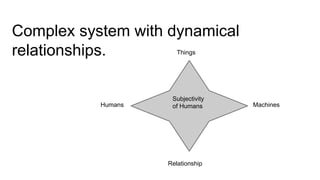
Subjectivity
of Humans
Things
Humans Machines
Relationship
Complex system with dynamical
relationships.
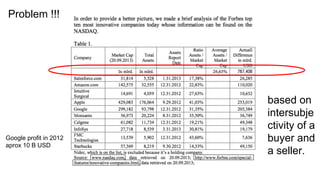
based on
intersubje
ctivity of a
buyer and
a seller.
Problem !!!
Google profit in 2012
aprox 10 B USD
Currently the only existing measurement of the company value is what somebody is willing to pay for the
company.
Shapiro and Varian defined term information delayas an important factor in the network
economy. What they say is that information could increase or reduce its value according to amount of delay in
time.
Smaller delay – higher value, bigger delay – smaller value.
Using information of market value, as a measurement and evaluation tools of company activities, we are
addressing one problem – delay of information, and value of this information, as a delay
from the moment when some activity is done and that activity reflected in share
price could be quite long.
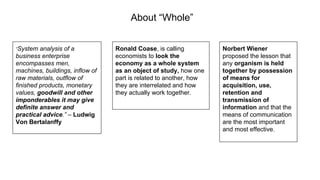
About “Whole”
“System analysis of a
business enterprise
encompasses men,
machines, buildings, inflow of
raw materials, outflow of
finished products, monetary
values, goodwill and other
imponderables it may give
definite answer and
practical advice.” – Ludwig
Von Bertalanffy
Ronald Coase, is calling
economists to look the
economy as a whole system
as an object of study, how one
part is related to another, how
they are interrelated and how
they actually work together.
Norbert Wiener
proposed the lesson that
any organism is held
together by possession
of means for
acquisition, use,
retention and
transmission of
information and that the
means of communication
are the most important
and most effective.
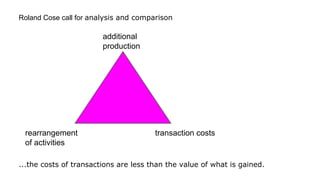
additional
production
rearrangement
of activities
transaction costs
Roland Cose call for analysis and comparison
...the costs of transactions are less than the value of what is gained.
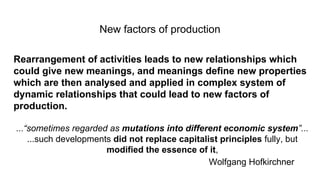
New factors of production
Rearrangement of activities leads to new relationships which
could give new meanings, and meanings define new properties
which are then analysed and applied in complex system of
dynamic relationships that could lead to new factors of
production.
...“sometimes regarded as mutations into different economic system”...
...such developments did not replace capitalist principles fully, but
modified the essence of it,
Wolfgang Hofkirchner
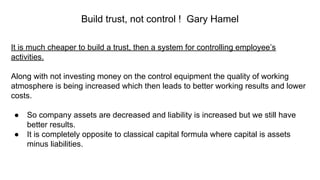
Build trust, not control ! Gary Hamel
It is much cheaper to build a trust, then a system for controlling employee’s
activities.
Along with not investing money on the control equipment the quality of working
atmosphere is being increased which then leads to better working results and lower
costs.
● So company assets are decreased and liability is increased but we still have
better results.
● It is completely opposite to classical capital formula where capital is assets
minus liabilities.
Mutation of capital
Those are things which are intangible, but they are not labour, nor land, so
only what they could be is capital, according to classical factors of
production.
A kind of a new mutated capital, which heavily depends on information
instead on tangible matter.
Such a transition of meaning of capital resulted in change of properties of the
capital.
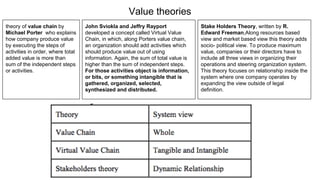
Value theories
theory of value chain by
Michael Porter who explains
how company produce value
by executing the steps of
activities in order, where total
added value is more than
sum of the independent steps
or activities.
John Sviokla and Jeffry Rayport
developed a concept called Virtual Value
Chain, in which, along Porters value chain,
an organization should add activities which
should produce value out of using
information. Again, the sum of total value is
higher than the sum of independent steps.
For those activities object is information,
or bits, or something intangible that is
gathered, organized, selected,
synthesized and distributed.
Stake Holders Theory, written by R.
Edward Freeman,Along resources based
view and market based view this theory adds
socio- political view. To produce maximum
value, companies or their directors have to
include all three views in organizing their
operations and steering organization system.
This theory focuses on relationship inside the
system where one company operates by
expanding the view outside of legal
definition.
If we look at the relationship of tangible and intangible as a system, and than
use this system as a mean of production then, whatever we produce and enter
the economic system has intangible and tangible in it.
So it is important to look them as one, not as separate entities, and even more
important, we have to focus on how it is produced and what are the relations
in that process.
Therefore, several questions need to be addressed:
● How we use technology available to produce value?
● How organization is driven by emotions?
● How we use relationship to produce value?
● How we apply knowledge in this process?
If we compare two companies, A and B, both owning a catalogue of 10,000
songs in similar genre and with similar popularity,
● and company A is not interested in using technology to promote and sell
them digitally, corporate culture is not driven by positive experience and
emotional attachment to the music they have in catalogue, they are not
interested in exploring value of relationship they have built over the years,
and they are not acquiring new knowledge how to conduct the business in
digital environment,
● while company B is doing opposite, using technology, driven by positive
experience and emotions, using relationship to the maximum and
developing knowledge.
It is not hard to answer to question which one will have higher market value.
Music Industry example
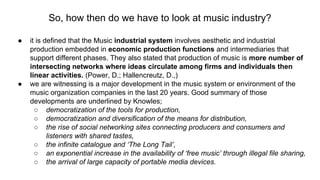
So, how then do we have to look at music industry?
● it is defined that the Music industrial system involves aesthetic and industrial
production embedded in economic production functions and intermediaries that
support different phases. They also stated that production of music is more number of
intersecting networks where ideas circulate among firms and individuals then
linear activities. (Power, D.; Hallencreutz, D.,)
● we are witnessing is a major development in the music system or environment of the
music organization companies in the last 20 years. Good summary of those
developments are underlined by Knowles;
○ democratization of the tools for production,
○ democratization and diversification of the means for distribution,
○ the rise of social networking sites connecting producers and consumers and
listeners with shared tastes,
○ the infinite catalogue and ‘The Long Tail’,
○ an exponential increase in the availability of ‘free music’ through illegal file sharing,
○ the arrival of large capacity of portable media devices.
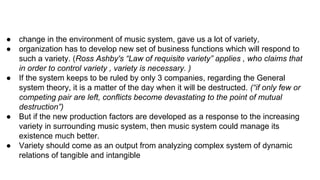
● change in the environment of music system, gave us a lot of variety,
● organization has to develop new set of business functions which will respond to
such a variety. (Ross Ashby's “Law of requisite variety” applies , who claims that
in order to control variety , variety is necessary. )
● If the system keeps to be ruled by only 3 companies, regarding the General
system theory, it is a matter of the day when it will be destructed. (“if only few or
competing pair are left, conflicts become devastating to the point of mutual
destruction”)
● But if the new production factors are developed as a response to the increasing
variety in surrounding music system, then music system could manage its
existence much better.
● Variety should come as an output from analyzing complex system of dynamic
relations of tangible and intangible
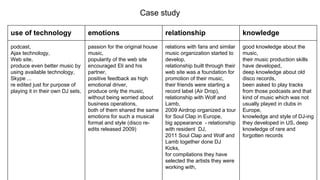
Case study
use of technology emotions relationship knowledge
podcast,
Ajax technology,
Web site,
produce even better music by
using available technology,
Skype ...
re edited just for purpose of
playing it in their own DJ sets,
passion for the original house
music,
popularity of the web site
encouraged Eli and his
partner,
positive feedback as high
emotional driver,
produce only the music,
without being worried about
business operations,
both of them shared the same
emotions for such a musical
format and style (disco re-
edits released 2009)
relations with fans and similar
music organization started to
develop,
relationship built through their
web site was a foundation for
promotion of their music,
their friends were starting a
record label (Air Drop),
relationship with Wolf and
Lamb,
2009 Airdrop organized a tour
for Soul Clap in Europe,
big appearance - relationship
with resident DJ,
2011 Soul Clap and Wolf and
Lamb together done DJ
Kicks,
for compilations they have
selected the artists they were
working with,
good knowledge about the
music,
their music production skills
have developed,
deep knowledge about old
disco records,
been asked to play tracks
from those podcasts and that
kind of music which was not
usually played in clubs in
Europe,
knowledge and style of DJ-ing
they developed in US, deep
knowledge of rare and
forgotten records
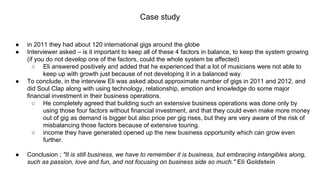
Case study
● in 2011 they had about 120 international gigs around the globe
● Interviewer asked – is it important to keep all of these 4 factors in balance, to keep the system growing
(if you do not develop one of the factors, could the whole system be affected)
○ Eli answered positively and added that he experienced that a lot of musicians were not able to
keep up with growth just because of not developing it in a balanced way.
● To conclude, in the interview Eli was asked about approximate number of gigs in 2011 and 2012, and
did Soul Clap along with using technology, relationship, emotion and knowledge do some major
financial investment in their business operations.
○ He completely agreed that building such an extensive business operations was done only by
using those four factors without financial investment, and that they could even make more money
out of gig as demand is bigger but also price per gig rises, but they are very aware of the risk of
misbalancing those factors because of extensive touring.
○ income they have generated opened up the new business opportunity which can grow even
further.
● Conclusion ; "It is still business, we have to remember it is business, but embracing intangibles along,
such as passion, love and fun, and not focusing on business side so much." Eli Goldstein
Almost there ...
The question this paper addresses is whether more variety in meaning of capital
could increase the value of capital as one of the factors of production.
● It is still business, we have to remember it is business, but embracing
intangibles along, such as passion, love and fun, and not focusing on
business side so much." Eli Goldstein
Mutation of capital
Those are things which are intangible, but they are not labour, nor land, so only what
they could be is capital, according to classical factors of production.
Such a transition of meaning of capital resulted in change of properties of the capital.
Conclusion
It doesn't matter who is better,
What counts is relationship as a matter.
It’s not about your technology toys,
It’s about how it’s used by your girls and boys.
It’s not about knowledge you could buy,
It’s about how it could be applied.
It’s not about profit giving you a positive drive,
It’s about how your people smile.
And when your profits start to dry,
Give this poem another try.

Mutation of Capital in the Information Age: Insights from the Music Industry

  • 1.
    Mutation of Capitalin the Information Age: Insights from the Music Industry Sergej Lugović, Polytechnic of Zagreb Sonja Špiranec, Faculty of Humanities and Social Sciences
  • 2.
    The question thispaper addresses is whether more variety in meaning of capital could increase the value of capital as one of the factors of production. Motivation for paper come from; “There’s Nothing Like the Real Thing” - Vincent Kenny A third-order cybernetics problematises, therefore, both the selfhood (subjectivity) of the observer and also the relationship of this subjectivity to any observed system… As Boxer & Kenny (1990: 5) put it: “Businesses have a tendency to ignore things. It’s their way of keeping life simple. After a while they forget what they are ignoring, so that when things start going wrong, they find it difficult to change because they get stuck within what they know…..
  • 3.
    Based on acase study from the music industry, the authors have tried to determine whether the extensive use of technology, relationship, knowledge and emotions can be used as a resource for value production in today‘s economy?
  • 4.
    Two different thoughtscome from two of the probably most important economists in the last century: John Maynard Keynes and Milton Friedman. "Thus if the animal spirits are dimmed and the spontaneous optimism falters, leaving us to depend on nothing but a mathematical expectation, enterprise will fade and die;" "The Social Responsibility of Business is to Increase its Profits" Tangible and intangible aspects of business operations are not opposite, they are complementary phenomenon. To put them in such constellation could give us much broader and better framework for analyzing, researching and measuring the success of companies.
  • 5.
  • 6.
    based on intersubje ctivity ofa buyer and a seller. Problem !!! Google profit in 2012 aprox 10 B USD
  • 7.
    Currently the onlyexisting measurement of the company value is what somebody is willing to pay for the company. Shapiro and Varian defined term information delayas an important factor in the network economy. What they say is that information could increase or reduce its value according to amount of delay in time. Smaller delay – higher value, bigger delay – smaller value. Using information of market value, as a measurement and evaluation tools of company activities, we are addressing one problem – delay of information, and value of this information, as a delay from the moment when some activity is done and that activity reflected in share price could be quite long.
  • 8.
    About “Whole” “System analysisof a business enterprise encompasses men, machines, buildings, inflow of raw materials, outflow of finished products, monetary values, goodwill and other imponderables it may give definite answer and practical advice.” – Ludwig Von Bertalanffy Ronald Coase, is calling economists to look the economy as a whole system as an object of study, how one part is related to another, how they are interrelated and how they actually work together. Norbert Wiener proposed the lesson that any organism is held together by possession of means for acquisition, use, retention and transmission of information and that the means of communication are the most important and most effective.
  • 9.
    additional production rearrangement of activities transaction costs RolandCose call for analysis and comparison ...the costs of transactions are less than the value of what is gained.
  • 10.
    New factors ofproduction Rearrangement of activities leads to new relationships which could give new meanings, and meanings define new properties which are then analysed and applied in complex system of dynamic relationships that could lead to new factors of production. ...“sometimes regarded as mutations into different economic system”... ...such developments did not replace capitalist principles fully, but modified the essence of it, Wolfgang Hofkirchner
  • 11.
    Build trust, notcontrol ! Gary Hamel It is much cheaper to build a trust, then a system for controlling employee’s activities. Along with not investing money on the control equipment the quality of working atmosphere is being increased which then leads to better working results and lower costs. ● So company assets are decreased and liability is increased but we still have better results. ● It is completely opposite to classical capital formula where capital is assets minus liabilities.
  • 12.
    Mutation of capital Thoseare things which are intangible, but they are not labour, nor land, so only what they could be is capital, according to classical factors of production. A kind of a new mutated capital, which heavily depends on information instead on tangible matter. Such a transition of meaning of capital resulted in change of properties of the capital.
  • 13.
    Value theories theory ofvalue chain by Michael Porter who explains how company produce value by executing the steps of activities in order, where total added value is more than sum of the independent steps or activities. John Sviokla and Jeffry Rayport developed a concept called Virtual Value Chain, in which, along Porters value chain, an organization should add activities which should produce value out of using information. Again, the sum of total value is higher than the sum of independent steps. For those activities object is information, or bits, or something intangible that is gathered, organized, selected, synthesized and distributed. Stake Holders Theory, written by R. Edward Freeman,Along resources based view and market based view this theory adds socio- political view. To produce maximum value, companies or their directors have to include all three views in organizing their operations and steering organization system. This theory focuses on relationship inside the system where one company operates by expanding the view outside of legal definition.
  • 14.
    If we lookat the relationship of tangible and intangible as a system, and than use this system as a mean of production then, whatever we produce and enter the economic system has intangible and tangible in it. So it is important to look them as one, not as separate entities, and even more important, we have to focus on how it is produced and what are the relations in that process. Therefore, several questions need to be addressed: ● How we use technology available to produce value? ● How organization is driven by emotions? ● How we use relationship to produce value? ● How we apply knowledge in this process?
  • 15.
    If we comparetwo companies, A and B, both owning a catalogue of 10,000 songs in similar genre and with similar popularity, ● and company A is not interested in using technology to promote and sell them digitally, corporate culture is not driven by positive experience and emotional attachment to the music they have in catalogue, they are not interested in exploring value of relationship they have built over the years, and they are not acquiring new knowledge how to conduct the business in digital environment, ● while company B is doing opposite, using technology, driven by positive experience and emotions, using relationship to the maximum and developing knowledge. It is not hard to answer to question which one will have higher market value. Music Industry example
  • 16.
    So, how thendo we have to look at music industry? ● it is defined that the Music industrial system involves aesthetic and industrial production embedded in economic production functions and intermediaries that support different phases. They also stated that production of music is more number of intersecting networks where ideas circulate among firms and individuals then linear activities. (Power, D.; Hallencreutz, D.,) ● we are witnessing is a major development in the music system or environment of the music organization companies in the last 20 years. Good summary of those developments are underlined by Knowles; ○ democratization of the tools for production, ○ democratization and diversification of the means for distribution, ○ the rise of social networking sites connecting producers and consumers and listeners with shared tastes, ○ the infinite catalogue and ‘The Long Tail’, ○ an exponential increase in the availability of ‘free music’ through illegal file sharing, ○ the arrival of large capacity of portable media devices.
  • 17.
    ● change inthe environment of music system, gave us a lot of variety, ● organization has to develop new set of business functions which will respond to such a variety. (Ross Ashby's “Law of requisite variety” applies , who claims that in order to control variety , variety is necessary. ) ● If the system keeps to be ruled by only 3 companies, regarding the General system theory, it is a matter of the day when it will be destructed. (“if only few or competing pair are left, conflicts become devastating to the point of mutual destruction”) ● But if the new production factors are developed as a response to the increasing variety in surrounding music system, then music system could manage its existence much better. ● Variety should come as an output from analyzing complex system of dynamic relations of tangible and intangible
  • 18.
    Case study use oftechnology emotions relationship knowledge podcast, Ajax technology, Web site, produce even better music by using available technology, Skype ... re edited just for purpose of playing it in their own DJ sets, passion for the original house music, popularity of the web site encouraged Eli and his partner, positive feedback as high emotional driver, produce only the music, without being worried about business operations, both of them shared the same emotions for such a musical format and style (disco re- edits released 2009) relations with fans and similar music organization started to develop, relationship built through their web site was a foundation for promotion of their music, their friends were starting a record label (Air Drop), relationship with Wolf and Lamb, 2009 Airdrop organized a tour for Soul Clap in Europe, big appearance - relationship with resident DJ, 2011 Soul Clap and Wolf and Lamb together done DJ Kicks, for compilations they have selected the artists they were working with, good knowledge about the music, their music production skills have developed, deep knowledge about old disco records, been asked to play tracks from those podcasts and that kind of music which was not usually played in clubs in Europe, knowledge and style of DJ-ing they developed in US, deep knowledge of rare and forgotten records
  • 19.
    Case study ● in2011 they had about 120 international gigs around the globe ● Interviewer asked – is it important to keep all of these 4 factors in balance, to keep the system growing (if you do not develop one of the factors, could the whole system be affected) ○ Eli answered positively and added that he experienced that a lot of musicians were not able to keep up with growth just because of not developing it in a balanced way. ● To conclude, in the interview Eli was asked about approximate number of gigs in 2011 and 2012, and did Soul Clap along with using technology, relationship, emotion and knowledge do some major financial investment in their business operations. ○ He completely agreed that building such an extensive business operations was done only by using those four factors without financial investment, and that they could even make more money out of gig as demand is bigger but also price per gig rises, but they are very aware of the risk of misbalancing those factors because of extensive touring. ○ income they have generated opened up the new business opportunity which can grow even further. ● Conclusion ; "It is still business, we have to remember it is business, but embracing intangibles along, such as passion, love and fun, and not focusing on business side so much." Eli Goldstein
  • 20.
    Almost there ... Thequestion this paper addresses is whether more variety in meaning of capital could increase the value of capital as one of the factors of production. ● It is still business, we have to remember it is business, but embracing intangibles along, such as passion, love and fun, and not focusing on business side so much." Eli Goldstein Mutation of capital Those are things which are intangible, but they are not labour, nor land, so only what they could be is capital, according to classical factors of production. Such a transition of meaning of capital resulted in change of properties of the capital.
  • 21.
    Conclusion It doesn't matterwho is better, What counts is relationship as a matter. It’s not about your technology toys, It’s about how it’s used by your girls and boys. It’s not about knowledge you could buy, It’s about how it could be applied. It’s not about profit giving you a positive drive, It’s about how your people smile. And when your profits start to dry, Give this poem another try.