© Copyright 2015 Lean Enterprise Institute. All rights reserved.© Copyright 2015 Lean Enterprise Institute. All rights reserved.
Lean WX:
Design of Work
Experience
GBMP 2017: Lean By Doing
John Shook
© Copyright 2015 Lean Enterprise Institute. All rights reserved.© Copyright 2015 Lean Enterprise Institute. All rights reserved.
Lean By Doing
 Learn By Doing
© Copyright 2015 Lean Enterprise Institute. All rights reserved.
“Learn By Doing” – Does NOT mean…
 Just “doing”
 Does include “purposeful” or “deliberate” doing
(i.e. establishing habits, etc.,)
 But, it’s not only that, either
 It means creating a structure for learning to occur
AS we do our DOing)
 But, it also means establishing an overall
environment that enables everyone to learn as
they do
3
© Copyright 2015 Lean Enterprise Institute. All rights reserved.
4
Lean By Doing  Lean WX
© Copyright 2015 Lean Enterprise Institute. All rights reserved.
Understanding Lean Work
 What Toyota has said
 What observers have
said
 What we know now
 What we need to do
next
5
© Copyright 2015 Lean Enterprise Institute. All rights reserved.
Understanding Lean Work
 What Toyota has said
• and SHOWED
 What observers have
said
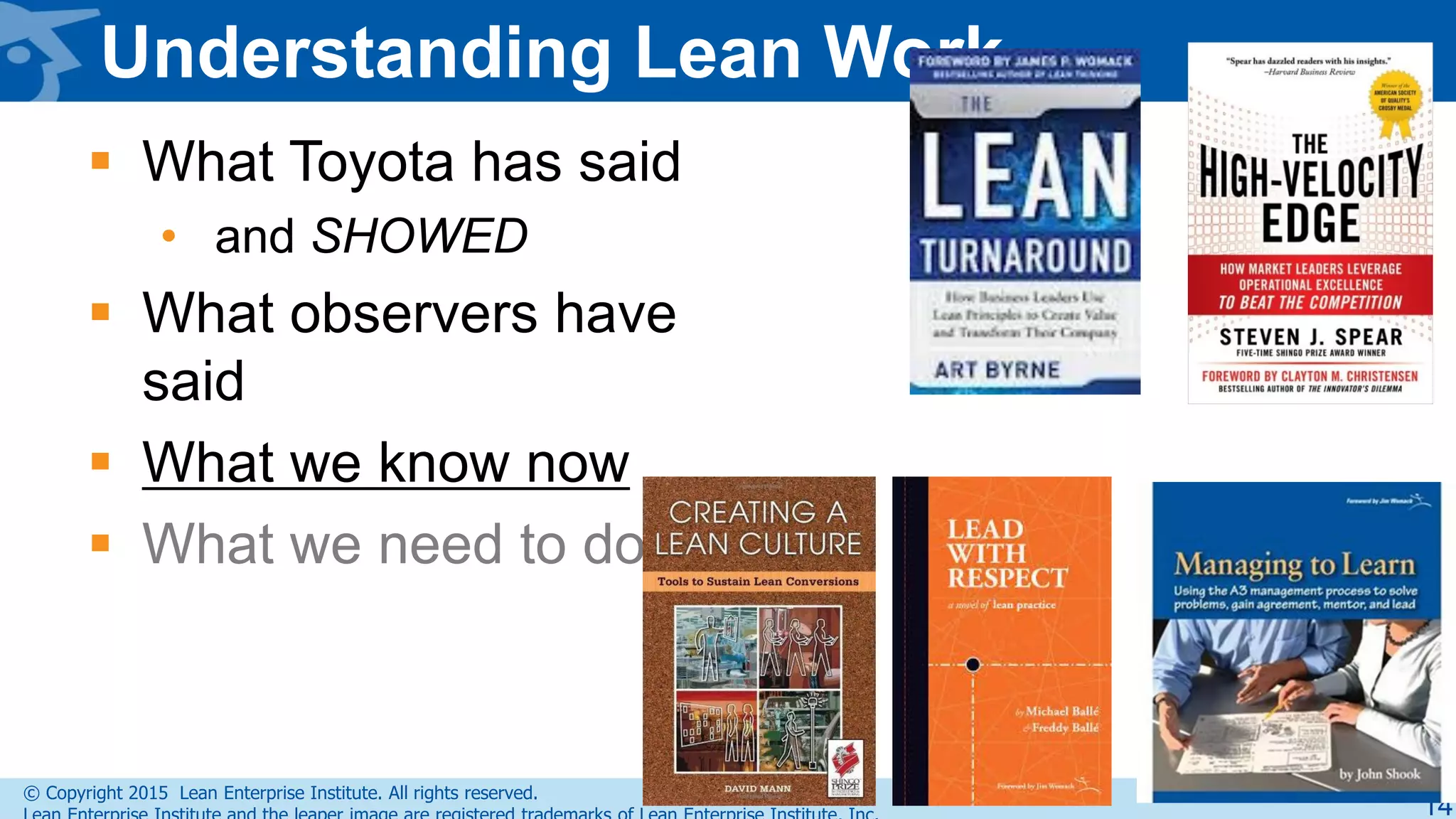
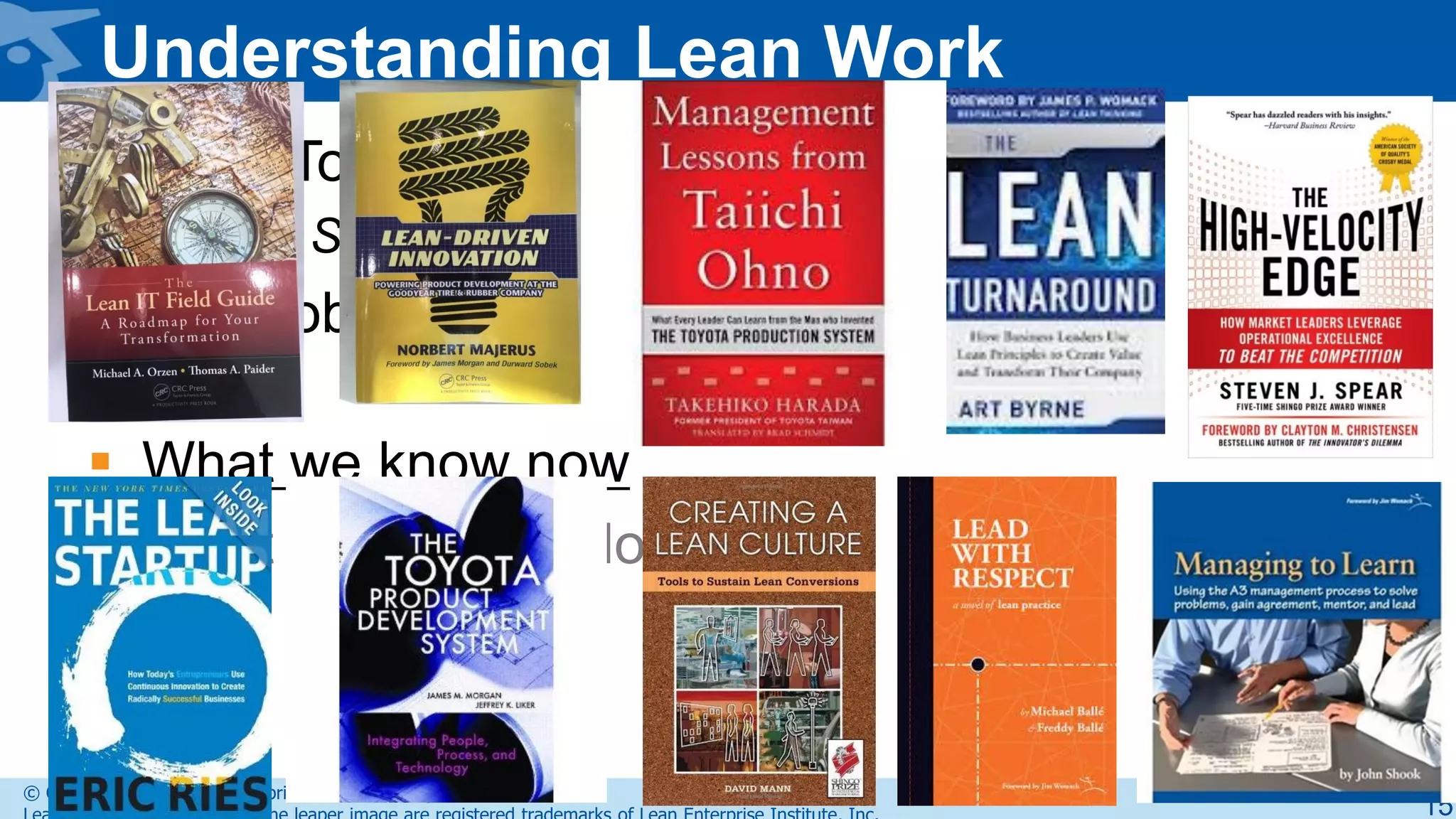
 What we know now
 What we need to do
 “Before we build cars, we build
people”
 “Good Products = Good
Thinking”
 TPS = Thinking Production
System
• T Minoura
 We develop people mainly on
the job
• OJD
• TWI
 SW/SS as a learning structure
6
© Copyright 2015 Lean Enterprise Institute. All rights reserved.
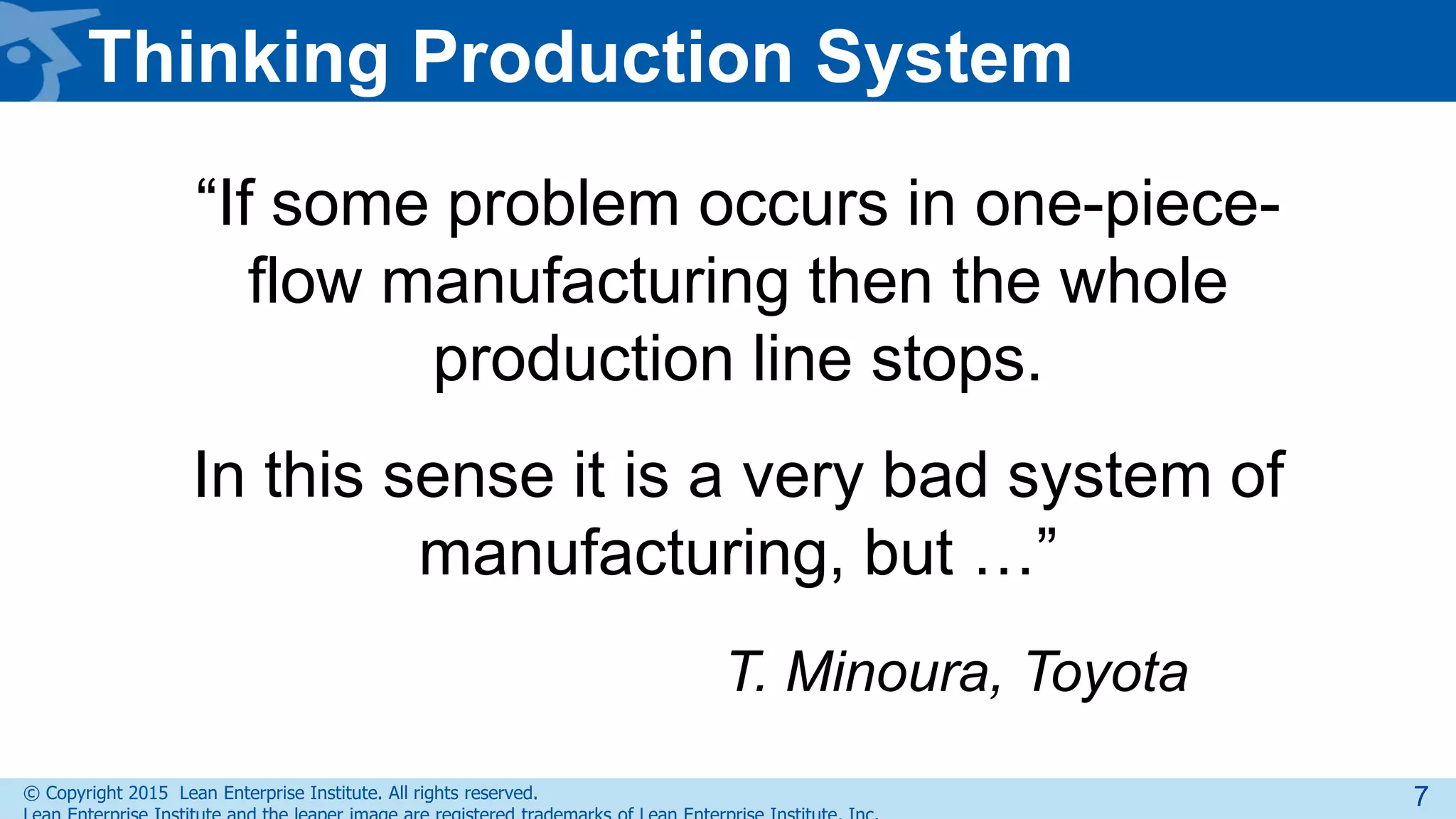
“If some problem occurs in one-piece-
flow manufacturing then the whole
production line stops.
In this sense it is a very bad system of
manufacturing, but …”
T. Minoura, Toyota
Thinking Production System
7
© Copyright 2015 Lean Enterprise Institute. All rights reserved.
“If some problem occurs in one-piece-flow manufacturing then the whole
production line stops. In this sense it is a very bad system of manufacturing.
But …
when production stops everyone is forced to solve
the problem immediately. So team members have
to think, and through thinking team members grow
and become better team members and people.”
T. Minoura, Toyota
Thinking Production System
8
© Copyright 2015 Lean Enterprise Institute. All rights reserved.
This American
Life:“NUMMI”
9
And what Toyota has SHOWED
© Copyright 2015 Lean Enterprise Institute. All rights reserved.
Understanding Lean Work
 What Toyota has said
• and SHOWED
 What observers have
said
 What we know now
 What we need to do
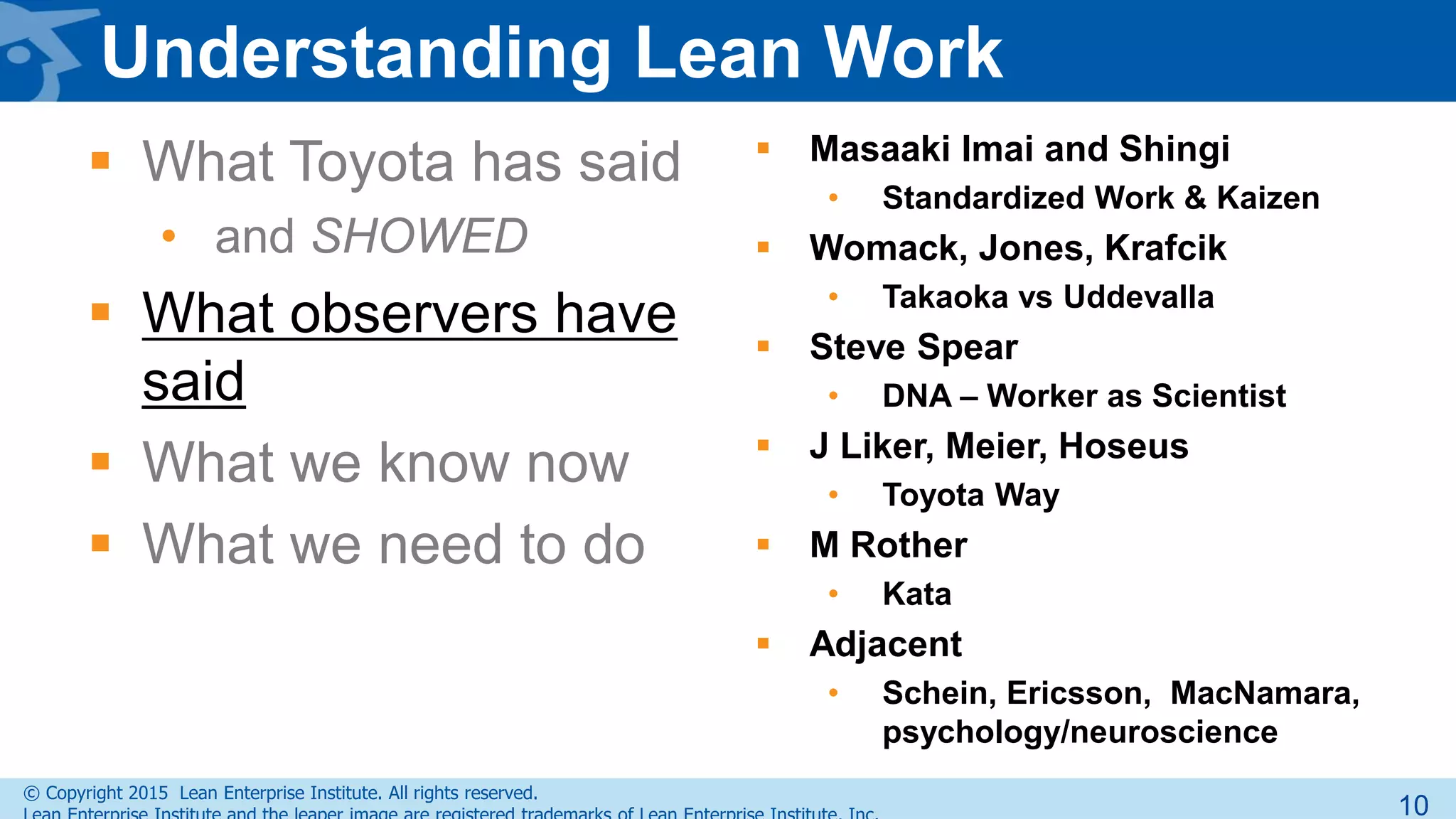
 Masaaki Imai and Shingi
• Standardized Work & Kaizen
 Womack, Jones, Krafcik
• Takaoka vs Uddevalla
 Steve Spear
• DNA – Worker as Scientist
 J Liker, Meier, Hoseus
• Toyota Way
 M Rother
• Kata
 Adjacent
• Schein, Ericsson, MacNamara,
psychology/neuroscience
10
© Copyright 2015 Lean Enterprise Institute. All rights reserved.
Understanding Lean Work
 Every worker a scientist
 The Four Rules-in-Use
11
© Copyright 2015 Lean Enterprise Institute. All rights reserved.
Understanding Lean Work
 What Toyota has said
• and SHOWED
 What observers have
said
 What we know now
 What we need to do
12
© Copyright 2015 Lean Enterprise Institute. All rights reserved.
Understanding Lean Work
 What Toyota has said
• and SHOWED
 What observers have
said
 What we know now
 What we need to do
 Everyone is better off if
everyone is learning as they
work
 It is possible for everyone to
learn through their work (learn
as they DO)
 But, only if we take steps to
intentionally make it happen
 Problem-solving is key
 A problem-solving culture is
possible
• But only if…
13
© Copyright 2015 Lean Enterprise Institute. All rights reserved.
Understanding Lean Work
 What Toyota has said
• and SHOWED
 What observers have
said
 What we know now
 What we need to do
14
© Copyright 2015 Lean Enterprise Institute. All rights reserved.
Understanding Lean Work
 What Toyota has said
• and SHOWED
 What observers have
said
 What we know now
 What we need to do
15
© Copyright 2015 Lean Enterprise Institute. All rights reserved.
Learning = 10,000 Hours??
© Copyright 2015 Lean Enterprise Institute. All rights reserved.© Copyright 2015 Lean Enterprise Institute. All rights reserved.
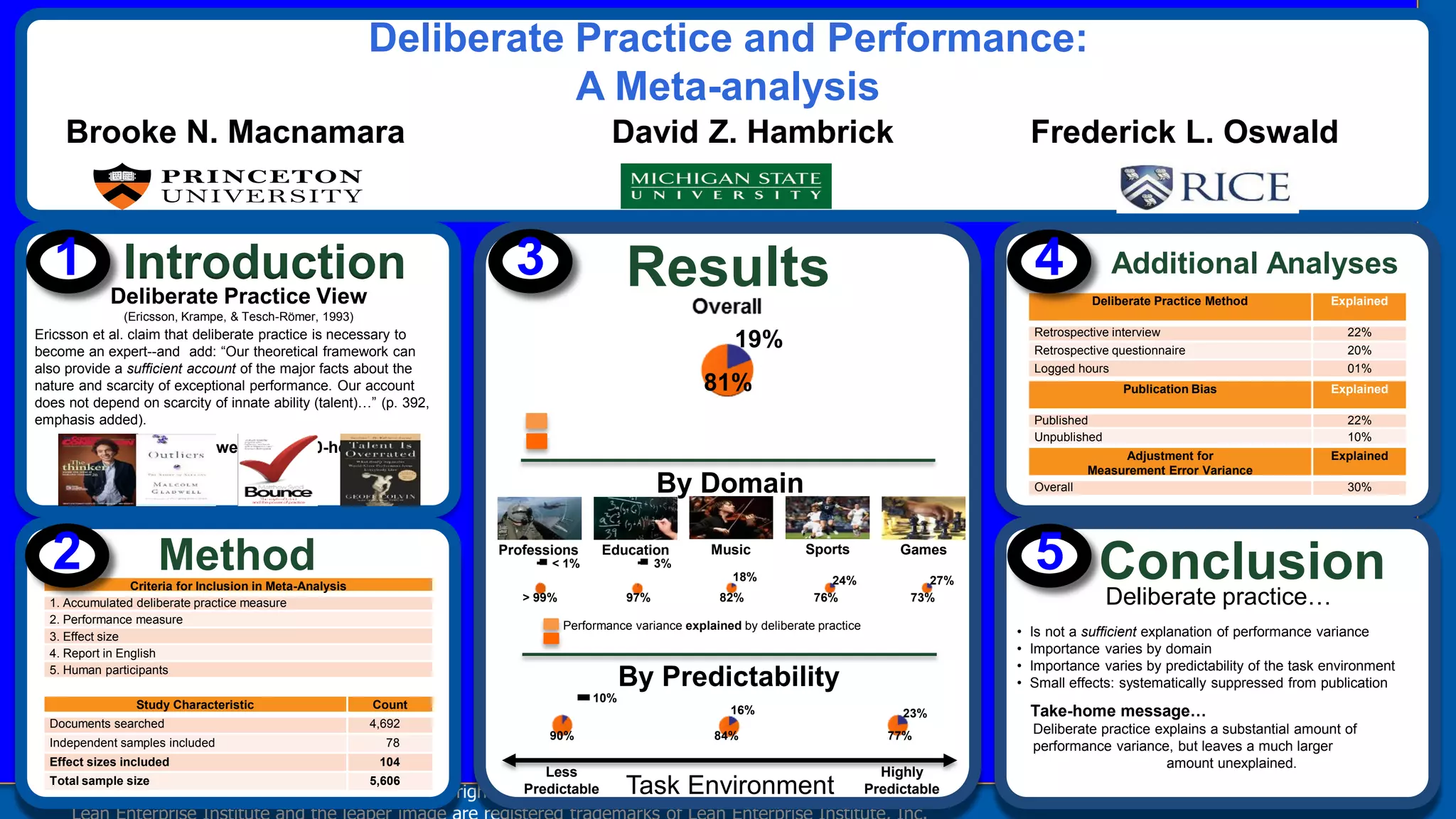
Deliberate Practice and Performance:
A Meta-analysis
Brooke N. Macnamara David Z. Hambrick Frederick L. Oswald
Introduction1
Method
Additional Analyses
Conclusion5
Performance variance explained by deliberate practice
Performance variance unexplained by deliberate practice
Deliberate Practice View
(Ericsson, Krampe, & Tesch-Römer, 1993)
Ericsson et al. claim that deliberate practice is necessary to
become an expert--and add: “Our theoretical framework can
also provide a sufficient account of the major facts about the
nature and scarcity of exceptional performance. Our account
does not depend on scarcity of innate ability (talent)…” (p. 392,
emphasis added).
Inspiration for Gladwell’s “10,000-hour rule”
Criteria for Inclusion in Meta-Analysis
1. Accumulated deliberate practice measure
2. Performance measure
3. Effect size
4. Report in English
5. Human participants
2
Study Characteristic Count
Documents searched 4,692
Independent samples included 78
Effect sizes included 104
Total sample size 5,606
Performance variance unexplained by deliberate practice
Adjustment for
Measurement Error Variance
Explained
Overall 30%
Deliberate Practice Method Explained
Retrospective interview 22%
Retrospective questionnaire 20%
Logged hours 01%
4
Publication Bias Explained
Published 22%
Unpublished 10%
• Is not a sufficient explanation of performance variance
• Importance varies by domain
• Importance varies by predictability of the task environment
• Small effects: systematically suppressed from publication
Take-home message…
Deliberate practice explains a substantial amount of
performance variance, but leaves a much larger
amount unexplained.
Deliberate practice…
Results3
By Domain
Professions Education Music Sports Games
Task Environment
Highly
Predictable
Less
Predictable
Performance variance explained by deliberate practice
27%
73%
24%
76%
18%
82%97%
3%
19%
81%
< 1%
> 99%
10%
90%
16%
84%
23%
77%
By Predictability
© Copyright 2015 Lean Enterprise Institute. All rights reserved.
Brooke MacNamara
Conclusion5
• Is not a sufficient explanation of performance
variance
• Importance varies by domain
• Importance varies by predictability of the task
environment
• Small effects: systematically suppressed from
publication
Take-home message…
Deliberate practice explains a substantial amount of
performance variance, but leaves a much larger
amount unexplained.
Deliberate practice…
Results3
By Domain
Professions Education Music Sports Games
Task Environment Highly
Predictable
Less
Predictable
Performance variance explained by deliberate practice
27%
73%
24%
76%
18%
82%97%
3%
19%
81%
< 1%
>99%
10%
90%
16%
84%
23%
77%
By Predictability
Performance variance NOT explained by deliberate practice
© Copyright 2015 Lean Enterprise Institute. All rights reserved.
Understanding Lean Work
 What Toyota has said
• and SHOWED
 What observers have
said
 What we know
 What we need now
 Not one thing. Five (or six)
things
 But, one thing at a time at
the value-creating front lines
 So, simple, but not simplistic
 Holistic, yet focused
 Regarding the value-creating
WORK of an organization,
we need to design the entire
work experience that each
individual … experiences
20
© Copyright 2015 Lean Enterprise Institute. All rights reserved.
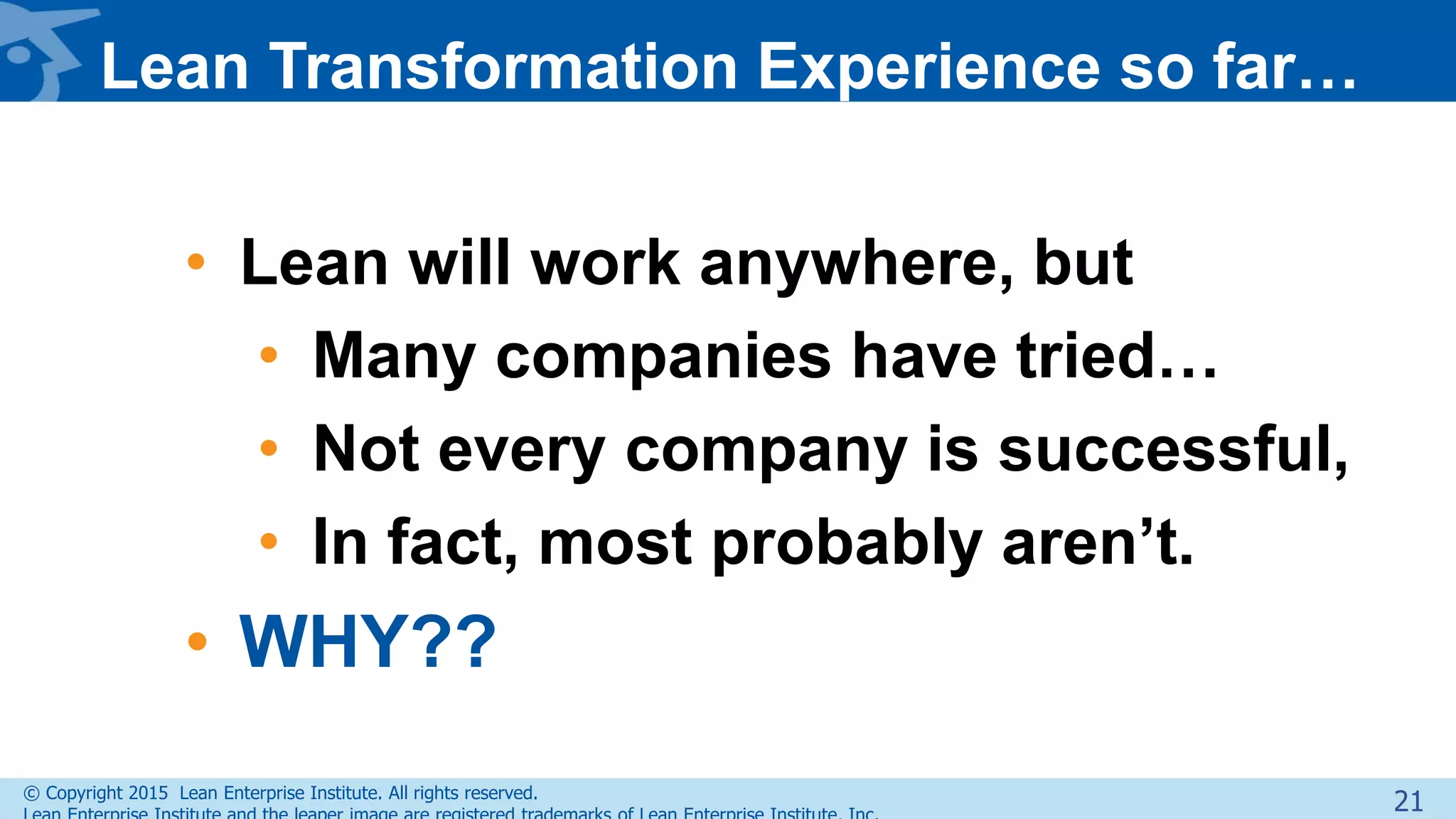
Lean Transformation Experience so far…
• Lean will work anywhere, but
• Many companies have tried…
• Not every company is successful,
• In fact, most probably aren’t.
• WHY??
21
© Copyright 2015 Lean Enterprise Institute. All rights reserved.
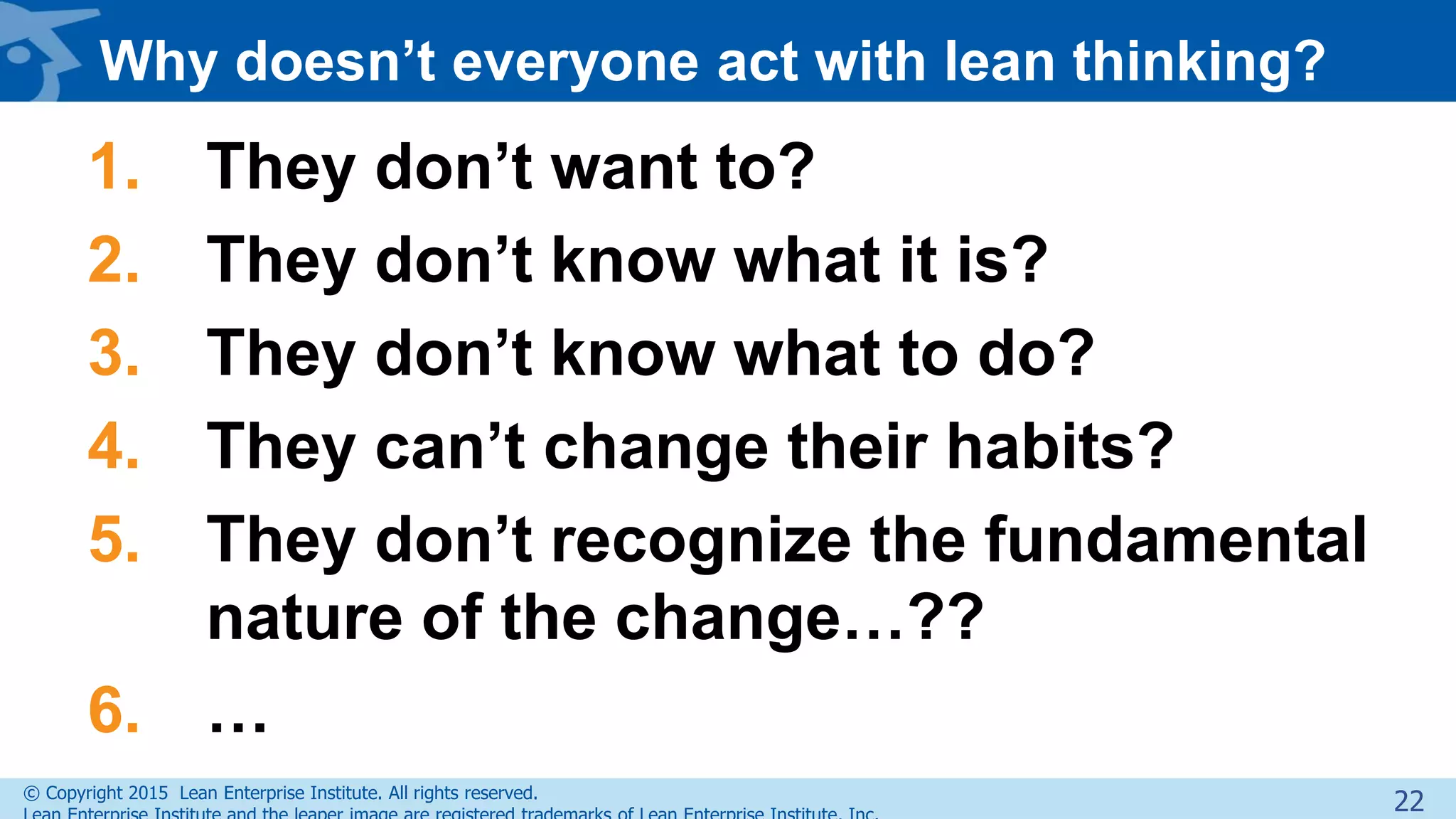
Why doesn’t everyone act with lean thinking?
1. They don’t want to?
2. They don’t know what it is?
3. They don’t know what to do?
4. They can’t change their habits?
5. They don’t recognize the fundamental
nature of the change…??
6. …
22
© Copyright 2015 Lean Enterprise Institute. All rights reserved.
Lean Transformation Framework
23
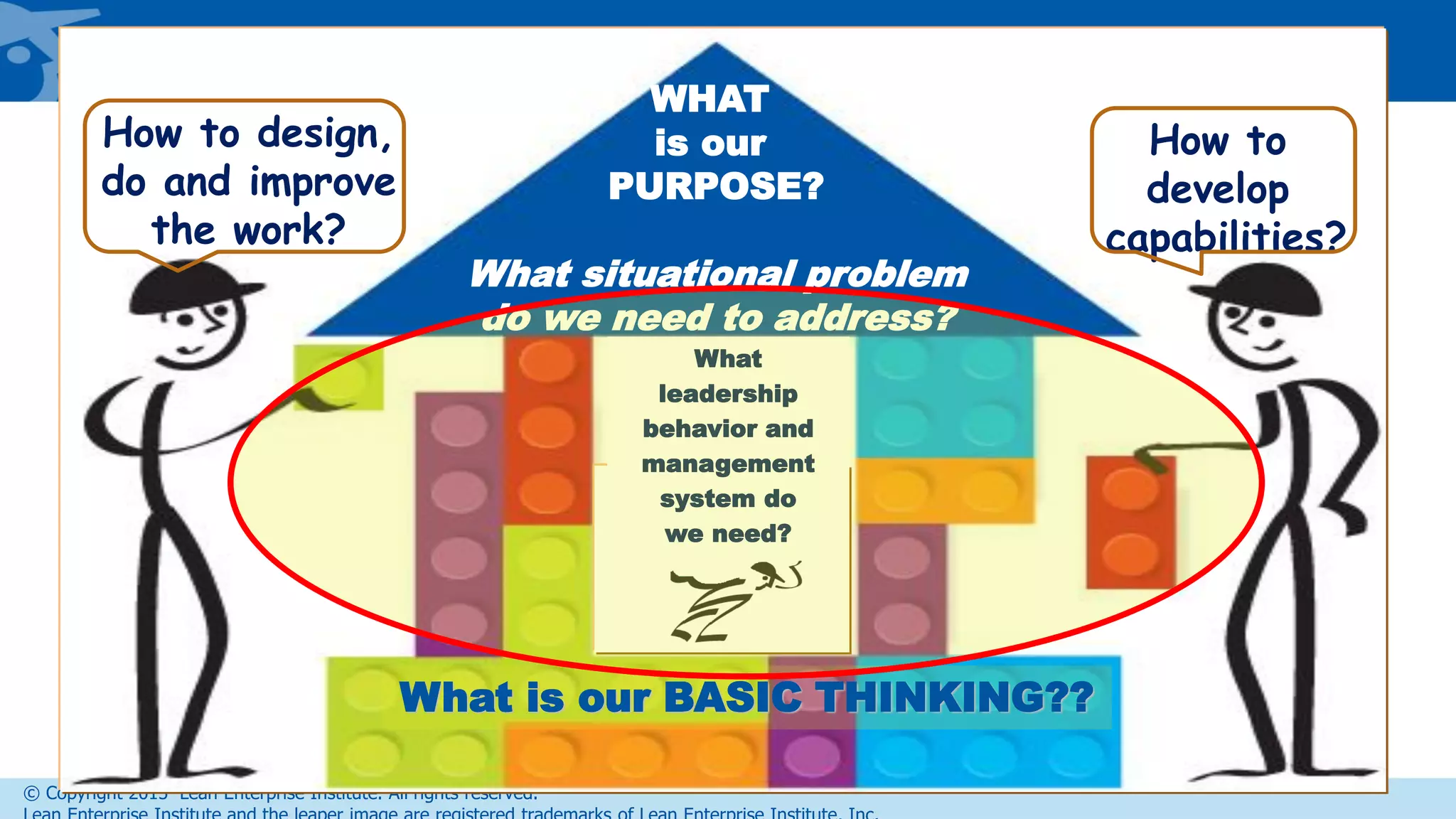
WHAT
is our
PURPOSE?
What situational problem
do we need to address?
How to design,
do and improve
the work?
How to
develop
capability?
What is our BASIC THINKING??
What
leadership
behavior and
management
system do
we need?
© Copyright 2015 Lean Enterprise Institute. All rights reserved.
What’s Your Challenge?
1. Purpose – alignment around ‘the problem
to solve’
2. Designing, doing, improving the work
3. Developing capability, developing people
4. a. Management system
b. Leader behavior
5. Basic thinking
24
© Copyright 2015 Lean Enterprise Institute. All rights reserved.
How was the Framework developed?
1. Reflections on failure modes and success factors over years of
working with and observing many organizations
2. Teachings of a substantial collection of “master lean sensei”
3. Reverse engineered the thinking
that went into the development
of the TPS house…
- Specific situational
challenges drove the
evolution of the TPS House!
25
© Copyright 2015 Lean Enterprise Institute. All rights reserved.
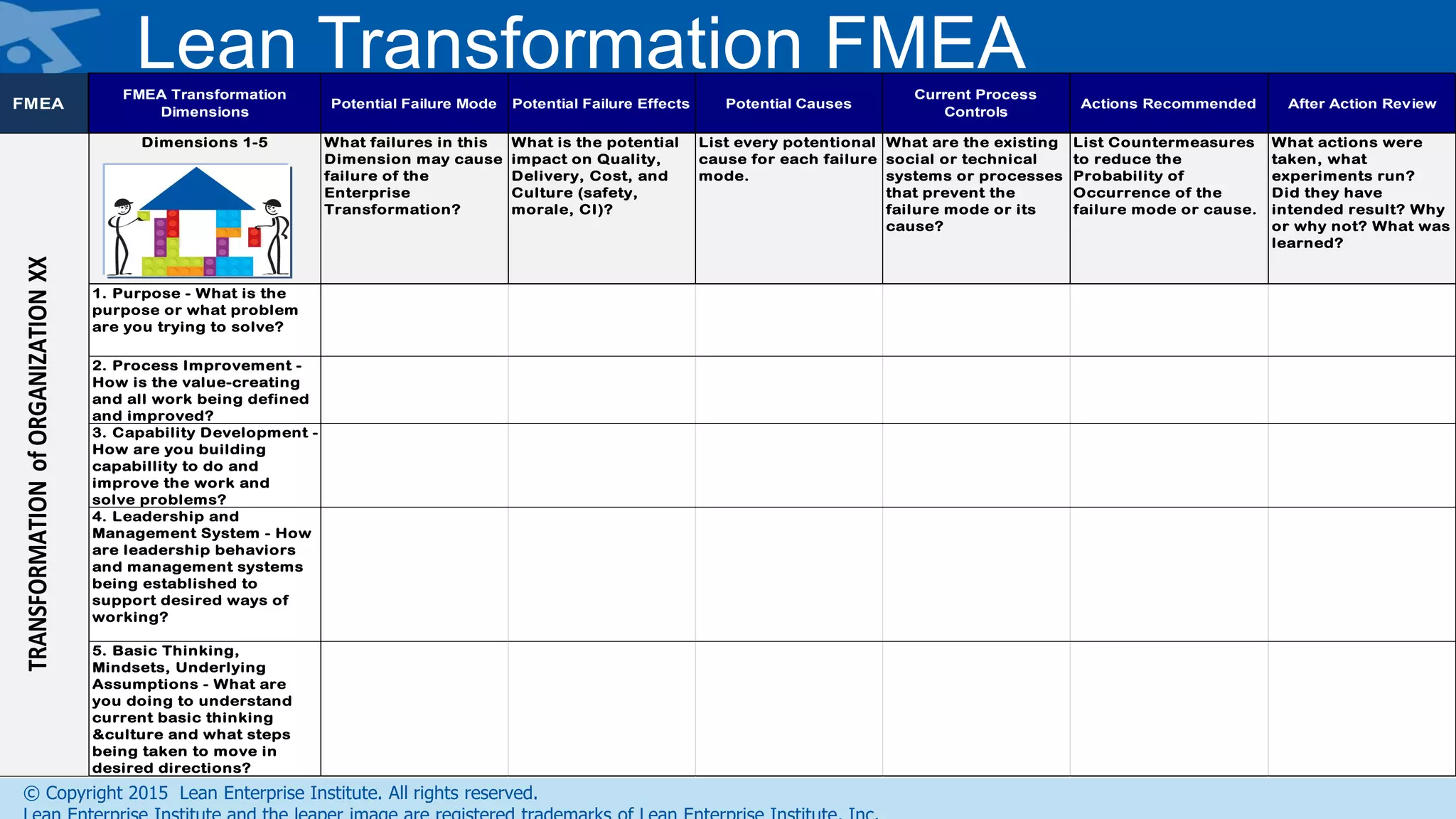
Lean Transformation FMEA
FMEA
FMEA Transformation
Dimensions
Potential Failure Mode Potential Failure Effects Potential Causes
Current Process
Controls
Actions Recommended After Action Review
Dimensions 1-5 What failures in this
Dimension may cause
failure of the
Enterprise
Transformation?
What is the potential
impact on Quality,
Delivery, Cost, and
Culture (safety,
morale, CI)?
List every potentional
cause for each failure
mode.
What are the existing
social or technical
systems or processes
that prevent the
failure mode or its
cause?
List Countermeasures
to reduce the
Probability of
Occurrence of the
failure mode or cause.
What actions were
taken, what
experiments run?
Did they have
intended result? Why
or why not? What was
learned?
1. Purpose - What is the
purpose or what problem
are you trying to solve?
2. Process Improvement -
How is the value-creating
and all work being defined
and improved?
3. Capability Development -
How are you building
capabillity to do and
improve the work and
solve problems?
4. Leadership and
Management System - How
are leadership behaviors
and management systems
being established to
support desired ways of
working?
5. Basic Thinking,
Mindsets, Underlying
Assumptions - What are
you doing to understand
current basic thinking
&culture and what steps
being taken to move in
desired directions?
TRANSFORMATIONofORGANIZATIONXX
© Copyright 2015 Lean Enterprise Institute. All rights reserved.
What is the Framework?
Purpose of the Lean Transformation Framework:
 Not a scorecard
27
A lens for self reflection to grasp the
gap between the current and future
state for your transformation (personal
or organizational) efforts.
© Copyright 2015 Lean Enterprise Institute. All rights reserved.
What is Lean Transformation?
Enterprise transformation is the process of
an organization shifting its “business” model
to a desired future state.
A lean transformation requires learning a
new way of thinking and acting…
28
© Copyright 2015 Lean Enterprise Institute. All rights reserved.
Lean Transformation
Enterprise transformation is the process of an organization
shifting its “business” model to a desired future state.
A lean transformation requires learning a new way of
thinking and acting…
characterized not by implementing a
series of steps or solutions but
addressing key questions of purpose,
process and people.
29
© Copyright 2015 Lean Enterprise Institute. All rights reserved.
What’s Your Challenge?
Which of these is the biggest challenge for your
transformation?
1. Purpose – alignment around ‘the problem to solve’
2. Designing, doing, improving the work
3. Developing capability, developing people
4. a. Management system
b. Leader behavior
5. Basic thinking
30
© Copyright 2015 Lean Enterprise Institute. All rights reserved.
LEI’s Lean Transformation Summit - 2016
31
© Copyright 2015 Lean Enterprise Institute. All rights reserved.
Lean Transformation Framework
32
WHAT
is our
PURPOSE?
What situational problem
do we need to address?
How to design,
do and improve
the work?
How to
develop
capability?
What is our BASIC THINKING??
What
leadership
behavior and
management
system do
we need?
© Copyright 2015 Lean Enterprise Institute. All rights reserved.
What
leadership
behavior and
management
system do
we need?
WHAT
is our
PURPOSE?
What situational problem
do we need to address?
How to design,
do and improve
the work?
How to
develop
capabilities?
What is our BASIC THINKING??
What
leadership
behavior and
management
system do
we need?
© Copyright 2015 Lean Enterprise Institute. All rights reserved.
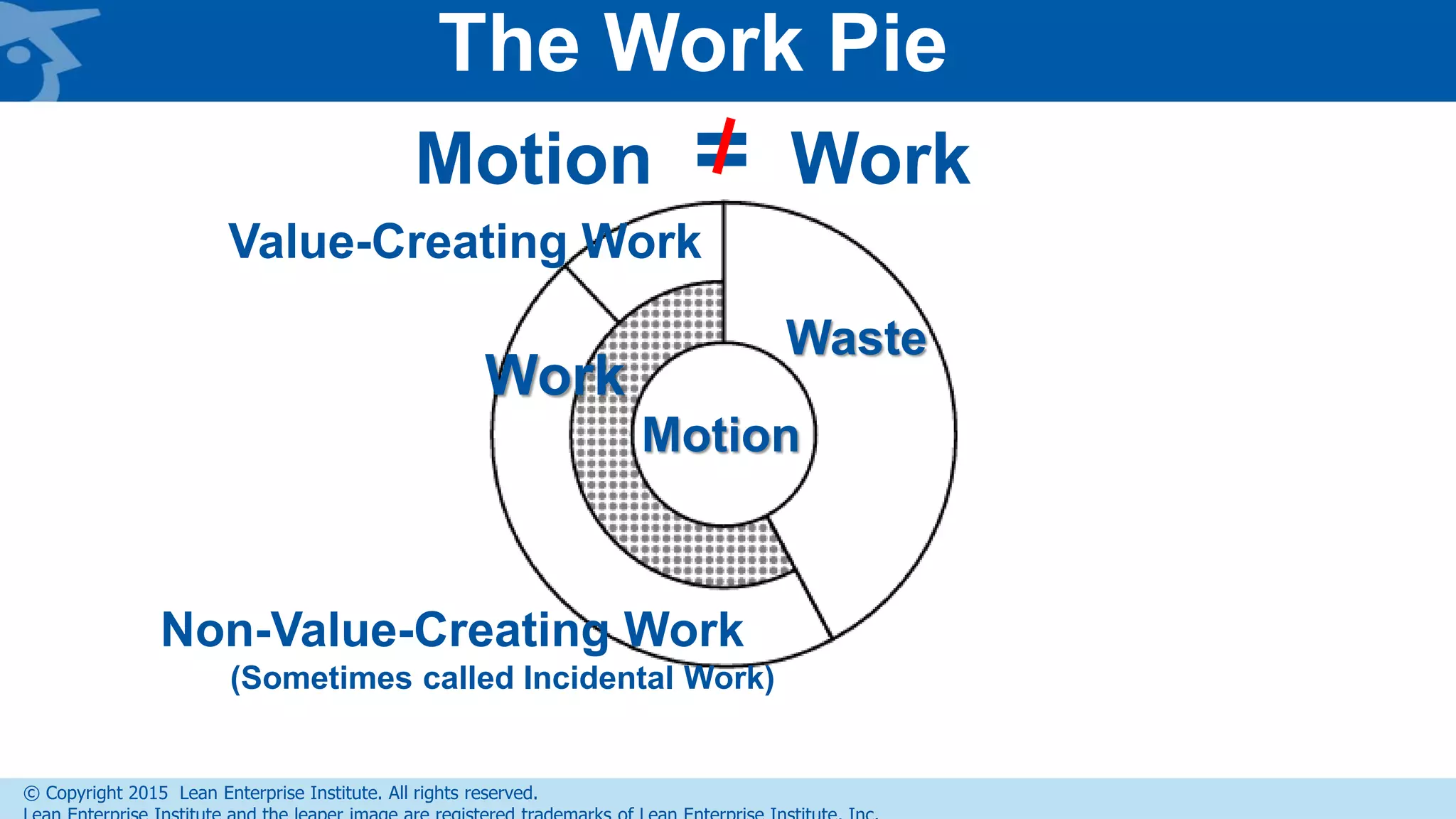
Motion
Waste
Work
Value-Creating Work
Non-Value-Creating Work
(Sometimes called Incidental Work)
The Work Pie
Motion = Work
© Copyright 2015 Lean Enterprise Institute. All rights reserved.
What
leadership
behavior and
management
system do
we need?
WHAT
is our
PURPOSE?
What situational problem
do we need to address?
How to design,
do and improve
the work?
How to
develop
capabilities?
What is our BASIC THINKING??
What
leadership
behavior and
management
system do
we need?
© Copyright 2015 Lean Enterprise Institute. All rights reserved.
Doing Work and Developing Capability
Get the work done and develop people’s capability…
at the same time!!
Problem-solving
Problem-solving
Problem-solving
© Copyright 2015 Lean Enterprise Institute. All rights reserved.
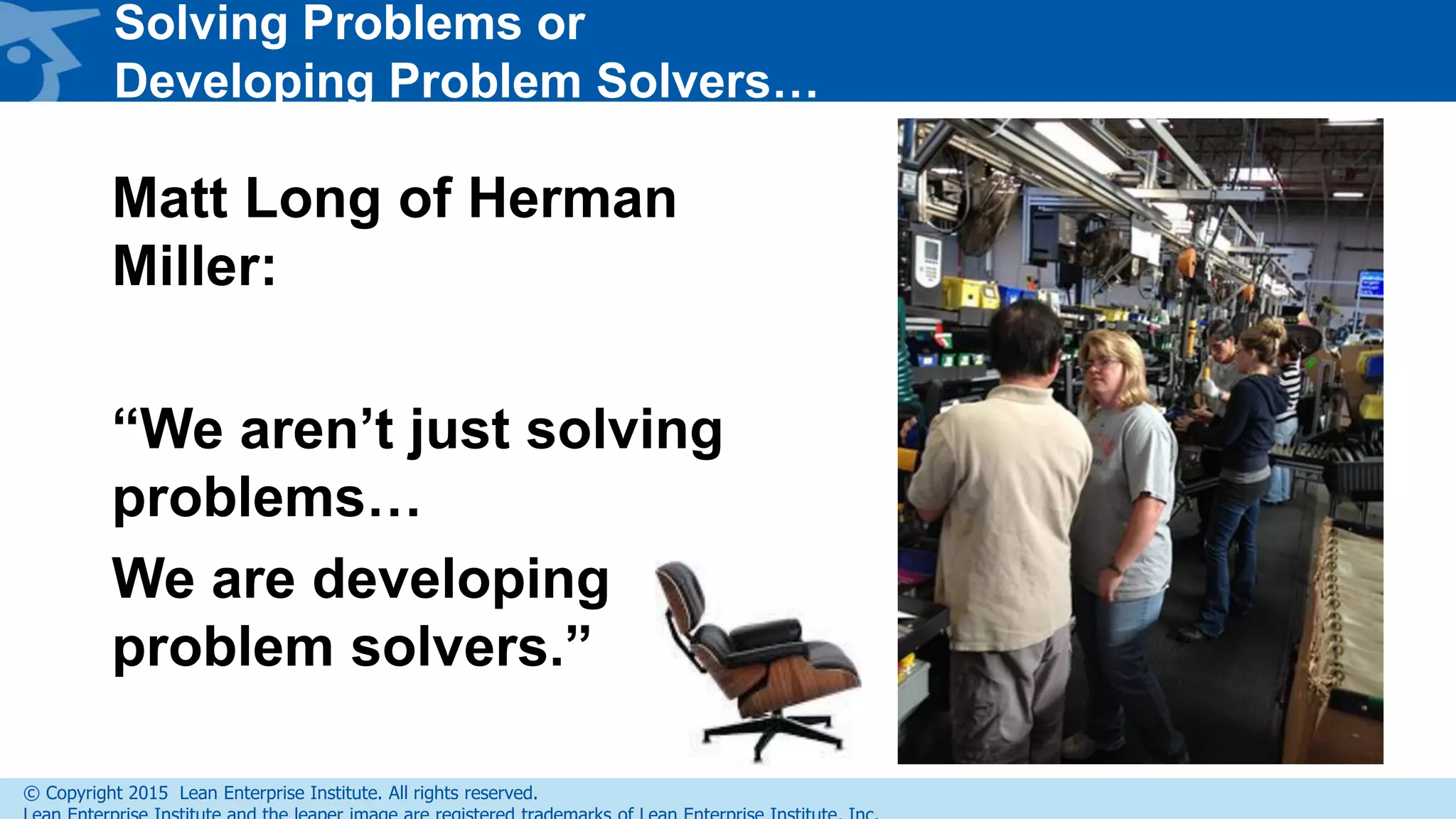
Solving Problems or
Developing Problem Solvers…
Matt Long of Herman
Miller:
“We aren’t just solving
problems…
We are developing
problem solvers.”
© Copyright 2015 Lean Enterprise Institute. All rights reserved.
What
leadership
behavior and
management
system do
we need?
WHAT
is our
PURPOSE?
What situational problem
do we need to address?
How to design,
do and improve
the work?
How to
develop
capabilities?
What is our BASIC THINKING??
What
leadership
behavior and
management
system do
we need?
© Copyright 2015 Lean Enterprise Institute. All rights reserved.
Where Do You Start – Either? Both at once?
Change Culture
First
Change System
First
Transformatiom
© Copyright 2015 Lean Enterprise Institute. All rights reserved.
It’s easier to
act your way to
a new way of
thinking than to
think your way
to a new way of
acting.
Lean Transformation
40
© Copyright 2015 Lean Enterprise Institute. All rights reserved.
Create the
Complete
Environment
for Problem
Solving and
Continuous
Learning
• Engage Everyone in Problem Finding and Continuous
Experimentation
• Give Everyone Permission to Fail and Ability to Succeed
That’s Why We Need To…
© Copyright 2015 Lean Enterprise Institute. All rights reserved.
The Lean Development Challenge
 Enable each person to take
responsibility to solve
problems and improve his or
her work
 Align each persons’ work to
provide value for the customer
and prosperity for the
organization
Get the work done and Develop Capability
- at the SAME TIME!
 Begin with ourselves!!
© Copyright 2015 Lean Enterprise Institute. All rights reserved.
Fundamentals of Lean Work
MOTION
≠
WORK
*
*Value-Add Work – motion that transforms
a product
Non-Value Add Work– given current
constraints (e.g. equipment) motions that
operators MUST perform to enable
transformation but do not create value from
the standpoint of the customer
Waste – motions that create no value and
can be eliminated given current constraints
Non-Value Add
Work
© Copyright 2015 Lean Enterprise Institute. All rights reserved.
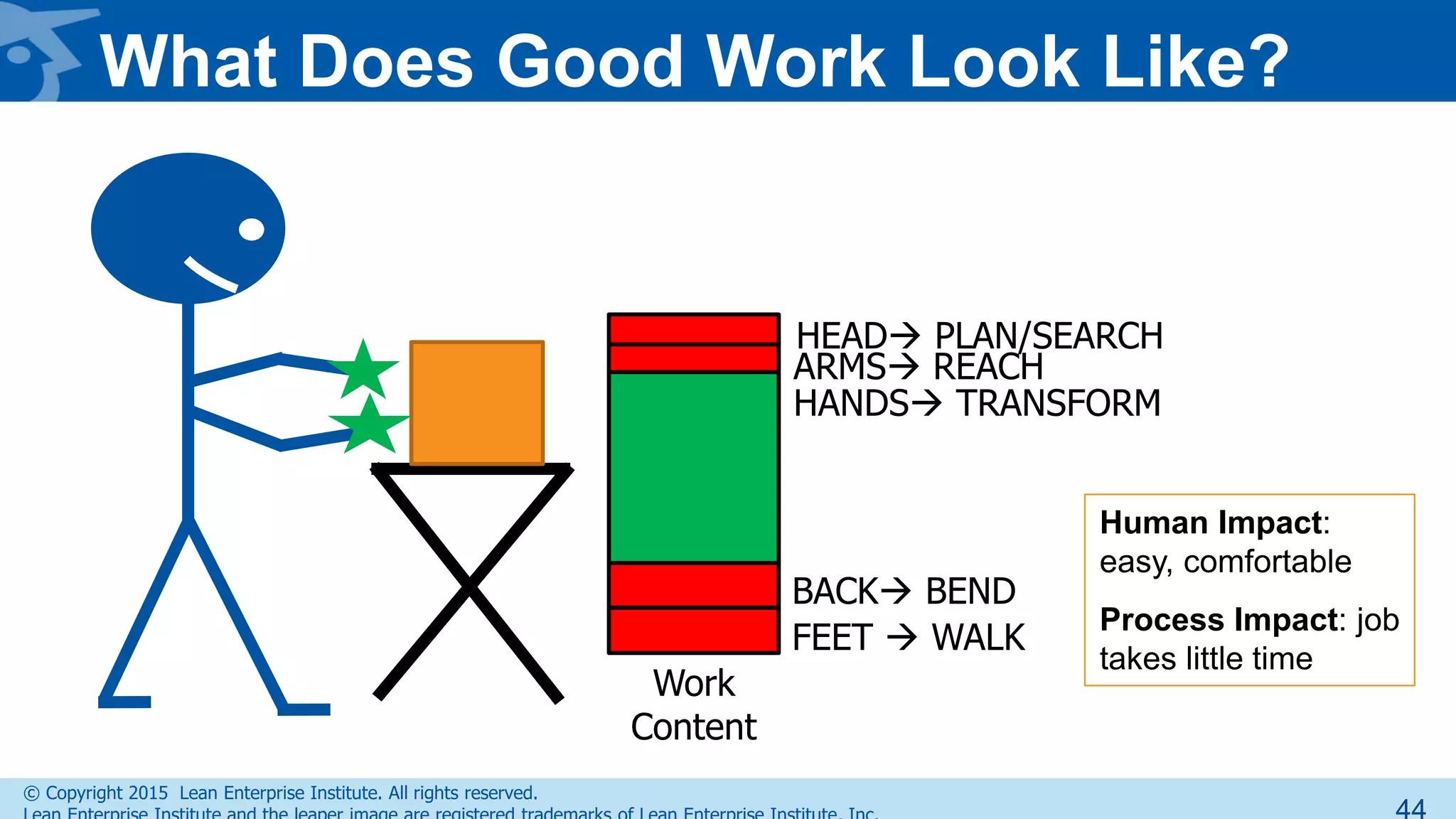
What Does Good Work Look Like?
FEET  WALK
BACK BEND
HANDS TRANSFORM
ARMS REACH
HEAD PLAN/SEARCH
Work
Content
Human Impact:
easy, comfortable
Process Impact: job
takes little time
© Copyright 2015 Lean Enterprise Institute. All rights reserved.
Respect For People
Design insanely great work
 Enable each person to:
• work safely
• know his/her customer
• be involved, engaged
• be successful
 Worker-out or the Front Lines-back principle
• Build your entire system from the work
• Remove wasteful steps from each person’s work,
• Until nothing is left but value-creating steps.
Never waste any human’s time and effort!
© Copyright 2015 Lean Enterprise Institute. All rights reserved.
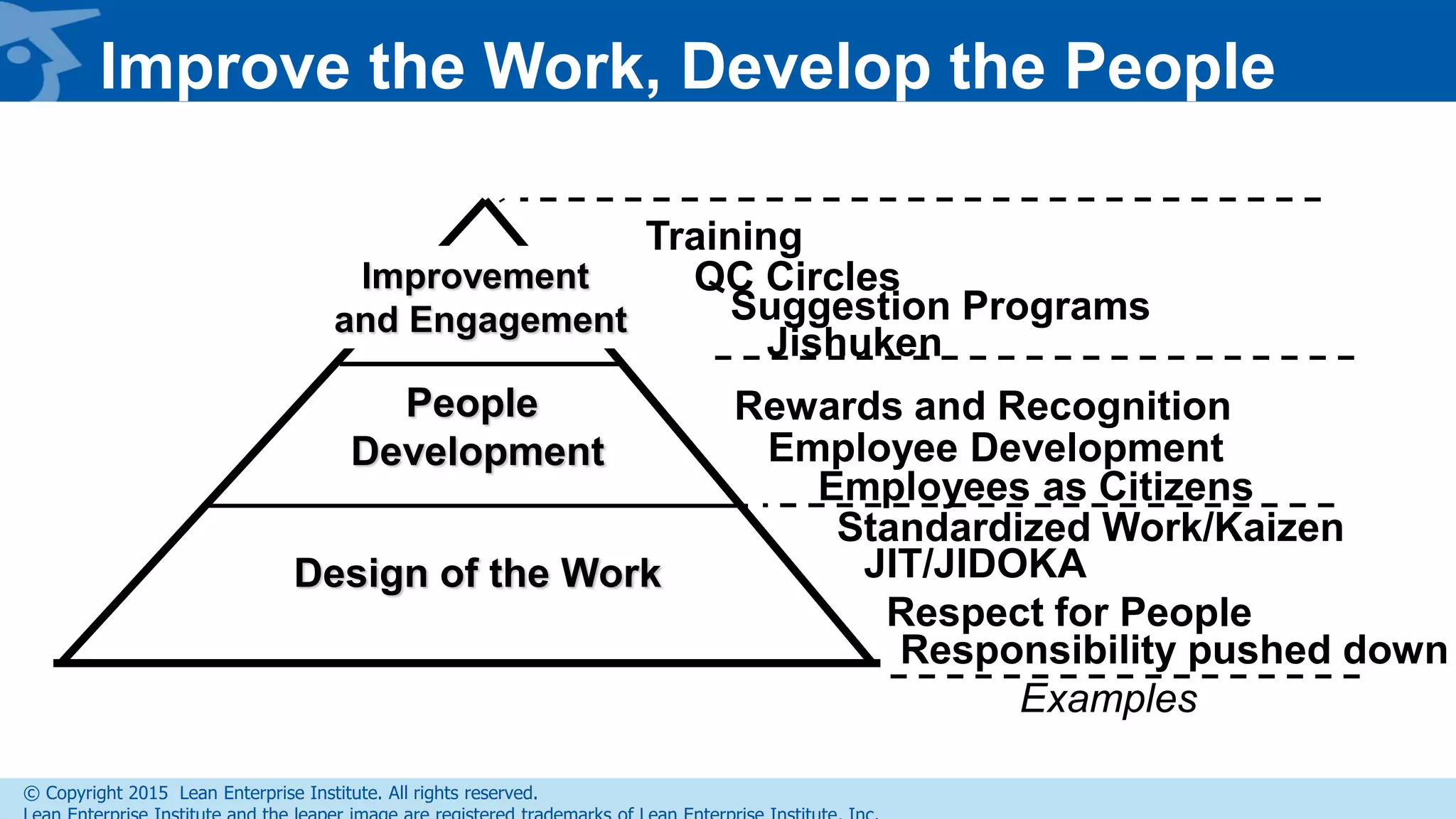
Improve the Work, Develop the People
People
Development
Design of the Work
Suggestion Programs
Employees as Citizens
Standardized Work/Kaizen
Responsibility pushed down
QC Circles
Employee Development
Rewards and Recognition
Examples
Training
JIT/JIDOKA
Respect for People
Improvement
and Engagement
Jishuken
© Copyright 2015 Lean Enterprise Institute. All rights reserved.
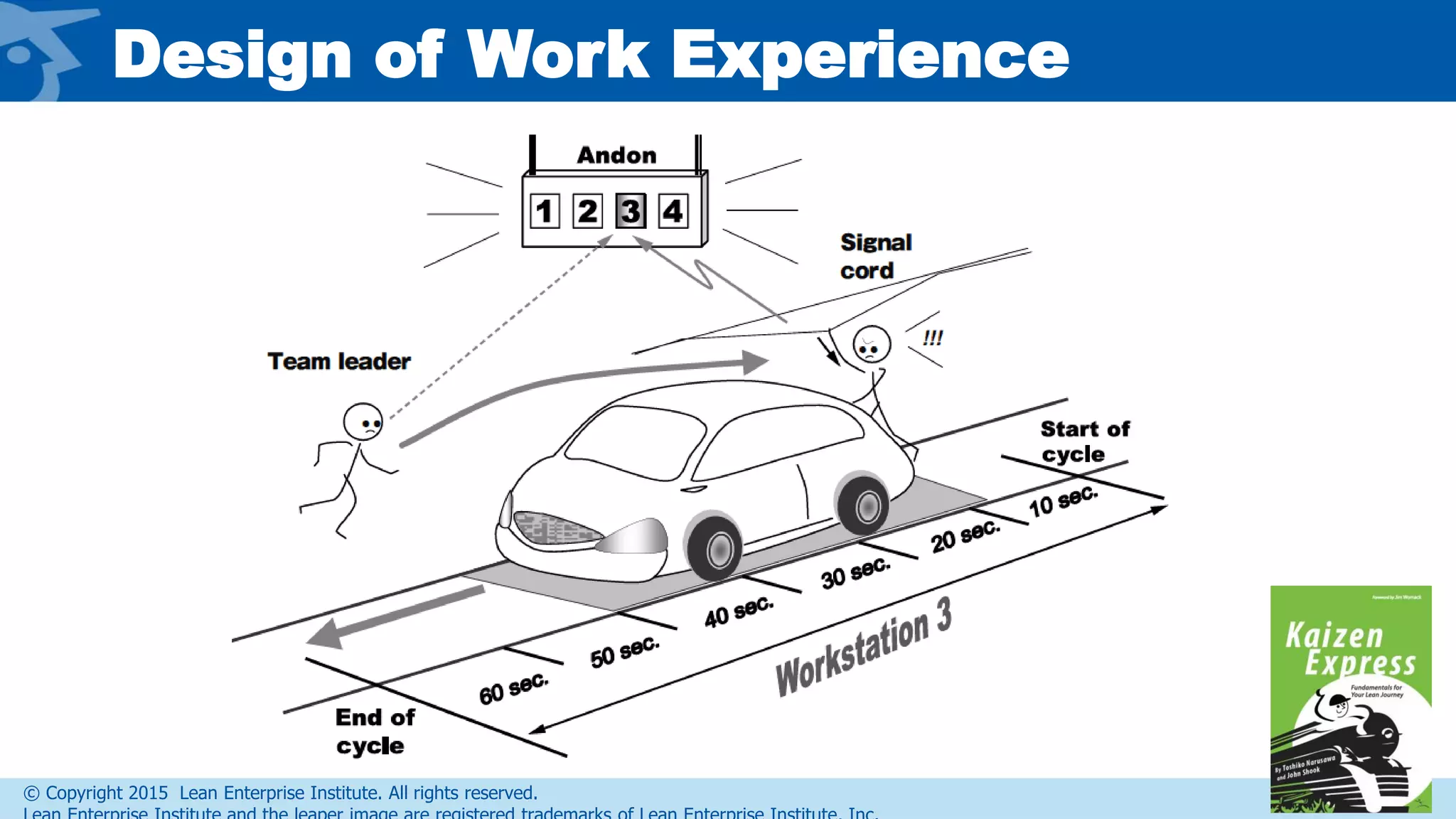
Design of Work Experience
© Copyright 2015 Lean Enterprise Institute. All rights reserved.
Design of Work Experience
Knowledge work, too!
 Individual, intentional PDCA Learning Cycles
How do I improve this
Situation??
A D
P
C
Try
Reflect
Struggle (!) to do
-Question why?!
What’s a good
target condition?
© Copyright 2015 Lean Enterprise Institute. All rights reserved.
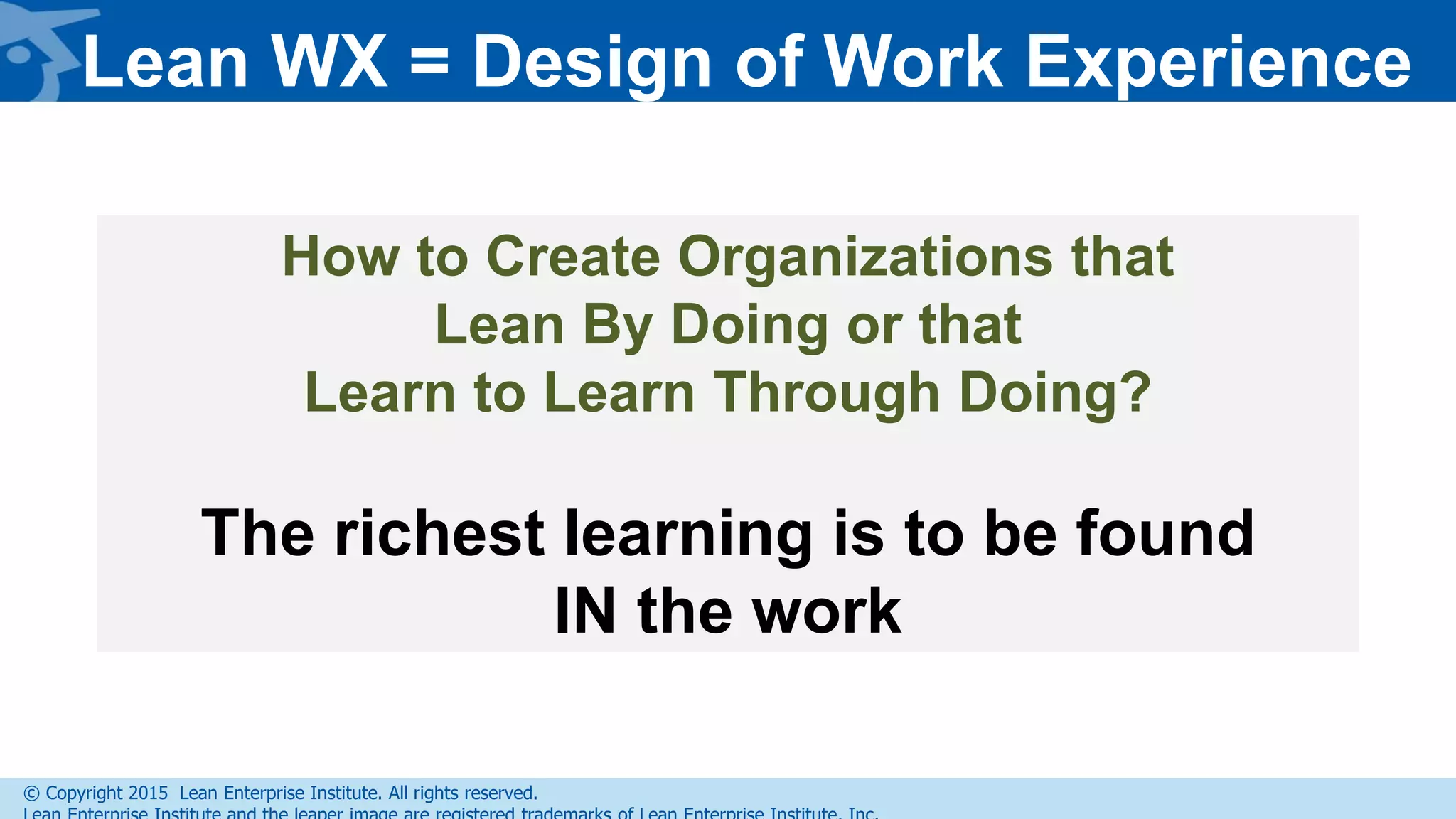
How to Create Organizations that
Lean By Doing or that
Learn to Learn Through Doing?
The richest learning is to be found
IN the work
Lean WX = Design of Work Experience
© Copyright 2015 Lean Enterprise Institute. All rights reserved.50
1914 2014
Lean WX: 100 Years of Innovation in the Work
© Copyright 2015 Lean Enterprise Institute. All rights reserved.
Managing to Build Problem-Solvers
51

Design of Work Experience

  • 1.
    © Copyright 2015Lean Enterprise Institute. All rights reserved.© Copyright 2015 Lean Enterprise Institute. All rights reserved. Lean WX: Design of Work Experience GBMP 2017: Lean By Doing John Shook
  • 2.
    © Copyright 2015Lean Enterprise Institute. All rights reserved.© Copyright 2015 Lean Enterprise Institute. All rights reserved. Lean By Doing  Learn By Doing
  • 3.
    © Copyright 2015Lean Enterprise Institute. All rights reserved. “Learn By Doing” – Does NOT mean…  Just “doing”  Does include “purposeful” or “deliberate” doing (i.e. establishing habits, etc.,)  But, it’s not only that, either  It means creating a structure for learning to occur AS we do our DOing)  But, it also means establishing an overall environment that enables everyone to learn as they do 3
  • 4.
    © Copyright 2015Lean Enterprise Institute. All rights reserved. 4 Lean By Doing  Lean WX
  • 5.
    © Copyright 2015Lean Enterprise Institute. All rights reserved. Understanding Lean Work  What Toyota has said  What observers have said  What we know now  What we need to do next 5
  • 6.
    © Copyright 2015Lean Enterprise Institute. All rights reserved. Understanding Lean Work  What Toyota has said • and SHOWED  What observers have said  What we know now  What we need to do  “Before we build cars, we build people”  “Good Products = Good Thinking”  TPS = Thinking Production System • T Minoura  We develop people mainly on the job • OJD • TWI  SW/SS as a learning structure 6
  • 7.
    © Copyright 2015Lean Enterprise Institute. All rights reserved. “If some problem occurs in one-piece- flow manufacturing then the whole production line stops. In this sense it is a very bad system of manufacturing, but …” T. Minoura, Toyota Thinking Production System 7
  • 8.
    © Copyright 2015Lean Enterprise Institute. All rights reserved. “If some problem occurs in one-piece-flow manufacturing then the whole production line stops. In this sense it is a very bad system of manufacturing. But … when production stops everyone is forced to solve the problem immediately. So team members have to think, and through thinking team members grow and become better team members and people.” T. Minoura, Toyota Thinking Production System 8
  • 9.
    © Copyright 2015Lean Enterprise Institute. All rights reserved. This American Life:“NUMMI” 9 And what Toyota has SHOWED
  • 10.
    © Copyright 2015Lean Enterprise Institute. All rights reserved. Understanding Lean Work  What Toyota has said • and SHOWED  What observers have said  What we know now  What we need to do  Masaaki Imai and Shingi • Standardized Work & Kaizen  Womack, Jones, Krafcik • Takaoka vs Uddevalla  Steve Spear • DNA – Worker as Scientist  J Liker, Meier, Hoseus • Toyota Way  M Rother • Kata  Adjacent • Schein, Ericsson, MacNamara, psychology/neuroscience 10
  • 11.
    © Copyright 2015Lean Enterprise Institute. All rights reserved. Understanding Lean Work  Every worker a scientist  The Four Rules-in-Use 11
  • 12.
    © Copyright 2015Lean Enterprise Institute. All rights reserved. Understanding Lean Work  What Toyota has said • and SHOWED  What observers have said  What we know now  What we need to do 12
  • 13.
    © Copyright 2015Lean Enterprise Institute. All rights reserved. Understanding Lean Work  What Toyota has said • and SHOWED  What observers have said  What we know now  What we need to do  Everyone is better off if everyone is learning as they work  It is possible for everyone to learn through their work (learn as they DO)  But, only if we take steps to intentionally make it happen  Problem-solving is key  A problem-solving culture is possible • But only if… 13
  • 14.
    © Copyright 2015Lean Enterprise Institute. All rights reserved. Understanding Lean Work  What Toyota has said • and SHOWED  What observers have said  What we know now  What we need to do 14
  • 15.
    © Copyright 2015Lean Enterprise Institute. All rights reserved. Understanding Lean Work  What Toyota has said • and SHOWED  What observers have said  What we know now  What we need to do 15
  • 16.
    © Copyright 2015Lean Enterprise Institute. All rights reserved. Learning = 10,000 Hours??
  • 17.
    © Copyright 2015Lean Enterprise Institute. All rights reserved.© Copyright 2015 Lean Enterprise Institute. All rights reserved. Deliberate Practice and Performance: A Meta-analysis Brooke N. Macnamara David Z. Hambrick Frederick L. Oswald Introduction1 Method Additional Analyses Conclusion5 Performance variance explained by deliberate practice Performance variance unexplained by deliberate practice Deliberate Practice View (Ericsson, Krampe, & Tesch-Römer, 1993) Ericsson et al. claim that deliberate practice is necessary to become an expert--and add: “Our theoretical framework can also provide a sufficient account of the major facts about the nature and scarcity of exceptional performance. Our account does not depend on scarcity of innate ability (talent)…” (p. 392, emphasis added). Inspiration for Gladwell’s “10,000-hour rule” Criteria for Inclusion in Meta-Analysis 1. Accumulated deliberate practice measure 2. Performance measure 3. Effect size 4. Report in English 5. Human participants 2 Study Characteristic Count Documents searched 4,692 Independent samples included 78 Effect sizes included 104 Total sample size 5,606 Performance variance unexplained by deliberate practice Adjustment for Measurement Error Variance Explained Overall 30% Deliberate Practice Method Explained Retrospective interview 22% Retrospective questionnaire 20% Logged hours 01% 4 Publication Bias Explained Published 22% Unpublished 10% • Is not a sufficient explanation of performance variance • Importance varies by domain • Importance varies by predictability of the task environment • Small effects: systematically suppressed from publication Take-home message… Deliberate practice explains a substantial amount of performance variance, but leaves a much larger amount unexplained. Deliberate practice… Results3 By Domain Professions Education Music Sports Games Task Environment Highly Predictable Less Predictable Performance variance explained by deliberate practice 27% 73% 24% 76% 18% 82%97% 3% 19% 81% < 1% > 99% 10% 90% 16% 84% 23% 77% By Predictability
  • 18.
    © Copyright 2015Lean Enterprise Institute. All rights reserved. Brooke MacNamara Conclusion5 • Is not a sufficient explanation of performance variance • Importance varies by domain • Importance varies by predictability of the task environment • Small effects: systematically suppressed from publication Take-home message… Deliberate practice explains a substantial amount of performance variance, but leaves a much larger amount unexplained. Deliberate practice… Results3 By Domain Professions Education Music Sports Games Task Environment Highly Predictable Less Predictable Performance variance explained by deliberate practice 27% 73% 24% 76% 18% 82%97% 3% 19% 81% < 1% >99% 10% 90% 16% 84% 23% 77% By Predictability Performance variance NOT explained by deliberate practice
  • 19.
    © Copyright 2015Lean Enterprise Institute. All rights reserved.
  • 20.
    © Copyright 2015Lean Enterprise Institute. All rights reserved. Understanding Lean Work  What Toyota has said • and SHOWED  What observers have said  What we know  What we need now  Not one thing. Five (or six) things  But, one thing at a time at the value-creating front lines  So, simple, but not simplistic  Holistic, yet focused  Regarding the value-creating WORK of an organization, we need to design the entire work experience that each individual … experiences 20
  • 21.
    © Copyright 2015Lean Enterprise Institute. All rights reserved. Lean Transformation Experience so far… • Lean will work anywhere, but • Many companies have tried… • Not every company is successful, • In fact, most probably aren’t. • WHY?? 21
  • 22.
    © Copyright 2015Lean Enterprise Institute. All rights reserved. Why doesn’t everyone act with lean thinking? 1. They don’t want to? 2. They don’t know what it is? 3. They don’t know what to do? 4. They can’t change their habits? 5. They don’t recognize the fundamental nature of the change…?? 6. … 22
  • 23.
    © Copyright 2015Lean Enterprise Institute. All rights reserved. Lean Transformation Framework 23 WHAT is our PURPOSE? What situational problem do we need to address? How to design, do and improve the work? How to develop capability? What is our BASIC THINKING?? What leadership behavior and management system do we need?
  • 24.
    © Copyright 2015Lean Enterprise Institute. All rights reserved. What’s Your Challenge? 1. Purpose – alignment around ‘the problem to solve’ 2. Designing, doing, improving the work 3. Developing capability, developing people 4. a. Management system b. Leader behavior 5. Basic thinking 24
  • 25.
    © Copyright 2015Lean Enterprise Institute. All rights reserved. How was the Framework developed? 1. Reflections on failure modes and success factors over years of working with and observing many organizations 2. Teachings of a substantial collection of “master lean sensei” 3. Reverse engineered the thinking that went into the development of the TPS house… - Specific situational challenges drove the evolution of the TPS House! 25
  • 26.
    © Copyright 2015Lean Enterprise Institute. All rights reserved. Lean Transformation FMEA FMEA FMEA Transformation Dimensions Potential Failure Mode Potential Failure Effects Potential Causes Current Process Controls Actions Recommended After Action Review Dimensions 1-5 What failures in this Dimension may cause failure of the Enterprise Transformation? What is the potential impact on Quality, Delivery, Cost, and Culture (safety, morale, CI)? List every potentional cause for each failure mode. What are the existing social or technical systems or processes that prevent the failure mode or its cause? List Countermeasures to reduce the Probability of Occurrence of the failure mode or cause. What actions were taken, what experiments run? Did they have intended result? Why or why not? What was learned? 1. Purpose - What is the purpose or what problem are you trying to solve? 2. Process Improvement - How is the value-creating and all work being defined and improved? 3. Capability Development - How are you building capabillity to do and improve the work and solve problems? 4. Leadership and Management System - How are leadership behaviors and management systems being established to support desired ways of working? 5. Basic Thinking, Mindsets, Underlying Assumptions - What are you doing to understand current basic thinking &culture and what steps being taken to move in desired directions? TRANSFORMATIONofORGANIZATIONXX
  • 27.
    © Copyright 2015Lean Enterprise Institute. All rights reserved. What is the Framework? Purpose of the Lean Transformation Framework:  Not a scorecard 27 A lens for self reflection to grasp the gap between the current and future state for your transformation (personal or organizational) efforts.
  • 28.
    © Copyright 2015Lean Enterprise Institute. All rights reserved. What is Lean Transformation? Enterprise transformation is the process of an organization shifting its “business” model to a desired future state. A lean transformation requires learning a new way of thinking and acting… 28
  • 29.
    © Copyright 2015Lean Enterprise Institute. All rights reserved. Lean Transformation Enterprise transformation is the process of an organization shifting its “business” model to a desired future state. A lean transformation requires learning a new way of thinking and acting… characterized not by implementing a series of steps or solutions but addressing key questions of purpose, process and people. 29
  • 30.
    © Copyright 2015Lean Enterprise Institute. All rights reserved. What’s Your Challenge? Which of these is the biggest challenge for your transformation? 1. Purpose – alignment around ‘the problem to solve’ 2. Designing, doing, improving the work 3. Developing capability, developing people 4. a. Management system b. Leader behavior 5. Basic thinking 30
  • 31.
    © Copyright 2015Lean Enterprise Institute. All rights reserved. LEI’s Lean Transformation Summit - 2016 31
  • 32.
    © Copyright 2015Lean Enterprise Institute. All rights reserved. Lean Transformation Framework 32 WHAT is our PURPOSE? What situational problem do we need to address? How to design, do and improve the work? How to develop capability? What is our BASIC THINKING?? What leadership behavior and management system do we need?
  • 33.
    © Copyright 2015Lean Enterprise Institute. All rights reserved. What leadership behavior and management system do we need? WHAT is our PURPOSE? What situational problem do we need to address? How to design, do and improve the work? How to develop capabilities? What is our BASIC THINKING?? What leadership behavior and management system do we need?
  • 34.
    © Copyright 2015Lean Enterprise Institute. All rights reserved. Motion Waste Work Value-Creating Work Non-Value-Creating Work (Sometimes called Incidental Work) The Work Pie Motion = Work
  • 35.
    © Copyright 2015Lean Enterprise Institute. All rights reserved. What leadership behavior and management system do we need? WHAT is our PURPOSE? What situational problem do we need to address? How to design, do and improve the work? How to develop capabilities? What is our BASIC THINKING?? What leadership behavior and management system do we need?
  • 36.
    © Copyright 2015Lean Enterprise Institute. All rights reserved. Doing Work and Developing Capability Get the work done and develop people’s capability… at the same time!! Problem-solving Problem-solving Problem-solving
  • 37.
    © Copyright 2015Lean Enterprise Institute. All rights reserved. Solving Problems or Developing Problem Solvers… Matt Long of Herman Miller: “We aren’t just solving problems… We are developing problem solvers.”
  • 38.
    © Copyright 2015Lean Enterprise Institute. All rights reserved. What leadership behavior and management system do we need? WHAT is our PURPOSE? What situational problem do we need to address? How to design, do and improve the work? How to develop capabilities? What is our BASIC THINKING?? What leadership behavior and management system do we need?
  • 39.
    © Copyright 2015Lean Enterprise Institute. All rights reserved. Where Do You Start – Either? Both at once? Change Culture First Change System First Transformatiom
  • 40.
    © Copyright 2015Lean Enterprise Institute. All rights reserved. It’s easier to act your way to a new way of thinking than to think your way to a new way of acting. Lean Transformation 40
  • 41.
    © Copyright 2015Lean Enterprise Institute. All rights reserved. Create the Complete Environment for Problem Solving and Continuous Learning • Engage Everyone in Problem Finding and Continuous Experimentation • Give Everyone Permission to Fail and Ability to Succeed That’s Why We Need To…
  • 42.
    © Copyright 2015Lean Enterprise Institute. All rights reserved. The Lean Development Challenge  Enable each person to take responsibility to solve problems and improve his or her work  Align each persons’ work to provide value for the customer and prosperity for the organization Get the work done and Develop Capability - at the SAME TIME!  Begin with ourselves!!
  • 43.
    © Copyright 2015Lean Enterprise Institute. All rights reserved. Fundamentals of Lean Work MOTION ≠ WORK * *Value-Add Work – motion that transforms a product Non-Value Add Work– given current constraints (e.g. equipment) motions that operators MUST perform to enable transformation but do not create value from the standpoint of the customer Waste – motions that create no value and can be eliminated given current constraints Non-Value Add Work
  • 44.
    © Copyright 2015Lean Enterprise Institute. All rights reserved. What Does Good Work Look Like? FEET  WALK BACK BEND HANDS TRANSFORM ARMS REACH HEAD PLAN/SEARCH Work Content Human Impact: easy, comfortable Process Impact: job takes little time
  • 45.
    © Copyright 2015Lean Enterprise Institute. All rights reserved. Respect For People Design insanely great work  Enable each person to: • work safely • know his/her customer • be involved, engaged • be successful  Worker-out or the Front Lines-back principle • Build your entire system from the work • Remove wasteful steps from each person’s work, • Until nothing is left but value-creating steps. Never waste any human’s time and effort!
  • 46.
    © Copyright 2015Lean Enterprise Institute. All rights reserved. Improve the Work, Develop the People People Development Design of the Work Suggestion Programs Employees as Citizens Standardized Work/Kaizen Responsibility pushed down QC Circles Employee Development Rewards and Recognition Examples Training JIT/JIDOKA Respect for People Improvement and Engagement Jishuken
  • 47.
    © Copyright 2015Lean Enterprise Institute. All rights reserved. Design of Work Experience
  • 48.
    © Copyright 2015Lean Enterprise Institute. All rights reserved. Design of Work Experience Knowledge work, too!  Individual, intentional PDCA Learning Cycles How do I improve this Situation?? A D P C Try Reflect Struggle (!) to do -Question why?! What’s a good target condition?
  • 49.
    © Copyright 2015Lean Enterprise Institute. All rights reserved. How to Create Organizations that Lean By Doing or that Learn to Learn Through Doing? The richest learning is to be found IN the work Lean WX = Design of Work Experience
  • 50.
    © Copyright 2015Lean Enterprise Institute. All rights reserved.50 1914 2014 Lean WX: 100 Years of Innovation in the Work
  • 51.
    © Copyright 2015Lean Enterprise Institute. All rights reserved. Managing to Build Problem-Solvers 51