


Art of Agile ( Introduction)
Basics
Roles
Various Methodologies
“
”
Course Objectives
 Learn the essence of Agile
 Bust the myths around agility
 Learn about various Agile Methodologies
 Know What’s Different in Agile?
 Understand the end to end Scrum process
 Know you Role and Responsibilities
 Understand Scrum Process, Activities & Deliverables
 Forget your fear from a change
 Speak Agilish
 Learn to have fun at work
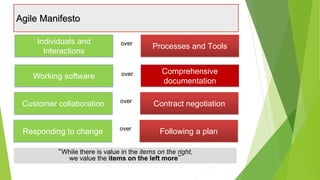
Individuals and
Interactions
Processes and Toolsover
Working software
Comprehensive
documentation
Customer collaboration Contract negotiationover
Responding to change Following a planover
over
“While there is value in the items on the right,
we value the items on the left more”
Agile Manifesto
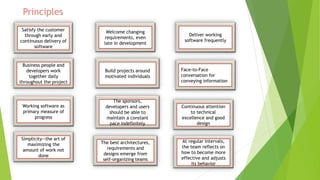
Continuous attention
to technical
excellence and good
design
The best architectures,
requirements and
designs emerge from
self-organizing teams
Simplicity--the art of
maximizing the
amount of work not
done
Satisfy the customer
through early and
continuous delivery of
software
Business people and
developers work
together daily
throughout the project
Working software as
primary measure of
progress
Welcome changing
requirements, even
late in development
Build projects around
motivated individuals
The sponsors,
developers and users
should be able to
maintain a constant
pace indefinitely
Deliver working
software frequently
Face-to-Face
conversation for
conveying information
At regular intervals,
the team reflects on
how to become more
effective and adjusts
its behavior
Principles
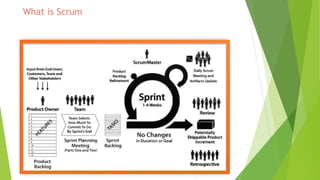
What is Scrum
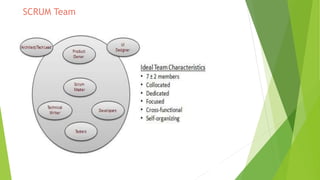
SCRUM Team
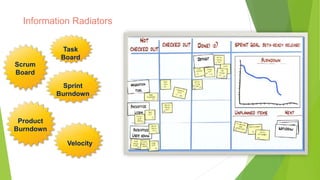
Scrum
Board
Task
Board
Sprint
Burndown
Product
Burndown
Velocity
Information Radiators
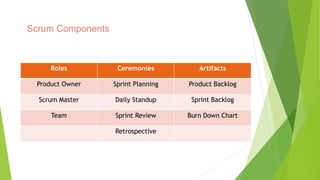
Roles Ceremonies Artifacts
Product Owner Sprint Planning Product Backlog
Scrum Master Daily Standup Sprint Backlog
Team Sprint Review Burn Down Chart
Retrospective
Scrum Components
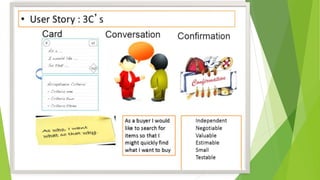
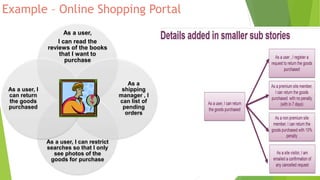
As a user,
I can read the
reviews of the books
that I want to
purchase
As a
shipping
manager , I
can list of
pending
orders
As a user, I can restrict
searches so that I only
see photos of the
goods for purchase
As a user, I
can return
the goods
purchased
Example – Online Shopping Portal
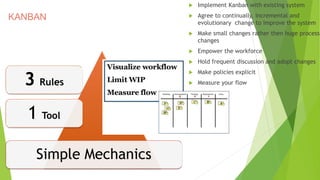
3 Rules
1 Tool
Simple Mechanics
 Implement Kanban with existing system
 Agree to continually, incremental and
evolutionary change to improve the system
 Make small changes rather then huge process
changes
 Empower the workforce
 Hold frequent discussion and adopt changes
 Make policies explicit
 Measure your flow
KANBAN
Agile Mind Set or
Rational Thinking
Limited capability of handling attention
July 2016, Namrata Datta
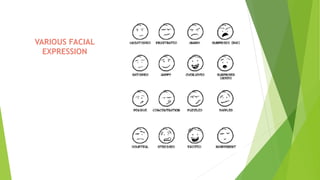
VARIOUS FACIAL
EXPRESSION
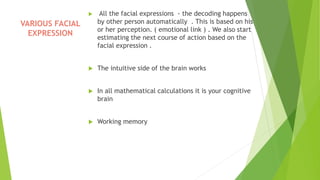
 All the facial expressions - the decoding happens
by other person automatically . This is based on his
or her perception. ( emotional link ) . We also start
estimating the next course of action based on the
facial expression .
 The intuitive side of the brain works
 In all mathematical calculations it is your cognitive
brain
 Working memory
VARIOUS FACIAL
EXPRESSION
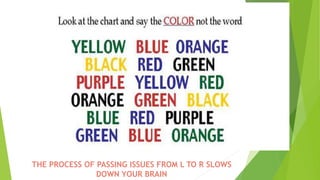
THE PROCESS OF PASSING ISSUES FROM L TO R SLOWS
DOWN YOUR BRAIN
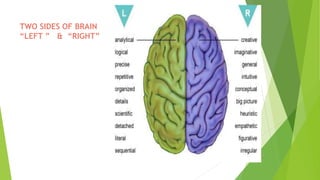
TWO SIDES OF BRAIN
“LEFT ” & “RIGHT”
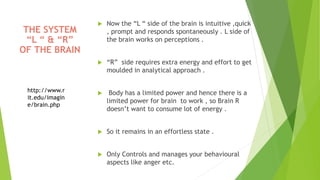
 Now the “L “ side of the brain is intuitive ,quick
, prompt and responds spontaneously . L side of
the brain works on perceptions .
 “R” side requires extra energy and effort to get
moulded in analytical approach .
 Body has a limited power and hence there is a
limited power for brain to work , so Brain R
doesn’t want to consume lot of energy .
 So it remains in an effortless state .
 Only Controls and manages your behavioural
aspects like anger etc.
THE SYSTEM
“L “ & “R”
OF THE BRAIN
http://www.r
it.edu/imagin
e/brain.php
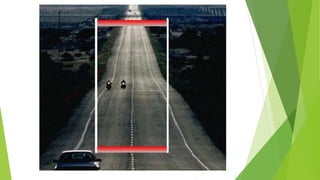
“L” SIDE OF THE BRAIN -
WHICH LINE IS BIGGER ??
“R”- SIDE OF THE
BRAIN
 Only comes into action where the nature of the
problem is serious and requires attention.
 COUNT 1 – 9 ( it is effortless )
 If I have to switch on to 1 A , 2 B , 3 C , 4 d , 5
E-----then efforts are required .
 At this stage “PART R “of your brain is working ,
your attentive system ceases down but those
who can do it faster are suppose to be
intelligent . BUT may not be rational .
EXAMPLE :
 A bat and a ball cost 1.1 $
 The bat costs 1 $ more than the ball
 How much does the ball costs ?
“ WE ARE BLIND TOWARDS OUR IGNORANCE AND GOOD IN FINDING MISTAKES IN OTHERS “
PERCEPTION
https://www.youtube.com/wat
ch?v=w9j3-ghRjBs
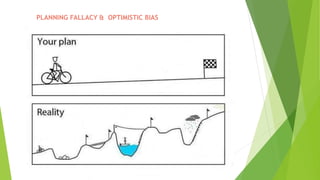
PLANNING FALLACY & OPTIMISTIC BIAS
PLANNING FALLACY
 While planning we take our strong views and if you are a good
leader you take views from your team as well.
 ( System A of your brain works , for success of your planning )
 Question : WHAT WE ARE NOT TAKING INTO ACCOUNT WHILE
PLANING ???
 What we are missing : Plan for fallouts
 Not thinking on the reasons for the failure
 Go for base rate – for success and failure
 EXAMPLE : Legal cases
( hence you support the people who gives support to your views )
 Similarly less assertive or low confident team is not liked by the
board
 The damaged caused by the overconfident CEO gets further
enhanced , if he is projected as a celebrity .
 WHAT IS MISSING ?
 Competition neglect : Zero sum game
 Working on WYSIATI
 We focus on our plan – where is the base rate effect
 Focus on our plan – where is the planning of others
 Illusion of control – we strongly believe on our skills , we believe
that the situation is within my control
Introduction to Agile & Agile MindSet

Introduction to Agile & Agile MindSet

  • 1.
    Art of Agile( Introduction) Basics Roles Various Methodologies
  • 3.
    “ ” Course Objectives  Learnthe essence of Agile  Bust the myths around agility  Learn about various Agile Methodologies  Know What’s Different in Agile?  Understand the end to end Scrum process  Know you Role and Responsibilities  Understand Scrum Process, Activities & Deliverables  Forget your fear from a change  Speak Agilish  Learn to have fun at work
  • 4.
    Individuals and Interactions Processes andToolsover Working software Comprehensive documentation Customer collaboration Contract negotiationover Responding to change Following a planover over “While there is value in the items on the right, we value the items on the left more” Agile Manifesto
  • 5.
    Continuous attention to technical excellenceand good design The best architectures, requirements and designs emerge from self-organizing teams Simplicity--the art of maximizing the amount of work not done Satisfy the customer through early and continuous delivery of software Business people and developers work together daily throughout the project Working software as primary measure of progress Welcome changing requirements, even late in development Build projects around motivated individuals The sponsors, developers and users should be able to maintain a constant pace indefinitely Deliver working software frequently Face-to-Face conversation for conveying information At regular intervals, the team reflects on how to become more effective and adjusts its behavior Principles
  • 6.
  • 7.
  • 9.
  • 10.
    Roles Ceremonies Artifacts ProductOwner Sprint Planning Product Backlog Scrum Master Daily Standup Sprint Backlog Team Sprint Review Burn Down Chart Retrospective Scrum Components
  • 11.
    As a user, Ican read the reviews of the books that I want to purchase As a shipping manager , I can list of pending orders As a user, I can restrict searches so that I only see photos of the goods for purchase As a user, I can return the goods purchased Example – Online Shopping Portal
  • 12.
    3 Rules 1 Tool SimpleMechanics  Implement Kanban with existing system  Agree to continually, incremental and evolutionary change to improve the system  Make small changes rather then huge process changes  Empower the workforce  Hold frequent discussion and adopt changes  Make policies explicit  Measure your flow KANBAN
  • 13.
    Agile Mind Setor Rational Thinking Limited capability of handling attention July 2016, Namrata Datta
  • 14.
  • 15.
     All thefacial expressions - the decoding happens by other person automatically . This is based on his or her perception. ( emotional link ) . We also start estimating the next course of action based on the facial expression .  The intuitive side of the brain works  In all mathematical calculations it is your cognitive brain  Working memory VARIOUS FACIAL EXPRESSION
  • 16.
    THE PROCESS OFPASSING ISSUES FROM L TO R SLOWS DOWN YOUR BRAIN
  • 19.
    TWO SIDES OFBRAIN “LEFT ” & “RIGHT”
  • 20.
     Now the“L “ side of the brain is intuitive ,quick , prompt and responds spontaneously . L side of the brain works on perceptions .  “R” side requires extra energy and effort to get moulded in analytical approach .  Body has a limited power and hence there is a limited power for brain to work , so Brain R doesn’t want to consume lot of energy .  So it remains in an effortless state .  Only Controls and manages your behavioural aspects like anger etc. THE SYSTEM “L “ & “R” OF THE BRAIN http://www.r it.edu/imagin e/brain.php
  • 21.
    “L” SIDE OFTHE BRAIN - WHICH LINE IS BIGGER ??
  • 23.
    “R”- SIDE OFTHE BRAIN  Only comes into action where the nature of the problem is serious and requires attention.  COUNT 1 – 9 ( it is effortless )  If I have to switch on to 1 A , 2 B , 3 C , 4 d , 5 E-----then efforts are required .  At this stage “PART R “of your brain is working , your attentive system ceases down but those who can do it faster are suppose to be intelligent . BUT may not be rational . EXAMPLE :  A bat and a ball cost 1.1 $  The bat costs 1 $ more than the ball  How much does the ball costs ? “ WE ARE BLIND TOWARDS OUR IGNORANCE AND GOOD IN FINDING MISTAKES IN OTHERS “
  • 24.
  • 25.
    PLANNING FALLACY &OPTIMISTIC BIAS
  • 26.
    PLANNING FALLACY  Whileplanning we take our strong views and if you are a good leader you take views from your team as well.  ( System A of your brain works , for success of your planning )  Question : WHAT WE ARE NOT TAKING INTO ACCOUNT WHILE PLANING ???  What we are missing : Plan for fallouts  Not thinking on the reasons for the failure  Go for base rate – for success and failure  EXAMPLE : Legal cases ( hence you support the people who gives support to your views )  Similarly less assertive or low confident team is not liked by the board  The damaged caused by the overconfident CEO gets further enhanced , if he is projected as a celebrity .  WHAT IS MISSING ?  Competition neglect : Zero sum game  Working on WYSIATI  We focus on our plan – where is the base rate effect  Focus on our plan – where is the planning of others  Illusion of control – we strongly believe on our skills , we believe that the situation is within my control