
The Self-organising Organisation
Nick Cahill & Lee Thomas
Fraedom
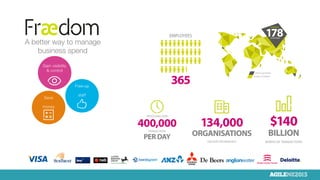
A better way to manage
business spend
Save !
money!
!
Gain visibility !
& control!
!
!
Free-up !
staff!
!
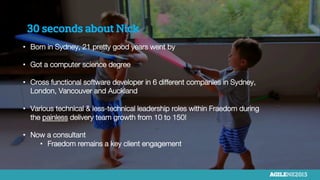
30 seconds about Nick
•  Born in Sydney, 21 pretty good years went by
•  Got a computer science degree
•  Cross functional software developer in 6 different companies in Sydney,
London, Vancouver and Auckland
•  Various technical & less-technical leadership roles within Fraedom during
the painless delivery team growth from 10 to 150!
•  Now a consultant
•  Fraedom remains a key client engagement
30 seconds about Lee

•  Born on a golf course (Long Story)
•  Experience 25++
•  Agile Coach & Trainer
•  Failed Rugby player, so now I coach J
“A coach is someone who can give
correction without
causing resentment.“ "
John Wooden,
Basketball Coach"
Advice & caveats
•  Built on an established agile culture
•  This change was an evolution, not a revolution

•  Some of the ideas & concepts might be useful for your evolution
•  We hope the story, ideas & lessons learned are interesting

•  Not a Spotify clone, borrows from everywhere (including Spotify)
•  Was not a “Restructure”
•  No redundancies
•  Potentially a bit of self-selection is still happening
Fraedom’s agile journey
Our environment
Our agile journey: Go Live


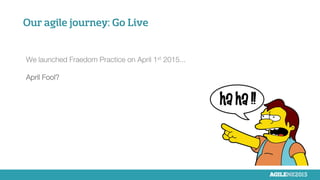
We launched Fraedom Practice on April 1st 2015...

April Fool?
Self organisation anti-patterns
… that Fraedom experienced
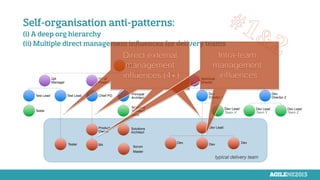
CTO
QA
Manager
Test Lead
Tester
Test Lead
Tester
VP of
Product
Chief PO
Product
Owner
BA
Technical
Director
Principal
Architect
Solutions
Architect
Lead
Solutions
Architect
Dev
Director 1
Dev Lead
Dev
Dev
Dev
Dev Lead
Team X"
Dev
Director 2
Dev Lead
Team Y
Dev Lead
Team Z
typical delivery team"
Self-organisation anti-patterns:
(i) A deep org hierarchy
(ii) Multiple direct management influences for delivery teams
Scrum
Master
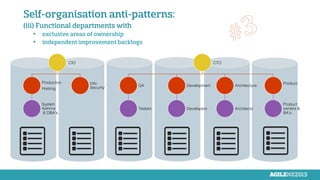
Self-organisation anti-patterns:
(iii) Functional departments with
•  exclusive areas of ownership
•  independent improvement backlogs
CIO!
Production!
Hosting!
System
Admins!
& DBA’s!
Info !
Security!
CTO!
QA!
Testers!
Development!
Developers!
Architecture!
Architects!
Product
!
Product
owners &
BA’s!
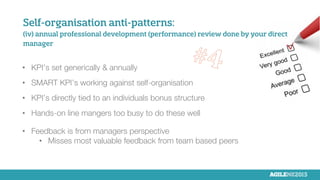
Self-organisation anti-patterns:
(iv) annual professional development (performance) review done by your direct
manager
•  KPI’s set generically & annually
•  SMART KPI’s working against self-organisation
•  KPI’s directly tied to an individuals bonus structure
•  Hands-on line mangers too busy to do these well
•  Feedback is from managers perspective 
•  Misses most valuable feedback from team based peers
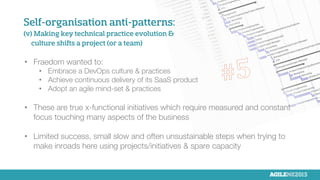
Self-organisation anti-patterns:
(v) Making key technical practice evolution &
culture shifts a project (or a team)
•  Fraedom wanted to: 
•  Embrace a DevOps culture & practices
•  Achieve continuous delivery of its SaaS product
•  Adopt an agile mind-set & practices
•  These are true x-functional initiatives which require measured and constant
focus touching many aspects of the business
•  Limited success, small slow and often unsustainable steps when trying to
make inroads here using projects/initiatives & spare capacity
The Fraedom Practice Model
…the theory
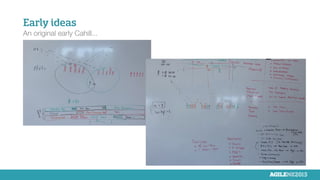
Early ideas
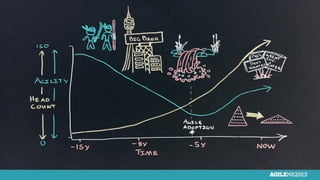
An original early Cahill...
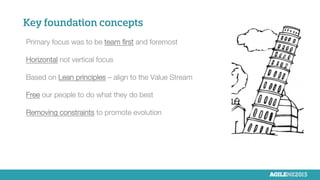
Key foundation concepts

Primary focus was to be team first and foremost

Horizontal not vertical focus

Based on Lean principles – align to the Value Stream

Free our people to do what they do best

Removing constraints to promote evolution
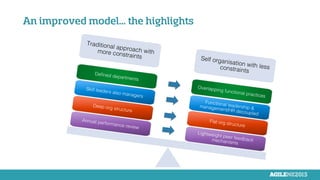
An improved model… the highlights
Traditional approach withmore constraints! Self organisation with lessconstraints!
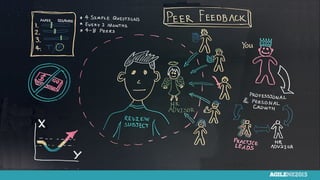
Lightweight peer feedbackmechanisms!
Flat org structure!
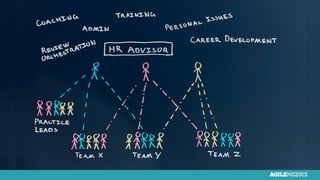
Functional leadership &management/HR decoupled !
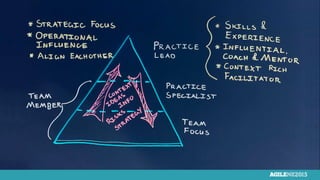
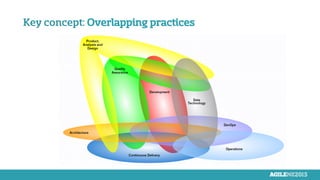
Overlapping functional practices!
Annual performance review!
Deep org structure!
Skill leaders also managers!
Defined departments !
Key concept: Overlapping practices
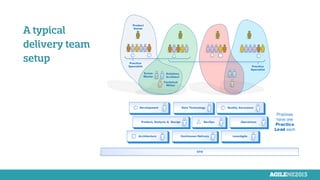
A typical
delivery team
setup
Development Data Technology Quality Assurance
Product, Analysis & Design DevOps
Architecture Continuous Delivery Lean|Agile
Operations
Product
Owner
Scrum
Master
Solutions
Architect
Technical
Writer
CTO
Practice
Specialist Practice
Specialist
Practices
have one
Practice
Lead each
A typical
delivery team
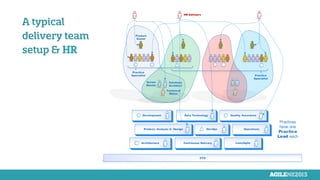
setup & HR
Development Data Technology Quality Assurance
Product, Analysis & Design DevOps
Architecture Continuous Delivery Lean|Agile
Operations
Product
Owner
Scrum
Master
Solutions
Architect
Technical
Writer
CTO
Practice
Specialist Practice
Specialist
Practices
have one
Practice
Lead each
HR Advisors
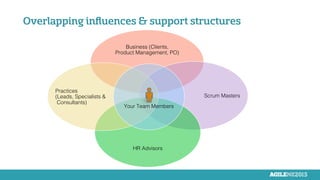
Overlapping influences & support structures
Business (Clients, !
Product Management, PO)!
!
!
!
Scrum Masters!
!
!
!
!
HR Advisors!
Practices !
(Leads, Specialists & !
Consultants)!
!
!
!
!
Your Team Members!
!
!
How did it go?
& how is it going?
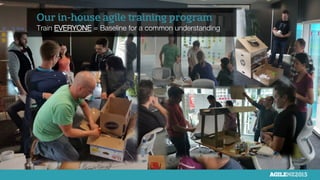
Our in-house agile training program

Train EVERYONE = Baseline for a common understanding
	
  
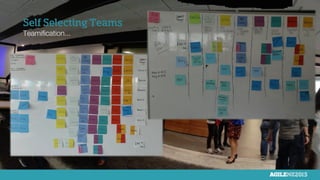
Self Selecting Teams
Teamification...
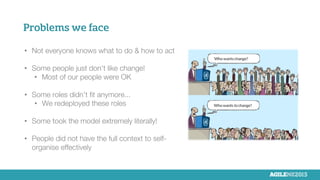
Problems we face
•  Not everyone knows what to do & how to act
•  Some people just don't like change! 
•  Most of our people were OK
•  Some roles didn’t fit anymore...
•  We redeployed these roles
•  Some took the model extremely literally!
•  People did not have the full context to self-
organise effectively
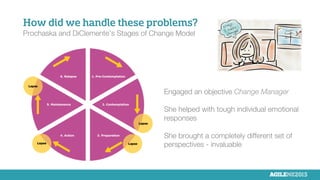
How did we handle these problems?
Prochaska and DiClemente’s Stages of Change Model


Engaged an objective Change Manager

She helped with tough individual emotional
responses 

She brought a completely different set of 
perspectives - invaluable
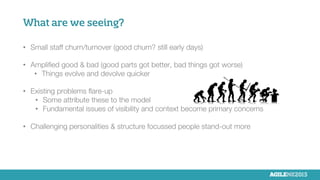
What are we seeing?
•  Small staff churn/turnover (good churn? still early days)

•  Amplified good & bad (good parts got better, bad things got worse)
•  Things evolve and devolve quicker
•  Existing problems flare-up
•  Some attribute these to the model
•  Fundamental issues of visibility and context become primary concerns
•  Challenging personalities & structure focussed people stand-out more
Measurement & moving forward

•  Measurement: Culture survey with baseline
•  Open spaces: Promote open discussions on challenges & hot topics

•  Only roll forward, never roll back
•  We are sure on one thing: we have not got the perfect model
•  The model allows low(er!) friction evolution so encourages further change
References
List of Case studies and books that fed into our approach:

Peopleware	
  - Tom DeMarco & Timothy Lister
Drive – Dan Pink
Spo.fy	
  – Henrik Kniberg
LESS	
  @	
  JP	
  Morgan	
  	
  - Craig Larmann
Scaled	
  Agile	
  Framework	
  – Dean Leffingwell
Trademe	
  (Squadification) – Sandy Mamoli 
Zappos	
  &	
  Holacracy	
  
How	
  to	
  run	
  a	
  company	
  with	
  no	
  rules	
  – Ricardo Semler
Lean	
  Product	
  Development	
  Flow	
  – Don Reinertsen
NeGlix	
  Culture – Freedom and Responsibility
Thanks	
  for	
  listening…	
  
Your	
  name	
  	
  
Your	
  organisa.on	
  
Follow	
  me	
  @your	
  twiLer	
  
Your	
  pic	
  
Thanks for listening…
Questions?
Nick Cahill nick.cahill@gmail.com | @quicknickc
Lee Thomas lthomas@fraedom.com | @iter8nz

Lee Thomas & Nick Cahill (Fraedom)

  • 1.
    The Self-organising Organisation NickCahill & Lee Thomas Fraedom
  • 2.
    A better wayto manage business spend Save ! money! ! Gain visibility ! & control! ! ! Free-up ! staff! !
  • 3.
    30 seconds aboutNick •  Born in Sydney, 21 pretty good years went by •  Got a computer science degree •  Cross functional software developer in 6 different companies in Sydney, London, Vancouver and Auckland •  Various technical & less-technical leadership roles within Fraedom during the painless delivery team growth from 10 to 150! •  Now a consultant •  Fraedom remains a key client engagement
  • 4.
    30 seconds aboutLee •  Born on a golf course (Long Story) •  Experience 25++ •  Agile Coach & Trainer •  Failed Rugby player, so now I coach J “A coach is someone who can give correction without causing resentment.“ " John Wooden, Basketball Coach"
  • 5.
    Advice & caveats • Built on an established agile culture •  This change was an evolution, not a revolution •  Some of the ideas & concepts might be useful for your evolution •  We hope the story, ideas & lessons learned are interesting •  Not a Spotify clone, borrows from everywhere (including Spotify) •  Was not a “Restructure” •  No redundancies •  Potentially a bit of self-selection is still happening
  • 7.
  • 9.
  • 10.
    Our agile journey:Go Live We launched Fraedom Practice on April 1st 2015... April Fool?
  • 11.
    Self organisation anti-patterns …that Fraedom experienced
  • 12.
    CTO QA Manager Test Lead Tester Test Lead Tester VPof Product Chief PO Product Owner BA Technical Director Principal Architect Solutions Architect Lead Solutions Architect Dev Director 1 Dev Lead Dev Dev Dev Dev Lead Team X" Dev Director 2 Dev Lead Team Y Dev Lead Team Z typical delivery team" Self-organisation anti-patterns: (i) A deep org hierarchy (ii) Multiple direct management influences for delivery teams Scrum Master
  • 13.
    Self-organisation anti-patterns: (iii) Functionaldepartments with •  exclusive areas of ownership •  independent improvement backlogs CIO! Production! Hosting! System Admins! & DBA’s! Info ! Security! CTO! QA! Testers! Development! Developers! Architecture! Architects! Product ! Product owners & BA’s!
  • 14.
    Self-organisation anti-patterns: (iv) annualprofessional development (performance) review done by your direct manager •  KPI’s set generically & annually •  SMART KPI’s working against self-organisation •  KPI’s directly tied to an individuals bonus structure •  Hands-on line mangers too busy to do these well •  Feedback is from managers perspective •  Misses most valuable feedback from team based peers
  • 15.
    Self-organisation anti-patterns: (v) Makingkey technical practice evolution & culture shifts a project (or a team) •  Fraedom wanted to: •  Embrace a DevOps culture & practices •  Achieve continuous delivery of its SaaS product •  Adopt an agile mind-set & practices •  These are true x-functional initiatives which require measured and constant focus touching many aspects of the business •  Limited success, small slow and often unsustainable steps when trying to make inroads here using projects/initiatives & spare capacity
  • 16.
    The Fraedom PracticeModel …the theory
  • 17.
    Early ideas An originalearly Cahill...
  • 18.
    Key foundation concepts Primaryfocus was to be team first and foremost Horizontal not vertical focus Based on Lean principles – align to the Value Stream Free our people to do what they do best Removing constraints to promote evolution
  • 19.
    An improved model…the highlights Traditional approach withmore constraints! Self organisation with lessconstraints! Lightweight peer feedbackmechanisms! Flat org structure! Functional leadership &management/HR decoupled ! Overlapping functional practices! Annual performance review! Deep org structure! Skill leaders also managers! Defined departments !
  • 22.
  • 23.
    A typical delivery team setup DevelopmentData Technology Quality Assurance Product, Analysis & Design DevOps Architecture Continuous Delivery Lean|Agile Operations Product Owner Scrum Master Solutions Architect Technical Writer CTO Practice Specialist Practice Specialist Practices have one Practice Lead each
  • 24.
    A typical delivery team setup& HR Development Data Technology Quality Assurance Product, Analysis & Design DevOps Architecture Continuous Delivery Lean|Agile Operations Product Owner Scrum Master Solutions Architect Technical Writer CTO Practice Specialist Practice Specialist Practices have one Practice Lead each HR Advisors
  • 25.
    Overlapping influences &support structures Business (Clients, ! Product Management, PO)! ! ! ! Scrum Masters! ! ! ! ! HR Advisors! Practices ! (Leads, Specialists & ! Consultants)! ! ! ! ! Your Team Members! ! !
  • 27.
    How did itgo? & how is it going?
  • 28.
    Our in-house agiletraining program Train EVERYONE = Baseline for a common understanding  
  • 29.
  • 30.
    Problems we face • Not everyone knows what to do & how to act •  Some people just don't like change! •  Most of our people were OK •  Some roles didn’t fit anymore... •  We redeployed these roles •  Some took the model extremely literally! •  People did not have the full context to self- organise effectively
  • 31.
    How did wehandle these problems? Prochaska and DiClemente’s Stages of Change Model Engaged an objective Change Manager She helped with tough individual emotional responses She brought a completely different set of perspectives - invaluable
  • 32.
    What are weseeing? •  Small staff churn/turnover (good churn? still early days) •  Amplified good & bad (good parts got better, bad things got worse) •  Things evolve and devolve quicker •  Existing problems flare-up •  Some attribute these to the model •  Fundamental issues of visibility and context become primary concerns •  Challenging personalities & structure focussed people stand-out more
  • 33.
    Measurement & movingforward •  Measurement: Culture survey with baseline •  Open spaces: Promote open discussions on challenges & hot topics •  Only roll forward, never roll back •  We are sure on one thing: we have not got the perfect model •  The model allows low(er!) friction evolution so encourages further change
  • 34.
    References List of Casestudies and books that fed into our approach: Peopleware  - Tom DeMarco & Timothy Lister Drive – Dan Pink Spo.fy  – Henrik Kniberg LESS  @  JP  Morgan    - Craig Larmann Scaled  Agile  Framework  – Dean Leffingwell Trademe  (Squadification) – Sandy Mamoli Zappos  &  Holacracy   How  to  run  a  company  with  no  rules  – Ricardo Semler Lean  Product  Development  Flow  – Don Reinertsen NeGlix  Culture – Freedom and Responsibility
  • 35.
    Thanks  for  listening…   Your  name     Your  organisa.on   Follow  me  @your  twiLer   Your  pic   Thanks for listening… Questions? Nick Cahill nick.cahill@gmail.com | @quicknickc Lee Thomas lthomas@fraedom.com | @iter8nz