Becoming Agile
Dr Rashina Hoda
Senior Lecturer – University of Auckland
2
Rashina Hoda
Senior Lecturer
Software Engineering
PhD in Agile
Award winning
“Theory of
Becoming Agile”
60+ publications
on Agile topics
10+ years industrial
Agile research
Founder,
AgileCourse@UoA
www.rashina.comVoice of Agile Research
3
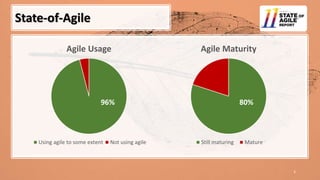
State-of-Agile
Agile Usage
Using agile to some extent Not using agile
Agile Maturity
Still maturing Mature
80%96%
4
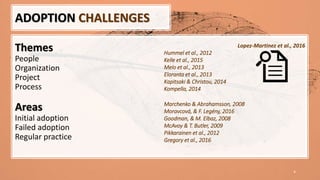
Themes
People
Organization
Project
Process
Areas
Initial adoption
Failed adoption
Regular practice
ADOPTION CHALLENGES
Hummel et al., 2012
Kelle et al., 2015
Melo et al., 2013
Eloranta et al., 2013
Kapitsaki & Christou, 2014
Kompella, 2014
Marchenko & Abrahamsson, 2008
Moravcová, & F. Legény, 2016
Goodman, & M. Elbaz, 2008
McAvoy & T. Butler, 2009
Pikkarainen et al., 2012
Gregory et al., 2016
Lopez-Martinez et al., 2016
5
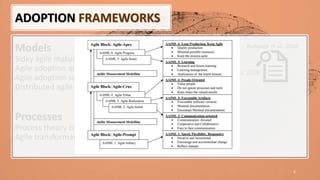
Models
Sidky agile maturity model
Agile adoption and improvement model
Agile adoption solution framework
Distributed agile transition model
Processes
Process theory of agility
Agile transformation framework
ADOPTION FRAMEWORKS
Sidky and Aurther, 2007
Qumer et al., 2007
Qumer and Henderson-Sellers, 2008
Sureshchandra and
Shrinivasavadhani , 2008
Wufka and Ralph, 2016
Gandomani & Nafchi, 2015
Rohunen et al., 2010
6
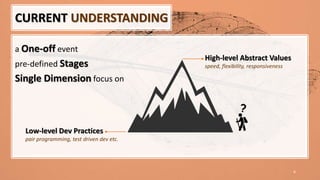
a One-off event
pre-defined Stages
Single Dimension focus on
CURRENT UNDERSTANDING
High-level Abstract Values
speed, flexibility, responsiveness
Low-level Dev Practices
pair programming, test driven dev etc.
7
Why are some teams more ‘agile’ than others?
How can we explain the differences?
What aspects are affected during agile transitions?
How do they relate?
OPEN QUESTIONS
8
Grounded Theory
• 31 agile practitioners
• 5 countries – Australia, India, New Zealand, Portugal and USA
• approx. 1 hour semi-structured interviews + observations
• Diverse perspectives – developer, tester, scrum master, PM, BA
• Total experience 2 – 14 years
• Agile experience 4 months – 6 years
• Methods scrum, kanban, lean, mixed
RESEARCH METHOD
Glaser & Strauss, 1967
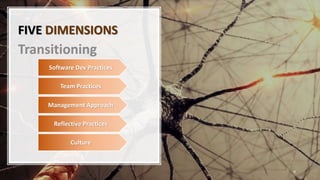
FIVE DIMENSIONS
Transitioning
9
Software Dev Practices
Team Practices
Management Approach
Reflective Practices
Culture
TRANSITIONING
SOFTWARE DEV PRACTICES
Delivery model sequential or
iterative and incremental
Meetings sprint and release planning,
demo, daily stand-up
Artifacts scrum boards, user stories
10
AgileHybridTraditional
“…people are resistant to changes...
not everybody is willing to attend the
meetings often...so it takes a while for
…the rhythm to set...
as time passes it gets easier.”
– P15, ERP, India
“Transition happens slowly.
Initially they don’t understand anything,
sprint planning, demo … We need to
explain [to] them. Initially learning,
then we start applying.”
– P25, Tech Lead, India
Marked by consistent use of agile
practices (daily standup, sprint
planning, demos, frequent releases)
and artifacts (user stories, scrum
boards)
TRANSITIONING
TEAM PRACTICES
Project management collective
specification, estimation, clarification
Task management delegation vs
self-assignment
11
Team-
driven
Manager-
assisted
Manager-
driven
“We really don’t feel that we get
delegated [tasks by clients],
but we feel one less job.”
– P13, Project Manager, India
“Here we get assistance from the scrum
master on how to assign tasks...
Once we are confident we can self-
assign ourselves in future.”
– P19, Developer, India
“Almost all tasks are
exclusively self-assigned.”
– P10, Scrum Master, NZ
“We don’t wait for them [team
leads]...We directly contact the client
...we are now used to it.”
– P30, Senior Developer, India
TRANSITIONING
MANAGEMENT APPROACH
Customer collaboration manager-
mediated vs direct
Problem solving on behalf of team
vs stepping in when required
12
EmpoweringAdaptingDriving
“He [manager] is the first point of the
contact between product owner,
dev[elopement] team, scrum master
and the stake-holders.”
– P6, Software Engineer, India
“I think it [self-organization] is fifty-fifty.
…try and allow them to self-organize
but there is a need for me to right now
monitor those activities that they don’t
revert to practices that are compulsive.
So my team is still transitioning...”
– P2, Project Manager, New Zealand
“For me self-organizing team is
something that wouldn’t notice if I
disappeared (laughs).”
– P10, Scrum Master, New Zealand
“Even if you are self-organizing team
you need someone who cuts the
interferences from the outside.”
– P9, Senior Developer, Australia
TRANSITIONING
REFLECTIVE PRACTICES
Reflection and learning
retrospectives, learning sessions, formal
training, personal efforts
Inspect and adapt process
improvement
13
EmbeddedFocusedLimited
“…where a whole team lacks
[knowledge/skills] in one specific area
of the project…we had to go through six
training sessions … but the problem is
time consumption.”
– P13, Project Manager, India
“We are now working on process
improvements. Previously we did not
have planning poker, but we
introduced it.”
– P25, Senior Developer, India
“There are many initiatives from
organisation...Somebody who just
learned new technology, he just speaks
on Saturdays once a month...everybody
would come and learn.”
– P22, Senior Developer, India
TRANSITIONING
CULTURE
Culture as a combined effect of
individual, team and organizational culture
Individuals and teams with same
organization manifest different levels of
autonomy
14
OpenEvolvingHierarchical
“...After getting the approval from the
managers we will follow up the same
[problems] with the product owner
who in turn provides necessary
explanation to the clients.”
– P6, Developer, India
“Also there is no defined
communications hierarchy.”
– P16, Senior Developer, USA
“...we can organize meeting with the
clients ourselves. It is purely upon the
individual to get the work
done on time.”
– P1, Business Analyst, USA
15
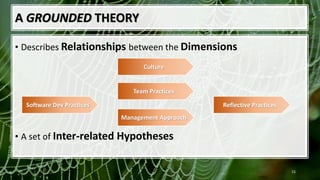
• Describes Relationships between the Dimensions
• A set of Inter-related Hypotheses
A GROUNDED THEORY
Software Dev Practices
Team Practices
Management Approach
Reflective Practices
Culture
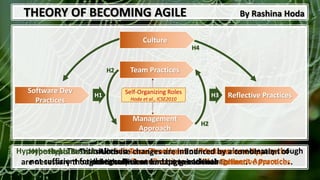
16THEORY OF BECOMING AGILE By Rashina Hoda
Software Dev
Practices
Team Practices
Management
Approach
Reflective PracticesH1 Self-Organizing Roles
Hoda et al., ICSE2010
H3
Culture
Hypothesis 1: Transition in Software Development Practices is necessary though
not sufficient for changes in Team Practices and Management Approach.
Hypothesis 2: Transitions in Team Practices and Management Approach
tend to reflect and adapt to each other.
Hypothesis 3: Transitions in Team Practices and Management Approach
are necessary though not sufficient for changes in their Reflective Practices.
Hypothesis 4: All these changes are influenced by a combination of
individual, team and organizational Culture.
17
Implications and Use
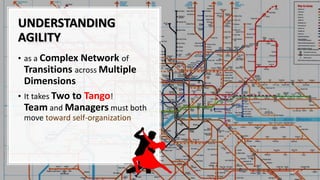
UNDERSTANDING
AGILITY
• as a Complex Network of
Transitions across Multiple
Dimensions
• It takes Two to Tango!
Team and Managers must both
move toward self-organization
18
19
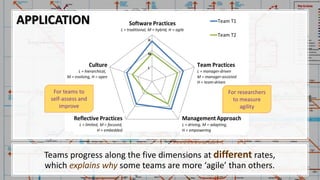
Teams progress along the five dimensions at different rates,
which explains why some teams are more ‘agile’ than others.
For researchers
to measure
agility
For teams to
self-assess and
improve
APPLICATION
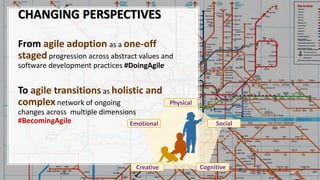
CHANGING PERSPECTIVES
20
From agile adoption as a one-off
staged progression across abstract values and
software development practices #DoingAgile
To agile transitions as holistic and
complex network of ongoing
changes across multiple dimensions
#BecomingAgile Social
Physical
Emotional
Creative Cognitive
Dr Rashina Hoda
The University of Auckland, New Zealand
@agileRashina
www.rashina.com
#BecomingAgile
#MoreThanSoftDev
Thanks for listening

Becoming Agile: Agile Transitions in Practice - Rashina Hoda - AgileNZ 2017

  • 1.
    Becoming Agile Dr RashinaHoda Senior Lecturer – University of Auckland
  • 2.
    2 Rashina Hoda Senior Lecturer SoftwareEngineering PhD in Agile Award winning “Theory of Becoming Agile” 60+ publications on Agile topics 10+ years industrial Agile research Founder, AgileCourse@UoA www.rashina.comVoice of Agile Research
  • 3.
    3 State-of-Agile Agile Usage Using agileto some extent Not using agile Agile Maturity Still maturing Mature 80%96%
  • 4.
    4 Themes People Organization Project Process Areas Initial adoption Failed adoption Regularpractice ADOPTION CHALLENGES Hummel et al., 2012 Kelle et al., 2015 Melo et al., 2013 Eloranta et al., 2013 Kapitsaki & Christou, 2014 Kompella, 2014 Marchenko & Abrahamsson, 2008 Moravcová, & F. Legény, 2016 Goodman, & M. Elbaz, 2008 McAvoy & T. Butler, 2009 Pikkarainen et al., 2012 Gregory et al., 2016 Lopez-Martinez et al., 2016
  • 5.
    5 Models Sidky agile maturitymodel Agile adoption and improvement model Agile adoption solution framework Distributed agile transition model Processes Process theory of agility Agile transformation framework ADOPTION FRAMEWORKS Sidky and Aurther, 2007 Qumer et al., 2007 Qumer and Henderson-Sellers, 2008 Sureshchandra and Shrinivasavadhani , 2008 Wufka and Ralph, 2016 Gandomani & Nafchi, 2015 Rohunen et al., 2010
  • 6.
    6 a One-off event pre-definedStages Single Dimension focus on CURRENT UNDERSTANDING High-level Abstract Values speed, flexibility, responsiveness Low-level Dev Practices pair programming, test driven dev etc.
  • 7.
    7 Why are someteams more ‘agile’ than others? How can we explain the differences? What aspects are affected during agile transitions? How do they relate? OPEN QUESTIONS
  • 8.
    8 Grounded Theory • 31agile practitioners • 5 countries – Australia, India, New Zealand, Portugal and USA • approx. 1 hour semi-structured interviews + observations • Diverse perspectives – developer, tester, scrum master, PM, BA • Total experience 2 – 14 years • Agile experience 4 months – 6 years • Methods scrum, kanban, lean, mixed RESEARCH METHOD Glaser & Strauss, 1967
  • 9.
    FIVE DIMENSIONS Transitioning 9 Software DevPractices Team Practices Management Approach Reflective Practices Culture
  • 10.
    TRANSITIONING SOFTWARE DEV PRACTICES Deliverymodel sequential or iterative and incremental Meetings sprint and release planning, demo, daily stand-up Artifacts scrum boards, user stories 10 AgileHybridTraditional “…people are resistant to changes... not everybody is willing to attend the meetings often...so it takes a while for …the rhythm to set... as time passes it gets easier.” – P15, ERP, India “Transition happens slowly. Initially they don’t understand anything, sprint planning, demo … We need to explain [to] them. Initially learning, then we start applying.” – P25, Tech Lead, India Marked by consistent use of agile practices (daily standup, sprint planning, demos, frequent releases) and artifacts (user stories, scrum boards)
  • 11.
    TRANSITIONING TEAM PRACTICES Project managementcollective specification, estimation, clarification Task management delegation vs self-assignment 11 Team- driven Manager- assisted Manager- driven “We really don’t feel that we get delegated [tasks by clients], but we feel one less job.” – P13, Project Manager, India “Here we get assistance from the scrum master on how to assign tasks... Once we are confident we can self- assign ourselves in future.” – P19, Developer, India “Almost all tasks are exclusively self-assigned.” – P10, Scrum Master, NZ “We don’t wait for them [team leads]...We directly contact the client ...we are now used to it.” – P30, Senior Developer, India
  • 12.
    TRANSITIONING MANAGEMENT APPROACH Customer collaborationmanager- mediated vs direct Problem solving on behalf of team vs stepping in when required 12 EmpoweringAdaptingDriving “He [manager] is the first point of the contact between product owner, dev[elopement] team, scrum master and the stake-holders.” – P6, Software Engineer, India “I think it [self-organization] is fifty-fifty. …try and allow them to self-organize but there is a need for me to right now monitor those activities that they don’t revert to practices that are compulsive. So my team is still transitioning...” – P2, Project Manager, New Zealand “For me self-organizing team is something that wouldn’t notice if I disappeared (laughs).” – P10, Scrum Master, New Zealand “Even if you are self-organizing team you need someone who cuts the interferences from the outside.” – P9, Senior Developer, Australia
  • 13.
    TRANSITIONING REFLECTIVE PRACTICES Reflection andlearning retrospectives, learning sessions, formal training, personal efforts Inspect and adapt process improvement 13 EmbeddedFocusedLimited “…where a whole team lacks [knowledge/skills] in one specific area of the project…we had to go through six training sessions … but the problem is time consumption.” – P13, Project Manager, India “We are now working on process improvements. Previously we did not have planning poker, but we introduced it.” – P25, Senior Developer, India “There are many initiatives from organisation...Somebody who just learned new technology, he just speaks on Saturdays once a month...everybody would come and learn.” – P22, Senior Developer, India
  • 14.
    TRANSITIONING CULTURE Culture as acombined effect of individual, team and organizational culture Individuals and teams with same organization manifest different levels of autonomy 14 OpenEvolvingHierarchical “...After getting the approval from the managers we will follow up the same [problems] with the product owner who in turn provides necessary explanation to the clients.” – P6, Developer, India “Also there is no defined communications hierarchy.” – P16, Senior Developer, USA “...we can organize meeting with the clients ourselves. It is purely upon the individual to get the work done on time.” – P1, Business Analyst, USA
  • 15.
    15 • Describes Relationshipsbetween the Dimensions • A set of Inter-related Hypotheses A GROUNDED THEORY Software Dev Practices Team Practices Management Approach Reflective Practices Culture
  • 16.
    16THEORY OF BECOMINGAGILE By Rashina Hoda Software Dev Practices Team Practices Management Approach Reflective PracticesH1 Self-Organizing Roles Hoda et al., ICSE2010 H3 Culture Hypothesis 1: Transition in Software Development Practices is necessary though not sufficient for changes in Team Practices and Management Approach. Hypothesis 2: Transitions in Team Practices and Management Approach tend to reflect and adapt to each other. Hypothesis 3: Transitions in Team Practices and Management Approach are necessary though not sufficient for changes in their Reflective Practices. Hypothesis 4: All these changes are influenced by a combination of individual, team and organizational Culture.
  • 17.
  • 18.
    UNDERSTANDING AGILITY • as aComplex Network of Transitions across Multiple Dimensions • It takes Two to Tango! Team and Managers must both move toward self-organization 18
  • 19.
    19 Teams progress alongthe five dimensions at different rates, which explains why some teams are more ‘agile’ than others. For researchers to measure agility For teams to self-assess and improve APPLICATION
  • 20.
    CHANGING PERSPECTIVES 20 From agileadoption as a one-off staged progression across abstract values and software development practices #DoingAgile To agile transitions as holistic and complex network of ongoing changes across multiple dimensions #BecomingAgile Social Physical Emotional Creative Cognitive
  • 21.
    Dr Rashina Hoda TheUniversity of Auckland, New Zealand @agileRashina www.rashina.com #BecomingAgile #MoreThanSoftDev
  • 22.

Editor's Notes

  • #3 A systematic literature review published last year identified agile adoption challenges to fall within four themes: people, organization, project and process. The areas of challenge include initial adoption, failed adoptions and even regular practice.
  • #4 A systematic literature review published last year identified agile adoption challenges to fall within four themes: people, organization, project and process. The areas of challenge include initial adoption, failed adoptions and even regular practice.
  • #5 A systematic literature review published last year identified agile adoption challenges to fall within four themes: people, organization, project and process. The areas of challenge include initial adoption, failed adoptions and even regular practice.
  • #6 A number of research models and frameworks have been proposed that aim to recommend the best number and sequence of steps to achieving agile adoptions.
  • #7 So we are currently used to looking at agile adoptions as a one-off event with pre-defined stages that focus on either high-level abstract values such as speed, flexibility and responsiveness or low-level dev practices such as pair programming, daily standups, test driven development etc. Leaving the average software team confused about where to begin and how to reconcile this huge gap in scale.
  • #8 It also leave a number of CRITICAL questions unanswered:
  • #9 Using GT allowed me to study agile transitions in the industry with an open mind and to generate a theory that is grounded in practice. It involved 31 agile practitioners from 5 different countries. I collected data using a combination of semi-structured interviews and observations, deliberately including diverse perspectives of practitioners with varying levels of professional and agile experiences.
  • #10 I found that software teams become agile across different dimensions.
  • #16 A grounded theory is more than a set of categories, it also describes the relationship between those categories, in our case the 5 dimensions of: SDP, TP, MA, RP, and C I will now show you our set of inter-related hypotheses that form the theory.
  • #17 H1 The first hypothesis derived from this study is that transition in a team’s SD practice from traditional to agile is necessary though not sufficient for the changes in team practices and management approach. H2 The second is that the transitions in the team practices and the management approach tend to reflect and adapt to each other. In other words, the team trying to become team-driven can only work if the management approach also moves towards becoming empowering. They are intrinsically tied to each other. The SO roles are mechanisms to achieve this dual shift. H3 Transitions in team and management practices are necessary (though not sufficient) for changes in the team’s reflective practices. I.e. Effective and regular reflective practice at a team and individual level can be considered a higher-order practice attained by highly autonomous, self-organizing teams. And Finally H4, all these changes are influenced by a combination of the organizational, team and individual culture. Such that a culture that is conducive will positively influence the other dimensions and vice versa. Culture is arguably the toughest to change bcoz of the sheer number of stakeholders involved.
  • #19 The theory has implications that we can understand agility as a complex network of transitions across multiple dimensions. It explains why every agile journey is unique. Also, that it takes 2 to TANGO! Both team and managers must move toward SO.
  • #20 An application of the theory is to track teams along the different dimensions of agility. Researchers can use this to measure where they are on their agile journey and better understand the context of the teams they are studying. Practitioners can use this to self-assess and improve their agile practices across all dimensions. Teams progress on different dimensions at different rates – that explains why some teams are more ‘agile’ than others even though they may all be performing the same agile SD practices.