



Agile
Transformations
That Stick
Nicola Dourambeis
Purple Agility
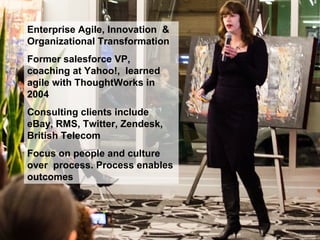
Enterprise Agile, Innovation &
Organizational Transformation
Former salesforce VP,
coaching at Yahoo!, learned
agile with ThoughtWorks in
2004
Consulting clients include
eBay, RMS, Twitter, Zendesk,
British Telecom
Focus on people and culture
over process. Process enables
outcomes
Why Transform?
Agile Transformation Playbook
Danger signs and what to do about them
Why Transform?
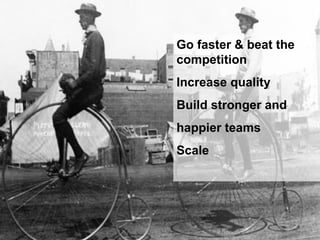
Go faster & beat the
competition
Increase quality
Build stronger and
happier teams
Scale
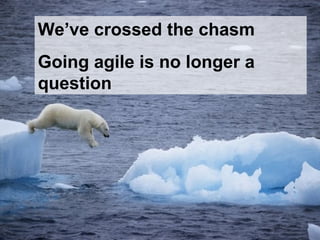
We’ve crossed the chasm
Going agile is no longer a
question
Agile is table stakes
If we all agree,
then why is it so
hard?
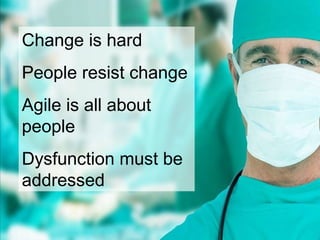
Change is hard
People resist change
Agile is all about
people
Dysfunction must be
addressed
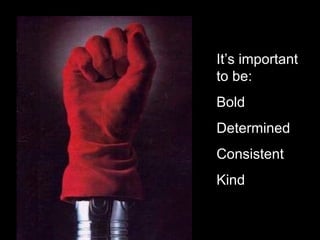
It’s important
to be:
Bold
Determined
Consistent
Kind
Bold
Agile
Transformation
Playbook
How to make it stick?
Agile has to be part of the culture –
everything changes
Don’t focus on mechanics, focus on
values, principles & behaviors
Look for and remove systemic
blockers
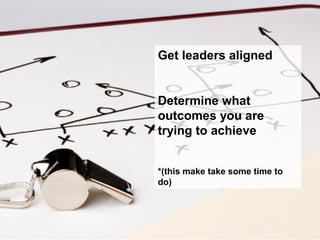
Get leaders aligned
Determine what
outcomes you are
trying to achieve
*(this make take some time to
do)
Technical:
How do you do builds?
Do you have continuous
integration?
Do you have test
automation frameworks?
Can teams mock?
Determine your infrastructure
Organizational:
Are you staffed to build cross
functional teams of 10 or
less?
Are those teams persistent?
Are there ScrumMasters and
Product Owners?
Do the teams have backlogs
which own portions of the
technology?
Determine your infrastructure
Form a cross functional
leadership team to make
decisions which impact
the whole organization
Build your organizational backlog
Definition of Done
Roles and Responsibilities
Environments, Tools & Metrics
Delivery Rhythm and Planning Cadence
Requirements and Dependency
Management
Technical Debt strategy
Way to stay visible
…but resist defining everything
Add large scale process only when it is
needed
Train Everyone in Agile
Leaders
Managers
Whole teams
* Everybody – even those people
who’ve “been doing it for years”
Bottom Up Release
Plan
Whole teams
Expect this to reveal
hard truths
Allow the teams start without
too much tweaking
They will make mistakes. They
may feel confused.
Help them see tradeoffs and
make wise decisions
Do not over – coach
Let them own the details of
their process
Keep them visible and
accountable
Let them fail fast and reset
Danger Signs
And what to do
Danger Signs
and what to do about them
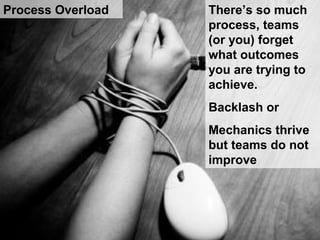
There’s so much
process, teams
(or you) forget
what outcomes
you are trying to
achieve.
Backlash or
Mechanics thrive
but teams do not
improve
Process Overload
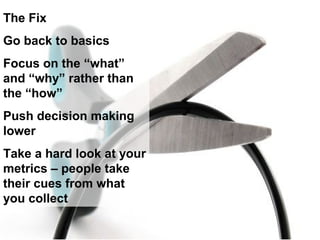
The Fix
Go back to basics
Focus on the “what”
and “why” rather than
the “how”
Push decision making
lower
Take a hard look at your
metrics – people take
their cues from what
you collect
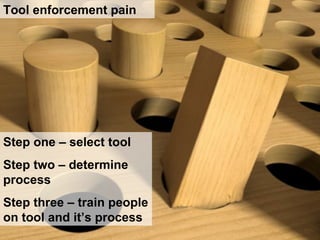
Step one – select tool
Step two – determine
process
Step three – train people
on tool and it’s process
Tool enforcement pain
The Fix
Put away the tool in favor of
simple, collaboration tools
Allow teams to customize their
process to their work and context
ScrumMasters are not
developed (or rotating or
part-time or shared with
any number of roles)
Product Owners are not
bought it to a
“development process”
Role Confusion
SMs - Name SMs, build job
descriptions & success metrics.
Develop community for shared
learning
Ensure rollout (and rollout team)
is comprehensive, not just
engineering. PMs (and their
managers) need skin in the game
The Fix
Decision Making is held;
no self organization
Leaders are unable to push
decision making down to
teams.
Managers don’t have a new job,
continue directive style,
assignments, estimates and
commitments
The Fix
Coach leaders on the
impact of their actions to
outcomes. Bring in data
rather than arguments.
Give managers a real
role in the agile org
which is different from
their previous one.
Critical partners to create
agile culture.
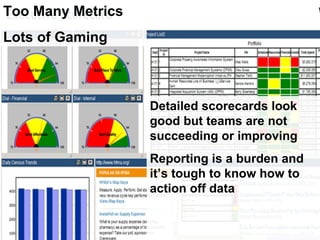
Too Many Metrics
Lots of Gaming
Detailed scorecards look
good but teams are not
succeeding or improving
Reporting is a burden and
it’s tough to know how to
action off data
The Fix
Simplify – go back to
desired outcomes
Measure no more than
5 things
Remind people of the
“why” so metrics have
value and promote
course correction
Final Thoughts
Genuine transformation takes time –
remember it’s culture change
Execute playbook quickly but inspect and
adapt often
Fail fast and find successes to amplify
Questions?

Agile Transformations that Stick

  • 1.
  • 2.
    Enterprise Agile, Innovation& Organizational Transformation Former salesforce VP, coaching at Yahoo!, learned agile with ThoughtWorks in 2004 Consulting clients include eBay, RMS, Twitter, Zendesk, British Telecom Focus on people and culture over process. Process enables outcomes
  • 3.
    Why Transform? Agile TransformationPlaybook Danger signs and what to do about them
  • 4.
  • 5.
    Go faster &beat the competition Increase quality Build stronger and happier teams Scale
  • 6.
    We’ve crossed thechasm Going agile is no longer a question
  • 7.
  • 8.
    If we allagree, then why is it so hard?
  • 9.
    Change is hard Peopleresist change Agile is all about people Dysfunction must be addressed
  • 10.
  • 11.
  • 12.
    How to makeit stick? Agile has to be part of the culture – everything changes Don’t focus on mechanics, focus on values, principles & behaviors Look for and remove systemic blockers
  • 13.
    Get leaders aligned Determinewhat outcomes you are trying to achieve *(this make take some time to do)
  • 14.
    Technical: How do youdo builds? Do you have continuous integration? Do you have test automation frameworks? Can teams mock? Determine your infrastructure
  • 15.
    Organizational: Are you staffedto build cross functional teams of 10 or less? Are those teams persistent? Are there ScrumMasters and Product Owners? Do the teams have backlogs which own portions of the technology? Determine your infrastructure
  • 16.
    Form a crossfunctional leadership team to make decisions which impact the whole organization
  • 17.
    Build your organizationalbacklog Definition of Done Roles and Responsibilities Environments, Tools & Metrics Delivery Rhythm and Planning Cadence Requirements and Dependency Management Technical Debt strategy Way to stay visible
  • 18.
    …but resist definingeverything Add large scale process only when it is needed
  • 19.
    Train Everyone inAgile Leaders Managers Whole teams * Everybody – even those people who’ve “been doing it for years”
  • 20.
    Bottom Up Release Plan Wholeteams Expect this to reveal hard truths
  • 21.
    Allow the teamsstart without too much tweaking They will make mistakes. They may feel confused. Help them see tradeoffs and make wise decisions Do not over – coach Let them own the details of their process Keep them visible and accountable Let them fail fast and reset
  • 22.
    Danger Signs And whatto do Danger Signs and what to do about them
  • 23.
    There’s so much process,teams (or you) forget what outcomes you are trying to achieve. Backlash or Mechanics thrive but teams do not improve Process Overload
  • 24.
    The Fix Go backto basics Focus on the “what” and “why” rather than the “how” Push decision making lower Take a hard look at your metrics – people take their cues from what you collect
  • 25.
    Step one –select tool Step two – determine process Step three – train people on tool and it’s process Tool enforcement pain
  • 26.
    The Fix Put awaythe tool in favor of simple, collaboration tools Allow teams to customize their process to their work and context
  • 27.
    ScrumMasters are not developed(or rotating or part-time or shared with any number of roles) Product Owners are not bought it to a “development process” Role Confusion
  • 28.
    SMs - NameSMs, build job descriptions & success metrics. Develop community for shared learning Ensure rollout (and rollout team) is comprehensive, not just engineering. PMs (and their managers) need skin in the game The Fix
  • 29.
    Decision Making isheld; no self organization Leaders are unable to push decision making down to teams. Managers don’t have a new job, continue directive style, assignments, estimates and commitments
  • 30.
    The Fix Coach leaderson the impact of their actions to outcomes. Bring in data rather than arguments. Give managers a real role in the agile org which is different from their previous one. Critical partners to create agile culture.
  • 31.
    Too Many Metrics Lotsof Gaming Detailed scorecards look good but teams are not succeeding or improving Reporting is a burden and it’s tough to know how to action off data
  • 32.
    The Fix Simplify –go back to desired outcomes Measure no more than 5 things Remind people of the “why” so metrics have value and promote course correction
  • 33.
  • 34.
    Genuine transformation takestime – remember it’s culture change Execute playbook quickly but inspect and adapt often Fail fast and find successes to amplify
  • 35.

Editor's Notes

  • #24 Team retros are great but the code is getting rolled back