Chapter 6 Design Generation
Chapter Objectives Design Types Creative Processes Models Creative Education Foundation Model Modes of Thoughts Types of Barriers to creative Thin inking. Techniques for Generating Alternatives
Types of Designs Configuration design. Parametric design. Original design
Configuration Design This deals with the selection and arranging of components to improve performance and reduce size. Example: location of air planes engines, location of shifting mechanism of  a two speed wheel chair.
Parametric Design Deals with varying design parameter to achieve design objectives. Boeing used this approach to design aircrafts.
Original Design This refers to designs that are substantially different than existing designs. The push button telephone is an example of a sudden major departure from rotary phone.
Characteristic of Creative Thinking Creative ideas are new combinations of previously unrelated ideas. Creative ideas are new original ideas solving problems in new and original ways. A product of unconscious mind. Elusive ideas.
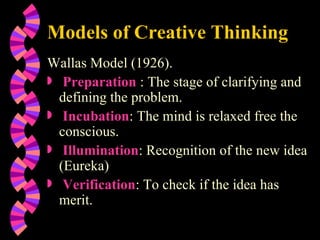
Models of Creative Thinking Wallas Model (1926). Preparation  : The stage of clarifying and defining the problem. Incubation : The mind is relaxed free the conscious. Illumination : Recognition of the new idea (Eureka) Verification : To check if the idea has merit.
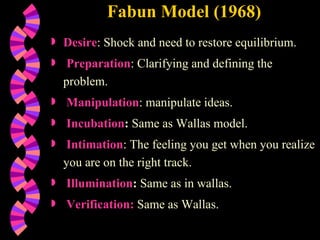
Fabun Model (1968) Desire : Shock and need to restore equilibrium. Preparation : Clarifying and defining the problem. Manipulation : manipulate ideas.  Incubation :  Same as Wallas model. Intimation : The feeling you get when you realize you are on the right track. Illumination :  Same as in wallas. Verification:  Same as Wallas.
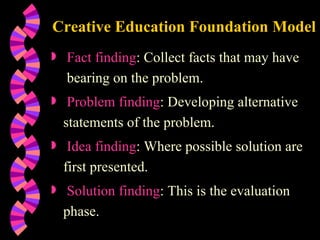
Creative Education Foundation Model Fact finding : Collect facts that may have  bearing on the problem. Problem finding : Developing alternative statements of the problem. Idea finding : Where possible solution are first presented. Solution finding : This is the evaluation phase.
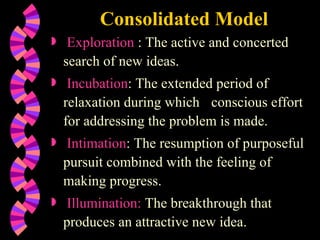
Consolidated Model Exploration  : The active and concerted search of new ideas. Incubation : The extended period of relaxation during which  conscious effort for addressing the problem is made. Intimation : The resumption of purposeful pursuit combined with the feeling of making progress. Illumination:  The breakthrough that produces an attractive new idea.
Creative Personalities Optimistic Confident Enthusiastic Endorses no perceived solution. Adventures spirit Willing to take risk. Has a good sense of humor
Modes of Thinking Left brain : Deductive, derivative, Specific, Logical, Hard and Linear. Right brain : Inductive, Integrating, General, Imaginative, Fuzzy and Nonlinear.
Types of Barriers to Creative Thinking Perceptual Cultural Environmental Emotional Intellectual
Types of Perceptual Barriers Patterns Boundaries Illusions Lens Meaning.
Techniques for Generating Alternatives Lateral thinking Do not pursue a design in detail Avoid critiquing any of the concepts. Perseverance  Try many times
Mental Push -Ups Making lists. Word games. Solving puzzles. Magic tricks.
Procedural Techniques Brain storming. Brain writing. Story boarding. Random simulation. Analogies

Design Generation Chapter6

  • 1.
    Chapter 6 DesignGeneration
  • 2.
    Chapter Objectives DesignTypes Creative Processes Models Creative Education Foundation Model Modes of Thoughts Types of Barriers to creative Thin inking. Techniques for Generating Alternatives
  • 3.
    Types of DesignsConfiguration design. Parametric design. Original design
  • 4.
    Configuration Design Thisdeals with the selection and arranging of components to improve performance and reduce size. Example: location of air planes engines, location of shifting mechanism of a two speed wheel chair.
  • 5.
    Parametric Design Dealswith varying design parameter to achieve design objectives. Boeing used this approach to design aircrafts.
  • 6.
    Original Design Thisrefers to designs that are substantially different than existing designs. The push button telephone is an example of a sudden major departure from rotary phone.
  • 7.
    Characteristic of CreativeThinking Creative ideas are new combinations of previously unrelated ideas. Creative ideas are new original ideas solving problems in new and original ways. A product of unconscious mind. Elusive ideas.
  • 8.
    Models of CreativeThinking Wallas Model (1926). Preparation : The stage of clarifying and defining the problem. Incubation : The mind is relaxed free the conscious. Illumination : Recognition of the new idea (Eureka) Verification : To check if the idea has merit.
  • 9.
    Fabun Model (1968)Desire : Shock and need to restore equilibrium. Preparation : Clarifying and defining the problem. Manipulation : manipulate ideas. Incubation : Same as Wallas model. Intimation : The feeling you get when you realize you are on the right track. Illumination : Same as in wallas. Verification: Same as Wallas.
  • 10.
    Creative Education FoundationModel Fact finding : Collect facts that may have bearing on the problem. Problem finding : Developing alternative statements of the problem. Idea finding : Where possible solution are first presented. Solution finding : This is the evaluation phase.
  • 11.
    Consolidated Model Exploration : The active and concerted search of new ideas. Incubation : The extended period of relaxation during which conscious effort for addressing the problem is made. Intimation : The resumption of purposeful pursuit combined with the feeling of making progress. Illumination: The breakthrough that produces an attractive new idea.
  • 12.
    Creative Personalities OptimisticConfident Enthusiastic Endorses no perceived solution. Adventures spirit Willing to take risk. Has a good sense of humor
  • 13.
    Modes of ThinkingLeft brain : Deductive, derivative, Specific, Logical, Hard and Linear. Right brain : Inductive, Integrating, General, Imaginative, Fuzzy and Nonlinear.
  • 14.
    Types of Barriersto Creative Thinking Perceptual Cultural Environmental Emotional Intellectual
  • 15.
    Types of PerceptualBarriers Patterns Boundaries Illusions Lens Meaning.
  • 16.
    Techniques for GeneratingAlternatives Lateral thinking Do not pursue a design in detail Avoid critiquing any of the concepts. Perseverance Try many times
  • 17.
    Mental Push -UpsMaking lists. Word games. Solving puzzles. Magic tricks.
  • 18.
    Procedural Techniques Brainstorming. Brain writing. Story boarding. Random simulation. Analogies