A creative thinking cheat-sheet
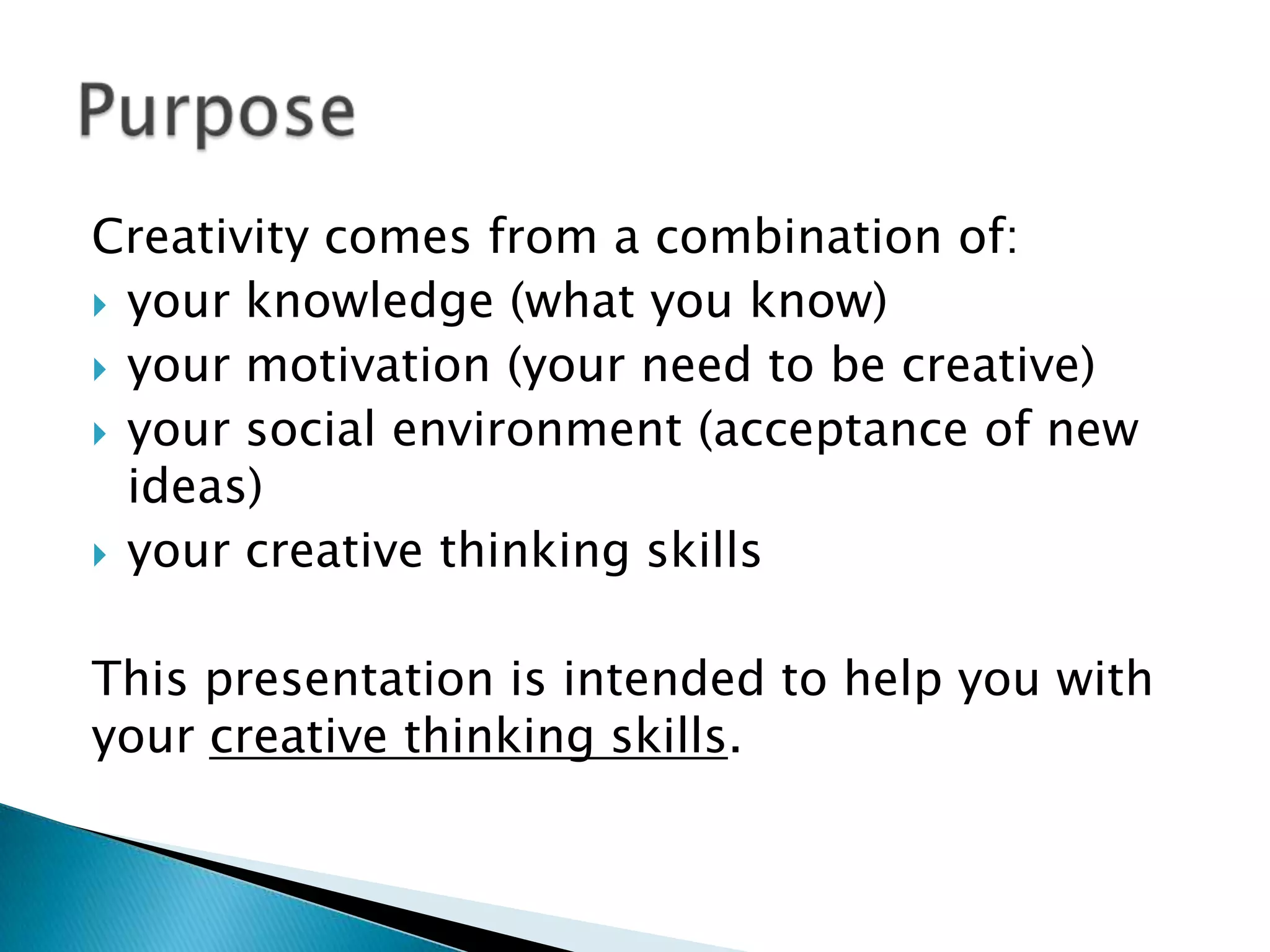
Creativity comes from a combination of:
 your knowledge (what you know)
 your motivation (your need to be creative)
 your social environment (acceptance of new
  ideas)
 your creative thinking skills


This presentation is intended to help you with
your creative thinking skills.
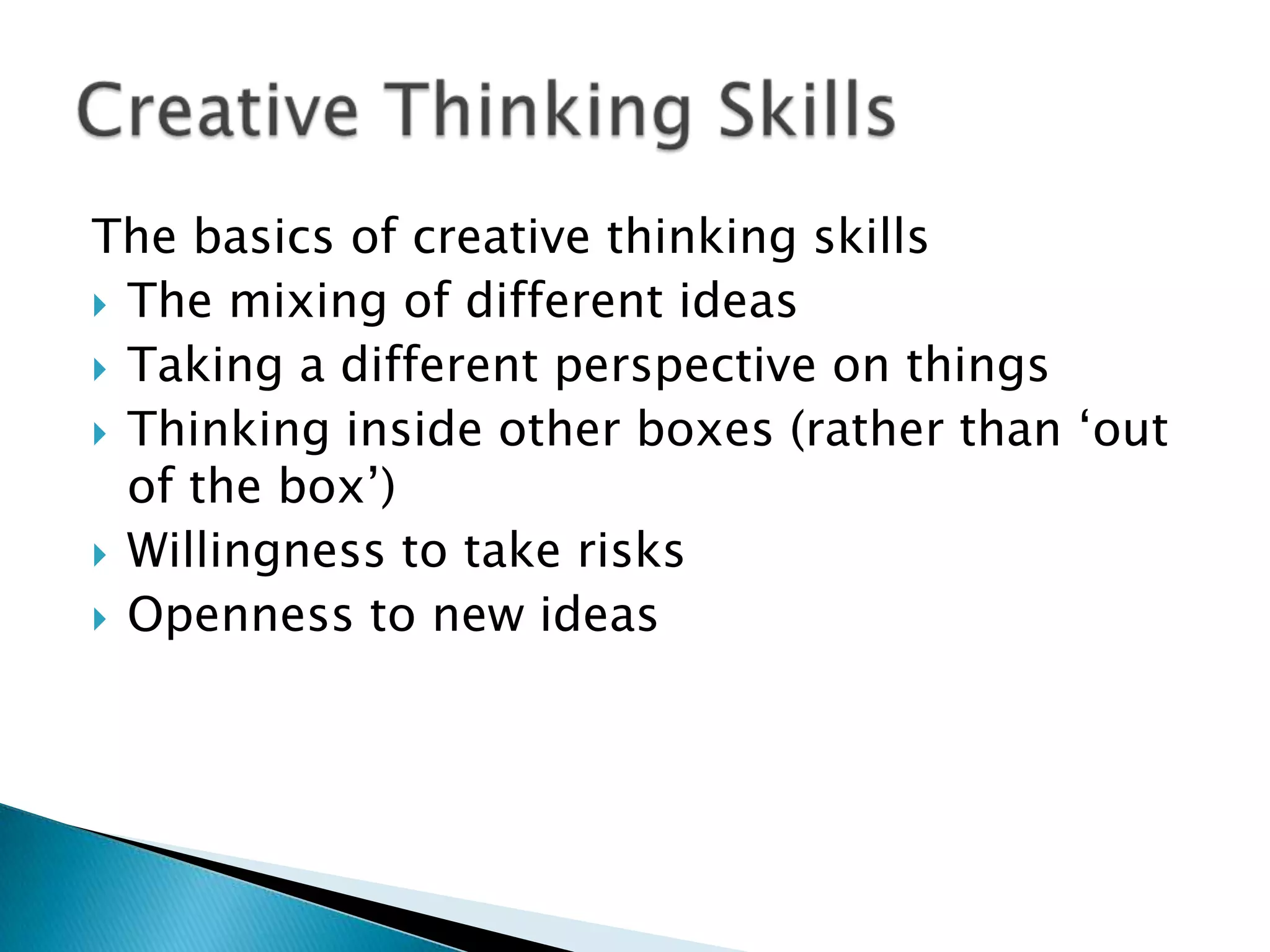
The basics of creative thinking skills
 The mixing of different ideas
 Taking a different perspective on things
 Thinking inside other boxes (rather than „out
  of the box‟)
 Willingness to take risks
 Openness to new ideas
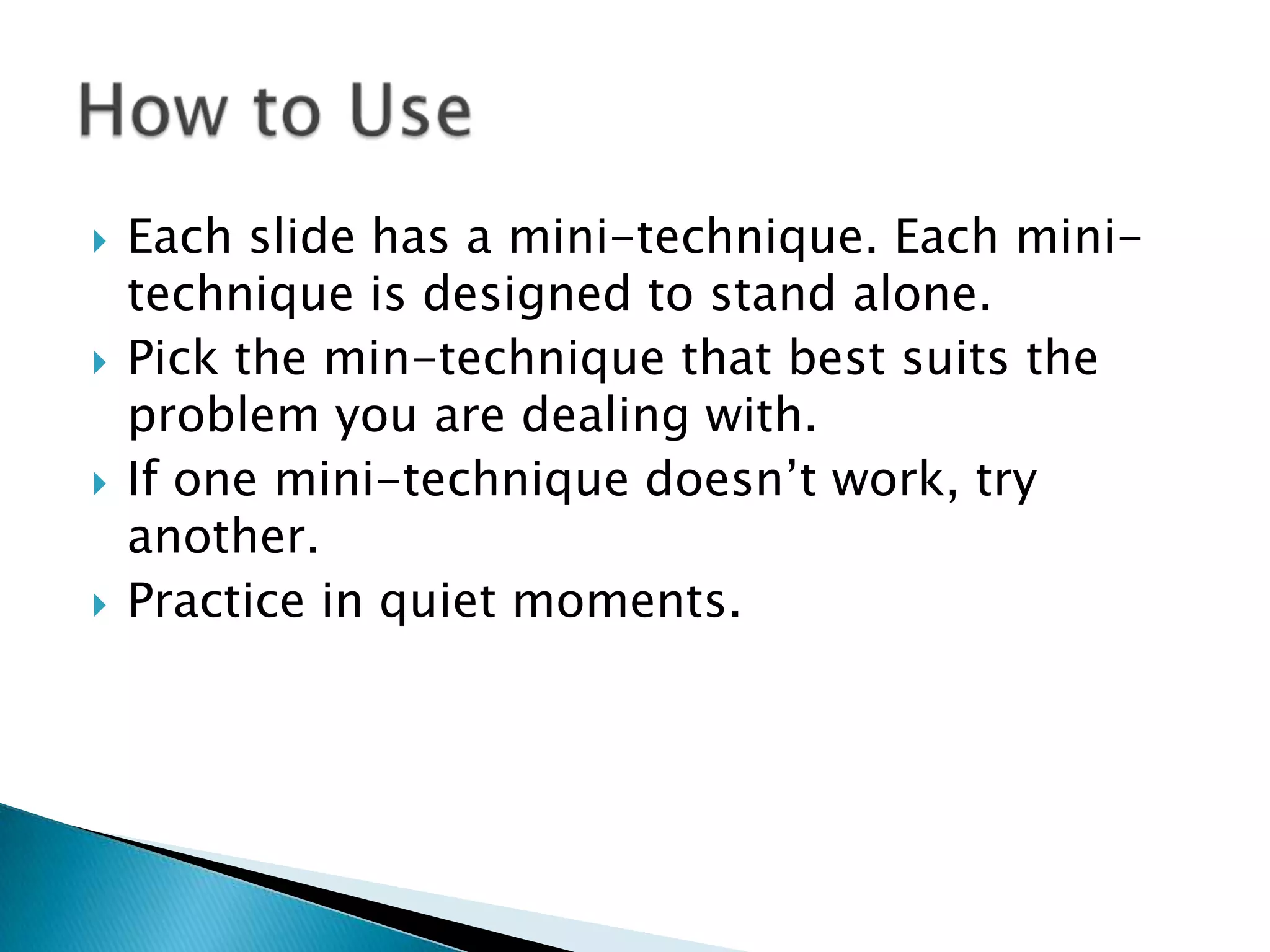
   Each slide has a mini-technique. Each mini-
    technique is designed to stand alone.
   Pick the min-technique that best suits the
    problem you are dealing with.
   If one mini-technique doesn‟t work, try
    another.
   Practice in quiet moments.
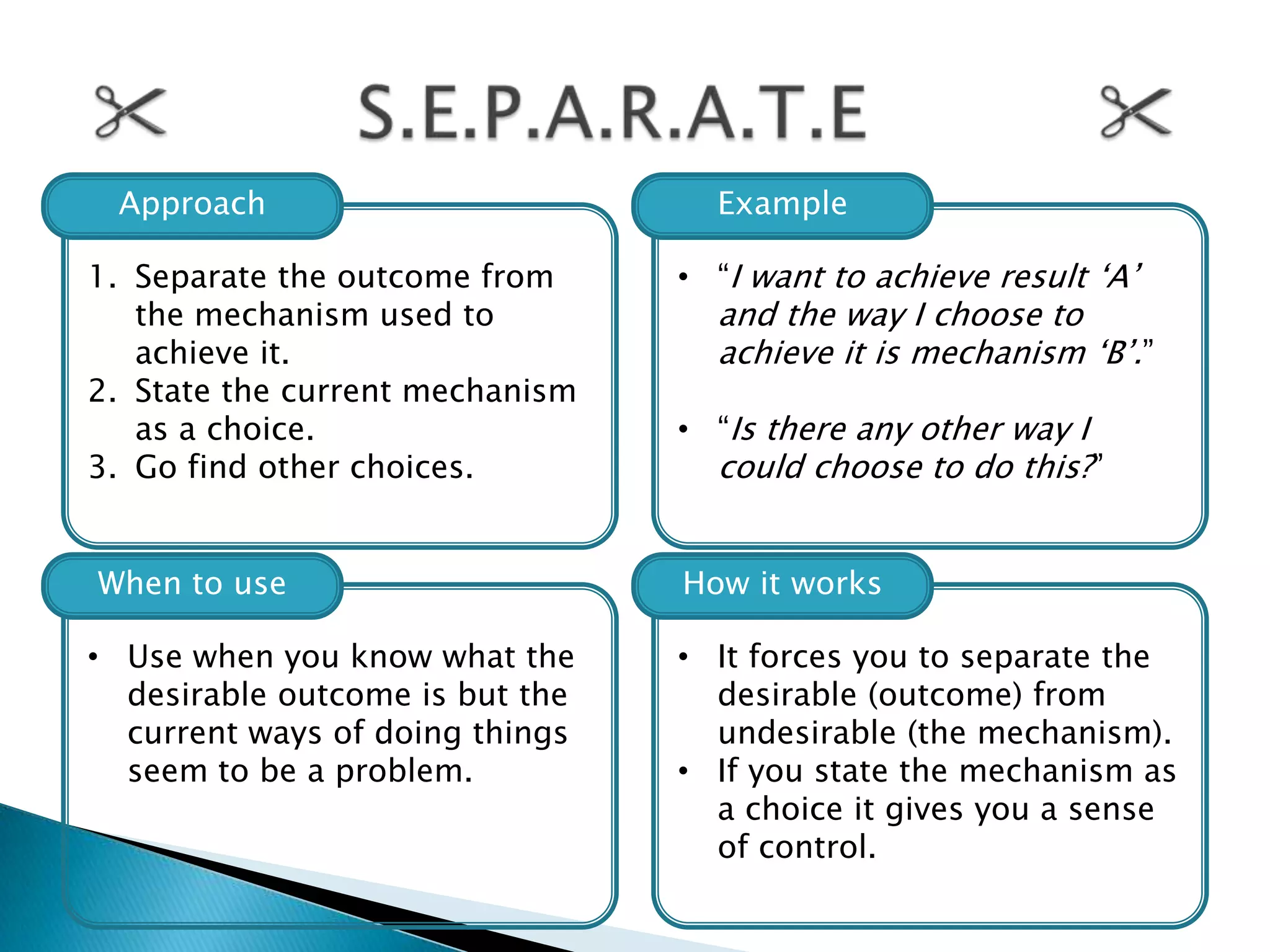
Approach                          Example

1. Separate the outcome from     • “I want to achieve result „A‟
   the mechanism used to           and the way I choose to
   achieve it.                     achieve it is mechanism „B‟.”
2. State the current mechanism
   as a choice.                  • “Is there any other way I
3. Go find other choices.          could choose to do this?”


When to use                      How it works

• Use when you know what the     • It forces you to separate the
  desirable outcome is but the     desirable (outcome) from
  current ways of doing things     undesirable (the mechanism).
  seem to be a problem.          • If you state the mechanism as
                                   a choice it gives you a sense
                                   of control.
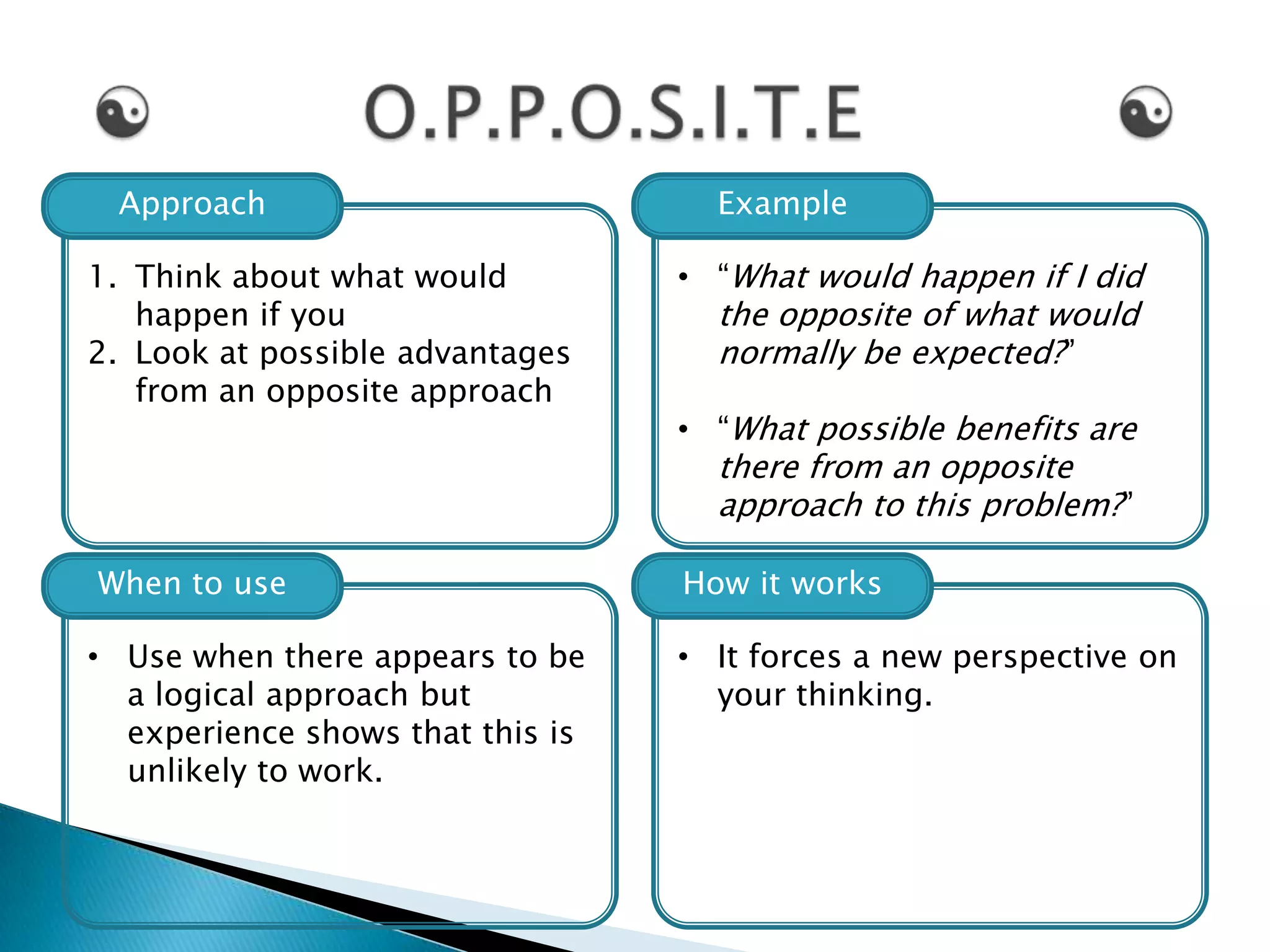
Approach                           Example

1. Think about what would         • “What would happen if I did
   happen if you                    the opposite of what would
2. Look at possible advantages      normally be expected?”
   from an opposite approach
                                  • “What possible benefits are
                                    there from an opposite
                                    approach to this problem?”

When to use                       How it works

• Use when there appears to be    • It forces a new perspective on
  a logical approach but            your thinking.
  experience shows that this is
  unlikely to work.
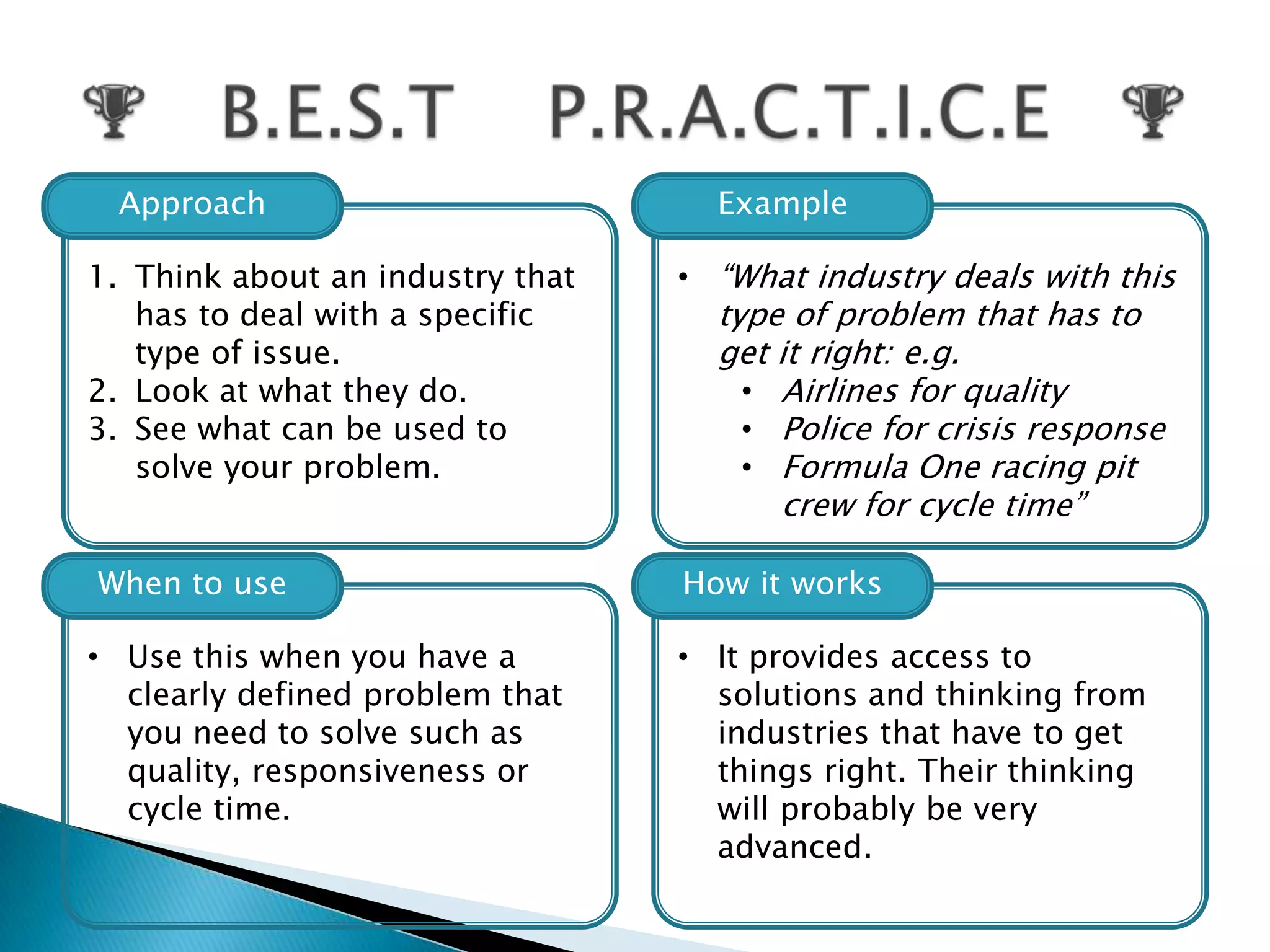
Approach                           Example

1. Think about an industry that   • “What industry deals with this
   has to deal with a specific      type of problem that has to
   type of issue.                   get it right: e.g.
2. Look at what they do.              • Airlines for quality
3. See what can be used to            • Police for crisis response
   solve your problem.                • Formula One racing pit
                                        crew for cycle time”

When to use                       How it works

• Use this when you have a        • It provides access to
  clearly defined problem that      solutions and thinking from
  you need to solve such as         industries that have to get
  quality, responsiveness or        things right. Their thinking
  cycle time.                       will probably be very
                                    advanced.
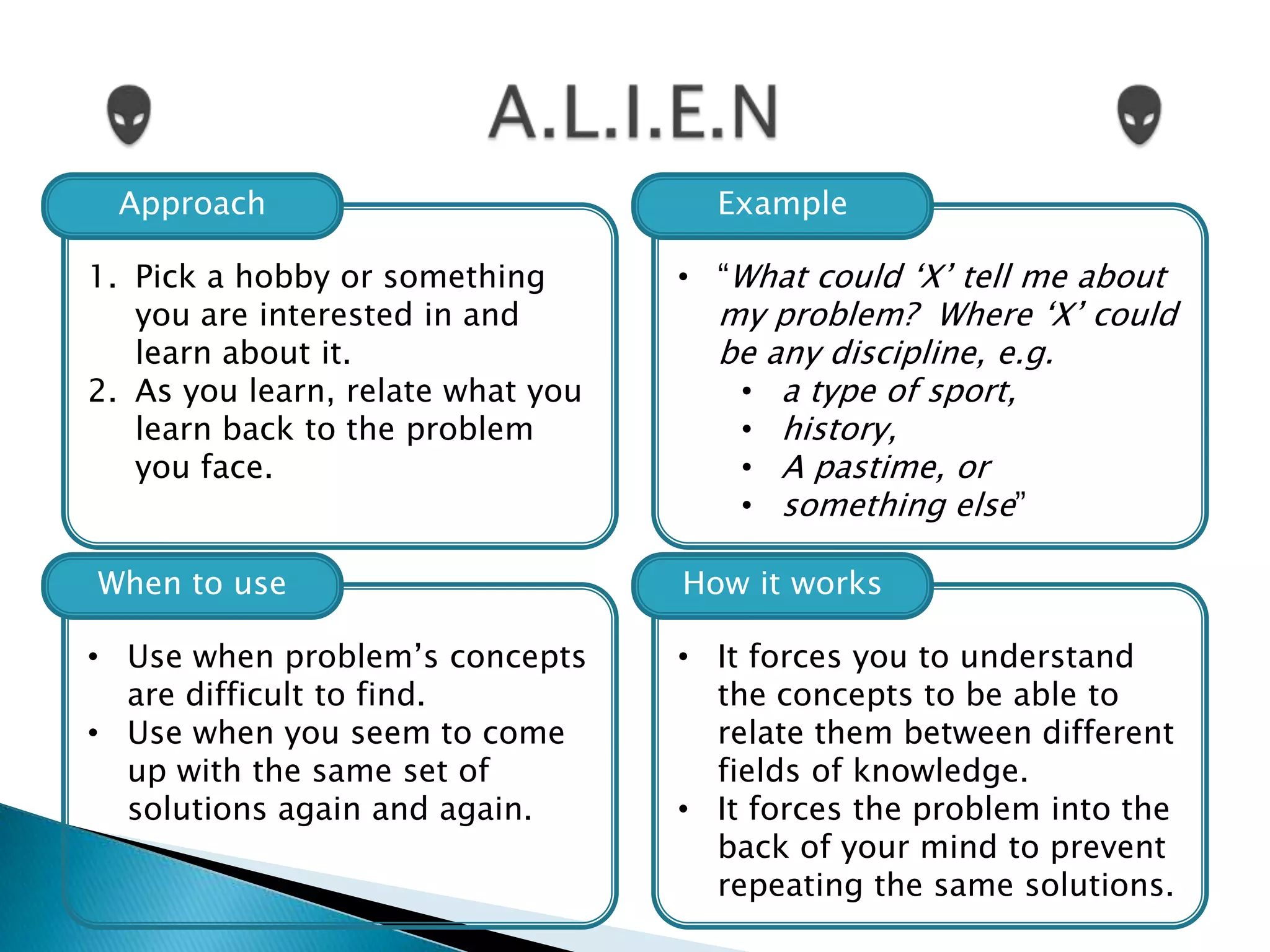
Approach                           Example

1. Pick a hobby or something       • “What could „X‟ tell me about
   you are interested in and         my problem? Where „X‟ could
   learn about it.                   be any discipline, e.g.
2. As you learn, relate what you      • a type of sport,
   learn back to the problem          • history,
   you face.                          • A pastime, or
                                      • something else”

When to use                        How it works

• Use when problem‟s concepts      • It forces you to understand
  are difficult to find.             the concepts to be able to
• Use when you seem to come          relate them between different
  up with the same set of            fields of knowledge.
  solutions again and again.       • It forces the problem into the
                                     back of your mind to prevent
                                     repeating the same solutions.
Approach                          Example

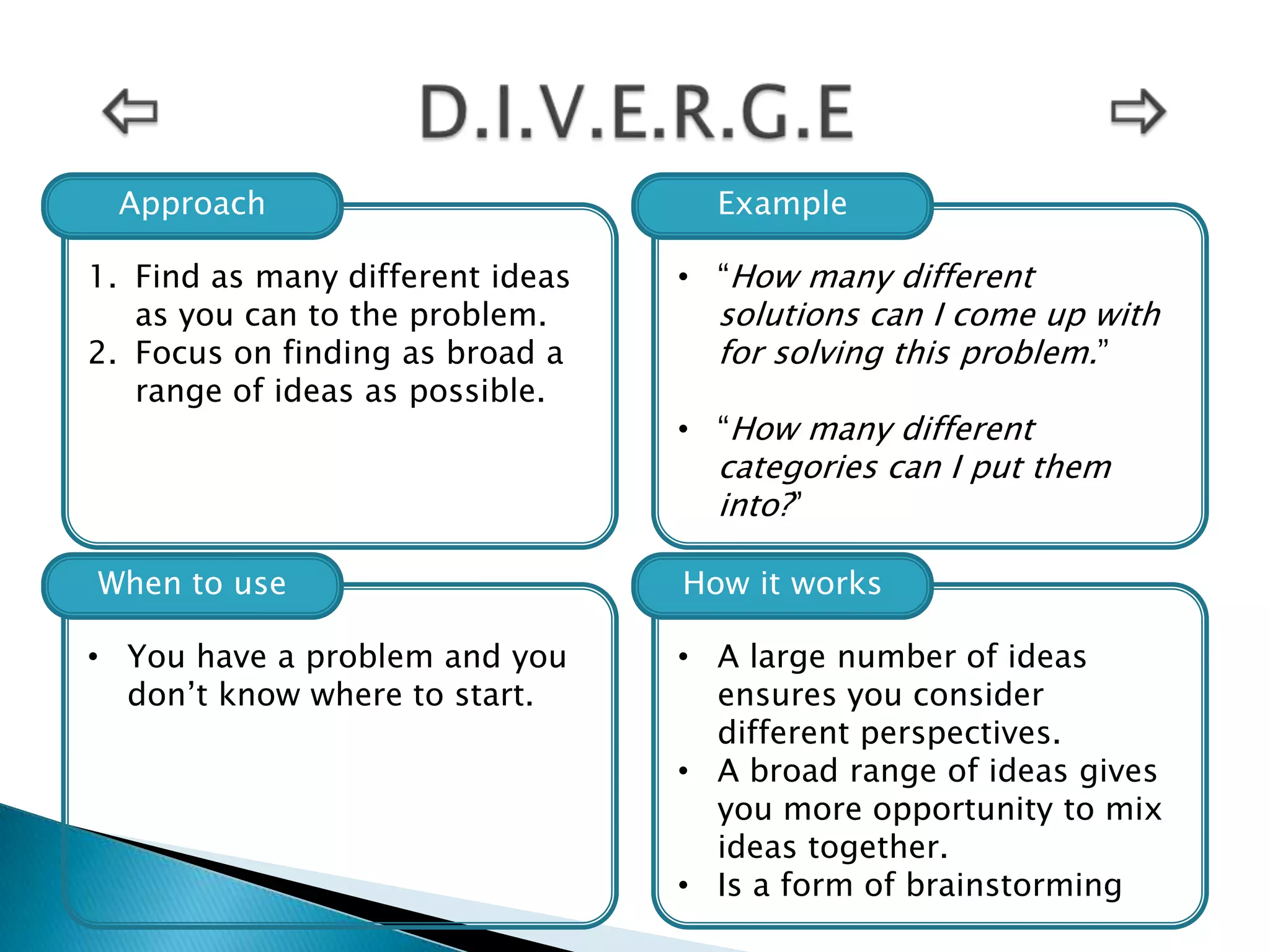
1. Find as many different ideas   • “How many different
   as you can to the problem.       solutions can I come up with
2. Focus on finding as broad a      for solving this problem.”
   range of ideas as possible.
                                  • “How many different
                                    categories can I put them
                                    into?”

When to use                       How it works

• You have a problem and you      • A large number of ideas
  don‟t know where to start.        ensures you consider
                                    different perspectives.
                                  • A broad range of ideas gives
                                    you more opportunity to mix
                                    ideas together.
                                  • Is a form of brainstorming
Approach                           Example

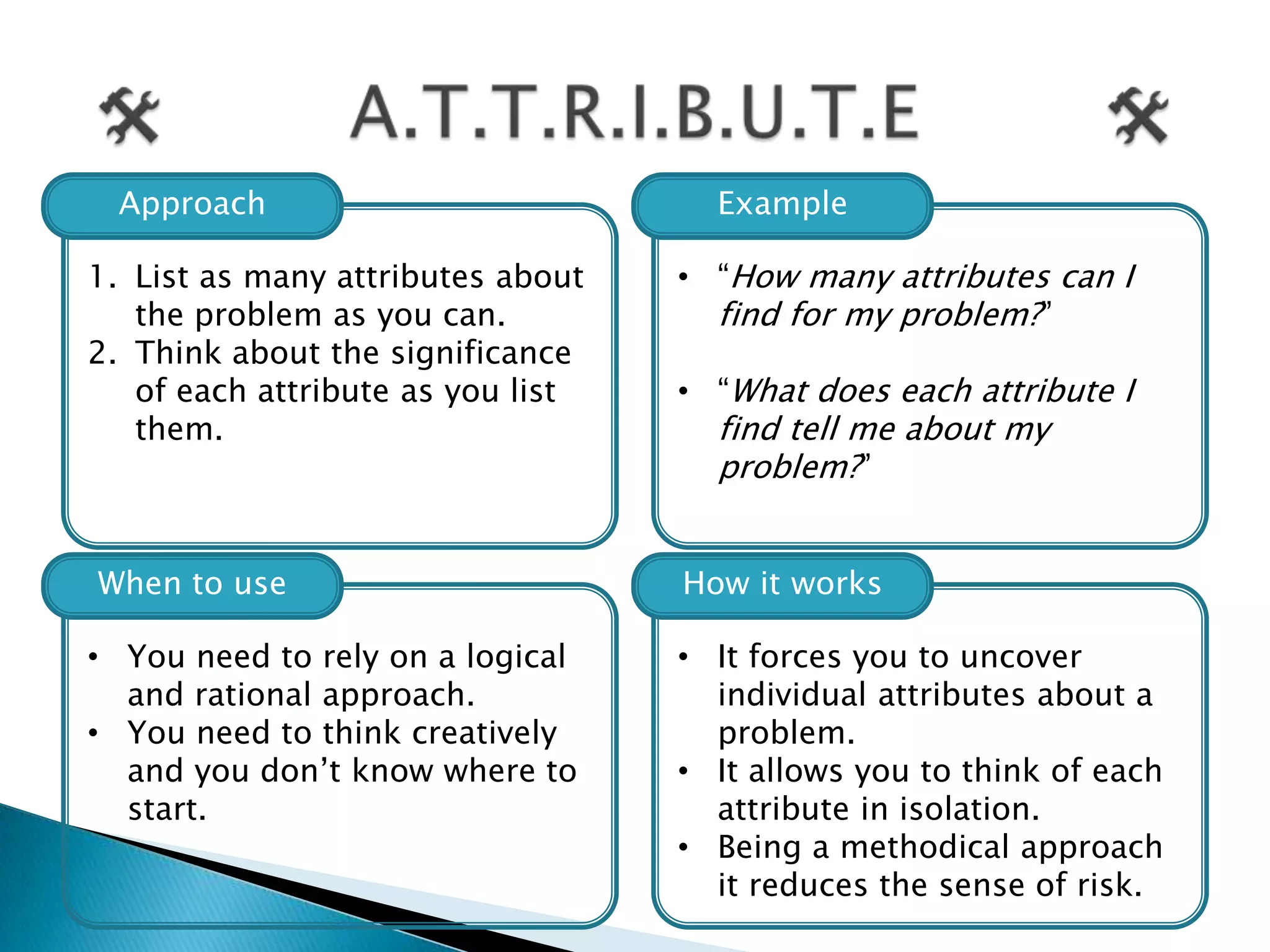
1. List as many attributes about   • “How many attributes can I
   the problem as you can.           find for my problem?”
2. Think about the significance
   of each attribute as you list   • “What does each attribute I
   them.                             find tell me about my
                                     problem?”


When to use                        How it works

• You need to rely on a logical    • It forces you to uncover
  and rational approach.             individual attributes about a
• You need to think creatively       problem.
  and you don‟t know where to      • It allows you to think of each
  start.                             attribute in isolation.
                                   • Being a methodical approach
                                     it reduces the sense of risk.
Approach                         Example

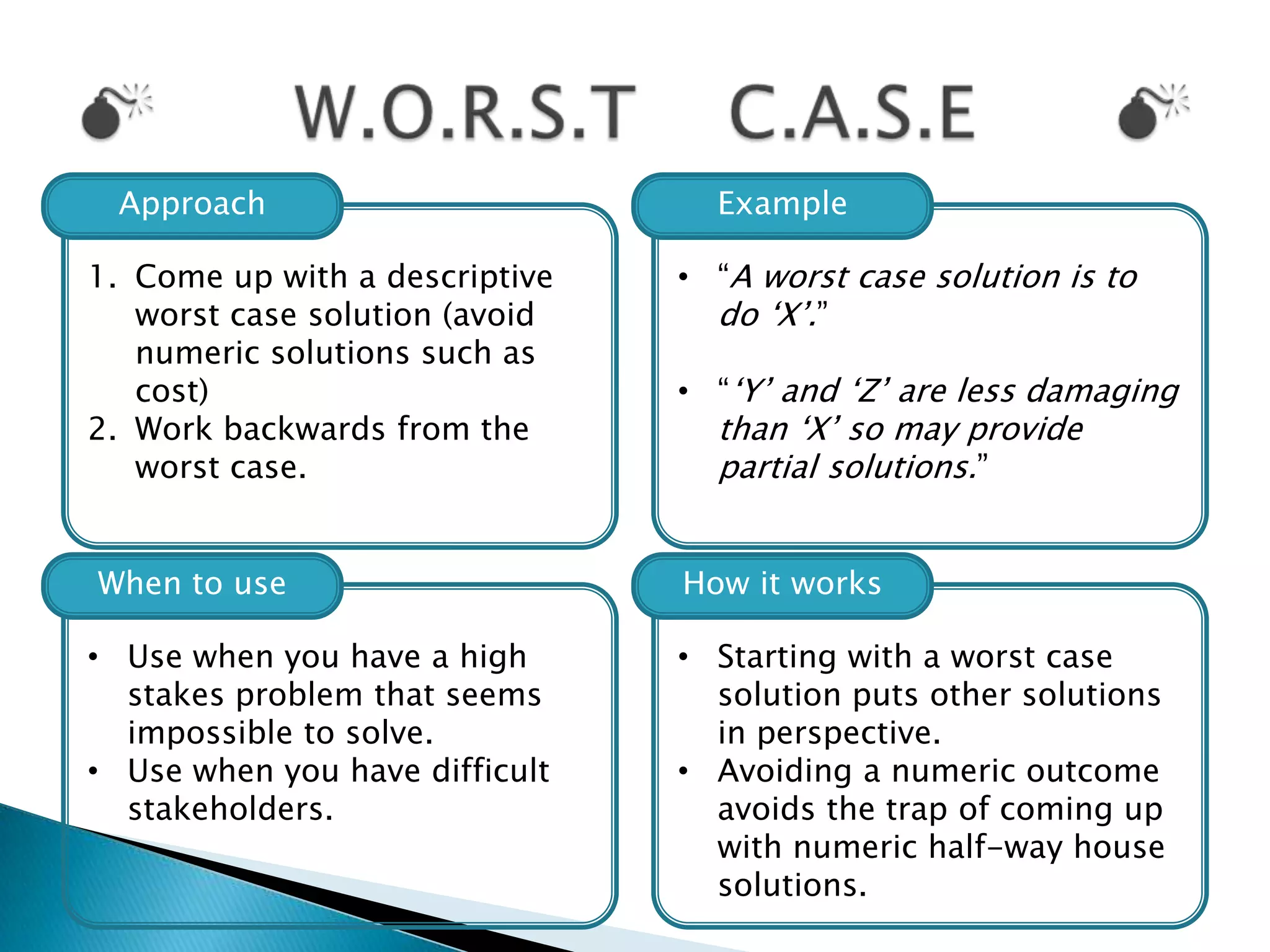
1. Come up with a descriptive   • “A worst case solution is to
   worst case solution (avoid     do „X‟.”
   numeric solutions such as
   cost)                        • “„Y‟ and „Z‟ are less damaging
2. Work backwards from the        than „X‟ so may provide
   worst case.                    partial solutions.”


When to use                     How it works

• Use when you have a high      • Starting with a worst case
  stakes problem that seems       solution puts other solutions
  impossible to solve.            in perspective.
• Use when you have difficult   • Avoiding a numeric outcome
  stakeholders.                   avoids the trap of coming up
                                  with numeric half-way house
                                  solutions.
Approach                          Example

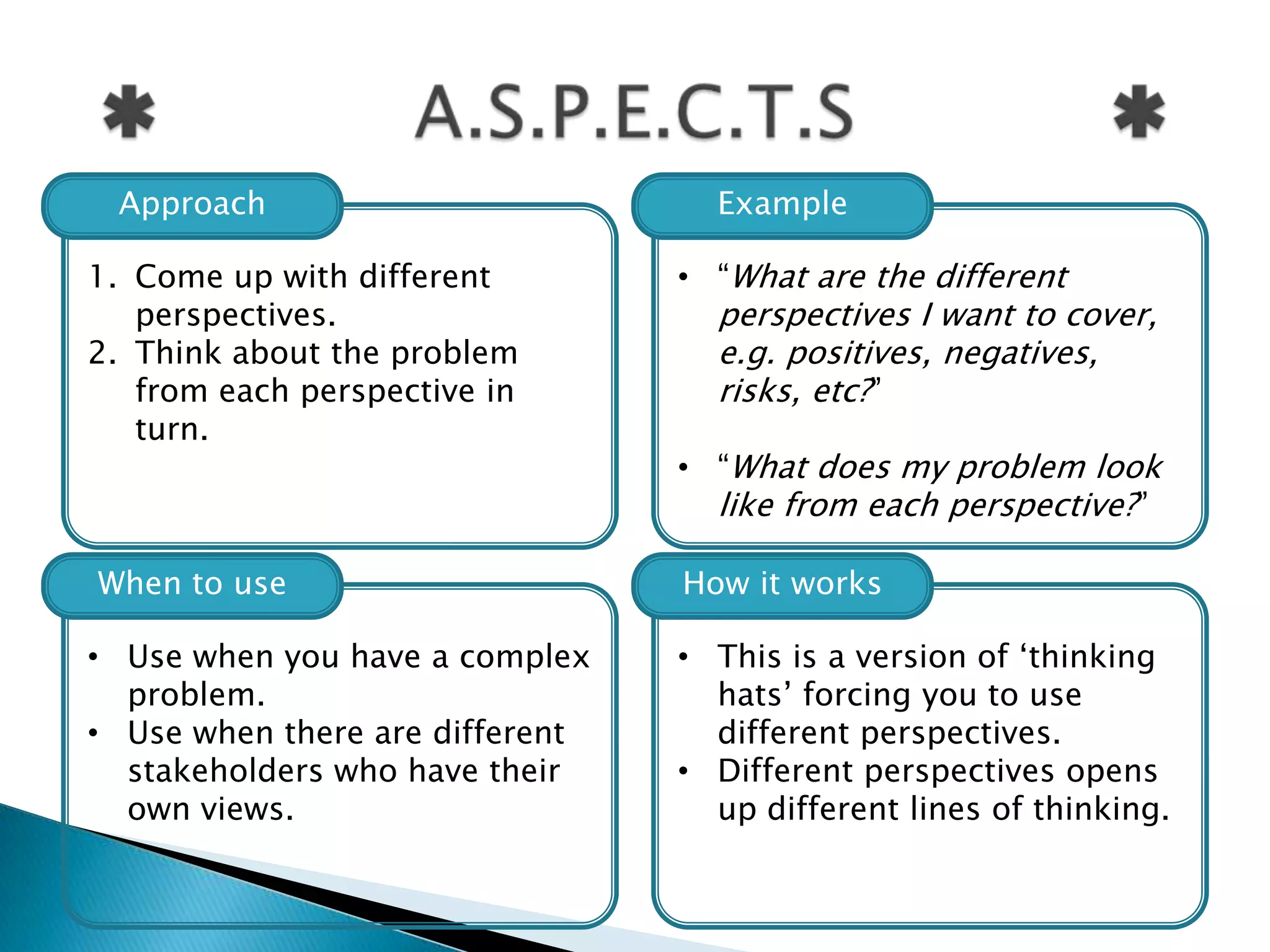
1. Come up with different        • “What are the different
   perspectives.                   perspectives I want to cover,
2. Think about the problem         e.g. positives, negatives,
   from each perspective in        risks, etc?”
   turn.
                                 • “What does my problem look
                                   like from each perspective?”

When to use                      How it works

• Use when you have a complex    • This is a version of „thinking
  problem.                         hats‟ forcing you to use
• Use when there are different     different perspectives.
  stakeholders who have their    • Different perspectives opens
  own views.                       up different lines of thinking.
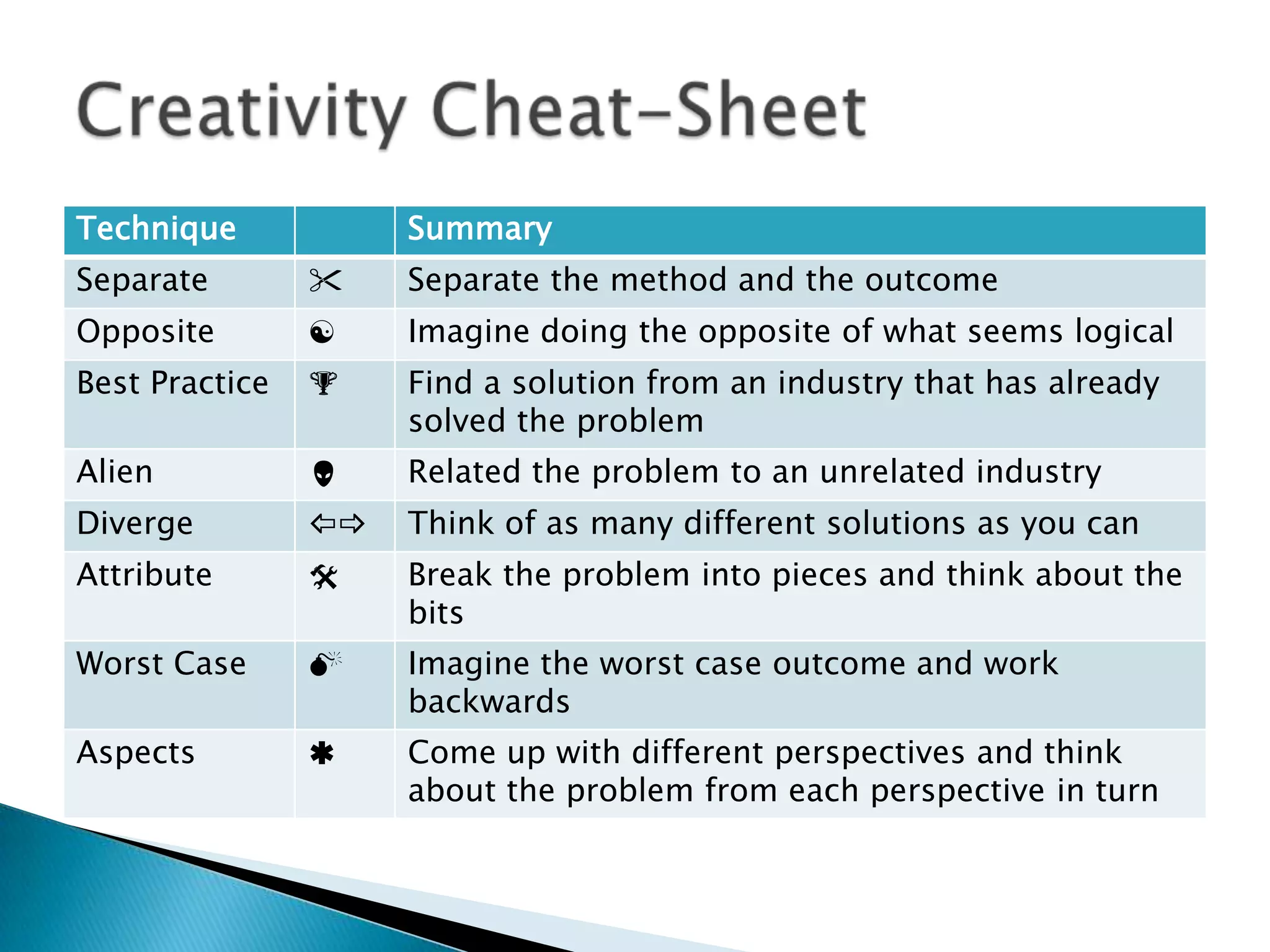
Technique            Summary
Separate            Separate the method and the outcome
Opposite            Imagine doing the opposite of what seems logical
Best Practice       Find a solution from an industry that has already
                     solved the problem
Alien               Related the problem to an unrelated industry
Diverge            Think of as many different solutions as you can
Attribute           Break the problem into pieces and think about the
                     bits
Worst Case          Imagine the worst case outcome and work
                     backwards
Aspects             Come up with different perspectives and think
                     about the problem from each perspective in turn

The creativity tool kit

  • 1.
  • 2.
    Creativity comes froma combination of:  your knowledge (what you know)  your motivation (your need to be creative)  your social environment (acceptance of new ideas)  your creative thinking skills This presentation is intended to help you with your creative thinking skills.
  • 3.
    The basics ofcreative thinking skills  The mixing of different ideas  Taking a different perspective on things  Thinking inside other boxes (rather than „out of the box‟)  Willingness to take risks  Openness to new ideas
  • 4.
    Each slide has a mini-technique. Each mini- technique is designed to stand alone.  Pick the min-technique that best suits the problem you are dealing with.  If one mini-technique doesn‟t work, try another.  Practice in quiet moments.
  • 5.
    Approach Example 1. Separate the outcome from • “I want to achieve result „A‟ the mechanism used to and the way I choose to achieve it. achieve it is mechanism „B‟.” 2. State the current mechanism as a choice. • “Is there any other way I 3. Go find other choices. could choose to do this?” When to use How it works • Use when you know what the • It forces you to separate the desirable outcome is but the desirable (outcome) from current ways of doing things undesirable (the mechanism). seem to be a problem. • If you state the mechanism as a choice it gives you a sense of control.
  • 6.
    Approach Example 1. Think about what would • “What would happen if I did happen if you the opposite of what would 2. Look at possible advantages normally be expected?” from an opposite approach • “What possible benefits are there from an opposite approach to this problem?” When to use How it works • Use when there appears to be • It forces a new perspective on a logical approach but your thinking. experience shows that this is unlikely to work.
  • 7.
    Approach Example 1. Think about an industry that • “What industry deals with this has to deal with a specific type of problem that has to type of issue. get it right: e.g. 2. Look at what they do. • Airlines for quality 3. See what can be used to • Police for crisis response solve your problem. • Formula One racing pit crew for cycle time” When to use How it works • Use this when you have a • It provides access to clearly defined problem that solutions and thinking from you need to solve such as industries that have to get quality, responsiveness or things right. Their thinking cycle time. will probably be very advanced.
  • 8.
    Approach Example 1. Pick a hobby or something • “What could „X‟ tell me about you are interested in and my problem? Where „X‟ could learn about it. be any discipline, e.g. 2. As you learn, relate what you • a type of sport, learn back to the problem • history, you face. • A pastime, or • something else” When to use How it works • Use when problem‟s concepts • It forces you to understand are difficult to find. the concepts to be able to • Use when you seem to come relate them between different up with the same set of fields of knowledge. solutions again and again. • It forces the problem into the back of your mind to prevent repeating the same solutions.
  • 9.
    Approach Example 1. Find as many different ideas • “How many different as you can to the problem. solutions can I come up with 2. Focus on finding as broad a for solving this problem.” range of ideas as possible. • “How many different categories can I put them into?” When to use How it works • You have a problem and you • A large number of ideas don‟t know where to start. ensures you consider different perspectives. • A broad range of ideas gives you more opportunity to mix ideas together. • Is a form of brainstorming
  • 10.
    Approach Example 1. List as many attributes about • “How many attributes can I the problem as you can. find for my problem?” 2. Think about the significance of each attribute as you list • “What does each attribute I them. find tell me about my problem?” When to use How it works • You need to rely on a logical • It forces you to uncover and rational approach. individual attributes about a • You need to think creatively problem. and you don‟t know where to • It allows you to think of each start. attribute in isolation. • Being a methodical approach it reduces the sense of risk.
  • 11.
    Approach Example 1. Come up with a descriptive • “A worst case solution is to worst case solution (avoid do „X‟.” numeric solutions such as cost) • “„Y‟ and „Z‟ are less damaging 2. Work backwards from the than „X‟ so may provide worst case. partial solutions.” When to use How it works • Use when you have a high • Starting with a worst case stakes problem that seems solution puts other solutions impossible to solve. in perspective. • Use when you have difficult • Avoiding a numeric outcome stakeholders. avoids the trap of coming up with numeric half-way house solutions.
  • 12.
    Approach Example 1. Come up with different • “What are the different perspectives. perspectives I want to cover, 2. Think about the problem e.g. positives, negatives, from each perspective in risks, etc?” turn. • “What does my problem look like from each perspective?” When to use How it works • Use when you have a complex • This is a version of „thinking problem. hats‟ forcing you to use • Use when there are different different perspectives. stakeholders who have their • Different perspectives opens own views. up different lines of thinking.
  • 13.
    Technique Summary Separate  Separate the method and the outcome Opposite  Imagine doing the opposite of what seems logical Best Practice  Find a solution from an industry that has already solved the problem Alien  Related the problem to an unrelated industry Diverge  Think of as many different solutions as you can Attribute  Break the problem into pieces and think about the bits Worst Case  Imagine the worst case outcome and work backwards Aspects  Come up with different perspectives and think about the problem from each perspective in turn