Design for Use
getting started with user research & customer development
A Workshop by Nicole capuana
hello!
I WORK ON A BOAT
Defined UX Standards for
Progressive
Built Software Design
Consultancy
Started Usability Program
for Fortune 500 Company
Teach Lean UX to high
schoolers
Lecturer & Contributor to
IOT class at Case Western
Reserve
& Evangelize Balanced Teams
PERFECTING PASTRAMI RECIPE
Design for use@ncapuana
Let’s begin
Design for use@ncapuana
Have you:
• sworn because
you’re so
Frustrated?
• felt you can’t figure
it out?
• wondered if you did
it correctly?
Design for use@ncapuana
Good design starts
with people
Design for use@ncapuana
Human
centered
design
Design for use@ncapuana
when we design
It’s not you or me
we don’t have the answers
Design for use@ncapuana
we talk to people to
find out what they
need and why
Design for use@ncapuana
we get Insight
through empathy
Design for use@ncapuana
it’s not hard
Design for use@ncapuana
it takes
practice
Design for use@ncapuana
Today you’ll get to practice &
learn how to:
• interview
• map your findings
• & create a persona
Design for use@ncapuana
part 1:
interviewing
Design for use@ncapuana
Pretty simple - it’s
asking people questions
It’s not pitching your idea
Design for use@ncapuana
Get out of the building
Go where your users are
Design for use@ncapuana
create a script
It’s meant to guide you & give you consistency.
It’s okay to adapt based on where your conversation with the person goes
Design for use@ncapuana
avoid the woulds
Design for use@ncapuana
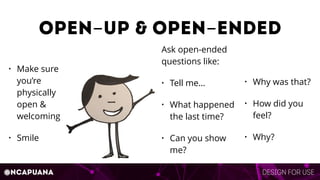
Open-up & Open-ended
• Make sure
you’re
physically
open &
welcoming
• Smile
Ask open-ended
questions like:
• Tell me…
• What happened
the last time?
• Can you show
me?
• Why was that?
• How did you
feel?
• Why?
Design for use@ncapuana
do vs. say
Observe when you can
99% said they
washed their
hands
32% of men and
64% of women
actually did
Design for use@ncapuana
get the stories out
Find out the “why”
Design for use@ncapuana
Listen!
Take notes or record
Design for use@ncapuana
silence will draw
more out
Design for use@ncapuana
Let’s practice
Design for use@ncapuana
Form teams
• Find 3 other people you
DON’T know
• You have 4 minutes to
introduce yourselves and
learn something about
your teammates
Design for use@ncapuana
Today’s challenge:
how might we
help people start
their day?
Design for use@ncapuana
We want to learn
• How do they start their day?
• What’s their goal?
• What do they do from the moment
they wake up until they get to
work?
• Where are opportunities for
improvement or removing friction?
Design for use@ncapuana
5 minutes - draft a script
• Write down questions you want to answer and ask in your
interview - make two copies of the questions.
• Remember to use open-ended questions and to elicit stories
• Avoid “do you like”, “yes/no”, and the “woulds”
Design for use@ncapuana
get ready to interview
• Divide into pairs
• Make sure each pair has a copy of the script
• Determine who will ask the questions and who will take notes for
the 1st interview
• You will switch roles on the 2nd interview
Design for use@ncapuana
interview - 1
• Find another pair
• Decide who will ask the questions and who will be interviewed
• You will have 2 minutes to interview the first candidate
• One person will interview (ask questions) of one person from the other pair
• One person will take notes
If you are interviewing, do not take over the conversation -
you want the person answering your questions to do most of
the talking
Design for use@ncapuana
interview - 2
• Interview second candidate
• Switch who interviews and who takes notes
• You will have 2 minutes to interview
If you are interviewing, do not take over the
conversation - you want the person answering your
questions to do most of the talking
Design for use@ncapuana
Switch
Design for use@ncapuana
interview - 3
• Pair that was interviewed should now interview the other pair
• Decide who will ask the questions and who will be interviewed
• You will have 2 minutes to interview the first candidate
• One person will interview (ask questions) of one person from the other pair
• One person will take notes
If you are interviewing, do not take over the conversation -
you want the person answering your questions to do most of
the talking
Design for use@ncapuana
interview - 4
• Interview second candidate
• Switch who interviews and who takes notes
• You will have 2 minutes to interview
If you are interviewing, do not take over the
conversation - you want the person answering your
questions to do most of the talking
Design for use@ncapuana
do we have time
for 1 more round?
If yes, find another pair and we’ll do another round - 8 minutes total
Design for use@ncapuana
part 2:
mapping findings
Design for use@ncapuana
come back together
Design for use@ncapuana
Discuss as a team what you
learned in your interviews
Design for use@ncapuana
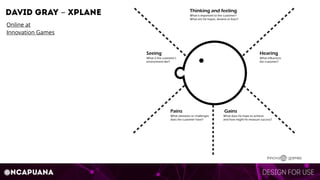
EmPathy Map
• Collaborative tool to develop a user
persona or customer segment (sometimes
it will surface multiple personas)
• Allows teams to quickly distill what they
learned in interviews & observations
• Most useful at the beginning of the design
process
• Feelings & thoughts may have to be
inferred
Design for use@ncapuana
David Gray - XPLANE
Online at
Innovation Games
Design for use@ncapuana
Paul Boag
Adapting
empathy maps
for UX design
Design for use@ncapuana
Map your findings
Write one finding per sticky note and place in
section
• What did you hear? What can be inferred?
• What did your users say?
• What actions and behaviors do your users do?
• What might your users be thinking?
• What emotions might your user be feeling?
• What do your users see and hear?
Design for use@ncapuana
part 3:
define your persona
Design for use@ncapuana
personas
• Guide us in design & development
• Not made up - based off of real people formed through research and
amalgamation of people
• Give insight into goals, behavior and motivations of users
• You can have multiple personas - they just might have differing priorities for
your project
• Refine and adjust your personas as you learn more
• Holistic view of persona beyond the role
Design for use@ncapuana
It’s magic - a persona emerges
At the center of the map:
• Draw a picture of your user
• Give your user a name
• List their goals, pains, and wants
• Create a scenario
• Can you identify any patterns or themes?
• What insights and needs can you identify?
Design for use@ncapuana
show & tell
Design for use@ncapuana
Learn More
Articles
• Three Exercises to Teach Your Team Empathy
• 4 Customer Interview Questions You Should Never Ask
• How Reframing a Problem Unlocks Innovation
• B2B Customer Discovery Interview Questions — A
Master List
• How The Lean Startup Team Practices Customer
Development
Online Tools
• DesignKit by IDEO
• Validation Board by Lean
Startup Machine
• Business Model Canvas and
Value Proposition Canvas by
Strategyzer
Books
• Lean UX by Jeff Gothelf
• Rocket Surgery Made Easy: The Do-It-Yourself Guide
to Finding and Fixing Usability Problems by Steve
Krug
• Universal Methods of Design: 100 Ways to Research
Complex Problems, Develop Innovative Ideas, and
Design Effective Solutions by Bella Martin, Bruce
Hanington
• Four Steps to the Epiphany by Steve Blank
• Value Proposition Design: How to Create Products
and Services Customers Want by Alexander
Osterwalder
• The Innovator's Dilemma: The Revolutionary Book
That Will Change the Way You Do Business by
Clayton M. Christensen

Design for Use - Workshop

  • 1.
    Design for Use gettingstarted with user research & customer development A Workshop by Nicole capuana
  • 2.
  • 3.
    I WORK ONA BOAT
  • 4.
    Defined UX Standardsfor Progressive Built Software Design Consultancy Started Usability Program for Fortune 500 Company Teach Lean UX to high schoolers Lecturer & Contributor to IOT class at Case Western Reserve & Evangelize Balanced Teams
  • 5.
  • 6.
  • 7.
    Design for use@ncapuana Haveyou: • sworn because you’re so Frustrated? • felt you can’t figure it out? • wondered if you did it correctly?
  • 8.
    Design for use@ncapuana Gooddesign starts with people
  • 9.
  • 10.
    Design for use@ncapuana whenwe design It’s not you or me we don’t have the answers
  • 11.
    Design for use@ncapuana wetalk to people to find out what they need and why
  • 12.
    Design for use@ncapuana weget Insight through empathy
  • 13.
  • 14.
  • 15.
    Design for use@ncapuana Todayyou’ll get to practice & learn how to: • interview • map your findings • & create a persona
  • 16.
  • 17.
    Design for use@ncapuana Prettysimple - it’s asking people questions It’s not pitching your idea
  • 18.
    Design for use@ncapuana Getout of the building Go where your users are
  • 19.
    Design for use@ncapuana createa script It’s meant to guide you & give you consistency. It’s okay to adapt based on where your conversation with the person goes
  • 20.
  • 21.
    Design for use@ncapuana Open-up& Open-ended • Make sure you’re physically open & welcoming • Smile Ask open-ended questions like: • Tell me… • What happened the last time? • Can you show me? • Why was that? • How did you feel? • Why?
  • 22.
    Design for use@ncapuana dovs. say Observe when you can 99% said they washed their hands 32% of men and 64% of women actually did
  • 23.
    Design for use@ncapuana getthe stories out Find out the “why”
  • 24.
  • 25.
  • 26.
  • 27.
    Design for use@ncapuana Formteams • Find 3 other people you DON’T know • You have 4 minutes to introduce yourselves and learn something about your teammates
  • 28.
    Design for use@ncapuana Today’schallenge: how might we help people start their day?
  • 29.
    Design for use@ncapuana Wewant to learn • How do they start their day? • What’s their goal? • What do they do from the moment they wake up until they get to work? • Where are opportunities for improvement or removing friction?
  • 30.
    Design for use@ncapuana 5minutes - draft a script • Write down questions you want to answer and ask in your interview - make two copies of the questions. • Remember to use open-ended questions and to elicit stories • Avoid “do you like”, “yes/no”, and the “woulds”
  • 31.
    Design for use@ncapuana getready to interview • Divide into pairs • Make sure each pair has a copy of the script • Determine who will ask the questions and who will take notes for the 1st interview • You will switch roles on the 2nd interview
  • 32.
    Design for use@ncapuana interview- 1 • Find another pair • Decide who will ask the questions and who will be interviewed • You will have 2 minutes to interview the first candidate • One person will interview (ask questions) of one person from the other pair • One person will take notes If you are interviewing, do not take over the conversation - you want the person answering your questions to do most of the talking
  • 33.
    Design for use@ncapuana interview- 2 • Interview second candidate • Switch who interviews and who takes notes • You will have 2 minutes to interview If you are interviewing, do not take over the conversation - you want the person answering your questions to do most of the talking
  • 34.
  • 35.
    Design for use@ncapuana interview- 3 • Pair that was interviewed should now interview the other pair • Decide who will ask the questions and who will be interviewed • You will have 2 minutes to interview the first candidate • One person will interview (ask questions) of one person from the other pair • One person will take notes If you are interviewing, do not take over the conversation - you want the person answering your questions to do most of the talking
  • 36.
    Design for use@ncapuana interview- 4 • Interview second candidate • Switch who interviews and who takes notes • You will have 2 minutes to interview If you are interviewing, do not take over the conversation - you want the person answering your questions to do most of the talking
  • 37.
    Design for use@ncapuana dowe have time for 1 more round? If yes, find another pair and we’ll do another round - 8 minutes total
  • 38.
    Design for use@ncapuana part2: mapping findings
  • 39.
  • 40.
    Design for use@ncapuana Discussas a team what you learned in your interviews
  • 41.
    Design for use@ncapuana EmPathyMap • Collaborative tool to develop a user persona or customer segment (sometimes it will surface multiple personas) • Allows teams to quickly distill what they learned in interviews & observations • Most useful at the beginning of the design process • Feelings & thoughts may have to be inferred
  • 42.
    Design for use@ncapuana DavidGray - XPLANE Online at Innovation Games
  • 43.
    Design for use@ncapuana PaulBoag Adapting empathy maps for UX design
  • 44.
    Design for use@ncapuana Mapyour findings Write one finding per sticky note and place in section • What did you hear? What can be inferred? • What did your users say? • What actions and behaviors do your users do? • What might your users be thinking? • What emotions might your user be feeling? • What do your users see and hear?
  • 45.
    Design for use@ncapuana part3: define your persona
  • 46.
    Design for use@ncapuana personas •Guide us in design & development • Not made up - based off of real people formed through research and amalgamation of people • Give insight into goals, behavior and motivations of users • You can have multiple personas - they just might have differing priorities for your project • Refine and adjust your personas as you learn more • Holistic view of persona beyond the role
  • 47.
    Design for use@ncapuana It’smagic - a persona emerges At the center of the map: • Draw a picture of your user • Give your user a name • List their goals, pains, and wants • Create a scenario • Can you identify any patterns or themes? • What insights and needs can you identify?
  • 48.
  • 49.
    Design for use@ncapuana LearnMore Articles • Three Exercises to Teach Your Team Empathy • 4 Customer Interview Questions You Should Never Ask • How Reframing a Problem Unlocks Innovation • B2B Customer Discovery Interview Questions — A Master List • How The Lean Startup Team Practices Customer Development Online Tools • DesignKit by IDEO • Validation Board by Lean Startup Machine • Business Model Canvas and Value Proposition Canvas by Strategyzer Books • Lean UX by Jeff Gothelf • Rocket Surgery Made Easy: The Do-It-Yourself Guide to Finding and Fixing Usability Problems by Steve Krug • Universal Methods of Design: 100 Ways to Research Complex Problems, Develop Innovative Ideas, and Design Effective Solutions by Bella Martin, Bruce Hanington • Four Steps to the Epiphany by Steve Blank • Value Proposition Design: How to Create Products and Services Customers Want by Alexander Osterwalder • The Innovator's Dilemma: The Revolutionary Book That Will Change the Way You Do Business by Clayton M. Christensen