LEAN UX WORKSHOP
“A guide to your first prototype”
BARCELONA JULY ‘16
@harriken
Jose Berengueres
Berengueres | 2
Outline
1. What is Lean UX?
2. Prototype vs. MVP
3. Types of Prototypes
4. Examples of MVPs
5. Further reading
6. Workshop time!
Berengueres | 3
1. What is Lean UX?
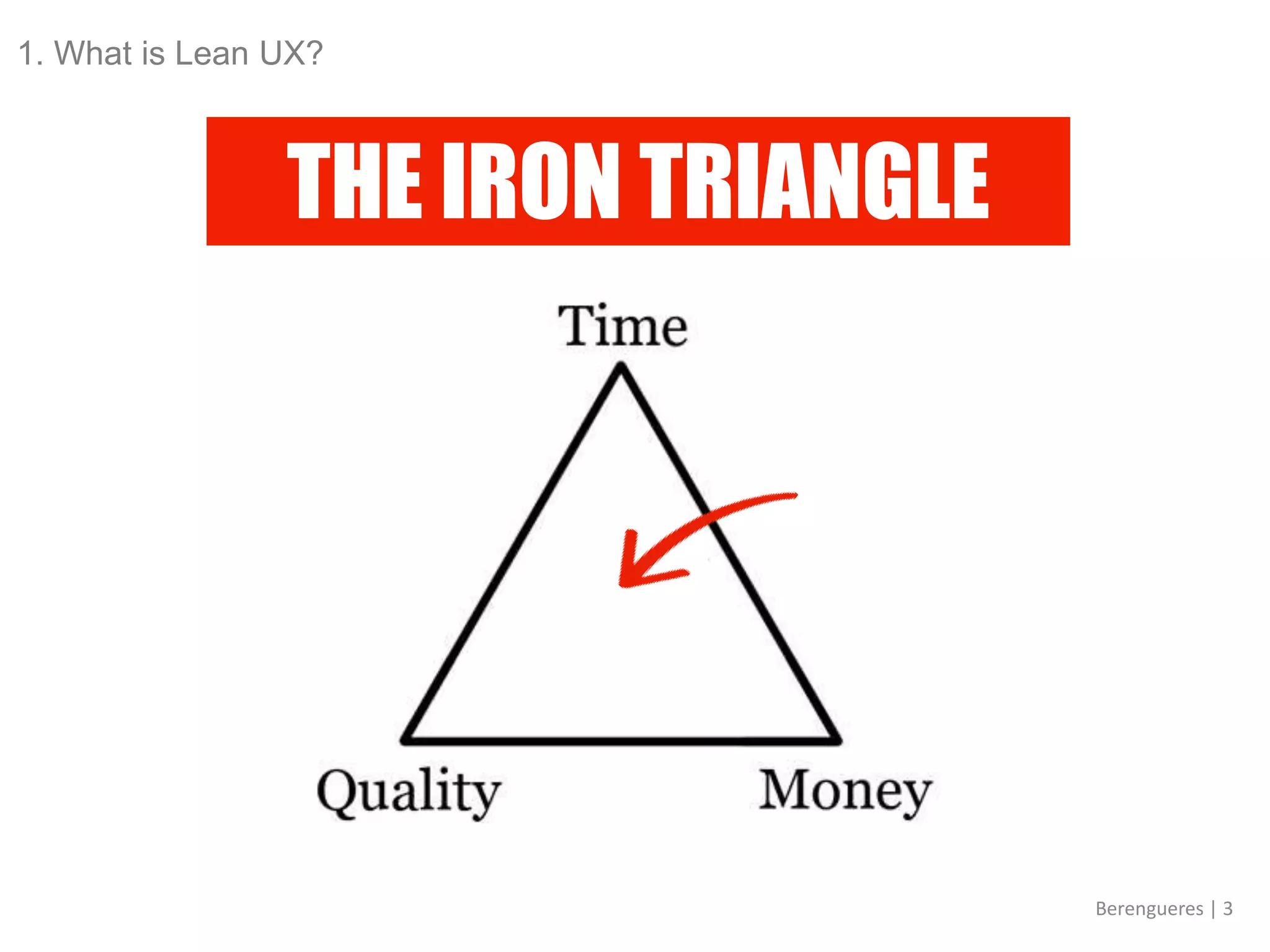
THE IRON TRIANGLE
Berengueres | 4
1. What is Lean UX?
LEAN UX minimize
time not money
Berengueres | 5
1. What is Lean UX?
Quality/Success
Number of Iterations
Berengueres | 6
1. What is Lean UX?
LEAN UX minimize
time by making
iteration cycle faster
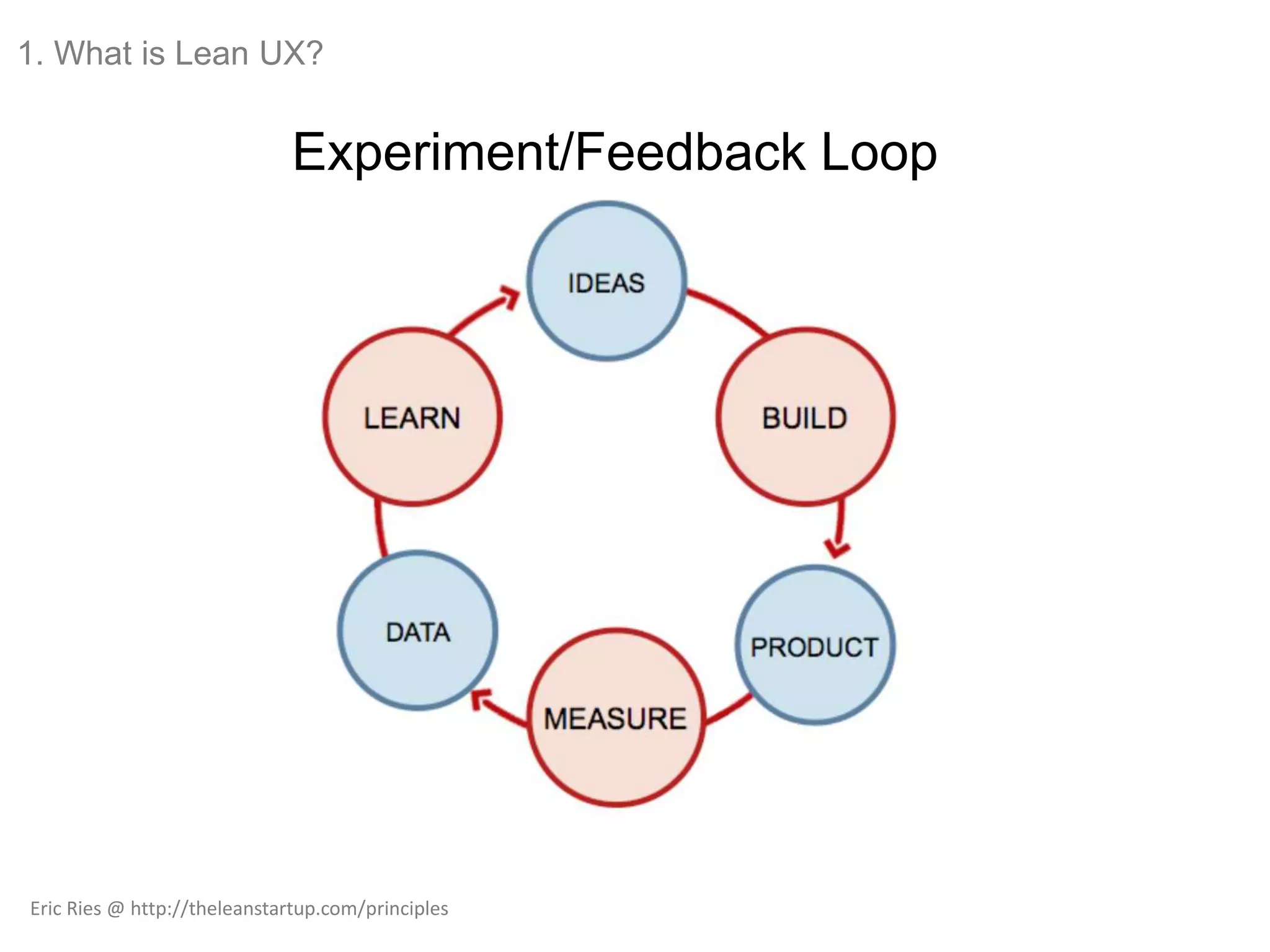
Eric Ries @ http://theleanstartup.com/principles
Experiment/Feedback Loop
1. What is Lean UX?
Berengueres | 8
Outline
1. What is Lean UX?
2. Prototype vs. MVP
3. Types of Prototypes
4. Examples of MVPs
5. Further reading
6. Workshop time!
2. Prototype vs. MVP
Prototype vs MVP
A Prototype’s goal is to test
product design or technical hypotheses.
An MVP’s goal is to test business hypotheses
as well as product design or technical hypotheses.
Berengueres | 10
2. Prototype vs. MVP
@boagworld
2. Prototype vs. MVP
HOW WOULD YOU BUILD A CAR?
A
B
2. Prototype vs. MVP
Work Work
feed-back point
Risk
Berengueres | 13
Outline
1. What is Lean UX?
2. Prototype vs. MVP
3. Types of Prototypes
4. Examples of MVPs
5. Further reading
6. Workshop time!
Paper
Prototypes
Tools often used:
● Paper
● Pen
● Markers
Example Here
3. Types of Prototypes
Paper prototypes are best for
• Producing tangible ideas from abstract ideas
• Preliminary team discussions
• Drafting layouts and flows
3. Types of Prototypes
Low Fidelity
Prototypes
Tools often used:
● Balsamiq
● Axure
3. Types of Prototypes
Low fidelity prototypes are best for
• Content driven
• Focuses on layouts and flows
• Free from arguments related to aesthetic values like
colors, typography, illustrations, images.
3. Types of Prototypes
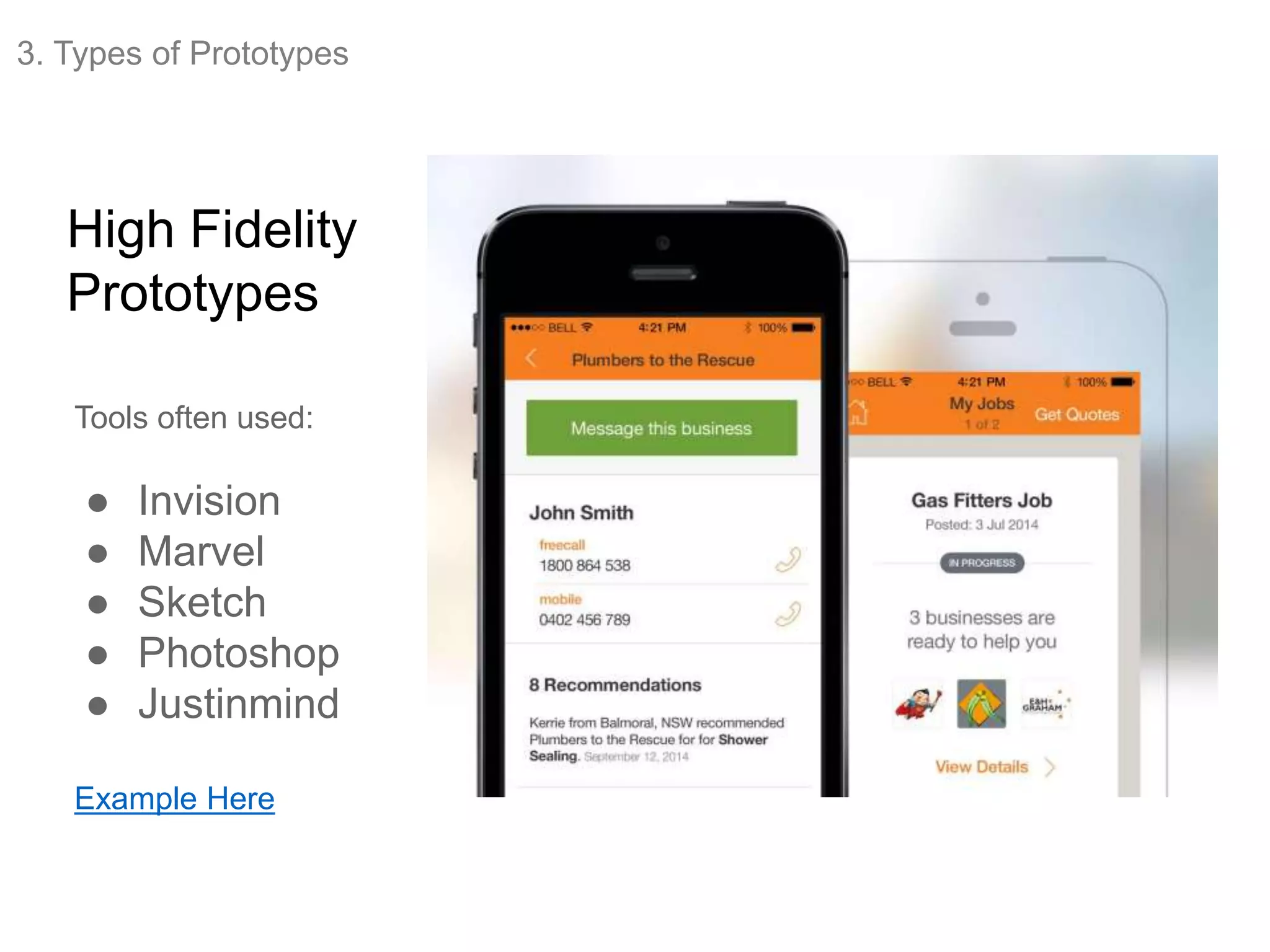
High Fidelity
Prototypes
Tools often used:
● Invision
● Marvel
● Sketch
● Photoshop
● Justinmind
Example Here
3. Types of Prototypes
High fidelity prototypes are best for:
• Content driven
• Focuses on layouts and flows
• Represents the look and feel of the real product
• Can be used for user research
3. Types of Prototypes
Functional Prototypes
Tools often used:
● App Inventor
● Origami
● Framer
● Twitter Bootstrap
● HTML & CSS or more
3. Types of Prototypes
Functional prototypes are best for
• Content driven
• Focuses on layouts and flows
• Represents the look and feel as well as the actual
experience of the product
• Best for user research
3. Types of Prototypes
Key Takeaways
• Different types of prototypes with their own usecase
• Prototypes are meant for iterations and progressions.
for e.g. sketching to low fidelity prototype to high fidelity
prototype to functional prototypes
• Testing technical hypotheses
3. Types of Prototypes
Berengueres | 23
Outline
1. What is Lean UX?
2. Prototype vs. MVP
3. Types of Prototypes
4. Examples of MVPs
5. Further reading
6. Workshop time!
4. Examples of MVPs
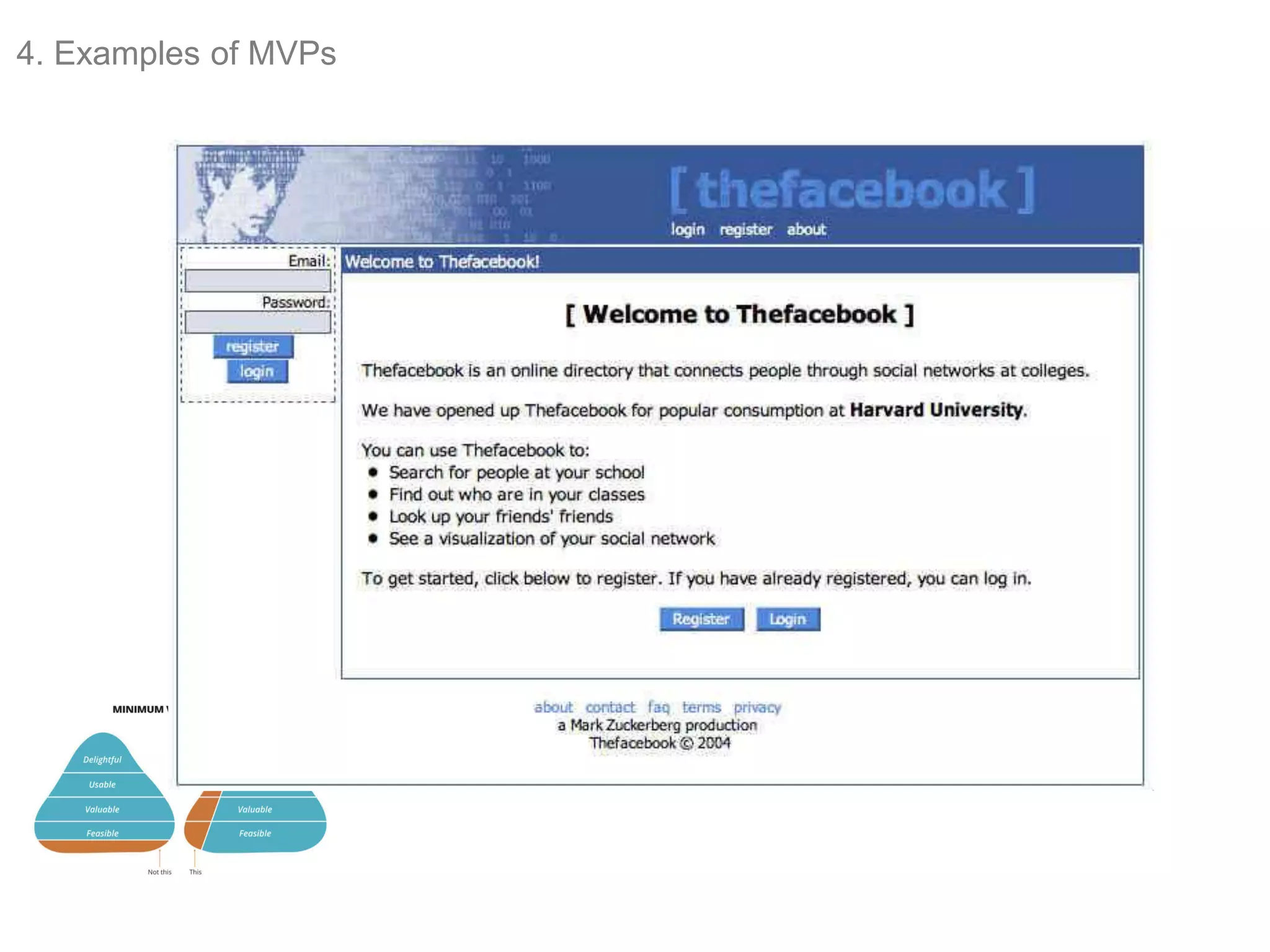
4. Examples of MVPs – Blog first groupon
4. Examples of MVPs – Hackernews video
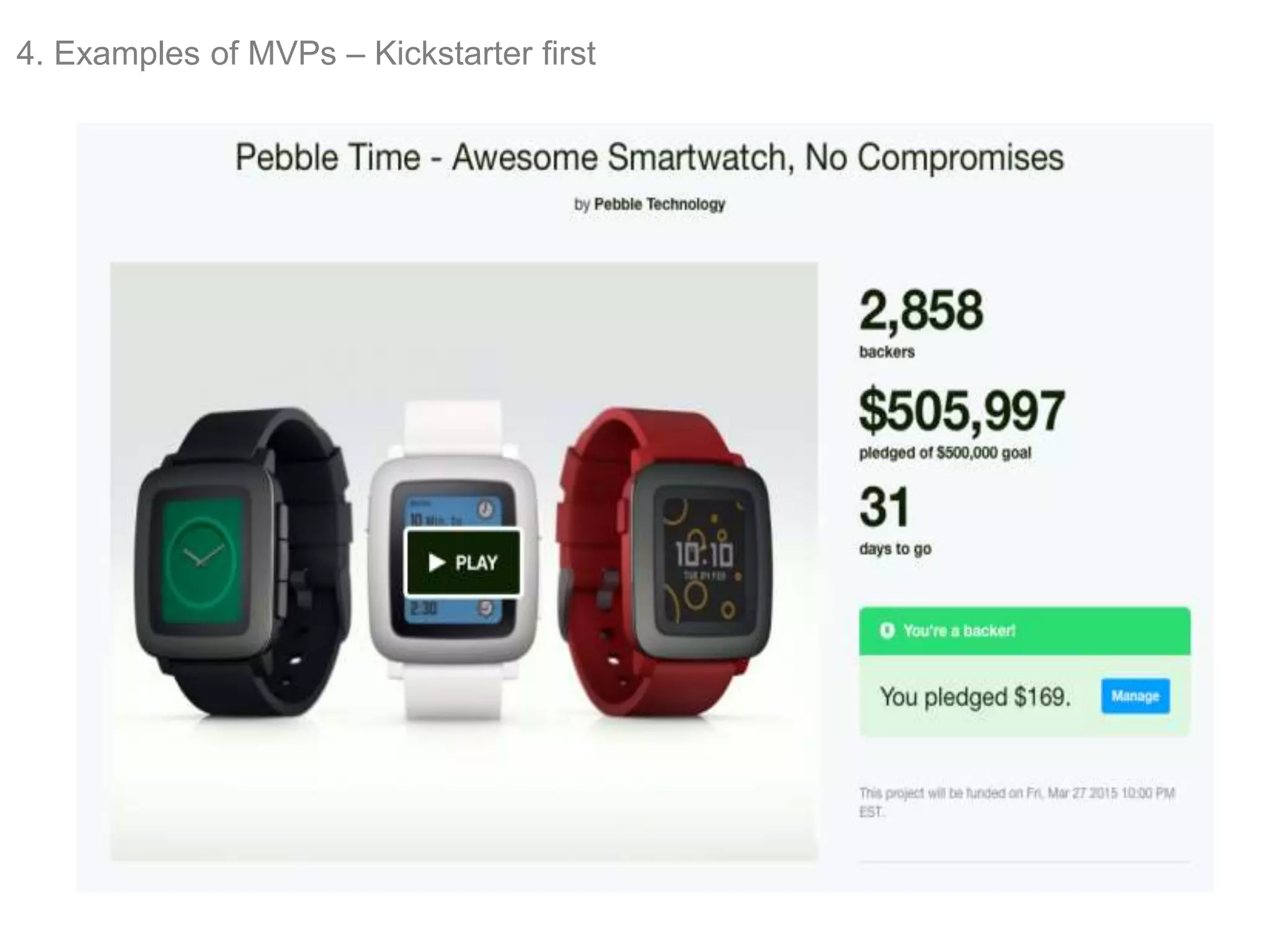
4. Examples of MVPs – Kickstarter first
4. Examples of MVPs – Craig’s List first
Key Takeaways
• An MVP is the first version of your idea intended to communicate value to
your target users or customers
• Almost anything can be an MVP as long as it can prove your idea to be a
viable business opportunity
• It’s absolutely normal for your MVP to suck
• The MVP should be a way to learn more about your users and the
problem you’re trying to solve
4. Examples of MVPs
4. Examples of MVPs - Palm
eff Hawkin’s Palm Pilot Prototype
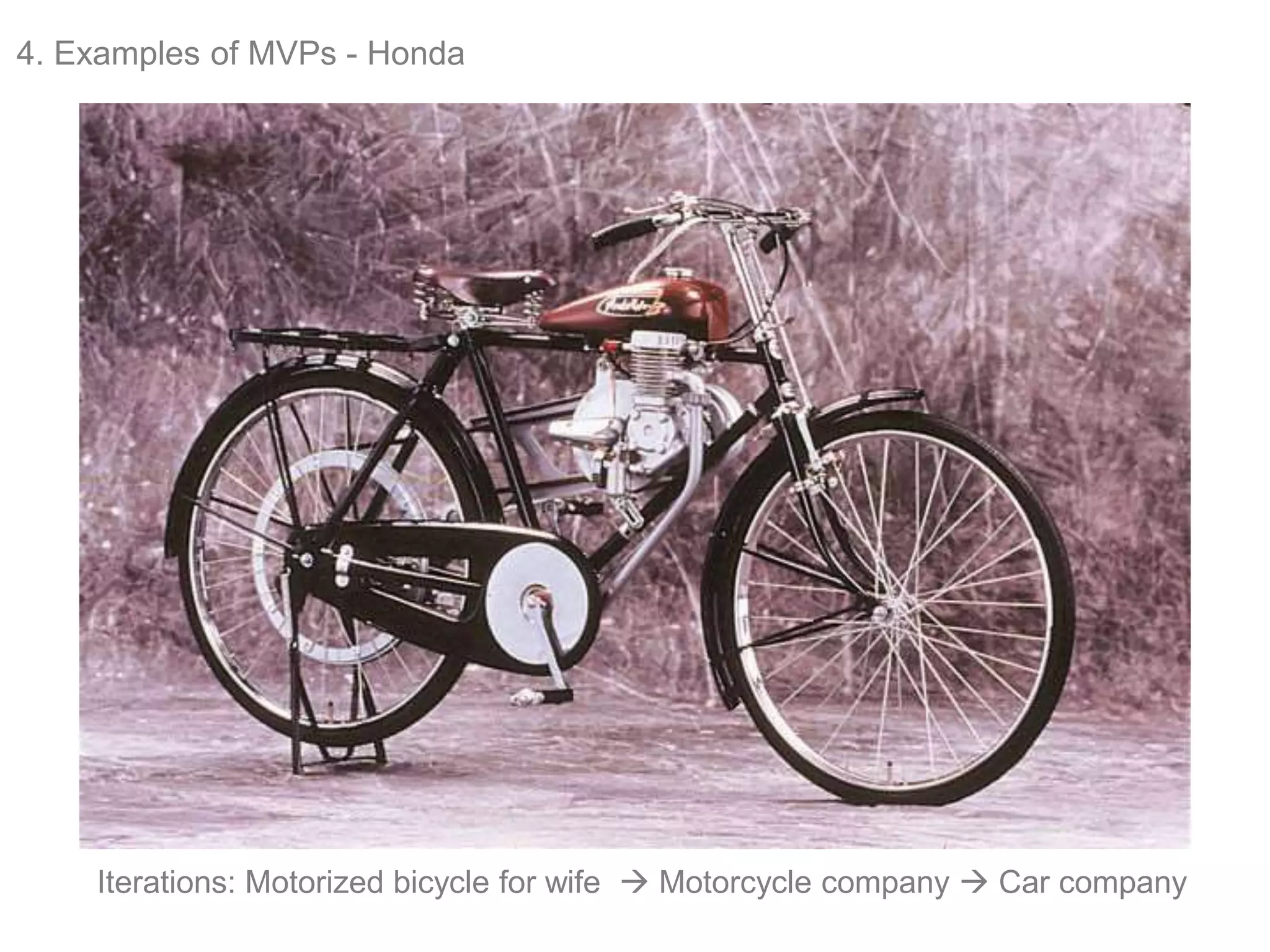
4. Examples of MVPs - Honda
Iterations: Motorized bicycle for wife  Motorcycle company  Car company
4. Examples of (non) MVPs – Toyota type AA
First iteration: Luxury car “AA” (3 years to make the engine)  epic fail
Berengueres | 34
1. What is Lean UX?
And now, the prototyping
session
Get your hands dirty
6. Workshop time
Before the Prototype, there is the Business Model
https://github.com/rodw/paper-forms/blob/master/lean-canvas/lean-canvas.pdf?raw=true
Before the Prototype, there is the Business Model
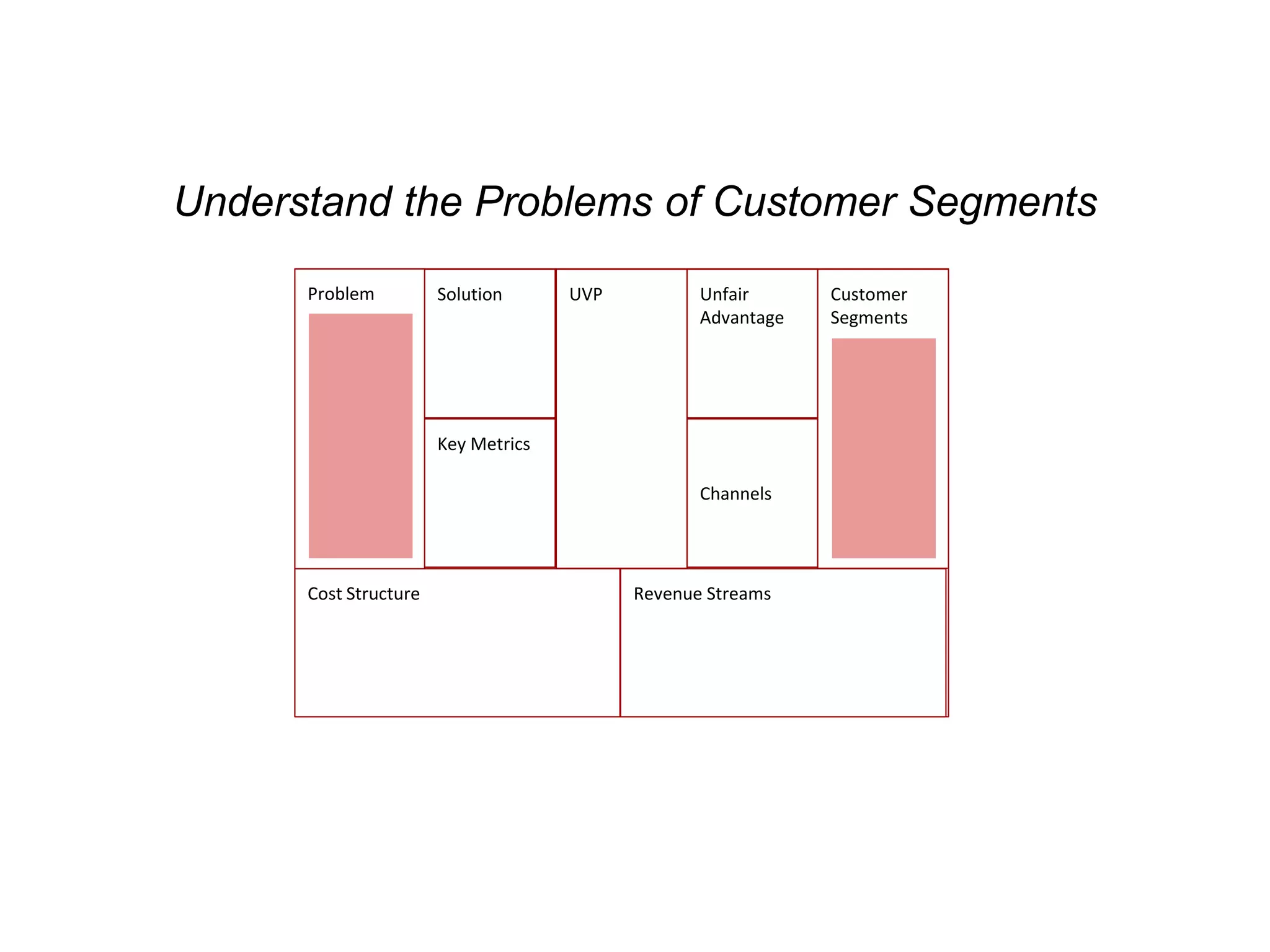
Understand the Problems of Customer Segments
Problem
Revenue Streams
UVP Unfair
Advantage
Customer
Segments
Channels
Solution
Key Metrics
Cost Structure
Problem
Revenue Streams
UVP Unfair
Advantage
Customer
Segments
Channels
Solution
Key Metrics
Cost Structure
Define the Solution and Unique Value Proposition
• Bachelors who are university students and
professionals
• Age 20 to 35
• Primarily expatriates
• Do not own cars
Customer Segment
• Don’t know who to call or where to find affordable
places
• Difficulty in knowing whether a roommate is the right fit
• Don’t know if the neighborhood has all the necessary
facilities nearby (including supermarkets, hospitals,
public transport)
Problems
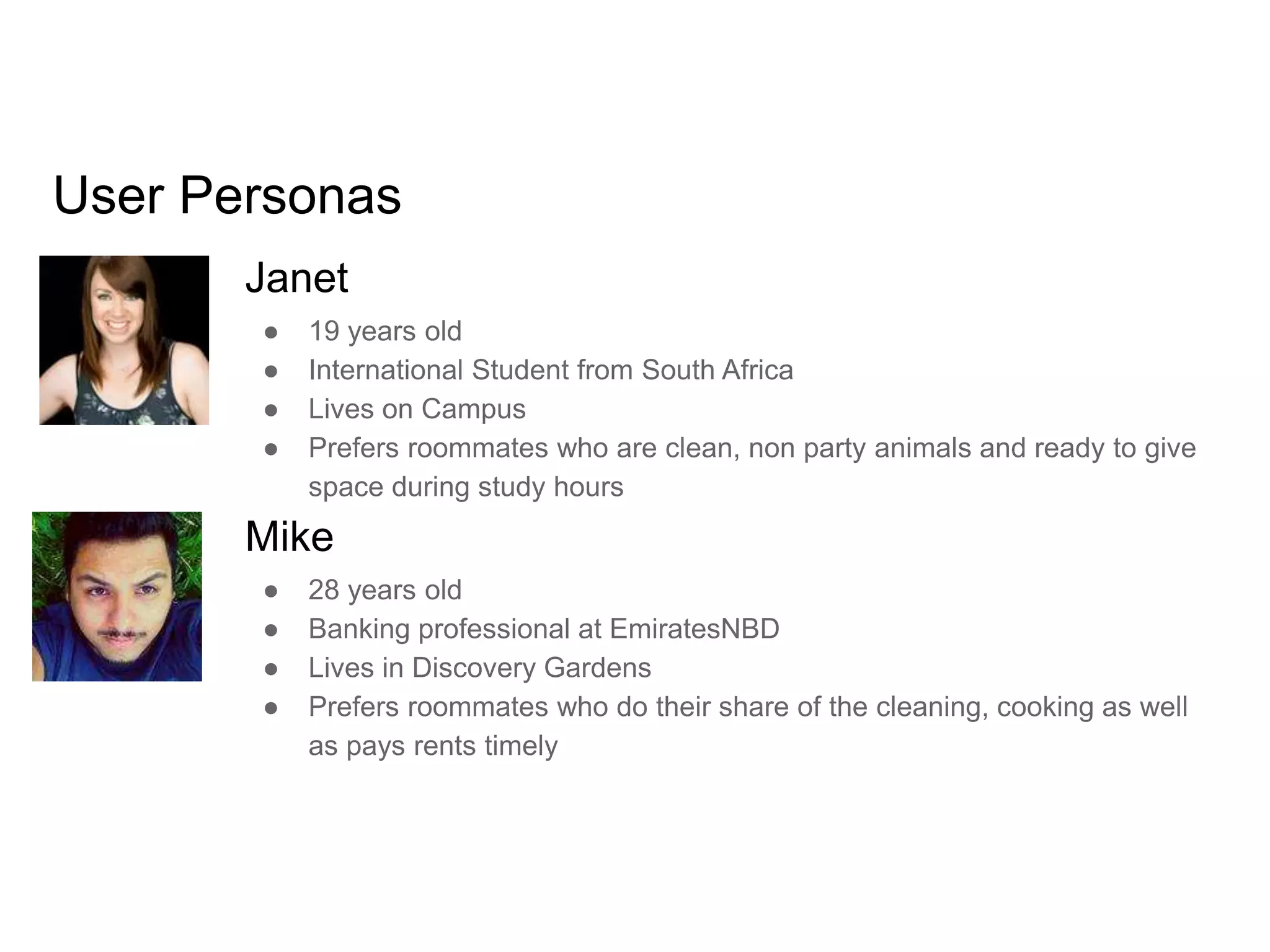
User Personas
Janet
● 19 years old
● International Student from South Africa
● Lives on Campus
● Prefers roommates who are clean, non party animals and ready to give
space during study hours
Mike
● 28 years old
● Banking professional at EmiratesNBD
● Lives in Discovery Gardens
● Prefers roommates who do their share of the cleaning, cooking as well
as pays rents timely
Map the User Journey (number the steps, story)
& draw the UVP
Group - 15 minutes
Sketch Your App
Individual - 15
minutes
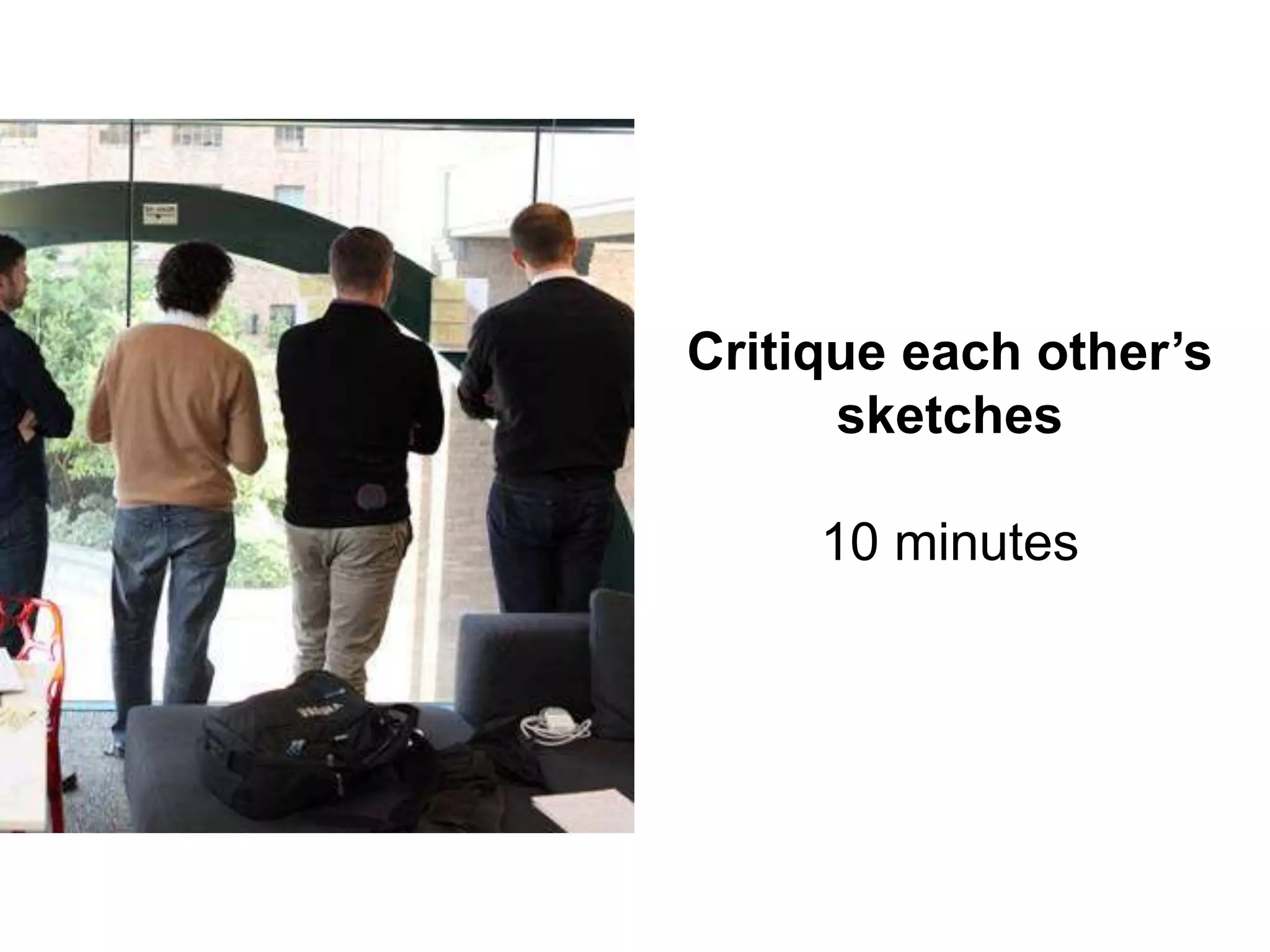
Critique each other’s
sketches
10 minutes
Pool best ideas from sketches into
one final version then use Marvel to prototype
Group - 20 minutes
So what next?
Depending on your level of confidence:
• Start with a low fidelity prototype - useful if you’re
working with a team of developers and a designer who
can convert to high fidelity
• Or skip to high fidelity prototype - useful if you’re skilled
in Sketch or Photoshop to create a glimpse of the look
and feel
• Or skip to functional prototype if you have mapped out
all the use cases thoroughly.
Berengueres | 48
8. Acknowledgement (original presentation adapted from)
Ashiqur Rahman
ar@inov.io

Lean UX workshop @ Makers of Barcelona (MOB) + Agile BCN Meetup

  • 1.
    LEAN UX WORKSHOP “Aguide to your first prototype” BARCELONA JULY ‘16 @harriken Jose Berengueres
  • 2.
    Berengueres | 2 Outline 1.What is Lean UX? 2. Prototype vs. MVP 3. Types of Prototypes 4. Examples of MVPs 5. Further reading 6. Workshop time!
  • 3.
    Berengueres | 3 1.What is Lean UX? THE IRON TRIANGLE
  • 4.
    Berengueres | 4 1.What is Lean UX? LEAN UX minimize time not money
  • 5.
    Berengueres | 5 1.What is Lean UX? Quality/Success Number of Iterations
  • 6.
    Berengueres | 6 1.What is Lean UX? LEAN UX minimize time by making iteration cycle faster
  • 7.
    Eric Ries @http://theleanstartup.com/principles Experiment/Feedback Loop 1. What is Lean UX?
  • 8.
    Berengueres | 8 Outline 1.What is Lean UX? 2. Prototype vs. MVP 3. Types of Prototypes 4. Examples of MVPs 5. Further reading 6. Workshop time!
  • 9.
    2. Prototype vs.MVP Prototype vs MVP A Prototype’s goal is to test product design or technical hypotheses. An MVP’s goal is to test business hypotheses as well as product design or technical hypotheses.
  • 10.
    Berengueres | 10 2.Prototype vs. MVP @boagworld
  • 11.
    2. Prototype vs.MVP HOW WOULD YOU BUILD A CAR? A B
  • 12.
    2. Prototype vs.MVP Work Work feed-back point Risk
  • 13.
    Berengueres | 13 Outline 1.What is Lean UX? 2. Prototype vs. MVP 3. Types of Prototypes 4. Examples of MVPs 5. Further reading 6. Workshop time!
  • 14.
    Paper Prototypes Tools often used: ●Paper ● Pen ● Markers Example Here 3. Types of Prototypes
  • 15.
    Paper prototypes arebest for • Producing tangible ideas from abstract ideas • Preliminary team discussions • Drafting layouts and flows 3. Types of Prototypes
  • 16.
    Low Fidelity Prototypes Tools oftenused: ● Balsamiq ● Axure 3. Types of Prototypes
  • 17.
    Low fidelity prototypesare best for • Content driven • Focuses on layouts and flows • Free from arguments related to aesthetic values like colors, typography, illustrations, images. 3. Types of Prototypes
  • 18.
    High Fidelity Prototypes Tools oftenused: ● Invision ● Marvel ● Sketch ● Photoshop ● Justinmind Example Here 3. Types of Prototypes
  • 19.
    High fidelity prototypesare best for: • Content driven • Focuses on layouts and flows • Represents the look and feel of the real product • Can be used for user research 3. Types of Prototypes
  • 20.
    Functional Prototypes Tools oftenused: ● App Inventor ● Origami ● Framer ● Twitter Bootstrap ● HTML & CSS or more 3. Types of Prototypes
  • 21.
    Functional prototypes arebest for • Content driven • Focuses on layouts and flows • Represents the look and feel as well as the actual experience of the product • Best for user research 3. Types of Prototypes
  • 22.
    Key Takeaways • Differenttypes of prototypes with their own usecase • Prototypes are meant for iterations and progressions. for e.g. sketching to low fidelity prototype to high fidelity prototype to functional prototypes • Testing technical hypotheses 3. Types of Prototypes
  • 23.
    Berengueres | 23 Outline 1.What is Lean UX? 2. Prototype vs. MVP 3. Types of Prototypes 4. Examples of MVPs 5. Further reading 6. Workshop time!
  • 24.
  • 25.
    4. Examples ofMVPs – Blog first groupon
  • 26.
    4. Examples ofMVPs – Hackernews video
  • 27.
    4. Examples ofMVPs – Kickstarter first
  • 28.
    4. Examples ofMVPs – Craig’s List first
  • 29.
    Key Takeaways • AnMVP is the first version of your idea intended to communicate value to your target users or customers • Almost anything can be an MVP as long as it can prove your idea to be a viable business opportunity • It’s absolutely normal for your MVP to suck • The MVP should be a way to learn more about your users and the problem you’re trying to solve 4. Examples of MVPs
  • 30.
    4. Examples ofMVPs - Palm
  • 31.
    4. Examples ofMVPs - Palm eff Hawkin’s Palm Pilot Prototype
  • 32.
    4. Examples ofMVPs - Honda Iterations: Motorized bicycle for wife  Motorcycle company  Car company
  • 33.
    4. Examples of(non) MVPs – Toyota type AA First iteration: Luxury car “AA” (3 years to make the engine)  epic fail
  • 34.
    Berengueres | 34 1.What is Lean UX?
  • 35.
    And now, theprototyping session Get your hands dirty 6. Workshop time
  • 36.
    Before the Prototype,there is the Business Model https://github.com/rodw/paper-forms/blob/master/lean-canvas/lean-canvas.pdf?raw=true
  • 37.
    Before the Prototype,there is the Business Model
  • 38.
    Understand the Problemsof Customer Segments Problem Revenue Streams UVP Unfair Advantage Customer Segments Channels Solution Key Metrics Cost Structure
  • 39.
    Problem Revenue Streams UVP Unfair Advantage Customer Segments Channels Solution KeyMetrics Cost Structure Define the Solution and Unique Value Proposition
  • 40.
    • Bachelors whoare university students and professionals • Age 20 to 35 • Primarily expatriates • Do not own cars Customer Segment
  • 41.
    • Don’t knowwho to call or where to find affordable places • Difficulty in knowing whether a roommate is the right fit • Don’t know if the neighborhood has all the necessary facilities nearby (including supermarkets, hospitals, public transport) Problems
  • 42.
    User Personas Janet ● 19years old ● International Student from South Africa ● Lives on Campus ● Prefers roommates who are clean, non party animals and ready to give space during study hours Mike ● 28 years old ● Banking professional at EmiratesNBD ● Lives in Discovery Gardens ● Prefers roommates who do their share of the cleaning, cooking as well as pays rents timely
  • 43.
    Map the UserJourney (number the steps, story) & draw the UVP Group - 15 minutes
  • 44.
  • 45.
  • 46.
    Pool best ideasfrom sketches into one final version then use Marvel to prototype Group - 20 minutes
  • 47.
    So what next? Dependingon your level of confidence: • Start with a low fidelity prototype - useful if you’re working with a team of developers and a designer who can convert to high fidelity • Or skip to high fidelity prototype - useful if you’re skilled in Sketch or Photoshop to create a glimpse of the look and feel • Or skip to functional prototype if you have mapped out all the use cases thoroughly.
  • 48.
    Berengueres | 48 8.Acknowledgement (original presentation adapted from) Ashiqur Rahman ar@inov.io

Editor's Notes

  • #4 There are 3 ingredients for a project’s success (or life). What is the Area under the triangle? = Success What is the most important? Correct answer: Time (and timing). Of the three time is the only one no one can control. It never stops. You can (somehow) control quality and the money (rise funds). But timing, timing is everything.
  • #6 Other methodologies based on minimizing dev time are : design thinking, Toyota Production System, Human Centered Design and Agile
  • #7 What is the most important? Correct answer: Time (and timing). Of the three time is the only one no one can control. It never stops. You can (somehow) control quality and the money (rise funds). But timing, timing is everything.
  • #8 Note that in Agile the Build is replaced by CODE, product by prototype. Hago una web, eso no es un producto, hago una web, hago spam doy una charla y contrato google ads, eso es un producto.
  • #11 The famous Maslow pyramid applied to Lean UX. A minimum viable product doesn't mean half finished. It's doing small number of things to a high standard. @boagworld
  • #13 Divergence, North.
  • #15 Add some examples
  • #19 Add some examples
  • #25 The Half Baked Facebook
  • #26 Blog-first Groupon
  • #27 Videos Dropbox at hackernews
  • #28  Pebbl Crowdfunded e
  • #29 Airbnb
  • #32 Jeff Hawkin’s Palm Pilot Prototype
  • #33 Bicyle  Moto  Car http://world.honda.com/history/limitlessdreams/joyofmanufacturing/
  • #34 A bad example. http://world.honda.com/history/limitlessdreams/joyofmanufacturing/
  • #35 What is the most important? Correct answer: Time (and timing). Of the three time is the only one no one can control. It never stops. You can (somehow) control quality and the money (rise funds). But timing, timing is everything.
  • #39 Its better to have 10% of a segement thant to have 0.5% of all segements. – Peter Thiel. IKEA Illustrative case.
  • #44 Number the steps