UX/UI Architecture
Session
March 13 2019
1
Agenda
• Unpacking UX and UI
• Human Centric Design
• Let’s make it Real
• Templates & Resources
• Appendix
2
Unpacking UX and UI
3
Tell me about a product you
4
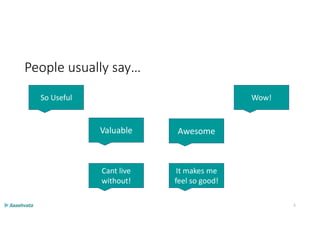
People usually say…
So Useful
Valuable
Cant live
without!
Wow!
Awesome
It makes me
feel so good!
5
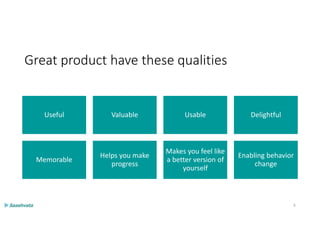
Great product have these qualities
Useful Valuable Usable Delightful
Memorable
Helps you make
progress
Makes you feel like
a better version of
yourself
Enabling behavior
change
6
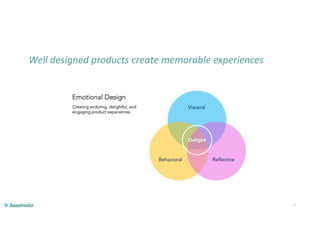
Well designed products create memorable experiences
7
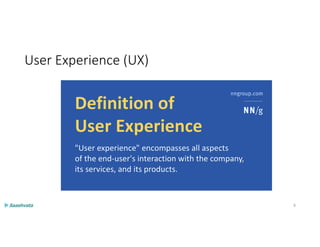
User Experience (UX)
8
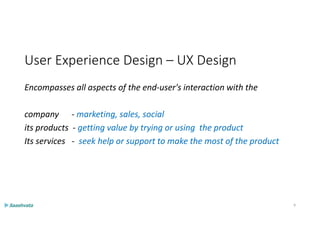
User Experience Design – UX Design
Encompasses all aspects of the end-user's interaction with the
company - marketing, sales, social
its products - getting value by trying or using the product
Its services - seek help or support to make the most of the product
9
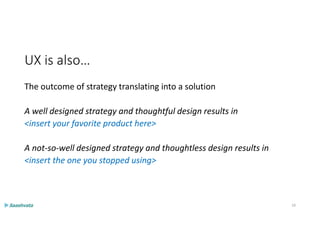
UX is also…
The outcome of strategy translating into a solution
A well designed strategy and thoughtful design results in
<insert your favorite product here>
A not-so-well designed strategy and thoughtless design results in
<insert the one you stopped using>
10
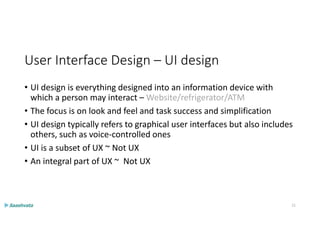
User Interface Design – UI design
• UI design is everything designed into an information device with
which a person may interact – Website/refrigerator/ATM
• The focus is on look and feel and task success and simplification
• UI design typically refers to graphical user interfaces but also includes
others, such as voice-controlled ones
• UI is a subset of UX ~ Not UX
• An integral part of UX ~ Not UX
11
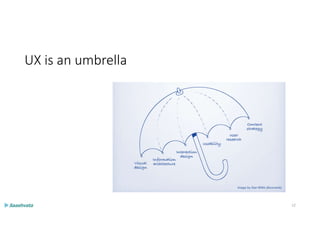
UX is an umbrella
12
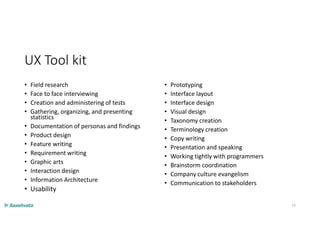
UX Tool kit
• Field research
• Face to face interviewing
• Creation and administering of tests
• Gathering, organizing, and presenting
statistics
• Documentation of personas and findings
• Product design
• Feature writing
• Requirement writing
• Graphic arts
• Interaction design
• Information Architecture
• Usability
• Prototyping
• Interface layout
• Interface design
• Visual design
• Taxonomy creation
• Terminology creation
• Copy writing
• Presentation and speaking
• Working tightly with programmers
• Brainstorm coordination
• Company culture evangelism
• Communication to stakeholders
13
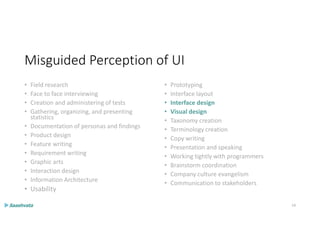
Misguided Perception of UI
• Field research
• Face to face interviewing
• Creation and administering of tests
• Gathering, organizing, and presenting
statistics
• Documentation of personas and findings
• Product design
• Feature writing
• Requirement writing
• Graphic arts
• Interaction design
• Information Architecture
• Usability
• Prototyping
• Interface layout
• Interface design
• Visual design
• Taxonomy creation
• Terminology creation
• Copy writing
• Presentation and speaking
• Working tightly with programmers
• Brainstorm coordination
• Company culture evangelism
• Communication to stakeholders
14
To design a successful UI
you need to think about
the end to end UX
15
So… UX is not UI
http://www.uxisnotui.com/
16
Some products are great and some are not!
Is this magic?
Is this a hit or miss?
Just Serendipitous?
17
How does this happen with some products?
Is this magic?
Is this a hit or miss?
Just Serendipitous?
No. You can engineer this
every. single. time
18
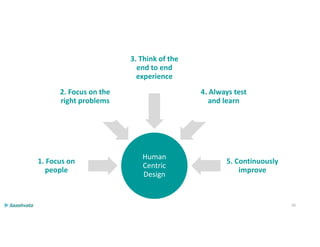
Human centric Design
19
Human
Centric
Design
1. Focus on
people
2. Focus on the
right problems
3. Think of the
end to end
experience
4. Always test
and learn
5. Continuously
improve
20
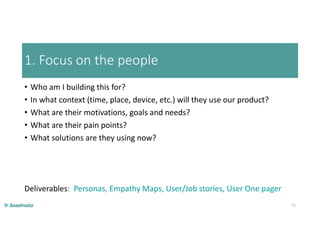
1. Focus on the people
• Who am I building this for?
• In what context (time, place, device, etc.) will they use our product?
• What are their motivations, goals and needs?
• What are their pain points?
• What solutions are they using now?
Deliverables: Personas, Empathy Maps, User/Job stories, User One pager
21
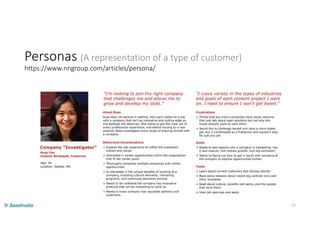
Personas (A representation of a type of customer)
https://www.nngroup.com/articles/persona/
22
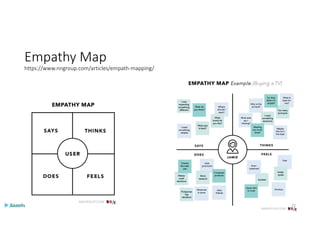
Empathy Map
https://www.nngroup.com/articles/empath-mapping/
23
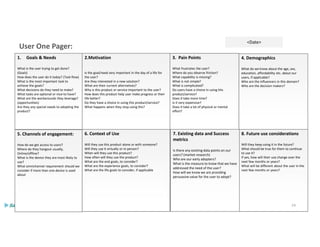
User One Pager:
<Date>
6. Context of Use
Will they use this product alone or with someone?
Will they use it virtually or in-person?
When will they use this product?
How often will they use the product?
What are the end goals, to consider?
What are the experience goals, to consider?
What are the life goals to consider, if applicable
5. Channels of engagement:
How do we get access to users?
Where do they hangout usually,
Online/offline?
What is the device they are most likely to
use?
What omnichannel requirement should we
consider if more than one device is used
about
2.Motivation
Is the goal/need very important in the day of a life for
the user?
Are they interested in a new solution?
What are their current alternatives?
Why is this product or service important to the user?
How does this product help user make progress or their
life better?
Do they have a choice in using this product/service?
What happens when they stop using this?
1. Goals & Needs
What is the user trying to get done?
(Goals)
How does the user do it today? (Task flow)
What is the most important task to
achieve the goals?
What decisions do they need to make?
What tasks are optional or nice-to have?
What are the workarounds they leverage?
(opportunities)
Are they any special needs to adopting the
product?
3. Pain Points
What frustrates the user?
Where do you observe friction?
What capability is missing?
What is not simple?
What is complicated?
Do users have a choice in using this
product/service?
Does it take more time?
Is it very expensive?
Does it take a lot of physical or mental
effort?
4. Demographics
What do we know about the age, sex,
education, affordability etc. about our
users, if applicable?
Who are the influencers in this domain?
Who are the decision makers?
8. Future use considerations
Will they keep using it in the future?
What should be true for them to continue
to use it?
If yes, how will their use change over the
next few months or years?
What will be different about the user in the
next few months or years?
7. Existing data and Success
metrics
Is there any existing data points on our
users? (market research)
Who are our early adopters?
What is the measure to know that we have
addressed the need of the user?
How will we know we are providing
persuasive value for the user to adopt?
24
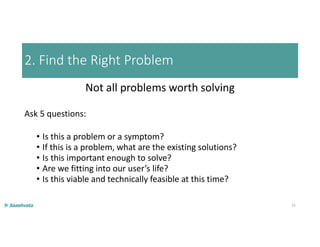
2. Find the Right Problem
Not all problems worth solving
Ask 5 questions:
• Is this a problem or a symptom?
• If this is a problem, what are the existing solutions?
• Is this important enough to solve?
• Are we fitting into our user’s life?
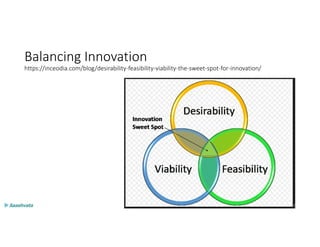
• Is this viable and technically feasible at this time?
25
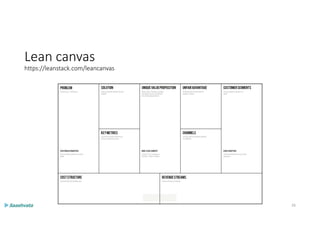
Lean canvas
https://leanstack.com/leancanvas
2
26
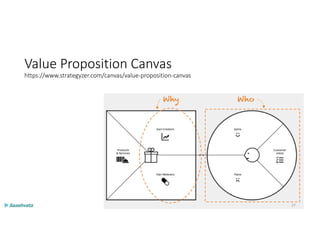
Value Proposition Canvas
https://www.strategyzer.com/canvas/value-proposition-canvas
27
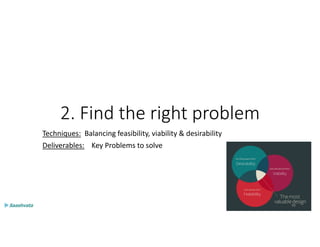
Balancing Innovation
https://inceodia.com/blog/desirability-feasibility-viability-the-sweet-spot-for-innovation/
2
28
3. Think about the end to end experience
Have you wondered landing on an article without the ability to share?
How many times have you had to repeat information to different
customer service reps?
How may times have you bought something online and could not
return in the store?
29
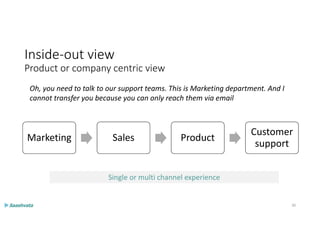
Inside-out view
Product or company centric view
Marketing Sales Product
Customer
support
Single or multi channel experience
Oh, you need to talk to our support teams. This is Marketing department. And I
cannot transfer you because you can only reach them via email
30
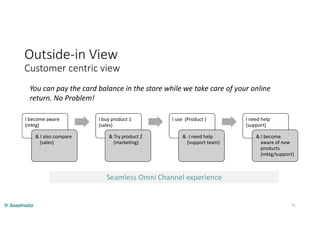
Outside-in View
Customer centric view
Seamless Omni Channel experience
You can pay the card balance in the store while we take care of your online
return. No Problem!
I become aware
(mktg)
& I also compare
(sales)
I buy product 1
(sales)
& Try product 2
(marketing)
I use (Product )
& I need help
(support team)
I need help
(support)
& I become
aware of new
products
(mktg/support)
31
Embrace this Reality
• People need to live life on their terms
• They do not and should not have to care about how our company is
organized
• You need to empathize with their needs and fulfill their expectations
32
Think This Not That
When you begin understanding your customer’s life,
• Think Narratives NOT Features
• Think experiences NOT interactions
• Think how your product will fit into their life NOT how you can sell
your product
33
How does this help?
• You start accounting for all touchpoints digital or physical
• You learn to accommodate the contextual needs.
• You design with an awareness about,
where the user has been before and where the user will go after
at a capability, feature, screen, transaction level
34
What does this look like?
Jordan: The bullied persona (Narrative)
Jordan stared at this phone. It made him angry and confused. Someone
had called him names and had become very abusive.
This was not the first time he felt bullied. But he wondered if he was
taking it too seriously.
He wanted to know if this was bullying or just online social drama. He
needed help and some support. He reached for his phone to explore.
35
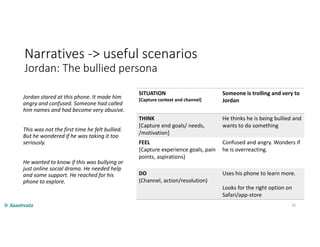
Narratives -> useful scenarios
Jordan: The bullied persona
Jordan stared at this phone. It made him
angry and confused. Someone had called
him names and had become very abusive.
This was not the first time he felt bullied.
But he wondered if he was taking it too
seriously.
He wanted to know if this was bullying or
just online social drama. He needed help
and some support. He reached for his
phone to explore.
SITUATION
[Capture context and channel]
Someone is trolling and very to
Jordan
THINK
[Capture end goals/ needs,
/motivation]
He thinks he is being bullied and
wants to do something
FEEL
[Capture experience goals, pain
points, aspirations)
Confused and angry. Wonders if
he is overreacting.
DO
(Channel, action/resolution)
Uses his phone to learn more.
Looks for the right option on
Safari/app-store
36
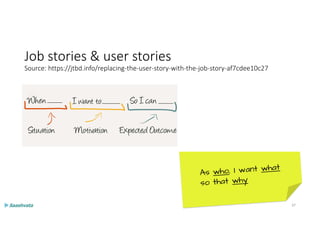
Job stories & user stories
Source: https://jtbd.info/replacing-the-user-story-with-the-job-story-af7cdee10c27
37
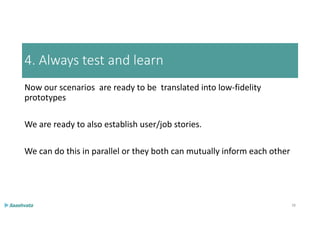
4. Always test and learn
Now our scenarios are ready to be translated into low-fidelity
prototypes
We are ready to also establish user/job stories.
We can do this in parallel or they both can mutually inform each other
38
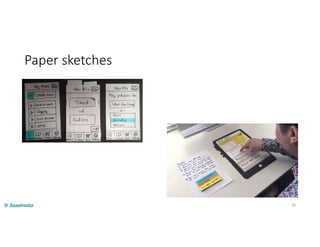
Paper sketches
39
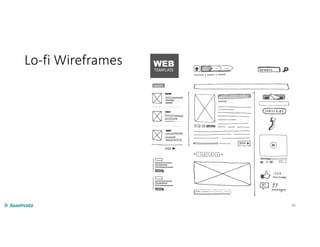
Lo-fi Wireframes
40
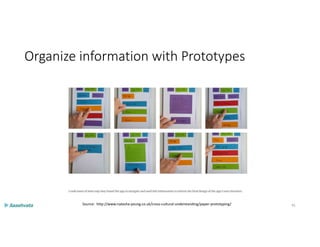
Organize information with Prototypes
Source: http://www.natasha-young.co.uk/cross-cultural-understanding/paper-prototyping/ 41
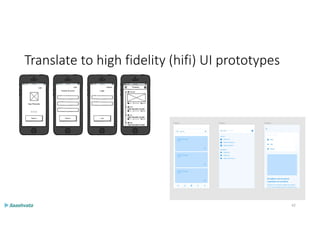
Translate to high fidelity (hifi) UI prototypes
42
Let’s make this real!
43
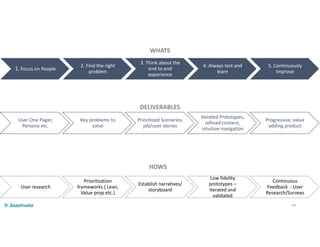
1. Focus on People
2. Find the right
problem
3. Think about the
end to end
experience
4. Always test and
learn
5. Continuously
Improve
User One Pager,
Persona etc.
Key problems to
solve
Prioritized Scenarios,
job/user stories
Iterated Prototypes,
refined content,
intuitive navigation
Progressive, value
adding product
DELIVERABLES
WHATS
User research
Prioritization
frameworks ( Lean,
Value prop etc.)
Establish narratives/
storyboard
Low fidelity
prototypes –
iterated and
validated
Continuous
Feedback - User
Research/Surveys
HOWS
44
1. Focus on People
Techniques: User Interviews
Deliverables: Personas and One Pagers
45
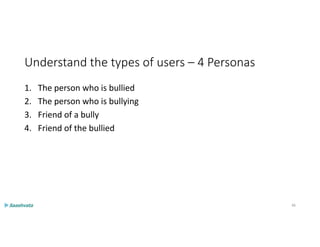
Understand the types of users – 4 Personas
1. The person who is bullied
2. The person who is bullying
3. Friend of a bully
4. Friend of the bullied
46
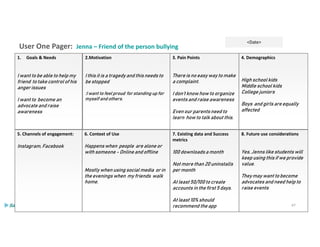
User One Pager: Jenna – Friend of the person bullying
<Date>
6. Context of Use
Happens when people are alone or
with someone - Online and offline
Mostly when using social media or in
the evenings when my friends walk
home.
5. Channels of engagement:
Instagram, Facebook
2.Motivation
I this it is a tragedy and this needs to
be stopped
:I want to feel proud for standing up for
myself and others.
1. Goals & Needs
I want to be able to help my
friend to take control of his
anger issues
I want to become an
advocate and raise
awareness
3. Pain Points
There is no easy way to make
a complaint.
I don’t know how to organize
events and raise awareness
Even our parents need to
learn how to talk about this.
4. Demographics
High school kids
Middle school kids
College juniors
Boys and girls are equally
affected
8. Future use considerations
Yes, Jenns like students will
keep using this if we provide
value.
They may want to become
advocates and need help to
raise events
7. Existing data and Success
metrics
100 downloads a month
Not more than 20 uninstalls
per month
At least 50/100 to create
accounts in the first 5 days.
At least 10% should
recommend the app 47
2. Find the right problem
Techniques: Balancing feasibility, viability & desirability
Deliverables: Key Problems to solve
48
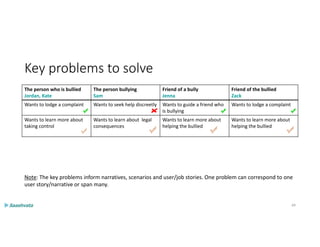
Key problems to solve
The person who is bullied
Jordan, Kate
The person bullying
Sam
Friend of a bully
Jenna
Friend of the bullied
Zack
Wants to lodge a complaint Wants to seek help discreetly Wants to guide a friend who
is bullying
Wants to lodge a complaint
Wants to learn more about
taking control
Wants to learn about legal
consequences
Wants to learn more about
helping the bullied
Wants to learn more about
helping the bullied
49
Note: The key problems inform narratives, scenarios and user/job stories. One problem can correspond to one
user story/narrative or span many.
3. Think about the end to end
experience
Techniques: User Interviews
Deliverables: Narratives, translated to scenarios and user /job stories
50
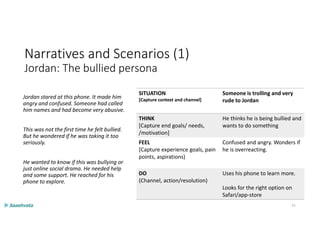
Narratives and Scenarios (1)
Jordan: The bullied persona
Jordan stared at this phone. It made him
angry and confused. Someone had called
him names and had become very abusive.
This was not the first time he felt bullied.
But he wondered if he was taking it too
seriously.
He wanted to know if this was bullying or
just online social drama. He needed help
and some support. He reached for his
phone to explore.
SITUATION
[Capture context and channel]
Someone is trolling and very
rude to Jordan
THINK
[Capture end goals/ needs,
/motivation]
He thinks he is being bullied and
wants to do something
FEEL
[Capture experience goals, pain
points, aspirations)
Confused and angry. Wonders if
he is overreacting.
DO
(Channel, action/resolution)
Uses his phone to learn more.
Looks for the right option on
Safari/app-store
51
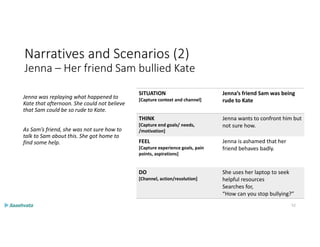
Narratives and Scenarios (2)
Jenna – Her friend Sam bullied Kate
Jenna was replaying what happened to
Kate that afternoon. She could not believe
that Sam could be so rude to Kate.
As Sam’s friend, she was not sure how to
talk to Sam about this. She got home to
find some help.
SITUATION
[Capture context and channel]
Jenna’s friend Sam was being
rude to Kate
THINK
[Capture end goals/ needs,
/motivation]
Jenna wants to confront him but
not sure how.
FEEL
[Capture experience goals, pain
points, aspirations]
Jenna is ashamed that her
friend behaves badly.
DO
[Channel, action/resolution]
She uses her laptop to seek
helpful resources
Searches for,
“How can you stop bullying?”
52
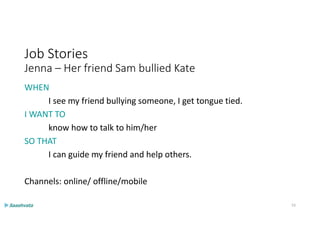
Job Stories
Jenna – Her friend Sam bullied Kate
WHEN
I see my friend bullying someone, I get tongue tied.
I WANT TO
know how to talk to him/her
SO THAT
I can guide my friend and help others.
Channels: online/ offline/mobile
53
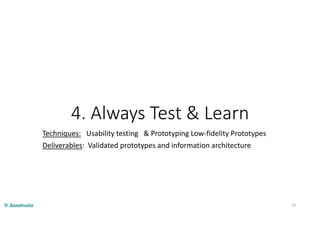
4. Always Test & Learn
Techniques: Usability testing & Prototyping Low-fidelity Prototypes
Deliverables: Validated prototypes and information architecture
54
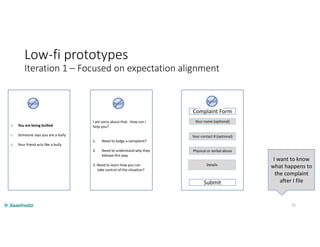
Low-fi prototypes
Iteration 1 – Focused on expectation alignment
o You are being bullied
o Someone says you are a bully
o Your friend acts like a bully
I am sorry about that. How can I
help you?
1. Need to lodge a complaint?
2. Need to understand why they
behave this way
3. Need to learn how you can
take control of the situation?
o
o
o
Complaint Form
Your name (optional)
Your contact # (optional)
Physical or verbal abuse
Details
Submit
I want to know
what happens to
the complaint
after I file
55
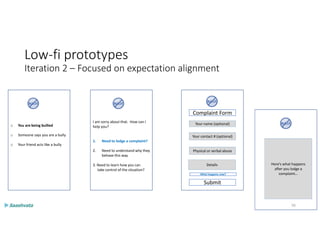
Low-fi prototypes
Iteration 2 – Focused on expectation alignment
o You are being bullied
o Someone says you are a bully
o Your friend acts like a bully
I am sorry about that. How can I
help you?
1. Need to lodge a complaint?
2. Need to understand why they
behave this way
3. Need to learn how you can
take control of the situation?
o
o
o
Complaint Form
Your name (optional)
Your contact # (optional)
Physical or verbal abuse
Details
Submit
o
o
What happens now?
Here’s what happens
after you lodge a
complaint…
56
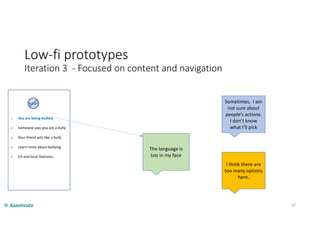
Low-fi prototypes
Iteration 3 - Focused on content and navigation
o You are being bullied
o Someone says you are a bully
o Your friend acts like a bully
o Learn more about bullying
o US and local Statistics
Sometimes, I am
not sure about
people’s actions.
I don’t know
what I’ll pick
The language is
too in my face
I think there are
too many options
here.
57
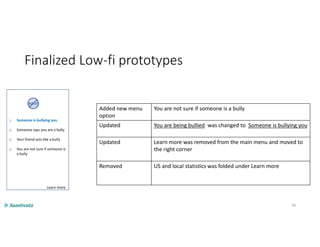
Finalized Low-fi prototypes
o Someone is bullying you
o Someone says you are a bully
o Your friend acts like a bully
o You are not sure if someone is
a bully
Learn more
Added new menu
option
You are not sure if someone is a bully
Updated You are being bullied was changed to Someone is bullying you
Updated Learn more was removed from the main menu and moved to
the right corner
Removed US and local statistics was folded under Learn more
58
Possible Next steps
1) You are ready to move to high fidelity prototyping
2) Visual design, animation, working on voice and tone of the
application are the possible next steps
3) One more round of usability testing
Note: Sketches and wireframing are usually low-fidelity prototyping
59
5. Continuously Improve
Techniques: User Interviews, Usability, Analytics, Survey feedback
Outcomes: A progressive product that adds value, helps them make
progress and changes their lives for the better
60
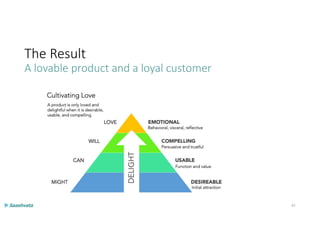
The Result
A lovable product and a loyal customer
61
Templates & Resources
62
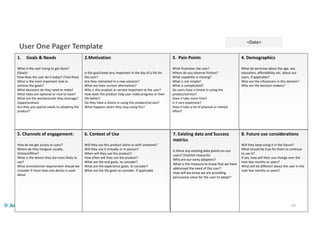
User One Pager Template
<Date>
6. Context of Use
Will they use this product alone or with someone?
Will they use it virtually or in-person?
When will they use this product?
How often will they use the product?
What are the end goals, to consider?
What are the experience goals, to consider?
What are the life goals to consider, if applicable
5. Channels of engagement:
How do we get access to users?
Where do they hangout usually,
Online/offline?
What is the device they are most likely to
use?
What omnichannel requirement should we
consider if more than one device is used
about
2.Motivation
Is the goal/need very important in the day of a life for
the user?
Are they interested in a new solution?
What are their current alternatives?
Why is this product or service important to the user?
How does this product help user make progress or their
life better?
Do they have a choice in using this product/service?
What happens when they stop using this?
1. Goals & Needs
What is the user trying to get done?
(Goals)
How does the user do it today? (Task flow)
What is the most important task to
achieve the goals?
What decisions do they need to make?
What tasks are optional or nice-to have?
What are the workarounds they leverage?
(opportunities)
Are they any special needs to adopting the
product?
3. Pain Points
What frustrates the user?
Where do you observe friction?
What capability is missing?
What is not simple?
What is complicated?
Do users have a choice in using this
product/service?
Does it take more time?
Is it very expensive?
Does it take a lot of physical or mental
effort?
4. Demographics
What do we know about the age, sex,
education, affordability etc. about our
users, if applicable?
Who are the influencers in this domain?
Who are the decision makers?
8. Future use considerations
Will they keep using it in the future?
What should be true for them to continue
to use it?
If yes, how will their use change over the
next few months or years?
What will be different about the user in the
next few months or years?
7. Existing data and Success
metrics
Is there any existing data points on our
users? (market research)
Who are our early adopters?
What is the measure to know that we have
addressed the need of the user?
How will we know we are providing
persuasive value for the user to adopt?
63
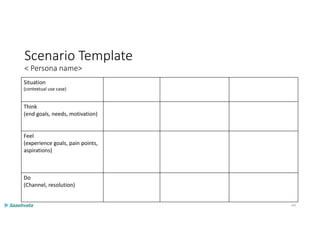
Scenario Template
< Persona name>
Situation
(contextual use case)
Think
(end goals, needs, motivation)
Feel
(experience goals, pain points,
aspirations)
Do
(Channel, resolution)
64
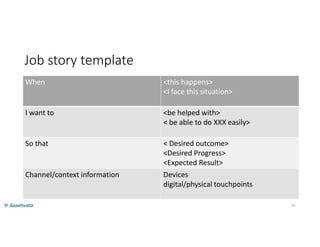
Job story template
When <this happens>
<I face this situation>
I want to <be helped with>
< be able to do XXX easily>
So that < Desired outcome>
<Desired Progress>
<Expected Result>
Channel/context information Devices
digital/physical touchpoints
65
66
Wishing you lots of inspiration and success 
You can reach me at: https://www.linkedin.com/in/vidhyasriram/
Question Time!
67
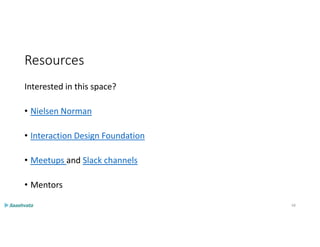
Resources
Interested in this space?
• Nielsen Norman
• Interaction Design Foundation
• Meetups and Slack channels
• Mentors
68
Appendix
69
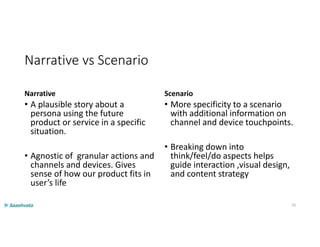
Narrative vs Scenario
Narrative
• A plausible story about a
persona using the future
product or service in a specific
situation.
• Agnostic of granular actions and
channels and devices. Gives
sense of how our product fits in
user’s life
Scenario
• More specificity to a scenario
with additional information on
channel and device touchpoints.
• Breaking down into
think/feel/do aspects helps
guide interaction ,visual design,
and content strategy
70
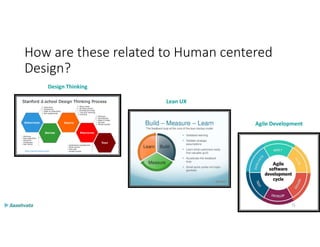
How are these related to Human centered
Design?
Lean UX
Agile Development
Design Thinking
71
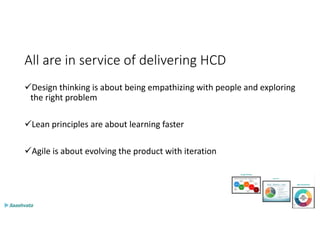
All are in service of delivering HCD
Design thinking is about being empathizing with people and exploring
the right problem
Lean principles are about learning faster
Agile is about evolving the product with iteration
72