
Allison Leach

                    MEANINGFUL
                   MANIPU TION
                How Designers Can Harness Cognitive Biases
                      to Motivate Positive Behavior


Designing Experiences for Facilitating Positive Behavior Change
Parallel Session at HCI International 2013
21-26 July 2013
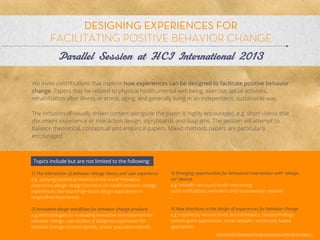
DESIGNING EXPERIENCES FOR
                       Allison Leach
         FACILITATING POSITIVE BEHAVIOR CHANGE
              Parallel Session at HCI International 2013

We invite contributions that explore how experiences can be designed to facilitate positive behavior
change. Papers may be related to physical health, mental well-being, exercise, social activities,
rehabilitation after illness or stress, aging, and generally living in an independent, sustainable way.

The inclusion of visually driven content alongside the paper is highly encouraged, e.g. short videos that
document experience or interaction design, storyboards and diagrams. The session will attempt to
balance theoretical, conceptual and empirical papers. Mixed methods papers are particularly
encouraged.


 Topics include but are not limited to the following:

1) The intersection of behavior change theory and user experience   3) Emerging opportunities for behavioral intervention with “always
e.g. applying traditional theories in the era of innovative         on” devices
experience design; design heuristics for health behavior            e.g. mHealth structural health monitoring
change experiences; low-touch/high-touch design approaches          push notifications, reminders and recommender systems
in longitudinal experiences

2) Innovative design workflows for behavior change products          4) New directions in the design of experiences for behavior change
e.g.methodologies for evaluating interactive entertainment for      e.g. inspired by neuroscience, bio-informatics, nanotechnology;
behavior change; case studies of designed experiences for           serious game approaches; social network / community based
behavior change; location-specific, and/or population-specific        approaches
                                                                                           http://hcii2013behaviorchange.wordpress.com/call-for-papers/
PROPOSAL FOR PRESENTATION
             Allison Leach

Abstract
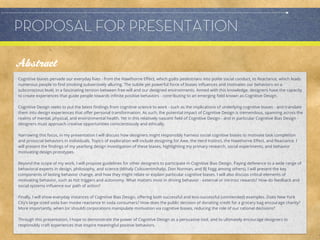
Cognitive biases pervade our everyday lives - from the Hawthorne Effect, which guilts pedestrians into polite social conduct, to Reactance, which leads
numerous people to find smoking subversively alluring. The subtle yet powerful force of biases influences and motivates our behaviors on a
subconscious level, in a fascinating tension between free will and our designed environments. Armed with this knowledge, designers have the capacity
to create experiences that guide people towards infinite positive behaviors - contributing to an emerging field known as Cognitive Design.

Cognitive Design seeks to put the latest findings from cognitive science to work - such as the implications of underlying cognitive biases - and translate
them into design experiences that offer personal transformation. As such, the potential impact of Cognitive Design is tremendous, spanning across the
realms of mental, physical, and environmental health. Yet in this relatively nascent field of Cognitive Design - and in particular Cognitive Bias Design -
designers must approach creative opportunities conscientiously and ethically.

Narrowing this focus, in my presentation I will discuss how designers might responsibly harness social cognitive biases to motivate task completion
and prosocial behaviors in individuals. Topics of exploration will include designing for Awe, the Herd Instinct, the Hawthorne Effect, and Reactance. I
will present the findings of my yearlong design investigation of these biases, highlighting my primary research, social experiments, and behavior
motivating design prototypes.

Beyond the scope of my work, I will propose guidelines for other designers to participate in Cognitive Bias Design. Paying deference to a wide range of
behavioral experts in design, philosophy, and science (Mihaly Csikszentmihalyi, Don Norman, and BJ Fogg among others), I will present the key
components of lasting behavior change, and how they might relate or explain particular cognitive biases. I will also discuss critical elements of
motivating behavior, such as hot triggers and autonomy. What matters most in driving behavior - external or intrinsic rewards? How do feedback and
social systems influence our path of action?

Finally, I will show everyday instances of Cognitive Bias Design, offering both successful and less-successful (unintended) examples. Does New York
City’s large-sized soda ban invoke reactance in soda consumers? How does the public decision of donating credit for a grocery bag encourage charity?
More importantly, when (or should) corporations manipulate motivation via cognitive biases, reducing the role of our rational decisions?

Through this presentation, I hope to demonstrate the power of Cognitive Design as a persuasive tool, and to ultimately encourage designers to
responsibly craft experiences that inspire meaningful positive behaviors.
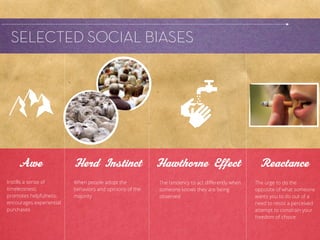
SELECTED SOCIAL BIASES
               Allison Leach


     Awe                 Herd Instinct               Hawthorne Effect                   Reactance
Instills a sense of      When people adopt the       The tendency to act differently   The urge to do the
timelessness;            behaviors and opinions of   when someone knows they are      opposite of what
promotes helpfulness;    the majority                being observed                   someone wants you to
encourages                                                                            do out of a need to resist
experiential purchases                                                                a perceived attempt to
                                                                                      constrain your freedom
                                                                                      of choice
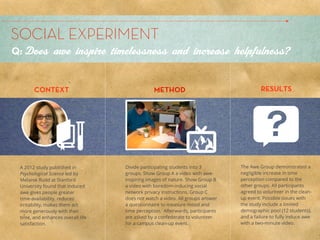
SOCIAL EXPERIMENT Leach
              Allison
Q: Does awe inspire timelessness and increase helpfulness?


       CONTEXT                                 METHOD                                   RESULTS


 A 2012 study published in         Divide participating students into 3        The Awe Group demonstrated a
 Psychological Science led by      groups. Show Group A a video with awe-      negligible increase in time
 Melanie Rudd at Stanford          inspiring images of nature. Show Group B    perception compared to the
 University found that induced     a video with boredom-inducing social        other groups. All participants
 awe gives people greater          network privacy instructions. Group C       agreed to volunteer in the clean-
 time-availability, reduces        does not watch a video. All groups answer   up event. Possible issues with
 irritability, makes them act      a questionnaire to measure mood and         the study include a limited
 more generously with their        time perception. Afterwards, participants   demographic pool (12 students),
 time, and enhances overall life   are asked by a confederate to volunteer     and a failure to fully induce awe
 satisfaction.                     for a campus clean-up event.                with a two-minute video.
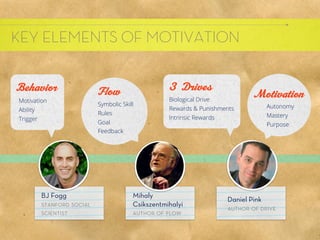
KEY ELEMENTS OF MOTIVATION
              Allison Leach


Behavior                    Flow                    3 Drives
Motivation                                          Biological Drive
                                                                                Motivation
                            Symbolic Skill                                          Autonomy
Ability                                             Rewards & Punishments
                            Rules                                                   Mastery
Trigger                                             Intrinsic Rewards
                            Goal                                                    Purpose
                            Feedback


          BJ Fogg                        Mihaly
                                                                        Daniel Pink
          stanford social                Csikszentmihalyi
                                                                        author of drive
          scientist                      author of flow
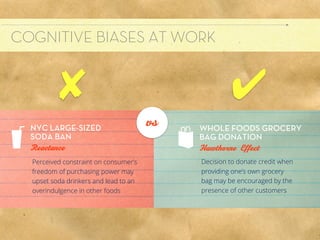
COGNITIVE BIASES AT WORK
               Allison Leach


          ✘                                          ✔
  NYC LARGE-SIZED
                                       vs   WHOLE FOODS GROCERY
  SODA BAN                                  BAG DONATION
  Reactance                                 Hawthorne Effect
  Perceived constraint on consumer’s        Decision to donate credit when
  freedom of purchasing power may           providing one’s own grocery
  upset soda drinkers and lead to an        bag may be encouraged by the
  overindulgence in other foods             presence of other customers
thank you
Allison Leach   © 2013

Meaningful Manipulation

  • 1.
    Allison Leach MEANINGFUL MANIPU TION How Designers Can Harness Cognitive Biases to Motivate Positive Behavior Designing Experiences for Facilitating Positive Behavior Change Parallel Session at HCI International 2013 21-26 July 2013
  • 2.
    DESIGNING EXPERIENCES FOR Allison Leach FACILITATING POSITIVE BEHAVIOR CHANGE Parallel Session at HCI International 2013 We invite contributions that explore how experiences can be designed to facilitate positive behavior change. Papers may be related to physical health, mental well-being, exercise, social activities, rehabilitation after illness or stress, aging, and generally living in an independent, sustainable way. The inclusion of visually driven content alongside the paper is highly encouraged, e.g. short videos that document experience or interaction design, storyboards and diagrams. The session will attempt to balance theoretical, conceptual and empirical papers. Mixed methods papers are particularly encouraged. Topics include but are not limited to the following: 1) The intersection of behavior change theory and user experience 3) Emerging opportunities for behavioral intervention with “always e.g. applying traditional theories in the era of innovative on” devices experience design; design heuristics for health behavior e.g. mHealth structural health monitoring change experiences; low-touch/high-touch design approaches push notifications, reminders and recommender systems in longitudinal experiences 2) Innovative design workflows for behavior change products 4) New directions in the design of experiences for behavior change e.g.methodologies for evaluating interactive entertainment for e.g. inspired by neuroscience, bio-informatics, nanotechnology; behavior change; case studies of designed experiences for serious game approaches; social network / community based behavior change; location-specific, and/or population-specific approaches http://hcii2013behaviorchange.wordpress.com/call-for-papers/
  • 3.
    PROPOSAL FOR PRESENTATION Allison Leach Abstract Cognitive biases pervade our everyday lives - from the Hawthorne Effect, which guilts pedestrians into polite social conduct, to Reactance, which leads numerous people to find smoking subversively alluring. The subtle yet powerful force of biases influences and motivates our behaviors on a subconscious level, in a fascinating tension between free will and our designed environments. Armed with this knowledge, designers have the capacity to create experiences that guide people towards infinite positive behaviors - contributing to an emerging field known as Cognitive Design. Cognitive Design seeks to put the latest findings from cognitive science to work - such as the implications of underlying cognitive biases - and translate them into design experiences that offer personal transformation. As such, the potential impact of Cognitive Design is tremendous, spanning across the realms of mental, physical, and environmental health. Yet in this relatively nascent field of Cognitive Design - and in particular Cognitive Bias Design - designers must approach creative opportunities conscientiously and ethically. Narrowing this focus, in my presentation I will discuss how designers might responsibly harness social cognitive biases to motivate task completion and prosocial behaviors in individuals. Topics of exploration will include designing for Awe, the Herd Instinct, the Hawthorne Effect, and Reactance. I will present the findings of my yearlong design investigation of these biases, highlighting my primary research, social experiments, and behavior motivating design prototypes. Beyond the scope of my work, I will propose guidelines for other designers to participate in Cognitive Bias Design. Paying deference to a wide range of behavioral experts in design, philosophy, and science (Mihaly Csikszentmihalyi, Don Norman, and BJ Fogg among others), I will present the key components of lasting behavior change, and how they might relate or explain particular cognitive biases. I will also discuss critical elements of motivating behavior, such as hot triggers and autonomy. What matters most in driving behavior - external or intrinsic rewards? How do feedback and social systems influence our path of action? Finally, I will show everyday instances of Cognitive Bias Design, offering both successful and less-successful (unintended) examples. Does New York City’s large-sized soda ban invoke reactance in soda consumers? How does the public decision of donating credit for a grocery bag encourage charity? More importantly, when (or should) corporations manipulate motivation via cognitive biases, reducing the role of our rational decisions? Through this presentation, I hope to demonstrate the power of Cognitive Design as a persuasive tool, and to ultimately encourage designers to responsibly craft experiences that inspire meaningful positive behaviors.
  • 4.
    SELECTED SOCIAL BIASES Allison Leach Awe Herd Instinct Hawthorne Effect Reactance Instills a sense of When people adopt the The tendency to act differently The urge to do the timelessness; behaviors and opinions of when someone knows they are opposite of what promotes helpfulness; the majority being observed someone wants you to encourages do out of a need to resist experiential purchases a perceived attempt to constrain your freedom of choice
  • 5.
    SOCIAL EXPERIMENT Leach Allison Q: Does awe inspire timelessness and increase helpfulness? CONTEXT METHOD RESULTS A 2012 study published in Divide participating students into 3 The Awe Group demonstrated a Psychological Science led by groups. Show Group A a video with awe- negligible increase in time Melanie Rudd at Stanford inspiring images of nature. Show Group B perception compared to the University found that induced a video with boredom-inducing social other groups. All participants awe gives people greater network privacy instructions. Group C agreed to volunteer in the clean- time-availability, reduces does not watch a video. All groups answer up event. Possible issues with irritability, makes them act a questionnaire to measure mood and the study include a limited more generously with their time perception. Afterwards, participants demographic pool (12 students), time, and enhances overall life are asked by a confederate to volunteer and a failure to fully induce awe satisfaction. for a campus clean-up event. with a two-minute video.
  • 6.
    KEY ELEMENTS OFMOTIVATION Allison Leach Behavior Flow 3 Drives Motivation Biological Drive Motivation Symbolic Skill Autonomy Ability Rewards & Punishments Rules Mastery Trigger Intrinsic Rewards Goal Purpose Feedback BJ Fogg Mihaly Daniel Pink stanford social Csikszentmihalyi author of drive scientist author of flow
  • 7.
    COGNITIVE BIASES ATWORK Allison Leach ✘ ✔ NYC LARGE-SIZED vs WHOLE FOODS GROCERY SODA BAN BAG DONATION Reactance Hawthorne Effect Perceived constraint on consumer’s Decision to donate credit when freedom of purchasing power may providing one’s own grocery upset soda drinkers and lead to an bag may be encouraged by the overindulgence in other foods presence of other customers
  • 8.