1
GUJARAT TECHNOLOGICAL UNIVERSITY
Chandkheda Ahmedabad
Affiliated
GOVERNMENT ENGINEERING COLLEGE VALSAD
A Report on :
ā€œThe effluent treatment by using Biodegradable material and Particulate matter for
Particular Industry.ā€
Under subject of
DESIGN ENGINEERING – II (A)
B.E. III, Semester : V
(ENVIRONEMENT BRANCH)
Submitted by: Group 07
Sr. Name of student Enrollment No.
1) DAKHARA NIRMALBHAI 160190113009
2) BHADANI ASHISHKUMAR J. 160190113003
3) PATEL SMIT 160190113040
Prof. Khyati Modi Prof. Monali Chaudhari
(Head Of Department) (Faculty guide)
2
GOVERNMENT ENGINEERING COLLEGE, VALSAD
CERTIFICATE
This is to certify that the project entitled ā€œ The effluent treatment by using Biodegradable
material and Particulate matter for Particular Industry. ā€ has been carried out by
Dakhara Nirmalbhai (160190113009), Bhadani Ashishkumar J. (160190113003), Patel Smit
P. (160190113040) students of BE III, Semester V Environmental engineering has
satisfactorily completed their work in DESIGN ENGINEERING – II (A) for the term ending
in OCTOBER - 2018.
Prof. Khyati Modi Prof. Monali Chaudhari
(Head Of Department) (Faculty guide)
External Faculty Sign
3
ACKNOWLEDGEMENT
We would like to express our special thanks to our guide Prof. Monali Chaudhari who
helped us in gaining knowledge about many things while doing our project.
For this project we took help from several sites, books, friends and faculties.
Our special gratitude is extended to the head of the department and the faculty members
of Environmental engineering department for helping us and our gratefulness to one
and all who are directly or indirectly involved in the completion of our project work.
4
ABSTRACT
The main objective of this project is effluent treatment by using biodegradable material and
particulate matter for the particular industry. In the following to know the advantages and
limitation of the model we are working on.
This project will help the users to convert influent water into fresh water. Its main aim is to
Reduce the Toxic Elements, Salts, TDS, TSS from the wastewater and provide a fresh
water to users and also provide a eco-friendly and pollution free environment.[4]
5
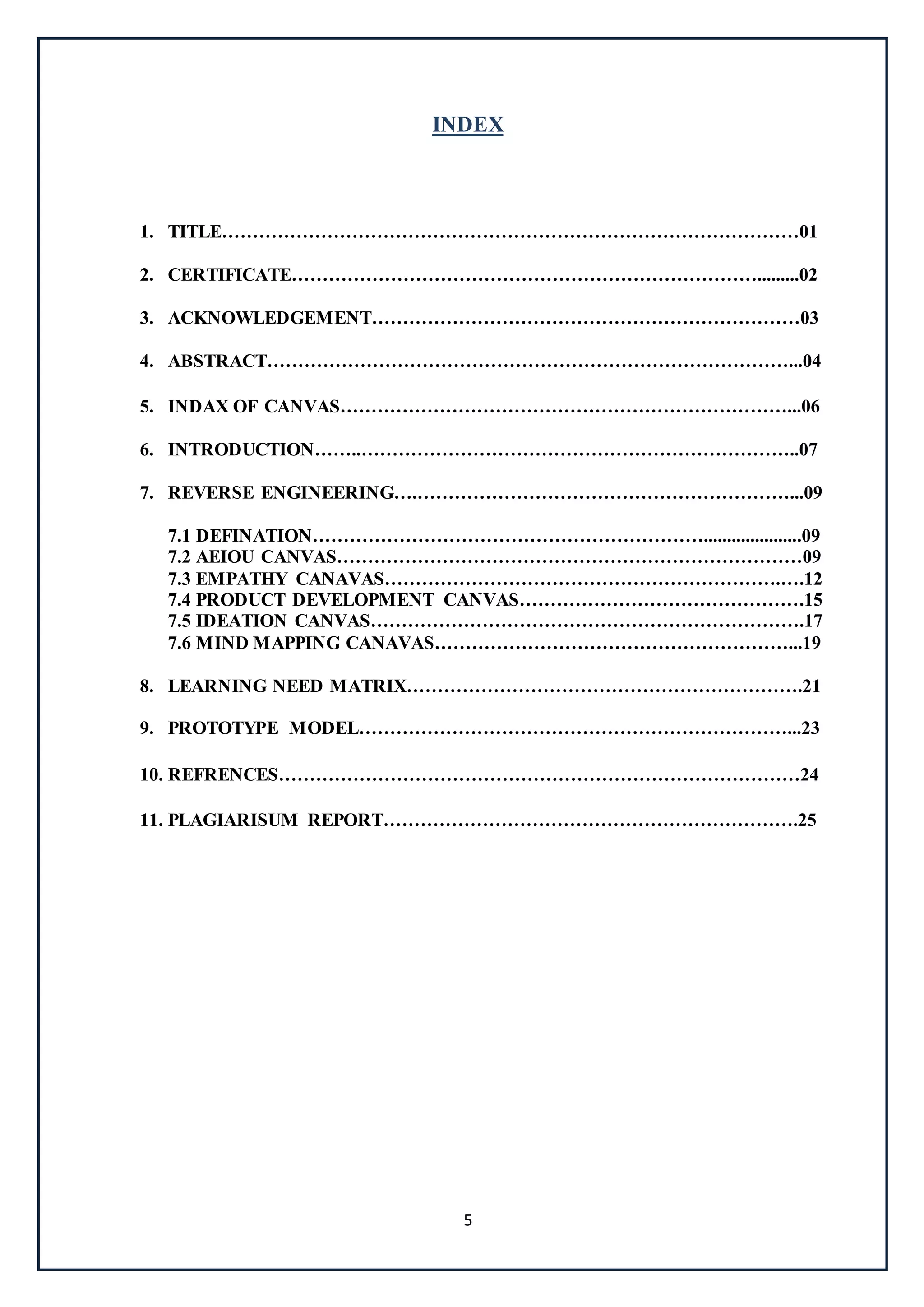
INDEX
1. TITLE…………………………………………………………………………………01
2. CERTIFICATE………………………………………………………………….........02
3. ACKNOWLEDGEMENT……………………………………………………………03
4. ABSTRACT…………………………………………………………………………...04
5. INDAX OF CANVAS………………………………………………………………...06
6. INTRODUCTION……..……………………………………………………………..07
7. REVERSE ENGINEERING….……………………………………………………...09
7.1 DEFINATION……………………………………………………….....................09
7.2 AEIOU CANVAS…………………………………………………………………09
7.3 EMPATHY CANAVAS……………………………………………………….….12
7.4 PRODUCT DEVELOPMENT CANVAS……………………………………….15
7.5 IDEATION CANVAS…………………………………………………………….17
7.6 MIND MAPPING CANAVAS…………………………………………………...19
8. LEARNING NEED MATRIX……………………………………………………….21
9. PROTOTYPE MODEL……………………………………………………………...23
10. REFRENCES…………………………………………………………………………24
11. PLAGIARISUM REPORT………………………………………………………….25
6
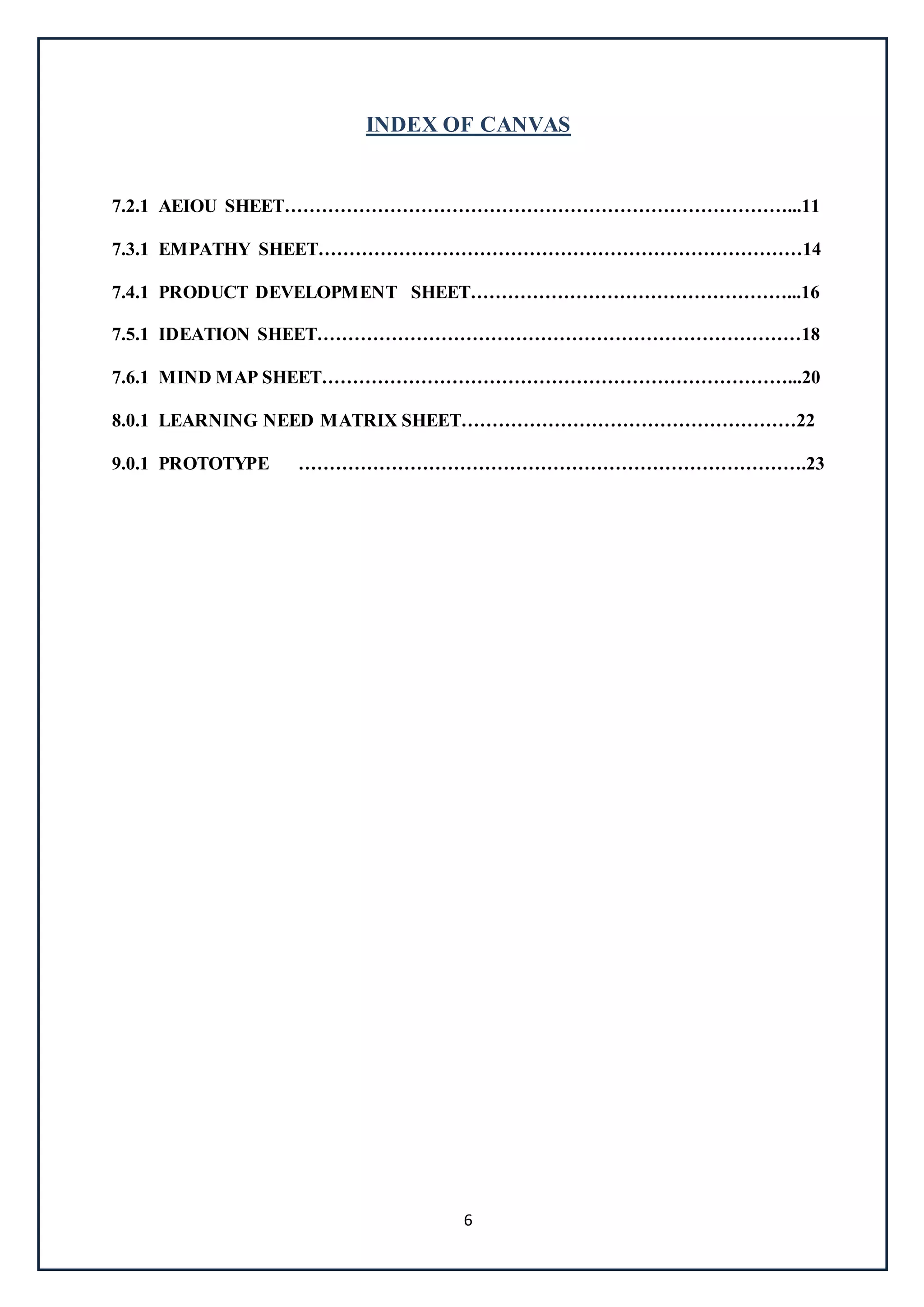
INDEX OF CANVAS
7.2.1 AEIOU SHEET………………………………………………………………………...11
7.3.1 EMPATHY SHEET……………………………………………………………………14
7.4.1 PRODUCT DEVELOPMENT SHEET……………………………………………...16
7.5.1 IDEATION SHEET……………………………………………………………………18
7.6.1 MIND MAP SHEET…………………………………………………………………...20
8.0.1 LEARNING NEED MATRIX SHEET………………………………………………22
9.0.1 PROTOTYPE ……………………………………………………………………….23
7
6.INTRODUCTION:-
Everyone needs water. Supplies of water are vital for agriculture, industry, recreation and
human consumption. One problem that the water industry faces is disposal of concentrate from
advanced water treatment processes.[1] This report discusses influent treatment process one
possible solution to concentrate disposal.
Water is required in several fundamental process operations such scrubbing, extraction, steam
generation etc.[4] Advantages and disadvantages of influent treatment process are currently
being seriously considered and discussed. Influent treatment process minimizes the
consumption of fresh water to that of make-up; therefore’ it should help relieve freshwater
availability limitations in places where it is scarce or expensive.[1] Purchased water, and waste
water treatment and disposal coast can significant; thus, saving associated with minimized site
makeup water and waste water flows can justify capital expenditures to minimize, if not
completely eliminated, wastewater flows.[4] Influent treatment process can save money on real
estate costs in the case of new facility construction, since location near a suitable receiving
waterway would not necessary.[3]
On the other hand, sometimes the disadvantages of implementing influent treatment process
include higher cost due to treatment of water to the extent it is suitable for reuse, or higher
capital cost in retrofit projects due to large scale restructuring of piping and the arrangement of
the disposal of the solid waste generated.[1]
Some of methodologies and compare their results that can apply to the influent treatment
process or at least decrease the amount of liquid.[1]
8
A) What is DesignThinking?:-
A method of problem of waste water treatment. In this method the reduce the influent of waste
water. In this method we connected the solution of the waste water treatment process.
B) Importance of design thinking and socio-economic relevance:-
The ultimate goal of design thinking is not merely making things that people enjoy or creating
awareness of the company. When design creates feelings of empowerment, people are eager to
share their experience with outlets. This cycle is essential for generating demand virally and
building brand loyalty.
C) Team building and its importance:-
Team building is an ongoing process that helps a work group evolve into a cohesive unit. The
team members not only share expectations for accomplishing group tasks, but trusts and
support one another and respect one another’s individual differences.[5]
This subject taught us to work in a group, to understand each other’s weak point as well as
strong point. As we work in a group or a team all wants their project to be best hence, all
focuses on project. Hence it teaches us to how to compete with other team than with individual.
There are many members in group hence all the minds have different ideas and creativity
which give out a best possible result.[5]
D) Importance of a log book exercises:-
This exercise is important because everyone wants their canvas to be perfect and neat and tidy
so by using log books we can make first a rough idea of sheet which helps us to keep our
canvas clean and also we can make changes in log books which we cannot do in canvas.
E) Learning Tools:-
The tools involve in Design engineering process are,
• Log book exercise
• Group discussion
• Internet
• Faculties guidance
• AEIOU canvas
• Empathy Mapping canvas
• Mind Mapping canvas
• Product development canvas
• Ideation canvas
9
7. Reverse Engineering:-
7.1 DEFINATION:
Reverse Engineering also called as Back Engineering, is the process of extracting
knowledge or design information from any man-made thing and then reproducing it by
following the Design process. Thus from a user’s point of view, there may be a need to
modify some features or to add some features.[6]
7.2AEIOU SHEET:
a. It is commonly used for coding observational data.
b. Organizational framework help designers to capture key
c. Details in observation and AEIOU is very easy mnemonic
d. Device to remember what to look for and write down.
i) Activities:-
Observation: Recent Scenario of ZLD Literature survey on absorption material,
Literature survey on Bio-degradable material,
Analysis of effluent.
Elements Features: Utilization of waste particulate matter to reduce color and odour,[1]
Utilization of waste Bio-degradable material to reduce TDS, TSS.[1]
ii) Environment:
Observations: Maximum Reuse of water,[1]
Eco-friendly system, [1]
Analysis of various component of water[1]
Elements Features: Not affect to eco cycle & bio-logical cycle,[1]
Minimize the affect of water due to water problem.[1]
.
iii) Interactions:
Observation: In between Student & Guide
In between Student & Industry
In between Student, Guide & Industry
In between group members
Elements Features: Guidance, advice, New ideas, more knowledge about topic.
10
iv) Objects:
Observations: (01)Mesh
(02) Filter Paper
(03) Packed bed column
(04) Bio-degradable material
(05) Particular matter
(06) TDS meter
(07) PH meter
(08) funnels
(09) Stands
Elements Features: To pass the effluent through the filter paper,
filter made by bio degradable Material
v) Users:
.
Observations: Industries :- Reduce cost of water treatment
Government: - Increase economy
Elements Features: Varies type of industries
Government treatment plants
CETP (Common effluent treatment plant)
c) Feedback analysis:
When the project was implemented it was found that the use of
this process in industry is very low.[2] So most of industry
discharge waste water as well as or for treatment to send other
treatment plant because this process is very costly.[7] The use of
this process is increase then the use of fresh water decrease and
the water source in environment is as well as.
d) Summary about Project:
This is a project based on the recycling or reuse of waste water.
But the process is required more cost.[3] So most up small
industry not acceptable this process but the some technical
modification required for this project for decrease the operating
cost by the some engineer and technician.
e) Summary of learning from Reverse Engineering:
Due to reverse engineering we came across a major problem of
our product i.e. the proper modification is required.[3] And we
use the coconut shell for the filtration process involving
absorption process[1]. So not more removing the waste from the
effluent. So industry is not accept the project, we came to know
from reverses engineering. Solution of the entire problem and a
way to overcome its limitations.[1]
11
7.2.1 AEIOU SHEET[8]
12
7.3 EMPATHY CANVAS:
These are the second stepof the project or problem. In this canvas, you have to find out
what are users to your problems? Who are stakeholders? What are the activities? And
what are broad stories of their activities?
User:-
ļ‚· Dyeing Industries
ļ‚· Textile Industries
ļ‚· CETP (Common effluent treatment plant)
ļ‚· Process Industries
Stake holders:-
ļ‚· Industries
ļ‚· Government
ļ‚· Environmental Engineer
Activities:-
ļ‚· Selection of topic
ļ‚· Selection of Industrial Effluent
ļ‚· Recent Scenario of ZLD
ļ‚· Literature Survey on absorption material
ļ‚· Literature Survey on Bio-degradable Material[1]
ļ‚· Analysis Of Effluent
13
 Happy Story:-
Treating waste water we can reuse. It in process industry for various purposelike using water in
boiler and cooling tower. Treating water we can use in some process and this water is very use
to clean tank and many processing equipments.[7]
 Happy Story:-
For treatment of waste water we will use Bio-degradable materials and flyash. Bio-degradable
material is eco-friendly and fly ash is waste product.[7] treating waste water we can use as
instead of pure water and after this process we can get pure water. So reduce the pollution of
water by industry effluent.[7]
 Sad story:-
In process industry further modification is required in effluent treatment plant.[1] So cost of
treatment plant is increased. Small industry is not accept this treatment process because this is
very costly.[7]
 Sad story:-
Proper designing and optimization is not carry out at initial stage for space and process time.
So some industry is not accept.[3] Developers and designer is trying hard to bring down capital
cost and take needed electricity.[7]
14
7.3.1 EMPATHY SHEET[8]
15
7.4 PRODUCT DEVELOPMENTCANVAS:
This step is about development of the product. Define purpose. What are the experience
when you compare it with other product? Problems for its application and its solution.
What are the components used for its model. following things is to do.
• Purpose:-(1)Reduce the waste water load on ETP.[7]
(2)Maximize the use of waste water in plant itself or Gardening.
(3) Reduce the use of fresh water in industry.[1]
• People:-(1) Process Designer
(2) Engineers
(3) Lab Technician
• Product experience:-(1)Primary experiment are going on.
(2)Experience share after some Modification.
• Product functions:-(1) Possible removal of color and odor.
(2) Removal of TDS, TSS[1]
• Product features:-(1) Utilization of waste particulate matter to
Reduce color and odor.[1]
(2) Utilization of waste bio-degradable
material to reduce TDS, TSS.[2]
• Components:- (01) Mesh
(02) Filter Paper
(03) Packed bed column
(04) Bio-degradable material
(05) Particular matter
(06) TDS meter
(07) PH meter
(08) Calorimeter
(09) funnels
(10) Stands
16
7.4.1 PRODUCT DEVLOPMENT SHEET[8]
17
7.5IDEATION CANVAS:
From the Empathy mapping canvas, you have an idea what are the people involve
in this project? In ideation canvas, you have to carry out which type of activities is
related to your project and people? What is situation and location regarding to
activities? Then after you find the possible solutions. It is depend or not depend to
your activities.
People:- :-
(1) Process Designer
(2) Engineer
(3) Lab. Technician
Activities:-
(1) Selection of Industry
(2) Characterization of industrial effluent[2]
(3) Recent scenario of ZLD
(4) Literature Survey on absorption material
(5)Literature Survey on bio-degradable material[1]
Situation/context/location:-
(01) Reduce the TDS, TSS[1]
(02) Reduce the odor and color[1]
(03) Improve the water Quality
(04) Reuse of water[1]
(05) Recycle of Industrial discharge
Props/possible solutions:-
(01) Mesh
(02) Filter Paper
(03) Packed bed column
(04) Bio-degradable material
(05) Funnel and Stand
(06) TDS, PH meter
(07) Chemicals
(08) Waste Water Sample
18
7.5.1 Ideation Canvas[8]
19
7.6MIND MAPPING:
Graphical technique for visualizing connections between several ideas or pieces of
information. Each idea or fact is written down and they linked by lines or curves to its
major or minor idea or fact, thus creating a web of relationships.
There are mainly 5 things you have to define,
1)Uses:-
ļ‚· Dyeing Industries
ļ‚· Textile Industries
ļ‚· CETP (Common effluent treatment plant)
ļ‚· Process Industries
2) Advantages:-
(1) Treating wastewater reuse in process Industry for different Propose.[1]
(2) Eco logical Process
(3) Water use for boiler cooling process
3) Disadvantages:-
(1) In process further modification is required
(2) Cost of treatment plant is more required[3]
(3) More electricity required
4) Customer Revalidation :-
(1) In Dying industry waste water load is higher so modification is Required.
(2) After modification water Quality is checked.
(3) Feasibility and cost also consider for further revalidation.
20
7.6.1 MIND MAPPING[8]
21
8.LEARNING NEED MATRIX:-
Learning need matrix has a fundamental role in education. It helps you to find out which
method/theories you need to learn which application process is involved. What are the
component used in the product and analysis of each and every individual components and the
environment required for its working.
There are 3 stages in which the learning process is divided
• Purpose/product concept: - :-(1)Reduce the waste water load on ETP.[3]
(2)Maximize the use of waste water in plant itself or
Gardening.[7]
(3) Reduce the use of fresh water in industry.[1]
During stage-1:-
-Basic idea and the use of the biodegradable matter to produce the fresh water.
- Different drawbacks we have deal with are listed below;
a. In India, most of industry is carried do not this effluent treatment process and
directly discharge of effluent into river.
b. Most industry is carried mineral water from the river due to the cost and
employment of this process.
- For the above mentioned challenges the solutions we have opted for are;
a. We are making the basis model for the step effluent treatment
process by use of biodegradable matter. It is very suited for the
effluent treatment process.
b. This process is required less cost more efficient for the recycle of
waste water.[2]
During stage-2:-
- Basic equations of mathematics for the known the value of the impurities in the
effluents.
- To find out the basic theorises behind the processes and knowing about that
theorises.
- Fetching some research papers and find out the mathematically relationship in
each other.
- Searching new material for the use as the adsorption material and filter media.
22
8.0.1 LNM CANVAS[8]
23
9.PROTOTYPE MODEL:
9.0.1 PROTOTYPE MODEL[8]
24
10.REFERENCES:-
[1] Achieving compliance with zero liquid discharge norms by N.K. Srivastava, 3rd Annual
conference on ā€œBalance of plantā€ New Delhi 22nd and 23rd May 2013.
[2] M. Helen kalavathy, t. karthikeyan, s. rajgopal and lima rose Miranda(2005), kinetic and
isotherm study of cu(2) adsorption onto h3po4 activate rubber wood sawdust. Journal of
colloid and interface science 292,354-362.
[3] Report of Reed Beds or Compost Trickling Filters as Low-Cost Technology to Treat
Industrial Effluents and Winery wastewater.
[4] https://gpcb.gov.in/images/pdf/ZLD_PRESENTATION_5.PDF
[5] https://en.wikipedia.org/wiki/Teamwork
[6] https://en.wikipedia.org/wiki/Reverse_engineering
[7] https://www.samcotech.com/what-is-zero-liquid-discharge-and-how-does-it-work/
[8] scanned sheet photograph through the camera
25
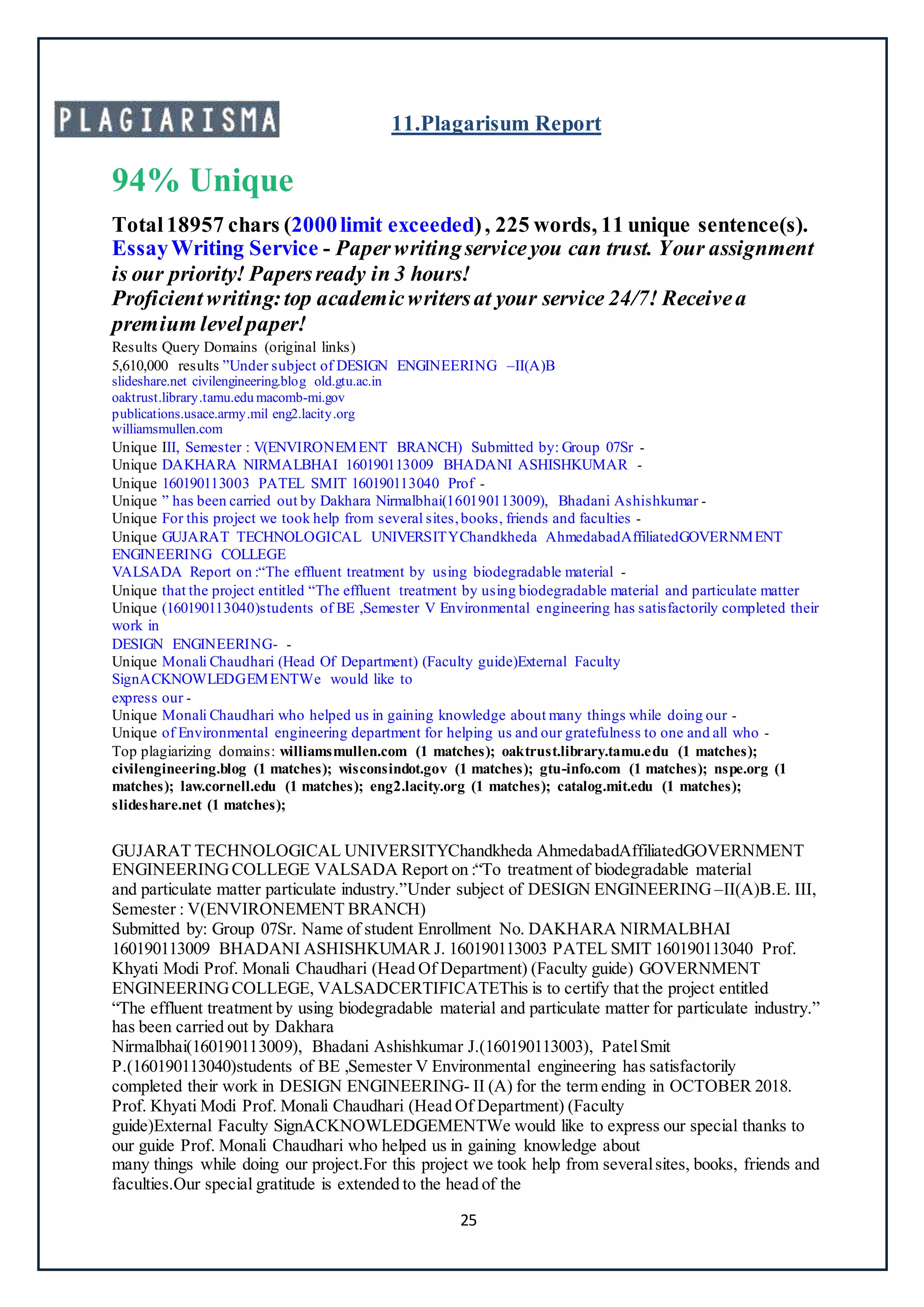
11.Plagarisum Report
94% Unique
Total18957 chars (2000limit exceeded), 225 words, 11 unique sentence(s).
EssayWriting Service - Paperwritingserviceyou can trust. Your assignment
is our priority! Papersready in 3 hours!
Proficientwriting:top academicwritersat your service 24/7! Receivea
premium levelpaper!
Results Query Domains (original links)
5,610,000 results ā€Under subject of DESIGN ENGINEERING –II(A)B
slideshare.net civilengineering.blog old.gtu.ac.in
oaktrust.library.tamu.edu macomb-mi.gov
publications.usace.army.mil eng2.lacity.org
williamsmullen.com
Unique III, Semester : V(ENVIRONEMENT BRANCH) Submitted by: Group 07Sr -
Unique DAKHARA NIRMALBHAI 160190113009 BHADANI ASHISHKUMAR -
Unique 160190113003 PATEL SMIT 160190113040 Prof -
Unique ā€ has been carried out by Dakhara Nirmalbhai(160190113009), Bhadani Ashishkumar -
Unique For this project we took help from several sites,books, friends and faculties -
Unique GUJARAT TECHNOLOGICAL UNIVERSITYChandkheda AhmedabadAffiliatedGOVERNMENT
ENGINEERING COLLEGE
VALSADA Report on :ā€œThe effluent treatment by using biodegradable material -
Unique that the project entitled ā€œThe effluent treatment by using biodegradable material and particulate matter
Unique (160190113040)students of BE ,Semester V Environmental engineering has satisfactorily completed their
work in
DESIGN ENGINEERING- -
Unique Monali Chaudhari (Head Of Department) (Faculty guide)External Faculty
SignACKNOWLEDGEMENTWe would like to
express our -
Unique Monali Chaudhari who helped us in gaining knowledge about many things while doing our -
Unique of Environmental engineering department for helping us and our gratefulness to one and all who -
Top plagiarizing domains: williamsmullen.com (1 matches); oaktrust.library.tamu.edu (1 matches);
civilengineering.blog (1 matches); wisconsindot.gov (1 matches); gtu-info.com (1 matches); nspe.org (1
matches); law.cornell.edu (1 matches); eng2.lacity.org (1 matches); catalog.mit.edu (1 matches);
slideshare.net (1 matches);
Create a FREE account to continue.
GUJARAT TECHNOLOGICAL UNIVERSITYChandkheda AhmedabadAffiliatedGOVERNMENT
ENGINEERINGCOLLEGE VALSADA Report on :ā€œTo treatment of biodegradable material
and particulate matter particulate industry.ā€Under subject of DESIGN ENGINEERING –II(A)B.E. III,
Semester : V(ENVIRONEMENT BRANCH)
Submitted by: Group 07Sr. Name of student Enrollment No. DAKHARA NIRMALBHAI
160190113009 BHADANI ASHISHKUMAR J. 160190113003 PATEL SMIT 160190113040 Prof.
Khyati Modi Prof. Monali Chaudhari (Head Of Department) (Faculty guide) GOVERNMENT
ENGINEERINGCOLLEGE, VALSADCERTIFICATEThis is to certify that the project entitled
ā€œThe effluent treatment by using biodegradable material and particulate matter for particulate industry.ā€
has been carried out by Dakhara
Nirmalbhai(160190113009), Bhadani Ashishkumar J.(160190113003), PatelSmit
P.(160190113040)students of BE ,Semester V Environmental engineering has satisfactorily
completed their work in DESIGN ENGINEERING- II (A) for the term ending in OCTOBER 2018.
Prof. Khyati Modi Prof. Monali Chaudhari (Head Of Department) (Faculty
guide)External Faculty SignACKNOWLEDGEMENTWe would like to express our special thanks to
our guide Prof. Monali Chaudhari who helped us in gaining knowledge about
many things while doing our project.For this project we took help from severalsites, books, friends and
faculties.Our special gratitude is extended to the head of the
26
department and the faculty members of Environmental engineering department for helping us and our
gratefulness to one and all who are directly or indirectly involved in the completion of our project
results.pdf

Design engineering - II (A) report

  • 1.
    1 GUJARAT TECHNOLOGICAL UNIVERSITY ChandkhedaAhmedabad Affiliated GOVERNMENT ENGINEERING COLLEGE VALSAD A Report on : ā€œThe effluent treatment by using Biodegradable material and Particulate matter for Particular Industry.ā€ Under subject of DESIGN ENGINEERING – II (A) B.E. III, Semester : V (ENVIRONEMENT BRANCH) Submitted by: Group 07 Sr. Name of student Enrollment No. 1) DAKHARA NIRMALBHAI 160190113009 2) BHADANI ASHISHKUMAR J. 160190113003 3) PATEL SMIT 160190113040 Prof. Khyati Modi Prof. Monali Chaudhari (Head Of Department) (Faculty guide)
  • 2.
    2 GOVERNMENT ENGINEERING COLLEGE,VALSAD CERTIFICATE This is to certify that the project entitled ā€œ The effluent treatment by using Biodegradable material and Particulate matter for Particular Industry. ā€ has been carried out by Dakhara Nirmalbhai (160190113009), Bhadani Ashishkumar J. (160190113003), Patel Smit P. (160190113040) students of BE III, Semester V Environmental engineering has satisfactorily completed their work in DESIGN ENGINEERING – II (A) for the term ending in OCTOBER - 2018. Prof. Khyati Modi Prof. Monali Chaudhari (Head Of Department) (Faculty guide) External Faculty Sign
  • 3.
    3 ACKNOWLEDGEMENT We would liketo express our special thanks to our guide Prof. Monali Chaudhari who helped us in gaining knowledge about many things while doing our project. For this project we took help from several sites, books, friends and faculties. Our special gratitude is extended to the head of the department and the faculty members of Environmental engineering department for helping us and our gratefulness to one and all who are directly or indirectly involved in the completion of our project work.
  • 4.
    4 ABSTRACT The main objectiveof this project is effluent treatment by using biodegradable material and particulate matter for the particular industry. In the following to know the advantages and limitation of the model we are working on. This project will help the users to convert influent water into fresh water. Its main aim is to Reduce the Toxic Elements, Salts, TDS, TSS from the wastewater and provide a fresh water to users and also provide a eco-friendly and pollution free environment.[4]
  • 5.
    5 INDEX 1. TITLE…………………………………………………………………………………01 2. CERTIFICATE………………………………………………………………….........02 3.ACKNOWLEDGEMENT……………………………………………………………03 4. ABSTRACT…………………………………………………………………………...04 5. INDAX OF CANVAS………………………………………………………………...06 6. INTRODUCTION……..……………………………………………………………..07 7. REVERSE ENGINEERING….……………………………………………………...09 7.1 DEFINATION……………………………………………………….....................09 7.2 AEIOU CANVAS…………………………………………………………………09 7.3 EMPATHY CANAVAS……………………………………………………….….12 7.4 PRODUCT DEVELOPMENT CANVAS……………………………………….15 7.5 IDEATION CANVAS…………………………………………………………….17 7.6 MIND MAPPING CANAVAS…………………………………………………...19 8. LEARNING NEED MATRIX……………………………………………………….21 9. PROTOTYPE MODEL……………………………………………………………...23 10. REFRENCES…………………………………………………………………………24 11. PLAGIARISUM REPORT………………………………………………………….25
  • 6.
    6 INDEX OF CANVAS 7.2.1AEIOU SHEET………………………………………………………………………...11 7.3.1 EMPATHY SHEET……………………………………………………………………14 7.4.1 PRODUCT DEVELOPMENT SHEET……………………………………………...16 7.5.1 IDEATION SHEET……………………………………………………………………18 7.6.1 MIND MAP SHEET…………………………………………………………………...20 8.0.1 LEARNING NEED MATRIX SHEET………………………………………………22 9.0.1 PROTOTYPE ……………………………………………………………………….23
  • 7.
    7 6.INTRODUCTION:- Everyone needs water.Supplies of water are vital for agriculture, industry, recreation and human consumption. One problem that the water industry faces is disposal of concentrate from advanced water treatment processes.[1] This report discusses influent treatment process one possible solution to concentrate disposal. Water is required in several fundamental process operations such scrubbing, extraction, steam generation etc.[4] Advantages and disadvantages of influent treatment process are currently being seriously considered and discussed. Influent treatment process minimizes the consumption of fresh water to that of make-up; therefore’ it should help relieve freshwater availability limitations in places where it is scarce or expensive.[1] Purchased water, and waste water treatment and disposal coast can significant; thus, saving associated with minimized site makeup water and waste water flows can justify capital expenditures to minimize, if not completely eliminated, wastewater flows.[4] Influent treatment process can save money on real estate costs in the case of new facility construction, since location near a suitable receiving waterway would not necessary.[3] On the other hand, sometimes the disadvantages of implementing influent treatment process include higher cost due to treatment of water to the extent it is suitable for reuse, or higher capital cost in retrofit projects due to large scale restructuring of piping and the arrangement of the disposal of the solid waste generated.[1] Some of methodologies and compare their results that can apply to the influent treatment process or at least decrease the amount of liquid.[1]
  • 8.
    8 A) What isDesignThinking?:- A method of problem of waste water treatment. In this method the reduce the influent of waste water. In this method we connected the solution of the waste water treatment process. B) Importance of design thinking and socio-economic relevance:- The ultimate goal of design thinking is not merely making things that people enjoy or creating awareness of the company. When design creates feelings of empowerment, people are eager to share their experience with outlets. This cycle is essential for generating demand virally and building brand loyalty. C) Team building and its importance:- Team building is an ongoing process that helps a work group evolve into a cohesive unit. The team members not only share expectations for accomplishing group tasks, but trusts and support one another and respect one another’s individual differences.[5] This subject taught us to work in a group, to understand each other’s weak point as well as strong point. As we work in a group or a team all wants their project to be best hence, all focuses on project. Hence it teaches us to how to compete with other team than with individual. There are many members in group hence all the minds have different ideas and creativity which give out a best possible result.[5] D) Importance of a log book exercises:- This exercise is important because everyone wants their canvas to be perfect and neat and tidy so by using log books we can make first a rough idea of sheet which helps us to keep our canvas clean and also we can make changes in log books which we cannot do in canvas. E) Learning Tools:- The tools involve in Design engineering process are, • Log book exercise • Group discussion • Internet • Faculties guidance • AEIOU canvas • Empathy Mapping canvas • Mind Mapping canvas • Product development canvas • Ideation canvas
  • 9.
    9 7. Reverse Engineering:- 7.1DEFINATION: Reverse Engineering also called as Back Engineering, is the process of extracting knowledge or design information from any man-made thing and then reproducing it by following the Design process. Thus from a user’s point of view, there may be a need to modify some features or to add some features.[6] 7.2AEIOU SHEET: a. It is commonly used for coding observational data. b. Organizational framework help designers to capture key c. Details in observation and AEIOU is very easy mnemonic d. Device to remember what to look for and write down. i) Activities:- Observation: Recent Scenario of ZLD Literature survey on absorption material, Literature survey on Bio-degradable material, Analysis of effluent. Elements Features: Utilization of waste particulate matter to reduce color and odour,[1] Utilization of waste Bio-degradable material to reduce TDS, TSS.[1] ii) Environment: Observations: Maximum Reuse of water,[1] Eco-friendly system, [1] Analysis of various component of water[1] Elements Features: Not affect to eco cycle & bio-logical cycle,[1] Minimize the affect of water due to water problem.[1] . iii) Interactions: Observation: In between Student & Guide In between Student & Industry In between Student, Guide & Industry In between group members Elements Features: Guidance, advice, New ideas, more knowledge about topic.
  • 10.
    10 iv) Objects: Observations: (01)Mesh (02)Filter Paper (03) Packed bed column (04) Bio-degradable material (05) Particular matter (06) TDS meter (07) PH meter (08) funnels (09) Stands Elements Features: To pass the effluent through the filter paper, filter made by bio degradable Material v) Users: . Observations: Industries :- Reduce cost of water treatment Government: - Increase economy Elements Features: Varies type of industries Government treatment plants CETP (Common effluent treatment plant) c) Feedback analysis: When the project was implemented it was found that the use of this process in industry is very low.[2] So most of industry discharge waste water as well as or for treatment to send other treatment plant because this process is very costly.[7] The use of this process is increase then the use of fresh water decrease and the water source in environment is as well as. d) Summary about Project: This is a project based on the recycling or reuse of waste water. But the process is required more cost.[3] So most up small industry not acceptable this process but the some technical modification required for this project for decrease the operating cost by the some engineer and technician. e) Summary of learning from Reverse Engineering: Due to reverse engineering we came across a major problem of our product i.e. the proper modification is required.[3] And we use the coconut shell for the filtration process involving absorption process[1]. So not more removing the waste from the effluent. So industry is not accept the project, we came to know from reverses engineering. Solution of the entire problem and a way to overcome its limitations.[1]
  • 11.
  • 12.
    12 7.3 EMPATHY CANVAS: Theseare the second stepof the project or problem. In this canvas, you have to find out what are users to your problems? Who are stakeholders? What are the activities? And what are broad stories of their activities? User:- ļ‚· Dyeing Industries ļ‚· Textile Industries ļ‚· CETP (Common effluent treatment plant) ļ‚· Process Industries Stake holders:- ļ‚· Industries ļ‚· Government ļ‚· Environmental Engineer Activities:- ļ‚· Selection of topic ļ‚· Selection of Industrial Effluent ļ‚· Recent Scenario of ZLD ļ‚· Literature Survey on absorption material ļ‚· Literature Survey on Bio-degradable Material[1] ļ‚· Analysis Of Effluent
  • 13.
    13  Happy Story:- Treatingwaste water we can reuse. It in process industry for various purposelike using water in boiler and cooling tower. Treating water we can use in some process and this water is very use to clean tank and many processing equipments.[7]  Happy Story:- For treatment of waste water we will use Bio-degradable materials and flyash. Bio-degradable material is eco-friendly and fly ash is waste product.[7] treating waste water we can use as instead of pure water and after this process we can get pure water. So reduce the pollution of water by industry effluent.[7]  Sad story:- In process industry further modification is required in effluent treatment plant.[1] So cost of treatment plant is increased. Small industry is not accept this treatment process because this is very costly.[7]  Sad story:- Proper designing and optimization is not carry out at initial stage for space and process time. So some industry is not accept.[3] Developers and designer is trying hard to bring down capital cost and take needed electricity.[7]
  • 14.
  • 15.
    15 7.4 PRODUCT DEVELOPMENTCANVAS: Thisstep is about development of the product. Define purpose. What are the experience when you compare it with other product? Problems for its application and its solution. What are the components used for its model. following things is to do. • Purpose:-(1)Reduce the waste water load on ETP.[7] (2)Maximize the use of waste water in plant itself or Gardening. (3) Reduce the use of fresh water in industry.[1] • People:-(1) Process Designer (2) Engineers (3) Lab Technician • Product experience:-(1)Primary experiment are going on. (2)Experience share after some Modification. • Product functions:-(1) Possible removal of color and odor. (2) Removal of TDS, TSS[1] • Product features:-(1) Utilization of waste particulate matter to Reduce color and odor.[1] (2) Utilization of waste bio-degradable material to reduce TDS, TSS.[2] • Components:- (01) Mesh (02) Filter Paper (03) Packed bed column (04) Bio-degradable material (05) Particular matter (06) TDS meter (07) PH meter (08) Calorimeter (09) funnels (10) Stands
  • 16.
  • 17.
    17 7.5IDEATION CANVAS: From theEmpathy mapping canvas, you have an idea what are the people involve in this project? In ideation canvas, you have to carry out which type of activities is related to your project and people? What is situation and location regarding to activities? Then after you find the possible solutions. It is depend or not depend to your activities. People:- :- (1) Process Designer (2) Engineer (3) Lab. Technician Activities:- (1) Selection of Industry (2) Characterization of industrial effluent[2] (3) Recent scenario of ZLD (4) Literature Survey on absorption material (5)Literature Survey on bio-degradable material[1] Situation/context/location:- (01) Reduce the TDS, TSS[1] (02) Reduce the odor and color[1] (03) Improve the water Quality (04) Reuse of water[1] (05) Recycle of Industrial discharge Props/possible solutions:- (01) Mesh (02) Filter Paper (03) Packed bed column (04) Bio-degradable material (05) Funnel and Stand (06) TDS, PH meter (07) Chemicals (08) Waste Water Sample
  • 18.
  • 19.
    19 7.6MIND MAPPING: Graphical techniquefor visualizing connections between several ideas or pieces of information. Each idea or fact is written down and they linked by lines or curves to its major or minor idea or fact, thus creating a web of relationships. There are mainly 5 things you have to define, 1)Uses:- ļ‚· Dyeing Industries ļ‚· Textile Industries ļ‚· CETP (Common effluent treatment plant) ļ‚· Process Industries 2) Advantages:- (1) Treating wastewater reuse in process Industry for different Propose.[1] (2) Eco logical Process (3) Water use for boiler cooling process 3) Disadvantages:- (1) In process further modification is required (2) Cost of treatment plant is more required[3] (3) More electricity required 4) Customer Revalidation :- (1) In Dying industry waste water load is higher so modification is Required. (2) After modification water Quality is checked. (3) Feasibility and cost also consider for further revalidation.
  • 20.
  • 21.
    21 8.LEARNING NEED MATRIX:- Learningneed matrix has a fundamental role in education. It helps you to find out which method/theories you need to learn which application process is involved. What are the component used in the product and analysis of each and every individual components and the environment required for its working. There are 3 stages in which the learning process is divided • Purpose/product concept: - :-(1)Reduce the waste water load on ETP.[3] (2)Maximize the use of waste water in plant itself or Gardening.[7] (3) Reduce the use of fresh water in industry.[1] During stage-1:- -Basic idea and the use of the biodegradable matter to produce the fresh water. - Different drawbacks we have deal with are listed below; a. In India, most of industry is carried do not this effluent treatment process and directly discharge of effluent into river. b. Most industry is carried mineral water from the river due to the cost and employment of this process. - For the above mentioned challenges the solutions we have opted for are; a. We are making the basis model for the step effluent treatment process by use of biodegradable matter. It is very suited for the effluent treatment process. b. This process is required less cost more efficient for the recycle of waste water.[2] During stage-2:- - Basic equations of mathematics for the known the value of the impurities in the effluents. - To find out the basic theorises behind the processes and knowing about that theorises. - Fetching some research papers and find out the mathematically relationship in each other. - Searching new material for the use as the adsorption material and filter media.
  • 22.
  • 23.
  • 24.
    24 10.REFERENCES:- [1] Achieving compliancewith zero liquid discharge norms by N.K. Srivastava, 3rd Annual conference on ā€œBalance of plantā€ New Delhi 22nd and 23rd May 2013. [2] M. Helen kalavathy, t. karthikeyan, s. rajgopal and lima rose Miranda(2005), kinetic and isotherm study of cu(2) adsorption onto h3po4 activate rubber wood sawdust. Journal of colloid and interface science 292,354-362. [3] Report of Reed Beds or Compost Trickling Filters as Low-Cost Technology to Treat Industrial Effluents and Winery wastewater. [4] https://gpcb.gov.in/images/pdf/ZLD_PRESENTATION_5.PDF [5] https://en.wikipedia.org/wiki/Teamwork [6] https://en.wikipedia.org/wiki/Reverse_engineering [7] https://www.samcotech.com/what-is-zero-liquid-discharge-and-how-does-it-work/ [8] scanned sheet photograph through the camera
  • 25.
    25 11.Plagarisum Report 94% Unique Total18957chars (2000limit exceeded), 225 words, 11 unique sentence(s). EssayWriting Service - Paperwritingserviceyou can trust. Your assignment is our priority! Papersready in 3 hours! Proficientwriting:top academicwritersat your service 24/7! Receivea premium levelpaper! Results Query Domains (original links) 5,610,000 results ā€Under subject of DESIGN ENGINEERING –II(A)B slideshare.net civilengineering.blog old.gtu.ac.in oaktrust.library.tamu.edu macomb-mi.gov publications.usace.army.mil eng2.lacity.org williamsmullen.com Unique III, Semester : V(ENVIRONEMENT BRANCH) Submitted by: Group 07Sr - Unique DAKHARA NIRMALBHAI 160190113009 BHADANI ASHISHKUMAR - Unique 160190113003 PATEL SMIT 160190113040 Prof - Unique ā€ has been carried out by Dakhara Nirmalbhai(160190113009), Bhadani Ashishkumar - Unique For this project we took help from several sites,books, friends and faculties - Unique GUJARAT TECHNOLOGICAL UNIVERSITYChandkheda AhmedabadAffiliatedGOVERNMENT ENGINEERING COLLEGE VALSADA Report on :ā€œThe effluent treatment by using biodegradable material - Unique that the project entitled ā€œThe effluent treatment by using biodegradable material and particulate matter Unique (160190113040)students of BE ,Semester V Environmental engineering has satisfactorily completed their work in DESIGN ENGINEERING- - Unique Monali Chaudhari (Head Of Department) (Faculty guide)External Faculty SignACKNOWLEDGEMENTWe would like to express our - Unique Monali Chaudhari who helped us in gaining knowledge about many things while doing our - Unique of Environmental engineering department for helping us and our gratefulness to one and all who - Top plagiarizing domains: williamsmullen.com (1 matches); oaktrust.library.tamu.edu (1 matches); civilengineering.blog (1 matches); wisconsindot.gov (1 matches); gtu-info.com (1 matches); nspe.org (1 matches); law.cornell.edu (1 matches); eng2.lacity.org (1 matches); catalog.mit.edu (1 matches); slideshare.net (1 matches); Create a FREE account to continue. GUJARAT TECHNOLOGICAL UNIVERSITYChandkheda AhmedabadAffiliatedGOVERNMENT ENGINEERINGCOLLEGE VALSADA Report on :ā€œTo treatment of biodegradable material and particulate matter particulate industry.ā€Under subject of DESIGN ENGINEERING –II(A)B.E. III, Semester : V(ENVIRONEMENT BRANCH) Submitted by: Group 07Sr. Name of student Enrollment No. DAKHARA NIRMALBHAI 160190113009 BHADANI ASHISHKUMAR J. 160190113003 PATEL SMIT 160190113040 Prof. Khyati Modi Prof. Monali Chaudhari (Head Of Department) (Faculty guide) GOVERNMENT ENGINEERINGCOLLEGE, VALSADCERTIFICATEThis is to certify that the project entitled ā€œThe effluent treatment by using biodegradable material and particulate matter for particulate industry.ā€ has been carried out by Dakhara Nirmalbhai(160190113009), Bhadani Ashishkumar J.(160190113003), PatelSmit P.(160190113040)students of BE ,Semester V Environmental engineering has satisfactorily completed their work in DESIGN ENGINEERING- II (A) for the term ending in OCTOBER 2018. Prof. Khyati Modi Prof. Monali Chaudhari (Head Of Department) (Faculty guide)External Faculty SignACKNOWLEDGEMENTWe would like to express our special thanks to our guide Prof. Monali Chaudhari who helped us in gaining knowledge about many things while doing our project.For this project we took help from severalsites, books, friends and faculties.Our special gratitude is extended to the head of the
  • 26.
    26 department and thefaculty members of Environmental engineering department for helping us and our gratefulness to one and all who are directly or indirectly involved in the completion of our project results.pdf