ARTICULATION
Of FORM
THEORY OF DESIGN
BAR-605
ASSIGNMENT- 1
SUBMITTED TO:
Ar. Mohili Jain
ASST. Professor
SUBMITTED BY:
Hemant Diyalani
B.ARCH, VI SEM, III YEAR
ARTICULATI
ON
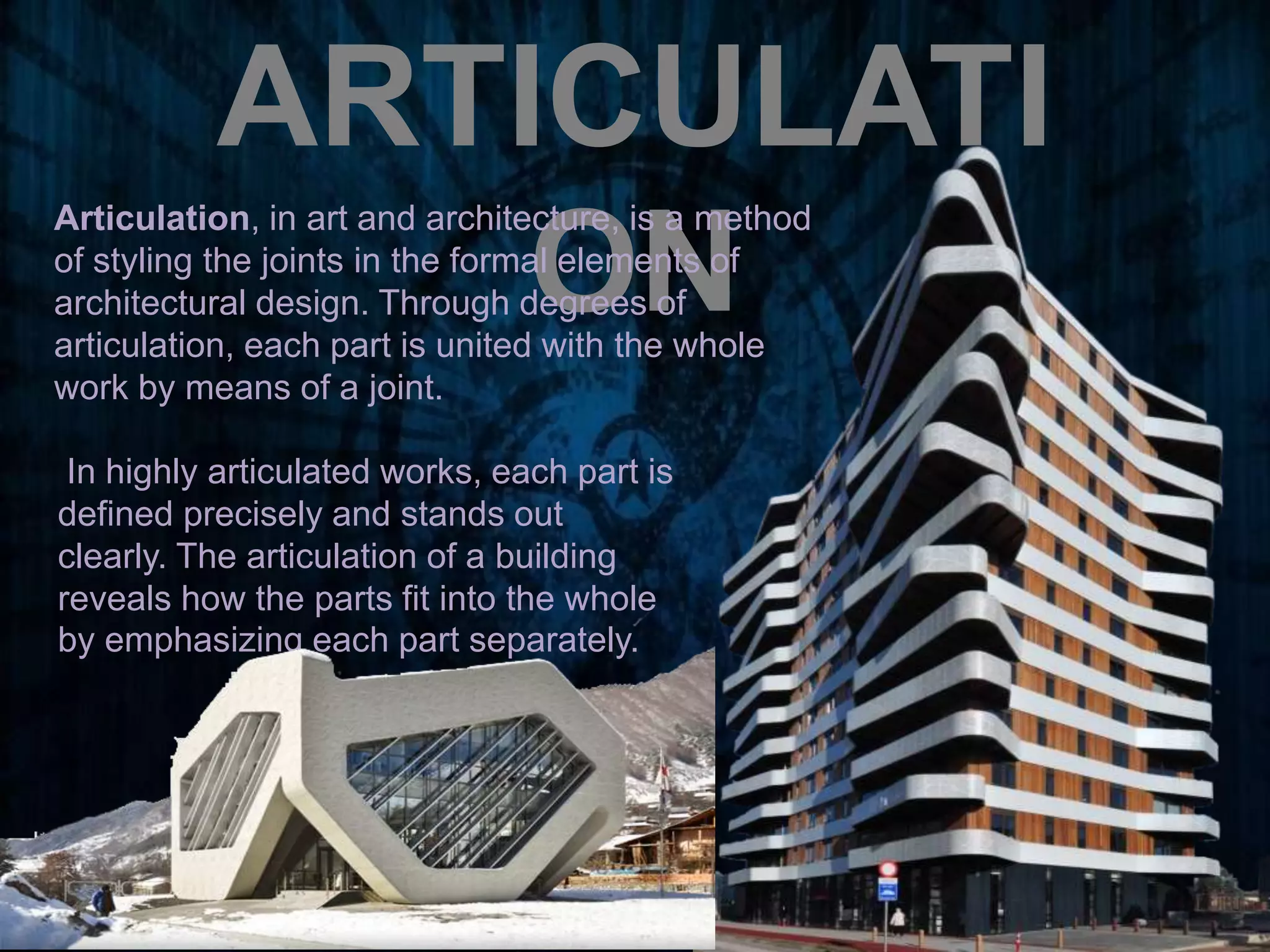
Articulation, in art and architecture, is a method
of styling the joints in the formal elements of
architectural design. Through degrees of
articulation, each part is united with the whole
work by means of a joint.
In highly articulated works, each part is
defined precisely and stands out
clearly. The articulation of a building
reveals how the parts fit into the whole
by emphasizing each part separately.
ARTICULATION
OF FORM
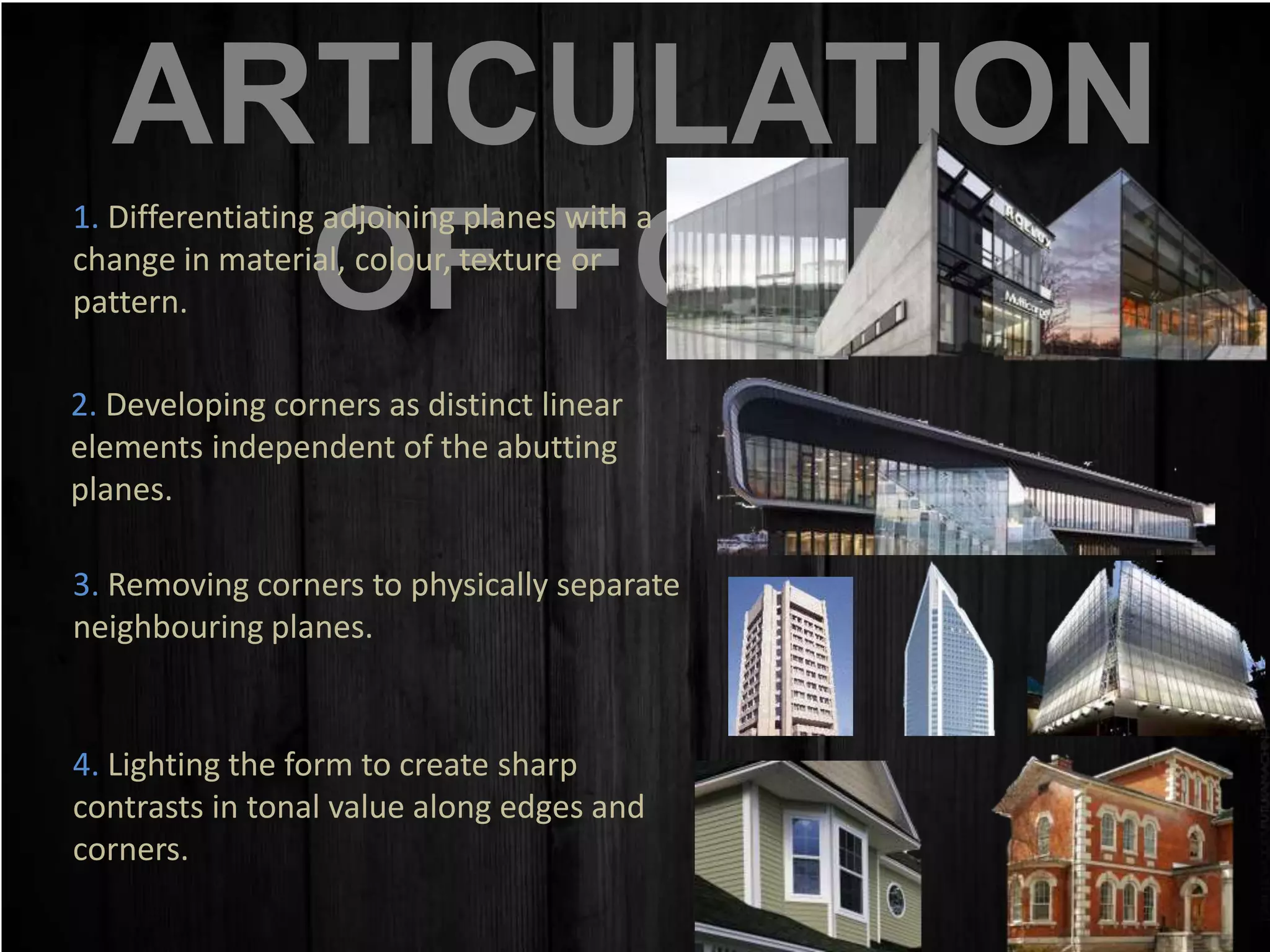
1. Differentiating adjoining planes with a
change in material, colour, texture or
pattern.
2. Developing corners as distinct linear
elements independent of the abutting
planes.
3. Removing corners to physically separate
neighbouring planes.
4. Lighting the form to create sharp
contrasts in tonal value along edges and
corners.
CORNER
ARTICULATION
Since the articulation of a form depends to a great degree on how its
surfaces meet each other at corners, how these edge conditions are
resolved is critical to the definition and clarity of a form.
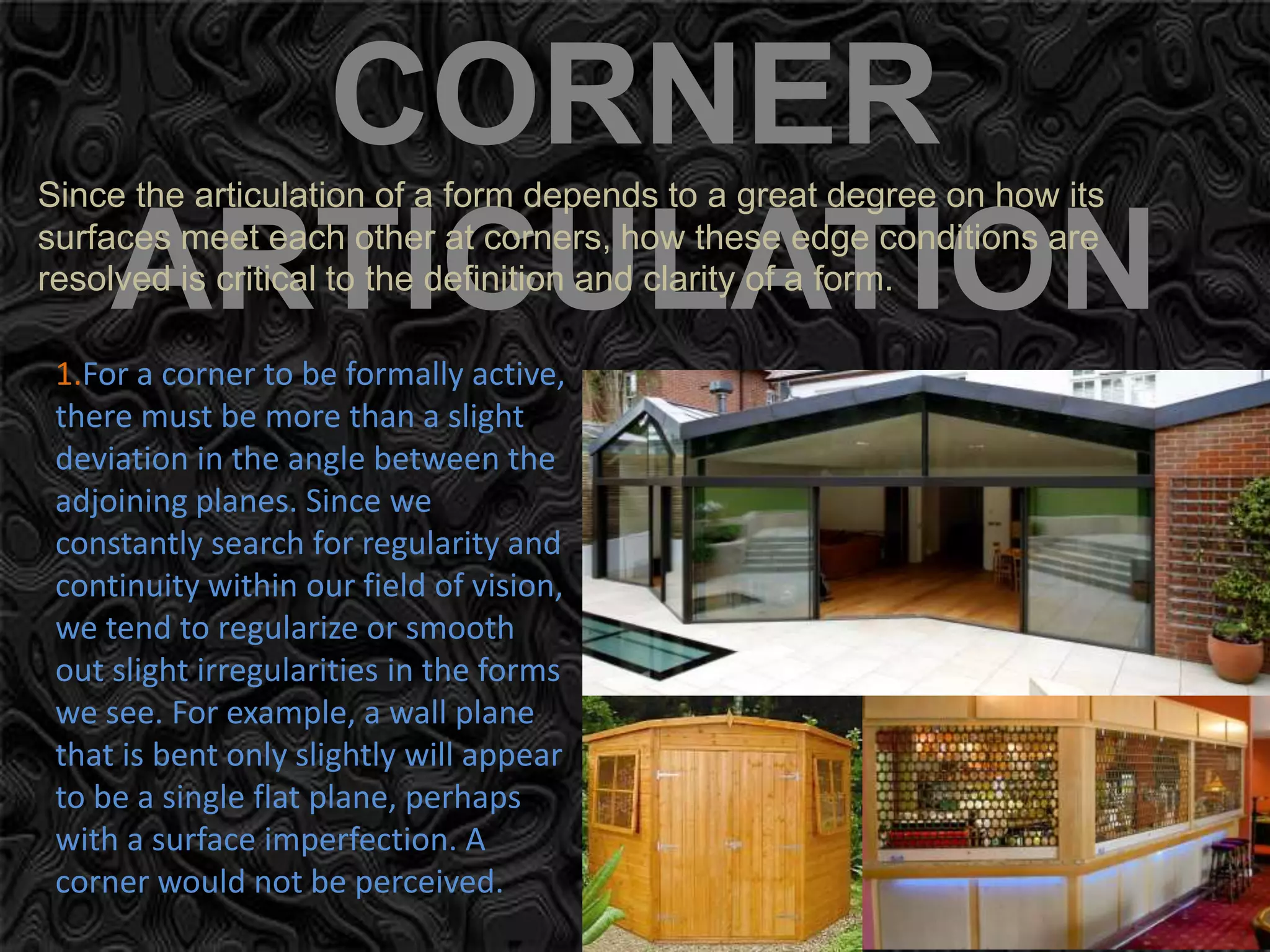
1.For a corner to be formally active,
there must be more than a slight
deviation in the angle between the
adjoining planes. Since we
constantly search for regularity and
continuity within our field of vision,
we tend to regularize or smooth
out slight irregularities in the forms
we see. For example, a wall plane
that is bent only slightly will appear
to be a single flat plane, perhaps
with a surface imperfection. A
corner would not be perceived.
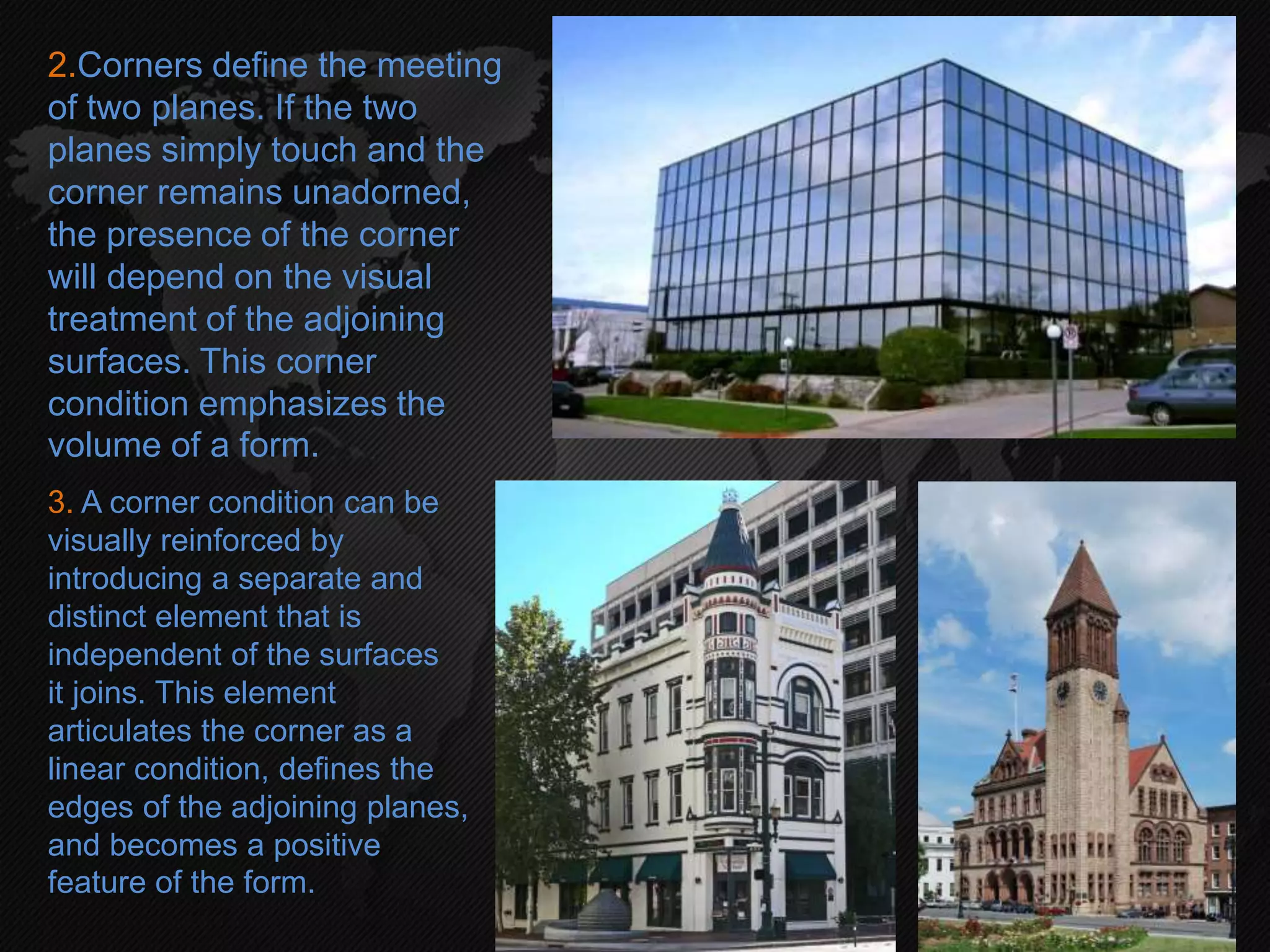
2.Corners define the meeting
of two planes. If the two
planes simply touch and the
corner remains unadorned,
the presence of the corner
will depend on the visual
treatment of the adjoining
surfaces. This corner
condition emphasizes the
volume of a form.
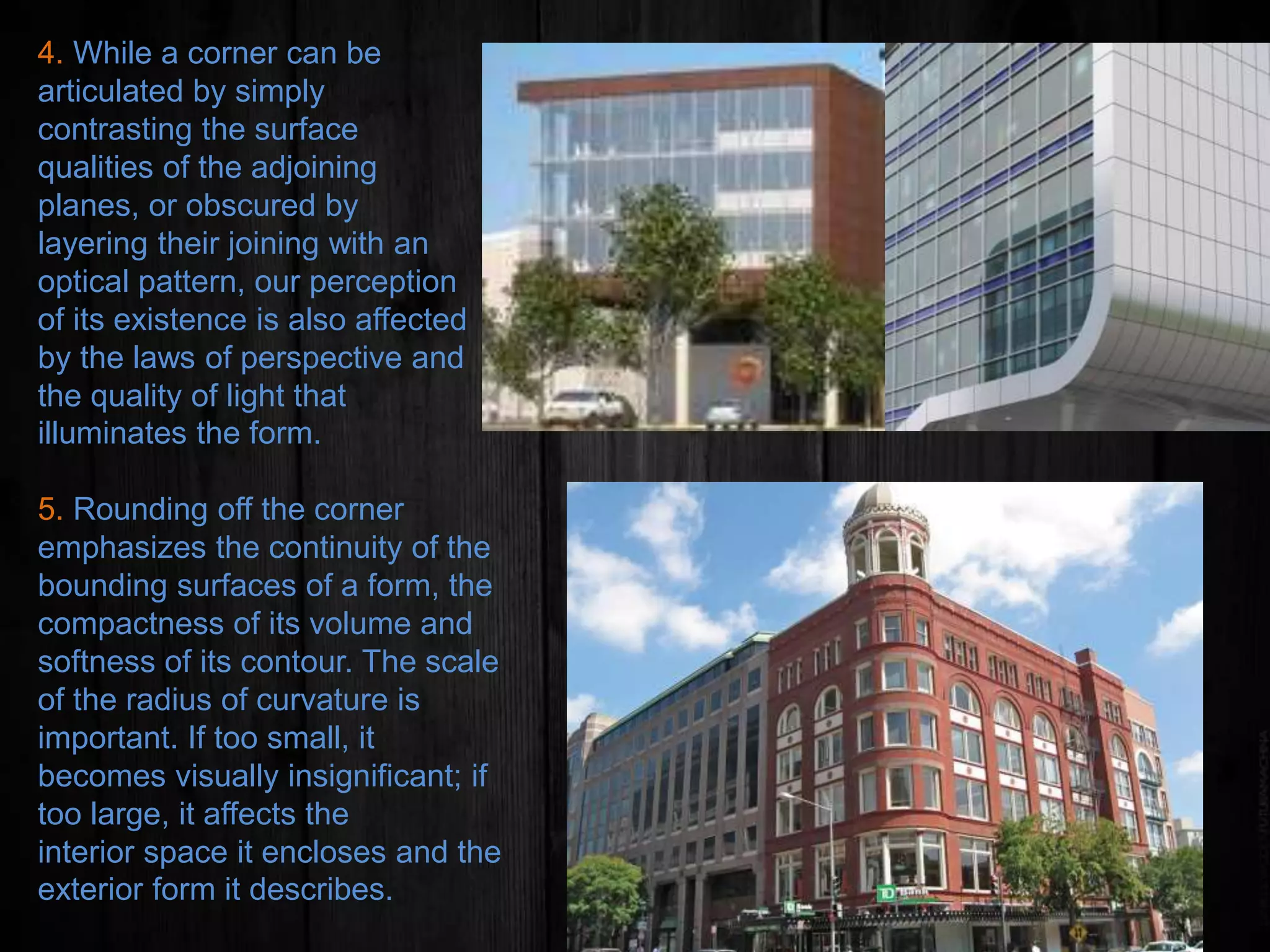
3. A corner condition can be
visually reinforced by
introducing a separate and
distinct element that is
independent of the surfaces
it joins. This element
articulates the corner as a
linear condition, defines the
edges of the adjoining planes,
and becomes a positive
feature of the form.
4. While a corner can be
articulated by simply
contrasting the surface
qualities of the adjoining
planes, or obscured by
layering their joining with an
optical pattern, our perception
of its existence is also affected
by the laws of perspective and
the quality of light that
illuminates the form.
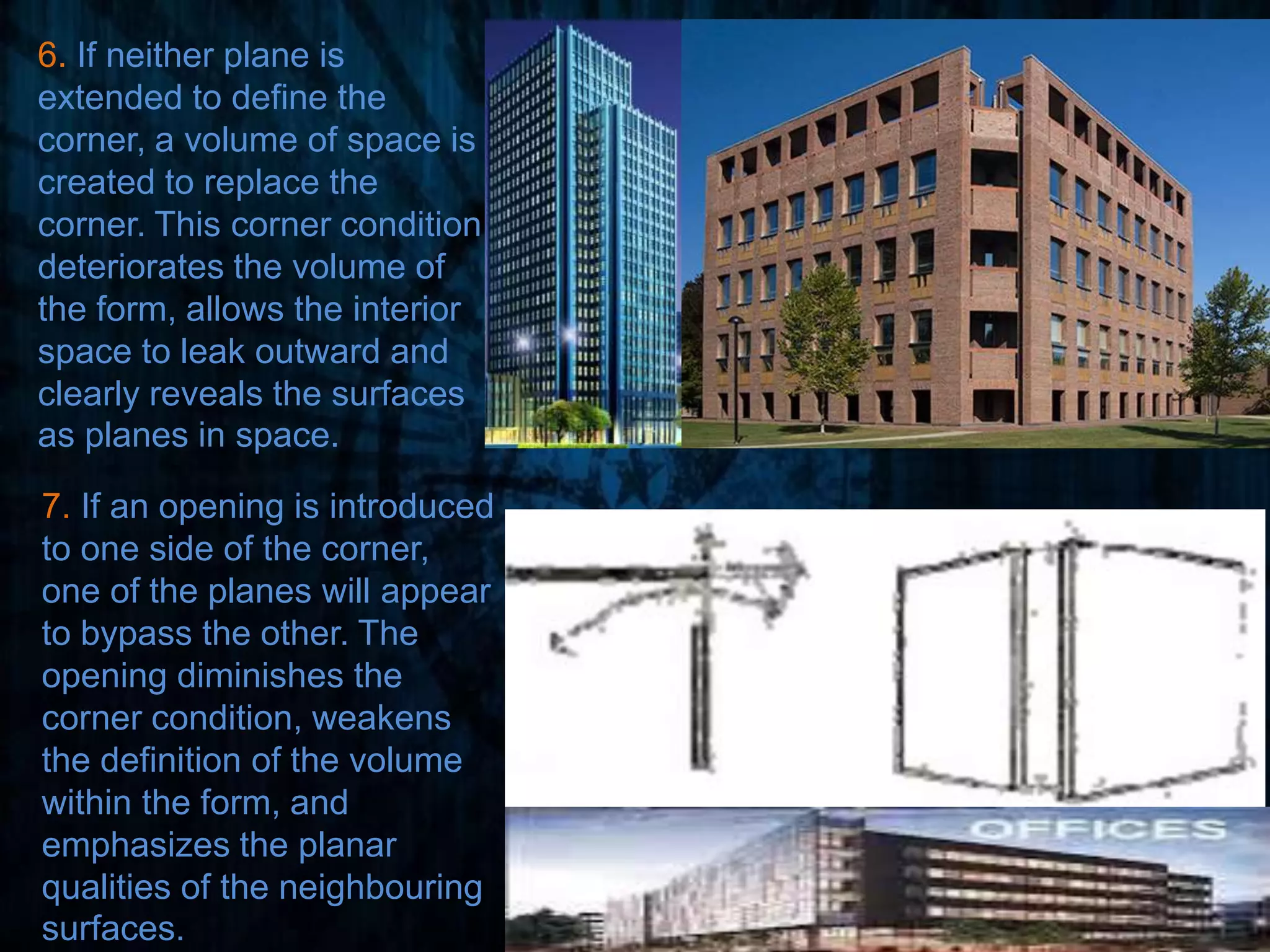
5. Rounding off the corner
emphasizes the continuity of the
bounding surfaces of a form, the
compactness of its volume and
softness of its contour. The scale
of the radius of curvature is
important. If too small, it
becomes visually insignificant; if
too large, it affects the
interior space it encloses and the
exterior form it describes.
6. If neither plane is
extended to define the
corner, a volume of space is
created to replace the
corner. This corner condition
deteriorates the volume of
the form, allows the interior
space to leak outward and
clearly reveals the surfaces
as planes in space.
7. If an opening is introduced
to one side of the corner,
one of the planes will appear
to bypass the other. The
opening diminishes the
corner condition, weakens
the definition of the volume
within the form, and
emphasizes the planar
qualities of the neighbouring
surfaces.
SURFACE
ARTICULATION
Our perception of the shape, size scale, proportion and visual weight of a
plane is influenced by its surface properties as well as its visual context.
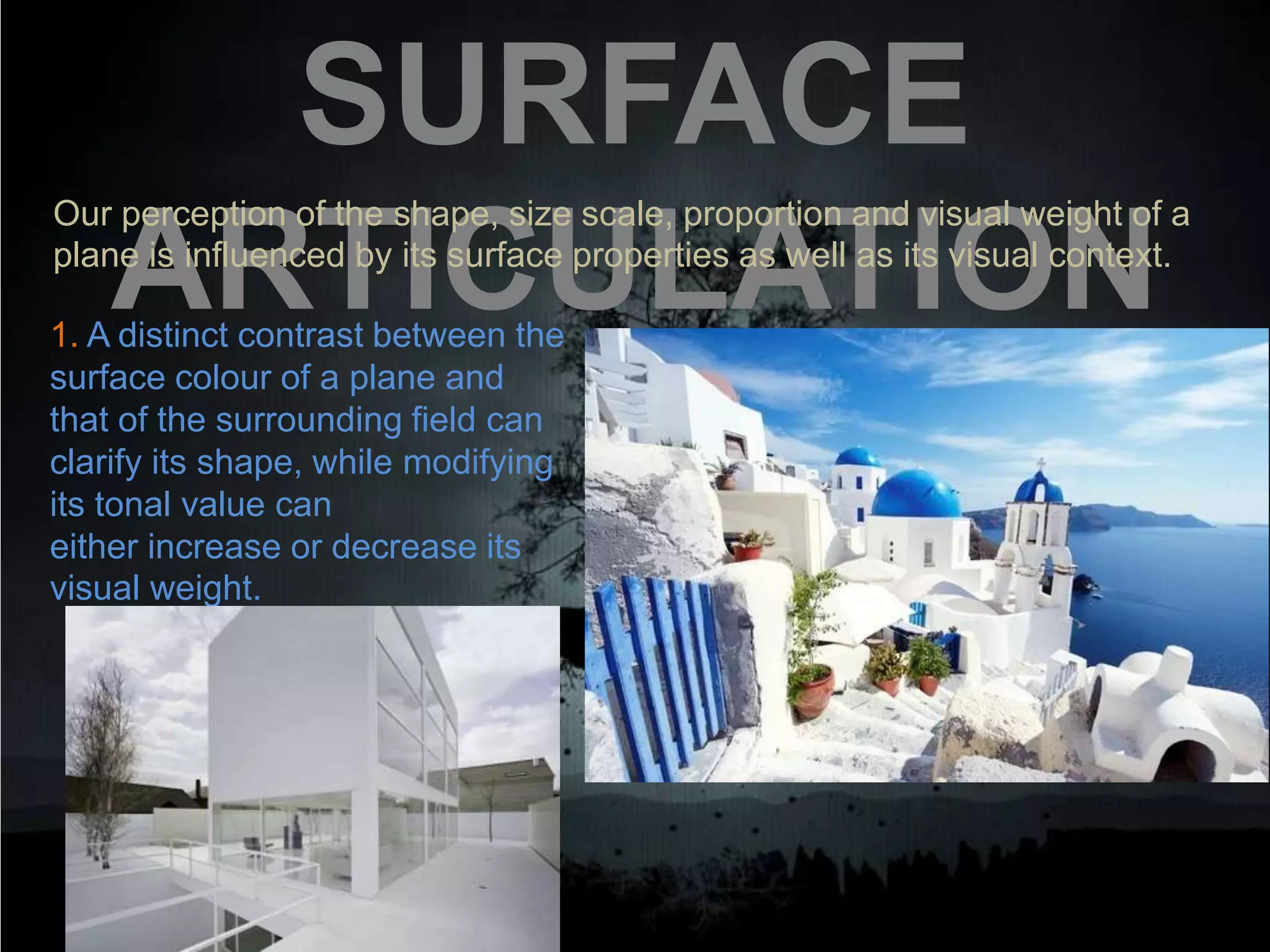
1. A distinct contrast between the
surface colour of a plane and
that of the surrounding field can
clarify its shape, while modifying
its tonal value can
either increase or decrease its
visual weight.
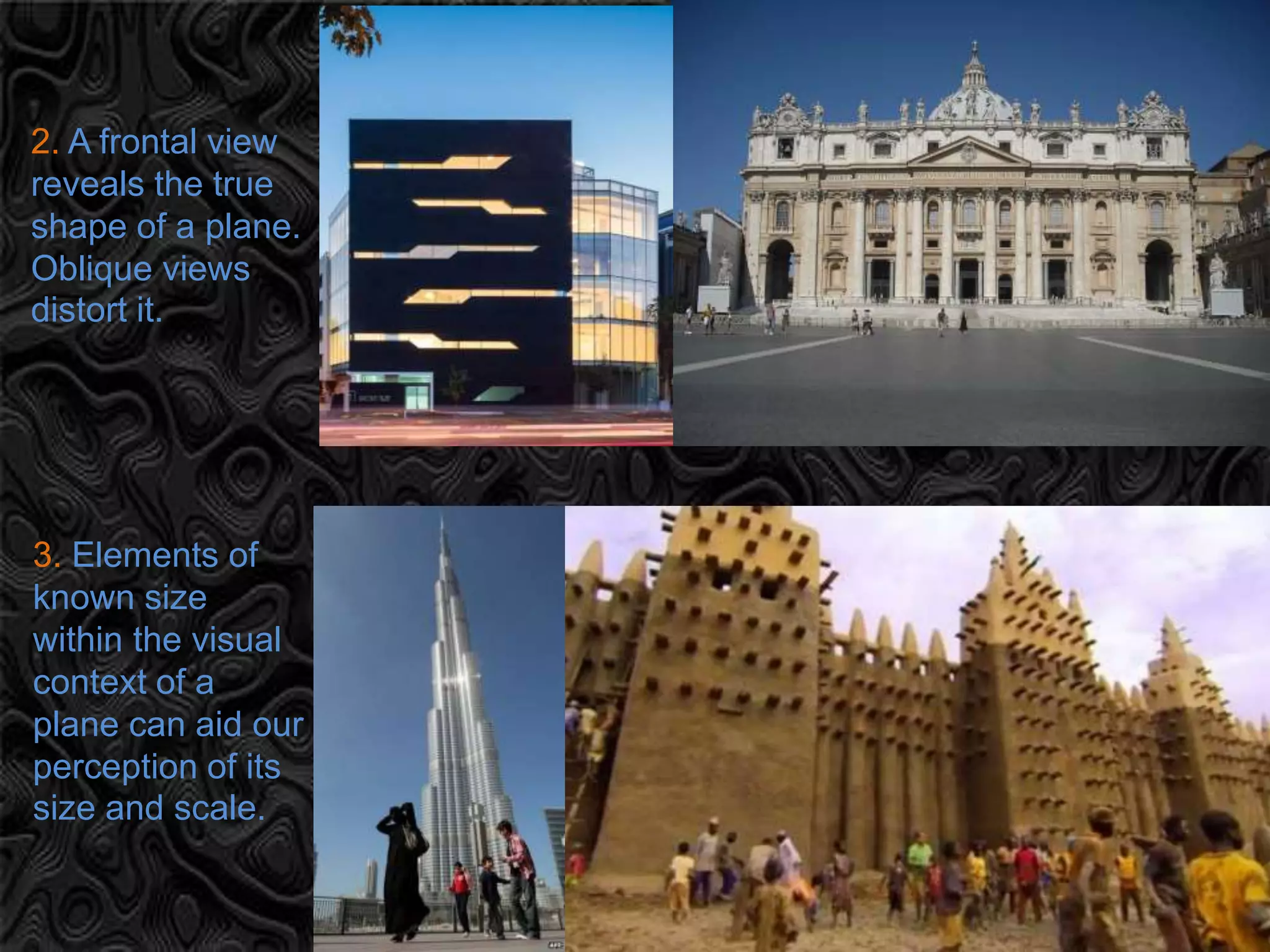
2. A frontal view
reveals the true
shape of a plane.
Oblique views
distort it.
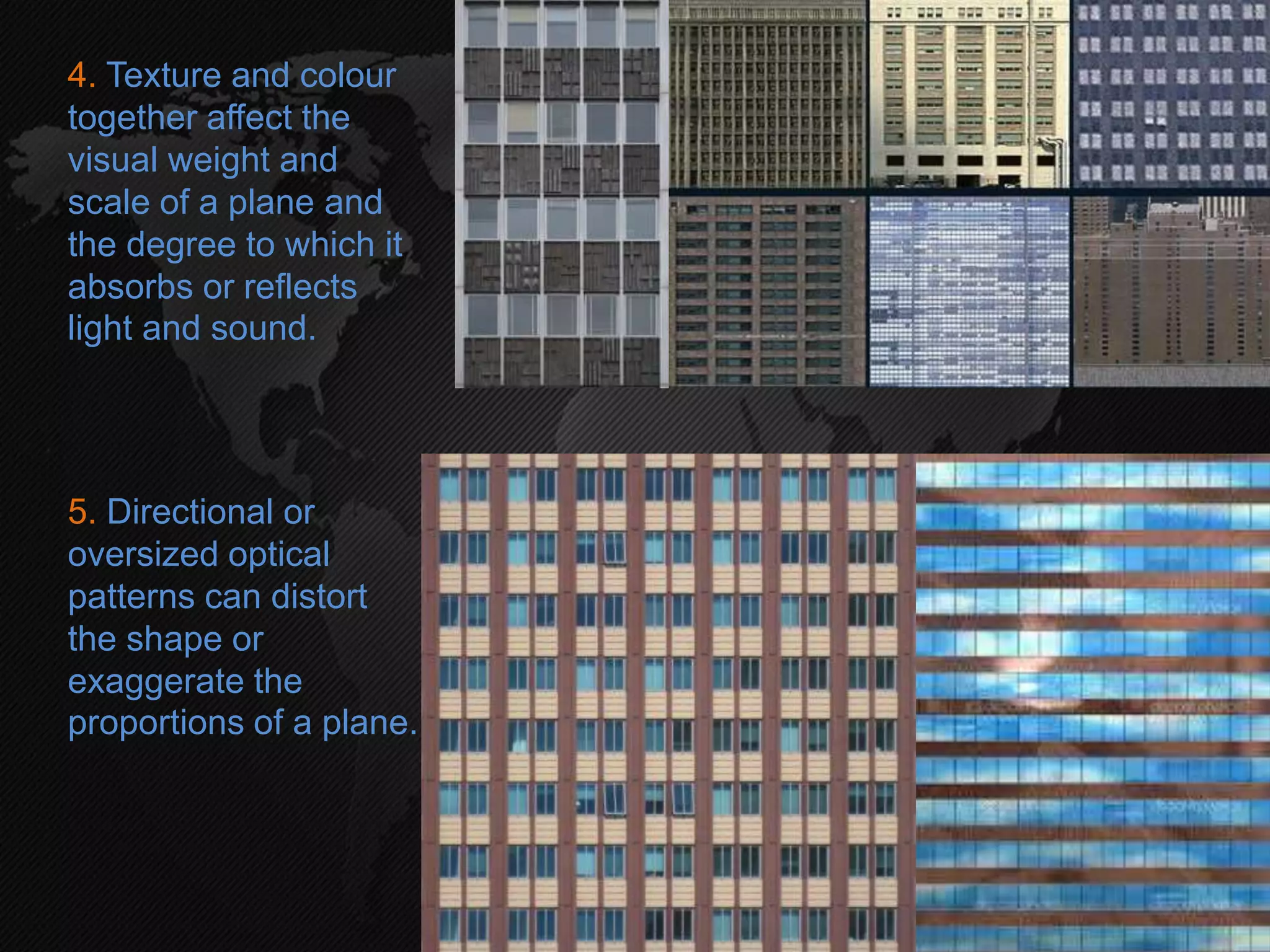
3. Elements of
known size
within the visual
context of a
plane can aid our
perception of its
size and scale.
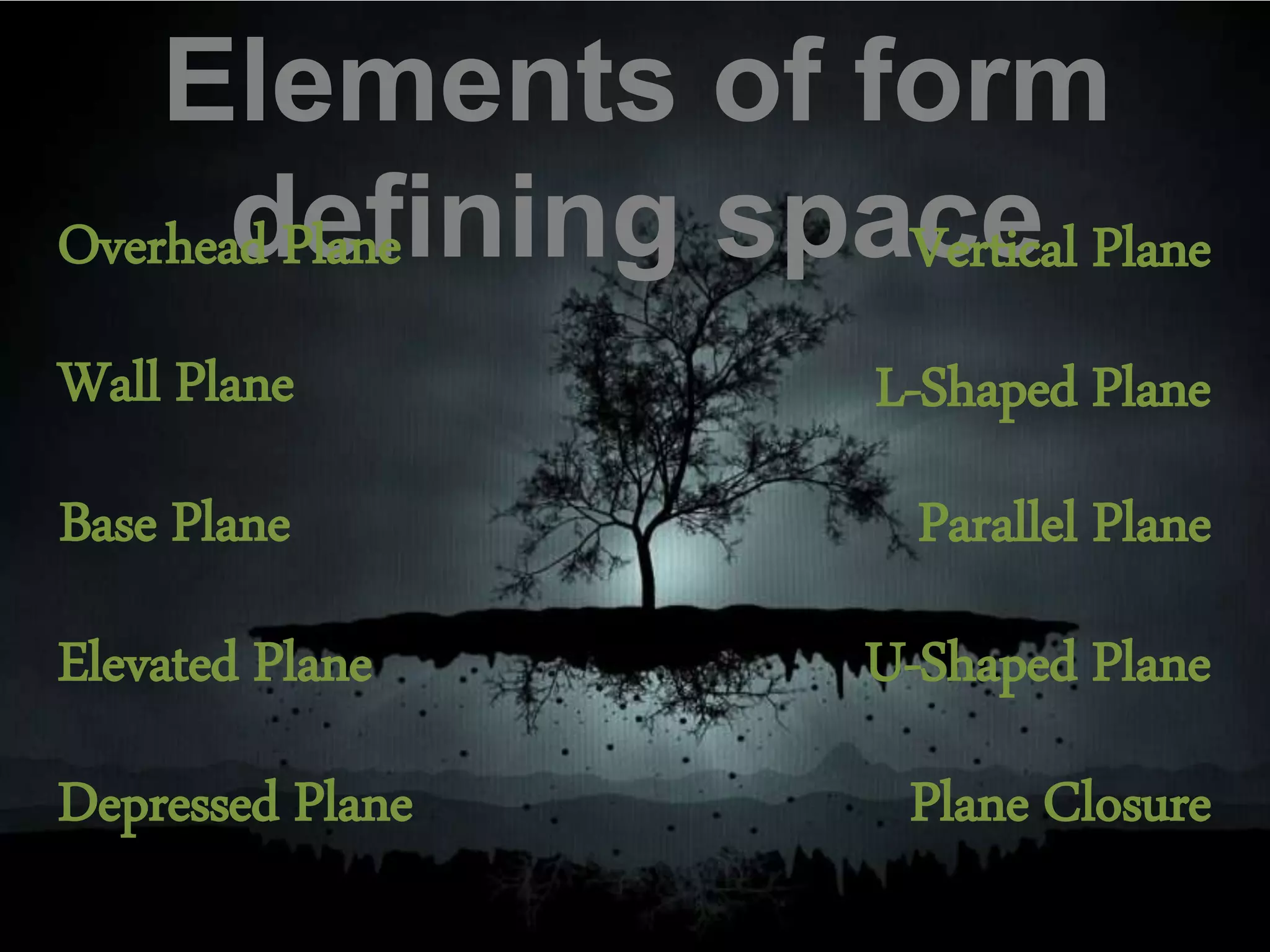
4. Texture and colour
together affect the
visual weight and
scale of a plane and
the degree to which it
absorbs or reflects
light and sound.
5. Directional or
oversized optical
patterns can distort
the shape or
exaggerate the
proportions of a plane.
Elements of form
defining spaceOverhead Plane
Wall Plane
Base Plane
Elevated Plane
Depressed Plane
Vertical Plane
L-Shaped Plane
Parallel Plane
U-Shaped Plane
Plane Closure
Horizontal Plane
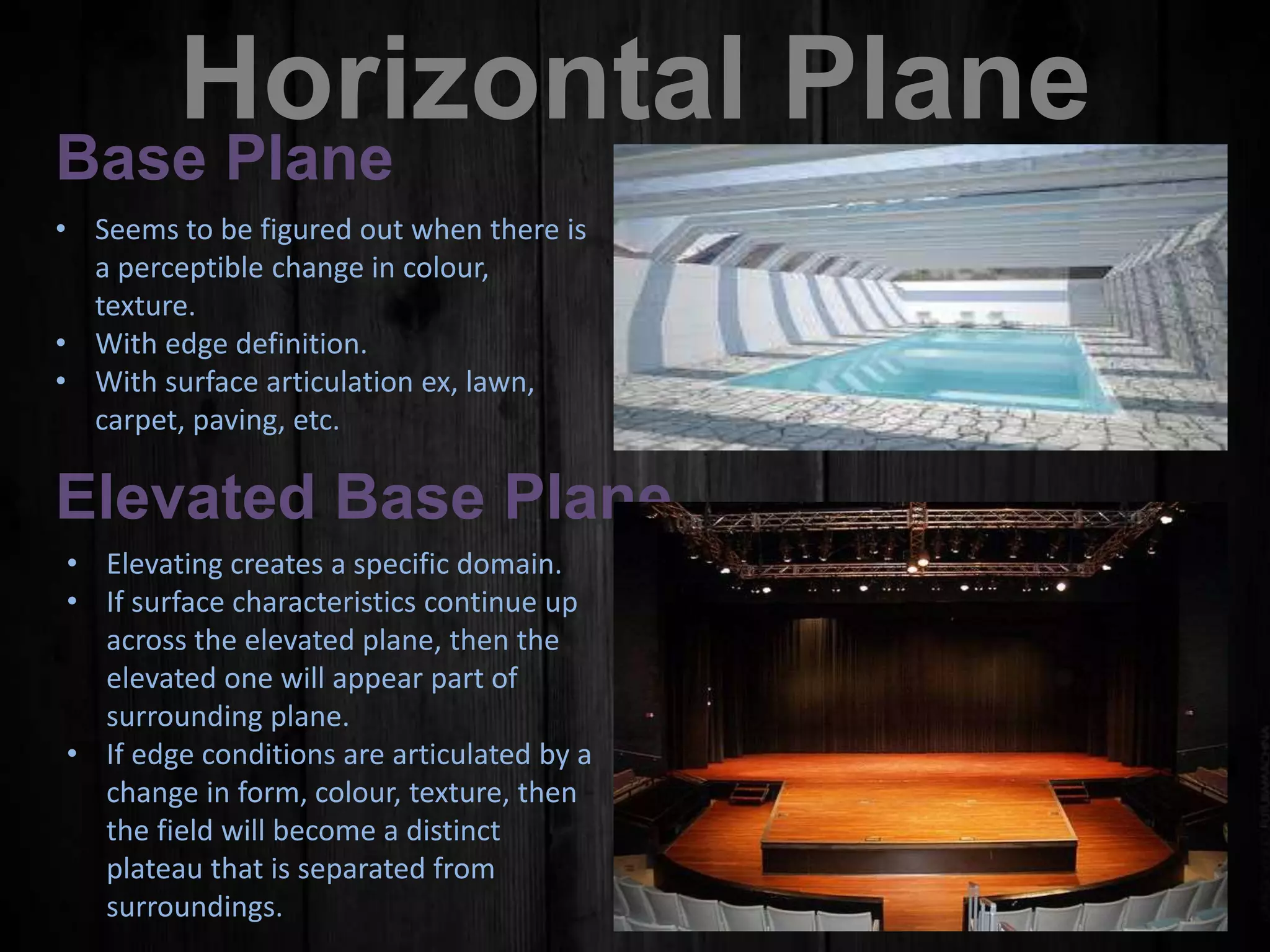
Base Plane
• Seems to be figured out when there is
a perceptible change in colour,
texture.
• With edge definition.
• With surface articulation ex, lawn,
carpet, paving, etc.
Elevated Base Plane
• Elevating creates a specific domain.
• If surface characteristics continue up
across the elevated plane, then the
elevated one will appear part of
surrounding plane.
• If edge conditions are articulated by a
change in form, colour, texture, then
the field will become a distinct
plateau that is separated from
surroundings.
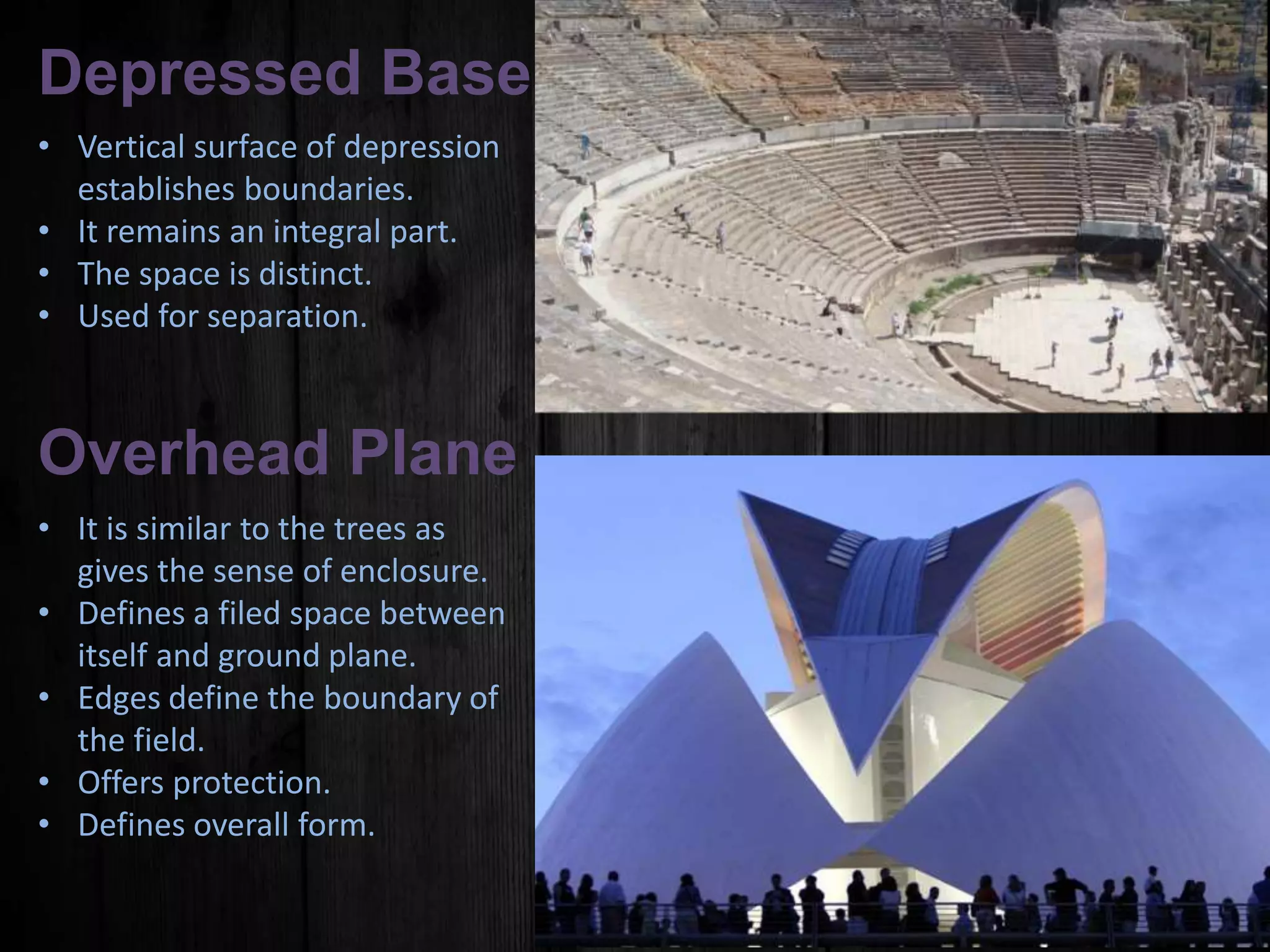
Depressed Base Plane
• Vertical surface of depression
establishes boundaries.
• It remains an integral part.
• The space is distinct.
• Used for separation.
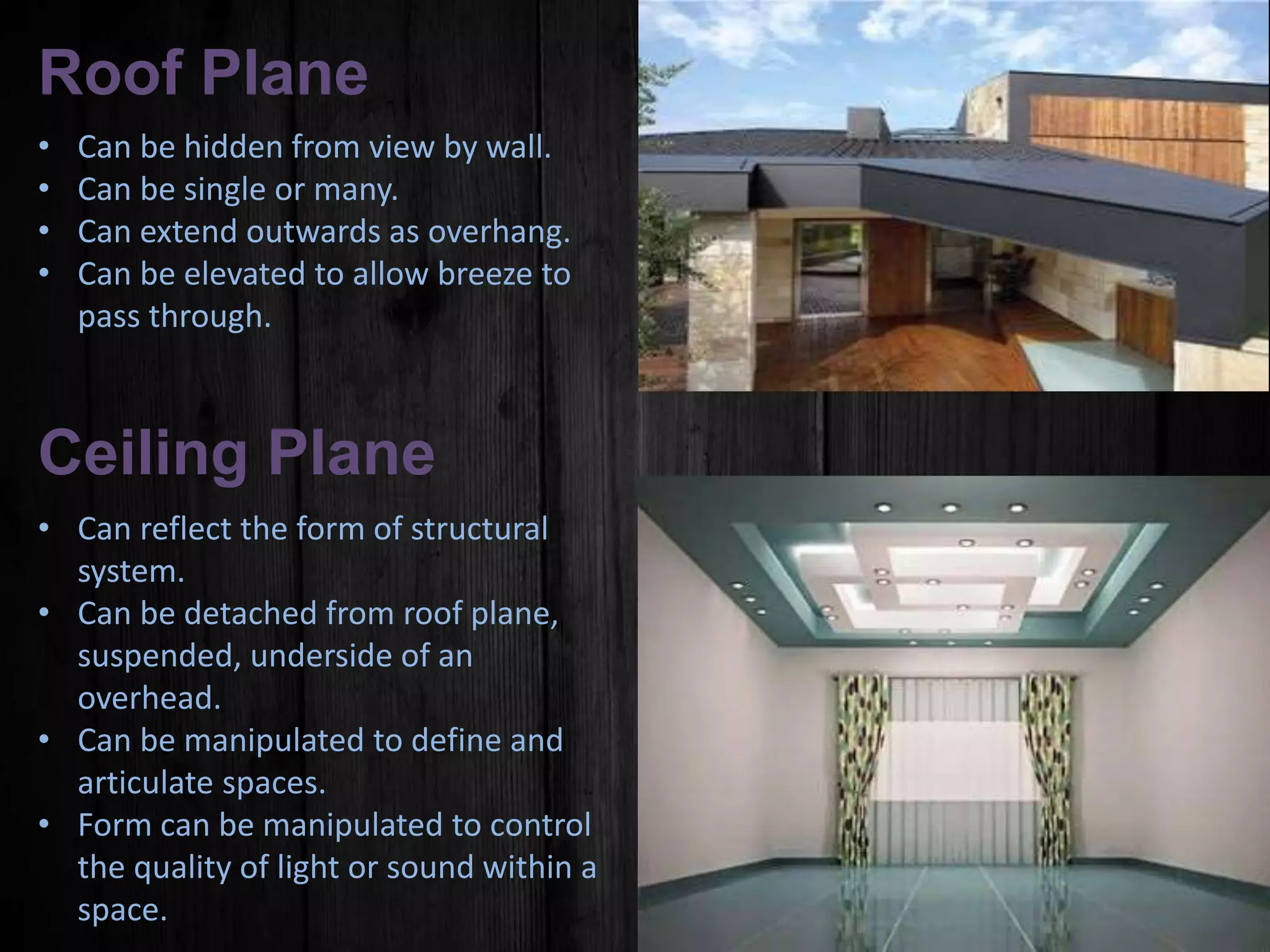
Overhead Plane
• It is similar to the trees as
gives the sense of enclosure.
• Defines a filed space between
itself and ground plane.
• Edges define the boundary of
the field.
• Offers protection.
• Defines overall form.
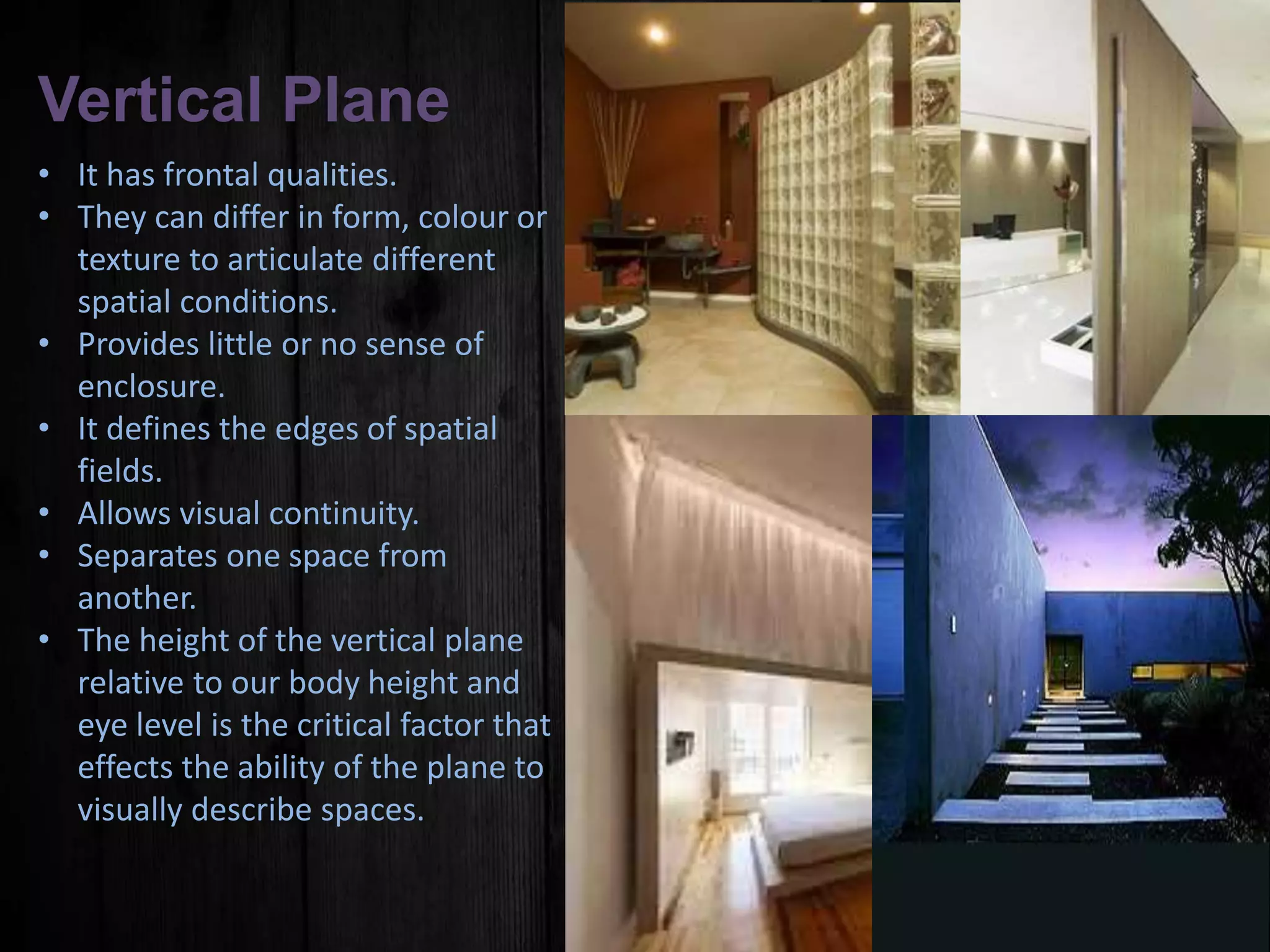
Roof Plane
• Can be hidden from view by wall.
• Can be single or many.
• Can extend outwards as overhang.
• Can be elevated to allow breeze to
pass through.
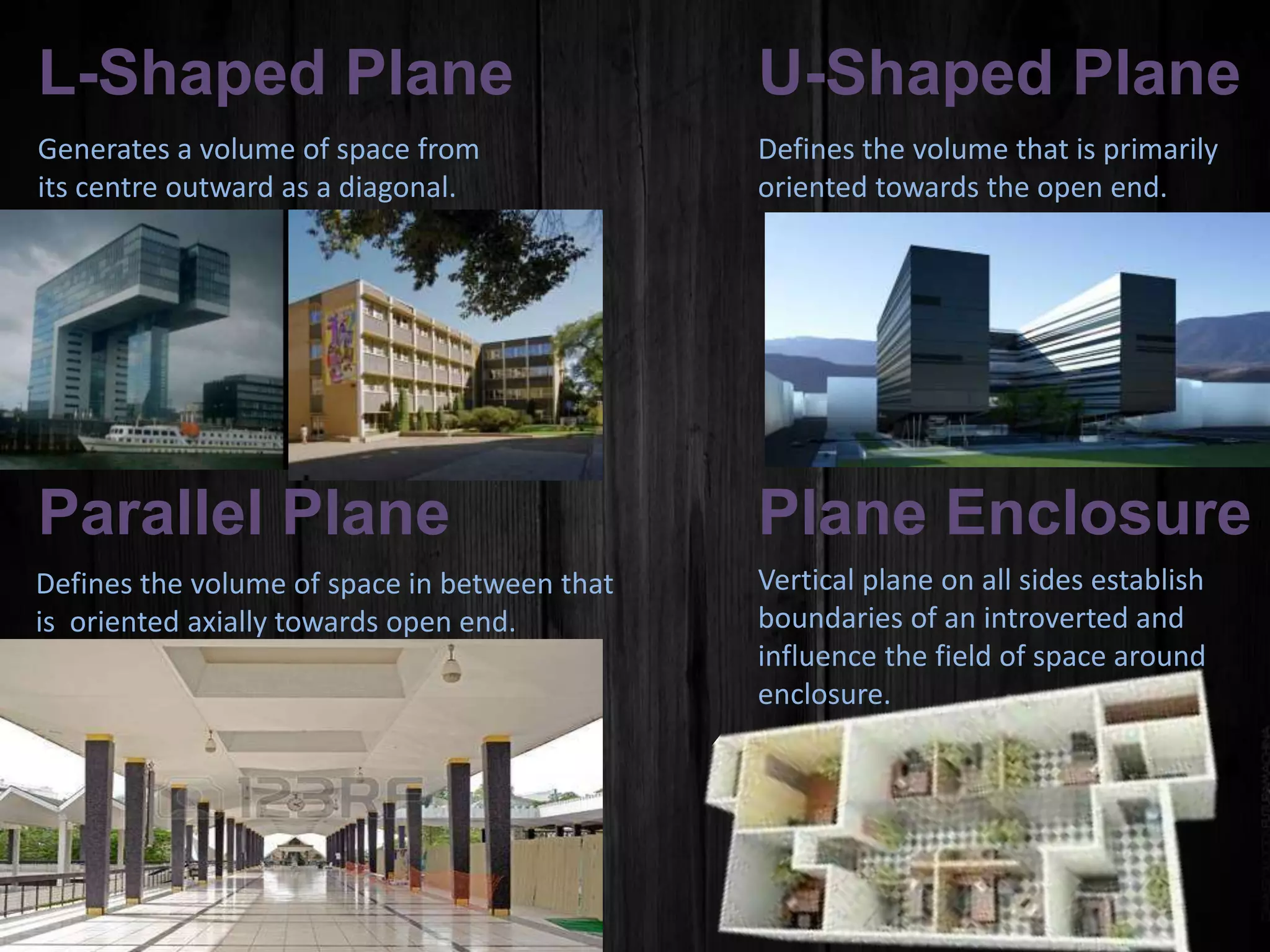
Ceiling Plane
• Can reflect the form of structural
system.
• Can be detached from roof plane,
suspended, underside of an
overhead.
• Can be manipulated to define and
articulate spaces.
• Form can be manipulated to control
the quality of light or sound within a
space.
Vertical Plane
• It has frontal qualities.
• They can differ in form, colour or
texture to articulate different
spatial conditions.
• Provides little or no sense of
enclosure.
• It defines the edges of spatial
fields.
• Allows visual continuity.
• Separates one space from
another.
• The height of the vertical plane
relative to our body height and
eye level is the critical factor that
effects the ability of the plane to
visually describe spaces.
L-Shaped Plane
Generates a volume of space from
its centre outward as a diagonal.
Parallel Plane
Defines the volume of space in between that
is oriented axially towards open end.
U-Shaped Plane
Defines the volume that is primarily
oriented towards the open end.
Plane Enclosure
Vertical plane on all sides establish
boundaries of an introverted and
influence the field of space around
enclosure.

Articulation of form

  • 1.
    ARTICULATION Of FORM THEORY OFDESIGN BAR-605 ASSIGNMENT- 1 SUBMITTED TO: Ar. Mohili Jain ASST. Professor SUBMITTED BY: Hemant Diyalani B.ARCH, VI SEM, III YEAR
  • 2.
    ARTICULATI ON Articulation, in artand architecture, is a method of styling the joints in the formal elements of architectural design. Through degrees of articulation, each part is united with the whole work by means of a joint. In highly articulated works, each part is defined precisely and stands out clearly. The articulation of a building reveals how the parts fit into the whole by emphasizing each part separately.
  • 3.
    ARTICULATION OF FORM 1. Differentiatingadjoining planes with a change in material, colour, texture or pattern. 2. Developing corners as distinct linear elements independent of the abutting planes. 3. Removing corners to physically separate neighbouring planes. 4. Lighting the form to create sharp contrasts in tonal value along edges and corners.
  • 4.
    CORNER ARTICULATION Since the articulationof a form depends to a great degree on how its surfaces meet each other at corners, how these edge conditions are resolved is critical to the definition and clarity of a form. 1.For a corner to be formally active, there must be more than a slight deviation in the angle between the adjoining planes. Since we constantly search for regularity and continuity within our field of vision, we tend to regularize or smooth out slight irregularities in the forms we see. For example, a wall plane that is bent only slightly will appear to be a single flat plane, perhaps with a surface imperfection. A corner would not be perceived.
  • 5.
    2.Corners define themeeting of two planes. If the two planes simply touch and the corner remains unadorned, the presence of the corner will depend on the visual treatment of the adjoining surfaces. This corner condition emphasizes the volume of a form. 3. A corner condition can be visually reinforced by introducing a separate and distinct element that is independent of the surfaces it joins. This element articulates the corner as a linear condition, defines the edges of the adjoining planes, and becomes a positive feature of the form.
  • 6.
    4. While acorner can be articulated by simply contrasting the surface qualities of the adjoining planes, or obscured by layering their joining with an optical pattern, our perception of its existence is also affected by the laws of perspective and the quality of light that illuminates the form. 5. Rounding off the corner emphasizes the continuity of the bounding surfaces of a form, the compactness of its volume and softness of its contour. The scale of the radius of curvature is important. If too small, it becomes visually insignificant; if too large, it affects the interior space it encloses and the exterior form it describes.
  • 7.
    6. If neitherplane is extended to define the corner, a volume of space is created to replace the corner. This corner condition deteriorates the volume of the form, allows the interior space to leak outward and clearly reveals the surfaces as planes in space. 7. If an opening is introduced to one side of the corner, one of the planes will appear to bypass the other. The opening diminishes the corner condition, weakens the definition of the volume within the form, and emphasizes the planar qualities of the neighbouring surfaces.
  • 8.
    SURFACE ARTICULATION Our perception ofthe shape, size scale, proportion and visual weight of a plane is influenced by its surface properties as well as its visual context. 1. A distinct contrast between the surface colour of a plane and that of the surrounding field can clarify its shape, while modifying its tonal value can either increase or decrease its visual weight.
  • 9.
    2. A frontalview reveals the true shape of a plane. Oblique views distort it. 3. Elements of known size within the visual context of a plane can aid our perception of its size and scale.
  • 10.
    4. Texture andcolour together affect the visual weight and scale of a plane and the degree to which it absorbs or reflects light and sound. 5. Directional or oversized optical patterns can distort the shape or exaggerate the proportions of a plane.
  • 11.
    Elements of form definingspaceOverhead Plane Wall Plane Base Plane Elevated Plane Depressed Plane Vertical Plane L-Shaped Plane Parallel Plane U-Shaped Plane Plane Closure
  • 12.
    Horizontal Plane Base Plane •Seems to be figured out when there is a perceptible change in colour, texture. • With edge definition. • With surface articulation ex, lawn, carpet, paving, etc. Elevated Base Plane • Elevating creates a specific domain. • If surface characteristics continue up across the elevated plane, then the elevated one will appear part of surrounding plane. • If edge conditions are articulated by a change in form, colour, texture, then the field will become a distinct plateau that is separated from surroundings.
  • 13.
    Depressed Base Plane •Vertical surface of depression establishes boundaries. • It remains an integral part. • The space is distinct. • Used for separation. Overhead Plane • It is similar to the trees as gives the sense of enclosure. • Defines a filed space between itself and ground plane. • Edges define the boundary of the field. • Offers protection. • Defines overall form.
  • 14.
    Roof Plane • Canbe hidden from view by wall. • Can be single or many. • Can extend outwards as overhang. • Can be elevated to allow breeze to pass through. Ceiling Plane • Can reflect the form of structural system. • Can be detached from roof plane, suspended, underside of an overhead. • Can be manipulated to define and articulate spaces. • Form can be manipulated to control the quality of light or sound within a space.
  • 15.
    Vertical Plane • Ithas frontal qualities. • They can differ in form, colour or texture to articulate different spatial conditions. • Provides little or no sense of enclosure. • It defines the edges of spatial fields. • Allows visual continuity. • Separates one space from another. • The height of the vertical plane relative to our body height and eye level is the critical factor that effects the ability of the plane to visually describe spaces.
  • 16.
    L-Shaped Plane Generates avolume of space from its centre outward as a diagonal. Parallel Plane Defines the volume of space in between that is oriented axially towards open end. U-Shaped Plane Defines the volume that is primarily oriented towards the open end. Plane Enclosure Vertical plane on all sides establish boundaries of an introverted and influence the field of space around enclosure.