Updates to Metals Standards
2013
2
Questions to Answer
• Which metals standards have changed recently?
• Why and how have the standards changed?
• How does it effect me?
• How do I ensure compliance with the latest
standards?
3
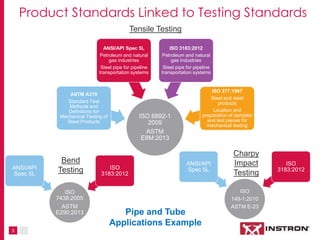
Product Standards Linked to Testing Standards
ISO 6892-1
2009
ASTM
E8M:2013
ASTM A370
Standard Test
Methods and
Definitions for
Mechanical Testing of
Steel Products
ANSI/API Spec 5L
Petroleum and natural
gas industries
Steel pipe for pipeline
transportation systems
ISO 3183:2012
Petroleum and natural
gas Industries
Steel pipe for pipeline
transportation systems
ISO 377:1997
Steel and steel
products
Location and
preparation of samples
and test pieces for
mechanical testing
ISO
7438:2005
ASTM
E290:2013
ANSI/API
Spec 5L
ISO
3183:2012
ISO
148-1:2010
ASTM E-23
ANSI/API
Spec 5L
ISO
3183:2012
Bend
Testing
Charpy
Impact
Testing
Tensile Testing
Example: Pipe and
Tube Applications
4
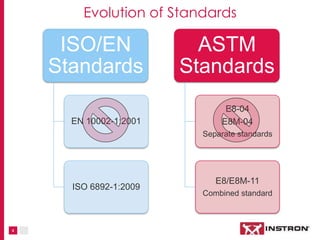
Evolution of Standards
ISO/EN
Standards
EN 10002-1:2001
ISO 6892-1:2009
ASTM
Standards
E8-04
E8M-04
Separate standards
E8/E8M-11
Combined standard
5
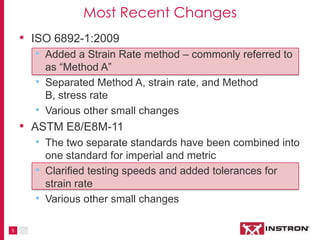
• ISO 6892-1:2009
• Added a Strain Rate method – commonly referred to as
“Method A”
• Separated Method A (strain rate)and Method B (stress
rate)
• Various other small changes
• ASTM E8/E8M-11
• The two separate standards have been combined into
one standard for imperial and metric
• Clarified testing speeds and added tolerances for strain
rate
• Various other small changes
Significant Recent Changes
6
Strain Rate
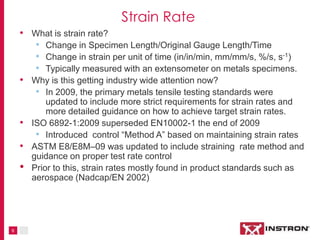
• What is strain rate?
• Change in Specimen Length/Original Gauge Length/Time
• Change in strain per unit of time (in/in/min, mm/mm/s, %/s, s-1)
• Typically measured with an extensometer on metals specimens
• Why is this getting industry-wide attention now?
• In 2009, the primary metals tensile testing standards were
updated to include more strict requirements for strain rates and
more detailed guidance on how to achieve target strain rates
• ISO 6892-1:2009 superseded EN10002-1
• Occurred at the end of 2009
• Introduced control “Method A” based on maintaining strain rates
• ASTM E8/E8M–09 was updated to include straining rate method
and guidance on proper test rate control
• Prior to this, strain rates were mostly found in product standards,
such as aerospace (Nadcap/EN 2002)
7
Why Strain Rate?
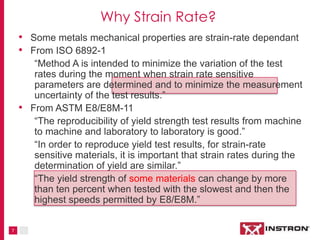
• Some metals have mechanical properties that are strain-rate
dependant
• From ISO 6892-1
“Method A is intended to minimize the variation of the test rates
during the moment when strain rate sensitive parameters are
determined and to minimize the measurement uncertainty of the
test results.”
• From ASTM E8/E8M-11
“The reproducibility of yield strength test results from machine to
machine and laboratory to laboratory is good.”
“In order to reproduce yield test results, for strain-rate sensitive
materials, it is important that strain rates during the
determination of yield are similar.”
“The yield strength of some materials can change by more than
ten percent when tested with the slowest and then the highest
speeds permitted by E8/E8M.”
8
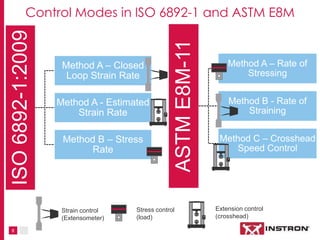
Control Modes in ISO 6892-1 and ASTM E8M
ISO6892-1:2009
Method A – Closed
Loop Strain Rate
Method A - Estimated
Strain Rate
Method B – Stress
Rate
ASTME8M-11
Method A – Rate of
Stressing
Method B - Rate of
Straining
Method C – Crosshead
Speed Control
Strain control
(Extensometer)
Stress control
(load)
Extension control
(crosshead)
9
The Challenge with Strain Control
10
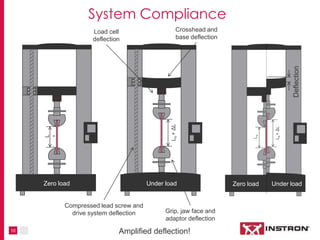
System Compliance
Zero load Under load
Deflection
L
o
Zero load
Lo+ΔL
Under load
Compressed lead screw and
drive system deflection
Load cell
deflection
Crosshead and
base deflection
Grip, jaw face and
adaptor deflection
Amplified deflection!
11
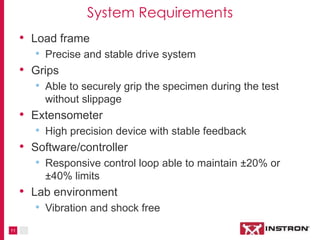
System Requirements
• Load frame
• Precise and stable drive system
• Grips
• Able to securely grip the specimen during the test
without slippage
• Extensometer
• High-precision device with stable feedback
• Software/controller
• Responsive control loop able to maintain ±20% or
±40% limits
• Lab environment
• Vibration and shock free
12
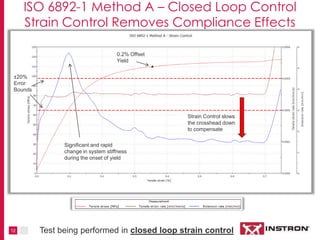
ISO 6892-1 Method A – Closed Loop Control
Strain Control Removes Compliance Effects
±20%
Error
Bounds
0.2% Offset
Yield
Strain Control slows
the crosshead down
to compensate
Significant and rapid
change in system stiffness
during the onset of yield
Test being performed in closed loop strain control
13
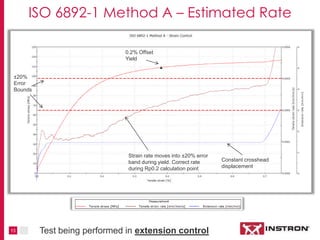
ISO 6892-1 Method A – Estimated Rate
Test being performed in extension control
±20%
Error
Bounds
Constant crosshead
displacement
0.2% Offset
Yield
Strain rate moves into ±20% error
band during yield. Correct rate
during Rp0.2 calculation point
14
Why Instron® Customers use Strain Control
• Repeatable and comparable results
• As some metals are strain-rate sensitive this reduces
variance between labs and systems
• Improved efficiency
• Shorter testing times with a range of specimens
• Automatic tuning reduces setup time
• No need to use a specimen for tuning
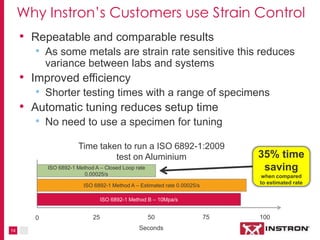
35% time
savings
when compared
to estimated rate
ISO 6892-1 Method B – 10Mpa/s
ISO 6892-1 Method A – Estimated rate 0.00025/s
ISO 6892-1 Method A – Closed Loop rate
0.00025/s
Seconds
50 100
Time taken to run a ISO 6892-1:2009
test on Aluminium
0 25 75
15
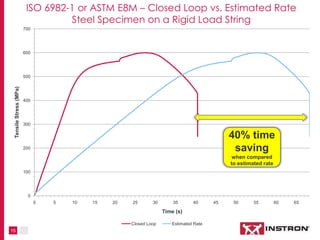
ISO 6982-1 or ASTM E8M – Closed Loop vs. Estimated Rate
Steel Specimen on a Rigid Load String
0
100
200
300
400
500
600
700
0 5 10 15 20 25 30 35 40 45 50 55 60 65
TensileStress(MPa)
Time (s)
Closed Loop Estimated Rate
40% time
savings
when compared
to estimated rate
16
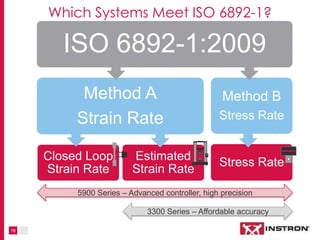
Which Systems Meet ISO 6892-1?
ISO 6892-1:2009
Method A
Strain Rate
Closed Loop
Strain Rate
Estimated
Strain Rate
Method B
Stress Rate
Stress Rate
5900 Series – Advanced controller, high precision
3300 Series – Affordable accuracy
17
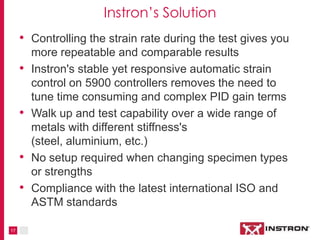
Instron Solutions
• Controlling the strain rate during the test gives you
more repeatable and comparable results
• Instron's stable, yet responsive, automatic strain
control on 5900 controllers removes the need to
tune time consuming and complex PID gain terms
• Walk up and test capability over a wide range of
metals with various degrees of stiffness (steel,
aluminium, etc.)
• No setup required when changing specimen types
or strengths
• Compliance with the latest international ISO and
ASTM standards
Does this sound familiar?
Do you see the same challenges in
your business?
www.instron.com
for more information

Metals Tensile Testing Standards - ISO 6892-1 ASTM E8/8M - Strain Control

  • 1.
    Updates to MetalsStandards 2013
  • 2.
    2 Questions to Answer •Which metals standards have changed recently? • Why and how have the standards changed? • How does it effect me? • How do I ensure compliance with the latest standards?
  • 3.
    3 Product Standards Linkedto Testing Standards ISO 6892-1 2009 ASTM E8M:2013 ASTM A370 Standard Test Methods and Definitions for Mechanical Testing of Steel Products ANSI/API Spec 5L Petroleum and natural gas industries Steel pipe for pipeline transportation systems ISO 3183:2012 Petroleum and natural gas Industries Steel pipe for pipeline transportation systems ISO 377:1997 Steel and steel products Location and preparation of samples and test pieces for mechanical testing ISO 7438:2005 ASTM E290:2013 ANSI/API Spec 5L ISO 3183:2012 ISO 148-1:2010 ASTM E-23 ANSI/API Spec 5L ISO 3183:2012 Bend Testing Charpy Impact Testing Tensile Testing Example: Pipe and Tube Applications
  • 4.
    4 Evolution of Standards ISO/EN Standards EN10002-1:2001 ISO 6892-1:2009 ASTM Standards E8-04 E8M-04 Separate standards E8/E8M-11 Combined standard
  • 5.
    5 • ISO 6892-1:2009 •Added a Strain Rate method – commonly referred to as “Method A” • Separated Method A (strain rate)and Method B (stress rate) • Various other small changes • ASTM E8/E8M-11 • The two separate standards have been combined into one standard for imperial and metric • Clarified testing speeds and added tolerances for strain rate • Various other small changes Significant Recent Changes
  • 6.
    6 Strain Rate • Whatis strain rate? • Change in Specimen Length/Original Gauge Length/Time • Change in strain per unit of time (in/in/min, mm/mm/s, %/s, s-1) • Typically measured with an extensometer on metals specimens • Why is this getting industry-wide attention now? • In 2009, the primary metals tensile testing standards were updated to include more strict requirements for strain rates and more detailed guidance on how to achieve target strain rates • ISO 6892-1:2009 superseded EN10002-1 • Occurred at the end of 2009 • Introduced control “Method A” based on maintaining strain rates • ASTM E8/E8M–09 was updated to include straining rate method and guidance on proper test rate control • Prior to this, strain rates were mostly found in product standards, such as aerospace (Nadcap/EN 2002)
  • 7.
    7 Why Strain Rate? •Some metals have mechanical properties that are strain-rate dependant • From ISO 6892-1 “Method A is intended to minimize the variation of the test rates during the moment when strain rate sensitive parameters are determined and to minimize the measurement uncertainty of the test results.” • From ASTM E8/E8M-11 “The reproducibility of yield strength test results from machine to machine and laboratory to laboratory is good.” “In order to reproduce yield test results, for strain-rate sensitive materials, it is important that strain rates during the determination of yield are similar.” “The yield strength of some materials can change by more than ten percent when tested with the slowest and then the highest speeds permitted by E8/E8M.”
  • 8.
    8 Control Modes inISO 6892-1 and ASTM E8M ISO6892-1:2009 Method A – Closed Loop Strain Rate Method A - Estimated Strain Rate Method B – Stress Rate ASTME8M-11 Method A – Rate of Stressing Method B - Rate of Straining Method C – Crosshead Speed Control Strain control (Extensometer) Stress control (load) Extension control (crosshead)
  • 9.
    9 The Challenge withStrain Control
  • 10.
    10 System Compliance Zero loadUnder load Deflection L o Zero load Lo+ΔL Under load Compressed lead screw and drive system deflection Load cell deflection Crosshead and base deflection Grip, jaw face and adaptor deflection Amplified deflection!
  • 11.
    11 System Requirements • Loadframe • Precise and stable drive system • Grips • Able to securely grip the specimen during the test without slippage • Extensometer • High-precision device with stable feedback • Software/controller • Responsive control loop able to maintain ±20% or ±40% limits • Lab environment • Vibration and shock free
  • 12.
    12 ISO 6892-1 MethodA – Closed Loop Control Strain Control Removes Compliance Effects ±20% Error Bounds 0.2% Offset Yield Strain Control slows the crosshead down to compensate Significant and rapid change in system stiffness during the onset of yield Test being performed in closed loop strain control
  • 13.
    13 ISO 6892-1 MethodA – Estimated Rate Test being performed in extension control ±20% Error Bounds Constant crosshead displacement 0.2% Offset Yield Strain rate moves into ±20% error band during yield. Correct rate during Rp0.2 calculation point
  • 14.
    14 Why Instron® Customersuse Strain Control • Repeatable and comparable results • As some metals are strain-rate sensitive this reduces variance between labs and systems • Improved efficiency • Shorter testing times with a range of specimens • Automatic tuning reduces setup time • No need to use a specimen for tuning 35% time savings when compared to estimated rate ISO 6892-1 Method B – 10Mpa/s ISO 6892-1 Method A – Estimated rate 0.00025/s ISO 6892-1 Method A – Closed Loop rate 0.00025/s Seconds 50 100 Time taken to run a ISO 6892-1:2009 test on Aluminium 0 25 75
  • 15.
    15 ISO 6982-1 orASTM E8M – Closed Loop vs. Estimated Rate Steel Specimen on a Rigid Load String 0 100 200 300 400 500 600 700 0 5 10 15 20 25 30 35 40 45 50 55 60 65 TensileStress(MPa) Time (s) Closed Loop Estimated Rate 40% time savings when compared to estimated rate
  • 16.
    16 Which Systems MeetISO 6892-1? ISO 6892-1:2009 Method A Strain Rate Closed Loop Strain Rate Estimated Strain Rate Method B Stress Rate Stress Rate 5900 Series – Advanced controller, high precision 3300 Series – Affordable accuracy
  • 17.
    17 Instron Solutions • Controllingthe strain rate during the test gives you more repeatable and comparable results • Instron's stable, yet responsive, automatic strain control on 5900 controllers removes the need to tune time consuming and complex PID gain terms • Walk up and test capability over a wide range of metals with various degrees of stiffness (steel, aluminium, etc.) • No setup required when changing specimen types or strengths • Compliance with the latest international ISO and ASTM standards
  • 18.
    Does this soundfamiliar? Do you see the same challenges in your business? www.instron.com for more information

Editor's Notes

  • #18 PID - Proportional Integral and Derivative