

Midlatitude deserts
Rain shadow deserts
Coastal deserts
Monsoon deserts
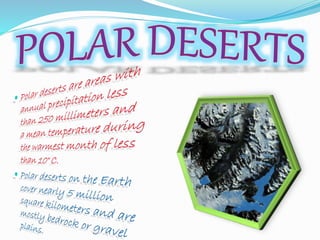
Polar deserts
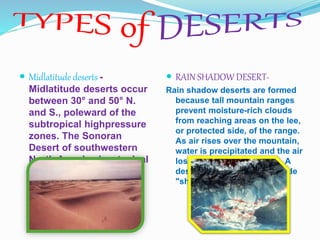
 Midlatitude deserts -
Midlatitude deserts occur
between 30° and 50° N.
and S., poleward of the
subtropical highpressure
zones. The Sonoran
Desert of southwestern
North America is a typical
midlatitude desert.
 RAIN SHADOW DESERT-
Rain shadow deserts are formed
because tall mountain ranges
prevent moisture-rich clouds
from reaching areas on the lee,
or protected side, of the range.
As air rises over the mountain,
water is precipitated and the air
loses its moisture content. A
desert is formed in the leeside
"shadow" of the range.
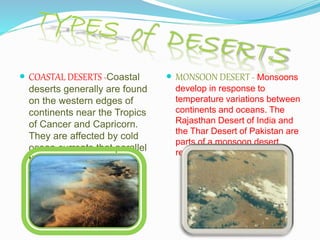
 COASTAL DESERTS -Coastal
deserts generally are found
on the western edges of
continents near the Tropics
of Cancer and Capricorn.
They are affected by cold
ocean currents that parallel
the coast.
 MONSOON DESERT - Monsoons
develop in response to
temperature variations between
continents and oceans. The
Rajasthan Desert of India and
the Thar Desert of Pakistan are
parts of a monsoon desert
region west of the ranqe.
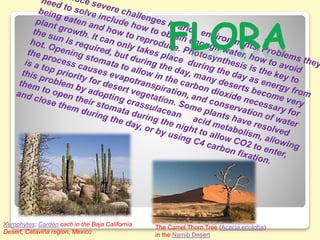
Xerophytes: Cardón cacti in the Baja California
Desert, Cataviña region, Mexico
The Camel Thorn Tree (Acacia erioloba)
in the Namib Desert
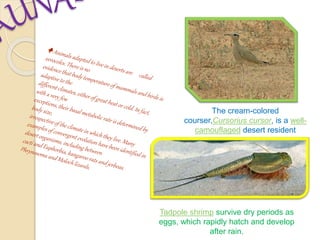
The cream-colored
courser,Cursorius cursor, is a well-
camouflaged desert resident
Tadpole shrimp survive dry periods as
eggs, which rapidly hatch and develop
after rain.
RAN
K
DESERT AREA
(Km2)
AREA
(Mi2)
1 Antarctic Desert (Antarctica) 14,200,000 5,500,000
2 Arctic Desert (Arctic) 13,900,000 5,400,000
3 Sahara Desert (Africa) 9,100,000 3,500,000
4 Arabian Desert (Middle East) 2,600,000 1,000,000
5 Gobi Desert (Asia) 1,300,000 500,000
6 Patagonian Desert (South
America)
670,000 260,000
7 Great Victoria Desert (Australia) 647,000 250,000
8 Kalahari Desert (Africa) 570,000 220,000
9 Great Basin Desert (North
America)
490,000 190,000
10 Syrian Desert (Middle East) 490,000 190,000
Made by IDRAAK
MOHD KHAN
Of class VII- D

Deserts

  • 2.
    Midlatitude deserts Rain shadowdeserts Coastal deserts Monsoon deserts Polar deserts
  • 3.
     Midlatitude deserts- Midlatitude deserts occur between 30° and 50° N. and S., poleward of the subtropical highpressure zones. The Sonoran Desert of southwestern North America is a typical midlatitude desert.  RAIN SHADOW DESERT- Rain shadow deserts are formed because tall mountain ranges prevent moisture-rich clouds from reaching areas on the lee, or protected side, of the range. As air rises over the mountain, water is precipitated and the air loses its moisture content. A desert is formed in the leeside "shadow" of the range.
  • 4.
     COASTAL DESERTS-Coastal deserts generally are found on the western edges of continents near the Tropics of Cancer and Capricorn. They are affected by cold ocean currents that parallel the coast.  MONSOON DESERT - Monsoons develop in response to temperature variations between continents and oceans. The Rajasthan Desert of India and the Thar Desert of Pakistan are parts of a monsoon desert region west of the ranqe.
  • 6.
    Xerophytes: Cardón cactiin the Baja California Desert, Cataviña region, Mexico The Camel Thorn Tree (Acacia erioloba) in the Namib Desert
  • 7.
    The cream-colored courser,Cursorius cursor,is a well- camouflaged desert resident Tadpole shrimp survive dry periods as eggs, which rapidly hatch and develop after rain.
  • 10.
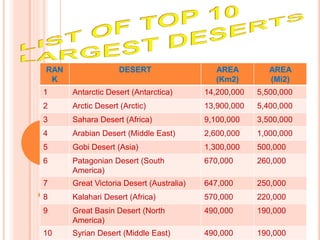
    RAN K DESERT AREA (Km2) AREA (Mi2) 1 AntarcticDesert (Antarctica) 14,200,000 5,500,000 2 Arctic Desert (Arctic) 13,900,000 5,400,000 3 Sahara Desert (Africa) 9,100,000 3,500,000 4 Arabian Desert (Middle East) 2,600,000 1,000,000 5 Gobi Desert (Asia) 1,300,000 500,000 6 Patagonian Desert (South America) 670,000 260,000 7 Great Victoria Desert (Australia) 647,000 250,000 8 Kalahari Desert (Africa) 570,000 220,000 9 Great Basin Desert (North America) 490,000 190,000 10 Syrian Desert (Middle East) 490,000 190,000
  • 11.
    Made by IDRAAK MOHDKHAN Of class VII- D