Deserts
How Are Deserts Created?
• To create annotated diagrams showing relief rainfall and a Hadley cell.
• To explain how relief rainfall and air pressure create deserts.
• To explain the formation of either rain shadow deserts or trade wind
deserts in an exam-style question.
• To explain how deserts are created.
Learning Objective
Success Criteria
desert an area the receives less than 25cm of rainfall per year
tropics areas of the Earth 30 degrees North and South of the Equator
Equator the circle around the centre of the Earth between the North
and South poles
evaporation the process of liquids turning into vapour
Hadley cell a diagram of a convection current
relief the shape of the land
Key Words
Use the key words and the diagram below to
remind yourself how rain is formed.
Starter
evaporation
condensation
precipitation
surface run-off
Keywords
Starter
1. The Sun heats the
water and turns it
into water vapour.
Warm, moist air rises.
This is called
evaporation.
2. As air rises, it cools
and the water vapour
condenses into clouds.
3. When clouds are
saturated with water
vapour, it rains. This
is called precipitation.
This type of rain is called
convectional rainfall.
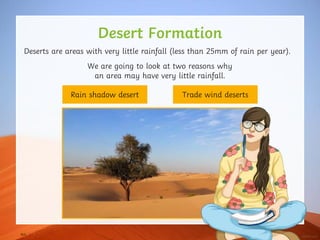
Deserts are areas with very little rainfall (less than 25mm of rain per year).
Desert Formation
Rain shadow desert
We are going to look at two reasons why
an area may have very little rainfall.
Trade wind deserts
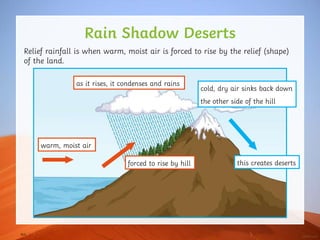
Relief rainfall is when warm, moist air is forced to rise by the relief (shape)
of the land.
Rain Shadow Deserts
warm, moist air
forced to rise by hill
as it rises, it condenses and rains
cold, dry air sinks back down
the other side of the hill
this creates deserts
Draw and annotate (label) a diagram of relief rainfall.
Your Task
In your own words,
write an explanation of
how rain shadow
deserts are created by
relief rainfall.
Your work should look like this:
warm, moist air
forced to rise by hill
as it rises, it condenses and rains
cold, dry air sinks back down
the other side of the hill
this creates deserts
A rain shadow desert is formed when the relief rainfall falls on one side of
a hill/mountain range, leaving dry air sinking down the other side of the
hill or mountain.
dry, sinking air = no rain = desert
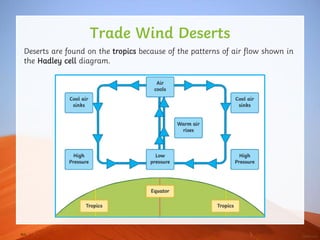
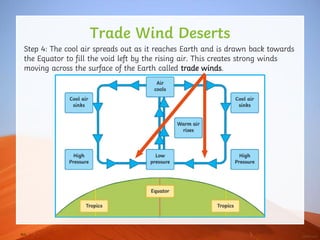
Deserts are found on the tropics because of the patterns of air flow shown in
the Hadley cell diagram.
Trade Wind Deserts
Step 1: The Sun heats the Earth at the Equator, causing air to rise. This
creates an area of low air pressure at the Equator.
Trade Wind Deserts
Step 2: As the air moves away from the heat source (the Earth), it cools. The
troposphere forces the air to spread out high up in the atmosphere.
Trade Wind Deserts
Step 3: Cool air sinks back down to Earth over the tropics. This creates high
pressure. Rain cannot form under high pressure as evaporation cannot happen.
Trade Wind Deserts
Step 3: Cool air sinks back down to Earth over the tropics. This creates high
pressure. Rain cannot form under high pressure as evaporation cannot happen.
Trade Wind Deserts
Step 4: The cool air spreads out as it reaches Earth and is drawn back towards
the Equator to fill the void left by the rising air. This creates strong winds
moving across the surface of the Earth called trade winds.
Trade Wind Deserts
At the Equator, where we have warm, rising air, we get a lot of rain. This
creates rainforests.
Trade Wind Deserts
At the tropics, where we have cold, sinking air, we get no rain.
This creates deserts.
Trade Wind Deserts
Draw and annotate (label) a diagram of a Hadley cell.
Your Task
In your own words,
write an explanation of
how deserts a trade
wind desert is formed.
Your work should look like this:
A trade wind desert is formed by the cold air sinking over the tropics.
The sinking air creates high pressure and prevents warm air rising to form rain.
As no rain can form in areas of high pressure, a desert is created.
desert desert
rain
forest
Name and explain one process that leads to desert formation. You may draw
a diagram to illustrate your answer. (5 marks)
Exam Question
Mark Scheme:
1 mark for correctly naming a process (rain shadow/trade wind). NB – this
must be a process, not simply a reason, such as ‘high pressure’.
1 mark for drawing an appropriate diagram (must be correct for the
named process).
3-4 marks for description and explanation of the process – this can either
be in written sentences or annotation of the diagram. You should explain:
• how and why the warm air rises;
• how and why the rain (precipitation) falls where it does;
• the impact of this process on the desert areas.
Write three quiz questions based upon what you have learned today. Don’t
forget to write your answers down as well!
I will choose 10 of you at random to share one of your questions.
Plenary Quiz
Deserts

Deserts

  • 1.
  • 2.
    • To createannotated diagrams showing relief rainfall and a Hadley cell. • To explain how relief rainfall and air pressure create deserts. • To explain the formation of either rain shadow deserts or trade wind deserts in an exam-style question. • To explain how deserts are created. Learning Objective Success Criteria
  • 3.
    desert an areathe receives less than 25cm of rainfall per year tropics areas of the Earth 30 degrees North and South of the Equator Equator the circle around the centre of the Earth between the North and South poles evaporation the process of liquids turning into vapour Hadley cell a diagram of a convection current relief the shape of the land Key Words
  • 4.
    Use the keywords and the diagram below to remind yourself how rain is formed. Starter evaporation condensation precipitation surface run-off Keywords
  • 5.
    Starter 1. The Sunheats the water and turns it into water vapour. Warm, moist air rises. This is called evaporation. 2. As air rises, it cools and the water vapour condenses into clouds. 3. When clouds are saturated with water vapour, it rains. This is called precipitation. This type of rain is called convectional rainfall.
  • 6.
    Deserts are areaswith very little rainfall (less than 25mm of rain per year). Desert Formation Rain shadow desert We are going to look at two reasons why an area may have very little rainfall. Trade wind deserts
  • 7.
    Relief rainfall iswhen warm, moist air is forced to rise by the relief (shape) of the land. Rain Shadow Deserts warm, moist air forced to rise by hill as it rises, it condenses and rains cold, dry air sinks back down the other side of the hill this creates deserts
  • 8.
    Draw and annotate(label) a diagram of relief rainfall. Your Task In your own words, write an explanation of how rain shadow deserts are created by relief rainfall.
  • 9.
    Your work shouldlook like this: warm, moist air forced to rise by hill as it rises, it condenses and rains cold, dry air sinks back down the other side of the hill this creates deserts A rain shadow desert is formed when the relief rainfall falls on one side of a hill/mountain range, leaving dry air sinking down the other side of the hill or mountain. dry, sinking air = no rain = desert
  • 10.
    Deserts are foundon the tropics because of the patterns of air flow shown in the Hadley cell diagram. Trade Wind Deserts
  • 11.
    Step 1: TheSun heats the Earth at the Equator, causing air to rise. This creates an area of low air pressure at the Equator. Trade Wind Deserts
  • 12.
    Step 2: Asthe air moves away from the heat source (the Earth), it cools. The troposphere forces the air to spread out high up in the atmosphere. Trade Wind Deserts
  • 13.
    Step 3: Coolair sinks back down to Earth over the tropics. This creates high pressure. Rain cannot form under high pressure as evaporation cannot happen. Trade Wind Deserts
  • 14.
    Step 3: Coolair sinks back down to Earth over the tropics. This creates high pressure. Rain cannot form under high pressure as evaporation cannot happen. Trade Wind Deserts
  • 15.
    Step 4: Thecool air spreads out as it reaches Earth and is drawn back towards the Equator to fill the void left by the rising air. This creates strong winds moving across the surface of the Earth called trade winds. Trade Wind Deserts
  • 16.
    At the Equator,where we have warm, rising air, we get a lot of rain. This creates rainforests. Trade Wind Deserts
  • 17.
    At the tropics,where we have cold, sinking air, we get no rain. This creates deserts. Trade Wind Deserts
  • 18.
    Draw and annotate(label) a diagram of a Hadley cell. Your Task In your own words, write an explanation of how deserts a trade wind desert is formed.
  • 19.
    Your work shouldlook like this: A trade wind desert is formed by the cold air sinking over the tropics. The sinking air creates high pressure and prevents warm air rising to form rain. As no rain can form in areas of high pressure, a desert is created. desert desert rain forest
  • 20.
    Name and explainone process that leads to desert formation. You may draw a diagram to illustrate your answer. (5 marks) Exam Question Mark Scheme: 1 mark for correctly naming a process (rain shadow/trade wind). NB – this must be a process, not simply a reason, such as ‘high pressure’. 1 mark for drawing an appropriate diagram (must be correct for the named process). 3-4 marks for description and explanation of the process – this can either be in written sentences or annotation of the diagram. You should explain: • how and why the warm air rises; • how and why the rain (precipitation) falls where it does; • the impact of this process on the desert areas.
  • 21.
    Write three quizquestions based upon what you have learned today. Don’t forget to write your answers down as well! I will choose 10 of you at random to share one of your questions. Plenary Quiz