DYSENTERY
MBA(RD)- Second
Semester
Batch::2012-14
GBPSSI , Jhusi
1. Abhishek Barthwal
2. Amit Pandey
3. Chandra Sekhar Singh Kushwaha
4. Devesh Kumar Srivastav
5. Rahul Mishra
PRESENTED BY::
 What is Dysentery?
 Signs and Symptoms Of Dysentery
 What Causes Dysentery
 Risk Factor of Dysentery
 Treatment of Dysentery
 Tips to prevent Dysentery
 Conclusion
FLOW OF PRESENTATION
 Dysentery (formerly known as flux or the bloody flux) broadly refers
to::-
Gastrointestinal disorders characterized by inflammation of the
intestines, chiefly the colon.
The World Health Organization (WHO) defines::-
Dysentery as any episode of diarrhea in which blood is present in
loose, watery stools.
WHAT IS DYSENTERY?
 Dysentery causes irritation and inflammation of the intestines that may result in
a number of symptoms . The symptoms can vary in intensity among individuals.
Common symptoms of Dysentery
The most common symptoms of dysentery are related to disturbances of the
digestive system and include:
Abdominal bloating
Abdominal pain
Bloody diarrhea
Flatulence
Nausea with or without vomiting
SIGNS AND SYMPTOMS OF DYSENTERY
As the dysentery infection progresses, other symptoms, including symptoms of
dehydration, may develop.
Other possible symptoms include:
 Decreased urine output
 Dry skin and mucous membranes (such as dry mouth)
 Feeling very thirsty
 Fever and chills
 Muscle cramps
 Muscle weakness (loss of strength)
 Weight loss
OTHER SYMPTOMS OF DYSENTERY
On rare occasions, dehydration resulting from dysentery may be so severe that a
life-threatening situation can develop.
The following symptoms:
Change in level of consciousness or alertness, such as passing out or
unresponsiveness
Change in mental status or sudden behavior change, such as confusion,
delirium, lethargy, hallucinations and delusions
High fever (higher than 101 degrees Fahrenheit)
Rapid heart rate (tachycardia)
Severe abdominal pain
Severe dizziness
SERIOUS SYMPTOMS THAT MIGHT INDICATE A LIFE-THREATENING
CONDITION
The bacteria Shigella and E coli and the amoeba Entamoeba histolytica are the
most common causes of dysentery. These organisms are present in the stool
(feces) of infected people and animals.
The Entamoeba histolytica may uneventfully reside in the colon, but if it attacks
the colon wall, it can cause dysentery.
People with weakened immune systems are also more likely to develop amoebic
dysentery.
Most commonly, dysentery is caused by drinking water or eating food from
sources contaminated with feces containing the pathogens.
Swimming in contaminated water may also result in dysentery.
For this reason, dysentery occurs most frequently in people traveling to
developing countries and in children who touch infected human or animal feces
without proper hand washing.
WHAT CAUSES DYSENTERY?
Several organisms are known to cause dysentery, most commonly:
 Campylobacter
 Certain types of E coli
 Entamoeba histolytica
 Salmonella
 Shigella
Dysentery is also spread through food that has been contaminated with
human faeces (stools), particularly cold, uncooked food, such as salad.
This is more likely to happen in countries where:
 There is poor sanitation
 Water supplies and sewage disposal are inadequate
 Human faeces are used as fertilizer
Severe dysentery is more common in developing countries.
The time between coming into contact with the bacteria and the
symptoms starting (the incubation period) is usually one to seven days.
COMMON CAUSES OF DYSENTERY
 Bacillary dysentery (shigellosis) is caused by shigella bacteria.
 The shigella bacteria are found in faeces and are spread through poor
hygiene; for example, by not washing your hands after having diarrhea.
 If you do not wash your hands, you can transfer the bacteria to other
surfaces. The bacteria can then infect someone else if they touch the surface
and transfer the bacteria to their mouth. The bacteria will travel from the
mouth to the bowel, invading the cells that line the large bowel. The bacteria
multiply, killing the cells and producing the symptoms of dysentery.
In the India, most cases of bacillary dysentery are spread within families
and in places where people are in close contact with one another, such as in
schools, nurseries, military bases and day centers. The condition can be
spread for up to four weeks after a person has become infected.
BACILLARY DYSENTERY
 Amoebic dysentery (amoebiasis) is caused by an amoeba (a single-celled parasite) called
Entamoeba histolytica.
It is mainly found in tropical areas so it is usually picked up abroad.
 When the amoebas inside the bowel of an infected person are ready to leave the body, they
group together and form a shell that surrounds and protects them. This group of amoebas is
known as a cyst.
 The cyst passes out of the person's body in their faeces and is able to survive outside the
body. If hygiene standards are poor; for example, if the person does not dispose of their
faeces hygienically, it can contaminate the surroundings, such as nearby food and water.
 If another person then eats or drinks food or water that has been contaminated with faeces
containing the cyst, they will also become infected with the amoeba. Amoebic dysentery is
particularly common in parts of the world where human faeces are used as fertiliser.
 After entering the person's body through their mouth, the cyst will travel down into their
stomach. The amoebas inside the cyst are protected from the stomach's digestive acid. From
the stomach, the cyst will travel to the intestines where it will break open and release the
amoebas, causing the infection. The amoebas are able to burrow into the walls of the
intestines and cause small abscesses and ulcers to form. The cycle then begins again.
 The amoebas that cause dysentery can also be sexually transmitted during mouth-to-anus
contact.
AMOEBIC DYSENTERY
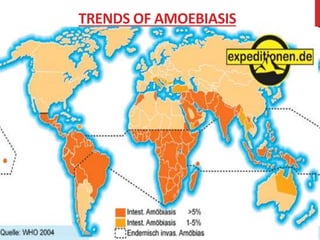
TRENDS OF AMOEBIASIS
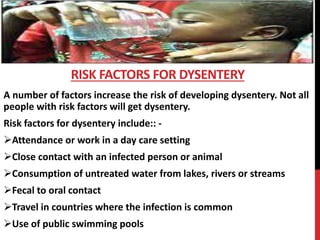
A number of factors increase the risk of developing dysentery. Not all
people with risk factors will get dysentery.
Risk factors for dysentery include:: -
Attendance or work in a day care setting
Close contact with an infected person or animal
Consumption of untreated water from lakes, rivers or streams
Fecal to oral contact
Travel in countries where the infection is common
Use of public swimming pools
RISK FACTORS FOR DYSENTERY
 Treatment for dysentery begins with seeking medical care from our health care
provider.
To determine if we have dysentery, our health care provider may ask us to provide stool
samples for laboratory testing.
 Antibiotic therapy is the mainstay of treatment for dysentery due to bacterial
organisms and is highly effective. It is important to follow our treatment plan for
dysentery precisely and to take all of the antibiotics as instructed to avoid reinfection or
recurrence.
Antibiotics for the treatment of dysentery ::-
 Ceftriaxone (Rocephin)
 Ciprofloxacin (Cipro)
 Trimethoprim-sulfamethoxazole (Bactrim, Septra)
 The most common treatment for amebic dysentery caused by Entamoeba histolytica is
metronidazole (Flagyl), an antiparasitic medication.
 If we have diarrhea and vomiting, fluid and electrolyte replenishment is also a
component of successful treatment.
 The seed, leaves, and bark of the kapok tree have been used in traditional medicine by
indigenous peoples of the rain forest regions in the Americas, West-Central Africa, and
South East Asia to treat this disease
TREATMENT OF DYSENTERY
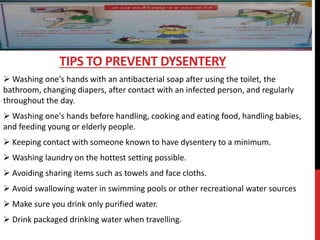
 Washing one's hands with an antibacterial soap after using the toilet, the
bathroom, changing diapers, after contact with an infected person, and regularly
throughout the day.
 Washing one's hands before handling, cooking and eating food, handling babies,
and feeding young or elderly people.
 Keeping contact with someone known to have dysentery to a minimum.
 Washing laundry on the hottest setting possible.
 Avoiding sharing items such as towels and face cloths.
 Avoid swallowing water in swimming pools or other recreational water sources
 Make sure you drink only purified water.
 Drink packaged drinking water when travelling.
TIPS TO PREVENT DYSENTERY
 Nearly ~225,000 children die every year from diarrhea / dysentery
accounting for more than a tenth of all childhood deaths
246 mln cases of diarrhea/ dysentery in India / year
Over half of all diarrhea/dysentery patients in India seek treatment from the
private sector, but most do not receive the recommended treatment,
ORS/Zinc.
 Three high burden states are Uttar Pradesh, Madhya Pradesh and Gujarat .
 We have to Ensure last mile availability of high quality medicinal treatment.
 By strengthening the public and private sector supply chain/distribution
systems.
(Source: World Health Statistics 2011 www.who.int ,District Level Household and Facility
Survey 2007-08 )
CONCLUSION
Desentery
Desentery

Desentery

  • 1.
  • 2.
    1. Abhishek Barthwal 2.Amit Pandey 3. Chandra Sekhar Singh Kushwaha 4. Devesh Kumar Srivastav 5. Rahul Mishra PRESENTED BY::
  • 3.
     What isDysentery?  Signs and Symptoms Of Dysentery  What Causes Dysentery  Risk Factor of Dysentery  Treatment of Dysentery  Tips to prevent Dysentery  Conclusion FLOW OF PRESENTATION
  • 4.
     Dysentery (formerlyknown as flux or the bloody flux) broadly refers to::- Gastrointestinal disorders characterized by inflammation of the intestines, chiefly the colon. The World Health Organization (WHO) defines::- Dysentery as any episode of diarrhea in which blood is present in loose, watery stools. WHAT IS DYSENTERY?
  • 5.
     Dysentery causesirritation and inflammation of the intestines that may result in a number of symptoms . The symptoms can vary in intensity among individuals. Common symptoms of Dysentery The most common symptoms of dysentery are related to disturbances of the digestive system and include: Abdominal bloating Abdominal pain Bloody diarrhea Flatulence Nausea with or without vomiting SIGNS AND SYMPTOMS OF DYSENTERY
  • 6.
    As the dysenteryinfection progresses, other symptoms, including symptoms of dehydration, may develop. Other possible symptoms include:  Decreased urine output  Dry skin and mucous membranes (such as dry mouth)  Feeling very thirsty  Fever and chills  Muscle cramps  Muscle weakness (loss of strength)  Weight loss OTHER SYMPTOMS OF DYSENTERY
  • 7.
    On rare occasions,dehydration resulting from dysentery may be so severe that a life-threatening situation can develop. The following symptoms: Change in level of consciousness or alertness, such as passing out or unresponsiveness Change in mental status or sudden behavior change, such as confusion, delirium, lethargy, hallucinations and delusions High fever (higher than 101 degrees Fahrenheit) Rapid heart rate (tachycardia) Severe abdominal pain Severe dizziness SERIOUS SYMPTOMS THAT MIGHT INDICATE A LIFE-THREATENING CONDITION
  • 8.
    The bacteria Shigellaand E coli and the amoeba Entamoeba histolytica are the most common causes of dysentery. These organisms are present in the stool (feces) of infected people and animals. The Entamoeba histolytica may uneventfully reside in the colon, but if it attacks the colon wall, it can cause dysentery. People with weakened immune systems are also more likely to develop amoebic dysentery. Most commonly, dysentery is caused by drinking water or eating food from sources contaminated with feces containing the pathogens. Swimming in contaminated water may also result in dysentery. For this reason, dysentery occurs most frequently in people traveling to developing countries and in children who touch infected human or animal feces without proper hand washing. WHAT CAUSES DYSENTERY?
  • 9.
    Several organisms areknown to cause dysentery, most commonly:  Campylobacter  Certain types of E coli  Entamoeba histolytica  Salmonella  Shigella Dysentery is also spread through food that has been contaminated with human faeces (stools), particularly cold, uncooked food, such as salad. This is more likely to happen in countries where:  There is poor sanitation  Water supplies and sewage disposal are inadequate  Human faeces are used as fertilizer Severe dysentery is more common in developing countries. The time between coming into contact with the bacteria and the symptoms starting (the incubation period) is usually one to seven days. COMMON CAUSES OF DYSENTERY
  • 10.
     Bacillary dysentery(shigellosis) is caused by shigella bacteria.  The shigella bacteria are found in faeces and are spread through poor hygiene; for example, by not washing your hands after having diarrhea.  If you do not wash your hands, you can transfer the bacteria to other surfaces. The bacteria can then infect someone else if they touch the surface and transfer the bacteria to their mouth. The bacteria will travel from the mouth to the bowel, invading the cells that line the large bowel. The bacteria multiply, killing the cells and producing the symptoms of dysentery. In the India, most cases of bacillary dysentery are spread within families and in places where people are in close contact with one another, such as in schools, nurseries, military bases and day centers. The condition can be spread for up to four weeks after a person has become infected. BACILLARY DYSENTERY
  • 11.
     Amoebic dysentery(amoebiasis) is caused by an amoeba (a single-celled parasite) called Entamoeba histolytica. It is mainly found in tropical areas so it is usually picked up abroad.  When the amoebas inside the bowel of an infected person are ready to leave the body, they group together and form a shell that surrounds and protects them. This group of amoebas is known as a cyst.  The cyst passes out of the person's body in their faeces and is able to survive outside the body. If hygiene standards are poor; for example, if the person does not dispose of their faeces hygienically, it can contaminate the surroundings, such as nearby food and water.  If another person then eats or drinks food or water that has been contaminated with faeces containing the cyst, they will also become infected with the amoeba. Amoebic dysentery is particularly common in parts of the world where human faeces are used as fertiliser.  After entering the person's body through their mouth, the cyst will travel down into their stomach. The amoebas inside the cyst are protected from the stomach's digestive acid. From the stomach, the cyst will travel to the intestines where it will break open and release the amoebas, causing the infection. The amoebas are able to burrow into the walls of the intestines and cause small abscesses and ulcers to form. The cycle then begins again.  The amoebas that cause dysentery can also be sexually transmitted during mouth-to-anus contact. AMOEBIC DYSENTERY
  • 12.
  • 13.
    A number offactors increase the risk of developing dysentery. Not all people with risk factors will get dysentery. Risk factors for dysentery include:: - Attendance or work in a day care setting Close contact with an infected person or animal Consumption of untreated water from lakes, rivers or streams Fecal to oral contact Travel in countries where the infection is common Use of public swimming pools RISK FACTORS FOR DYSENTERY
  • 14.
     Treatment fordysentery begins with seeking medical care from our health care provider. To determine if we have dysentery, our health care provider may ask us to provide stool samples for laboratory testing.  Antibiotic therapy is the mainstay of treatment for dysentery due to bacterial organisms and is highly effective. It is important to follow our treatment plan for dysentery precisely and to take all of the antibiotics as instructed to avoid reinfection or recurrence. Antibiotics for the treatment of dysentery ::-  Ceftriaxone (Rocephin)  Ciprofloxacin (Cipro)  Trimethoprim-sulfamethoxazole (Bactrim, Septra)  The most common treatment for amebic dysentery caused by Entamoeba histolytica is metronidazole (Flagyl), an antiparasitic medication.  If we have diarrhea and vomiting, fluid and electrolyte replenishment is also a component of successful treatment.  The seed, leaves, and bark of the kapok tree have been used in traditional medicine by indigenous peoples of the rain forest regions in the Americas, West-Central Africa, and South East Asia to treat this disease TREATMENT OF DYSENTERY
  • 15.
     Washing one'shands with an antibacterial soap after using the toilet, the bathroom, changing diapers, after contact with an infected person, and regularly throughout the day.  Washing one's hands before handling, cooking and eating food, handling babies, and feeding young or elderly people.  Keeping contact with someone known to have dysentery to a minimum.  Washing laundry on the hottest setting possible.  Avoiding sharing items such as towels and face cloths.  Avoid swallowing water in swimming pools or other recreational water sources  Make sure you drink only purified water.  Drink packaged drinking water when travelling. TIPS TO PREVENT DYSENTERY
  • 16.
     Nearly ~225,000children die every year from diarrhea / dysentery accounting for more than a tenth of all childhood deaths 246 mln cases of diarrhea/ dysentery in India / year Over half of all diarrhea/dysentery patients in India seek treatment from the private sector, but most do not receive the recommended treatment, ORS/Zinc.  Three high burden states are Uttar Pradesh, Madhya Pradesh and Gujarat .  We have to Ensure last mile availability of high quality medicinal treatment.  By strengthening the public and private sector supply chain/distribution systems. (Source: World Health Statistics 2011 www.who.int ,District Level Household and Facility Survey 2007-08 ) CONCLUSION