1
Presented By
Deveshvari DeepakChaudhary
M Pharm ( Pharmacology)
Sem - II
Guided By
DR. C.R. Patil
Professor & HOD Of Pharmacology
R.C. Patel Institute Of Pharmaceutical Education and Research , Shirpur
DERMAL TOXICITY AND DERMAL
IRRITATION STUDIES
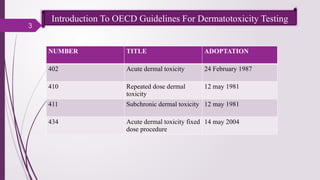
3
NUMBER TITLE ADOPTATION
402Acute dermal toxicity 24 February 1987
410 Repeated dose dermal
toxicity
12 may 1981
411 Subchronic dermal toxicity 12 may 1981
434 Acute dermal toxicity fixed
dose procedure
14 may 2004
Introduction To OECD Guidelines For Dermatotoxicity Testing
4.
4
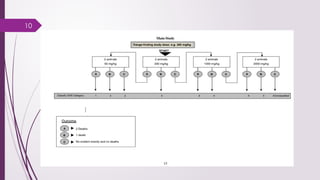
Acute dermaltoxicity – “It is the adverse effects occurring within a short time of dermal
application of a single dose or multiple dose of a test substance within 24hrs period”
Objective –Provide information on health hazards on short term dermal exposure
Limit Test –When data on structurally related compounds is inadequate. Administer a limit dose
of at least 2000 mg/kg to a single group of 5males and 5 females
Principle- Dermal application of test substance in graduated doses to each group.
Guideline No. 402 Acute dermal toxicity
5.
5
Selection of Species– Rat, Other Species .
Animal Procurement – Healthy young adult animals should be procured from CPCSEA
approved Animal Breeding Facility
Body Weight – Rat body weight (200g-300g), Guinea pig body weight (350g-450g),
Rabbit body weight (1.5kg-3.0kg)
Age – Rat (8-12 weeks old) Guinea pig (5-6 weeks old) Rabbit (at least 12 weeks old)
Sex - Female (Nulliparous & Non-Pregnant)
Acclimatization – Minimum 5 days
Randomization – Manually
Housing - Caged individually
TEST SYSTEM
6.
6
Temperature –22 ± 3 C for rats & 20 ± 3 C for rabbits and Guinea Pigs.
Relative Humidity – 30 to 70% Air Changes – At least 10-15 ACH
Photo Period – 12 hours dark & 12 hours light
Bedding – Sterilized Paddy Husk
Feed – Ad libitum
Water – Ad libitum
PREPARATION OF TEST ITEM
Solids – Pulverized (if necessary) before used and moistened with distilled water or vehicle.
Liquid – applied directly with out dilution.
HUSBANDRY
7.
7
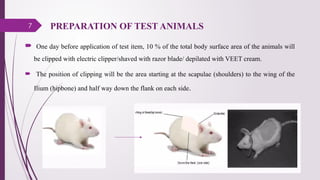
One daybefore application of test item, 10 % of the total body surface area of the animals will
be clipped with electric clipper/shaved with razor blade/ depilated with VEET cream.
The position of clipping will be the area starting at the scapulae (shoulders) to the wing of the
Ilium (hipbone) and half way down the flank on each side.
PREPARATION OF TEST ANIMALS
8.
8 TEST ITEMAPPLICATION
Test item should be applied uniformly over a 10 % area of total body surface (approx. 4 cm
x 4 cm area of skin covered by test item) with porous gauge dressing and non irritating tape
for a period of 24 hours.
After 24 hours exposure period, residual test item should be removed with distilled water.
BODY WEIGHTS
•Body weights should be taken –
• Animal procurement
• Randomization
• Day 0 (prior to Administration), Day 7, Day 14 and at death.
11 OBSERVATION
Animalsare observed immediately after dosing at least once during the first 30 minutes, periodically
during the first 24 hours, with special attention given during the first 2 to 6 hours after the beginning
of the exposure period and daily thereafter, for a total of 14 days.
Observation Should Include:-
Changes in skin, fur, eyes, mucous membranes, also respiratory, circulatory, autonomic, central
nervous systems, somatomotor activity and behaviour pattern.
Attention should be directed to observations of tremors, convulsions, salivation, diarrhoea , lethargy,
sleep and coma.
In addition, the treatment site may be observed at 24, 48 and 72 hours after removal of test chemical
using the Draize criteria.
12.
12
Principle of thetest method
The test substance is applied daily to the skin in graduated doses to several groups of
experimental animals, one dose per group, for a period of 21/28 days.
During the period of application, the animals are observed daily to detect signs of toxicity.
Animals which die during the test are necropsied, and at the conclusion of the test the surviving
animals are sacrificed and necropsied.
GUIDELINE NO. 410 – REPEATED
DOSE DERMAL TOXICITY
13.
13
Description Of TheTest Procedure
Selection of species adult rat, rabbit or guinea pig may be
Weights: rats, 200 to 300 g; rabbits, 2.0 to 3.0 kg; guinea pigs, 350 to 450 g.
Number and sex: At least 10 animals (5 female and 5 male) with healthy skin should be used at
each dose level.
Housing and feeding conditions
Animals should be caged individually.
Temperature: 22°C (± 3°) for rodents or 20°C (± 3°) for rabbits
Relative humidity: 30-70 per cent
12 hours light, 12 hours dark cycle.
Feeding: conventional laboratory diets & unlimited supply of drinking water.
14.
14 Procedure
Theanimals are treated with the test substance, ideally for at least 6 hours per day on a 7-day per
week basis, for a period of 21/28 days.
Application on a 5-day per week basis is considered to be acceptable.
Animals in a satellite group scheduled for follow-up observations should be kept for a further 14
days without treatment to defect recovery from, or persistence of , toxic effects.
15.
15 Observation
Acareful clinical examination should be made at least once each day. Additional observations should
be made daily with appropriate actions taken to minimize loss of animals to the study, e.g. necropsy or
refrigeration of those animals found dead and isolation or sacrifice of weak or moribund animals .
Clinical observations
Haematological parameters,
Clinical biochemistry determination
Gross necropsy
Histopathology
16.
DATA
Individualanimal data should be provided
Additionally, all data should be summarized in tabular forms.
TEST REPORT
The test report must include the following information:
species/strain used & toxic response data by sex and dose;
Time of death during the study or whether animals survived to termination;
Haematological tests employed and results with relevant baseline data; clinical biochemistry
tests ;necropsy findings.
Discussion & interpretation of results
Conclusion
16 Data and Report
17.
17
Definition –
“Adverse effects occurring as a result of repeated daily dermal application of a chemical to
experimental animals for a part of life span not exceeding 10%”
Principle –
Test substance is applied in graduated dose daily
Test substance applied for period of 90 days.
Guideline Number : 411 – Subchronic
Dermal Toxicity
18.
18
Preparations
Healthyyoung adult animals
Acclimatization period is 5 days
Shave dorsal area of trunk 24 hours before testing
Experimental Animals
Housing & feeding condition
Limit test
If test at one dose level i.e. 1000 mg/kg not produce toxic symptoms
If toxicity wouldn't be expected based on data from structurally similar compounds, then
full study carried out
Observation period - Once each day
Test Report
19.
19 Test Procedure
Dosing
Animals are treated for at least 6 hours per day on a 7 days per week basis (for 90 days)
Satellite group 90 days high dose level + 28 days follow-up
Application of test substance
Observations
Clinical examinations
Ophthalmological examinations
Hematology
Clinical biochemistry
20.
20
Pathology
a) Grossnecropsy :
b) Histopathology :
Data and Reporting
a)Treatment of results :
b)Evaluation of results :
Test report & Interpretation of results
21.
21
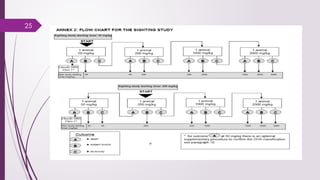
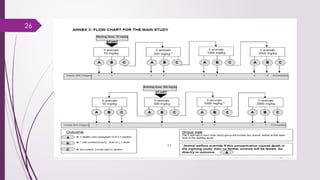
Introduction –
Suggested by British Toxicological Society in 1984
Death as “end point” removed
Classification of the substance into GHS(Globally Harmonized System)
Initial Considerations –
Identity and chemical structure of substance
Results of any other In vitro and In vivo toxicity tests.
Guideline Number 434: Acute Dermal Toxicity :
Fixed Dose Procedure
22.
22 Selection ofanimal species
Adult rat, guinea pig or rabbit Females – nulliparous and nonpregnant
8-12 weeks old
Weight range ± 20% of average body wt.
Principle
Moderately toxic doses
Corrosive, irritant, marked distress causing doses
Humanely killing moribund animals
Groups of animals of single sex using appropriate fixed doses
23.
23 Housingand feeding conditions
Temperature - 22 ± 3 C
RH - 30% - 70%
Lighting - Artificial (12 hours light-dark cycle)
Feed- Conventional & enormous water Supply
Groups - According to specific dose level
Preparation of animals –
5 days acclimatisation period before test study
Shaving of the dorsal trunk hair 24 hours before the study weight.
24.
24
Administration of doses–
Substance applied as thin, uniform layer
Porous gauze dressing & non-irritant tape till 24 hours exposure period
Moistening of test substance if in Solid form, with water or suitable vehicle
Liquids used undiluted
Removal of test substance at the end of exposure period
27 Observations
Forsigns of toxicity animals to be observed
Immediately after dosing during first 30 minutes
Periodically during first 24 hours
Daily thereafter for a total of 14 days
Other observations – changes in fur, skin color, eyes n mucus membranes
Body Weight should be determined
28.
28
Data and Reporting
Individualdata for each animal in tabular form showing:
No. used animals
Animals showing toxicity
Animals found dead during test or killed
Time of death of individual animals
Time course of Toxic effects
Necropsy findings
Results –
Tabulation of response data and dose level of each animal
Weight of animals
Time course of onset of toxicity symptoms (Reversible or not)
Necropsy and histopathological findings
Discussion & Interpretation of results –
Conclusions
29.
29
Omission Of OECDGuideline 434
Official Deletion
• Deleted in 2014 by OECD
• Encouraged by international efforts to reduce animal testing
Reasons For Omission
• Low Regulatory Uptake – Rarely used by industry or regulatory bodies
• Scientific Redundancy – OECD guideline 402 ( Acute Dermal Toxicity) was
sufficient
• Better Alternatives – Emphasis shifted to non animal or in vitro methods
30.
30
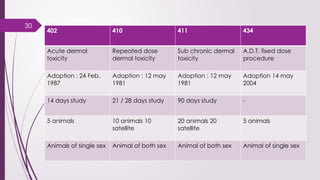
402 410 411434
Acute dermal
toxicity
Repeated dose
dermal toxicity
Sub chronic dermal
toxicity
A.D.T. fixed dose
procedure
Adoption : 24 Feb.
1987
Adoption : 12 may
1981
Adoption : 12 may
1981
Adoption 14 may
2004
14 days study 21 / 28 days study 90 days study -
5 animals 10 animals 10
satellite
20 animals 20
satellite
5 animals
Animals of single sex Animal of both sex Animal of both sex Animal of single sex
31.
31
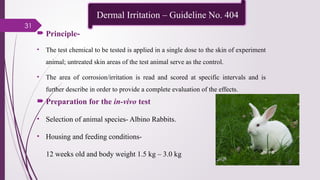
Principle-
• Thetest chemical to be tested is applied in a single dose to the skin of experiment
animal; untreated skin areas of the test animal serve as the control.
• The area of corrosion/irritation is read and scored at specific intervals and is
further describe in order to provide a complete evaluation of the effects.
Preparation for the in-vivo test
• Selection of animal species- Albino Rabbits.
• Housing and feeding conditions-
12 weeks old and body weight 1.5 kg – 3.0 kg
Dermal Irritation – Guideline No. 404
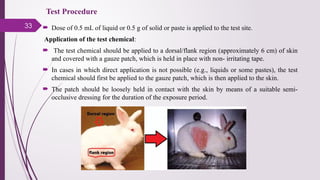
33 Doseof 0.5 mL of liquid or 0.5 g of solid or paste is applied to the test site.
Application of the test chemical:
The test chemical should be applied to a dorsal/flank region (approximately 6 cm) of skin
and covered with a gauze patch, which is held in place with non- irritating tape.
In cases in which direct application is not possible (e.g., liquids or some pastes), the test
chemical should first be applied to the gauze patch, which is then applied to the skin.
The patch should be loosely held in contact with the skin by means of a suitable semi-
occlusive dressing for the duration of the exposure period.
Test Procedure
35 Observation Period
The duration of the observation period should be sufficient to evaluate fully the
reversibility of the effects observed.
The experiment should be terminated at any time that the animal shows
continuing signs of severe pain or distress.
To determine the reversibility of effects, the animals should be observed up to 14
days after removal of the patches.
If reversibility is seen before 14 days, the experiment should be terminated at
that time.
36.
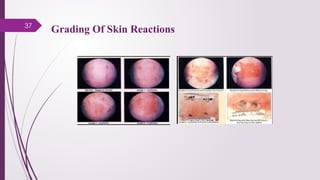
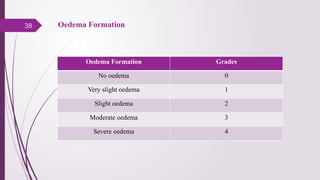
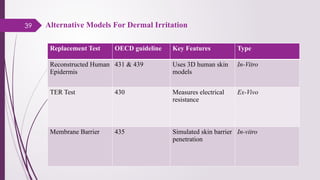
Table : GradingOf Skin Reaction
36
Erythema and Eschar Formation Grades
No erythema 0
Very slight erythema 1
Well defined erythema 2
Moderate to severe erythema 3
Severe erythema to eschar formation
preventing grading of erythema
4
38 Oedema Formation
OedemaFormation Grades
No oedema 0
Very slight oedema 1
Slight oedema 2
Moderate oedema 3
Severe oedema 4
39.
39 Alternative ModelsFor Dermal Irritation
Replacement Test OECD guideline Key Features Type
Reconstructed Human
Epidermis
431 & 439 Uses 3D human skin
models
In-Vitro
TER Test 430 Measures electrical
resistance
Ex-Vivo
Membrane Barrier 435 Simulated skin barrier
penetration
In-vitro
40.
40 REFERENCES
OECDGuidelines for the testing of chemicals , Number 402 “Acute Dermal Toxicity” adopted 24
February 1987
OECD Guideline for Testing of Chemicals (1981),Repeated Dose Dermal Toxicity:21/28-day
Study, 1-23.
OECD Guideline for Testing of Chemicals (1981). Sub chronic Dermal Toxicity:90-day
Study,24-29.
OECD Guideline for Testing of Chemicals (2004),Proposal for a New Draft Guideline 434:Acute
Dermal Toxicity-Fixed Dose Procedure,30-41.
OECD/OCDE, Test No. 404: ‘‘Acute Dermal Irritation/Corrosion’’, 28 July 2015 OECD
Publishing, peris, Page no, 1- 8












![PERI-PROSTHETIC FRACTURE NAIL-PLATE CONSTRUCT [NPC].pptx](https://cdn.slidesharecdn.com/ss_thumbnails/drarunkumardrmohamedashrafperiprostheticfrasturenail-plateconstructnpc-260209164459-7e9d15a1-thumbnail.jpg?width=640&height=640&fit=bounds)


