
DEPTH FIRST SEARCH
(DFS)
PADA GRAPH
Algoritma dan Struktur
Data
Dr. Achmad Solichin,
S.Kom, M.T.I
GRAPH
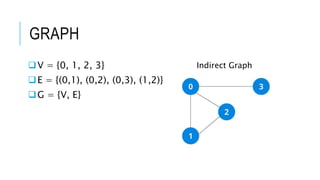
V = {0, 1, 2, 3}
E = {(0,1), (0,2), (0,3), (1,2)}
G = {V, E}
Indirect Graph
GRAPH TERMINOLOGY
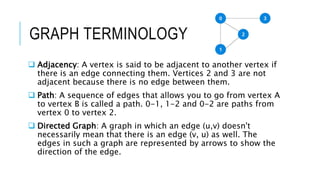
 Adjacency: A vertex is said to be adjacent to another vertex if
there is an edge connecting them. Vertices 2 and 3 are not
adjacent because there is no edge between them.
 Path: A sequence of edges that allows you to go from vertex A
to vertex B is called a path. 0-1, 1-2 and 0-2 are paths from
vertex 0 to vertex 2.
 Directed Graph: A graph in which an edge (u,v) doesn't
necessarily mean that there is an edge (v, u) as well. The
edges in such a graph are represented by arrows to show the
direction of the edge.
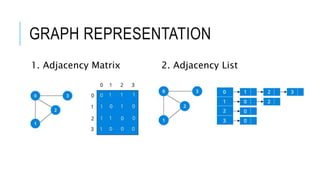
GRAPH REPRESENTATION
1. Adjacency Matrix 2. Adjacency List
DEPTH FIRST SEARCH (DFS)
ALGORITHM
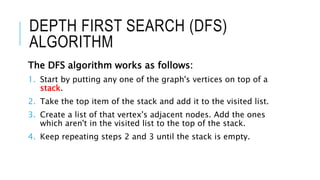
The DFS algorithm works as follows:
1. Start by putting any one of the graph's vertices on top of a
stack.
2. Take the top item of the stack and add it to the visited list.
3. Create a list of that vertex's adjacent nodes. Add the ones
which aren't in the visited list to the top of the stack.
4. Keep repeating steps 2 and 3 until the stack is empty.
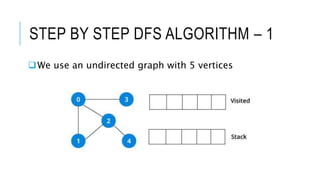
STEP BY STEP DFS ALGORITHM – 1
We use an undirected graph with 5 vertices
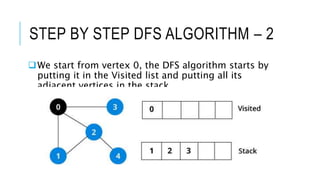
STEP BY STEP DFS ALGORITHM – 2
We start from vertex 0, the DFS algorithm starts by
putting it in the Visited list and putting all its
adjacent vertices in the stack.
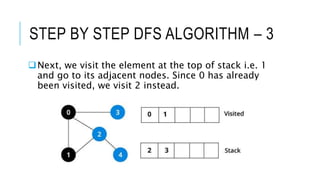
STEP BY STEP DFS ALGORITHM – 3
Next, we visit the element at the top of stack i.e. 1
and go to its adjacent nodes. Since 0 has already
been visited, we visit 2 instead.
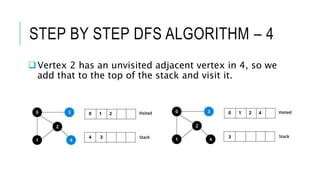
STEP BY STEP DFS ALGORITHM – 4
Vertex 2 has an unvisited adjacent vertex in 4, so we
add that to the top of the stack and visit it.
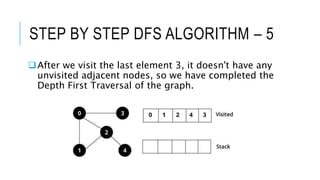
STEP BY STEP DFS ALGORITHM – 5
After we visit the last element 3, it doesn't have any
unvisited adjacent nodes, so we have completed the
Depth First Traversal of the graph.
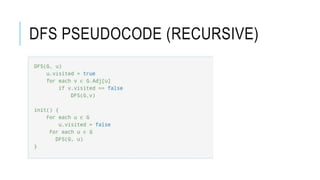
DFS PSEUDOCODE (RECURSIVE)
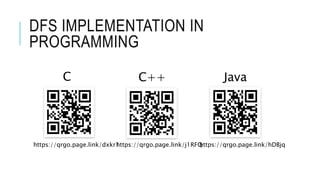
DFS IMPLEMENTATION IN
PROGRAMMING
C C++ Java
https://qrgo.page.link/j1RFQhttps://qrgo.page.link/hDBjqhttps://qrgo.page.link/dxkr1
REFERENCES
 Slide “Graph: Pemahaman dan Konsep Dasar Graph – Algoritma dan
Struktur Data 3” by Moh. Sjukani (Universitas Budi Luhur)
 Slide “Graph Traversal (Penelusuran Graph) – Algoritma dan Struktur
Data 3” by Achmad Solichin (Universitas Budi Luhur)
 DFS Algorithm - https://www.programiz.com/dsa/graph-dfs
TERIMA KASIH
 Dr. Achmad Solichin, S.Kom., M.T.I.
 Fakultas Teknologi Informasi, Universitas Budi Luhur
 achmatim@gmail.com | Achmad.Solichin@budiluhur.ac.id
 http://achmatim.net

Depth First Search (DFS) pada Graph

  • 1.
    DEPTH FIRST SEARCH (DFS) PADAGRAPH Algoritma dan Struktur Data Dr. Achmad Solichin, S.Kom, M.T.I
  • 2.
    GRAPH V = {0,1, 2, 3} E = {(0,1), (0,2), (0,3), (1,2)} G = {V, E} Indirect Graph
  • 3.
    GRAPH TERMINOLOGY  Adjacency:A vertex is said to be adjacent to another vertex if there is an edge connecting them. Vertices 2 and 3 are not adjacent because there is no edge between them.  Path: A sequence of edges that allows you to go from vertex A to vertex B is called a path. 0-1, 1-2 and 0-2 are paths from vertex 0 to vertex 2.  Directed Graph: A graph in which an edge (u,v) doesn't necessarily mean that there is an edge (v, u) as well. The edges in such a graph are represented by arrows to show the direction of the edge.
  • 4.
    GRAPH REPRESENTATION 1. AdjacencyMatrix 2. Adjacency List
  • 5.
    DEPTH FIRST SEARCH(DFS) ALGORITHM The DFS algorithm works as follows: 1. Start by putting any one of the graph's vertices on top of a stack. 2. Take the top item of the stack and add it to the visited list. 3. Create a list of that vertex's adjacent nodes. Add the ones which aren't in the visited list to the top of the stack. 4. Keep repeating steps 2 and 3 until the stack is empty.
  • 6.
    STEP BY STEPDFS ALGORITHM – 1 We use an undirected graph with 5 vertices
  • 7.
    STEP BY STEPDFS ALGORITHM – 2 We start from vertex 0, the DFS algorithm starts by putting it in the Visited list and putting all its adjacent vertices in the stack.
  • 8.
    STEP BY STEPDFS ALGORITHM – 3 Next, we visit the element at the top of stack i.e. 1 and go to its adjacent nodes. Since 0 has already been visited, we visit 2 instead.
  • 9.
    STEP BY STEPDFS ALGORITHM – 4 Vertex 2 has an unvisited adjacent vertex in 4, so we add that to the top of the stack and visit it.
  • 10.
    STEP BY STEPDFS ALGORITHM – 5 After we visit the last element 3, it doesn't have any unvisited adjacent nodes, so we have completed the Depth First Traversal of the graph.
  • 11.
  • 12.
    DFS IMPLEMENTATION IN PROGRAMMING CC++ Java https://qrgo.page.link/j1RFQhttps://qrgo.page.link/hDBjqhttps://qrgo.page.link/dxkr1
  • 13.
    REFERENCES  Slide “Graph:Pemahaman dan Konsep Dasar Graph – Algoritma dan Struktur Data 3” by Moh. Sjukani (Universitas Budi Luhur)  Slide “Graph Traversal (Penelusuran Graph) – Algoritma dan Struktur Data 3” by Achmad Solichin (Universitas Budi Luhur)  DFS Algorithm - https://www.programiz.com/dsa/graph-dfs
  • 14.
    TERIMA KASIH  Dr.Achmad Solichin, S.Kom., M.T.I.  Fakultas Teknologi Informasi, Universitas Budi Luhur  achmatim@gmail.com | Achmad.Solichin@budiluhur.ac.id  http://achmatim.net