Introducting…
WEB 3.0
Dr. Achmad Solichin | @achmatim
Jakarta, 16 Juli 2022
BEM Fakultas Teknologi Informasi
Universitas Budi Luhur
internet = web ?
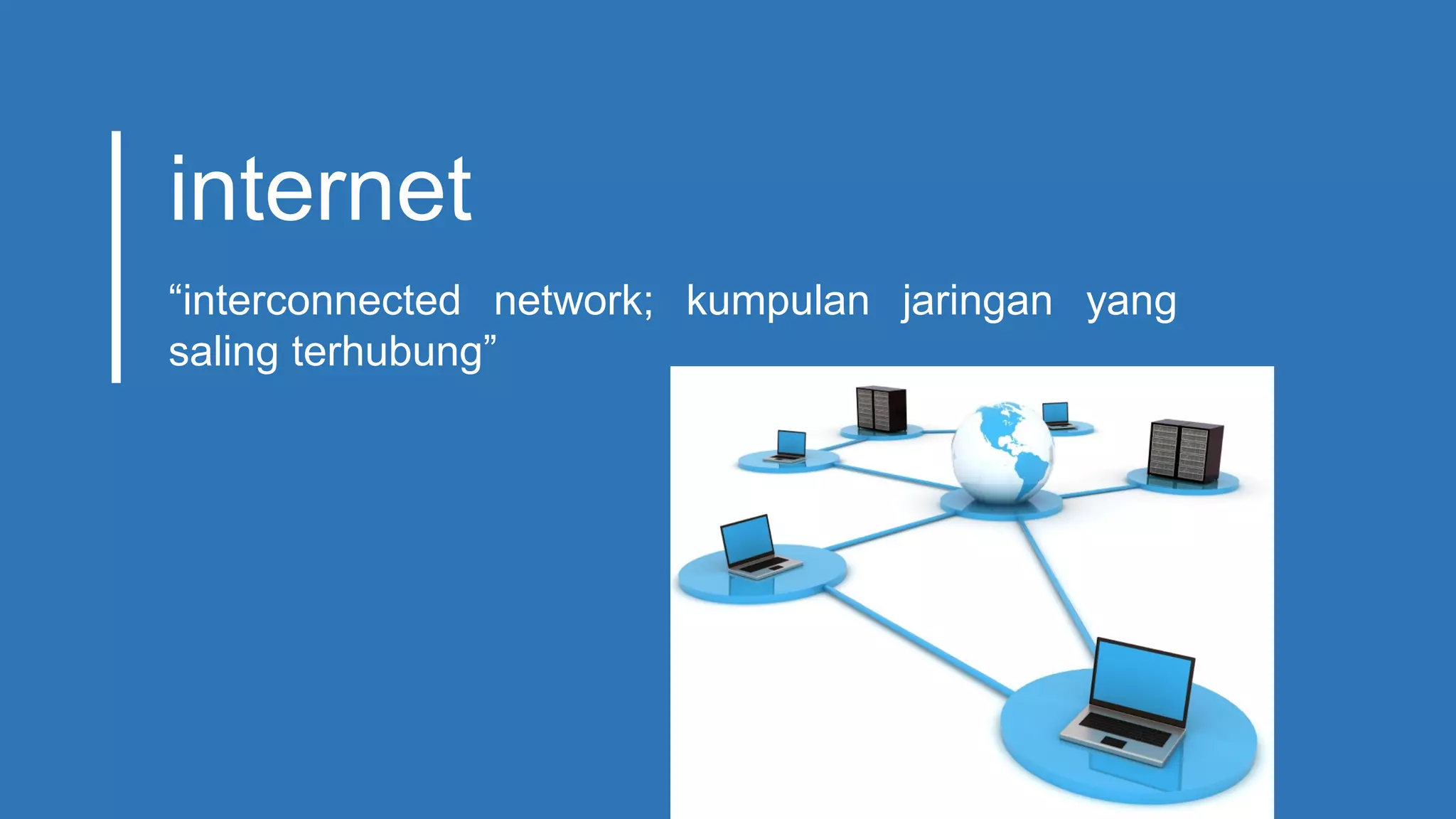
internet
“interconnected network; kumpulan jaringan yang
saling terhubung”
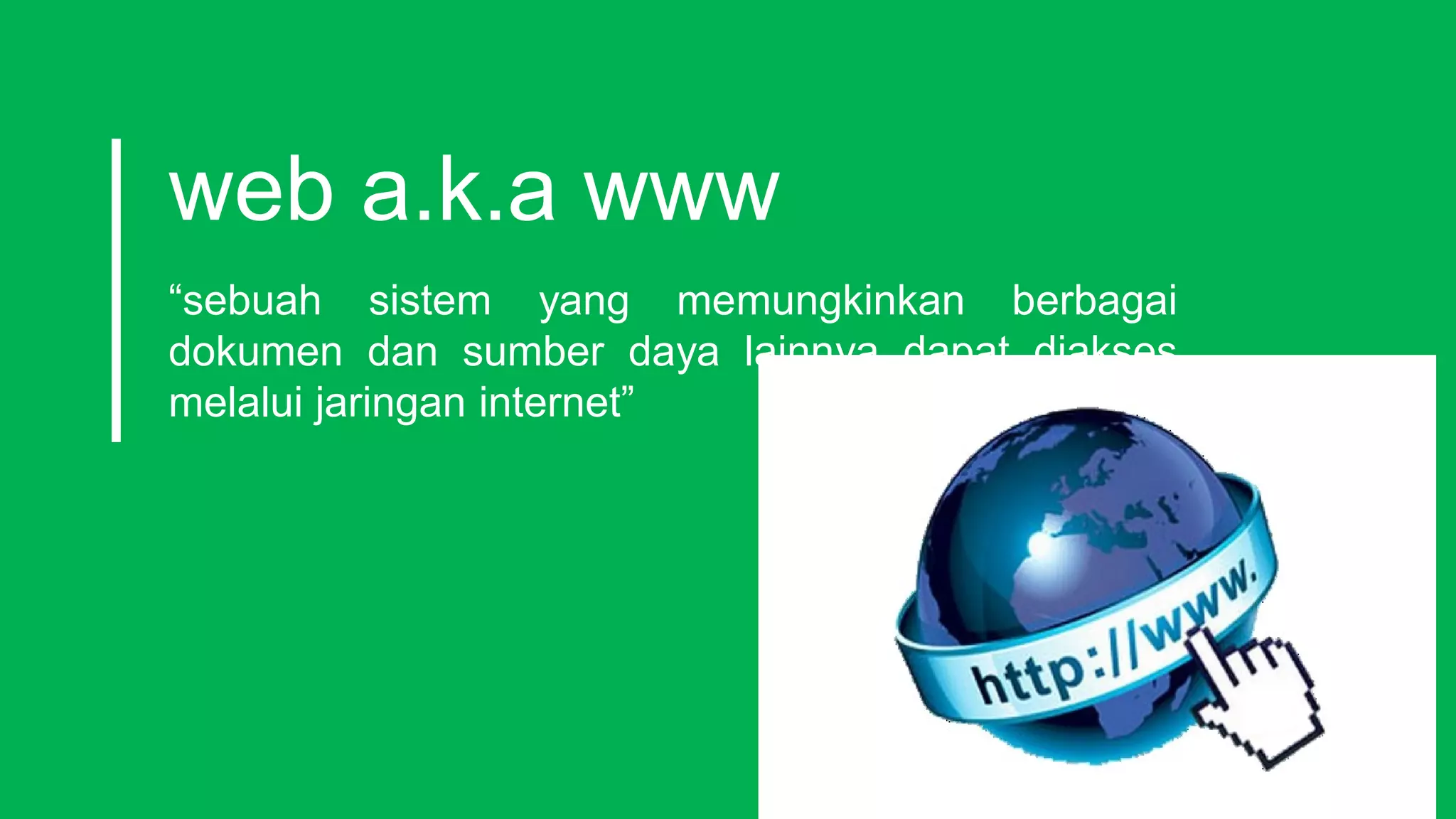
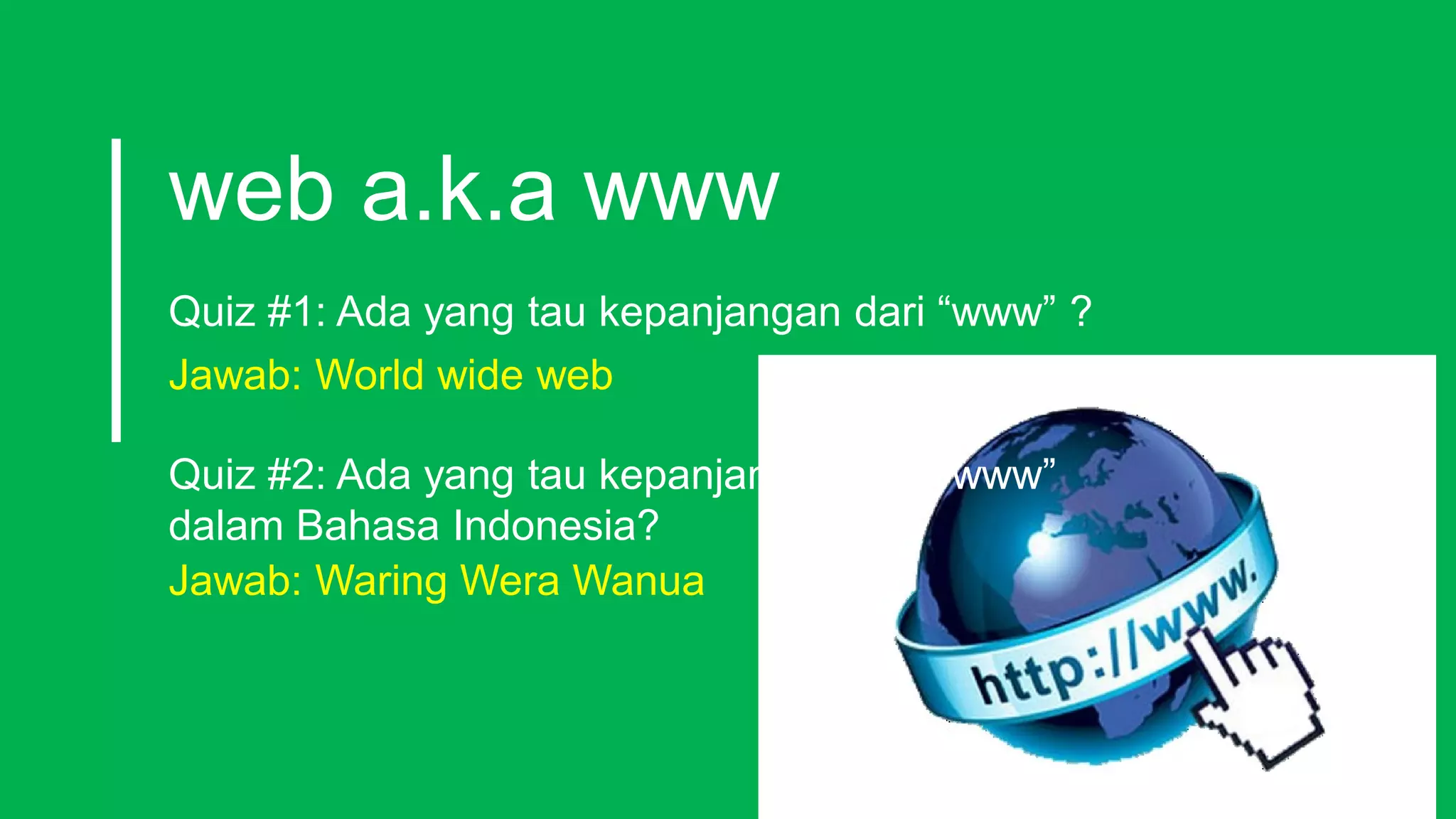
web a.k.a www
“sebuah sistem yang memungkinkan berbagai
dokumen dan sumber daya lainnya dapat diakses
melalui jaringan internet”
web a.k.a www
Quiz #1: Ada yang tau kepanjangan dari “www” ?
Jawab: World wide web
Quiz #2: Ada yang tau kepanjangan dari “www”
dalam Bahasa Indonesia?
Jawab: Waring Wera Wanua
Siapa penemu web pertama kali?
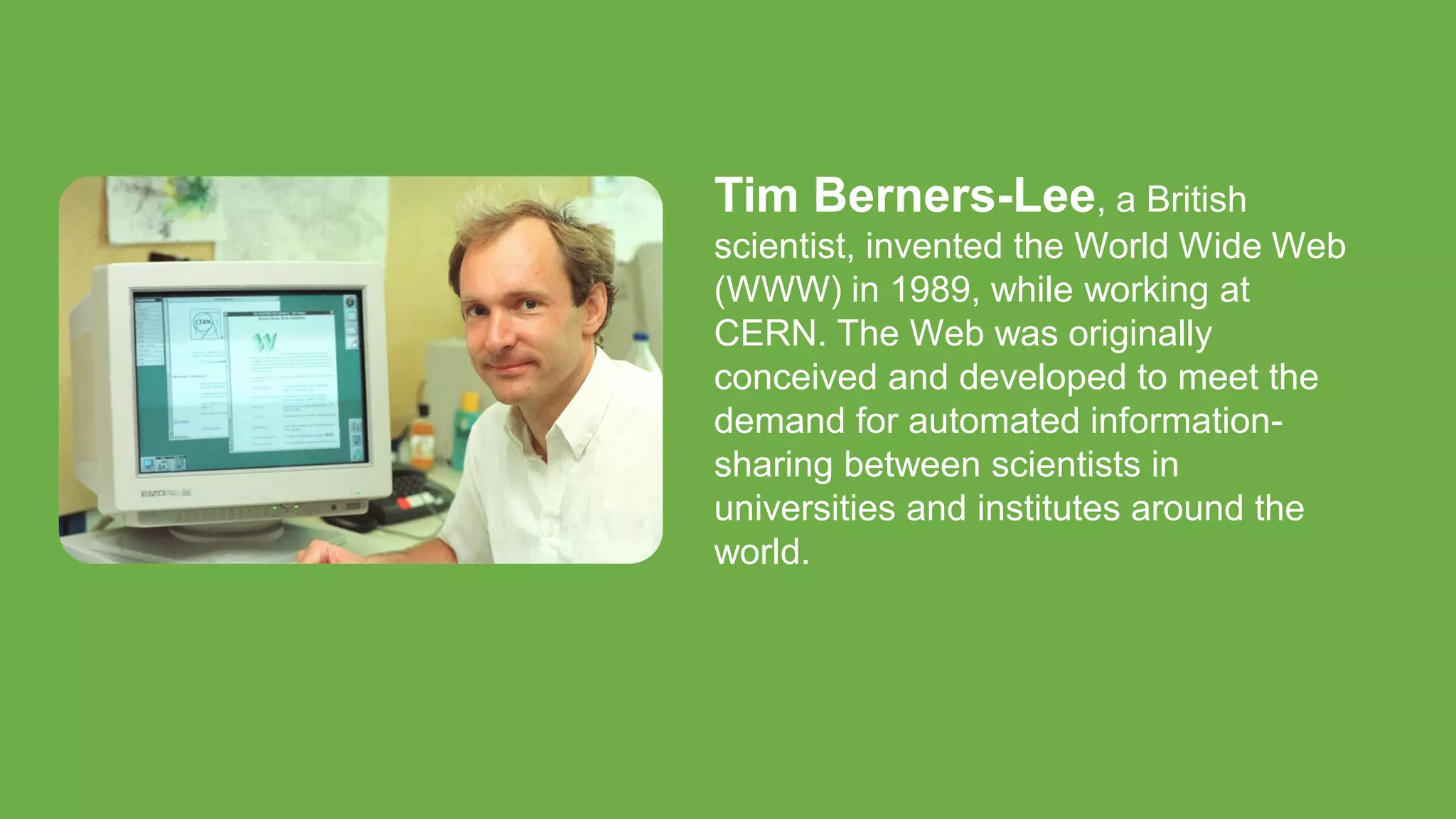
Tim Berners-Lee, a British
scientist, invented the World Wide Web
(WWW) in 1989, while working at
CERN. The Web was originally
conceived and developed to meet the
demand for automated information-
sharing between scientists in
universities and institutes around the
world.
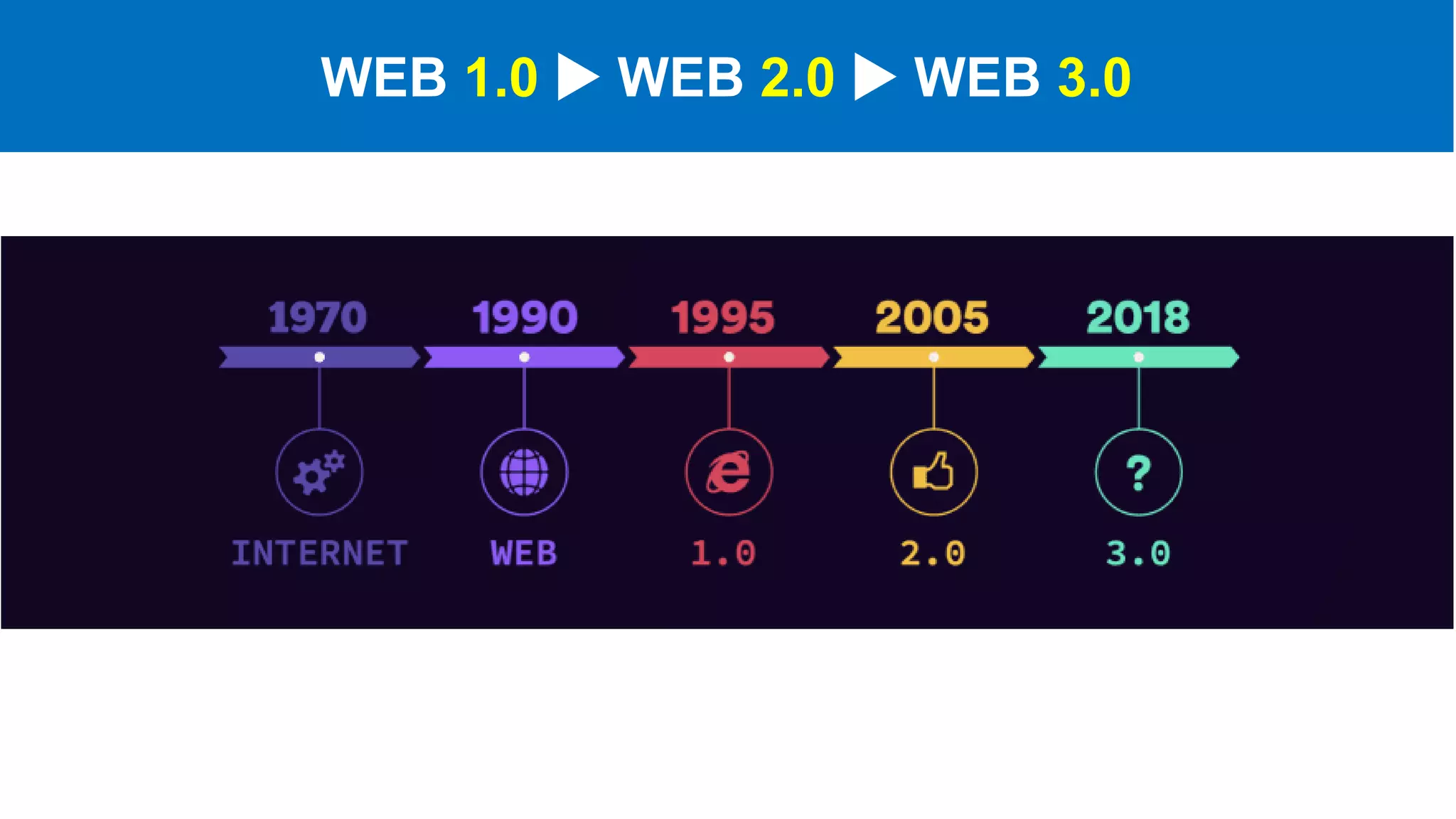
WEB 1.0  WEB 2.0  WEB 3.0
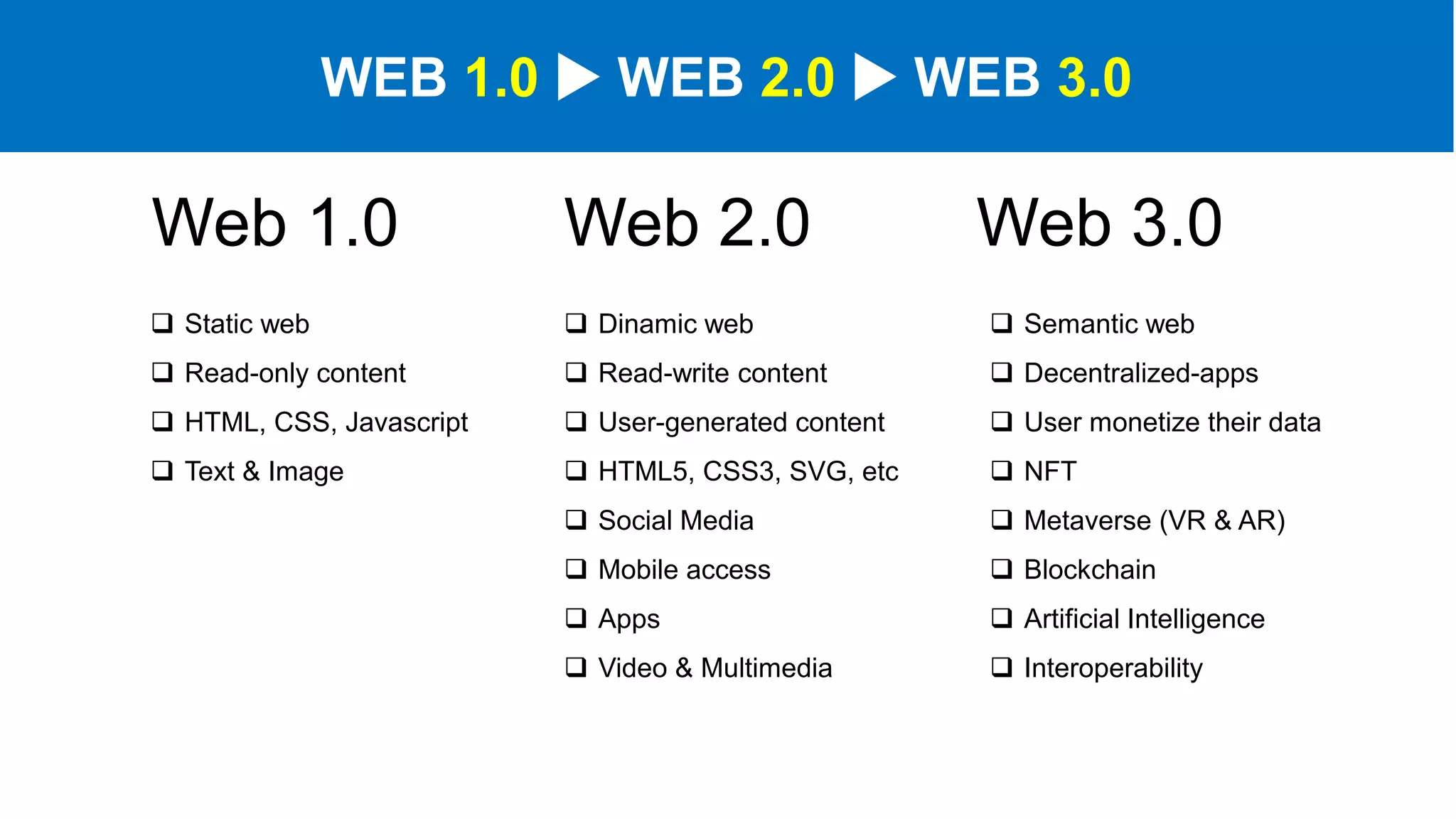
Web 1.0 Web 2.0 Web 3.0
 Static web
 Read-only content
 HTML, CSS, Javascript
 Text & Image
 Dinamic web
 Read-write content
 User-generated content
 HTML5, CSS3, SVG, etc
 Social Media
 Mobile access
 Apps
 Video & Multimedia
 Semantic web
 Decentralized-apps
 User monetize their data
 NFT
 Metaverse (VR & AR)
 Blockchain
 Artificial Intelligence
 Interoperability
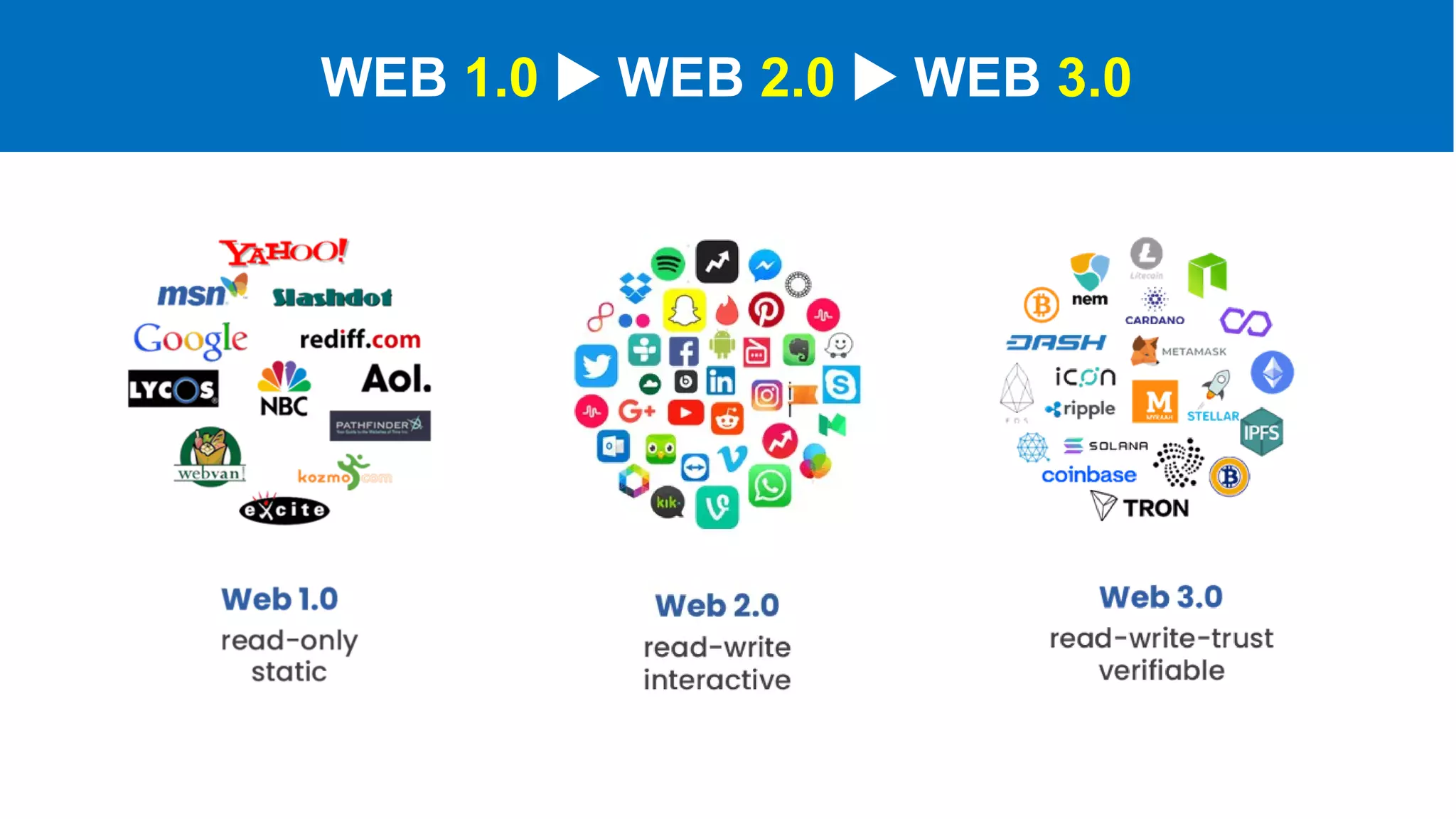
WEB 1.0  WEB 2.0  WEB 3.0
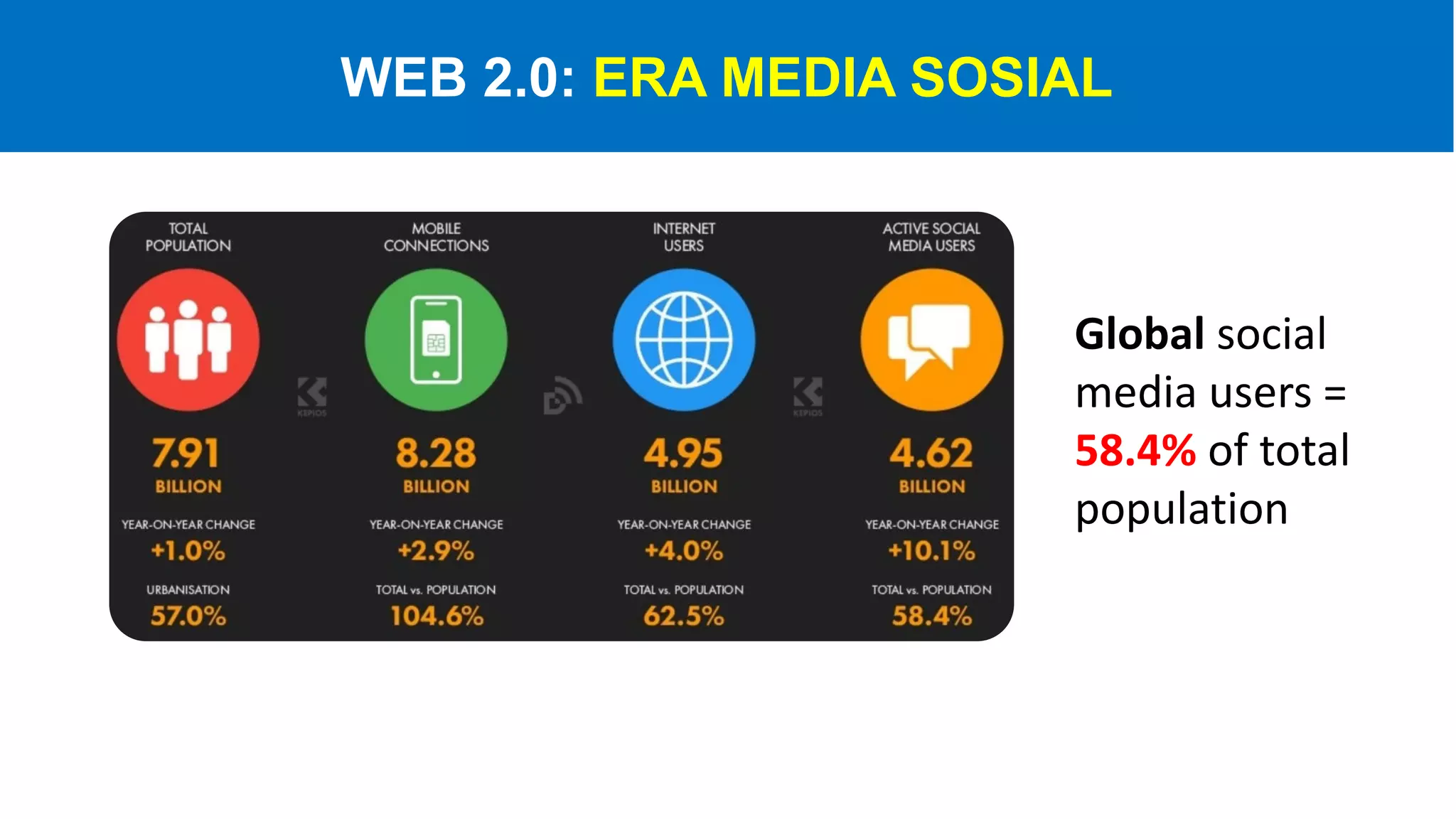
WEB 2.0: ERA MEDIA SOSIAL
Global social
media users =
58.4% of total
population
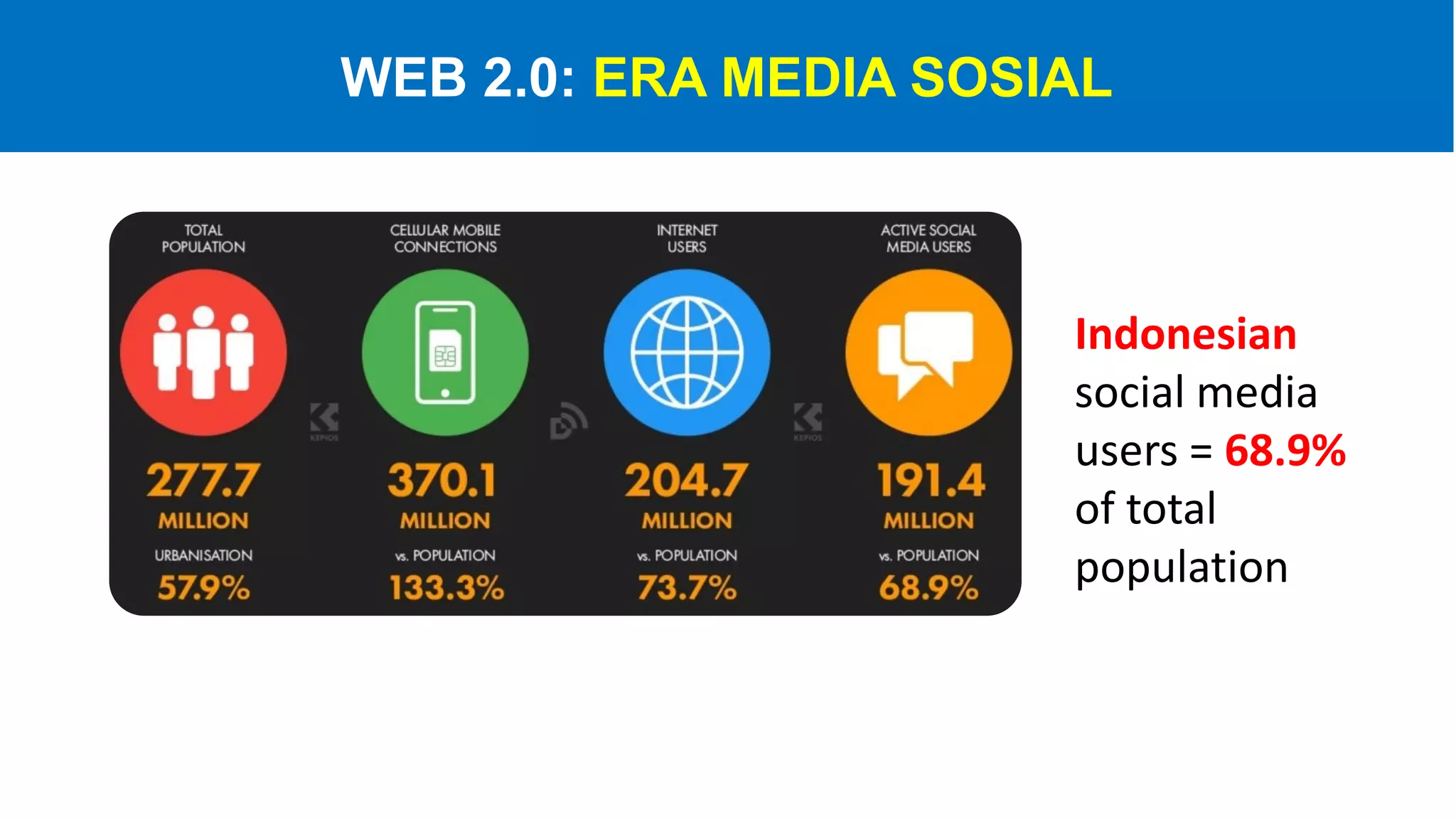
Indonesian
social media
users = 68.9%
of total
population
WEB 2.0: ERA MEDIA SOSIAL
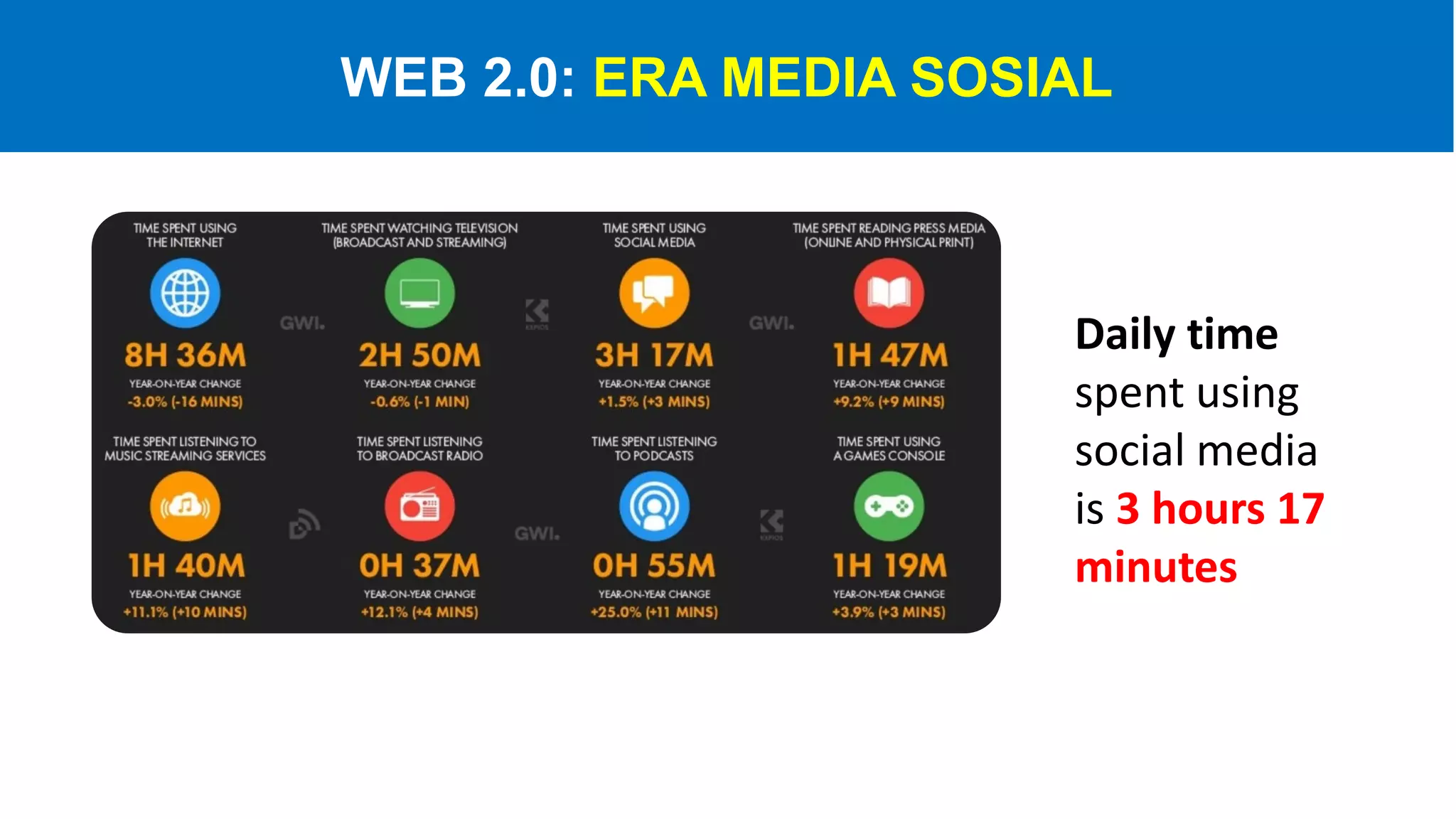
Daily time
spent using
social media
is 3 hours 17
minutes
WEB 2.0: ERA MEDIA SOSIAL
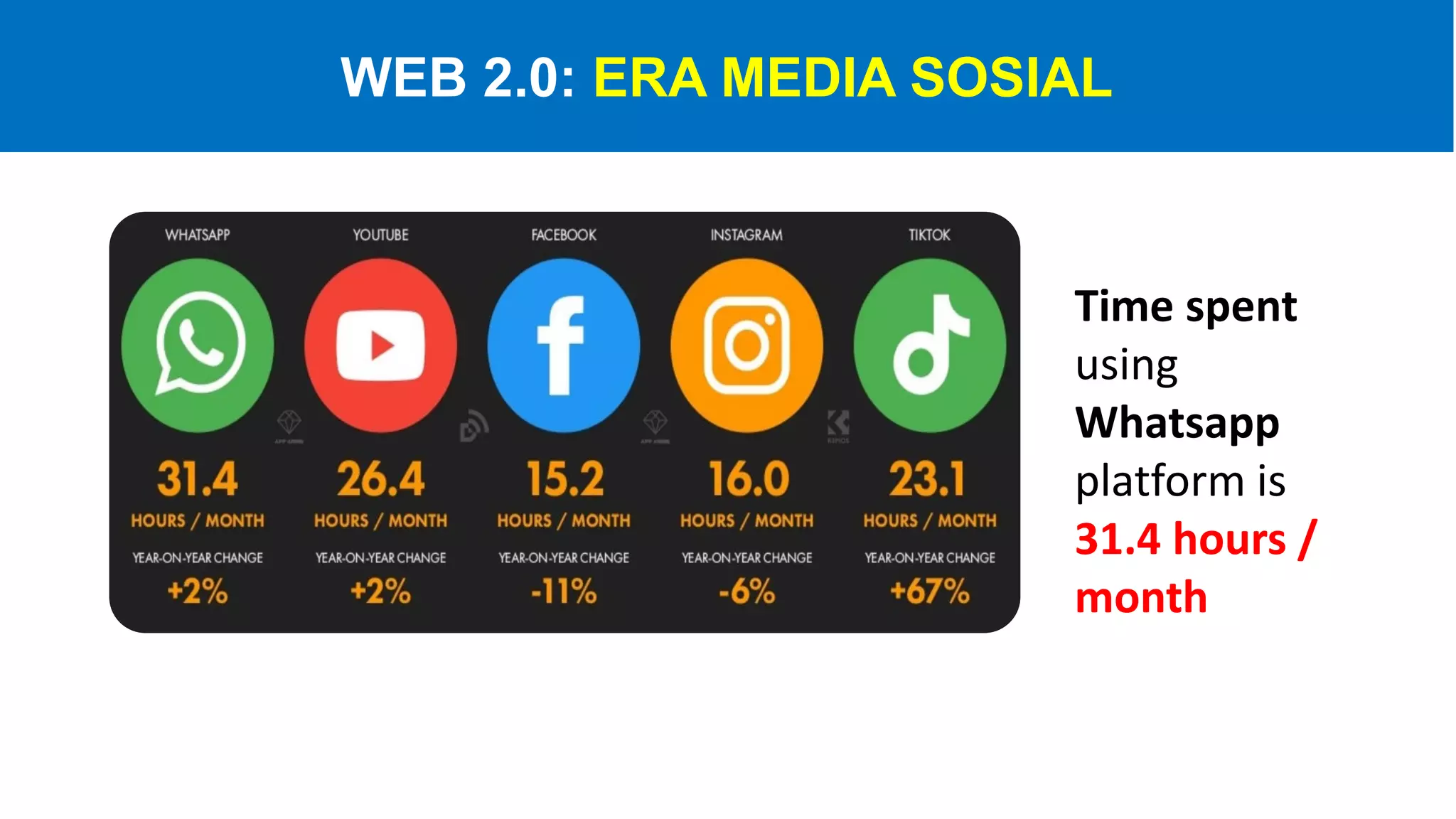
Time spent
using
Whatsapp
platform is
31.4 hours /
month
WEB 2.0: ERA MEDIA SOSIAL
Bagaimana dengan
“Web 3 is the new version of the internet which is
serverless and decentralized. An internet where
users are in control of their own data, identity and
destiny. It uses decentralized protocols and
cryptographic methods to safeguard, benefit and
make the ecosystem stable and resilient.”
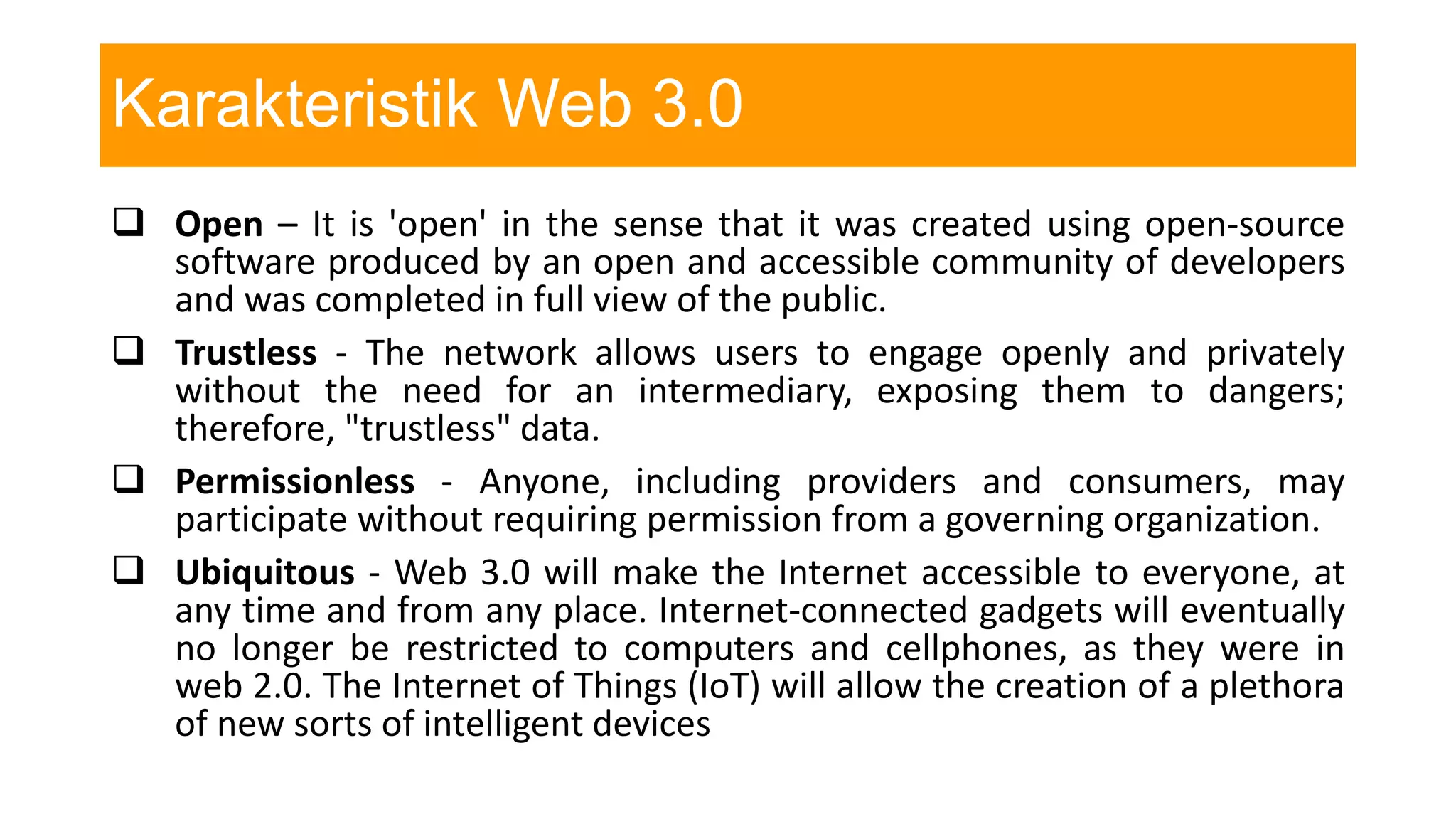
Karakteristik Web 3.0
 Open – It is 'open' in the sense that it was created using open-source
software produced by an open and accessible community of developers
and was completed in full view of the public.
 Trustless - The network allows users to engage openly and privately
without the need for an intermediary, exposing them to dangers;
therefore, "trustless" data.
 Permissionless - Anyone, including providers and consumers, may
participate without requiring permission from a governing organization.
 Ubiquitous - Web 3.0 will make the Internet accessible to everyone, at
any time and from any place. Internet-connected gadgets will eventually
no longer be restricted to computers and cellphones, as they were in
web 2.0. The Internet of Things (IoT) will allow the creation of a plethora
of new sorts of intelligent devices
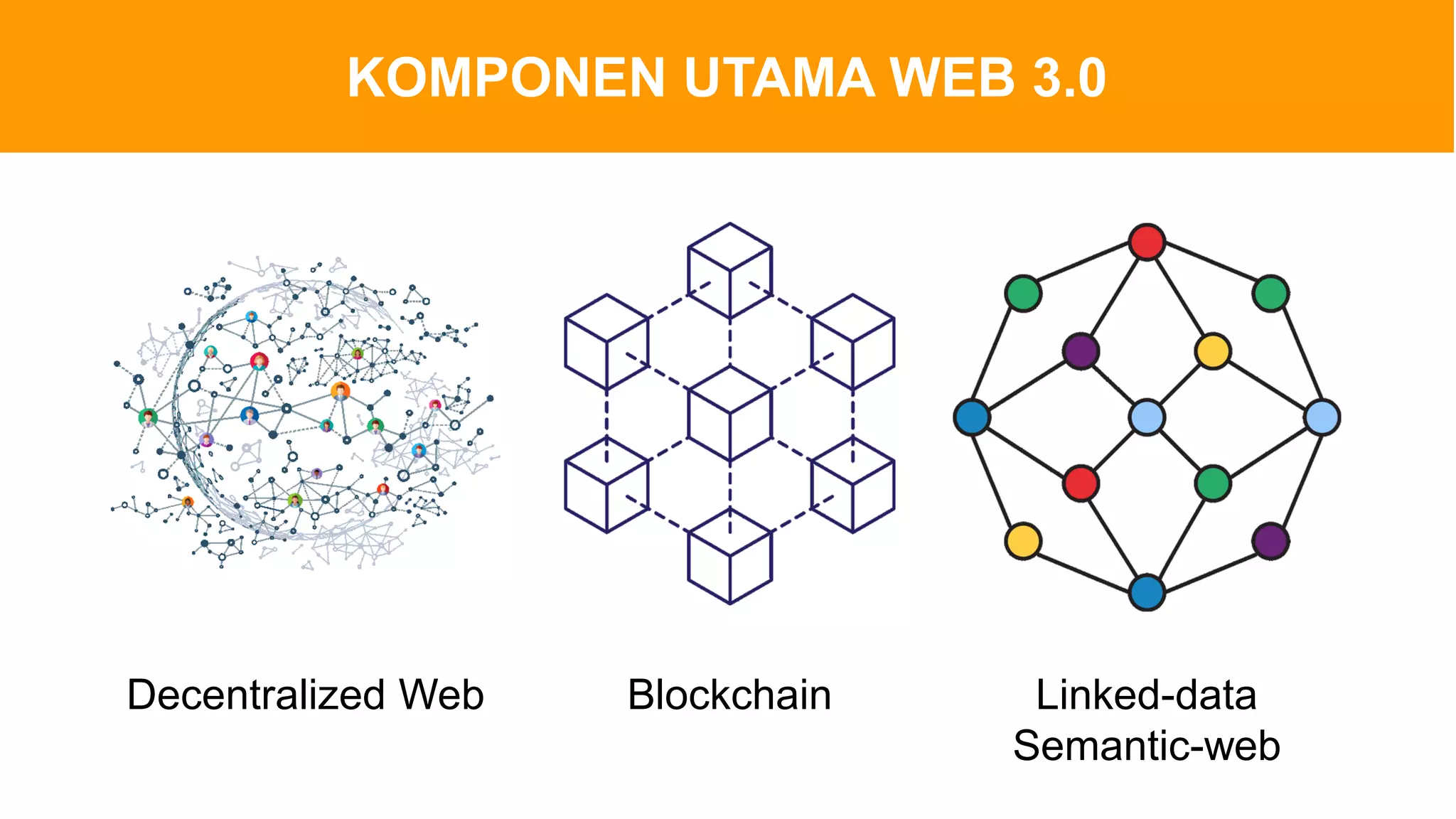
KOMPONEN UTAMA WEB 3.0
Decentralized Web Linked-data
Semantic-web
Blockchain
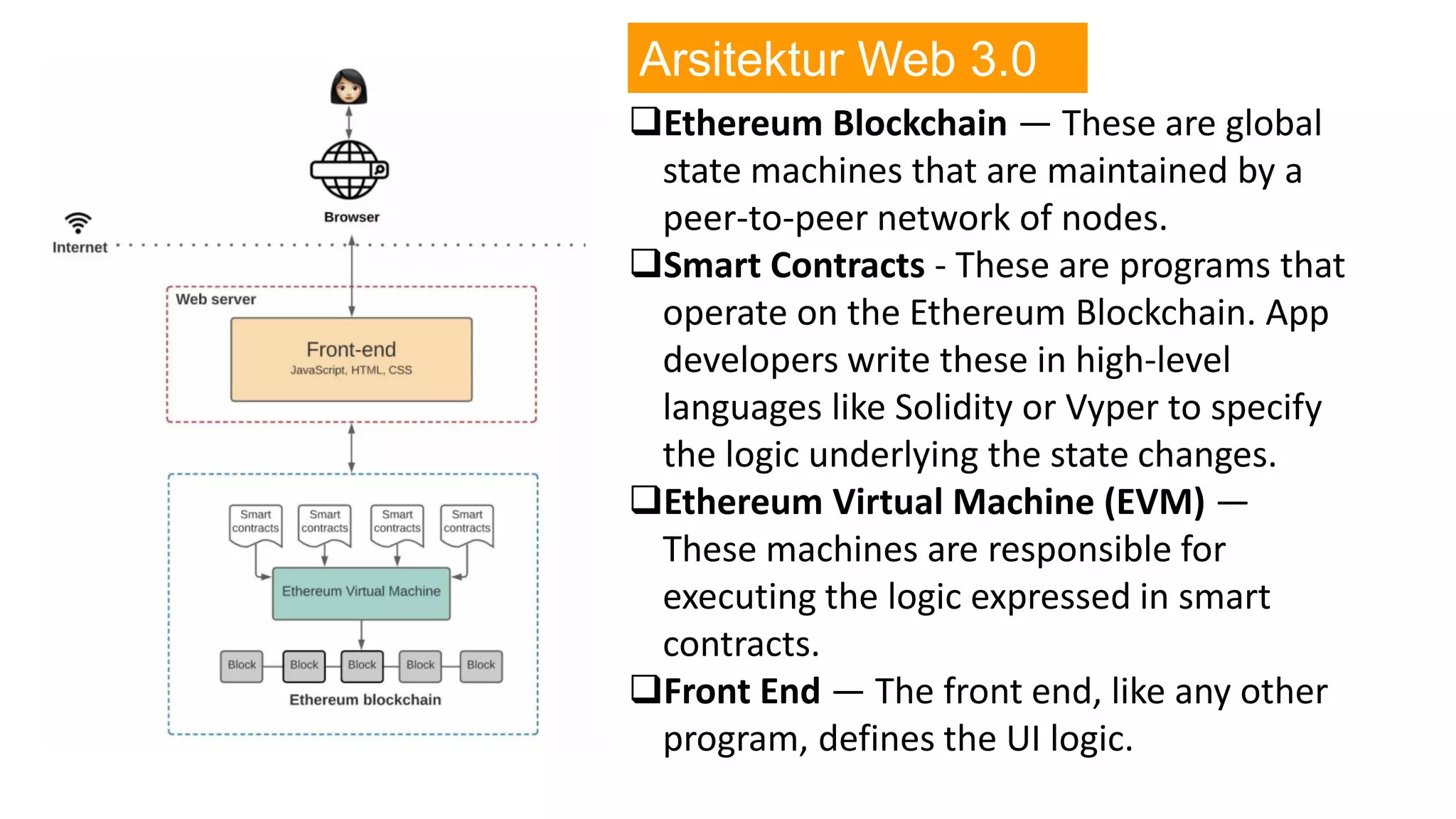
Ethereum Blockchain — These are global
state machines that are maintained by a
peer-to-peer network of nodes.
Smart Contracts - These are programs that
operate on the Ethereum Blockchain. App
developers write these in high-level
languages like Solidity or Vyper to specify
the logic underlying the state changes.
Ethereum Virtual Machine (EVM) —
These machines are responsible for
executing the logic expressed in smart
contracts.
Front End — The front end, like any other
program, defines the UI logic.
Arsitektur Web 3.0
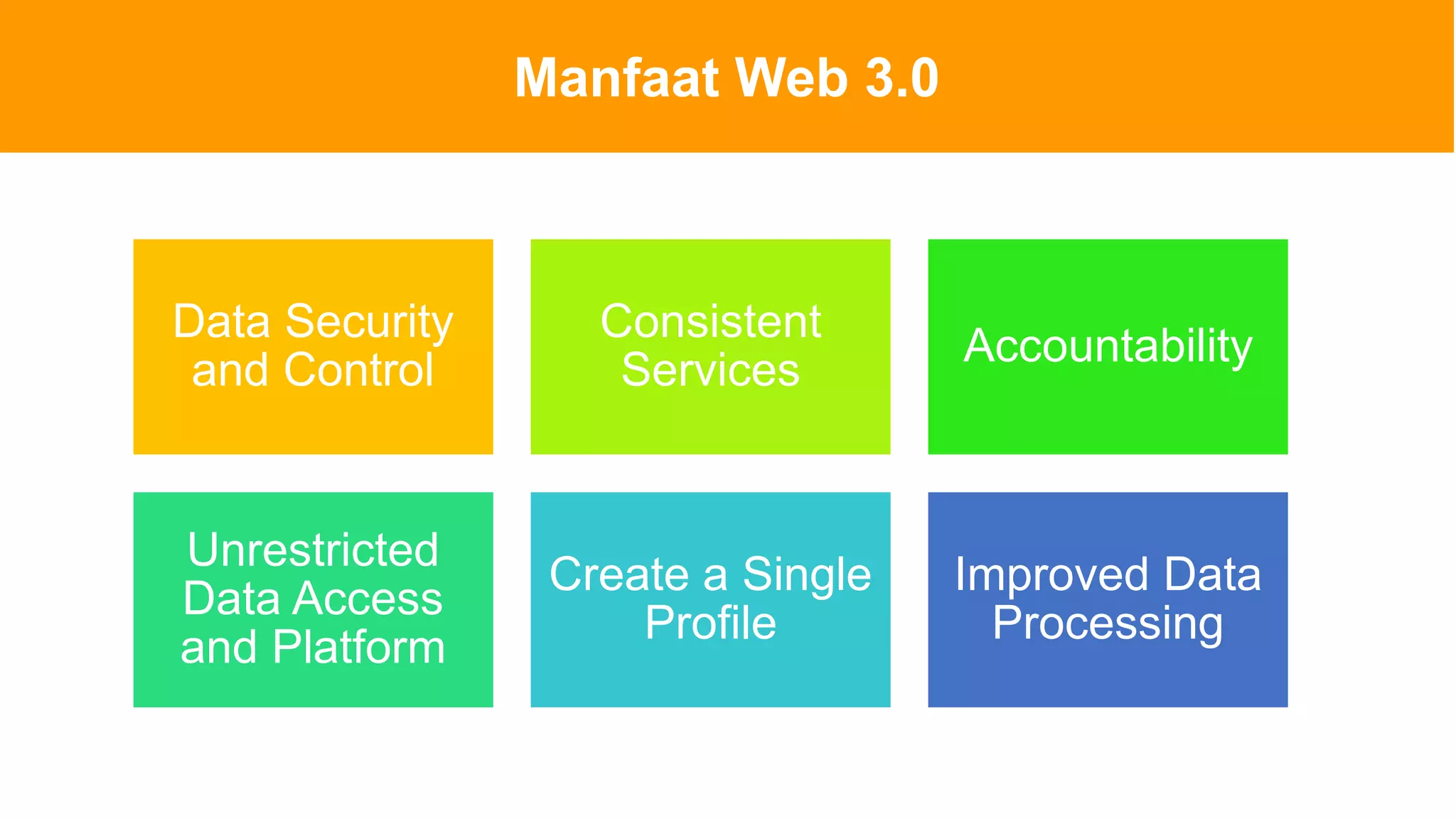
Manfaat Web 3.0
Data Security
and Control
Consistent
Services
Accountability
Unrestricted
Data Access
and Platform
Create a Single
Profile
Improved Data
Processing
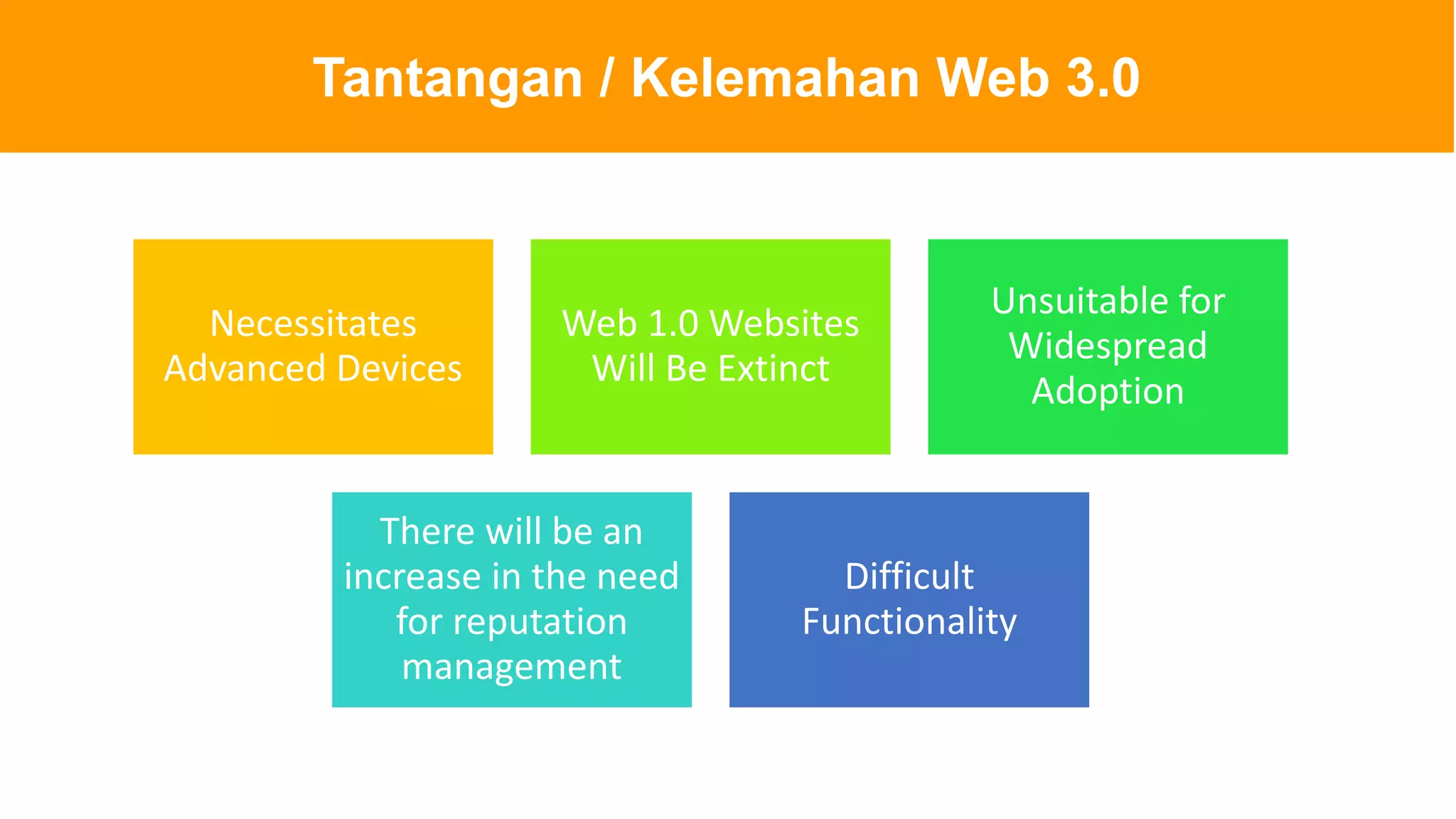
Tantangan / Kelemahan Web 3.0
Necessitates
Advanced Devices
Web 1.0 Websites
Will Be Extinct
Unsuitable for
Widespread
Adoption
There will be an
increase in the need
for reputation
management
Difficult
Functionality
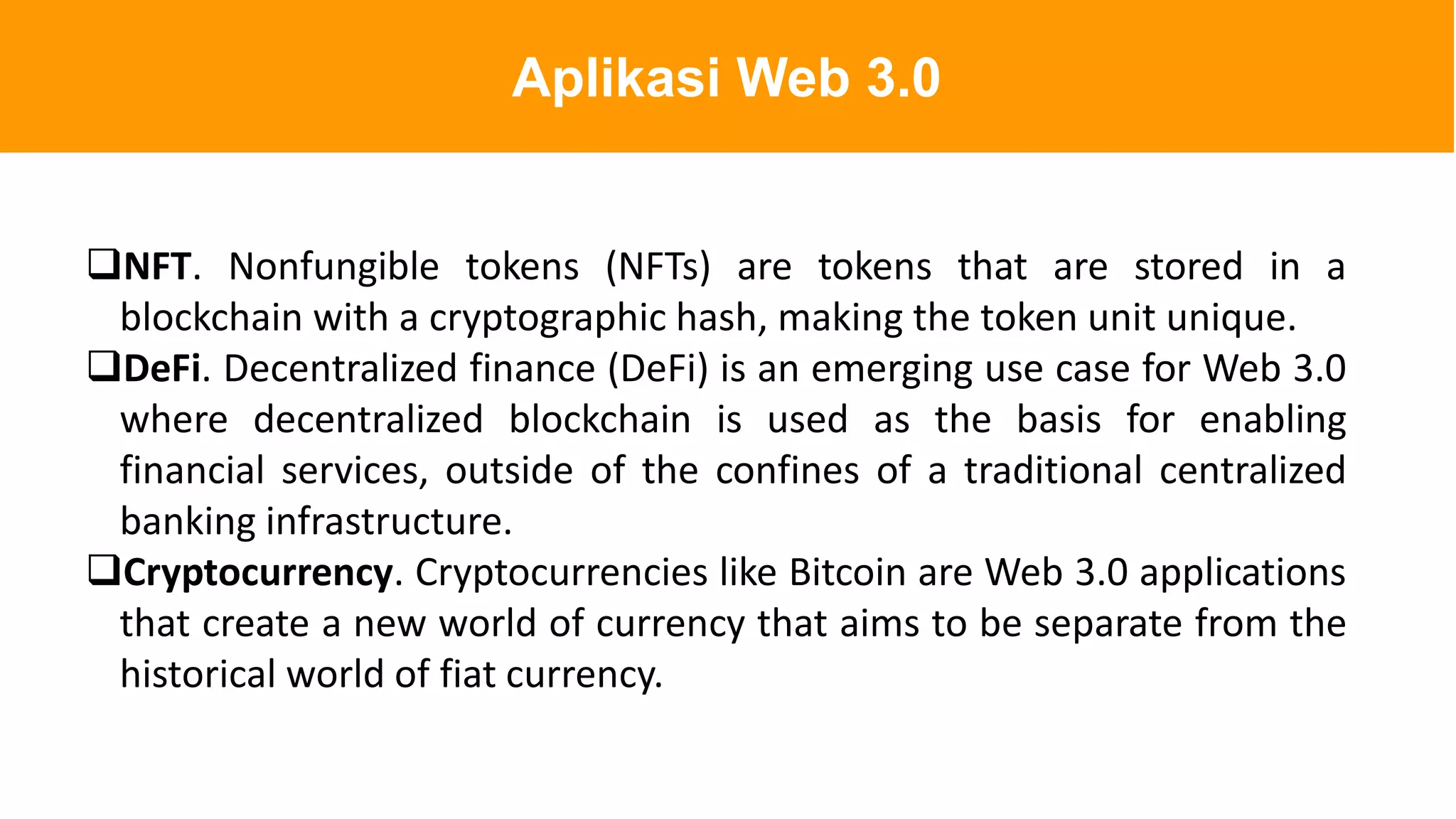
NFT. Nonfungible tokens (NFTs) are tokens that are stored in a
blockchain with a cryptographic hash, making the token unit unique.
DeFi. Decentralized finance (DeFi) is an emerging use case for Web 3.0
where decentralized blockchain is used as the basis for enabling
financial services, outside of the confines of a traditional centralized
banking infrastructure.
Cryptocurrency. Cryptocurrencies like Bitcoin are Web 3.0 applications
that create a new world of currency that aims to be separate from the
historical world of fiat currency.
Aplikasi Web 3.0
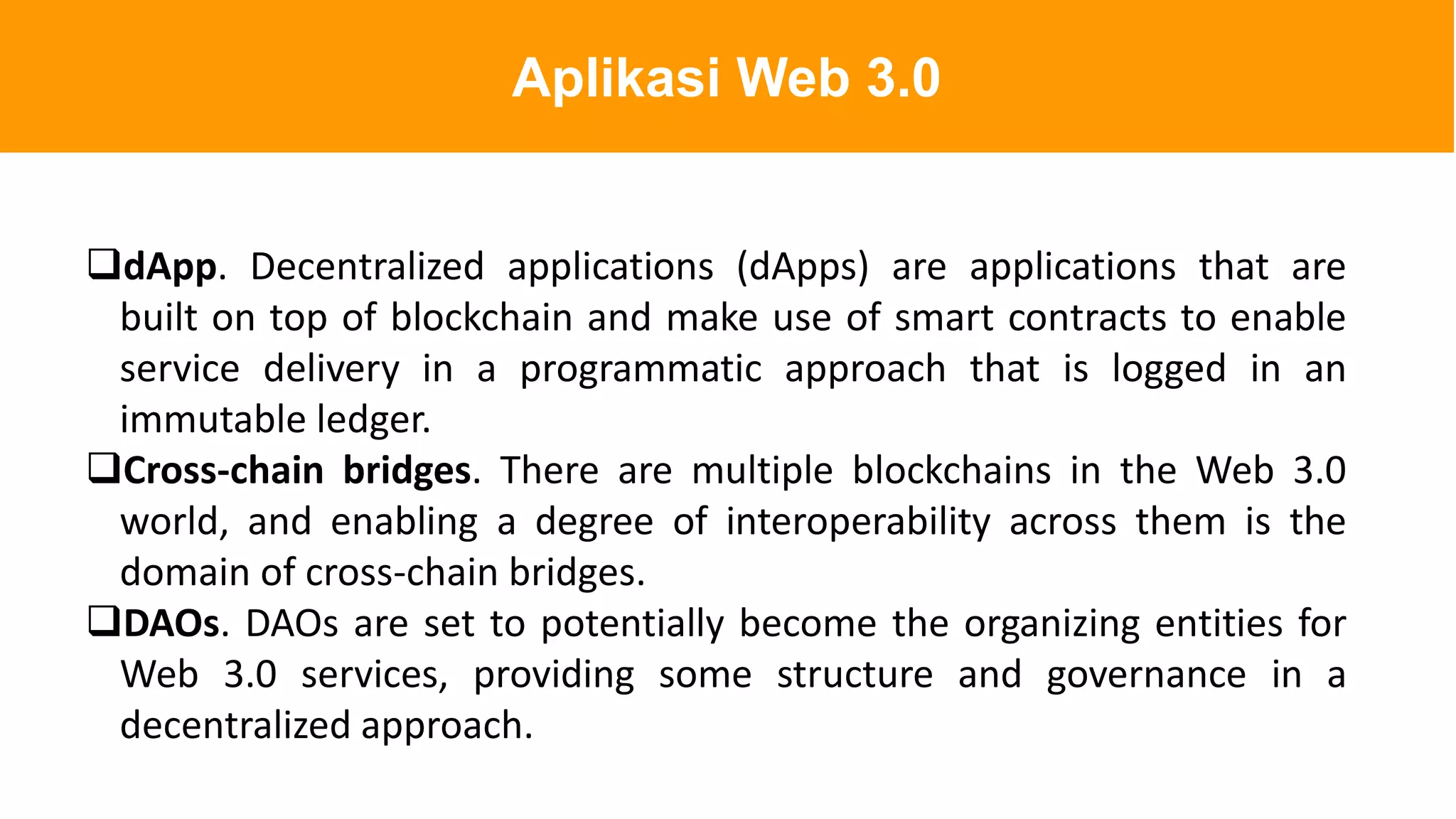
dApp. Decentralized applications (dApps) are applications that are
built on top of blockchain and make use of smart contracts to enable
service delivery in a programmatic approach that is logged in an
immutable ledger.
Cross-chain bridges. There are multiple blockchains in the Web 3.0
world, and enabling a degree of interoperability across them is the
domain of cross-chain bridges.
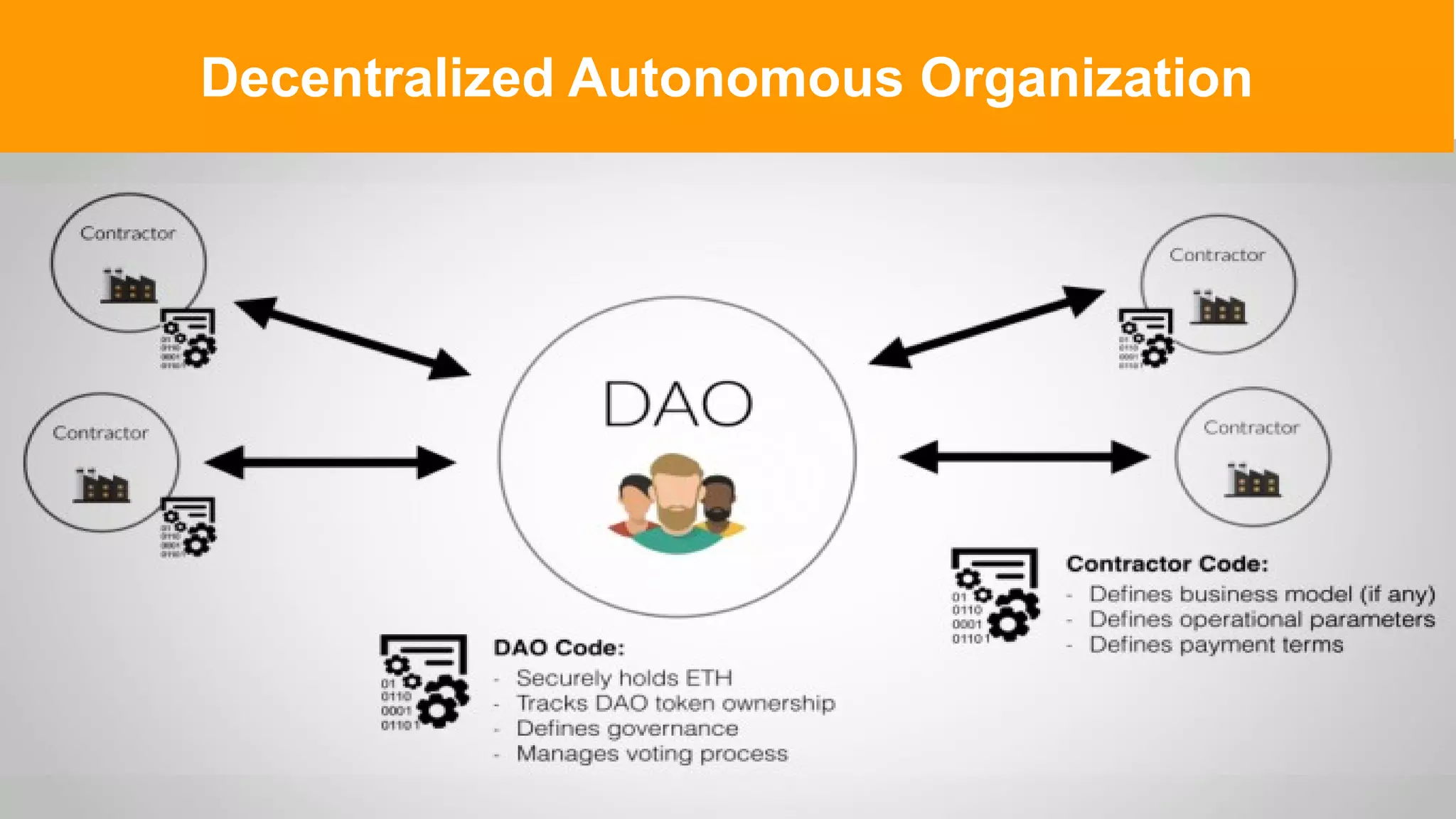
DAOs. DAOs are set to potentially become the organizing entities for
Web 3.0 services, providing some structure and governance in a
decentralized approach.
Aplikasi Web 3.0
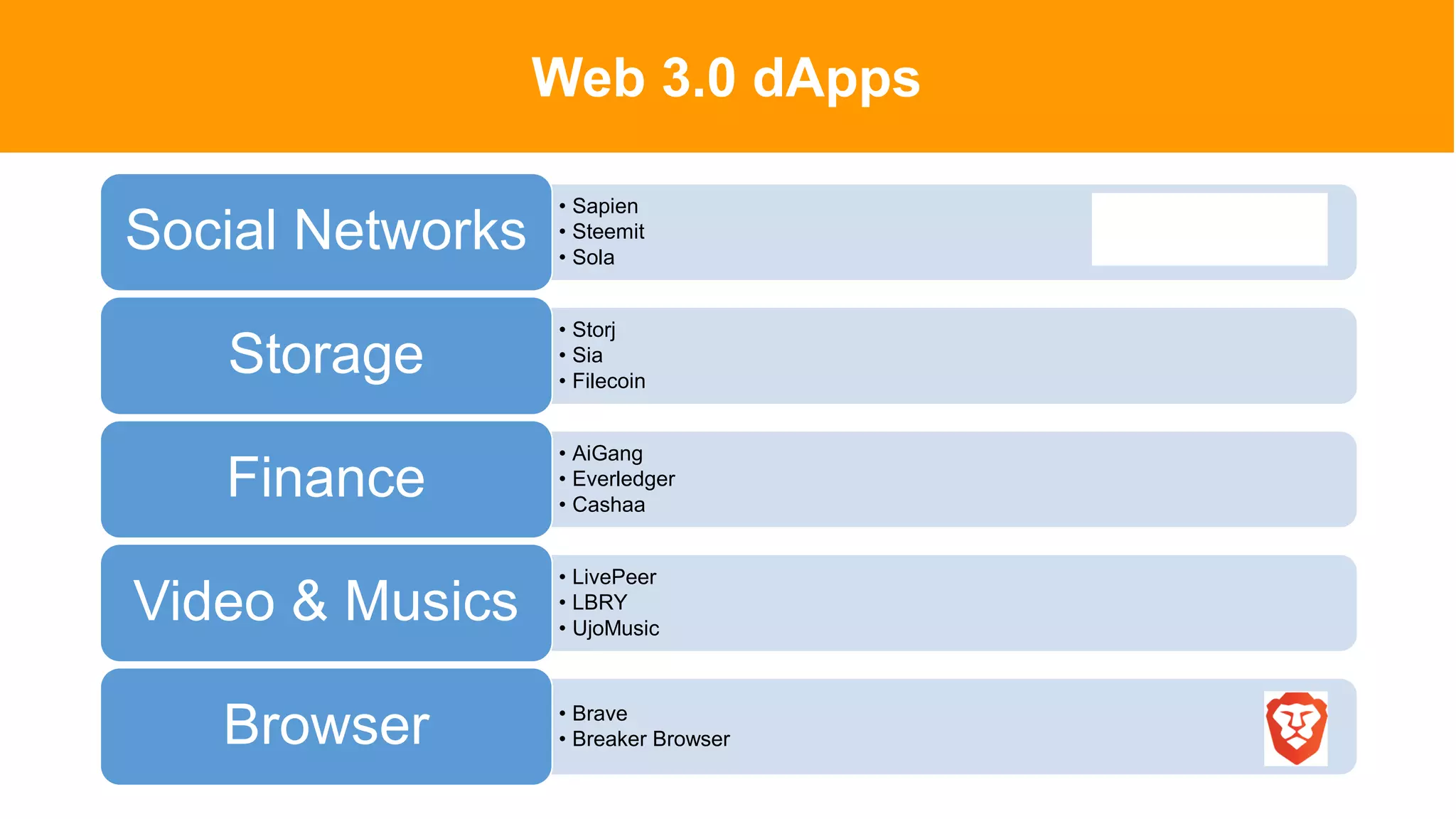
Web 3.0 dApps
• Sapien
• Steemit
• Sola
Social Networks
• Storj
• Sia
• Filecoin
Storage
• AiGang
• Everledger
• Cashaa
Finance
• LivePeer
• LBRY
• UjoMusic
Video & Musics
• Brave
• Breaker Browser
Browser
Decentralized Autonomous Organization
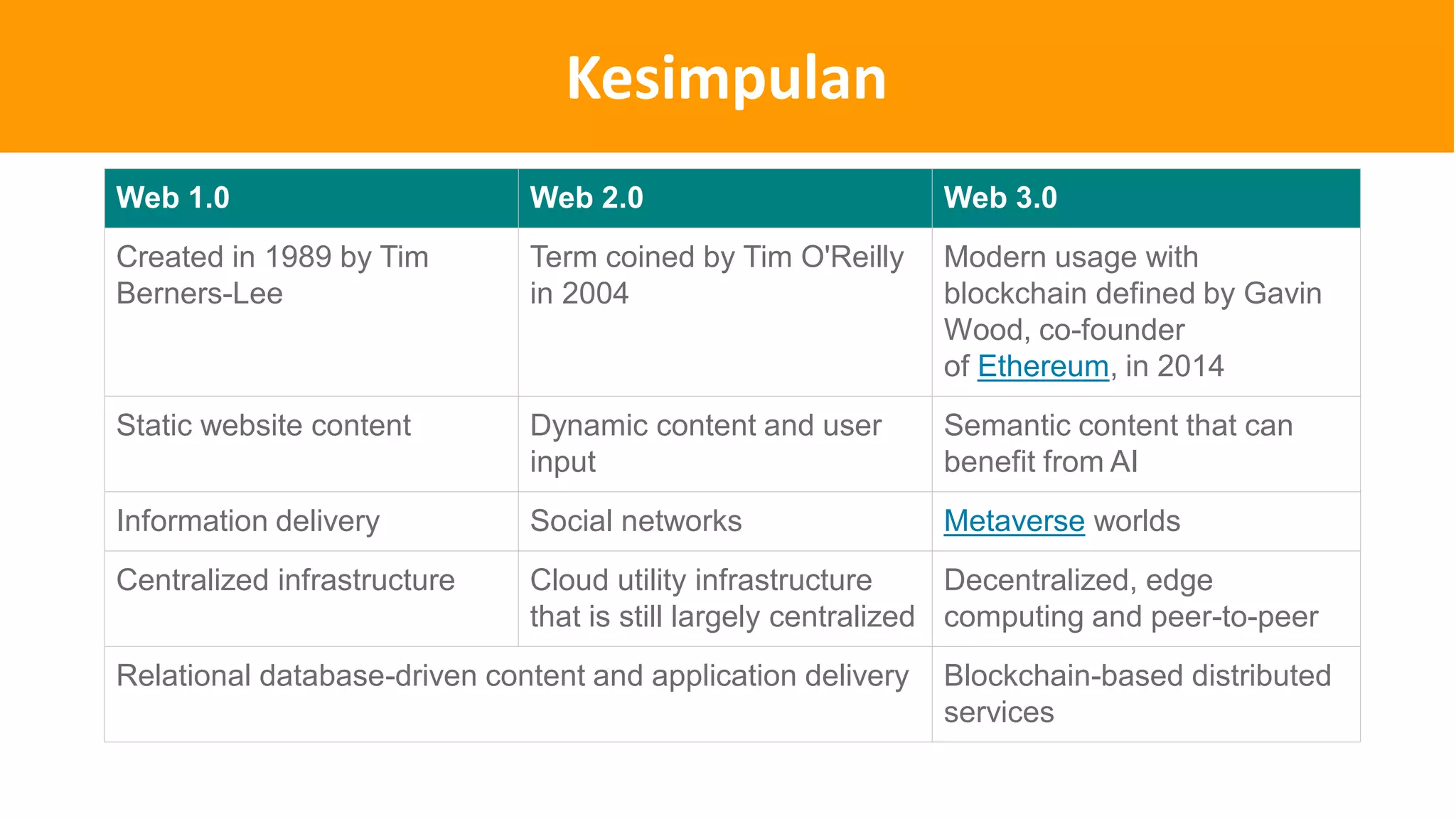
Web 1.0 Web 2.0 Web 3.0
Created in 1989 by Tim
Berners-Lee
Term coined by Tim O'Reilly
in 2004
Modern usage with
blockchain defined by Gavin
Wood, co-founder
of Ethereum, in 2014
Static website content Dynamic content and user
input
Semantic content that can
benefit from AI
Information delivery Social networks Metaverse worlds
Centralized infrastructure Cloud utility infrastructure
that is still largely centralized
Decentralized, edge
computing and peer-to-peer
Relational database-driven content and application delivery Blockchain-based distributed
services
Kesimpulan
Web 3.0 masih terus dikembangkan dan
akan terus berkembang
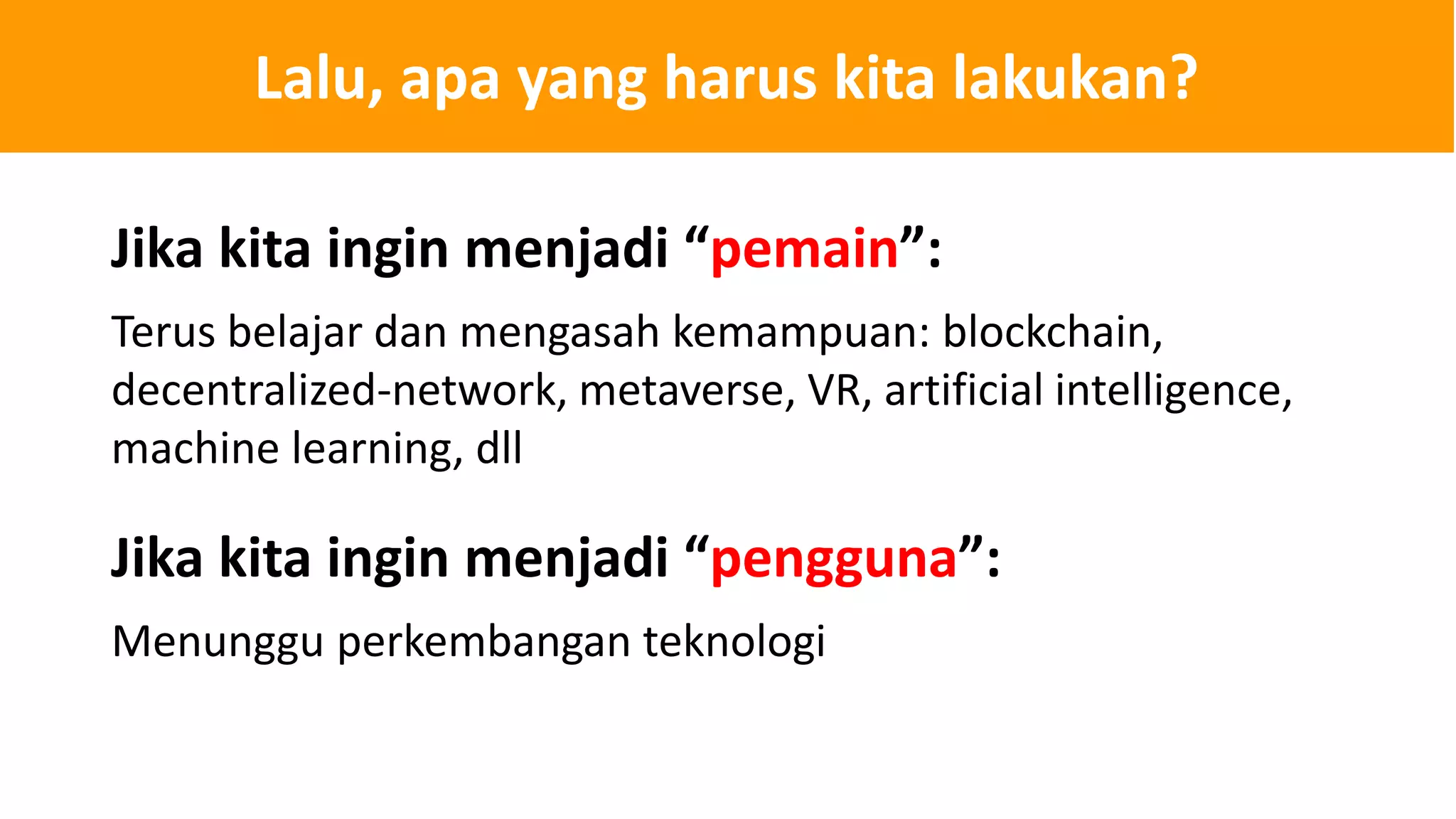
Lalu, apa yang harus kita lakukan?
Terus belajar dan mengasah kemampuan: blockchain,
decentralized-network, metaverse, VR, artificial intelligence,
machine learning, dll
Jika kita ingin menjadi “pemain”:
Menunggu perkembangan teknologi
Jika kita ingin menjadi “pengguna”:
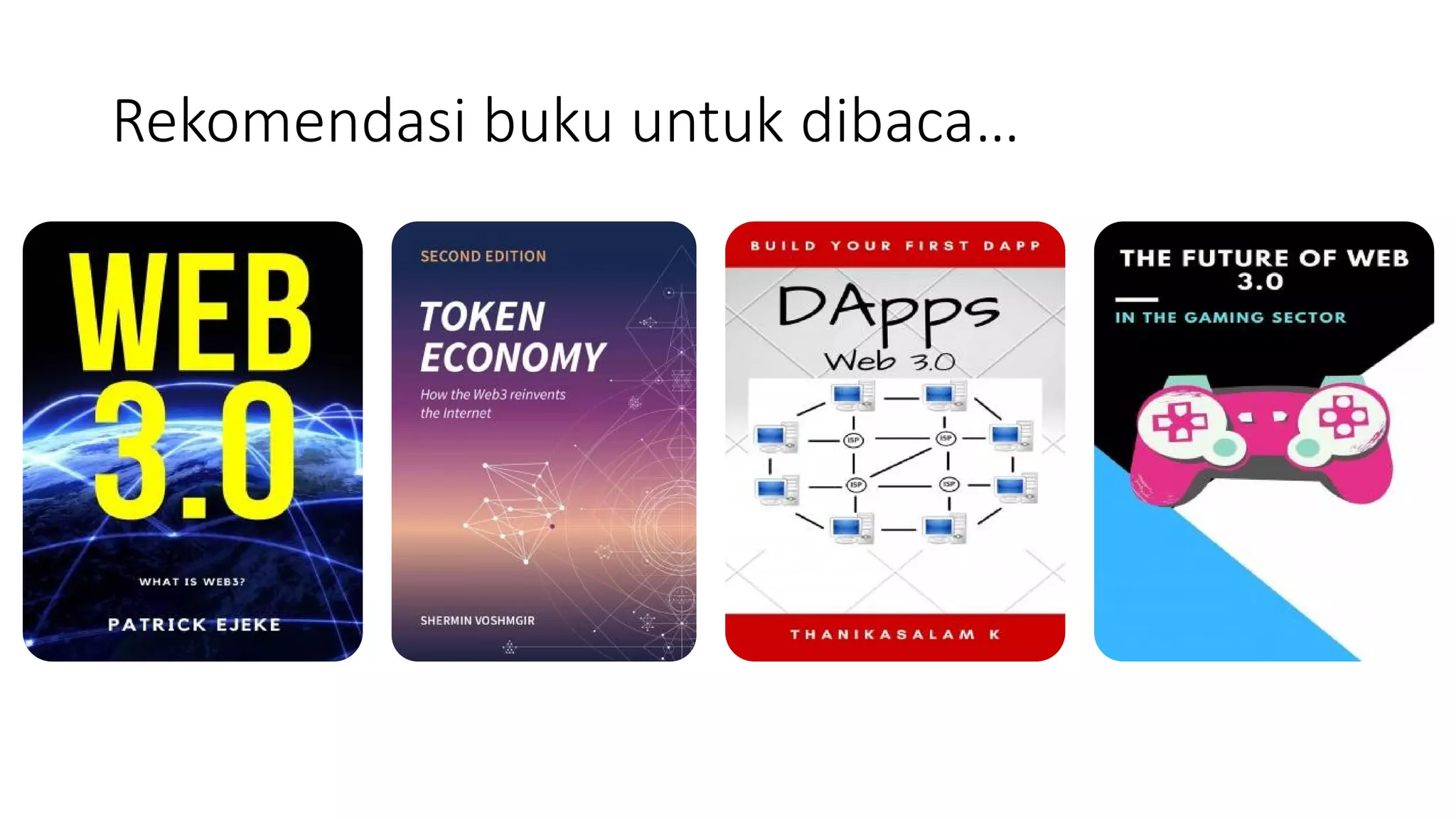
Rekomendasi buku untuk dibaca…
Terima Kasih
@achmatim Achmad Solichin achmatim@gmail.com
slideshare.net/achmatim http://achmatim.net
Universitas Budi Luhur, Jakarta

Materi Webinar Web 3.0 (16 Juli 2022)

  • 1.
    Introducting… WEB 3.0 Dr. AchmadSolichin | @achmatim Jakarta, 16 Juli 2022 BEM Fakultas Teknologi Informasi Universitas Budi Luhur
  • 3.
  • 4.
    internet “interconnected network; kumpulanjaringan yang saling terhubung”
  • 5.
    web a.k.a www “sebuahsistem yang memungkinkan berbagai dokumen dan sumber daya lainnya dapat diakses melalui jaringan internet”
  • 6.
    web a.k.a www Quiz#1: Ada yang tau kepanjangan dari “www” ? Jawab: World wide web Quiz #2: Ada yang tau kepanjangan dari “www” dalam Bahasa Indonesia? Jawab: Waring Wera Wanua
  • 8.
    Siapa penemu webpertama kali?
  • 9.
    Tim Berners-Lee, aBritish scientist, invented the World Wide Web (WWW) in 1989, while working at CERN. The Web was originally conceived and developed to meet the demand for automated information- sharing between scientists in universities and institutes around the world.
  • 10.
    WEB 1.0 WEB 2.0  WEB 3.0
  • 11.
    Web 1.0 Web2.0 Web 3.0  Static web  Read-only content  HTML, CSS, Javascript  Text & Image  Dinamic web  Read-write content  User-generated content  HTML5, CSS3, SVG, etc  Social Media  Mobile access  Apps  Video & Multimedia  Semantic web  Decentralized-apps  User monetize their data  NFT  Metaverse (VR & AR)  Blockchain  Artificial Intelligence  Interoperability WEB 1.0  WEB 2.0  WEB 3.0
  • 12.
    WEB 1.0 WEB 2.0  WEB 3.0
  • 13.
    WEB 2.0: ERAMEDIA SOSIAL Global social media users = 58.4% of total population
  • 14.
    Indonesian social media users =68.9% of total population WEB 2.0: ERA MEDIA SOSIAL
  • 15.
    Daily time spent using socialmedia is 3 hours 17 minutes WEB 2.0: ERA MEDIA SOSIAL
  • 16.
    WEB 2.0: ERAMEDIA SOSIAL
  • 17.
    Time spent using Whatsapp platform is 31.4hours / month WEB 2.0: ERA MEDIA SOSIAL
  • 18.
  • 19.
    “Web 3 isthe new version of the internet which is serverless and decentralized. An internet where users are in control of their own data, identity and destiny. It uses decentralized protocols and cryptographic methods to safeguard, benefit and make the ecosystem stable and resilient.”
  • 20.
    Karakteristik Web 3.0 Open – It is 'open' in the sense that it was created using open-source software produced by an open and accessible community of developers and was completed in full view of the public.  Trustless - The network allows users to engage openly and privately without the need for an intermediary, exposing them to dangers; therefore, "trustless" data.  Permissionless - Anyone, including providers and consumers, may participate without requiring permission from a governing organization.  Ubiquitous - Web 3.0 will make the Internet accessible to everyone, at any time and from any place. Internet-connected gadgets will eventually no longer be restricted to computers and cellphones, as they were in web 2.0. The Internet of Things (IoT) will allow the creation of a plethora of new sorts of intelligent devices
  • 21.
    KOMPONEN UTAMA WEB3.0 Decentralized Web Linked-data Semantic-web Blockchain
  • 22.
    Ethereum Blockchain —These are global state machines that are maintained by a peer-to-peer network of nodes. Smart Contracts - These are programs that operate on the Ethereum Blockchain. App developers write these in high-level languages like Solidity or Vyper to specify the logic underlying the state changes. Ethereum Virtual Machine (EVM) — These machines are responsible for executing the logic expressed in smart contracts. Front End — The front end, like any other program, defines the UI logic. Arsitektur Web 3.0
  • 23.
    Manfaat Web 3.0 DataSecurity and Control Consistent Services Accountability Unrestricted Data Access and Platform Create a Single Profile Improved Data Processing
  • 24.
    Tantangan / KelemahanWeb 3.0 Necessitates Advanced Devices Web 1.0 Websites Will Be Extinct Unsuitable for Widespread Adoption There will be an increase in the need for reputation management Difficult Functionality
  • 25.
    NFT. Nonfungible tokens(NFTs) are tokens that are stored in a blockchain with a cryptographic hash, making the token unit unique. DeFi. Decentralized finance (DeFi) is an emerging use case for Web 3.0 where decentralized blockchain is used as the basis for enabling financial services, outside of the confines of a traditional centralized banking infrastructure. Cryptocurrency. Cryptocurrencies like Bitcoin are Web 3.0 applications that create a new world of currency that aims to be separate from the historical world of fiat currency. Aplikasi Web 3.0
  • 26.
    dApp. Decentralized applications(dApps) are applications that are built on top of blockchain and make use of smart contracts to enable service delivery in a programmatic approach that is logged in an immutable ledger. Cross-chain bridges. There are multiple blockchains in the Web 3.0 world, and enabling a degree of interoperability across them is the domain of cross-chain bridges. DAOs. DAOs are set to potentially become the organizing entities for Web 3.0 services, providing some structure and governance in a decentralized approach. Aplikasi Web 3.0
  • 27.
    Web 3.0 dApps •Sapien • Steemit • Sola Social Networks • Storj • Sia • Filecoin Storage • AiGang • Everledger • Cashaa Finance • LivePeer • LBRY • UjoMusic Video & Musics • Brave • Breaker Browser Browser
  • 28.
  • 30.
    Web 1.0 Web2.0 Web 3.0 Created in 1989 by Tim Berners-Lee Term coined by Tim O'Reilly in 2004 Modern usage with blockchain defined by Gavin Wood, co-founder of Ethereum, in 2014 Static website content Dynamic content and user input Semantic content that can benefit from AI Information delivery Social networks Metaverse worlds Centralized infrastructure Cloud utility infrastructure that is still largely centralized Decentralized, edge computing and peer-to-peer Relational database-driven content and application delivery Blockchain-based distributed services Kesimpulan
  • 31.
    Web 3.0 masihterus dikembangkan dan akan terus berkembang
  • 32.
    Lalu, apa yangharus kita lakukan? Terus belajar dan mengasah kemampuan: blockchain, decentralized-network, metaverse, VR, artificial intelligence, machine learning, dll Jika kita ingin menjadi “pemain”: Menunggu perkembangan teknologi Jika kita ingin menjadi “pengguna”:
  • 33.
  • 34.
    Terima Kasih @achmatim AchmadSolichin achmatim@gmail.com slideshare.net/achmatim http://achmatim.net Universitas Budi Luhur, Jakarta