COMMON NEONATAL
DISORDER
By- Mr. M. Binanda Singh
RINPS
INTRODUCTION
 A wide variety of disorders affecting the newborn may originate in
utero, during birth or in immediate postnatal period.
 These disorder may be due to prematurity, genetic mutations,
chromosomal aberrations or acquired from environment.
Neonatal disorder
a. BIRTH INJURY
1. Soft tissue injury
2. Caput succedanum
3. Cephalohematoma
4. Nerve injuries.
b. PROBLEMS RELATED TO PHYSIOLOGICAL FACTORS.
1. Hyperbilirubinema.
2. Hypoglycemia.
3. Hypocalcemia.
4. Hypothermia.
Contd….
c. PROBLEMS OF RESPIRATORY SYSTEM
1. Respiratory distress syndrome.
2. Meconium aspiration syndrome.
d. NEONATAL SEPTICEMIA
e. NEONATE SEIZURES
SOFT TISSUE INJURY
1. ERYTHEMA AND ABRASION- Usually result from application of forceps during delivery.
Contd…..
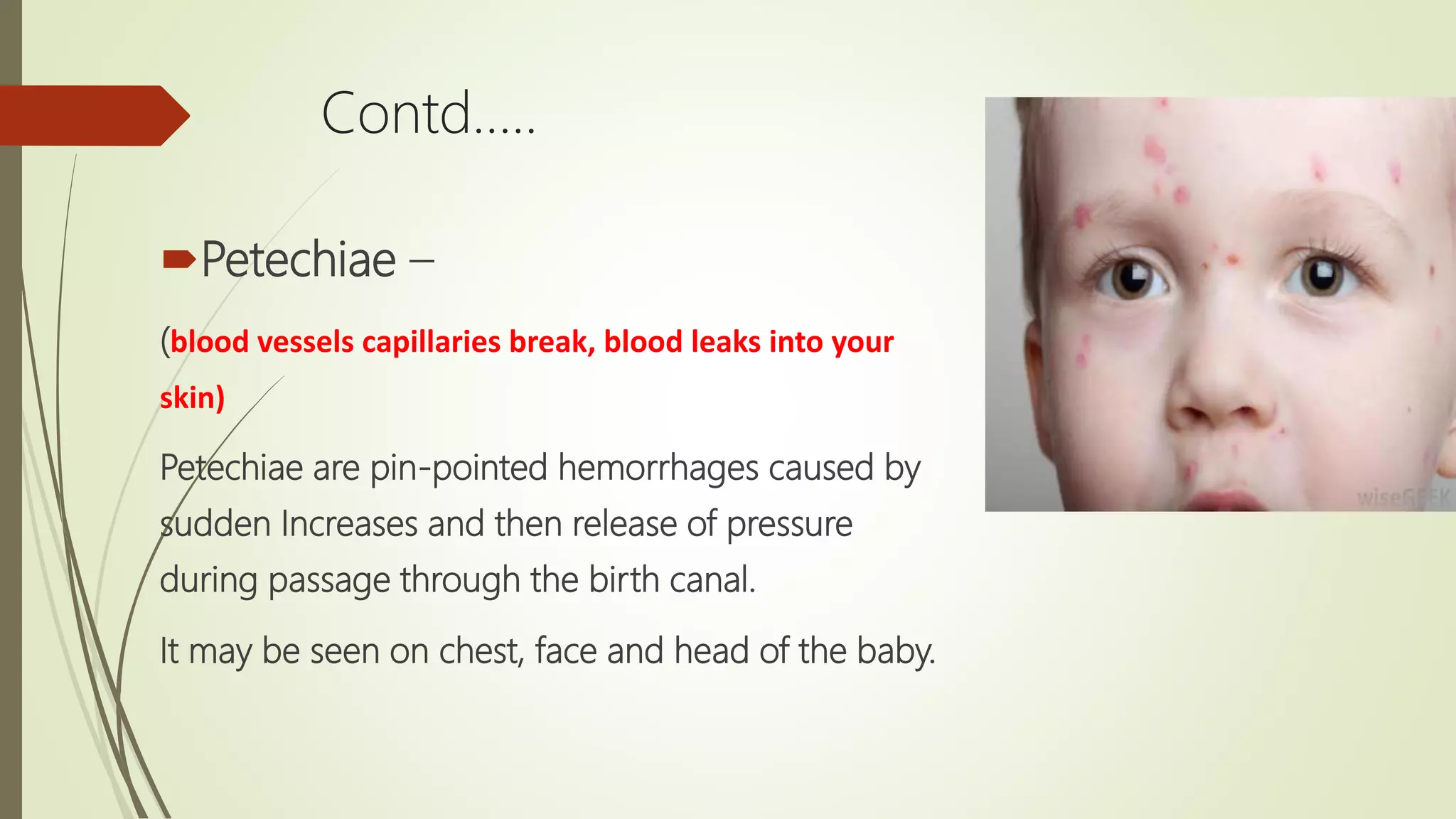
Petechiae –
(blood vessels capillaries break, blood leaks into your
skin)
Petechiae are pin-pointed hemorrhages caused by
sudden Increases and then release of pressure
during passage through the birth canal.
It may be seen on chest, face and head of the baby.
Contd…..
 ECHYMOSIS –
 Small hemorrhagic areas ( larger
than petechiae)
 May occur after traumatic delivery.
Contd….
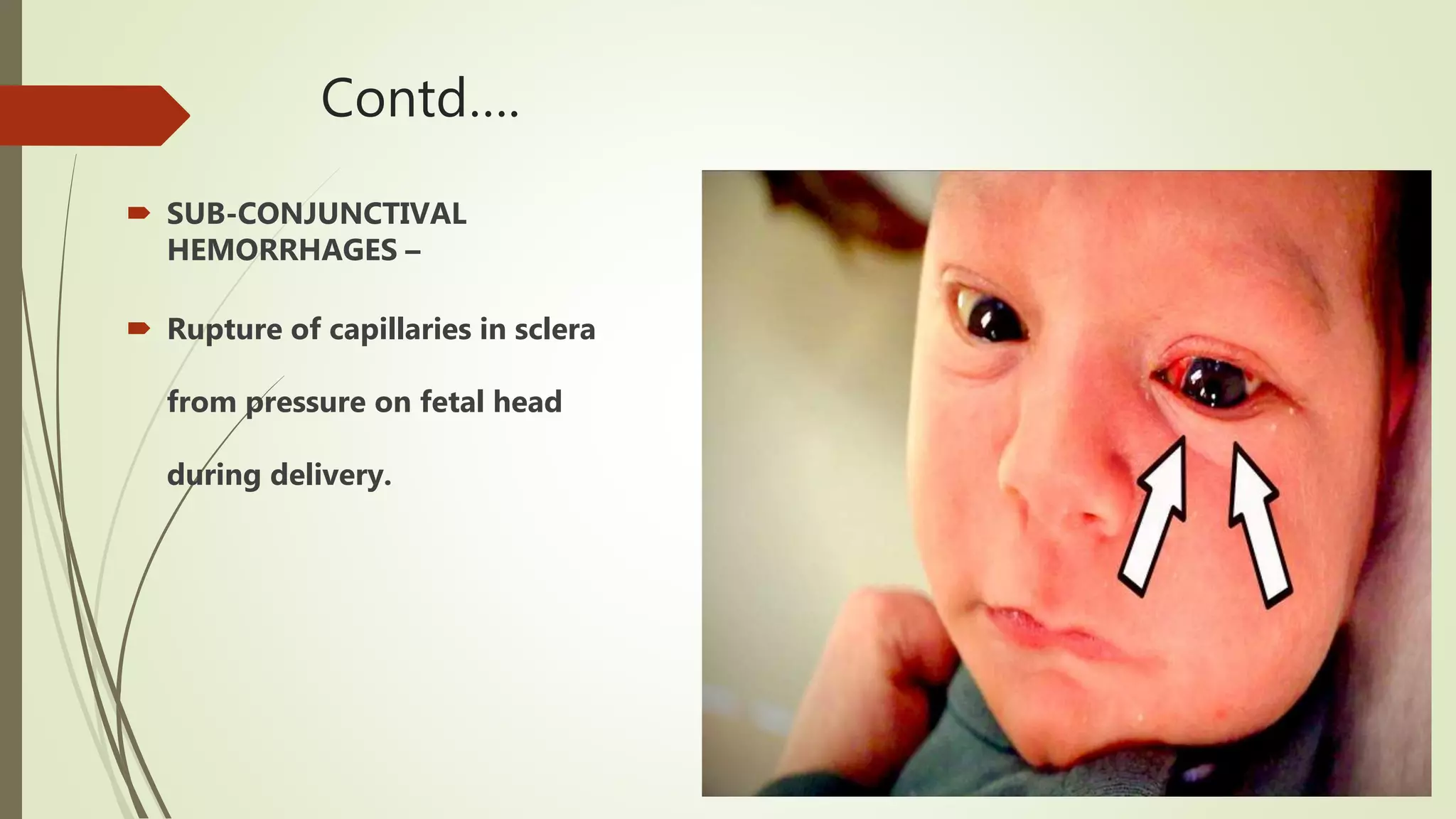
 SUB-CONJUNCTIVAL
HEMORRHAGES –
 Rupture of capillaries in sclera
from pressure on fetal head
during delivery.
BIRTH INJURIES
The passage from the safety of the uterus to the outside
world is a dangerous journey.
Birth injuries is an impairment of the infant’s body function
or structure due to adverse influence that occurred at birth.
Injury may occur during antepartum, intrapartum or
postpartum period.
Risk factors
 MATERNAL :-
 Primi parity .
 Maternal pelvic anomalies .
 Prolonged or extremely rapid labor.
 Oligohydromnios .
FETAL:-
 Abnormal presentation .
 Very low birth weight infant or extremely prematurity.
 Fetal Macrosomnia - large baby.
 Large fetal head .
 INTERVENTIONAL /INORGANIC :-
 Use of mid forceps .
 Inappropriate vacuum applications .
 Versions & extractions .
Types of birth injuries
Head and neck injuries
Skull injury
Facial mandibular injuries
Nerve injury
Spinal cord injuries
Bone injuries
Intra-abdominal injuries
HEAD
INJURIES
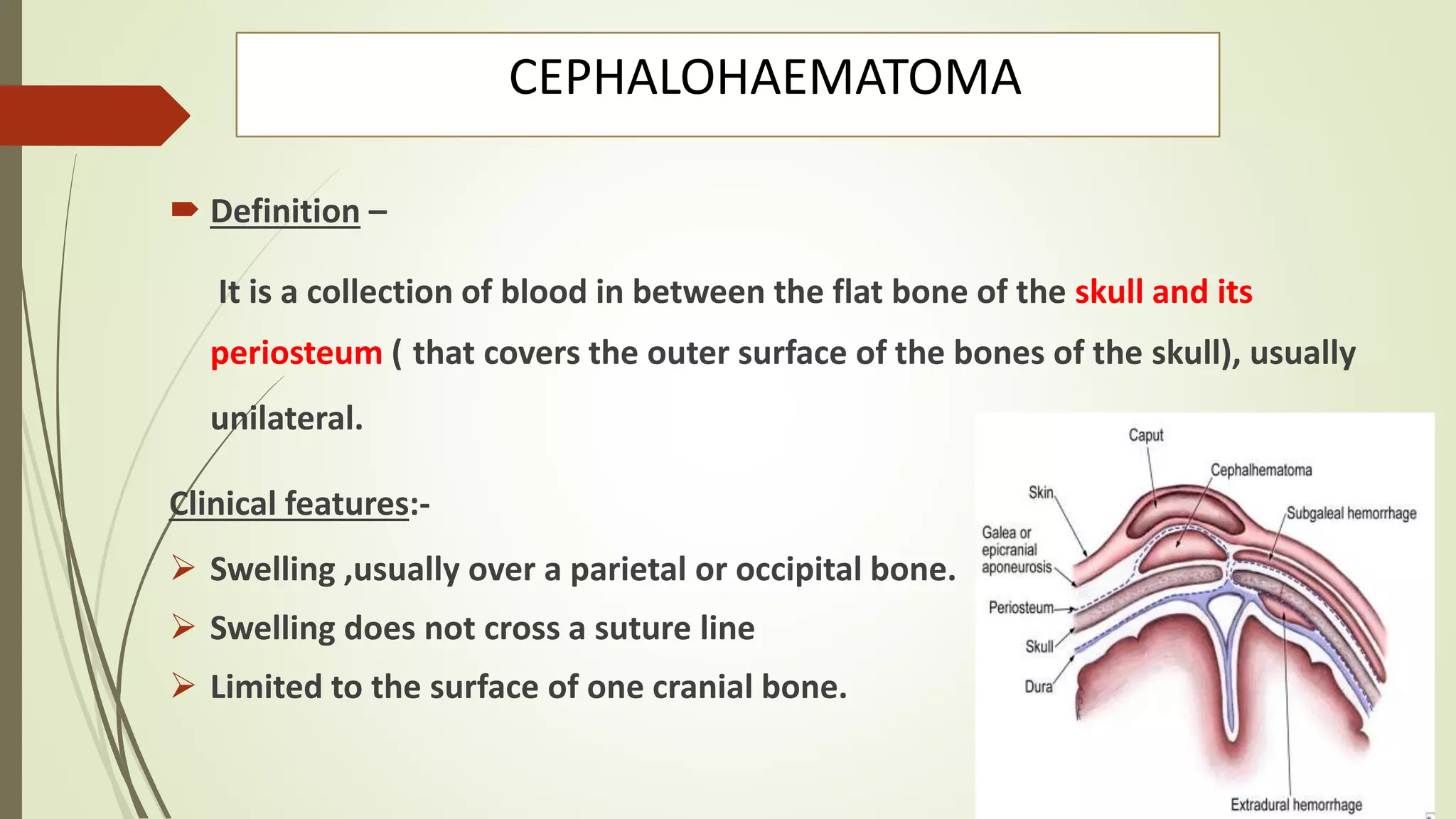
CEPHALOHAEMATOMA
 Definition –
It is a collection of blood in between the flat bone of the skull and its
periosteum ( that covers the outer surface of the bones of the skull), usually
unilateral.
Clinical features:-
 Swelling ,usually over a parietal or occipital bone.
 Swelling does not cross a suture line
 Limited to the surface of one cranial bone.
DIAGNOSTIC EVALVUATION
 Physical examination
 Skull radiography
 Cranial computed tomography
Resolution
 Slow resolution occurs over 1-2 months,occassionally with residual
calcification.
Management
Observation
Rule out the bleeding disorders
 Aspiration for smear & culture if infection is
suspected.
Complication
 Anemia
 Hypotension
 Hyperbilirubinemia
 Infection
 Association skull fractures
CAPUT SUCCEDANEUM
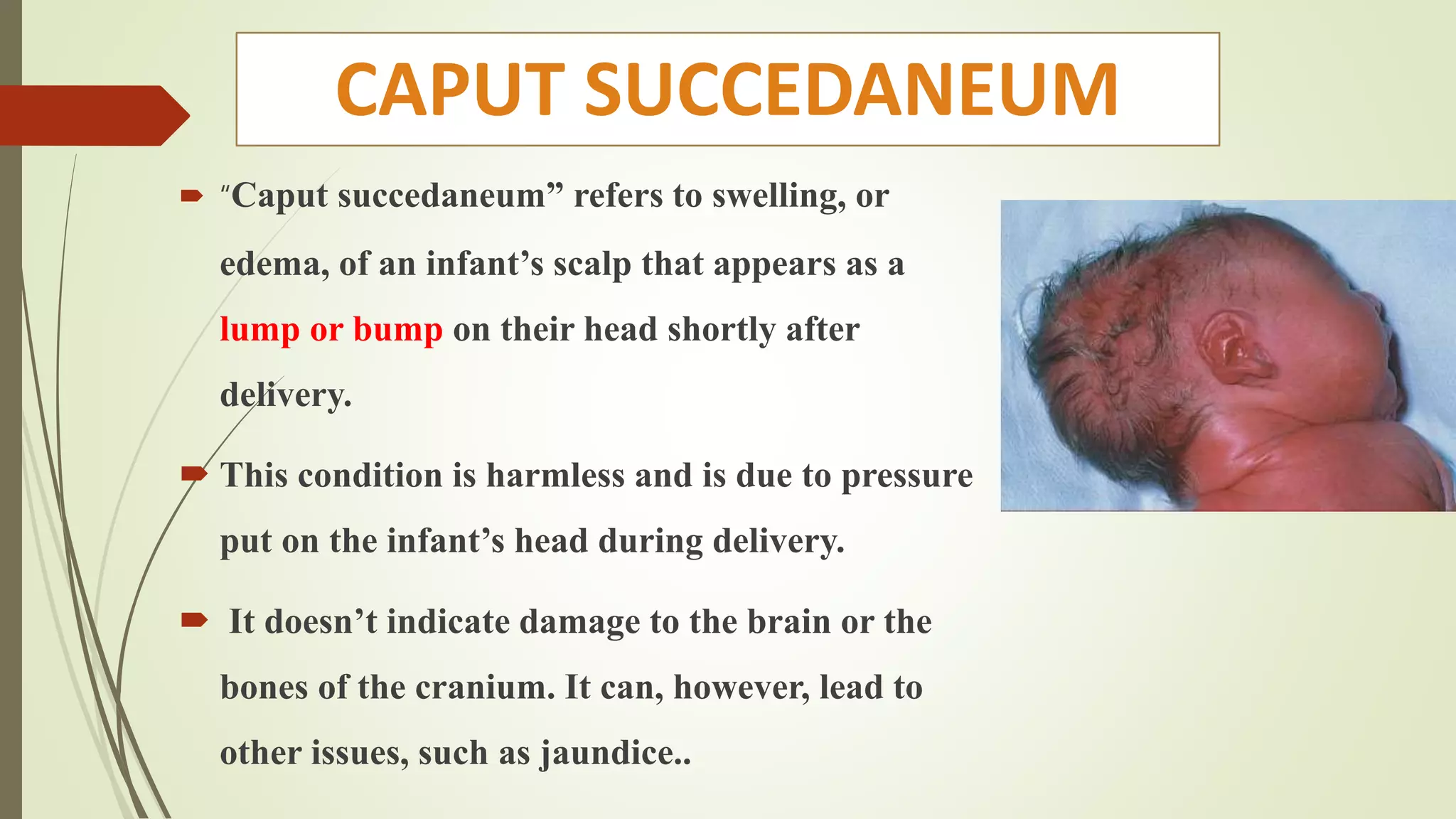
 “Caput succedaneum” refers to swelling, or
edema, of an infant’s scalp that appears as a
lump or bump on their head shortly after
delivery.
 This condition is harmless and is due to pressure
put on the infant’s head during delivery.
 It doesn’t indicate damage to the brain or the
bones of the cranium. It can, however, lead to
other issues, such as jaundice..
Clinical manifestations
 Petechiae - blood vessels capillaries break, blood leaks into your skin
 Hair loss develops
 Collection of serous fluid
 Increased molding (elongation) of the head
 Edema
 Puffiness under the skin of the scalp
Diagnostic Evaluation
 History collection.
 Physical examination.
 Physical examination and observation of apparent
symptoms (such as swelling or bruising) is usually
sufficient.
Management
 The condition almost always resolves itself with in a few days.
 No treatment is usually necessary
 In case of jaundice phototherapy given.
Complications
 Anemia
 Hyper bilirubinemia
 Scalp necrosis
 Permanent scarring alopecia
D)Nerve injury
 Nerve injury commonly associated with breech delivery .
Causes :-
 Hyper extension
 Traction and
 Over stretching with simultaneous rotation .
Cranial nerve injury
 Facial nerve injury :-
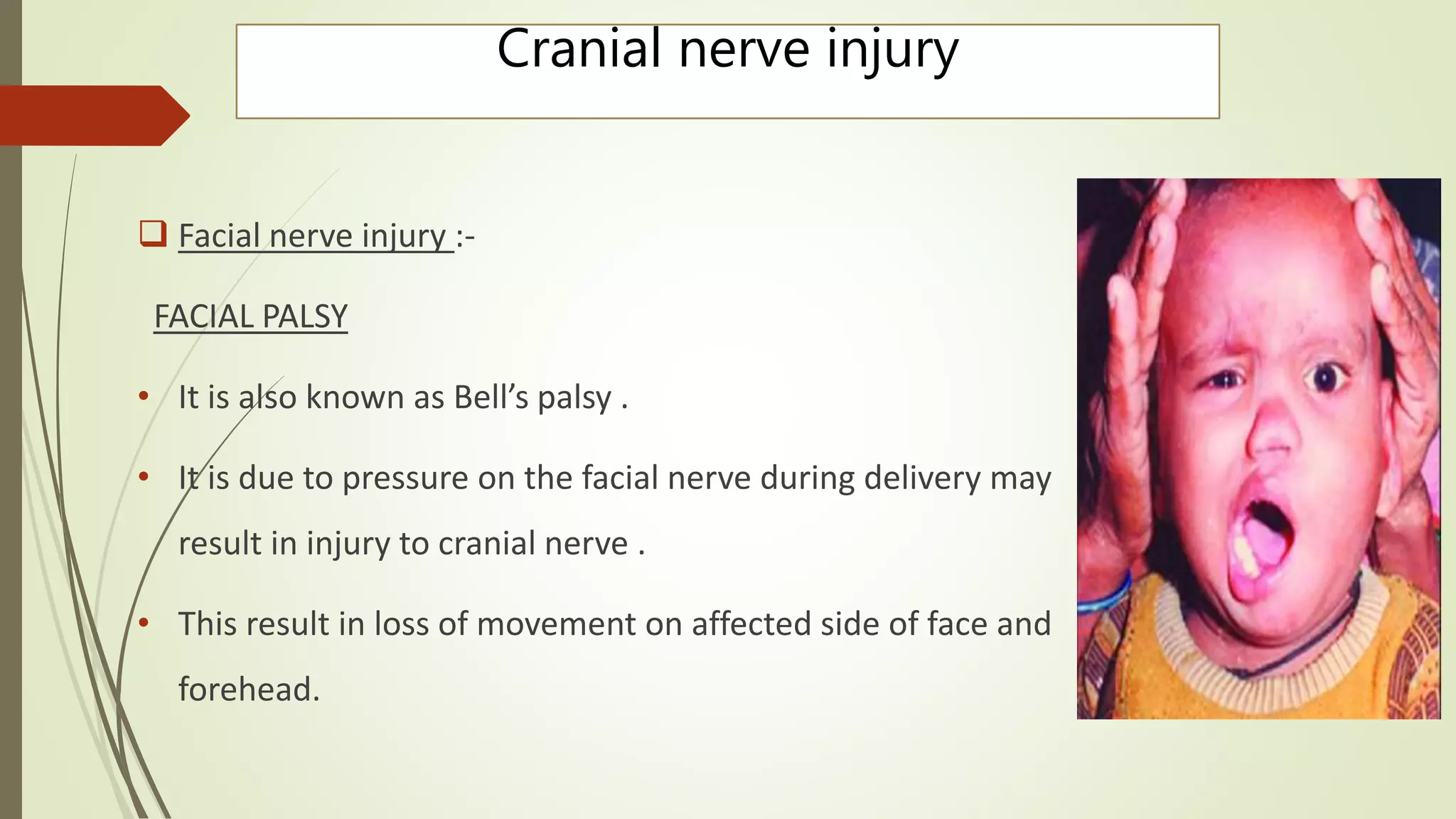
FACIAL PALSY
• It is also known as Bell’s palsy .
• It is due to pressure on the facial nerve during delivery may
result in injury to cranial nerve .
• This result in loss of movement on affected side of face and
forehead.
Clinical features
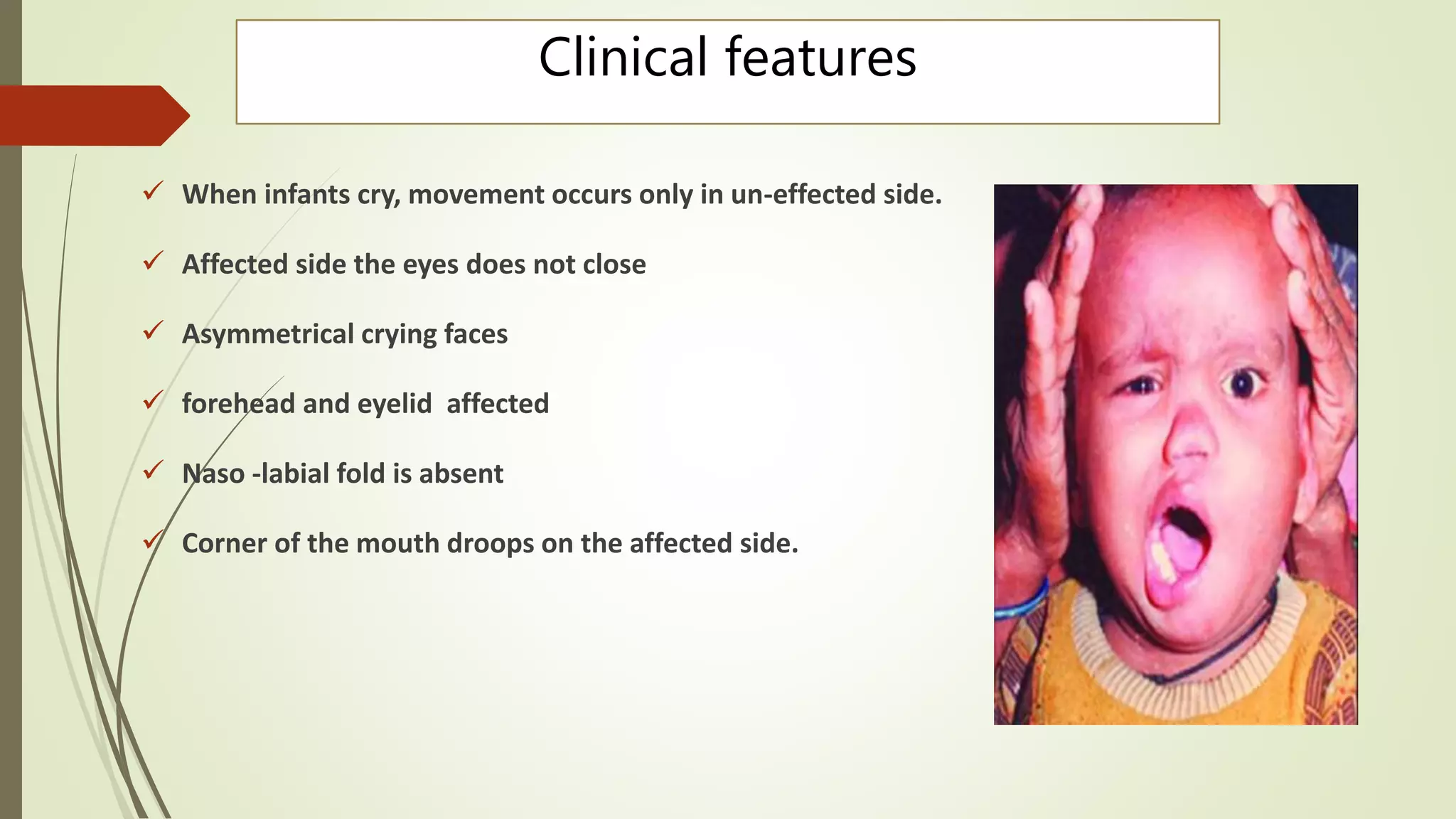
 When infants cry, movement occurs only in un-effected side.
 Affected side the eyes does not close
 Asymmetrical crying faces
 forehead and eyelid affected
 Naso -labial fold is absent
 Corner of the mouth droops on the affected side.
Management
 Protection of open eyes
 Neurological and surgical consultation
Nursing management
 Feeding is the first given by the NG tube to prevent aspiration.
 When possible the infant should be feed orally using a nipple
having a large hole.
 Eye shield to prevent drying of the conjunctiva and cornea .
 Gentle restraining of the hands.
Laryngeal nerve injury
When an infant’s laryngeal nerve is injured, the
injury causes a disturbance that can affect the
infant’s ability to breath and swallow normally.
Clinical features
 Hoarse cry, respiratory stridor
 Bilateral vocal; cord damage
 Severe respiratory distress
 Asphyxia
Diagnostic evaluation
 History collection
 Physical examination
 Direct laryngoscopy
Management
 Small frequent feedings may be required to decrease the risk
of aspiration.
 Intubation may be required
 Tracheostomy,if recovery does not occur by 06 weeks.
Spinal cord injuries
 Spinal cord damage occurs when blunt force trauma or a
medical melady affects the spine of the infants.
Causes
Hyper extended head
Vaginal breech delivery
Clinical features
Alert yet flaccid
Low APGAR score
 motor function absent distant to the level of injury
Temperature instability
Constipation and urinary retention
Management
 Resuscitation and prevention of further injuries
 Head to be immobilized
 Neurological examinations and cervical spinal x-rays.
 Supportive therapy required.
Brachial plexus injury
 Duchene –erb paralysis (C5-6).
 Klumpke’s paralysis (C7,C8 and T1).
Risk factors :-
 Macrosomia .
 Shoulder dystocia .
 Instrumental deliveries .
 Malpresentation .
Duchenne –Erb paralysis
Erb ‘s palsy may also be associated with injury to the
phrenic nerve, which is innervated with fibers from c3-c5.
Clinical features
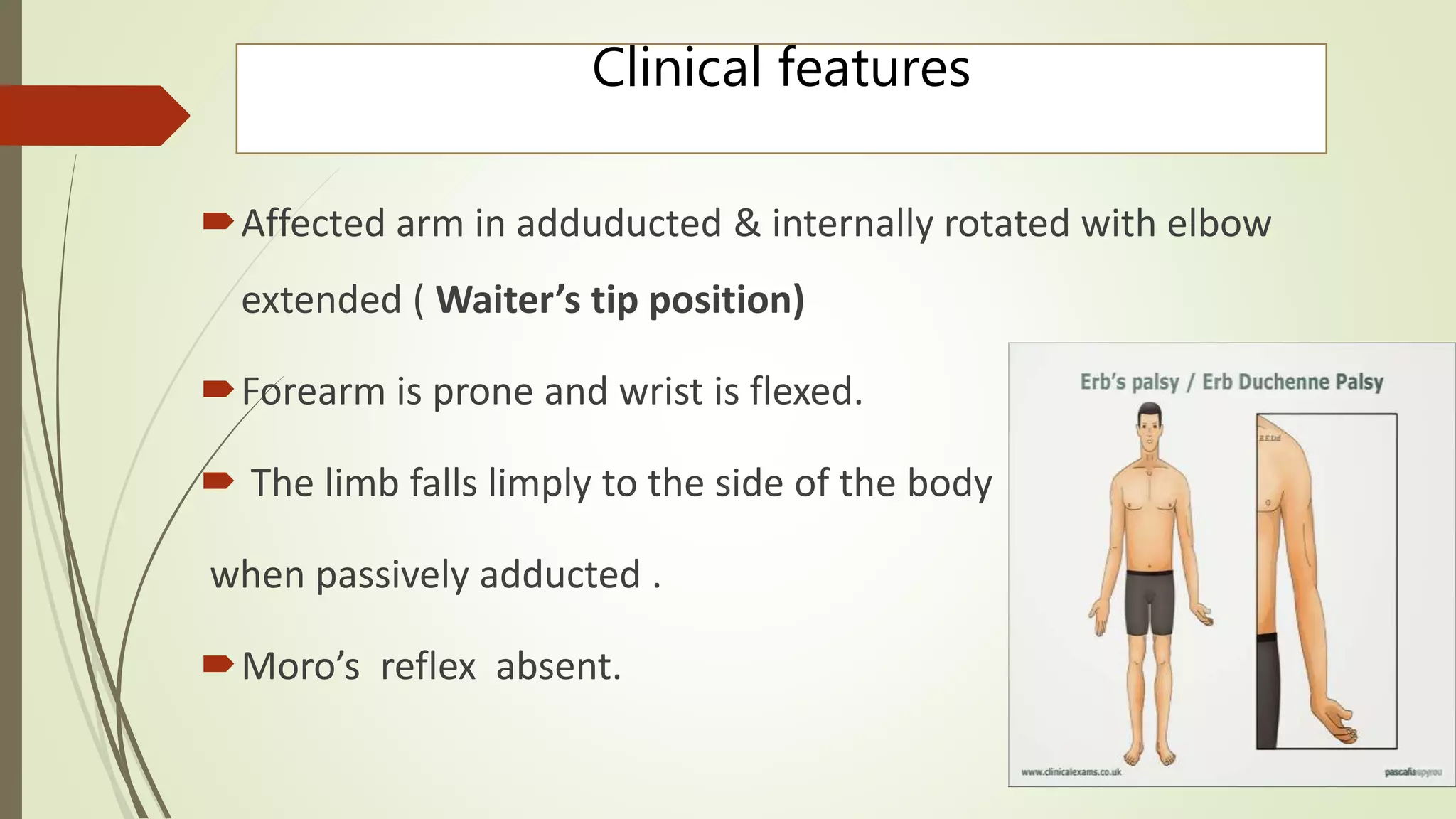
Affected arm in adduducted & internally rotated with elbow
extended ( Waiter’s tip position)
Forearm is prone and wrist is flexed.
 The limb falls limply to the side of the body
when passively adducted .
Moro’s reflex absent.
Klumpke’s paralysis
Involves the C8 and T1 nerves, resulting in weakness of the
intrinsic hand muscles & long flexors of wrist and fingers.
Clinical features
Grasp is absent ( claw hand )
Biceps and radial reflex are present
Horner’s syndrome may present.
The entire arm is flaccid ,all reflexes are absent.
Management
X-ray studies to rule out bony injury ,chest examination to rule
out diaphragmatic involvement
Splints to prevent wrist and digit contractures
 Passive movements started after 7-10 days.
Recovery
Improvement in 1-2 weeks, normal function.
No improvement in 06 months, permanent deficit .
Nursing management
The goal of the care is to prevent the contractures of the
paralyzed muscle.
The arm should be partially immobilized in a position of
maximum relaxation so that the non paralyzed muscles
can not exert pull on the affected muscles.
By the use of splint or brace when the upper arm is
paralysed,the arm is abducted 90˚ and rotated
internally at the shoulder with the elbow flexed so
that the palm of the hand is turned towards the head.
NEONATAL JAUNDICE
o Jaundice is an important problem in the first week of life.
o High bilirubin levels may be toxic to the developing central
nervous system and it cause neurological impairments in term
newborns.
o Almost 60% term neonate and 80% preterm neonate have
bilirubin levels greater than 5mg/dl in the first week of life.
INTRODUCTION
 It is also called Icterus neonatrum , neonatal
hyperbilirubinemia.
 Neonatal jaundice defined as a total serum bilirubin level
above 5mg/dl.
 It refers to an excessive accumulation of unconjugate bilirubin
in blood resulting in yellowish discoloration of skin & mucous
membrane.
DEFINITION
Contd…..
 Bilirubin is formed from the breakdown of RBCs.
 It excreted from the body in the form of Urobilinogen
(through urine) and Stercobilinogen (through stool).
 Jaundice occurs when the liver can not excrete sufficient
bilirubin from the plasma.
PHYSIOLOGICAL
JAUNDICE
Peak level of bilirubin (>12mg/dl) is reached on 4th to 5th day
and disappears by 7-14 days.
In premature babies, maximum bilirubin level reaches
15mg/dl on 5th to 7th day & disappears by 14-28 days.
INTRODUCTION
CAUSES
INCREASED BILIRUBIN
LOAD ON LIVER CELLS
DEFECTIVE
BILIRUBIN
CONJUGATE
DEFECTIVE HEPATIC UPTAKE
OF BILIRUBIN FROM PLSMA
DECREASE
BILIRUBIN
 IN TERM BABIES: It appears between 30 to 72 hours of age .
 Intensity is found on the 4th day.
 Disappears by 7th to 10th day.
CHARACTERSTICS
IN PRETERM BABIES: It appears earlier but not before 24
hours of age.
Intensity is found on 6th to 7th day.
Disappears by 14th.
Serum bilirubin does not exceeds 15mg/dl.
Conti..
PATHOLOGICAL JAUNDICE
 Jaundice occurring within 24hrs.of birth is called pathological
jaundice.
 About 5% of neonates develop pathological jaundice.
INTRODUCTION
CAUSES
 Appears within 24 hrs. of birth.
 In term babies: It persist more than 1 week.
 In preterm babies: It persist more than 2 weeks.
 Bilirubin level is increasing by more than 5mg/dl per day or
0.5mg/dl per hour.
CHARACTERSTICS
 Total bilirubin level is more than 15mg/dl.
 Palms & soles are yellow.
 Stool clay or white colored & urine is staining clothes.
Conti…
Inadequacy of breast feeding.
Decreased hepatic clearance of bilirubin.
Begin at 2-4 days of age.
Occur in approx.10-25% of breast fed infants.
Appears between 24-72 hrs. of age.
Peaks by 5-15 days of life.
Disappears by 3rd week of life.
BREAST FEEDING JAUNDICE
 It is caused by factors in breast milk like fatty acids, pregnanediol
that inhibit conjugation or decrease excretion of bilirubin.
 Begins at the age of 5-7 days.
 Occur in 2-3% of breast feed infants.
 Peak level is seen during 2nd week of life and then gradually
diminishes.
BREAST MILK JAUNDICE
Yellow discoloration of
skin. Sclera or nails.
CLINICAL FEATURES
Lethargy.
Refusal to food.
Dark urine and stool.
• Serum bilirubin.
• Hemoglobin.
• Hematocrit value.
• Serum albumin.
• RBC morphology.
• COOMBS test.
• ABO & Rh-blood groups.
• Liver & thyroid function test etc.
DIAGNOSTIC EVALUATION
ASSESSMENT
AREA OF THE BODY RANGE OF INDIRECT
BILIRUBIN
Head and neck 4-8mg/dl
Upper trunk 5-12mg/dl
Lower trunk & thighs 8-16mg/dl
Arms & lower legs 11-18mg/dl
Palms & soles >15mg/dl
KRAMER’S CRITERIA FOR
ASSESSMENT OF JAUNDICE
ADMIT
o All the babies with jaundice should be admitted to special
care nursery.
HISTORY COLLECTION
o Family history of jaundice/liver disease, previous sibling
with jaundice, maternal illness during illness.
o Perinatal history such as traumatic delivery, delayed cord
clamping, birth asphyxia etc.
MANAGEMENT
PHYSICAL EXAMINATION
o Inspection of skin.
o Should also be examined for presence of IUGR &
cephalohematoma.
o Non- invasive Assessment
• It is done with Ingram icterometer & transcutaneous bilirubinometer.
Conti…..
PHOTOTHERAPY
o The main aim is reduction of serum bilirubin level within safe limit
& prevention of CNS toxicity.
o Non-invasive, inexpensive & easy method of degradation of
unconjugated bilirubin by photo-oxidation.
o The light waves convert toxic bilirubin into water soluble non-toxic
form which is excreted from blood in the bile,stool,urine.
INTRODUCTION
 RECOMMENDATION
 Started when serum bilirubin approaches 15mg/dl.
 In preterm babies, it started at serum bilirubin level of 5mg/dl or
more.
 Fluorescence or halogen lights are used.
Conti…..
 Technique
 Blue or white lights are used and most effective, 6-8 light sources
are used.
 Wavelength of light should be 420-600nm.
 The distance between naked infant or light sources is 45cm from the
skin of the baby.
Conti….
 When to stop phototherapy
 When serum bilirubin level are less than 10mg/dl for 2 times.
 Intensive phototherapy usually reduces 1to2mg/dl of serum
bilirubin within 4to6 hrs. of exposure.
Conti…
Infant with direct hyperbilirubinemia: Because in direct
bilirubin levels are not usually high in these conditions &
phototherapy may lead to “ Bonze Baby Syndrome”.
CONTRAINDICATION
IMMEDIATE PROBLEMS
 Dehydration.
 Hypothermia.
 Loose stools.
 Electric shock.
 Hyperthermia.
COMPLICATION
LONG TERM PROBLEMS
 Disturbance of endocrine or sexual maturation.
 Retinal damage.
 Skin cancer.
Contii..
o Baby’s eyes should be covered.
o Diaper to be kept on to cover the genital(specially in male baby
to prevent gonadal damage).
o Position should be changed every 2nd hrly or after each feed.
ROLE OF NURSE
o Temperature to be recorded 2nd hrly.
o 2nd hrly breastfeeding to be given or extra fluids to be
provided.
Contd…
CONTI….
o Baby’s weight to be recorded.
o Constant observation should be made for urine,stool,skin rashes etc.
o Serum bilirubin level to be estimate at least every 12 hours.
Conti….
 PHENOBARBITONE
 It promote hepatic glucuronyl transferase synthesis.
 It promote synthesis of albumin.
 METALLOPORPHYRINS
 Tin-protoporphyrin & tin-mesoporphyrin inhibit heme
oxygenase activity.
PHARMACOLOGICAL
MANAGEMENT
It is used when serum bilirubin levels is more than 20mg/dl
in term baby or more than 15mg/dl in preterm baby.
EXCHANGE BLOOD
TRANSFUSION
It also help to stop hemolysis in affected baby.
It is given when phototherapy fails to prevent a rise in
bilirubin to toxic levels.
Conti…
CONTI…
IMMEDIATE
• Cardiac failure.
• Air embolism.
• Tetany.
• Hypoglycemia.
DELAYED
• Portal vein
thrombosis.
• HIV.
• Ulcerative colitis
etc.
COMPLICATION
COMPLICATION
TRANSIENT
ENCEPHALOPATHY
KERNICTERUS
TRANSIENT ENCEPHALOPATHY
 It is reversible neurological complication suspected in increasing
lethargy along with bilirubin level.
TRANSIENT
ENCEPHALOPATHY
KERNICTERUS
It occurs as a result of necrosis of neurons in basal
ganglia,subthalmic nuclei.
Problems in neonates are:
Poor sucking.
Lethargy.
Fever.
High pitched cry.
Death.
KERNICTERUS
HYPOTHERMIA
 Newborn baby is homeothermic,but his ability to stay warm may
easily by extreme of environmental temperature.
 Neonatal hypothermia often due to lack of attention by health
providers, continues to be a very important cause of neonatal
deaths.
INTRODUCTION
Contd…….
 A new born is more prone to develop hypothermia because of
large surface area per unit of body weight.
 A low birth weight baby develops hypothermia easily because of
decreased thermal insulation due to less subcutaneous fat &
reduced amount of brown fat.
DEFINITION
Normal axillary temperature is 36.5-37.5˚c
In hypothermia the temperature is below 36.5˚c.
CLASSIFICATION
Acc. to severity, hypothermia is classified as,
1. Cold stress- 36.0 ˚c to 36.4˚ c
2. Moderate Hypothermia- 32.0˚c to 35.9˚c
3. Severe hypothermia - <32˚c
CLINICAL FEATURES
 Peripheral vasoconstriction
 Cyanosis.
 Cool extremities.
 Decreased peripheral perfusion.
 C.N.S. Depression
 Lethargy.
 Bradycardia.
 Apnea.
 Increased metabolism
 Hypoglycemia.
 Hypoxia.
 Metabolic acidosis.
 Chronic signs
 Weight loss.
 Poor weight gain.
DIAGNOSTIC EVALVUATION
 Temperature Recording –
a) Axillary temperature :-
 It is accurate as rectal temperature & probably safer (less
risk of injury or infection ) .
 It is recorded by placing the bulb of thermometer against
the roof of dry axilla free from mother.
b) Rectal Temperature
 This method is not used for routine monitoring.
 The thermometer is kept in place at least for 02 minutes .
c) Skin Temperature
Skin temperature is recorded by a thermister .
The probe of thermister is attached to the skin over
upper abdomen.
Warm & pink feet of the baby indicate that baby is in
thermal comfort.
MANAGEMENT
 A hypothermic baby has to be rewarmed as quickly as possible .
 The method selected will depend the severity of hypothermia &
availability of staff & equipments.
The method used to manage cold stress include,-
A warm room or bed
Skin-skin contact
A 200 watt bulb
A radiant heater or an incubator
In case of Moderate hypothermia
(>32to >36˚c)
 Skin to skin contact should be in a warm room & warm bed.
 Warmer /incubator may be used ,if available ,continue rewarming till
temperature reaches normal range . Monitor every 15-30 minutes.
In case of Severe hypothermia (<32˚c)
Use air heated incubator or
manually operated radiant warmer or
thermostatically controlled heated mattress set at 37-38˚c.
Prevention of Hypothermia
 Acc. to the concept of “warm chain” baby must be kept warm at the
place of birth ( home or hospital) & during transportation for special
care either from home to hospital or with in the hospital.
 It is a set of 10 interlinked procedures carried out at birth & later
,which will minimize the likelihood of hypothermia in all newborns.
1. Warm delivery room (>25˚c)
2. Warm resuscitation.
3. Immediate drying .
4. Skin-skin contact between baby & the mother.
5. Breast feeding .
6. Bathing & weighing.
7. Appropriate clothing & bedding .
8. Mother & baby together .
9. Warm transportation .
10. Training /awareness of health care providers.
Temperature maintenance during transport
 Always stabilize the baby’s temperature before transport.
 Record temperature before transport .
 Carry the baby close of mother.
 Cover head ,legs & hands.
 Avoid undressing the infant for cleaning ,weighing or examination .
Contd…
1. In the delivery room:-
 Conduct delivery in a warm room.
 Immediately dry the newborn with a clean soft preferably warm
towel.
 Ensure that the head is well covered.
 Keep the baby by the mother’s side.
2. skin-skin contact ( the kangaroo method ) ‘’kangarooing”
 Assists in maintaining the temperature of infant.
 Facilitates breast feeding.
 Helps to increase the duration of breast feeding.
 Improves mother-infant bonding.
3.Bathing the baby-
 Bathing immediately after birth should be avoided. Ensure before
giving bath baby’s temperature should be normal.
 Bath is given to normal baby on second day in summers.
 The nurse should follows the instruction for bathing as given
below;-
 Use warm room & warm water.
 Bath quickly & gently
 Dry quickly & wrap in a warm ,dry towel.
PROBLEMS OF RESPIRATORY SYSTEMS
RESPIRATORY DISTRESS SYNDROME (RDS)
Also known as hyaline membrane disease.
A syndrome in premature infant caused by insufficiency of
surfactant production and structural immaturity of lungs.
RDS is a leading cause of death in preterm infants.
It occurs in 50% babies born in 26-28 weeks and 25% in
born in 30-31 weeks.
SURFACTANT
 Pulmonary surfactant is of phospholipids and protein which is
secreted by the epithelial type II cells into the alveolar space.
 It begins to be produced in the fetus at about 24 to 28 weeks of
pregnancy, and is found in amniotic fluid between 28 and 32 weeks.
 It is established that pulmonary surfactant reduces surface tension at
the air–water interface in the alveoli, thereby preventing collapse of
these structures at end-expiration.
 In this manner, surfactant reduces the work associated with
breathing.
MODS- multiple organ dysfunctions
CLINICAL FEATURES
 RDS begins shortly after and is manifested by-
1. Tachypnea
2. Tachycardia
3. Chest wall retraction
4. Expiratory grunting
5. Nasal flaring
6. Cyanosis.
As the disease progress the baby may develop ventilator failure (rising
CO2 in blood) and prolonged cessation in breathing.
DIAGNOSTIC EVALUATION
Physical examination.
Chest X ray.
ABG (Monitored PCO2, PO2, PH value).
Gastric aspirate Shake test.
Prenatal diagnosis can be done by determining
Lecithin/sphingomyelin ratio in amniotic fluid. L/S ratio of
more than 2 indicates adequate lungs maturity.
MANAGEMENT
The principle of management of RDS include-
1. Improving ventilation to enhance oxygenation.
2. Correction of acidosis.
3. Maintenance of thermo neutral environment.
4.Adequate nutrition.
Management of RDS
1. Monitoring of the baby’s condition.
 Temperature checking hourly.
 Resp. rate.
 Any abnormal breathe sound/pattern. ( grunting/retraction)
 Skin colour. (bluish discoloration)
 Apneic episodic.
 Activity, responsiveness and cry of the baby.
 Urine output.
Management…contd…
2. IV infusion for maintain acid base balance and nutritional
status of baby.
3. Ventilatory support.
4. Oxygen via hood. (maintain 90-95%)
5. Surfactant therapy-
(Surfactant to be administered via intratracheally via ET tube in
a dose of 100mg/kg body weight.)
Management ……contd….
6. Antibiotics –
To treat any pulmonary infection, if present due to continuous
invasive procedure. Septic screening and periodic cultures from ET
tube and blood are taken to guide antimicrobial therapy.
7. Administered Vitamin E.
Vit. E being a biologic antioxidant. 100 IU/kg/day for LBW/preterm
babies who are receiving oxygen therapy,..
Nursing management
MECONIUM ASPIRATION
SYNDROME (MAS)
MECONIUM ASPIRATION SYNDROME (MAS)
 AMNIOTIC FLUID- The amniotic fluid is the
protective liquid contained by the amniotic sac of a
gravid amniote.
 This fluid serves as a cushion for the growing fetus,
but also serves to facilitate the exchange of
nutrients, water, and biochemical products between
mother and fetus.
Contd…….
 MECONIUM - Meconium is the earliest stool of a infant.
 Unlike later feces, meconium is composed of materials ingested during the time the
infant spends in the uterus: intestinal epithelial cells, lanugo, mucus, amniotic fluid,
bile and water.
INTRODUCTION
 Neonates born to mothers with thick and thin meconium stained
liquor can aspirate meconium into lungs and develop respiratory
distress. This is known as meconium aspiration syndrome.
 Aspiration can be occur in utero, during birth or immediately after
birth.
Contd………
Thin meconium can cause chemical pneumonitis.
Thick meconium aspiration can block large and small
airways. That can cause atelectasis and emphysema.
Presence of atelectasis and emphysema can lead to
respiratory failure.
WHAT IS ATELECTASIS AND EMPHYSEMA?
Find out what is ATELECTASIS AND EMPHYSEMA?
Definition
 Meconium aspiration syndrome occurs when a newborn breathes a mixture of
meconium and amniotic fluid into the lungs around the time of delivery.
 Meconium aspiration syndrome, a leading cause of severe illness and death in
the newborn,
Pathophysiology
CLINICAL FEATURES
Usually occurs in post mature and small-for –dates babies.
These babies usually develop respiratory distress in first 24 hrs
of life, if untreated it can lead to respiratory distress.
Pneumothorax,
Air leak syndrome ( pneumopericardium, pneumomediastinum)
Persistent pulmonary hypertension.
Chest X ray shows bilateral pneumonia and air leak syndrome.
MANAGEMENT
 OROPHARYNGEAL SUCTION before the delivery of shoulder and
 immediately after endotracheal intubation and suctions needs to
be done.
 Oxygen therapy.
 Antibiotic management .
NEONATAL SEPSIS
NEONATAL SEPSIS
Neonatal sepsis or sepsis neonatrum or neonatal
septicemia occurs when pathogenic bacteria gain
access into the blood stream.
Neonatal septicemia occurs in infants less than 90
days of age, late onset sepsis occurs after 1 week
of age with in 90 days.
ETIOLOGY
A no. of different bacteria including e.coli hysteria &
certain strains of streptococcus may cause neonatal
sepsis.
ETIOLOGY
EARLY ONSET NEONATAL SEPSIS
 Early onset neonatal sepsis most
often appears with in 24 hours of
birth.
 The baby gets infected from mother
or during the delivery.
LATE ONSET NEONATAL SEPSIS
 Baby get infected after delivery by the
organisms thriving in the external
environment of the home or hospitals.
The following increases an infant’s risk of early onset sepsis-
 Preterm delivery & low birth weight baby.
 Group B streptococcus infection during pregnancy.
 Premature rupture of membranes
 Infection of placental tissues & amniotic fluid
 Maternal fever & infection.
EARLY ONSET NEONATAL SEPSIS
The following increases an infant’s risk of Late onset sepsis-
 Hospital stay for long time.
 Unhygienic.
 Having intracath in blood vessels for long time.
 LBW
 Lack of breastfeeding.
 Superficial infection e.g umbilical sepsis.
Etc…….
LATE ONSET NEONATAL SEPSIS
Contd…….
 All these factors enhance of
entry of organisms into the
body of neonates who have
low immunity as compared
to others.
CLINICAL FEATURES
 The manifestation of Neonatal septicemia, are subtle vague,& non-
specific.
 The most common complaint concerning infant’s progress is “failure
to do well” or “ not looking right.”
 Hypothermia is common manifestation.
 All the body system tend to shown some indications of sepsis which are
as follows;-
 CIRCULATORY SYSTEM-
 Pallor, cyanosis or mottling.
 Cold, clammy skin
 Hypotension & shock
 Edema
 Bradycardia & tachycardia
Contd…
 RESPIRATORY SYSTEM
 Irregular respiration, apnea or trachypnea
 Cyanosis
 Grunting
 Dyspnea
 Retractions
 pneumonia
CENTRAL NERVOUS SYSTEM :
Reduced activity, lethargy ,cry poor cry.
Increased activity- irritability ,tremors
Full fontanel
Abnormal eye movements
GASTRO INTESTINAL SYSTEM
Poor feeding ,refuse to suckle.
Vomiting.
Diarrhea or decreased stool passage.
Abdominal distension.
Hepatomegaly.
HEPATOPOIETIC SYSTEM
Jaundice
Pallor
Petechiae, ecchymosis
Spleenomegaly ,bleeding
DIAGNOSTIC EVALVUATION
Culture of blood ,urine & C.S.F
Complete blood count(C.B.C)
ESR ( test that indirectly measures the degree of inflammation
present in the body.)
MANAGEMENT
For babies with neonatal sepsis, supportive care &
antibiotic therapy are 2 important components of
treatment.
 SUPPORTIVE CARE-
1. Provide warmth. The septic neonate should be nursed in
thermo neutral environment.
Start intravenous line, infuse normal saline 10 ml/kg over
5-10 minutes.
Infuse 10% glucose ,2 ml /kg stat to manage
hypoglycemia.
Administer injection vitamin k , 1 mg IM to prevent
bleeding.
Avoid oral feeding if baby is very sick & give I/V
fluids.
In neonates with sclerema ,exchange transfusion
with fresh whole blood may be required.
ANTIBIOTIC THERAPY
Antibiotic therapy should cover common
causative bacteria like; E.coli, staphylococcus
aureus & klebisella pneumoniae.
ANTIBIOTIC THERAPY IN NEONATAL SEPSIS
 A combination of ampicillin and gentamycin for the treatment of sepsis and
pneumonia.
1. Inj. Ampicillin 50mg/kg/dose, IM/IV 7-10 days.
2. Inj. Gentamycin 2.5mg/kg/dose, IM/IV 7-10 days.
 In suspect of meningitis, cefotaxime should be used along with aminoglycoside,
Inj. Ampicillin 100mg/kg/dose, IM/IV 3 weeks
+
Inj. Gentamycin 2.5mg/kg/dose, IM/IV 3 weeks
+
Inj. Chloramphenicol 12mg/kg, IV, 3 weeks.
* The antibiotic choices depends on the causative organism detected in the culture.
PROGNOSIS
The prognosis is variable, severe neurologic & respiratory
problems may occur in low birth weight babies as a result
of early onset sepsis.
Late onset sepsis & meningitis may result in poor
outcomes.
Birth injuries are impairment of neonatal body function due to
adverse events that occur at birth and can be avoidable or
inevitable , birth trauma usually cure by prenatal care.
CONCLUSION
 Pal Panchali, “ Textbook of pediatric nursing ,” 1st edition ;2016 ,Paras medical publishers ,p.p-
198-204.
 Dutta D.C, “ Textbook of obstetrics ;7th edition new central book agency (P) ltd,p.p-483-487.
 https ://www.abclawcenters.com/practice –areas/parenatal –birth-injuries/traumatic birth
injuries /intracranial hemorrhages.
 https://medlineplus.gov/ency/articles/007301/htm.
 https://www.ncbi.nlm.nih.gov/PMC/articles/
PMC 4460260
 https://www.fpnotebook.com/nicu/neuro/cptfcdnm.htm
Bibliography

Common neonatal disorder BSC Nursing 3r year

  • 1.
    COMMON NEONATAL DISORDER By- Mr.M. Binanda Singh RINPS
  • 2.
    INTRODUCTION  A widevariety of disorders affecting the newborn may originate in utero, during birth or in immediate postnatal period.  These disorder may be due to prematurity, genetic mutations, chromosomal aberrations or acquired from environment.
  • 3.
    Neonatal disorder a. BIRTHINJURY 1. Soft tissue injury 2. Caput succedanum 3. Cephalohematoma 4. Nerve injuries. b. PROBLEMS RELATED TO PHYSIOLOGICAL FACTORS. 1. Hyperbilirubinema. 2. Hypoglycemia. 3. Hypocalcemia. 4. Hypothermia.
  • 4.
    Contd…. c. PROBLEMS OFRESPIRATORY SYSTEM 1. Respiratory distress syndrome. 2. Meconium aspiration syndrome. d. NEONATAL SEPTICEMIA e. NEONATE SEIZURES
  • 5.
    SOFT TISSUE INJURY 1.ERYTHEMA AND ABRASION- Usually result from application of forceps during delivery.
  • 6.
    Contd….. Petechiae – (blood vesselscapillaries break, blood leaks into your skin) Petechiae are pin-pointed hemorrhages caused by sudden Increases and then release of pressure during passage through the birth canal. It may be seen on chest, face and head of the baby.
  • 7.
    Contd…..  ECHYMOSIS – Small hemorrhagic areas ( larger than petechiae)  May occur after traumatic delivery.
  • 8.
    Contd….  SUB-CONJUNCTIVAL HEMORRHAGES – Rupture of capillaries in sclera from pressure on fetal head during delivery.
  • 9.
    BIRTH INJURIES The passagefrom the safety of the uterus to the outside world is a dangerous journey. Birth injuries is an impairment of the infant’s body function or structure due to adverse influence that occurred at birth. Injury may occur during antepartum, intrapartum or postpartum period.
  • 10.
    Risk factors  MATERNAL:-  Primi parity .  Maternal pelvic anomalies .  Prolonged or extremely rapid labor.  Oligohydromnios .
  • 11.
    FETAL:-  Abnormal presentation.  Very low birth weight infant or extremely prematurity.  Fetal Macrosomnia - large baby.  Large fetal head .  INTERVENTIONAL /INORGANIC :-  Use of mid forceps .  Inappropriate vacuum applications .  Versions & extractions .
  • 12.
    Types of birthinjuries Head and neck injuries Skull injury Facial mandibular injuries Nerve injury Spinal cord injuries Bone injuries Intra-abdominal injuries
  • 13.
  • 16.
    CEPHALOHAEMATOMA  Definition – Itis a collection of blood in between the flat bone of the skull and its periosteum ( that covers the outer surface of the bones of the skull), usually unilateral. Clinical features:-  Swelling ,usually over a parietal or occipital bone.  Swelling does not cross a suture line  Limited to the surface of one cranial bone.
  • 17.
    DIAGNOSTIC EVALVUATION  Physicalexamination  Skull radiography  Cranial computed tomography
  • 18.
    Resolution  Slow resolutionoccurs over 1-2 months,occassionally with residual calcification.
  • 19.
    Management Observation Rule out thebleeding disorders  Aspiration for smear & culture if infection is suspected.
  • 20.
    Complication  Anemia  Hypotension Hyperbilirubinemia  Infection  Association skull fractures
  • 21.
    CAPUT SUCCEDANEUM  “Caputsuccedaneum” refers to swelling, or edema, of an infant’s scalp that appears as a lump or bump on their head shortly after delivery.  This condition is harmless and is due to pressure put on the infant’s head during delivery.  It doesn’t indicate damage to the brain or the bones of the cranium. It can, however, lead to other issues, such as jaundice..
  • 22.
    Clinical manifestations  Petechiae- blood vessels capillaries break, blood leaks into your skin  Hair loss develops  Collection of serous fluid  Increased molding (elongation) of the head  Edema  Puffiness under the skin of the scalp
  • 23.
    Diagnostic Evaluation  Historycollection.  Physical examination.  Physical examination and observation of apparent symptoms (such as swelling or bruising) is usually sufficient.
  • 24.
    Management  The conditionalmost always resolves itself with in a few days.  No treatment is usually necessary  In case of jaundice phototherapy given.
  • 25.
    Complications  Anemia  Hyperbilirubinemia  Scalp necrosis  Permanent scarring alopecia
  • 27.
    D)Nerve injury  Nerveinjury commonly associated with breech delivery . Causes :-  Hyper extension  Traction and  Over stretching with simultaneous rotation .
  • 29.
    Cranial nerve injury Facial nerve injury :- FACIAL PALSY • It is also known as Bell’s palsy . • It is due to pressure on the facial nerve during delivery may result in injury to cranial nerve . • This result in loss of movement on affected side of face and forehead.
  • 30.
    Clinical features  Wheninfants cry, movement occurs only in un-effected side.  Affected side the eyes does not close  Asymmetrical crying faces  forehead and eyelid affected  Naso -labial fold is absent  Corner of the mouth droops on the affected side.
  • 31.
    Management  Protection ofopen eyes  Neurological and surgical consultation
  • 32.
    Nursing management  Feedingis the first given by the NG tube to prevent aspiration.  When possible the infant should be feed orally using a nipple having a large hole.  Eye shield to prevent drying of the conjunctiva and cornea .  Gentle restraining of the hands.
  • 33.
    Laryngeal nerve injury Whenan infant’s laryngeal nerve is injured, the injury causes a disturbance that can affect the infant’s ability to breath and swallow normally.
  • 34.
    Clinical features  Hoarsecry, respiratory stridor  Bilateral vocal; cord damage  Severe respiratory distress  Asphyxia
  • 35.
    Diagnostic evaluation  Historycollection  Physical examination  Direct laryngoscopy
  • 36.
    Management  Small frequentfeedings may be required to decrease the risk of aspiration.  Intubation may be required  Tracheostomy,if recovery does not occur by 06 weeks.
  • 38.
    Spinal cord injuries Spinal cord damage occurs when blunt force trauma or a medical melady affects the spine of the infants.
  • 39.
  • 40.
    Clinical features Alert yetflaccid Low APGAR score  motor function absent distant to the level of injury Temperature instability Constipation and urinary retention
  • 41.
    Management  Resuscitation andprevention of further injuries  Head to be immobilized  Neurological examinations and cervical spinal x-rays.  Supportive therapy required.
  • 42.
    Brachial plexus injury Duchene –erb paralysis (C5-6).  Klumpke’s paralysis (C7,C8 and T1). Risk factors :-  Macrosomia .  Shoulder dystocia .  Instrumental deliveries .  Malpresentation .
  • 43.
    Duchenne –Erb paralysis Erb‘s palsy may also be associated with injury to the phrenic nerve, which is innervated with fibers from c3-c5.
  • 44.
    Clinical features Affected armin adduducted & internally rotated with elbow extended ( Waiter’s tip position) Forearm is prone and wrist is flexed.  The limb falls limply to the side of the body when passively adducted . Moro’s reflex absent.
  • 45.
    Klumpke’s paralysis Involves theC8 and T1 nerves, resulting in weakness of the intrinsic hand muscles & long flexors of wrist and fingers.
  • 47.
    Clinical features Grasp isabsent ( claw hand ) Biceps and radial reflex are present Horner’s syndrome may present. The entire arm is flaccid ,all reflexes are absent.
  • 49.
    Management X-ray studies torule out bony injury ,chest examination to rule out diaphragmatic involvement Splints to prevent wrist and digit contractures  Passive movements started after 7-10 days.
  • 50.
    Recovery Improvement in 1-2weeks, normal function. No improvement in 06 months, permanent deficit .
  • 51.
    Nursing management The goalof the care is to prevent the contractures of the paralyzed muscle. The arm should be partially immobilized in a position of maximum relaxation so that the non paralyzed muscles can not exert pull on the affected muscles.
  • 52.
    By the useof splint or brace when the upper arm is paralysed,the arm is abducted 90˚ and rotated internally at the shoulder with the elbow flexed so that the palm of the hand is turned towards the head.
  • 55.
  • 56.
    o Jaundice isan important problem in the first week of life. o High bilirubin levels may be toxic to the developing central nervous system and it cause neurological impairments in term newborns. o Almost 60% term neonate and 80% preterm neonate have bilirubin levels greater than 5mg/dl in the first week of life. INTRODUCTION
  • 57.
     It isalso called Icterus neonatrum , neonatal hyperbilirubinemia.  Neonatal jaundice defined as a total serum bilirubin level above 5mg/dl.  It refers to an excessive accumulation of unconjugate bilirubin in blood resulting in yellowish discoloration of skin & mucous membrane. DEFINITION
  • 58.
    Contd…..  Bilirubin isformed from the breakdown of RBCs.  It excreted from the body in the form of Urobilinogen (through urine) and Stercobilinogen (through stool).  Jaundice occurs when the liver can not excrete sufficient bilirubin from the plasma.
  • 60.
  • 61.
    Peak level ofbilirubin (>12mg/dl) is reached on 4th to 5th day and disappears by 7-14 days. In premature babies, maximum bilirubin level reaches 15mg/dl on 5th to 7th day & disappears by 14-28 days. INTRODUCTION
  • 62.
    CAUSES INCREASED BILIRUBIN LOAD ONLIVER CELLS DEFECTIVE BILIRUBIN CONJUGATE DEFECTIVE HEPATIC UPTAKE OF BILIRUBIN FROM PLSMA DECREASE BILIRUBIN
  • 63.
     IN TERMBABIES: It appears between 30 to 72 hours of age .  Intensity is found on the 4th day.  Disappears by 7th to 10th day. CHARACTERSTICS
  • 64.
    IN PRETERM BABIES:It appears earlier but not before 24 hours of age. Intensity is found on 6th to 7th day. Disappears by 14th. Serum bilirubin does not exceeds 15mg/dl. Conti..
  • 65.
  • 66.
     Jaundice occurringwithin 24hrs.of birth is called pathological jaundice.  About 5% of neonates develop pathological jaundice. INTRODUCTION
  • 67.
  • 68.
     Appears within24 hrs. of birth.  In term babies: It persist more than 1 week.  In preterm babies: It persist more than 2 weeks.  Bilirubin level is increasing by more than 5mg/dl per day or 0.5mg/dl per hour. CHARACTERSTICS
  • 69.
     Total bilirubinlevel is more than 15mg/dl.  Palms & soles are yellow.  Stool clay or white colored & urine is staining clothes. Conti…
  • 70.
    Inadequacy of breastfeeding. Decreased hepatic clearance of bilirubin. Begin at 2-4 days of age. Occur in approx.10-25% of breast fed infants. Appears between 24-72 hrs. of age. Peaks by 5-15 days of life. Disappears by 3rd week of life. BREAST FEEDING JAUNDICE
  • 71.
     It iscaused by factors in breast milk like fatty acids, pregnanediol that inhibit conjugation or decrease excretion of bilirubin.  Begins at the age of 5-7 days.  Occur in 2-3% of breast feed infants.  Peak level is seen during 2nd week of life and then gradually diminishes. BREAST MILK JAUNDICE
  • 72.
    Yellow discoloration of skin.Sclera or nails. CLINICAL FEATURES
  • 73.
  • 74.
  • 75.
    • Serum bilirubin. •Hemoglobin. • Hematocrit value. • Serum albumin. • RBC morphology. • COOMBS test. • ABO & Rh-blood groups. • Liver & thyroid function test etc. DIAGNOSTIC EVALUATION
  • 76.
  • 77.
    AREA OF THEBODY RANGE OF INDIRECT BILIRUBIN Head and neck 4-8mg/dl Upper trunk 5-12mg/dl Lower trunk & thighs 8-16mg/dl Arms & lower legs 11-18mg/dl Palms & soles >15mg/dl KRAMER’S CRITERIA FOR ASSESSMENT OF JAUNDICE
  • 78.
    ADMIT o All thebabies with jaundice should be admitted to special care nursery. HISTORY COLLECTION o Family history of jaundice/liver disease, previous sibling with jaundice, maternal illness during illness. o Perinatal history such as traumatic delivery, delayed cord clamping, birth asphyxia etc. MANAGEMENT
  • 79.
    PHYSICAL EXAMINATION o Inspectionof skin. o Should also be examined for presence of IUGR & cephalohematoma. o Non- invasive Assessment • It is done with Ingram icterometer & transcutaneous bilirubinometer. Conti…..
  • 80.
  • 81.
    o The mainaim is reduction of serum bilirubin level within safe limit & prevention of CNS toxicity. o Non-invasive, inexpensive & easy method of degradation of unconjugated bilirubin by photo-oxidation. o The light waves convert toxic bilirubin into water soluble non-toxic form which is excreted from blood in the bile,stool,urine. INTRODUCTION
  • 82.
     RECOMMENDATION  Startedwhen serum bilirubin approaches 15mg/dl.  In preterm babies, it started at serum bilirubin level of 5mg/dl or more.  Fluorescence or halogen lights are used. Conti…..
  • 83.
     Technique  Blueor white lights are used and most effective, 6-8 light sources are used.  Wavelength of light should be 420-600nm.  The distance between naked infant or light sources is 45cm from the skin of the baby. Conti….
  • 84.
     When tostop phototherapy  When serum bilirubin level are less than 10mg/dl for 2 times.  Intensive phototherapy usually reduces 1to2mg/dl of serum bilirubin within 4to6 hrs. of exposure. Conti…
  • 85.
    Infant with directhyperbilirubinemia: Because in direct bilirubin levels are not usually high in these conditions & phototherapy may lead to “ Bonze Baby Syndrome”. CONTRAINDICATION
  • 86.
    IMMEDIATE PROBLEMS  Dehydration. Hypothermia.  Loose stools.  Electric shock.  Hyperthermia. COMPLICATION
  • 87.
    LONG TERM PROBLEMS Disturbance of endocrine or sexual maturation.  Retinal damage.  Skin cancer. Contii..
  • 88.
    o Baby’s eyesshould be covered. o Diaper to be kept on to cover the genital(specially in male baby to prevent gonadal damage). o Position should be changed every 2nd hrly or after each feed. ROLE OF NURSE
  • 89.
    o Temperature tobe recorded 2nd hrly. o 2nd hrly breastfeeding to be given or extra fluids to be provided. Contd…
  • 90.
  • 91.
    o Baby’s weightto be recorded. o Constant observation should be made for urine,stool,skin rashes etc. o Serum bilirubin level to be estimate at least every 12 hours. Conti….
  • 92.
     PHENOBARBITONE  Itpromote hepatic glucuronyl transferase synthesis.  It promote synthesis of albumin.  METALLOPORPHYRINS  Tin-protoporphyrin & tin-mesoporphyrin inhibit heme oxygenase activity. PHARMACOLOGICAL MANAGEMENT
  • 93.
    It is usedwhen serum bilirubin levels is more than 20mg/dl in term baby or more than 15mg/dl in preterm baby. EXCHANGE BLOOD TRANSFUSION
  • 94.
    It also helpto stop hemolysis in affected baby. It is given when phototherapy fails to prevent a rise in bilirubin to toxic levels. Conti…
  • 95.
  • 96.
    IMMEDIATE • Cardiac failure. •Air embolism. • Tetany. • Hypoglycemia. DELAYED • Portal vein thrombosis. • HIV. • Ulcerative colitis etc. COMPLICATION
  • 97.
  • 98.
  • 99.
     It isreversible neurological complication suspected in increasing lethargy along with bilirubin level. TRANSIENT ENCEPHALOPATHY
  • 100.
  • 101.
    It occurs asa result of necrosis of neurons in basal ganglia,subthalmic nuclei. Problems in neonates are: Poor sucking. Lethargy. Fever. High pitched cry. Death. KERNICTERUS
  • 102.
  • 103.
     Newborn babyis homeothermic,but his ability to stay warm may easily by extreme of environmental temperature.  Neonatal hypothermia often due to lack of attention by health providers, continues to be a very important cause of neonatal deaths. INTRODUCTION
  • 104.
    Contd…….  A newborn is more prone to develop hypothermia because of large surface area per unit of body weight.  A low birth weight baby develops hypothermia easily because of decreased thermal insulation due to less subcutaneous fat & reduced amount of brown fat.
  • 105.
    DEFINITION Normal axillary temperatureis 36.5-37.5˚c In hypothermia the temperature is below 36.5˚c.
  • 106.
    CLASSIFICATION Acc. to severity,hypothermia is classified as, 1. Cold stress- 36.0 ˚c to 36.4˚ c 2. Moderate Hypothermia- 32.0˚c to 35.9˚c 3. Severe hypothermia - <32˚c
  • 107.
    CLINICAL FEATURES  Peripheralvasoconstriction  Cyanosis.  Cool extremities.  Decreased peripheral perfusion.  C.N.S. Depression  Lethargy.  Bradycardia.  Apnea.
  • 108.
     Increased metabolism Hypoglycemia.  Hypoxia.  Metabolic acidosis.  Chronic signs  Weight loss.  Poor weight gain.
  • 109.
    DIAGNOSTIC EVALVUATION  TemperatureRecording – a) Axillary temperature :-  It is accurate as rectal temperature & probably safer (less risk of injury or infection ) .  It is recorded by placing the bulb of thermometer against the roof of dry axilla free from mother.
  • 110.
    b) Rectal Temperature This method is not used for routine monitoring.  The thermometer is kept in place at least for 02 minutes .
  • 111.
    c) Skin Temperature Skintemperature is recorded by a thermister . The probe of thermister is attached to the skin over upper abdomen. Warm & pink feet of the baby indicate that baby is in thermal comfort.
  • 112.
    MANAGEMENT  A hypothermicbaby has to be rewarmed as quickly as possible .  The method selected will depend the severity of hypothermia & availability of staff & equipments.
  • 113.
    The method usedto manage cold stress include,- A warm room or bed Skin-skin contact A 200 watt bulb A radiant heater or an incubator
  • 114.
    In case ofModerate hypothermia (>32to >36˚c)  Skin to skin contact should be in a warm room & warm bed.  Warmer /incubator may be used ,if available ,continue rewarming till temperature reaches normal range . Monitor every 15-30 minutes.
  • 115.
    In case ofSevere hypothermia (<32˚c) Use air heated incubator or manually operated radiant warmer or thermostatically controlled heated mattress set at 37-38˚c.
  • 116.
    Prevention of Hypothermia Acc. to the concept of “warm chain” baby must be kept warm at the place of birth ( home or hospital) & during transportation for special care either from home to hospital or with in the hospital.  It is a set of 10 interlinked procedures carried out at birth & later ,which will minimize the likelihood of hypothermia in all newborns.
  • 117.
    1. Warm deliveryroom (>25˚c) 2. Warm resuscitation. 3. Immediate drying . 4. Skin-skin contact between baby & the mother. 5. Breast feeding . 6. Bathing & weighing. 7. Appropriate clothing & bedding . 8. Mother & baby together . 9. Warm transportation . 10. Training /awareness of health care providers.
  • 118.
    Temperature maintenance duringtransport  Always stabilize the baby’s temperature before transport.  Record temperature before transport .  Carry the baby close of mother.  Cover head ,legs & hands.  Avoid undressing the infant for cleaning ,weighing or examination .
  • 119.
    Contd… 1. In thedelivery room:-  Conduct delivery in a warm room.  Immediately dry the newborn with a clean soft preferably warm towel.  Ensure that the head is well covered.  Keep the baby by the mother’s side.
  • 120.
    2. skin-skin contact( the kangaroo method ) ‘’kangarooing”  Assists in maintaining the temperature of infant.  Facilitates breast feeding.  Helps to increase the duration of breast feeding.  Improves mother-infant bonding.
  • 121.
    3.Bathing the baby- Bathing immediately after birth should be avoided. Ensure before giving bath baby’s temperature should be normal.  Bath is given to normal baby on second day in summers.  The nurse should follows the instruction for bathing as given below;-  Use warm room & warm water.  Bath quickly & gently  Dry quickly & wrap in a warm ,dry towel.
  • 124.
  • 126.
    RESPIRATORY DISTRESS SYNDROME(RDS) Also known as hyaline membrane disease. A syndrome in premature infant caused by insufficiency of surfactant production and structural immaturity of lungs. RDS is a leading cause of death in preterm infants. It occurs in 50% babies born in 26-28 weeks and 25% in born in 30-31 weeks.
  • 127.
    SURFACTANT  Pulmonary surfactantis of phospholipids and protein which is secreted by the epithelial type II cells into the alveolar space.  It begins to be produced in the fetus at about 24 to 28 weeks of pregnancy, and is found in amniotic fluid between 28 and 32 weeks.  It is established that pulmonary surfactant reduces surface tension at the air–water interface in the alveoli, thereby preventing collapse of these structures at end-expiration.  In this manner, surfactant reduces the work associated with breathing.
  • 128.
  • 129.
    CLINICAL FEATURES  RDSbegins shortly after and is manifested by- 1. Tachypnea 2. Tachycardia 3. Chest wall retraction 4. Expiratory grunting 5. Nasal flaring 6. Cyanosis. As the disease progress the baby may develop ventilator failure (rising CO2 in blood) and prolonged cessation in breathing.
  • 130.
    DIAGNOSTIC EVALUATION Physical examination. ChestX ray. ABG (Monitored PCO2, PO2, PH value). Gastric aspirate Shake test. Prenatal diagnosis can be done by determining Lecithin/sphingomyelin ratio in amniotic fluid. L/S ratio of more than 2 indicates adequate lungs maturity.
  • 132.
    MANAGEMENT The principle ofmanagement of RDS include- 1. Improving ventilation to enhance oxygenation. 2. Correction of acidosis. 3. Maintenance of thermo neutral environment. 4.Adequate nutrition.
  • 133.
    Management of RDS 1.Monitoring of the baby’s condition.  Temperature checking hourly.  Resp. rate.  Any abnormal breathe sound/pattern. ( grunting/retraction)  Skin colour. (bluish discoloration)  Apneic episodic.  Activity, responsiveness and cry of the baby.  Urine output.
  • 134.
    Management…contd… 2. IV infusionfor maintain acid base balance and nutritional status of baby. 3. Ventilatory support. 4. Oxygen via hood. (maintain 90-95%) 5. Surfactant therapy- (Surfactant to be administered via intratracheally via ET tube in a dose of 100mg/kg body weight.)
  • 135.
    Management ……contd…. 6. Antibiotics– To treat any pulmonary infection, if present due to continuous invasive procedure. Septic screening and periodic cultures from ET tube and blood are taken to guide antimicrobial therapy. 7. Administered Vitamin E. Vit. E being a biologic antioxidant. 100 IU/kg/day for LBW/preterm babies who are receiving oxygen therapy,..
  • 136.
  • 137.
  • 138.
    MECONIUM ASPIRATION SYNDROME(MAS)  AMNIOTIC FLUID- The amniotic fluid is the protective liquid contained by the amniotic sac of a gravid amniote.  This fluid serves as a cushion for the growing fetus, but also serves to facilitate the exchange of nutrients, water, and biochemical products between mother and fetus.
  • 139.
    Contd…….  MECONIUM -Meconium is the earliest stool of a infant.  Unlike later feces, meconium is composed of materials ingested during the time the infant spends in the uterus: intestinal epithelial cells, lanugo, mucus, amniotic fluid, bile and water.
  • 140.
    INTRODUCTION  Neonates bornto mothers with thick and thin meconium stained liquor can aspirate meconium into lungs and develop respiratory distress. This is known as meconium aspiration syndrome.  Aspiration can be occur in utero, during birth or immediately after birth.
  • 141.
    Contd……… Thin meconium cancause chemical pneumonitis. Thick meconium aspiration can block large and small airways. That can cause atelectasis and emphysema. Presence of atelectasis and emphysema can lead to respiratory failure.
  • 142.
    WHAT IS ATELECTASISAND EMPHYSEMA? Find out what is ATELECTASIS AND EMPHYSEMA?
  • 143.
    Definition  Meconium aspirationsyndrome occurs when a newborn breathes a mixture of meconium and amniotic fluid into the lungs around the time of delivery.  Meconium aspiration syndrome, a leading cause of severe illness and death in the newborn,
  • 144.
  • 145.
    CLINICAL FEATURES Usually occursin post mature and small-for –dates babies. These babies usually develop respiratory distress in first 24 hrs of life, if untreated it can lead to respiratory distress. Pneumothorax, Air leak syndrome ( pneumopericardium, pneumomediastinum) Persistent pulmonary hypertension. Chest X ray shows bilateral pneumonia and air leak syndrome.
  • 146.
    MANAGEMENT  OROPHARYNGEAL SUCTIONbefore the delivery of shoulder and  immediately after endotracheal intubation and suctions needs to be done.  Oxygen therapy.  Antibiotic management .
  • 147.
  • 149.
    NEONATAL SEPSIS Neonatal sepsisor sepsis neonatrum or neonatal septicemia occurs when pathogenic bacteria gain access into the blood stream. Neonatal septicemia occurs in infants less than 90 days of age, late onset sepsis occurs after 1 week of age with in 90 days.
  • 150.
    ETIOLOGY A no. ofdifferent bacteria including e.coli hysteria & certain strains of streptococcus may cause neonatal sepsis.
  • 151.
    ETIOLOGY EARLY ONSET NEONATALSEPSIS  Early onset neonatal sepsis most often appears with in 24 hours of birth.  The baby gets infected from mother or during the delivery. LATE ONSET NEONATAL SEPSIS  Baby get infected after delivery by the organisms thriving in the external environment of the home or hospitals.
  • 152.
    The following increasesan infant’s risk of early onset sepsis-  Preterm delivery & low birth weight baby.  Group B streptococcus infection during pregnancy.  Premature rupture of membranes  Infection of placental tissues & amniotic fluid  Maternal fever & infection. EARLY ONSET NEONATAL SEPSIS
  • 153.
    The following increasesan infant’s risk of Late onset sepsis-  Hospital stay for long time.  Unhygienic.  Having intracath in blood vessels for long time.  LBW  Lack of breastfeeding.  Superficial infection e.g umbilical sepsis. Etc……. LATE ONSET NEONATAL SEPSIS
  • 154.
    Contd…….  All thesefactors enhance of entry of organisms into the body of neonates who have low immunity as compared to others.
  • 155.
    CLINICAL FEATURES  Themanifestation of Neonatal septicemia, are subtle vague,& non- specific.  The most common complaint concerning infant’s progress is “failure to do well” or “ not looking right.”  Hypothermia is common manifestation.
  • 156.
     All thebody system tend to shown some indications of sepsis which are as follows;-  CIRCULATORY SYSTEM-  Pallor, cyanosis or mottling.  Cold, clammy skin  Hypotension & shock  Edema  Bradycardia & tachycardia
  • 157.
    Contd…  RESPIRATORY SYSTEM Irregular respiration, apnea or trachypnea  Cyanosis  Grunting  Dyspnea  Retractions  pneumonia
  • 158.
    CENTRAL NERVOUS SYSTEM: Reduced activity, lethargy ,cry poor cry. Increased activity- irritability ,tremors Full fontanel Abnormal eye movements
  • 159.
    GASTRO INTESTINAL SYSTEM Poorfeeding ,refuse to suckle. Vomiting. Diarrhea or decreased stool passage. Abdominal distension. Hepatomegaly.
  • 160.
  • 161.
    DIAGNOSTIC EVALVUATION Culture ofblood ,urine & C.S.F Complete blood count(C.B.C) ESR ( test that indirectly measures the degree of inflammation present in the body.)
  • 162.
    MANAGEMENT For babies withneonatal sepsis, supportive care & antibiotic therapy are 2 important components of treatment.  SUPPORTIVE CARE- 1. Provide warmth. The septic neonate should be nursed in thermo neutral environment.
  • 163.
    Start intravenous line,infuse normal saline 10 ml/kg over 5-10 minutes. Infuse 10% glucose ,2 ml /kg stat to manage hypoglycemia. Administer injection vitamin k , 1 mg IM to prevent bleeding.
  • 164.
    Avoid oral feedingif baby is very sick & give I/V fluids. In neonates with sclerema ,exchange transfusion with fresh whole blood may be required.
  • 165.
    ANTIBIOTIC THERAPY Antibiotic therapyshould cover common causative bacteria like; E.coli, staphylococcus aureus & klebisella pneumoniae.
  • 166.
    ANTIBIOTIC THERAPY INNEONATAL SEPSIS  A combination of ampicillin and gentamycin for the treatment of sepsis and pneumonia. 1. Inj. Ampicillin 50mg/kg/dose, IM/IV 7-10 days. 2. Inj. Gentamycin 2.5mg/kg/dose, IM/IV 7-10 days.  In suspect of meningitis, cefotaxime should be used along with aminoglycoside, Inj. Ampicillin 100mg/kg/dose, IM/IV 3 weeks + Inj. Gentamycin 2.5mg/kg/dose, IM/IV 3 weeks + Inj. Chloramphenicol 12mg/kg, IV, 3 weeks. * The antibiotic choices depends on the causative organism detected in the culture.
  • 167.
    PROGNOSIS The prognosis isvariable, severe neurologic & respiratory problems may occur in low birth weight babies as a result of early onset sepsis. Late onset sepsis & meningitis may result in poor outcomes.
  • 169.
    Birth injuries areimpairment of neonatal body function due to adverse events that occur at birth and can be avoidable or inevitable , birth trauma usually cure by prenatal care. CONCLUSION
  • 170.
     Pal Panchali,“ Textbook of pediatric nursing ,” 1st edition ;2016 ,Paras medical publishers ,p.p- 198-204.  Dutta D.C, “ Textbook of obstetrics ;7th edition new central book agency (P) ltd,p.p-483-487.  https ://www.abclawcenters.com/practice –areas/parenatal –birth-injuries/traumatic birth injuries /intracranial hemorrhages.  https://medlineplus.gov/ency/articles/007301/htm.  https://www.ncbi.nlm.nih.gov/PMC/articles/ PMC 4460260  https://www.fpnotebook.com/nicu/neuro/cptfcdnm.htm Bibliography