DEPRESSION
Ms. Puspasana yumnam
DEPRESSION
• According to WHO, depression is a common mental
health disorder that presents with depressed mood, loss
of interest or pleasure , feeling of guilt or low self worth,
disturbed sleep or appetite , low energy and poor
concentration.
• An alteration in mood that is expressed by feelings of
sadness, despair and pessimism
CLASSIFICATION (ICD10)
F32: Depressive episode
 F32.0: Mild depressive episode
 F32.1: Moderate depressive episode
 F32.2: Severe depressive episode without psychotic
symptoms
 F32.3: Severe depressive episode with psychotic
symptoms
 F32.8: Other depressive episodes
 F32.9: Depressive episode unspecified
 F33: Recurrent depressive episode
ETIOLOGY
Biological Theories
 Neurochemical: decrease norepinephrine and serotonin
and dysregulation of acetylcholine and GABA occurs
 Genetic theories
 Circadian rhythm theories : Individual experiencing
circadian rhythm changes are at increased risk . These
changes might be caused by medication , nutritional
deficiencies , physical or psychological illness, hormonal
fluctuations.
 Changes in brain anatomy: loss of neurons in the frontal
lobes, cerebellum and basal ganglia
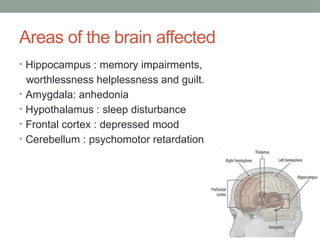
Areas of the brain affected
• Hippocampus : memory impairments,
worthlessness helplessness and guilt.
• Amygdala: anhedonia
• Hypothalamus : sleep disturbance
• Frontal cortex : depressed mood
• Cerebellum : psychomotor retardation
 Psychosocial theory
 Psychoanalytic theory : “Mourning & Melancholia” –
Freud 1957
A profoundly painful dejection ,cessation of interest in the
outside world , loss of the capacity to love, inhibition of all
activity and a lowering of the self regarding feelings to a
degree that finds utterances in self reproaches and self
revilings and culminates in delusional expectation of
punishment.
He observed that melancholia occurs after the loss of a
loved object>> ambivalence>> ambivalence turned inward
against the ego.
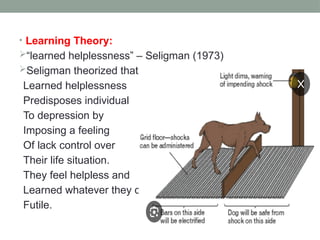
• Learning Theory:
“learned helplessness” – Seligman (1973)
Seligman theorized that
Learned helplessness
Predisposes individual
To depression by
Imposing a feeling
Of lack control over
Their life situation.
They feel helpless and
Learned whatever they do is
Futile.
• Object loss theory
Depression occurs as a result of having been
abandoned by or otherwise separated from significant
other during the first six months of life
Absence of attachment which may be either physical
or emotional leads to feeling of helplessness and
despair that contribute to life long pattern of
depression in response to loss.
• Cognitive theory
Beck and colleagues (1979)
Primary disturbance is cognitive than affective
Cognitive theorist believe that depression as the
product of negative thinking.
Negative expectations of the environment
Negative expectation of the self
Negative expectations of the future
• The transactional model :
Predisposing factors( family history+ biochemical
alteration) + past experience (object loss in infancy,
defect in cognition development) + existing condition
(lack of support system, inadequate coping skills, other
physiological condition)  DEPRESSION
Mild Depression
• Affective: denial of feelings , anger, anxiety, guilt ,
helplessness, hopelessness, sadness, despondency
• Behavioral : tearfulness , regression, restlessness,
agitation withdrawal
• Cognitive: preoccupation with the loss , self blame ,
ambivalence , blaming others
• Physiological : anorexia or overeating , insomnia or
hypersomnia, headache, backache , chest pain etc.
Moderate depression
• Affective : feeling of sadness, dejection , helplessness,
powerlessness, hopelessness , gloomy and pessimistic outlook,
low self esteem , difficulty experiencing pleasure in activities.
• Behavioral : sluggish movement, slumped posture, slowed
verbalization , possibly consisting of ruminations about life
failure or regrets, social isolation, increase use of substance,
self destructive, decreased interest in personal hygiene and
grooming.
• Cognitive : slowed thinking process, difficulty concentrating
and directing attention, negativism, suicidal ideation.
• Physiological : anorexia or overeating , insomnia or
hypersomnia, headache, backache , chest pain , amenorrhea,
decreased libido.
Severe depression
• Affective : total despair, hopelessness, worthlessness ,
flat affect, nothingness and emptiness, apathy ,
loneliness, sadness, inability to feel pleasure.
• Behavioral : psychomotor retardation, slumped posture,
sitting in curled up position, virtually non existent
communication, no personal hygiene and grooming ,
social isolation
• Cognitive : prevalent delusional thinking ,
confusion ,hallucination , excessive self deprecation, self
blame and thoughts of suicide.
• Physiological : weight loss, sluggish digestion , urinary
retention, amenorrhea, impotence , diminished libido.
Somatic symptoms of depression
Significant decrease in appetite or weight
Early morning awakening , at least 2 hours or more than
usual.
Diurnal variation
Lack of reactivity to pleasurable stimuli
Psychomotor agitation or retardation.
Other features
Difficulty in thinking and concentration
Subjective poor memory
Menstrual disturbance
Vague physical symptoms like fatigue, aching discomfort ,
constipation etc.
Decreased libido
Dependency
DSM Diagnostic Criteria
• A . Five or more of the following symptoms have been present during the
same 2 weeks period and represent a change from previous functioning ;
at least one of the symptoms is either depressed mood or loss of interest
or pleasure.
1. Depressed mood most of the day , nearly everyday (as indicated either
by subjective report or observation made by others)
2. Marked diminished interest or pleasure in all or almost all activities,
nearly everyday
3. Significant weight loss when not dieting or weight gain
4. Insomnia or hypersomnia nearly everyday
5. Psychomotor agitation or retardation nearly everyday
6. Fatigue or loss of energy nearly everyday
7. Feelings of worthlessness or excessive or inappropriate guilt
8. Diminished ability to think or concentrate nearly everyday.
9. Recurrent thoughts of death, suicide ideation or a suicide attempt.
• B. The symptoms cause clinically significantly
distress or impairment in social, occupational or other
important areas of functioning
• C. The episode is not attributable to the physiological
effects of a substance or to other medical condition.
DIAGNOSIS
Psychological test: Beck Depression inventory.
 Dexamethasone suppression test: failure to suppress
cortisol secretions,
Toxicology screening suggesting drug induced
depression.
Psychopharmacology
• SSRIs: Fluoxetine, Sertraline
• TCAs : Imipramine, Clomipramine
• MAOIs : Isocarboxazid, phenelzine
Nurse’s responsibilty
• Food like beef liver , chicken liver , fermented sausages,
dried fish , overripe fruits, beverages like wine , beer and
coffee should be avoided to prevent hypertensive crisis.
• Report promptly if occipital headache , nausea , vomiting,
chest pain or other unusual symptoms occur.
• Instruct patient not to take any medication with out
prescription.
• Caution the patient to change position slowly.
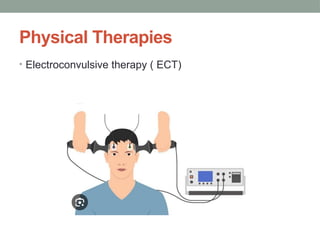
Physical Therapies
• Electroconvulsive therapy ( ECT)
• Light therapy
Psychosocial Treatment
• Psychotherapy
• Cognitive therapy
• Supportive psychotherapy
• Group therapy
• Family therapy
• Behavioral therapy
Nursing Diagnosis
• High risk of self directed violence related to depressed
mood , feelings of worthlessness and anger directed
towards on the self.
• Dysfunctional grieving related to real or perceived loss ,
bereavement , evidenced by denial of loss, inappropriate
expression of anger, inability to carry out activities of daily
living.
• Self esteem disturbance related to learned helplessness,
impaired cognition , negative view of self, evidenced by
expression of worthlessness.
THANK YOU

DEPRESSION.mooddisorder.nursingdiagnosispptx

  • 1.
  • 2.
    DEPRESSION • According toWHO, depression is a common mental health disorder that presents with depressed mood, loss of interest or pleasure , feeling of guilt or low self worth, disturbed sleep or appetite , low energy and poor concentration. • An alteration in mood that is expressed by feelings of sadness, despair and pessimism
  • 3.
    CLASSIFICATION (ICD10) F32: Depressiveepisode  F32.0: Mild depressive episode  F32.1: Moderate depressive episode  F32.2: Severe depressive episode without psychotic symptoms  F32.3: Severe depressive episode with psychotic symptoms  F32.8: Other depressive episodes  F32.9: Depressive episode unspecified  F33: Recurrent depressive episode
  • 4.
    ETIOLOGY Biological Theories  Neurochemical:decrease norepinephrine and serotonin and dysregulation of acetylcholine and GABA occurs  Genetic theories  Circadian rhythm theories : Individual experiencing circadian rhythm changes are at increased risk . These changes might be caused by medication , nutritional deficiencies , physical or psychological illness, hormonal fluctuations.  Changes in brain anatomy: loss of neurons in the frontal lobes, cerebellum and basal ganglia
  • 5.
    Areas of thebrain affected • Hippocampus : memory impairments, worthlessness helplessness and guilt. • Amygdala: anhedonia • Hypothalamus : sleep disturbance • Frontal cortex : depressed mood • Cerebellum : psychomotor retardation
  • 6.
     Psychosocial theory Psychoanalytic theory : “Mourning & Melancholia” – Freud 1957 A profoundly painful dejection ,cessation of interest in the outside world , loss of the capacity to love, inhibition of all activity and a lowering of the self regarding feelings to a degree that finds utterances in self reproaches and self revilings and culminates in delusional expectation of punishment. He observed that melancholia occurs after the loss of a loved object>> ambivalence>> ambivalence turned inward against the ego.
  • 7.
    • Learning Theory: “learnedhelplessness” – Seligman (1973) Seligman theorized that Learned helplessness Predisposes individual To depression by Imposing a feeling Of lack control over Their life situation. They feel helpless and Learned whatever they do is Futile.
  • 8.
    • Object losstheory Depression occurs as a result of having been abandoned by or otherwise separated from significant other during the first six months of life Absence of attachment which may be either physical or emotional leads to feeling of helplessness and despair that contribute to life long pattern of depression in response to loss.
  • 9.
    • Cognitive theory Beckand colleagues (1979) Primary disturbance is cognitive than affective Cognitive theorist believe that depression as the product of negative thinking. Negative expectations of the environment Negative expectation of the self Negative expectations of the future
  • 10.
    • The transactionalmodel : Predisposing factors( family history+ biochemical alteration) + past experience (object loss in infancy, defect in cognition development) + existing condition (lack of support system, inadequate coping skills, other physiological condition)  DEPRESSION
  • 11.
    Mild Depression • Affective:denial of feelings , anger, anxiety, guilt , helplessness, hopelessness, sadness, despondency • Behavioral : tearfulness , regression, restlessness, agitation withdrawal • Cognitive: preoccupation with the loss , self blame , ambivalence , blaming others • Physiological : anorexia or overeating , insomnia or hypersomnia, headache, backache , chest pain etc.
  • 12.
    Moderate depression • Affective: feeling of sadness, dejection , helplessness, powerlessness, hopelessness , gloomy and pessimistic outlook, low self esteem , difficulty experiencing pleasure in activities. • Behavioral : sluggish movement, slumped posture, slowed verbalization , possibly consisting of ruminations about life failure or regrets, social isolation, increase use of substance, self destructive, decreased interest in personal hygiene and grooming. • Cognitive : slowed thinking process, difficulty concentrating and directing attention, negativism, suicidal ideation. • Physiological : anorexia or overeating , insomnia or hypersomnia, headache, backache , chest pain , amenorrhea, decreased libido.
  • 13.
    Severe depression • Affective: total despair, hopelessness, worthlessness , flat affect, nothingness and emptiness, apathy , loneliness, sadness, inability to feel pleasure. • Behavioral : psychomotor retardation, slumped posture, sitting in curled up position, virtually non existent communication, no personal hygiene and grooming , social isolation • Cognitive : prevalent delusional thinking , confusion ,hallucination , excessive self deprecation, self blame and thoughts of suicide. • Physiological : weight loss, sluggish digestion , urinary retention, amenorrhea, impotence , diminished libido.
  • 14.
    Somatic symptoms ofdepression Significant decrease in appetite or weight Early morning awakening , at least 2 hours or more than usual. Diurnal variation Lack of reactivity to pleasurable stimuli Psychomotor agitation or retardation.
  • 15.
    Other features Difficulty inthinking and concentration Subjective poor memory Menstrual disturbance Vague physical symptoms like fatigue, aching discomfort , constipation etc. Decreased libido Dependency
  • 16.
    DSM Diagnostic Criteria •A . Five or more of the following symptoms have been present during the same 2 weeks period and represent a change from previous functioning ; at least one of the symptoms is either depressed mood or loss of interest or pleasure. 1. Depressed mood most of the day , nearly everyday (as indicated either by subjective report or observation made by others) 2. Marked diminished interest or pleasure in all or almost all activities, nearly everyday 3. Significant weight loss when not dieting or weight gain 4. Insomnia or hypersomnia nearly everyday 5. Psychomotor agitation or retardation nearly everyday 6. Fatigue or loss of energy nearly everyday 7. Feelings of worthlessness or excessive or inappropriate guilt 8. Diminished ability to think or concentrate nearly everyday. 9. Recurrent thoughts of death, suicide ideation or a suicide attempt.
  • 17.
    • B. Thesymptoms cause clinically significantly distress or impairment in social, occupational or other important areas of functioning • C. The episode is not attributable to the physiological effects of a substance or to other medical condition.
  • 18.
    DIAGNOSIS Psychological test: BeckDepression inventory.  Dexamethasone suppression test: failure to suppress cortisol secretions, Toxicology screening suggesting drug induced depression.
  • 19.
    Psychopharmacology • SSRIs: Fluoxetine,Sertraline • TCAs : Imipramine, Clomipramine • MAOIs : Isocarboxazid, phenelzine
  • 20.
    Nurse’s responsibilty • Foodlike beef liver , chicken liver , fermented sausages, dried fish , overripe fruits, beverages like wine , beer and coffee should be avoided to prevent hypertensive crisis. • Report promptly if occipital headache , nausea , vomiting, chest pain or other unusual symptoms occur. • Instruct patient not to take any medication with out prescription. • Caution the patient to change position slowly.
  • 21.
  • 22.
  • 23.
    Psychosocial Treatment • Psychotherapy •Cognitive therapy • Supportive psychotherapy • Group therapy • Family therapy • Behavioral therapy
  • 24.
    Nursing Diagnosis • Highrisk of self directed violence related to depressed mood , feelings of worthlessness and anger directed towards on the self. • Dysfunctional grieving related to real or perceived loss , bereavement , evidenced by denial of loss, inappropriate expression of anger, inability to carry out activities of daily living. • Self esteem disturbance related to learned helplessness, impaired cognition , negative view of self, evidenced by expression of worthlessness.
  • 25.