SOC 222
SOCIAL DEVELOPMENT AND
CHANGE
16.02.2016
PhD Fatma Altınbas Sarıgul
İstanbul Kemerburgaz University
MODERNIZATION
 How modernization is defined?
 Why does modernization occur?
 How do relatively modernized societies differ from
relatively non-modernized societies?
 What are the prospects for the modernization of Third
World Countries?
Modernization
 Modernization theory is used to explain the process that
a society or nation goes through as its transitions from a
traditional society to a modern one.
 American social scientists developed modernization
theory during 1950s.
 During the Cold War era (1947-1991) , 2 versions of
modernization theory were dominant;
Marxist Theory and Capitalist Theory
Marxist Theory of Modernization
 The marxist theory of modernization theorized that
as nations developed, adopting a communist
approach to governing, such as eradicating private
property, would end conflict, exploitations and
inequality.
 Economic development and social change would
lead developing nations to develop into a society
much like that of the Soviet Union.
Capitalist Theory of Modernization
 The capitalist version of modernization theorized that
as nations developed, economic development and social
change would lead to democracy.
 Many modernization theorists of the time, such as
W.Rostow, argued that when societies transitioned from
traditional to modern societies, they would follow a
similar path.
 They argued a Linear development path is eligible for
all societies.
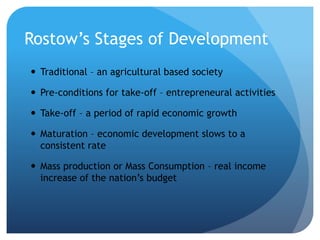
Rostow’s Stages of Development
 Traditional – an agricultural based society
 Pre-conditions for take-off – entrepreneural activities
 Take-off – a period of rapid economic growth
 Maturation – economic development slows to a
consistent rate
 Mass production or Mass Consumption – real income
increase of the nation’s budget
Modernization
 Other modernization theorists, such as Samual
Huntington, argued that social mobilization and
economic development were driving forces behind
modernization.
 Increased social mobilization meant that individuals and
societal groups changed their aspirations.
 Increased economic development meant the capabilities
of the newly modern society would change.
 Huntington argued that these societal changes would
inevitably lead to democratization.
Modernization
 Critiques of modernization theory pointed out that
there were many countries that could not, would not,
follow the stages of development because they held a
unique set of challenges, such as cultural or political
norms.
 Theorists noted that development was not linear.
 Instead development was said to occur in inflection
points, in which a significant event would occur and
spark a negative or positive change in the individual’s
worldviews.
Modernization
 The new version of modernization theory
theorized that modernization would more
than likely come from economic
development that stemmed from
developing nations producing products or
services for the world market.
Modernized and
Non-Modernized Nations
 When we make a differentiation between modernized and non-
modernized nations, the characteristics of relatively modernized
societies include the following:
 High degree of specialization
 Interdependency of organizations
 Cultural norms of rationality
 Universalism
 Functional specificity
 High degree of centralization
 Relatively great emphasis on money circulation and market
 Systematized Bureucracy
Modernization
 Third World Countries possess the advantages of
knowing where they are going; of being able to borrow
initial expertise in planning, capital accumulation, skills
and patterns of organization without the cost of
invention.
 On the other hand, they may face the problems of scale
(that they must do certain things from the very outset
on a fairly large scale), problems of conversion of
resources, materials, skills and so on from one use to
another; and problems of disappointment (such as
frustration of trying harder and harder only to fall
further and further behind.)
Structural Differentiation in
Modernization (Smelser)
 Modernization generally involves structural
differentiation because, through the modernization
process, a complicated structure that performed
multiple functions is divided into many specialized
structures that perform just one function each.
 For example: Family institution- traditional to modern
 The problem of integration rised.
 Social disturbances, as the result of integration.
Theoretical Assumptions of
Modernization
 According to European Evolutionary Theory, social change is
unidirectional, progressive, and gradual, irreversibly moving
societies from a primitive stage, and making societies more
like one another as they proceed along the path of evolution.
 Assumptions:
1. Modernization is a phased process.
2. Modernization is a homogenizing process.
3. Modernization is a Europeanization (or Americanization)
process.
4. Modernization is an irreversible process.
5. Modernization is a progressive process.
6. Modernization is a lengthy process.
Theoretical Assumptions of
Modernization
 Functionalist(Marxist) Theory emphasizes the
interdependence of social institutions, the importance
of pattern variables at the cultural level, and the built-
in process of change through homeostatic equilibrium.
 Assumptions:
1. Modernization is a systematic process.
2. Modernization is a transformative process.
3. Modernization is an immanent process.
Modernization
 Modernization theories as policy implications.
 Modernization theories help to provide an implicit
justification for the asymmetrical power relationship
between ‘traditional’ and ‘modern’ societies.
 Modernization theories suggest economic development,
the replacement of traditional values, and the
institutionalization of democratic procedures.
 Modernization theories help to legitimate the foreign
aid policy of the USA.
CRITICAL THINKING
 Do you think all societies have to follow the path of
modernization?
 Is it ideal or is it emphasized to all world’s nations for
governing them easier and create superiority?

Soc 222 2

  • 1.
    SOC 222 SOCIAL DEVELOPMENTAND CHANGE 16.02.2016 PhD Fatma Altınbas Sarıgul İstanbul Kemerburgaz University
  • 2.
    MODERNIZATION  How modernizationis defined?  Why does modernization occur?  How do relatively modernized societies differ from relatively non-modernized societies?  What are the prospects for the modernization of Third World Countries?
  • 3.
    Modernization  Modernization theoryis used to explain the process that a society or nation goes through as its transitions from a traditional society to a modern one.  American social scientists developed modernization theory during 1950s.  During the Cold War era (1947-1991) , 2 versions of modernization theory were dominant; Marxist Theory and Capitalist Theory
  • 4.
    Marxist Theory ofModernization  The marxist theory of modernization theorized that as nations developed, adopting a communist approach to governing, such as eradicating private property, would end conflict, exploitations and inequality.  Economic development and social change would lead developing nations to develop into a society much like that of the Soviet Union.
  • 5.
    Capitalist Theory ofModernization  The capitalist version of modernization theorized that as nations developed, economic development and social change would lead to democracy.  Many modernization theorists of the time, such as W.Rostow, argued that when societies transitioned from traditional to modern societies, they would follow a similar path.  They argued a Linear development path is eligible for all societies.
  • 6.
    Rostow’s Stages ofDevelopment  Traditional – an agricultural based society  Pre-conditions for take-off – entrepreneural activities  Take-off – a period of rapid economic growth  Maturation – economic development slows to a consistent rate  Mass production or Mass Consumption – real income increase of the nation’s budget
  • 7.
    Modernization  Other modernizationtheorists, such as Samual Huntington, argued that social mobilization and economic development were driving forces behind modernization.  Increased social mobilization meant that individuals and societal groups changed their aspirations.  Increased economic development meant the capabilities of the newly modern society would change.  Huntington argued that these societal changes would inevitably lead to democratization.
  • 8.
    Modernization  Critiques ofmodernization theory pointed out that there were many countries that could not, would not, follow the stages of development because they held a unique set of challenges, such as cultural or political norms.  Theorists noted that development was not linear.  Instead development was said to occur in inflection points, in which a significant event would occur and spark a negative or positive change in the individual’s worldviews.
  • 9.
    Modernization  The newversion of modernization theory theorized that modernization would more than likely come from economic development that stemmed from developing nations producing products or services for the world market.
  • 10.
    Modernized and Non-Modernized Nations When we make a differentiation between modernized and non- modernized nations, the characteristics of relatively modernized societies include the following:  High degree of specialization  Interdependency of organizations  Cultural norms of rationality  Universalism  Functional specificity  High degree of centralization  Relatively great emphasis on money circulation and market  Systematized Bureucracy
  • 11.
    Modernization  Third WorldCountries possess the advantages of knowing where they are going; of being able to borrow initial expertise in planning, capital accumulation, skills and patterns of organization without the cost of invention.  On the other hand, they may face the problems of scale (that they must do certain things from the very outset on a fairly large scale), problems of conversion of resources, materials, skills and so on from one use to another; and problems of disappointment (such as frustration of trying harder and harder only to fall further and further behind.)
  • 12.
    Structural Differentiation in Modernization(Smelser)  Modernization generally involves structural differentiation because, through the modernization process, a complicated structure that performed multiple functions is divided into many specialized structures that perform just one function each.  For example: Family institution- traditional to modern  The problem of integration rised.  Social disturbances, as the result of integration.
  • 13.
    Theoretical Assumptions of Modernization According to European Evolutionary Theory, social change is unidirectional, progressive, and gradual, irreversibly moving societies from a primitive stage, and making societies more like one another as they proceed along the path of evolution.  Assumptions: 1. Modernization is a phased process. 2. Modernization is a homogenizing process. 3. Modernization is a Europeanization (or Americanization) process. 4. Modernization is an irreversible process. 5. Modernization is a progressive process. 6. Modernization is a lengthy process.
  • 14.
    Theoretical Assumptions of Modernization Functionalist(Marxist) Theory emphasizes the interdependence of social institutions, the importance of pattern variables at the cultural level, and the built- in process of change through homeostatic equilibrium.  Assumptions: 1. Modernization is a systematic process. 2. Modernization is a transformative process. 3. Modernization is an immanent process.
  • 15.
    Modernization  Modernization theoriesas policy implications.  Modernization theories help to provide an implicit justification for the asymmetrical power relationship between ‘traditional’ and ‘modern’ societies.  Modernization theories suggest economic development, the replacement of traditional values, and the institutionalization of democratic procedures.  Modernization theories help to legitimate the foreign aid policy of the USA.
  • 16.
    CRITICAL THINKING  Doyou think all societies have to follow the path of modernization?  Is it ideal or is it emphasized to all world’s nations for governing them easier and create superiority?