
ORGANIZATION
DEPARTMENTATION
 “The process of identifying & grouping the work is to be
performed ,defining & delegating responsibility &
authority & establishing relationship for the purpose of
enabling people to work most effectively together in
accomplishing objectives”
-
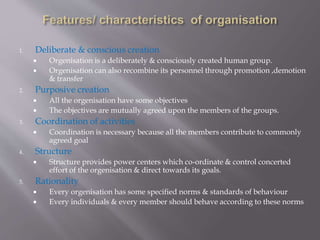
1. Deliberate & conscious creation
 Orgenisation is a deliberately & consciously created human group.
 Orgenisation can also recombine its personnel through promotion ,demotion
& transfer
2. Purposive creation
 All the orgenisation have some objectives
 The objectives are mutually agreed upon the members of the groups.
3. Coordination of activities
 Coordination is necessary because all the members contribute to commonly
agreed goal
4. Structure
 Structure provides power centers which co-ordinate & control concerted
effort of the orgenisation & direct towards its goals.
5. Rationality
 Every orgenisation has some specified norms & standards of behaviour
 Every individuals & every member should behave according to these norms
 Organizational structure is the pattern of relationship
among various components or parts of the orgenisation.
 Organization structure refers to the differentiation &
integration of activities & authorities ,role & relationship
in the orgenisation
 Features of good organization structure.
o Clear line of authority.
o Adequate delegation of authority.
o Application of ultimate responsibility.
o Minimum managerial levels.
o Unity of direction.
o Proper emphasis on staff activities.
o Simplicity.
o Flexibility.
 The process of grouping the activities known as
departmentation
 Departmentation means the process by which similar
activities of the business are grouped into units for the
purpose of facilitating smooth administration at all levels
 According koontz & O,Donnell a departmentation is process
of dividing the large functional orgenisation into small &
flexible & administrative unit.
 Choosing basis for departmentation
 Specialization
 Coordination
 Control
 Economy
 Recognition of local condition
 Adequate attention
 Human consideration
 Types of departmentation/ways to structure the
business
1. Departmentation by product
2. Departmentation by function
3. Departmentation by region or territory
4. Departmentation by customer
5. Departmentation by process
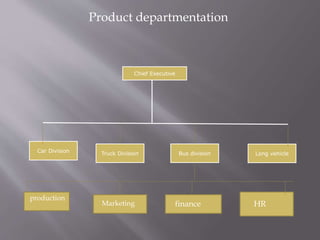
 Grouping of activities according to products or
product lines , especially in multiline, large
enterprises.
Product departmentation
Car Division Truck Division Bus division Long vehicle
Chief Executive
production
Marketing finance HR
Advantages
 Clear focus on market segment helps meet customers’ needs
 Positive competition between divisions
 Better control as each division can act as separate profit
centre
 Improve coordination of functional activities.
 Places responsibility for profit at division level.
 Places attention & effort on product line.
 Duplication of functions (e.g. different sales
force for each division)
 Negative effects of competition
 Lack of central control over each separate
division.
 Require more personal with general manager
abilities .
 Trend to make maintained of economical
central services difficult
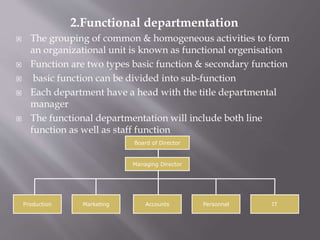
2.Functional departmentation
 The grouping of common & homogeneous activities to form
an organizational unit is known as functional orgenisation
 Function are two types basic function & secondary function
 basic function can be divided into sub-function
 Each department have a head with the title departmental
manager
 The functional departmentation will include both line
function as well as staff function
Production Marketing Accounts Personnel IT
Managing Director
Board of Director
Advantages
 Specialisation – each department focuses on its own work
 Accountability – someone is responsible for the section
 Clarity – know your and others’ roles
 Simplifies training
 Closed communication could lead to lack of
focus
 Departments can become resistant to change
 Reduce Coordination between function
 Gap between top and bottom
 .
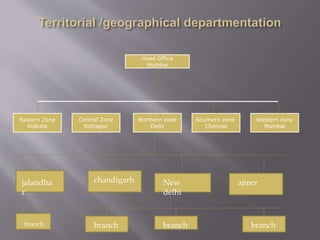
 Territorial Orgenisation is especially attractive to large
scale firms or rather enterprises whose activities are
physically or geographically dispersed.
 All the activities of given area of operation are grouped
into zone ,division ,branches
 This structure is suitable for large scale orgenisation or
whose activities are physically or geographically spread.
 This structure is most often used in sales & in production
Eastern Zone
Kolkata
Central Zone
Kolhapur
Northern zone
Delhi
Southern zone
Chennai
Western zone
Mumbai
Head Office
Mumbai
jalandha
r
chandigarh New
delhi
ajmer
branch branch branch branch
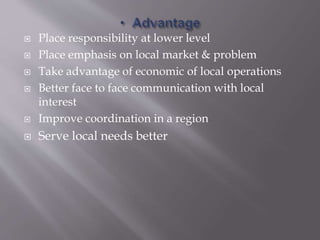
 Place responsibility at lower level
 Place emphasis on local market & problem
 Take advantage of economic of local operations
 Better face to face communication with local
interest
 Improve coordination in a region
 Serve local needs better
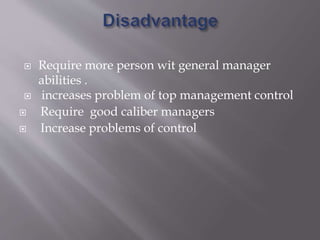
 Require more person wit general manager
abilities .
 increases problem of top management control
 Require good caliber managers
 Increase problems of control
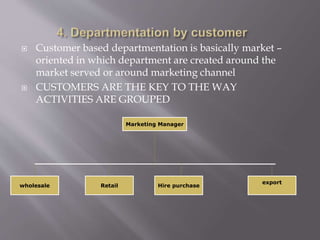
 Customer based departmentation is basically market –
oriented in which department are created around the
market served or around marketing channel
 CUSTOMERS ARE THE KEY TO THE WAY
ACTIVITIES ARE GROUPED
wholesale Retail Hire purchase
export
Marketing Manager
 It fulfills the expectation & needs of customer
 Better service to customer
 Fully focus on customer
 Disadvantage
 Their may be duplication of activities
 Co-ordination is difficult
 Conflict
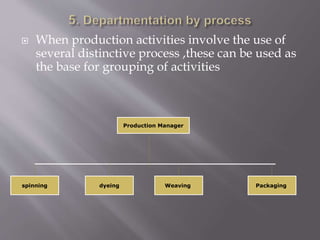
 When production activities involve the use of
several distinctive process ,these can be used as
the base for grouping of activities
spinning dyeing Weaving Packaging
Production Manager
 Advantage
 Machine can be used effectively
 Economy in operation
 No duplication of activities
 Principle of specialization & division of labor is followed
 Disadvantages
 Heavy cost of operation
 More specialist are essential
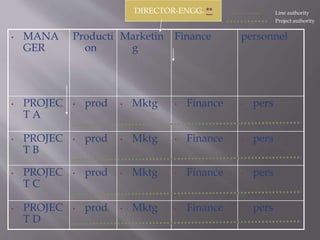
 COMMONLY CALLED THE “GRID” ORG.
 Matrix orgenisation structure is the realization of two
dimensional structure
 Matrix structure applied when the orgenisation has large
number of smaller projects so that when one project is
completed it resources are directed to other project
 Project manager is appointed to coordinate the activities of the
 Personal are drawn from their respective functional
departments
 Employee should receive instruction from two boss
 Application:-insurance & retailing , manufacturing electronics
equipment ,industrial product
• MANA
GER
Producti
on
Marketin
g
Finance personnel
• PROJEC
T A
• prod • Mktg • Finance • pers
• PROJEC
T B
• prod • Mktg • Finance • pers
• PROJEC
T C
• prod • Mktg • Finance • pers
• PROJEC
T D
• prod • Mktg • Finance • pers
DIRECTOR-ENGG. **
Project authority
Line authority
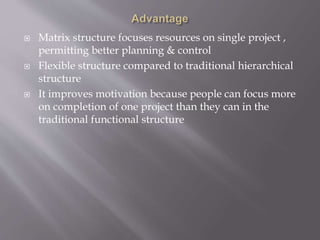
 Matrix structure focuses resources on single project ,
permitting better planning & control
 Flexible structure compared to traditional hierarchical
structure
 It improves motivation because people can focus more
on completion of one project than they can in the
traditional functional structure
 People have to work under multiple command
 Delay in decision making process
 Companies have been using an organizational
device generally referred to as a strategic
Business unit (SBU).
 Distinct businesses set up as units in a larger
company to ensure that certain product or
product lines are promoted and handled as
though each were an independent business.
 The virtual organization is a rather loose
concept of a group of independent firms or
people that are connected through, usually,
information technology.
 This firms may be suppliers, customers, and
even competing companies.
 The aim of virtual organization is to gain access
to another firms competence, to gain flexibility,
to reduce risk, or to respond rapidly to market
needs.
Departmentation

Departmentation

  • 1.
  • 2.
     “The processof identifying & grouping the work is to be performed ,defining & delegating responsibility & authority & establishing relationship for the purpose of enabling people to work most effectively together in accomplishing objectives” -
  • 3.
    1. Deliberate &conscious creation  Orgenisation is a deliberately & consciously created human group.  Orgenisation can also recombine its personnel through promotion ,demotion & transfer 2. Purposive creation  All the orgenisation have some objectives  The objectives are mutually agreed upon the members of the groups. 3. Coordination of activities  Coordination is necessary because all the members contribute to commonly agreed goal 4. Structure  Structure provides power centers which co-ordinate & control concerted effort of the orgenisation & direct towards its goals. 5. Rationality  Every orgenisation has some specified norms & standards of behaviour  Every individuals & every member should behave according to these norms
  • 4.
     Organizational structureis the pattern of relationship among various components or parts of the orgenisation.  Organization structure refers to the differentiation & integration of activities & authorities ,role & relationship in the orgenisation
  • 5.
     Features ofgood organization structure. o Clear line of authority. o Adequate delegation of authority. o Application of ultimate responsibility. o Minimum managerial levels. o Unity of direction. o Proper emphasis on staff activities. o Simplicity. o Flexibility.
  • 6.
     The processof grouping the activities known as departmentation  Departmentation means the process by which similar activities of the business are grouped into units for the purpose of facilitating smooth administration at all levels  According koontz & O,Donnell a departmentation is process of dividing the large functional orgenisation into small & flexible & administrative unit.  Choosing basis for departmentation  Specialization  Coordination  Control  Economy  Recognition of local condition  Adequate attention  Human consideration
  • 7.
     Types ofdepartmentation/ways to structure the business 1. Departmentation by product 2. Departmentation by function 3. Departmentation by region or territory 4. Departmentation by customer 5. Departmentation by process
  • 8.
     Grouping ofactivities according to products or product lines , especially in multiline, large enterprises.
  • 9.
    Product departmentation Car DivisionTruck Division Bus division Long vehicle Chief Executive production Marketing finance HR
  • 10.
    Advantages  Clear focuson market segment helps meet customers’ needs  Positive competition between divisions  Better control as each division can act as separate profit centre  Improve coordination of functional activities.  Places responsibility for profit at division level.  Places attention & effort on product line.
  • 11.
     Duplication offunctions (e.g. different sales force for each division)  Negative effects of competition  Lack of central control over each separate division.  Require more personal with general manager abilities .  Trend to make maintained of economical central services difficult
  • 12.
    2.Functional departmentation  Thegrouping of common & homogeneous activities to form an organizational unit is known as functional orgenisation  Function are two types basic function & secondary function  basic function can be divided into sub-function  Each department have a head with the title departmental manager  The functional departmentation will include both line function as well as staff function Production Marketing Accounts Personnel IT Managing Director Board of Director
  • 13.
    Advantages  Specialisation –each department focuses on its own work  Accountability – someone is responsible for the section  Clarity – know your and others’ roles  Simplifies training
  • 14.
     Closed communicationcould lead to lack of focus  Departments can become resistant to change  Reduce Coordination between function  Gap between top and bottom
  • 15.
  • 16.
     Territorial Orgenisationis especially attractive to large scale firms or rather enterprises whose activities are physically or geographically dispersed.  All the activities of given area of operation are grouped into zone ,division ,branches  This structure is suitable for large scale orgenisation or whose activities are physically or geographically spread.  This structure is most often used in sales & in production
  • 17.
    Eastern Zone Kolkata Central Zone Kolhapur Northernzone Delhi Southern zone Chennai Western zone Mumbai Head Office Mumbai jalandha r chandigarh New delhi ajmer branch branch branch branch
  • 18.
     Place responsibilityat lower level  Place emphasis on local market & problem  Take advantage of economic of local operations  Better face to face communication with local interest  Improve coordination in a region  Serve local needs better
  • 19.
     Require moreperson wit general manager abilities .  increases problem of top management control  Require good caliber managers  Increase problems of control
  • 20.
     Customer baseddepartmentation is basically market – oriented in which department are created around the market served or around marketing channel  CUSTOMERS ARE THE KEY TO THE WAY ACTIVITIES ARE GROUPED wholesale Retail Hire purchase export Marketing Manager
  • 21.
     It fulfillsthe expectation & needs of customer  Better service to customer  Fully focus on customer  Disadvantage  Their may be duplication of activities  Co-ordination is difficult  Conflict
  • 22.
     When productionactivities involve the use of several distinctive process ,these can be used as the base for grouping of activities spinning dyeing Weaving Packaging Production Manager
  • 23.
     Advantage  Machinecan be used effectively  Economy in operation  No duplication of activities  Principle of specialization & division of labor is followed  Disadvantages  Heavy cost of operation  More specialist are essential
  • 24.
     COMMONLY CALLEDTHE “GRID” ORG.  Matrix orgenisation structure is the realization of two dimensional structure  Matrix structure applied when the orgenisation has large number of smaller projects so that when one project is completed it resources are directed to other project  Project manager is appointed to coordinate the activities of the  Personal are drawn from their respective functional departments  Employee should receive instruction from two boss  Application:-insurance & retailing , manufacturing electronics equipment ,industrial product
  • 25.
    • MANA GER Producti on Marketin g Finance personnel •PROJEC T A • prod • Mktg • Finance • pers • PROJEC T B • prod • Mktg • Finance • pers • PROJEC T C • prod • Mktg • Finance • pers • PROJEC T D • prod • Mktg • Finance • pers DIRECTOR-ENGG. ** Project authority Line authority
  • 26.
     Matrix structurefocuses resources on single project , permitting better planning & control  Flexible structure compared to traditional hierarchical structure  It improves motivation because people can focus more on completion of one project than they can in the traditional functional structure
  • 27.
     People haveto work under multiple command  Delay in decision making process
  • 28.
     Companies havebeen using an organizational device generally referred to as a strategic Business unit (SBU).  Distinct businesses set up as units in a larger company to ensure that certain product or product lines are promoted and handled as though each were an independent business.
  • 29.
     The virtualorganization is a rather loose concept of a group of independent firms or people that are connected through, usually, information technology.  This firms may be suppliers, customers, and even competing companies.
  • 30.
     The aimof virtual organization is to gain access to another firms competence, to gain flexibility, to reduce risk, or to respond rapidly to market needs.